



Abstract
The in situ upgrading of impoverished, unsanctioned neighbourhoods in South Africa is envisaged in an Upgrading of Informal Settlements Programme in the National Housing Code. However, implementation is obstructed by a unitary planning system, reinforced by the dominant programme under the housing subsidy system. This paper critically reflects on technical planning assistance the author and close colleagues lent to the representative committees of two neighbourhoods, officially deemed ‘unplanned’, Harry Gwala in Ekurhuleni and Slovo Park in Johannesburg, over more than a decade. To frame the complicated trajectories and multiple approaches that emerged in this praxis, the paper adopts the frame of ‘critical planning advocacy in solidarity’. It derives this from a review of mainly Anglo-American positions on engaged planning, from advocacy and radical to insurgent and solidarity-based approaches. While the approaches the paper presents yielded some advances in a hostile context, more is needed to unlock in situ upgrading in South Africa.
Keywords
I. Introduction
Professionally registered spatial planners working at the neighbourhood level enact procedurally defined practices intended to shape the built environment, thus facilitating what Porter calls “regulation and control of place and spatial relations”.(1) The planner, as Lefebvre puts it, is “the creator of space and human relationships”.(2) In South Africa, planning consultants design the layouts for state-funded housing projects. Implementation is often delayed or stalled, or plans are shelved.(3) Addressing the causes of this widespread problem, the recent White Paper on human settlements lists “cost of building materials, limited bulk infrastructure [and] inadequate grant absorptive capacity of the construction industry”, alongside issues framed as outside the state’s control, such as land occupation and unlawful disruptions to construction sites.(4) Plans, though approved, may also simply be unfit for purpose. This is the case when housing layouts are drawn up for parcels of land long occupied by households excluded from the formal land market and whose spatial relations were self-organized outside of the land-use management system. In the planning discourse, these are ‘informal settlements’. From the perspective of living conditions, they are labelled ‘slums’.
In South Africa, spatial planning for low-income neighbourhoods has interlocked with the capital subsidy system for housing in an enduring path-dependency that ignores the glaring mismatch between this funding mechanism and the households for whom plans are intended. The dominant delivery mechanism for basic free housing for qualifying beneficiaries since 1994 is the project-linked capital subsidy, reframed in the National Housing Code of 2009 as the Integrated Residential Development Programme.(5) A total of 5.2 million ‘housing units’ had been allocated as of early 2024; of these, 89 per cent were delivered through this programme, 29 per cent of which are serviced sites only.(6) Constraints, including the implementation challenges mentioned above, caused housing output to drop from around 240,000 units per year in 1999 to around 50,000 in 2023/2024.(7) The maximum income that qualifies beneficiaries for free housing is ZAR 3,500/month (equivalent to US$ 188), last adjusted for inflation in 2005 when it catered for the unemployed and low-waged working class.(8) In 2025, a ZAR 3,500 income for a four-person household lies between the food and lower-bound poverty line,(9) well below the minimum monthly wage of ZAR 5,067.04 (US$ 272.42) for full-time work,(10) thereby excluding domestic workers and other low-paid employees. Unable to afford a home in the formal market, they resort to unregulated and often substandard rental accommodation in formal low-cost housing areas or informal settlements.
Since a 2004 policy review, the National Housing Code has included an upgrading programme, the UISP (Upgrading of Informal Settlements Programme).(11) This requires minimal disruption to households’ lives and participatory, in situ layout planning, validating existing spatial relations wherever possible. However, professional discourse has drifted from the UISP’s mandate – conventional housing development on formerly occupied land is labelled ‘in situ upgrading’, ignoring the requirement for minimal disruption. In the national Department of Human Settlements’ (DoHS) breakdown of output across its housing programmes, the UISP does not feature,(12) reflecting its low uptake and incomplete implementation. Contributing to this is the path-dependency mentioned above. Spatial planning consultants understand service provision, tenure rights and housing assistance as predicated upon conventional modern town planning layouts and township establishment. Indeed, this process underpins freehold titling of urban land, a feature of the dominant mode of housing delivery, and is assumed to be the only tenure form that can secure investment. In conventional planning expertise, therefore, ‘informal’ layouts must be replaced and conventional planning norms and standards followed. These erase established spatial relations, rule out choice and produce subsidized housing environments for which most households in the targeted neighbourhoods no longer qualify. When implementation stalls, even qualifying households are suspended indefinitely in temporary relocation areas, often ultimately to find their house corruptly allocated to others.(13)
As faith in the long-promised house evaporates, impoverished households have begun transforming shack settlements into brick-and-mortar neighbourhoods, firmly cementing their ‘informal’ layouts. Faced with conventional plans for housing and service delivery on the land they occupy, inhabitants must weigh the implications of removal, disruption to social networks and livelihoods and, increasingly, the destruction of brick-and-mortar homes against resistance to such plans. Further considerations are that projected timeframes may not be met, while uncertainty prevails over who will receive the coveted house.
This juncture defines the drawn-out trajectories of two neighbourhoods in greater Johannesburg, Harry Gwala and Slovo Park, the focus of this paper. Both experienced state resistance to their validation and extensive delays in the implementation of upgrading. Each has a representative leadership committee, a ubiquitous though uneven feature of grassroots democracy in South Africa.(14) With a mandate from the inhabitants, the two committees have sought an alternative pathway to development, building on existing socio-spatial relations. To this end, they built relationships with pro bono lawyers and planners. The planning support, to which I have contributed since 2005 alongside close colleagues, takes different forms. It includes being requested to confront, engage and at times disempower professional planning expertise. This resonates with elements of ‘advocacy planning’, a term coined in the wake of 1960s resistance to imposed plans in the US.(15) Advocacy planning has since been debated, critiqued and categorized alongside other modes of planning.(16) Southern and decolonial turns in urban theory and praxis have offered further angles on the relationship between planners and impoverished or disenfranchised groups.(17) These debates inform my reflection on our relationship with the two representative committees, allowing me to frame this as ‘critical advocacy in solidarity’.
Following a literature review, the paper introduces Harry Gwala and Slovo Park as examples of determined land occupation within their spatial and historical context in Greater Johannesburg. It sets out the methods used in preparing the paper and discusses our embedded yet privileged positionality. I then explain the legal advocacy that anchors our engagement with the two committees. To justify the claim to criticality, advocacy and solidarity, the subsequent section sets out our modes of planning practice, showing the resonance of these strands with the scholarly debate on engaged forms of planning. In the conclusion, I argue that critical planning advocacy in solidarity is a necessary though limited praxis at the juncture ‘informal settlements’ find themselves at in South Africa and possibly elsewhere.
II. From Advocacy to Solidarity: Evolving Debates on Engaged Planning
The mid-1960s hope for democracy and equality in the US spawned reflection on the relationship between planners and those whom their plans would affect. The endurance of the modern town planning system and its ubiquity across much of the West and postcolonial global South gives continuous relevance to these reflections. In South Africa, where layout planning remains the purview of the trained professional, planners produce a single layout, with alternatives only if pushed. In an influential essay, Davidoff(18) critiqued this dominant ‘unitary’ planning mode, proposing to democratize planning by pluralizing it, allowing alternative plans to be brought into “[l]ively political dispute”.(19) Davidoff’s call for an advocacy role for planners drew on his training in both law and planning.(20) However, in subsequent decades, planning advocacy as it unfolded in the US was, as Marris argued, not “in the competition between plans” but rather “in the process” (emphasis in the original).(21) Advocacy planners had promoted mechanisms for community participation though facing criticism of coopting participants into an illusory system.(22) Thus, pluralism fell off the agenda of practising advocacy planners.(23) The transformative potential of Davidoff’s idea of alternative plans, relevant to in situ upgrading of informal settlements, was not considered further in the discourse on engaged planning.
Already in the late 1960s, reservations about community participation entered the debate. From her base in the non-profit advocacy planning sector in the US, Peattie(24) insisted communities were not homogeneous; therefore, low-income households could not be meaningfully included in the planning process. While advocacy planning had begun sensitizing social policy in the US towards ‘social reality’, more profound changes, Peattie argued,(25) were needed to the planning framework, for instance an ‘ombudsman’s office’. Beyond this, Peattie(26) called for an approach that would enable political movements to tackle “the general economic and social order”(27) that produces economic and spatial inequality. She coined the term ‘radical planning’ for the consequent role for planners.
Peattie’s provocation was not taken forward in the advocacy planning discourse. However, in the early 1970s, Marxist scholars considered radical approaches to planning. Utopian and anarchist-oriented planning and law scholars Grabow and Heskin,(28) inspired among others by Martin Luther King, promoted a decentralized, communal and ecologically sound society, with the planner as ‘a radical agent of change’, constantly learning among ‘the people’ and rejecting the modernist role of control over space. In part, this vision resonates with Henri Lefebvre’s more extensively elaborated critique of planning and the approach or praxis he put forward, namely transduction. From the Marxist-humanist perspective in France, Lefebvre(29) drove Peattie’s(30) reservations about participation deeper, arguing that the “humanist and technological” exterior of planning “masks capitalist strategy”.(31) Planners, he argued, are unaware of their role in the capitalist production of space, complicit in the imposition of domination in a way that traps thought and closes it to ‘the possible’, that is to an alternative imagination of the city.(32) “This strategy overwhelms the ‘user’, the ‘participant’, the simple ‘inhabitant’”.(33) Lefebvre(34) therefore underlined the need for a ‘radical critique’ of ‘urbanism’ or planning. His critique rejects liberalism and neoliberalism but also the role or strategy of the state in the politics and production of space. Dismissing conventional layout planning, in which planners “minutely” organize “a repressive space”, Lefebvre(35) instead called for the “possible-impossible” to be explored through “transduction”. As I have discussed elsewhere,(36) Lefebvre defines transduction in his earlier Right to the City(37) as involving “an incessant feed back between conceptual framework used and empirical observations”. Lefebvre’s approach therefore combines a profound structural critique with a radical but practical planning approach, in essence an alternative to unitary planning. Meanwhile, Lefebvre’s urban writing of the late 1960s and early 1970s was translated into English only as of 1991. Despite Lefebvre’s subsequent popularity in the Anglo-American planning and urban studies discourse, his ideas on transduction remain largely unexplored. In my earlier work I argue their relevance for in situ upgrading.(38) Grabow and Heskin’s provocations(39) were also not taken forward. Friedmann argues they failed to provide a sufficiently defined “alternative to social reform”.(40)
In the early 1980s, Forester(41) contributed a categorization of planners across the political spectrum from technician, incrementalist, liberal-advocate, structuralist to progressive. Structuralist analysis, Forester suggests,(42) if taken to its full consequences, debilitates the planner. In contrast, Forester advocates for the progressive planner, who is “structurally critical” and avoids merely legitimizing the planning process (through participation).(43) Anticipating “misinformation and distortion” in planning communication and information, the progressive planner conducts “political and organizational analysis”.(44) Perhaps blurring the distinction between progressive and radical, Friedmann,(45) in the same decade, framed radical planning as based on social mobilization, seeking to achieve emancipation, social transformation and structural change through solution-oriented skills such as design and costing and the critical analytical capacity that Forester calls for. Importantly, Forester(46) also argues that political and organizational analysis is a role “community organisers and political actors” generally perform. This acknowledges a capacity for critical analysis beyond planning and other professions.
From the late 1990s, Holston’s(47) and Miraftab’s(48) research in unequal contexts in the global South associated radical planning with the notion of insurgent citizenship and insurgent planning. Their recommendations for planning are less radical than Peattie’s(49) call for alignment with the pursuit of a new political and economic order or Forester and Friedmann’s structurally critical yet pragmatic progressive or radical planning. Drawing on his research in Brasilia, Holston calls for “ethnographic detection” by planners to understand insurgent citizenship and the lived experience of “insurgent urbanism”, thus to “establish the terms in which residents participate in the planning of their communities”.(50) While this may resonate with transduction, ethnographic detection is potentially a more extractive approach than the learning “among people” that Grabow and Heskin(51) called for. In resonance with Peattie’s cautioning of assumptions about a uniform and unified ‘community’, Holston,(52) distinct from Lefebvre’s position, charts a role for “the project of state-directed futures which can be transformative but which is always the product of specific politics”.(53) With neoliberalism articulating state politics of transformation in post-apartheid South Africa, Miraftab’s(54) research on insurgent movements in marginalized parts of Cape Town leads her to argue insurgent planning must primarily challenge the neoliberal myth of inclusion. She frames insurgent planning as planners’ support to grassroots, both in ‘invited’ or formal participatory spaces of the state and in “invented” or “oppositional practices of the grassroots as they innovate their own terms of engagement”.(55) Along the lines of Holston’s(56) call, she encourages planners to recognize de facto planning that occurs outside of the formal planning process.(57)
The recognition and validation of planning and design abilities among organized inhabitants is an important ingredient in a more recently articulated mode of planning, which Legacy(58) terms ‘solidarity-formation’ as a planning praxis. Here “planners meet diverse communities in a way that sees them, hears them, and builds solidarity with them” (emphasis in the original). Along these lines and with elements of Forester’s progressive planner, Sletto(59) understands insurgent planners as critically reflexive ‘allies’, attentive to the “risks of misrepresentation and co-optation”. One may add that these solidarity-based approaches, when coupled with Forester’s(60) argument about analytical capacity in the civic and political realm, may break down knowledge hierarchies and the elevated position of the expert planner.
These various modes of engaged planning, discussed here chronologically, have existed alongside one another and at times regained prominence. Thus Godschalk(61) argued a decade ago that planning “advocacy is back as an exciting professional role” taking on multiple forms, including championing “sometimes unpopular but necessary policies”. This speaks directly to the position planners ought to take on the unpopular and often misinterpreted UISP in South Africa. My framing of our planning practice in Harry Gwala and Slovo Park as ‘critical planning advocacy in solidarity’ picks up several strands in the debate reviewed above. I argue that our role, combining criticality, advocacy and solidarity, responded to and remains relevant (though limited) at the juncture I described in the introduction.
III. Harry Gwala and Slovo Park: Late Apartheid Land Occupations Actively Anticipating Formal Recognition
Greater Johannesburg is made up of two adjacent metropolitan municipalities, Ekurhuleni and Johannesburg. Harry Gwala in Ekurhuleni and Slovo Park in Johannesburg are shack settlements that emerged in the early 1990s, the ambiguous late apartheid years when certain restrictions gave way, but repression and state-orchestrated violence intensified. Neighbourhoods officially considered ‘unplanned’ emerged in anticipation of a fairer post-apartheid city and government. Their inhabitants typically appropriated land adjacent to existing formal townships, and mirrored street layouts and stand sizes in neighbouring residential areas in expectation of formal recognition. In an analysis of Johannesburg’s informal settlements, colleagues and I(62) characterized these as particularly conducive to in situ upgrading.
A gold reef and mining belt cuts across Ekurhuleni and Johannesburg. Through this geological and industrial feature, segregationist pre-apartheid and apartheid planners separated white suburbs to the north from black townships to the south and south-east.(63) Socioeconomic segregation and spatial marginalization of an unemployed, under-employed and poorly remunerated majority remains largely spatialized by apartheid plans. Income inequality and unemployment in South Africa, both at “obscene” levels,(64) are the highest globally, while the country’s wealth inequality is on a par with that of Indonesia and surpassed only by Brazil.(65)
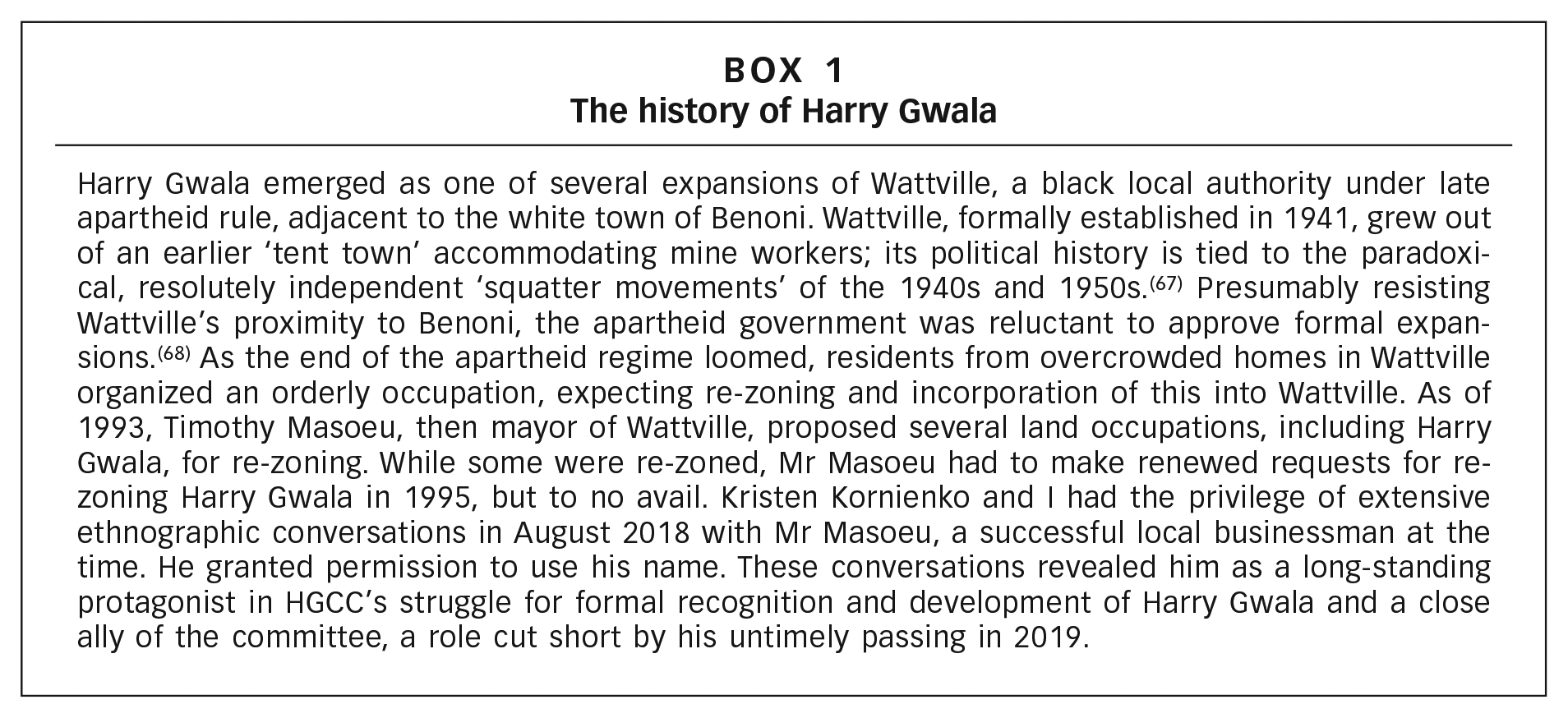
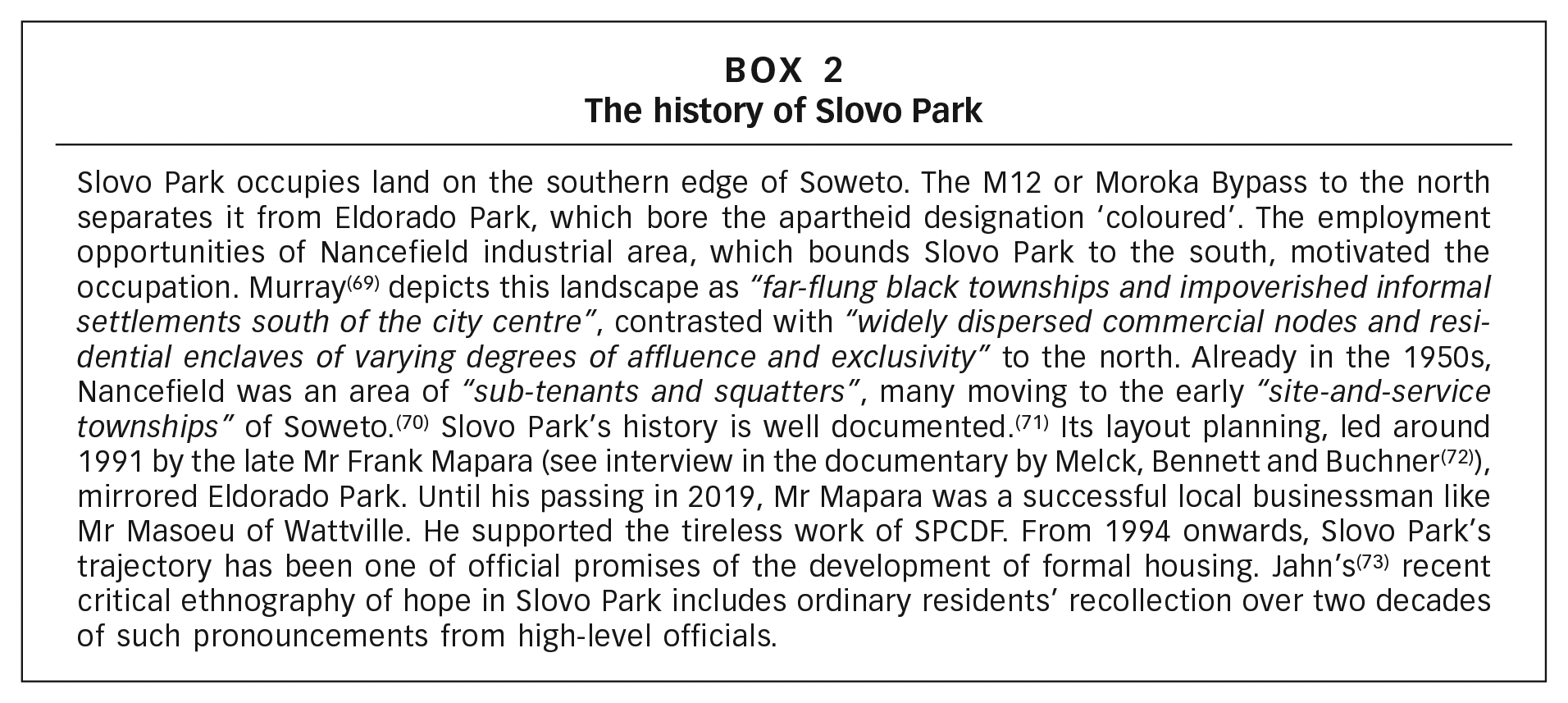
Figure 1 depicts the unequal landscape that embeds Harry Gwala 40 kilometres eastward and Slovo Park 20 kilometres south-west of inner-city Johannesburg, the base for the legal NGOs and academic institutions with which these neighbourhoods engage. Figures 2 and 3 show the intentionally regular layouts of the two neighbourhoods roughly a decade into their existence. Both settlements emerged from an earlier history of dispossession and land and housing struggle in their respective areas (see Boxes 1 and 2). After actively pursuing validation through demands for re-zoning and subsidized housing development on the occupied land, both neighbourhoods instead received eviction threats linked to relocation plans. At this point, the representative Harry Gwala Civic Committee (abbreviated HGCC here) in 2004 elicited pro bono legal support from the law firm Webber Wentzel through the Landless People’s Movement (LPM) which formed in 2001 around the state’s rural land reform programme and in response to urban eviction threats.(66) Like several other issue-based movements emerging at that time, LPM could not sustain its urban mobilization into the 2010s. The representative leadership structure of Slovo Park, the Slovo Park Community Development Forum (SPCDF), approached the Socio-Economic Rights Institute (SERI) in 2011 for support in engaging the municipality with stronger authority. Confronted with a relocation plan in 2015, SPCDF decided to take a legal route through the court with SERI’s support. In response to requests made through the respective legal support organizations, I have contributed planning and policy insights for Harry Gwala since 2005 and Slovo Park since 2012 (and more regularly from 2016), sharing this role with the close colleagues introduced below. Boxes 1 and 2 provide condensed histories of the neighbourhoods. After a brief discussion of methods and positionality, I explain the legal cases in both settlements, as these form the backbone to our planning assistance.
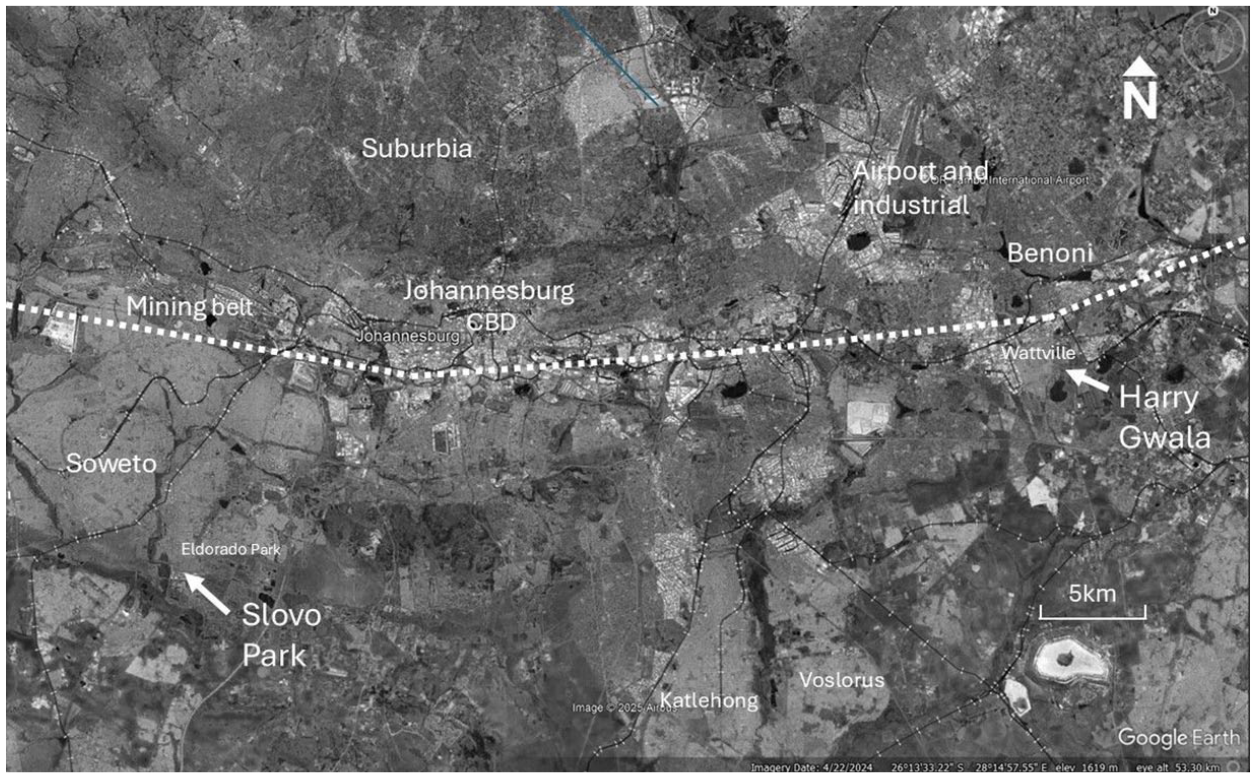
Harry Gwala and Slovo Park within the unequal geography of greater Johannesburg
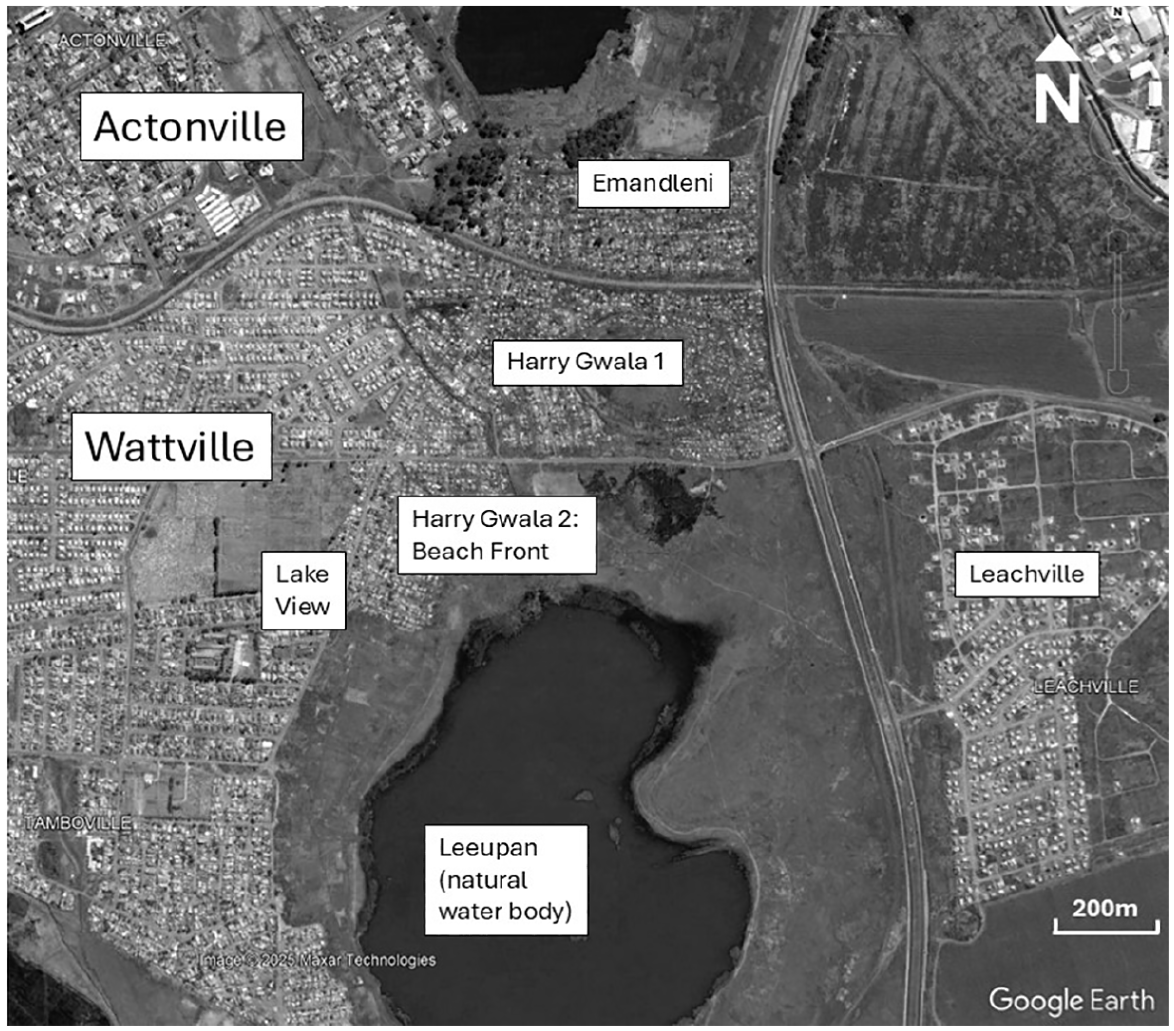
Harry Gwala in 2002 within its immediate surroundings
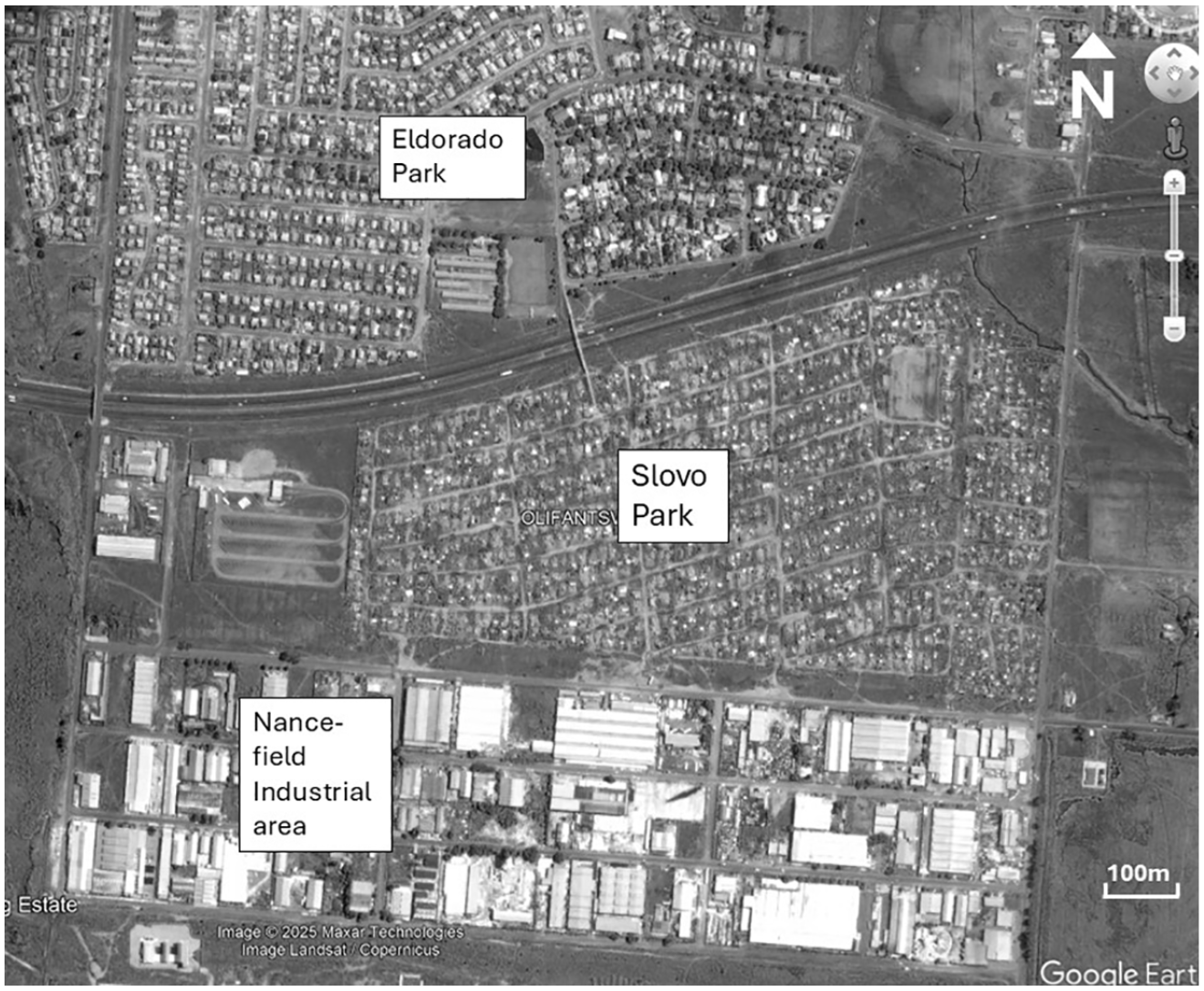
Slovo Park in 2000 within its immediate surroundings
The history of Harry Gwala
The history of Slovo Park
IV. Methods and Positionality
This paper is based on an analysis of and reflection on my experience in engaged planning with HGCC and SPCDF and their legal teams. I have performed this role from my academic base at CUBES (Centre for Urbanism and Built Environment Studies) in the School of Architecture and Planning at the University of the Witwatersrand in Johannesburg. As a small group within CUBES, we have promoted meaningful informal settlement upgrading through research, workshops, policy submissions and networking. This led to invitations through HGCC and SPCDF’s pro bono lawyers to help counter relocation and pursue upgrading for Harry Gwala and Slovo Park. The ongoing engagement has spanned two decades and 13 years respectively. In the Harry Gwala engagements, landscape architect Kristen Kornienko, from the US and Canada, joined me in 2007, first as a Fulbright Fellow, then a PhD candidate, a postdoc and since then a visiting colleague in CUBES. In the Slovo Park engagements, experienced professional planner and academic Neil Klug, a colleague in the Architecture and Planning school and CUBES, shared this role with me since 2016. We have written accounts and analyses individually and collectively(74) and remain conscious of the need to do justice to the insights gained through additional publications. The remaining sections of this paper present an analysis of my notes, documentation and communication, verified against formal minutes as well as timelines and accounts produced for legal advocacy. I filtered the records through key strands in the literature on planning advocacy and related approaches. This and the compilation of the timeline and network diagrams (Figures 4, 6, 8 and 9) helped me condense and make sense of the complex trajectories and provided a frame for analysis. I owe this approach to two reviewers of my first attempt at writing this account.
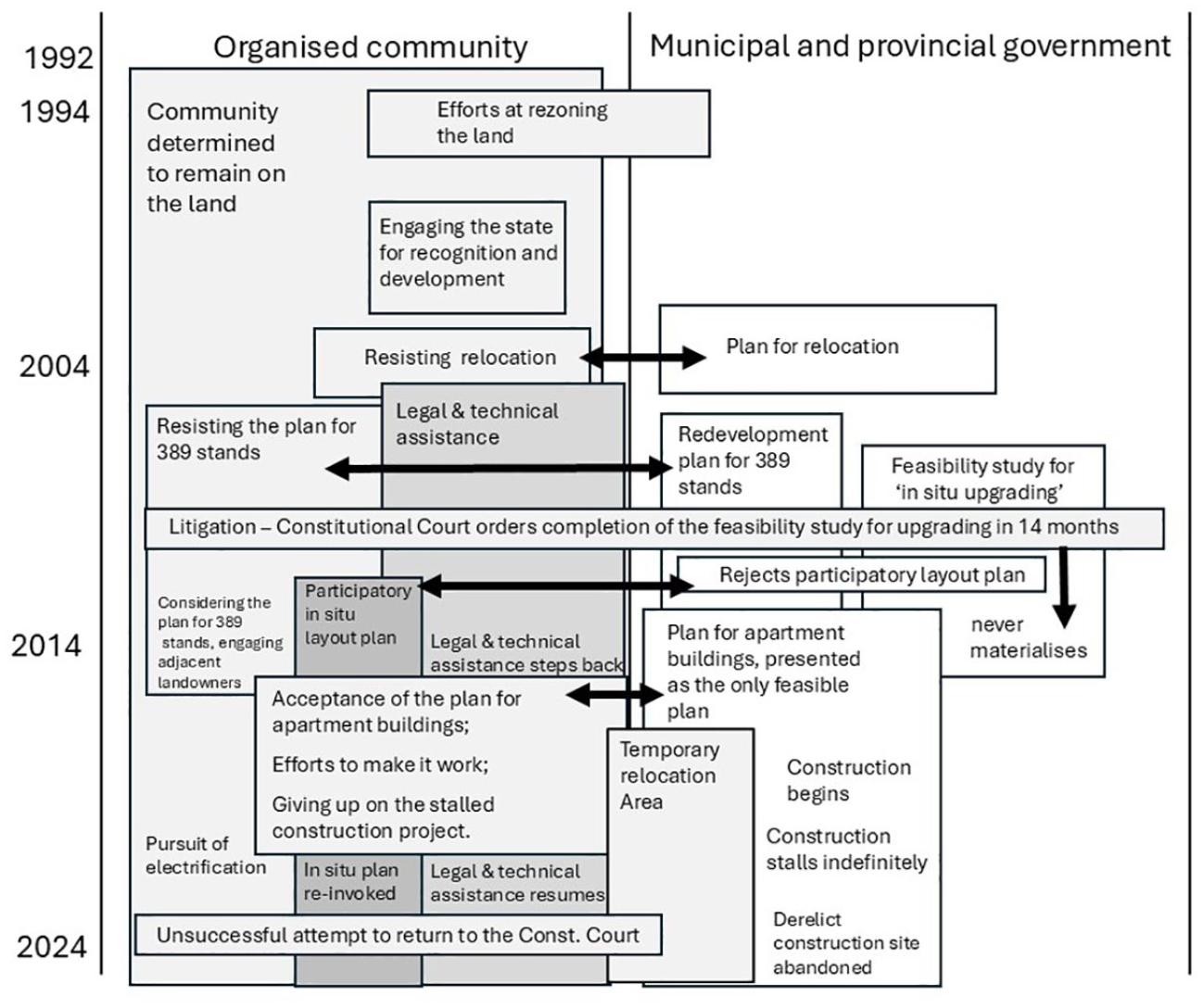
Legal and planning technical assistance in the trajectory of the Harry Gwala community’s pursuit of permanent in situ development
Given our academic base, work with HGCC and SPCDF has intersected with postgraduate research supervision and teaching. Both neighbourhoods are rich, welcoming sites for student research, field trips and transect walks, and members of HGCC and SPCDF generously assist in pedagogic initiatives. In Harry Gwala, we enjoy the privilege of insights shared by highly regarded human rights lawyer Moray Hathorn of the Legal Resources Centre, who formerly led the pro bono unit at the law firm Webber Wentzel. In Slovo Park, the relationship with SPCDF is embedded in the group Friends of Slovo Park, comprising CUBES, the non-profit social enterprise 1to1 Agency of Engagement(75) and, initially, Carin Combrinck, out of whose engaged pedagogy with architecture students in Slovo Park in 2010 to 2013, 1to1 was born.(76) Carin Combrink later set up the Unit for Urban Citizenship, a centre for transformative engagement within University of Pretoria’s architecture department, to work with similar neighbourhoods in Pretoria and remains connected as part of a network of such initiatives across a few Southern African universities. SERI undertakes research and policy advocacy related to its legal cases and is a highly respected and trusted sounding board for our concerns, ideas and reflections. Across these organizations (see Figures 8 and 9), trust and a mutual search for solutions has meant that critical reflection informing the planning engagement has been derived collectively. Several of us lived our adolescent and formative adult years on the sheltered and privileged side of the apartheid divide and, though with discomfort, continue to benefit from privilege within post-apartheid’s social and economic order. Collective reflection helps overcome our individual biases and blindness. Our networks in these engagements may be the diverse collectives that Sebola-Samanyanga,(77) while reminding how our past shapes us, argues are needed to dismantle entrenched knowledge hierarchies and the structures they hold in place.
V. Legal Advocacy: Asserting Occupational Rights in Harry Gwala And Slovo Park
The legal system in South Africa remains invested in the institution of property, an apartheid legacy, treating occupational rights as inferior.(78) Property rights, including those of the state, are readily defended through evictions. Confronting the violation of occupational rights involves a protracted court process. A legislated infrastructure of pro bono legal support, in addition to human rights NGOs such as the Legal Resources Centre and SERI, hypothetically enables impoverished individuals and groups to secure legal representation. These institutions are oversubscribed. Nevertheless, in instances where communities in unsanctioned neighbourhoods secure such support, courts preside over and adjudicate in the battle between lawyers directly or indirectly standing for property rights, and those defending occupational rights. Communities, with the help of legal representatives, may achieve orders and judgements that keep displacement at bay. More rarely are ambitions for self-determined, permanent occupation and development of land by marginalized communities endorsed in court. Ironically, in Harry Gwala and Slovo Park most occupied land is owned by the state and litigation was to implement the state’s own applicable but unpopular policy. In Slovo Park, the judgement endorsed all principles and phases of the UISP, although its order was only for a funding application under this programme. In Harry Gwala the court merely required the state to speed up its existing undertaking. I briefly set out the litigation by HGCC and SPCDF as it forms the backbone of our engagement (see Figures 4 and 6), which I discuss in the paper’s remaining section.
a. Harry Gwala
Having resisted a plan for relocation with the support of Moray Hathorn since 2004, HGCC began litigation in the high court in 2008, proceeding with an appeal in the constitutional court in 2009. In what is known as the Nokotyana case, HGCC sought interim services while awaiting a drawn-out provincial government decision on the suitability of the neighbourhood for in situ upgrading. This corresponds with phases 1 and 2 of the UISP.(79) The constitutional court ordered that the provincial government expedite its investigations regarding a decision on the applicability of upgrading in Harry Gwala, and conclude them within 14 months, but it did not undertake to oversee this.(80) The order represented a tentative endorsement of rights beyond mere occupation, realized through in situ upgrading. But as Kapindu’s(81) analysis of the judgement finds, “the Court should have issued a structural interdict in order to ensure that the MEC [Member of Executive Committee, equivalent to a provincial minister] remained accountable to the Court throughout the process”.
Over 14 subsequent years, the provincial and municipal government consistently misinterpreted the UISP and delayed development (see Figure 4). In 2017, it displaced part of the community to a waterlogged temporary relocation area to make way for apartment block construction ostensibly for the same residents, a fraught project that stalled several times. At the time of writing, the site with half-built structures was unfenced and abandoned (see Figures 5a and 5b). HGCC was attempting to guard the site but could not prevent vandalism at night by people with drug addictions. In 2023, the HGCC requested Moray Hathorn to bring the trajectory that followed the judgement to the attention of the constitutional court. A substantial dossier chronicled the development ordeal and policy misinterpretation.(82) It pleaded for the resumption and completion of phase 1 of the apartment project and withdrawal of the plans for the remaining phases of that project (which would have erased the remainder of Harry Gwala) and asked instead for electrification and in situ upgrading to be implemented as endorsed in the 2009 judgement.(83) The constitutional court elicited an answer from the municipality, which, as expected, opposed all claims.(84) It also submitted “that the 2009 Nokotyana Judgment has nothing to do with the present application”, arguing a new legal route needed to be taken through the high court.(85) Despite a detailed reply rebutting the municipality’s arguments and making the case for a direct continuation of the Nokotyana case,(86) the constitutional court sided with the municipality and, without hearing the case, issued an order refusing direct access to the constitutional court.(87) The demoralized HGCC decided against the lengthy legal route through the high court. At the time of writing, it was pursuing political and media routes and was contemplating following SPCDF’s recent appeal to parliament, set out below, or approaching the South African Human Rights Commission.
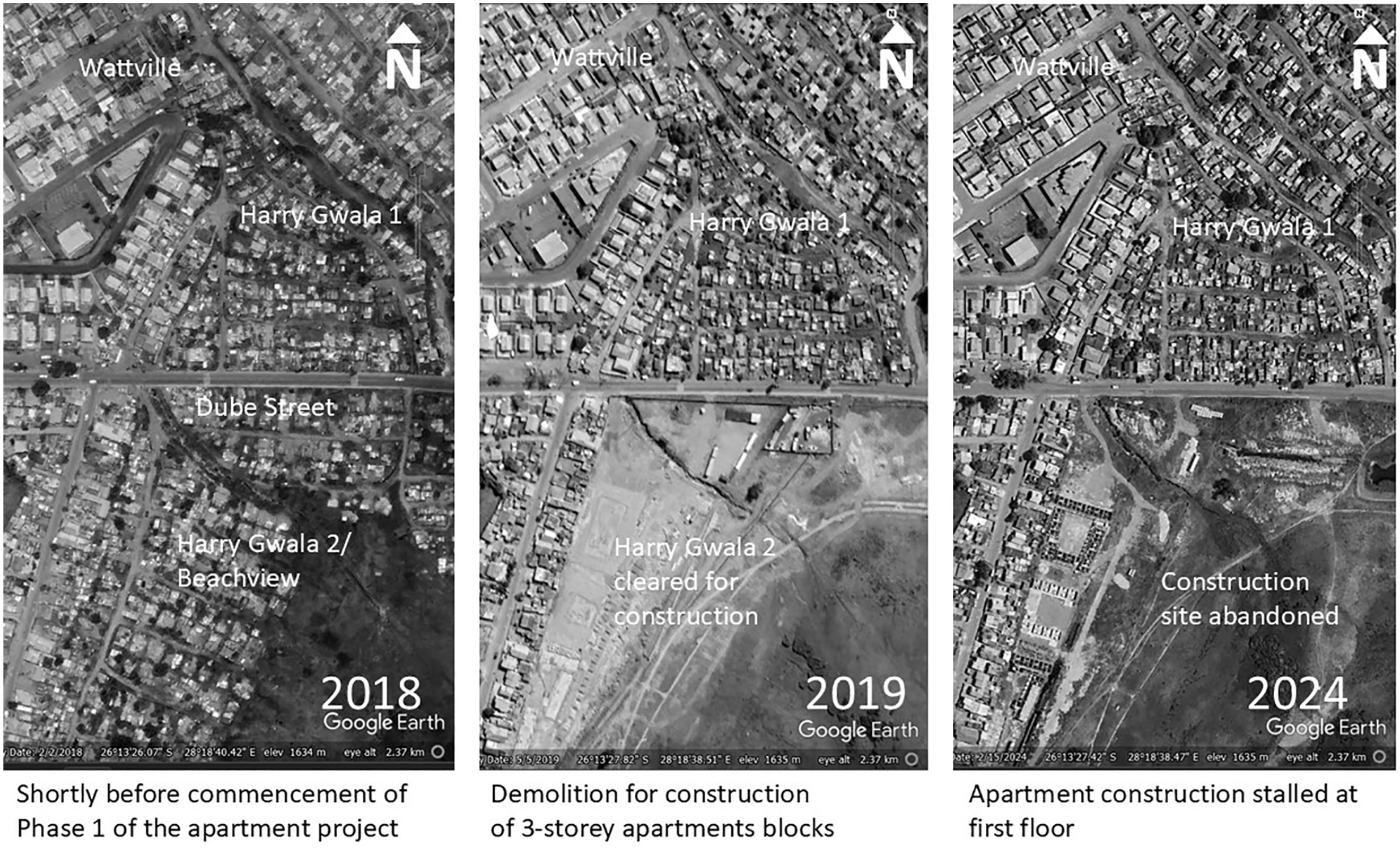
The stalled progression of state-led redevelopment in Harry Gwala
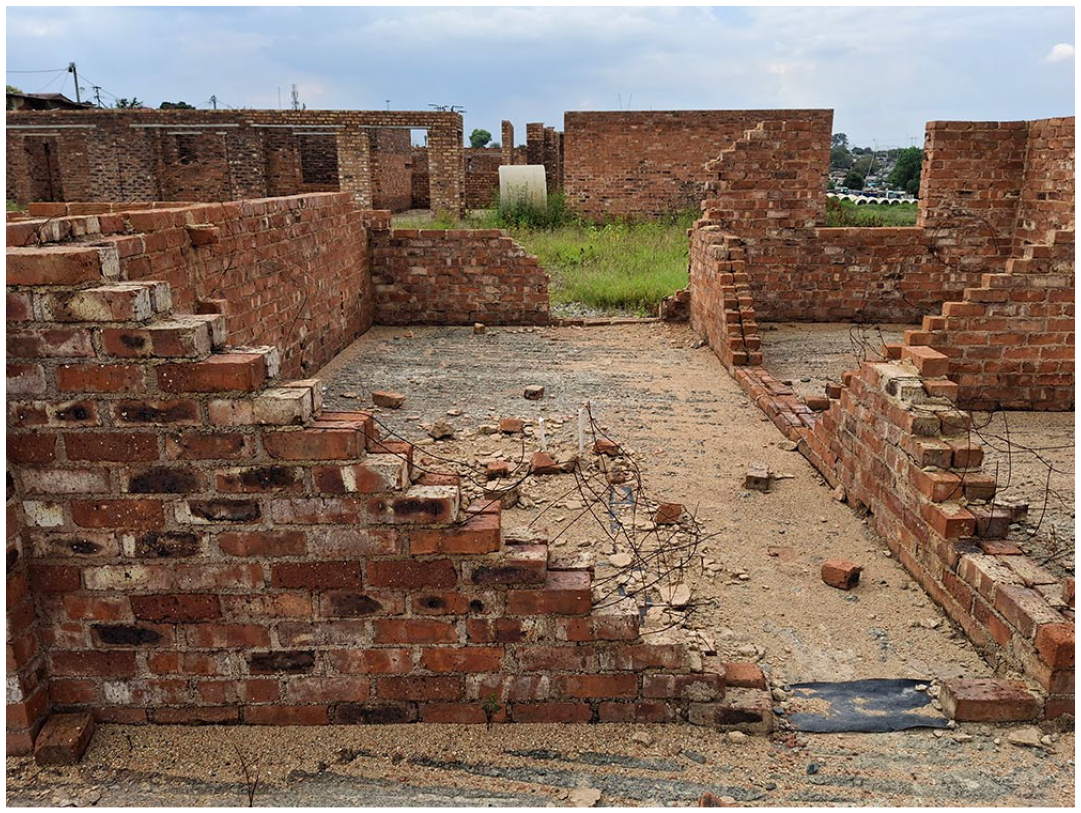
The abandoned site of the Harry Gwala housing project
b. Slovo Park
The legal battle of the Slovo Park community, supported by an experienced team of lawyers and SERI researchers, led to the Melani judgement in the high court in 2016.(88) The case entailed an appeal against a pending eviction and relocation and a request for implementation of the UISP. The judgement, which the state did not appeal, underlined the applicability of the UISP, and, by implication, recognized the Slovo Park occupation. It obliged the City to prepare an application for funding to the provincial government under the UISP.(89) In this case, the court undertook to oversee the implementation of its judgement, ensuring proper adjudication of the City’s application for funding. The City prepared a rushed submission reproducing the plan that had triggered the legal case in the first place, with no participation from the SPCDF or inhabitants of Slovo Park. As a result of court oversight, the provincial government was compelled to reject this application.(90)
At this point, SPCDF requested the establishment of a task team as a participatory vehicle for implementing the judgement. The legal representatives of both the City and SPCDF served on this (and do so to date) alongside the core members that I mention in the next section. Despite the existence of the task team, the ensuing nine years saw fraught and protracted planning, budgeting and procurement processes for Slovo Park and no implementation(91) (see Figures 6 and 7). Wishing to return to the court only as a last resort, in 2024 SPCDF devised a political strategy to appeal to parliament. In South Africa’s parliamentary system, members are assigned to committees in proportion to their party’s representation in parliament. The committees’ role is linked to the work of national departments, DoHS in this case; they may also “investigate any [related] matter of public interest”.(92) SPCDF secured a hearing with the parliamentary portfolio committee for human settlements early in 2025. This yielded a new commitment from all three spheres of government, to expedite the upgrading through resumption of task team meetings, adequate and continuous project-based funding allocations, oversight by the parliamentary portfolio committee and acceptance of Slovo Park as a pilot to inform the pending review of the housing code with its UISP. At the time of writing, it was evident that implementation would take several more years. SPCDF, cautiously optimistic, was aware it needed to remain as vigilant as it had over the past nine years.
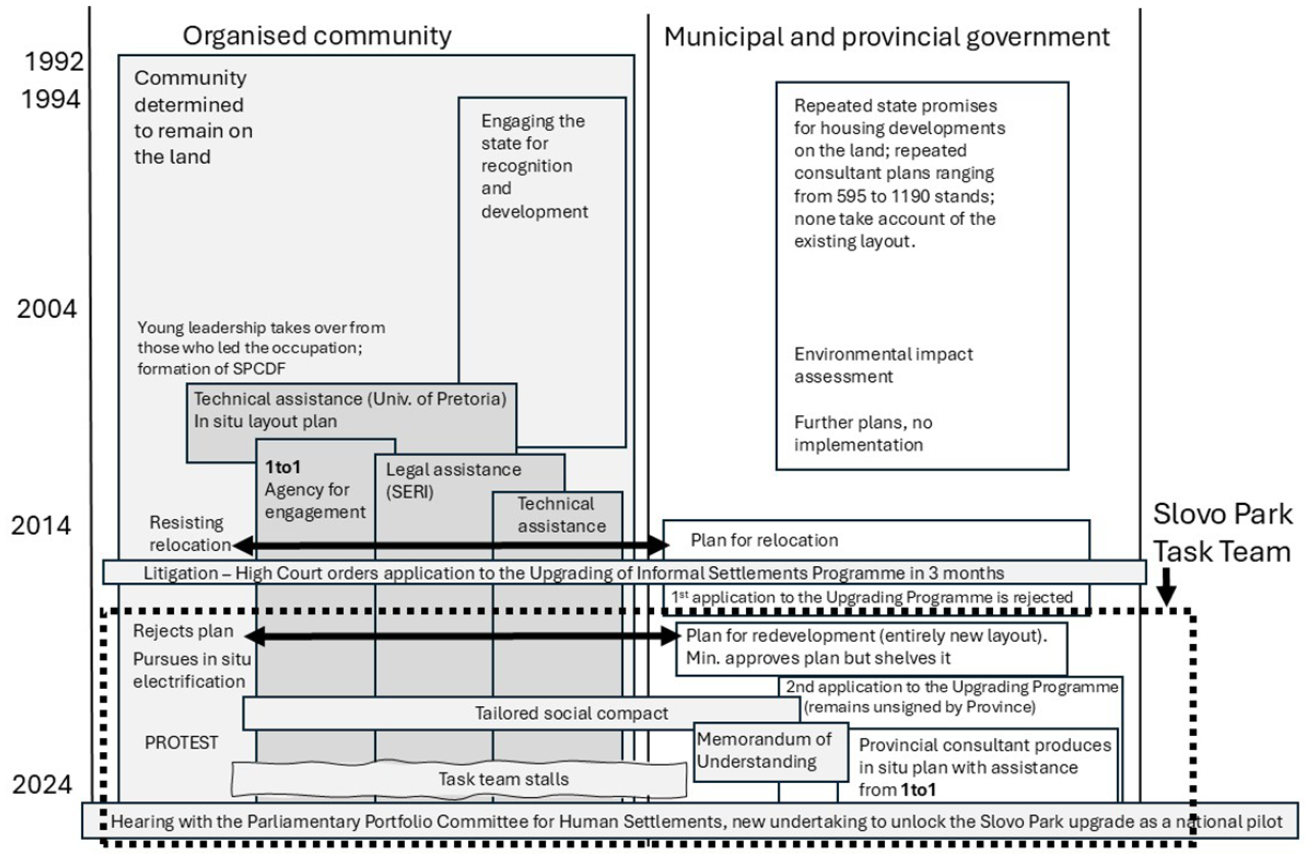
Legal and planning technical assistance in the trajectory of the Slovo Park community’s pursuit of development
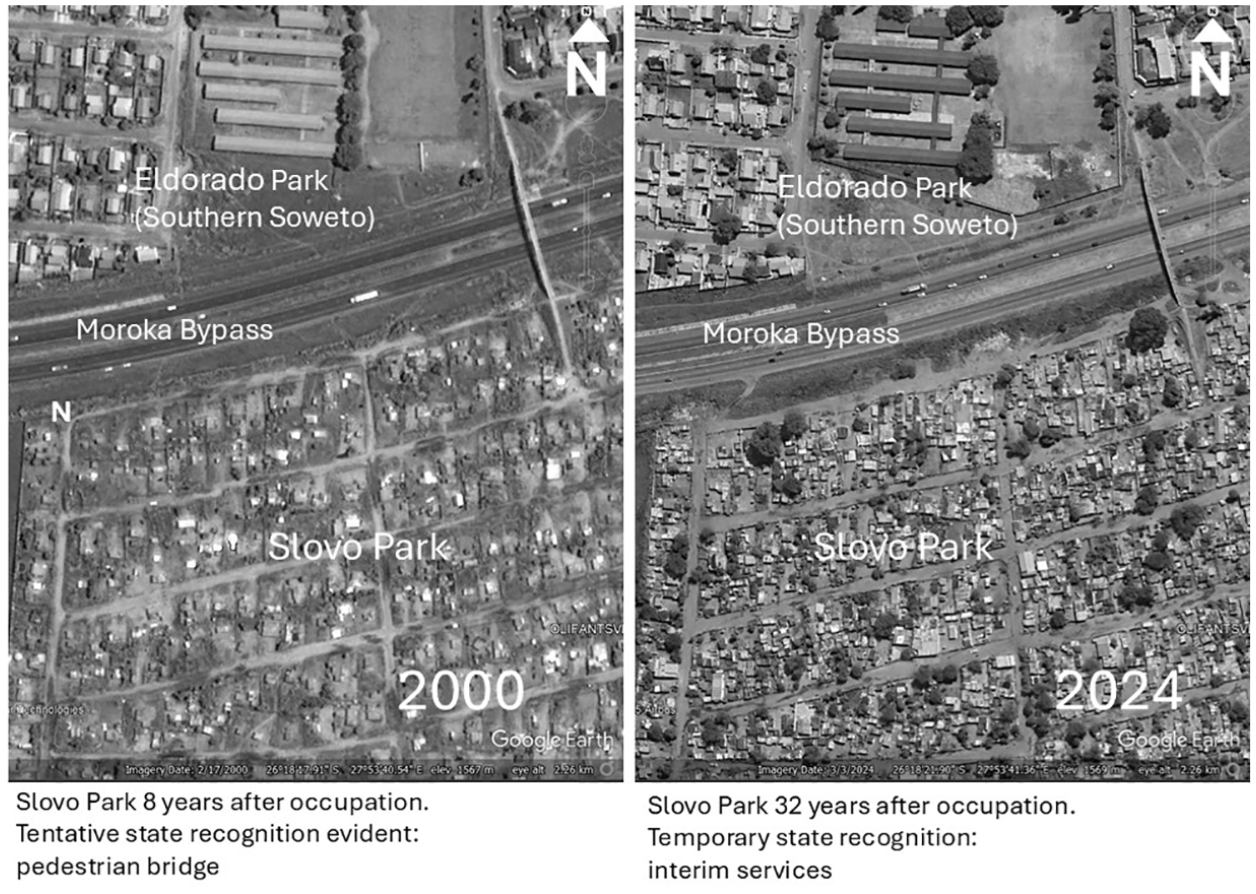
Slovo Park, modelled on the layout of Eldorado Park, gradually densifying in the absence of permanent recognition and development
VI. Critical Planning Advocacy Approaches in Solidarity with HGCC and SPCDF
Though providing analysis and insight for the litigation set out above, the planning advocacy over the 20 and 13 years of engagement with HGCC and SPCDF respectively did not take the form of representing a client. Although a simplification, Figures 8 and 9 show the network of multiple interactions and relationships within which the planning advocacy took and continues to take place. They highlight the centrality of HGCC and SPCDF and depict their direct and frequent engagement with municipal and provincial governments, which are at the forefront of the two committees’ political strategies. HGCC and SPCDF are also part of other structures not depicted in the diagrams. The Wattville steering committee, championed by HGCC, combines struggles for housing, land and services across Wattville’s neighbourhoods in solidarity and joint civic action, including protests. SPCDF is connected, among others, to NGO-supported structures such as the Informal Settlement Network (ISN).
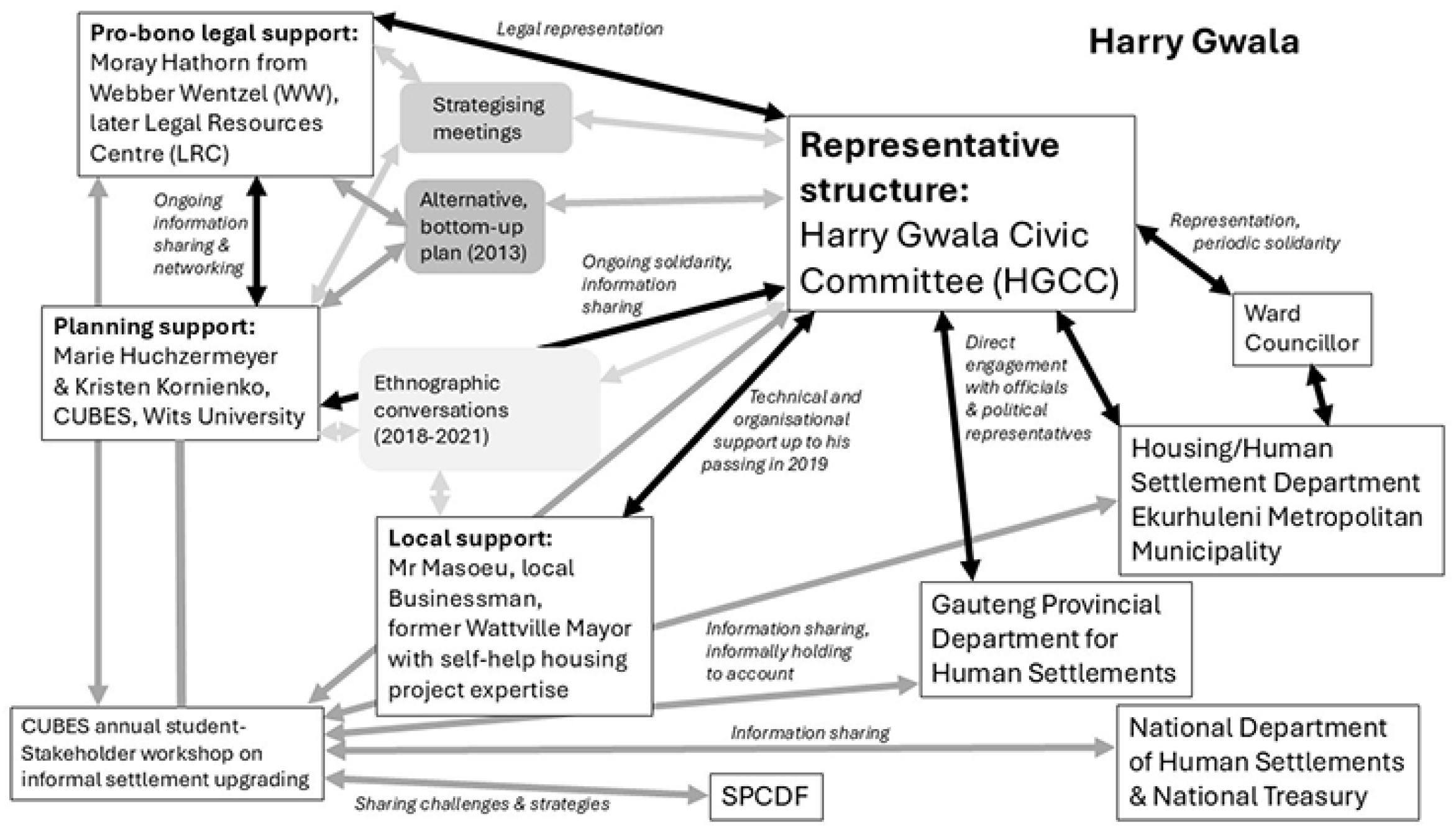
Networks of engagement, advocacy and solidarity in the case of Harry Gwala
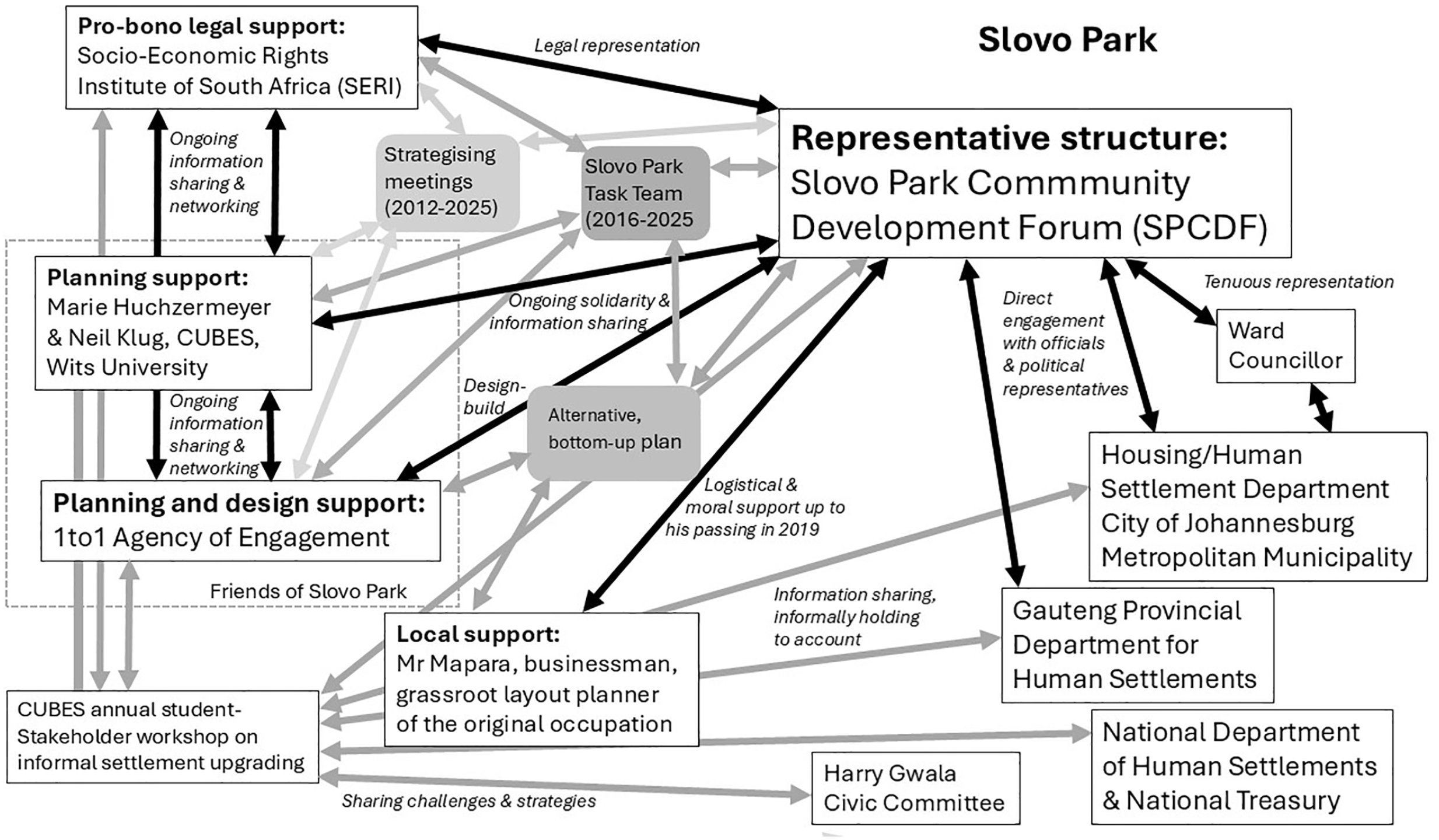
Networks of engagement, advocacy and solidarity in the case of Slovo Park
HGCC and SPCDF have maintained a consistent leadership structure over the years of our involvement, allowing solidarity-formation to shape the planning praxis over time. Highly committed, principled and astute individuals carry the portfolios, although ageing and illness in impoverished circumstances have caused some members to pass on. Johnston Nokotyana, chair of the HGCC at the time of the 2008/2009 litigation, relocated to his rural home around 2018. What follows are six different approaches that the planning advocacy in Harry Gwala and Slovo Park has taken over the years, one often contributing to the other. Together, they represent criticality, advocacy and solidarity.
a. Sharing insights, critically reflecting and strategizing
On an ad hoc basis, directly or through their legal representatives, HGCC and SPCDF call meetings and at times transect walks when they feel our support is needed. In Harry Gwala, these are on weekends or weekday evenings in spaces HGCC uses to hear and resolve residents’ matters – a committee member’s home or small meeting hall. HGCC respects the travel and time required for our participation, calling meetings only when really necessary, with intervals of up to a year. Although travel to Slovo Park is easier, meetings with the SPCDF are mostly at SERI’s inner-city offices. Meetings are chaired by HGCC and SPCDF respectively, following the formalities and inclusive ethos Ngwane(93) identifies with ‘people’s committees’ in shack settlements across South Africa. They cover pressing challenges, important project or policy updates, critical reflections and analyses by all participants, strategies for engaging municipalities and other relevant bodies and tasks to be carried out. Critical analysis involves HGCC and SPCDF’s political and institutional reading of the respective municipalities. Our own analysis has mainly involved interpretation of planning and human settlements policy and comparisons, through our knowledge of other neighbourhoods and projects. Our collective meeting records are referenced in affidavits for court cases. The meetings, therefore, also play the role of formally witnessing unfolding trajectories. When collective strategizing has exhausted all other avenues and a collective decision is made to litigate, legal arguments must be framed around the applicable policy. We have been requested to participate in brainstorming the approach, to comment on founding affidavits or draft supporting affidavits. Both Moray Hathorn and his counterparts at SERI insist on their clients’ direct involvement in crafting the motion or formal request to the court and approving the wording of affidavits in detail, this necessitating further meetings, up to the initialling of each page and signing under oath.
b. Technical support in deliberations with the provincial and municipal government
Both HGCC and SPCDF have invited us into deliberations with their respective municipalities to help champion an unpopular policy,(94) the UISP. We have done so alongside HGCC and SPCDF, which themselves have become bearers of UISP principles and approaches, often calling out officials’ misrepresentation. This is notwithstanding periods of doubt, wavering and uncertainty among HGCC and SPCDF members in the face of consultants insisting on top-down, unitary planning with professional conviction and officials’ endorsement, and politicians consistently favouring conventional housing delivery. Our reception alongside HGCC or SPCDF in municipal meetings has differed across the two institutions, with resentment from Ekurhuleni Metropolitan Municipality (EMM) and relative respect from City of Johannesburg (CoJ), where our collegial and alumni networks are more extensive. The different trajectories of the respective litigations, in which both municipalities implicate us, may also define officials’ and politicians’ attitudes towards our technical assistance. In EMM, tensions were most pronounced in 2013 when HGCC attempted to pluralize planning by tabling its alternative, an in situ plan, to which I return below.
For Slovo Park, the deliberations with state entities that involved us since 2017 have mostly been within the Slovo Park Task Team. Its membership, analysed by Klug,(95) comprised CoJ human settlements officials and legal representatives, SPCDF, SERI, Friends of Slovo Park, the ward councillor and successive planning consultants for the duration of their appointments. When needed, the City’s utility companies and planning department have been in attendance, notably City Power for the duration of the participatory, in situ electrification of Slovo Park in 2018. In a strategy collectively deliberated outside of the task team, SPCDF engaged the municipal electricity utility, resulting in considerable state investment in the in situ electrification. This added to the rationale for in situ upgrading. In 2021, when CoJ found itself legally unable to procure planning consultants, the provincial human settlements department and Gauteng Partnership Fund took over this role and participated in the task team.(96) A deadlock in intergovernmental relations in 2023 stalled task team meetings. The procurement role was handed back to CoJ after the appeal to parliament early in 2025. Invited but not attending the task team were national entities (DoHS, the state-owned Housing Development Agency and, up to its dissolution in 2021, the National Upgrading Support Programme). CoJ’s human settlements officials accept the task team as a forum for frank but respectful deliberation. Politicians have been less comfortable with this arrangement. The task team is not an invited space but rather invented and insurgent(97) in its existence at the direct insistence of SPCDF and its litigation.
CoJ convened the task team in its Region D facilities in Soweto and centrally located human settlements department boardroom, the latter shifting the travel burden onto SPCDF. During the COVID-19 pandemic, SERI facilitated SPCDF’s online participation as the task team convened on Teams. Meeting frequency and style have depended on the presiding official, with turnover preventing continuity. The first responsible official as of late 2016 requested highly experienced SPCDF Deputy Chairperson Lerato Marole to chair, but subsequent officials saw this as their own role. Throughout, institutional memory and continuity have largely been ensured by SPCDF. Since the parliamentary intervention, the task team has been chaired by the member of the mayoral committee for human settlements, with scheduling depending on the unpredictable diary of this high-level politician.
c. Confronting unitary planning
With relocation plans successfully countered for Harry Gwala and Slovo Park, the planning conundrum explained in the introduction arose. Professional planning consultants, trained and apprenticed for ‘unitary’ planning,(98) insisted on replacing the self-planned neighbourhoods with arbitrary, ill-suited layouts for conventional state-subsidized housing. EMM and CoJ ignored clearly articulated objections and allowed the consultants to submit the plans for the costly planning approval process. EMM officials, who repeatedly presented HGCC with the consultants’ plan, believed in its correctness, having instructed the consultants to adjust it only by replacing freestanding houses with apartment blocks to increase yield. After a decade of such treatment, HGCC, with a reluctant mandate from the wider community, agreed in 2016 to the ill-suited unitary plan (Figure 4). At that point, Moray Hathorn and ourselves, respecting this decision, stepped back somewhat from direct technical support. We resumed this role fully late in 2022 after EMM’s abandonment of the half-built first phase of the apartment project and HGCC’s renewed wish to pursue the UISP.
SPCDF deployed our professional town planning expertise to directly confront CoJ’s planning consultants’ presentations in the task team. Neil Klug practised in situ upgrading in KwaZulu Natal before joining Wits University in the early 2000s and could cite concrete examples and experiences, adding evidence that the proposed plans were unimplementable. The consultants reluctantly devised alternative layouts, but as mentioned, submitted their original layout for planning approval with CoJ’s endorsement. Following collective critical reflection, SPCDF tasked us with compiling a critique of the approved layout. It was tabled in a tense meeting with the political leadership of the municipality’s human settlements’ department, leading to the layout plan being shelved and, ultimately, to the appointment of new planners, who, once again, needed to be sensitized to the UISP.
d. Pluralizing planning – developing alternative plans through transduction
Outside the official processes, HGCC and SPCDF had academic institutions produce in situ layout plans, and used these to advocate for this approach. Following collective strategizing, HGCC decided on this route in 2013. Kristen Kornienko’s PhD fieldwork on the notion of ‘place’ in Harry Gwala(99) positioned her well to lead a collaborative process,(100) which resembled Lefebvre’s transduction. Although the municipality dismissed the in situ plan, save for minor elements, HGCC kept laminated copies and re-tabled these in 2022 in deliberations around in situ electrification. In Slovo Park, also around 2013, Pretoria University’s Carin Combrinck conducted an immersive architecture studio. In a similar process of transduction, this also produced an in situ layout. During a task team deadlock following the shelving of the approved plan in 2018, SERI raised funds for the professional preparation of an in situ plan, based on the 2013 layout. Once CoJ resumed the task team meetings and appointed a new set of planning consultants, SPCDF tasked 1to1 with working alongside the appointed planning firm and Slovo Park inhabitants to ensure adoption of this plan. At the time of writing, this was the agreed plan based on which the Member of the Executive Committee tasked the water utility company with designing a sewer reticulation. Final approval was still subject to a renewed geotechnical investigation and traffic impact study.
e. Convening a transdisciplinary pedagogic forum
Since 2015, HGCC and SPCDF have generously engaged in sharing their challenges and insights in our annual postgraduate student–stakeholder workshop on upgrading. Consciously non-hierarchical, this forum exposes students, among them human settlement officials, to policy updates and real-life policy implementation dynamics. The off-the-record format encourages frank discussion by all participants, including human settlements officials from all tiers of government and treasury’s city support programme, NGO practitioners and pro bono legal entities. In 2018, the deliberations helped resolve a deadlock in the Slovo Park task team deliberations. In 2022, the forum exposed HGCC and an EMM official to Slovo Park’s electrification trajectory, yielding a commitment to consider this route for Harry Gwala. HGCC has followed up relentlessly to keep this commitment alive. At the time of writing EMM had drawn up an electrification plan for Harry Gwala.
f. Accompanying the leadership through ethnographic conversation
After HGCC acceded to the apartment project in 2016, Kristen Kornienko and I sought to learn from HGCC’s navigation of this complex development, and its efforts to make the project as feasible as possible for a diverse and complex community, including elderly inhabitants and households with livestock. We requested HGCC’s consent for an ethnographic phase, in which we would accompany its members through recorded conversations. With implementation delays and premature contractor departures, these conversations turned to the information HGCC was gathering and its political and institutional analysis of EMM’s internal strife amid investigations into allegations of corruption and budgetary mismanagement. In retrospect, our conversations clearly built solidarity. The committee wishes to see them analysed and published as witness to what they endured, a task that lies ahead. At the time of writing, Neil Klug and I were contemplating similar ethnographic conversations with SPCDF, if not a process to facilitate SPCDF members to write their own account.
VII. Conclusion
This paper offers the framing of critical planning advocacy in solidarity as relevant to the challenging juncture in which informal settlements seem suspended in South Africa. Our palette of mutually reinforcing approaches reflects what is possible and makes sense from our time-pressured yet flexible base in an academic institution. Our entry point was through the trusted legal support of the two representative committees, by invitation. However, community–planner relationships of solidarity for similar settings and towards similar ends can emerge through other routes. Critical ingredients we can extract are local embeddedness enabling commitments for the long-haul, non-hierarchical ways of imparting expertise, pluralizing planning from below and finding ways to introduce alternative, collaborative in situ layout plans into municipal planning. Small gains, as in our case, can be made through collective persistence. More radical outcomes require a return to Peattie’s(101) conclusion, which Porter(102) echoes in her call “to situate planning in a relation of accountability with the strong and growing movements of Indigenous resurgence and broader anti-colonial resistance”.
Footnotes
Acknowledgements
The perspective in this paper is that of a professional spatial practitioner and academic and not of residents. In the case of Harry Gwala, the author shared the socio-technical assistance role with Kristen Kornienko. In a bid to understand the work of the Civic Committee in relation to the disruptive development approach from which the technical support team stepped back, the author and Kristen Kornienko sought permission to conduct recoded in-depth conversations in the 2018–2020 period. In the case of Slovo Park, Neil Klug and the author formed the technical support team based at the Centre for Urbanism and Built Environment (CUBES) at the University of the Witwatersrand. In this case, they have not stepped back into a mode of recording deeper conversations with the community representatives. For both cases, the author is deeply indebted to the long-serving community representatives. The author is also grateful for the collaborative spirit within the legal and socio-technical teams in which the assistance to the civic leadership was embedded.
Funding
The engaged research for this paper was conducted over many years as a combination of community service and research, which forms part of the author’s work as an academic at the University of the Witwatersrand. In this sense, no dedicated funding support was needed.
Ethical Approval Statement
The following ethics protocol number applies to this study: Protocol number: H18/02/12, Human Research Ethics Committee (Non-medical).
