



Abstract
This paper examines the strategies that forced migrants adopt to (re)build their livelihoods and cope with displacement while living in the city. It contributes to the growing body of research that recognizes the capacity of displaced persons to find, grow and sustain livelihood opportunities, thereby laying the foundation for self-reliance in urban areas. Focusing on a secondary city – Makurdi, in central Nigeria – the paper demonstrates how IDPs there are creating pathways for self-reliance by leveraging their social capital and their individual and collective agency. Their establishment of an informal market serves the daily needs of the host community, in addition to offering opportunities for livelihoods to the IDPs and members of the host community alike.
I. Introduction
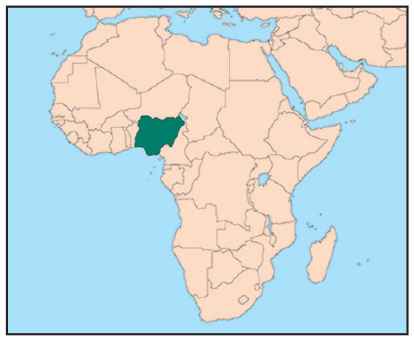
Mimi (not her real name) and members of her family arrived in Makurdi, a secondary city in central Nigeria, after conflicts between sedentary farmers and itinerant herders forced them out of their rural community. Armed with her secondary school certificate and the determination to thrive, Mimi searched for menial jobs with the help of kind neighbours who often informed her of available job vacancies. Her older sister owned a yam(1) stall, a business she had started when she arrived in Makurdi. Mimi assisted in selling the yams any time her sister travelled to the rural market to restock the stall. She would sit under the makeshift stall with the yams neatly arranged on planks in front of her, patiently waiting for interested buyers to purchase her goods. The proceeds from the yam sales were used for her family’s sustenance. Mimi’s makeshift stall was just one in a cluster of structures dotting the landscape along a major interstate road on the periphery of Makurdi, occupied predominantly by other internally displaced persons (IDPs) selling a variety of items.
Mimi’s experience reflects the daily realities of IDPs who arrive in cities like Makurdi with limited access to the labour market but are faced with the arduous task of generating income for their sustenance in an uncertain economic terrain.(2) Her story further demonstrates how urban IDPs negotiate such livelihood challenges by adopting a variety of economic coping strategies ranging from low-skilled formal or informal sector jobs to trading in markets in order to generate income and contribute to their host communities.
This paper builds on and supplements previous studies on the livelihood strategies and economies of displaced persons in cities(3) by focusing on the establishment of this informal local market in the peri-urban area of Makurdi. I argue that, like Mimi and her sister, IDPs in urban areas deploy their agency to negotiate livelihood strategies and forge a path to self-reliance, thereby challenging the popular narrative that displaced persons are a burden to host communities and are overly dependent on government assistance and humanitarian aid.(4)The paper contributes to the growing body of research on forced migrants’ capacities, economies and self-reliance, amplifying their agency and resilience over and above their vulnerabilities and acquired dependency.
As Haysom notes, “little is known about how poor displaced people make ends meet in highly competitive and often viciously exploitative informal economies”.(5) Through this case study, I explore some of the strategies that IDPs adopt to find work and generate income for their daily household needs. Adam(6) identified participation in informal markets as one strategy used by IDPs to cope with economic hardships. The Makurdi example, however, deviates from findings in other contexts where urban IDPs negotiate their livelihoods through integration into already existing formal and informal markets in host communities.(7) The emergence of this IDP-run local market and its operations have implications for humanitarian and development programming targeted at supporting the livelihood strategies and economic integration for displaced populations in towns and cities.
In the next section, the paper examines the literature on IDPs in cities and the livelihood strategies they adopt on arrival. This is followed by discussions of the study context and the methods of data collection. In Section IV, the findings of the study include a description of IDPs in the study area, the emergence and operations of the informal market, and potential ways that humanitarian and development programming could support IDPs’ livelihoods in this situation. The concluding section discusses the study’s implications for rethinking assistance to IDPs as they seek social and economic integration in host cities.
II. Literature Review
a. Internally displaced persons in urban areas
The extent of internal displacement has attained record-breaking levels globally. By the end of 2023, available estimates showed numbers reaching 75.9 million globally and 35 million in Africa for people displaced by conflict, violence and disasters – the highest ever recorded.(8) With an estimated 3.3 million IDPs, Nigeria is one of five countries in Africa which accounted for about 80 per cent of people displaced by conflict and violence by the end of 2023.(9) Following current trends, a significant proportion of IDPs flee to urban areas where they live dispersed among the resident population rather than in camps.(10) This new pattern of urban displacement has significant but insufficiently understood implications for humanitarian and development actors in cities and towns.(11) Crisp, Morris and Refstie(12) suggest that the arrival and long-term settlement of displaced persons in towns and cities need to be better anticipated, understood and planned for.
While cities present opportunities for self-reliance and ultimately durable solutions,(13) IDPs continually face challenges associated with access to livelihood opportunities and social and economic integration in the process of attaining self-reliance in cities. These challenges are similar to those experienced by other poor residents in cities; but for displaced persons, they are further exacerbated by the trauma of displacement, the loss of social capital, limited support networks, restrictive laws and policies and, in some cases, hostility from host communities.(14) Regasa, Godesso and Lietaert(15) note that urban IDPs in Ethiopia experience multi-layered marginalization, manifested in segregation, social distance and stigmatization, all affecting their access to urban spaces and services.
In a bid to survive in the city, some IDPs depend on support from their social networks while others seek low-skilled jobs. Jacobsen reported that in some cases, “economic desperation”(16) drives displaced persons to pursue negative coping strategies like involvement in sex trade and gangs. Humanitarian interventions, largely focused on those in camps, are often beyond the reach of urban IDPs, who are considered both invisible and capable of fending for themselves. For these reasons, the UN Secretary-General’s high-level panel on internal displacement (2021),(17) along with scholars such as Barbelet and Wake,(18) reported that access to livelihood opportunities was one of the most critical needs of urban IDPs and refugees.
b. Livelihood strategies of urban IDPs
With limited or no humanitarian assistance, forced migrants, who usually begin from a position of loss, including the loss of assets, must figure out how to (re)-establish their livelihoods in often hostile policy, political and economic contexts.(19) Though Fielden noted in 2008 that urban displaced persons were unable to improve their plight and become self-reliant because of limited access to livelihoods,(20) evidence increasingly points to the contrary. Much of the refugee/IDP capacity literature is divided into support for or opposition to the argument that forced migrants in urban areas can achieve economic self-reliance.(21) According to Landau,(22) IDMC(23) and Brown et al.,(24) the presence of displaced persons can significantly reconfigure the social and economic life of urban areas. Huang and Graham affirm this,(25) observing that IDPs can bring skills that complement those of the host labour force and boost economic productivity.
Researchers approach self-reliance for displaced persons from two perspectives – in the context of the right to work in host countries (for refugees) and from the perspective of humanitarian interventions that support sustainable livelihoods for displaced persons.(26) For the latter, the focus has mostly been on state-led interventions or humanitarian aid, often neglecting the role of the private sector and innovation as potential sources of solutions.(27) However, in recent times, there has been a noticeable shift from an aid-centric view of livelihoods towards the potential of displaced persons to use their agency and human/social capital to rebuild their livelihoods.(28) Here, the concepts of agency and self-reliance in research and policy discourse about displaced persons’ livelihood strategies are prominent.
Agency is the ability to define one’s goals and to act upon them.(29) It has been conceptualized in three interconnected ways – in terms of capabilities, empowerment and citizenship.(30) These are manifested in the ways displaced persons mobilize individual or collective resources to make a living and contribute to their host communities, thereby (re)inforcing their sense of belonging and their social and economic integration in towns and cities. Etzold and Fechter argue that displaced persons are not passive victims, but resourceful agents who continually adapt to change, (re)position themselves in social networks and use spatial mobility to (re)build their livelihoods.(31) The underpinning theme of the sustainable livelihoods’ framework emphasizes agency – the way people organize their lives and the opportunities available to them.(32) In research on the agency of Somali migrant women in South Africa, for instance, Ripero-Muñiz reported that they “migrate independently, start businesses on their own and take ownership of many of their cultural and religious practices”.(33)
Self-reliance, in contrast to agency, is considered a controversial concept and there is no consensus either on its conceptual definition or its practical application.(34) Views also differ on how best to measure self-reliance, and indicators have included income, employment, access to shelter, food, education and safety.(35) UNHCR’s handbook for self-reliance defined it as the social and economic ability of an individual, household or community to meet essential needs sustainably and with dignity.(36) In the context of humanitarian programming, the objective of self-reliance tends to be far more narrowly focused on strengthening the livelihoods of displaced persons and reducing their long-term dependence on humanitarian assistance.(37) Related concepts such as rehabilitation, self-sufficiency, self-help, resilience and economic integration(38) have been used to reflect this notion that refugees and IDPs should be able to support themselves with little or no external assistance from humanitarian agencies.
Despite renewed interest in the topic of refugee self-reliance(39) there appears to be a dearth of critical analysis on the understanding of self-reliance for displaced persons, whether in its conceptualization or its manifestation and the practical implications for displaced persons.(40) Krause and Schmidt note that the idea of self-reliance is used to project displaced persons as capable of surviving on their own.(41) However, they argue that when used in the context of humanitarian interventions, the concept can strengthen the power of aid agencies over displaced persons. Easton-Calabria and Omata affirm that framing self-reliance and dependence as mutually exclusive can ultimately provide aid agencies with a basis for withholding assistance to displaced persons.(42) Using the example from research in Ghana, Easton-Calabria and Omata demonstrated how the perceived self-reliance of displaced persons can trigger neglect by aid agencies.(43) Despite these arguments regarding the risks of promoting self-reliance, Crawford and Holloway suggest that solutions that allow displaced persons to find and sustain their own livelihoods should be encouraged as a foundation for future self-reliance.(44)
For many displaced persons, participation in markets through petty trading provides one such productive livelihood solution. In Bukavu, Binda and Koch found that IDP women engage in petty trading in formal and informal markets, often gaining access to these economic spaces through the assistance of their social networks.(45) However, the study also notes that these women were more successful in integrating into formal markets as compared to informal markets. In a similar vein, Monteith and Lwasa showed that displaced persons in Kampala depend on both formal and informal markets for livelihood generation.(46) The study further noted a variation in the types of goods offered by different categories of displaced persons. Acholi IDPs from Uganda offered paper beads, Somali refugees sold cosmetics and Congolese refugees entered the market with bitenge fabric. Jacobs, Kubiha and Katembera argue that instead of being dependent on their hosts, displaced persons enrich their host economies by introducing products from their communities of origin into host markets.(47)
Though the experiences of displaced persons, their resulting vulnerabilities and their livelihood strategies differ significantly across populations and geographies, research has often focused solely on the experiences of those in camps or in capital cities. Crawford et al. note that “while there is some research on refugee livelihoods, IDP and returnee livelihoods are significantly under-researched, and even less is available from the point of view of displaced people”.(48) Examples of research on refugees and IDPs in camps and capital cities include the study of Liberian refugee livelihoods in camps in Ghana;(49) the livelihood crisis in Darfur;(50) livelihoods of refugees in cities;(51) the adaptation of displaced persons into formal and informal markets in Bogota;(52) the participation of refugees and IDPs in markets in Kampala;(53) and the livelihood strategies adopted by IDPs in camps in Goma, the Democratic Republic of Congo.(54)
Easton-Calabria and Wood note disproportionate attention on capital cities and the failure of researchers to acknowledge the presence of forcibly displaced persons in secondary cities and towns, where it is projected that significant growth driven by displacement is taking place.(55) Those studies on secondary cities that do exist include research on the integration of displaced persons into formal and informal markets in Bukavu and parts of the Democratic Republic of Congo;(56) the negotiation of ‘informal citizenship’ and membership of political communities by IDPs in Bukavu;(57) and the social capital of displaced persons in Lagos, Ibadan, Port Harcourt and Onitsha in Nigeria.(58)
This paper bridges various research gaps by focusing on the livelihood strategies of displaced persons in a secondary city and including the voices of this under-researched population group and their livelihood priorities. The next section presents a description of the study context and the methods used in data collection.
III. The Study Context and Methodology
Since 2014, Makurdi, the capital of Benue State in central Nigeria, has experienced the intermittent influx of displaced persons fleeing protracted violent conflicts between sedentary farmers and itinerant pastoralists in neighbouring rural communities. These conflicts are widespread and frequent across Nigeria, and Benue State has experienced them for over 10 years. Originally the result of the destruction of farmlands and crops by stray cows, these conflicts have in recent years taken on political and religious undertones and appear to have defied all attempts at an amicable resolution.(59) Available estimates suggest that in 2018, about 541,000 new displacements from conflict and violence occurred in parts of Nigeria.(60) Of this number, about 200,000 were displaced in central Nigeria as a result of the protracted conflicts between farmers and pastoralists. In Benue State, the conflicts have severely affected rural farming communities in Guma and Makurdi local government areas, leading to loss of lives and property and forced displacements. While some of these displaced persons moved into government-established camps in adjoining communities, others moved to Makurdi and are dispersed in communities across the town.
By 2022, there were 27 IDP camps across Benue State with about 2 million displaced persons.(61) Most of these camps accommodated people displaced by the farmer–herder conflicts. Seven were officially designated camps run by the state government and an international non-governmental organization, while 20 were unofficial camps. By July 2023, an official of the state government was quoted as saying that “241,342 persons were in thirteen IDP camps while over a million (1,882,658) were living within various host communities”.(62) This announcement confirmed the reports referenced earlier that most displaced persons drift to towns and cities.
As a resident of Makurdi, the author observed the growth of an informal market in Yagba – a community located on both sides of the interstate road that runs through Makurdi to northern and eastern Nigeria. Conversations with some of the traders revealed that the market was initiated by IDPs to generate income for their daily needs. Formal semi-structured interviews were conducted with five customers, 10 traders and three members of the market management committee (who are also traders in the market) in 2022. Eight follow-up interviews with a different set of traders were conducted in 2023 by two research assistants, who also photographed the market. The interviews sought information on the emergence and management of the market, the composition of the traders and their access to trading spaces, the market’s sphere of influence and the support (if any) from local or state authorities or humanitarian agencies for displaced persons in the community and market. In May 2024, five additional interviews with different traders from the previous research participants were conducted to clarify issues raised earlier. The estimated number of traders at this market was 100–150, but numbers were reported to have been fluctuating over time due to the changing circumstances of the traders. Some traders had returned to the camps; others relocated to other communities; still others came to the market only when they had goods to sell, and some had given up trading and moved into low-skilled employment within Makurdi. Seasonal variations in the number of traders were also reported, because some traders travelled to safer rural communities during the rainy season for farming activities.
About 20 of the traders in the market were men while observations over different visits pointed to a larger number of women. The men were mostly mobile – often spending more time away in safer rural communities to engage in farming, and the women appeared to be the more consistent traders. Of 26 traders interviewed (all 18 years and above), nine were men and 17 were women. Two of the traders interviewed were not displaced persons – they had voluntarily migrated from other rural communities to the host community during the COVID-19 pandemic in 2020 and made the decision to continue trading at the IDPs’ market. Goods sold by the traders interviewed ranged from food items like yam, assorted grains and meat to cosmetics and second-hand clothes.
The market is organized in sections according to the goods sold by the traders. There is a section for traders selling assorted grains, another for the butchers selling meat and for vegetable sellers, and a separate area for those selling cosmetics and second-hand clothes. The interviews included traders in all these sections. All the traders who participated in the research identified as IDPs except for the two voluntary migrants mentioned earlier. The traders selected for the study had joined the local market at varying times – some from its inception in 2014, and others in later years. Because the research visits to the market took place on multiple days across three years, it was possible to speak to a variety of traders and to complement the formal interviews with informal chats with previous research participants. The traders spoke about how the market started and its operations. The customers who were interviewed were members of the host community and commuters who stopped to buy foodstuffs. These were both long- and short-term patrons.
The interviews were conducted by the author and the research assistants in Tiv (the local language spoken by the IDPs and the author) and transcribed into English. The narratives of the experiences of the IDPs in the market are woven into the discussion of the findings.
IV. Findings and Discussion
a. The urban displaced persons in the study area
Two categories of IDPs were identified among the traders that participated in the study: those that chose to move to Makurdi town after displacement and those that ended up in Makurdi as a last resort after some failed attempts at settling elsewhere or after voluntarily leaving camps. These categories are important in understanding the adaptive capabilities of IDPs. It was evident from the interviews that they had differing levels of resilience. Some of the IDPs returned to camps because they were unable to cope with the challenges of fending for their families or were unable to adapt to the new urban living conditions. It was evident from the visits to the market and in the interviews with the respondents that the majority of the IDPs were women with children or other dependants to cater for. Interviews revealed that some of the women were widows who had lost their husbands before or during the conflicts; others reported that their husbands were either engaged in farming in safer communities or were trying to find other low-skilled jobs as an alternative source of income to support their families. The preponderance of female-headed households and sole female breadwinners exacerbated their vulnerability as IDPs. The meagre incomes of single breadwinners were insufficient to address the needs of their often-large households. To augment the shortfall in incomes, family members are routinely drafted into a range of income-generating activities to support the family, highlighting the importance of collective agency in achieving self-reliance.
For instance, one respondent had sent her older children to a state in southern Nigeria to find jobs and contribute to the household income and in paying off her loans. Access to formal jobs was a challenge for many of the IDPs due to their lack of skills, low levels of formal education and language barriers, as some IDPs could barely communicate in English or Nigerian pidgin (a blend of English and local languages popularly used for everyday conversations), which was required for many of the available jobs. Despite these potential obstacles, and as Mimi mentioned earlier, some of these urban IDPs were making efforts by exploring their social capital with neighbours and relatives to secure lower-level jobs that matched their skills and level of education and to engage in apprenticeship opportunities to become self-reliant.
Mimi’s case is a good illustration. In addition to searching for a job, she would take any opportunity to sell on behalf of traders who had to be away from the market temporarily. By doing this, she was saving up money to pay for sewing and computer lessons.
As noted by the Red Cross, displaced persons may encounter difficulties in (re-)establishing themselves in new locations because of limited finances.(63) Even with the desire to better their lives, they may often struggle to achieve their aspirations in the absence of adequate support, whether from their social networks, the government or humanitarian organizations. In such situations, programming for humanitarian aid to facilitate IDP self-reliance could reasonably be viewed as support to the social and economic stability that can lead to independence, rather than as a means of fostering dependency. In the next section, the IDPs’ strategy of establishing a local market as a pathway to achieving self-reliance is discussed.
b. The emergence of the local informal market in the area
Some of the displaced persons reported that they had salvaged some agricultural produce from their farms and barns as they fled from the conflicts between farmers and itinerant pastoralists. On arriving in Makurdi in 2014, they displayed these food items, like yams and different types of grains (corn, guinea corn/sorghum and millet), in empty spaces along the major interstate road in a desperate attempt to attract patronage from members of the host community and commuters so that they could generate sufficient income to pay for their daily household needs.
As the cluster of roadside traders grew, the group nominated representatives to negotiate with the owner of the vacant land they had occupied to pay for continuous use of the space as a temporary trading site. A monthly rental amount for the land was agreed and the IDPs have traded on that site from 2014 to this day (2024).
That assemblage of a handful of roadside traders has metamorphosed into a makeshift local informal market that attracts patronage from across Makurdi and from interstate travellers. The market has been named kasuwa u Utyondu (meaning the market of the Utyondu people), because most of the displaced persons who first converged at that location to sell farm produce were from the Utyondu community in Guma local government area, which shares geographical boundaries with Makurdi. By naming the market after one of the communities where they resided before displacement, the IDPs have attempted to claim ownership and stamp the market with their identity. The market currently serves as a meeting place for IDPs within and outside the community. It is also an inclusive space, where forced and voluntary migrants and members of the host community can (re)start or build their livelihoods.
Findings from the interviews suggest that the majority of the IDP research participants were originally farmers in their rural communities who have now taken up trading as a livelihood strategy to generate income and fend for their families. Second-hand clothes, assorted food (tuber crops, grains, meat, fish and vegetables) and cosmetics are, as noted, some of the items they sell in the market. There is a noticeable difference in the types of goods sold by men and women. The women sell food items like yams and assorted grains, including vegetables and cooking ingredients, while the men work as butchers selling meat, and operate the cosmetics and second-hand clothing stalls.
One of the traders, Joy (a pseudonym), explained how the market began: “Before we were displaced, we were farmers. After we arrived in Makurdi, we were experiencing hardship . . . little food to eat and no money to buy other types of food [including vegetables, rice, beans or meat] from the market . . . we thought that if we don’t do something about our situation, we might die of hunger or malnutrition. So, we decided that instead of sitting idle and being a burden to our hosts, we would do something to better our lives. So, we [referring to displaced persons] gathered in this empty plot to sell some of the food we were able to carry while fleeing from the conflict and then other members of the host community who liked what we were doing and wanted to be a part of it joined us and that is how the market began. Even people from other ethnic groups sell in this market.”
A second trader, Grace (also a pseudonym), provided other insights on the market and her life before displacement: “Many of the displaced persons left their communities with some food items from their barns. So, they decided to sell these items, and the market began from there. I was a farmer in my community, but I also used to sell items from my farm at our rural market to raise money for toiletries and other household needs before I was displaced.”
Joy and Grace’s narratives both show how hardship and struggles to survive in the city, often with limited or no support, motivated IDPs to make decisions about or set goals for income generation. They first turned to the one resource they had at the time – the food items from their farms and barns back home – and they took action by congregating by the roadside to sell the items. While tuber crops are edible, they are perishable and cannot be stored for long periods in unfavourable weather conditions and poor storage facilities. Grains, meanwhile, require additional processing before they can be consumed, generating additional costs for the IDPs. This explains why the IDPs chose to sell off these food items to enable them to access a variety of other food options. The decision to sell some of their food was also to enable them to raise some capital to invest in longer-term livelihood opportunities.
A male trader (whom I am calling Joe), who is also the nominal chairman of the market committee, explained why he began trading and how he raised the capital to sustain the trading: “Most of the traders in this market are displaced persons from Utyondu community. But other people have joined us. When I arrived in this community, I didn’t know who I could ask for loans to feed myself and family. So, I took the guinea corn [sorghum] I had escaped the conflicts with and went to sit close to the interstate road to sell. After I sold it, I was able to buy food for my family. I saved some of the money I realized from the sales, and I was able to have some capital. I used this capital to buy more grain to sell again . . . and that is how I have been surviving on what I get from this trading.”
Amina (a pseudonym), by contrast, did not leave her community with any food items. She had to secure a loan from a member of the host community to start trading. She explained that the absence of a market near the host community is the major reason the Utyondu market has endured over time.
“North Bank market [the formal market] is very far from us . . . and we could not afford to go there every day to sell or buy our daily needs. So the displaced persons who had food items began to gather at this vacant plot to sell the items. When I came, I had nothing. Every day, I sat at my host’s house doing nothing. Then I got this idea that I could join the other displaced persons to sell. So I got a little loan from my host, and I started selling multi-purpose dye, palm kernel oil and locally made black soap. I wasn’t trading before I was displaced; I was a farmer. I had to trade so that I could feed my family.”
While some IDPs sold food crops to raise the start-up capital for sustained trading activities, others like Amina took out loans to purchase goods to sell in the market. The loans ranged from 10,000 to 25,000 Nigerian Naira (US$14–36) and were obtained from members of the IDPs’ social networks. Payment periods and instalments were negotiated. The traders paid back the loans and saved any profits to buying additional goods for sale. Some of the traders collected goods from other traders in the market or in other rural markets on credit and paid them back after selling off the goods. Again, the profits were used to feed the family and where possible were saved as capital. Nguya found that displaced persons in Bukavu, similarly, often obtained goods on credit through sellers’ networks to sustain their livelihoods.(64)
Some of the displaced persons took advantage of a particular practice in Makurdi. Individuals here who are well off buy food in large quantities during the harvest season, when it is sold at lower prices. They hoard the food and sell it off when the prices go up. The IDPs reported that they were approached by some of these individuals who asked them to sell their food on their behalf. The IDPs were paid after they had returned the proceeds from the sales. Some of the respondents, both male and female, were also involved in farming in safer communities within Benue State or in neighbouring Nasarawa State. They explained that they paid landowners to have access to land for every farming season. They cultivated food crops like rice, soybeans and corn; some of the harvest was used to feed their households and some was sold to generate income.
In their narratives, IDPs demonstrated their ability to source capital to enable them to pursue their livelihoods while living in displacement. The role of social networks as critical facilitators for (re)building livelihoods for forced migrants is evident. Here, the importance of translocal connections can also be seen. As Etzold et al. observed, while displaced persons live in a state of waiting, they also move around to sustain their livelihoods and markets.(65)
Local residents confirmed that the market had helped the Yagba host community because they no longer had to pay for transport to travel long distances to buy simple items like food. The closest market to the area before the establishment of the Utyondu market was, as noted, the North Bank market, about 4–6 kilometres away. These accounts depict how IDPs deploy their agency and resourcefulness to negotiate economic independence and stability as a foundation for self-reliance under precarious conditions in cities. They also indicate that IDPs can contribute positively to creating livelihood opportunities for themselves and other city residents while adding value to the local economy.
c. Operations of the market
The market operates under the leadership of a committee made up of IDPs who are traders in the market. The committee chairman reported that the decision to constitute a market committee was taken after repeated harassment by disruptive youths from the host community, who threatened to destroy the goods sold in the market and to forcefully evict the IDPs from the market. The chairman attributed these threats to the initial hostilities that displaced persons often face from sections of the host community. Though the harassment was in fact short-lived, and while traders confirmed that their relations in the host community have for the most part been peaceful, the committee decided to provide security for the market. Some IDP men were engaged as security guards at the market both to deter criminals and to tackle any further threats from disruptive youths in the community.
In addition to addressing potential security threats to the market, the committee was charged with the responsibility of resolving disputes between traders and overseeing the market’s daily operations. This involved coordinating such activities as admitting new entrants into the markets, allocating spaces for the makeshift stalls and collecting monthly dues from the traders.
The market committee is made up of a chairman, chairlady, secretary, treasurer and market leader. According to the unwritten constitution of the market, committee members are elected to the positions for a two-year term, although the position of the market leader has no set term. Although the leadership positions are supposed to be rotated every two years, the current market officials have been in their positions since the market started in 2014. Those interviewed argued that the committee members have performed well, so there was no need to change them. This could be an expression of the cohesion, collaboration and mutual understanding that exists among the IDPs who make up most of the market traders, but it could also point to an elite control of resources.
The traders, as noted, are organized in the market according to the types of goods they sell. The process of space allocation entails registering as a trader in the market and paying approximately US$14 (value as of July 2023) for a space which is measured and assigned by a member of the market management committee. Traders who can afford to, buy used corrugated roofing sheets and wood to construct their stalls. Those who cannot afford to build stalls carry out their trading activities without shelter and are exposed to the elements. In addition to paying for spaces, the traders also contribute US$0.071 daily and US$0.43(66) at the end of every month. These levies are used to pay for the monthly rent on the land and the services of the security guards.
Figures 1 and 2 show the makeshift structures constructed by traders in the market, some of the types of goods sold, and some traders and customers.
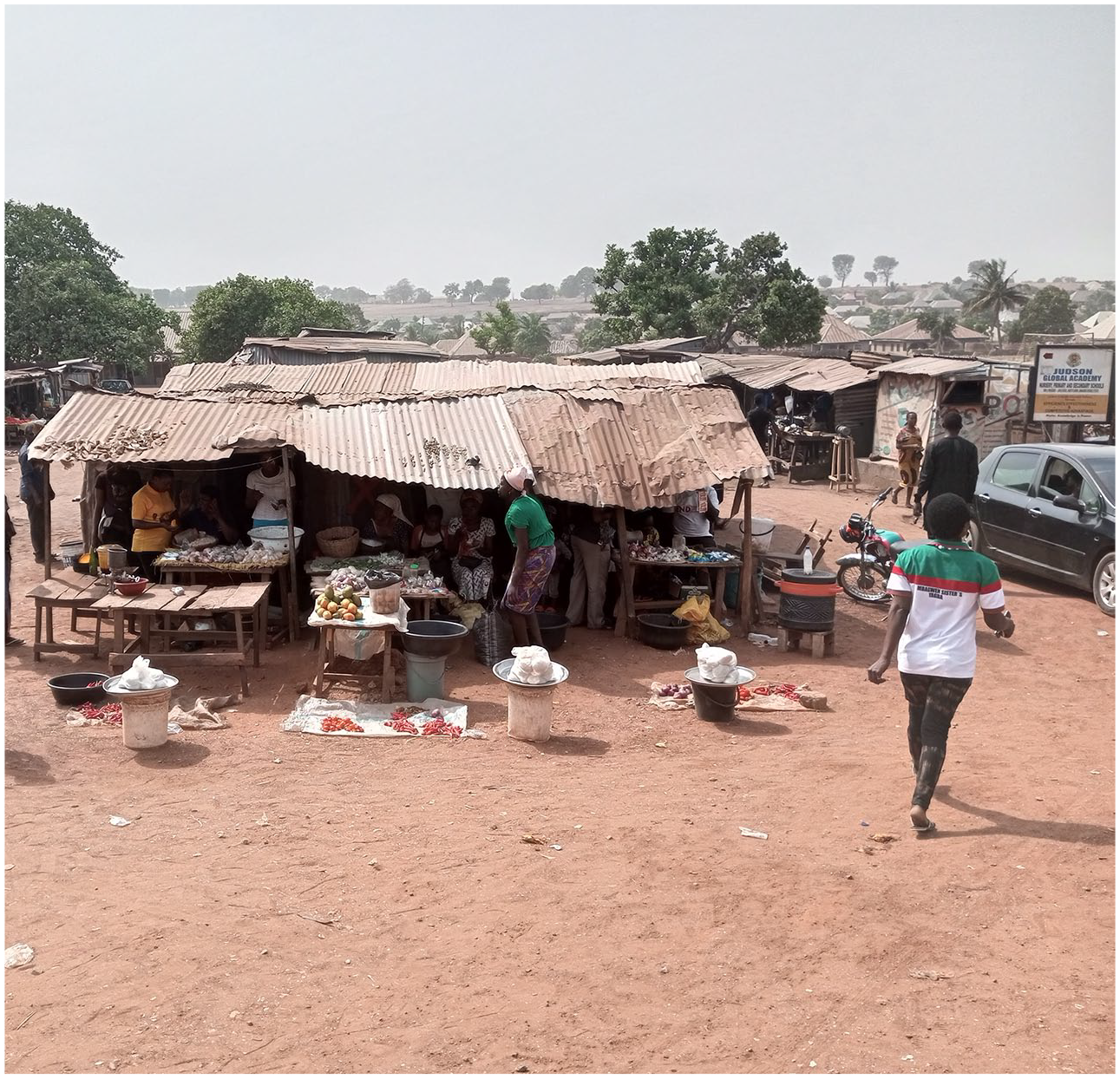
Makeshift stalls and patrons at the Utyondu market
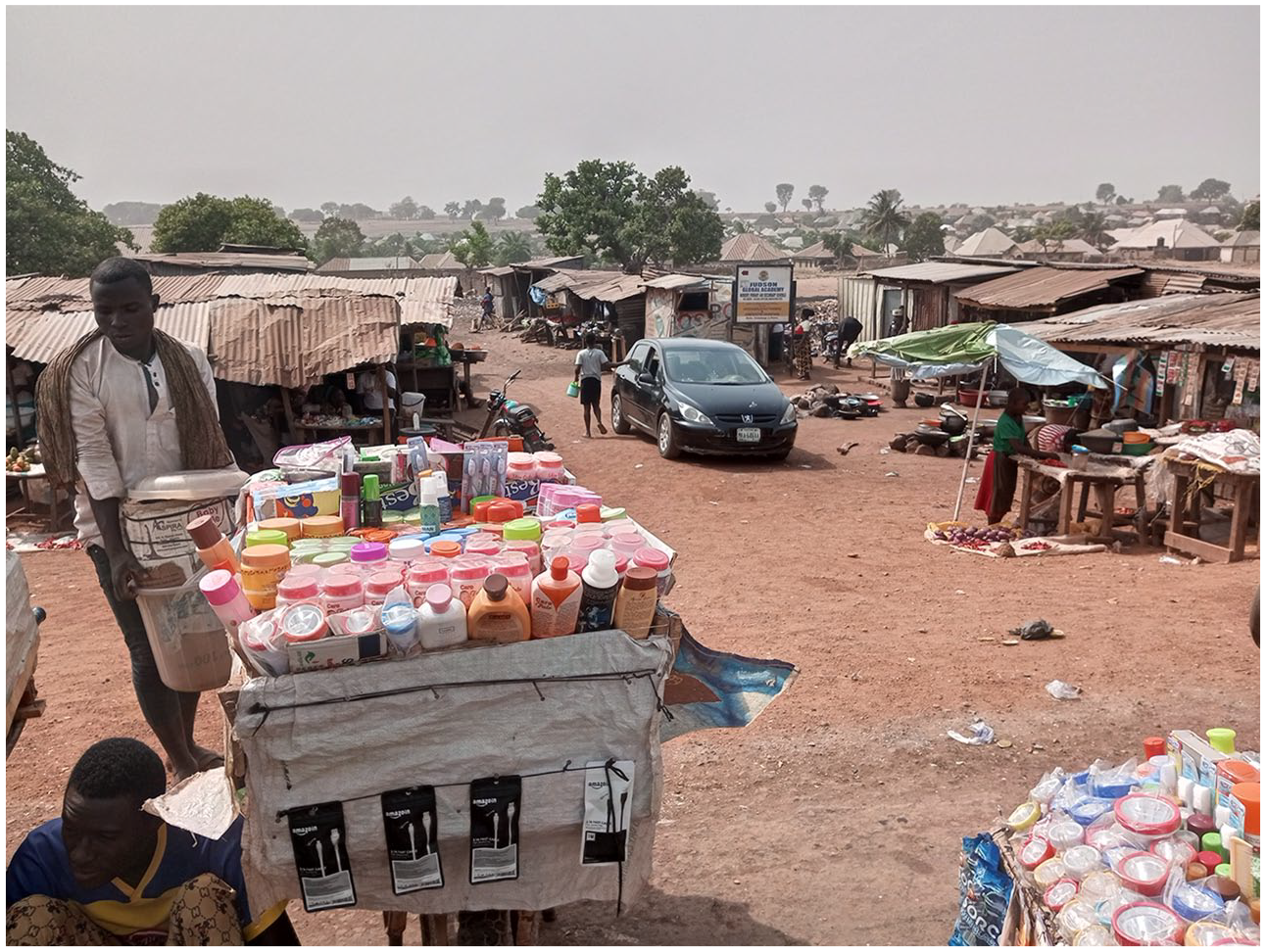
Traders displaying goods at the Utyondu market
Even though the market is informal and not officially recognized by the local government, revenue collectors occasionally visit the market to demand the payment of taxes to the government coffers. A representative of the market committee reported that they often plead with the revenue collectors, pointing to their IDP status, the temporary nature of the market and the lack of support from government as bargaining chips to evade payments to local government officials. No other engagement with local or state government officials, and no demands for bribes or threats of eviction by local/state government officials, were reported or observed. The weak enforcement of official regulations in Makurdi’s urban spaces, has contributed to the market’s endurance in this location for the last 10 years. In 1999, Kabeer argued that agency can take the form of bargaining and negotiation, deception and manipulation, subversion and resistance.(67) With the evasion of taxes, IDPs trading in the Utyondu market display their ability to negotiate and to deploy their vulnerability and the lack of government support to urban forced migrants as a strategy to subvert the systems of government and protect their livelihoods.
The avoidance of punitive taxation in the Makurdi market is reminiscent of the experience of IDPs in Kampala, where Monteith and Lwasa noted that informal markets may be more attractive to forced migrants because they offer “a sanctuary from restrictive systems of taxation and regulation”.(68) These experiences, however, differ from the situation in the Democratic Republic of Congo(69) where the payment of taxes in non-recognized markets was identified as a major challenge to market participation by IDP women.
The findings in Makurdi show that the IDPs ‘created’ the market by negotiating for the space, naming the market and constituting the management committee to oversee the day-to-day market activities. In Kampala(70) and Bukavu,(71) on the other hand, IDPs engaged in already existing formal and informal markets. These contrasting scenarios suggest that in Makurdi, IDPs set the rules of engagement and had more control over the actualization of their aspirations for self-reliance. The establishment of the Makurdi market is a demonstration of the resilience and agency of IDPs who identified a need and provided a practical solution to that need, thereby positioning themselves as service providers and potentially adding value to the host community and the city at large.
d. Targeting humanitarian and development programming to support urban IDPs’ livelihoods
The implications of the findings for policy and practice are discussed in this section. In Makurdi, as in other contexts, IDPs lack access to humanitarian assistance. Assistance by government and local or international humanitarian organizations is targeted only at displaced persons in camps. As mentioned in Mimi’s story and echoed by a number of other IDPs, some members of the host community have rendered assistance in the form of loans and job referrals. The lack of official support confirms that IDPs in towns and cities are a neglected subset of forced migrants. This underscores the need for governments, NGOs and other humanitarian actors to consciously develop programmes and interventions that support the quest for IDPs in host cities to diversify their livelihood strategies and attain self-reliance.
Currently, displaced persons in towns like Makurdi are left to negotiate their own survival in the new environments. As indicated in the preceding discussion, this has been done through the establishment of an informal market to create employment and sources of income-generation for IDPs and members of the host community alike. The UN Secretary-General’s high-level panel on internal displacement advocates that states and other actors recognize the rights and agency of displaced persons to drive their own solutions and to seek more deliberately to understand and promote the capacities of displaced persons.(72) The report also pointed to interviews with IDPs, who identified loans to start profitable businesses as a priority.
In Makurdi, the overwhelming desire of IDPs trading in the market is that the market will continue to thrive, and they look forward to receiving the necessary support for relocating and developing the market. Joy and Grace, who were mentioned earlier, noted that they would like to go back to their rural community when the conflicts are over, but hoped that the market would last and remain their legacy for the host community. They expressed hope the market would not be closed when they left but that it would grow and expand and be handled properly by members of the host community. They indicated that if the government or any other interested organization were willing to assist in contributing to the growth and expansion of the market, they would not refuse, saying that it is progress that they want.
The experiences of IDPs in Makurdi offer possibilities for rethinking humanitarian assistance. IDPs can be supported through interventions beyond the usual provision of food, shelter and cash transfers to IDPs in camps. In cases like Makurdi, government intervention could take the form of acquiring the Utyondo market land on behalf of the traders, getting the market registered and providing basic amenities and services there as incentives for self-reliance and to discourage a culture of dependency. Livelihood interventions, such as interest-free or low-interest loans or microcredit schemes, could be introduced to boost the capacity of IDPs to take up or expand already existing income-generating activities. The restriction of humanitarian assistance to food, shelter and cash suggests a narrow conceptualization of the kinds of programmes that could be most helpful in improving the living conditions of urban IDPs.
An example in Somalia reveals that displaced persons preferred support in the form of safe and affordable housing and transport as well as childcare – which in turn would allow them to seek out their own livelihoods.(73) It is imperative that states, donors, policy makers and practitioners co-design interventions with displaced persons to ensure that the right priorities are targeted. The promotion of the objective of self-reliance should not be viewed as a justification to withhold assistance from urban displaced persons; rather, it should be seen as an opportunity to understand and prioritize the specific needs of IDPs as they work to become self-reliant. This study contributes to and advances emerging discourses in the literature that focus on rethinking policies and practical interventions that target self-reliance for forced migrants in African cities and beyond.
V. Conclusion
Drawing on fieldwork in Makurdi, central Nigeria, this paper examined one of the livelihood strategies that IDPs in cities adopt as they seek to achieve economic integration in their new host communities and to attain self-reliance. The paper argues that IDPs apply their agency to create pathways for self-reliance in contexts where they have little or no access to humanitarian assistance, whether from governments or local and international organizations. The study contributes to the extant literature on displaced persons’ capacities, economies and self-reliance.
Findings from the study reveal that urban IDPs in Makurdi town negotiate livelihood opportunities through self-help efforts and render valuable service to their host community, rather than remaining dependent on their hosts for food, money and other basic necessities. Though they remain invisible to the local government, they channel their agency and resilience to produce possibilities and spaces of inclusion and sustenance as exemplified by their establishment of a local informal market in Makurdi. Besides trading in the informal market they created for themselves, they also seek low-skilled employment in the city, and engage in farming in surrounding communities. Their individual and collective agency has been manifested in their ability to set goals in order to provide food and other basic needs for themselves, and to mobilize resources to this end, whether by selling off food items to raise income or capital or turning to their social networks. This includes seeking job referrals from neighbours and turning to translocal connections in other communities to sustain their livelihoods and survive in the city. Traders at the informal market also apply other forms of agency like negotiating with government officials to evade the payment of taxes, thereby protecting their livelihoods.
Despite these efforts by IDPs in Makurdi, it is evident that a more coordinated approach to leveraging the capabilities and agency of urban IDPs would achieve more lasting results. As Lyytinen observed, there is a need to develop a framework of integration by strengthening the capacity of urban areas and their institutions and partners to deal sustainably with IDPs who move into cities and adopt self-help measures to reduce their vulnerabilities and build resilience.(74) Understanding the livelihood strategies that IDPs turn to while living in displacement can help guide the development of targeted interventions that address the priorities of displaced persons in their quest for self-reliance.
Footnotes
1.
An edible potato-like tuber grown in West Africa.
3.
10.
13.
Crisp, Morris and Refstie (2012), page S26.
28.
29.
Kabeer (1999), page 438;  .
.
56.
Nguya (2016, 2020); .
59.
See Higazi (2016); Adzande (2021, ).
66.
Values as of July 2023.
69.
Nguya (2016, ).