




Abstract
This article is based on a research project led by the International Institute for Environment and Development (IIED) on shelter in East Africa. It explores Mogadishu’s history, political settlements and variations in housing to inform more inclusive, affordable shelter interventions.
•
•
•
Keywords
I. Introduction
“How do vulnerable people access shelter in Mogadishu - Africa’s most densely populated city?”
(1)
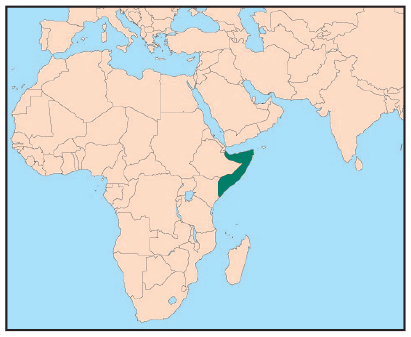
This is the question this paper seeks to answer. It draws on a larger study,(2) which focused on shelter provision in the cities of Nairobi in Kenya and Hawassa in Ethiopia as well. This paper explores the history of Mogadishu (Map 1), its political settlements, and variations in housing conditions, in order to generate new insights that can inform more inclusive and affordable shelter interventions. In addition, the research process has provided opportunities for knowledge sharing and spaces for dialogue between communities and local officials, using shelter as an entry point to foster more responsive local governance. The research was designed to identify policy-relevant, locally driven solutions to improve shelter at scale for vulnerable groups, including low-income women and men, displaced people, and people with disabilities. The qualitative methodology underpinning the study allowed for a fine-grained understanding of the ways that gender, poverty, displacement and ethnicity can act as major axes of discrimination that impede access to land, shelter and services in East African cities.
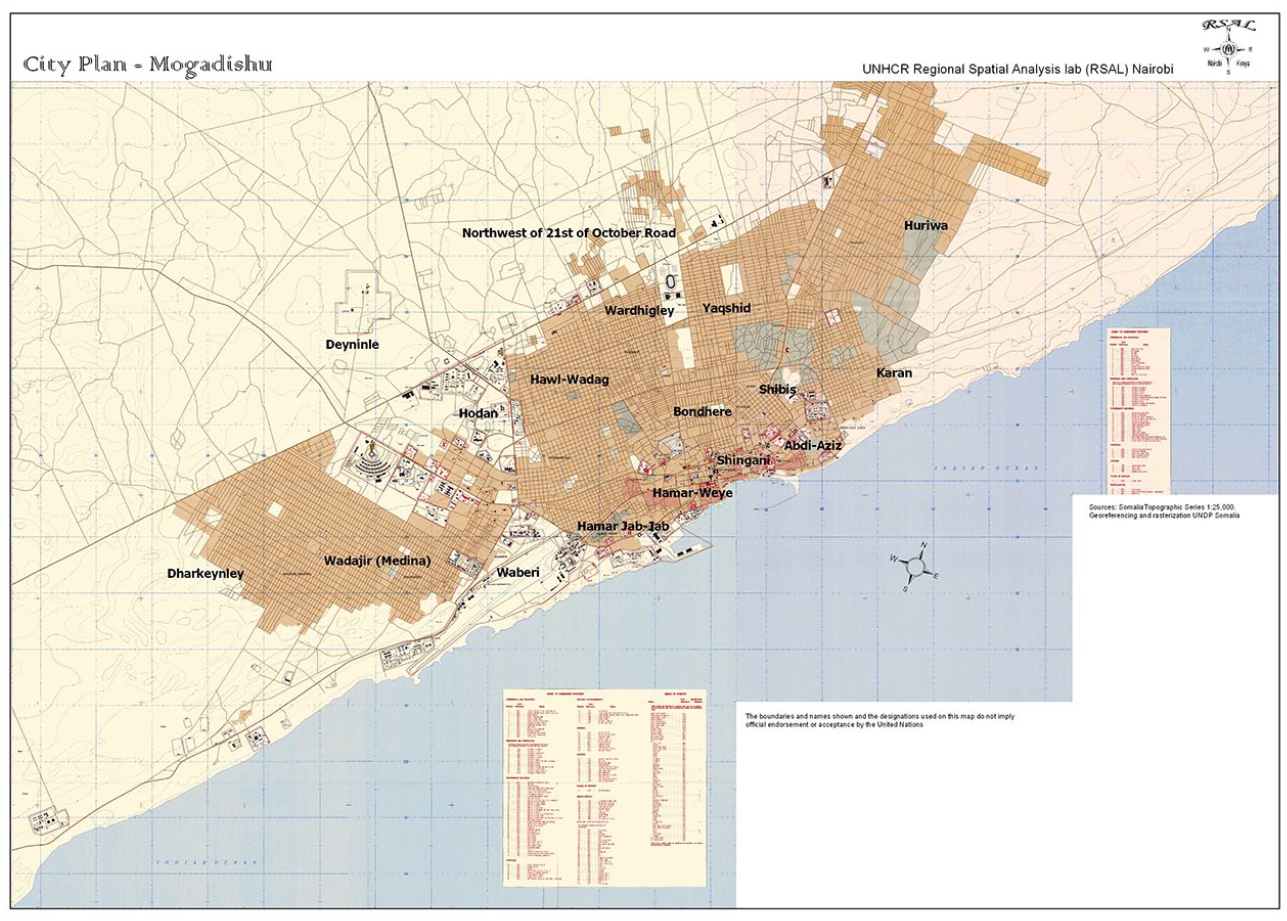
City plan of Mogadishu
II. Background: The History of Mogadishu
Mogadishu’s history is believed to go back at least as far as the 10th century, when Iranians from Shiraz founded this coastal city to trade with the Arabian Peninsula, Persia, India and China.(3) As in many African countries, the current borders around Somalia have little resemblance to the distribution of the ethnic Somali people who are also present in the neighbouring countries of Kenya, Ethiopia and Djibouti. During the colonial period, Somalia was divided into northern British Somaliland and southern Italian Somaliland. On 26 June 1960, Britain granted independence to the north. Four days later, the Italian-administered UN Trusteeship Territory of Somalia achieved independence. On 1 July 1960, the people of the former British and Italian territories united to form the Somali Republic.(4)
At independence, the population of Mogadishu was estimated to be 90,000. By the 1980s, shortly before the collapse of the Siad Barre government, it had grown to one million, with unplanned informal settlements mushrooming, and the inhabitants living in cramped, unhygienic conditions with no access to basic services. Between 1970 and 1984, the central area grew from 1,500 to 8,000 hectares.(5) The city was divided into 13 districts and subdivided into departments (waah), sections (laan) and neighbourhoods, and most districts became dominated by one or more particular clans.(6) The city currently has 17 districts. Somalia adopted a Provisional Federal Constitution in 2012 that envisages the establishment of a federal system of government with regional states. The status and boundaries of Benadir Region, whose capital is Mogadishu, remains unclear and highly contested in the ongoing federalization process.
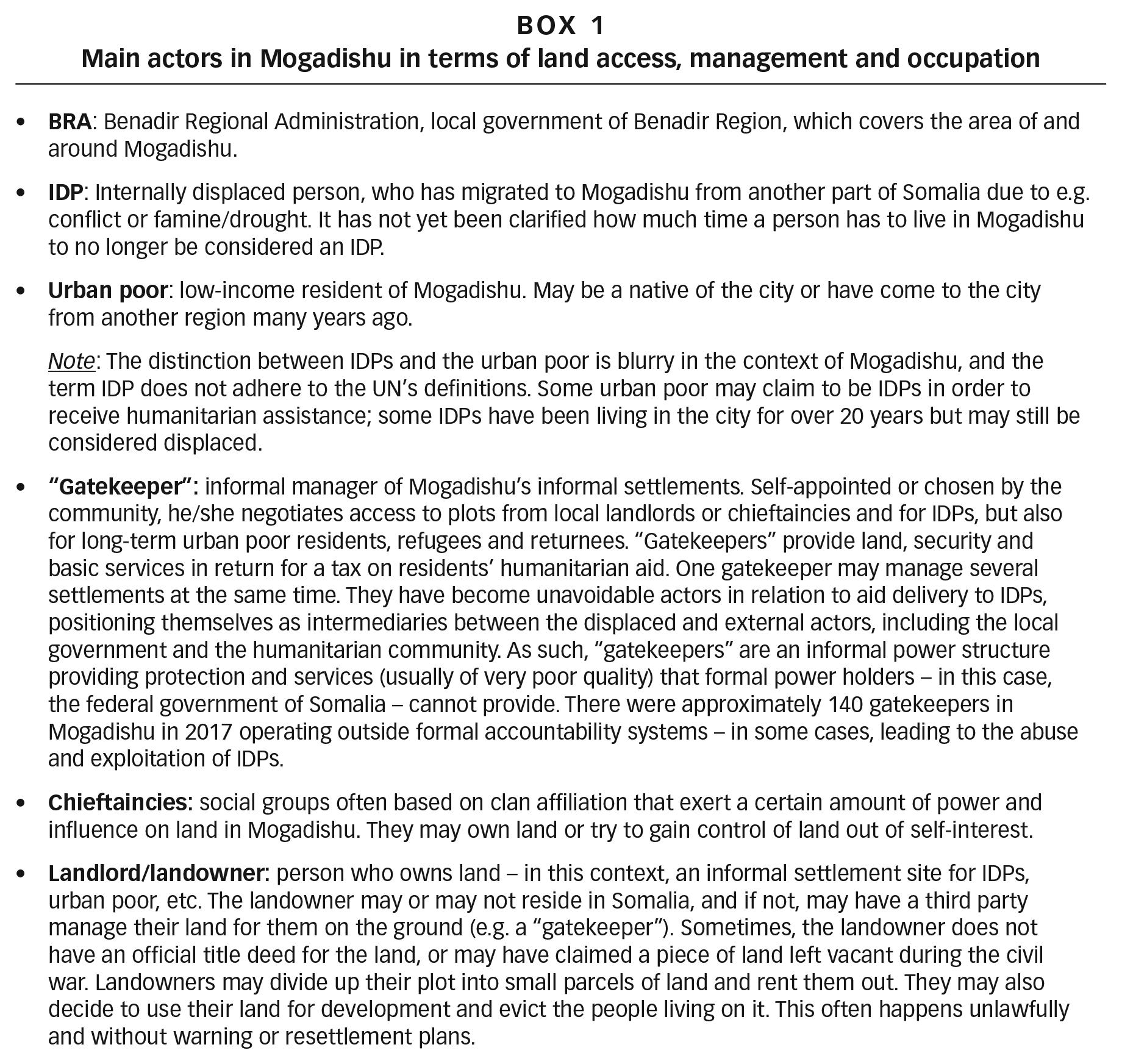
Unlike many other countries afflicted by conflict and displacement, Somalia has no UN-administered camps for internally displaced people (IDPs). The high levels of insecurity after the collapse of the government in 1991 and the withdrawal of the United Nations Operation in Somalia from the country in 1995 meant no UN presence to organize the housing and support for those displaced by the conflict. Rather, local Somalis took on this task – leading to the eventual growth of the “gatekeeper” system (Box 1).(7) The UN started negotiating a return of access to Mogadishu in 2006, but with the fall of the Islamic Courts Union (which attempted to break the stranglehold of the warlords over the city) and the rise of al-Shabaab,(8) security again degenerated. With the famine of 2011–2012, agencies again had access to the city, by which time the “gatekeeper” system was well established in the face of weak or collapsed government structures.(9) Various interventions by international and regional actors led to the setting up of a transitional national authority, which governed Somalia between 2004 and 2012, when the Federal Government of Somalia (FGS) was officially inaugurated.
Main actors in Mogadishu in terms of land access, management and occupation
III. The Research
The Mogadishu case study focused on six settlements in three districts of the city. It spanned two years and involved qualitative and quantitative data collection in three different phases:
1) A desk study phase assessed existing legislation, reviewed previous research and identified gaps that needed to be addressed.
2) The first field research phase included: (a) semi-structured interviews with key informants from government and development agencies as well as representatives from banks, notaries, real estate developers and private utility companies, (b) a number of cross-city excursions aimed at identifying shelter types and spatial patterns of Mogadishu, and (c) a cross-city questionnaire survey interviewing residents of different shelter types across the city identified in the excursions. The findings from this phase were validated through a workshop with Benadir Regional Administration (BRA) and private sector representatives.
3) The second field research phase focused on six selected settlements across three districts (Kaxda, Hodan and Daynile), ranging from the centre to the periphery of the city, and housing poor urban residents or people classified in Mogadishu as IDPs. Semi-structured interviews were conducted with 63 older and younger members of male and female-headed households. Four focus group discussions (with two groups of 10 women and two groups of 10 youth) were also conducted, followed by social mapping exercises with groups of women and young men from two of the three districts, Hodan and Kaxda, which also host a large number of IDPs. Through the social mapping exercise,(10) the participants were asked to draw their settlements and to describe their external living spaces, in a bid to identify social and spatial patterns.
The security situation in Mogadishu limited access to some parts of the city and this may have biased the results vis-à-vis locations visited and people interviewed. The team sought to mitigate this through triangulation with other actors working in the areas, and is of the opinion that the research is representative of the situation in and around informal settlements in the city.
IV. Mogadishu Today
The current security situation in Mogadishu fluctuates. Frequent terrorist attacks perpetrated by al-Shabaab plague the city, but predominantly target government buildings or the offices of donors or international organizations, not the general population. Today, Mogadishu is controlled by troops from the African Union Mission in Somalia (AMISOM),(11) and movement within the city is still restricted; but the situation has improved considerably over the last few years. However, insecurity in informal settlements is rife, as local police forces struggle to protect residents from robbery, theft, assault, gender-based violence, trafficking and murder.
The end of the transition period in 2012 and liberation of the city from al-Shabaab have triggered reconstruction and development initiatives – supported not only by the international community, but also by the Somali diaspora. These have resulted in increased population growth in the city, buoyed by some improvement of the security situation as well as economic opportunities driven by a revived private sector. Businesses are opening, markets are bustling, tourism is developing and local residents can walk freely on the streets within the limits of AMISOM’s curfew. Along with agriculture, growth in areas such as telecommunications, construction and money-transfer services is credited with contributing to this new impetus. Land prices are estimated to have increased as much as tenfold since 2012.(12) Several factors underpin this rapid price increase:
1) Confusion over ownership and entitlements and official rules governing land and property, creating a situation where speculation and the ability to pay go a long way in determining property ownership
2) Irregular acquisition of public land by private actors
3) The influx of IDPs
4) The increasing numbers of returnees (including diasporic Somalis) seeking to reclaim their property
5) Finally, the presence of foreigners, including from international development agencies, as they can pay higher prices for properties
A 2014 population estimation survey(13) found that of all the regions of Somalia, Benadir Region (covering the same area as the city of Mogadishu) had the highest proportions of urban residents (77.6 per cent) and internally displaced people (22.4 per cent) in the country. (A 2018 estimate indicated the urban population stood at 45 per cent in all of Somalia,(14) pointing to the rapid urban increase over a short period.) The continued influx of people into the city puts enormous pressure on the already fragile urban systems and infrastructure, causing people to settle in informal settlements in and around the city.
In 2017, over 480 of these settlements were spread across Mogadishu.(15) Most of them are located in the northwestern part (e.g. Hodan and Daynile Districts), though there are also some in the centre (e.g. Shangani) and southwest (e.g. Kaxda). Living conditions in these settlements are dire. Housing consists predominantly of corrugated metal sheet shacks or so-called buuls, temporary shelters made of sticks, plastic and fabric.
The residents are primarily displaced people from other Somali regions who have moved to Mogadishu and other major cities of Somalia for several reasons. Some are fleeing conflict and the control of al-Shabaab; economic migration is also an important factor. Unpredictable climatic conditions leave the country prone to frequent bouts of drought and floods, all of which deplete people’s productive assets – animals and farmland – resulting in very low resilience. Many who lose their ability to survive in the face of recurrent shocks move to the cities, where they are considered to be IDPs, as explained below.
However, poor Mogadishuites are also being pushed into informal IDP settlements as land and real estate prices have skyrocketed and they can no longer afford decent housing. These settlements often lack proper buildings and the most basic services (electricity and access to water and sanitation).
a. Political settlements around land and shelter
The concept of political settlement can be defined as “the formal and informal processes, agreements, and practices that help consolidate politics, rather than violence, as a means for dealing with disagreements about interests, ideas and the distribution and use of power”.(16) These processes “play out across two levels, involving both intra-elite and elite-non-elite relations”.(17) This concept is very useful in understanding the different systems governing land rights and access to shelter in Mogadishu, and in mapping the many formal and informal actors involved.
The political settlement around shelter and land in Mogadishu poses a particular challenge for new migrants and IDPs. Tana’s research has shown that the IDP label is not used in accordance with the UN IDP guidelines.(18) Instead, newcomers to the city in the last 20 years, especially if they are low-income, and do not have relatives in Mogadishu, have been classified as IDPs, even though they are, in fact, poor urban residents. The research has also identified an unholy alliance of different actors in Mogadishu, which ensures that the IDP classification remains, and that IDPs remain largely in the informal settlements on the outskirts of the city.
There are reasons for this. First, relinquishing the term IDP would put many NGOs assisting humanitarian agencies and their work in Somalia in jeopardy, eliminating their raison d’être. Second, accepting IDPs as full residents of Mogadishu would interfere with the clan balance in the city, and compromise the political power balance among some actors in the city.(19) Despite this, there is some potential for integration of those who can afford eventually to move out of the settlements.
Local respondents also mentioned other factors that help to retain the IDP status quo in Mogadishu:
Local landowners benefit from the “gatekeeper” schemes and see the value of their property increase with population growth. The IDP status means that a social and economic ecosystem develops around them in terms of provision of services, setting up of small shops, community organizing, etc.
Local humanitarian service providers have a business interest in delivering humanitarian assistance, and benefit from having IDPs in the city.
Dominant chieftaincies want to maintain the status quo for future control of Mogadishu and thus prefer that “newcomers” retain IDP status.(20)
Residents are better able to access (some) humanitarian assistance as IDPs than as urban poor. And of course, the “gatekeepers” who make a living from the IDP situation by taxing IDPs in return for the provision of safe shelter prefer the status quo.(21)
For this research, attention was focused on the urban poor – defined to include both the long-term urban poor residing in the city centre and the newcomers classified as IDPs.
According to the BRA, there is a need for land on which to locate public services, and on which they can settle migrants and IDPs as a long-term solution to the protracted IDP situation in Somalia. The lack of a comprehensive land registry and the influence of informal power holders (local chieftaincies, “gatekeepers”, guarantors, etc.) makes land allocation a challenge for the city in terms of providing land for shelter for the poor and IDPs. However, research excursions through the city demonstrate that there is unoccupied land available in Kaxda and Daynile Districts. According to interviews with BRA and other resource persons, however, this land has already been “grabbed”(22) as “community land” by powerful local chieftaincies. Interviews revealed that for many Somalis, landownership is entwined with a sense of belonging and identity; given the historical use/misuse of land by the Barre regime, it remains an explosive topic. This also means that repossessing this grabbed land would need careful negotiations with the local chieftaincies.
V. Shelter in Mogadishu
a. Housing and services
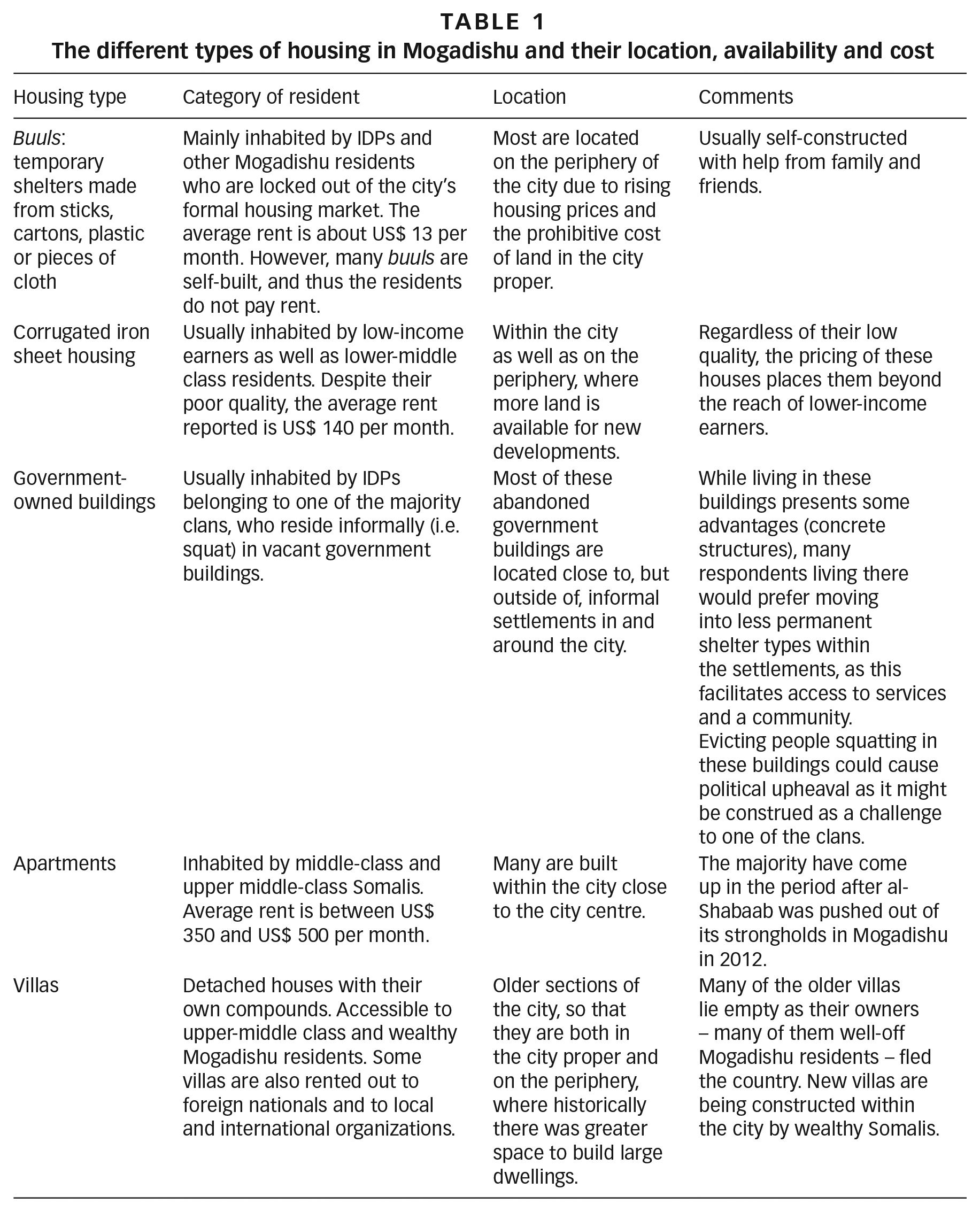
The city’s shelter options take a range of forms, described in the typology laid out in Table 1.
The different types of housing in Mogadishu and their location, availability and cost
b. Service provision
Until its collapse, the Siad Barre government was responsible for service provision in Mogadishu. While electricity and water supply are more expensive now, they are considered more reliable than under the Barre regime. Where they exist, private water and electricity service providers use old government installations for their supply, but many of these are poorly maintained and require new fittings (with pressures on service delivery heightened by the city’s growing population). Planning permission and building inspection are not enforced, resulting in access concerns – especially in relation to new water pipes, extended connectivity and sanitation facilities.
c. Land transfers and ownership
During the civil war, much of the privately owned land in Mogadishu was abandoned and property titles lost. Many owners who later returned to claim their land found it occupied by other people, or claimed by the government. While notaries and the BRA are responsible for keeping records on property and rental housing in the city, it is difficult to know exactly how much land is privately owned and by whom, as land transfers have been taking place outside of formal procedures for many years. A summary of the current situation with regard to access to and ownership of land and property is provided below:
According to Somali civil law, landlords can only evict tenants who violate a tenancy contract, or otherwise by mutual arrangement, if a formal agreement exists and has been registered with a notary. Even where a contract exists, application of the law, according to interviewees, is patchy at best. If no formal agreement exists, then the landlords can act as they see fit.
From the 1960s to 1991, a land registry and cadastral records existed, and were held by the municipal authorities. However, these records are now in the possession of a diasporic Somali living in Sweden who – through his office in Mogadishu – charges a percentage fee for the verification of deeds.(28)
d. Access to finance
People have greater trust in real estate than in other investment avenues, and prefer it to using banks – especially since, after over 20 years, formal banking is only just returning to Mogadishu.
Banks and a few real estate developers provide housing finance. However, only 15 per cent of the population have accounts with formal banks,(29) and the more vulnerable residents in Mogadishu lack access to formal housing finance. This is because the borrower is required to raise 20–30 per cent of the value of a property as a down payment, and to be represented by a suitable guarantor who can vouch for the individual and is of good standing in the community. Borrowers must also show identification (ID or passport), proof of a regular income, and the availability of collateral (in the case of non-property loans). The majority of bank loans are payable within 36 months.
These requirements put financing beyond the reach of the majority of Mogadishu’s residents. The poor cannot raise the necessary 20–30 per cent, many lack identity documents, and most IDPs have difficulty identifying a guarantor with sufficiently good financial standing to be acceptable to the banks. In the absence of access to formal housing finance, vulnerable groups usually rely on their networks to find the money. They may borrow small sums from friends or relatives, sometimes in the form of remittances from other parts of the country or abroad. None of the informal settlement residents interviewed has used a banking institution of any type to access housing finance.
VI. People Affected by Displacement and Other Vulnerable Groups
Although most IDPs fall within the category of the poor in Mogadishu, there is as yet no commonly understood agreement on when one ceases to be an IDP. For those who have been displaced for over 25 years, the question remains as to whether they can still be referred to as IDPs, and this creates difficulty in establishing who are long-term residents and who are IDPs. Other categories of the urban poor are people who have lived in Mogadishu for their entire lives, refugee returnees from neighbouring countries, and a small proportion of refugees from Ethiopia and Yemen.
With regard to IDPs, apart from a few cases, such as the BRA-administered IDP settlement in Kaxda District,(30) IDPs primarily reside on privately owned land, the majority having been evicted from government land and property. Through “gatekeepers”, IDPs gain access to small plots of land on which to build their shelters. These “gatekeepers” arrange to rent land from private owners and negotiate the means of payment for all who choose to reside on the property.(31) Lease terms are insecure and with the growth of Mogadishu and rising land prices, evictions have become rampant.
Mogadishu’s informal settlements offer no tenure security to their residents, and forced evictions are a huge threat to IDPs and the urban poor. Benadir is the most affected: by March 2019, there had already been 60,157 evictions in the region since the beginning of the year.(32) The vast majority are forced, with only very few lawful evictions or evictions involving dignified relocations. In the majority of cases, evictions happen when private owners seek to develop their land, where, as often happens, the residents have no formal (written) rental agreement. This causes intra-city migration flows from district to district.(33) Most of these intra-city flows take place between three of the Mogadishu areas with the highest concentrations of IDPs – Kaxda, Hodan and Daynile – and the city centre (Dharkenley), where it is easiest to secure casual employment.
The influx of IDPs is perceived to have generated demographic changes in some locations, with clan concentrations diminishing and the resulting population being more diverse than before the city’s liberation from al-Shabaab in 2011. In some cases, the living conditions of IDPs and the urban poor are similar in terms of housing quality and access to services. Having an ID, however, is usually a prerequisite for land and housing transactions, and this presents a significant barrier to accessing housing in the city for IDPs and the small numbers of refugees and returnees. Realizing their needs for protection, ID cards, and land and services, the BRA in January 2019 launched its first IDP policy outlining the rights of IDPs and the obligations of the BRA, NGOs and other stakeholders. The BRA has recently developed a set of settlement management guidelines,(34) which will guide the implementation of this policy.
a. Case study of Alkodhar, an informal settlement on the outskirts of Mogadishu(35)
Alkodhar is located in Kaxda, a new district on the city outskirts formed in 2012. Kaxda, along with Hodan, hosts the highest numbers of IDPs in the city.
IDPs are responsible for building their own shelters, but many receive initial help from the ‘gatekeepers’, also referred to as informal settlement managers (ISMs), or from friends and relatives. In the IDP settlement, most shelters are temporary buuls made from sticks, cartons, plastic or pieces of cloth. For most IDPs, these are the most affordable option, rented for US$ 2–30 per month, based on the size of the plot. Since the IDPs construct their own shelters, the rent is not for the structure but for the plot on which it is located.
Access to electricity is limited; most IDPs use solar lamps (provided by NGOs) or kerosene lamps. A few who can afford it also have battery-powered lamps. There are no streetlights.
There are communal water taps built by NGOs, but not enough, so the IDPs have to access water from expensive mobile vendors. Some entrepreneurial businesspeople have wells from which they pipe water to the settlement at a cost. Sanitation is a challenge. The settlement has seven free-to-use latrines for 307 households, and queues are long, especially in the morning. Many residents have no choice but to use the bush, and at night this is a security risk for women and girls. Women prefer to live in the centre of the settlement where they feel better protected, especially at night. It is also closer to the latrines and water taps. At night, a number of male IDP volunteers patrol the settlement to keep out potential criminals.
Exacerbating the sanitation problem is the lack of a garbage collection service; using private companies is too expensive. Garbage is burnt just outside the settlement and there is a lot of litter around the settlement, posing a health hazard, especially for children who play in these locations.
Most of those interviewed expressed a desire to relocate closer to the city proper, to access services and livelihoods. But the need for secure tenure was more pressing. Respondents also indicated the need for more local authority involvement in the welfare of IDPs, especially with regard to them having a “voice” in Mogadishu and advocating for better access to services. For now, local authorities are absent from the settlement, and residents do not feel that their voices are heard or represented at the local authority level. They rely on their ISM to advocate for their needs, which can be tricky given the controversial nature of the ISM role – some humanitarian organizations are reluctant to work with them.
The relative safety and affordability of the settlement mean that most IDPs prefer to be located there rather than trying to survive on the outskirts of the city outside these fenced-in neighbourhoods. The location presents a challenge in terms of accessing livelihood opportunities in central Mogadishu, however. Road infrastructure to the area has yet to be developed, making transportation problematic in terms of cost and access.
Despite the settlement being congested, the area surrounding Alkodhar is sparsely populated, posing a security risk for the sentence should continue on the same line those venturing further on their own, more so for unaccompanied women and girls. To travel to the city, most women indicated that for security they band together to walk to the main road for transport, and share the cost of the vehicles.
b. Other types of exclusion
In terms of access to housing in Mogadishu, the biggest discriminating factor is wealth. Any person who cannot afford property or rent can be considered vulnerable, because of the limited options and the likelihood of having to find shelter in the city’s informal settlements or poorer sections of the city.
IDPs make up the majority of the informal settlement residents, but the city’s poor also reside there for similar reasons: affordability of shelter, access to services, and security. Within these two groups, there are cross-sectional categories of vulnerable people: female- and youth-headed households, people living with disabilities (PLWD), and also young single men. Somalia’s patriarchal society limits women’s rights and opportunities to access decent housing, and the poor infrastructure in the settlements does not cater in any way to the special needs of physically or mentally disabled people. Young men often carry the stigma of being likely to cause trouble or to join the ranks of al-Shabaab, so are denied access to shelter.
During our in-depth interviews with vulnerable people from these categories across two informal settlements in Mogadishu, different ways of accessing housing emerged:
While people in these different categories of vulnerability are all dependent on external support in accessing shelter, whether from relatives/communities or humanitarian organizations, young single men seem to be the most isolated from personal networks on this front. During social mapping exercises, young men explained that when seeking shelter in the settlements, they have to bring a guarantor before being allowed to move in, given all the negative perceptions associated with young men. Finding a guarantor can often prove difficult, as this person is responsible for the young man in case an incident occurs. It is especially difficult to be accepted into the camp when one is an IDP or has no family ties in the settlement. Often, young men are not let in at all, on the suspicion that they will cause trouble. When they do find somebody to vouch for them and are allowed in, they will often be relegated to disadvantaged areas on the outskirts of the settlement.
Patriarchal values have wider implications for women, as they create a system of inequality in many aspects of society that limits women’s access to shelter. Women are very dependent on men to acquire property, rental housing or even temporary shelter. During semi-structured field interviews, several women expressed comments like: “Women can’t fight as aggressively for their right to land as men can”. They have significantly fewer economic opportunities that would enable them to afford housing by themselves; they also have less access to relevant personal connections necessary to acquire housing than men. A personal connection can sometimes be the most valuable asset for women trying to secure shelter: a charitable neighbour is more likely to offer help to a single, widowed or divorced woman than to a man, especially if she has children.
PLWD are another especially disadvantaged group in all areas of social and economic life in the city. Consideration of their needs is almost nonexistent. Currently, there is no specific national legal or policy framework regarding PLWD, although the Provisional Constitution does recognize and provide for the protection of their rights.
VII. Conclusions
The study documents the lack of a coherent system for developing and managing land and shelter in Mogadishu, with the poor and displaced bearing the brunt of this state of affairs. Land, a significant factor in shelter development, has been and continues to be one of the key causes of conflict in Somalia; and considering the history of property and land ownership, especially in Mogadishu, the process of formalizing and ensuring a single and transparent process towards regulating this valuable resource would likely shake up the existing political settlement in Mogadishu. This partly explains the present system of shelter production. Access to land and shelter is managed through a mix of formal and informal processes all related to tightly controlled networks and money flows. For this reason, any attempts to change this status quo have fallen short in terms of enhancing transparency and accountability in the processes, around land and property transactions, access and usage.
Despite this, for the average Mogadishu resident, the mix of systems for managing shelter and land needs allows for some degree of flexibility. However, multiple formal and informal actors are involved in undertaking land and property transactions; and securing one’s family a safe place to stay, with access to work and services, is heavily dependent on financial situations and relationships with the people residing in the desired area.
This research has also documented the difficulties faced by the most disadvantaged in accessing shelter. This includes, first, IDPs, particularly newer arrivals, who face the greatest challenges in terms of accessing secure tenure, services and livelihood opportunities. People who have resided in the city for longer and have the right personal networks can manage to remain closer to the city centre with better facilities and services, though this group also faces considerable hardship. The distinction between IDPs and the urban poor is not always clear or helpful, and the label of IDP can be loosely applied – and with different motivations – by the various actors operating in Mogadishu. Among IDPs in particular, three groups emerged as being particularly vulnerable: single/widowed/divorced women and female-headed households, young men and youth-headed households, and PLWD. For these groups, accessing shelter is especially challenging. In the case of young men, they are further disadvantaged by the limited attention of humanitarian and other aid agencies to their shelter needs.
The challenges around ensuring durable, affordable and secure access to shelter are closely linked to the lack of clear leadership in the development and implementation of relevant policies and regulations. The roles and responsibilities of different authorities managing shelter and related policy and planning in Mogadishu – from the FGS to the BRA and private service providers – need to be clarified, agreed upon and turned into law, preferably starting with the updating of the constitution currently under review. Key to this process will be to ensure that, once and for all, land rights and registration are anchored in the constitution and that, from the state down to the municipal level, the relevant legislation is developed. Taking into account the political realities at play in Mogadishu, this change will not happen overnight. There are vested interests around relationships, networks and land speculation, and concerns around security. Local actors, especially informal power holders, are keen to maintain the status quo. Thus, any change is likely to be incremental over the medium to long term and non-linear, as has been the practice in Somalia for decades.
There is movement towards improving formal shelter access in Somalia more generally, with Parliament discussing land and housing policies as well as national policies for IDPs. In Benadir specifically the BRA is launching a new IDP policy and drafting settlement management guidelines. Similarly, at the private sector level, monopolies (e.g. in the electricity sector) are being challenged by new companies, paving the way for more competitive and therefore affordable services. These developments will likely only bear fruit over the long term.
Footnotes
Funding
The research was funded by the UK Department for International Development’s East Africa Research Fund (EARF) and contributed to EARF’s programme of research: Shaping East African Cities as Systems to Work Better for All. This material has been funded by UK aid from the UK government. However, the views expressed do not necessarily reflect the UK government’s official policies.
