



Abstract
The actions of diverse urban reform coalitions, driven by grassroots organizations, federated networks and social movements, have generated new articulations of urban knowledge and practice. Working collaboratively across urban stakeholders, movements have negotiated diverse forms of expertise, highlighting the contested epistemologies at the heart of urban interventions. This paper explores the work of one such urban reform coalition operating at regional scale – the Asian Coalition for Housing Rights (ACHR) – a network of grassroots community organizations, NGOs and professionals pursuing community-led development across Asian cities. It draws on rich reflections from founders and members on the shifting strategies deployed over time to build a trans-local urban reform coalition, including the grounded tools, collective learning processes and critical emotions informing how actions are undertaken. The paper reflects on how the circulation of knowledges across scales has been vital in consolidating and extending regional solidarities as a route to urban equality.
Keywords
I. Introduction
Across the global South, the mobilization of grassroots organizations, federated networks and social movements to challenge deep and historical injustices has generated new articulations of urban knowledge and practice. Engaging in ‘insurgent’, ‘lived’ or ‘everyday’ actions,(1) diverse groups have worked across alliances in efforts of collaboration and contestation to address deep urban inequalities through mapping, enumerations, infrastructure and housing projects, and collective savings. A key value of what Mitlin has called “urban reform coalitions”(2) lies in their working across different forms of expertise, including that of technical professionals in state agencies and civil society organizations and private sector actors, while remaining rooted in and driven by the priorities of excluded urban poor groups. Spanning these multiple knowledges to address material inequalities, these coalitions have engaged with power dynamics, either explicitly or implicitly, shaping whose knowledge is seen as legitimate in negotiating and addressing urban challenges.
Increasingly, such locally rooted coalitions transcend geographies, building transnational alliances to share knowledge-in-practice across borders.(3) This crossing of scales raises key questions for trans-local urban reform coalitions: What value is there for local groups to engage across scales? How can learning and sharing respond to differential political opportunities and constraints? How can regional or global alliances further locally specific actions? This paper dialogues with such interrogations, adding to the rich set of reflections focused on urban reform movements at local and national levels, and exploring the value, consolidation and challenges of urban reform coalitions operating trans-locally.
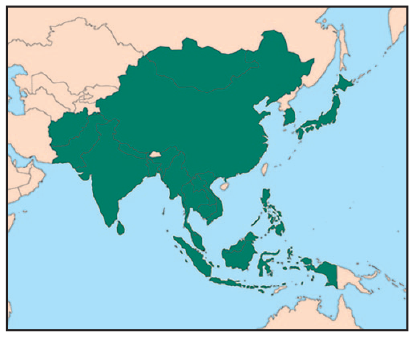
Specifically, the paper considers the case of the Asian Coalition for Housing Rights (ACHR) and traces the practices through which it has produced, translated and mobilized diverse knowledge(s) across scales, actors and geographies. The ACHR, established in 1988, is a regional network of grassroots community organizations, NGOs and professionals involved in alternative and community-led models of urban development across Asian cities. At the heart of the network is a focus on communities living in informal conditions and an engagement with collective tenure, savings and housing, not just to achieve material outcomes, but also to build solidarities and confidence among urban poor groups.(4) Groups involved in the network have worked closely with local and national governments, seeking to influence processes of policy and planning at local, national and regional levels. Over its nearly 40-year history, the network has built and sustained community organizations seeking to empower collectives across diverse cities.
Drawing on 12 in-depth semi-structured interviews with founders and active members of the network (who are also credited here as co-authors) the paper reflects on the history through which the network was consolidated, and the role of the regional coalition in the sharing and translation of knowledge(s) across scales. This paper adds to a long tradition of work, much of it featured within this journal,(5) that has examined the ACHR network, focusing either on specific local practices, or on regional programmes and activities. What this paper adds with its focus on the development, evolution and operation of the regional network is twofold: (1) explicit attention to trans-local operation as a strategy of coalition-building and (2) an emphasis on knowledge co-production across scale as fundamental to the consolidation and success of urban reform coalitions.
The paper first dialogues with scholarship on the uneven geographies of knowledge production and circulation, opening up key questions for trans-local action. After describing the research methods, it then outlines ACHR’s historical trajectory, exploring how different approaches to knowledge have underpinned coalition formation at the regional scale over time. Section V then draws on the reflections of the 12 network members to outline the complex practices that currently sustain the network. These include the grounded tools through which local groups mobilize; the collective learning processes through which experiences travel across localities; and the critical emotions – shaped by an ethos of friendship, a deep listening to lived experiences, and a shared commitment to learning from and prioritizing the urban poor – which inform how actions are undertaken. The paper offers key insights pertinent to this special issue, unpacking the value granted by locally rooted groups to engagement at other scales, and some of the key time- and place-specific ingredients for successful trans-local urban reform coalition-building.
II. Knowledge, power and planning: towards alternatives
a. Knowledge and urban development – expanding spaces through mobilization
Understanding the interconnections between knowledge, expertise and power is fundamental to understanding the possibilities for urban transformation. Important work from Southern theory and practice has offered powerful critiques of how knowledge is produced and circulated, revealing how colonial processes continue to delegitimize localized understandings and knowledge, shaping which perspectives are considered rational, legitimate and valid.(6) These critiques have been taken up in urban development and planning scholarship. Scholars have highlighted inappropriate planning systems based upon colonial priorities and systems(7) and what Watson has termed “conflicting rationalities” between the state and urban poor communities,(8) questioning urban development trajectories governed and normalized by Euro-centric and patriarchal knowledge production(9) complicit in the extension of inequalities. Appeals have emerged to ‘provincialize’ urban theory,(10) with scholars such as Bhan calling for “new vocabularies of a Southern urban practice”,(11) Rydin for “joined-up knowledge”(12) and Watson for “critical collaborative planning” traditions.(13)
Simultaneously, notions of insurgent, radical, grassroots, subaltern development have been formulated out of the everyday actions of movements, networks and federations to secure dignified shelter and services. From Holston’s work on “insurgent citizenship”,(14) to the slow negotiations on housing and infrastructure in Appadurai’s “politics of patience”,(15) and the exploration of practices of collaboration and contestation,(16) empirical work has explored contested, uncertain and differentiated forms of mobilization through which alternatives for land, housing and infrastructure are produced. This often engages diverse stakeholders, who build alliances as an explicit strategy to achieve particular goals – what Mitlin, again, calls “urban reform coalitions”. These coalitions also contribute important discussions of knowledge, revealing the value of learning through doing, of collaborating across diverse forms of expertise, and of imagining alternatives when the experiences of groups on the margins of urban processes are forefronted. This paper posits that urban reform coalitions can be understood as collective spaces of knowledge production, crucial to challenging material, representational and recognitional inequalities.(17)
b. Trans-local movements: action across scales, geographies and knowledges
The relationship between collective action and knowledge production takes on new ramifications where urban reform coalitions move across scales, whether local, regional or global, to enhance claims-making.(18) Groups such as ACHR, but also Habitat International Coalition (HIC) and Slum/Shack Dwellers International (SDI), have explicitly focused on habitat, alongside a range of other movements focused on issues such as the environment, migration or informal economies.(19) These efforts speak to the transnationalization of grassroots movements, representing what Davis calls a “complex geography that mixes local grievances, regional political tensions, and globally circulating ethics and activists”.(20) In the circulation from local to global, knowledge emerging from localized grievances interacts with new actors and rationalities, generating novel adaptations, reframings or contestations of both localized and global discourses. Transnational grassroots organizations can therefore be understood as simultaneously local and global in nature, what McFarlane calls “translocal assemblages”(21) constructed relationally through practices, scales and actions.
This movement across scale raises new questions in relation to urban reform coalitions. For instance, how can local grievances remain rooted and responsive to local contexts, while simultaneously facilitating the movement of knowledge that can effect change elsewhere?(22) Speaking to the role of Habitat International Coalition, for instance, Allen, Cociña and Wesely reflect:
“. . . trans-local empowerment works through ‘bubbling up’ processes of co-learning, exchange, action, advocacy and communication. This is not easy, as it requires refraining from ventriloquising grassroots voices to facilitate instead the travelling of such voices across different advocacy scales.”(23)
Likewise, how can trans-local urban reform coalitions work in ways that challenge the decontextualized or the uncritical circulation of knowledge? Substantial work has revealed how ideologies travel and are replicated across different contexts in ways that can deepen rather than address exclusions. Scholarship has revealed, for instance, how the notions of best practice or policy transfer on drug policies,(24) smart cities(25) or resilience,(26) when framed within dominant ideologies, have been deployed in ways that reproduce socio-spatial exclusions. That is, the circulation of knowledge is not inherently progressive, where knowledge is imbued with ideologies that reflect and reproduce dominant understandings of urban development and planning. Reflecting on these challenges, della Porta and Paven call for a deeper examination of the knowledge practices that “foster the coordination of disconnected, local, and highly personal experiences and rationalities . . . able to provide movements and their supporters with a common orientation for making claims and acting collectively to produce social, political, and cultural changes”.(27) This call speaks to the challenge of how urban reform coalitions can collectively build alternative epistemologies that speak across scales to build broad regional solidarities, while remaining relevant to and reflective of local contexts. What mechanisms allow for counter-expertise that permits both rootedness and travel beyond borders? What facilitates sharing and learning across diverse contexts? What sustains engagement in the face of deeply uneven circuits of knowledge production? These questions animate this paper, which explores the collections of practices that underpin urban reform coalition-building for the ACHR network over time and through and across scales.
III. Tracing a movement: a historical mapping methodology
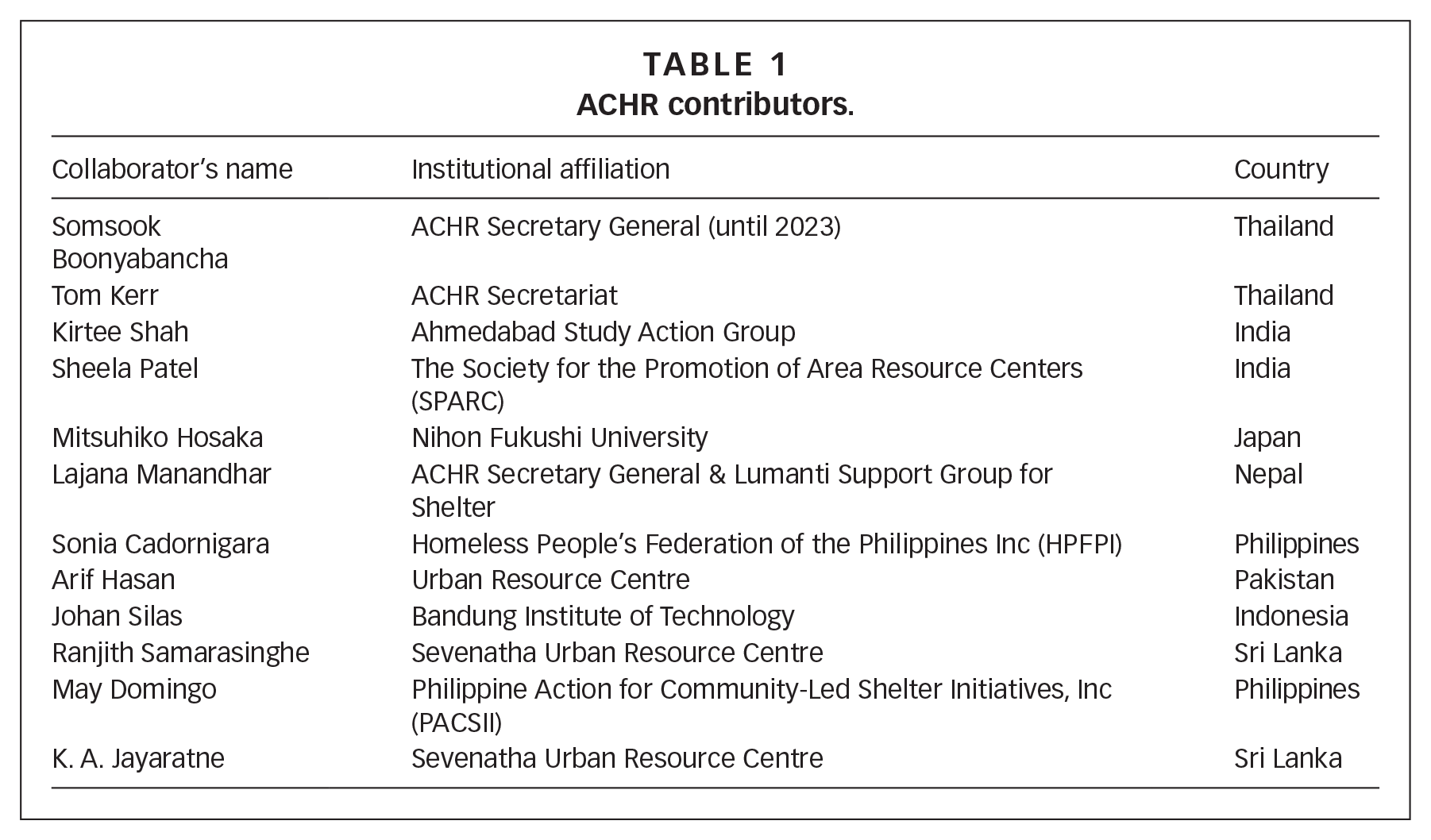
This research was carried out as part of the Knowledge in Action for Urban Equality (KNOW) programme, a global research initiative that co-produces research and builds capacities and action to inform policy, planning and practice for more equitable cities with partners in Asia, Latin America and Africa.(28) It focuses on how over the last 30+ years, the ACHR network conceived, produced and actioned diverse knowledges, as a part of promoting community-led development in Asian cities. The research entailed in-depth interviews with 12 key network members (Table 1), particularly those integral to the formation and extension of the network, as well as archival reviews of ACHR meeting notes, newsletters, reports and documentation.
ACHR contributors.
Interviews were semi-structured, and focused on thematic entry points, including the histories and legacies of the ACHR network; understandings of how the regional network has supported knowledge exchange across cities, regionally and globally; personal trajectories related to the network; important learnings, locally and regionally; and the implications of regional coalition-building for urban equality. Interviewed network members have undertaken diverse (and sometimes multiple) roles, including working within NGOs, with government and international agencies, as activists, technical professionals, academics and community leaders. A final review of ACHR’s history and timeline was completed with Somsook Boonyabancha, Executive Director of ACHR until 2023.(29)
The selection of interview participants/contributors was driven by ACHR itself with guidance from Somsook Boonyabancha. Selection emphasized individuals who have been part of the development of ACHR’s shared principles approach to structural change. The reflections expressed here are mediated by the positionality of these contributors, echoing a key query of this special issue, around how coalitions narrate and construct their collective public identity. That is, the reflections shared here are grounded in the stories that these particular network members have chosen to emphasize and narrate for a broadly academic audience. These contributors were interviewed by the first three authors, all of whom have worked as key allies of the network: indeed Brenda Pérez-Castro was at the time of writing embedded within ACHR. Our engagement with the network and commitment to the co-production of actionable knowledge is reflected in the emphasis here on knowledge circulation. Some of the reflections shared here have also been organized into an audio capsule, capturing the narration of the network’s evolution in the contributors’ own voices.(30)
In engaging with leaders and founders, this research may not capture the experience of wider grassroots members over time. Nonetheless, it offers a specific activists’ imagination of urban change. While placing the knowledge and experiences of urban poor groups at the centre, members of the ACHR network commit to working in partnership, seeking actively to engage local authorities and decision makers through strategic interventions. This may generate important questions on the role of conflictual processes in furthering housing rights. However, ACHR’s sophistication lies in offering a set of strategies for building connections across technical, policy-oriented, lived and practice-based forms of knowledge, which are deeply rooted in local context and experience, while also driving regional learning.
IV. ACHR: The building of a network
Over a 30-plus-year history, the ACHR network has moved through six distinct phases in its route to coalition-building at scale.(31) While this section is not a comprehensive account of ACHR activities across phases, it offers an overview of this trajectory, with illustrative examples of how knowledge was conceived and mobilized (Figure 1). The evolution through these phases has resulted both from dynamics external to ACHR – in the development and funding sectors specifically – as well as from internal and within-region dynamics or opportunities. These shifts also reflect the ongoing learnings of the network as a regional entity, showing the maturation and consolidation of a collective, trans-scalar approach to community-led development.
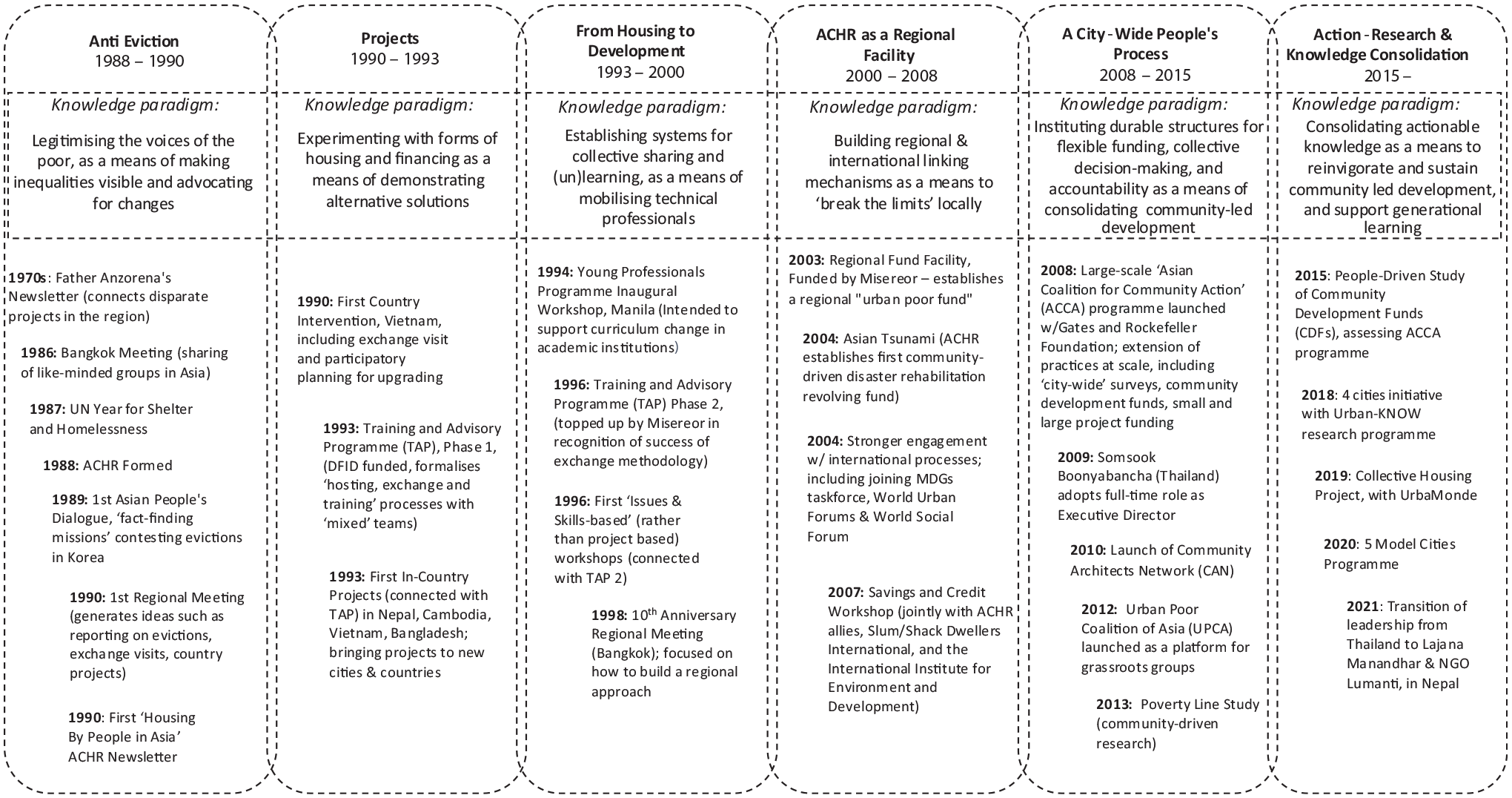
ACHR timeline: Eras, knowledge paradigms and key events
The ACHR network emerged in 1988, in a context of rapid urbanization and mass evictions across Asia, and the 1987 UN designation of the Year of Shelter for the Homeless. In this first Anti Eviction phase (1988–1990), several “islands of innovation” (Thomas Kerr) were developing across Asia – key initiatives that would become foundational to the network, including women-led savings groups by Mahila Milan in India, the Kampung Improvement Programme in Indonesia, the Orangi Pilot Project in Pakistan and the Baan Mankong Land Sharing Programme in Thailand. These groups were loosely connected through the Selavip Newsletter, via the writings of Father George Anzorena, a Jesuit priest sharing inspirational projects globally to promote people-led solutions to urban poverty.(32) The first regional activity of the nascent network was a response to evictions in South Korea, strategically linked with the upcoming 1988 Olympic games. A fact-finding mission – the People’s Dialogue – was organized in 1989, attended by 100 NGO and community activists from 11 countries. Efforts were focused on documenting human rights abuses via regional reports and videos, using the power of documented numbers to stand in solidarity with urban poor groups. This approach to knowledge-building legitimizes the voices of the poor to make inequalities visible and advocate for change.
Following the South Korea mission, ACHR was officially formed. At the first regional meeting with representatives from 16 NGOs from 10 Asian countries, emerging leaders decided to concentrate on demonstrating credible alternatives, rather than contesting human rights abuses. As recounted by Somsook Boonyabancha:
“. . . we couldn’t just shout and be rights-based and expect the existing system to change. Life is not that easy. So we should try to intervene. . . . After that, we started looking into how to find resources to support concrete activities.”
With this shift, the coalition moved into its Projects phase (1990–1993). The first in-country intervention in Vietnam (Hiep Thanh) supported the formation of a policy for community-based improvement, implemented with UN-ESCAP (United Nations Economic and Social Commission for Asia and the Pacific) and Ho Chi Minh City’s Land and Housing Department. During a four-day workshop, representatives from India, Sri Lanka, Thailand and Japan shared stories of their struggles and strategies to secure land and services. As recounted by Mitsuhiko Hosaka, then working within ESCAP:
“I was particularly impressed by Punthip, a community leader from a Bangkok slum, simply telling how her community had organized to secure land and services. This profoundly impacted her counterparts in Ho Chi Minh City, who had never been exposed to community-based approaches, and never imagined that there were people in a neighbouring country in similar disadvantaged conditions, striving for the better.”
This era saw a shift from rights-based contestations to an approach to knowledge focused on experimenting with alternative forms of housing and financing to demonstrate practical solutions. This included community-led plans, precedent-setting projects and learning across contexts.
The shift from discrete housing projects to a wider issue-based focus marked the phase From Housing to Development (1993–2000). This period saw the formalization of region-wide hosting and training processes, including exchanges, skills development and the Young Professionals Programme, supporting the education of young architects and planners attentive to people-led processes of urban development. The knowledge paradigm was focused on systems for collective sharing and (un)learning, to mobilize technical professionals. Crucial to the network’s extension and shift was the DFID-funded Training and Advisory Programme (TAP) (1993–1999), which provided flexible grant financing to support exchange visits, with mixed teams of community leaders, NGOs and government officials learning from successful projects across the region.(33) This curation of shared experiences across diverse sectors, actors and knowledge(s) was focused on preparing these professionals for collaborative action.
The fourth phase saw ACHR performing a wider coordination role as a Regional Facility (2000–2008). This era was shaped by the devastating 2004 Asian tsunami, with relief efforts marked by a lack of international engagement with affected communities. ACHR established a regional rehabilitation fund, an important shift to people-driven disaster rehabilitation. This period reveals an approach to knowledge focused on regional and international mechanisms for sharing, cross-learning and funding as a means to “break the limits” (Somsook Boonyabancha) in cities or nationally. Key to this phase was the wide-scale adoption of community savings and credit activities, sharing of learnings from key programmes, such as Baan Mankong in Thailand(34) and the establishment of Community Development Funds(35) to support mutual aid and learning. This scalar shift was also evident in closer engagement with international processes, attendance at World Urban Forums, collaboration with international networks such as SDI, and acting as an executive member of CITYNET, a way to legitimate the expertise of urban poor groups within global spaces.
A significant shift for ACHR occurred with the large-scale Asian Coalition for Community Action (ACCA) programme,(36) ushering in a City-Wide People’s Process (2008–2015). This city-wide approach to urban transformation used surveys to prioritize issues, financial or housing tools to build maturity in community organizing and financial management, and revolving community development funds, made up of community savings, ACCA seed funding, and contributions from local/national governments or other donors.(37) At the programme’s completion, it had supported upgrading processes across 165 cities and 11 countries, in which urban poor groups took leadership roles on issues of land, infrastructure and housing in collaboration with local and national authorities.(38) This period saw the complex and harmonized threading of principles, strategies and tools to seek innovative changes with governments in terms of funding, policy or legal regulations. ACCA’s focus on institutionalization and scaling demonstrated a knowledge paradigm focused on instituting durable structures for flexible funding, collective decision-making and accountability as a means of consolidating a vision of community-led development. As reflected by Kirtee Shah:
“Because it had strategy and it had scale, it really was not just a project A or project B, it was a kind of a movement. A strategic orientation, a direction, which the countries could take.”
Finally, the current phase, Action-Research and Knowledge Consolidation, can be traced from 2015 to the present. Following the end of the major support provided by the ACCA programme, the network has sought to redefine its future direction, influenced by shifts in the international arena – a (re)turn to more project-based funding, stricter donor reporting mechanisms and links to Sustainable Development Goals (SDGs) priorities. The COVID-19 pandemic deepened old issues and brought new ones to the fore, from food security and community kitchens and gardens, to the importance of housing and services as vital infrastructures of care. Internally, the network has been in a period of transition. The Secretariat, guided by Somsook Boonyabancha and a Bangkok-based team, will take up residence in Kathmandu, guided by Lajana Manandhar and the locally based NGO Lumanti Support Group for Shelter. This period has been focused on consolidating actionable knowledge, as a means of reinvigorating and sustaining community-led development, and supporting intergenerational learning. Processes of action-research, documentation and transition are aimed at consolidating and sharing knowledge and action both externally and internally for the next generation of leaders.
V. Building solidarities: grounded tools, collective learning and critical emotions
Throughout ACHR’s history, the network’s approach to knowledge – and how, in turn, it informs an approach to urban equality – has shifted. This section explores the key practices that have materialized these principles and sustained the building of an urban reform coalition across knowledges, geographies and scales, as narrated through the voices and reflections of the contributing network members.
a. Grounded tools: gathering the empowerment of the community
At the heart of the network are various tools that emerged from specific contexts, including efforts at land sharing and collective tenure in Thailand;(39) community finance, savings and revolving loans, as with Mahila Milan in India;(40) work on upgrading through Indonesia’s Kampung Improvement Programme;(41) and community-managed, non-networked infrastructure from the Orangi Pilot Project in Pakistan.(42) While the material practices may differ, they share a common approach to challenging urban development processes that deprive urban poor groups of land, housing and access to finance, showcasing credible alternatives emerging from the knowledge of excluded communities. Linking these approaches is the shared principle: “making people control their own lives, look after their own settlements, do what they could to improve things – and from that position, negotiate with government” (Arif Hasan).
Another shared principle, consistent with the idea of an urban reform coalition, has been actively engaging government officials as essential partners for change: “even though this was people-led, the government was not seen as alien, [or] as a part of the problem. They also were part of the solution, and therefore required cooperation and collaboration” (Kirtee Shah). Beyond the technical operations of these tools, they are used, crucially, as vital routes to reconfiguring social relations at different scales. According to Mitsuhiko Hosaka:
“ACHR’s focus is not implementing specific projects to achieve blue-printed goals, but promoting a system and its change in a ‘people’s process’. Community funds, savings and credit, land sharing, even the Orangi Pilot Project are systems. People’s insights into systems can be shared. ‘Trust the people’ is the most significant message ACHR has successfully appealed to the world.”
The tools themselves are the sites of knowledge production – of experiential and experimental learning – where communities learn not just the practical strategies (how to do savings, collectively bid for tenure), but also build the critical capacities to act as collectives, reflect on challenges and develop trusted relationships.
While emerging from specific place-based contestations, the regional network has played a crucial role in seeing these strategies travel and become adapted to diverse contexts throughout the region, for instance, in the regularization of savings groups in Indonesia, the development of affordable rental housing in Nepal, or the turn towards housing cooperatives or pooled purchase of land where collective tenure is not possible. This trans-local facilitation highlights a key approach of ACHR as a regional urban reform coalition: the shift from seeing a tool as a practice to be replicated, to a process of collective reflection on the possibilities for action – what della Porta and Pavan refer to as building knowledge about the collective self.(43) This shift can be illustrated through a story shared by Sonia Cadornigara, a community leader from Ilo Ilo, Philippines, about when she first encountered the idea of conducting city-wide mapping in 1998, supported by regional ACHR leadership:
“Personally, I didn’t understand what this community settlement survey would do at that time, because we didn’t know that informal dwellers can be called ‘communities’ – we didn’t call ourselves that. . . . During that time, we were given some money [from ACHR], so we conducted the survey. We were not aware about what we were doing, to tell you frankly. We were just so naive that we didn’t look at the whole picture. I didn’t have this kind of mindset.”
Through this survey, nearly 12,000 households were identified in the disaster-prone shoreline areas, where they were being charged PHP 3000 (GBP 43) by the local barangay captain (the highest elected official of the local ward or district) to construct their houses. Sonia recounts her “hands-on learning” – from her recognition of informal settlements as communities, to the identification of corruption, to learning to interpret and act on legal codes – supported by the “wake-up call” of the survey:
“I was very angry, because the local government said settling there is illegal, and the one who should be protecting this is the barangay captain. And it’s the barangay captain who’s earning money, allowing people to be there! So I was confused. I didn’t know why this barangay captain was not punished if the law said this. That is the kind of realization when you’re still learning. And then I have to learn to read laws: the local government code, the Urban Development and Housing Act. Our learning is coming little by little – because it’s hands-on learning. It’s not just by books, it’s based on the experience that we have. So it’s really a wake-up call for all of us with that kind of survey.”
Today, Sonia is one of the most experienced members of the Philippine network, and mapping is one of their most important mobilizing tools. Similar stories were shared by other network members. In Sri Lanka, city-wide mapping helped people to “think beyond the micro”, supporting them to have a “better idea about the city and its issues”, with “the map as one output, but also the community being mobilized” (Ranjith Samarasinghe). Or in Nepal, where learning to collect and manage community savings supported “leadership, confidence development, and financial empowerment” of especially women leaders (Lajana Manandhar). In other words, the primary innovation of these tools – whether savings, mapping, community development funds or small upgrading projects – is to build collective systems for self-recognition and action.(44) It is precisely this (indirect) impact that supports the translation of these tools across the region. In Sonia’s words: “the bottom line is that in upgrading projects it’s not only about development, but also gathering the empowerment of the community”.
b. Collective learning: from replication to a ‘spice market’
Beyond the specific tools developed within each locality, the ACHR network has developed highly curated mechanisms for sharing knowledge and practice through exchanges, newsletters and reports, regional meetings, panels at international forums or trainings and workshops. These efforts are shaped by the idea of the “region as a university” (Somsook Boonyabancha), focused on creating space for learning across similarities and difference. These sharing processes are underpinned by a deeply relational approach to learning as strategic, multi-directional, interlinked, and as an active and collective challenge to unequal relations in the city. Knowledge-sharing transcends the exchange of information on the how-to of particular tools. Rather it creates shared experiences among diverse actors with different ways of doing things; builds a collective discourse, confidence and capacities among those sharing;(45) and perhaps most crucially, can be strategically leveraged to generate political change. For Lajana Manandhar, this flexible sharing sustains and defines the network: “ACHR exposes you to the various ideas and options, but how we do it is up to the local community leaders to decide in a participatory and transparent way. It’s the people’s principles.”
Exchanges, trainings, workshops, the Young Professionals Programme, the establishment of Urban Resource Centres are all key systems aimed at retraining professionals, and building collaborations across diverse knowledge sources. For instance, crucial to the exchange methodology is the engagement of diverse actors, including communities, technical professionals and local authorities – what Somsook Boonyabancha refers to as “joint learning”:
“In the beginning, the simplest idea was to let different groups see the difference. Exchanges between one city or country to another. And then we thought, no, it should have a more combined learning, where we put together the communities, the NGOs, the local government as a team. If they see something positive together in another country, they learn it together. They would have discussions and sharing. This will be really very powerful learning – a joint learning process between the different actors who are supposed to do the same thing, but normally do with different, and sometimes antagonistic, attitudes. I would say the ACHR was one of the key regional organizations who developed this.”
Tom Kerr recalls how, as the exchanges became formalized, they became “highly curated”, taking advantage of the prestige of visits from a network of regional peers to “address political needs locally” and build positive relations:
“People, relationships and projects get so stuck, with this heavy sense that ‘this is not possible’ in this country or city. The way to shake that is just put those people on the plane and take them to another place where they did it. That could be so powerful, and we see it over and over again. . . . A lot comes from Jockin Arputham in India. He was the guy who taught us how to never let anything happen without politically maximizing the potential. In Bombay he would invite the slum dwellers to come have a picnic on the lawn in front of the Bombay Municipal Corporation, and the Bangkok Minister, and it’s all about making a fuss and making political mileage. It’s just an outing – kind of a fun thing.”
Crucial to this joint learning approach is its multi-directional nature. For instance, in 2019 a meeting was organized in Yangon to discuss alternative schemes for housing delivery in the city. Invited to this meeting were representatives from CODI,(46) the Thai government institution, as a key example of the successful financing and scale-up of community-led housing. While the specific invitation was to support the emerging process in Myanmar, the intention was also reciprocal – to re-energize the CODI bureaucrats who had been struggling with their organizational structure and lacked the freshness of new ideas. Learning and sharing was not only about the more experienced guiding the newer alliance, but reinvigorating the older institution with the emerging creativity and innovation of the Yangon team, even in the midst of a harsh economic and political context.
Finally, just as key to these trans-local collective learning processes is the building of the confidence and trust of collectives in their own capacity. As reflected by Sheela Patel:
“The whole imagery of how you teach and learn is like women who exchange recipes. If you like the dal I cook, I tell you my recipe. Then you take it home and you find you don’t have this lentil, so you substituted it. But you more or less have something new and unusual in your food diet. . . . This whole generosity of learning and sharing, and the serious value of how much more confident you are when you teach somebody, are very important qualities that also came out of these exchanges.”
Fundamental to this approach to learning are the “tactics practised over the years” (Mitsuhiko Hosaka) to change the balance of power and spark political change. Examples include using the prestige of visits from outsiders to “change the credentials” of urban poor groups (Sheela Patel); organizing fact-finding missions or policy-level study tours in successful countries to unlock stuck ones, using new processes to re-energize flagging movements; supporting the education and retraining of young professionals and bureaucrats locally to build technical support; or attending high-level international meetings, such as the World Urban Forums, to challenge the invisibility of the urban poor within mainstream development forums. In these examples, learning and sharing have layered and multiple agendas – from inspiring groups and sharing tactics by introducing “new horizons of possibilities” (Tom Kerr), to generating political pressure by demonstrating a “proof of concept” of community-driven solutions to local authorities (May Domingo), or building confidence by “changing yourself and your mindset” (Ranjith Samarasinghe). This approach to learning is about so much more than sharing replicable strategies (which may or may not be relevant within different contexts). It’s about building “regional solidarity” (Mitsuhiko Hosaka):
“I often felt NGO workers tended to be sceptical of the ‘replicability’ of what they observed abroad, while community leaders were more intuitive and insightful. Contrary to ‘professional advice’, listening to those who share the same issues, even in different contexts, feeling new possibilities by observing others’ attempts, and reflecting on their own experiences as encouraged by regional solidarity, lead to not project transfer but their own community initiatives.”
Echoing Sheela’s example of the dal recipe, this approach can be thought of as a spice market, operating for the informal exchange of ideas, where ingredients may be shared, but the pathways and outcomes retain a decidedly local flavour.
c. Critical emotions: building a ‘soul and spirit’ for action
Finally, ACHR members referred over and over to the crucial intangible aspects of trans-local coalition-building, which have sustained the network throughout the decades. These are linked with feelings of passion, dedication, commitment and empathy for the poor (Lajana Manandhar), interpersonal, spiritual or cultural connections (Kirtee Shah), and a sense of family, friendship or shared spirit (Ranjith Samarasinghe). It is through these critical emotions that hope and willingness to act is ignited and sustained. These emotions are sustained not only through friendship and connection, but also through practical activity – the trust built through shared experiences of acting together against injustices.
The common motivations, and the creative and empowering emotions shared by network members, drive and increase their determination to struggle and their willingness to run risks. From ACHR’s establishment, there was a “strong eagerness to really share our knowledge and capacities to help the poor” (Johan Silas), a commitment to understanding the structural conditions which create poverty, and the contribution of poorer groups to the city. As outlined by Kirtee Shah:
“ACHR really has an understanding of poverty, not only in the economic or material sense. In the cultural sense. . . . which also meant a belief that the poor can solve their problems. Because they have been! They’ve been building their houses, growing their food, fetching their water. They essentially are the problem solvers. And therefore, it’s very clear that participatory processes, putting them in the centre of the process, was automatic and logical.”
This emotional support can be understood as critical, in that it has been vital in bolstering a collective energy to face and contest the dominant urban paradigm throughout the region, particularly from the 1980s, which has prioritized market-driven and state-led processes of development. The emphasis on emotional connection manifests in particular aspects of the group’s functioning which may be hard to measure, yet are crucial elements of ACHR’s longevity. May Domingo, for instance, reflects on her work in Tondo: “we may not have scaled up the programme, but we have [sustained the approach] with the relationships and the friendships”. For K A Jayaratne, the formation of solidarity networks was crucial in building confidence: “in some forums I did not learn anything new, but I built my confidence. It helped me to understand I’m doing the right thing in Sri Lanka.” For Ranjith Samarasinghe, this comes down to a set of ‘ethics’ which inform action:
“For me, you have to develop that ethic of treating people equally. You can read all the books about participatory action, but it’s different in practice. We need trained people, architects, engineers, sociologists, these professionals who have – I don’t know, it’s hard to explain – who have some feelings about those communities.”
These values are also reflected in friendships between ACHR members – the emotional glue that links the network – even as affiliated individuals or organizations come and go. From Kirtee Shah:
“The meetings of ACHR were a delight, joy. . . . And I think one of the most important assets of ACHR’s work is the tremendous amount of interpersonal warmth. You reach there late, and the meeting has started, and the moment you set your foot down, the hands start waving. There was also a huge amount of positive intensity. An intensity arising of ideas, out of expectations, out of interpersonal dynamics. Friendship.”
This emotional connection has supported transformations in the personal and organizational biographies of those involved, and intergenerational learning. A powerful example is shared by Lajana Manandhar. Trained in agricultural economics, Lajana first encountered community organizing through her husband, Dr Ramesh Manandhar, an architect working on urban shelter. When Ramesh died in 1992, Lajana established Lumanti, meaning memory, to continue this work in Nepal. She recounts calling on support from ACHR, with “no experience, only commitment”:
“After my husband passed away, I started discussing with Somsook [Boonyabancha], Sheela [Patel], Kirtee [Shah]. I wrote to everyone. I’m not an architect, I didn’t have any NGO experience. Just my commitment. Actually, I had no idea about this. But I said, okay, because that’s what he wanted to do, let me give it a try. I started communicating with ACHR and they gave me full support. Somsook is an inspiration to me. And a mentor.”
In 1995, an ACHR meeting was organized to discuss the rapidly growing informal settlements in Nepal. Together, the “ACHR big heads” (Lajana Manandhar) prepared a proposal for modest funding from UNDP to start a settlement survey. Lajana recounts the importance of the advice and mentorship of the first generation of ACHR leaders:
“When I attended meetings organized by ACHR, I used to just sit quiet without speaking a single word. I had no idea what to say, because I hadn’t worked on or done anything! I would just listen. . . . So we learned from others in the beginning. That’s how we actually got shaped.”
In this way, Lajana recounts the profound learnings, as an individual, as well as institutionally, building the first organization in Nepal working on issues of urban poverty during a time of transition for the country. In particular, she cites the enormous influence of the savings schemes of Mahila Milan in India, and the women’s bank in Sri Lanka, which led to the establishment of the women’s federation (Mahila Ekta Samaj) and cooperative banking movement in Nepal:
“We were fascinated when we visited the saving schemes in Bombay. Jockin [Arputham] opened the trunk and showed us that day’s savings. We said, ‘Oh Bombay has so much, when can we have that much?’ And our community leaders got inspired. . . . We came back and discussed with the community leaders what would be feasible for us to promote the saving schemes.”
Today, more than 35,000 women across Nepal are legally registered in savings groups and cooperatives, with significant impacts for leadership, access to credit and upgrading projects. This trajectory is all the more profound given the recent decision to move the ACHR Secretariat to Nepal, where regional facilitation will be guided by Lajana and the Lumanti team. As reflected by Sheela Patel: “the real proof of the pudding is that you have people who are with the organization for 15–20 years, and they have raised a whole new lot of younger people”.
These deep connections, built through shared values, the sense of collective identity and a “culture of collective decision-making” (Ranjith Samarasinghe), have sustained important emotions linked with friendship, family, inspiration and optimism. This echoes Freire’s understanding of solidarities as built by learning and doing together,(47) and social movement literature on the powerful role of affect and kinship in sustaining action. As Davis notes: “solidarity emerges from translocal performances of care and shared experience”.(48) May Domingo reflects that the network has built a “soul and a spirit for the different groups in the region”, and Lajana sees this shared culture as the “strength and beauty of the ACHR . . . all the values and principles we have learned from ACHR are reflected in our work; in whatever we do”.
VI. Conclusion
This paper explores the role and value of a trans-local urban reform coalition in contesting urban trajectories that perpetuate a profoundly unjust and unsustainable urban status quo. It pays particular attention to the role of knowledge co-production, which urban reform coalitions, comprised of diverse actors and institutions working together towards a shared aspiration, are uniquely positioned to enable. Specifically, the article has explored the role of the ACHR network in forging solidarities across scale, both expanding the imaginaries towards alternative people-centred urban futures and demonstrating their concrete possibilities in the present day.
Building on critical reflection with key actors of the ACHR network, the paper highlights key ingredients that have made this regional network an enduring and powerful collective. Over its 30-plus-year history, this network has enabled an evolving constellation of deeply grounded local, national and regional alliances, many representing urban reform coalitions in their own right. Crucial to this trans-local strengthening of alliances and mobilizations are the grounded tools, collective learning and critical emotions which have been carefully nurtured. The tools – shared material practices – have been key in demonstrating ‘proof of concept’, responding to situated needs and strategic openings, building the capacities of organized urban poor collectives, and illustrating existing alternatives to dominant urban planning trajectories. Through evolving and carefully crafted collective learning processes, the network has facilitated the exchange of ideas, bringing together diverse actors at city level, crossing borders to expand political opportunities; leveraging global platforms to raise visibility at local or national scale; and taking advantage of learnings generated in one context to support similar challenges elsewhere. Such mobilizations show highly strategic efforts of collective learning, both locally and, cumulatively, at the regional scale. Moved by critical emotions of shared values and solidarity, this trans-local network has played an intangible but vital role for individuals and groups in building a confidence and motivation to act, even under highly challenging urban conditions. Crucial here is the flexible positionality of many of the coalition’s members, who occupy sometimes multiple roles in government, academia and civil society, as community leaders or as technical professionals. Just as important as the shared expertise is the acknowledgement that individuals themselves may move, effecting change from different institutional positions.
Beyond concrete learnings to support strategic collective action on land, housing and infrastructure, the ACHR network has reconfigured knowledge-building as a practice of mobilization and coalition-building. ACHR’s engagement with knowledge as situated, partial and political is crucial to the transformation of inequalities, challenging the dominant epistemologies shaping how policy and planning are undertaken. Honed over decades, ACHR offers a powerful example of coalition-building for change at scale, nurturing solidarities through knowledge, sharing and action.
Supplemental Material
sj-mp3-1-eau-10.1177_09562478251317977 – Supplemental material for Pathways to urban equality: trans-local solidarities within the Asian Coalition for Housing Rights
Supplemental material, sj-mp3-1-eau-10.1177_09562478251317977 for Pathways to urban equality: trans-local solidarities within the Asian Coalition for Housing Rights by Stephanie Butcher, Brenda Pérez-Castro, Barbara Lipietz, Somsook Boonyabancha, Tom Kerr, Kirtee Shah, Sheela Patel, Mitsuhiko Hosaka, Lajana Manandhar, Sonia Cadornigara, Arif Hasan, Johan Silas, Ranjith Samarasinghe, May Domingo and K A Jayaratne in Environment & Urbanization
Footnotes
Funding
This study was supported by the Global Challenges Research Fund ES/P011225/1.
Supplemental Material
Supplemental material for this article is available online.
5.
For instance: Anzorena (1993); Archer (2012); ACHR (1993); Boonyabancha and Kerr (2018a); Boonyabancha and Kerr (2018b); Boonyabancha and Mitlin (2012);  , amongst many others.
7.
Roy (2005); .
15.
Doshi (2013); .
23.
Allen, Cociña and Wesely (2020), page 183.
29.
Somsook Boonyabancha has played this role until the recent transition in 2022–2023 and is referred to as such throughout this paper.
33.
TAP helped to consolidate new country projects in Nepal, Cambodia, Vietnam and Bangladesh.
36.
Funded by the Bill and Melinda Gates Foundation and the Rockefeller Foundation, in collaboration with the International Institute or Environment and Development (IIED).
37.
45.
This resonates with Freirean (1970) philosophy: “Whoever teaches learns in the act of teaching, and whoever learns teaches in the act of learning” (page 31).
References
Supplementary Material
Please find the following supplemental material available below.
For Open Access articles published under a Creative Commons License, all supplemental material carries the same license as the article it is associated with.
For non-Open Access articles published, all supplemental material carries a non-exclusive license, and permission requests for re-use of supplemental material or any part of supplemental material shall be sent directly to the copyright owner as specified in the copyright notice associated with the article.
