




Abstract
Urban reform coalitions take on different formations constituted by an equally diverse range of actors. Typically, the founding logic for urban reform coalitions has been to build evidence and translate it into a collective voice with a view to influence and drive urban change. This change can be conceived within the realm of either practice or policy. This paper builds on existing understandings of urban reform coalitions by considering alliances in Harare, Zimbabwe, of both advantaged and disadvantaged actors operating both at the city and settlement level. Based on the findings, I draw the following conclusions. First, the institutional positioning of coalitions is key to navigating contested urban politics. Second, inclusion considerations for disadvantaged groups must be intentionally and judiciously worked out so that reform spaces are genuinely inclusive. Finally, because policy space in Harare is complex, politically informed tactics are required to register meaningful policy accomplishments.
I. Introduction
One important strand in the global quest for urban reform may be traced to Latin America, in particular Brazil, between the 1960s and 1980s. I reference the Brazilian context here not only for the deep challenges of uneven urbanization encountered there, but also the progress on the reform frontier through the work of urban social movements.(1) More specifically, this particular urban reform agenda, linked to the emergence of urban social movements, sought to tackle spatial inequalities relating to accessing public land.(2) Urban social movements in Brazil confronted city commodification and duality, inspired by the right to the city for all through an emphasis on the social function of urban space. Related to this critical spatial engagement, the urban reform agenda evolved to push for the democratization of city management. These urban realities in Latin America have found equivalent expression in parts of Africa and Asia. Alongside growing urbanization, there has been a corresponding phenomenon there of widening inequalities manifested through the emergence and growth of slums(3) in cities. Africa’s urban population, for instance, grew from 237 million in 1995 to 472 million in 2015, accompanied by huge gaps in services and infrastructure.(4) In the same period, the slum population in sub-Saharan Africa increased from 111 million to 201 million.(5)
The spatial inequalities and injustices in Africa and other parts of the global South have largely been accounted for in terms of colonial-era planning. Watson(6) describes this within the context of South Africa, explaining how apartheid-based planning introduced and entrenched racialized spatial divisions in cities. Strauss(7) supports this, arguing that the apartheid regime in South Africa, through restrictive planning legislation, entrenched spatial segregation, systematically dispossessing and displacing blacks. The same racial dynamics were at play in Zimbabwe, producing equally disconcerting spatial realities. Chirisa and Dumba(8) posit that Zimbabwe’s racially dualized spatial structure was created by the British colonial administration. The material effects – inequalities and poverty – typically found spatial expression through the creation of sprawling slums. In the post-colonial state, these discriminatory spatial practices have persisted, premised not on apartheid, but on neoliberal planning logics. Kamete(9) illustrates this, demonstrating how the planning discipline, infatuated by urban modernity, is complicit in the exclusionary handling of informality in its manifold manifestations.
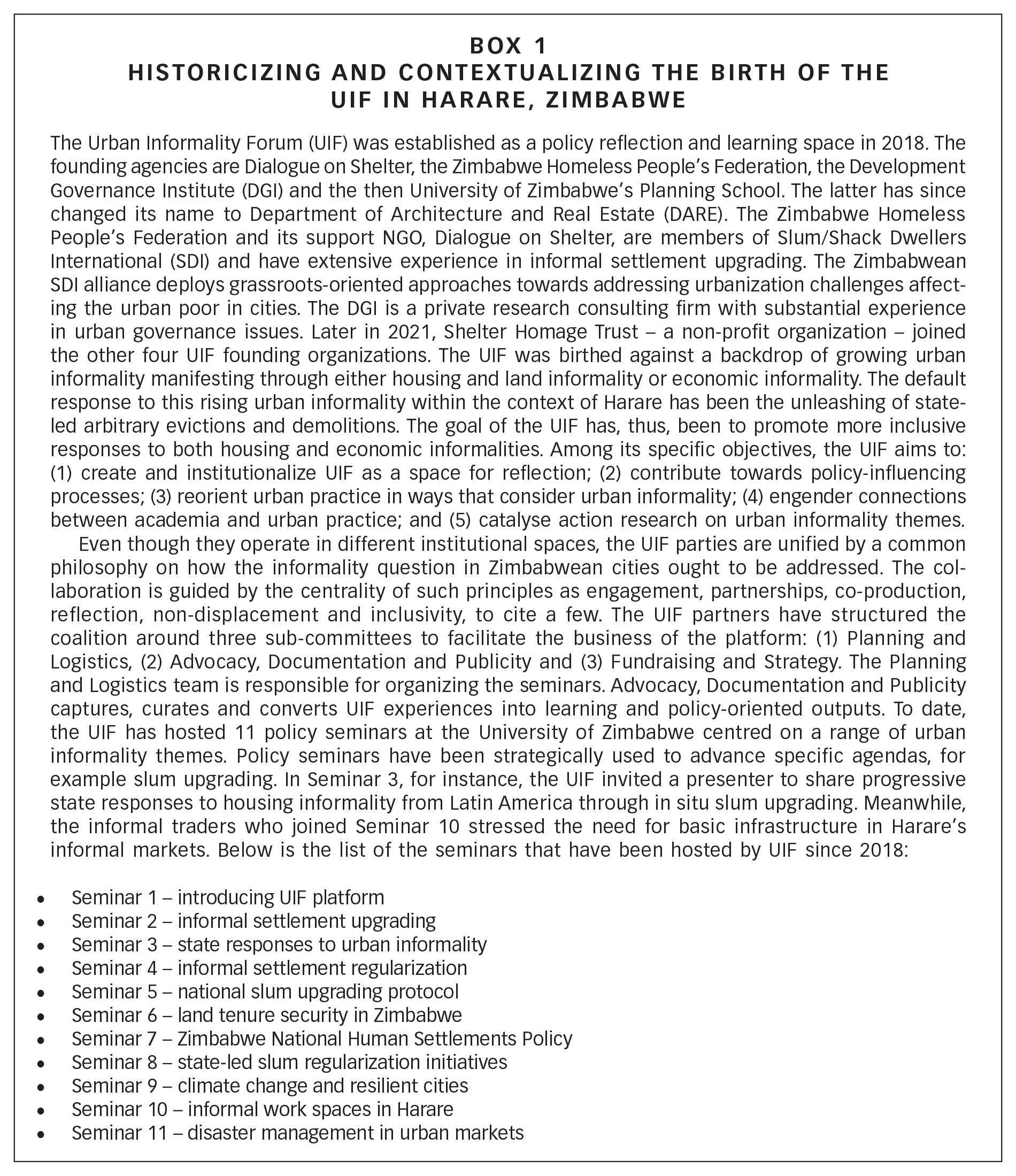
Attempts to respond to mounting inequalities in developing cities have employed multiple strategies. This paper explores one such strategy, examining the urban reform coalitions in Harare, Zimbabwe. To better understand the coalitions’ activities, I deploy the Advocacy Coalition Framework (ACF). Developed in the 1980s by Sabatier and Jenkins-Smith to study coalition formation and policy learning, the ACF provides a politically informed lens that helps to discern intersections between reform processes and power politics.(10) Notwithstanding the popularity of coalitions as platforms for catalysing urban reforms, there have been questions regarding their efficacy. Some authors have expressed caution at the notion of bringing together multiple and different stakeholders, pointing to the challenges for broad-based coalitions of developing coherent reform approaches.(11) To illuminate this analytical sphere, this paper spotlights the activities of one particular coalition, the Urban Informality Forum (UIF) in Harare, as an institutional platform for advancing urban reform, and examines the institutional configuration and individual roles of the UIF reform partners. As the name suggests, the UIF primarily focuses on tackling urban informality in its diverse manifestations. At the core of its methods and tactics, the UIF has employed dialogues, learning exchanges and research activities (see Box 1). These urban reform engagements typically target government functionaries, while politicians such as councillors are deliberately excluded to avoid unwarranted politicization of the space. This is crucial considering the polarized nature of urban politics in Zimbabwe.(12)
Historicizing and contextualizing the birth of the UIF in Harare, Zimbabwe
In this contribution I also probe the kinds of insights and learnings that accrue from urban reform coalitions operating at both city and neighbourhood scale. The paper, thus, analyses the scale and locus of coalition activities, how they influence specific operations and tactics and how these, in turn, mediate urban reform outcomes. Urban reform coalitions are defined here as collaborations between the state, academic experts and civil society organizations (CSOs) with a view to advance urban transformation.(13) I draw attention here to how multi-scale urban reform coalitions at both city and community level help to ground reform conversations in lived experiences. I further demonstrate how field visits or learning exchanges are deployed to complement and create spaces for urban reform engagements. In this regard, the paper makes two arguments. Beyond the fact that context matters,(14) I posit that imagining and constructing the urban reform coalitions around a particular pilot is key to help to give concrete spatial expression to the reform agendas. The paper also explores the positioning of the UIF in Harare within a learning institution – the University of Zimbabwe’s Department of Architecture and Real Estate (formerly Rural and Urban Planning). I demonstrate that the presence of professionals is crucial, in line with Sabatier and Smith’s Advocacy Coalition Framework,(15) and also illustrate that the physical location of the reform coalition’s activities within a tertiary institution constitutes a political strategy to help navigate a very complex reform space. The findings reveal that the university, as a research and learning organization, has served as a neutral zone where potentially emotive issues can be tackled in a relatively free, amicable and honest manner.
Different scholars have come up with manifold conceptualizations of urban reform. Lines and Dessie(16) conceptualize urban reform as a process of restructuring governance arrangements to address exclusionary obstacles. Priyadarshi(17) presents urban reforms as the remaking of cities through disruptive encounters with formal rules, policies, organizational structures and institutional legacies. Typically, the preoccupation of urban practitioners with reconfiguring city regulatory and governance arrangements has been inspired by the need to improve the quality of life for urban dwellers. However, there is need for caution as not all urban reforms yield progressive and inclusive urban outcomes. Fernandes,(18) for instance, argues that legalization of informality, if not approached within the broader urban management framework, may not result in socio-spatial inclusion, given unintended financial encumbrances on the urban poor. In the context of Harare’s UIF, urban reforms have largely centred around imagining new modes of delivering urban land, housing and services for the urban poor. Building on this rationale, inclusive urban reforms would, thus, include urban approaches that advance pro-poor agendas, such as participatory slum upgrading.(19) In practice, this would mean replacing displacement and demolitions with either in situ slum upgrading or relocation, among other inclusive approaches.
Following on this introduction, the next section considers the extant literature. Section III then describes the study and the methods employed, and Section IV explains the Advocacy Coalitions Framework and its relevance to the UIF. The paper then describes and discusses the findings, and the final section closes with a summary of the main conclusions and their implications for practice and future research.
II. A review of extant literature
This section considers the major theoretical conversations surrounding the arguments being advanced in this contribution. I reflect on the politics of urban reform processes in general. The key debates around the urban reform coalition tools and tactics are also placed under a spotlight to examine what catalyses transformation in cities facing intractable challenges of uneven urbanization processes. I conclude the literature review by examining how urban social movements, otherwise loosely referred to here as organized communities, interface with urban reform coalitions and activities.
a. Urban reform as political activity
Cities are inherently political spatialities typically mediated by power. They are characterized and constituted by a multiplicity of institutional actors with diverse and deeply vested interests in relation to varied urban assets and services.(20) These actors include, but are not limited to, council officials, central government, non-governmental organizations, grassroots movements, academia and private sector companies. Examples of the urban resources that determine the nature and form of urbanization outcomes are infrastructure (such as water, sanitation, roads) and services in the form of energy supply and refuse collection. These urban assets characteristically have either broken down or are perennially under-supplied in the global South, thereby adversely affecting effective service delivery. Urban management tools such as privatization can further complicate the goal of establishing inclusive cities. Against this background, there is a need for urban reforms aimed at reorienting cities towards trajectories of inclusion. This inevitably entails building a politicized agenda backed by groups that have coalesced around a set of issues such as access to affordable housing. Politics in the sense of urban reform suggests changes that invariably introduce costs and benefits, which may vary for different groups.
Not all observers are equally convinced of the potential for politically transformative engagement emanating from urban reform processes: Kamath,(21) for instance, cautions about the prospects for meaningful political gains. Nonetheless, as I demonstrate later in this paper, although seismic political changes on urban policies and practice are unlikely, it is possible to realize incremental milestones which, when in aggregate, contribute to altering the city through a transformational urban politics. It is also important to be realistic and acknowledge that reform politics is riddled with complexities. For instance, reform processes have to contend with the vested interests of powerful groups who can block the democratization of urban governance. This is achieved through such exclusionary tactics as blocking participation in the development of policy agendas. While acts that deliberately undermine powerless groups are a reality, I argue that combining diverse actors with varied backgrounds into some urban reform coalitions in Harare has helped counter potential reform failures linked to the notion of hidden power.
b. Urban reform coalitions and grassroots organizations
It has been well documented that the presence of a diverse group of stakeholders is a precondition for constituting viable urban reform coalitions.(22) A multiplicity of institutional actors has been posited as a critical success factor as it amplifies voices for policy change and civic capacity.(23) While professionals remain crucial in helping to craft and shape technical reform proposals, Hess(24) points to the need for institutional formations with political muscle, such as grassroots organizations. Mitlin echoes this belief when she observes that pro-poor reforms depend on the inclusion of excluded populations.(25) The participation of grassroots-oriented urban social movements has been celebrated for its potential to bring in practical experience from ‘local experimentation’ and ‘bottom-up alternatives’.(26) The presence of these movements presents considerable scope for grounding reform proposals in best practices from implemented pilot projects. Yet some scholars have also cautioned against this optimism around grassroots local experience.(27) The external validity and hence scalability of these local experiences have been challenged, and there have been warnings regarding the potential perils of parochialism associated with the uncritical celebration of grassroots organizations’ local capabilities.(28)
c. Geography matters
Urban reform is a delicate and contentious subject, and the careful placement of the coalition process either at the city level or settlement scale around specific project experiences is of paramount importance. This means many things. First, I consider geography in terms of the actual physical location of reform activities. Second, I deploy geography to reference the scale at which the coalitions can be pitched – that is, either at the city or settlement level. Urban reform activities here denote engagements centred on alternative policy or regulatory improvements and practices that seek to alter the very essence of the city and the structural means for producing it. Reform coalition positioning has implications for functioning, influence, legitimacy and visibility, among many other issues. Dhindaw, Ganesan and Pai,(29) writing on reform coalitions activities in Indian cities, present numerous successful case studies including those that are grassroots sited. The same authors also warn about the potential risks of situating these processes in communities. For example, they argue that locating coalition activities within communities inevitably promotes self-governance and this is often perceived as a threat by city authorities. A way out, they contend, rests in bringing in more actors to neutralize the imagined threat of enormously empowered communities. They further posit that confining coalition processes to the settlement scale also limits capacity to catalyse urban policy changes in the way that development operates at the city level. This means, wherever possible, there is always a need to ensure that settlement and city scale activities are intentionally connected to help trigger transformative reform gains. However, the notion of fostering the kind of plurality being emphasized in this section is not an easy matter. For instance, this can introduce contestations and tensions due to the misalignment of agendas, priorities and interests.
Increasingly, urban reform coalitions are now being hosted within universities, especially in the built environment departments.(30) University-based urban learning labs, for instance, have started incorporating a focus on policy agendas, helping to realize cities that are inclusive. Multiple benefits have been cited for this, including harnessing the research expertise that is so crucial in providing much-needed evidence for the value of pro-poor urban reforms or urban sustainability pathways.(31) Tertiary institutions also present opportunities for reflection on the utility of urban policies. Writing about universities as viable reflective spaces in the context of global North experiences, Thelin(32) considers such platforms as critical for revisiting patterns of thought and practice.
Yet, there is also a real risk of using the university’s knowledge and research experience in ways that merely become rituals of alignment rather than genuine dialectical engagement with different epistemic experiences, as pointed out by Mihailova.(33) This analytical caution resonates with findings by Mitlin et al.,(34) who highlight the need to acknowledge alternative epistemologies, particularly those of urban social movements, in the co-production of knowledge. This has implications for this paper, stressing as it does that locating coalitions in university spaces should not devalue grassroots experiences or any other perspectives. Instead, as will be illustrated through this study, the goal of the siting of reform coalitions is simply to establish a neutral space that allows urban social movements to engage with city and central government stakeholders and to objectively dialogue on matters of policy and ideological disagreement.
III. Methodological considerations
I have worked for over two decades as a member of one of the founding organizations of the UIF, dedicated to broadly supporting pro-poor urban development approaches, and have coordinated the UIF platform since its inception in 2018. This has allowed for an in-depth perspective on the coalition. However, my embedded role in the UIF has also meant that subjecting the institution and its experiences to a value-free scientific research process was an inescapably daunting task. Thus, my methodological approach has been more oriented towards the potential of research as a situated activity, taking advantage of my position as a way of engaging with and understanding the complexities of that situation.(35) To counter any unexamined and unwarranted assumptions on my own part, the perspectives of both presenters and participants at UIF events were sought and engaged with in order to triangulate findings and respond to any potential bias. Content analysis aided the process of drawing up the emerging research findings’ themes. The multiple accounts on urban reform coalitions from interview responses and written sources from secondary data were thematically analysed to help address the research questions.
This paper casts a light on the role and operations of urban reform coalitions in Harare through a case study of the UIF – a policy and reflection space hosted within the University of Zimbabwe (see Box 1). The UIF case was examined with a particular focus on the coalition’s operational context, processes and outcomes. In addition to drawing on my own observations and experience, I gathered data through drawing on seminar presentations, interviews and a review of secondary material. The semi-structured interviews were conducted with 11 past presenters and participants from the UIF sessions (e.g. see Figure 1). These respondents included city officials, central government staff, academics and community leaders, allowing for diverse perspectives, especially relating to the contributions of the platform. Use of recording helped to accurately capture responses. Participants’ responses were systematically rephrased and repeated during interviews to ensure that I captured their insights accurately before engaging in analysis. I also shared my interpretations of the participants’ insights together with the final draft with professional colleagues in the built environment sector to help pick out biases I may have missed. Secondary data were sourced from UIF seminar agendas, proceedings reports, UIF bulletins and minutes for preparatory meetings. In my engagement with these internal sources, I attempted to remain conscious and critical of the potential biases that can be present in project reports.

City of Harare City Planner making a presentation at the UIF at the University of Zimbabwe, 2019
IV. The use of the advocacy coalition framework
The Advocacy Coalition Framework was developed as a tool for enhancing the study of the policy process, explaining and forecasting how coalitions can effect policy change. The ACF identifies a policy subsystem essentially constituted by formal and informal policy stakeholders that form alliances or coalitions.(36) Stakeholders typically include bureaucratic agencies, policymakers, researchers and civil society groups. According to the ACF, coalitions are held together by belief systems that seldom change. When they do, this often results in the breakdown of the coalition. Another relevant component of the ACF for this study, and more precisely for the UIF, is the policy learning element. The framework views learning as key to policy change and posits that it takes the form of exposure of coalition members to new experiences, information and knowledge. The ACF wields some explanatory power for understanding urban reform coalitions in Harare and their activities, specifically its routine seminars hosted by the University of Zimbabwe. Beyond the lecture theatres, the UIF has also utilized informal settlement upgrading projects as sites for catalysing coalition learning processes, thereby highlighting again how the forum’s approach aligns with the ACF’s theoretical postulations.
As indicated above, the ACF sees coalition members as held together by core policy beliefs.(37) In the case of the UIF, the central perspective on urban informality and its impact for inclusion is the dominant theme running through the institutional identities of the different organizations making up the forum, and could be considered the principal attraction holding the forum together. It is the defining feature of the Slum Dwellers International partners, and also a subject of interest within built environment schools and hence for the University of Zimbabwe. There is a broad alignment, then, between ACF and UIF experiences in Harare. However, the Harare context also demonstrates that, despite the shared policy beliefs within the coalition, the scale and depth of these beliefs are not uniform for all parties. What is crucial is to have some element of policy appeal across the parties, as it appears that the depth of commitment grows as the journey of collaboration unfolds. I argue at the very onset here that the existence of a reform coalition is not conditional on the presence of core beliefs, as long as one or two key parties demonstrate and articulate some common policy beliefs. Other parties may join in, helping the platform to grow in numbers as well as in terms of its ideological footprint.
While an ACF account of policy change appears to neatly mirror the dynamics unfolding in Harare under the auspices of the UIF, there are still some evident gaps that trigger questions on some of the ACF’s theoretical formulations. One of the main concerns is the framework’s assumption, based on its global North origins, of pluralistic political systems with competition and frequent power shifts. Such political shifts are seldom evident in the global South, thereby taking away a key consideration that informs the framework’s theoretical logic. In Harare, for example, the national administration has since 1980 in the post-independence era been dominated by a single ruling party, a political reality that was not imagined in the American political systems where the ACF was born. The ACF has also been challenged for not clearly outlining the pathway for policy change. Some scholars have contended that the relationship between learning and policy change is not automatic.(38) Against this backdrop, instead of a focus on mere learning, there is increasingly an interest in the use of that learning and in drawing systematic linkages between exposure to novel experiences and ideas on the part of coalition members and resultant policy change.(39) The exchange visits to informal settlement upgrading project sites, a common feature of the UIF reform space, could thus be one way through which the forum is embedding its knowledge and extending it to the way this knowledge is used.
The emphasis on both formal and informal actors under the ACF implies the inclusion of marginalized groups in reform coalition spaces. In Harare, the active involvement of urban social movements through the participation of community groups such as the Zimbabwe Homeless People’s Federation and the Zimbabwe Young People’s Federation provides a classic example. The active engagement of community groups resonates with the ACF’s theoretical formulations around, for example, actor-centred policy formulation, referring to the inclusion of groups that are affected by a policy issue. Community groups under the Zimbabwe Homeless People’s Federation, typically residents of the informal settlements, are adversely affected by exclusionary urban policies expressed through, for instance, arbitrary state-led evictions and demolitions. The inclusion and participation of the community groups under the UIF have taken various forms, involving them either as designers of the forum agenda or as participants. Community groups have also been requested to make presentations, demonstrating the alignment of the UIF to the ACF logic in terms of the meaningful involvement of those parties responsible for making policy demands that are subsequently converted into the reform agenda. However, although Sabatier and Jenkins-Smith, writing about coalitions in 1993, imagined only formal actors as being responsible for the actual establishment of policies, UIF activities in Harare present different dynamics, as will be highlighted in detail in the findings section. UIF parties, for example, have taken steps to craft policy proposals showing how, in instances where formal actors appear lethargic, informal actors tend to occupy spaces originally thought of as the preserve of the state. This essentially means, in practice, that in some jurisdictions like Harare the policy processes as initially conceived by the ACF in the global North have now been reconfigured in the global South.
V. Results
This section of the paper presents and analyses the findings. Three themes emerge in particular and are addressed as part of the major findings emerging from the study. First, given the contested nature of urban reform processes, the study reveals that the university space has provided a neutral setting that allows for less polarized engagement. Second, it focuses on the extent to which the UIF has meaningfully engaged excluded groups. Finally, it explores the UIF’s contribution towards influencing urban policy and practice.
a. Beyond a mere venue: university as a less contested space
Engagements around urban policy are invariably disputed. At the core of the debates is the accusation that neoliberal urbanization has produced exclusionary cities. Encounters between city governments and urban social movements can typically involve facing off in often emotionally charged conversations on how to make the institutional environment more inclusive. Harare has not escaped these contestations. Like many other urban social movements, the alliance of Dialogue on Shelter and the Zimbabwe Homeless People’s Federation (DOS-ZIHOPFE) has employed a range of tactics to try and push for more inclusive urban approaches in Harare. Notwithstanding a 2010 Memorandum of Understanding (MOU) signed by the alliance with the City of Harare, which presumes smooth collaborative arrangements, the reform journey continues to be riddled with ideological differences. For example, arbitrary evictions and demolitions have persisted, demonstrating disagreement regarding the level of need in informal settlements and hence policy failure somewhere in the housing value chain. Against this background in 2018, the alliance, in partnership with the University of Zimbabwe’s (then) Rural and Urban Planning School and DGI, established the UIF. Its founding documents presented, among its objectives, the need to “create a comfortable space for honest policy reflections”.(40) Key informants confirm that situating the UIF at the university has resulted in benefits beyond just offering convening space and has enabled balanced reflections on often very contentious issues such as informal settlement upgrading. Viewed this way, university-based academia, with its research-inspired objective of neutrality, has been instrumental in mediating potentially antagonistic policy perspectives.
While key informants from the alliance confirm that city officials are often noncommittal and difficult to pin down on bilateral appointments, an invitation to present on an urban informality-related theme is seldom turned down. Even though the forum includes the founding members and other invited agencies, city and government officials view themselves as addressing a university audience. The seminar themes and topics are delicately structured to engage with very sensitive policy issues. Seminar 4, for example, hosted by the UIF, focused on regularization experiences in Harare and invited the City Planner for Harare City Council and a representative of the Urban Development Corporation. On its own, the regularization of informal settlements has been a very tricky space, with city and central government arguing it could potentially incentivize often politically connected land barons to illegally subdivide council or state land for rents and electoral support. Stakes are, therefore, high when it comes to informal settlement regularization in Harare. Not only are there multiple policy perspectives, but power politics are also invoked and heavily involved. The use of university space, therefore, becomes a strategic move for deflecting sensitivities traditionally associated with urban informality issues. A lecturer from the University of Zimbabwe observed that:
“Instead of framing the engagements between state and organized communities as policy negotiations, the UIF’s university setting introduces a learning dimension, yet one producing policy outcomes.”
Considered in this light, the university as a convening space not only provides neutral space but also crucially contributes towards creating a platform for critiquing policy and practice. One key informant from a participating CSO (Dialogue on Shelter) claims that the UIF has provided an emotion-free space for city officials to better appreciate the pain points linked to existing urban policies without personalizing these reflections, noting that:
“The university as a neutral venue allows some level of detachment enabling conversations that we would consider tricky.”
Put simply, emphasis shifts from blaming to learning and this is made easier through the choice of venue within which these conversations are transacted. A closer examination of these strategies, however, reveals how reform coalitions occasionally employ tactical moves regarding selecting neutral hosting platforms to avoid polarized politics. These manoeuvres resonate with the ACF’s argument that, due to polarization, coalitions identify multiple policy arenas that are friendly and strategic for the realization of policy objectives.(41) The strategy behind hosting the UIF within the university is also revealed by a director from the Ministry of National Housing, who states that:
“We can engage even on more contentious issues of evictions and demolitions which often elsewhere in formal engagements would lead to very heated debates given the relaxed environment. During the UIF seminars at the university, we are listening and learning from each other.”
Notwithstanding their purported suitability as neutral sites, universities can present practical challenges. For instance, it was reported that policy seminars proved difficult to host during semester breaks, and that the virtual modes of participation faced internet connectivity challenges. Finally, the absence of a fully-fledged secretariat to deal with administrative processes, such as the dispatch of invitations, could potentially affect the effectiveness of the UIF platform. Some of these problems could be solved with a sustainable coalition funding model, whether through membership fees, participation fees, donations or the sale of research outputs such as booklets, manuals, books or policy briefs. The fact that the university is currently promoting Education 5.0, a national policy approach prioritizing community engagement and innovation, potentially provides scope for approaching the institution for resources to support the UIF platform.(42)
b. UIF: a closer look at inclusion considerations
Even though coalitions like the UIF were founded with the objective of championing and pushing for inclusive cities, it is not inconceivable that they themselves may fall short in terms of living up to this ideal of democratizing urban development.(43) Against this backdrop, the study explored how well the UIF institutional philosophy and practices reflect the meaning and spirit of its policy agenda. In line with this, a multiplicity of inclusion parameters are considered and critiqued in this section. The fact that the UIF’s founding partners include community-based organizations in the form of the Zimbabwe Homeless People’s Federation could naturally result in the coalition being perceived as grassroots-oriented. Beyond that, the UIF has also ensured that community representatives function as presenters alongside academics and high-profile government officials. One community member remarked about transformation at the individual scale, indicating that:
“Even when we look from our first seminar, it’s easy to see growth of the community members in terms of capacity to engage with state actors and meaningfully use the UIF platform. This success would not have been there had it not been for the way in which the space is structured, enabling real participation of community members.”
During Seminar 5, for example, a community leader from the Zimbabwe Homeless People’s Federation presented together with the Deputy Minister of National Housing and Social Amenities. The theme of the seminar was ‘Formulating a National Slum Upgrading Protocol for Improving Access to Basic Services in Urban Zimbabwe’. Such a line-up of speakers is unusual and defies all conventional protocol. The UIF as an institution is also organized around thematic teams, including community members, that plan and design different streams of activities. This means that aside from being represented as presenters or discussants, community groups are also substantively contributing towards defining the UIF’s policy agenda.
In a move to address inclusion, UIF has also hosted some of its policy seminars off-campus in communities such as Dzivarasekwa Extension,(44) and in some instances on-campus policy seminars have included field visits to slum upgrading project sites. Sessions within communities have been used to achieve multiple things, for instance allowing for wider participation by community members. Taking a seminar into a community setting where slum upgrading processes are underway establishes a crucial platform for slum dwellers to showcase their potential to transform their settlements. This has the effect of disrupting dystopian narratives about slum dwellers. Another measure of inclusion is the UIF’s acceptance of local languages like Shona and Ndebele as mediums of communication for participants’ contributions and presentations. Although English is the main language used for transacting UIF business, community members have always had the opportunity to use the language they are most conversant with. This flexibility is very important, as language restrictions can engender serious exclusion. The UIF has also recognized youths as an often-marginalized group, allowing young people to play a key role in the various publicity outputs, that include video documentaries, photo magazines and impact stories.
While significant inroads have been made with regard to the inclusion of disadvantaged groups, the UIF as a reform space has a lot more to reflect on and address moving forward. For instance, the inclusion of communities could be reconceptualized to go beyond alliance-linked groups. That is, this could take the form of a deliberate strategy geared towards mobilizing community groups coalesced around different collectives in Harare, like housing cooperatives and informal urban markets, yet experiencing similar forms of exclusions such as homelessness. This would have the obvious advantage of amplifying reform voices. Furthermore, this route would acknowledge that inclusion should extend past convenient groupings to cover and capture vulnerable populations in the city. Related to this, the UIF could also consider participation of city councillors in UIF reform activities, as they constitute a key policy-making body in urban governance. Yet, what appears to be counterintuitive exclusion of councillors constitutes a deliberate decision by UIF parties, informed by the polarized and politicized nature of Zimbabwe’s urban landscape. This reality calls for caution and consideration of the best engagement strategy for political actors. While the notion of rallying all stakeholders is enticing, it is important to pay attention to the ACF’s postulation that advocacy coalitions rely on ideological coherence, without which the fabric that ties them together falls apart.(45) Yet, the presence of diverse lead organizations driving the UIF agenda also provides the multiple experiences critical for informing and pushing the reform processes. For instance, while DGI brings in vast urban governance expertise, DOS-ZIHOPFE alliance comes in with urban grassroots experience. The ACF’s notion of ideological consistency as a conditionality should be balanced with the richness that comes with institutions with varied philosophies.
c. UIF: a political resource for urban reforms?
This section examines the utility of the UIF as a platform for attaining meaningful reforms that can set Harare on a more inclusive urban development trajectory. Drawing on the research findings, I engage with the question of how the reform space has been deployed to confront structural inequalities in Harare. Key informant interviews revealed that UIF events have attracted high-profile central government and City of Harare officials in positions of power. In particular, keynote presenters who have graced the UIF include the Deputy Minister of National Housing and Social Amenities, City of Harare City Planner, General Manager for Urban Development Corporation, Acting Director of Housing – Ministry of Housing and Social Amenities and the Provincial Planning Officer for Harare Metropolitan Province. Typically, individual coalition parties would struggle to secure appointments with these officials. According to a staff member from Dialogue on Shelter, one of the founding organizations:
“Pinning down city and central government officials to engagements on urban informality and more specifically slums has always been a very challenging exercise. There is no substantial official appetite to engage on the topic and this could be explained by the absence of clearly dedicated inclusive policy frameworks to guide decisions of bureaucrats. The result is that appointments on such themes are hard to materialize. Meanwhile under the UIF, seminar invitations are from the University of Zimbabwe’s Department of Architecture and Real Estate and presenters from government always honour them or at least send a representative.”
Strategically positioned government bureaucrats have also been intentionally afforded the opportunity to present on themes with a policy inclination. A classic example is the informal urban work spaces theme, which constitutes a critical policy agenda considering the recently launched Harare’s Small and Medium Enterprises Policy. The points outlined above help illustrate two arguments on the efficacy of the UIF as a political resource with transformative power. First, the presence of high-profile government officials as either panellists or participants indicates some degree of state support and commitment. The presence of these officials is significant in the sense that in jurisdictions where government officials are characteristically elusive, this state presence becomes a huge starting point with political implications. The connections established here become useful in various policy spaces since the UIF does not operate in isolation as a reform space. Rather, it is tied to a multiplicity of urban reform processes that operate in different spatial-temporal scales. The Harare Slum Upgrading Programme collaboration of 2010(46) presented during Seminar 2 is one such partnership. Second, the invitations to government bureaucrats have been strategically used to feed into existing policy processes. Seminar themes presented by the bureaucrats are, thus, tactically framed and timed to run alongside prevailing pro-poor policy conversations. It is no coincidence that the Zimbabwe National Human Settlements Policy of 2020 has a specific section (Clause 2.3) that references ‘Regularisation of Informal Settlements’, underlining the state’s appetite for more inclusive urban approaches.
Besides impacting the institutional environment as shown above, UIF reform efforts have also gradually started filtering into the practice space. Albeit in a less systematic manner, this has been happening in multiple ways. Here I address one of them. During Seminar 4, Harare’s Acting City Planner presented on the city’s adoption of a regularization programme targeting informal settlements. Under the programme, the city had developed a criterion for rolling out regularization which prioritized residents informally settled on land ordinarily earmarked for housing. Even though this process entailed penalties for illegal building, it also signalled progressive urban practice with some potential contribution from the UIF’s multiple engagements with the City of Harare through carefully structured presentations and policy reflections. Furthermore, the Acting City Planner observed that the council had preceded the regularization exercise with a city-wide enumeration process producing an inventory of 147 slums. A community enumerator who has led city-wide profiles and has participated in UIF seminars weighed in, saying:
“That the city has considered it important to count informal settlements as part of the regularization programme constitutes a huge statement about how our practices are being incorporated as part of [the] city’s ways of doing urban development.”
Although the city-led enumeration did not sufficiently engage stakeholders, the decision to determine the magnitude and nature of housing informality demonstrates the conversion of urban reform engagements into practice. The reference to the city-wide slum documentation exercises by a city official presenting at the UIF highlights the way the platform reflections have contributed to rethinking city processes.
It is worth considering that the polarized nature of Zimbabwe’s urban space presents enormous hurdles for urban reform processes.(47) Not all the urban reform efforts have yielded inclusive outcomes. Formulating a National Slum Upgrading Protocol has been slow and some government officials think this would invite more informal land invasions in the hope that land tenure security would eventually be regularized. Notwithstanding this constraint, the UIF as a political space still needs to clearly qualify and quantify its urban reform targets at the various scales – that is, settlement, city and national scale. Developing a simplified learning, monitoring and evaluation framework could be a starting point, making it easier to check whether the policy issue in question has been addressed and whether minor adjustment, overhaul or abandonment are needed.(48)
d. Reforming through precedent-setting pilots
While the UIF’s main arena for catalysing urban reform has been the university, actual project sites also offer equally significant reform potential. The Dzivarasekwa Extension Slum Upgrading Project (SUP) has been one such site, employed to push the urban reform agenda. Seminar 2 consisted of a field visit to the project,(49) and brought together academics and students from the university, staff from central government and the city, financing institutions, civil society actors and community groups. Through this project, informal settlers who typically would have been evicted were upgraded with both land tenure security and improved access to basic urban services. The upgrading project also demonstrated the co-production of urban services between communities and city authorities. These unique experiences helped provide practical examples that support reform engagements with either city or central government stakeholders. During an interview, an academic staffer explained the significance of connecting UIF seminars to real-life experiences:
“Decisions at city and ministerial levels should be influenced by evidence from communities and the use of a multi-scale approach targeting communities infuses lived experiences into policy-making.”
While seminar-type policy interactions remain a crucial arena for the UIF’s reform activities, precedent-setting pilots have the added advantage of translating the policy proposals into a concrete, comprehensible form.
VI. Conclusion
The study presented here engaged with the question of the UIF’s utility as a potential reform space. More broadly, it has entailed a reflection on the political implications of co-created policy engagement platforms domiciled at universities, deployed for an empirical analysis. Several insights stand out. First, I have argued that positioning the UIF coalition within the University of Zimbabwe is a politically informed strategic decision. A university, with its professed commitment to objectivity and neutrality in learning and research, can help address the sensitivities and contestations typically linked to urban policy engagements in polarized contexts such as Zimbabwe. The study also reveals how the UIF has deliberately embedded inclusion considerations through configuring the space to include grassroots communities. Yet, I also demonstrate that inadvertently selective inclusion is still possible through the expedience of reaching out only to convenient collectives. The inclusion of disadvantaged groups must be carefully thought out so that all groups that can realistically be reached are brought on board. This is no easy task as it has to be conducted while remaining cautiously aware of the risk of disrupting what the ACF terms the ‘core belief systems’ that hold coalitions together.
Finally, I engage with the question of the UIF as a political resource. The paper has examined the extent to which the forum has generated transformative outcomes, while at the same time disrupting power politics. The UIF has attracted high-profile government officials both as panellists and participants and I contend that their involvement constitutes a significant political milestone with potential policy and practice implications. UIF events have also availed much-needed platforms free from official protocols. While this achievement may appear mundane, it marks a noteworthy political milestone especially in a context where power politics play out unevenly at the expense of urban poor groups. This raises an issue of flexibility in terms of how we conceptualize and imagine policy improvements, particularly in politically tricky settings like Harare. A nuanced reading of urban politics is key to crafting customized tactics and progress markers, lest coalition parties become frustrated by what may appear as slow progress. I have also shown that city bureaucrats are often reluctant to introduce or support urban policy shifts out of a fear of interfering with elite interests and inviting politically motivated suspensions.
While the ACF has provided a very useful analytical lens, the study also exposes its shortcomings, showing, for example, that coalition parties in Harare occasionally alternate venues within which they transact reform activities. That is, a single policy agenda may be pushed both at the coalition level and at the organizational scale, resulting in the blurring of the contours that map out causal connections between specific reform efforts and policy outcomes.
Footnotes
Acknowledgements
The author is thankful to all the Urban Informality Forum partners and participants who provided valuable insights that informed this study.
Declaration of conflicting interests
The author has worked extensively coordinating the work that is subject of this study.
2.
3.
The term ‘slum’ usually has derogatory connotations and can suggest that a settlement needs replacement or can legitimate the eviction of its residents. However, it is a difficult term to avoid for at least three reasons. First, some networks of neighbourhood organizations choose to identify themselves with a positive use of the term, partly to neutralize these negative connotations; one of the most successful is the National Slum Dwellers Federation in India. Second, the only global estimates for housing deficiencies, collected by the United Nations, are for what they term ‘slums’. And third, in some nations, there are advantages for residents of informal settlements if their settlement is recognized officially as a ‘slum’; indeed, the residents may lobby to get their settlement classified as a ‘notified slum’. Where the term is used in this journal, it refers to settlements characterized by at least some of the following features: a lack of formal recognition on the part of local government of the settlement and its residents; the absence of secure tenure for residents; inadequacies in provision for infrastructure and services; overcrowded and substandard dwellings; and location on land less than suitable for occupation. For a discussion of more precise ways to classify the range of housing sub-markets through which those with limited incomes buy, rent or build accommodation, see Environment and Urbanization Vol 1, No 2 (1989), available at  .
.
19.
22.
42.
Education 5.0 is a policy approach by the government of Zimbabwe under which institutions of higher learning are expected to champion practical-based learning. It is a five-mission model that emphasizes a problem-solving approach to learning through teaching, research, community service, industrialization and innovation.
44.
Dzivarasekwa Extension is one of the slum upgrading sites in Harare implemented under the Harare Slum Upgrading Programme.
46.
Under a City of Harare–Dialogue on Shelter–Zimbabwe Homeless People’s Federation collaboration.
49.
Urban Informality Forum Seminar Series – Update Bulletin, Edition 2 of 2018.