



Abstract
City managers, research institutions, civil society organizations, communities, and to some degree the private sector, are grappling with what kinds of social formations and governance processes are best suited to address wicked urban challenges. Centralized, modernist forms of government can no longer address urban problems alone, given the complexity of environmental and social risks. In response, urban reform coalitions bring actors together in a network around a common goal, usually at the local scale, to co-produce knowledge for more progressive, evidence-based urban policies and practice. An urban reform coalition has been established in Durban, South Africa to support catchment rehabilitation through investment in social, ecological and governance processes, as part of the city’s ecosystem-based approach to improving social and environmental well-being. This paper focuses on how this diverse group of actors, through knowledge co-production, have been able to navigate contestations generated through different framings of catchment rehabilitation, and remain together.
Keywords
I. Introduction
Cities in the global South face multiple challenges, including poverty and inequality; rapid, unplanned urbanization; insufficient housing, infrastructure and services; food and health insecurity; complex governance arrangements; and environmental risk. These challenges cannot be successfully addressed through centralized, conventional modes of government alone. In Durban, South Africa, as in many other cities, innovative, collaborative and localized forms of urban governance have emerged to build urban resilience and sustainability in the face of resource, infrastructure and capacity scarcity and institutional voids.(1) These localized governance platforms include multiple stakeholders, and aim to address social, economic and environmental issues in defined geographical areas.
The literature classifies these participatory, knowledge-centred, context-specific forms of urban governance in different ways.(2) Examples conceptualized in the literature include Urban Living Labs(3) and communities of practice (CoP).(4) Among them also, are the urban reform coalitions that are the focus of this special issue, which Mitlin defines as “groups of diverse stakeholders (potentially involving civil society, state agencies, private enterprises) who perceive benefits in coming together (for varying lengths of time) to achieve common goals”.(5) While there is evidence of these localized forms of participatory urban governance in many places, Mitlin and Collard, Goodfellow and Adebi Asante(6) point out that there is still much to learn about their formation and purpose, the actors they include, the nature of their engagement, their knowledge production, the strategies they use, how they make a difference and how they might best be supported.
In response to these identified gaps, this paper presents the case of an urban reform coalition, the Palmiet Catchment Rehabilitation Project (PCRP), established in Durban in 2014 as part of the city’s innovative and experimental approach to water, environmental and climate governance, and how it was able to navigate conflict and contestation through knowledge co-production.(7) Actors within the coalition came together with the common goal of rehabilitating the Palmiet River and its catchment to reduce different forms of social, economic and environmental risk and to improve both human and environmental well-being.
After outlining the conceptual framing of urban reform coalitions, the paper provides background on Durban and the Palmiet Catchment. It then describes the formation of the coalition’s diverse actor network, analysing how and why these particular actors came together, and what keeps them together, given they cut across class, cultural (including language) and political boundaries. It reflects on the coalition’s internal relations, and analyses conflicts and fragmentations that have arisen, which have in part been addressed through the coalition’s processes of knowledge production. It also presents examples of the coalition’s successes and failures in order to advance our understanding of the difference urban reform coalitions may make to inclusive urban governance and transformative sustainability by recognizing and sharing different knowledges in the face of increasing risk. Bulkeley et al. argue that innovative governance arenas are “not a stand-alone set of interventions, but part of a wider ‘politics of experimentation’ through which the governing of urban sustainability is increasingly taking place”.(8) The paper therefore provides further insights on how localized forms of urban governance become embedded in the broader logics and processes of urban development, through knowledge transfer, and what the consequences and benefits of their actions are.
II. Defining Urban Reform Coalitions
Different participatory urban governance platforms are emerging in cities across the world to address complex urban challenges and support learning and innovation. Dupont et al.,(9) through participatory research on the politics of slums in six cities in the global South,(10) identified six modalities of social mobilization(11) that advance the rights of the urban poor when they cannot rely on formal democratic channels or governance structures. Focusing on civil society organizations (CSOs) and their networks, these researchers highlighted the importance of context, and the politics and value of knowledge production in urban reform processes, through time-bound spaces of participation and contestation. In South Africa, across their case study sites, they saw evidence of emergent hybrid organizational forms. Here social movements, including both formal and informal residents, CSOs, research institutions and the state, were working together in urban reform processes to address the legacies of the past and the failures of the present. Innovative political opportunity spaces for urban transformation were beginning to emerge in response to institutional voids.
To contribute to our understanding of these collaborative urban reform processes, this paper considers the transition from social mobilization and time-bound spaces of participation and contestation of the urban poor, identified by Dupont et al.,(12) to incremental and evolving participatory urban governance processes. These operate through broader actor networks, which include the state, formal and informal communities and research institutions (as intermediaries), and emerge through the lens of ongoing knowledge co-production. Castells(13) suggests that the main strategies of an urban reform coalition are: to make visible spaces that prior to action had been marginalized or invisible, and to secure services or investment from the state, where state intervention had been limited, thereby building belief in joint action; to build cultural identity around people and place, making visible their collective presence; and to engage in urban self-management and the decentralization of activities and services, contextualizing solutions to urban problems, which may or may not include the state.
Mitlin(14) argues that different social movements and agencies use coalition politics to address urban challenges, empowering marginalized residents, leading to pro-poor urban reforms and hybrid solutions. These social movements, which she defines as urban reform coalitions, are transformative. They build networks, relational capital and knowledge among different actors; enhance political opportunities, often through improved and more transparent state–citizen relationships, particularly for those who are vulnerable and often excluded from policymaking;(15) and are incremental in nature. They also recognize the importance of context in shaping social relations and the spaces within which change can occur. They are usually not financially resource-intensive. The Durban case extends the notion of coalition politics suggested by Mitlin, to include broader actor groups, which cut across historical (apartheid), class, cultural (including language), environmental and political boundaries, using the co-production of knowledge as a strategy. In the course of this shared knowledge production, the different discourses and interests of these actor groups have been identified and have resulted in conflict. This conflict has generated further learning, providing insight into how collectively produced knowledge can be used to manage differences and to sustain a common purpose.
The following section draws on existing literature on urban reform coalitions and proposes additional concepts and ideas which are explored through the case study in this paper.
a. Actor networks
Urban reform coalitions include diverse actors who retain their own organizational or institutional identity as they address collectively identified problems.(16) While these actors may share common goals, their reading of and responses to urban challenges may differ. This, as just noted, can lead to conflict, and to fragmentation between the actors within the coalition and across the discourses and practices they identify with. But this tension in relations and knowledge can also lead to the building of stronger alliances. Urban reform coalitions therefore raise critical questions about governance, as they focus on who, and whose knowledge, gets to produce solutions to a problem, which results in changing relationships between citizens and the state. These coalitions also illuminate the role of intermediaries in negotiating across the actor network, to create new pathways to more resilient, sustainable urban futures. They represent an alternative approach to urban development for constituents who are increasingly marginalized from state-led practices, who perceive state failure in development and service delivery, or who struggle to find a voice in shaping resilience and sustainability. Urban reform coalitions build relations through the establishment of innovative actor networks which adopt participatory governance processes, and address real issues on the ground. They draw in new actors and lose others as urban development politics, needs and issues change as a result of, for example, political contestation, changing urban futures and environmental disasters.
b. Knowledge co-production
Knowledge co-production and shared learning, which has the power to shift discourses and practices of elite and powerful actors and address conflict between actors, is central to urban reform coalitions, as is the contestation over whose knowledge counts. As other forms of knowledge are made visible, the powerful role of the state, in partnership with scientists and professionals as custodians of urban development and planning knowledge and practice, is reduced. By including CSOs and community members in knowledge production processes, civic science and local knowledge can inform policymaking. Mitlin notes that “coalitions use knowledge, dialogue and co-learning to change the subjectivities of elite participants, other powerbrokers and community members”.(17) Local actors also understand that, in partnering with progressive or supportive partners within the state, and understanding the knowledge and practices of actors within government departments, sustainable solutions, appropriate to the local context and aligned with local state capabilities, are more likely.
c. Political opportunity spaces
Urban reform coalitions emerge in spaces where there are institutional voids, and where urban development challenges are not adequately addressed through formal state processes or private sector investment. While the state may invest in urban infrastructure development in global South cities, this investment cannot keep pace with the economic, social, environmental and political challenges cities face that are related to poverty, informality, inequality, inadequate state capacity and social and environmental shocks and disruptions. As a result, coalitions of local actors (which can include state actors), turn to counter-moves to re-vision the city’s future.(18)
Coalitions are deeply political. They invoke contestations that reveal different discourses and desired impacts for those who produce and share knowledge within the coalition.(19) While coalition members value being part of an established actor network, at times they act outside of the coalition, using strategies and tactics of social mobilization(20) or more subversive approaches to assert their position. Questions are central to their debates, including who has the power to frame the discourses and action of the coalition, to whom actors are accountable, how they claim their legitimacy and give voice to others, how they are organized institutionally, and how power can be captured by some.(21)
Network actors strategically understand how to elevate and steer their concerns and goals through the knowledge they produce, at times with support from intermediaries, participating in the development of hybrid solutions to the challenges, and learning by doing. Urban reform coalitions are adaptive and flexible in formation and build knowledge and inclusive governance processes incrementally over long periods of time. However, due to their internal relations, and their bringing together of different knowledges, they have to learn how to negotiate and deal with conflict, as this paper will show.
d. Context matters
Place, space and context matter to the formation, purpose and governance processes of urban reform coalitions, as well as to the knowledge produced through them. The nature and role of the state in each context shapes the coalition’s formation, most particularly in the way the state sees citizens and citizens see the state. Most urban coalitions emerge in particular places, at different scales, influenced strongly by the histories and geographies of the spaces they represent and seek to transform. The actors who form the coalition around a particular issue usually live in the geographical area that forms the coalition’s focus, or have an interest in the issue, or are state representatives who are responsible for and struggle to address local challenges.
The next section presents a brief background on Durban and the Palmiet Catchment, within which the urban reform coalition is located.
III. Durban and the Palmiet Catchment
Durban, or the eThekwini Municipal Area (EMA), is home to 4.2 million people. The city has high levels of poverty and inequality, and 26 per cent of its population live in 587 informal settlements, mostly within the urban core. In the rural–urban periphery, a large proportion of the land (43 per cent) is governed by both traditional authorities and the municipal administration.(22) The legacy and impact of both colonialism and apartheid continue to shape the city’s development, which has struggled to address the inequalities of the past and the ongoing challenges of a fast-growing African city, including severe housing and service provision backlogs and major social, economic and environmental disruptions.
Durban is a city of rivers, with 7,400 kilometres of streams and rivers flowing through its richly diverse biogeographical zones, and its varied settlement and land use types and land ownership arrangements (Figure 1). These rivers, with their catchments, play a significant role as pathways of sustainability under the municipality’s Transformative Riverine Management Programme, which prioritizes community ecosystem-based adaptation to reduce social, economic and environmental risk.(23) These catchments, which are legally required to be governed and managed by state agencies through collaborative governance platforms, such as catchment management agencies, are not adequately managed. This has led to the emergence of locally based urban governance platforms, established by diverse groups of stakeholders, who come together to achieve a common goal, in this case the rehabilitation of catchments, achieved through a range of process-orientated, knowledge-focused and material projects.(24) While the city grapples with chronic challenges of poverty, inequality and environmental disruptions, including droughts and floods, it also demonstrates resilience, supported by its innovative urban governance and development approaches, which focus on learning by doing and experimental governance. The Palmiet Catchment Rehabilitation Project (PCRP) (see Figure 1) to date has been far more about building social relations and governance processes in innovative catchment and urban management, than on being an intervention-based project. The PCRP provides a good example of the complexities in coalition partnerships; however, it is located within the urban core and not in a dual governance area and hence does not include the added management complexity of this particular dynamic. Other catchments in the rural periphery, where most traditional land is located, bring together still more diverse partners and objectives.
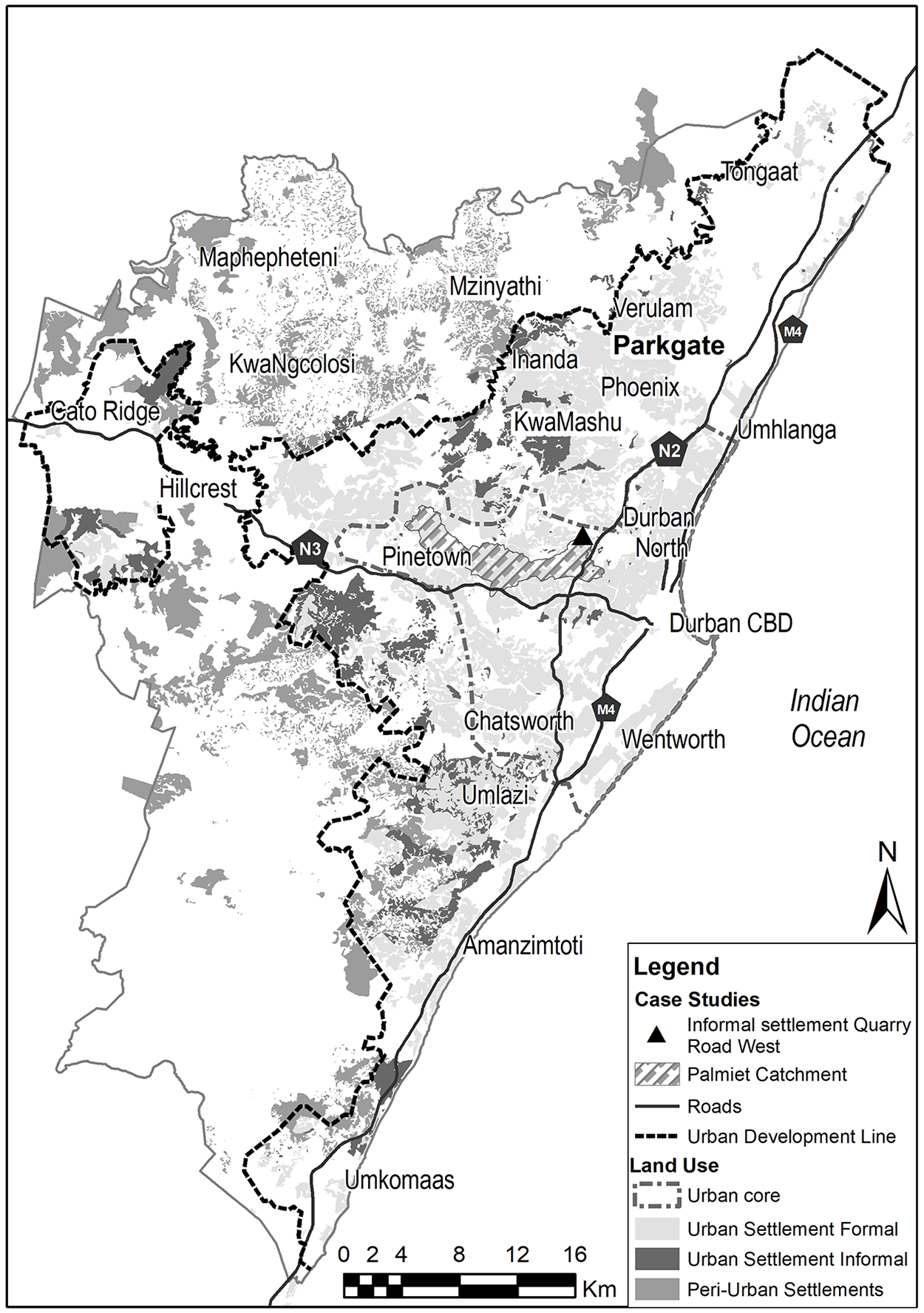
The Palmiet Catchment within the eThekwini Municipal Area
Communities living in formal and informal residential areas adjacent to the Palmiet River and in its catchment are concerned about flood risk, water quality and environmental degradation. While the Palmiet River is a relatively small river during normal flow conditions, under heavy rainfall it rises very quickly and can flood. The river has high levels of pollution and poor water quality due to the impacts of stormwater flow, the illegal release of pollutants by industry through stormwater systems, and poor solid waste management and limited sanitation services in informal settlements located in its lower reaches. The control of alien vegetation along the riverine corridor, which impacts on the ecological and hydrological functions of the river system, is a major challenge.
IV. Methodology
As a geographer at the University of KwaZulu-Natal I have conducted research on environmental governance in Durban over the past 30 years. With scholars in our environmental governance research group, guided by Dianne Scott, I have engaged with communities and their leaders, state officials and NGOs and community-based organizations, co-producing knowledge on mega-project development, investment in ecological infrastructure and catchment rehabilitation, informal settlement upgrading, water and sanitation provision, building the city from below in traditional authority areas, and more recently climate adaptation and disaster risk reduction. Our research group has developed and applied social assessment methodologies, participatory research approaches and, more recently, transdisciplinary research methods, working in collaborative partnerships with other actors in the city. Our research and practice aim to ensure that multiple voices are included in knowledge production processes and decision-making in the city’s environmental governance, with a focus on the urban poor, who are often ‘invisible stakeholders’ in environment and development processes.(25)
As a result of my long-term engagement with different development actors, I have learned about the importance of context, the power of collaboration, the value of knowledge co-production and the impact of building informal governance networks to inform state policy and practice. The university has increasingly played an intermediary role in urban development processes, as local actors (state officials, citizens and university researchers) collectively find themselves in spaces of political opportunity. Each participatory network that has emerged has aimed to shift discourses and practices and inform policy and decision-making, changing the framing and direction of urban interventions in small but meaningful ways, with failures along the way too. Our research group frames this process of engagement broadly as participatory environmental governance. We have asked questions about the role of these governance platforms in urban development and reform in Durban, of which we are a part.
In 2023 I participated in the African Cities Research Consortium (ACRC) and Manchester Urban Institute’s conference The Role of Coalitions for Equitable, Inclusive and Sustainable Urban Outcomes Conference (13–15 June 2023). The conference was framed by Mitlin’s conceptualization of urban reform coalitions, with case studies of urban reform coalitions presented from within and outside the global South. The concept of an urban reform coalition resonated strongly with the forms of participatory governance evident at the local scale in Durban, including the PCRP and hence it was applied to my analysis of the PCRP’s social and governance processes. The analysis presented in this paper is an insider’s account. It also reflects the insights and analysis of other partners in the urban reform coalition as it has evolved(26) and with whom I have spent many hours over 10 years, debating the value and relations within our urban reform coalition. This analysis is strengthened by framing it in theoretical concepts and critical perspectives I gained from the urban reform coalition conference, as well as the detailed comments provided through the review of this paper.
The question of how this local urban reform coalition was formed, what knowledge building strategies were used, and what its outcomes have been, are presented below. The significance of context, actor networks, intermediaries within and between actor groups, and diverse forms of knowledge, which were integrated through co-production methodologies, is analysed to contribute to the growing body of literature on urban reform coalitions, and in particular to highlight the internal dynamics and knowledge production processes which have not been widely documented but are an inevitable component of any collective process.(27)
V. An Urban Reform Coalition in Durban
a. Bringing actors together across scales for water security
Managing catchments to ensure water supply for the present and the future in water-scarce Durban, is essential to the state, which is responsible for the regulation of water resources (national government) and the provision of water services (local government). The Umgeni Ecological Infrastructure Partnership (UEIP) was established in 2013 by the South African National Biodiversity Institute, eThekwini Municipality, the uMngeni-uThukela Water Board and the KwaZulu-Natal Provincial Department of Water and Sanitation, to support water security and climate adaptation through investment in ecological infrastructure in the uMngeni Catchment, which supplies water to Durban and its city-region. The UEIP was central to the formation of the PCRP in 2014,(28) which was selected as one of its four pilot projects by the then head of the eThekwini Water and Sanitation Unit (EWS).(29) The Palmiet River, which flows into the Umgeni River, changes very quickly under different rainfall conditions, as it is a small sub-catchment, which has varied land uses and high levels of pollution (see Figure 2). The UEIP provided strategic direction for municipal actors to focus on catchment rehabilitation through investment in ecological infrastructure, improvement in water and sanitation services and climate governance adjacent to the Palmiet River. In 2013, as part of the UEIP, EWS designed a range of technical water and sanitation interventions for the Quarry Road West informal settlement, located on the floodplain of the Palmiet River, in an attempt to improve the river’s water quality.(30) As municipal officials, EWS accessed the settlement for fieldwork through the ward councillor. A councillor is a politically elected representative within local government, who is the channel between the community he or she represents (through a ward committee) and the municipal council. Councillors have a leadership and decision-making role in the municipal council.
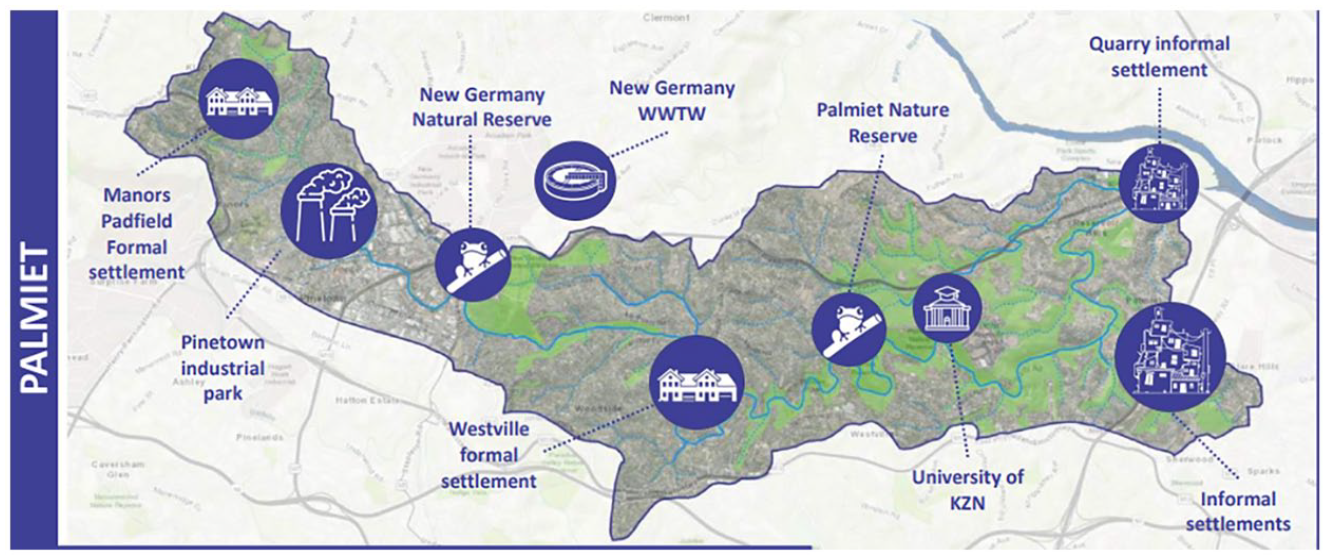
The Palmiet Catchment with its main land uses
The officials required security to enter the settlement as a result of conflictual relationships between the informal settlement community and the municipality, due to poor service delivery. They used engineering knowledge to develop technical solutions without the participation of the community or municipal funding for implementation, which they presented to the Climate Protection Branch (now the Climate Change Adaptation Branch) in 2014 as part of municipal efforts to link climate and water governance across the institution. Initial efforts to improve the Palmiet Catchment thus used a technical and top-down approach.
At the same time, the University of KwaZulu-Natal obtained funding for integrated climate and water governance research (a project known as SANCOOP CLIMWAYS, which ran from 2014 to 2017), identified by the Chance2Sustain Project (2010–2014) as critical to the city’s sustainability.(31) As principal investigator of CLIMWAYS, I approached eThekwini Municipality (EWS and the Climate Protection Branch) to identify current water and climate security projects, to ensure that my research was relevant to the city and its resilience-building efforts.(32) The head of the Climate Protection Branch of eThekwini Municipality, a lead partner in the UEIP, understood the need for, and value of, participatory water and climate governance and diverse knowledge production in a local catchment. He played a visionary and leadership role in bringing EWS, the Climate Protection Branch and the University of KwaZulu-Natal’s CLIMWAYS project team together, to discuss establishing a collaborative governance platform in the Palmiet Catchment. This paper describes how the initial top-down approach shifted to the development of and reliance on an urban reform coalition, as a result of social learning and leadership from both the municipality and university.
b. The formation of the Palmiet Catchment Rehabilitation Project
University researchers were perceived as neutral actors who could identify and meet with actors engaged in river-related community projects. Their alignment with the Climate Protection Branch on the environmental and social value of investing in ecological infrastructure in the city, and their joint belief in participatory urban governance and knowledge co-production, were critical to the initiation and sustainability of the community of practice (CoP) established for the rehabilitation project, reframed in this paper as an urban reform coalition. In the initial meeting convened by the municipality, the university team recommended that an actor map be developed and key stakeholders invited to discuss joining the CoP to support river rehabilitation in the Palmiet Catchment.
RiverWatch was identified as one potential partner. This community-based forum is composed of middle- to upper-income formal residents living adjacent to the upper and middle reaches of the river, and it invests in civic science, data collection (which it claims is apolitical) and localized action. It aims to address the causes and not the symptoms of pollution in the Palmiet River with the vision of “achieving ‘One Pollution Free Catchment in eThekwini’ based on the principle of being factual, non-personal, non-political and non-sensational, while using [a model] that is results driven, action orientated, persistent, corrective and innovative”.(33) Using transect walks, RiverWatch members monitor the river, observing pollution events (changes in colour or illegally released industrial foam), which are reported to the municipality (see Figure 3).
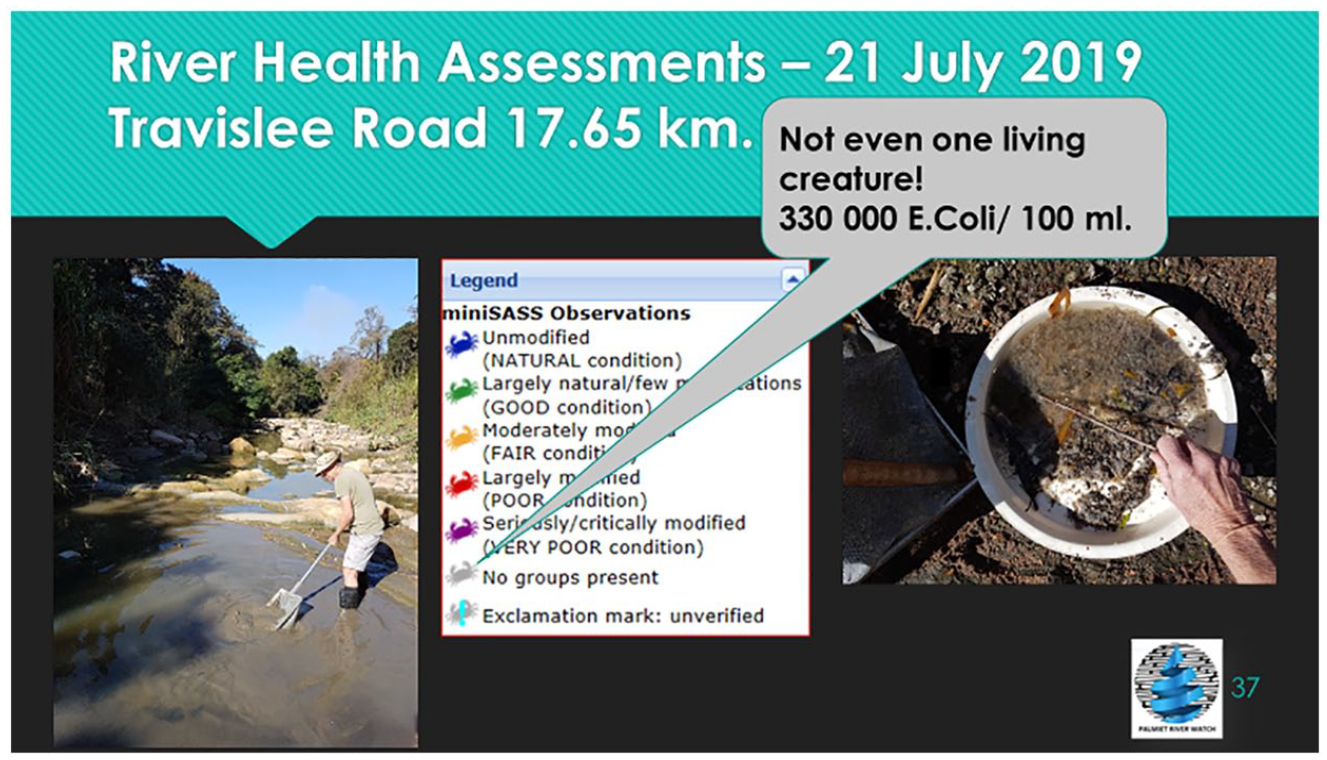
Monitoring of the Palmiet River by RiverWatch
The forum maintains a storyline that the Palmiet’s pollution is due to the local state’s failure to regulate and manage water, sanitation, pollution (solid and industrial waste) and informality, and that local citizens understand what needs to be done to solve these challenges. RiverWatch, supported by members of ratepayers’ associations,(34) lack confidence and trust in the municipality to deal with the river’s rehabilitation and provide infrastructure and services, although their households have good service provision.(35)
Quarry Road West informal settlement residents, located on a floodplain in the lower reaches of the Palmiet River (lower catchment) (see Figures 2 and 4), do not trust the municipality either, but for different reasons. They have limited access to basic services and face high levels of social, economic and environmental exclusion and risk. Prior to 2014, informal settlement residents across the city and politicians and municipal officials had limited understanding of each other’s rights and responsibilities and visions for a future sustainable city; rather, they saw the future of informal settlements from their own positionality.(36) Politicians and some municipal officials supported the discourse of a ‘city without slums’, with political promises of state-subsidized low-cost houses for informal settlement dwellers. Given Durban’s housing backlogs, this was never going to be a reality. Community members used protest to gain the attention of councillors and officials of relevant service departments, and demanded improved services and informal settlement upgrading. While this strategy worked in the short term, ensuring the councillor came and addressed the community, it had limited long-term benefits.
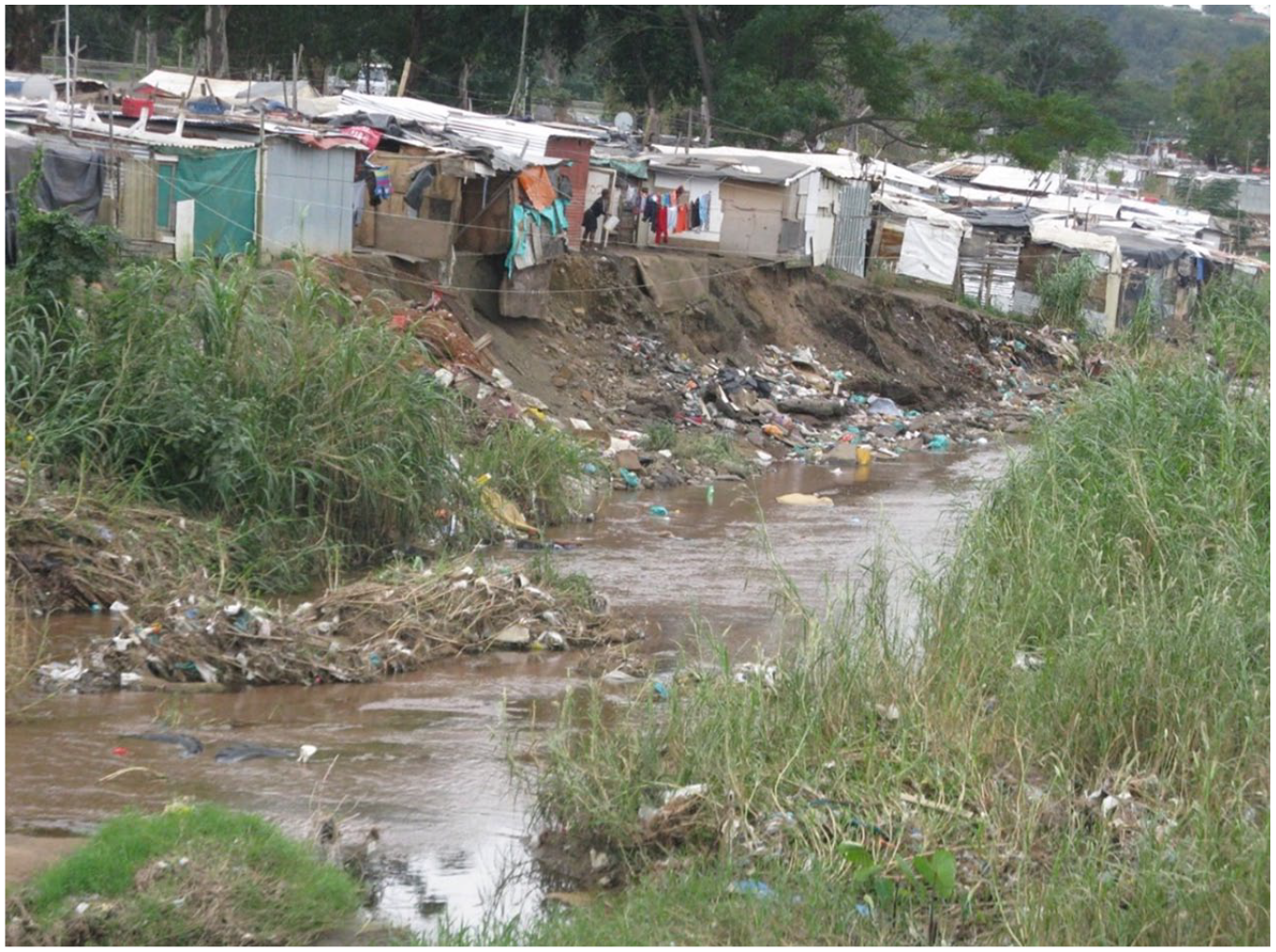
The Quarry Road West informal settlement and the Palmiet River
The Quarry Road West community was flagged by municipal officials in the initial UEIP meetings as a critical actor group in the river’s rehabilitation, given its precarity, its confrontational relationship with the municipality and the challenging relationship it had, and still has, with the river. According to a municipal official, “the river has to work its guts out to remove waste water, sanitation and solid waste from the settlement in the absence of basic services, provide river sand for building and it produces risk in terms of flooding, and being a habitat for snakes and rats”.(37)
The university researchers met with community leaders in 2014, having been introduced by EWS officials, and explained that the municipality and the university wished to work on improving river conditions. Community leaders were asked if they would like to join this collaboration and share knowledge on their relationship with the river. They agreed, given the researchers’ support for the co-production of knowledge, using open dialogue and participatory methodologies to hear and understand community concerns, and their experience in engaging with communities, including continually returning to the space. A relationship with Quarry Road West was built which remains in place 10 years later. In a dialogue held in a community tavern, one leader stated that: “after you came to meet us with the municipality, we did not expect you to come back so soon, and to ask us what we feel about our relationship with the river and how we share our life with it. We are not used to people coming back and asking us questions, asking us what we think, making us visible.”(38)
Once these initial relationships were established, four meetings, organized by the municipality’s Climate Protection Branch, were held in 2014 and 2015 in the Palmiet Nature Reserve(39) Community Hall, a neutral local venue, to establish a CoP. Meetings were attended by the primary stakeholders – municipal officials, members of RiverWatch, university researchers, community members from Quarry Road West, and in some instances members of the business sector. There were also various secondary stakeholders, less committed in terms of time available for the coalition. These included the eThekwini Conservancies Forum, representing local environmental conservancies, and municipal departments in eThekwini Municipality, including Environmental Health and EWS, as well as non-profit organizations and engineering firms. The Human Settlements Unit from eThekwini Municipality, which is critical to the work of the coalition, only joined the CoP in 2017 when Quarry Road West informal settlement was included in the citywide EU-funded iQhaza Lethu informal settlement upgrading programme, which it was leading.(40) The ebbs and flows of these other actors in the network have been important in sustaining the coalition, as they have been able to provide valuable knowledge and support to the reform processes of the coalition at critical points, as issue-based challenges arose.
Some CoP meetings included up to 53 people. Councillors only attended sporadically, as they prioritize meetings that respond to crises or lead to instrumental outcomes. What is important here is that the initially established CoP, which has now evolved into an urban reform coalition, did not rely on the power and presence of politicians, but rather was led and championed by municipal officials, university researchers and interested and affected community members, whose focus it was to draw different knowledge together, to reach a broad understanding of what a rehabilitated catchment should be.
c. Internal relations and knowledge production within the Palmiet Catchment Rehabilitation Project
It was agreed in 2015 that an action plan was required to guide the efforts of the CoP of the PCRP. Community representatives presented citizen science (RiverWatch) and locally produced knowledge (Quarry Road West informal settlement), which was translated from isiZulu by university researchers. Municipal officials presented scientific and policy knowledge and explained the catchment governance challenges they faced. University researchers played an intermediary role, drawing the different forms of knowledge together. RiverWatch’s contribution included detailed presentations, drawing from their extensive data sets and evidence of pollution, using MiniSASS and photographic evidence of pollution events (see Figure 3). Their storylines and evidence on the causes (rather than the symptoms) of pollution, including infrastructure absence or failure, poor catchment management and negative human behaviour, shaped the initial activities of the CoP.
The university researchers, using focus groups, community surveys, community-based mapping and arts-based methodologies including photovoice, worked with Quarry Road West community members to develop their storylines and narratives of home, social and environmental risk, localized climate change adaptation approaches, their use of ecosystem services and their resilience strategies as they negotiated everyday life adjacent to the Palmiet River(41) (see Figure 5).
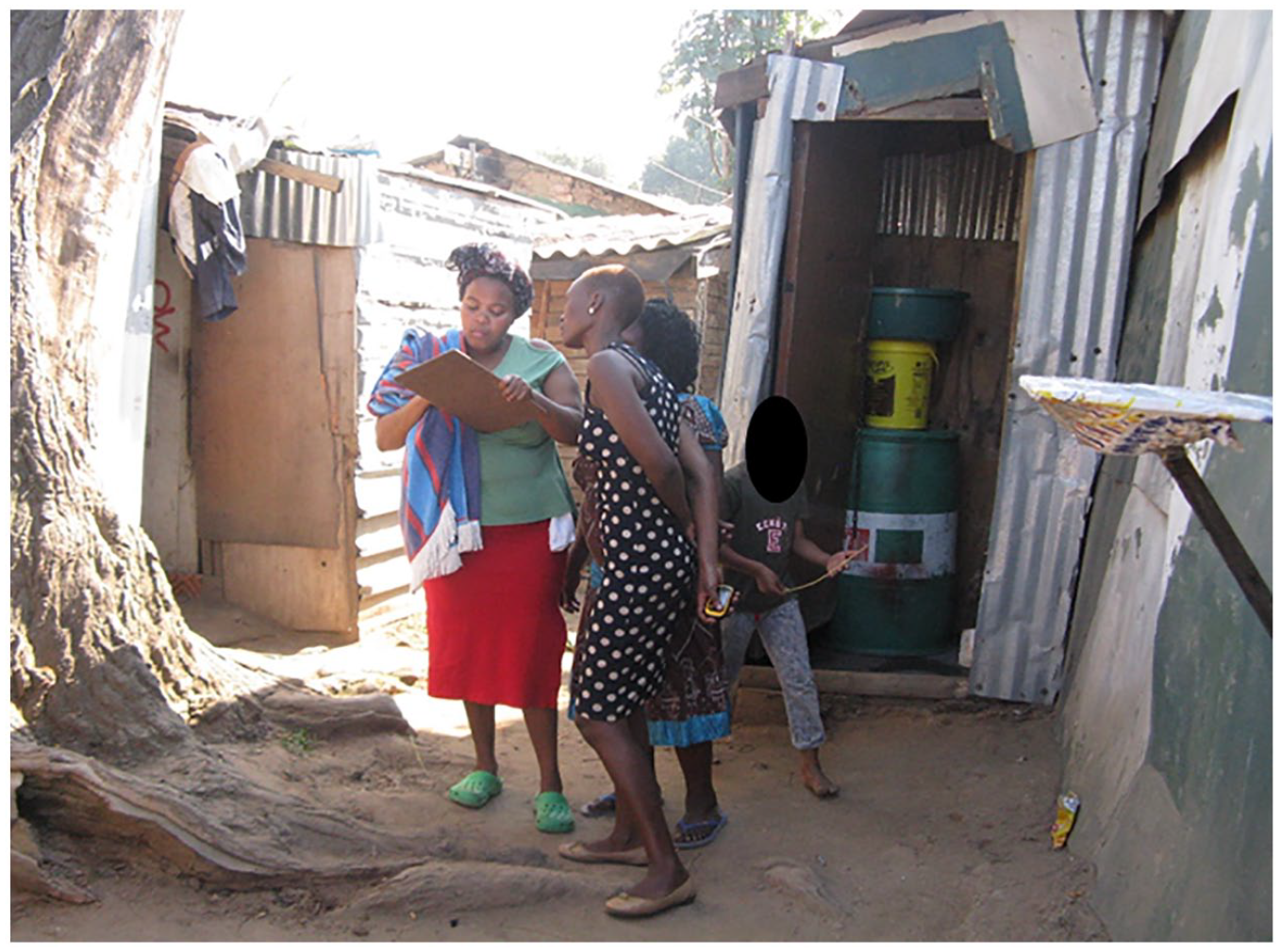
Community-based researchers from Quarry Road West informal settlement mapping their community
The local knowledge of the community was collected, translated and coded by university and community-based researchers into a form that could be embedded in the knowledge processes of the coalition. As a result, this community-based knowledge was made visible, and was able to frame and shape the CoP’s rehabilitation discourse and practice. Focused as it was on the relationship between informal settlements and rivers, it highlighted different knowledge and priorities to RiverWatch, which led to contestation. RiverWatch members argued that the knowledge production processes for the PCRP had shifted towards the informal community, who should not be living in the Palmiet’s lower reaches, given the precariousness of life on a floodplain. They stated that “disproportionate attention has been given to the QRIS [Quarry Road Informal Settlement] ever-since the Palmiet Rehabilitation Project commenced in 2014; which has diverted resources and attention away from remedial action that is required upstream”.(42) They suggested that the university researchers were encouraging the growth of informal settlements and informality, through their normalization of everyday life in informal settlements. They stated that the researchers were transferring this knowledge into municipal discourse and policy to promote their own social science research agenda, rather than municipal good practice for urban development. The conflict was underpinned by class differences and different conceptualizations of a rehabilitated catchment and a future African city: one without informality, and one recognizing that informality was here to stay. While actors in an urban reform coalition may share goals, the way they interpret these goals, the knowledge they produce to address them, and the action required to achieve them, can vary significantly and lead to fragmentation both between actors within the coalition and in the knowledge it produces.
An action plan for the catchment rehabilitation project was drawn up collaboratively in 2015 by the actors in the CoP, focusing on three themes: governance, biophysical and social issues.(43) In two learning labs designed by the Climate Protection Branch municipal officials and university researchers, members of the PCRP worked in mixed groups to identify the main challenges in the river’s rehabilitation, and how they could be addressed. They recognized that in formulating the plan, they needed to take municipal mandates into account (in other words what the municipality can do, given its roles and responsibilities), the land use context as it changed along the river, and the concerns of local stakeholders, who experienced the impacts of poor catchment management in different ways in their everyday lives. The Climate Protection Branch coordinates the Durban Climate Change Strategy, with implementation invested in other departments responsible for service delivery. It plays a strategic, regulatory, knowledge-based and facilitatory role, guiding municipal departments that implement projects (such as EWS, Environmental Health, the Human Settlements Unit). This placed them in a challenging position as residents’ expectations were that they should implement the action plan activities, which included the biophysical, social and governance dimensions of a rehabilitated catchment. Understanding local government mandates therefore became a critical part of capacity-building and social learning in the CoP.
The alignment of different actor groups around the rehabilitation of the river meant the initial development of the action plan was relatively simple. Critical issues included more inclusive and participatory governance processes, improved sanitation and solid waste management, the removal of alien vegetation, improved housing and services for those who live in informal settlements, citizen identification of pollution and the monitoring and regulation of pollution events by the municipality. The initial phase did not lead to significant conflict, as actor groups appreciated learning about and sharing knowledge on different relationships, roles and responsibilities with regard to the river. However, they differed on the way these issues were to be addressed, and on what knowledge should be used, the expectations and timelines for addressing them, and the future vision of what the rehabilitation of the river and its catchment would look like. For the formal residents, rehabilitation meant focusing on the causes and evidence of pollution in the upper reaches of the catchment, where light industry, a domestic waste disposal site and retail areas are located, as well as relocating the informal residents from the floodplain, to reduce pollution and risk to the river, the catchment and the informal settlement. The Quarry Road West residents’ activities threatened the river, given their lack of water, sanitation and waste services, but they were also at the receiving end of all that flowed down the river, including pollution and excess water during floods. Knowledge about how they impacted on the river and how the river impacted on them needed to be documented and shared, given that this was not always made visible. Municipal officials and researchers recognized that the causes of pollution had to be addressed through improved catchment governance, and how to do this needed to be understood, but they also pragmatically knew how difficult it would be to relocate the informal settlement in a city struggling to upgrade 587 informal settlements. Informal settlement residents did not wish to be moved away from Quarry Road West, which was advantageously located in terms of access to livelihoods and a bundle of urban resources, while most state-subsidized low-cost housing projects are located in the city’s periphery. In 2009, the community had in fact resisted relocation to Parkgate (see Figure 1), a low-cost housing project not deemed to be central enough to meet their social and economic needs, a point made clear in PCRP discussions.(44) An understanding of why they had resisted moving had never been communicated to the Human Settlements Unit by the community, as their knowledge usually was not transferred to state officials. The university researchers were interested in both social and environmental justice in the catchment and were building knowledge to make sense of these competing priorities.
d. The fragmentation of the Palmiet Catchment Rehabilitation Project
As the coalition began to elevate the voices of the various actors in relation to each other, moving civic science and local knowledge into municipal policymaking, the social and governance processes became more political, fragmenting around some issues, but also cohering around others. The fragmentation occurred along fault lines between formal and informal communities’ different expectations of local government, and their conceptions of what a rehabilitated catchment should look like. The local state was attempting to balance its responsibilities to plan and implement ecosystem-based adaptation in formal and informal areas. While these efforts were predominantly centred on ecological knowledge, regarding removing alien vegetation and investing in indigenous vegetation and the clean-up of the Palmiet River, itself a valuable ecosystem service, the state also had to address development deficits, such as poor service provision and the upgrading of informal housing. This required different forms of knowledge, including knowledge on infrastructure development, informal settlement upgrading, social development and poverty reduction. University researchers had invested most of their knowledge production efforts in the informal settlement, co-producing knowledge with community members, and building state–citizen relationships. This form of knowledge did not normally find its way into policymaking, and these relationships were not common, as the ward councillor was generally seen as the entry point of ordinary citizens to the state. The researchers therefore played a knowledge brokering role, acting as intermediaries by building relationships and translating knowledge between different actor groups.(45)
Conflict emerged within the coalition, a result of both the misalignment of goals and different knowledges used to create solutions, and tensions around the lack of material improvement in the catchment. Certain actor groups, notably RiverWatch, blamed the municipality for its lack of appropriate action and failure to meet mandates for service delivery. They also challenged the university research, which they believed was biased in favour of informality, perpetuating poor conditions in the catchment, while not addressing the root causes of environmental degradation higher up in the catchment. In 2019, RiverWatch sought to reframe the coalition and its purpose, by writing critical and open letters, which focused on their catchment rehabilitation agenda, to senior city leadership (the city manager) and politicians (the city mayor). This response placed significant pressure on municipal officials who were part of the coalition and prompted a call for the municipal ombudsman to intervene. The matter was resolved, as it was agreed that there are different ways to frame what catchment rehabilitation means in South Africa, where there are diverse and unequal challenges, but this broke trust within the coalition. Municipal officials, university researchers and informal settlement residents continued to engage with RiverWatch, but in a more cautious and measured way.
While the informal settlement residents saw little material change in their settlement, they trusted that their participation and the knowledge they had co-produced with the university had made them visible to the municipality. They had evidence that, for the first time, their knowledge was finding its way into various municipal projects, programmes and policies. As a result of support from the university researchers, they had participated in and informed the process of developing the city’s resilience strategy, ratified by the council in 2017,(46) one pillar of which is partnerships for informal settlement upgrading. The knowledge developed through the PCRP resulted in Quarry Road West being included as one of 10 case study settlements in the municipality’s iQhaza Lethu informal settlement upgrading programme, thus raising the profile of the need to address the relationship between informal settlements and the environment in upgrading processes. iQhaza Lethu led to more progressive approaches for dealing with the municipality’s informal settlements, with the first ever municipal informal settlement upgrading policy in South Africa, the eThekwini Informal Settlement Incremental Upgrading City-Wide Strategy and Programme Description, ratified by its council on 30 June 2022. Joice Stein, a Quarry Road West resident, speaking in a conference panel on catchment rehabilitation in May 2018, stated that “the municipality to some extent has been educated about informal settlements. Firstly, they now know there is the Quarry Road community. Most importantly, the municipality has learned, beyond the settlement, we are as human as they are.”
e. Building social cohesion in the PCRP
While there was fragmentation and contestation within the coalition, social cohesion and hope were also being built. Although actors within the network disagreed on the approach to catchment rehabilitation, the knowledge they produced on river levels and flood risk during storm events in 2016, integrated by university researchers, drew them back together. The leader of RiverWatch collected rainfall data in his rainfall gauge and reported it to the project’s WhatsApp group. The university researchers obtained experiential knowledge from the informal community on flood risk after storm events and began to correlate this with the RiverWatch leader’s reports of rain having fallen higher up in the catchment. Collaboration and learning across the network began to develop around reducing flood risk and knowledge was shared and supported by WhatsApp groups. The inclusion of informal settlement residents in these groups by 2017, as smartphones and mobile data access became more accessible, further enhanced the effectiveness of the localized warning system. In 2018, the senior manager of Catchment Management in the municipality began to collaborate with the PCRP, through the Climate Protection Branch, using a forecast early warning system (FEWS) which runs hydraulic models, with a radar located in the Palmiet Catchment. This led to the development of a community-based flood early warning system, which played a significant role in saving lives in the Quarry Road West settlement in the April 2019 and April 2022 floods.(47) This positive example provides evidence of how different knowledges, skills and capacities across the urban reform coalition’s network, for the common goal of disaster risk reduction, have been developed, shared and applied to build an early warning system that includes the knowledge of local and national government and local communities. The integrative, analytical and governance skills of the researchers, as intermediaries drawing together different forms of early flood warning knowledge, has been instrumental in this process.(48) The conflictual internal relations and politics between actors in the network, which led to fragmentation, were partly overcome, as these same groups engaged with each other through the early warning system, leading to the building of social cohesion.
VI. Conclusion
Finding solutions, in cities where the state and its centralized, hierarchical modes of governing can longer address challenging urban problems alone, requires the sharing of different knowledges, produced by multiple actors. Urban reform coalitions are emerging in many cities (see the special issue of which this paper is a part) creating a new form of urban politics, which includes diverse groups of actors, an emphasis on knowledge co-production and recognition of different ways of framing problems and their solutions. The PCRP, as an urban reform coalition initiated in 2014 in Durban, remains in place in 2025. It has navigated its way through multiple challenges in its catchment, including the contestation that took place among its different actors as a result of the coming together of different knowledges and expectations on catchment rehabilitation and the power relations this triggered. The collection of actors brought together by the PCRP urban reform coalition were working towards the same goal: the rehabilitation of a catchment, which over time included disaster risk reduction. However, they framed the required knowledge and the approach for achieving this goal very differently. Power struggles, challenging internal politics, debates about whose vision and knowledge counts, and the re-negotiation of a common purpose around newly emerging challenges around disaster risk reduction, are all routine features of an urban reform coalition, particularly in the context of cities facing multiple challenges. This paper reflects on the role of knowledge co-production in sustaining this coalition. I would argue that these challenges need to be addressed with commitment and a spirit of hope, respect, trust and positivity between actors, where champions invest in making invisible things known. Although the paper has not drawn this out explicitly, my hope is that its findings demonstrate that the relationships between people and their willingness to engage with one another across different world views, cultures (including languages) and knowledges is central to the impacts and longevity of urban reform coalitions, which are much needed in a world facing challenging social, economic and environmental problems. Building social processes, which include knowledge production, is just as critical as achieving material impacts.
Footnotes
Acknowledgements
I would like to thank two anonymous reviewers for their valuable comments on this paper. I would also like to thank the members of the PCRP who have helped me understand the value of urban reform coalitions.
Funding
The National Research Foundation of South Africa provided funding for SANCOOP CLIMWAYS, through the International Science and Technology Agreement, Norway/Republic of South Africa Cooperation Grants. The work was partially funded by the Sustainable and Healthy Food Systems in Southern Africa (SHEFS-SA) Project, supported through the Wellcome Trust’s Climate and Health Programme [Grant No 227749/Z/23/Z]. For Open Access, the author has applied a CC BY public copyright licence to any Author Accepted Manuscript version arising from this submission.
10.
Part of the European Union’s 7th Framework Programme’s project Chance2Sustain.
11.
These six modalities include everyday forms of resilience; protest or confrontational mobilization; judicialization of struggle; engagement and partnerships; division and demobilization; weak mobilization.
14.
Mitlin (2018,  ).
).
15.
25.
26.
These other coalition partners include Sean O’Donoghue and Smiso Bhengu (Climate Change Adaptation Branch, eThekwini Municipality), Geoff Tooley (Catchment Management, eThekwini Municipality), Patrick Martel, Bahle Mazeka, Sibongile Buthelezi and Duduzile Khumalo (University of KwaZulu-Natal) and Nomandla Nqanula, Thembisa Nomlala, Luyanda Xolo, Zandile Ntuli, Mabutho Miya, Samuel Zondani, Sebenzani Hlongwa, Nobuthanani Thuthu and Joice Stein (community-based researchers in Quarry Road West) and Lee D’Eathe (RiverWatch).
32.
While the paper presents my voice and analysis as the author, the urban reform coalition includes myself and members of my team of environmental governance researchers. Hence, we are referred to as university researchers from this point onwards in the paper.
33.
Minutes of the Palmiet Rehabilitation Project’s Multi-Stakeholder Workshop, 21 January 2016.
34.
Ratepayers’ associations in South Africa are groups of businesses and residents who represent the interests of their community, with the aim of improving local services, protecting the environment and ensuring the community has a say over decisions that affect them. They usually report issues through their councillor. The parallel institution in informal settlements and townships is an area-based committee.
35.
Minutes of Infrastructure Investment Programme of South Africa (IIPSA) Advisory Group, 11 February 2022.
37.
Municipal official 2, Palmiet Catchment Rehabilitation Project Meeting, 27 January 2015.
38.
Community leader, Quarry Road West informal settlement, 23 February 2014.
39.
A small nature reserve run by the Parks, Recreation and Culture Department of eThekwini Municipality.
40.
This project was funded by the European Union in partnership with eThekwini Municipality.
42.
Palmiet River Watch, 6 September 2019.