



Abstract
This paper contributes to critical and Southern urban studies by discussing how the notion of hybridity is useful to understand contemporary modes of politics rooted in equality pursuits and crafted by peripheral subjects. It analyses the birth, discourses and tactics of three grassroots groups in Rocinha, an immense peripheral settlement in Rio de Janeiro, Brazil, to show how modern insurgent claims – based on material urban rights – are intertwined with other grammars of justice, such as the politics of intersectional difference, critical pedagogies, solidarity and care. These cases suggest that contemporary insurgency builds on rights-based citizenship claims to create unique pathways that somehow articulate the universality and relationality of justice. I suggest that hybrid insurgent citizenship operates like a braid in which different strategies are uniquely and interdependently linked over time. Whilst in Rocinha the central thread is insurgency, the same logics could apply to other context-situated political traditions.
Keywords
I. Introduction
When discussing emerging Southern urban theory, Harrison and Watson(1) claimed that postcolonial territories are marked by hybridity – either because of the conflicting rationalities of different urban actors, or because of the way formal and informal processes blend in everyday life – for instance, the way land markets operate. Years later, Caldeira would note that peripheral urbanization – both geographic and symbolic – is marked by highly unequal cities with transversal engagements with official logics, specific agencies and temporalities and “new modes of politics”,(2) the latter characteristic being precisely a product of deep inequalities which entail the need for creativity and adaptation.
Drawing on the context of Rio de Janeiro, a city historically marked by such stark inequalities and conflictive urban politics, this paper contributes to Southern urban theory by exploring hybridity in the context of political engagements crafted by grassroots groups in informal settlements. In particular, it discusses how insurgent citizenship(3) – primarily identified in Latin America but evident elsewhere – is today a hybrid political tactic in which different grammars of justice are blended with “traditional” (of modern origin) universal citizenship claims in reflexive(4) ways, generating intertwined pathways to urban equality.
Here, urban equality is understood in articulation with Fraser’s framework of social justice,(5) which entails juxtaposing notions of redistribution, recognition, representation and reframing through parity of participation. It is also connected to justice reframings that place spatial, environmental and knowledge concerns at the basis of a broader pursuit of change.(6) Equality could thus be seen as both a principle guiding justice and one of its primary goals. This implies expanding the meanings of the term beyond the realms of redistribution(7) (of wealth, income and so on) and seeing it as a multidimensional experience. As Fraser elaborates, in a “radical-democratic interpretation of the principal of
Struggles for urban equality through parity of participation can be found in diverse marginalized and peripheral spaces, but they often appear with different degrees of intensity and through different performances. This article explores the case of the favela of Rocinha, an immense settlement with many features of peripheral urbanization and a rich history of activism that draws on insurgent citizenship claims. The history and strategy of three grassroots groups are discussed to advance the argument of hybrid insurgent citizenship in contemporary peripheral settlements. The paper shows that these case study groups emerge from the same tradition but have blended universal rights-based claims (usually focused on redistribution of urban services and resources) with other discourses, performances and logics.
By connecting the notion of hybridity to the literature on insurgent citizenship and planning, this paper offers a lens to explore such “new modes of politics” produced by peripheral subjects, whether these are rooted in insurgency or in other political traditions. It also complicates the narrative that links peripheral insurgent planners to the autoconstruction of cities – and implicitly to the material side of planning. Contemporary peripheral insurgent citizenship, I argue, maintains a focus on material urban claims, but is increasingly more sensitive to (and intentionally dialoguing with) the politics of intersectional difference, the role of critical pedagogies and counter-narratives, and relational ethics. It is often crafted and practised by urban subjects with accumulated cultural and political capital drawn from their longstanding learning and transversal engagements with powerful actors and logics.
Further, the analysis sheds light on what de Sousa Santos and Meneses refer to as the “knowledges born from the struggle”(9) in the global South and their capacity to influence planning trajectories in cities. So, beyond the field of Southern urban theory, it also contributes to pluriversal planning scholarship,(10) and other decolonial/postcolonial efforts that seek to understand multiplicity, coexistence and interdependence.(11) The case of Rocinha illustrates how, instead of refusing universal citizenship claims, contemporary insurgency strategically builds on them to legitimize its struggles and to create connections between past and future arrangements. In these hybrid political modes, the universality and relationality of justice somehow coexist, and further reinforce the capacity of the grassroots to adapt to ever-changing urban political contexts.
The discussion is structured in four main sections. It starts by highlighting different ways in which the grassroots have pursued urban equality. Complex and nuanced rationales are simplified into three vectors to create a framework for the analysis of the cases in Rocinha. Then, a few notes explain the author’s positionality and the methods that enabled the empirical analysis. The next section is focused on Rocinha. It shows how insurgent citizenship shaped urban activism in the settlement, and how the legacies of this political mode can be identified – albeit in hybrid ways – in the three selected cases. In the discussion section, the groups’ rationales and tactics are analysed against the three vectors of urban equality to offer more clarity on how insurgency and other grammars of justice create intertwined pathways to urban equality.
II. Grassroots Pursuits Of Equality
Based on a more explicit dialogue with Southern urban studies(12) – but not restricted to that – this section briefly sketches political performances which are underpinned by the pursuit of equality. This is by no means an exhaustive discussion of the broad spectrum of practices that shape urban and planning politics. Rather, it is a way to highlight the grammars of justice which complicate insurgency. I suggest that the three themes below should be understood not as isolated approaches, but as entangled/juxtaposed layers(13) that express diverse knowledges and peripheral subjectivities – as well as grassroots capacities to translate such knowledges into political capital and action-oriented approaches.
a. Universal insurgent citizenship – the foundation
Claims for universal citizenship rights through insurgency have been the basis for many grassroots-led performances concerned with equality throughout the twentieth century. Holston’s seminal work on insurgent citizenship describes in detail how deep social inequalities materialize in cities through processes of rapid urbanization.(14) As the author notes, “entrenched citizenship” is a form of urban inequality shaped by elites but sanctioned by the state through planning actions and regulations, which explains why grassroots citizenship demands are usually directed at the state in its diverse instances.
Insurgency is essentially a conflictive citizenship claim because inequalities in cities are interpreted by critical subjects as a breaking of the modern social democratic pact. And despite being about legal rights – and thus involving the abilities of peripheral subjects to interpret the law,(15) insurgency most commonly speaks to the physical and material dimensions of urban life, e.g. housing and infrastructure. Accounts vary across Southern territories, extending from anti-eviction campaigns in informal settlements to the occupation of vacant buildings in central urban areas.(16) Yet, whilst insurgency has been associated with confrontation, citizenship studies have also pondered the fact that state–citizen engagements, even when conflictive, are over time a combination of one-off events and quieter quotidian interactions.(17) Moreover, with the strengthening of neoliberal states in the twenty-first century,(18) studies on insurgent planning have indicated that citizenship discourses might be directed at other actors beyond the state.(19)
Despite such varied understandings, insurgency remains at its heart a citizenship pursuit which ultimately aims to corrode the urban status quo through spatial changes.(20) Equality is thus advanced by reflexive urban subjects who experience marginalization (through material exclusion), and intentionally challenge the never-fulfilled promise of state-led rights-based inclusion.(21)
b. Equality through diversity – the politics of difference
Unlike insurgency, the politics of difference(22) is not always associated with the realm of urban studies. Yet, in peripheral territories, non-tangible claims and agendas are constantly dialoguing with urban spaces. By exploring their racialized and gendered identities, and connecting them with urban territories, urban dwellers craft unique narratives about cities and their inhabitants.(23) Materializations of such politics in peripheral spaces include community-led radio stations, independent newspapers,(24) museums and tourism,(25) in addition to other practices of self-enumeration, counter-mapping and storytelling(26) that intentionally produce actionable knowledge. What these practices have in common is an ability to engage in alternative or counter discourses that disrupt dominant perspectives and reframe conventional diagnostics of urban spaces. Simply put, the politics of difference helps to produce questions such as: is the city catering for diverse needs and aspirations? What kinds of visions/knowledges have not been transmitted through hegemonic discourses? Who should be engaged in decision-making and in discussion of how to better represent minority groups in urban arenas?
It is important to recall, however, that peripheral narratives and actions are not inherently progressive or transformative,(27) which means that urban initiatives that emerge from the politics of difference might not be rooted in deliberate quests for justice. In certain times and spaces, there can also be a clash of competing subaltern identities or internal inequalities,(28) even within progressive initiatives, which leads to complicated ethical dilemmas for planning.(29) Still, grassroots performances based on the politics of difference have a potential to contribute to urban equality by shedding light on diverse of ways of being and knowing the city.(30) They often turn narratives of poverty and absence into narratives of power, and their knowledges “born in the struggle” might advance quests for epistemic justice in planning.(31)
c. Equality as process – care, solidarity and critical pedagogies
Universal (insurgent) citizenship and the politics of difference are often underpinned by recognition claims – and thus directed at “external” interlocutors, often the state. Yet, in everyday life, grassroots performances aimed at alleviating the effects of inequality or at pursuing long-term equality often operate autonomously.(32) These are actions that may activate institutional nodes at times but remain rooted in the mutual care and solidarity among marginalized urban subjects. And beyond superficial aid (such as one-off donations and assistance), these practices can be connected to critical and emancipatory pedagogies – especially if conducted by peripheral “critical urban planning agents”.(33)
Although such performances are not exclusive to peripheral territories, Southern studies have illuminated how, in contexts of precarity, solidarity works as a web of human infrastructures(34) that facilitates the circulation of urban goods and resources beyond material pipes and wires. They have also indicated that critical pedagogies practised by urban social movements (partially or fully led by peripheral grassroots groups) are conduits for the social production of the city(35) and part of the process of training and emancipating radical planners.(36)
Meanwhile, feminist and gendered perspectives that dialogue with care have raised discussions about relational forms of ethics in planning(37) – which put more emphasis on contextualized responsibilities than on rights, and on injustices connected to labour and the embodiment of risk and violence.(38) In urban studies, this means for example the association of gender roles with the maintenance of everyday life, e.g. fetching water or managing collective/community services whilst being more exposed to material and environmental risk.(39) Further, it has been argued that the city in itself may facilitate or constrain care practices through its governance and materiality.(40) But while a focus on care highlights differential vulnerabilities, when it is attached to solidarity practices and critical pedagogies, it may also help to realise citizenship rights(41) through the production of tangible collective goods such as housing.(42)
While this paper does not wish to conflate the notions of care, solidarity and critical pedagogies, it highlights that those three tactics are embedded in political relations, usually grounded in urban peripheral territories, and understood as processes that are valuable in themselves. That is, they are not mere instruments to pursue urban equality but ways to practise urban quality in everyday life.
III. Notes On Research Design, Methodology And Positionality
This paper draws on my ongoing engagement with Southern territories and the diverse urban-political actors that intersect with them. My first research contact with Rio de Janeiro’s favelas started in early 2014, and with Rocinha in 2017 (when my PhD research began). I entered the field through events promoted by the Sankofa Museum and had an intense ethnographic immersion during the first two years of research (2017–2019). The approach was mostly qualitative but encompassed diverse methods: semi-structured interviews (30) with key informants (current and past grassroots leaders, planning authorities and other active professionals engaged with peripheral activism); quantitative questionnaires based on statistical sampling methods with dwellers from Rocinha (521); participant observations in state- and community-led discussion forums, and dozens of informal conversations and observations noted in a field diary.
The PhD research design entailed a longitudinal analysis of Rocinha’s planning trajectory (from the 1970s to 2021), which was aimed at capturing the nuances and transformations of diverse participatory planning spaces in a territory marked by rich but hard-to-grasp urban politics. The realization of political hybridity (and how it connects with insurgent citizenship) is one of the many gains of this longitudinal view, but other interesting issues – such as the contrasts between different generations of activism – will also be hinted at, albeit in a more superficial way.
A few modifications to the research design are also noteworthy. During the COVID-19 pandemic I engaged in a process of digital ethnography: conducting remote interviews, following the actions of grassroots collectives and leaders through social media, and observing dynamics in virtual arenas. My early in-person immersion made the digital stage more viable, as many residents and leaders were familiar with this research. Yet, as a white, middle-class Brazilian who was not experiencing the pandemic in the same ways as favela dwellers, I was mindful not to overload participants. Whenever possible, I assisted grassroots groups in conducting their own designed activities, which allowed for more meaningful conversations and insights. For instance, I contributed to the organization of a remote debate in the lead-up to the election for the main favela association, and to fundraising campaigns aimed at food security and hygiene during the peaks of the pandemic.
Slowly, my research moved away from more traditional methods and towards a process of knowledge sharing and co-production, especially after my PhD ended. I still conduct periodic visits to Rocinha, listen to residents’ priorities and aspirations, and try to understand their perspective on urban phenomena without a strictly bounded agenda. This has led to interesting engagements such as the course “Peripheral territories, memory and rights” which I taught in partnership with the Sankofa Museum. I also co-designed new research with members from the Rocinha Resists collective, and still participate in the discussions and events organized by Rocinha Without Borders.
The analysis below is therefore a mix of findings from my PhD research, coupled with reflections from my co-production engagements with these collectives since 2021.
IV. Learning From Rocinha
The events described in this section are summarized in the timeline in Figure 1.
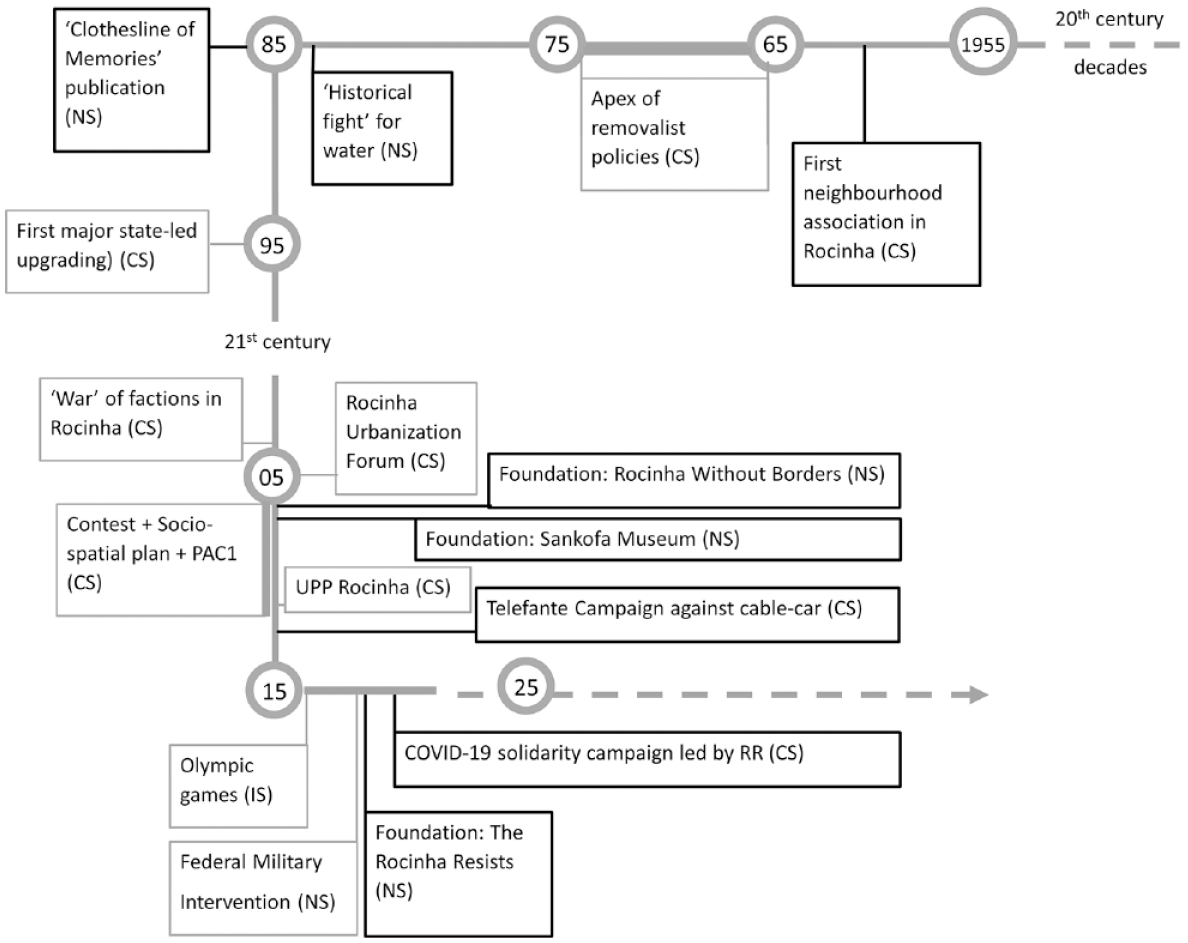
Summary of key events, starting from the upper right
a. Historical fights
In the 1970s, Luis(43) left the interior of the state of Ceará for Rio de Janeiro and in search of livelihood opportunities. Like him, a mass of Brazilians migrated from the north-east of the country to south-eastern (more industrialized) cities, something that contributed to the demographic explosion of informal settlements in the mid-twentieth century.(44) Luis soon settled in Rocinha, a neighbourhood which did not offer legal titles and conventional housing or infrastructure but was vibrant and close to job opportunities. Once, in an informal conversation,(45) he mentioned that his life followed the “paths of water”: the name of his hometown (which translates as “Hydroland”) alluded to this natural good and, arriving in Rio, he worked carrying buckets of water for wealthier families in his first years living in Rocinha. He also entered politics on account of water shortages in the settlement.
After negotiations with the local water company and other groups – including church representatives and informal providers – he and other neighbours managed to install the first public water posts in the lower part of the settlement in the mid-1980s. Luis says he learned a lot about citizen participation at that time: “[The negotiation] was supposed to take three months. It took three years.”(46) It also required a conscious effort not to yield to the easiest solution, which in Rocinha meant the construction and control of water posts by local mafias. This episode of material politics was long but fruitful, as it created a precedent for other claims.
This short vignette describes what is commonly called in Rocinha “the fight for water” or “one of the historic fights”. The use of the term “fight” – repeatedly captured in interviews and dialogues – is noteworthy: it alludes to the tradition of insurgency(47) in this and many other peripheral settlements.(48) In Rocinha, not only did the event trigger the emergence of diverse political leaderships; it also represented the first major urban citizenship gain for residents. Up to that point, they were mostly engaging with the state in acts of patronage or merely to resist eviction.(49) From this event forward, there was a precedent for advancing more claims.
b. Rocinha Without Borders
Many decades later, in 2006, Jose and Ricardo – two young dwellers from Rocinha, one of them the son of a known activist – started to activate the local powers to discuss socio-spatial issues in the neighbourhood. They wanted to create a space where favela residents could become the protagonists for urban change in the city.(50) The timing of the mobilization is relevant; governed by the Workers’ Party at the national level, Brazil and Rio de Janeiro were living a moment of socio-economic prosperity, and Rocinha – always an enormous, economically vibrant and visible favela – was one of the epicentres of transformation.
Change was nonetheless complicated by the competing sovereignties(51) (formal and parallel states – such as drug trafficking factions, militias and multiple urban-political representations) that constantly intersected with planning. In Rocinha, many interests (connected to the urban territory) are constantly colliding and, although it was never among the most violent settlements in Rio, armed conflicts and gunshots were not uncommon. In 2004, a violent local “war” caused commotion in the city. Rocinha was invaded by a rival drug trafficking faction and, on top of numerous deaths, this caused the days-long closure of a key tunnel that grants access to Rio’s South Zone and city centre. The episode galvanized an alliance between diverse associations (from Rocinha and its wealthy neighbours), which was facilitated by technicians and intellectuals from Rio. The objective was to create a non-governmental space that redirected the energy of the crisis towards positive outcomes. A series of encounters, later baptized “The Rocinha Urbanisation Forum”, delivered a document with visions, recommendations and conceptual plans.
In the aftermath of this event, a few alliance members continued to mobilize to act on ideas from the Forum. This led to a National Contest of Ideas for Rocinha, organized by the Brazilian Institute of Architects in Rio, whose call was based on the outcomes of the Urbanisation Forum. By the end of 2006, a team composed of planners familiar with Rocinha and some local leaders won the prize, and thus begun the development of “Rocinha’s Socio-spatial Plan”.
It was around this period that the two youths from Rocinha started to mobilize and engage in urban-political discussions. They first considered joining one of existing local groups, as Rocinha already housed four neighbourhood associations and dozens of NGOs and other grassroots spaces. Among the most active was the headquarters of the Workers’ Party in the favela. The two youths were invited to participate more often and provide input. Yet, they wanted to engage more locals in the process and were concerned that a clear partisan affiliation would impact negatively on the group’s reach. Internal negotiations eventually led to the creation of the non-partisan group “Rocinha Without Borders” (RWB).(52)
Excepting the interruptions caused by the pandemic, RWB holds in-person open meetings once a month. The two founders eventually left the group’s leadership, which was filled by some of Rocinha’s old-school activists. This shift contributed to a reinforced emphasis on materially driven insurgent claims, which in the settlement connect to the historic fight for water, sanitation and hygiene (WASH) infrastructures. Discussion themes nonetheless vary a lot and include, for example, tenure security, urban health and disaster risk reduction. One thing that gives identity to the group is the consistent participation of invited technicians, politicians and intellectuals from other neighbourhoods, cities and countries. It is not uncommon for researchers new to Rocinha to be directed towards RWB. Over the years, it has become a network that has somehow transcended Rocinha’s physical and administrative limits, that is, it became a trans-local hub for critical pedagogies.
The work of RWB mixes care, solidarity and critical pedagogies (equality as process) with traditional insurgent citizenship in an interesting way. The declared objective of the group is to make Rocinha residents increasingly aware of their rights and responsibilities(53) – something that points to RWB’s rights-based educational mission but also to residents’ care for the community. Yet, the work of RWB is strongly action-oriented and constantly conflictive, which can be illustrated by the period from 2006 to 2013. Here it is worth recalling that Rocinha was living a moment of socio-urban effervescence. The Contest of Ideas led to a contract with the state government for the production of a plan with comprehensive interventions. This was carried through rounds of discussion forums (spread across Rocinha’s sub-neighbourhoods) and through ‘urbanization courses’ and Q&A spaces on local radio shows. These spaces were intensely frequented and/or mediated by RWB members.
Soon after this – and precisely because of the existence of a local plan (not common in favelas at the time) – Rocinha was chosen as the pilot territory for the first stage of the National Growth Acceleration Programme in favelas (PAC 1).(54) This meant a massive flow of investments from the central to the state government for upgrading purposes.(55) In theory, PAC was intended to adopt the decisions that had been made in the more participatory socio-spatial plan. In practice, however, PAC arrived with multinational actors, top-down changes (such as new housing units whose design had not been discussed) and little space for negotiation with local groups.(56)
Still, a national requirement and budget for civic engagement opened up some opportunities for activists. For instance, an initial “Local Leadership Forum” conducted at the beginning of PAC led to the creation of Working Groups – in practice, monitoring teams where locals “supervised” the impacts of PAC. Several members of RWB comprised those groups and, although they claimed not to have enough leverage to change key decisions (e.g. the number of evictions where new streets were opening), they still could create obstacles (for instance by delaying works) when the programme was too off course. That insurgent “vetoing” capacity would become more tangible a few years later.
When PAC 1 faded away with work incomplete, and the government appeared with a new flow of investments branded “PAC 2”, RWB had enough political capital in the form of powerful supporters gathered through its hub to communicate its discontents effectively. The focus of conflicts at that time (2013) was the proposal for a cable car. Instead of giving continuity to the ideas put forward in the socio-spatial plan or finishing the incomplete works of PAC 1, PAC 2 borrowed from the upgrading experience of Medellín, Colombia (which had included a cable car)(57) without previously discussing the intervention with residents. A pilot had already begun in the favela Alemão, and it seemed to RWB activists that huge sums would be invested for little social gain. More importantly, they were worried that the key “historical fight” within the favela for WASH infrastructure would never be addressed if most of PAC’s budget was diverted to the expensive cable car.
From this central critique, RWB spearheaded the Telefante Campaign. Its slogan was: “Sanitation yes, white elephant no”. Although backed by several intellectuals and activists in Rio, the campaign was not universally supported within Rocinha, which created deep divisions between supporters of the government and those of RWB. Tensions were aggravated by discussions of the exclusionary effects of the mega-events (i.e. the FIFA World Cup and the Olympics) and the pacification-militarization policy in favelas(58) – all of which were heated at the time. Hence, for several reasons, which included the Telefante Campaign, PAC 2 was weakened and never implemented in Rocinha.
This was a bittersweet victory for RWB, for while the group had succeeded in vetoing a project which in their view would exacerbate inequalities, the advancements in WASH infrastructures that the group prioritized had not yet got off the ground. Still, this insurgent conflict was key to consolidate WASH as a priority agenda in Rocinha. And despite the divisions that the Telefante Campaign caused at the time, my quantitative research with dwellers shows that RWB captures well the overall sentiment in this favela: 262 out of 521 dwellers, in response to an open-ended question, said that WASH is “what Rocinha needs the most”. In the presentation of a later upgrading programme (also discontinued), the government stated that the bulk of its investments would be in sanitation, accompanied only by complementary works (e.g., housing and waste management). According to some interviewed leaders, it is the first time that politicians have prioritized non-visible (underground) urban improvements in favelas, at least in Rocinha. As this paper is being completed (2022), RWB continues to organize events and campaigns asking local and state government where the money that has been promised for WASH in Rocinha is.
c. Sankofa Museum
In the 1970s, anthropologist Lygia Segala was conducting literacy-oriented education projects in Rocinha while also working with dwellers to collect memories from the settlement.(59) At that time, the biggest neighbourhood association (UPMMR) was the progressive group boosting political action on site, and through some of its members the researcher and her students were able to collect thousands of photographs and testimonies from long-time residents. The collection was published by the association as the book Clothesline of Memories,(60) and was one of the first community-led historical data collections in Rio.
Decades later (2007), the secretary of culture of the state of Rio de Janeiro presided over the Cultural Forum of Rocinha, an event which gathered representatives from the government and local political/cultural grassroots groups. Among the Forum’s discussions and key outputs was a plan for the creation of a community-led museum. One of its main objectives would be to document and publicize Rocinha’s (im)material heritage. For favela cultural leaders, this was a way of reactivating Segala’s work and giving it local contours.(61) After the event, the core of the museum’s team decided to call themselves “Sankofa Museum”(62) – a reference to a symbol of the Akan people (present-day Ghana) which means “to retrieve”. Besides an interest in alluding to the African continent as a Black territory, the founders were attracted by the symbol (and logo) of “Sankofa”: a bird with its feet facing forward and head looking back. According to the group, this is the function of an action-oriented favela museum: to look back (learn from memory) whilst also walking forward (promoting positive change).
Sankofa provides a unique experience for its visitors. This is an open-air interactive museum, meaning that the whole urban space of Rocinha is understood as “the collection”. Paper archives (old documents and photos) are sometimes shown at fairs and events in Rio, but the museum’s key strategy is more dynamic and involves a walk-through of the favela. The pre-set route starts at the top of the hill, where the growth of the settlement mostly started. Visitors then pass through old houses, key streets and alleys and even through the works installed by PAC. Sankofa’s activists tell an urban story from Rocinha about Rio and Brazil. That is, they link buildings, natural elements and events in Rocinha to key moments in the local and national urban history.
For example, they explain how the sub-neighbourhood called faz depressa (do it quickly) expresses the Brazilian removalist legislation of the twentieth century.(63) In that period, houses were sometimes built overnight in favelas so residents could demonstrate their presence and resist eviction threats. The way Sankofa’s “history of Rocinha” starts is also interesting and differs from conventional narratives. It does not start with urbanization but with the occupation of the land by the Tamoyo Indigenous tribes in pre-colonial times. Documents retrieved by the group also indicate that the subdivision and sale of plots – which shaped Rocinha’s main streets – were in fact carried out by white elites, thus disrupting the hegemonic tale that freed slaves and immigrants “invaded” the hill in a chaotic manner.
In addition to these routes, Sankofa’s activists often organize and participate in a series of courses and pedagogical activities at the city scale. An example is the periodic “Museum tea” event: a space in which residents (from within and outside Rocinha) are invited to storytelling sessions. Also, with the crisis generated by the pandemic, the group worked to collect local stories aimed at understanding local experiences and views about COVID-19, which include local/peripheral anti-vaccine perspectives.
The Sankofa Museum is therefore producing both physical data about Rocinha and narratives that disrupt general accounts about informal settlements and the planning actions they entail. It keeps memory alive while pursuing concrete agendas. The very “historical fight” for WASH is the result not only of the “word-of-mouth” of residents, but of the museum’s recovery of information about the first citizen–state engagements in earlier decades, which further consolidates insurgent claims. In sum, more than being simply a route designed to offer “tourism poverty”, the museum produces counter-narratives about the city, thus contributing to peripheral postcolonial and decolonial accounts. The emphasis on Black and Indigenous presences, and their relation to favela territories, is further evidence of how the politics of difference are shaping insurgent narratives in contemporary favela activism.
d. Rocinha Resists
Over the years, much has changed in the violent battle for territorial dominance in Rocinha. The “war” which led to the assemblage of the Urbanisation Forum (2004/2005) culminated in the rise of a drug dealer named Nem in the leadership of organized crime in the favela.(64) He was arrested in 2011, and in 2012 a station for the UPP (Unit of Pacification [militarized] Police) was built on the hill. The pacification policy’s first years were already troubled, but one event in particular aggravated citizen–state relations. A local resident (Amarildo) was arrested, tortured and killed by the police within the UPP premises. The case gained international notoriety.(65) In 2017, another armed conflict disrupted the peace of Rocinha’s residents, and in 2018 the armed forces took over Rocinha and other favelas to the sound of gunshots. There is no space here to explore the delicate play of forces that connects different political actors in Rocinha and the experiences of violence and fear it entails. But it is important to briefly mention these events because they have triggered social alliances and participatory synergies, including the formation of a strong new grassroots group.
At that moment (2018), young Rocinha dwellers felt frustrated with the crisis in the country and with the violence that was once again knocking on their doors. They felt violated as their lives became increasingly “militarized”,(66) and outraged by the way mass news outlets reported the events – focusing on the fear that “the favela” caused to nearby middle-class neighbourhoods. Similar to what happened with RWB founders in 2006, young dwellers wanted an opportunity to freely reflect on their realities, but also, as one of them put it, to “go to the alleys and take action”.(67) The message the group wanted to transmit to the world became its name: Rocinha Resists (RR).
When the new group emerged, it differed from its peers in several ways. First, RR is organized and led only by young activists from Rocinha, most of them in their twenties. This has implications, for example, in the way the group puts the politics of (intersectional) difference at the centre of its agendas – e.g., organizing favela-led events during the local “Black Women’s Week” – and in the way it makes strategic use of digital tools, including live-sharing their actions via Instagram and YouTube.(68) Second, these activists have little in common with the twentieth century stereotype of favela dwellers as poor migrants who arrived in the big city to try to make a living. Most RR members are attending or have completed higher education, either because of the accumulation of family wealth, or because of social policies or private scholarships. This often confers on the group the social status and leverage to negotiate with more parity in diverse urban forums in the city. The group commonly publicizes itself as a transdisciplinary group, formed by favela-bred engineers, architects, journalists, social workers, etc. Third, RR projects itself as a group that places concrete action above dialogue. That is, its members value dialogical spaces but are overall more interested in hands-on activities. This predisposition would prove essential in the pandemic.
In light of the new crisis in 2020 – and while groups led by older residents (such as RWB) stopped their in-person activities – RR members, according to one youth, put their “Black bodies on the streets to think of ways to create measures to combat COVID-19”.(69) Risking their health in the alleys of Rocinha (already the locus of other diseases(70)), these youths embraced the ethics of care and spearheaded a huge solidarity campaign. They were of course not the only ones. My digital ethnography in this favela suggests that virtually every political leader in Rocinha was somehow connected to solidarity actions in the early months of the pandemic. Still, RR’s actions stood out, not only because it was able to reach hundreds of vulnerable families, but also because of its ability to effectively distribute resources and goods. At that moment, the group partnered with local state agencies (for example, the contact point of Rio de Janeiro’s Secretary of Health in the favela) to map and identify the most vulnerable areas and households in terms of food insecurity or lack of access to basic sanitation. That is, instead of collecting and distributing donations randomly or to known families, RR developed its own hands-on redistribution methodology, which was constantly shared on social media.
The group grew considerably during the pandemic and gained immense political capital. Now it is undergoing a process of restructuring and reassessment of its strategic priorities.(71) As of 2022, however, activities have slightly weakened, partly because the visibility of the group has led to more concrete job opportunities for some of its leaders. In interviews, RR activists are constantly emphasizing that activism is an unpaid, labour-intensive practice which can often create fatigue for bodies already marked by marginalization and prejudice. Although it is not clear whether RR is going to continue its growth and consolidate a niche of action, its fluid and nuanced tactics – mixing insurgency, care and the politics of intersectional difference – point to a new generation of activism in Rio de Janeiro. This is the result of longstanding social policies and other pedagogical spaces that, despite being harmed by the country’s political setback in recent years, left marks in territories such as Rocinha.
V. Discussion: Intertwined Pathways To Urban Equality
The previous section describes the performance of three grassroots groups in the favela of Rocinha in Rio de Janeiro, Brazil, and the context that helps to explain their birth and rationales. Given the fluid and dynamic way in which these groups formed their alliances, campaigns and projects, it would be inaccurate to claim clear-cut commonalities and differences. Yet, a few patterns emerge and they are useful to advance the argument for hybrid urban politics in contemporary peripheral settlements.
First, a longitudinal analysis of Rocinha’s activism and planning shows that those three groups crafted their identities from a tradition of insurgency. This is made explicit both through an analysis of tactics – all action-oriented, conflictive in nature and dialoguing with material inequalities that express the non-realization of urban rights – but also through an analysis of their discourse. That is, all groups explicitly affirm that they exist thanks to the “historical fights” of older insurgent activists.
However, a closer look at the niche occupied by each group and the emphasis they all give to different themes and discussions helps to illuminate that these are not slight variations on traditional insurgent citizenship. These groups are crafting unique pathways to urban equality by producing deeply hybrid claims that blend insurgent citizenship with other grammars of justice. I make a point of saying “deeply” because, in many cases, these grammars are interdependent and therefore not easily detachable from one another. For instance, the insurgent counter-narratives of Sankofa Museum would not be possible without the emphasis on the Indigenous and Black occupations of favela territories. I suggest then that hybrid urban politics – or in this case hybrid insurgent citizenship – is somewhat like a complex “braid” made of visibly identifiable threads but arranged in patterns that are unique for each group, creating a cohesive pathway to justice (see Figure 2.)

The concept of “hybrid insurgent citizenship”: a foundation of longstanding citizenship claims intertwined/braided with other grammars of justice
In the case of RWB, the specific braid or pathway to justice operates through building trans-local learning hubs that, besides making residents aware of rights and responsibilities, are often effective means of galvanizing action. Their strategy is rooted in critical pedagogies and hints at notions of care and solidarity (e.g., claiming for residents the responsibility to care for the territory), but it is also action-oriented, leading to engagements that could be portrayed as classic insurgent tactics. The latter was illustrated by the Telefante Campaign in 2013.
Sankofa’s pathway to justice happens through the production of counter-narratives about the city, which draw on the politics of difference, given the emphasis on Black and Indigenous experiences. Yet, the communication of such narratives, despite their intentionally conflictive tone, is projected through critical pedagogies – interactions with tourists, intellectuals, etc. The ultimate objective is – as in insurgent citizenship – to erode the status quo. But the museum pursues this goal via long-term strategic dialogues with local and trans-local urban actors.
The RR pathway to justice emerges from an impulse of resistance in light of violent forces that produce feelings of unrealized rights. Such sentiments are strongly connected to what drives insurgency. The group also borrows from its predecessors and old-school peers some pedagogical tactics such as awareness campaigns and participation in state- or elite-initiated spaces but blends them with a unique approach to the politics of difference. For example, the fact that this group is entirely led by young people – many women and most Black – gives a more explicit intersectional emphasis to their work, which is not as prominent in RWB or Sankofa Museum. Although a consistent strategy is not so clear in their case, their willingness to deal with differential internal vulnerabilities, and the need for care and solidarity to practically respond to urban rights deficits, were pathways to justice identified in the pandemic.
I do not wish here to argue that the pathways of these groups are statistically representative of peripheral (Southern) urban politics, or even that hybrid insurgent citizenship can be found in every territory marked by marginalization and precarity. In fact, it is important to note that Rocinha is an “elite” favela of sorts in Rio de Janeiro. Located on valuable urban land, the settlement and its activists are more visible and better able to make their voices heard, at least when compared to more literally peripheral territories in the hinterlands of the metropolis.
Still, in the context of Rio de Janeiro and even of Brazil, what happens in Rocinha is important because it creates precedents for further interaction with state agencies and urban elites. Rocinha’s activists (and those from other, better-known favelas) engage constantly in discussion forums at the city and national levels, sharing their experiences and tactics, which means practical learning and an enriching of performances for other territories and activists wishing to advance urban equality.
These cases – and particularly the case of RR – further suggest that a “new face” of insurgent peripheral activism might be emerging in cities. This is shaped not only by marginalized migrants and displaced bodies, but by complex identities that experience prejudice, yet have also benefited from past progressive policies and/or longstanding pedagogical arenas that have helped to raise their status. Although this particular point is somewhat still speculative, I wish to suggest that contemporary insurgent citizenship might create unique and legitimized pathways to urban equality, such as the one that starts with peripheral activism and “ends” with peripheral dwellers reaching positions inside the state. This could be illustrated by the high-profile case of councilwoman Marielle Franco, although there are other progressive political actors increasingly occupying spaces of power in Brazil and elsewhere.
At a theoretical level, I wish to point to at least two contributions that these grassroots experiences produce. First, the notion of hybridity in association with insurgent citizenship disrupts the understanding that insurgency could be but one instrument in the “toolbox” of radical planners – whether these are from peripheral territories or not. The case of Rocinha shows that insurgency operates as the backbone of contemporary radical tactics that juxtapose different grammars of justice in intentional and unique ways.(72) It therefore has a perennial quality, although its contours are altered by other claims and more relational ethics.(73)
Second – and connected to the first point – the employment of hybridity in this context helps to overcome the idea that insurgency is antithetical to communicative rationality and collaboration.(74) Although this mode of politics remains action-oriented and ultimately erodes an unequal urban status quo, it often operates through critical pedagogies and more dialogical strategies that touch on the discursive front of planning. This notion further contributes to Southern urban studies and pluriversal thinking(75) by showing the interdependent process that attaches conflictive claims of universal citizenship to the politics of difference and equality as process. This is not to say that these logics operate at the same time. Here, coexistence and interdependence are attributed to the fact that insurgent planners are able to adapt their tactics to particular contexts and needs and blend them in creative and unique ways.
Still, more research is needed to understand how other urban political traditions beyond insurgency may trigger hybrid forms of politics, and in which ways different political cultures lead to diverse but identifiable forms of hybridity. For instance, a comparison between contemporary forms of urban activism in Latin American, African and Asian cities could be helpful to show how hybrid insurgency is to some extent similar to co-production practices or other emancipatory strategies led by the grassroots elsewhere.
Footnotes
Acknowledgements
I would like to thank Professor Barbara Lipietz, with whom I had conversations that helped to mature reflections on the role of hybridity in contemporary planning. I also especially thank the members of the three collectives mentioned in this paper for their collegiality and critical insights over these years of research and knowledge co-production.
Funding
This research was undertaken with the support of the Coordination for the Improvement of Higher Education Personnel (CAPES), and of the National Council for Scientific and Technological Development (CNPq), process 141281/2017 – 0, both based in Brazil.
1.
4.
In the context of this paper, reflexivity refers to (self-)awareness and a critical gaze at one’s own values, rationalities and role in a given context, as well as the ability to draw cause-and-effect connections that support more conscious discourses and action.
6.
Schlosberg (2007); see also Moroni (2020);  .
.
8.
See reference 5, page 16.
14.
See reference 3.
16.
Miraftab (2006); see also de Carli and Frediani (2016); .
17.
Lemanski (2020); Millstein (2020); see also .
19.
20.
See references 3 and 19.
22.
See reference 7.
26.
Patel et al. (2012); see also Allen et al. (2015); .
27.
28.
Sultana (2020); see also .
30.
See references 12.
36.
Frediani et al. (2019); ; see also reference 18.
39.
Ramakrishnan et al. (2021); see also .
43.
The names of all research participants and collaborators have been pseudonymized.
45.
Field diary entry, 2019.
46.
Semi-structured interview, 2020.
47.
See reference 3.
48.
See reference 2.
50.
Interview, 2019.
51.
Alsayyad and Roy (2006); see also .
52.
YouTube video advertising the group’s work available at https://www.youtube.com/watch?v=Fn1E9KXDQiI&t=143s.
53.
Interviews and group pamphlets consistently advertise this goal.
56.
Interviews from diverse stakeholders pointed to the role of construction companies as the main barrier to continued participation on the site.
61.
Interview, 2020.
63.
See reference 49.
66.
Interview, 2021.
67.
Interview, 2021.
70.
According to the Rio de Janeiro health department, Rocinha was, for example, one of the biggest tuberculosis hotspots in the country in the 2000s.
71.
Informal conversation, 2021.
72.
This relates, for example, to references 1, 3, 12 and 15.
73.
See references 4, 27 and 28.
74.
See reference 19.
75.
See references 10 and 11.