



Abstract
This paper explains how an informal partnership is changing the way affordable housing is produced in Cape Town. It explores the alliance’s composition, the roles of different actors and the shifts in City Council policies and practices. The shared objective is to supplement or replace state-led housing delivery systems with a more developmental approach driven by many grassroots property enterprises. With the glue of goodwill, the alliance draws together diverse partners with different expertise, resources and legitimacy. Through collective action they have amplified the voice and capabilities of emerging micro-developers and opened the bureaucracy to outside interests. This has altered the perspectives of senior politicians and officials towards informality, and prompted the City Council to instigate wide-ranging reforms, galvanizing a momentum for change that may be difficult to arrest. The paper illustrates the power of a compelling vision supported by sound technical arguments and articulated by credible actors and organizations.
Keywords
I. Introduction
An unusual alliance has emerged among incongruous partners concerned about the dire housing situation in one of southern Africa’s largest and fastest growing cities, Cape Town. This loose-knit partnership or coalition doesn’t have a name, let alone any formal organization or membership. Yet, it is beginning to create genuine momentum for change through advocacy, capacity-building and incipient reforms to City Council policies and practices. This paper explains how this influential grouping has evolved to lay the foundations for transforming the way affordable housing is produced in the city. It explores the anatomy of this network, the various roles played, the ways it operates and its contribution to altering city government policies, regulations and practices.
The alliance arose in response to a growing crisis of lack of decent affordable accommodation and swelling informality in the city. Approximately 50,000 additional dwellings are required each year, but fewer than 20,000 formal units are being produced.(1) The worsening housing shortfall is the product of continuing urbanization in the context of mass unemployment, low household incomes and deep-seated inequality. For the last three decades, national housing policy has been locked into an outmoded and inflexible regime based on the state trying to build its way out of the problem through large-scale construction of stand-alone dwelling units for poor households. This formula has proved financially, environmentally and socially unsustainable, leading to widespread calls for change.(2)
The established approach partly reflects the traditional top-down way in which the government plans, makes decisions and typically functions. Funding programmes and administrative systems have tended, through excessive prescription, unreasonable standards and overregulation, to hinder rather than help the efforts of small private developers and homeowners to participate in housing production.(3) Regulatory frameworks that are not fit for purpose for affordable housing are not unique to South Africa, but are common to many African countries.(4) In South Africa, policy inertia and unresponsiveness to the lived experiences of low-income communities have caused growing disaffection and discontent, culminating in a dramatic decline in ruling party fortunes in the 2024 national elections.
In some parts of the country, the bureaucratic character of government planning and control over decision-making has been questioned by disparate networks of civil society bodies, social movements, non-government organizations (NGOs), community-based organizations, business associations, academics and independent professionals. This is arguably most apparent in Cape Town, with its rich assortment of such actors. Some social movements and NGOs trace their origins to community struggles against apartheid policies in the 1980s; others have arisen in response to recent social problems, such as HIV/AIDS and food insecurity. Several NGOs have not survived in the environment of government enmity and funding difficulties of the last decade or so. Those that remain range in style and orientation. On the one hand there are activists and social movements committed to confronting unequal power structures and challenging state laws through high-profile advocacy campaigns and protest politics; on the other, pragmatic groups aiming to achieve incremental improvements in material conditions through constructive engagement with the state around policy reforms, and collaboration around building capabilities within communities.
Some of these actors have gradually coalesced into an informal alliance with a shared goal to transform the provision of affordable housing in the city by supporting the efforts of micro-developers and emerging contractors to build decent quality rental units (rooms or flats) in single- or two-storey blocks. These units are often situated in the backyards of formal dwellings or are constructed after demolishing the original unit. Most buildings currently produced this way do not comply with municipal rules and regulations, which are too onerous, costly and slow.(5) The unauthorized or informal character of these projects inhibits access to conventional loan finance and undermines their ultimate resale value. Informality also deprives the City Council of revenues required to fund essential infrastructure to accommodate the growing population in these neighbourhoods, threatening viability. Yet, the same municipality has control over some of the levers required to rectify the situation by regularizing this construction. Once again, these circumstances are not unique to South Africa but are pervasive across many African countries.(6)
Urban reform coalitions in the global South have not been extensively studied, unlike those in the global North.(7) Compared with reform coalitions elsewhere in the South,(8) there are arguably three novel features of the housing alliance in Cape Town. First, it is issue-based rather than neighbourhood-based or founded on fundamental human rights principles. The partners are city-focused and drawn together by a shared commitment to two goals: (i) expanding the supply of decent affordable accommodation across the city, and (ii) widening access to the economy and income-generating opportunities by uplifting black and emerging property enterprises. Both objectives are simple and compelling enough to encourage active participation, although they are more complicated than appears at first sight, with many subtleties and technical nuances. Being multifaceted, these objectives are also beyond the capacity of any single government entity or other organization to achieve, which is why a coalition of actors with distinctive strengths is required. Property is an attractive sector for fostering empowerment through enterprise. The barriers to entry are relatively low, most activities are labour intensive, and the property industry in South Africa remains relatively untransformed post-apartheid, being dominated by large established white-owned companies.(9)
The second unusual feature of the partnership is the voluntary involvement of many dissimilar entities and actors, particularly in performing complementary roles and responsibilities without any overarching plan. Success requires diverse and sometimes even discordant civil society groups, NGOs, government officials, business organizations, microfinance institutions, independent professionals and academics to overcome prior suspicions and different values in order to work together to pool their resources. Partners bring different forms of “soft power” to bear in the forum, including ideas, energy, expertise, organization, grassroots credibility, finance and the capacity to deliver change on the ground, and they have a great deal to learn from each other. They cooperate on a more or less equal basis with greater agility and urgency than the state can muster, with its restrictive rules and cumbersome procedures. The loose arrangement relies primarily on goodwill, and to a lesser extent, trust between partners, coupled with some healthy tension and debate, which lends a degree of spontaneity and dynamism to their interactions.(10) The emergent character of the partnership is a source of creativity and innovation, which is beginning to attract interest from other city governments and other spheres of the state.
Third, the alliance is committed to working hand-in-hand with the state to achieve the incremental reforms, as well as acting independently and trying to hold the state to account. Reforms to state policies, institutional practices and regulatory frameworks are necessary to regularize, formalize and accelerate building activity that is informal (in the legal rather than material sense). This includes simplifying and streamlining land-use planning, building regulations and infrastructure financing to reduce the prohibitive compliance costs and the administrative burdens and delays. However, alliance members are also involved in separate and complementary efforts to strengthen the capabilities and voice of micro-developers, so as to scale-up their activities. This includes the provision of training, mentoring, funding and bespoke project advisory services. Some partners act as intermediaries to facilitate communication and meaningful engagement between the state and individual developers because of their superior knowledge and/or grassroots legitimacy. They help to articulate the needs of groups that are not normally present at the table and to build social connections across diverse interested parties, some of whom suffered from blatant discrimination and dispossession historically, and who remain disaffected today. The potential to foster new conversations and creative solutions to long-standing problems by engaging with practices emerging outside government is a desirable and necessary feature of adaptive urban governance worldwide.(11)
This paper explains why these features of the alliance contribute to its positive impact and effectiveness, and why they can sometimes also hold it back. The structure is as follows. The next section examines the origins of the alliance for affordable urban housing. Section III discusses internal differences in the City Council’s response to backyarding. Section IV analyses how the collective has generated momentum in recent years and its influence on the City. Section V describes the policy reforms that are underway. The final section provides reflections and conclusions.
It is helpful to begin with a brief note about methods and perspectives. The paper draws on my active participation in the alliance as an experienced researcher of backyard housing and micro-developers, offering both constructive and critical contributions. I have been involved in six different studies of small-scale rental housing over the last decade, four of which involved action research undertaken in collaboration with local and national government officials, NGOs, activist scholars and experienced professionals. These studies enabled knowledge and practical recommendations to be co-created, informed by a broader understanding but rooted in local realities. I have also participated in numerous meetings, one-to-one interviews and casual discussions with stakeholders in this particular alliance over a period of about five years. To mitigate the risk of misrepresentation, the draft paper was shared with other members, whose feedback was overwhelmingly positive, with some minor factual amendments suggested. I am solely responsible for the interpretation and conclusions, but fully acknowledge the contribution of collaborators and colleagues to my understanding of the issues.
II. The origins of an alliance for affordable urban housing
The alliance emerged through a series of unrelated initiatives undertaken by different organizations. These efforts responded to separate problems and opportunities with no indication that they would ultimately come together into a coalition for policy reform. Some were driven by intellectual curiosity and visible evidence of novel physical developments on the ground, while others were experimental, action-oriented and geared to supporting the housing endeavours of ordinary people and grassroots entrepreneurs operating in very challenging circumstances. Figure 1 identifies the main stakeholders who became involved according to their broad functions.
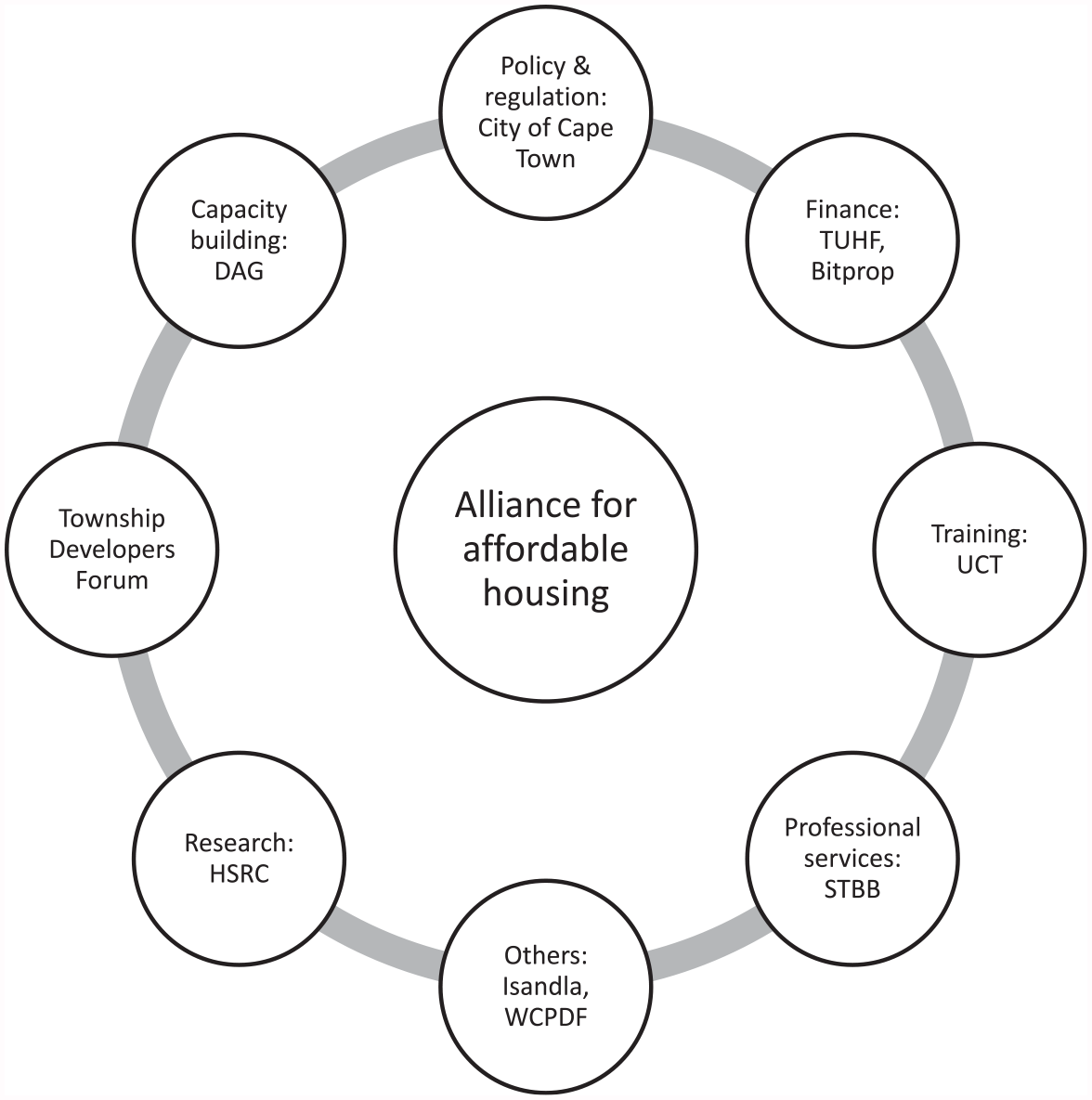
Main stakeholders in the alliance and their functions
The activities of the Development Action Group (DAG) were pivotal. DAG is a long-standing NGO formed in 1986 by built environment professionals and academics from the University of Cape Town. They sought to provide technical expertise and advocacy for communities struggling against apartheid policies of forced eviction and to support groups seeking to improve their housing and neighbourhood conditions. In the early 2010s, DAG began to provide practical assistance to community-based housing projects in the Khayelitsha township of Cape Town, where the programme manager Zama Mgwatyu discovered that significant shortfalls in the skills and capabilities of local building contractors and nascent developers were holding them back.
This observation prompted DAG to establish a modest non-profit entity to address the problem. The Contractor and Developer Academy (CDA) was launched in 2017 to provide advice, training and direct support to emerging property developers and construction businesses involved in producing solid brick and mortar rental housing.(12) By 2024, the CDA under Chuma Giyose had given information to over 500 individuals interested in starting such enterprises, and training to more than 120 fledgling contractors and 45 developers. It had also provided ad hoc technical support and project management for 28 small-scale building schemes comprising 190 rental units. This experience gave DAG deep insight into the issues and obstacles facing township micro-developers, and valuable credibility for its policy advocacy work. For example, it prompted the CDA to set up a Facebook page that helps to match tenants with landlords. Some 85,000 people have used this facility at the time of writing, indicating notable impact.
DAG also had the foresight and openness to collaborate with external partners where it lacked expertise. For example, it embarked on a range of studies to investigate the hurdles facing micro-developers, including the regulatory burdens, financial constraints and red tape.(13) These partners included individual researchers and the Human Sciences Research Council (HSRC). The character of this research was demand-led and embedded in local conditions to ensure its relevance. As an intermediary organization with strong networks within the City Council and beyond, DAG was well-positioned to identify research topics with the potential to make a difference to the policy agendas of public entities. Building a strong evidence base proved to be an astute decision that bolstered the case for policy reforms.
The biggest inquiry involved a four-year partnership with another NGO supporting the alliance, Isandla Institute.(14) This action research project was funded by international donors and aimed to improve understanding of the whole backyard housing sector, including shacks and other rudimentary structures. Besides the data collection and analytical work, workshops and peer learning events were held among community-based organizations, which helped to forge personal relationships and trust. The most notable recommendation to emerge was a detailed proposal to establish housing support centres in selected settlements to provide guidance and capacity-building to micro-developers, landlords and tenants of informal rental housing.(15) Take-up of this recommendation is discussed in Section V.
A decision by the CDA to help create a Township Developers Forum (TDF) in 2020 has also proved to be prescient and impactful. The TDF helps to bring some cohesion and organization to the kinds of small enterprises that were discriminated against in the past and that ordinarily see themselves as rivals rather than collaborators. Under the leadership of Brian Bango and Cynthia Ngxukuma, it functions as the collective voice of emerging developers and associated professionals (surveyors, architects, engineers, solicitors, rental agents, etc.) in dialogue with the City Council and other role players. This has enhanced the ability and confidence of these groups to articulate their needs and concerns. Even more importantly, the TDF creates a platform or support system for information-sharing and mutual learning among these actors. They exchange experience and information about reputable suppliers of material inputs, services and contractors. Their ongoing interactions promote ethical and socially responsible practices in relation to standards of construction, building maintenance and tenant management. Working closely together also instils a sense of solidarity and esprit de corps among developers.(16)
These pioneering activities undertaken by DAG and the CDA began to attract the interest of other professionals and researchers. Some began to study and document the small-scale rental housing sector themselves, because it appeared to be thriving in a context where the government’s housing programme was languishing and there were few alternatives on the horizon.(17) These studies benefited from earlier research on backyard housing dating back to the 1980s and 1990s.(18) Backyarding emerged under apartheid as a relatively flexible form of township accommodation that was highly accessible and offered people a form of supported living.(19) It has subsequently evolved with a stronger economic rationale associated with the payment of rent, generation of income and investment in the creation of physical assets.
Selected professionals, like Peter Ahmad and John Spiropoulos, offered to lend their technical and commercial expertise in property development, construction and built environment regulations to support the CDA. Two property academics from the University of Cape Town, Rob McGaffin and Francois Viruly, created a six-week training course for micro-developers in conjunction with the CDA, which has been delivered three times as of the time of writing. The graduation ceremony is held at a local hotel and attracts many different stakeholders. Such events help to strengthen personal relationships and goodwill, boost morale and foster feelings of pride and mutual loyalty shared among developers and the wider support network.
Growing awareness of the burgeoning small-scale rental sector also attracted the interest of development finance institutions that recognized the value of this market segment. The Johannesburg-based Trust for Urban Housing Finance (now simply called TUHF) opened a branch of its subsidiary (called uMaStandi) in Cape Town, managed by Nomfundo Molemohi, to offer loans to micro-developers. TUHF is the largest South African lender to the affordable urban housing sector. It specializes in hands-on loans to inexperienced property entrepreneurs operating in locations that mainstream financial institutions typically avoid.(20) uMaStandi began lending to micro-developers in Cape Town, but was dismayed when a large fine was imposed on one of them for failing to comply with planning regulations. This caused uMaStandi to halt lending in Cape Town and join the housing coalition to encourage the City to simplify its rules and speed up project approvals. During alliance meetings held in 2023 uMaStandi explained that stringent City procedures had forced it to turn down applications for loans worth R50 million (US$ 3 million) to at least 17 viable projects that would have produced 320 rental units. Meanwhile, it has been managing to lend successfully in Soweto and other townships in Johannesburg because the regulatory framework there has been streamlined.
The Cape Town-based social enterprise Bitprop offers a different approach. It targets homeowners who lack the skills and resources to develop their own rental units, but who possess title deeds. Bitprop provides the investment, employs professionals to navigate the City’s complex procedures, and contracts local builders to construct the flats in the backyards of these households, who then manage the properties. The rental income is shared over a 10-year period, during which the homeowner/landlord earns a small income stream and Bitprop secures a return on its investment. After 10 years the whole income stream reverts to the homeowner, making the model ideal for people planning for their retirement. By 2023, Bitprop had constructed 372 rental units for 69 homeowners in seven different townships.(21) The average age of the homeowners was 50 and almost two-thirds (62 per cent) were women.
Another organization involved in the housing network is the Western Cape Property Development Forum (WCPDF). This energetic non-profit organization was founded in 2008 to raise awareness of problems facing mainstream property and construction industries and to serve as their collective voice to tackle these issues. The Forum deliberately engages and lobbies different spheres of government on draft legislation and policy. The WCPDF chair, Deon van Zyl, recognizes that the formal property sector faces some similar challenges to micro-developers, including burdensome regulations, slow procedures and poor access to land and finance. The WCPDF has found common cause with the small-scale rental housing coalition and created two positions on their management committee, one for the CDA and another for the TDF. It has showcased their efforts to strengthen micro-developer capabilities, and encouraged Forum members to cooperate with township enterprises. One of these members, STBB, is a large firm of attorneys specializing in property law, conveyancing, planning, development and construction law. A senior associate, Tashreeq Jaffar, has actively participated in the coalition by offering pro bono legal advice and providing legal services to emerging developers.
III. Contrasting Dynamics within the City Council
During the late 2010s, officials from the City Council became increasingly aware that backyard shacks were being replaced by rental blocks in selected settlements.(22) This was most apparent in townships relatively well-located in relation to economic opportunities, reflecting the pressure of demand from people willing to pay for convenient accommodation. A senior official in the Finance Department, Louise Muller, sought to quantify lost revenue to the City arising from the mismatch between the formal valuation roll and the actual value of multistorey blocks of flats by using aerial photographs to document the investment taking place. Her small team revealed the striking extent of unauthorized building activity and how public infrastructure was compromised by encroachments over easements, making it impossible to access and repair the facilities. However, their analysis gained little traction among decision makers because the issues were considered too complicated and sensitive for the City to address. It seemed politically easier to turn a blind eye and disregard what was happening on the ground in these places.
Other planning officials embarked on more detailed (but also unpublished) studies of particular settlements where the scale of residential densification was putting extreme pressure on public services. Liezel Kruger-Fountain led a major study of Dunoon, and Marco Geretto collaborated with a small HSRC team (led by the author) in action research on Joe Slovo Park.(23) The growth strains in these places were causing blockages and breakdowns in the sewerage network, stormwater system, fresh water supply, solid waste collection and electricity grid. Illegal connections to the utility networks were also causing overload and failure. Frequent service disruptions, sewage spills and flooding fuelled immense community frustration and suspicion towards the City Council.(24) Meanwhile, household growth and disregard for municipal bylaws were yielding some buildings that were structurally unsafe, extending over legal boundaries and onto public road reserves, electricity substations, stormwater drains and open spaces, making it infeasible to maintain or replace this infrastructure.
The City typically responded to problems of service decline and damaged infrastructure through short-term crisis management, fire-fighting and other reactive measures. For example, the blocked sewers were usually cleared using powerful water jets. Access to electricity substations was cordoned off with steel security cages. Large piles of accumulated rubbish were occasionally removed using excavators and dump trucks. The expense of these costly responses was obscured in the operational budgets of each department.(25) Officials confirmed to the author that there was no strategic thinking or political appetite for a forward-looking, preventative approach working across departmental silos. This would have required coordinated upgrading of municipal services and expansion of the capacity of the pipes and pylons to meet the needs of the growing population. It would also have necessitated better communication and constructive engagement with community members involved in informal housebuilding in order to raise awareness of the dangers of encroachment, and work together to raise building standards, tackle the other hazards and rebuild public trust.(26)
For many years the City Council was ambivalent about the whole backyard housing phenomenon and disinterested in the bottom-up replacement of shacks by solid rental units.(27) Backyard accommodation was simply deemed illegal because it didn’t conform to the City’s bylaws and ordinances. Officials believed that the structures could be dangerous, overcrowded and pose risks to health and safety. They recognized the strain on the physical and social fabric of townships and the possibility of public services being overwhelmed. Since so few of the developers and owners were paying property rates or service charges, either because they fell within the exemption brackets for low property values or low household incomes, or through non-payment, top officials felt they didn’t deserve or qualify for support. In the absence of prescient and visionary leaders able to recognize the momentous changes underway, to take a longer-term view, and to envisage the positive potential of backyarding, most officials saw their job as enforcing existing regulations by serving notices.(28) Yet, they were constrained from completing the enforcement process by the realization that violent protests would erupt if they tried to halt construction or demolish completed buildings. The outcome was essentially a standoff between the City and local communities. Few people benefited from the stalemate, and these settlements steadily deteriorated towards slum-like conditions, threatening the City’s financial position.
Fortunately, the City’s approach to backyard housing was not uniform or set in stone. For example, individual planners in some district offices began to use their discretion to offer constructive advice to micro-developers who sought official approval for their schemes. One planning official, Charles Rudman, was head of the Khayelitsha office, where he carefully documented developments on the ground and, through his personal experience, gained unrivalled insights into how the rules foster informality and inhibit investment. He became an internal champion of reforms to reduce the burden of regulatory compliance. Rudman was also an effective networker within the bureaucracy and beyond and helped to spread knowledge of the whole small-scale rental phenomenon. His practical work in supporting inexperienced developers as a front-line official came to be seen as innovative and far-sighted among external stakeholders, although some other City officials questioned the legality and rationality of his approach.
Rudman’s most visible achievement was persuading his senior colleagues and politicians to endorse a report to the City Council, with the low-key title “Facilitating Small Scale Rental Units in Khayelitsha”.(29) It described the growth of rental accommodation locally, set in the context of Cape Town’s worsening housing crisis and the resulting hardship and social instability. The report advocated altering the approach from regulating to embracing small-scale rental: “if this form of housing delivery is encouraged . . . it can make a significant contribution to address the housing backlog at little cost to the City”.(30) It applauded homeowners for responding to the demand for accommodation by using their properties to build flats and generate income without state support. It also recommended reforming municipal procedures to make it simpler to construct backyard rooms. These were high-level suggestions rather than detailed prescriptions, and the report was approved at a full Council meeting in October 2020.
Meanwhile, a new Human Settlements Strategy was being prepared by the Council. Published a few months later, it surprised many observers by recommending a broad shift in the City’s approach from housing provider and regulator to enabling other actors to contribute. This was unexpected because Human Settlements departments throughout the country are notoriously uncreative and blinkered, preoccupied with administering fixed government housing programmes. The Strategy recognized the sector’s potential to accelerate housing provision: “The City sees enormous value in micro-developers being able to supply housing at scale within an affordability bracket not usually targeted by traditional developers.”(31) The document acknowledged that the City itself inhibited the sector’s growth and formalization through its regulatory procedures and inflexible approach to infrastructure provision. It promised to review some of these obstacles, and to provide more assistance to developers. For example, it suggested releasing unused municipal land for this purpose and forming partnerships with intermediary organizations working on the ground, such as DAG. This was very encouraging for long-suffering local stakeholders and observers in the housing field.
IV. Growing Momentum for Policy Reform
These proposals began to be taken up after the local government elections in November 2021, when a new mayor took office in Cape Town. Geordin Hill-Lewis represented the same political party as the previous office holders, the centre-right Democratic Alliance, but was younger and more enlightened. Before the elections, he met privately with independent experts and activists to discuss challenges facing the City. It was widely understood that affordable housing was an urgent issue, and people alerted him to the contribution of small-scale rental accommodation. Hill-Lewis seemed interested and adopted affordable housing as one of several Mayoral Priority Programmes (MPP) after taking office. His vision was to assist micro-developers to deliver more rental units by cutting red tape and offering practical support, not penalizing non-compliance. He also believed that engaging with backyarding might provide valuable insights into ways of dealing with the growth of informality more generally, and mitigate threats to City governance and finances. In a short media article, he explained the appeal of small flats being built more quickly than state housing and harnessing the power of private investment.(32) Although the idea was not really new, the Mayor’s endorsement was a bold decision and represented a significant step-change in political stance and tone within the City, particularly towards informality.
Oversight for pursuing the MPP was given to Eddie Andrews, the Deputy Mayor and politician responsible for the Spatial Planning and Environment portfolio. During the first few months of 2022, he had many engagements with City officials and external stakeholders to discuss what the municipality might do to facilitate small-scale rental housing, and to formulate an agenda for policy and regulatory reform. He became enthused by the idea that micro-developers were making a positive contribution to their communities, and expressed the strong personal view that the City should be working with residents, rather than doing things for them. This can be rationalized in different ways according to different ideological positions – supporting self-reliance rather than paternalism, or a developmental approach rather than welfarism.
This period coincided with the launch of a landmark report published by DAG,(33) which Eddie Andrews and other key stakeholders attended. DAG had commissioned the study the year before to better understand the dynamics of the sector and to measure the costs of regulatory compliance. The report was undertaken by a small HSRC team (including the author) with inputs from Bitprop, and it proved to have a major influence on policy deliberations. First, it calculated that seeking land-use approval for a rental project could more than double the development cost and render the scheme unviable at prevailing rent levels. This simple insight was enough to explain why most micro-developers built without authorization. This finding also made a compelling case for streamlining the regulations to reduce the burden, and the report recommended a series of procedural reforms – essentially less stick and more carrot.
Second, the HSRC report identified different types of developer, each with distinctive capabilities, financing requirements and growth potential. At one end of the spectrum were “homeowner developers”, who used practical know-how, personal savings and ad hoc resources to build a few rooms in their own backyards. They were more like subsistence endeavours than real business enterprises because of their limited growth aspirations and potential. At the other end were “entrepreneurial developers”, who were more calculating, had professional networks and could access loans from external institutions. They could potentially undertake multiple projects, conform to higher building standards and serve a different market. They deserved to be treated quite differently from homeowners by the municipality and support system.
Third, the report articulated two future scenarios and argued that many townships were at a crossroads. This insight helped to shift official perspectives on backyarding as a problem or liability, to more of an asset or opportunity. The continuation of municipal neglect would mean getting locked into a “low road” of unregulated growth creating health and safety hazards, overloading public services and risking abuse by unscrupulous and extractive developers and landlords who refused to pay municipal charges. These cumulative stresses would put communities on a perilous trajectory of overcrowding, insecurity and instability, which would degrade, devalue and vandalize public and private assets. Alternatively, progressive municipal reforms could unlock opportunities for more abundant and better investment in affordable housing and more jobs across the construction value chain, enabling movement towards a “high road” of dignified, liveable and safe environments, with rising property values and positive tax contributions to public infrastructure.
During this period Eddie Andrews appointed Charles Rudman to work as a policy adviser in his office. Rudman had a free hand to engage and share information among different municipal departments and outside stakeholders. This was useful in lubricating the wheels of the housing network and facilitating constructive interactions with other City officials, usually one-to-one or in small groups. It also opened doors for micro-developers to meet and share their experience with Eddie Andrews and other decision makers. Later that year, one of the academics involved with DAG and the developers, Rob McGaffin, was appointed Executive Director of the Spatial Planning and Environment Department and given responsibility for implementing the reform agenda. This seemed to confirm high-level political backing for small-scale rental accommodation.
Officials in Spatial Planning and Urban Design began work to flesh out the MPP in consultation with officials in Infrastructure, Finance and several other departments. There were occasional interactions with housing coalition members as well. The fundamental character of the changes required in institutional policies and practices began to dawn on senior officials. The MPP was no simple add-on to the existing housing policy, but a cross-cutting endeavour necessitating a far-reaching transformation in how the City functions internally and its approach to other organizations and ordinary citizens working with informality. Some of the long-standing norms, standards and criteria used by engineers, planners, surveyors and other professionals would have to be recalibrated, along with their cautious ways of working, driven by narrow performance indicators. This shift in practices and procedures was all the more daunting because of the sheer size, complexity and bureaucratic culture of the City administration. It also came at a time when budgets were under pressure. The resulting austerity was an additional challenge, but perhaps also an indication of long-term constraints that needed to be addressed. Ten different workstreams were identified to take forward particular elements (see below). A Programme Management Team (PMT) was also created to coordinate the policy and practical work. However, no new staff were appointed to manage the extra workload, so existing officials had to shoulder the additional tasks.
Months went by with little formal communication and few meetings between the City and external stakeholders. Behind the scenes, individual officials shared their private anxieties with alliance members and complained about the slow progress and lack of direction. There were internal tensions between older officials wedded to the established rules and procedures, and younger, more progressive officials who recognized and embraced the winds of change. The upshot of this hiatus was that alliance partners wrote a collective letter to the Deputy Mayor in mid-2023, expressing serious concern about the situation. They urged the City to communicate more frequently with them and with local communities, and to engage more closely on the reforms in the spirit of co-design and co-creation. They reminded the Deputy Mayor of their collective knowledge and experience of the issues at stake, their shared commitment to the reform agenda, and their constructive role in supporting grassroots action. They also urged the City to coordinate the workstreams more effectively since they had encountered inconsistencies and uneven progress in their personal interactions with officials.
The letter appeared to spur several useful reactions from the City. A team of three external experts was appointed a few months later to help facilitate and manage the different workstreams in conjunction with the PMT. Led by an experienced technical adviser, David Gardner, they started to clarify the concepts and terminology that required consistent definition across the administration and formulated a typology of small-scale projects and developers, depending on their potential to grow and comply with the rules. They fleshed out a theory of change to guide the workplan, identifying benefits for affordable housing, economic growth, liveable neighbourhoods and financial sustainability for the City. The team also unpacked implementation pathways for each workstream, and spelled out various risks and mitigation measures for consideration. The City also began to communicate more regularly with key actors, and agreed to participate in quarterly meetings of the “stakeholder forum” convened by DAG to report on progress. Such meetings were reasonably well-attended by municipal officials, including the Deputy Mayor on some occasions.
V. The Substance of the Policy Reforms
There were six primary workstreams and four support functions (Figure 2). The first was strategy, where the main task was to formulate a consolidated small-scale rental policy for the City. The immediate focus was to alleviate the largest cost barrier facing developers – development charges. These are sizeable financial contributions towards the additional public infrastructure needed by projects. The City’s interim solution was to establish a R20 million (US$ 1.2 million) fund early in 2024 to exempt the first tranche of projects from the payment. A more sustainable approach would be required when these funds ran out, such as phasing in the development charge over time to limit prohibitive up-front cost. Many developers might be able to pay something once they started earning rent.
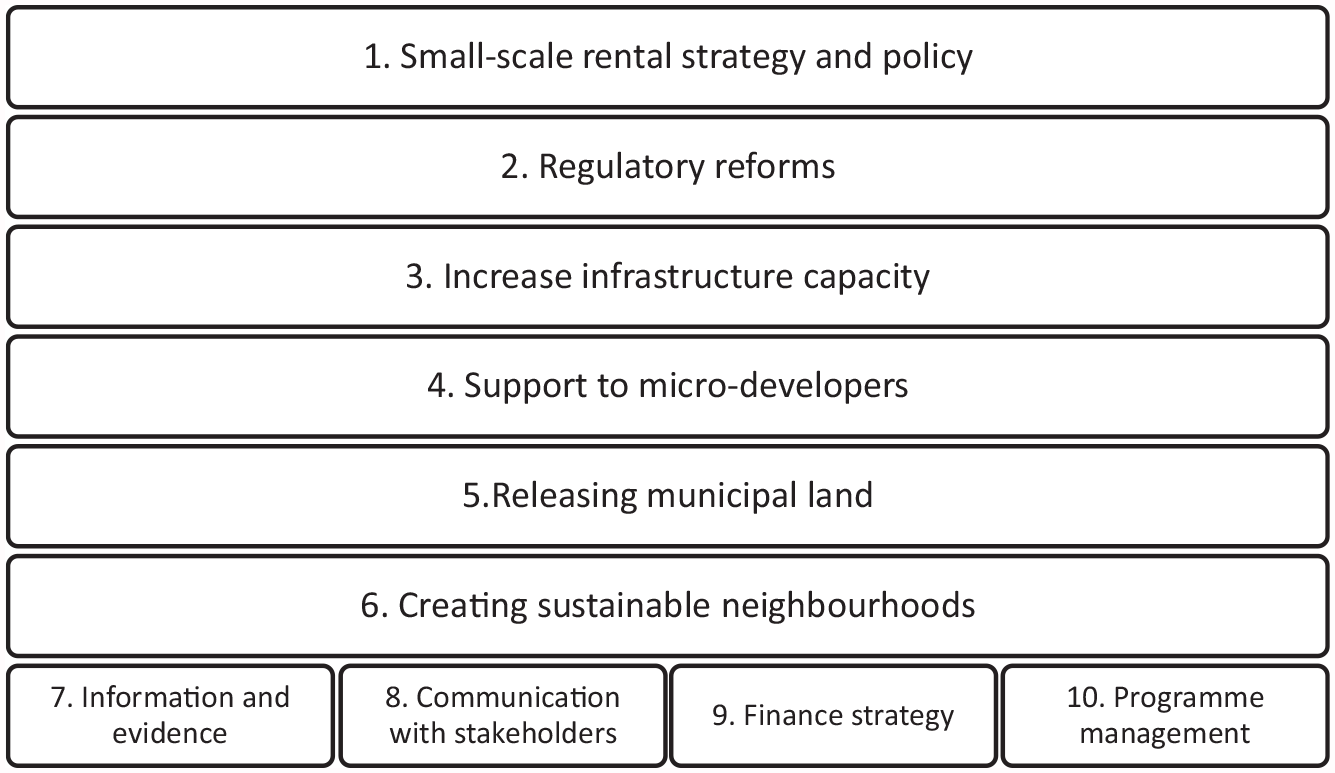
Programme workstreams and support functions
The second workstream involved regulatory reforms to simplify building affordable rental accommodation in suitable neighbourhoods. The first step was to grant additional development rights to avoid the need for micro-developers to apply for land-use permission if they met certain conditions, such as building apartment blocks of no more than 12 units and two storeys. This bold measure required amending the municipal planning by-law, which went out for public consultation during mid-2024. It was a sensitive matter because it effectively reduced the power of neighbours to object to quite sizeable projects next door that might impinge on their property values.(34) The City also devised a series of “prototypical plans” and design guidelines to expedite building approval. These were standard models or designs of rental units that would limit the tasks required of architects and surveyors. City officials could approve these applications quickly because they knew what to expect without scrutinizing every aspect in detail. It was hoped that these design guidelines would encourage quality projects, suitably set back from property boundaries, and limit the negative impact for neighbours. The intention was also to introduce new technologies, such as cell-phone apps, to simplify this design work and greatly reduce the time and cost of project planning and approval.
Third, the City sought a way to increase public infrastructure capacity in selected areas, a daunting prospect for engineers and finance officials because of the enormous cost of upgrading fixed infrastructure and the uncertain prospects of cost recovery. The starting point was to estimate the additional capacity required to accommodate the residential growth expected and then to determine a way to finance it by stitching together three potential sources – the City’s own budget, infrastructure grants from national government and external borrowing. Careful prioritization and phased implementation were essential because of the huge scale of the task.
In the fourth workstream the City wanted to offer technical assistance to micro-developers to strengthen their capabilities, enhance their understanding of the regulatory framework and help them comply. They decided to establish local planning support offices in a few selected townships, following an idea from Scheba et al.’s 2022 report for DAG,(35) and elaborated in an Isandla report in 2023.(36) The first step would be to pilot several versions of such facilities, one of them a mobile office that could move between locations on different days of the week to avoid the cost of establishing fixed facilities.
The fifth component involved releasing surplus municipal land parcels for small-scale rental housing. This required a framework to guide the process, with criteria to define eligibility and the various steps and timeframes in the procedure spelled out. The approach would have to conform to the complex national legislation governing the disposal of municipal assets, including direction for public consultation and competitive bidding. The methodology would then be piloted in one of the townships, by going through the critical steps of site identification, feasibility analysis, land preparation and binding sale agreements for their release. This cumbersome but essential de-risking process would take at least a year or two for each site.
Workstream six was broader and aimed at creating sustainable neighbourhoods through some form of area-based management. The City sought ways to coordinate its services within districts experiencing rapid densification and intense development pressures, and to engage local communities and harness their knowledge and initiative. Building public trust would be crucial to encourage people to adhere to the regulations and pay their municipal taxes and service charges. The plan also recognized the opportunity to act strategically at the precinct scale to promote mixed-use development by coordinating housing investment with job-creating activities around transport nodes and along “high streets”.
The four support functions included work to improve information and evidence on small-scale rental housing, to enhance communication with stakeholders, to investigate methods of financing each workstream, and to support the overarching task of programme management.
VI. Conclusion
Cape Town faces a daunting housing problem. The old model of the state acting alone to build its way out of the backlog has proved unattainable and unsustainable. A city-based housing coalition advocates a more developmental approach to mobilize the energy, expertise and capacity of other actors, especially citizens themselves, many of whom have shown the appetite and wherewithal to contribute. This will be less neat and tidy than the highly ordered and unyielding procedures of the state bureaucracy, as it involves disparate role players and stakeholders following different norms and specifications. Top-down control and inflexible regulations need to be replaced by an enabling response to the efforts of thousands of fledgling property enterprises and their support networks to construct small-scale rental units.
An undoubted strength of the alliance has been the coming together of diverse partners with goodwill and different kinds of know-how, resources and legitimacy. They have worked collaboratively on two main pillars of action: (i) supporting each other’s efforts to develop the skills and capabilities of micro-developers, and (ii) encouraging the City Council to instigate a series of interlinked policy reforms cutting across departmental silos. The coalition has created associations across inherited social and economic divides, and enabled people from historically excluded groups and other “outsiders” from disparate backgrounds to gain access to the bureaucracy and learn how to navigate the system. As the network of actors and organizations has grown larger and stronger, it has shifted the perspectives and mindsets of officials and politicians, especially on the issue of informality. Establishing a reasonable consensus on the necessary policy reforms has been an important achievement. Even if progress is slow and incremental, a momentum for change has been established that may be difficult to arrest, at least for the next few years. Ongoing monitoring and evaluation of these reforms and their impact on the ground will be important to detect any adverse and unintended consequences, and to make appropriate adjustments in good time.
An outstanding issue for the future is whether the alliance should alter its modus operandi as it grows and matures, becoming more organized as the number of partners increases and the range of activities broadens. Could the network be more powerful if it was institutionalized in various ways, or would this make some members more passive, or erode the good faith and trust that currently drive participation? For example, a secretariat could be created with resources to cover the recording of proceedings and decisions of stakeholder meetings for consistency and mutual accountability. This could make the roles and responsibilities of members more explicit with written agreements committing them to certain conditions and obligations, including responsibility for leading particular activities, or monitoring the progress and impact of specific policy reforms.
Beyond this, the alliance could formulate a more deliberate agenda or plan for the group to identify priorities and to guide their separate and collective activities in the short- and longer-term. A more systematic way of working might leave the network less reliant on the City to determine the pace and nature of reform, and strengthen accountability all round. A deeper concept of the reform agenda, including its guiding principles and values, would help to clarify policy tensions and choices, and sharpen internal discussions and debates. The current informal method of working is partly a reaction to the tortuous state procedures, but there may be an intermediate position to consolidate and build upon what has already been achieved, and to mitigate the risk of things going awry because internal disagreements cause disruption, key individuals get side-tracked or worn out, or vital institutional partners redirect their attention and energy elsewhere.
A more methodical approach might help to address some of the gaps and neglected issues. Access to mainstream finance is a major challenge for micro-developers, forcing most of them to rely on savings and bootstrap resources.(37) A concerted effort is required to better understand the problem and to engage the financial institutions and their regulators in serious discussions to find solutions. The retrospective regularization of existing rental properties is another outstanding matter, although it is particularly complicated to resolve. Policy reforms have focused on legitimizing new development, rather than addressing the thousands of non-conforming structures already built, and hamstrung by their unauthorized status. Many of these projects could probably be approved without major remedial works, but a proper procedure is required to institutionalize this.
Finally, there are issues lying beyond the alliance’s scope, but which affect its ultimate success.(38) Many properties cannot be formalized and made compliant because land title is a precondition, but the owners might never have received their title deeds, or their land titles are compromised in some way. These problems reflect the cumbersome, costly nature of South Africa’s property registration system and explain the prevalence of informal, off-register transactions.(39) Rectifying the problem requires complex national legislative reforms, but there is no appetite at present within the relevant department to even consider this.(40) Building regulations are another function of national government. Some rules and standards are patently not fit for purpose for affordable housing, but advocating successfully for reform is difficult for a single city, as is influencing existing national housing programmes and grant funding for infrastructure.(41) Several partners in the Cape Town coalition have begun to reach out to like-minded organizations in other cities to replicate and scale their activities, and to broaden support for these reforms. They also helped to organize a national symposium on small-scale rental housing in 2023 that attracted about 150 participants.(42) However, national inertia and disinterest are frustrating progress at present.
Footnotes
Acknowledgements
The author is grateful to the editors, reviewers and following individuals for their feedback on a draft version of the paper: Claudia Hitzeroth, Zama Mgwatyu, Deon van Zyl, Francois Viruly, Nomfundo Molemohi, Brian Bango and Helen Rourke.
Funding
The author disclosed receipt of the following financial support for the research, authorship, and/or publication of this article: Department of Science and Innovation, South Africa National Research Foundation SACN190418431632
