



Abstract
Protracted displacement turns what should be a temporary protection status, asylum, into a long-term process that defines the existence of millions of people. The unresolved causes of displacement, a flawed asylum system and restrictive refugee policies all force refugees to inhabit a state of temporariness in cities. We discuss the unfulfilled potential of Eritrean refugees in Addis Ababa, Ethiopia, and show how urban migration becomes part of a waiting game on a journey towards the realization of this potential. Using Brun’s concept of agency-in-waiting, we illustrate how Eritrean refugees use their agency in cities, finding ways to remain hopeful, circumvent restrictions and prepare for unpredictable futures. Our findings challenge the dominant discourse on Addis Ababa as a transit space where Eritreans remain inactive and unproductive, idly waiting for resettlement. Rather, they work towards their ultimate goal – to establish a secure life with full rights, wherever this might be.
I. Introduction
Protracted displacement represents the failure of the international community and host countries to assist forced migrants to achieve durable solutions to their plight.(1) By the end of 2023, an estimated 24.9 million refugees and internally displaced people (IDPs) were living in protracted displacement, 66 per cent of the total population of concern to UNHCR, and at least 60 per cent of refugees were in cities.(2,3) Protracted refugee lives are often described as being on hold, depending on humanitarian assistance, devoid of agency and history, in a state of limbo. However, protracted displacement is actually far from static,(4) and refugees use their agency every day to inhabit the temporary as they wait for a future resolution to their plight.
In refugee studies, waiting is often analysed in relation to refugee camps and asylum-seekers, and to the time spent until the resolution of refugees’ applications. It is usually defined as a harmful experience with a detrimental effect on well-being.(5) Yet, waiting is far from being void and passive, and the asylum claim stage and camp stay period, we argue, is only part of an extended life journey marked by waiting, which starts long before departure and can continue long after the acquisition of refugee status. In this paper we examine the agency of Eritrean urban refugees to ease waiting in Addis Ababa, where they remain mostly excluded from aid and face discrimination. With full integration denied, our study suggests that urban refugees remain in cities waiting for an opportunity to realize their human potential, either waiting for policy changes to enable their local inclusion or preparing themselves for often-uncertain onward migration.
This paper adopts and expands the concept of “agency-in-waiting” to explore the strategies adopted by Eritrean refugees in Addis Ababa.(6) The experience of these Eritrean refugees is specific to the context, shaped both by repression in Eritrea and the limited support to local integration afforded by Ethiopia’s 2019 Refugee Proclamation and associated directives.(7) The concept of agency-in-waiting is useful in analysing the thinking and behaviour of urban refugees and what they wait for, and it serves as a basis for broadening the approaches to refugee inclusion, and rethinking protracted displacement. This paper adds to the literature on the protracted refugee experience by further developing the concept of agency-in-waiting and testing its application in relation to urban refugees.
The paper is organized as follows. First, we explore the concepts of agency and “agency-in-waiting” as applied in refugee and migration studies, to build a classification of agentic behaviours applicable to urban refugees. After discussing the methods adopted for this study, we examine urban refugees’ human potential in Addis Ababa in terms of their human capital and life aspirations, to understand the migration journey as a search for the realization of their potential. Eritrean refugees’ agency-in-waiting is then analysed through three categories identified in the literature: endurance, preparedness and defiance, which allow refugees to wait in the present for uncertain futures ahead. Finally, we conclude that for those in protracted displacement, waiting occurs throughout the refugee journey, during which they use their agency to create routines that help them bear the undetermined duration of their exile experience, envisage alternative courses of action as the basis for hope for a better future, and rebel against refugee governance mechanisms that keep their lives on hold.
II. Exploring Agency in Refugee Studies
Agency is a slippery term. Discussed extensively in sociology literature, the term has also been employed in the fields of political science, anthropology, philosophy, economy and development studies. Conceived of broadly as the capacity to act, agency has been mostly understood and analysed in terms of its interaction with structure. Amartya Sen explains that agency can be observed in the capacity of individuals to define their own goals, establish a hierarchy among them based on their value, and assess the potential results of actions according to their own standards and principles.(8) Agency is also conceived of as social and relational, something that cannot be understood in a vacuum but only as the product of its orientation towards, and connections with, other persons, places, meanings and events.(9) Sen further argues that, in order to act, individuals must have “agency freedom” (capability) – a right to decide, act and achieve goals, whether through individual or collective action, a freedom that is enhanced or constrained by the social, economic or political opportunities available.(10)
Emirbayer and Mische argue that agency can be better understood by exploring its three components: iteration, projectivity and practical evaluation.(11) They use iteration to refer to the course of thought and action in everyday activities that provides a sense of stability and generates behavioural patterns whose repetition sustains social structures. Projectivity is the capacity to elaborate alternative trajectories that could creatively redraw established patterns of action based on actors’ fears and desires for the future. Finally, practical evaluation is the capacity to choose between these potential trajectories in the light of emerging demands and the dilemmas of an evolving present.
In refugee studies, existing research on agency is mainly empirical, with a focus on agency outcomes – what refugees do – and limited theoretical elaboration on what agency means in a context of asylum. For a long time, classical migration theory glossed over the agency of forced migrants, with an understanding that fleeing precludes choice, and in the belief that an acknowledgement of any degree of choice could compromise the formal recognition of refugee status.(12) Narrating the experience in camps, Agamben and Malkki, for instance, described how refugees were reduced to “bare life” and “speechless emissaries”, devoid of agency.(13) More recently, forced migration scholars have countered this narrative, reflecting on the agency displayed by refugees in the course of their everyday life in more or less regulated camps and asylum-seeker centres.(14) However, much less has been said about the agency of refugees in urban settings in the global South.
Scholarship on refugees’ agency has mainly focused on refugee participation in humanitarian programming and camp management, on the role of refugee-led organizations in protection and assistance, and on peacebuilding processes. Refugee agency is conceived of either as “the capacity of refugees to make and enact choices” with the potential to influence a peace process,(15) or as refugee leaders’ capacity to facilitate collective action,(16) and analysed in its interaction with structures ranging from international humanitarian institutions to complex and dynamic historical, socioeconomic, cultural, institutional and political norms.
In urban settings, studies often focus on the vulnerabilities of displaced people and the challenges they present to humanitarian intervention, but relatively little is known about the agency of these people to navigate urban environments and their ingenuity in dealing with restrictions, generating opportunities or transforming the setting.(17) For the most part, urban refugees’ agency has been approached using proxy terms, particularly “self-reliance” and “resilience”, in studies that take stock of refugees’ actions and strategies in the light of global refugee policies featuring those concepts.(18) However, their findings and theoretical discussion offer little insight on what agency may entail for refugees in cities.
III. Framing Refugees’ Agency-in-Waiting
While studies on refugee agency mainly centre on strategies and actions aimed at changing refugees’ present lives,(19) in a context of protracted displacement characterized by long-term waiting the ability to sustain hope is evidence of subtle and less evident forms of agency. Cathrine Brun’s concept of agency-in-waiting illustrates how people in protracted displacement use their agency to carry on through an indeterminate waiting period and to project themselves into alternative futures.(20) In her study with internally displaced Georgians from Abkhazia, Brun argues that protracted displacement is not a static but a fluid condition. She inserts a time perspective to explain how displaced people’s agency changes in relation to their experience of dislocation and their hopes for the future.(21) The concept of agency-in-waiting thus captures the capacity to act while in protracted displacement. Whether those actions are conducive to a change or useful in putting an end to displacement is uncertain, she argues, but they should be seen as an expression of hope.(22)
Following Brun, several authors have explored different expressions of agency-in-waiting for asylum-seekers and migrants, generating a classification of agentic behaviours. Three studies are particularly relevant: two looking at the waiting experience of asylum-seekers in the UK, and a third at the westward journey of South Asian and Eastern European migrants. Each takes a slightly different approach to agency-in-waiting, and we draw on these approaches to further develop the categories of agency-in-waiting applied in this paper, summarized in Table 1.
Summaries of “agency-in-waiting” in refugee and migration studies
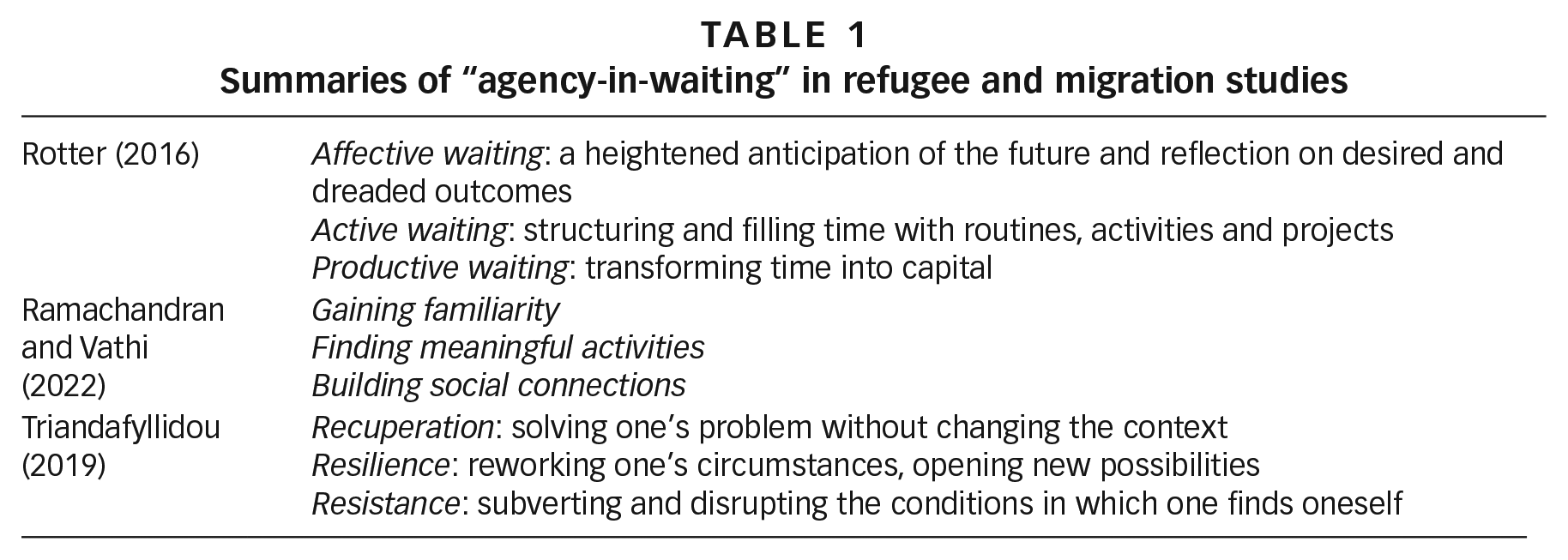
Studying the agency-in-waiting of asylum-seekers in Glasgow, Rotter found that, despite their own perceptions of waiting as static and empty, their accounts masked a more complex picture of anticipation and hope, which she categorized as affective waiting (anticipation of and reflection on future outcomes), active waiting (structuring time around activities and routines), and productive waiting (capitalizing on waiting time to secure a more permanent status).(23) Also based on work in Glasgow, Ramachandran and Vathi talk about the small acts and micro-level tactics to relieve the burden of waiting and exercise control. They describe these acts as helping refugees gain familiarity with their new location, engage in meaningful activities and establish social connections, developing a set of tactics over time.(24)
Triandafyllidou engages with migrant agency, although not the agency-in-waiting concept. She defines agency as social navigation, through which migrants make decisions and enact them to pursue their journey.(25) Migrants, whose experience combines moments of stagnation and of progress, reassess their choices when faced with different challenges in transit. In the fluidity of migration, she explains that norms, policies, institutions and other structures and their implications are impermanent and evolve to create new scenarios to which migrants have to adapt, reassessing their goals and strategies as they go. This idea is in line with Brun’s time perspective on agency, yet the agency Triandafyllidou describes is not solely aimed at the act of waiting but also at progress and mobility in the migration journey. In her study, she identifies three different types of migrant agency: recuperation, as individuals seek to solve or address their own problems without changing the context; resilience, as they attempt to rework their own circumstances, creating new opportunities; and resistance, as they act to subvert refugee conditions.
In our study we are interested, on the one hand, in the different types of agency in prolonged waiting described by Rotter, and by Ramachandran and Vathi, which connect with Emirbayer and Mische’s component of iteration. On the other hand, we respond to the agentic behaviour described by Triandafyllidou, which feeds dynamic adaptation in response to changing circumstances, and to the subversive resistance she describes, which resonates with elements of projectivity and practical evaluation. We have thus brought together these concepts to develop a three-way classification of agency-in-waiting displayed by urban refugees in protracted displacement. We describe these categories as endurance, preparedness and defiance (Table 2) as set out below.
Categorization of “agency-in-waiting” used in this paper

We understand endurance as the strategies developed by refugees to get by and wait, creating routines that help them bear the indeterminate duration of their exile, and to build a sense of stability through iteration. Preparedness defines the use of agency to devise and actively engage with the present, working simultaneously towards alternative visions of the future in the short- to long-term. This gives meaning to waiting and feeds hope, an expression of Emirbayer and Mische’s projectivity. Finally, defiance includes those actions resulting from practical evaluation and aimed at challenging existing restrictions imposed on refugees, in an attempt to redefine the rules that keep them waiting, and not to lose hope.
In this research we explore the protracted displacement of Eritrean refugees as a prolonged state of transience, during which refugees are prevented from forming roots by policies and norms that restrict their integration, enforcing the act of waiting and intensifying their desire to move on. These policies also create an image of transience in which Eritrean refugees are seen as passers-by, thus justifying policy measures that preclude or hinder permanent settlement. Analysing the data on Eritrean urban refugees’ livelihoods and well-being in Addis Ababa, we reveal their human potential as constrained by migration control and refugee policies. We also test the adequacy of our three-way classification to categorize the individual and collective agency through which Eritrean refugees deal with waiting in cities and interact with the structures that shape their relationship with other members of society.
IV. Methods
The research described in this paper is part of a wider study of protracted displacement which compared the well-being and livelihoods of refugees in cities and camps in four countries.(26) This paper draws on the large mixed-methods study in Ethiopia, a country with one of the largest refugee populations in Africa. Ethiopia is involved in the pioneering Comprehensive Refugee Response Framework (CRRF),(27) and is relatively accepting of refugees living outside camps. The study focuses on Tigrinya-speaking Eritrean refugees in Addis Ababa, who were selected as the focus of a case study because they are the largest refugee group at present in that city.
The study combined quantitative survey data on Tigrinya Eritrean refugees with semi-structured interviews about their well-being and entrepreneurship. The data provide information on refugees’ potential and aspirations, the barriers to their realization, and their strategies to endure waiting. In addition, key informant interviews and secondary data sources made it possible to contextualize and add nuance and depth to the findings.
The data were collected in Gofa Mebrat Haile neighbourhood in Addis Ababa. Gofa Mebrat Haile is a public housing development in Nefas Silk Sub-city where a significant concentration of Eritrean refugees are hosted. The randomized quantitative survey conducted in March 2021 collected information from a representative sample of 365 refugees, approximately half women and half men. The survey examined their well-being and livelihoods at both individual and household level. Two sets of in-depth semi-structured interviews with men and women refugees were completed. First, 25 interviews were held with selected survey respondents to explore the factors affecting well-being. Then, 35 interviews were held with refugee entrepreneurs in key sectors identified through the survey, to explore their business experiences. All names in the quotes below have been changed to preserve anonymity.
We selected relevant data from the large survey dataset, drawing on principal component analysis to assess urban refugees’ potential in terms of the human capital and life aspirations fuelling their agency-in-waiting. The NVivo analysis of the qualitative data allowed us to test our agency-in-waiting classification, providing examples of its different expressions and their interaction with migration governance structures in Eritrea, Ethiopia and the global asylum system, which hinders refugee integration and prolongs the duration of displacement.
V. Eritrean Refugees’ Potential
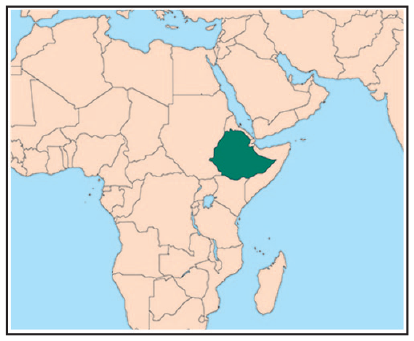
Ethiopia is the third-largest refugee-hosting country in Africa, and was providing protection to 979,846 refugees by the end of 2023.(28) National refugee policy has favoured encampment, but refugees awarded out-of-camp (OCP) status are allowed to live in cities and towns, often moving to Addis Ababa. In practice, most OCP-status refugees are Tigrinya Eritreans since the exemption making it possible to leave the camp was initially applied only to Eritrean nationals.
Eritreans are the third-largest national refugee group in the country (after South Sudanese and Somalis). Many young refugees fled Eritrea to avoid draconian forced conscription, and what the UN Commission of Inquiry on Human Rights in Eritrea (COIE) has described as crimes against humanity.(29) Military training and national service are compulsory for all Eritreans aged 18–40, both men and women, and service is often for an indefinite period of time.(30) Today, an estimated 71,000 Eritrean refugees live in Addis Ababa, 92 per cent of the total refugee population in the city. Around 24,900 of them have self-settled in Addis Ababa after fleeing the Tigray war in 2020–2022.(31)
The 2019 Refugee Proclamation recognizes refugees’ right to work, but obstacles remain to its full implementation, making it almost impossible for most refugees to work formally either as employees or entrepreneurs.(32) An earlier study on Eritrean refugees’ onward migration reflects how the frustration about the lack of opportunities in their present asylum in Ethiopia makes them focus on a distant future, turning to escapism or adopting risky behaviours to pursue their dreams often through secondary migration.(33) In addition, OCP status was initially provided only to Eritrean refugees who could prove their self-reliance without working – often through family remittances or sponsorships. These factors have resulted in a popular image of Eritrean refugees as idle, uninterested in work and only waiting for resettlement or family reunification abroad, rendering their agency and activities invisible.
The analysis below explores how refugees’ human potential is conditioned by evolving regulatory regimes in Eritrea and Ethiopia which prevent refugees from developing their capacities, hinder their integration and keep them in a permanent state of transience and waiting.(34) To arrive at these findings on their potential, we analyse indicators in our quantitative dataset that provide a measure for refugees’ human capital and aspiration. We supplement these indicators with reflections on the same issues from the qualitative interviews and hypothesize on how these combined findings show refugee agency in its everyday interaction with refugee governance policies structures.
Human potential is understood here in terms of human capital and aspirations that enable people to flourish, with their implications for livelihoods and enhancing personal realization and satisfaction. Human capital is used in our analysis as a proxy to analyse refugee capacities in terms of education, health, skills, knowledge, employability and other personal attributes which could potentially enable a person to become self-reliant and resilient. Life aspirations reflect refugees’ ability to set their own goals, conceived of as personal markers of a fulfilled life, which includes choices about place of residence, family and relationships. In the context of protracted displacement, which inhibits their full development, refugees can still use their human potential to sustain agency-in-waiting and remain hopeful.
The agency of urban refugees is also influenced by existing social structures, including refugee governance policies and their implementation at local level, and the cultural and social norms and economic structures as these manifest in cities. Social structure is a rather imprecise concept used in sociology studies to identify the norms, regulations and processes that shape the relations between different elements within a society.(35) Structures can be both limiting, feeding marginalization, or nurturing, engendering solidarity, recognition or support.
a. Human capital
Analysis of the data related to human capital suggests that, despite good health and high levels of education among the Eritrean refugee population in Addis Ababa, labour participation rates are extremely low. Ninety-five per cent said their health was good or very good, 78 per cent of women and 66 per cent of men have pursued secondary education, and 24 per cent of refugee men had university education. Additionally, 50 per cent of men and 28 per cent of women had completed some vocational training. Startlingly, our results show that 40 per cent of women and 71 per cent of men respondents had worked in Eritrea before displacement, but only 7 per cent of women and 35 per cent of men were working in Gofa Mebrat Haile at the time of the survey, pointing to a clear waste of their potential in displacement.
Government policy and regulations in both Eritrea and Ethiopia have conditioned refugees’ education, work and opportunities before and during displacement. Many refugees interviewed had left Eritrea to avoid the draconian and often unlimited demands of national service. Some left before completing secondary studies, since national service training starts in the last year of school. Others escaped while they were doing their national service or when they were summoned to return to service, which would have forced them to stop paid work. Considered deserters by the Eritrean regime, these refugees find it hard to obtain official documents and certificates at the embassy in Addis Ababa, such as proof of their education or marital status, which hinders economic inclusion or resettlement.(36) Many summarized their situation as “having no option” and no control over their future unless they emigrated to another country.
Refugees’ potential is further curtailed by their inability to earn an income once in Ethiopia. Data show that 62 per cent of unemployed refugee women and 83 per cent of unemployed refugee men were willing to work, of which 57 per cent and 76 per cent respectively were looking for a job. Some 27 per cent of non-working refugee women said they had too many house chores and care duties to search for employment. Our data further show refugees’ perception of the poor quality of employment available to them: 26 per cent of working refugees considered they were overqualified for the kind of work they were doing, only 23 per cent thought they were being paid fairly, and 40 per cent were unsure of their ability to keep their employment for as long as they wanted.
Our survey data reveal that Eritrean refugees face many barriers, including insecure and informal work, discriminatory wages, police harassment, lack of access to work permits or enterprise registration and, for refugees studying in Ethiopia, a lack of professional accreditation. The implementation of the 2019 Refugee Proclamation and the associated Directive to Determine the Procedure for Refugees Right to Work, which grant some employment rights to refugees, remains patchy,(37) and over 40 per cent of refugees found they did not have the right to work or register an enterprise, or could only do so with limitations.
Refugees interviewed expressed their frustration at being dependent on remittances to survive and being unable to cover basic needs with income from work (only 14 per cent were able to pay their rent without struggling). They were concerned about the future if regulations do not change so they can get a decent job, or if they cannot resettle. Thirty-nine per cent rarely or never feel their life is being spent constructively, although the majority remain optimistic about the future (73 per cent) and find they have a clear plan for their lives (77 per cent).
b. Life aspirations
Eritreans’ aspirations for a better life, one where they can fully develop their potential, compels them to leave their country. Once in Ethiopia, many make a conscious decision to live in the city. Safety, social networks and family were the main reasons why refugees moved to Addis Ababa according to our data. Seventy-six per cent had OCP status, and 47 per cent had lived for at least three months in a camp before arriving in Addis Ababa. Refugees must normally complete their first registration in a camp before being transferred to a city, and interviewees often talked about staying in the camp as a transit point to Addis Ababa.
In the interviews, some mentioned moving to the city to start family reunification or resettlement processes, since Addis Ababa is the only place from which refugees can apply. Of our sample, 56 per cent planned to resettle to a third country over the next 12 months. However, application processes can drag on and their stay in Addis often becomes much longer than expected. UNHCR figures showed that only 331 Eritrean refugees were resettled from Ethiopia in 2023, out of nearly 180,000 in the country. Resettlement quotas have remained low since the 2020 pandemic, far from the numbers achieved in the previous decade, when around 1,000 Eritrean refugees were resettled annually.(38) Refugees who were interviewed talked about difficult relations with their partners abroad, or delays in processing reunification with their parents or siblings. For many, resettlement is a dream unlikely to be realized.
Survey data show Eritrean refugee women in Addis Ababa are more likely to be married (83 per cent) than men (56 per cent). The households of female refugee respondents are more often headed by women (62 per cent) and are more likely to include children under 16 (52 per cent) than those of male respondents (8.8 per cent and 18 per cent respectively). This substantive difference in family configuration could be related to an instrumental use of marriage by women to avoid national service conscription or as part of a migration strategy. Married women and mothers with young children are often relieved from military service in Eritrea, although they may have to do civilian service.(39) Marriage is also a common strategy among women for gaining resettlement through family reunification, increasing their chances of leaving Ethiopia if their partner accesses asylum in a western country, often after irregular migration. Married Eritreans may obtain a permit to leave the country legally if their partner has migrated irregularly, signed a letter of apology, and paid a “diaspora tax” for five years (2 per cent of their annual income), something that reduces the risks associated with irregular migration.(40)
Some interviewees voiced their concern about arranged marriages and the vulnerability of women waiting for reunification in Addis Ababa. Some women postponed having children to facilitate reunification, while also fearing their husband might leave them behind. Sarah, 25, said “I got married because I did not have any other option. You have to do a lot of things to live, and migration is not an easy thing.” Birikti, 29, explained that “most Eritrean women plan to go abroad, and even if men come from abroad and marry them, they would avoid getting pregnant, so it wouldn’t be an obstacle for their resettlement since they could move out easily”. Calling for work permits for refugees, Solomon, 25, claimed that “the money they got [from remittances] could have been used for productive activities. Our female refugees would not have been forced to enter unwanted marriages for the sake of migration.”
In addition to the experience of displacement and their hopes for the future, as identified by Brun, our analysis shows that refugees’ agency-in-waiting is further characterized by the parameters set by their human potential in its relationship with the social structures that constrain or promote their realization in each context (i.e. refugee governance policies, societal norms and economic structures). Based on this analysis, we argue that refugees are waiting for an opportunity to fully realize their human potential and that their agency is expressed through their capacity to sustain that waiting and project themselves into the future. Following Turner’s conceptualization of emplacement,(41) refugees are waiting to become the person they aspire to be, irrespective of their final location.
Given the multiple obstacles they face in the city, it might be questioned whether urban refugees enjoy Sen’s “freedom agency” – the ability to set their goals and act effectively, making decisions to realize their objectives. Our analysis below shows that urban refugees may have little capacity to determine the duration of their stay or the way their needs are addressed, but they still display agency in confronting, adjusting or carrying on in the face of severe political, social and economic constraints.
VI. Refugees’ Agency-in-Waiting
Waiting is what Eritrean urban refugees do from the onset of their displacement journey – waiting for the opportunity to leave the country and escape national service; waiting for the resolution of their OCP status allowing travel to the city; waiting for an employment offer or to feel safe enough to start their own business; waiting for permits, licences, certificates; waiting for the resolution of their resettlement or reunification process; waiting for their life abroad to begin. This waiting period is stretched out and of indeterminate length, based on bureaucratic processes which reduce refugees’ mobility inside and outside of the country of asylum. During this period, there is seldom the necessary environment and conditions for refugees to become integrated locally and develop their potential.
Nevertheless, waiting, as explained by Brun, is not an empty endeavour. From everyday routines to organized protest, refugees show their agency by keeping going and hoping for the realization of their potential, referred to in our research as “a good life”. When refugees were asked what a “good life” means, these kinds of responses were typical: “living in a secure place, making a living, and being able to think and work for the future”; “looking for a country where I can live safely, work and change my life”; “having a life with respected rights . . . All meaningful things fall under our rights: the right to work and the right to learn. I think life is good when you have stable work and living conditions. A life without freedom is meaningless.”
Refugees’ expectations for their futures change over time, based on their experience of exile, their human potential and in response to critical events. Eritrean refugees who arrived in Addis Ababa for resettlement, confident of a short stay, often have to reconfigure their horizons in the face of bureaucratic delays, or when relatives abroad fail to complete the resettlement paperwork, stop communicating or pass away. Those with high expectations of completing their education, finding a good job or creating their own enterprise have to deal with limited opportunities and restrictive policy implementation that curtail their potential.
In this situation of protracted displacement, when urban refugees come to terms with their extended temporariness, their agency moves along a continuum between two main attitudes: putting their potential on hold and putting their potential to work. In putting their potential on hold, refugees feel incapable of realizing any of their life goals at present and use their agency to remain hopeful, thinking about an idealized future when they can meet their aspirations for education, employment or family. In putting their potential to work, refugees do not give up on their present but, as they remain hopeful, they try in parallel to use their potential to prepare themselves for different visions of the future. Alternating between a vision of staying in Addis Ababa or moving abroad, their time of waiting is filled with duties and a drive for personal growth. Irrespective of their attitude towards the present, their agency is aimed at remaining hopeful.
Our data show the potential that refugees hold and how this is constrained by policy and regulatory barriers even before displacement. Agency-in-waiting reveals the strategies of refugees to circumvent or overcome these hurdles, using their individual or collective agency to manage their waiting via endurance, preparedness or defiance. The following sections discuss each of these three dimensions of refugee agency-in-waiting, drawing from examples in the qualitative interviews of individual and collective agency regarding entrepreneurship and well-being. The analysis reveals how different normative frames (structures) such as kinship, age, gender or status shape their agency-in-waiting in the city and mediate their relations with other refugees, Ethiopian neighbours, humanitarian institutions and local authorities.
a. Endurance
Endurance is expressed in all actions aimed at “getting by” and filling a present time otherwise considered wasted, useless and meaningless. Refugees’ agency sustains this waiting and helps them carry on inhabiting the temporary. Refugees refrain from actively searching for a change in their situation, putting their potential on hold. At an individual level, agency is exercised through constant anticipation of how life will evolve and expressed in their capacity to postpone life aspirations. Under these circumstances, collective endurance appears to build a sense of community, helping refugees to cope. Participating in block committees in their building, joining community events (baptisms, funerals or religious festivities) and creating support groups for others all help pass time, as illustrated in the examples below.
In Gofa we met Selam, 29 years old, who has been waiting for family reunification for seven years. She is worried about being separated from her husband for so long and raising their two children in Addis Ababa on her own. She recounts the routines that make up her days:
I wake up in the morning and send my son to school. When I return, I wash and feed my younger son, clean the house and cook lunch. Then, I make coffee for myself. At 4pm my son comes out of school, so I go to get him. I bring him home and sit down.
Every month she joins other women in the support group they have created: “I have an association with my friends, and we meet once a month for Mother Mary [on the 21st]. That is our social life: we meet for joy and sadness.” Her general feeling about the present in Addis Ababa is that “I am living here just because I have to, and there is no benefit to me from living here except for loss. You only face loss in this country; you cannot work and make an income. We only spend the money that others [those sending remittances] worked hard for.”
This quote reveals the agency-in-waiting involved in creating routines by iteration, a sense of repetition that somehow provides solace. Powerful structures of gender norms and conceptions of motherhood generate a bond and a gathering space to share experiences, helping urban refugee women cope with waiting as an expression of collective agency.
Men are more likely to focus on pastimes to endure their waiting, enjoying social life when they have enough money, but otherwise remaining rather isolated at home, particularly young men without a family. Daniel, 27, explains:
I have a routine. Most of the time I sleep in the morning and wake up at 11 a.m. and take a shower and eat something. After that, I go to my friends and take coffee. Regularly, we talk till 5 p.m. in the neighbourhood cafe. Sometimes we eat our dinner and then we go to nightclubs.
Ibrahim, 29, unemployed and with more limited resources, retreats:
I get up in the morning and cook my food because I am living alone. I spend the rest of my time reading books. In the evening, I get out and go for a walk. I try to write and compose music. I also enjoy reading the bible, especially at night.
Spending time with their families, having a good relationship with neighbours and attending church are all activities appreciated by refugees with children, which help them remain hopeful. Celebrating life events or public holidays together is a common way of strengthening social networks that helps refugees get by and develop a sense of community. Moses, 44, notes:
What gives me the greatest joy and meaning in my life is to have time with my family, play with my children and go to church. [. . .] As a community in the building, we contribute some money from each household for coffee, food and beverage. During the holidays, we celebrate in the compound and our children play together. On a daily basis, if we lack something, we borrow from each other.
b. Preparedness
Preparedness as an expression of agency-in-waiting includes all those activities and behaviours that allow refugees to act in the present, equipping themselves for multiple potential courses of action and working simultaneously towards alternative visions of the future. Refugees actively prepare, gaining skills and knowledge that can help move them towards social inclusion wherever this may finally take place. This aspect of agency-in-waiting reveals a mindset of personal growth and a drive for improvement among refugees who find Addis Ababa can still offer some options, supporting their capacity to wait for better opportunities. They have often experienced changes in the course of their displacement journey and are aware that regulations and their implementation may evolve during their stay, providing new opportunities.
Examples include the completion of bureaucratic procedures needed to attain OCP status; gathering information on housing, work or education; enrolment in training, or completion of academic studies; getting paid employment or establishing strategies to run one’s own enterprise. The latter often requires a collective effort, as illustrated below. Refugees often partner with Ethiopian nationals to ease enterprise registration and operate formally. They also use remittances from relatives abroad to start their businesses. Jacob, 31, and a grocery owner in Gofa, explains:
I believed that engaging in any activity would help me make myself busy. I thought a grocery would give me the chance to learn new skills and earn a good income. [. . .] The enterprise was started in September 2017. The licence was already registered by the landlord, and I got start-up capital from my wife in Germany. [. . .] I spend all day in my shop and avoid the psychological impacts of staying idle for a long time. [. . .] I intend to join my family in Germany, but I hope this experience will help me in the future.
Others, like Solomon, 25, prepare for alternative futures in both Ethiopia and abroad. He quit his job as a mechanic to enrol in a basic electrical installation course: “I am just studying, I might use it when I leave this country, I have no hope that I will be hired here. It is difficult to open your own business.” However, when asked about his future plans he asserts: “I plan to start a private business in electric installation and improve myself simultaneously. I need financial support and a work permit. I can’t start anything without a work permit.” His options are open, and their realization undetermined.
Partnerships with Ethiopian nationals to facilitate registration of enterprises are a common practice, often based on a shared ethnic background, a structure enabling refugee agency-in-waiting. Collaboration is often established between Tigrinya-speaking Ethiopians and refugees, and these partnerships enable refugees to make use of their potential while they wait for a change in legislation that would allow them to register their enterprises under their own name, or at least to gain entrepreneurial experience that could help them after resettlement.
c. Defiance
Defiance includes all those strategies devised by refugees and initiatives they have carried out with the aim of challenging existing regulations that constrain their potential. These less frequent approaches often have a collective character, with refugees going beyond their own personal needs and thinking of urban refugees as their community. In the city, refugee status becomes a social structure, one that brings refugees together for joint action and which sustains refugees’ hopes, making waiting more bearable.
This collective agency-in-waiting is often organized around a particular event or situation that calls for advocacy to exert pressure on institutions to change policies or regulations. Examples include protests, lobbying and advocacy with refugee agencies and other institutions, signing letters or manifestos, organizing in refugee committees to advocate for refugee rights, or voluntary advocacy and peer-support, as the following illustrations show.
Abraham, 28, completed his studies in medicine in Addis Ababa University and passed the competency test to obtain his medical licence, but his refugee status banned him from getting the Certificate of Competency. He joined other refugee students and appealed to responsible bodies and refugee agencies, albeit unsuccessfully. Still, he remains committed to supporting the refugee community and participated, for instance, in an organized action calling for the release of hundreds of registered Eritrean refugees detained during the repression against the Tigrinya in Addis Ababa that followed the start of the conflict in Ethiopia’s Tigray region in 2020: “Along with some passionate friends, we are relentlessly knocking on refugee agency doors and we have been requesting them through formal letters to find an immediate solution for refugees.”
Other Eritrean refugees like Teodros, 34, claim the right of refugees to access basic services in Addis Ababa:
. . . our basic rights as refugees are not respected. We complained that our rights should be fulfilled and called for a rally. The Ministry of Peace and the Mayor’s Office granted us permission, but the National Security banned our protest. [. . .] We have submitted formal complaints to different organizations like the UN, National Security, the Refugees and Returnees Services, and to the National Television, and we are waiting to see what is going to happen.
On an individual level, refugees challenge the limitations and waiting periods imposed by existing refugee governance instruments and establish connections that can support their onward migration through irregular channels, whether to leave Eritrea or to continue their journey to other countries in Africa and beyond. In this regard, Ismail, 27, comments “If the resettlement process is not resumed, the future of refugees here will be dark. Many refugees are already moving towards Kenya and Uganda for better resettlement options.”
Revisiting his migration journey, Dawit, 29, explains that he left Eritrea and tried to follow his journey first from Mai-Aini refugee camp to the Middle East, and then from Addis Ababa to Europe through irregular migration. After several failed attempts, he returned to the same camp and decided to move to Addis Ababa, searching for employment: “I cannot realize my plans here. [. . .] I am 29 now, I was 10 when I first came to Ethiopia. I am looking for a country where I can live safely, work and change my life.”
VII. Conclusion
This paper revisits and rethinks Brun’s concept of agency-in-waiting, applying it to urban refugees facing protracted displacement and an uncertain future, and thus contributing to theoretical understandings of the agency of urban refugees. While humanitarian policy and academic literature often discuss urban refugees within the opposing binary of vulnerability and self-reliance, the agency of these refugees to cope with, adapt to and shape their environments is still poorly understood. Our evidence from Addis Ababa demonstrates that Eritrean refugees have human capital and life aspirations which are not fully deployed as a result of the constraints imposed by refugee governance structures, but which nevertheless help them sustain hope despite the uncertainty of protracted displacement. The evidence further shows that waiting is a constant reality in protracted refugee situations, from the onset of the journey, beyond status recognition, to life in the city. This reality calls for a better understanding of refugee agency in cities, beyond the analysis of its outcomes.
The act of waiting – everyday temporariness and permanent transience – leads refugees to imagine different visions of the future. The recurrent visions of refugees are either an idealized image of resettlement in a third country, or a fulfilled life in Ethiopia if regulations ever allow for decent livelihoods and education for themselves and their families. The critical point is that in both kinds of future vision, refugees are waiting for self-fulfilment. Thus, their destination is less the place where they want to go, than the person they want to become. Eritrean refugees use their agency to remain hopeful as they wait for the full realization of their rights and potential. Becoming a refugee is therefore a rite of passage, a strategy to develop and project themselves into the future. Refugee status becomes a liminal stage between their former citizenship, defined by constraints and limited rights, and a desired alternative with full rights that allows their capabilities to flourish.
We identify three variations on agency-in-waiting in protracted refugee situations. Endurance is seen as a means of coping with the “here-and-now”, finding ways through routine and social networks to manage family life, accept their situation and make sense of a time that is otherwise considered wasted. Preparedness is a more responsive mode, enabling refugees to invest their waiting time in the construction and improvement of their skills, adapting to a hostile regulatory and social environment and finding ways to circumvent restrictive laws and economic limitations. Defiance is less frequent and is often expressed collectively, as refugees seek to change the status quo through rights claims and joint action, responding to a particular event or exclusion through advocacy, protest or individual acts of defiance. Even if unsuccessful, that collective action can help them not to lose hope and to wait for a change in their situation.
Our model adds two aspects to the pivotal work of Catherine Brun by further exploring the temporal aspects of waiting through different stages of refugeehood, and by focusing on the different expressions of agency-in-waiting of refugees, from routinized endurance to responsive preparedness and active defiance. While agency-in-waiting has been highlighted in the work of both Rotter and of Ramachandran and Vathi, their focus is on agency applied to the construction of an everyday sense of stability, more akin to our concept of “endurance” and the iterative component of agency. Triandafyllidou’s reflection on the social navigation of migrants on their way to Europe adds the agency of migrants in using their resilience and resistance to create new scenarios. Combining these two categorizations, we provide a new classification of agentic behaviours – endurance, preparedness and defiance. These categories help us reveal the different forms taken by individual and collective agency-in-waiting in protracted refugee situations, shaped by existing social structures, and shed light on how refugees confront barriers that hinder their inclusion in the city and their life journey.
Footnotes
Funding
The author(s) disclosed receipt of the following financial support for the research, authorship, and/or publication of this article: This research was financially supported by UK Research and Innovation’s Global Challenges Research Fund (GCRF) (project ES/T004525/1). The project was supported by additional funding from the IKEA Foundation; Bernard van Leer Foundation; Swiss Development Cooperation (SDC); UKRI COVID-19 Grant Extension Allocation (CoA); ESRC Impact Acceleration Award; Cardiff University HEFCW (Higher Education Funding Council for Wales) ODA Award and a GCRF and Newton Institutional Consolidated Impact Accounts Award.
