



Abstract
Reporting from ongoing research and planning with low-income residents in Nairobi, Lagos and Johannesburg, this field note discusses infrastructure-led sustainability transitions that are in progress, probable and possible from the perspective of Africa’s politically marginalized urban majority. Its authors probe to what extent efforts to advance more sustainable urban futures in African cities can foster climate justice – not only in terms of resource distribution and infrastructural access but also in terms of political rights, recognition and participation in decision-making about what those futures should or could be. They suggest different ways by which engaging with the infrastructural lives of politically marginalized urban subjects and collectives may allow reframing of dominant, donor-driven sustainability agendas.
Keywords
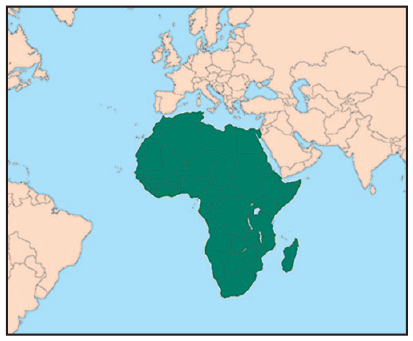
I. Introduction
How can Africa’s marginalized(1) urban majority reframe the sustainability agendas? To answer this question, we start from three basic acknowledgements. First, the North(2) has historically produced and, together with China, continues to produce the bulk of emissions that cause climate change. Yet the consequences of climate change are unequally felt and fall with particular intensity on vulnerable subjects and ecologies across Africa. Activists for climate justice emphasize that addressing climate change requires addressing global inequities in terms of race, gender and class. They have taken up slogans such as “Environmentalism without class struggle is just gardening”, repeating the powerful words of Brazilian environmentalist Chico Mendes decades ago.(3) Critical voices call our global age one of “climate colonialism”,(4) arguing that the climate crisis is the latest manifestation of a long-standing global crisis of environmental justice. Any serious engagement with sustainability should thus address endemic legacies of coloniality, extractivism and asymmetric industrialization across the world. These legacies explain, at least in part, how and why current sustainability agendas continue to be formulated by global institutions that are embedded in and dominated by the interests of wealthy countries.
Second, to reframe sustainability agendas from a Southern perspective, we recognize not only material and epistemic inequalities at a global level, but also material inequalities within the varied urban geographies of the global South. African cities are expected to triple their population by 2050,(5) with a projected growth of 900 million people on the continent.(6) The accelerated urbanization in African countries will require massive infrastructural investments, many of which will be framed as “sustainable” in the context of the pressing reality of the climate crisis. This urban transition underscores the future developmental opportunities of the continent. It requires a reimagination of an “urban Africa” with varying and uneven degrees of urbanization across regions and a significant informal hybrid service economy.(7) Infrastructural development interventions have historically benefited the elites and failed to accurately reflect urbanization trends. Hindered by a lack of finance options, municipalities are often reliant on national governments or international funders to plan and build infrastructure.(8) This lack of capacity has encouraged private sector investments, usually directed at the rapidly growing middle and upper classes of Africa’s cities. Low-income residents have once more been excluded, leading to further economic disparities.(9) Low-income residents are amongst the lowest CO2 emitters in a context of growing inequality – not only of material wealth and therefore carbon emissions, but also of political participation. These residents are also spatially marginalized, while the wealthy in those same cities take up the majority of urban land and are responsible for the bulk of consumption and emissions.(10)
Third, despite these inequalities, African cities carry enormous potential to address systemic injustices, in particular considering the dynamism and inventiveness of their youthful populations. African cities are sites where inequalities are being contested through a range of actions and inventions to raise African voices and political representation, and where carbon-intensive models of development are less entrenched. These three acknowledgements undergird our intention to examine how questions of sustainability transitions might be reframed.
Rather than asking how international donors and development institutions should build sustainable infrastructure in Africa’s low-income urban areas, we start from the perspectives, lifeworlds and agency of their residents. The dominant impact of sustainability discourse and urban and environmental policy, including in many Southern cities, has been, if not to disregard the marginalized urban majority, to further deepen patterns of racialized inequality. Here we think of ongoing projects of environmental rehabilitation, such as river ecology rehabilitation projects in Southern cities, which often entail mass dispossession and displacement of groups whose livelihoods are interlinked with the ecologies around them. As new, African-centric sustainability agendas such as Agenda 2063 are being formulated,(11) how can we ensure that these are rooted in the needs and aspirations of those most affected by the effects of our current un-sustainability?
The growing literature on urban climate justice examines the disproportionate distribution of climate risks and vulnerabilities in urban areas, particularly those affecting poor and marginalized communities. Scholars in this field emphasize the colonial legacies that shape this distribution, and the way in which race, class and gender intersect to shape unequal exposure to climate hazards such as floods, heatwaves and landslides.(12) While scholars increasingly argue for the inclusion of residents in decision-making about climate adaptation strategies, they have devoted more attention to top-down adaptation strategies, such as the World Bank’s Climate Structural Adjustment Programmes, than to the actually existing adaptation practices of socially marginalized urban communities.(13) Rather than analysing how low-income residents operate in relation to the shrinking space of nationally dictated climate adaptation practices, we centre indigenous practices and knowledges and their potential in setting sustainability agendas. Our goal in doing so is to redress the epistemic inequality that un-voices the urban majority of socio-spatially marginalized residents in African cities.
Central to our work is Mohtat and Khirfan’s invitation to foster empirical and theoretical studies that go beyond normative suggestions and centre questions of justice in the “how” of current adaptive forms of intervention.(14) Ziervogel et al. have suggested that inserting a rights and justice approach into the resilience debate opens up spaces for more transformational sustainability concepts.(15) Patterson et al. note how notions of justice are embedded in the Paris Agreement through its acknowledgement of human rights and the role of equity in its implementation, monitoring and evaluation, highlighting the importance of climate justice in decarbonization efforts.(16) In this vein, we take a recognitional justice approach as defined by Fricker,(17) Chu and Michael(18) and Fraser.(19) Drawing on research in the Indian cities of Bengaluru and Surat, Chu and Michael illustrate how a lack of recognition leads to climate injustice or environmental marginality. They conclude that non-recognition leads to a variety of adverse impacts on the possibility to participate in political decision-making, including broken social networks, “erasure of identity, political voice and, more crucially, access to citizenship rights”.(20) Recognitional justice thus acknowledges the historical production of material and social inequality and difference in cities, while tackling what Mohan and Khirfan refer to as the “social, political, and economic differences that share unjust decision-making processes and outcomes”.(21)
The African continent accounts for the smallest share of greenhouse gas (GHG) emissions per capita at around 3.8 per cent of the total global emissions.(22) However, this is not as a result of low-carbon development, but rather of historical poverty and economic stagnation.(23) Sovacool et al. note that the transition to decarbonized and largely digital economies generates serious human and environmental impacts(24) which interact with already-existing vulnerabilities and inequalities structured by gender, age, class, geography and patterns of globalization. With rapid urban growth, social justice assumes greater importance for decarbonization transformations – first, to protect vulnerable populations from climate change impacts; second, to protect communities from disruptions of transformation; and third, to enhance the process of an equitable post-carbon society.(25) Building on this approach to urban climate justice, our work centres the knowledge and practices of low-income urban residents in ongoing efforts to reframe dominant sustainability agendas. We do so by bringing into dialogue ongoing research from different African urban geographies.
This field note builds on a panel at the “African Infrastructural Futures” conference at the African Centre for Cities in Cape Town, which took place in November 2022. Reporting from Lagos, Nairobi and Johannesburg, the panellists discussed their research on infrastructural practices in low-income urban areas in East, South and West Africa, ranging from energy and water to transportation, housing and waste management. Our research is participatory in nature, covering a range of methods including interviews, observations, spatial design, photo walks, action research workshops and focus group discussions. After a brief introduction of each research project, this paper: (a) identifies existing practices of sustainable infrastructure; (b) analyses the relationship of these practices to government; and (c) outlines research strategies for recognitional justice. Finally, we conclude by looking at how to incorporate these frames within the debates around sustainability and climate justice in order to support policies that are rooted in neighbourhood-level tried and tested approaches.
a. Lagos: Water governance and health infrastructure in Makoko (Nura Ali)
Lagos is facing a water crisis, triggered by a historical combination of postcolonial planning legacies,(26) partially planned or “bypass” urbanization,(27) vested interests in public service delivery(28) and the commodification of access to basic rights. While the production of this water crisis is inherently sociopolitical, most policies follow a managerial or market-driven approach to solving the issue. The “environmental nuisance” (to use Adow’s term)(29) that is a by-product of infrastructural deficiencies, specifically water, sanitation and hygiene (WASH) infrastructure, is used as justification for threats of evictions or actual demolitions. Particularly, low-income dwellers along Lagos’s coast fall victim to the logics of a liberal market economy that drives the urge to develop land for higher-earning segments of society.
Civil society interventions have started to intervene strategically through local and traditional governance structures to promote and pair the ongoing “urbanism from below” with a request for more inclusive urban development, and public and corporate accountability.(30) In an attempt to map interventions that are tested by the urban majority, this case study shows the entanglements of hydro-social relations, water governance and community-driven health services in Makoko, a long-established Lagos coast community with little to no public service delivery.
b. Nairobi, Kenya: An integrated and inclusive infrastructure framework for under-resourced neighbourhoods (Margarita Garfias Royo, Jack Campbell-Clause and George Arabbu Ndege)
In Kenya, incoming legislation and many current and planned “neighbourhood upgrades” emphasize investment in infrastructure as the basis of urban development.(31) A common assertion among practitioners and academics is that if infrastructure investments are inclusive of a broader set of voices and needs, and integrate physical, social and ecological systems, they can create just, climate-resilient and viable neighbourhoods.(32) But how can these systems be conceived, planned and designed to shape a new and viable urban future for city residents?
To provoke thinking and action towards better development planning in low-income areas, a multi-agency coalition of built environment practitioners (Kounkuey Design Initiative), organizations of the urban poor (Akiba Mashinani Trust), a professional institution (Architectural Association of Kenya), a private sector engineering firm (Arup East Africa) and academics (UCL Engineering for International Development – EFID) came together to engage Kenyan actors to co-develop an Integrated and Inclusive Infrastructure Framework (known as 3iF) for informal settlement upgrading in Kenya.(33)
The 3iF used an impact-focused research approach to develop, test and disseminate a set of principles and “tactics” to support sustainable infrastructure-led upgrading of low-income neighbourhoods considered informal in Kenya. It was developed through an extensive co-production process where definitions (and outcomes) of “sustainable”, “integrated” and “inclusive” infrastructure and the actors involved within the Kenyan context were explored. The development of the framework included baseline research, content inputs from professionals, academics, private sector and practitioners, and roundtable and workshop sessions with the core team, advisory team and informal settlement stakeholders.
The aim of the framework is to support the policy development, planning, design and implementation of infrastructure upgrading projects, with the objective of reducing inequality and promoting shared prosperity. The framework is intended to be used as guidance and consists of a “Practice Guide” for decision makers within the built environment and a “People’s Guide” devised for community groups and their interlocutors, focusing on awareness and ability to respond to infrastructure from an informed point of view.
c. Reframing the imaginary of “upgrading” in Johannesburg (Jhono Bennett and 1to1)
Johannesburg, unlike most cities, lacks natural water resources and instead owes its existence to the gold rush of the late nineteenth century, which drove its formation. Despite the dismantling of Apartheid in 1994, Johannesburg still grapples with profound spatial inequality, with the city’s structure reflecting enduring patterns of separation and inequality. The roots of this inequality can be traced back to the pre-Apartheid era when labour, industry and housing were organized in a manner that reinforced control and division between the city centre, townships and rural areas.
Ideas of what can be defined as informal/formal remain contested across South African urban studies,(34) but “informal settlements”, as defined in government-supported development actions,(35) are one of many tangible manifestations of South Africa’s legacy of spatial injustice. Since 1994, there have been substantial efforts at various scales in both governmental and non-governmental sectors to address the societal challenges related to informal settlement development for residents of such neighbourhoods, now known colloquially as “upgrading”. These have mostly included a focus on housing, services and tenure(36) through what has been known as the Reconstruction and Development Programme (RDP), interwoven with various other governmental mechanisms. Although these efforts have been substantial in scale and have provided many new homes to those marginalized by centuries of sociopolitical injustice, in doing so they have also further reinforced urban spatial patterns of exclusion and are agreed by many to have missed other opportunities in addressing the legacy of South Africa’s spatial inequality.
Within this system of socio-spatial injustice are residents inhabiting otherwise vacant buildings, more centrally located. These dynamic and socially complex “occupied buildings”, as they are known locally, represent an opportunity to contribute to sustainable urban development. They require fewer physical resources and less embodied carbon than more traditional upgrading projects, and they are in prime and appropriately dense locations for in situ development.(37) There is still much work to be done in this sector towards meaningfully embodying what the Upgrading Informal Settlement Policy (UISP) was intended to achieve. Within these challenges lies an underlying issue in navigating the often-detrimental stigmas and perceptions of what and who upgrading is for – as well as how this looks in action.
II. Reframing Sustainability Agendas
a. Frame 1 – Identifying existing sustainable infrastructures
Sustainable development is both an approach and a process of material and immaterial practices arising to mitigate, adapt or create resilience in response to a global condition; these practices encompass economic, ecological, social and political factors that are contextually attuned to a specific geographic location.(38) This requires us to look at the types of infrastructure that are cared for by the people that have stakes in it, namely residents of low-income communities. As for social and ecological sustainability, we are interested in the complexity of social status and the feedback with its physical surroundings.
How can sustainable solutions start from better seeing and building on existing infrastructures? This question is particularly relevant in resource-scarce settings with hybrid infrastructural coverage. To answer this question, we study the sustainability of existing neighbourhood infrastructures.
Reinforcing existing water and health infrastructures
In Lagos, there exists great potential for sustainable urban futures at the intersection of water and health – provided that urban development policies start to invest more in established infrastructures (both physical and non-physical). For example, in the Makoko/Iwaya neighbourhoods and across other low-income communities in Lagos, local water producers have accumulated in-depth knowledge about soil quality, geology and borehole drilling techniques. Various NGOs or private investors drill boreholes that are not functional in the long term (beyond six months) and remain unused because of bad water quality. Sometimes chemicals are mixed into the groundwater due to a lack of expertise on the part of private households, having adverse ecological, social and economic effects. Here, collaboration between the government or NGOs and local water producers could go a very long way, as these producers have spent decades building relationships with clients and learning about Lagos’s water networks.(39)
Lagosian water infrastructure is marked by a high degree of hybridity. Drinking water is provided by small private businesses that tap into local groundwater resources, chemically treat the water and sell it in the form of sachet and bottled water to customers in Makoko (and other places across Lagos). Negative effects of this quasi-privatized water system in Makoko are well known to those working in the sector. These include disproportionately high prices for drinking water, plastic pollution, and preventable illness in cases where small water companies sell water that is unfit for consumption. Meanwhile, the opportunities and infrastructural transitions that are in place and that already transform low-income urbanism are sometimes overlooked: for instance, water businesses registered through the controlling body of NAFDAC (National Agency for Food and Drug Administration and Control) supply safe water to areas where government infrastructure is not present.
On the lagoon side of the settlement, health services are delivered through Traditional Medicine Practitioners (TMPs), registered nurses and birth attendants who operate in an environment of acute health risks due to water-borne diseases such as typhoid and cholera. TMPs also play a role in terms of water governance, by tracing and treating water-borne diseases, while circulating information on water quality and recommended water practices. There exists a deep and visible interlinkage of water and health issues in Makoko. The urban adaptation forms identified now may play a crucial role in a future of increased climate-caused water-borne diseases globally.
Reincorporating grassroots voices
It is only through inclusion, inclusivity and inclusive processes that we can get close to sustainable urban futures. In Nairobi, currently, 60 to 70 per cent of the city dwellers live in informal settlements, taking up only 5 per cent of the urban space.(40) The majority of the city’s residents have historically and repeatedly benefited very little from infrastructure investments. Consider the case of Nairobi’s visions for urban development in the past (its 1948 colonial master plan), present (the 2022 Mega Government Infrastructure Projects)(41) and future (the aspirations demonstrated in the Kenya Government Vision 2030, the African Agenda 2063 and the UN’s SDGs).(42) The 1948 master plan for Nairobi segregated citizens through the creation of class enclaves, whose postcolonial legacy still lingers in the city today.(43) The eastern part of the city was grossly under-resourced with services and amenities, effectively creating far-reaching economic sabotage for the pre-colonial inhabitants.(44)
Currently, the Government of Kenya has made significant achievements in infrastructure development through massive borrowing and technical support from abroad.(45) There are several completed, ongoing and planned infrastructure projects in Nairobi and across the country to connect cities and the hinterlands.(46) It can be argued that most of these projects continue to be constructed along the colonial exclusion lines and that little consideration is given to the low-income neighbourhoods. With heavy funding from abroad, local professionals are either sidelined or given subservient seats at the table. The Inclusive and Integrated Infrastructure Framework (3iF) was developed in reaction to the status quo and the need to change the way we build now, and in the future.
The Mukuru Special Planning Area (MSPA) is a significant example of inclusive urban development and participatory planning of a low-resource settlement,(47) where residents and local actors/stakeholders initiated and called for designation as a Special Planning Area (SPA).(48) The organizations involved in the MSPA process, led by Muungano Alliance, advocated for the SPA declaration using data, political rights and proposal preparations, and led the planning process with the county government once the SPA was in place. MSPA is one of the largest informal settlement upgrading projects and used large-scale mobilization to achieve a community-wide consultation and planning process.(49) In practice, however, MSPA is struggling to deliver results. The plans have either not been formally adopted or are not being followed, and new developments are not aligning with agreed-upon SPA plans.
3iF is specifically trying to enable inclusive processes like SPAs. In 2020, the Kibera informal settlement was also declared an SPA.(50) But the designation was announced without recognizing the required engagement process and with much less of the groundwork that had been undertaken in Mukuru SPA. As a result, development in Kibera is meant to be paused under the SPA for two years in order to enable a participatory planning process to take place.
Far from pausing development, however, in 2021 an urgent road building initiative was launched through presidential decree, bringing its own “special” parameters. Kibera was one of several settlements to be included in the total 444 kilometres of roads that were to be built in Nairobi’s low-resource settlements.(51) The project was budgeted at more than US$ 50 million and included plans for roads, water, sewer infrastructure and power. Kibera, where 28 kilometres of roads were to be implemented in a six- to eight-month window, was the flagship project in the initiative. The only information issued to contractors for the development of the roads, however, was a 1:10,000 scale plan, as shown in Figure 1.(52) To date, just 10 kilometres have been built, leading to a general expectation that the full 444 kilometres that were planned will not be constructed. In the MSPA process, driven by needs and priorities of residents, a negotiation with the roads authority and the inter-stakeholder groups resulted in Road Reserve Wayleaves(53) that were several metres less than the code standards, while the full reserve area for the roads in Kibera was cleared with no discussion or engagement.
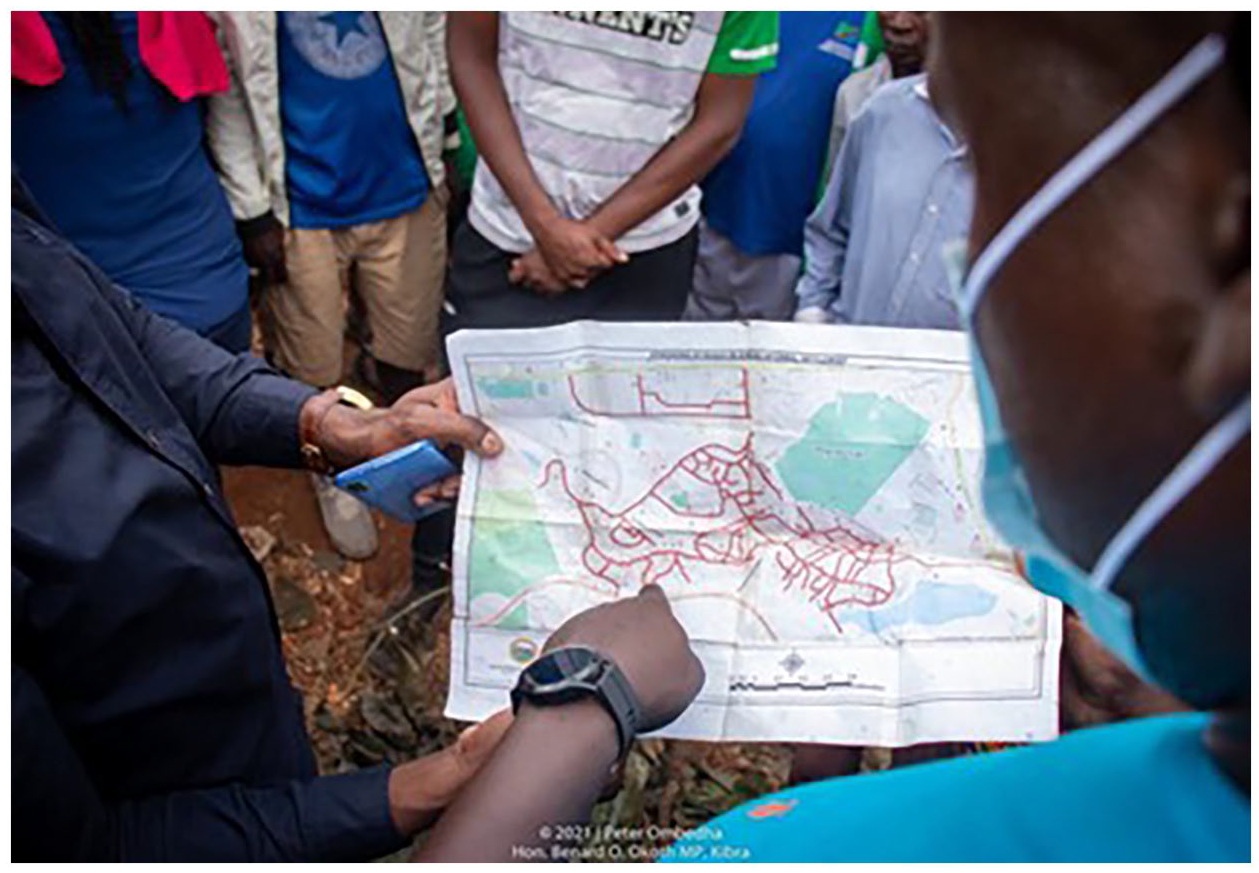
Photograph of the 1:10,000 scale map used to set out the Kibera Roads for contractors
Redeveloping existing housing stock
Bertrams is a suburb in Johannesburg, South Africa, situated to the east of Ellis Park Stadium and consisting of low-medium density residential development. The priority block in Bertrams (see Figure 2), located between Gordon Road and Berea Road, comprises a series of “abandoned buildings” that have been occupied in various ways over the last few decades.(54) The housing ranges from fenced brick housing to apartment buildings, and many buildings serve as student accommodation due to the proximity of the university. However, many of the buildings have not been well maintained and their conditions pose some health and safety hazards. Building residents have raised concerns about unfair evictions without provision of alternative affordable accommodation, a lack of waste removal services, non-functional ablution facilities and leaking roofs.(55) These buildings are not in any way homogeneous and they vary in organization, technical requirements and the aspirations of the inhabitants.
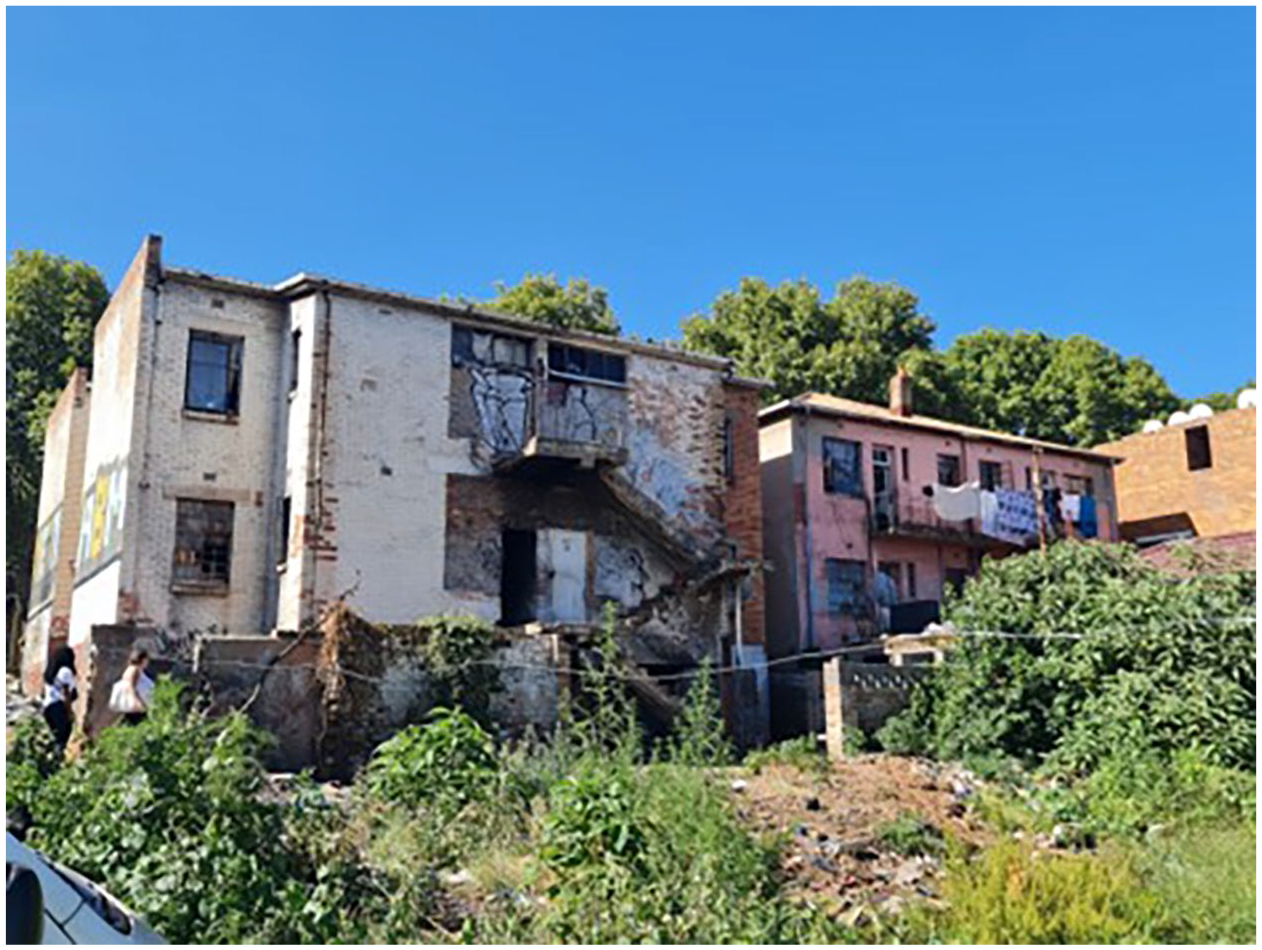
Bertrams occupied buildings, Johannesburg
As an opportunity to encourage more sustainable and equitable forms of city growth and use, Johannesburg’s occupied buildings already have many desirable features that would be hard won or beyond reach in informal settlement upgrading: density, good location, access to services and other urban infrastructure such as transport networks and job opportunities. While there are some differences in terms of structural limits, social support and various legal definitions, the challenges of supporting these occupied buildings are much the same as for informal settlements.
1to1-Agency of Engagement, in collaboration with the Inner-City Resource Centre (ICRC), has worked on challenging the limitations of UISP in situ upgrading projects and maintaining productive relationships with the Bertrams residents. Since 2018, they have collaborated with the National Research Foundation (NRF) and Misereor to fund various incremental interventions. The Bertrams priority block Community Engagement Project (CEP) is supported by a multi-year collaborative project, Change by Design Joburg,(56) that aims to engage with the complexities of living conditions in Johannesburg’s inner city. The collective approach was to co-design and co-create a series of built interventions to support the efforts of the community’s active building committee, but also to strategically improve living conditions and prioritize maintenance activities to improve safety in the buildings. The series of built interventions have included the repair and completion of a dilapidated toilet outbuilding, the repair of a hazardous steel staircase and a leaking roof, and the improvement of public spaces for community activities in two buildings. Residents have contributed by painting spaces, installing security doors and repairing plumbing. The tenure of residents remains unclear due to delayed court proceedings, with no indication of an expected timeline, as is the case for many other building occupants in the inner city.
b. Frame 2 – Government and collaboration
The second frame looks at the nature of the integrated collaboration of stakeholders in sustainable urban development in three major African cities. Pointing to values, principles and responsibilities, this section discusses how successful collaboration can happen.
Integrated stakeholder responsibilities
Residents in low-income Lagosian neighbourhoods represent the majority of the urban population – an estimated 70 per cent(57) – and when organized activists reach certain numbers, it is impossible to ignore their demands. In 2012, the Lagos State Government started evicting people in Makoko, and the Vice Baale(58) of one community was hit by a bullet trying to protect a house from being demolished by the police. Defending their right to the city, Makoko chiefs and residents refused to accept the loss of life or the eviction order, and mobilized thousands to march to the governor’s office. The community was represented by a lawyer, alerted the UN and, most importantly, received solidarity from other communities with no formal land titles who joined them. They succeeded in talking to the then-governor and signed a Memorandum of Understanding (MoU) that prevents further demolition of the community – a temporary symbol(59) of the recognition that Makoko is an integral part of the city centre. While the MoU is a positive development, it is not legally binding for the government, nor does it provide a transition towards securing the tenure, and therefore livelihoods, of Makoko residents, or the sustainable development of the land. Residents’ resistance to their eviction is at the same time a resistance to the development of luxury housing units that leave the land vulnerable to climate-related damage. This situation can be seen in other parts of Lagos where low-income neighbourhoods have been replaced by luxury developments, resulting in former residents seeking shelter in other parts of the city, where urban and peri-urban informal settlements are growing.(60) While the MoU has been successful in preventing demolition for over 10 years, the legal precarity of such an agreement has real effects on Makoko residents’ mental health and ability to make long-term plans, or invest in infrastructural adaptation.
When considering the impetus of climate change, the necessity of thinking intersectionally and bringing down the walls of siloed ministerial responsibilities becomes clear. In Lagos, various ministries are involved in water supply, oversight, infrastructure, taxation, etc. – and they often have only partial knowledge about each other’s work. Working with water stakeholders in low-income neighbourhoods gives insight into the bureaucratic hurdles and challenges for inclusive and sustainable water infrastructure. Working with local stakeholders (such as TMPs for instance) could also help in balancing globally skewed epistemic infrastructures by giving value to community knowledge and local systems of care that respond to the maladies associated with service deficiencies. Balancing epistemic inequality means to pair it with activism and awareness-raising on political rights and participation in decision-making, pushing from many angles. In a meeting with various stakeholders where infrastructural upgrading was discussed,(61) a director mentioned that they are working with communities to strategically approach their political representatives to build pressure over time, and enforce the representation of community interests. Following such an approach could contribute to mainstreaming the SDGs through local government channels. These channels are currently disconnected from the Office of Lagos SDGs and Investments, whose two main focuses are to create a policy environment that aligns with SDGs and thereby attract investments into the Lagos State government (as opposed to the local governments), as well as to distribute small-scale funding for sustainability projects of NGOs.(62)
Integrated stakeholder principles
The 3iF project attempts to disrupt the notion of what infrastructure seeks to achieve and who it is for, and supports the transition to better infrastructure in Kenya. The SDGs have been adopted as the international framework for sustainable development and it is commonly expected that development projects and programmes should address these goals.(63) But recognizing that the 3iF was to be applied in the African context, and that the African Union has worked towards publishing its own regional sustainable agenda, Agenda 2063, the possible connections between the SDGs and Agenda 2063 were reviewed in order to explore the links between the agendas. The exercise was carried out as part of the framework development to show funders, policymakers and practitioners that it is possible to find commonalities in targets while ensuring a basis in an Africa-led vision and goals for development. This could help leverage resources for projects, but also support planning, implementation, monitoring and reporting.(64) A targeted integration of SDGs and Agenda 2063 could help achieve locally prioritized targets while also allowing for the delivery of global goals.
The two agendas overlap through targets relating to the creation of policies for sustainable development and development programmes, including building capacity and participatory systems at multiple governance levels. In order to implement this in real life, it is crucial to understand how communities are represented (whether by “formal” or “informal” groups, as considered from a governmental perspective), and how they are organized (through saving groups, Muungano structures, community volunteer organizations, neighbourhood associations, etc.). It is also critical to identify interlocutors for these different groups and to determine the scale at which to communicate and include low-income residents’ views of sustainability.(65)
Integrated stakeholder translation
The challenge for 1to1 as a socio-technical spatial design organization lies in how best to support the residents and leaders of occupied buildings in framing and co-developing small-scale strategies that contribute to larger visions for the city from different agents of change (i.e., government, private sector and support NGOs). The types of cohesion (or “community”) and solidarity found in occupied buildings, as well as the timeframes and aspiration of their residents, are very different from what we have encountered in informal settlements. Misreading these particular forms of solidarity and aspiration caused many problems in the early phases of engagement and has required particular approaches.
The grassroots support provided by the various community-based organizations (CBOs) to the residents of different occupied buildings and the work to foster a network of solidarity in the face of often hostile engagement from the government (and emerging vigilante groups) has been considered successful by 1to1’s own leadership(66) and by project partners. In terms of 1to1’s socio-technical spatial design engagement in these projects, the successes have been more in the realm of developing data-gathering systems and building the capacity of a group of community facilitators (CFs) to engage the city and the leadership across these sites. In addition to this, it has been important also to identify perceptions, imagery and framings that have contributed to stigmatization and bias towards the residents.
c. Frame 3 – Research approaches for recognitional justice
Knowledge silos often prevent government, academia and civil society from benefiting from each other’s expertise and experience. Globally, epistemic infrastructures still reflect colonial global histories where sustainability agendas are formulated by dominant actors and institutions. While we recognize the ways in which our own positions are inscribed in these inequalities, we attend, in the third section, to our efforts to counter such epistemic imbalances in shaping sustainability agendas. In this final section, we localize research and the everyday practices of decolonial knowledge production to look at how marginalized communities can reframe the sustainability discourse. We use a recognitional justice approach as a platform for thinking about urban climate justice, moving across existing silos of knowledge and practice. From water–health infrastructural entanglements, to upgrading occupied buildings, to exploring ways to shift practice through multi-agency collaborations, all sites of investigation show the indissolubility of socioeconomic realities and environmental needs for successful urban adaptation to climate change.
Intersectional approaches
Understanding politically marginalized lifeworlds can be pivotal in understanding the bias of global sustainability agendas. The intersectionality of urban climate adaptation impact is particularly visible in low-income neighbourhoods. How feminist, anti-racist and class struggles coincide is fully visible when looking at the ways that the increase in fuel prices also increases the cost of water (borehole pumps are fuel-powered to bring the water into the tanks, as shown in Figure 3). In low-income neighbourhoods in Southern Nigeria, for example, water supply is gendered: women usually provide water for their families, with high associated costs, while they are excluded from the economic opportunities in the water production businesses. This trend can be seen across low-income neighbourhoods in various cities.(67) In Makoko, those who make the most profit from water production (i.e., borehole businesses) are exclusively men. In communities like Makoko or Ikorodu, the price of water already surpasses that of children’s school fees. Increases in costs over the coming decades of further climate change may impact the ability of households to invest in education or health altogether when water prices keep rising as fuel is needed to power the city’s generators pumping water out of the ground. At the same time, low-income coastal neighbourhoods are more exposed to the impacts of the climate crisis, including flooding (both pluvial and coastal) and heatwaves.(68) Looking at the intersectionality of politically marginalized lifeworlds will help to reframe the sustainability agenda in a way that prevents future siloed thinking, and the unequal burden of climate impacts that results.
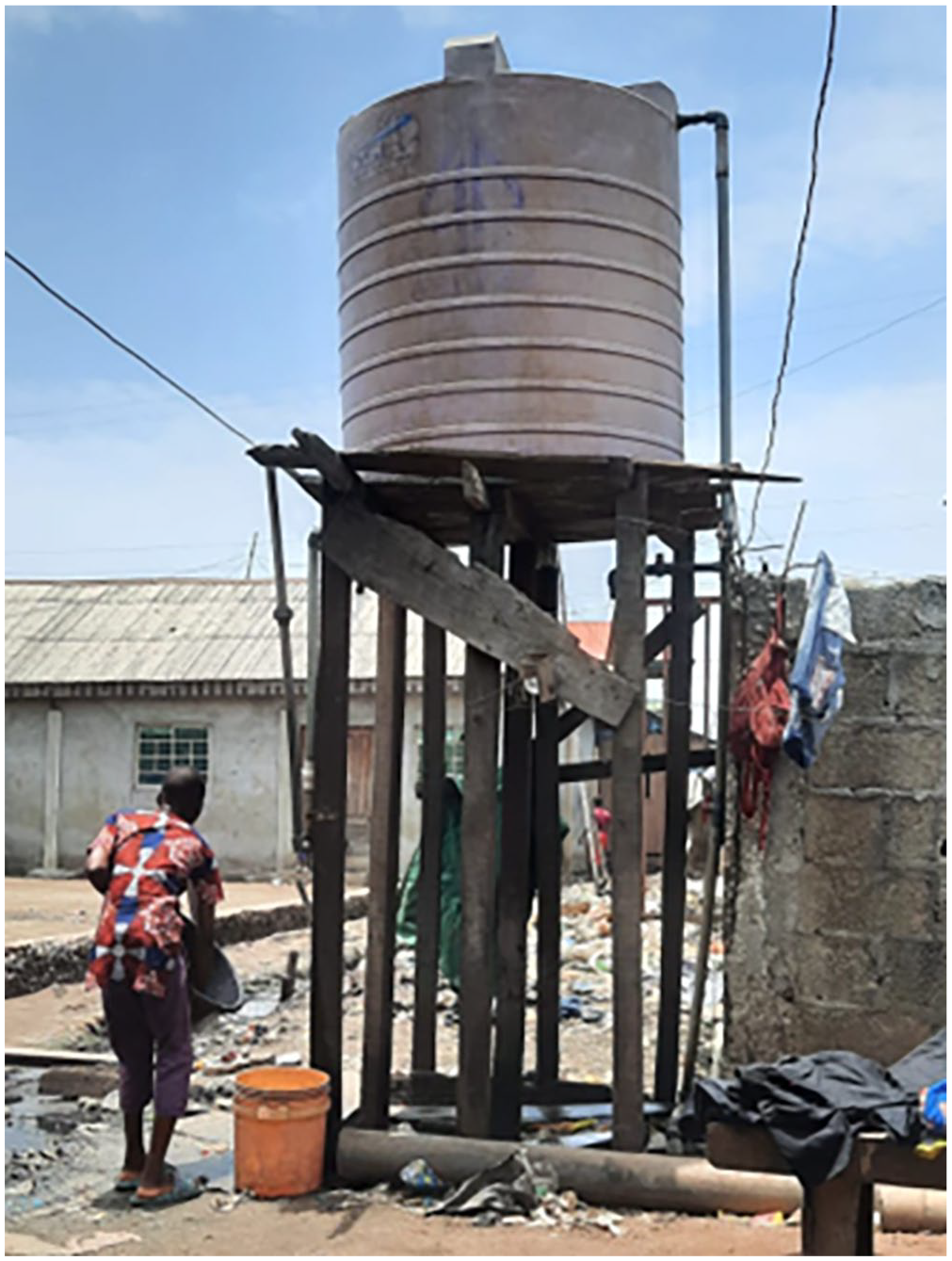
Borehole and water tank in the Sogunro District of Makoko
Inter-stakeholder approaches
There is a visible need to reframe the idea of sustainable development to a systems approach, with all its dimensions, advantages and drawbacks. A crucial step towards such a reframing is the evaluation at different levels of our own set of privileged positions, especially for those in power, and how those positions can support voices that adopt holistic sustainable approaches. From an academic perspective, and rooted in the Kenyan urban development experience, a key point for reframing sustainability agendas includes scaling up collaborations with different stakeholders (funders, communities, practitioners, industry, government organizations/departments) to support and strengthen knowledge exchanges and best-practice sharing, as well collaborations with local and international universities, especially for influencing curricula and focusing on a theory of change. This is a long-run strategy, reliant on education at different levels.
Interdisciplinary principles
The Asivikelane campaign stands out as a grassroots, interdisciplinary, collaborative initiative established during the nationwide COVID-19 lockdown in March 2020. Its primary objective was to create a platform enabling residents in informal settlements to communicate severe water, sanitation and refuse removal (WASH) shortages during the lockdown in South Africa. This pioneering initiative successfully brought together 153 informal settlements in five metropolitan municipalities and five smaller towns, garnering support from numerous grassroots organizations and civil society groups. Residents actively participated by providing live updates on the status of their WASH infrastructure, fostering a more robust dialogue with local governments and promoting solidarity across grassroots informal settlement leadership networks. In this collaborative effort, 1to1 played a crucial role, working closely within the interdisciplinary framework to co-develop small-scale, bottom-up improvements addressing poor maintenance and potentially hazardous infrastructure, including issues related to “occupied buildings”. Prioritizing maintenance activities aimed at enhancing safety and overall living conditions was a key aspect of their involvement.
This initiative not only served as a powerful platform for co-production and engagement within the larger campaign network but also demonstrated the efficacy of interdisciplinary approaches to tackling large-scale infrastructural challenges. The success achieved underscored the importance of adopting a bottom-up grassroots perspective in addressing complex issues, showcasing the effectiveness of interdisciplinary principles in bringing about positive change.
III. Conclusion
Recognizing and building upon existing infrastructures and attendant practices within low-income communities can contribute to urban climate justice and neighbourhood approaches to decarbonization. Challenges to identifying such practices in the three cities include detached or silenced value systems, disintegration of objectives and funding capacity, and a lack of accountability and recognition in collaboration. In Lagos, civil society organizations and private firms function as bridge builders between government and low-income neighbourhoods. If water resilience and successful climate adaptation is to be achieved, government, local engineering NGOs and international actors need to work with local “waterpreneurs” and TMPs who trace and treat water-borne illnesses in Makoko. In Johannesburg, a critical reading of the socio-spatial value assigned to historically disadvantaged areas among stakeholders (occupied building residents, leaders, private sector elements or government officials) is crucial to navigate negative perceptions rooted in the multigenerational legacies of systemic spatial injustice. This is highlighted in how 1to1 and their CBO collaborators had to advocate both strategically and technically for upgrading existing building stock over eviction, demolition and rebuilding in Bertrams.
The shared value of social infrastructure (resident cohesion, existing infrastructure knowledge, proximity to livelihoods) is often hidden behind the stigma associated with people and buildings, or is difficult to recognize as a means of safety or survival in highly unequal contexts. This makes it hard to incorporate these social strengths along with more tangible infrastructures and easier-to-translate value systems in the determination of critical supports.
If the system is questioned in terms of legality, safety or “fairness”, the model falls apart, resulting in often unfavourable outcomes for the more vulnerable. In Nairobi, participation and inclusive processes helped to deliver fit-for-purpose infrastructure while the 3iF team recognized that the integration of objectives and funding is indispensable. Here, the team’s close engagement in the road initiative uncovered a few challenges: due to the “special” (that is, presidential) nature of the initiative, meaningful participation, engagement and even public notice were bypassed in Kibera, despite the Kenyan Constitution enshrining participation.
A second key to urban climate justice is to push for more integrated collaboration among stakeholders. Examples from Lagos highlight the role of organized activism in defending community rights, while in Nairobi and Johannesburg, initiatives like Special Planning Areas (SPAs) and community engagement projects illustrate attempts to shift traditional urban development paradigms towards inclusivity and participation. Challenges for meaningful sustainability action by the respective governments and collaboration with other sectors included a lack of integration in local, national and global sustainability agendas, as well as a lack of engagement and co-production in formulating these agendas. In Lagos, as in Nairobi, young people and low-income residents are sidelined in the battle for climate justice as the SDGs have not been successfully mainstreamed by the respective institutional actors. In Kenya, while the overriding principles of collaboration, rights to the city, social justice and environmental resilience are outlined in legal and policy documents,(69) they have not been mainstreamed on a local urban level.(70) Importantly, and parallel to empowered grassroots movements, efforts on behalf of sustainable urban futures must take the budgetary restrictions and scopes of action of different government tiers into account. In Lagos, local government autonomy can be a realistic prerequisite to building sustainable infrastructure where it is most needed as the Local Council Development Areas (LCDAs) are closest to their constituencies and in constant dialogue with the neighbourhoods under their administration.(71)
While linking the targets of the SDGs and Agenda 2063 does not address the issue of how low-income residents could reframe sustainable infrastructure agendas directly, it supports the idea that the inclusion of a diverse set of voices is possible. As such, this linkage raises epistemological questions of whose priorities get taken into consideration, showing how history, culture and narrative can be integrated in infrastructure projects and how agenda-setting still carries the legacy of colonial and modern planning as well as of donor-driven development in respect of larger scale climate or sociopolitical injustices. Through its interdisciplinary approach, 1to1 has fostered productive relationships with the residents of Bertrams and co-built awareness with the various CBOs whose members live and work in inner-city Johannesburg. 1to1’s work has set a precedent for co-development approaches in the region and has demonstrated the potential for sustainable urban development that prioritizes the safety and livelihoods of existing residents by addressing small-scale issues of epistemic systemic justice that hold the potential to make larger scale change in South African cities.
Finally, our research suggests that in order to counter the epistemic imbalances undergirding dominant sustainability agendas, bridging knowledge silos by including marginalized communities in agenda-setting is crucial, including addressing concerns around who gets the benefits of development interventions, and where, particularly for decarbonization practices.(72) Challenges include intersectional inequities, while inter-stakeholder and interdisciplinary approaches highlight the importance of systems thinking and multi-stakeholder collaborations. Africa’s urbanization is generally characterized by a large informal and survival-oriented economy, that could be transformed to expand on the urban imaginary and diversify avenues for urban investment that prioritize existing low-carbon practices.(73) Lagos, Johannesburg and Nairobi show the complexities and diverging realities in how the politically marginalized urban majority navigate infrastructures in their respective cities and neighbourhoods. By formulating more inclusive frames of reference, anchored in empirical and grounded approaches, research can support majority-centred climate transition efforts towards urban climate adaptation and the inclusion of existing local decarbonization practices that serve the majority of urban residents.
Footnotes
Funding
Nura Ali is a grantholder of the Wellcome Trust Doctoral Studentship in Humanities & Social Sciences. Margarita Garfias Royo, George Arabbu Ndege and Jack Campbell-Clause received funding from the Royal Academy of Engineering (GCRF Africa Catalyst). Jhono Bennett received funding from ‘TACK/Communities of Tacit Knowledge: Architecture and its Ways of Knowing’: Innovative Training Network, as part of the Marie Sklodowska-Curie Actions within the European Framework Program Horizon 2020.
1.
While the framing of concepts such as marginalization can be difficult to apply across three distinct contexts (Soja, 2010), this field note understands socio-spatial marginalization in regard to the aspects of access to democratic mechanisms in locationally complex conditions experienced by disadvantaged individuals and groups of residents due to a range of social, political and factors, both market-related and socially constructed (Mehretu et al., 2000).
3.
Many activists attribute the citation to Mendes yet without a detailed reference. For example the use of the slogan in climate justice work by the All India Central Council of Trade Unions: https://www.aicctu.org/workers-resistance/v1/workers-resistance-october-2022/addressing-climate-change-environmental-justice-through-economic-and-social-justice#:~:text=“Environmentalism%20without%20class%20struggle%20is,of%20forest%20in%20the%20Amazon. Although not confirming the citation, his work and legacy is examined in  .
.
10.
12.
See the recent review by Mohtat and Khirfan (2021). See also Romero-Lankao and Gnatz (2019); Miller (2020); Moser and Stein (2011); Robin and Castán Broto (2021); .
24.
The authors refer to human and environmental impacts such as health risks, air pollution, environmental destruction, water contamination, exploitation of children and minorities and community dispossession to name a few. According to the authors, these inequalities can arise as a result of unmanaged and poorly planned decarbonization pathways that do not consider the entire lifecycle of a system, in a phenomenon they call the “decarbonisation divide” (Sovacool et al., 2020).
30.
NGOs (such as CAPPA Africa, Justice and Empowerment Initiative – Nigeria/JEI, Revamp Rave Network), Community Development Associations (CDAs) organized by community, grassroots movements (such as the Nigerian Slum/Informal Settlement Federation) or civil society partnerships between a range of NGOs (such as the World Water Day).
39.
An example of a socially sustainable and recognitional project is the Iwaya/Makoko healthcare project by Arctic Infrastructure, connecting community-driven solutions with the state through recognizing (i.e., formalizing) traditional health education and the importance of traditional medicine for community health.
42.
This will be discussed in the Integrated Stakeholder Principles section.
47.
Horn (2021); .
48.
An SPA is a Nairobi County process that accepts “special” conditions for an area that requires a non-standard approach for its improvement.
50.
Initiated by the Nairobi Metropolitan Services (NMS) – a nationally-instituted two-year temporary body, constituted to stand-in for the elected county leadership following an impeachment of the then governor, Sonko (KDI, 2020).
52.
AAK et al. (2021).
53.
The Kenyan code for road reserve (area reserved for all infrastructure that follows the road development such as roadways including carriage, pedestrian ways and drainage) stipulates that roads must have a 12-metre width, which is ultimately designed for greenfield development, limiting scope for road development in informal settlements. The code does not account for the retrofitting of alleyways and other forms of narrow pathways in access infrastructure planning. We argue that the road reserve needs to be context specific, which is something that is being missed in current planning approaches and standards. In Mukuru SPA, residents negotiated with the government for a smaller road reserve width, as the stipulated road reserve has led to negative impacts to the community in terms of community displacement. In the Mukuru SPA, these negotiations led to a balance between relocating people versus providing good and adequate infrastructure.
58.
The Baale and Vice Baale are the local-level representatives of the traditional government in Lagos and Nigeria. Baale means “chief”, and the Vice Baale is the second to the chief of a traditional district.
59.
An MoU is usually used to negotiate in good faith until a final, legally binding contract is signed by all parties. However, there exists pre-contractual liability. In Nigeria, a breach of an MoU can be brought to court where the breach can be argued for and against.
61.
Taken from Nura Ali’s participatory observation field notes and minutes of the mentioned project meeting.
66.
Led by co-founder Jacqueline Cuyler, leadership of PlanAct, SERI and our CBO collaborators.
69.
The 2010 Constitution of Kenya, the 1999 Constitution of the Federal Republic of Nigeria, the 1996 Constitution of South Africa, various national and urban strategy documents, the African Agenda 2063 and the United Nations Sustainable Development Goals (SDGs).
71.
The fiscal autonomy of Lagos’s LCDAs is demanded by various actors while Nigerian scholars like have been writing about the need for local government expansion. Here, a major challenge for local governments will be to expand their capacity to acquire and manage the amount of funding that is needed to finance sustainable infrastructure in low-income neighbourhoods.