




Abstract
Local priorities shape the way urban adaptation to climate change is envisioned. Yet processes to capture these priorities often overlook the power dynamics behind structural vulnerabilities. Approaches to positive futures thinking that are transdisciplinary offer a way to centre local communities in the process. However, these approaches are often limited as communities struggle to conceive climate change beyond their known realities and lived experiences, creating a disconnect between the present and future. We introduce the concept of ‘urban adaptation imaginaries’ to connect futures thinking to real-world social, political, and environmental contexts. Through a critical review, we argue this concept supports urban adaptation decision-making by emphasising its socio-political and relational dimensions, and by addressing the fragmentation and abstraction common in adaptation discourse about the future. We identify three key contributions: (1) fostering context-sensitive adaptation; (2) prioritising justice and inclusivity; and (3) enabling iterative learning processes. To support this, we highlight creative methods such as arts-based approaches, and storytelling to help make climate futures more accessible, grounded, and transformative.
Introduction
Ideas of urban climate change adaptation are diverse, ambiguous and sometimes even opposed, with adaptation priorities often differing not only within cities themselves but also within a single local community (Castán Broto et al., 2024). The way climate change adaptation is imagined and operationalised is currently limited by a belief in universal problems and solutions, a lack of pluralistic forms of knowledge and values, and an oversimplification of adaptation processes (Olazabal et al., 2024a). Lived experiences and dominant social and political contexts shape both individual and collective imagination, narrowing the urban adaptation solution space and contributing to a lack of relational thinking in adaptation. Furthermore, processes of urbanisation concentrate climate risks and shape adaptive capacity, particularly in informal and rapidly growing settlements marked by infrastructure deficits, social vulnerabilities, and spatial inequalities (Almulhim and Cobbinah, 2023; Elmqvist et al., 2021; IPCC, 2023). On the ground, implementation struggles with fragmented governance, competing priorities, and informal interventions, which complicate the alignment of adaptation actions across scales and actors (Cartier, 2015; Ortega, 2020; Walsh, 2012). In this restrictive context, an absence of contact and collaboration between groups and communities results in a lack of empathy and recognition of diverse realities, needs, and values (Brown et al., 2019). As a consequence of neglecting these, implemented adaptations can create new local vulnerabilities or negative externalities (Schipper, 2020). For example, adaptation narratives of ‘urban greening’ and ‘techno-fixes’ often fail to adequately account for the underlying power relations that are implicit in any response to climate change (Celermajer et al., 2024; Neidig et al., 2022) and address the sources and drivers of risk to reduce the need for emergency response (Ziervogel et al., 2016).
On the one hand, there is a need for a nuanced understanding of the perceptions, needs, and expectations of those deemed vulnerable to climate change and for approaches where their voice can be heard and their knowledge and experiences integrated (Amorim-Maia et al., 2023). On the other hand, there is an urgent need to conceptualise adaptation not just as a technical, but also as a socio-political process, where the recognition of the needs and views of others is critical (Eriksen et al., 2015). Negotiation processes to identify existing stakes and ways to balance them can then turn into a breakthrough to more effective adaptation processes that align with shared goals and expectations (Harris et al., 2018).
Yet, such breakthroughs require a shift in how knowledge, power, and values are negotiated and integrated throughout adaptation processes (Böhme et al., 2024; Cox, 2024; Nightingale et al., 2022). In this context, transdisciplinary research has gained traction as a critical mode of inquiry and practice capable of enabling more just and transformative adaptation. Defined as a process of knowledge co-production in which academic and non-academic actors collaborate from the outset to identify problems, design research, and develop actionable solutions (Olazabal et al., 2025), transdisciplinary research reconfigures traditional boundaries of expertise and authority. It seeks to address real-world problems by integrating scientific and non-scientific knowledge systems through inclusive, iterative, and dialogical processes (Pohl et al., 2017).
Transdisciplinary approaches consider how knowledge is co-produced across disciplines and worldviews. Therefore, these approaches are central to challenging entrenched power asymmetries and epistemic hierarchies in adaptation planning (McClure et al., 2024; Ziervogel et al., 2022). Transdisciplinary research opens up space for reflexivity, relationality, and the recognition of multiple forms of knowing, creating conditions in which adaptation is not only more responsive to local contexts but also more legitimate and sustainable (Chambers et al., 2021; Max-Neef, 2005; Polk, 2015). Importantly, this approach supports a relational view of adaptation as a learning process based on strong, trust-based relationships, shared meanings, and negotiated understandings of climate risks and solutions (Goodwin et al., 2025; Taylor et al., 2025). By confronting the politics of adaptation and investing in inclusive, co-produced knowledge, transdisciplinary research contributes to adaptation pathways that are more just, context-sensitive, and transformative.
In line with the emphasis on creativity and co-production in adaptation, scholars have increasingly emphasised the value of positive futures thinking as a core component of transdisciplinary research. We use the term ‘positive futures thinking’ to refer to a broad spectrum of approaches that engage with aspirational and optimistic futures to support proactive, intentional climate action (Nalau and Cobb, 2022; Pelling et al., 2023; Rusca et al., 2023). These approaches include practices such as normative future visioning or backcasting, which involves producing and deliberating desirable future end-states and the trajectories needed to reach them, or, in the case of backcasting, working back to the present (Comelli et al., 2024b; Uwasu et al., 2020; van der Voorn et al., 2023). In urban adaptation, positive futures thinking not only helps surface the aspirations and preferences of local communities and stakeholders but also motivates action by enabling a more hopeful and values-driven framing of the future (McPhearson et al., 2016; Terry et al., 2024). Despite its promise, however, such approaches have yet to be widely embedded in adaptation processes, highlighting the need for greater attention to their practical integration within transdisciplinary work, especially as a means to connect positive futures thinking with co-produced, context-specific adaptation strategies (Nalau and Cobb, 2022). Recent scholarship has shown that when positive futures thinking is applied in a transdisciplinary manner, it can open avenues to challenge structural conditions of oppression that marginalise certain communities from formal decision-making processes, opening a door for equity and justice (Coelho et al., 2025; Terry et al., 2024). In particular for climate change adaptation, an inclusive approach to futures thinking can help to identify compound vulnerabilities and locally specific realities, particularly in the face of uncertainty (Chu and Michael, 2019; Wise et al., 2014). In this debate paper, we introduce and define the concept of ‘urban adaptation imaginaries’ as collective understandings and social expectations for climate change adaptation in cities. We then explore how integrating urban adaptation imaginaries into transdisciplinary research could enhance positive futures thinking by revealing the social, cultural, and political assumptions influencing adaptation efforts in urban areas in the present and future. The concept of imaginaries is not new but has strongly re-emerged across a diversity of arts and sciences disciplines during the last decade (Goudsmit et al., 2024; Kuchler and Stigson, 2024; Olazabal et al., 2024b). It has thereby emphasised a need for collective and contextual understandings when explaining complex phenomena affecting individual or collective choices. Urban adaptation imaginaries go beyond technical and quantitative framings of climate action and present an opportunity to reconceptualise adaptation in urban settings, influencing how it is thought, implemented, and experienced (Westman and Castan Broto, 2020). Thus, we argue that the concept of urban adaptation imaginaries can offer an innovative theoretical framing by emphasising the socio-political and relational nature of adaptation and its influence on futures thinking and by addressing the abstraction and divergence around ideas of adaptation.
Connecting urban adaptation imaginaries with existing futures thinking appears fundamental to justifying and expanding its applicability space. However, existing positive futures thinking methodologies operate under different framings, each with its own set of goals and terminologies, which are many times used lightly or ambiguously. ‘Narratives’, ‘pathways’, ‘scenarios’, ‘visions’, ‘imaginaries’, and ‘utopias’ are often used interchangeably to refer to different present and future conceptualisations of urban adaptation and can be interpreted and applied differently. The lack of standardised terminology and methods for positive futures thinking poses significant barriers to inter- and transdisciplinary learning, effective communication, and the advancement of innovative approaches in practice (Cork et al., 2023; Kuiper et al., 2024).
This article brings together a critical review of the scientific literature (see Snyder, 2019) on imaginaries in the context of urban climate change adaptation to examine how the concept of urban adaptation imaginaries can complement transdisciplinary research and positive futures thinking. We analyse how the term is used across a range of futures-oriented approaches (Robinson, 2003; Sheppard et al., 2011), and clarify its relevance to urban adaptation. Grounded in this review, we propose a definition of urban adaptation imaginaries.
Positive futures thinking and transdisciplinary approaches in urban climate change adaptation
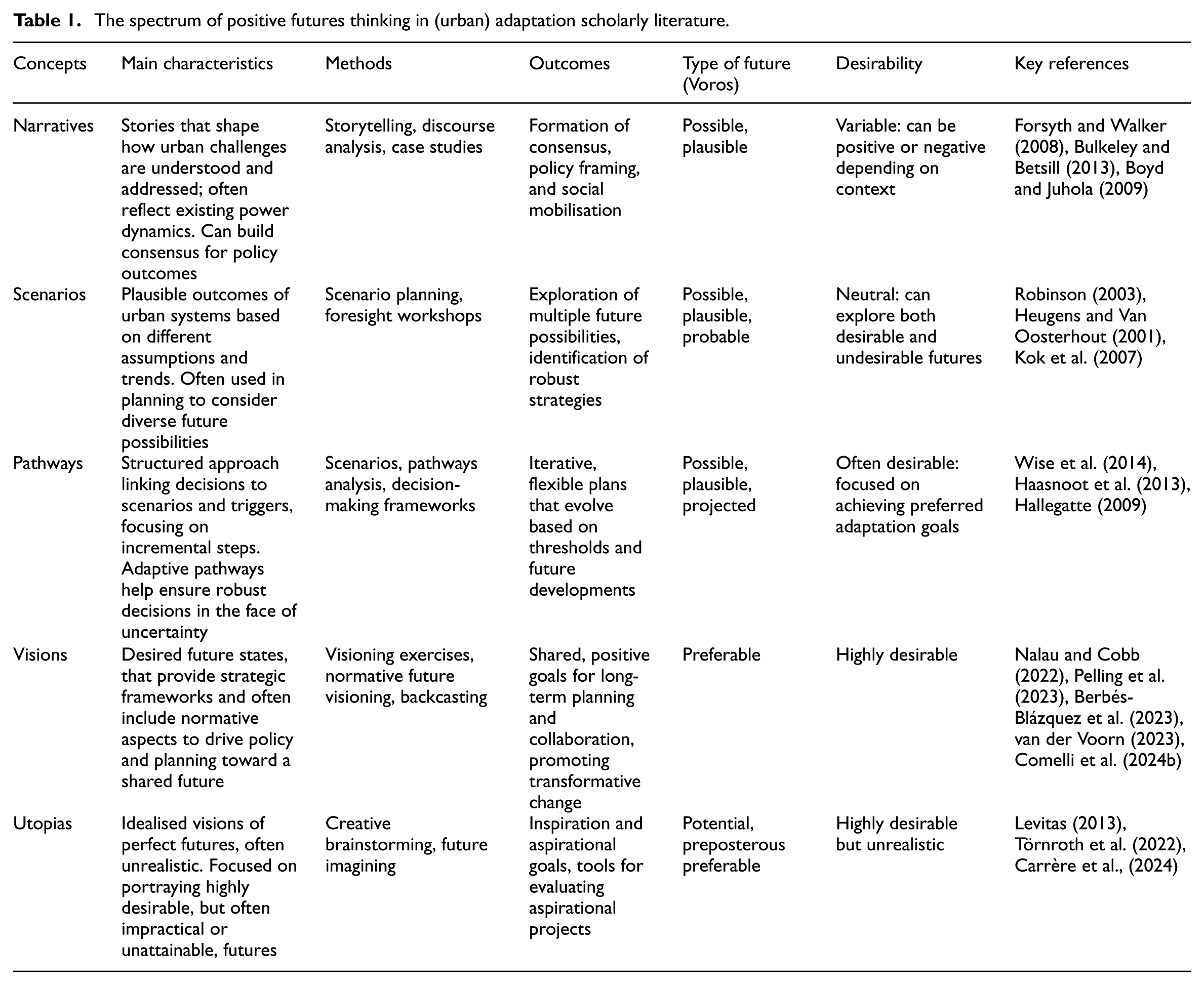
Futures thinking and transdisciplinary approaches have developed largely independently since the 1980s but are increasingly combined to inform urban decision-making, particularly in climate change adaptation (Sheppard, 2005). Futures thinking is valuable in urban adaptation because it encourages consideration of a broad range of potential outcomes rather than predicting a single future. This approach moves away from top-down, technocratic methods by exploring various futures, including an array of different perspectives, and ranging from possible and plausible to preferable futures. Voros’s (2003) ‘futures cone’ categorises futures into seven types: potential, preposterous, possible, plausible, probable, preferable, and projected.
Transdisciplinary futures thinking is particularly well suited to incorporating diverse perspectives and addressing local needs often overlooked in dominant narratives (Olazabal et al., 2024b). Examples include initiatives and projects such as Vesper Hill’s (2024) ‘Pam’s Story: Preparing for Possible Futures’ and SMHI’s (2022) ‘Create your future’ workshop. As Pelling et al. (2023) highlight, how a desirable future is envisioned and who participates in that vision creation critically shape present-day decisions and their long-term impacts. In urban politics, the process of envisioning the future influences political aims, planning strategies, and implementation mechanisms (Rusca et al., 2023). Therefore, understanding and strengthening the social and political foundations and mechanisms of collective future-building is vital to foster fair, inclusive, and sustainable decision-making, especially in new political areas such as climate change, where uncertainty can entrench conventional approaches (Eckersley and Olazabal, 2024; Olazabal et al., 2024a; Yusoff and Gabrys, 2011).
Futures thinking has a rich and multidisciplinary history, but it is often underappreciated and inconsistently applied. This has led to confusion in how futures are studied and discussed, with overlapping terminology that can hinder interdisciplinary and transdisciplinary collaboration (Cork et al., 2023; Kuiper et al., 2024). In climate futures research, much attention has been given to what could happen, especially negative or dystopian scenarios, while less focus has been placed on what should happen, considered desirable or preferable (McPhearson et al., 2016; Nalau and Cobb, 2022). Futures thinking typically includes three approaches: predictive (what will happen), explorative (what could happen), and normative (what should happen; Comelli et al., 2024a; Nalau and Cobb, 2022). Given the uncertainties of climate change and the long-term impacts of adaptation decisions, approaches focusing on aspirational goals are increasingly seen as valuable. These approaches help challenge business-as-usual adaptation and support the development of inclusive, transformative visions (Castán Broto et al., 2024). Positive futures can also prevent reliance on narrowly shared solutions (Comelli et al., 2024b). Table 1 summarises these approaches and their relationship to the different futures types based on Voros (2003).
The spectrum of positive futures thinking in (urban) adaptation scholarly literature.
Current challenges for the use of positive futures thinking in urban adaptation
Despite the many advantages of positive futures thinking, we identify three main challenges that diminish the potential of its use for adaptation in a just, inclusive, and transformative way. Notably, (1) a need for climate futures literacy and the ability to imagine beyond one’s own experience, (2) a lack of practice in including diverse vulnerable groups, and (3) insufficient attention to processes of reflection and experimentation to imagine alternative adaptation futures.
First, where a multitude of diverse stakeholders are involved, there are varied levels of climate futures literacy, that is, the ability to project one’s own actions in relation to climate change into the future (Mangnus et al., 2021; van der Voorn et al., 2017). Furthermore, the intangible nature of the present and future of climate change also makes it difficult for participants in visioning exercises to relate to climate change outside of their everyday experiences (Bornemann and Strassheim, 2019; Bremer et al., 2024; Nalau and Cobb, 2022; Totin et al., 2021). Climate change is thought to be experienced through the weather and seasonal shifts, but in reality, it is an accumulation of data and everyday experiences over time (Brace and Geoghegan, 2011: 291). This disconnect, described by Brace and Geoghegan (2011: 291) as a ‘metaphysical and semiotic problem’, makes conceptualising climate change in transdisciplinary futures thinking particularly challenging. For example, in the case of rising temperatures, local communities may be asked to visualise a heatwave in their community without ever having experienced one. Conversely, the affective sphere of climate change politics can influence perceptions of what can or should be done and who is responsible for it (Cox, 2024; Nightingale et al., 2022). To combat this, there is a need for imaginative approaches that engage with our collective ability to imagine and shift climate change from something that is ‘out there’ to something that is grounded temporally and spatially within the political, social, and cultural lenses of our current realities (Comelli et al., 2024a; Davoudi and Machen, 2022; Finn and Wylie, 2021; Yusoff and Gabrys, 2011). This can give rise to a newly developed empathy for the individual and collective experiences of climate change and what can or should be done in that regard (Böhme et al., 2024; Brown et al., 2019).
Second, in understanding such collective experiences and building empathy, there is a need for diverse understandings of alternative adaptation futures that expand the adaptation solutions space (Fattah and Walters, 2023; Olazabal et al., 2021). This can be achieved through the recognition of pluralistic knowledge and values of communities that might be more severely exposed or vulnerable to climate change, and of urban practices that might be more or less affected, for which adaptations are required (Chmutina et al., 2023; Leal Filho et al., 2022). As Olazabal et al. (2024a) stress, current understandings of the future are constrained by an assumption of universality, which often overlooks the importance of local knowledge systems and cultural values. This neglect reproduces existing vulnerabilities and leads to unsustainable or short-lived outcomes. Additionally, adaptation processes are frequently oversimplified, failing to account for the intricate socio-political and socio-spatial dimensions of climate adaptation (Adger et al., 2009; Cerrada Morato, 2024; Eriksen et al., 2015; Mabon et al., 2022; Olazabal et al., 2024a). These limitations highlight the need for disruptive approaches that challenge dominant narratives and foster more inclusive and context-sensitive adaptation strategies (Castán Broto et al., 2024). However, as a result of traditional practices in adaptation governance that incentivise accountability (Hughes et al., 2020), conventional approaches to positive futures thinking can inadvertently fall prey to data-driven technocratic approaches that are often not that inclusive or collective. Such practices tend to marginalise subaltern knowledge systems and lived experiences in climate sense-making and decision-making, and perpetuate epistemic injustices (Amorim-Maia et al., 2023; Chu and Cannon, 2021; Olazabal et al., 2021).
Finally, urban adaptation requires approaches to positive futures thinking that go further to embrace reflection and challenge established norms (Bulkeley and Castan Broto, 2013; Löf, 2010). As highlighted by Bulkeley (2023), there is often a lack of space for diverse urban stakeholders to connect, exchange ideas, and align practical knowledge with potential solutions. The practice of simply providing information is not enough to change behaviour (Steelman and McCaffrey, 2013; Spence et al., 2011) and can lead to ineffective learning and ambiguous decision-making (Sol et al., 2018; Spence et al., 2011). To leverage the potential of positive futures thinking, there is a need to provide diverse actors with the opportunity to collectively (re)interpret their experience of climate change as a guide for future action (Alexander et al., 2009) using creative methods and imagination to harness social potential (Donnelly and Montuori, 2022). Nalau and Cobb (2022) highlight the increasing importance of experience-based knowledge, arguing that creating spaces for collaborative reflection can enhance ‘adaptation mindshare’, enabling communities to think more deeply and reflectively about uncertain futures (Grosz, 1998). Without such forward-thinking approaches, it is difficult to learn from existing urban adaptation and enable the spaces needed for collaborative reflection and learning for urban adaptation to climate change.
Contributions of urban adaptation imaginaries as a conceptual framing
Imaginaries, as present and future conceptualisations of social processes, have sparked extensive research, though, recently, scholars have criticised their lack of clarity and interchangeable usage (Delanty, 2021; Matheney et al., 2024). Imaginaries have been described as society’s collective aspirations shaped by institutions (Castoriadis, 1987). Jasanoff (2015) extends this idea, defining ‘socio-technical imaginaries’ as institutionally grounded, collectively held visions rooted in our understanding of social life, especially influenced by science and technology. Through our critical review, we have observed that while the understanding of urban adaptation imaginaries shares some commonalities with the concept of socio-technical imaginaries, particularly in how visions of the future are connected to governance and infrastructure, it is not limited to this framing. Urban adaptation imaginaries have the potential to extend further by incorporating socio-spatial and political dynamics, as well as cultural and experiential dimensions that are specific to urban contexts. This broader perspective allows us to explore how adaptation is imagined not only through institutions and technologies, but also through lived urban experiences, contested spaces and everyday practices. Although imaginaries have only recently been linked to climate action in urban areas (Westman and Castán Broto, 2020), the connection between urban adaptation imaginaries with positive futures thinking in transdisciplinary research contributes to this emerging literature by offering a more expansive and situated lens. However, there are examples of current non-situated imaginaries dangerously shaping narratives of urban climate adaptation. These include: (1) the framing of nature-based solutions as universal, off-the-shelf fixes, often ignoring local complexities and adaptations (Rochell et al., 2024); (2) an emphasis on abstract, technocratic notions of risk and vulnerability, which can obscure the everyday experiences and political dimensions of climate impacts (Schubert, 2024); and (3) a reliance on technological, infrastructure-heavy, and engineering-led responses, prioritising material fixes over relational and community-led approaches (Castán Broto et al., 2024; Cerrada Morato, 2024; Schubert, 2024). We argue that the power of imaginaries in positive transdisciplinary futures thinking lies in their ability to bridge the present with the future, linking real and ideal, actuality and potentiality – all key to understanding urban adaptation to climate (Davoudi and Machen, 2022; Delanty, 2021; Jasanoff, 2015; Kanarp et al., 2025). Collective imaginaries, conceived in this way, allow communities to envision futures that extend beyond the constraints of the present while integrating cultural practices, values, and aspirations. In this context, imaginaries not only relate to envisioned futures but are also grounded in current social and political realities. Through our critical review, we reintroduce urban adaptation imaginaries as a concept that spans both explorative and normative approaches. On the one hand, these imaginaries reflect current understandings shaped by policies and norms; on the other, they tap into a community’s capacity to envision alternative adaptation futures. Embedded within specific value systems, ways of knowing, and worldviews, urban adaptation imaginaries can play a pivotal role in shaping the socio-political landscape of cities and can provide a fresh perspective on what might be envisioned or realised through urban adaptation (Kanarp et al., 2025; Yusoff and Gabrys, 2011). In doing so, urban adaptation imaginaries can help move beyond reactive adaptation measures and support more anticipatory, transformative approaches within transdisciplinary climate research (Hellin et al., 2022; Pelling et al., 2023).
By integrating diverse, context-specific values and lived realities, urban adaptation imaginaries arguably broaden the scope of adaptation beyond technocratic, one-size-fits-all solutions, revealing the social and spatial complexities of evolving urban areas, from suburban expansion to urban decline, and fragmented governance (Castán Broto et al., 2024; Cerrada Morato, 2024; Long and Rice, 2019; Mabon et al., 2024; Pandey et al., 2022). Embedding futures-oriented imaginaries grounded in local lived experiences and acknowledging the messiness of urban change can illuminate pathways that are both innovative and feasible, moving beyond top-down, infrastructure-heavy solutions to co-produced, justice-centred approaches (Teebken, 2024; Zhu and Simarmata, 2015). This could help foster sustained commitment and adaptive governance tailored to the evolving urban realities of climate vulnerability and social inequality.
Based on the current challenges of positive futures thinking and the potential of imaginaries described above, we identify the three main contributions of ‘urban adaptation imaginaries’ to the field of positive and transdisciplinary futures thinking (Figure 1). These are: (1) promoting a context-sensitive and relational turn in adaptation; (2) channelling justice and inclusivity early in the adaptation process; and (3) enabling learning processes to respond to the iterative and experimental nature of urban climate adaptation management.
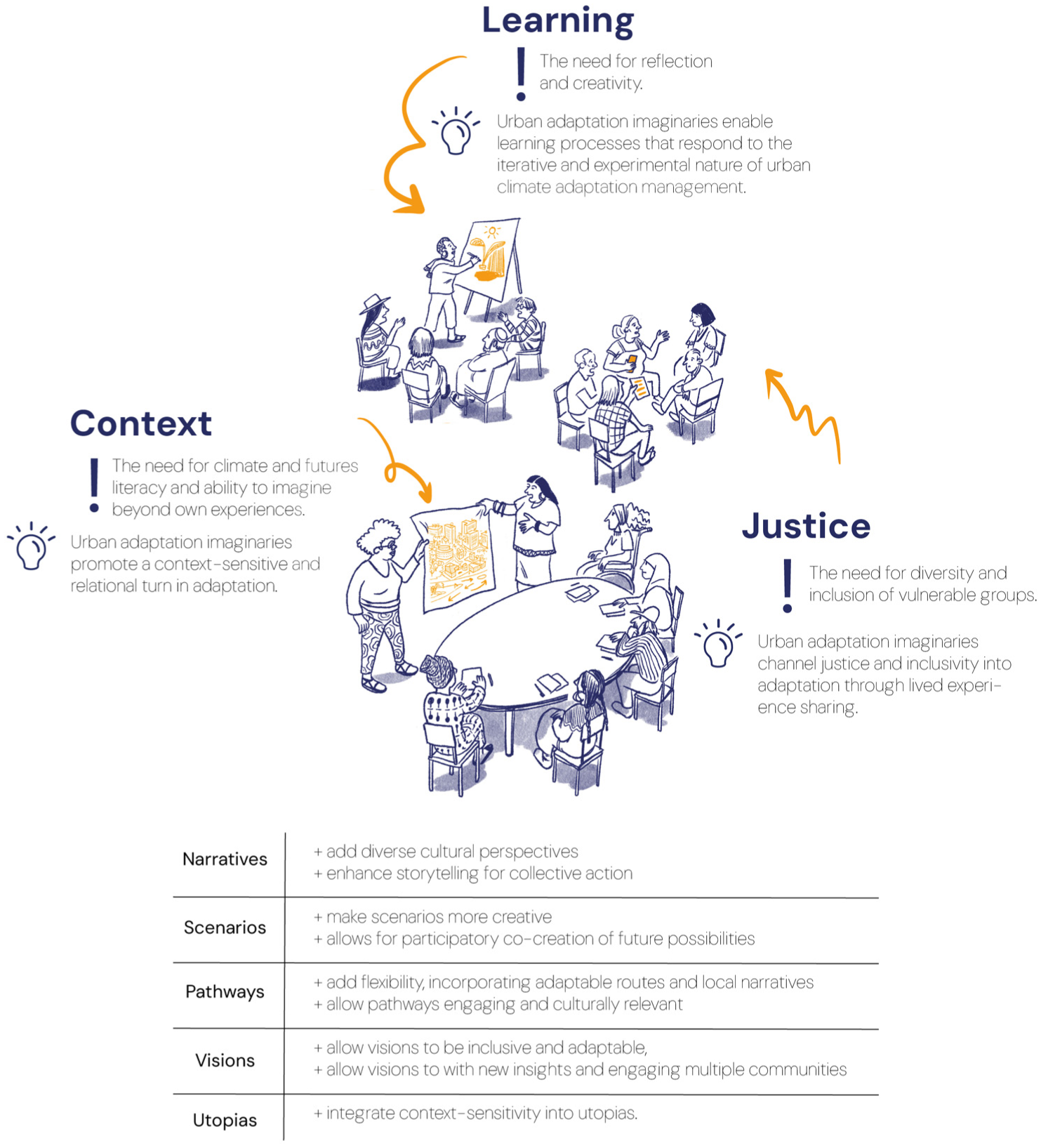
The three main challenges to positive futures thinking (denoted with an exclamation mark in the illustration) and the possible contributions of urban adaptation imaginaries to positive futures thinking (denoted with a light bulb in the illustration). Central artistic illustration: Josune Urrutia for the IMAGINE Adaptation project (all rights reserved).
In the following sections, we discuss in detail each of these three contributions and identify practical methods and tools that help bring an imaginaries lens to urban adaptation futures thinking.
Context-specific and relational turn in adaptation
Understanding the role that imaginaries can play in urban adaptation first requires examining the role of positive futures thinking to address current social limits to adaptation (Olazabal et al., 2024a). Our review highlighted some examples of positive futures thinking expanding adaptation to create space for innovative and transformative visions (Berbés-Blázquez et al., 2023; Reed et al., 2022). However, it also pointed out that by focusing only on the ‘adapted’ future, processes for positive futures thinking can overlook the practical and immediate realities of adaptation practices, which are deeply embedded in existing societal, political and environmental contexts (Eriksen et al., 2015). For instance, communities facing extreme home temperatures during heatwaves may struggle to envision a city adapting solely through green infrastructure. Without recognising how their living conditions impact their everyday experiences of heat and the associated emotions and values, the futures thinking process in place may not be as positive or inclusive (Amorim-Maia et al., 2023; Zander et al., 2021). We reason that an urban adaptation imaginaries lens can help balance the collective visions and social expectations for a city adapting to climate change (Hulme, 2009), with present-focused approaches that emphasise ways of being and knowing in current adaptation practice (Jasanoff, 2015; Lawhon et al., 2023; Olazabal et al., 2024a). Urban adaptation should be repositioned away from an estranged off-the-shelf idea toward a local opportunity and manageable challenge within everyday reach (Celermajer et al., 2024; Yusoff and Gabrys, 2011). Scholars have attributed this to a shift away from traditional positivist frameworks that aim to construct future visions on unattached values towards more nuanced, post-colonial, and feminist perspectives that emphasise the present intersections of social, environmental, and economic vulnerabilities (Amorim-Maia et al., 2024; Pelling et al., 2023; Yusoff and Gabrys, 2011). Such approaches are particularly relevant in urban adaptation, where the interplay between global climate risks and local realities often results in complex challenges that necessitate inclusive, place-based solutions (Shi et al., 2016). Grounded imaginaries, as described by Celermajer et al. (2024), are essential in framing locally relevant adaptation pathways that account for these complex realities. They offer a way to envision adaptation not merely as a technical or ecological challenge but as a socio-cultural and political process that is intertwined with issues of justice, equity, and sustainability (Zografos et al., 2020). Imaginaries consciously or unconsciously shape how policies are formed and whose interests are prioritised; without engaging with lived experiences and pluralistic knowledges, adaptation strategies risk entrenching the vulnerabilities of those most affected by climate change. However, unveiling these local experiences and knowledge-affecting imaginaries is not an easy task. In their ethnographic imaginary research process, for example, Celermajer et al. (2024) embedded themselves in local communities for a number of weeks to fully understand the local imaginaries.
As noted by Oomen et al. (2022: 252), ‘the absence of meaningful images of the future can stifle transformative change’. Further, imaginaries studies reveal that climate adaptation efforts, when detached from an understanding of place and community, may not only hinder transformative action but further lead to unjust adaptation (Holden et al., 2015). Our review shows that, without context-sensitive approaches, (positive) futures thinking risks perpetuating the injustices of urban adaptation, transforming adaptation into a tool for reinforcing and developing more autochthonous strategies linked to their socio-spatial context, rather than dismantling social inequalities (Anguelovski et al., 2016). Integrating the concept and framing of urban adaptation imaginaries into futures thinking can help move toward performative actions that carry both meaning and content and incorporate individual and collective expectations and emotions.
Recent scholarly work argues that art has immense potential to build a relational link between abstract climate data and tangible urban futures, helping address the challenge of climate and futures literacy (Olazabal et al., 2024b). Visuals, for example, those co-created with local communities, can engage people at an emotional and experiential level, fostering deeper connections to the challenges and opportunities of climate adaptation (Pahl and Pool, 2018). Art-based approaches enable participants to envision alternative futures that are not only technically feasible but also socially just. The use of comics alongside other techniques such as photo elicitation and collaborative storytelling can be a useful tool that captures localised yet diverse understandings of climate change in the present and reimagine possible and alternative climate futures (Goldstein et al., 2015; Potter, 2020; Pyyry et al., 2021; Sou, 2023). Another example of this is the project Tomorrow’s Cities, which incorporates drawing of individual storylines with statements or images about past, present and future into their future visioning approach (Comelli et al., 2024b).
By making the adaptation process more relational, transdisciplinary work for futures thinking can challenge the often universal and impersonal narratives of climate action, replacing them with locally grounded, context-specific visions of the future. We argue that this shift is essential for fostering truly context-sensitive adaptation within futures thinking – one that recognises the dynamic relationships and interconnectedness of social and ecological systems shaping both present and future urban realities.
Channelling justice and inclusivity within adaptation
Imaginaries can help to democratise processes for climate action by prioritising epistemic, procedural, and recognitional justice, thereby accommodating a broader spectrum of perceptions and experiences in envisioning positive futures (Mabon et al., 2022; Matheney et al., 2024; Paprocki, 2020). When used in combination with transdisciplinary futures thinking approaches, imaginaries can be a transformative tool to grant agency and amplify the voices of traditionally excluded groups, such as marginalised and disenfranchised communities (Latulippe and Klenk, 2020; Rusca et al., 2023; Sultana, 2020). The decision-making processes embedded within these imaginaries can be designed to actively involve these communities, valuing their knowledge and experiences.
Recent literature highlights how participatory mapping and community workshops can amplify the voices and needs of traditionally excluded groups (see Kok et al., 2007; Thompson and Ban, 2022; Törnroth et al., 2022). In this context, imaginaries can play a pivotal role in removing barriers to participation in transdisciplinary futures thinking and facilitate the inclusion of a diversity of values and worldviews in visions and co-created solutions. For instance, Terry et al. (2024: 1) argue that cultural traditions and lived experiences serve as ‘navigational compasses’ within these imaginaries, guiding communities in envisioning and building adaptation futures. However, such cultural resources are often underutilised in conventional futures thinking, which tends to focus primarily on hazard scenarios or technological innovations. Embracing imaginaries in positive futures thinking allows cities to explore epistemological pluralism, challenging traditional framings and conceptions in contemporary hazard-focused or technology-driven discourses and shifting climate engagement towards experiential knowledge and diverse lived realities (Nightingale et al., 2022). Thus, valuing lived experiences and cultural narratives can enhance the inclusivity and effectiveness of urban adaptation efforts (Lawhon et al., 2023; Mabon et al., 2022; Terry et al., 2024). Ultimately, incorporating pluralistic lived experiences into urban adaptation imaginaries allows for a richer, more nuanced understanding of climate impacts and responses (Ghimire and Chhetri, 2023; Sánchez-Castillo and Gómez-Cano, 2024), emphasising the importance of valuing cultural knowledge as a critical resource for navigating complex risks.
Lived experiences foster justice that acknowledges the complex realities of different communities (Lawhon et al., 2023; Mabon et al., 2022; Terry et al., 2024). By integrating this knowledge, urban adaptation imaginaries can expand beyond a technocratic or growth-oriented approach and foster more just futures. As highlighted by Arnall and Hilson (2023) and Riesto et al. (2022), adaptation is not only about physical or ecological factors but also about addressing the social and economic inequalities exacerbated by climate change. Using imaginaries as framing allows for interconnections to be recognised and strategies to be developed that are responsive to the needs of vulnerable populations. Through lived experience sharing, imaginaries can support improved justice outcomes in positive futures thinking, helping ground climate adaptation in the everyday realities of local communities, particularly vulnerable populations. These imaginaries move beyond abstract, top-down approaches by emphasising the perspectives and needs of those most affected by climate change (Ahmed et al., 2022). By drawing on the lived experiences of individuals, urban adaptation imaginaries allow for a more nuanced understanding of how adaptation can be tailored to specific social, cultural, and political contexts, ensuring that systems of oppression do not exclude the voices of marginalised groups in decision-making processes. In summary, by embracing disruption and fostering diverse, locally driven adaptation alternatives, we can envision more place-based futures that challenge the status quo (Amorim-Maia et al., 2024; Castán Broto et al., 2024; Paprocki, 2020).
Learning for urban climate adaptation
Learning and reflection are central to effective adaptation decision making in cities (Fisher and Dodman, 2019). They occur in the bedrock of real-world problem-solving, innovation and collaborative work to pursue sustainability. While there are interesting approaches to futures experimentation through urban living labs (Marvin et al., 2018), in general, cities lack established institutional mechanisms for iterative learning and implementing changes (Olazabal and Castán Broto, 2022; Olazabal and Ruiz De Gopegui, 2021). Indeed, an understanding of what learning looks like in practice and the stage at which cities integrate reflections is crucial (Finn and Wylie, 2021). Learning involves understanding what adaptation success looks like and how and why change has occurred (Valters, 2015).
Although the literature on learning is vast and covers numerous contexts, literature on social learning is particularly illustrative of how imaginaries can contribute to learning processes for adaptation. The field of social learning understands learning as changes in behaviour, attitudes, skills, knowledge or situations of actors at an individual, network and system level as a result of social interactions and processes between actors within a social network (Reed et al., 2010). As with urban adaptation imaginaries, this learning can occur on three different levels: cognitive (i.e. how actors understand adaptation and their place within it), normative (i.e. determining what kind of future actors prefer), and relational (i.e. how collective action can be improved; Ensor and Harvey, 2015). Previous work has highlighted how developing a shared vision for change is a crucial enabling factor to ensure social learning occurs for adaptation (Cundill and Harvey, 2019).
From our critical review, there is evidence that urban adaptation imaginaries can support futures thinking to create opportunities for communities to better learn, adapt, and envision the future (Kanarp, 2024; Rutting et al., 2024). In particular, when they are institutionalised to achieve desired long-term outcomes, they can be integrated with existing proposals for testing and innovation (Marvin et al., 2018; Torrens and von Wirth, 2021). By bringing communities into the process, early collective imagination work can help ensure that diverse identities, experiences, and needs are acknowledged and valued, creating an opportunity for learning through active engagement and expanding the solution space, or in other words, offering creative innovations on potential adaptation options (Olazabal et al., 2021). By situating learning within this broader context, urban adaptation imaginaries allow cities to confront not only the immediate risks posed by climate change but also the deeper structural inequalities and diverse subjectivities that shape vulnerability and urban decision making (McClure et al., 2024). This means that learning is not confined to technical knowledge about climate impacts and the technical effectiveness of adaptation actions, but also encompasses the development of social and economic coping strategies to reduce disparities. Urban adaptation imaginaries thus generate spaces for continuous and multiple-loop learning, where policies and practices are revised based on the lived experiences of communities and their evolving needs (Valters, 2015). Participation is central to the learning potential of urban adaptation imaginaries. Some recent studies demonstrate how an imaginaries lens in futures thinking can provide opportunities for collective learning and adaptation (Iwaniec et al., 2020; Totin et al., 2021). When communities actively participate in imagining and developing future urban scenarios, they are not just passive recipients of knowledge but active co-creators (Shipley and Michela, 2006). For example, imaginaries allow communities to reflect on existing adaptation and to envision future changes, which can be useful for learning about current adaptation interventions. An example of this is the ‘Creative Climate Futures’ approach in Glasgow, which recognises the importance of reflection and imagination as a means to engage local communities and residents, deconstructing their idealised understandings of an urban future adapting to climate change (Marino et al., 2024). In this way, using urban adaptation imaginaries as a conceptual frame in positive futures thinking encourages reflection and experience-sharing, balancing the real with the ideal of adaptation options (Davoudi and Machen, 2022) and offering a less biased, hopefully neutral, space for experimentation.
To address the need for learning and expanding the adaptation solution space, an imaginaries lens offers an effective way to enhance stakeholders’ understanding of climate adaptation strategies by immersing them in realistic, interactive futures. Simulated or gaming experiences demonstrate how transdisciplinary learning can include imaginaries in futures thinking and help convey complex adaptation issues in a more engaging and impactful manner. By placing participants in active roles within simulated environments, these tools facilitate a more profound understanding of adaptation challenges, making the abstract more tangible and increasing preparedness for real-world climate risks.
Conclusion
Through this critical review, we have shown that while the terminology in futures thinking is complex and often ambiguous, a growing body of literature is tackling urban adaptation imaginaries. We hereby propose an umbrella definition that coalesces fragmented understandings of urban adaptation imaginaries as collective understandings and social expectations for adaptation to climate change in cities. An emerging literature shows how urban adaptation imaginaries anchor futures thinking in real-world social, political, and environmental contexts by emphasising the socio-political and relational nature of context-specific adaptation. We have argued how urban adaptation imaginaries offer a promising framework for envisioning more context-specific, just, and learning-oriented futures. By drawing from these three main contributions of urban adaptation imaginaries, different methods can be used to integrate these imaginaries into urban adaptation transdisciplinary futures thinking processes. Specifically, growing experiences demonstrate how tools such as art-science collaborations and experience sharing can help translate these new insights into concrete, transdisciplinary positive futures thinking processes (Galafassi et al., 2018; Meerow and Newell, 2019; Olazabal et al., 2024b). These approaches support the critical reflection needed to ensure that urban adaptation addresses climate risks in ways that are attentive to the societal and political dynamics of both present and future contexts.
We conclude that urban adaptation imaginaries can complement transdisciplinary positive futures thinking approaches to more effectively challenge status quo responses and promote relational, just, and informed futures. We argue, nonetheless, that the diversity of existing problems, solutions, experiences, and perspectives in climate action requires an even broader and more imaginative set of approaches, ones that recognise the political and relational dimensions of adaptation, support experimentation and learning, and engage more meaningfully with diverse stakeholder perspectives over time.
Footnotes
Acknowledgements
We would like to thank Sean Goodwin for his feedback that helped refine the final version of the article.

Author contributions
WL: Conceptualisation; Methodology; Investi-gation; Formal Analysis; Writing – original draft; Writing – review & editing, Visualisation. MO: Conceptualisation; Methodology; Writing – original draft; Writing – review & editing; Funding acquisition; Supervision. ATA-M: Conceptuali-sation; Methodology; Writing – original draft; Writing – review & editing. ML-L: Conceptuali-sation; Methodology; Writing – review & editing; Visualisation.
Funding
The authors disclosed receipt of the following financial support for the research, authorship, and/or publication of this article: This research is funded by the European Union (ERC, IMAGINE adaptation, 101039429). Views and opinions expressed are, however, those of the author(s) only and do not necessarily reflect those of the European Union or ERCEA. Neither the European Union nor the granting authority can be held responsible for them. All authors acknowledge the support from María de Maeztu Excellence Unit 2023-2027 Ref. CEX2021-001201-M, funded by the Spanish Government MICIU/AEI/10.13039/501100011033; and by the Basque Government through the BERC 2022-2025 program. MO would also like to acknowledge the support of the grant RYC2022-037585-I funded by MICIU/AEI/10.13039/501100011033 and ESF+.
Declaration of conflicting interests
The authors declared no potential conflicts of interest with respect to the research, authorship, and/or publication of this article.