



Abstract
In collaboration with women’s organizations in India, Indonesia, Mexico and South Africa, an approach for a novel gender assessment of urban climate policies was developed and tested. The Gender Assessment and Monitoring of Mitigation and Adaptation (GAMMA) methodology allows for an in-depth analysis of the institutional framework and the mitigation and adaptation policies of cities. Its application by the women’s organizations in 14 pilot cities led to policy recommendations on how to integrate gender equality into urban mitigation and adaptation actions. The results of a monitoring exercise show that the project has made a significant step forward in raising awareness of gender issues and gender-responsive action at the urban level. It provides civil society organizations working on climate justice with a tool to push local governments to work towards low-carbon, resilient, gender-just and inclusive cities. It can also be used by local governments for self-assessment.
I. Introduction
Gender is one of the most fundamental categories of inequality. There is sufficient evidence of gendered vulnerability to the impacts of climate change(1) to conclude that adaptation needs to take gender into account. For mitigation, there is less evidence. However, for key sectors such as energy and transport, research suggests that gender also plays a role, for example in gendered consumption, mobility and access to energy. Contributions to the mitigation problem differ by gender both in terms of individual carbon footprints and the ability to respond. Gender, in other words, is clearly a climate justice issue that needs to be addressed by climate policies.(2) If gendered preferences, needs, socioeconomic conditions and power relations are not taken into account, mitigation policies may even exacerbate inequalities. For example, subsidies for cleaner motorized vehicles offer financial benefits for car drivers, the majority of whom are male, whereas women in many places would be more likely to benefit from the provision of clean, accessible, safe and affordable public transport services.
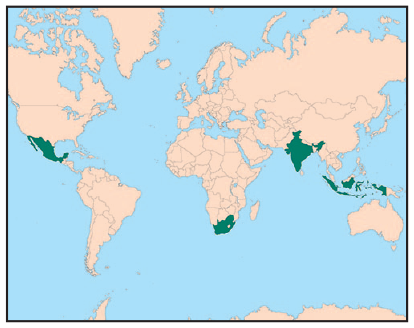
However, there is little experience of integrating gender considerations into urban climate action. In an attempt to fill this gap and to explore the extent to which cities are already considering gender issues in climate action, the global network of women’s organizations and gender activists, GenderCC, launched the “Gender into Urban Climate Change Initiative” (GUCCI) project in 2015 to develop and test a methodology for assessing urban climate policies from a gender perspective. The project was not a research activity as such, but rather a pilot project involving civil society organizations in four countries(3) and 14 pilot cities.(4) Nevertheless, its aim was to test a unique, novel approach to support the integration of gender issues into urban climate action.
This field note describes the starting points, the development and application of the methodology, and the results in terms of pilot actions and policy recommendations presented to the pilot cities, as well as their responses. The latter are preliminary, given the considerable timespans required for urban planning and decision-making. Finally, conclusions are drawn for the application and further development of the approach.
II. Gender and urban climate policy
In 2015, at the time the project was designed, research, evidence and resources on gender and urban climate policy were extremely scarce. In particular, broader, systematic approaches were lacking. Several case studies looked primarily at vulnerability and adaptation from a gender angle,(5) while others focused on specific sectors such as transport or waste. The few broader, more systematic studies on gender and urban climate policy were a background paper for UN-Habitat(6) and a chapter in the first book to explore the gender–climate nexus in depth,(7) the latter also focusing on adaptation. In its 2014 evaluation report, the Asian Cities Climate Change Resilience Network (ACCCRN) called for the inclusion of a gender lens in its work.(8) Later, a guidebook by the author of this field note sought to highlight the opportunities associated with gender-responsive urban climate action.(9) However, a comprehensive methodological approach on how to integrate gender into urban climate policies was still lacking.
Since 2015, international city networks have taken up the issue of gender and climate policy. For example, C40 Cities, an international network of large cities, has started to develop an approach to inclusive climate action in cities taking gender into consideration. However, their report on gender-inclusive urban climate action only mentions case studies from high-income countries, even though the international debate on the gender–climate nexus focuses on middle- and low-income countries.(10) ICLEI, another international city network, took up the topic of gender in adaptation around 2018(11) and now offers webinars on “Gender-aware Cities: Planning through the Gender Lens”.(12)
Beyond the focus on cities, several methods and tools have been introduced to facilitate gender mainstreaming, such as Gender Responsive Budgeting, various approaches to Gender Analysis, and Gender Impact Assessment (GIA). Common to these approaches is the recognition that policies can have unintended, unforeseen and negative effects on gender relations, such as additional burdens on family caregivers or distributional effects that favour those who are already privileged. These tools are used to analyse the impact of policies, programmes, projects and public spending on gender equality. Despite these many advances, there is a need for gender-responsive methodologies and tools for municipal climate policy that respond to both adaptation and mitigation and work for cities in the global South.
a. Designing the assessment method
The aim of developing a new approach, called “Gender Assessment and Monitoring of Mitigation and Adaptation” (GAMMA), was to go beyond simply looking for gender references in the descriptions of urban programmes, policies and projects and to provide instead a more in-depth analysis of urban climate action. It was to: (1) target local governments; (2) cover urban mitigation and adaptation actions; (3) provide in-depth insight into gender responsiveness; and (4) be applicable by civil society groups wishing to actively engage with their city, as well as by city officials as a self-assessment tool. Moreover, the intention was to support the initiation of a conversation between the civil society organizations carrying out the assessment and city decision-makers, to contribute to the development of policy recommendations, and to play a role in monitoring progress towards gender-responsive urban climate policies.
The basic design of the assessment methodology was developed by the author, who led the project, while the partner organizations contributed significantly to its detailed elaboration, in particular the formulation of the GAMMA I questionnaire (see Annex 1 in supplementary material). After a phase of drafting, clarification of terms, testing and feedback from partner organizations, GAMMA is ready for use in other cities. It consists of three elements: GAMMA I, II and III.
GAMMA I
Given that gender-responsive climate policy requires the cross-mainstreaming of both climate change and gender, which poses major challenges to institutions and therefore requires an effective mechanism, we wanted to look at the institutional setting as a first step. Many cities do not have fully developed climate policies; therefore, we wanted to gain insight into two questions: first, to what extent is the city already aware of and active in climate policy (including on both mitigation and adaptation), and second, are relevant policymakers aware of and able to address the gender aspects of climate change? Moreover, we wanted to assess the inclusiveness of institutional processes and procedures in terms of information sharing and civil society participation.
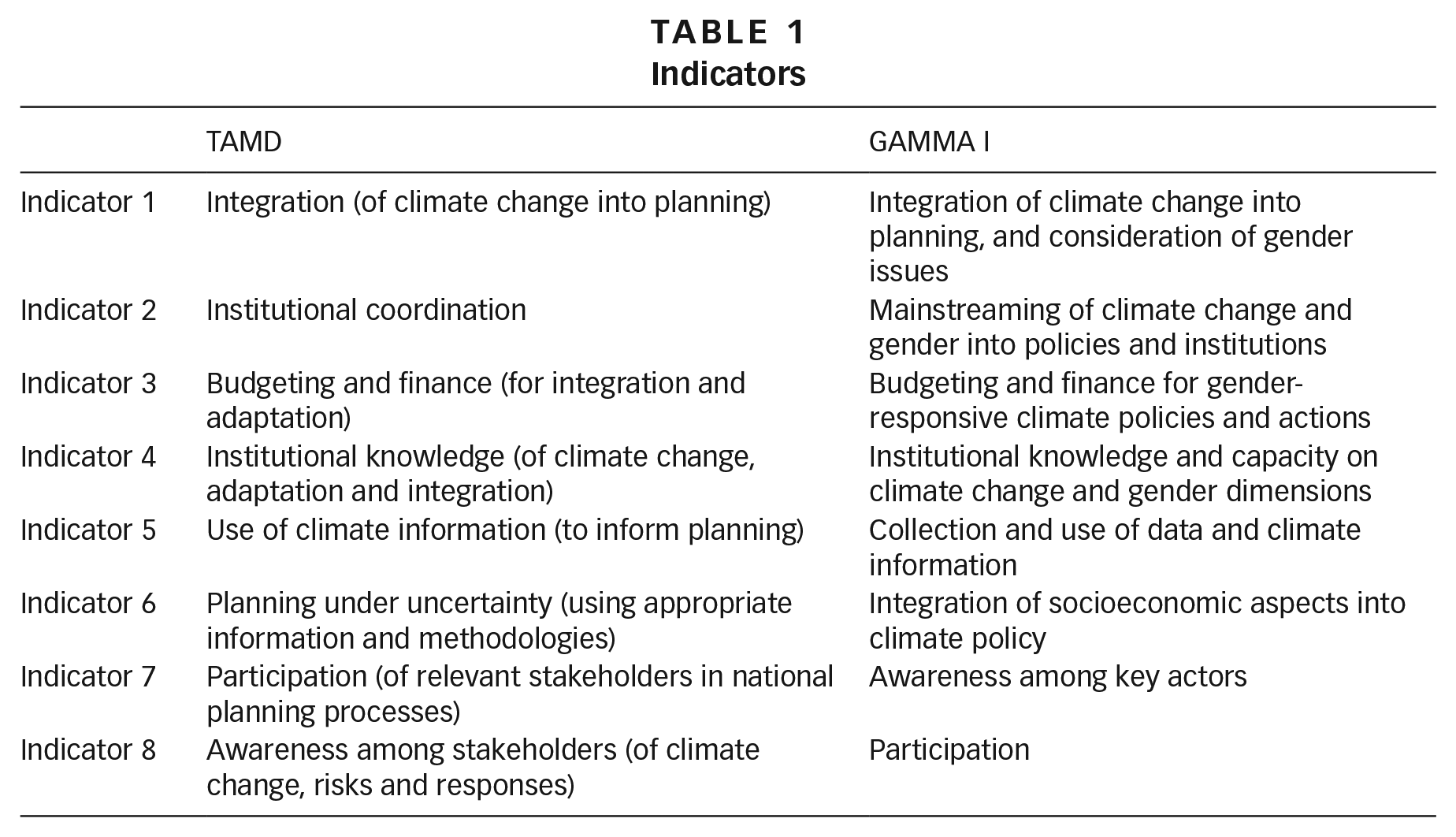
As a starting point, we chose Track 1 of the “Tracking Adaptation and Measuring Development” (TAMD) framework developed by the International Institute for Environment and Development (IIED).(13) It is based on scorecards, with five questions per scorecard that can be answered by “yes”, “no” or “partly”, and is designed to check how well institutions are able to manage climate risks. In an iterative process of drafting, testing and feedback from partners, we adapted the scorecards in order to cover climate policy more broadly and to integrate gender considerations. We kept most of the indicators from the TAMD methodology except the category “planning under uncertainty” because we felt it was more important for us to ask about approaches to consider socioeconomic aspects of climate policy. In addition, we swapped the last two indicators, because we felt it was more logical to have “participation” after “awareness among key actors”, as the latter is a prerequisite for meaningful participation (see Table 1 for a comparison). The questions for each indicator had to undergo more substantial changes because the TAMD scorecards are designed for the national level rather than the city level, and also because we wanted to include two or three gender-related questions for each indicator. The initial draft involved a larger number of questions; for reasons of practicability, however, it was eventually shortened, after ordering the questions by their priority. The final version is available as supplementary material.
Indicators
GAMMA II
The second part of GAMMA was developed by the author as part of a German research project.(14) The basic idea is that a gender analysis in the form of a Gender Impact Assessment (GIA, see below) can only be carried out for policies that are already on the table. But this may mean that priority sectors are not covered from a gender perspective. A search process would be needed to identify which policies and measures are critical to contribute to both urban climate action and gender equality. A broader gender analysis of existing policies alone does not necessarily generate ideas for mitigation and adaptation policies that would be desirable from a gender perspective. Our approach to this problem was to develop a catalogue of measures as comprehensive as possible and then to prioritize its elements according to their potential positive impact on gender equality, their mitigation and/or adaptation effects and, more generally, their social benefits and improvements in liveability. This allowed us to identify policies that are not necessarily gender-responsive as such, but which have the potential to improve gender equality if properly designed. We have included this step as the second element of GAMMA because these priority policies, once at the planning stage, need to be subjected to a GIA in order to maximize their positive impact on gender equality.
For mitigation, this exercise is quite straightforward, as we have a good understanding of the sectors that contribute to greenhouse gas emissions and, based on the existing experience with mitigation plans and programmes in many cities, we have developed a catalogue of mitigation actions. These are mainly in the areas of buildings, settlements and urban planning; mobility, transport and transport infrastructure; energy supply and demand; and consumption and waste management. For adaptation, the situation is more complex because improving the resilience of systems, including communities, can involve a large number of sectors and types of action. We have therefore decided to focus on the following key areas: buildings, settlements and urban planning; (urban) agriculture/fisheries/food security; biodiversity; disaster risk reduction; energy supply and demand; human health; and, to some extent, economic and business activities. As an example, the mitigation portfolio is provided in Table 2.
Mitigation portfolio
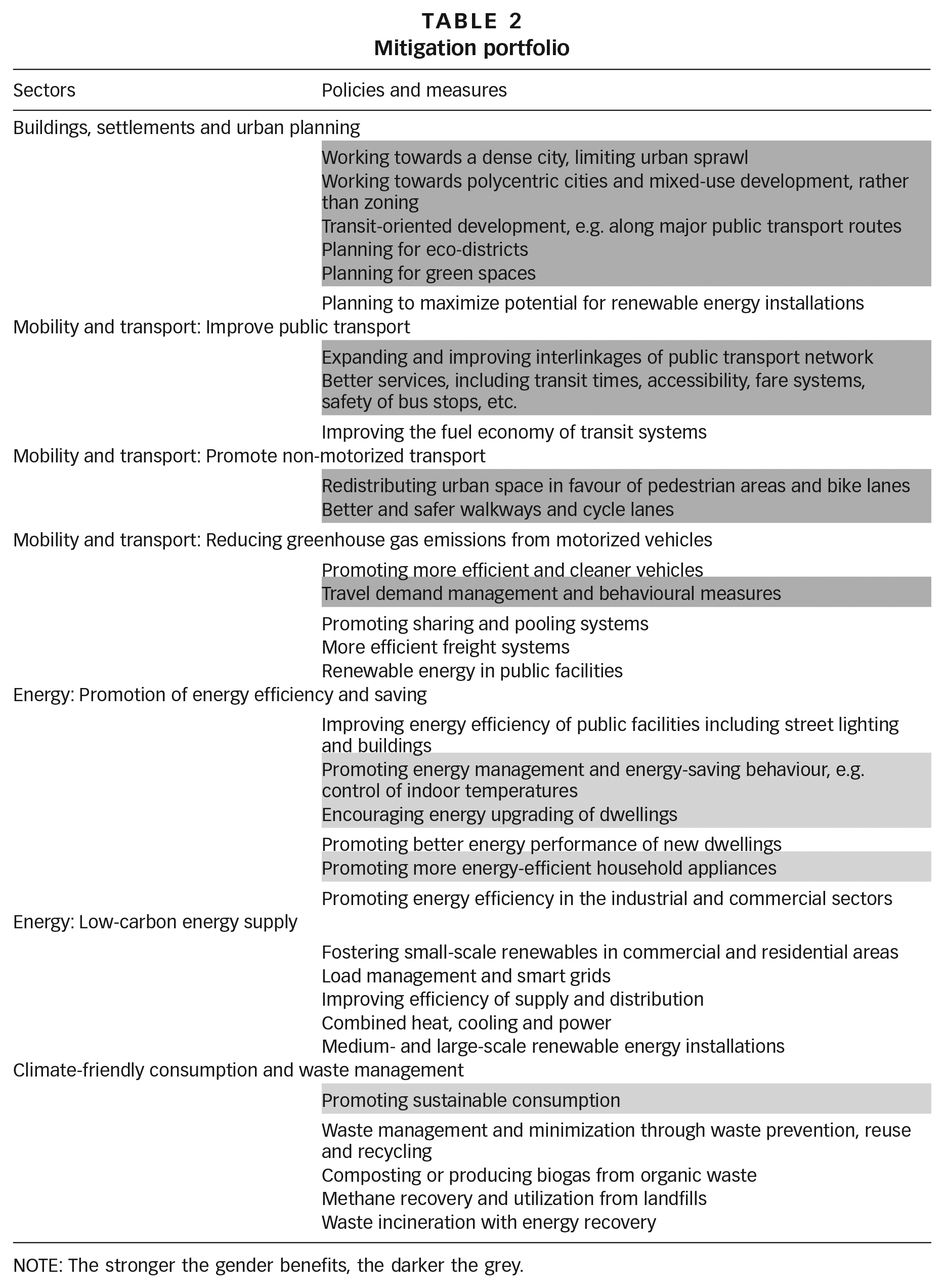
Note: The stronger the gender benefits, the darker the grey.
The mitigation and adaptation portfolios are a first attempt. For wider application, consideration could be given to their adaptation to national contexts, whereby the specific competencies and powers of local governments are taken into account. It would furthermore be useful if the portfolio could be adapted in order to respond to specific conditions, such as the specific vulnerability of urban settlements in the region.
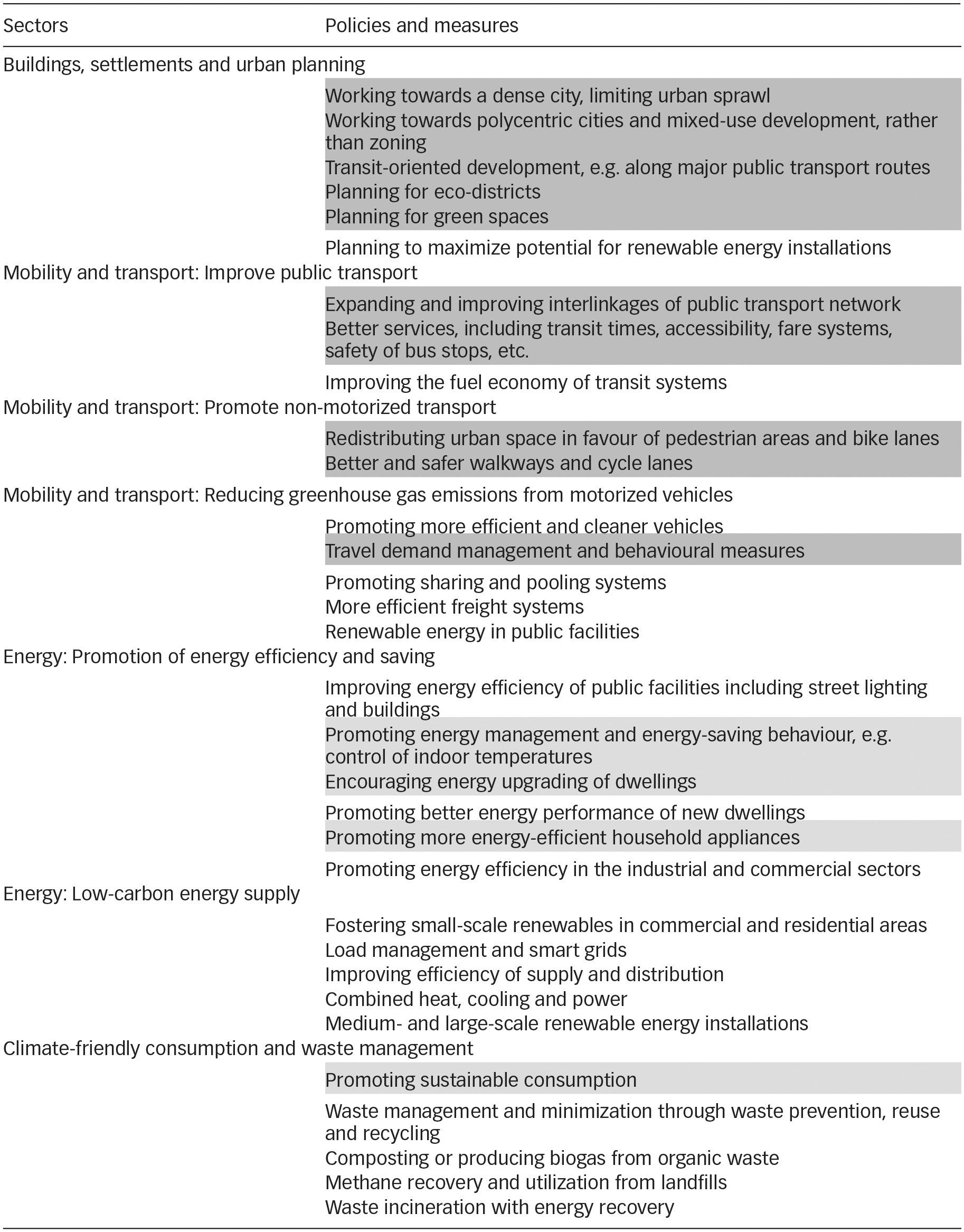
A preliminary prioritization of policies and interventions has been made based on past experience, the judgement of partner organizations and some common sense. To be robust, this prioritization would require much more empirical evidence on the gender impacts of interventions at the urban level, particularly for policies that have already been improved using a GIA. Table 2 shows the mitigation catalogue, with priority policies highlighted.
GAMMA III
We have chosen the existing GIA tool as a further element of GAMMA to be applied to selected policies and measures. Its purpose is to identify unintended impacts on gender equality, to avoid adverse effects and maximize positive effects on gender relations. Although the method can be applied ex-post, it is mainly used ex-ante, starting with a screening to determine whether the planned policy measure or programme in question is relevant in terms of gender. This makes particular sense when people are directly affected. The main assessment involves an analysis of the point of departure, a detailed description of the characteristics of the policy, an assessment of the impacts on gender equality and, finally, the preparation of recommendations on how to modify and improve the policy.
An early version of the GIA was developed to evaluate the EU Research Programme(15) and was later piloted in Germany.(16) It was based on three analytical categories, called gender dimensions, namely: the gendered division of labour; the societal organization of human reproduction and health; and women’s and men’s power to shape policy. Questions along these dimensions yield information that helps in estimating the impacts of the policy being studied. GIA is not as well established for gender mainstreaming as Gender Responsive Budgeting (GRB), but it has several advantages: GRB looks at how public money has been spent and can then start a learning cycle over time, while a GIA can be used ex-ante, i.e., during the planning stage of a policy. Moreover, unlike GRB, a GIA can be applied to all types of policies, including regulatory policies that have no budgetary impact.
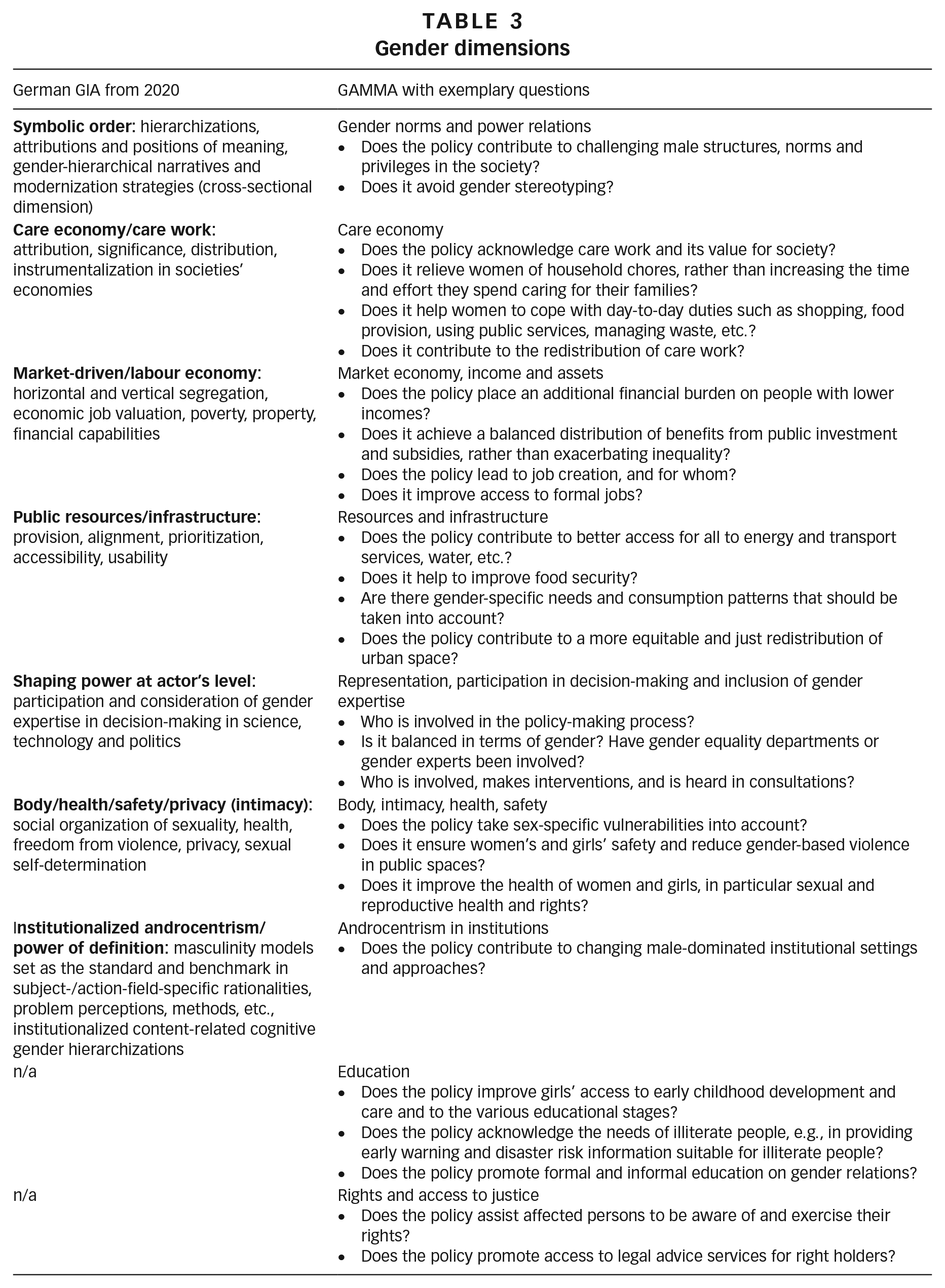
At the time of the development of GAMMA, a revised version of the GIA was underway as part of a German research project.(17) In the course of this project, the GIA was extended to make it suitable for climate policy and tested with staff from the ministry in charge. This version of the GIA is based on seven gender dimensions that are linked to key areas of social structuring that establish, maintain and reproduce hierarchical gender relations. They allow for the examination of social power relations (causes, structural inequalities and their manifestations), thereby supporting a transformative approach.
For the GAMMA methodology, we have reworded some of the dimensions to make them more accessible to practitioners and added others to address specific inequality issues found in middle- and low-income countries. The original seven GIA gender dimensions and the dimensions used in GAMMA are shown in Table 3. They represent areas of life that are at the root of gender discrimination and are critical to achieving structural change, thereby contributing to work towards climate justice. For the GIA, they serve as search lights to guide the estimation of unintended impacts on gender equality.
Gender dimensions
The documentation of the GAMMA methodology can be found at GenderCC’s website.(18)
III. Pilot city work process
As a first step, training was provided for the partner organizations and their local branches in the pilot cities to strengthen their capacity to engage on an equal footing with local officials in charge of climate policy, and later to intervene in local government planning processes. It included information on the scientific basis of climate change, urban metabolism, urban climate policy and gender aspects of climate change and responses.
A step-by-step document guided the partners through the entire process. It started with the preparation of a status quo report for each city, comprising available information on urban greenhouse gas emissions, climate change impacts in the region and gender data, e.g., share of female-headed households, gender income gap, etc., if available. Relevant national gender data were provided by GenderCC. This status quo report was expected, moreover, to include an overview of planned or implemented climate change programmes, as well as of city governance, administrative structures and relevant climate policy actors. A peer review of the status quo reports by the other partners concluded this and the following steps.
For the next step, GAMMA I, key questions were: Are local government institutions, arrangements and procedures capable of addressing climate change and integrating the gender dimension? Is there awareness of gender and climate issues, and are there available approaches to address them? Are the processes inclusive? To answer these questions, partners were required to conduct interviews with key individuals, including at least three city policymakers or officials from relevant departments. Interviewees were identified on the basis of the information collected in the status quo report. Ideally, they would include one policymaker, one mitigation and one adaptation official. The results, including notes and comments, were processed in a spreadsheet provided by GenderCC which automatically calculated average scores for the answers to each question.
Challenges of GAMMA I included the availability and willingness of potential interviewees. In some cities, group interviews were held rather than individual interviews. This proved to be useful, because the ensuing discussions among city policymakers and officials revealed important information about internal processes and evaluations. During interviews, clear answers were often lacking, and the interviewers had to decide on the answer based on the narrative explanations given by the interviewees.
The next step, GAMMA II, aimed to answer the following key questions: What policies and measures is the city planning or implementing? Are there gaps from a gender perspective, e.g., are important sectors not covered at all; and are there policies missing that are crucial from a gender perspective? Even if gender is not explicitly mentioned in the city’s description of a measure, it may still be a priority measure with the potential to contribute to gender equality beyond its mitigation and adaptation effects. Partners were required to conduct a screening of all climate-related programmes and policies in their city, first by collecting available information on adaptation and mitigation policies the city was planning or already implementing, based on the initial findings in the status quo report, as well as additional information gathered during the interviews. Second, they had to match these with the sectors and policies identified in the mitigation and adaptation portfolios and provide a brief description. Partners were given a spreadsheet to enter this information, as well as a more comprehensive document with descriptions of the policies and their prioritization. This was particularly important for the mitigation portfolio, as most women’s organizations in middle- and low-income countries have so far focused on adaptation. Third, they needed to check whether priority sectors and actions were covered. This allowed them to identify missing policies that would be crucial to include in the climate action programme.
The main challenge for GAMMA II was the fact that most cities do not have comprehensive climate action programmes. Climate-relevant policies are often spread across a number of sectoral programmes and a master plan, and are therefore difficult to identify. Some of the pilot cities relied on regional programmes which were not fully adequate for a local government. A number of policies lacked meaningful descriptions of implemented and planned actions, and most of them lacked clear targets, timeframes and monitoring and evaluation mechanisms. The status of implementation was also unclear for many actions.
Finally, for GAMMA III, partners were asked to conduct a rapid GIA for a small number of selected policies. Key questions for this step were: What undesired impacts might a policy have on gender relations? How can it be improved in order to address climate issues and at the same time contribute to gender equality? Partners were expected to select gender-relevant policies in the sense that they affect certain target groups of women (or men) and their daily lives. Thereby, they could skip the pre-check and work directly with the gender dimensions to discover unintended and undesired impacts on gender equality. Finally, they were asked to look for ways to improve the policy to avoid adverse impacts and maximize positive effects on gender equality.
For policies that were already being implemented, partners were encouraged to complement the assessment with a direct examination of the impact of the policy or measure on the ground, for example, through an exploratory walk (e.g., for policies on urban planning, public spaces or public transport), or through consultations with affected groups of women.
The more specific and clearly defined a policy measure is, the more possible it is to estimate its impact. However, most partners chose relatively broad policies or even programmes to be evaluated. This made it difficult to estimate impacts. Nevertheless, going through the questions related to the gender dimensions helped to generate ideas about what would need to be taken into consideration in the detailed design of an intervention or in the implementation of the policy or programme.
The final step of GAMMA was the preparation of an assessment report, from which policy recommendations were derived. These might relate to the institutional framework and procedures, to the priorities and focus of action programmes, and to specific interventions, depending on where gaps were found. Any gap identified in the assessment, whether a weakness in coordination within the institution or in addressing a priority area properly, could be translated into a recommendation. For example, if GAMMA II indicates that policies to improve public transport are absent, a recommendation might be to introduce bus rapid transit, possibly using trolley or battery-powered e-buses. If such systems are in place, GAMMA III might reveal that they are not accessible and affordable to women in the communities. Recommendations could then be made to improve bus stations and connections, introduce a fair fare system, or initiate safety programmes. Furthermore, training programmes and gender-sensitive recruitment and hiring could ensure that women have equal opportunities to obtain quality jobs in the public transport system.
To derive policy recommendations from the assessment reports turned out to be straightforward and feasible. However, in some cases the recommendations were quite general, mainly due to the fact that these cities had not yet developed climate policies, let alone gender-responsive policies.
In addition, partners developed small-scale pilot actions, for example training township women in energy efficiency and small-scale renewables in South Africa, dealing with waste management in India, or lobbying for the expansion of urban green spaces in Indonesia.
Partners also developed strategies on how to mainstream gender into their city’s climate policy, what alliances to build and how to advocate for the recommendations they had developed. Although there was not much time left within the project cycle to implement these strategies, a monitoring exercise was carried out at the end of the project in 2022. First, follow-up GAMMA I interviews were held, preferably with the same interviewees as before. This was not always possible due to political and staff changes in some cities. In addition, partners needed to find out whether their recommendations had been taken up, and how many of them. It would have been too early to monitor tangible outcomes, due to the lead times necessary for decision-making and implementation.
Based on the policy recommendations from the partners, GenderCC finally compiled policy recommendations for a national and international audience, targeting national governments and city networks. For dissemination, an e-learning course as well as a guidebook on GAMMA were prepared.
IV. Findings
The assessment found a severe lack of awareness and expertise at the gender and climate change nexus among almost all city policymakers and officials, suggesting that the gender debate in the United Nations Framework Convention on Climate Change (UNFCCC) process has not yet trickled down to the city level. Even within the UNFCCC process, a limited understanding of gender in the sense of “women as one of the vulnerable groups”, still prevails, and there is a neglect of gender diversity and the role gender plays in mitigation. Among pilot sites, awareness was higher in cities that had already established cooperation with women’s organizations, such as Mexico City, and lower in cities that were reluctant to engage with civil society.
It was evident that there was a lack of coordination and coherence across sectors and departments, with policymakers working in silos without necessarily recognizing the full scope of the societal impacts and in particular the gender dimensions of climate change policies. Another key finding was the challenges related to the budgetary and financial resources available for the design and implementation of climate policies, and in particular gender-responsive policies. Shortcomings, such as a lack of systematic gender-sensitive data collection, monitoring and review of climate policies, were common challenges identified throughout the assessment processes.
The process achieved substantial positive results in the areas covered by GAMMA I (institutional setting, procedures and processes). The monitoring exercise showed that the GAMMA I score improved, on average, by around 10 per cent over three years, with considerable variation between cities: the largest increase was 38 per cent, while in one city it even fell by around 20 per cent, presumably due to changes in decision-makers, priorities and staff following elections. It should be noted that this exercise is not free from bias, depending on the ambitions of interviewees and interviewers, and it would therefore not be meaningful to compare absolute scores between cities.
The second monitoring exercise looked at the qualitative aspects in terms of new mechanisms, programmes and policies. At the institutional level, three of the 14 pilot cities had started to involve gender equality units in climate action planning, and three had involved gender experts. Some of the pilot cities had not been working on climate policy at all, so for them it was an achievement simply to work out a climate action plan. Seven cities took gender into account in their new or updated master plans or climate action plans, and three of them held planning workshops on gender and climate change. Two cities introduced gender mainstreaming provisions in climate policy, e.g., a regular gender check, and two others established a budget for community-based activities, including special funds for women. Two South African cities planned to address socioeconomic inequalities and other social issues in their efforts towards a just transition to a low-carbon economy, for example by taking advantage of co-benefits such as reduced poverty among vulnerable groups and reduced unemployment through the creation of green jobs and green entrepreneurship. It should be noted, however, that no clear evidence can be provided for a causal relation between our interventions and these outcomes, as there was no reference group.
One example of a city responding positively to the ideas generated by the project is Makassar on the Indonesian island of Sulawesi. The pilot project initiated by the local project partner was a vision of zero-emission neighbourhoods called “Lorong Garden” (Alley Gardens). The idea was taken up by the Makassar city government, which developed the concept further into “Lorong Wisata” (Tourism Alleys), turning these small streets into tourist destinations that will increase the income of the people living in the area. Of the some 5,000 lorong (alleys) in Makassar City, more than 1,000 have been earmarked for Lorong Wisata, with a specific focus in each sub-district, for example growing organic vegetables to be consumed or sold to other residents, or a culinary lorong, where people can enjoy local food. Lorong Wisata also serve as creative spaces for the residents with colourful murals. The local partner organization continues to be involved and aims to create two model communities where they were already working closely with women to develop a shared vision for an emission-free neighbourhood. Activities include the local production of handicrafts, traditional foods, vegetables and herbs and schemes to minimize motorized traffic. They are aware, however, that women, who play a leading role in implementing these projects, may be burdened by this additional work on top of their caring responsibilities.
V. Conclusions
The main concluding message is that the gender assessment tool GAMMA worked well, but its use requires in-depth knowledge of the gender–climate change nexus, as well as urban options for responding to climate change. It can be used by suitably skilled civil society organizations that want to work with their city and push urban policymakers for more ambitious gender-responsive climate action. In principle, it can also be used by local governments for self-assessment, but the inclusion of gender expertise would be advisable. This would help policymakers to understand that gender equality is about gender roles and norms and power relations, and that it requires taking into account the underprivileged role of women, as well as the privileges of men. They also need to understand that gender-responsive climate policies must start from the right to water, food, energy and mobility services, land, adequate housing and health, and must include gender-just transitions towards sustainable and localized economies.
Civil society has an important role to play in pushing for such institutional learning processes and monitoring their progress. However, the necessary gender awareness and expertise, as well as knowledge of mitigation and adaptation strategies, is a rare combination, and capacity-building is therefore needed for women’s organizations on climate change responses, and for environmental groups on gender issues.
The GAMMA tool can also be used at national level. An adapted version was developed and tested during the project and preliminary results show its applicability and usefulness. During the course of the project, awareness of the gender–climate change nexus improved at the national level, following the growing prominence of the issue in the UNFCCC process. The efforts of the women’s organizations involved in the project were increasingly acknowledged by national governments and agencies. These do not only play a role in developing gender-responsive mitigation and adaptation action, but also support subnational and local governments in climate change and gender integration through guidance, training and finance, as well as improved vertical coordination and collaboration.
Supplemental Material
sj-docx-1-eau-10.1177_09562478241230037 – Supplemental material for A novel approach to work towards gender-responsive urban climate policy
Supplemental material, sj-docx-1-eau-10.1177_09562478241230037 for A novel approach to work towards gender-responsive urban climate policy by Gotelind Alber in Environment & Urbanization
Footnotes
Funding
This work was supported by the International Climate Initiative of the German Federal Ministry for the Environment, Nature Conservation, Nuclear Safety and Consumer Protection based on a decision of the German Bundestag [grant number 15_I_256_GUCCI]. Through volunteer work, All India Women’s Conference provided co-funding.

Supplemental material
Supplemental material for this article is available online.
Notes
References
Supplementary Material
Please find the following supplemental material available below.
For Open Access articles published under a Creative Commons License, all supplemental material carries the same license as the article it is associated with.
For non-Open Access articles published, all supplemental material carries a non-exclusive license, and permission requests for re-use of supplemental material or any part of supplemental material shall be sent directly to the copyright owner as specified in the copyright notice associated with the article.
