




Abstract
Slums and informal settlements have long been a policy concern, particularly in post-independence cities of the global South. Although national and local governments devise public policy seeking to address these habitations, these policy initiatives occur in conversation with the often far less visible global policy discourses of international urban development actors. Positing their ideational influence, this study analyses how global discourses from key multilateral agencies and donors have framed the problem of slums and informal settlements over time, to uncover assumptions and biases that ideationally, if indirectly, contribute to urban inequality, marginalization and socio-spatial othering in the city.
I. Introduction
Slum, favela, basti, katchi abadi, shanty town – these are but a few of the terms used to describe urban informal settlements across Latin America, South Asia and Africa. These words conjure up images of spaces and populations that are enormously diverse but that also have something in common: they are all seen as what UN-Habitat described in 2003 as “a physical and spatial manifestation of urban poverty and intra-city inequality”.(1) Slum dwellers and informal residents were estimated to make up almost 30 per cent of the world’s urban populations in 2018,(2) with even higher figures for many urban centres in South and East Asia and sub-Saharan Africa. The World Health Organization (WHO) and UN-Habitat in 2010 claimed that “[s]lums are no longer just marginalised neighbourhoods housing a relatively small proportion of the urban population. In many cities, they are the dominant type of human settlement.”(3) Thus, it is important to address the issue of slums and urban informal settlements when engaging with urban inequality.
The world continues to urbanize, and by the 2030 deadline of the Sustainable Development Goals (SDGs), 60.4 per cent of the global population is expected to live in urban settings, up from almost 30 per cent in 2018, as stated above.(4) Much of this urban population growth is taking place in low- and middle-income regions of South and East Asia and Africa.(5) As global populations have urbanized, the number of people living in slums and informal urban settlements has grown, establishing a positive correlation between urbanization and the total populations living in informal urban settlements through much of South and East Asia, Africa and Latin America. In 2001, 924 million people were estimated to be living in slum settings globally.(6) By 2018, that number was up to 1.03 billion people worldwide.(7)
Slums and informal settlements have been of significant concern for policymakers, particularly in response to the rapid urbanization from the mid-twentieth century onwards in post-independence development in Asia, Africa and Latin America. In this regard, most urban policy is devised by national and local governments. Yet global development actors also have a role, albeit one that is less well known. Although these global actors have no formal mandates to set policy in countries, their policy discourses can have significant ideational influence. In public policy, the framing of an issue or phenomenon articulates how a social problem is seen or understood, which in turn guides policy solutions.(8) Bacchi and Goodwin argue that “By asking how ‘problems’ are represented or constituted in policies, it becomes possible to probe underlying assumptions that render these representations intelligible and the implications that follow for how lives are imagined and lived.”(9)
Global policy framings thus can be critical in determining how long-term national and local policies related to a phenomenon are conceived and executed. They also influence where and how large multilateral and bilateral donors identify projects and allocate development aid and capacity support to recipient countries and, indirectly, how communities and individuals advocate for their rights and make claims on a daily basis. Accordingly, this study had two objectives: first, to examine the way slums/informal settlements have been conceptualized in global policy discourses over time while also reflecting on these framings in the light of established critique in the academic literature; second, to infer the possible effects of these discourses on urban inequalities, stigmatization and socio-spatial othering.
This paper is an output of a review exercise carried out for the UKRI-funded ARISE (Accountability and Responsiveness in Informal Settlements for Equity) Hub,(10) a research consortium investigating accountability and health and wellbeing of marginalized populations in informal settlements across urban sites in Bangladesh, India, Kenya and Sierra Leone. The review sought to understand the global policy discourse around urban informal settlements with the intention of relating local findings in ARISE sites to global policy about these types of settlements. While the main activities of this study were desk-based reviews of academic and institutional literatures carried out during COVID-19-related lockdowns, some consultations with ARISE partners in Bangladesh, India, Kenya and Sierra Leone were carried out to complement the analysis. This process highlighted that, although an extensive academic literature exists on the theme of slums and informal settlements, (i) a comparative review of global development actors’ policy documents had not been undertaken before and (ii) engagement with ARISE partners during the period of framing the study suggested that a disjuncture existed between the definitions presented by global policy actors and the day-to-day experience of residents of these spaces – which further justified a detailed analysis of the discourse.
This paper begins by laying out the conceptual framework and methodology of the study. This is followed by an analysis of definitional framings of slums and urban informal settlements in global policy discourse as represented in the reports of major multilateral organizations, primarily UN-Habitat, the World Bank and WHO. Our analysis of embedded assumptions suggests that global policy discourses overly aggregate understandings of slums and urban informal settlements, which under-represents the complex realities and dynamics of these places, populations and developmental processes in ways that can heighten urban inequality.
II. Conceptual Framework And Methodology
The framework for the study is broadly informed by Bacchi and Goodwin’s WPR (“what is the problem represented to be”) post-structural approach to policy analysis.(11) These authors state that “policies do not address problems that exist; rather, they produce ‘problems’ as particular sorts of problems. Further, it is argued that the manner in which these ‘problems’ are constituted shapes lives and worlds.”(12) The WPR approach hence poses a series of questions (see Figure 1) that can guide an analysis of policy discourses. It thus provides an approach for interrogating the framings of informal settlements or slums in global policy documents, but also the underlying assumptions and their possible implications for other policies that they could inform.
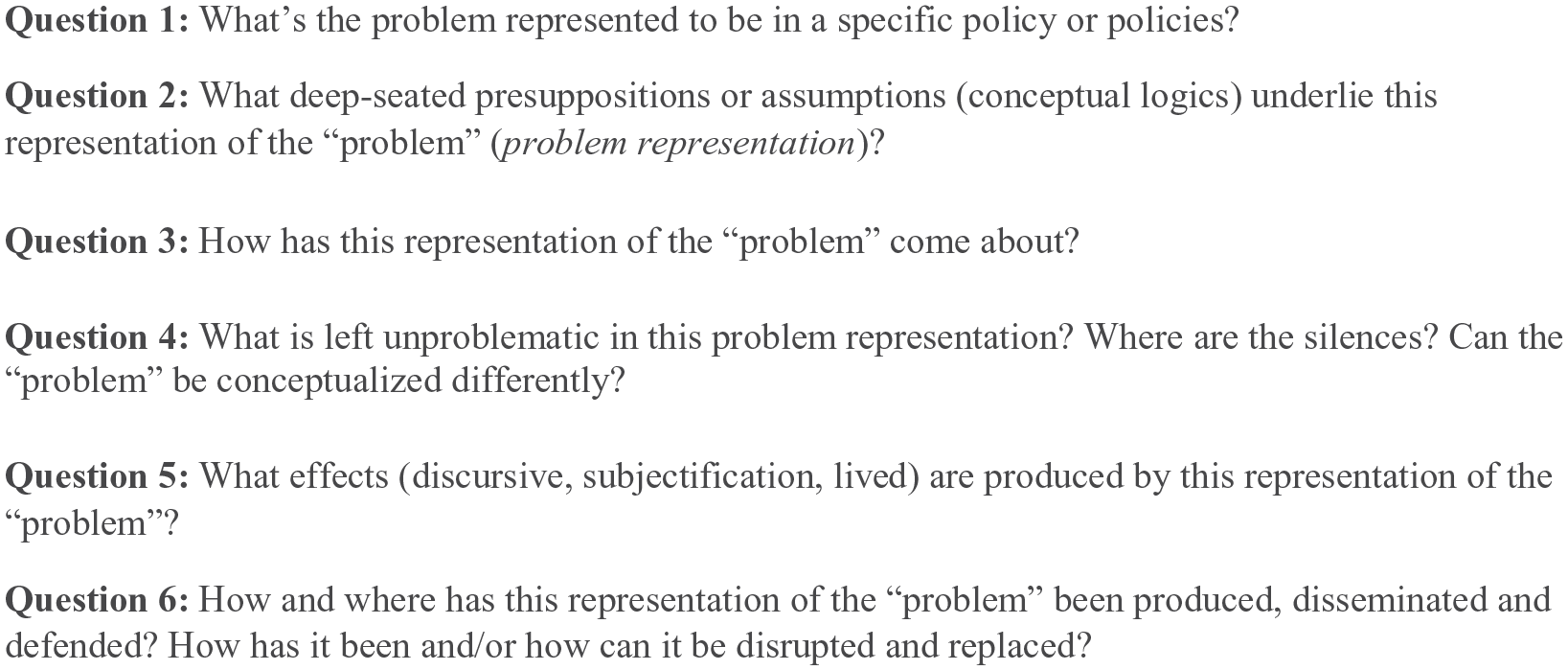
Questions from the Bacchi and Goodwin WPR framework
This paper examines how key multilateral donor organizations that are globally active in the areas of urban development and health have framed the problem of informal settlements, through a review of policy documents. The following organizations were selected:
the World Bank – the major global multilateral donor, whose large-scale funding programmes have significant influence on policies and programmes within recipient countries
UN-Habitat – the UN agency focused on the built environment in urban settings with a mandate to “promote transformative change in cities and human settlements through knowledge, policy advice, technical assistance and collaborative action”(13)
WHO – the UN agency focused on health in general, but with some history of engaging with urban health issues
The paper covers the period 1999–2020 for the listed organizations. In 1999, the Cities Alliance, in collaboration with the World Bank, launched the Cities Without Slums action plan,(14) in which they stated their commitment to significantly improve the lives of at least 100 million slum dwellers. This initiated a global shift in the approach towards engaging with the phenomenon of slums and urban informal settlements. UN-Habitat followed up by publishing its seminal report, The Challenge of Slums.(15)
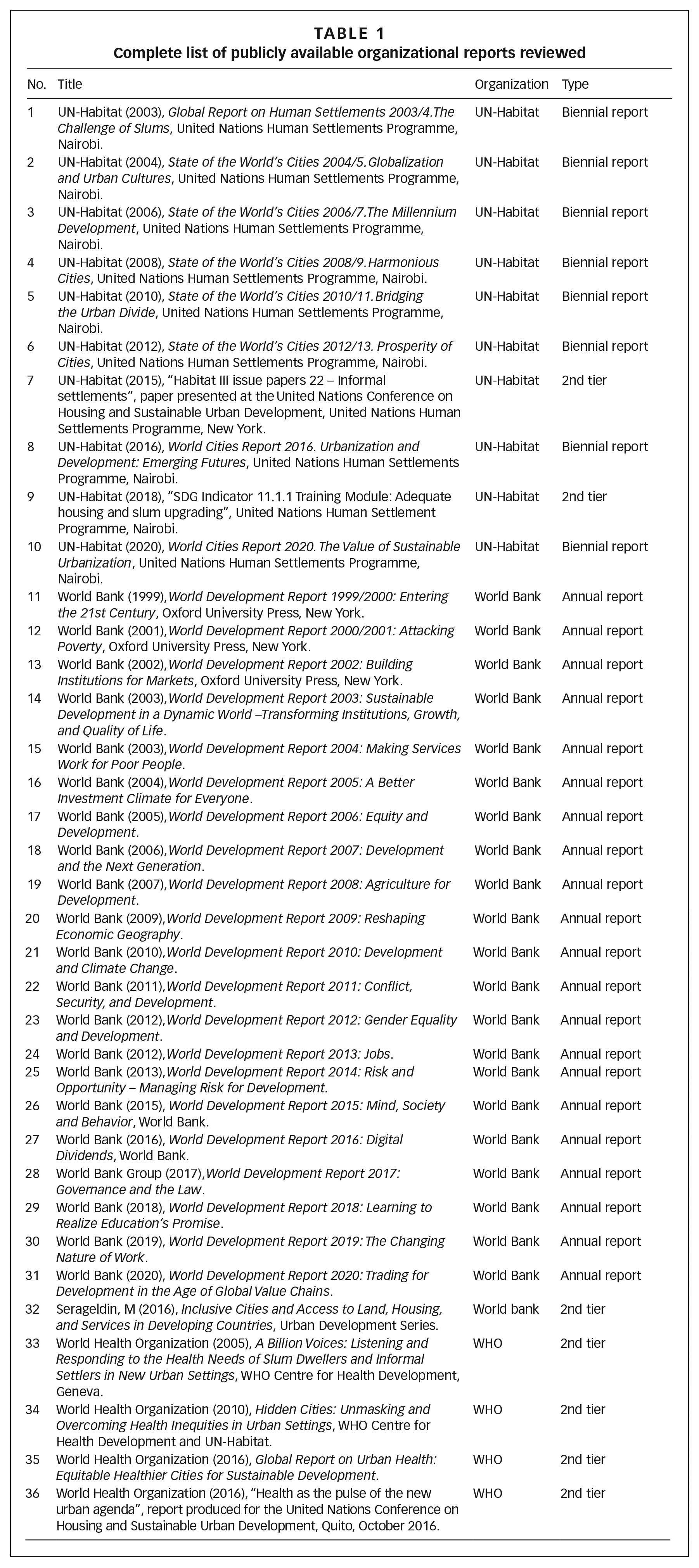
Our study identified publicly available reports that represent the strategic positioning of each of the above-mentioned agencies, notably flagship publications, multi-year strategies and annual reports. For both UN-Habitat and the World Bank, we reviewed their annual flagship reports: the World Cities Report (previously known as the State of the World’s Cities Report) and the World Development Report respectively. These reports are organized around a specific theme,(16) and present the organizations’ thinking on key issues within their purview. A second tier of reviewed documents included specific thematic reports for both the WHO and World Bank. A total of 36 documents and reports were reviewed (see Table 1).
Complete list of publicly available organizational reports reviewed
The next step was to review the selected texts and conduct keyword searches to identify sections of interest. While reference to the materiality of housing in informal and slum settlements was included in the definitions used by organizations, our specific focus was on how the settlements and their inhabitants had been defined and conceptualized, hence the keywords included were limited to slum(s), informal settlement(s) and squatter settlement(s). Each report was read in its entirety after which we systematically addressed the questions posed by the Bacchi–Goodwin framework to unpack how the policy terrain of slums and urban informal settlements has been conceptualized in the discourse of the agencies. The time frame made it possible to track shifts in institutional definitions from their ideational genesis to the time of analysis.
This study has several limitations. It is Anglo-centric, including donor organizations from the wider EU cache. Similar organizations from the Arab world or China have not been considered. It is therefore by no means exhaustive in terms of multilateral agencies or donors working in the realm of urban development. Our objective was simply to present the prevalent global narratives and discourse that ARISE hopes to address and respond to.
We also acknowledge that the methodology’s use of a relatively small set of publicly available reports presents potential pitfalls as a means of inferring organizational thinking and priorities. The discourses found in these reports are admittedly imperfect windows into the complex behaviour of large organizations and their funding and programming priorities. The organizations reviewed are not monolithic, and so the publication of one or even multiple reports championing a particular stance should not necessarily be seen as representing the discourse of the institution. Instead, it is more accurately understood as one of the organization’s discourses, which are constantly being mobilized by internal groups to compete for political support, funding and influence. Nevertheless, not all public reports are equally authoritative, and our selection of flagship and multi-year strategic reports offers greater confidence that they are broadly representative of the respective institutional stances.
III. Findings
Slums and urban informal settlements have been a concern for policymakers for quite some time. Many postcolonial states initially adopted anti-urbanization policies that discouraged rural–urban migration in order to stem the growth of slums and informal settlements. The ineffectiveness of these policies inspired new theoretical approaches to and policy discourses about the challenges of rapid urbanization by the turn of the millennium.(17)
Cities Without Slums was shortly followed by the adoption of the Millennium Development Goals (2000) by the United Nations. Target 11 of Goal 7 committed specifically to “achieve a significant improvement in the lives of at least 100 million slum dwellers” by 2020. This was followed by the publication of UN-Habitat’s seminal report The Challenge of Slums in 2003, which laid out the relationship between slums and urban poverty as “closely related and mutually reinforcing, but . . . not always direct or simple”.(18) Critically, this was the first time a report on slums at a global scale had been undertaken and a definition for “slums” was introduced: slum households were defined as those in which inhabitants lacked one or more of the following: (i) access to improved water source; (ii) access to improved sanitation facilities; (iii) sufficient living area;(19) (iv) housing durability; and (v) security of tenure. These are known as the “5 deprivations”.(20) Both UN-Habitat and the World Bank acknowledged that there were economic benefits to urbanization but indicated that uncontrolled urbanization without economic growth, as in many urban African settings, was often the cause of economic and social crises in these regions.(21) This process of uncontrolled urbanization resulted in a growing urban population with limited means of sustaining themselves, which resulted in the mushrooming of informal settlements and urban inequality.
Against this background, our analysis focuses on exploring the assumptions that underpin the definitional framing of slums and then juxtaposes these assumptions against academic understandings of the places, populations and processes these terms describe.
We begin by discussing how the problem has been represented, examining the definitions used by all three organizations and how they have evolved over the 20-year period of study. We then move on to discuss the underlying assumptions embedded within these representations and infer their implications for people’s lives and spaces. Finally, we discuss some of the more nuanced features of slums and informal settlements that, while not present in the definitions, are addressed in the body of the reports reviewed and show that these major agencies are aware of the complexity of these spaces.
a. Problem definition: are urban inequalities considered?
UN-Habitat’s definition of “slums”, first published in 2000, and listing the 5 deprivations, appears to have influenced definitions subsequently developed by both the WHO (published 2005) and the World Bank. The WHO states that slums are characterized by (i) lack of basic services; (ii) substandard housing or illegal and inadequate building structures; (iii) overcrowding and high density; (iv) unhealthy living conditions and hazardous locations; (v) insecure tenure, irregular or informal settlements; (vi) poverty and social exclusion; and (vii) a minimum settlement size.(22) Building on UN-Habitat’s definition, but in keeping with their organizational focus on health, WHO includes unhealthy living conditions and hazardous locations, and poverty and social exclusion in its definition. Earlier (2002), the World Bank had focused on legal status and substandard living conditions in informal neighbourhoods that it acknowledged to be termed generically as slums.(23) By 2009, it had moved on to state that “Slums have chronically over-crowded dwellings of poor quality in under-served areas”.(24) By including overcrowding and lack of services, this definition now closely resembled that of UN-Habitat.
UN-Habitat’s focus on operational terms enabled the assessment of the degree of settlement deprivation by drawing on household deprivation analysis. The aggregation of household data to a settlement level obscured intra-settlement socio-spatial variation between households, thus flattening the assessment of deprivation within settlements. Further, this definition was comprised of two types of indicators for household assessment: those related to the physicality of the slum (access to services and infrastructure, overcrowding and the materiality of housing structures) and those addressing legal status and security of tenure. The inclusion of legal status is interesting considering that both UN-Habitat and the World Bank acknowledged that legal status is a complex and often convoluted feature within slums and informal settlements; the State of the World’s Cities Report 2006/7 noted that legality “is not as easy to measure or monitor, as the status of slum dwellers often depends on
While UN-Habitat initially used the terms “slums” and “informal settlements” interchangeably, UN-Habitat’s State of the World’s Cities Report 2012/13 provides a specific definition for the latter: informal settlements are characterized by (i) no security of tenure vis-à-vis the land or dwellings inhabited, with modalities ranging from squatting to informal rental housing; (ii) a lack of, or being cut off from, basic services and formal city infrastructure; and (iii) housing that may not comply with current planning and building regulations, situated in geographically and environmentally hazardous areas, and may lack a municipal permit.(26) In this characterization, legal issues in the form of tenure security, planning permissions and adherence to building regulations became more significant than overcrowding and the physical/material appearance of the dwelling itself. This emphasis on the modalities of tenure, infrastructure provision and planning permission broadens the definition to potentially capture not just spaces occupied by urban low-income communities, as we will see later in this paper.
In the two decades since their first use, these definitions for slums and informal settlements have persisted with limited shifts in focus. By choosing to focus on the material and legal aspects as a means of measuring settlement deprivation, these definitions frame slums and informal settlements as deficient and inadequate in some regard. While the definitions are not explicitly relational, in that they do not compare these spaces to other settlements and neighbourhoods in the city, they imply an intra-urban inequality. Slums are places with unhealthy living conditions, substandard housing, lacking in services, with residents that are vulnerable to political and social exclusion from the rest of the city. The choice of indicators in these definitions overlooked the rich socio-spatial complexity and heterogeneity of daily practices in rapidly urbanizing settings where the state provided only limited and highly contested resources and services. This brings us to certain other implicit assumptions embedded within these definitions.
b. Embedded assumptions and their implications for urban inequality
Our analysis shows that organizational documents frequently exhibit an inconsistency in the manner in which the terms “slum” and “informal settlement” are used. Prior to developing a definition for informal settlements in 2013, UN-Habitat used the two terms interchangeably in many reports. By contrast, both WHO and the UK’s Department for International Development (DFID) made a distinction in their texts: WHO often used the phrase “slum dwellers and informal settlers” while some DFID documents referred to “slums and informal settlements” in tandem. This composite usage of the terms suggests that there was a perceived difference between the two settlement types. However, no explanation on how they differ was offered in either WHO or DFID texts.
We raise this point as the revival of the term “slum” appeared to be conscious and potentially provocative; documents showed that UN-Habitat acknowledged that the term was used as a catch-all and that it was considered loose and deprecatory and could “also vary considerably in what it describes in different parts of the world, or even in different parts of the same city”.(27) Schmid et al. refer to this use of a catch-all term as conceptual stretching, whereby “the original definition is relaxed to encompass more and more cases, until it becomes almost a generic label”.(28) These authors go on to argue that this “loss of precision”(29) and relevance results in the emergence of broad assumptions; these include the notion that slums only house urban low-income communities and that informal urban settlements involve the illegal occupation and construction of dwellings by low-income populations that have no regard for building regulations and service provision. Critically, these kinds of generalizations often place state-sanctioned, developer-built, middle-income informal habitations, as described by Roy, outside the scope of the discourse and the generalized definition, whilst simultaneously stigmatizing slum dwellers.(30)
The term “slum” carries significant baggage. Historically, in European contexts, it was associated with industrialization and spaces in cities with poor and unsanitary living conditions; they were seen as places of infection, disease and “vice” or criminal activity.(31,32) Hence the term was used to describe the spaces occupied by urban residents in poverty with the assumed socioeconomic and moral conditions associated with this group. Significantly, the term was generally discarded from use in both academic and institutional writings specifically for this reason in the decades preceding the launch of Cities Without Slums. Academics and practitioners continue to question and criticise the resurrection of this term by UN-Habitat.(33,34,35) Gilbert (2007) argues that “The word is also dangerous because it confuses the physical problem of poor quality housing with the characteristics of the people living there.”(36)
Definitions of slums/informal settlements that emphasize the 5 deprivations suggest that these spaces house only the urban poor and that, too, it is a homogeneous urban poor. The definitions used make no reference to their dynamic, if informal, systems of governance or infrastructure provision, or the multiple axes of vulnerability experienced by the populations living within these spaces. Intersecting vulnerabilities often create hierarchies of deprivation, marginalization and inequality within these communities. Despite these drawbacks, grassroots organizations like Slum Dwellers International (SDI) have vigorously attempted to reappropriate the term “slum” by choosing to use it to identify themselves and their communities in a positive way, highlighting the community engagement, mobilization and agency that can characterize them.(37) While this clearly is an important effort, UN-Habitat’s persistent usage of the term slums and its associated definitional oversight of contextual nuance further embeds socio-spatial inequality between the settlement and the city whilst invisibilizing intra-settlement inequalities.
c. Recognized yet peripheralized
We have demonstrated that organizational definitions prioritize the physical and legal features of slums and informal settlements. While definitions inevitably must focus on aspects deemed critical, their framing also entails the peripheralization of other issues. Our analysis has hence observed a disconnect between such definitions and the often more sophisticated analyses in organizational documents. Three features stand out: the complex processes producing slums and informal settlements; the diverse populations living there; and the vital role these spaces play not only for the residents within them but for the processes of the city at large.
Both the World Bank and WHO acknowledge that the production of slums and urban informal settlements should not be attributed solely to urban low-income communities and that there are other processes and powers at play. A 2009 World Bank report stated that “The reason for the lack of basic public services and infrastructure is the inability or unwillingness of many urban governments, utilities, and service providers to operate in slums, generally because of the informality and illegality of such settlements.”(38) This suggests that the persistence of urban inequality in terms of housing and service provision in informal settlements is a product of the state and utility providers considering theses spaces as illegal and informal. Moreover, the World Bank’s World Development Report 2002 noted that “not all informal settlements feature low-quality housing. Some illegal or irregular housing is produced by commercial developers or politically influential parties who speculate that property investments will be regularized later.”(39) Hence, as early as 2002, the World Bank recognized the diversity of the processes of production of informal settlements, acknowledging developers and political parties as actors in these processes, and that the questionable legality of these spaces is often utilized to the benefit of investors.
Roy presents a complementary perspective, arguing that slums and informal settlements are often deliberately left underserviced by the state to allow for planning flexibility later.(40) Dismantling underserviced spaces to make room for large infrastructure like airports often facilitates a transition from informal to formal planning and land use. This transition to formal status may be made smoother when the initial squatting is a planned occupation by the state with the intent to evict and displace residents later. WHO described urban informal settlements as a manifestation of poverty and slums as a failure of governance.(41) This understanding had evolved a decade later, when the WHO described these settlements as “a clear manifestation of both poor urban planning and management as well as [sic] malfunctioning housing sector”(42) and noted that slum settlements represent a formal expression of exclusion in urban areas.
The 2010 WHO–UN-Habitat report(43) states that “Slums are no longer just marginalized neighbourhoods housing a relatively small proportion of the urban population. In many cities, they are the dominant type of human settlement.”(44) This statement acknowledged the scale and persistence of these kinds of settlements within cities today. Slums and informal settlements are often viewed as holding places for urban low-income communities.(45) They have also been referred to as “arrival city” for new migrants from rural areas, providing an intermediary space that provides a connection both to the opportunities of the city but often also to their villages of origin.(46) These settlements are an integral part of the economic functioning of the city, whether in the form of housing a labour force that feeds the city’s formal activities or by providing critical informal services that over time become a part of the main urban economy.(47) In this regard, UN-Habitat has acknowledged the multifaceted role these spaces and populations play within the social and economic systems of the city, thus highlighting the co-dependence of the formal and informal.(48) This does not mean that this kind of urban inequality is acceptable or necessary for the integration and subsistence of urban low-income communities in the urban setting.
Our analysis showed that whilst UN-Habitat’s definition is used to measure household deprivation, the assessment is then aggregated at the settlement scale. This is a form of socio-spatial standardization of these spaces and populations living therein that minimizes the intra-settlement socioeconomic diversity and disparity and impacts the manner in which services are needed, accessed and provided. That being said, not all organizations studied took this approach: the 2010 Hidden Cities report – co-authored by WHO and UN-Habitat – advocated for the disaggregation particularly of health data (urban–rural, intra-urban or intra-slum health statistics) to be able to identify “which city-dwellers are affected by which health issues and why”.(49) This speaks to an awareness of the heterogeneous nature of residents in slum and informal settlements, at least from the health perspective. The report suggests that this kind of data collection would not only allow for evidence-based action on healthcare provision but would also address issues of “invisibility” of urban low-income communities and the flattening of urban trends and subgroups that is often the result of aggregating data at city level. In the same vein, the 2016 WHO Global Report on Urban Health goes on to state that “informal settlements are far from being homogenous as unfair differences exist even within these settings”.(50)
IV. Discussion
How populations and spaces in slums and informal settlements are perceived in low- and middle-income cities is often coloured by the assumptions embedded within the global definitional framings. The various definitions established and used by the three organizations studied foreground material and legal deficiencies and deprivation within slums and informal settlements. We have argued that, while the definitions are specific and designed to measure and track slum demographics and the impact of interventions,(51) they are also exclusionary. While patterns of urban inequality are not explicitly stated, the comparison of these settlements with the rest of the city is implied. This contributes to the persistence of socio-spatial inequality and stigmatization in the urban context while simultaneously providing an opportunity that is exploited by developers, service providers and political parties. Our review of institutional documents showed that organizations like UN-Habitat, World Bank and WHO are aware of the complex nature of slums and informal settlements yet choose to work with standardized definitions. These definitions are (necessarily) oversimplifications of a complex problem that fail to address such key features as the complex processes of production, the persistence and reproduction of these spaces and the heterogeneous nature of their populations. This omission of nuance from the central definitions can lead to an invisibilization of residents and practices, minimizing the role that difference and disparity play within urban systems.
An illustration of the detrimental outcome for slum dwellers of this oversimplification of complex ideas is the processes of eviction and demolition of slums. Target 11 of Goal 7 of the MDGs was to achieve, by 2020, a significant improvement in the lives of at least 100 million slum dwellers. The wording of Target 11 was revised in 2005 to “by 2020, improv[e] substantially the lives of at least 100 million slum dwellers
As described above, the issues of both stigma and legality that are carried within the conceptualization of slums pose very real challenges to people living in slums and urban informal settlements. Mitlin and Patel state that “it can be difficult for the residents of informal areas to secure jobs and access to public services because of social attitudes towards their home address”.(54) They cite Bhan’s 2009 study of Delhi evictions, which shows a rise in hostility towards the presence of informal settlements, and notes that the knock-on effect of such stigma is both the real and perceived access and agency individuals and communities have to resources and influence.(55) As seen earlier, both the World Bank and WHO peripherally acknowledge that the lack of housing, service and infrastructure provision relates to the political economies underlying urban governance. Unfortunately, more often than not, the stigma associated with these spatio-legal inadequacies and the institutional repercussions are borne by the people residing within these spaces in the form of harassment and evictions.
The conceptual socioeconomic homogeneity discussed above mirrors the territorial or material standardization of how slums and informal settlements are defined. While UN-Habitat acknowledged that what constitutes an informal settlement and what is considered “liveable” differs in different contexts,(56) the organization failed to include this variability in their definition, thus implying uniform levels of inter- and intra-settlement deprivation. This, coupled with the reintroduction of the term “slum” into the development vernacular by international development agencies, has had important knock-on effects.(57,58) Not only does the term suggest uniform urban poverty, precarity and poor living conditions, it further marginalizes both the spaces and the people residing within them while neglecting to acknowledge the dynamism and diversity to be found therein.(59) This leads to a heightened sense of socio-spatial and political segregation. A more fine-grained analysis of the intersection of vulnerabilities and social, economic, political and spatial marginalization would introduce the notion of heterogeneity into conceptions of urban inequality and allow for greater understanding of intra-settlement diversity and needs.
UN-Habitat’s World Cities Reports have in the past focused on the harmonious city (2008/9), bridging the urban divide (2010/11) and the prosperous city (2012/13) – all themes that perpetuate a top-down economic view of the city, equating slums and informal settlements with urban poverty.(60) This view more often than not invisibilizes rather than integrates the social, economic and political needs of people living in slums and informal settlements, viewing the city as a single thing rather than the sum of many parts. The inclusion of tenure security as a feature of UN-Habitat’s definition of both slums(61) and informal settlements(62) has played a significant role in this perception that urban economic prosperity is the key to resolving issues of urban inequality. Property is seen as an unexploited asset, particularly in slums – an idea popularized by de Soto.(63) In the same vein, UN-Habitat suggested that property ownership is a means of impacting urban poverty, sustainable livelihoods, access to services and rights claiming, as this is an untapped yet accessible form of capital for slum dwellers.(64) Unfortunately, advocates of property ownership and titling do not factor in the myriad legal statuses that are found in informal settlements, including, according to Karaman and colleagues, “traditional property rights, hard-fought collective claims, as well as formalised, ‘legal’ rules as backed by state institutions”,(65) all functioning with varying degrees of legitimacy, along with the cost of acquiring tenure security. Processes of titling often further stratify the residents of slums and informal settlements into those who can afford to regularize or formalize their land/property vs. those who cannot, thus adding to issues of intra-settlement inequality.
As much as slums and informal settlements are seen as an issue of urban poverty, organizations also seem to agree that they are an issue of urban governance and political access. The World Bank attributed the underservicing of slums to “the inability or unwillingness of many urban governments, utilities, and service providers” to act in slums.(66) Additionally, the World Bank suggested that access to political actors was a challenge for socio-spatially marginalized settlements only until these spaces were spatially absorbed into the city, when the developmental lag and associated inequalities would be overcome. This seems overly simplistic and overlooks two issues. First, access to services is often limited by the spatial legality of settlements but that spatial legality is often contingent on the presence of legally provided services.(67) Second, this conceptualization is built around the sorting of urban populations into binaries: the “haves” and “have-nots”, those with political access vs. those who lack it, and so on. This neatly avoids (i) acknowledging the catch-22 nature of service provision and legal status and (ii) building a deeper, more nuanced and disaggregated conception of informal settlements that foregrounds the heterogeneity of people living there, recognizing and valuing distinct lived experiences based on gender, ethnicity, caste, religion, age and ability/disability. Along with this, it should be noted that the inequalities that exist and persist in informal settlements are often intersectional – and can relate at the same time to more than one characteristic, whether gender, migration status, age or different abilities. Intersectionality is another angle that goes under-represented in the documents reviewed.
There is also a need to move beyond a conceptualization of urban informal settlements as a purely territorial form. Rao helpfully refers to the slum as “a demographic, legal and territorial construct”.(68) Furthermore, challenging dualistic thinking on formal vs. informal settlements, Caldeira argues for the need to “think in terms of transversal logics to understand these complex urban formations which are inherently unstable and contingent”.(69) These are spaces that are generated by systems and processes that closely reference the law and that are typically an outcome of government policy decisions. Moreover, informality is not the domain of low-income people alone, and the state uses informality in many of its practices.(70) Bhan further explores this last claim, stating that in the case of Indian cities the state has taken to mimicking informal practices such as squatting, repairing and consolidating as more efficient in situ solutions than the more formal processes of building and upgrading.(71) In this regard, defining the edges of informality is as much about perspective as it is about power; in other words – what is considered informal and by whom?
Historically, in the context of post-independence cities, urban informal settlements have been viewed as a temporary or transitional phase for new migrants to the city. This understanding of urban informal settlements was built around the belief that they are the result of rapid in-migration, fuelled by industrialization’s demand for labour(72) and by the absence of affordable housing elsewhere. Today, in many developing cities this is no longer the case, and it disregards the urban growth that is the outcome of natural population growth. In this regard, working towards cities without slums, where the intention is to stem the reproduction of the phenomenon and remove slum incidence, seems like a legitimate objective. Yet, the expectation that slums will disappear with the emergence of modern economies and industrialization has not stood the test of time.
To come to terms with the fact that urban informal settlements are not temporary, we must acknowledge first that these spaces are likely to be permanent fixtures in the landscape of developing cities, given figures estimating that 72 per cent of urban Africans and 56 per cent of urban South Asians live in informal settlements.(73) Second, we must, as Davis argues, decouple our understanding of urbanization from industrialization and development.(74) Not only are many cities growing as a result of natural growth, but much in-migration into low- and middle-income cities today is the result of conflict and climate change – desertification and rising sea-levels – rather than industrialization.(75) The persistence and reproduction of informal settlements is a phenomenon that spans time and space; as settlements are upgraded by their residents, they become unaffordable for newer arrivals. These newer entrants must then establish residence elsewhere; so while one settlement may regularize, formalize and/or gentrify, others will emerge, and the cycle will continue.(76) In fact, AlSayyad presents “urban informality as a ‘new way of life’” and a “new paradigm for understanding urban culture”,(77) as opposed to something more transient.
Dovey’s critique of current urban theories and top-down conceptualization of slums and urban informal settlements by development agencies seems somehow apt: “Traditional forms of urban theory and practice – focused on formal regulation and top-down plans – have proven poorly equipped to cope with the dynamism, complexity and resilience of informal urbanism.”(78) Perhaps what is needed is to build an urban theory of cities of the global South from the global South(79) that is informed by a bottom-up/inside-out process of conceptualization. This process would use case-by-case empirical studies, and look at cities as systems, people as infrastructure, the incremental production of space as social collaboration,(80) and it would put people at the centre of the production of space and place as opposed to the state.
V. Conclusions
Global policy discourse describes slums and urban informal settlements as manifestations of urban poverty but also as physical expressions of urban inequality, based on their location in cities, how they are serviced – or not – and how legal they are considered to be. This global discourse posits these settlements as inadequate or lacking in certain material and legal qualities that identify them as different from the planned, formal and state-provisioned city. This conceptualization directs where and how bilateral and multilateral donors deploy funds to tackle the issue and influences national and local policymaking. Bacchi and Goodwin state that “policies are contingent historical creations, human constructions that produce effects”.(81) Accordingly, we have argued that the prevalent definitions for slums and informal settlements produced by major global actors, through their framing and underlying assumptions, can indirectly affect the ways in which urban inequalities are viewed and perpetuated, both by commission and omission. The flattening of donor discourses and aggregation of data gathered through the indicators used to measure impact and improvement effectively erase difference and disparity. This does not allow policy and programmatic responses to effectively and efficiently target limited resources to the particular urban inequalities of concern between and within informal settlements at a global scale. Additionally, they matter because they influence policy thinking at national and subnational level; they help to direct funding, develop capacities, shape knowledge of the policy problem and solutions and orientate developmental interventions.
In this light, with regard to further understanding urban inequality, there is a need to revisit the framings of global agencies with respect to slums and informal settlements. Policymakers must take a more nuanced approach to framing, considering the heterogeneous and intersectional nature of the people, places and processes that the existing definitions attempt to describe. This in turn would facilitate a more targeted response in terms of funding appropriate sites and programmes and developing relevant capacities. For truly harmonious and prosperous cities, we need a more holistic representation of the people and spaces therein.
Footnotes
Acknowledgements
This piece of work was developed for the ARISE Hub as part of the accountability and responsiveness around health and wellbeing in informal settlements project. This paper does not involve any primary data, and all sources are referenced in Table 1, and available to the public. This work was supported by the UK Research and Innovation (UKRI). The GCRF Accountability for Informal Urban Equity Hub (“ARISE”) is a UKRI Collective Fund award with award reference ES/S00811X/1. For the purpose of open access, the author has applied a CC BY public copyright licence to any Author Accepted Manuscript version arising. We would like to acknowledge Jaideep Gupte (IDS/AHRC), Christopher Ward (IDS) and Rachel Tolhurst (LSTM) for their input, feedback and support in the production of this work.
