




Abstract
Inadequate water access is central to the experience of urban inequality across low- and middle-income countries and leads to adverse health and social outcomes. Previous literature on water inequality in Mumbai, India’s second-largest city, offers diverse explanations for water disparities between and within slums. This study provides new insights on water disparities in Mumbai’s slums by evaluating the influence of legal status on water access. We analysed data from 593 households in Mandala, a slum with legally recognized (notified) and unrecognized (non-notified) neighbourhoods. Households in a non-notified neighbourhood suffered relative disadvantages in water infrastructure, accessibility, reliability and spending. Non-notified households also used significantly fewer litres per capita per day of water, even after controlling for religion and socioeconomic status. Findings suggest that legal exclusion may be a central driver of water inequality. Extending legal recognition to excluded slum settlements, neighbourhoods and households could be a powerful intervention for reducing urban water inequality.
I. Introduction
a. Legal exclusion as an underexamined challenge for urban water access globally
Inadequate water access is central to the experience of urban inequality across low- and middle-income countries (LMICs). Despite recognition of the human right to water by many LMIC governments, including India’s, urban water provision is highly inequitable and falls short in slum(1) communities.(2,3) The fight to obtain water has become a platform through which slum residents argue for social recognition and rights as urban citizens.(4,5)
Understanding the mechanisms behind urban water disparities is important because water access is a determinant of health and poverty.(6) Water is critical for ensuring adequate hygiene and sanitation, an interrelationship reflected in the increasing recognition of human rights to safe drinking water and sanitation.(7,8,9) Inadequate water access contributes to adverse health outcomes including diarrhoea, undernutrition and depression.(10,11,12,13,14,15) Failures of water service delivery also adversely impact household economy, education, employment, quality of life and social cohesion in slums.(16)
Globally, the literature on cities describes numerous barriers contributing to water disparities among slum residents. These include differential burdens related to gender, class and ethnic or religious conflict, as well as environmental challenges, including threats from climate change.(17,18,19) While multiple mechanisms contribute to water inequality, the complex legal status of slums emerges as a key barrier across the literature,(20,21,22,23) with governments and private companies being hesitant to invest in water infrastructure in communities at risk of displacement.(24,25,26,27)
Although the literature acknowledges that slums – as a broad category of human settlement – are often legally barred from accessing formal water supplies, few studies explore how legal exclusion contributes to inequality in water access between and within different slums. For example, in a study of slums in Nairobi, Kenya, Mudege and Zulu pointed out that inadequate water access resulted not from water scarcity – the government’s justification – but rather from political marginalization due to lack of legal land tenure. The authors highlighted the importance of water disparities not only between slum and non-slum communities but also within slums, as some households had water taps while others did not. The authors attributed intra-slum disparities to socioeconomic differences, but did not explore the role of legal barriers.(28)
Similarly, in a study of water inequality in Dhaka, Bangladesh, Sultana explored access to infrastructure as a means of claiming urban citizenship. Expansion of municipal water infrastructure to selected households created disparities in access within slum settlements. Sultana attributed this to class and gender discrimination, but did not explore the legal dynamics that determined who received government water standposts.(29)
By not fully evaluating legal barriers, many studies miss the opportunity to highlight a central mechanism that may drive inequality in water provision within and between slums, which could then lead to unequal access to water across other dimensions, including gender or class. In the public health field, foundational determinants, such as legal exclusion, that shape other determinants, such as water access, have been referred to as the “causes of the causes” of ill health.(30,31) Understanding the role of legal exclusion is critical to inform structural interventions to address this root cause of water and health inequality in LMIC cities.
In this study, using data from a representative household survey, we explore the role of legal exclusion in shaping water access in Mandala, a slum in Mumbai. Mandala is a unique settlement because residents describe some of its neighbourhoods as being legally recognized (henceforth “notified”) while others are unrecognized (henceforth “non-notified”). This heterogeneity allowed us to explore how legal status may lead to water disparities within one geographically contiguous community (i.e. intra-slum disparities).
We first summarise the literature on causes of water inequality in Mumbai’s slums and describe the legal backdrop shaping water provision. By analysing household survey data, we then assess whether the legal status of Mandala neighbourhoods is associated with inequalities in water access. Finally, we investigate pathways by which legal status may influence access to sufficient water quantity. Our findings highlight dramatic differences in multiple water indicators – including quantity, mode of access, cost and reliability – as well as adverse impacts on the ability to work, between households in a non-notified neighbourhood and those in a notified neighbourhood. An implication of our findings is that legal exclusion may be a crucial driver of water inequality even within a single slum settlement. Extending legal recognition to slum settlements, neighbourhoods and households could potentially have a major impact on reducing water inequality in cities in India and other LMICs.
b. Debates on causes of water inequality in Mumbai’s slums
Previous literature offers diverse explanations for water disparities between and within slums in Mumbai. While acknowledging that legal status plays a role, ethnographic studies have largely attributed water inequalities in slums to religious and ethnic discrimination or preferential treatment of individuals with social capital, who are then better able to navigate the convoluted process of obtaining legal or illegal water connections.(32)
For example, Anand described how slum residents with religious or ethnic affinities with government officials can obtain legal water connections through exerting social and political pressure.(33) Given the ethnonationalist platform of the city’s dominant Shiv Sena Party, slums with predominantly Hindu and Maharashtrian residents were favoured to receive water infrastructure while predominantly Muslim and North Indian slums were neglected.(34,35,36) Similarly, Contractor found that religious discrimination shaped water inequality in the Shivaji Nagar slum, resulting in “the exclusion and marginalization of Muslims from the urban public of Mumbai”.(37)
Some studies have highlighted unequal impacts of water insecurity by gender, most notably Bapat and Agarwal’s interviews with slum residents.(38) The physically and mentally taxing work of water collection often falls on women and girls and includes carrying heavy containers and waiting in early morning queues. Women manage the limited water available for household use, prioritising bathing of children and men. While women disproportionately experience the burdens of poor water access, these gendered consequences do not explain the social forces leading to unequal access in the first place.
Our prior quantitative research in the Kaula Bandar slum on Mumbai’s eastern waterfront showed how water inequality is linked to social capital and gender. The Gini coefficient (a measure of inequality) was substantially higher for measures of water access, as compared with household income.(39) Individuals with higher social capital – those of South Indian ethnicity or homeowners – accessed greater water quantities, due to relationships with predominantly South Indian informal water vendors.(40) The toll of collecting and managing water often fell on women and girls.
And yet, while social capital and gender were crucial in shaping household-level experiences of water inequality, community-level water inequality was likely the fallout of a deeper root cause: legal exclusion.(41) Kaula Bandar’s non-notified status – related to its location on central government land – meant residents could not access Mumbai’s water supply, and also resulted in authorities taking punitive actions to periodically shut down informal water distribution. However, our focus on a single non-notified slum could not provide insights into whether water access in Kaula Bandar was objectively worse than in notified slums. Previous studies thus provide an incomplete understanding of legal exclusion as a cause of water inequality.
c. The legal backdrop to water access in Mumbai and intersections with other forms of social disadvantage
In India, notification refers to the process of legally recognizing slum communities or households, often conferring the right to housing rehabilitation in the event of government eviction. Notified households may also be eligible for municipal services including water, sanitation and electricity.(42) In Maharashtra state, where Mumbai is located, households established before 2000 in slums located on city- or state-owned land can be notified per the Maharashtra Slum Areas Act of 1971 and its amendments.(43) To prove they meet notification requirements, households must have an official document, such as a voter ID card, dated before 2000. Those without such documentation are barred from receiving municipal services and have no right to rehabilitation. In addition, because the Maharashtra Slum Areas Act does not apply to land owned by India’s central government, slums on such land – including areas along seaports, airports and railways – are ineligible for notification. As of 2012, 39 per cent of slum households in Maharashtra were non-notified.(44)
Mandala is on Maharashtra state government land. As such, households that can prove residence before 2000 can apply to access municipal services. For example, a group of notified households in proximity can apply for a community water tap.(45)
Although, in theory, notification is applied at household level for slums on state government land, in practice, residents and government entities refer to entire slum settlements or neighbourhoods as notified or non-notified. For example, India’s National Sample Survey and National Family Health Survey assess notification at settlement, rather than household level.(46,47) Similarly, in Mandala, one entire neighbourhood (Matangrushi Nagar) and an adjacent part of another neighbourhood (Ekta Nagar) are widely described by residents as being “notified”. These areas, close to a major road, are viewed as notified because they were populated the earliest, with most residents having arrived before the 2000 cut-off date.
Residents describe three remaining neighbourhoods – Indira Nagar, Janta Nagar and part of Ekta Nagar – as “non-notified”. These areas were populated more recently and are further from the major road, with some households adjacent to a river and landfill site. While some of these households are eligible for notification and receive metered electricity, notified households in these areas are more dispersed, making it difficult to apply as a group for community water taps.
In theory, region of origin, religion and caste should not influence a household’s legal status. In practice, legal exclusion may intersect with, and be shaped by, other forms of social disadvantage. In the 1960s to 1980s, many people belonging to disadvantaged castes in the South Indian state of Tamil Nadu migrated to Mumbai’s slums.(48,49) In Mandala, recent migration has drawn from northern states such as Uttar Pradesh and Bihar, including Muslims who may face economic disadvantage partly stemming from discrimination. Muslims are more likely to have arrived after the notification cut-off date and are therefore over-represented in Mandala’s non-notified neighbourhoods.
Social disadvantage may then shape how legal status is implemented in practice. Because entire slum neighbourhoods or settlements are viewed as being non-notified – in a manner discordant with the law’s articulation of household-level notification – it is possible that these perceptions are influenced by the population’s social composition. In Mandala, over-representation of Muslims in certain neighbourhoods may increase perceptions by officials that these areas are non-notified. In addition, because notified households must apply to the municipality for services, officials can exercise discretion in approving applications. In other words, notification may serve as an additional barrier that enables discrimination based on religion or caste.
This study explores the role of legal status and other forms of social disadvantage by comparing water access in households in notified and non-notified neighbourhoods in Mandala, while controlling for religious and economic differences. Our data were collected at a critical moment just after a Bombay High Court(50) order mandated that the city extend water access to non-notified slum households but before implementation of this order. That court ruling – which emphasised the human right to water in the Indian Constitution and international law – declared that water access should be separated from a slum household’s legal status.(51,52) Understanding whether legal status influences water access has implications for whether the High Court order – or other interventions that extend access regardless of legal status – could be effective in reducing water inequality in India’s slums.
II. Methods
a. Study site and research partnerships
Mumbai, India’s second-most populous city,(53,54) is home to India’s stock exchange and largest number of billionaires. At the same time, nearly 41 per cent of the population lives in slums.(55)
Mandala is located in M-East, the city ward with the lowest human development index in 2009.(56) According to a 2017 enumeration by Partners for Urban Knowledge, Action, and Research (PUKAR), Mandala had nearly 8,000 households – about 40,000 people, assuming each household has five people on average. For this study, we focus on two Mandala neighbourhoods: Matangrushi Nagar, the largest notified neighbourhood, which contained 1,285 households (based on enumeration in 2015), and Indira Nagar, an adjacent non-notified neighbourhood, which contained 918 households. Together, these two neighbourhoods had more than a quarter of the slum’s population.
Data were collected by PUKAR, a research collective that trains community residents to conduct research on globalization, urbanization and health. These residents, called “barefoot researchers”, are integral to PUKAR’s community-based participatory model, which envisions research as an opportunity for self-transformation. Study design and data analysis were conducted in collaboration with epidemiologists and legal scholars at the Tufts University School of Medicine and Suffolk University Law School.
b. Water access in Mandala
Mandala’s government-provided water infrastructure includes large underground pipes supplying an entire area and smaller pipes supplying public community water taps. Mandala also contains smaller-scale private infrastructure created by informal vendors for local water delivery. We evaluated water indicators without separating public and private provision for two reasons. First, many households use both. Second, informal vendors tap into public pipes to distribute water to nearby households.
Modes of water access in Mandala include public community taps, taps connected to borewells, shared water tanks, private vendor hoses, private water tanker trucks and well water. All modes provide water intermittently, such that nearly all residents collect water in containers for household use (Figure 1). Household taps supplied by piped water are rare. Community taps and tanks are more common. Public community taps, mostly located in notified neighbourhoods, connect to piped infrastructure and are shared by multiple families. Public borewell taps, mostly in non-notified neighbourhoods, provide brackish groundwater. Shared water tanks, unconnected to piped infrastructure, are filled intermittently by the municipality.
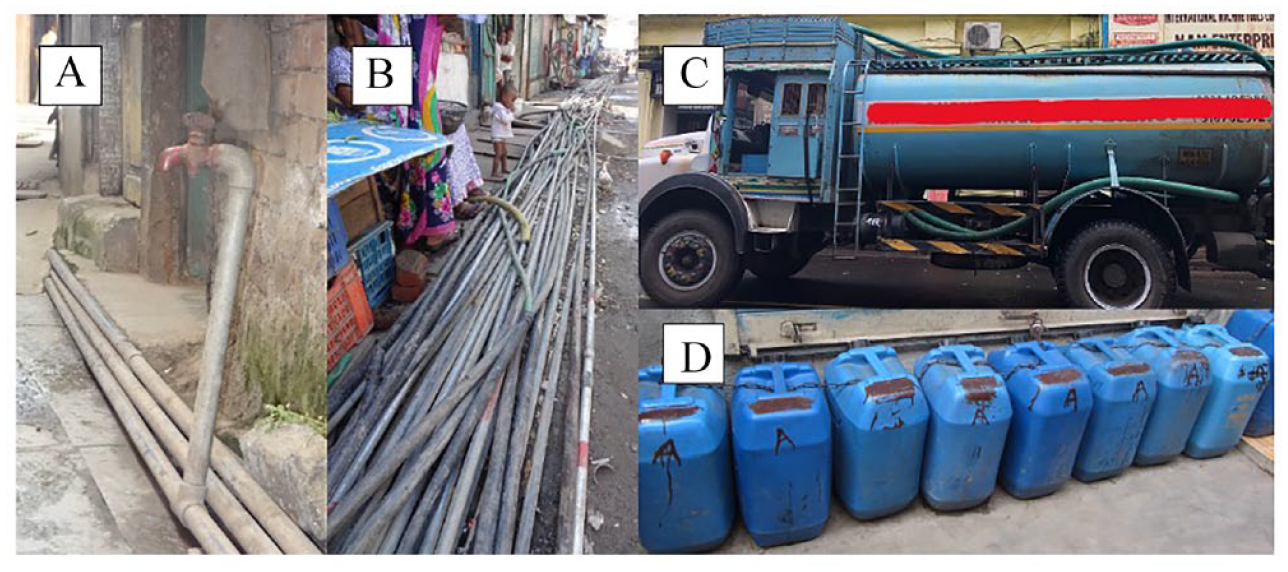
Water distribution and storage in Mandala
The most common mode of access is through informal vendors, who funnel water to households via hoses connected to motors tapping into municipal pipes. Tanker trucks, which bring water irregularly, are considered a less desirable mode of private access. Both hose and truck vendors are usually paid per container filled. Fetching water from taps elsewhere in the community, or other settlements, is another time-consuming mode of access. Finally, a few households obtain brackish water from open wells. For most modes of access, residents usually wait in long queues to collect water.
Households use blue plastic drums, with a capacity of 100 to 300 litres, or jerry cans, with a 50-litre capacity, to store water needed for bathing and washing clothes (Figure 1). Smaller containers are used to store water for drinking or washing dishes.
c. Data collection
The study was approved by PUKAR’s Institutional Ethics Committee and deemed an exempt study (i.e. presenting no more than minimal risk) by the Brigham and Women’s Hospital Institutional Review Board. Before data collection, barefoot researchers mapped all households in Matangrushi Nagar and Indira Nagar using a system developed by PUKAR for household enumeration and re-identification in dense slums.(57) Given that the barefoot researchers lived in Mandala, we used their ground knowledge to define neighbourhood boundaries and facilitate geographic information system (GIS) mapping of public community taps using mobile phone-based collection of latitude and longitude data.
Taps were classified based on functionality: “high functioning” if water came as scheduled by the municipality with appropriate pressure; “medium functioning” if water came in smaller quantities due to low pressure; “low functioning” if water came only intermittently or from neighbouring taps; and “non-functioning” if no water came at any point.
To facilitate representative sampling of households across both neighbourhoods, a random number generator was used to select 600 household codes from the census. This sample size allowed us to assess percentages for each indicator within a five per cent standard error. A sensitivity analysis indicated a sample of 400 households would achieve this desired precision; however, as we anticipated substantial differences in indicators between the neighbourhoods we therefore increased this initial sample size using a design effect of 1.5, given the likely presence of clustering.
We conducted the household survey from March to May 2016 (India’s summer season) when water hardships are most severe. To estimate household water consumption (i.e. quantity), we employed a container enumeration method shown to have strong construct validity in prior studies.(58,59,60) In each household, barefoot researchers counted the number of containers used to store water, estimated each container’s volume (standard across drums and jerry cans), and asked respondents how many times each container had been filled in the prior week. This was multiplied by each container’s storage capacity to estimate total weekly water use. This method works well because intermittent water delivery means little water is used directly at the source and almost all water must be stored before use.
Barefoot researchers visited selected households, collected informed consent and interviewed an adult >18 years old who engaged in water collection. Most respondents (62 per cent) were women. We collected two weeks of water quantity data to minimise the influence of week-to-week variability in water use. The week before the full survey was administered, each household’s water use for the preceding week was quantified. Researchers visited the same households the following week to administer the full survey and quantify water use again.
d. Data analysis
Maps of households and water infrastructure were visualised using QGIS.(61) Survey data analyses were conducted using Stata/IC 15.1.(62) Of 600 households surveyed, seven did not provide information for key water-related variables and were excluded from analyses.
We first compared demographic characteristics and water indicators between notified and non-notified households in Mandala. We used the chi-squared test to assess differences for categorical variables and the Wilcoxon test to assess differences for continuous variables.
To understand the independent effect of legal status, we conducted multivariate regression analyses with water quantity used by households, in litres per capita per day (LPCD), as the outcome of interest. By focusing on water quantity, we do not intend to minimize the importance of other water indicators. We chose quantity as the outcome because of its strong associations with health outcomes, including vulnerability to trachoma and diarrhoeal disease, and effects on child growth.(63) Additionally, water quantity may integrate deficiencies across a broader range of water indicators, including distance from a water source, reliability and water cost.(64,65)
Our primary analysis involved multivariate linear regression. As water quantity data were not normally distributed, we log-transformed the data to meet the normality assumption for linear regression. Coefficients for the log-transformed data were transformed for interpretation by exponentiating the coefficient, subtracting one and then multiplying by 100 to produce a per cent difference coefficient.
To assess whether findings were robust to the analytical approach used, we also conducted a multivariate logistic regression analysis to identify factors associated with use of ⩽20 LPCD. Widely-cited World Health Organization (WHO) guidance describes use of ⩽20 LPCD as conferring “very high” risk to health, with this guidance supported by findings of a recent systematic review.(66,67) Our prior research suggests that low water use is also associated with adverse consequences across household economy, employment, education, quality of life, social cohesion and perceptions of political inclusion.(68) Finally, 20 LPCD is roughly the median water quantity used by households in our survey, suggesting this is a reasonable cut-off from a statistical perspective. For context, people in the United States use about 306 LPCD for indoor household use.(69)
In these regression models, we adjusted for variables that could be confounders of the relationship between notification and water quantity. For example, socioeconomic disparities between notified and non-notified households could result from differences in legal status. In turn, income may be independently associated with the water quantity used by households.(70) As such, income was included in the model to control for socioeconomic status. We included religion as a covariate because evidence from the ethnographic literature suggests religious discrimination, particularly against Muslims, can influence water access.(71,72) Finally, the number of people in a household has been shown to be independently associated with water quantity, even after accounting for use of a per capita water quantity metric.(73) We purposefully did not include water-related covariates (e.g. cost of water, water source) in our regression analyses because these covariates may be mediators of the association between notification and water quantity; we instead more appropriately examined their associations in a path analysis.
The path analysis aims to understand the ways in which differences in legal status might lead to disparities in water quantity by interrogating the mediating role of other water indicators. Based on ethnographic observations from Kaula Bandar and the current research in Mandala, we constructed a hypothetical pathway model using water indicators that may mediate the association between legal status and water quantity. Specifically, we hypothesised that different neighbourhoods’ legal status may prevent extension of infrastructure to households by the government. We captured aspects of infrastructural quality in variables assessing primary and secondary modes of water access for each household. Infrastructural quality, in turn, may contribute to challenges accessing water, captured in the number of households using each primary water source and time spent collecting water. Accessibility challenges may then increase water costs and the frequency with which water is obtained, both of which may affect water quantity used by households.
Based on this hypothetical model, we used Stata’s GSEM feature to conduct a path analysis with log-transformed water quantity data (in LPCD) as a continuous outcome. Along each pathway, each predictor variable had to have a statistically significant association with the subsequent outcome variable while controlling for preceding variables. Variables included in the regression analyses to adjust for potential confounding – such as income and religion – were not included in the pathway analysis as they did not have significant associations with water quantity. Post-estimation tests cannot be used with Stata’s GSEM feature. We therefore cannot assess whether our model represents the best fit for the data. However, in this admittedly exploratory analysis, our goal was to understand the percentage of the association between legal status and water quantity explained by mediating variables, rather than to find the best fit model for our data.
III. Results
a. Population characteristics and disparities in water indicators
Of 593 households included in our analysis, 283 (47 per cent) were notified and 310 (53 per cent) were non-notified (Table 1). Socioeconomic status – whether measured by housing quality or monthly income per capita – was not statistically significantly different between notified and non-notified households. However, non-notified households were considerably less likely to have electricity meters and had more people living in each housing structure, on average. Notified households were predominantly Hindu, whereas non-notified households were predominantly Muslim.
Demographic and socioeconomic characteristics and access to basic services in two neighbourhoods in Mandala (N = 593 households)
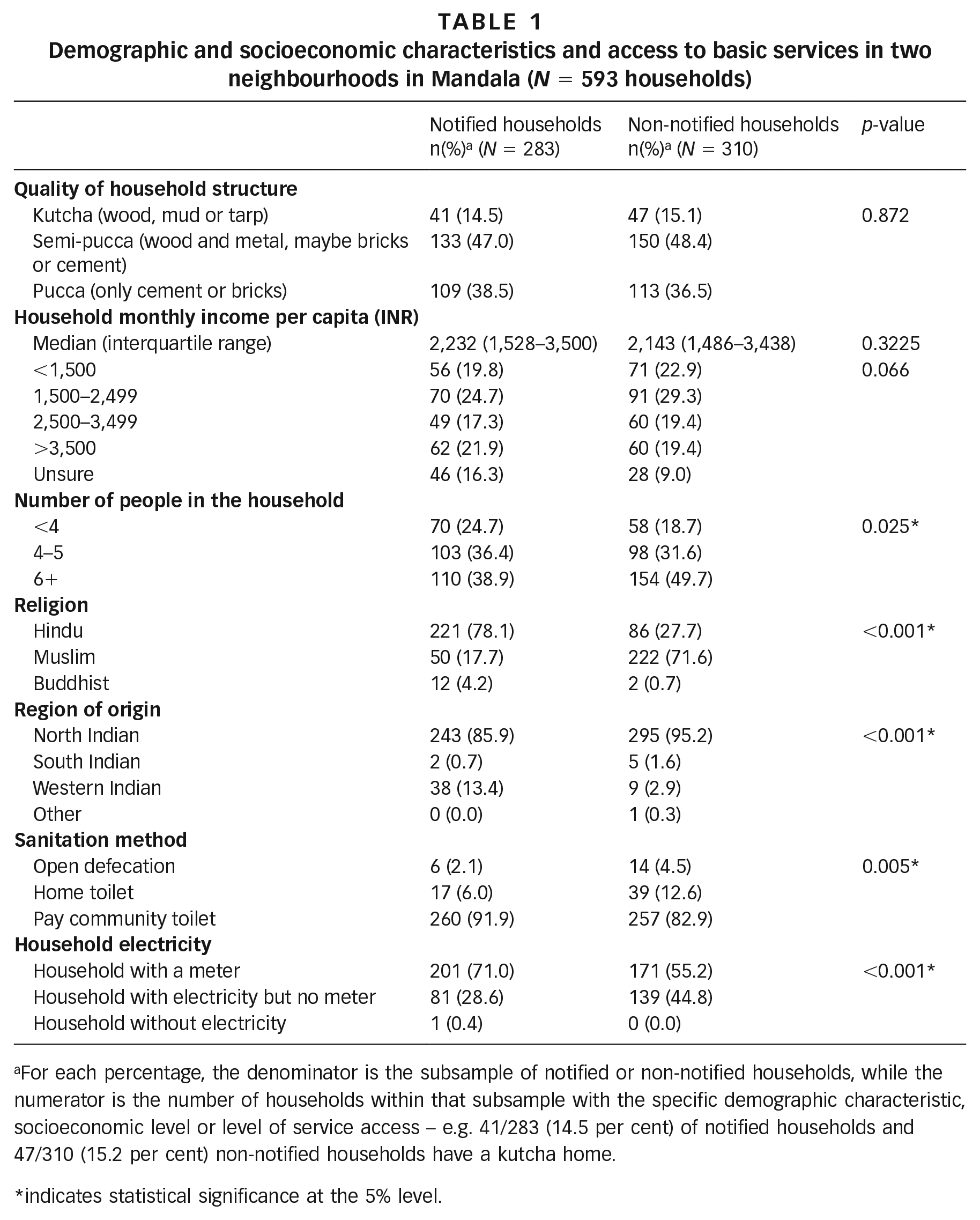
For each percentage, the denominator is the subsample of notified or non-notified households, while the numerator is the number of households within that subsample with the specific demographic characteristic, socioeconomic level or level of service access – e.g. 41/283 (14.5 per cent) of notified households and 47/310 (15.2 per cent) non-notified households have a kutcha home.
indicates statistical significance at the 5% level.
GIS mapping of water infrastructure revealed dramatic disparities in access to functional government community water taps between the notified and non-notified neighbourhoods (Figure 2). Household survey data showed that, relative to notified households, non-notified households suffer statistically significant disadvantages in primary and secondary modes of access (a proxy for formal and informal infrastructure); time spent collecting water and the number of households accessing the same source (measures of accessibility); the frequency of obtaining water (a proxy for reliability); and water costs paid and the percentage of monthly income spent on water (measures of economic impact). For example, for mode of water access, notified households were more likely to have access to an in-home tap or informal hose vendors, less likely to collect water from tanker trucks (a highly insecure source), and less likely to need a secondary water source. Median water cost for notified households was 219 Indian rupees (INR)/1000 litres, while non-notified households paid a median of 407 INR/1000 litres (USD2.92 and 5.42, respectively). Non-notified households consumed 13 LPCD less water quantity, on average, than notified households and had experienced more days with insufficient water availability in the prior two weeks. Residents of non-notified households were statistically significantly more likely to miss or be late for work; however, days in which children missed or were late for school due to water collection were comparable between non-notified and notified households (Table 2).
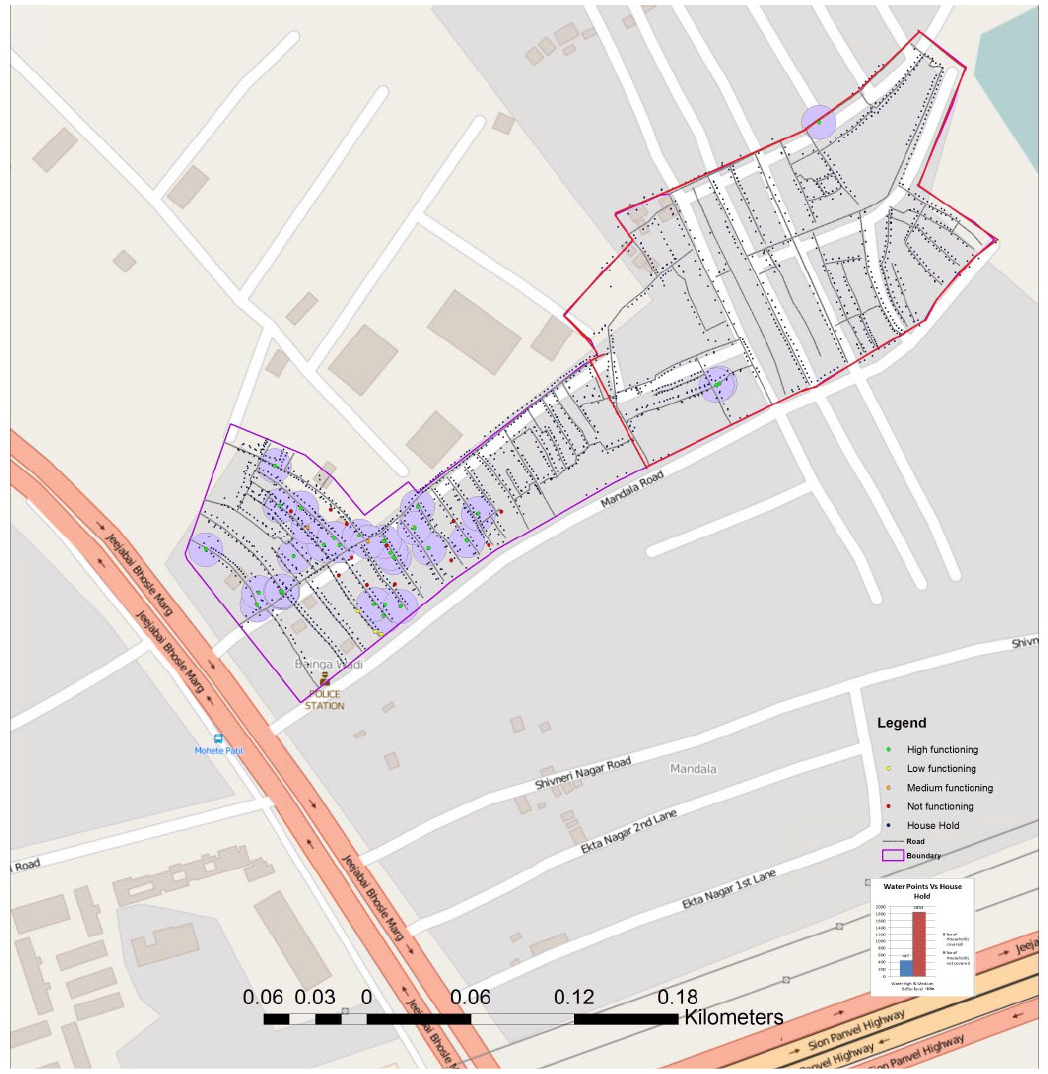
Map of community water taps in a notified neighbourhood and a non-notified neighbourhood in Mandala
Comparison of water service delivery indicators between notified and non-notified households (N = 593) a
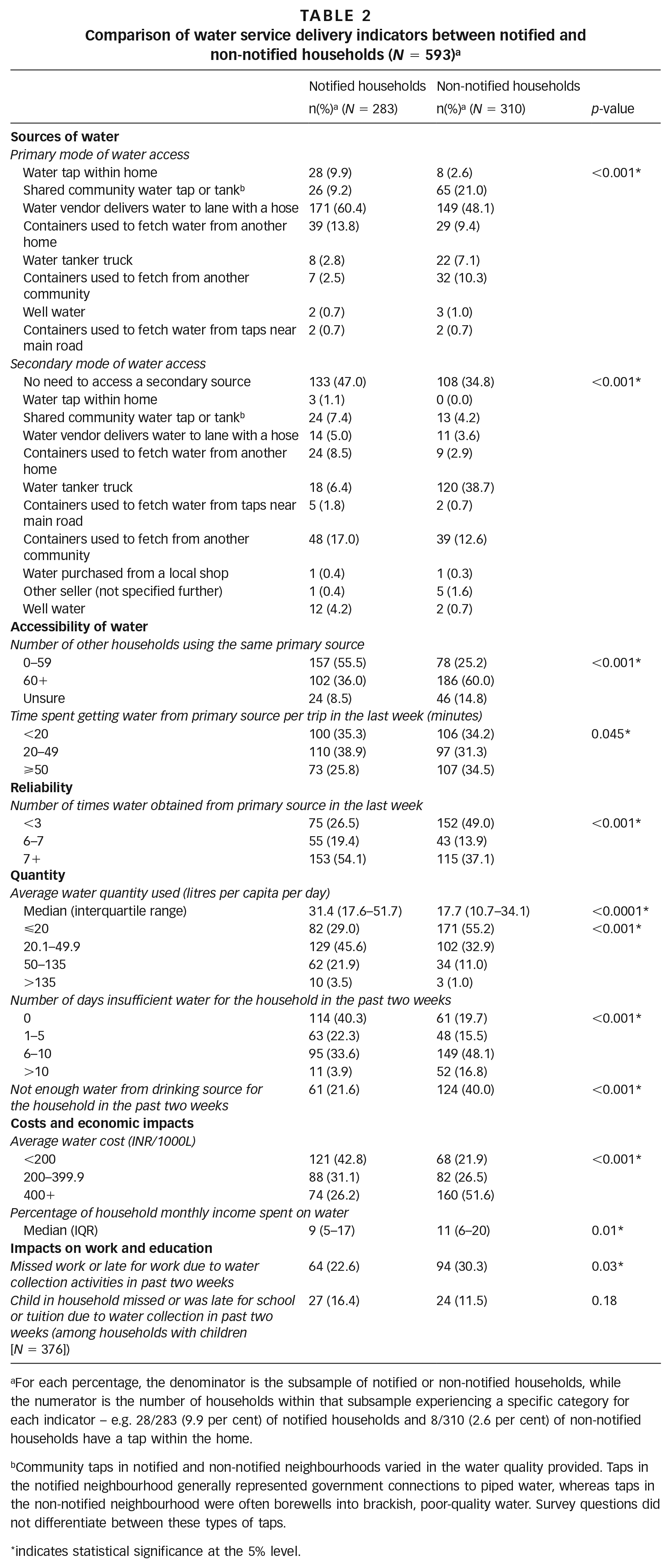
For each percentage, the denominator is the subsample of notified or non-notified households, while the numerator is the number of households within that subsample experiencing a specific category for each indicator – e.g. 28/283 (9.9 per cent) of notified households and 8/310 (2.6 per cent) of non-notified households have a tap within the home.
Community taps in notified and non-notified neighbourhoods varied in the water quality provided. Taps in the notified neighbourhood generally represented government connections to piped water, whereas taps in the non-notified neighbourhood were often borewells into brackish, poor-quality water. Survey questions did not differentiate between these types of taps.
indicates statistical significance at the 5% level.
b. Disparities in water quantity used by households
In the multivariate linear regression analysis, using log-transformed water quantity in LPCD as the outcome, being non-notified and having more people in the household were statistically significantly and independently associated with use of a lower water quantity (Table 3). Non-notified households used 37 per cent fewer LPCD on average than notified households, which translates to 12 fewer LPCD based on median water quantity used by notified households. Similarly, in a multivariate logistic regression model, non-notified households had 3.4 higher adjusted odds of using ⩽20 LPCD compared with notified households (Supplementary Appendix, Table S1).
Factors associated with water quantity used by households in Mandala in a multivariate linear regression analysis (N = 593)
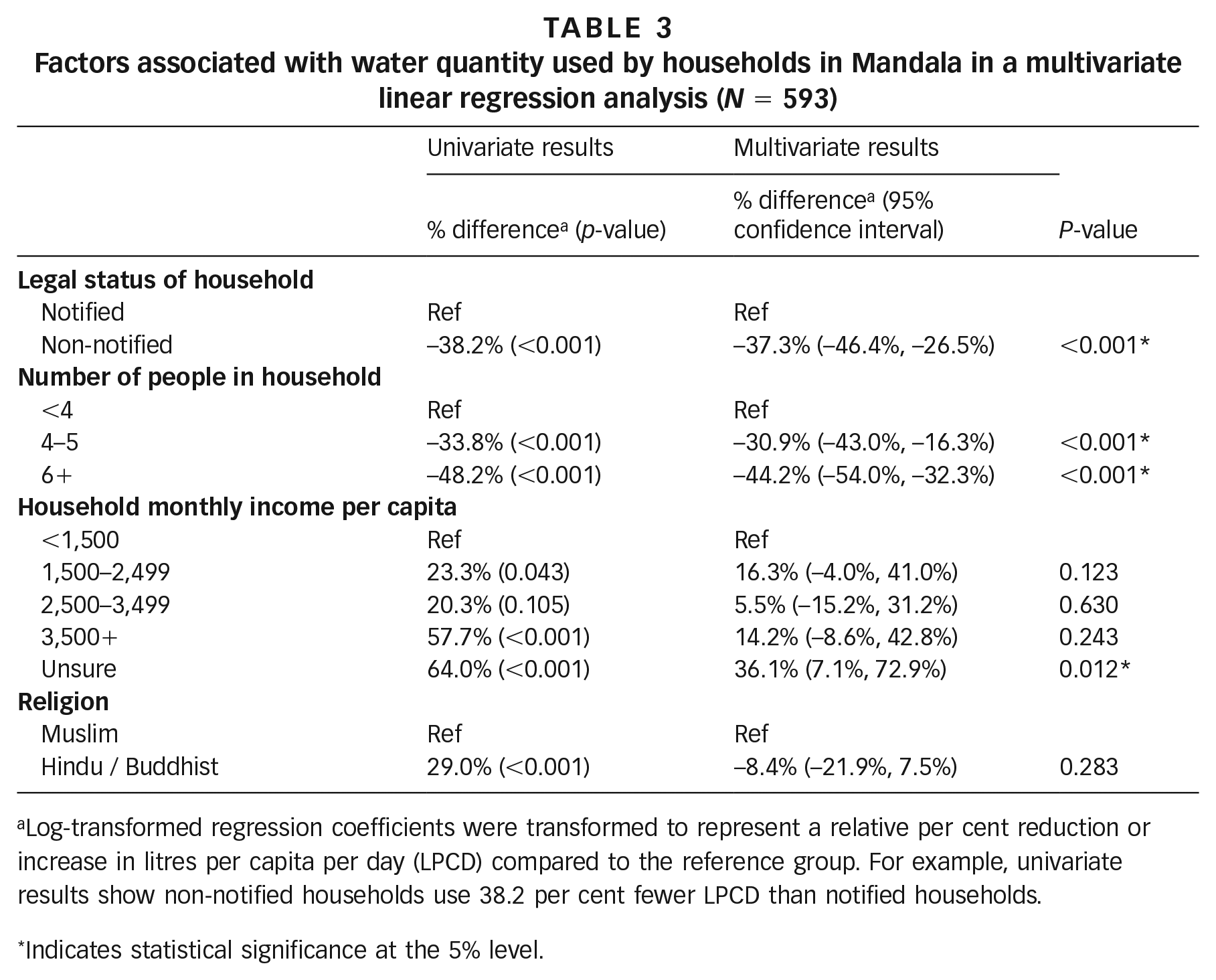
Log-transformed regression coefficients were transformed to represent a relative per cent reduction or increase in litres per capita per day (LPCD) compared to the reference group. For example, univariate results show non-notified households use 38.2 per cent fewer LPCD than notified households.
Indicates statistical significance at the 5% level.
c. Path analysis: explaining how legal exclusion may lead to disparities in water quantity
Figure 3 shows our model mapping the association between legal status and water quantity. Panel A presents the unmediated association, while panel B presents potential mediating factors. We hypothesized non-notified status prevents development of infrastructure, represented by each household’s primary and secondary water sources (primary mediators). Lack of infrastructure, in turn, leads to challenges accessing water, represented by the number of households using the same water source and time spent collecting water (secondary mediators). Barriers to access may then increase water cost and reliability (tertiary mediators), leading to reduced water quantity.
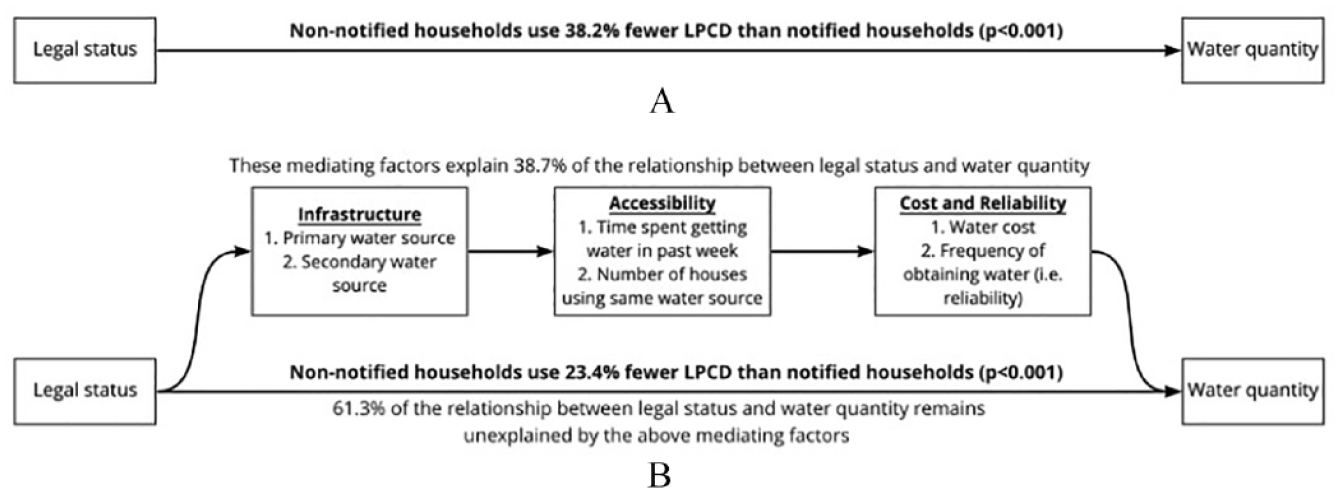
Hypothetical model mapping pathways by which legal status may lead to household-level disparities in water quantity
Without any mediators, non-notified households used 38.2 per cent fewer LPCD than notified households (Figure 3, panel A). Accounting for the partial mediation of water infrastructure, accessibility, cost and reliability, non-notified households use 23.4 per cent fewer LPCD than notified households. Therefore, 38.7 per cent of the association between notification and water quantity was explained by the mediating variables (Figure 3, panel B). Pathway coefficients for this model are presented in the Supplementary Appendix (Table S2). In a variation on this model allowing for more complicated relationships among intermediary variables, the mediators explain up to 50 per cent of the association between legal status and water quantity; however, we present a simplified model here for conceptual clarity.
IV. Discussion: The Central Role Of Legal Exclusion In Shaping Water Inequality
This study revealed substantial disparities between notified and non-notified neighbourhoods across several water indicators, including accessibility and reliability of supply, cost and quantity used by residents. Mapping of government-provided community taps revealed infrastructure deficits in both notified and non-notified neighbourhoods, but deficits in non-notified neighbourhoods are more substantial. Non-notified households faced disproportionate economic and social impacts of poor water access, including spending a higher percentage of income on water and being more likely to miss or be late for work due to water collection.
We identified factors influencing water quantity used by residents, given the importance of sufficient quantity for maintaining health and quality of life.(74,75) Even after adjusting for socioeconomic status and religion, legal status was strongly associated with the quantity accessed. Non-notified households used 37 per cent fewer LPCD (about 12 fewer LPCD on average) than notified households and had threefold higher adjusted odds of using 20 or fewer LPCD, a level associated with high health risk.(76) We proposed a model by which legal status could influence a series of water-related indicators to explain household-level disparities in water quantity. These pathways provide partial explanations for how legal status shapes water access in slums, which may be explored further in future research.
Although our regression analyses focused on water quantity, given its known association with health outcomes, disparities in other water indicators may each be associated with unique adverse impacts for non-notified households. Greater reliance on water fetching, tanker trucks and multiple water sources may increase the physical and psychological toll of water collection, especially for women, children or elderly individuals. Poorer reliability of the water supply and higher water costs may increase stress, psychological distress and risk of depression.(77) Lost wages from missing or being late for work, in combination with higher water costs, may contribute to these households remaining stuck in a “poverty trap”.
Our work has implications for understanding drivers of urban water inequality, especially intra-slum disparities. Our quantitative approach highlights the critical influence of legal status across multiple water indicators. These findings are concordant with trends evident in data from India’s National Sample Survey (NSS). Across the 2002, 2008–2009 and 2012 survey waves, NSS data demonstrate increasing disparity in access to piped water between notified and non-notified slums.(78) By 2012, only 16 per cent of notified slums lacked access to piped water infrastructure, compared with 34 per cent of non-notified slums. The NSS was limited, however, in that it broadly evaluated slum conditions, including piped water infrastructure, at community level. This over-estimated water access because visible community-level infrastructure often does not map onto household-level access. For example, pipes sometimes do not work or provide water only intermittently. Our findings present a more accurate picture of household-level water access, while allowing us to highlight the importance of intra-community (rather than just inter-community) disparities.
Religion was not associated with access to lower water quantity in our analyses, after adjusting for legal status. On average, Muslim households in the notified neighbourhood accessed comparable water quantities to those of their non-Muslim neighbours; conversely, Hindu households in the non-notified neighbourhood suffered similar deficits to those of their neighbours. However, this finding does not imply that discrimination by religion, region of origin or other social factors does not influence water access. Indira Nagar is farther from the major road and was populated later than Matangrushi Nagar, so perceptions that Indira Nagar is non-notified were at least partly shaped by differences in the proportion of households that could prove residence before the 2000 cut-off date. At the same time, these two neighbourhoods had substantial differences in social composition. Indira Nagar had a higher proportion of Muslim residents, whereas Matangrushi Nagar had more residents who were Hindu or from Western India (i.e. Maharashtra). These religious differences could have influenced officials to treat the entire neighbourhood of Indira Nagar as being non-notified. In other words, the existence of this legal category, particularly when misapplied at a neighbourhood or settlement (rather than household) level, may enable collective discrimination against socially disadvantaged populations.
Even though the law applies notification at the household level, legal status may be operationalized as a neighbourhood- or settlement-level designation, because basic services, especially water, require construction of aggregate infrastructure for local delivery. In our study, aggregate public infrastructure likely accounts for the better water indicators achieved in the notified neighbourhood directly (e.g. through government community taps) but more so indirectly (e.g. through informal vendors tapping into public infrastructure to deliver water to nearby households). For this reason, even non-notified households in notified neighbourhoods are likely to achieve better water access due to proximity to aggregate infrastructure, whereas households eligible for notification in non-notified neighbourhoods may continue to face barriers to water access despite having a legal entitlement. Policies applying notification at the household level and requiring households to apply for community taps are fundamentally misaligned with the reality of how water access improves, which is through construction of aggregate infrastructure at the neighbourhood level.
How can legal exclusion be addressed to improve water access and reduce disparities for people living in Indian slums? The people’s campaign Pani Haq Samiti has used public interest litigation, based on the human right to water, as one strategy. In response to this litigation, in 2014 the Bombay High Court ordered Mumbai’s government to extend basic water access to non-notified slum households. However, limitations in the order – and its operationalization by the city – may limit its benefits and maintain inequalities.(79,80) The ruling states that, while people in non-notified slums have a right to life and therefore water, they are not entitled to a water supply comparable to what “law abiding citizens” receive.(81) In response, the city aims to provide a lower level of water service to non-notified households, while also noting that water still cannot be provided to slums on central government or private land. Households now eligible for legal taps have experienced long, unsuccessful application processes. Of the 1,200 applications for community taps from non-notified households in Mumbai submitted between 2017 and March 2020, only 96 were granted.(82) That being said, over the last year PUKAR’s barefoot researchers who live in Mandala have reported that the municipality is constructing new infrastructure in non-notified neighbourhoods, although local extension of piping to community taps or households has been limited by people’s ability to make informal payments to officials. Further research may shed light on whether construction of infrastructure is being driven by the High Court order and whether this is reducing water inequality in Mandala.
More comprehensive and equitable approaches to extending legal recognition are needed given that non-notified households often live in the same location for decades despite the threat of displacement.(83) Governments may be reluctant to extend services to non-notified households, believing that service provision may encourage further migration, though little evidence supports this. In fact, evidence suggests that providing basic services improves urban economic growth.(84) Investment in basic infrastructure for non-notified households is also a moral imperative from a human rights perspective and because slum residents silently undergird the city’s economic activity.
We believe a critical missing link in achieving equitable water access in slums is lack of measurement of – and accountability for – water access at the ground level. Few studies measured household-level water access in slums before the High Court order, and, to our knowledge, no one has measured whether this order changed water access for non-notified slum households. Our current study provides an innovative path forward for identifying water disparities. Our prior work suggests that notification has powerful potential to reduce deprivation in access to basic services in slums; however, these improvements often take a decade or more to materialize.(85) If surveys such as ours were implemented repeatedly at a large scale, these longitudinal data could provide information that communities could use to hold governments accountable for achieving objective improvements in water access.
In pointing out disparities related to legal status, we are not suggesting that water access is sufficient for notified households, for whom provision was also suboptimal. The superior water indicators achieved by these households resulted from indirect benefits of public infrastructure, because informal water vendors more easily tapped into nearby municipal pipes to funnel water to notified households. The average water quantity used by notified households was still well below India’s targets for urban provision.(86) Not surprisingly, some adverse impacts of poor water access, such as missing or being late for school due to water collection, are experienced at a comparable level by notified and non-notified households. Systematic reviews suggest that diarrhoeal disease drops substantially only once a household achieves access to a high-quality in-home piped water supply.(87) This level of access was rare in Mandala, regardless of legal status. Achieving in-home piped water should be the long-term goal for all slum households.
Our analyses have a few limitations. First, we used cross-sectional data and cannot infer causality for the associations identified. Second, given the inclusion of categorical variables in the path analysis, we were not able to generate post-estimation statistics to identify the best fit model for our data. However, with the path analysis, our goal was not to create the most statistically optimized model. Third, although we adjusted for income in our analyses, 12 per cent of respondents were unsure of their household income. Fourth, while water quantity has strong associations with health outcomes, water quality also influences health outcomes, but we did not assess microbiological contamination due to resource limitations. Finally, our household survey was not designed to capture individual-level responses that could shed light on gender- or age-related impacts of inadequate water access; however, we hypothesize that women, children and elderly people experience a greater psychological and physical toll related to collecting water.
V. Conclusions: Legal Exclusion As A “Cause Of The Causes”
In this study of an urban slum in Mumbai, we found that non-notified status of neighbourhoods may be a central determinant of poor water access. Our findings revealing the role of legal exclusion in creating intra-slum disparities are in line with national data showing that legal exclusion contributes to inter-slum disparities in water infrastructure. If used widely by communities, rigorous household surveys of water indicators, such as the one conducted here, could accelerate water access by holding governments accountable for objective improvements in service delivery.
By serving as a critical barrier to water access, legal exclusion is one of the foundational “causes of the causes” not only of poor health, but also of other adverse life outcomes in slums, including income poverty and loss of employment and education. Expanding legal recognition could be a powerful intervention for creating social inclusion, improving water access and securing health and well-being for vulnerable slum populations. Addressing the intersection of legal exclusion and water access should be central to future agendas for ameliorating urban inequality.
Supplemental Material
sj-pdf-1-eau-10.1177_09562478221121737 – Supplemental material for Divided infrastructure: legal exclusion and water inequality in an urban slum in Mumbai, India
Supplemental material, sj-pdf-1-eau-10.1177_09562478221121737 for Divided infrastructure: legal exclusion and water inequality in an urban slum in Mumbai, India by Maya Lubeck-Schricker, Anita Patil-Deshmukh, Sharmila L Murthy, Munni Devi Chaubey, Baliram Boomkar, Nizamuddin Shaikh, Tejal Shitole, Misha Eliasziw and Ramnath Subbaraman in Environment & Urbanization
Footnotes
Acknowledgements
Study data were collected by PUKAR’s barefoot researchers, many of whom live in Mandala, including Afreen Shaikh, Afsar Khan, Arfat Shaikh, Danish, Faisal Shaikh, Fatima, Khushnuma, Mayur, Ravi Jaiswar, Renu, Rohit, Ruman Sayyed, Sabira Shah, Shabana Shaikh, Shama Khan, Sunil Kumar, Susmita Chauhan, Vipul Dubey and Zaida Sha. Avni Rastogi and Prabu Raja at the Citizen Consumer and Civic Action Group provided training and support in GIS mapping of water infrastructure in Mandala.
Funding
Data were collected as part of a project funded by a Human Rights Innovation Fellowship from the Unitarian Universalist Service Committee and a Harvard South Asia Institute faculty grant. Maya Lubeck-Schricker was supported by a Borghesani Memorial Prize and a Tufts University Career Center Internship Grant. Data analysis and reporting were partly supported by the National Science Foundation (Division of Social and Economic Sciences) grant #1918175.

Supplemental Material
Supplemental material for this article is available online.
1.
The term “slum” can have derogatory connotations. As a result, alternative terms, such as “informal settlement” are sometimes preferred. In India, however, administrative policies and classification schemes specifically use the term “slum”, making this word difficult to avoid when discussing government policies. In addition, some community-based organizations in India, such as the National Slum Dwellers Federation, have reclaimed this term in a manner that focuses on collective empowerment. Third, notified slums or slum households are provided with forms of government recognition, thereby complicating the use of “informal settlement” to broadly describe these communities.
17
See reference 3.
18.
See reference 4.
21.
See reference 2.
23.
See reference 3.
24.
See reference 3.
28.
See reference 3.
29.
See reference 4.
32.
See reference 5.
34.
See reference 5.
36
See reference 33.
39.
See reference 16.
42.
See reference 41.
43.
See reference 25.
45.
See reference 5.
49.
See reference 41.
50.
Although the name of the city was changed from Bombay to Mumbai in 1995, the Court retains the name Bombay High Court.
51.
See reference 2.
52
High Court of Bombay, Pani Haq Samiti & Ors v. Brihan Mumbai Municipal Corporation & Ors, Public Interest Litigation No. 10 of 2012, Approved Judgment, 15 December 2014.
58.
See reference 16.
59.
See reference 40.
61.
QGIS Geographic Information System. QGIS Association.
62.
Stata: Software for Statistics and Data Science.
64.
See reference 16.
66.
See reference 63.
68.
See reference 16.
70
See reference 16.
71.
See reference 5.
72.
See reference 37.
73.
See reference 16.
74.
See reference 16.
75.
See reference 63.
76.
See reference 63.
77.
See reference 10.
78.
See reference 46.
79.
See reference 52.
81.
See reference 52.
82
See reference 80.
83.
See reference 41.
84.
See reference 46.
85.
See reference 46.
86
See reference 80.
References
Supplementary Material
Please find the following supplemental material available below.
For Open Access articles published under a Creative Commons License, all supplemental material carries the same license as the article it is associated with.
For non-Open Access articles published, all supplemental material carries a non-exclusive license, and permission requests for re-use of supplemental material or any part of supplemental material shall be sent directly to the copyright owner as specified in the copyright notice associated with the article.
