




Abstract
How has COVID-19 affected the urban poor across cities and over time? This research note serves as a follow-up to an earlier study on the impacts of the first wave of the pandemic on informal settlements in two Indian cities. This note draws on additional interviews with key informants from 20 settlements to compare the economic and health impacts of the first two major waves of the pandemic in Bengaluru and Patna, as well as respondents’ attitudes towards the government’s response. Informants in both cities reported higher levels of food insecurity during the second wave resulting from a substantial reduction in government aid, cumulative economic impacts from the first and second waves and, in the case of Bengaluru only, a surge in COVID-19 infections and associated healthcare costs. While slum residents in Bengaluru universally describe the health and economic effects of the second wave as more severe than the first, residents in Patna report the opposite. I argue these disparate characterisations reflect different expectations and approval of local government’s response to the crisis across cities and waves.
I. Introduction
More than 100 million urban Indian citizens live in “slums” – neighbourhoods that lack adequate housing, infrastructure and property rights.(1) These settlements, to varying degrees, are densely crowded and lack provision for viable water and sanitation, making residents particularly vulnerable to health hazards in general, and to the spread of SARS-CoV-2, the coronavirus that causes COVID-19, in particular.(2) Furthermore, many slum residents are “triply informal”: lacking secure employment in the formal economy, security from housing evictions, as well as the identification documents required to access social assistance programmes.(3) As a result, even before the pandemic residents of informal settlements experienced what Gupte and Mitlin refer to as “heightened vulnerability profiles due to multiple and cascading risks” which “speak to a much deeper history of marginalization and exclusion [of these citizens]”.(4) In light of these histories, many slum residents express low levels of trust in government institutions.(5) If governments do not respond equitably to the heightened risks that informal residents face, the health, economic and educational crises resulting from the COVID-19 pandemic threaten to exacerbate urban economic, social and political inequalities.(6)
As outbreaks of the virus have ebbed and flowed with new variants and “waves”, government responses as well as health and economic impacts have varied. How have informal settlements fared across cities and waves? And how have varying government responses shaped residents’ attitudes towards the state? This research note summarizes key takeaways from interviews of 40 key informants from informal settlements in Patna and Bengaluru – two vastly different state capitals in India. The note serves as an addendum to a previous article focused on the implications of the first major wave of the pandemic.(7) Key informants in both cities report higher levels of food insecurity in the second major wave than in the first. Yet, Patna slum residents describe the second wave overall as less severe, while Bengaluru residents describe the second wave overall as more severe. In Patna, where health outcomes were similar across waves, residents viewed the second wave more favourably because the state “left them alone”(8) with fewer lockdown restrictions. In Bengaluru, where health outcomes were worse in the second wave, and government assistance scarcer, residents viewed the second wave as more damaging and expressed frustration with the state’s neglect.
The rest of this note proceeds in four additional sections. Section II introduces a timeline of the pandemic in India and summarizes key findings from existing literature as well as from our prior study on the impacts of the first major wave. The third section briefly describes the research methodology. The fourth compares impacts of the first and second major waves of the pandemic on urban slum residents; the fifth section concludes.
II. A Timeline Of The Virus And Key Findings From The First Wave
Figure 1 shows the daily new confirmed cases in India from the start of the pandemic through March 2022. As shown in the figure, India has experienced three waves since the first reported cases in 2020. The first wave began in March 2020, with new confirmed cases peaking in September of that year. After a steady decline in new confirmed cases between September 2020 and February 2021, the second wave exploded in March 2021, peaking in May 2021. The third wave, driven by the highly infectious but less deadly Omicron variant, began in early 2022, peaking by the end of January. Relative to the first two waves, the third wave resulted in fewer severe health impacts as well as fewer lockdown-related livelihood impacts.(9)
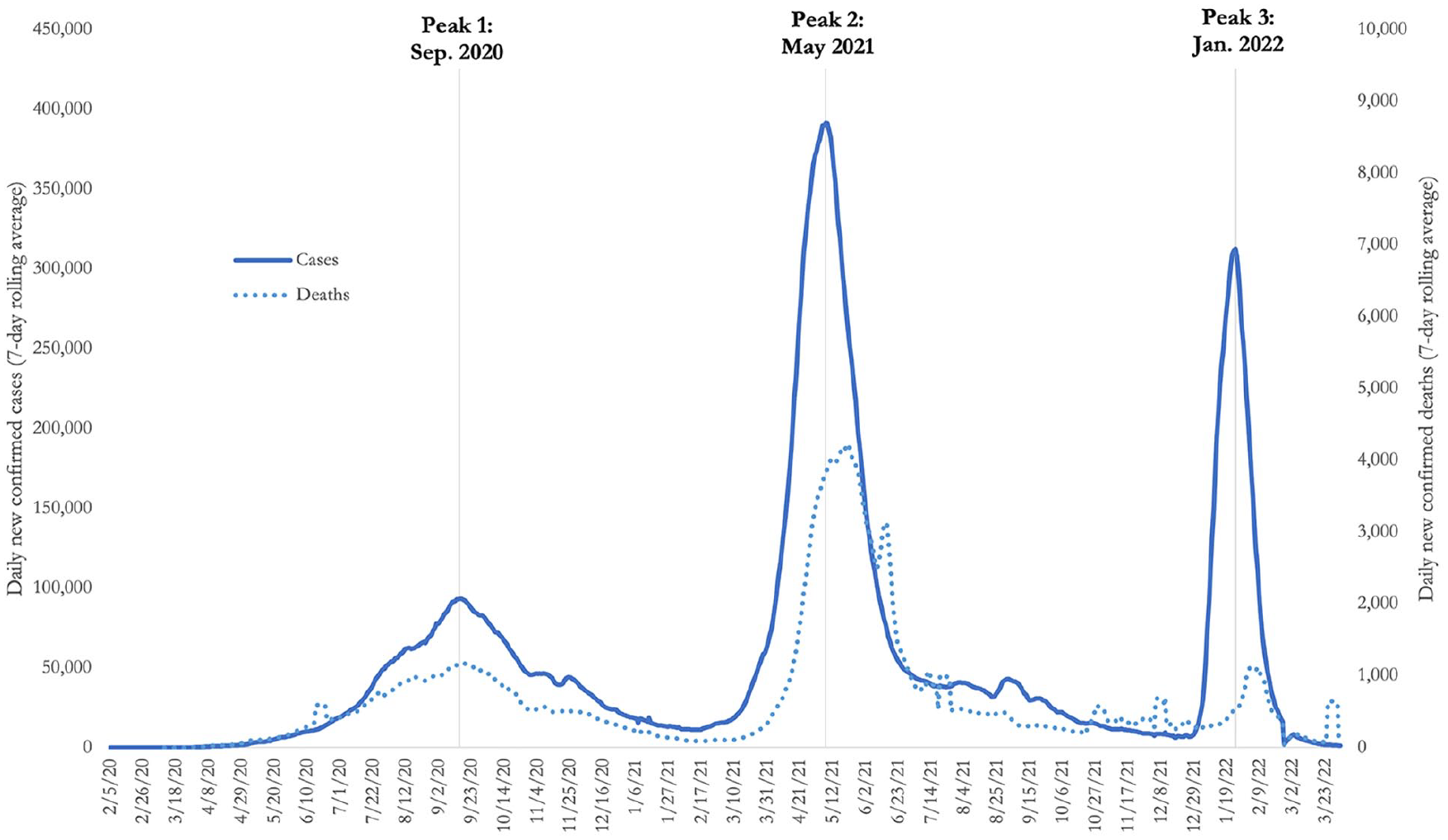
Daily new confirmed COVID-19 cases and deaths in India: February 2020 through March 2022
Early during the first wave in March 2020, the Indian government instigated a strict lockdown, requiring people to stay in their homes except for absolute necessities or if given special permissions. This lockdown was one of the most stringent lockdowns enacted in the world.(10) Initially, it was announced that the lockdown would last only three weeks, but it was ultimately – and unexpectedly to most slum residents – extended for months. The length ranged across cities, with restrictions beginning to ease in Bengaluru by July 2020 but not until September 2020 in Patna. Though community–police relationships vary considerably across informal settlements,(11) key informants from all 40 of the settlements we contacted during the first wave reported that the lockdown was strictly enforced by police officers, at times with violence. Reports from other countries, too, reveal evidence of the police employing violent tactics to suppress the mobility of informal labourers.(12)
The economic effects of the first wave of the pandemic, and the corresponding lockdown, were devastating for India’s slum residents.(13) The vast majority of informal residents also work in the informal economy – earning meagre wages, holding limited savings and remaining excluded from social benefits linked to formal employment. To cope with the loss of income during the lockdown, slum residents cut back on food, spent down their savings, borrowed food and money and liquidated assets. The economic impacts were particularly severe in Patna, where residents were poorer before the pandemic than those in Bengaluru and where the lockdown lasted two months longer. By November 2020 (two months after the lockdown ended in Patna), Downs-Tepper et al. explain that “people faced widespread job losses and wage reductions . . . [such that] one-quarter of pre-pandemic income in Bengaluru and one-third in Patna had still not been recovered” by November 2020.(14) Studies from around the world report similar findings of substantial income losses, food insecurity and stress among residents of informal settlements.(15)
Research conducted prior to the pandemic demonstrates that politicians exercise considerable discretion in deciding which slums to target for development assistance, often distributing crucial resources to the communities that organize most effectively.(16) Initial evidence from the COVID-19 pandemic and evidence from the 2014–2016 West Africa Ebola epidemic suggest relief efforts are still politically targeted – to some extent – during health crises.(17) In response, early in the pandemic, neighbourhood community leaders began leveraging their informal connections to attempt to secure urgent aid for their neighbours from local representatives.(18) In the early months of the pandemic, most settlements did receive food and cash handouts from local politicians, and this aid helped mitigate the impacts of lost wages. However, this assistance largely dried up by June 2020, before the lockdowns had ended in Bengaluru or Patna. As a result, households increasingly had to cut back on food, and borrow and liquidate assets once they stopped receiving government assistance and before they could get back to work.(19) Neighbours provided crucial support to one another, offering loans and food to those in need.
While economic hardship was deep and widespread among slums in Patna and Bengaluru during the first wave of the pandemic, the direct health impacts appeared to be less devastating. Without directly testing for antibodies, it is impossible to know how many slum residents were infected with SARS-CoV-2; in fact, the actual incidence of outbreaks is likely vastly undercounted.(20) In order to generate an estimate of the order of magnitude of severe cases, we asked several key informants about deaths and hospitalizations attributable to the virus within their communities, and triangulated their responses. Within the 20 settlements we repeatedly contacted in Patna between July and November 2020, just one neighbourhood reported a single death attributable to COVID-19. More outbreaks were reported in Bengaluru, where in six of the 20 settlements we contacted, key informants reported that a total of 28 residents had died during the first wave (ranging from 0.3 to 1.3 per cent of the settlement populations).(21) Studies that directly test for the seroprevalence of the virus show that urban areas in general – and slum areas in particular – have experienced far more outbreaks than their rural and non-slum counterparts.(22) However, the vast majority of these infections have been asymptomatic and, consistent with our findings, the number of deaths in South Asian slums appear to have been curiously lower than originally expected.(23) While the reasons for the relatively low fatalities in slums are not well understood, biologists and virologists hypothesize that slum residents may have developed “trained immunity” to the virus as a result of their exposure to other endemic RNA viruses.(24)
As confirmed cases continued to drop after the first wave, Bhuyan claims that “an opinion that India had overcome the pandemic and acquired herd immunity gained ground among policy makers, sections of the media, and the public”.(25) In stark contrast to the government reaction to the onset of the first wave, according to Bhuyan, “March [2021] was a period of hectic public gatherings, sanctioned and even encouraged by public officials. Five states held elections this month, and many politicians, including India’s prime minister and leaders of several parties, conducted hundreds of massive political rallies around India.”(26) Eventually, however, as new cases surged (as depicted in Figure 1), the government enacted a second lockdown toward the end of April 2021. In contrast to the “full” lockdown enacted during the first wave, the second lockdown was a “partial” lockdown, as it limited the number of hours that businesses could remain open rather than prohibiting mobility outside the settlements entirely. As discussed further in the fourth section, informal settlement residents describe a more muted government response to the second wave in general – not only with the severity of the second lockdown but also with the level of information and assistance provided to them. Both factors contributed to differences in respondents’ experiences of the two waves. The next section describes the methods for collecting information on the effects of the pandemic over time before turning to a comparison of how slum residents in the two Indian cities experienced the two major waves.
III. Data And Analysis
Government information about informal settlements is often outdated, incomplete or inaccurate, and locating these areas can be a challenge. Moreover, the most vulnerable settlements are often undocumented in official data.(27) In the absence of existing comprehensive or reliable data sources on urban slums, our research team previously used analysis of satellite images, ground verifications and consultation with local non-state agencies to locate and survey a representative sample of urban slums in three state capitals.(28) Our follow-up work examining the health and livelihood effects of the pandemic focuses on two of these three cities.
To study the impacts of the first major wave of the pandemic for residents of Patna and Bengaluru’s informal settlements, we selected 40 settlements where we had conducted extensive household surveys and interviews previously. These settlements were chosen to ensure they spanned the full continuum of living conditions present across slums in these two cities. We selected three key informants from each settlement whose phone numbers we had collected during our earlier investigations and who had been recognized previously as local community leaders or otherwise socially central individuals. We then conducted repeated phone interviews approximately every two weeks between July and November 2020 with these 120 key informants, collecting what we refer to as “a record of near-real-time perceptions of the evolution of the virus and associated lockdowns in these slums”.(29)
This note serves as an addendum to our earlier study on the implications of COVID-19 for urban slum residents. To collect additional information on the second wave of the pandemic, we purposively selected 10 settlements from each city that again spanned the full range of living conditions in these city’s slums, ensuring that we also included the six settlements that had experienced the worst health impacts in Bengaluru during the first wave.(30) We then developed an interview protocol asking respondents to describe the impacts of the second wave and to compare their experiences between waves. Two trained investigators who had conducted the initial interviews carried out these interviews with two key informants from each of these selected 20 settlements in the local languages (Hindi and Kannada) during August and September 2021. The investigators then wrote up summaries of each of the interviews in English. After reviewing each written summary, I debriefed the investigators on the key takeaways and queries from each interview within a week of the interview having been conducted. I then triangulated responses across key informants to develop the key takeaways expressed for each of the 20 settlements. After summarising key themes for each neighbourhood, I grouped settlements based on whether the economic impacts and the level of government assistance had each been relatively high or low in the first wave in order to analyze how key takeaways varied based on experiences with the first wave. I also examined whether responses varied based on pre-pandemic settlement living conditions as well as severity of the direct health impacts of the pandemic.
IV. Comparing The First And Second Waves
a. Health
Key informants from all 10 settlements in Bengaluru reported the health impacts in the second wave were worse than in the first, while informants from all 10 settlements in Patna described the opposite. We rely on key informant reports of deaths and hospitalizations attributable to COVID-19 without directly testing for the virus, and recognize that people may not know or may choose not to disclose their status. Key informant estimates of the number who contracted the virus are inevitably imprecise. However, reports of the order of magnitude of severe cases are strikingly similar between the first and second waves in Patna and strikingly different between waves in Bengaluru, regardless of the severity of the health impacts from the first wave. While respondents report a similarly low level of the virus in Patna in both waves (next to no deaths or infections), they all characterize the health impacts of the second wave as less severe. In contrast, respondents across all 10 settlements in Bengaluru characterize the health impacts of the second wave as more severe. The consistency of these reports lends confidence to respondents’ assessments that the health impacts were worse during the second wave of the pandemic just in the case of Bengaluru.
During the first wave, respondents from 40 per cent of the settlements in Bengaluru reported at least one death. In contrast, during the second wave, respondents from all but one (nine out of 10) neighbourhoods reported residents of their settlement died from the virus. In addition to more neighbourhoods reporting deaths, the number of deaths within neighbourhoods was also higher. Informants reported an average of 18 deaths attributed to COVID-19 per settlement during the second wave. The average reported deaths during the second wave was higher in the slums that reported deaths during the first wave (22 deaths) than in the settlements that did not report deaths during the first wave (11 deaths). However, both averages stand in stark contrast to the 28 total deaths reported during the first wave in the six settlements where these outbreaks were clustered in Bengaluru.
Overall, key informants reported a higher incidence of symptomatic infections during the second wave, ranging from an estimated 20 to 50 per cent of the settlement populations. In every neighbourhood, interview respondents stressed that, given the vast number of infections during the second wave, it was difficult to gain access to government hospital beds. As described by the area leader in Shekhawati Nagar,(31) only those with political influence were admitted to government hospitals. Similarly, NK Garden’s neighbourhood leader said, “this year the government did not provide facilities to poor people”. This led to increases in home – rather than hospital – quarantines for many residents. In six of 10 Bengaluru slums, key informants explicitly linked the higher number of deaths in the second wave to the inability to get access to or receive adequate treatment in public hospitals. Deepa in Govindpuri said:
“Sometimes people willingly admit [to the hospital] but at that time beds are not available. For getting general beds people have to wait 1–2 days. If we reserved the bed they didn’t provide requested beds. If they need ICU, the BBMP [municipal corporation] people said they don’t have ICU beds so they were only allowed general beds. Private hospitals charged more than 20,000 [~US$ 270] per day for ICU beds so people weren’t admitted to private hospitals. They just consulted doctors and took treatment [at home].” (female resident, Govindpuri)
In Shivaji Nagar, Pavan said something similar – that people with more money would be admitted to the hospital, while “poor people take treatment at home. Due to the high COVID cases people didn’t get beds in hospitals. At that time they underwent the home quarantine, meanwhile some of the patients died due to lack of treatment at home.”
In contrast, in Patna, informants describe (very) low levels of infection in both waves. One settlement reported three deaths, while the rest attributed no deaths to COVID-19 during the second wave. In two settlements, key informants reported fewer than 10 total symptomatic infections. Notably, respondents from half of the neighbourhoods (n = 5/10) said they were not worried about future waves because they characterized the virus as an illness of the rich. For example, in Kachara Basti, Sabina said, “COVID does not disturb the people living in slums. The people worry here for loss of job, not for COVID”; while Girish said, “People are not worried here about [future] waves. Even if it comes, nothing will happen to slum dwellers.” In Kartarpura, Chando Devi said, “People say, ‘Corona[virus] will not come in the poor settlement. We do not sleep in air conditioning. We work hard and sweat.” In Laxmi Nagar, Taara said, “This is not a serious problem. People here do physical work and corona[virus] only catches to those who live luxurious life. Our children also play in dust, clean sewage – we believe corona will not touch them.”
Though the reported levels of infection and deaths attributed to the virus were similarly low across waves, respondents in Patna universally characterize the overall health impacts of the second wave as less severe than those of the first. They attribute this difference to differences in the indirect health impacts, reporting that the second wave caused lower psychological distress and fear about the virus and implications of the lockdown (n = 9/10); fewer disruptions to regular life from masking and distancing (n = 9/10); and reduced police brutality/forcefulness associated with enforcing the lockdown (n = 8/10).(32)
While there are clear differences in the self-reported outbreaks across cities, as well as in the characterization of the second wave as more or less severe from a health standpoint, this article can only speak to the reasons for the disparate characterization but not the disparate outbreaks. In Bengaluru, residents reported that the second wave was worse because there were not only more outbreaks but also a lack of adequate access to treatment. In Patna, residents describe the second wave as better because, though outbreaks were low in both waves, they appreciated the less disruptive change to their lifestyles. In our earlier article, we tested various hypotheses to explain the differences in outbreaks across cities but were unable to find support for any of the possible explanations tested.(33) Understanding why the slums in these two cities experienced such different health outcomes, as well as understanding differences between outcomes in slum and non-slum areas, remains an important area for additional enquiry.
b. Livelihoods and assistance
This subsection turns to an analysis of the key informants’ descriptions of the economic impacts of the first two waves. As previously described, the economic effects of the first wave, and associated lockdown, were devastating across slums. Residents were unable to work for months and earned reduced wages when they did return to work. Early assistance from local politicians (and some NGOs in Patna) helped mitigate food insecurity but dwindled within the first few months of the pandemic. As a result, slum residents had not only cut back on food but many also took out loans, spent down their savings and liquidated their assets, depleting much of their (often meagre) personal safety nets by the end of the first wave.
The second lockdown was far less disruptive to employment than the first. As described by Anni in Bariav Basti, “This time did not feel like lockdown. We were going to the market to purchase things. Women were going for collecting wood and family members were going for daily wage work. Last year, we did not go to the shop for three months. We were dependent on people’s help and on rations.” Residents of most neighbourhoods – and particularly daily wage labourers – experienced economic losses due to reduced days or hours they could work, but overall slum residents were still able to generate some income. In one-third of the settlements in Patna, key informants also reported that residents began to supplement their incomes by selling vegetables and other goods locally.
Yet, despite a smaller shock to income in the second wave, key informants from nine out of 10 settlements in Patna and seven out of 10 settlements in Bengaluru reported higher (or similar) levels of food insecurity during the second wave.(34) This is because both the personal safety nets (savings and assets) as well as government assistance that had helped residents mitigate food insecurity during the early parts of the first wave were largely exhausted and absent by the second wave in both cities. Moreover, in Bengaluru, where respondents from all 10 settlements characterized the economic impacts in the second wave as worse than in the first, the more severe health impacts in the second wave contributed to adverse economic consequences.
Informants from two (of 10) settlements explicitly attributed worse economic impacts overall in their settlement to the higher levels of sickness during the second wave. When asked to describe particular families within their settlements who had been most severely impacted during the second wave, 15 of the 20 key informants in Bengaluru discussed families who had experienced COVID-19 related tragedies and expenses. For example, the area leader from NK Garden told the following story about his neighbour Ashok, a 47-year-old taxi driver. Before the pandemic, Ashok was earning more than 30,000 rupees [~US$ 393] per month driving a rented car for Uber and Ola. After the first wave, his income had dropped to about 20–25,000 rupees [~US$ 262–328] per month, and he was struggling to make loan repayments on his car. When the second wave started, he had to stop driving for these companies due to government restrictions, but he continued to take private passengers. In May, he drove a COVID-positive patient to the hospital; two days later he tested positive for the virus and had to spend several days in the hospital. Though he ultimately recovered, his 16-year-old daughter, who suffered from respiratory problems, had also been infected, and was also admitted to the hospital. After four days, his daughter died. To pay for the hospital and funerary expenses, Ashok’s wife, Ritu, sold her gold jewellery to her neighbours. As of August 2021, Ashok was back to driving his taxi regularly, but his family continues to grapple with both the loss of their daughter and the financial consequences.
In Ashok’s case, his family still had assets to liquidate during the second wave, but many slum residents in both Bengaluru and Patna had already exhausted their savings or liquidated assets prior to the start of the second wave. In seven out of 10 settlements in Bengaluru, key informants described the economic impacts of the second wave as more severe, at least in part because residents had already exhausted their savings and assets or were continuing to repay loans. Moreover, while neighbours had played a vital role in sharing food and making small loans to one another during the first wave,(35) in all 10 settlements in Bengaluru neighbours were unable to provide as much assistance to one another during the second wave.
In all 20 settlements in Bengaluru and Patna, respondents reported a substantial reduction in government assistance during the second wave, or no assistance at all. Government assistance during the first wave took many forms, including the provision of food and cash, as well as permission to delay payments on loans or bills from government agencies (in Bengaluru). This assistance played a meaningful role in helping slum residents cope with the economic effects of the pandemic. Our quantitative evidence suggests receiving assistance during this earlier period helped people forestall the need to take out loans or liquidate assets.(36) Yet, leaders from all 10 settlements in Bengaluru said their area received less food and cash aid from local politicians in the second wave, while three settlements reported their neighbourhood received no aid at all during the second wave. In Patna, where government assistance during the first wave was more limited than in Bengaluru, none of the 10 settlements received any support from politicians during the second wave. This was a decrease in assistance for nine of the 10 settlements – the tenth received no aid during either wave.(37)
Key informants from every settlement in Bengaluru linked the reduction in government assistance to their characterization of the economic effects of the second wave as more severe than the first. For example, when asked to compare the economic impacts of the two waves, both key informants from Shakti Colony said livelihood impacts were worse during the second wave because their neighbours did not receive “any kind of help [from the central and state government or political leaders]”. Incomes alone were insufficient, and many people had already sold their jewellery and other assets during the first wave. As a result, the residents of this settlement struggled to “fulfil their family’s needs”. In Azad Nagar, Shreya said government officials helped their neighbourhood access food rations during the first wave but “in the second wave they didn’t help us and it affected families’ economic condition . . . During the second wave, what we earned we had to pay to our loans and debts and for purchasing food and essentials, we faced problems.”
In stark contrast, key informants in Patna universally describe the economic impacts of the second wave as less severe – despite the fact that assistance was also lower and food insecurity higher in Patna than in the first wave. Even in Durgapura, where the estimated proportion of families cutting back on food was twice as high during the second wave as during the first, Ahmed says, “Last time it was like dying from hunger but this time we are able to have food.” All 20 key informants from Patna attributed their characterization of the second wave as less severe to the less disruptive lockdown. Though nine out of 10 settlements reported that the second wave still resulted in reduced wages, all 10 noted that wages were more adversely affected in the first wave. As described by Amrita in Mahadev Nagar, “It was better this time . . . As the markets were open, daily wage labourers were not deprived of work.” Also, for some people who worked in shops that were only open on alternate days during the second wave, they could “either change their job or [start] selling things on the street”. Similarly, Kala in Laxmi Nagar said, “We can say that this time was better than the last time. Last year everything was closed. If anybody opened their shop, the police used to come and beat us. This time shops were running, but sales were down during the lockdown. Last year nobody was able to make money during the lockdown.”
c. Perceptions of government response
Ultimately, slum residents from these two cities describe different experiences with the pandemic over time. They also differ in how they characterize the relative severity of the second wave, despite reporting heightened food insecurity during the second wave in both cities. Why do residents of these two cities describe the consequences of the two waves differently? I argue, based on the reasoning key informants provided for their comparisons, that the answer has to do with how these residents view the role and response of the local government to the pandemic.
Patna is the capital of Bihar, one of India’s poorest states. Scholars have attributed Bihar’s slow economic growth in general to poor governance, and Patna’s slow growth in particular to the focus of development efforts on Bihar’s predominantly rural areas.(38) Relatedly, prior to the pandemic, slums in Patna had weaker institutional and political connections than those in Bengaluru.(39) Residents in Patna also expressed a lower sense of political efficacy – that is, the belief that they could “be effective and influential in politics”.(40) In Patna, as elsewhere, slum residents reported that serving as a “vote bank”(41) is important for neighbourhood development outcomes, but only 28 per cent of respondents in Patna (surveyed prior to the pandemic) thought their neighbourhood was an effective vote bank, in contrast to 41 per cent in Bengaluru. As a result, Patna slum residents were less likely to have petitioned the government to improve conditions in their neighbourhood in the past year (1.53 per cent) than Bengaluru slum residents (7.29 per cent). Residents of informal settlements in Patna were also much less satisfied than those in Bengaluru with local policing in particular.(42)
In light of these pre-pandemic expectations in Patna, key informants described the lack of politically delivered aid during the first wave as disappointing but unsurprising. As conveyed by Chetan in Kartarpura, “People in this settlement have never expected anything from the government as we do not have much say to convince or ask the government to help us. Even during the last [wave] and this time, we wanted the government to help us but we did not get help.” In eight out of 10 settlements, respondents express similar sentiments – that during the pandemic, as before, their problems have been ignored.
In the same number of settlements (eight of 10), respondents also characterized the imposition of the first lockdown and the predominantly negative interactions with the police officers enforcing it as a threat to their ability to survive. Suraj from Kachara Basti said,
“Last year the government helped people but it was not sufficient. Many had to survive on one meal per day. They were even getting work to earn but the government forced them to live inside. The police were given full power to beat us. Our families could not go outside even to purchase vegetables and medicines. Many times, the police beat us when re-entering our settlement if we were found on the road. The settlement is very crowded. In one room, a family of 3–4 members live and, in this case, people used to spend a good amount of time on the street, but the police forced us all to remain inside. Many [here] survive on small jobs – rag picking, vending, labour activities . . . but the government banned it completely.” (male resident, Kachara Basti)
During the second wave, though again frustrated with the lack of government aid to the poor, interview respondents were relieved to be left alone by the police and permitted to go outside to work. Suraj continued, “But this time [in the second wave] the situation was better as it was
Though health outcomes were similar across waves and reported food insecurity was higher in the second wave, residents from all 10 settlements in Patna described the second wave as less severe due to the more lenient lockdown. For many, this partial lockdown made the second wave more bearable, as it enabled them to “rely on themselves to survive” as they report they are accustomed to. Misha in Rai Tola articulated this sentiment poignantly: “The government and officials should visit our place and see what kind of challenges we face. But nobody comes here to listen [to] us … Every time the government announces help for us but the officials do not ensure that those benefits reach to us.
In contrast, in Bengaluru, political linkages in slums are stronger and a sense of political efficacy was generally higher prior to the pandemic. There, informal leaders (an estimated 88 per cent of whom are politically affiliated, in contrast to 52 per cent in Patna),(43) immediately began to negotiate with local politicians to obtain aid during the first wave. Interview respondents from all 10 settlements then expressed frustration that this assistance quickly dwindled, which increased residents’ financial anxiety. According to Rekha in Govindpuri, “During the first wave we were worried but the government had supported us . . . But during the second wave the government didn’t interfere . . . [and] people have worried about their family needs and income level.”
Moreover, though health outcomes were worse in all 10 settlements during the second wave, interviewees reported that the municipal corporation stopped conducting health-related visits (to provide health information, check in on positive cases, or set up containment zones) during the second wave. In nine out of 10 settlements, key informants characterized the reduction in visits as a signal that the government “didn’t worry” about them in the second wave. As described by Aarushi in NK Garden, “During the first wave, the area corporator helped people get admitted to the hospital but this year they were not worried . . . [Also] during the first wave, the BBMP health workers followed up with COVID-positive cases but this year they didn’t bother.” In all 10 settlements in Bengaluru, key informants said the government should be doing more to help slum residents: “The government
While interview respondents in Patna described government interference during the first wave as a threat to their survival, interview respondents in Bengaluru described the opposite: there, key informants emphasize how it was the lack of government interference that threatened their ability to survive during the second wave.
V. Conclusion
Residents of informal settlements are highly vulnerable to both health risks and economic shocks. However, these settlements are not monolithic, and living conditions and risks can vary substantially across neighbourhoods and cities. This research note contributes an understanding of the different impact of the pandemic for slum residents over time across two Indian cities. The findings underscore the need for location-specific studies, as aggregate statistics can obscure divergent realities across contexts.
While the economic impacts of the pandemic have been devastating in both these two cities during the first two major waves, the health impacts were worse during the second wave in Bengaluru only. In Patna, where residents’ expectations of local government were lower going into the pandemic, slum residents welcomed the retreat of government “interference” during the second wave, and universally characterized the second wave as less disruptive than the first. In Bengaluru, where health outcomes worsened and where respondents also felt neglected by the government during the second wave, residents characterized the second wave as more severe. These experiences appear to have shaped residents’ level of concern about potential upcoming waves, and they also have important implications for shaping trust and expectations of the government among a historically marginalized and excluded group of urban citizens. Future research should further examine how disparate expectations of the government shape slum residents’ resilience and coping strategies in the face of a crisis.
Prior to the pandemic, slum residents were already highly susceptible to health and economic shocks. After two major waves of COVID-19, their safety nets have been substantially eroded, leaving residents even more vulnerable to future crises. In the event of another wave as disruptive as the first two, slum residents will require acute and immediate economic assistance. But as the longer-term economic, social and political consequences of the pandemic are revealed, cities must work to address the underlying conditions that made these settlements so vulnerable to begin with.
Footnotes
Acknowledgements
I would like to thank Mohammad Mansoor and Sujeet Kumar for excellent research assistance. Anirudh Krishna provided support with conceptualization and data collection (including funding and research design) and provided helpful comments on an earlier draft. I would also like to thank the two reviewers for their helpful feedback.
1.
The United Nations defines “slums” as neighbourhoods with inadequate access to water or sanitation, poor structural quality of housing, overcrowding, or insecure residential status (UN-Habitat, 2016). I use the terms “slum”, “settlement” and “informal settlement” interchangeably in this research note.
2.
5.
Auerbach and Kruks-Wisner (2020); also  .
.
8.
The interviews drawn on in this research note were not recorded or transcribed. All quotations presented therefore reflect paraphrased translations.
9.
15.
21.
We were not able to ascertain why we observed more severe health effects in Bengaluru than in Patna during the first wave; understanding differences in outbreaks across cities remains an important area for future enquiry.
24.
See Chinnaswamy (2020); also .
26.
See reference 25.
27.
Bhan and Jana (2013); also .
29.
See reference 7 page 191.
30.
We did not do the same for Patna simply because reported health outcomes were similar (and consistently low) across settlements in Patna during the first wave.
31.
Names have been changed to preserve anonymity.
32.
Patna residents described more negative encounters with police officers during the first wave than Bengaluru residents. Key informants from 16 out of 20 settlements in Patna had described interactions with the police enforcing the first lockdown as mostly negative, compared with key informants from five of 20 settlements in Bengaluru.
33.
See reference 7.
34.
Key informants estimated the percentage of households who had to cut back on food and other essential expenditures during the second wave during these follow-up interviews. I then compared these estimates to the same estimates they had made when interviewed during the first wave.
35.
See reference 7.
36.
See reference 7.
37.
During the first wave, NGOs (eight out of 10 settlements), and even residents of wealthier surrounding neighbourhoods (four out of 10 settlements), donated food to Patna’s informal settlements. However, this too decreased during the second wave. NGOs returned to three of the eight settlements during the second wave to help the most vulnerable subset of residents within these neighbourhoods. None of the settlements received donations from surrounding neighbourhoods during the second wave.
39.
See reference 36.
41.
Vote banking refers to a situation in which the residents of a particular area coordinate their votes, in the hope of receiving a benefit or transfer in return.
42.
In household surveys we conducted prior to the pandemic, 21 per cent of respondents in Patna said they were somewhat or very dissatisfied with the quality of local policing, compared with 6 per cent in Bengaluru.
43.
In our household surveys conducted prior to the pandemic, we ask respondents to list the name of the main neighbourhood leader. We then ask if that leader is affiliated with a political party.