



Abstract
This article explores the relationship between design methodologies and the scaling of participation in cities. The article recognizes that the scaling of community-led informal settlement upgrading is a central concern in the broader debate on scaling participation, and it interrogates the potential contribution of design methodologies in connecting localized, community-led upgrading initiatives outwards and upwards. We discuss these ideas by drawing on our own experience of devising and facilitating a number of participatory design and planning initiatives titled Change by Design with the non-profit organization Architecture Sans Frontières – UK (ASF-UK). Reflecting on this experience, we argue that the inclusion of a design-based, city-level perspective in localized upgrading initiatives can be a powerful conceptual and practical tool to support horizontal, vertical and deep scaling; and we highlight the importance of constructing this design tool in an embodied and situated manner, so that scaling processes remain firmly grounded in everyday lives and experiences.
I. Introduction
This article explores the relationship between design methodologies and the scaling of participation in cities. It recognizes that the scaling of community-led informal settlement upgrading is central to the broader debate on scaling participation, and it interrogates the potential of design methodologies in connecting local initiatives outwards and upwards.
Recent planning and development debates on scaling participation have mostly highlighted avenues for horizontal scaling out – i.e., linking otherwise discrete community-led initiatives – and for vertical scaling up – i.e., introducing change in planning institutions, norms and practices.(1) Social innovation literature further includes scaling deep – i.e. transforming culture and ways of seeing and doing.(2) This article argues that including a design-based “city-level perspective” in localized upgrading can be a powerful conceptual and practical tool to support horizontal, vertical and deep scaling. We highlight the importance of constructing this design tool in an embodied, situated manner, so that scaling processes remain firmly grounded in everyday lives, experiences and concerns.
We draw here on our own experience of devising and facilitating participatory design and planning initiatives (Change by Design) with the non-profit design organization Architecture Sans Frontières – UK (ASF-UK). In doing so, we draw from the discourse and practice of participation in urban planning and architecture, particularly as interpreted by contemporary feminist scholars and practitioners, to critically illustrate the potential of design methodologies for scaling community-led upgrading initiatives.
Section II introduces ASF-UK’s Change by Design as a programme and a methodology, outlining its connections to broader debates and practices. It discusses how the programme approaches the question of scale, and introduces a “city-level perspective” in this context. Section III briefly illustrates the reflective practices that underpinned our analysis of past and ongoing Change by Design initiatives in Quito, Cape Town and Freetown, and explains why we selected these three instances. Section IV explains why and how a city-level perspective was included in each of the three cases, and what the outcomes were. Finally, Section V draws broader conclusions from this reflective process, outlining the forms of design practice that might contribute to the scaling of community-led informal settlement upgrading.
II. Scaling Participation Through Design
a. Situating Change by Design
Change by Design, the oldest of ASF-UK’s areas of work, is a learning and knowledge-sharing programme. Devised in dialogue with Nabeel Hamdi and building upon his approach to participatory action planning and community practice,(3) Change by Design was initiated by ASF-UK in 2011 as a platform for developing participatory urban planning and design methodologies that can support community-led informal settlement upgrading.(4) What we label the Change by Design methodology evolved over the last decade through initiatives in Brazil, Ecuador, Kenya, South Africa, Sierra Leone and the UK – gradually expanding the programme’s focus to include urban regeneration processes alongside settlement upgrading. Our current approach been shaped through the collective efforts of ASF-UK’s volunteers and advisors, collaboratively working at the intersection of participatory planning and critical architecture.
Our collective point of departure was a discontent with technocratic, depoliticized applications of participatory planning.(5) This resonates with a broader concern with the failure of collaborative planning approaches to recognize power relations and their effect on the planning process, as well as on people’s experiences of place.(6) These participatory forms of planning often result in a local focus, dealing with the things that people can agree on, and leaving unchallenged the more conflictual, structural factors that underpin city making.(7) Change by Design emerged as a way for us to reflect collectively on these challenges and create a different form of practice. This form of practice positions participation beyond formal planning systems and highlights everyday life as a key site for the production of planning frameworks and procedures.(8) Change by Design thus connects to other voices elevating everyday acts of city making, through an emphasis on self-help housing,(9) the social production of habitat,(10) and insurgent practices.(11) It also focuses on open-ended scenarios and options for change, rather than settling for the lowest common denominator.(12)
Aligning with other critical approaches to architecture that stress the consequences of design processes beyond the making of built objects,(13) Change by Design emphasizes the role of power relations in the material production, use and management of urban space. Through this lens, design is seen as a method for creatively exploring the connections between social and physical spaces – mapping the material conditions of an area, while also unpacking the values and aspirations that residents attach to it. Through this back-and-forth movement, Change by Design processes celebrate personal experience, difference, the everyday and the collective, and seek to build deep connections to the lives and imaginaries of local residents and their support networks.
In defining “design”, we draw on urban critic Kim Dovey, understanding it as a broad field of knowledge and practice centred on the collaborative task of “inventing urban futures”, uniting formal and informal practices of imagining and shaping the city.(14) We also think together with feminist practitioners and scholars who explore design as a form of situated practice,(15) echoing the term “situated knowledges” coined by feminist theorist Donna Haraway. Haraway famously critiqued science’s claims to impartial objectivity and universal truth, while proposing that knowledge is always embodied, partial and relative to the position of the “knower”. Privileging partial perspectives and situated knowledges is not a means to arrive at relativism, but rather a way of building what Haraway called “a more adequate, richer, better account of a world”(16) and what Sandra Harding referred to as a “strong objectivity” grounded in a multiplicity of points of view.(17) In architecture and urban design, this notion has been interpreted as an invitation to challenge the professional view of the city from above (what Haraway called the “god trick”: the disembodied gaze that sees “everything from nowhere”)(18) and to shift the focus from the universal to the specific – in Helen Stratford’s words, “from the drawing board to the intricacies of place and everyday life”.(19) The Change by Design methodology also takes this stance, and through the methods of participatory design, adopts a situated approach to the task of imagining and shaping the city.
b. Change by Design in practice
Change by Design initiatives aim to support collaboration and mutual learning about urban space and to produce open-ended principles, guidelines and options to improve local living conditions. The practical methodology has four stages: diagnosis, dreaming, developing and defining. The diagnosis stage assesses local patterns and situations. The dreaming stage elicits the needs and aspirations of residents. The developing stage sketches out potential pathways to change. The defining stage sets out concrete plans for action. The initial stages facilitate co-design activities at three scales: micro (dwelling), meso (community) and macro (city); and include participatory research around urban policy and planning systems. In the later stages, the findings from scale-specific activities are brought together into a planning exercise that explores cross-scale interactions, and assesses trade-offs between scales (Figures 1 and 2).
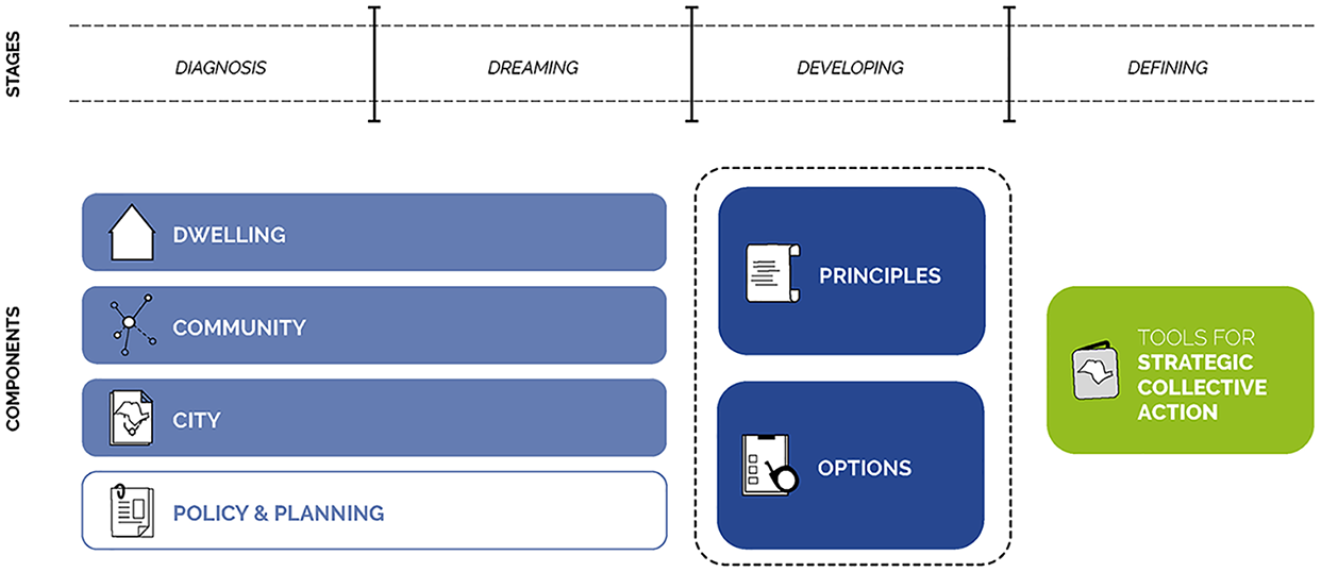
Diagram illustrating the stages and components of the Change by Design methodology for participatory design and planning
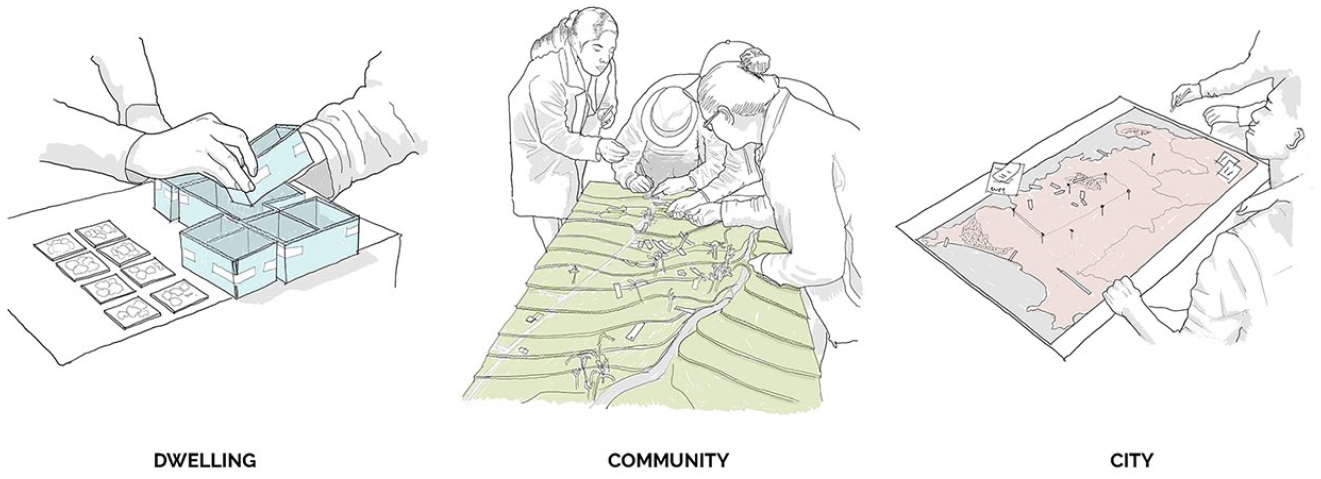
Design activities at the micro (dwelling), meso (community) and macro (city) scales
The micro, meso and macro scales are not understood as isolated containers, but as moments in a continuum of relationships that link across and beyond them. The spatial boundaries of each scale are defined experientially and relationally with local residents and project partners.
Co-design activities at the micro scale draw attention to domesticity, homey spaces and home-making practices. The meso scale attends to broader social relations and their spatial settings, and how social identity and power shape the use of shared spaces (for instance, streets or market areas) and infrastructure (such as water or energy) in a local area. Finally, the macro scale interrogates the larger urban context – whether the municipality or metropolitan region. This city-level perspective challenges the idea that communities must be self-sufficient, and contextualizes local and bottom-up change within broader urban dynamics and structural inequalities that might affect life in a settlement.
c. The city-level perspective as a tool for scaling
In the field of social innovation, Moore, Riddell and Vocisano(20) identify three types of scaling adopted by organizations wishing to expand the impact of their work: scaling out refers to replicating and spreading innovations to achieve greater numbers; scaling up consists of fostering structural change through influencing legal and policy frameworks; and scaling deep refers to transforming culture and understanding.
Change by Design engages with the question of scaling participatory design and planning for community-led informal settlement upgrading in several ways. In a local area, the programme aims to scale out through establishing links with other settlements and locations in the city; it aims to scale up via its policy and planning component, as well as its emphasis on embedding community-led planning into wider processes of social mobilization and policy change; and at its core, it aims to scale deep by supporting learning and knowledge sharing around the idea and practice of participation.
Across these different types of scaling, we understand our adoption of a macro, city-level perspective as a conceptual and practical tool to support horizontal, vertical and deep scaling: one that allows for building a situated, bodily and spatial-material dimension into scaling processes. Through participatory design methods, the macro scale aims to deepen residents’ and partners’ understanding of city-wide dynamics and their own positions in relation to them, so that they can reach out and up to other places and stakeholders.
This focus on the city as a scale of co-design was not present in the early iterations of Change by Design, which primarily focused on the settlement level. However, it soon became apparent that the process would gain much from including the city as an object/subject of design in its own right. Many of the aspirations and needs that residents express about their settlement or neighbourhood are connected to broader social and material systems – transport, livelihoods, knowledge, ecology, and so forth. These large-scale systems have an important impact on how people transact their daily lives, and it seemed important to us that settlement plans articulate demands for their transformation, whether within or beyond the settlement’s boundaries.
We also observed that the idea of the city is a powerful catalyst of critical engagement, imagination and social mobilization. In Change by Design, introducing the city as a scale of design nurtured imagination and ambition in a way that is seldom possible when the focus is confined within the boundaries of the local area.
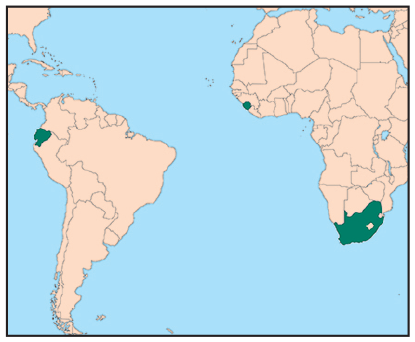
The city emphasis was first introduced during a Change by Design workshop in Quito, Ecuador in 2013, and was later refined through collaborative projects in Cape Town, South Africa (2015–2018) and Freetown, Sierra Leone (2017–ongoing). In each case, the city was considered on the one hand as the context of urban development, a web of places and people surrounding a settlement; on the other hand, the city was considered relationally and physically as something that evolves from and is generated from the local area, and has an impact on it. Yet the choice of engaging with the city has posed critical questions: How can we reconcile a situated, site-specific approach with an engagement with the large scale? How can we examine city-wide systems while at the same time resisting the disembodied gaze of traditional top-down planning? What design methods may allow us to explore and reimagine the city without losing connection to the local areas? With these questions in mind, we have worked closely with our partners to experiment with co-design methods that may allow us to explore the city from within and through what Haraway called “the privilege of partial perspectives”.(21)
We consider this a work-in-progress, and in the following sections, we revisit three different approaches to incorporating a city-level perspective within the Change by Design methodology. Each of these was developed by ASF-UK in response to the methodological concerns described above, and in dialogue with our local partners and their particular ways of seeing and knowing the city or wider urban context. In exploring these examples, we discuss why a city-scale perspective was important in each instance, how we approached it methodologically, and with whom.
III. Reflective Methods
The thoughts and questions raised here grew out of ongoing conversations between the two of us and with a broader community of practice, including ASF-UK volunteers and advisors, project partners and workshop participants. In the following section we report our reflections on three intensive workshops that took place in Quito, Cape Town and Freetown in 2013, 2015 and 2017 respectively. Each lasted around two weeks and involved 90–180 people, including volunteers, partners, supporting experts, workshop participants, local residents and key stakeholders. Although each workshop formed only part of a wider collaboration between ASF-UK and the relevant local partners, we decided to focus specifically on these experiences because they represented an important shift in our approach to the city scale of Change by Design – and to our approach to scaling community-led upgrading initiatives.
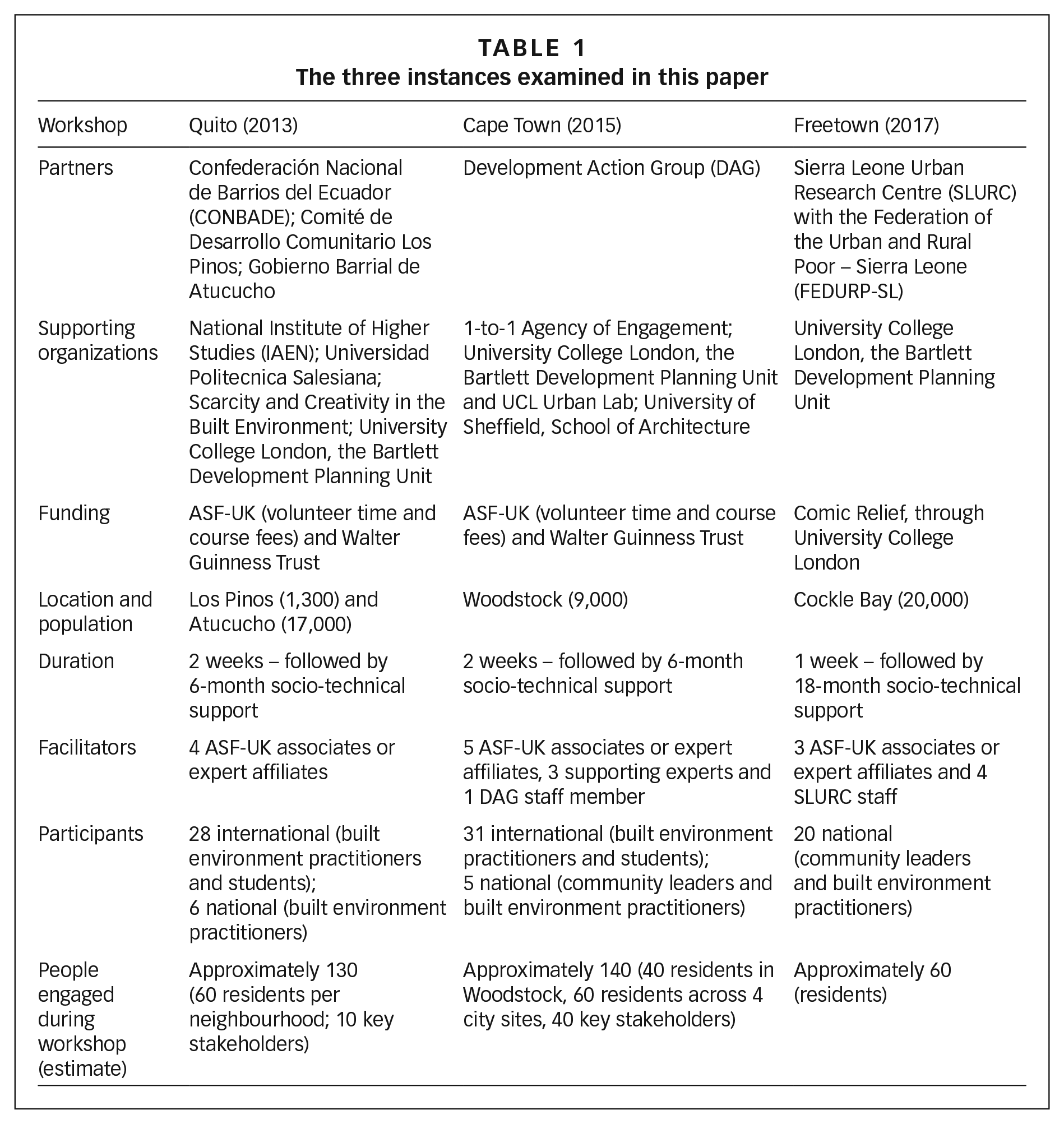
These shifts took place in very different contexts (as outlined in Table 1), which influenced our methodology in each instance.
The three instances examined in this paper
In each instance, reflective conversations have taken place at all stages of the process: from the formulation of workshop briefs, to field activities, to collaborative sense-making and writing. This paper draws on those conversations, using three types of sources. First, we revisited our own facilitators’ briefs – the preparatory notes that we developed before each workshop in dialogue with the project partners, which include guiding questions, open-ended plans of activities, maps and sketches, and ideas about documentation and analysis. Second, we drew from the field notes recorded during each workshop, including our own reflections on activities and encounters, as well as notes from collective conversations with project partners, workshop participants and the residents of the area. Finally, we relied on the published reports from each initiative, documenting the workshop process and findings.(22) Some of these documents tell the story of a place and its residents; others focus on the methods and tools utilized during the workshop.
The following section, grounded in this body of work, discusses our approach to incorporating a city-level perspective within the three workshops. In each instance, we describe the urban context and the workshop motivations, and reflect on our methodological approach to city-scale co-design – highlighting what we learned and carried forward.
IV. Three Instances
a. Quito, Ecuador
ASF-UK was active in Quito’s wider metropolitan area between 2013 and 2014, in partnership with local and national neighbourhood organizations and their support networks. The two-week participatory design workshop was led by ASF-UK in two local areas. By involving residents in the co-design of a public space plan for Atucucho and of a neighbourhood plan for Los Pinos, the workshop aimed to test how the Change by Design methodology could support the local implementation of Ecuador’s national development agenda, Buen Vivir.(23)
This was the first workshop where we experimented with the “city scale”. During the workshop we observed the metropolitan region from the perspective of the two local areas, and asked how the urban context shaped local dynamics – and how local actions affected the wider urban area.
The workshop took place at a critical time for Ecuador, when struggles for land and housing rights, like others, were being reframed around principles of collective wellbeing and sustainable living. Urbanization in Quito presented two main features: increasing migration from rural areas; and peripheralization of the poor from the city’s central areas to its outskirts and surrounding municipalities. Carrión and Espinosa argue that peripheralization was driven by changes to municipal policies. Through large-scale infrastructure projects (new airport, new urban rail network), alongside other policies and programmes, the municipality contributed to a land speculation process that made inner-city areas unaffordable to low-income groups, and deepened social and spatial segregation across the city and metropolitan region. For Carrión and Espinosa,(24) this dynamic demonstrates that for nearly two decades Quito’s local governments opted for dispersing low-income residents from the city into the surrounding areas and municipalities – rather than providing them with access to services in the city itself. As a result, between 1994 and 2012, Quito’s city centre lost 41 per cent of its population, which settled in areas with poorer access to collective infrastructure and facilities.(25)
In the meantime, Ecuador’s National Plan 2009–2013 sought to radically depart from Western and neoliberal conceptions of economic development. Linking to the cosmovision (cosmic worldviews) and claims of the Quechua peoples of the Andes, this Buen Vivir plan was based on the 2008 Constitution and created important opportunities to imagine more socially and environmentally just alternatives to dominant economic development models.(26) At the same time, some felt the plan fell short in terms of its local-level impact.(27)
In this context, ASF-UK partnered in 2013 with the national network of neighbourhood organizations CONBADE (Confederación Nacional de Barrios del Ecuador), its local affiliates in Atucucho and Los Pinos, and Universidad Politecnica Salesiana. Through a focus on Atucucho and Los Pinos, the workshop aimed to address the urban challenges, while also exploring how Buen Vivir’s agenda could be put into practice locally through collaborative collective planning.
Atucucho, located in the northwest section of Quito, on the slopes of Pichincha Mountain, began in 1988 through a so-called land invasion, and consolidated over the years through incremental improvements by residents, along with targeted interventions by the state and NGOs. Atucucho’s consolidation is described by Giulia Testori,(28) who emphasizes its innovative character, linking it to high levels of social mobilization and collective action. Atucucho’s consolidation included the formation of a Neighbourhood Government and Community Bank, which demonstrated residents’ ability to self-manage their local area. At the time of our workshop, Atucucho had an estimated population of 17,000 distributed over six districts. Since obtaining tenure regularization in 2010, the Neighbourhood Government wanted to keep local residents involved in improving the area, which the workshop was meant to contribute to through the co-design of public space.
Los Pinos, a 13-hectare peri-urban site, located in the Mejia municipality on Quito’s southern edge, was owned by the Ministry of Agriculture (MAGAP) and had been labelled as unsuitable for urban uses. It began with a 2006 invasion when 300 people settled on this unused plot. Residents agreed to build as little as possible, and rather focus on planning the occupation and seeking formal recognition. A Community Development Committee was set up, with representatives elected every two years. The partnership among the Community Development Committee, academics from Universidad Politecnica Salesiana and ASF-UK aimed to assist the committee in the planning process, using Change by Design methodology to produce design principles and guidelines for the settlement’s future.
Whilst preparing for the workshop, we decided to introduce a focus on the city scale to explore the connections between residents’ needs and aspirations, and the wider context for the two neighbourhoods’ improvements and upgrading. Change by Design’s work at the macro scale had two aims: first, to uncover and critically examine the implications of urban processes for the neighbourhoods – and particularly their impacts on the lives of residents; and second, to define design principles that could adapt to, challenge or leverage city-wide dynamics to address residents’ needs and aspirations with regard to the city and metropolitan region.
Following the Change by Design methodology, the workshop’s city-scale exploration was structured into three main moments. The diagnosis aimed to identify the city-wide dynamics and connections that residents perceived as most relevant to their lives. This included, for instance, distance to work and facilities, and the transport challenges; access to agricultural land; and the value residents attached to nearby rivers and forests. The dreaming stage imagined new relations between each neighbourhood and these wider systems, in ways that would better respond to residents’ desires for the future. As an outcome of this process, we articulated a set of guiding principles that could inform the co-design of public space for Atucucho and a neighbourhood plan for Los Pinos. For example, in Los Pinos, these stressed the maintenance of a balance between the urban and rural character of the area, and highlighted residents’ desire to participate in managing natural resources. The third stage of the workshop outlined possible ways forward and involved the discussion of design guidelines for selected spaces in each neighbourhood.
Our main methods of enquiry into connections between people’s everyday lives and city-wide dynamics consisted of key informant interviews and participatory mapping activities (Figure 3). Through overlaying residents’ housing histories onto maps of environmental conditions and future urban development plans, it became apparent that Atucucho and Los Pinos were affected by similar dynamics, albeit in different ways. For example, the polarization described earlier was pushing low-income residents to settle in the areas most vulnerable to natural disasters. Neighbourhoods situated on the slopes of the Pichincha, like Atucucho, faced increasing slope instability (erosion, landslides due to rain runoffs); those in the lowest parts of the city – such as Los Pinos’s valley – were increasingly suffering from flooding and diffused soil and water pollution. In summary, a focus on the city scale highlighted the importance of addressing these challenges both within and beyond local areas through networked initiatives that could address the social and environmental fragilities generated by regional urbanization.
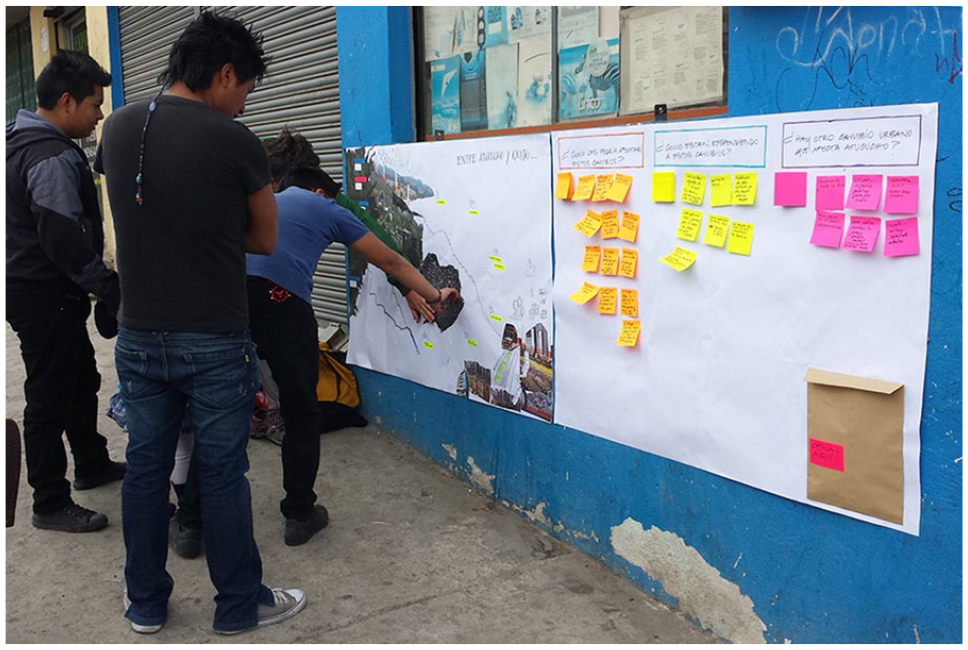
Mapping the impact of urban dynamics on Atucucho, Quito
While this focus on the city as seen from the two neighbourhoods allowed us and our partners to develop a shared understanding of the challenges facing both Atucucho and Los Pinos, co-design activities generated limited conversations about possible responses. Participating residents’ main interest was to generate a design for public spaces and a neighbourhood plan, respectively. Although there was general recognition of how city-wide and regional dynamics were impacting each neighbourhood, it was difficult to engage in creative, future-oriented conversations about how localized, community-led actions might affect change in the wider urban context.
This first experience of city-level co-design triggered a discussion within our team about the value of including the city scale as a permanent component of our methodology. This perspective had supported a shared understanding of the urban context and its relations to everyday lives. But at the same time, this experience highlighted the importance of including other voices and other concerns in the conversation.
b. Cape Town, South Africa
The second workshop built on our collective learning in Quito. In Cape Town, we continued experimenting with including a city-level perspective in our locally grounded initiatives. We assembled a more plural, multi-located perspective on both the city and the settlement, allowing for stronger links between participatory design and planning activities and other ongoing coalition-building processes in Cape Town.
ASF-UK’s partnership with the Cape Town-based NGO Development Action Group (DAG) in 2014 led to three collaborative workshops between 2015 and 2018. Each was embedded within one of DAG’s core programmes aimed at “enabling citizens coalitions to create change”,(29) and supported the forming of grassroots networks around specific urban development objectives. In 2015, the focus was on inner-city regeneration in the Woodstock area.(30)
Woodstock, Cape Town’s oldest suburb, lies next to the city centre, and has recently undergone a rapid and highly contested process of transformation. Historically, the neighbourhood provided Cape Town’s lower-income residents with access to affordable housing close to transport connections and economic opportunities. These conditions are symbolically and strategically significant in a city still characterized by deep social and spatial inequality. In the apartheid era, the 1950 Group Areas Act had enforced racial segregation, and Woodstock was one of only two areas in central Cape Town not to be affected. Jayne Garside described it as “one of the few multiracial spaces [surviving] the deliberate ‘whitening’ of South African cities during the Apartheid era”.(31)
By 2015, Woodstock was undergoing profound change, primarily via the rapid redevelopment of land and properties. In the early 2010s, the area saw a dramatic rise in investment by large and smaller-scale real estate developers, supported by the local government, resulting in a sharp rise in property prices. The largely Black and Coloured(32) lower-income residents of Woodstock were under great pressure to leave the area, either because of the rising cost of living, or because they were evicted from informally occupied land or houses. By the mid-2010s, these transformations had triggered large-scale social mobilizations, calling for more equitable and inclusive forms of urban regeneration.
ASF-UK started working in Woodstock in 2015 to support the Development Action Group’s Re-imagining the City campaign. This initiative brought together informal settlement dwellers from across Cape Town to discuss the city’s future in a series of dialogues and public forums. One outcome was a shared advocacy strategy that identified priority areas in the city, and demanded urban development interventions there that addressed the city’s extreme spatial, social and economic inequality. Woodstock was one of the prioritized locations. DAG initiated partnerships with grassroots groups and other NGOs based in Woodstock, to examine the changes in the area and reveal the aspirations of local residents. Through the localized Re-imagining Woodstock campaign, DAG aimed to make visible the perspectives of local people most in need of support. ASF-UK’s Change by Design workshop in 2015 aimed to contribute to this process.
Based on the Change by Design methodology, the workshop involved grassroots leaders and residents from Woodstock and across Cape Town, alongside representatives from local authorities and NGOs. Working groups approached a vision for Woodstock from different design entry points – dwelling, community and city – with one group exploring contextual policy and planning frameworks. Together they generated a manifesto of principles for Woodstock’s urban regeneration, which was used in a large action-planning workshop with representatives from government, academia, civil society and residents to co-design a more socially just urban regeneration agenda.
The workshop’s approach to the city scale was shaped by our ongoing methodological reflections, as well as by DAG’s strategic objective to strengthen its city-wide network and involve a larger coalition of stakeholders in discussing Woodstock’s future. Learning from our experience in Quito, we agreed that our city-scale activities should involve grassroots leaders and local residents from a range of Cape Town locations, focusing on their diverse ways of mobilizing around the policy and planning issues that affected them. We wanted to understand how Woodstock’s ongoing transformation related to other processes of change and contestation in the city, and to create opportunities for discussion of the future of Cape Town’s inner-city areas. The aim was to shed light on the strategic, city-wide meaning of Woodstock’s regeneration – not in a generalized and abstract manner, but from the practical perspective of those in Cape Town who suffered most from inequality and exclusion.
From ASF-UK’s perspective, this was a radical shift in our approach to city-scale work. Instead of focusing on the aspirations that Woodstock residents might have towards the city, we emphasized the expectations other urban dwellers might have for Woodstock. Activities were structured around Change by Design stages and the use of walking, mapping and storytelling methods. In each of the four focus areas, we asked grassroots leaders to take us for a half-day walk through their local area, showing us the places that had been at the heart of their struggles for housing and dignity. The walks engaged us with the particularities of their experiences and allowed for chance encounters and conversations with local residents who had been involved in the same struggles – all recorded through detailed field notes and transect drawings (Figure 4). At a later stage, these drawings and attached narratives formed the basis for a facilitated focus group discussion at DAG’s offices, involving the four groups that had guided us through their areas. Here, we revisited and compared their different stories of exclusion and mobilization, and co-designed a set of principles and guidelines to inform ongoing struggles related to Woodstock.
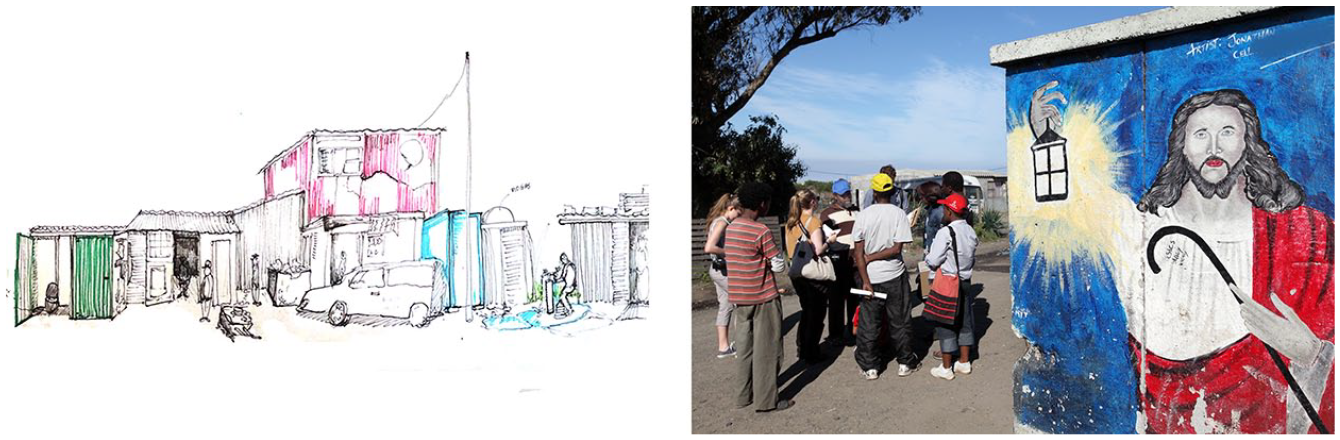
Transect walk in Egoli, Cape Town
Drawing on our reflective evaluations with partners, we learned that this approach to the city scale contributed significantly to DAG’s objectives to bring together stakeholders to reimagine Woodstock and the city. Developed in continuity with DAG’s approach, our city-scale work was based on the understanding that narratives about places play an important role in decision making. More inclusive forms of urban development require new stories about the city, grounded in a plurality of personal experiences and everyday lives. During the workshop, design methods allowed us to capture and share both personal and collective stories of mobilization, foregrounding residents’ own understanding of their place, the exclusion and violence they had endured, and their capacity to resist and propose alternatives.
Change by Design’s plural, multi-located approach to the city scale identified and connected a broad range of bottom-up responses to social and spatial segregation, informing the struggle for more inclusive urban regeneration in Woodstock. We found that this approach allowed the participatory planning and design process to contribute more effectively to coalition building and to the scaling out and up of a local initiative.
On the other hand, a lack of focus on residents’ aspirations limited our capacity to think about strategic, place-based actions that could challenge segregation in Woodstock and Cape Town more broadly. We attempted to address this limitation in our subsequent workshops and other initiatives.
c. Freetown, Sierra Leone
The third instance that we describe here brought together the learning from Quito and Cape Town. In Freetown, we worked with partners to construct a perspective on the city that was both localized and plural: a vantage point for observing both the urban context at large, and particular places within it. This allowed us to sharpen our collective understanding of both opportunities and barriers in weaving together local areas and transforming policy.
Since 2017, ASF-UK has worked in Freetown in partnership with the Sierra Leone Urban Research Centre (SLURC), the Federation of the Urban and Rural Poor of Sierra Leone (FEDURP-SL) and the Bartlett Development Planning Unit (DPU) of University College London. This began with a pilot workshop aimed at exploring how participatory design and planning processes could support the ongoing efforts of the federation and its allies to improve living conditions in informal settlements, while also promoting a more democratic planning system. The workshop marked the start of a long-term collaboration among ASF-UK, SLURC and FEDURP-SL. It centred on developing Community Action Area Plans (CAAPs) – community-led spatial planning documents that help local residents to articulate their needs and aspirations, and to plan and advocate for change. Since 2018, the CAAP process has been implemented in the settlements of Cockle Bay and Dworzark,(33) and is being tested again in the area of Portee/Rokupa.
In the 2017 pilot workshop we explored how the Change by Design approach could be adapted to Freetown, and began shaping the methodology that has since informed the CAAPs. Workshop participants included community representatives from several areas of the city, staff from the Freetown City Council and the Ministry of Lands, Country Planning and the Environment, and researchers from Njala University. The group utilized the Change by Design methodology to engage with the residents of Cockle Bay, a settlement located along the Aberdeen Creek in Western Freetown with about 540 households. The land, mainly owned by the municipality, has been occupied since the 1940s, although most of the current community settled here after the 1991–2002 civil war. Cockle was previously an important source of income, but has diminished as the local ecosystem has been damaged, and residents rely now on their close proximity to city-centre livelihood opportunities.(34)
Local challenges include severe poverty and a lack of basic services. In 2017, only 9 per cent of households had access to electricity; there was one toilet for every 129 people and one water tap for every 187.(35) The community has long been exposed to multiple hazards, most prominently flooding, and the Freetown City Council has often argued that Cockle Bay residents should be relocated to preserve and nurture the area’s ecological potential. At the same time, residents, in coalition with other Freetown groups, have demanded a shift in the local and national government approach to informal settlements. They have asked authorities to recognize residents’ capacity to address local risks, and to support them in upgrading their own settlements, in partnership with social and technical support organizations. Meanwhile, research has highlighted the need to regulate the real estate development taking place in higher areas of the city, where urbanization has reduced the capacity of the soil to absorb rain, causing extensive runoff that impacts coastal settlements like Cockle Bay.(36)
In response to these conditions, our pilot workshop and subsequent activities in Cockle Bay aimed to enhance local residents’ capacity to respond to the settlement’s problems – supporting their efforts to avoid evictions and promote community-led in-situ upgrading. We thus needed a creative design and planning process that addressed both local and city-wide issues affecting the area. We agreed with our partners that the workshop’s city-scale activities should focus on understanding how city-wide dynamics had affected Cockle Bay’s residents; and on identifying potential sites of action outside the settlement that could allow for addressing and changing the relations between Cockle Bay and the city.
Based on our own reflections and on SLURC’s ongoing work in Freetown, we decided that city-scale activities should involve representatives from informal settlement communities across Freetown, not just Cockle Bay. To help participants draw connections between the city and the everyday experiences of Cockle Bay residents, we asked the group’s participants to engage in a series of mapping and visioning exercises through the perspectives of key “personas”: fictional characters developed by SLURC and FEDURP-SL based on their understanding of life in Cockle Bay. Each persona illustrated different aspects of local residents’ experiences of the area and of the city.
As part of the diagnosis stage, we asked group participants to identify and draw on a Freetown map the urban processes that seemed most important to Cockle Bay’s residents. During the dreaming stage, participants agreed on their personas’ aspirations for the city and identified key places for intervention. In the developing stage, we imagined concrete interventions in each place as well as partnership strategies to support them. After prioritizing possible interventions, participants developed an action plan outlining potentials and limitations, timeframes and people involved (Figure 5).
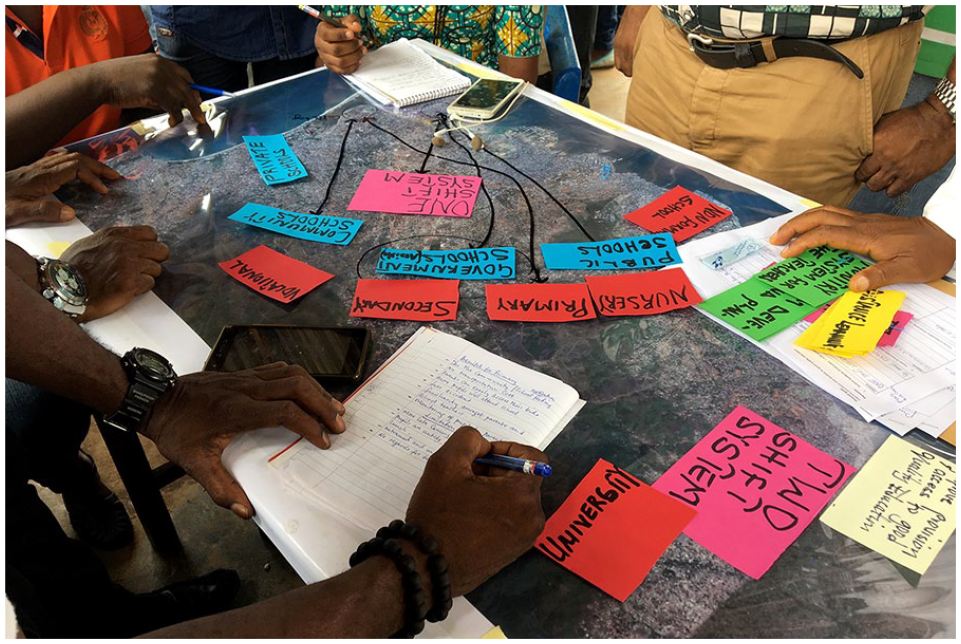
Mapping education opportunities in Cockle Bay, Freetown
This set of activities was effective in enabling future-oriented conversations about potential interventions that could take place at the city scale, without losing the connection with everyday place-based experiences. Workshop participants from other parts of the city mobilized their deep knowledge of the lives of informal settlement dwellers in Freetown, while also demonstrating great sensibility towards the particular experiences of Cockle Bay’s residents. Meanwhile, the Cockle Bay participants played a key role in raising and explaining these particularities, while also making connections to city-wide trends and processes shaping the way they saw and perceived the city. The use of personas combined with large-scale mapping exercises helped the group to recognize the role that social identities and personal circumstances play in the way people experience, and respond to, city-wide forces.
This simultaneously localized and plural approach to the city scale of design, focusing both on city-wide dynamics and on local particularities, has been adopted, as noted above, in subsequent Community Action Area Planning processes in Cockle Bay, Dworzark, and currently Portee/Rokupa. Each of these CAAPs includes recommendations for the specific settlement, as well as bottom-up proposals for the city.
As the work unfolds and the CAAP process extends to new areas of the city, we do not yet know how the proposals for the city advanced by different communities will come together, or what impact they will have, individually or jointly, on Freetown’s future development. The Freetown City Council and national ministries have been supportive of the CAAP as a planning instrument. However, from the state’s perspective the CAAP objective is to enforce centrally defined planning regulations at the neighbourhood scale – not necessarily to inform city-wide decision making from the bottom up.(37) While design methodologies have contributed to the formulation of a city-wide agenda grounded in the reality of local areas, this is a contested process and there is still a need to create concrete pathways for this agenda to affect city-wide deliberations.
V. Conclusions
For the last 10 years, ASK-UK’s Change by Design programme has aimed to create initiatives grounded in place-specific struggles for equitable urban development – while also giving continuity to specific learning questions that connect our work across places and partnerships. One such question concerns the creation of conceptual and practical tools that might support horizontal, vertical and deep scaling. A focus on the city level as a scale of co-design is one such tool. Over several years, we have worked with our community of practice to refine this tool in action.
This work has revolved around the idea that a city-level perspective that supports community-led informal settlement upgrading should be embodied and situated, so that scaling processes remain firmly grounded in everyday lives and in the experiences and concerns of local residents. The three instances illustrated in this paper each capture a different way of framing a situated point of view on the city.
In Quito in 2013, the process was successful in highlighting the connections between the areas of Los Pinos and Atucucho and the wider urban region. However, it did not contribute to building city-wide coalitions or to envisioning future city actions that could support local residents in achieving their aspirations. In Cape Town in 2015, we worked with partners to construct a view of the city based on a broader range of voices and concerns. Here our city-scale work was grounded in several neighbourhoods, connecting with their grassroots organizations and localized struggles, and exploring what could be learned from those struggles to inform localized mobilizations in Woodstock. This process was successful in establishing horizontal and vertical relationships between Woodstock and other localities and social mobilization processes in Cape Town. At the same time, it did not produce suggestions for concrete changes in the city that could have a positive effect for Woodstock’s residents. In Freetown in 2017, we mixed these approaches and positioned our work back in the local area, Cockle Bay, while at the same time bringing into it an assortment of other people who could think about the city together with local residents. After a few years of experimentation with our partners, we feel that this approach holds the potential to generate richer, better visions for the future of a local area like Cockle Bay, in contrast to the disembodied visions put forward by traditional top-down planning.
We started this article with the premise that the scaling of community-led informal settlement upgrading is central to the broader debate on scaling participation, and that design methodologies can potentially contribute to connecting localized, community-led upgrading initiatives outwards and upwards. We define design as a method of engagement rather than a discipline or a profession: a method that can support the co-production of situated, open-ended propositions for the future of a place. Based on this definition and on the experiences examined here, we observe two primary contributions that design can make to the scaling of participation.
The first has to do with the capacity of the design process to bring together the micro and the everyday with the macro and the long term. By beginning from the details, from drawing and narrating places that people inhabit on a day-to-day basis, design methods such as those employed by Change by Design enable residents to think about and reimagine the city in a way that is embodied and relational, rather than abstract and universal. It can be difficult to make sense of the enormous scale of the city and the sheer amount of technical information that makes up urban policy documents. In our experience, design’s embodied and partial perspective can become a powerful tool to enhance a sense of presence and agency within these otherwise ungraspable spaces and processes.
In Quito, for instance, our city-scale work started with the collaborative mapping of residents’ daily routes through the city, and their own stories of housing and displacement. Composing these maps together enabled residents to see themselves represented in relation to the whole city. In Los Pinos, these forms of representation supported conversations about city-wide dynamics such as the rising costs of living in central Quito (one of the reasons many residents had settled in the south); and the concentration of livelihood opportunities in the northern parts of the city, forcing many to commute daily for three hours or more. In turn, these conversations allowed for discussion of the importance of planning the Los Pinos area in a way that would let residents maintain collective control over the value of land moving forward; and of making space for basic livelihoods and subsistence activities within the settlement’s boundaries.
Since our Quito experience, we have continued to find this a powerful approach to the city in its emphasis on the interconnectedness of the personal and the strategic. It reveals possibilities for change that start from the micro and resonate at the macro scale.
Of course, design, for all its exploratory and imaginative nature, is not the only way to explore imagination, and several scholars have highlighted the role of storytelling in urban planning – describing planning itself as performed through stories(38) and fuelled by fantasies.(39) Yet design, intended as the collective and collaborative act of imagining and illustrating the future, does hold a unique capacity to nurture imagination and explore alternatives. We find that this potential in design is deeply connected to, and can serve, what Arjun Appadurai famously described as people’s capacity to aspire:(40) the cultural capacity to imagine pathways to achieve one’s aspirations, connecting present actions to future outcomes.
It seems to us that design can nurture people’s capacity to aspire, especially in contexts where this capacity has been profoundly challenged by the continued exposure to oppression and inequality. Design can allow people to deepen their understanding of their own context of living, and imagine alternatives for the future. In Freetown, the mapping and design processes described above played a key role in this regard. First, they created a set of conditions and practical tools that the residents of Cockle Bay and their peers could use to examine their living environments together. Second, they focused on collaboratively exposing the range of alternatives and alliances that might be available to them, in order to transform the city.
Finally, this article demonstrates that design methodologies can contribute to social mobilization, expanding the range of devices and rituals that grassroots groups and their support networks can put into practice to scale participation. If approached in this situated and collaborative manner, design can support participatory processes in connecting experiences of everyday life with broader visions for more emancipatory urban futures.
Footnotes
Acknowledgements
Change by Design is a collective endeavour and we are grateful to ASF-UK’s volunteer associates and expert affiliates, with whom we have thought and learnt over the years.
The work discussed in this article would have not been possible without the trust and friendship of our partner organizations and of the innumerable local residents and grassroots group members who have shared their stories and experiences with us.
Our gratitude extends to the editorial team for their guidance, and to the anonymous reviewers who both offered valuable comments on the manuscript.