




Abstract
While existing datasets and statistics provide a useful indication of progress towards meeting Sustainable Development Goal (SDG) 6, they are far from accurate and sufficient. There is a need for new and more disaggregated data to shed light on unequal service provision patterns, particularly for many informal urban settlements. This paper aims to address this need through a granular space and time-based examination of the diverse everyday practices in two lower-income settlements of Dar es Salaam. The findings reveal spatial and temporal variations at the inter- and intra-settlement scale while tracing differential and changing practices among poor women and men. The in-depth case study exposes important blind spots in policy and planning, provides wider lessons for achieving more equal and sustainable access to services and developing more responsive policy and planning approaches, and emphasizes the value of local data collection.
Keywords
I. Introduction
The most recent global assessment by the Joint Monitoring Programme (JMP)(1) estimates that worldwide 844 million people still lack access to basic drinking water services and 2.3 billion people to basic sanitation. A large proportion of those inadequately served live in sub-Saharan Africa.(2) As part of the United Nations 2030 Sustainable Development Agenda, the water, sanitation and hygiene (WASH)-related Sustainable Development Goal (SDG6) aims to “ensure availability and sustainable management of water and sanitation for all”, with Target 6.1 specifically seeking “universal and equitable access to safe and affordable drinking water for all” by 2030.(3) This constitutes a significant shift from the less ambitious (and heavily criticized(4)) Millennium Development Goal (MDG) for water and sanitation, which only sought to halve the population lacking improved access. Notably, SDG6 incorporates previously excluded issues of service accessibility, quality and affordability in a newly established monitoring category of “safely-managed” WASH facilities. However, the JMP stresses the need for new and more disaggregated data to shed light on unequal service provision patterns, particularly for informal urban settlements. At present, there are insufficient data on service affordability and safe pit emptying/excreta management of onsite sanitation systems. And estimates for water quality are only available for three out of eight SDG regions, which together account for just 34 per cent of the global population.(5) For urban areas, data about service access, largely collected through surveys and by the utility, have two major shortcomings: first, data are not disaggregated by income level or neighbourhood and thus are unable to provide insights into differential access within a city; second, administrative data are largely skewed towards formal provision and exclude information on the informal service providers many lower-income urban residents rely on. As current monitoring masks contextual variations and unequal consumption patterns, several scholars have emphasized the need for localized, in-depth data to monitor efforts and provide the basis for enhancing access without neglecting the WASH needs of urban residents in lower-income settlements.(6)
Water supply and sanitation (WSS) in Dar es Salaam is well researched and documented. Several studies highlight inequalities in how water is provided and accessed in the city, demonstrating the insufficiencies of policy initiatives implemented by government, private sector providers, external support agencies and other key players (henceforth referred to as policy-driven practices). At the same time these studies emphasize the importance of alternative water supply arrangements, including community-managed systems and informal private provision to enhance access to services.(7) Research has further increasingly focused on everyday practices (i.e. diverse and multiple activities of the urban and peri-urban poor to meet their WSS needs) in different parts of Dar es Salaam, but without providing detailed insights into the dynamic trajectories of practices in specific sub-wards.(8)
This article aims to address these gaps by going beyond a static snapshot and offering a granular space and time-based exploration of how lower-income urban and peri-urban dwellers meet their water needs. While the paper refers to sanitation, it focuses primarily on everyday practices to access water. In response to the need for new (and more fine-grained) data, zooming into the diverse everyday practices in a particular space over time not only sheds light on rapidly changing realities and challenges, but further produces invaluable insights into how access in lower-income settlements can be expanded more fairly and sustainably. The next section provides background information on Dar es Salaam and the provision of water supply and sanitation in the city. This is followed in Section III by details regarding the study’s methodology. Section IV reports the study’s findings on the range of water supply arrangements and everyday practices in two lower-income city sub-wards. This is followed by a discussion in Section V and, in Section VI, conclusions calling attention to important implications for meeting SDG6.
II. Background
a. Dar es Salaam
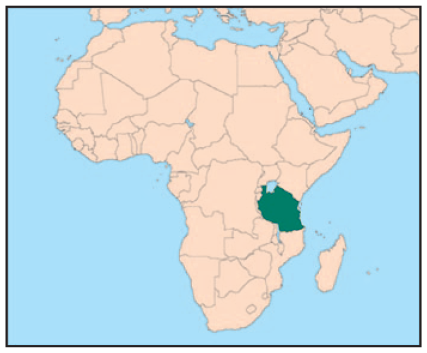
With an estimated 5.2 million inhabitants,(9) the coastal city of Dar es Salaam is the most populous city in East Africa. Colonization by European powers left its imprint on the city, in terms of the physical shape as well as service provision, with today’s layout and building structure resulting from colonial land laws. With an average 5.8 per cent growth rate per year, well above national figures, Dar es Salaam’s population has grown steadily over decades, particularly in informal areas that expand and emerge in close proximity to work opportunities, largely without the provision of infrastructure and services.(10) Nowadays, approximately 75 per cent of the city’s inhabitants, predominantly lower-income dwellers, live in informal settlements.
The Dar es Salaam Water and Sanitation Authority (DAWASA), a public utility, largely draws its water from the Ruvu river, approximately 80 kilometres from the city, and claims to serve an estimated 76 per cent of the population through household water connections and public water kiosks connected to the network with varying levels of service (Map 1).(11) Apart from limited coverage and regularity, the utility system suffers from losses of revenue; approximately 48 per cent of the water produced at the city’s three surface water treatment plants is lost to payment due to broken pipes, illegal connections and other issues.(12) In some settlements lacking utility provision, municipal councils and NGOs have established distributed borehole schemes, managed by local communities. Since the late 1990s, the number of public water kiosks and distributed systems has increased significantly, with estimates of 510 kiosks and 280 distributed systems.(13) Many low-income Dar es Salaam residents, however, continue to rely on informal service providers, including owners of private boreholes, neighbourhood resellers, mobile vendors and tankers. These providers largely access water through means other than the utility, with a heavy reliance on the fast-depleting groundwater from Dar es Salaam’s coastal aquifer.(14) In addition to a small number of utility-operated boreholes, 2016 estimates indicate more than 10,000 boreholes across the city, with abstraction quantities amounting to almost half the surface water extracted by the utility.(15) Sanitation provision in the city is even more dire. With less than 12 per cent of the population connected to underground sewers, the majority of residents rely on onsite sanitation in form of pit latrines, and approximately 10 per cent have access to flush toilets connected to soakaway pits or septic tanks.(16)
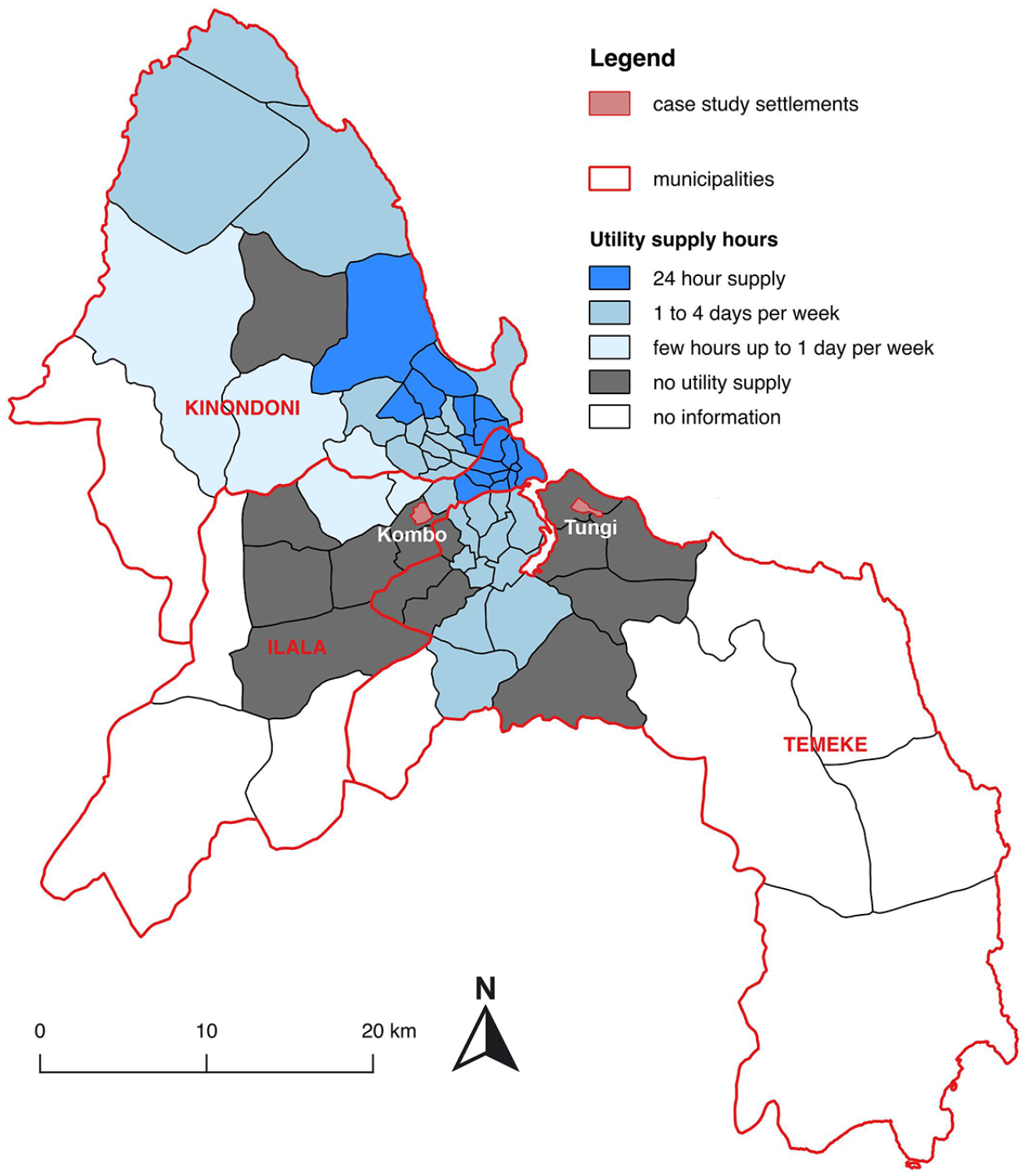
Coverage and frequency of utility water supply in Dar es Salaam
b. The case study settlements
Kombo and Tungi are two sub-wards(17) in different Dar es Salaam municipalities (Map 1) that house lower-income residents. While Tungi is closer to the city centre, until the completion of a bridge in 2016, access depended primarily on a dilapidated ferry service across the harbour. Kombo, with approximately 9,950 households in 2012, is more urbanized, with higher density, and for the most part has been incorporated into the urban core. Tungi, with 2,230 households in 2012, is less densely populated and still shows considerable peri-urban features,(18) but vacant land is becoming scarce and land values are fast increasing. While the two settlements are distinct in many ways, both have been undergoing a process of urbanization characterized by a continuous influx of people and densification of built-up areas, while continuing to lag behind in the provision of adequate infrastructure and services.
In the absence of sufficient formal provision, residents in both settlements access water through a set of practices that have evolved since the settlements’ inception. With a few exceptions, the range of infrastructure and technology is very similar. However, arrangements for how these facilities are run and managed vary, with implications for people’s access to services. Most residents rely on water facilities away from their dwelling and compound (offsite). Only a small minority benefit from onsite access, with connections to a borehole or to the utility network, or to their own boreholes or wells. Offsite access ranges from borehole distribution points (DPs) to utility network DPs, neighbours’ facilities and water tanks. In both settlements there are mobile vendors, including both tanker trucks and small-scale water vendors using bicycles, pushcarts and donkeys.
III. Methods
This article draws on research conducted in Dar es Salaam since 2014, and carried out in partnership with the Centre for Community Initiatives (CCI), a Tanzanian NGO that promotes pro-poor policy and planning and works with the Tanzanian Federation of the Urban Poor (TFUP). Significant components of the research were co-developed and delivered with CCI, particularly fieldwork in lower-income settlements, which in turn strengthened local capacity to generate knowledge that might contribute to enhancing access to services. Case study settlements were selected following interviews with local stakeholders, conversations with CCI and other local contacts, and exploratory visits. These were limited to two settlements, namely Kombo and Tungi, to allow for in-depth exploration. The objective was to choose settlements that shared some features, but also showed distinct characteristics, offering a comparative element. Settlements were selected based on the following criteria:
Distinct features in relation to location and level of urbanization
Evidence of an evolution of diverse practices involving a range of actors to improve provision of water supply and sanitation across the settlement
Residents experiencing various levels of urban water poverty
Residents involved in a variety of income-earning activities
Some residents involved in collective action/community collectives
The research involved numerous trips on my part to Dar es Salaam between 2014 and 2019. In-depth fieldwork was conducted between 2014 and 2016, with further updates during a visit in 2019 and through continued collaboration with CCI. Fieldwork to explore everyday practices consisted of transect walks, mapping of water supply facilities, focus group discussions (FGDs) with residents and local leaders, observation and interviews with key informants. The latter comprised ward and sub-ward government representatives (one ward councillor, one ward health officer, one ward community development officer, one ward assistant, four ward and sub-ward executive officers, two sub-ward chairs), six local TFUP leaders and three water committee members. These conversations initially focused on the development of each settlement, past interventions, and existing facilities and services. Regular ongoing dialogue made it possible to follow up on and triangulate insights gained through other means.
The mapping was conducted by teams of community mappers through a tripartite process(19) that involved: (1) capturing the location of water supply infrastructure on a printed satellite map of the settlement; (2) recording water supply infrastructure data on an online georeferenced platform using smartphones(20); and (3) compiling survey sheets to chart the history, current operation and management of water supply facilities through interviews with operators of water supply facilities. This went beyond capturing the existence of infrastructure and facilities, as undertaken by the above-mentioned JMP method, and offered insights into the management, maintenance, regularity, reliability and affordability of water supply facilities. It built upon CCI and TFUP’s mapping and enumeration efforts to empower local communities, based on a community mapping initiative by WaterAid Tanzania in collaboration with local partners prior to the establishment of TFUP.(21) Value was added through the accessible digitization of mapping data and a specific focus on the evolution of water supply facilities.(22)
Discussions with key informants and the mapping provided the basis in each case study settlement for one FGD with a diverse group of participants to discuss the range of practices that had emerged over time. The FGDs consisted of 15 and 11 participants in Kombo and Tungi respectively and were composed as follows: women and men between 18 and 65 years old; from different parts of the settlement; long-term residents and newcomers; landlords, live-in relatives and tenants; with diverse access to services; and both members and non-members of local collectives. The discussions largely focused on the range of people’s practices and explored key factors influencing local action to improve access to services. The paper further draws on insights from 50 in-depth interviews with residents in Kombo (26) and Tungi (24) that explored individual household trajectories. This engaged a diverse group of participants based on the same diversity criteria used for the FGDs. An overall sensitivity towards diverse identities and relations as well as spatial and temporal specificity, using large-scale maps and timelines, revealed how adequate and sustainable different practices are, and for whom.
IV. Everyday Practices in Kombo and Tungi
Table 1 shows the range of practices to access water in Kombo and Tungi, grouped by water supply arrangement. To put the costs into context, the majority of households in both settlements earn on average less than TSh 200,000 (£74.73)(23) per month. As is evident in the following sections, who manages water facilities at the local level influences the price, but also other important aspects of service provision and access.
Access to onsite water facilities in Kombo and Tungi is low compared to ward-level figures,(24) limited to approximately 10 per cent and 5 per cent of households respectively according to a 2016 CCI household survey. Most people rely on offsite water facilities, most commonly purchasing water by the bucket from a borehole DP, but 35 per cent (Kombo) and 69 per cent (Tungi) use more than one source to meet their needs. Over the years, the distance to water facilities in Kombo and Tungi has decreased from a two-hour walk in the 1990s to 0–15 minutes in 2019.(25) Nevertheless, water facilities are not distributed equally in space (Maps 2 and 3(26)) and long queues can prolong collection time. There is no utility water in Tungi, and in Kombo it is restricted to areas close to the utility network. As discussed below, both settlements rely substantially on private and public boreholes. These distributed systems pump groundwater to overhead storage tanks, and water flows by gravity to the connected DPs. Certain private boreholes only have one DP, usually at the location of the borehole. Public systems, and the more commercial private ones, have several DPs across the settlement. Some residents purchase water for drinking and cooking from tanker trucks (Kombo) or small-scale mobile vendors (Tungi).
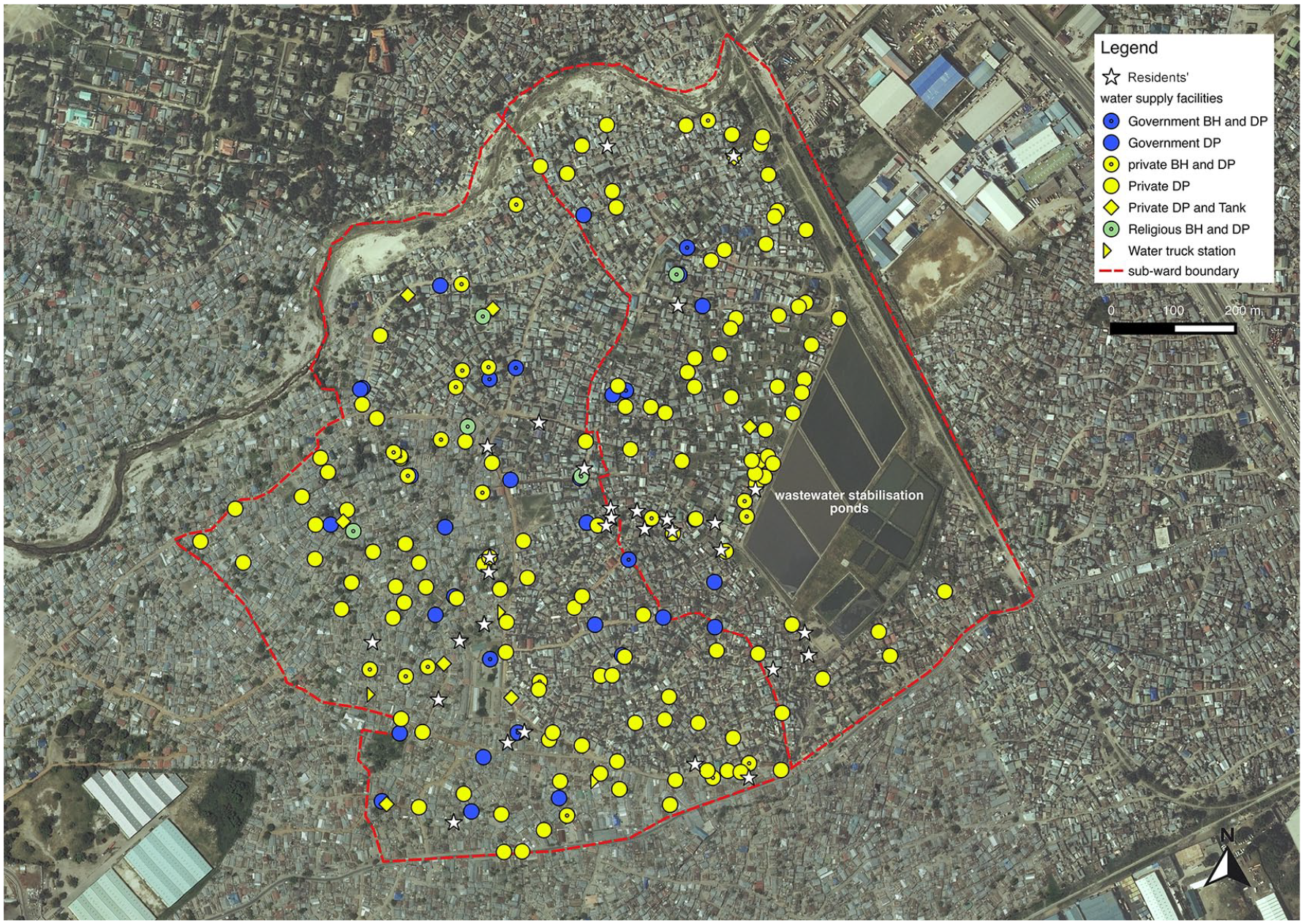
Water supply facilities in Kombo
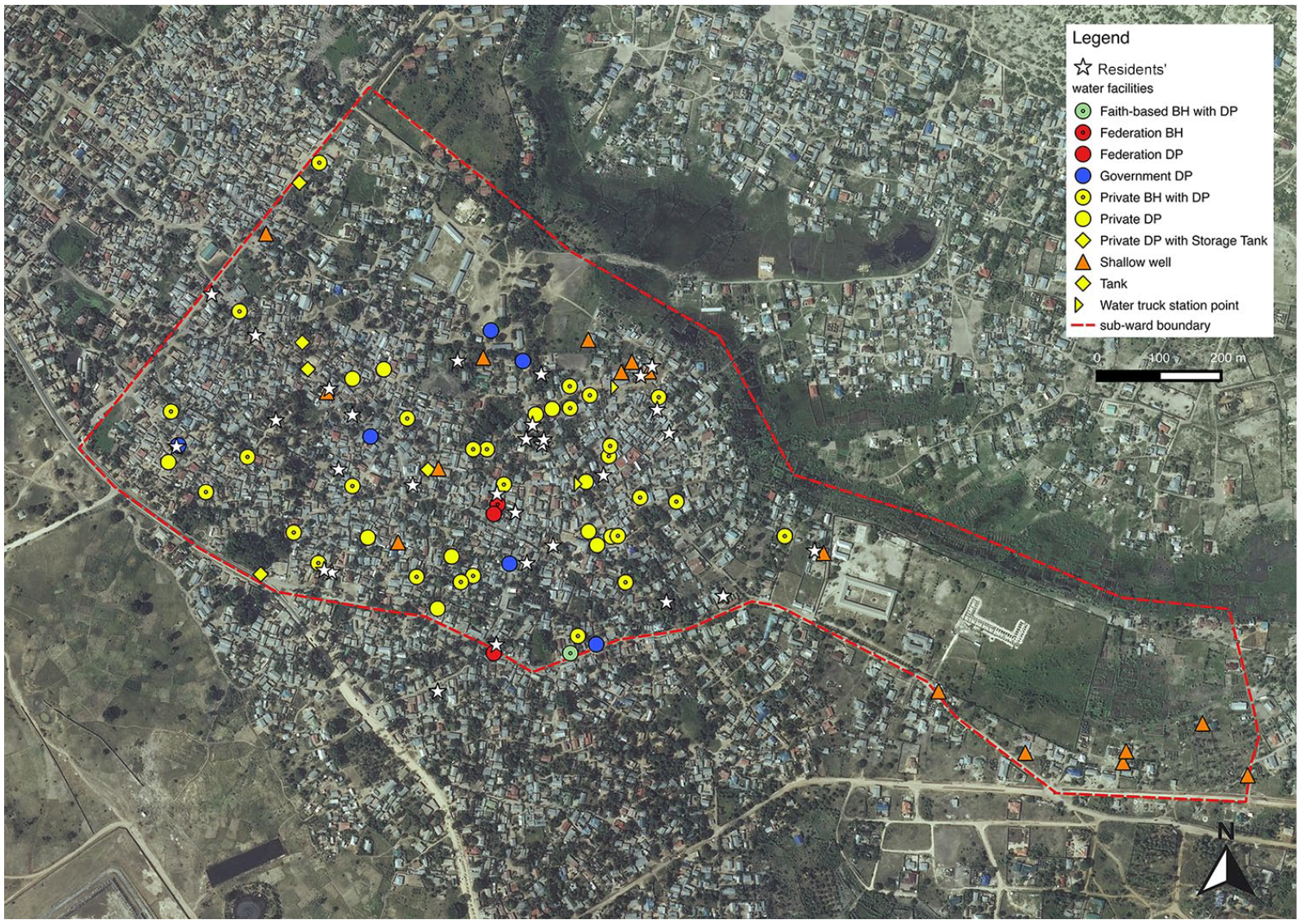
Water supply facilities in Tungi
Onsite sanitation is seen as a household responsibility by residents and government alike. Most households use simple pit latrines, the cheapest available option. Because of limited space, particularly in Kombo, and the informal nature of development and construction in both settlements, pit latrines are frequently too close to dwellings and water sources and many are of poor quality. Even where pit latrines have been constructed safely, irregular cleaning and unsafe, unhygienic pit-emptying practices(27) have led to contamination of the local environment, including water sources, and exposure to faecal waste. Water testing of selected boreholes and DPs in both settlements has detected unsafe levels of coliform contamination, particularly in Tungi,(28) and there is a high incidence of cholera, particularly during the rainy season. While the municipality undertakes regular water quality tests (especially during cholera outbreaks), these are only done at boreholes and fail to detect contamination at DPs. To address sanitation inadequacies in Kombo, since 2014 240 toilets have been connected by CCI, in collaboration with the utility, to a simplified sewerage scheme, serving approximately 8.6 per cent of residents in the newly created sub-ward, with concrete plans for further expansion.
The following subsections provide a more detailed discussion of everyday practices as per the water supply arrangements presented in Table 1.
Water supply practices and their costs in Kombo and Tungi
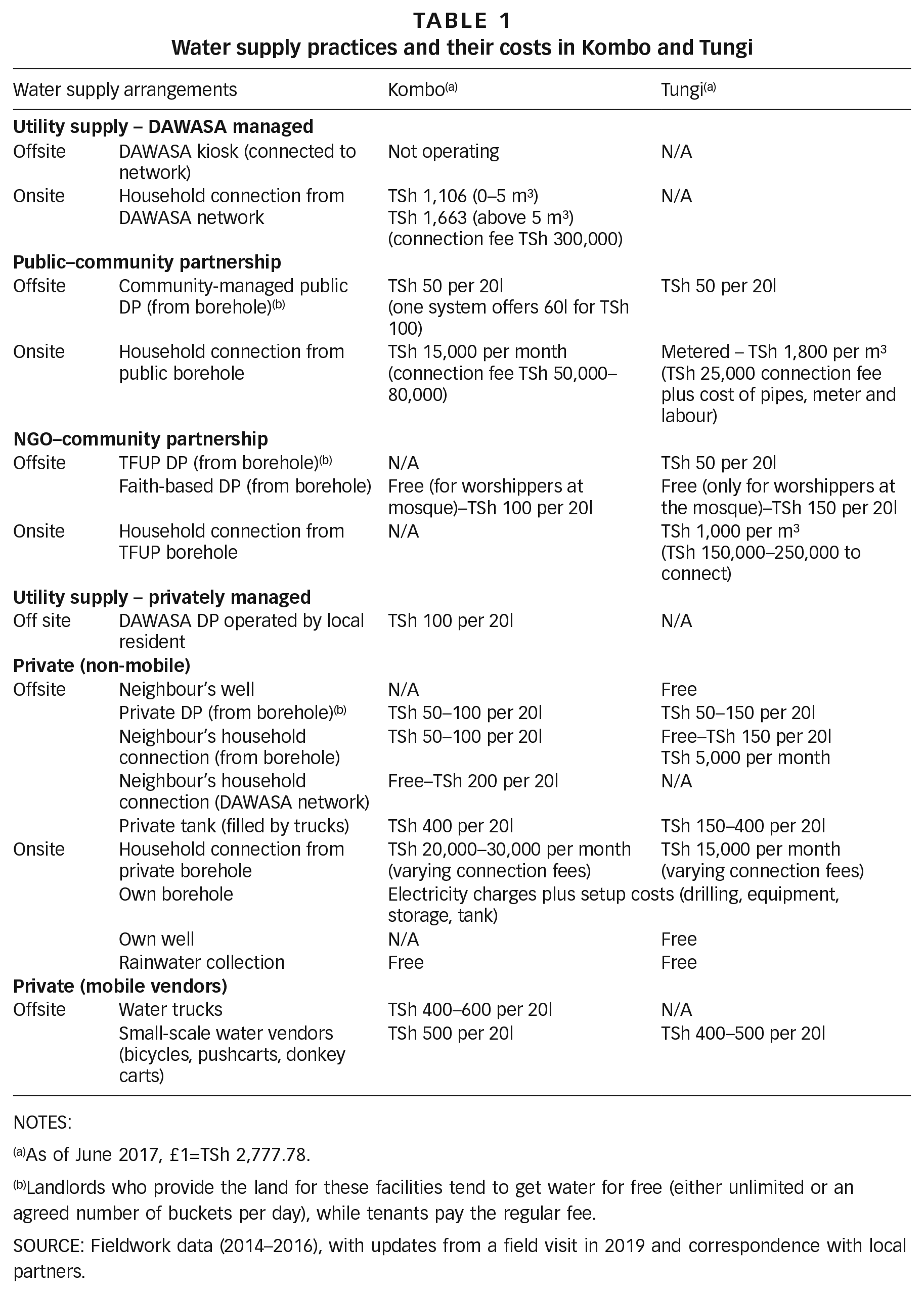
NOTES:
As of June 2017, £1=TSh 2,777.78.
Landlords who provide the land for these facilities tend to get water for free (either unlimited or an agreed number of buckets per day), while tenants pay the regular fee.
SOURCE: Fieldwork data (2014–2016), with updates from a field visit in 2019 and correspondence with local partners.
a. Utility supply
As stated above, there is no utility water supply in Tungi, and it is restricted to certain areas of Kombo, either through household connections managed by the utility, or by the bucket through privately operated DAWASA DPs. A small number of landlords established utility connections in 2010 through an intervention that enabled connections at a highly subsidized fee of TSh 15,000 (£5.40). Utility supply is largely confined to the northern and northeastern parts of the settlement close to the network mains, and only those within a 50-metre radius can connect, thus excluding a large proportion of Kombo residents. Even those connected suffered from unreliable service and were often forced to seek other sources until the service in Kombo was restored in 2015.
Further pressure was placed on the utility following the new Tanzanian president’s pledge in 2015 to ensure access to clean water, with particular emphasis on lifting the burden on women.(29) This has since led to improved service hours and Kombo residents regaining trust.(30) Since 2016, it has become easier to apply for a utility connection, now possible locally at the sub-ward office, resulting in a steady increase in connections.
Direct utility access (DAWASA managed)
According to the 2002 National Water Policy (NAWAPO), household connections are not pro-poor measures and are thus not subject to concessions.(31) In 2015, household connection fees in Kombo increased by 50 per cent, from TSh 200,000 (£72) to TSh 300,000 (£108).(32) Monthly instalments serve to make connections more accessible, but the fee remains well above the capacity of most households and is up to six times higher than connection charges for distributed borehole systems (Table 1), which are already prohibitive for many. Homeowners with lower and irregular incomes especially fear an inability to manage repayment alongside other monthly bills. Terms and conditions are entirely determined by DAWASA and not amenable to individual circumstances.
The quality of DAWASA water is perceived as very high and until 2015, the utility water tariff was among the lowest in the city. Despite the president’s urge for lower water tariffs to reach more people, DAWASA increased its by 50 per cent in December 2015, to TSh 1,663 (£0.60) per cubic metre. But the first 5 cubic metres are charged at a lower rate of TSh 1,106 (£0.40)(33) each. It is still less costly than most other systems in Kombo and, considering the superior quality of the water, it offers the best value for money. Even though utility tariffs are regulated, Kombo reflects different local realities. Most households with a DAWASA connection pay the official utility tariff, but some with an old connection do not pay at all because of a broken meter. The households with broken meters often also grant access to neighbouring households without charging them.
Utility water through intermediaries
Households without a DAWASA connection in Kombo can still access utility water, either informally through other people’s connections, or through authorized DAWASA DPs, and they do so at differing costs. Although DAWASA does not technically permit residents with regular utility connections to sell water, many do so informally at a marked-up price of TSh 100–200 (£0.04–0.08) per 20 litres. Depending on how much these residents sell, this can cover part or all of their water expenses. DAWASA DPs are metered utility connections introduced in 2015 on the plots of private individuals who are authorized by the utility to sell water. In theory, as instructed by DAWASA, these facilities offer affordable offsite access at TSh 50 per 20 litres. In practice, so as not to compromise the operation of the community-managed public borehole systems, which charge the same for lower-quality water, these private operators raised the local tariff to TSh 100 per 20 litres without communicating this to the utility. Initially, with only a few DAWASA DPs and a limited number of household connections, private operators could make a healthy profit from selling water, exceeding the average household income. While an increase in household connections has lowered demand, in 2016 these private operators still managed to cover their monthly water bills and retain a profit. This might change if household connections continue to rise. Residents relying on utility supply continue to be vulnerable to service disruptions. In 2019 the system was still prone to breakages.(34)
Kombo also has DAWASA kiosks established through a World Bank-funded project. These are built structures with an overhead storage tank that supply water from the utility network, but in 2019 there was still no evidence of them ever operating. At DAWASA-operated kiosks in other settlements, residents can access utility water at TSh 50 per 20 litres. However, the government’s eagerness to shift the onus of serving the poor to third parties can subject customers to unregulated price structures, as evidenced through the DAWASA DPs.(35) The involvement of private intermediaries not only leads to significant price inflation, but these intermediaries further define their own access terms and conditions, e.g. with regard to opening hours and quantities.
Tungi is not connected to the utility network; nor does the area receive utility water through intermediaries. However, DAWASA has established a new well field southeast of Dar es Salaam that is supposed to supply most residents of the Temeke and Kigamboni districts through a water network in the future. In 2019 the project was still incomplete, and it remains unclear how Tungi residents might benefit, particularly since the capacity of the new scheme seems much lower than originally anticipated.(36)
b. Public–community partnerships
Kombo has three public boreholes, two constructed with the assistance of Plan International (in 1998 and 2007) and a third entirely paid for by Ilala Municipality in 1998. Each system has multiple DPs across the settlement where water is sold by the bucket. Each public borehole scheme is under the jurisdiction of the municipality, which provides occasional technical support, and is managed locally by water committees consisting of elected community members. There is limited opportunity for inclusive resident participation. Committee members tend to be well-connected residents and local leaders and are thus not representative of the more marginalized. DPs are operated by water sellers hired by the committees and spending decisions need municipal approval. Since inception, these systems have established approximately 130 household connections, installed by a committee-appointed technician and paid for by the customers, who are subsequently charged a monthly flat rate.(37) Tungi established one public borehole system in 2002, with support from WaterAid, with five DPs and 170 metered household connections by 2016.(38)
Cost and supply capacity
To cater to different income levels, public borehole systems in Kombo and Tungi sell water through household connections and by the bucket through DPs across the settlements. While the DPs clearly represent a policy-driven practice as stipulated in NAWAPO, the household connections have emerged due to local demand and as a cost-recovery mechanism. Although these schemes are supposed to be self-sufficient, revenues are often inadequate to deal with unforeseen circumstances. A broken pump left one public borehole in Kombo defunct since 2009, forcing affected residents to seek alternatives. In Tungi, the public system faced long periods of service suspensions until 2012, once because of a stolen motor, another time due to a land dispute. To enhance their revenue, water committees are keen to augment the number of household connections as DPs make increasingly negligible profits. In 2015 the revenue from household connections for Tungi’s public borehole system was almost seven times that from all DPs. However, without increased storage capacity, this increases the pressure on an already overstretched system, thus causing existing customers to compete over limited amounts of water, particularly during power cuts, and with a growing customer base.
The proficiency of these systems is noticeably different. In Kombo, they operate without water meters. This makes them vulnerable to inefficient operation and revenue collection as there is no record of how much water is distributed. To augment their income informally, DP water sellers (who tend to earn a small commission on their sales) declare a lower take to the committee and keep part of the revenue. While this does not affect customers directly, it reduces public revenue that could be invested in service improvements. Rising operation and maintenance costs are often dealt with by raising household tariffs. The public system in Tungi raised the price per cubic metre from TSh 1,000 to TSh 1,800 (£0.36 to £0.65) in June 2016 to cope with growing electricity charges, possibly affecting households with lower incomes. In 2014 one public system in Kombo increased the monthly flat rate by 50 per cent from TSh 10,000 to TSh 15,000 (£3.60 to £5.40), disadvantaging those with lower consumption levels.
While not every household in the two settlements benefits directly, evidence suggests that a public system brings settlement-wide advantages in helping to keep local water prices down and limiting the marketization of water by private providers. At the time of writing, public borehole systems represent the most affordable option in both settlements for gaining a household connection (Table 1), provided people live near the water mains. However, the connection fee is still an impediment, particularly for households with low and irregular incomes. In cases where tenants live on the same compound as their landlord, they are able to share the convenience of onsite water access, and the monthly fee is divided by the number of households. While this tends to lower water bills, service improvements often go hand in hand with rent increases that leave tenants worse off financially, forcing some to look for cheaper accommodation with poorer access to water.
None of the public schemes has the capacity to guarantee a safe, sustainable service over time, putting customers at risk from unsafe water. As pipes are prone to breakage, and frequently run through polluted drainage channels, the water is susceptible to contamination. But local monitoring practices are unable to detect this and residents’ judgements regarding water quality are largely based on visual appearance and taste.
c. NGO–community partnerships
There are two types of NGO–community partnerships in the settlements, with some borehole systems operated by faith groups and one managed by TFUP. Both types have received NGO support and are managed by community members. Both settlements have a few boreholes attached to mosques and established with the assistance of the African Relief Committee of Kuwait. These comprise a borehole with an overhead tank and a number of onsite taps. Most faith-based systems are for the exclusive use of worshippers and the families living onsite, while some operate on a commercial basis, selling water by the bucket to residents irrespective of their religious affiliation.(39)
After a settlement enumeration in Tungi identified the need for better access to water, TFUP implemented a small borehole system in 2011 through a loan from the national federation fund. In 2016, the system had three DPs and six household connections operated by a water committee of six TFUP members. As in the public borehole systems, residents are recognized as customers but significantly fewer households benefit. While there is potential for more inclusive water supply, TFUP’s ability to sustain the system, let alone extend it to reach more residents, is restricted as they struggle to meet the monthly loan repayments. The limited number of household connections offer water at a very affordable price (TSh 1,000 [£0.36] per cubic metre) but generate little revenue, and powerful private providers have been trying to sabotage any increase in their number to minimize competition.
d. Private non-mobile provision
This category includes onsite practices of self-provision whereby individuals have set up their own water supply either with onsite connections to a private borehole, or with their own well, borehole or tank. This category further encompasses all the practices that rely on offsite access to different private sources (wells, boreholes, storage tanks or neighbours’ household connections).
Self-provision and commercial water providers
With 27 private borehole systems and 19 shallow wells (and a significant presence of mobile water vendors, as discussed below), in 2016 Tungi residents accessed water predominantly through private facilities. At that time, Kombo had over 20 private boreholes and more than 150 DPs. In both settlements, a few households have managed to invest in their own well or borehole from savings or with the help of family members, primarily to meet individual water needs. Loans are predominantly used for income-earning opportunities rather than water supply improvements. Setting up a borehole is expensive (TSh 1 million [£360] and above), and installation costs, which usually need to be paid upfront, are an impediment for many households. Wells or household connections require less investment. However, some residents have reached more manageable agreements. A landlord in Kombo negotiated to pay for his borehole construction in instalments. Those who succeed in establishing their own water source commonly venture into selling water to recover costs. In a few cases, it generates additional income and can develop into a small business if water supply in the neighbourhood is scarce. While the cost of public water supply has some influence over private tariffs, fees paid at private DPs can vary, e.g. customers able to pay more can get preferential treatment. Moreover, if residents perceive a private borehole to supply better-quality, less salty water, this is reflected in a higher price. (However, people’s perception is not necessarily a reflection of the actual quality of water, and private boreholes are equally at risk of supplying water with faecal contamination.)
Insufficient public water supply in Kombo and Tungi has enabled the water vending business to flourish, with a significant increase in private boreholes and DPs between 2010 and 2016 (18 boreholes and 118 DPs in Kombo, and 10 boreholes and 21 DPs in Tungi). Both settlements feature commercial boreholes with multiple DPs and household connections. Kombo particularly has seen an emergence of entrepreneurs from outside the settlement engaging in the local water-selling business. In certain cases, private supply outperforms public supply if the vendors can provide a more reliable service; this led to two public DPs in Kombo closing down. The water-selling business in Tungi is less developed but is nonetheless increasing. In 2008, the government announcement of a planned development in the area and subsequent stop order stalled local development for a few years, including water supply improvements. But since 2010 the settlement has witnessed a steady growth of private non-mobile vendors and in 2016 most households in the settlement relied at least partially on private facilities.
Private household connections and wells
Households with an onsite connection from a private borehole pay a monthly flat fee, and borehole owners do not allow them to give water to residents outside of the compound. Since most private borehole owners live locally, it is difficult to circumvent this. Some households depend on their neighbours’ facility to access water and are thus subject to their access terms. Most households pay their neighbours for water, largely in relation to local prices based on the quality of water, but Tungi further demonstrates examples of benevolent neighbourly behaviour where some landlords with a metered household connection grant free access to others in need, a practice no longer evident in Kombo. These arrangements are usually based on close social ties. Wells used to be important in both settlements, particularly until the late 1990s when the local water supply was extremely limited. In Kombo, they disappeared with increasing urbanization. But there were still more than 15 wells in Tungi in 2016, predominantly in the lower-lying area where groundwater levels are higher, and they continued to play an important role in meeting non-drinking water needs or serving as a backup facility. Even though they are privately owned, most are outside of people’s compounds so that others can access them unconditionally.
e. Private mobile vendors
Mobile vendors are the most expensive water providers in both settlements, with trucks and small-scale vendors charging TSh 500 (£0.18) per 20 litres. In Tungi, small-scale water vendors using pushcarts, bicycles and donkeys are quite prominent; in Kombo, tanker trucks are the dominant type. While some households in other low-income settlements rely exclusively on mobile vendors for their water needs, this is not the case in Kombo or Tungi. Mobile vendors still play an important role, however, particularly to meet drinking and cooking needs (for approximately 37 per cent of households in Kombo and 50 per cent in Tungi).
Reliance on mobile vendors is partially conditioned by spatial and temporal aspects. In Kombo, residents near DAWASA water supply only use mobile vendors when the utility supply is insufficient. In Tungi, some households turn to mobile vendors when their usual sources fail to meet their water needs, while others use them regularly. Household composition and structure can further determine residents’ use of mobile vendors, with single households relying on them less than families with young children.
Tanker trucks
Tanker trucks drive daily along the main access roads in Kombo and fill people’s buckets on demand. This service has become more accessible in Kombo since a 2011 World Bank project that improved access roads and drainage. However, road conditions have deteriorated since due to lack of maintenance, making it more difficult (and time-consuming) for some households to reach these trucks. Many residents, landlords and tenants alike are willing to pay this higher price for better-quality water. While the JMP categorizes delivered water (including tanker trucks) as “improved” sources, the water quality can be questionable. Tanker trucks usually get their water from large commercial boreholes or from utility standpipes, but it is often unclear to the customer where the water originates. Following the Tanzanian cholera outbreak in 2015, with evidence of some tanker trucks supplying contaminated water, DAWASA started to regulate tanker trucks, compelling them to register and use authorized DAWASA standpipes. However, the success of this intervention remains unclear. In 2018, tanker water in Dar es Salaam was still considered unimproved(40) and in 2020, unregistered tankers still operate in Kombo.
Small-scale vendors
Small-scale mobile vendors usually deliver water directly to customers. As illustrated in Table 1, they charge considerably more because of the additional labour and transport costs involved. Small-scale water vending not only provides drinking water for a number of households in Tungi. It further offers an income-earning opportunity, mainly for men between the ages of 18 and 30 because of the physical strength required to transport water over longer distances.(41) Many of these vendors fill their drums at a private borehole outside of the settlement where the water is not salty and is considered of high quality. Most manage two trips per day, which for pushcart vendors can provide an average monthly income of TSh 400,000(42) (£144) or more, double the average estimated income of most Tungi households.
V. Discussion
Despite an overall increase in water supply facilities over the years, their uneven distribution between Kombo and Tungi and within each settlement confirms significant intra- and inter-settlement disparities, also evident in other studies on Dar es Salaam.(43) Overall, the range and number of policy-driven practices have been far greater in Kombo than in Tungi, particularly those supported by external assistance, potentially offering more opportunities for residents to improve their access. Where people live, not just in the city but also within a settlement, can extend or restrict their options. None of the arrangements in the two settlements operates at the settlement scale. Each in its own way is restricted in spatial reach. Everyday practices are also subject to change over time. The provision of and access to WSS is closely associated with the trajectory of a neighbourhood, i.e. the evolution of the natural and built environment in which human–nature interactions are continuously (re)negotiated in situ through different types of infrastructure and service modalities. The availability of water resources and the type of infrastructure and technology enable and promote certain practices while foreclosing others. However, even for particular practices, the ways individuals in the settlements benefit or not is neither identical nor constant, as it further depends on the dynamic interaction between these local practices and wider developments across scales. Some reconfigurations are longer term; others are triggered by seasonal variations, e.g. individual coping strategies to deal with water scarcity induced by frequent electricity cuts or lower groundwater levels during the dry season.
Local communities and private individuals step in to compensate for the limited capacity of the state. Public–community and NGO–community partnerships serve to increase access to water supply in informal settlements. However, pressure from the government to aim for efficiency along with affordability and inclusiveness has prevented more inclusive and participatory service provision. In line with national policy, the government has pushed for pay-by-use systems managed by third parties as pro-poor options, based on a “one size fits all” approach that fosters a pragmatic approach to community involvement. The government has thus failed to consider how local dynamics and everyday practices shape access to water, both positively and negatively. These systems have struggled to provide water consistently and sustainably. Not all residents have access and even those who do, do not benefit equally or continuously. Intermediaries play an important local role, which is particularly evident in relation to utility water, and its price, accessibility, regularity and sufficiency. They can also obstruct water supply improvements.(44) By shifting management responsibilities to local community representatives and private individuals, the utility removes itself from local negotiations around water and, in contrast to assertions in other studies,(45) this causes the line between formal and informal provision to become increasingly blurred. Access terms for individuals depend as much on the type of access (e.g. onsite, offsite or from mobile vendors) and the water source as on the relations with those directly managing access for the end user. For many, everyday practices are intertwined with and conditioned by the practices of others, e.g. husbands, landlords, water providers and intermediaries, which means they have less control over their access and are potentially more vulnerable to change. While there is clear evidence in the literature about the benefits of meaningful involvement on the part of beneficiaries, this has not fully materialized in the two settlements. Community-managed systems are influenced by prevailing policy-driven practices that tend to overlook unequal power relations in their participatory approaches and thus remain largely insensitive towards, and often incompatible with, the diverse realities, needs and capacities in informal settlements such as Kombo and Tungi, with implications for more inclusive service provision.
With perceived differences in water quality, variations in price, and variable and irregular supplies, most residents rely on multiple water sources to satisfy different needs. Tenants are generally less able to improve their access than landlords. While both settlements initially offered low-income tenants an opportunity to climb onto the property ladder, this has become increasingly difficult and most newcomers nowadays are tenants. In 2016, recent migrants to Kombo and Tungi therefore had fewer opportunities to take direct control over their living conditions, including access to services. As the population in each settlement has continued to rise, public systems have not grown in capacity. An increasing number of private water systems have continued to emerge, but without consideration for the sustainability of the underground aquifer. Private providers are largely profit-driven and mimic the service modalities of the public systems to fill the gap. Despite the difference in motives, the implications of public and private borehole systems for individual everyday practices are not substantially different. For both, access to water is linked to the ability to pay rather than need.
Although many residents consider onsite water supply to be the ideal, they commonly perceive offsite facilities and payment by the bucket to be acceptable. Moreover, particular water supply arrangements serve some households better than others, e.g. pay-by-use schemes mainly suit small households, especially singles, with lower water consumption, which prefer the flexibility and freedom these schemes offer. For households with low and irregular incomes, purchasing water on a daily basis is restricted by the money available each day. For larger families, and those using large quantities of water for income-earning activities, paying by the bucket can become expensive and limit the capacity to incur other household expenditures. Improved sanitation facilities further increase household water demand. Residents perceive a move to water-based sanitation facilities as the natural progression, but the water required to meet sanitation needs is not considered in minimum water quantity thresholds, such as those adopted by the JMP. Furthermore, everyday practices dependent on offsite access are challenging for households with limited mobility.
For residents with a household connection, a monthly flat rate, regardless of the number of water users or consumption levels, disproportionately benefits larger households (or compounds with several households sharing) and those using large quantities of water. Switching to more water-intensive sanitation facilities is also easier to manage as water bills will not alter. For singles or small households with low water consumption levels, whether landlords or tenants, a monthly flat rate generally does not make economic sense unless a connection can be shared, but these are informal arrangements rather than strategic collective endeavours embedded in policy-driven practices. Even then, some profit more than others because bills are split by the number of households rather than the number of users or the amount of water consumed. Moreover, a flat rate encourages households to increase their water consumption to get their money’s worth. This further depletes the underground aquifer and increases saltwater intrusion and the drying up of shallow water sources. However, in the absence of alternatives, most residents cannot alter their current practices.
VI. Conclusions
This article sought to address the inadequacies of existing datasets and statistics and to respond directly to the need for new data and in-depth case studies in the global pursuit to meet SDG6. Within the context of wider processes of change and development in the city and country, it presented detailed space and time-based empirical evidence on the everyday practices of urban and peri-urban lower-income residents to meet their water needs. The insights gained point to wider lessons for achieving more equal, sustainable access to services.
The findings highlight the value of collecting disaggregated and context-specific data over time to capture important alterations in practices, conditions and relations. Differential access to water in Dar es Salaam is apparent not only across the city, but also within settlements among diverse residents. This can be revealed through new approaches to data collection that pay attention to spatial
In towns and cities of the global South where disaggregated data on access to services are lacking for a significant proportion of the population, strengthening capacity for local data collection is crucial. The methods employed to capture and examine everyday practices described in Section III can assist local stakeholders to gain spatialized and time-based insights into the opportunities and challenges regarding access to services and how well they are meeting diverse needs over time. Local organizations working with lower-income communities like CCI can play a key role in championing new approaches that promote the active involvement of lower-income residents and less reliance on expert-led data collection. Notably, the collaboration with CCI and TFUP in Dar es Salaam, with the involvement of local leaders, has enhanced participatory mapping, profiling and enumeration practices and strengthened local efforts to improve access to services more equally.(46) The resulting data and knowledge can be used in negotiations with the utility and other relevant stakeholders to challenge unsubstantiated claims and universal approaches towards context-specific service provision. The mapping methodology can further serve to systematically monitor the performance of local water supply arrangements in informal settlements and address issues of safety, inclusiveness and sustainability.
Footnotes
Funding
This paper draws on research conducted in Dar es Salaam as part of an Engineering Doctorate (EngD) between 2013 and 2018, supported by the Engineering and Physical Sciences Research Council (EPSRC - Grant Number EP/G037698/1).
1.
The JMP is a joint undertaking of the World Health Organization (WHO) and the United Nations Children’s Fund (UNICEF). It is the most widely used assessment in the water and sanitation sector to monitor progress globally.
2.
WHO and UNICEF (2017), Progress on Drinking Water, Sanitation and Hygiene: 2017 Update and SDG Baseline, World Health Organization and UNICEF, Geneva, available at  .
.
3.
United Nations (2020), Sustainable Development Knowledge Platform, SDG6, accessed 9 January 2020 at .
4.
Bain, Robert, Jim Wright, Hong Yang, Steve Pedley, Stephen Gundry and Jamie Bartram (2012), Improved but Not Necessarily Safe: Water Access and the Millennium Development Goals, Global Water Forum, Canberra, available at http://www.globalwaterforum.org/2012/07/09/improved-but-not-necessarily-safe-water-access-and-the-millennium-development-goals; also McGranahan, Gordon, Anna Walnycki, Festo Dominick, Willard Kombe, Alphonce Kyessi, Tatu Mtwangi Limbumba, Hezron Magambo, Mwanakombo Mkanga and Tim Ndezi (2016), Universalising Water and Sanitation Coverage in Urban Areas: From Global Targets to Local Realities in Dar es Salaam, and Back, IIED working paper, International Institute for Environment and Development, London; Hofmann, Pascale (2011), “Falling through the net: access to water and sanitation by the peri-urban water poor”, International Journal of Urban Sustainable Development Vol 3, No 1, pages 40–55, available at http://dx.doi.org/10.1080/19463138.2011.577274; and Weststrate, Johanna, Geske Dijkstra, Jasper Eshuis, Alberto Gianoli and Maria Rusca (2019), “The Sustainable Development Goal on Water and Sanitation: Learning from the Millennium Development Goals”, Social Indicators Research Vol 143, No 2, pages 795–810, available at .
5.
See reference 2.
6.
See reference 4, McGranahan et al. (2016); also see reference 4, Weststrate et al. (2019); and Buckley, Robert M and Achilles Kallergis (2019), “The Sustainable Development Goal for urban sanitation: Africa’s statistical tragedy continues?”, Journal of Urban Health Vol 96, No 1, pages 123–130.
7.
See reference 4, Hofmann (2011); also Allen, Adriana, Julio D Dávila and Pascale Hofmann (2006), “The peri-urban water poor: citizens or consumers?”, Environment and Urbanization Vol 18, No 2, pages 333–351, available at http://eau.sagepub.com/cgi/doi/10.1177/0956247806069608; Kyessi, Alphonce G (2005), “Community-based urban water management in fringe neighbourhoods: the case of Dar es Salaam, Tanzania”, Habitat International Vol 29, No 1, pages 1–25; Kjellén, Marianne (2006), From Public Pipes to Private Hands: Water Access and Distribution in Dar es Salaam, Tanzania, Department of Human Geography, Stockholm University, Stockholm, 330 pages; Kjellén, Marianne and Gordon McGranahan (2006), Informal Water Vendors and the Urban Poor, International Institute for Environment and Development, London; and Mapunda, Damas William, Sophia Shuang Chen and Cheng Yu (2018), “The role of informal small-scale water supply system in resolving drinking water shortages in peri-urban Dar es Salaam, Tanzania”, Applied Geography Vol 92, pages 112–122, available at .
8.
Nganyanyuka, Kapongola, Javier Martinez, Anna Wesselink, Juma H Lungo and Yola Georgiadou (2014), “Accessing water services in Dar es Salaam: Are we counting what counts?”, Habitat International Vol 44, pages 358–366, available at http://www.sciencedirect.com/science/article/pii/S019739751400112X; also Smiley, Sarah L (2013), “Complexities of water access in Dar es Salaam, Tanzania”, Applied Geography Vol 41, pages 132–138, available at http://linkinghub.elsevier.com/retrieve/pii/S0143622813000854; and Smiley, Sarah L (2020), “Heterogeneous water provision in Dar es Salaam: the role of networked infrastructures and alternative systems in informal areas”, Environment and Planning E: Nature and Space.
9.
NBS (2020), 2019 Tanzania in Figures, National Bureau of Statistics, Dodoma, available at .
10.
Brennan, James R and Andrew Burton (2007), Dar es Salaam: Histories from an Emerging African Metropolis, Mkuki na Nyota/British Institute in Eastern Africa, Dar es Salaam/Nairobi.
11.
12.
This includes for instance unbilled connections, broken or rigged meters, and unpaid bills. See reference 11.
13.
See reference 11 for kiosk figures. Distributed borehole systems are less documented and the figure provided stems from an interview with a DAWASA engineer in September 2014.
14.
Mtoni, Yohana Enock (2013), Saltwater Intrusion and Nitrate Pollution in the Coastal Aquifer of Dar es Salaam Tanzania, PhD thesis, Ghent University, Faculty of Sciences, Ghent; also Gomme, Joe (2016), Availability and Sustainability of Groundwater in Dar es Salaam and Its Potential Role in Meeting SDG 6, unpublished report prepared for IIED, ESI, Shrewsbury.
16.
See reference 11.
17.
Following the 2012 census, where the population of Kombo was estimated at 36,816, the settlement was subdivided in 2014. As the fieldwork commenced prior to this subdivision taking place, references to Kombo include the newly created sub-ward. Tungi’s population was estimated at 9,744.
18.
Peri-urban areas are spaces where rural and urban features coexist in physical, environmental, social, economic and institutional terms, and are subject to rapid change over time. For a more detailed discussion see Allen, Adriana (2005), Governance and Service Delivery in the Peri-Urban Context: Towards an Analytical Framework, unpublished paper prepared for the research project Service Provision Governance in the Peri-urban Interface of Metropolitan Areas, Bartlett Development Planning Unit, University College London, London; also Simon, David, Duncan McGregor and Donald Thompson (2006), “Contemporary perspectives on the peri-urban zones of cities in developing countries”, in Duncan McGregor and David Simon (editors), The Peri-Urban Interface: Approaches to Sustainable Natural and Human Resource Use, Earthscan, London, pages 3–17; and Marshall, Fiona, Linda Waldman, Hayley MacGregor, Lyla Mehta and Pritpal Randhawa (2009), On the Edge of Sustainability: Perspectives on Peri-Urban Dynamics, STEPS Working Paper 35, STEPS Centre, Brighton, available at .
19.
The mapping was planned and delivered in collaboration with CCI. The mapping teams were composed of local residents, TFUP community enumerators and local leaders. The methodology applied is based on an approach developed by colleagues at the Development Planning Unit as part of a project on the disruption of risk traps in Lima, Peru (see ), and was modified to suit the mapping of water supply facilities. This largely involved the development of a tailored questionnaire to capture qualitative and quanitative information regarding the evolution of water supply facilities.
21.
For further information see Glöckner, Heike, Meki Mkanga and Timothy Ndezi (2004), “Local empowerment through community mapping for water and sanitation in Dar es Salaam”, Environment and Urbanization Vol 16, No 1, pages 185–198.
22.
Other mapping efforts in Tanzania that have advanced data collection include WaterAid’s rural waterpoint mapping [see Jiménez, Alejandro and Agustí Pérez-Foguet (2011), “Water point mapping for the analysis of rural water supply plans: case study from Tanzania”, Journal of Water Resources Planning and Management-Asce Vol 137, No 5, pages 439–447, available at https://doi.org/10.1061/(asce)wr.1943-5452.0000135], which is largely expert-led, and the Ramani Huria project funded by the World Bank and the UK Department for International Development (DFID) (), focused on flooding and disaster management. Both had limited community involvement, an important aspect in this research.
23.
The exchange rate used corresponds to £1=TSh 2,777.78, as valid in June 2017.
24.
In 2012, 14 per cent of residents in Vingunguti Ward and 24 per cent in Tungi Ward were estimated to have water piped to their dwelling or onto their plot (2012 census data).
25.
26.
The maps have been produced with the data collected through the water facility mapping. They exclude household connections and private boreholes not accessible to residents outside those compounds.
27.
To avoid paying for pit-emptying services, the opening up of pits during the rainy season is a common practice; some use salt and other additives to reduce the amount of sludge in the pit and others employ a mechanism of pit diversion or manual emptying.
28.
CCI water testing results, November 2016.
30.
See reference 11.
31.
32.
Current fees are already well above the approved charges of a TSh 26,000 connection fee and TSh 50,000 meter deposit, as stipulated in the 2018 DAWASA tariff order. Up until July 2020 there has been no further increase.
33.
DAWASA Tariff Order 2018.
34.
See reference 11.
35.
37.
It is difficult to quantify the number of beneficiaries per scheme. Based on estimates from fieldwork, a borehole system with 10–15 distribution points can serve between 200 and 400 households in addition to household connections, which in Kombo ranged between 60 and 70 per scheme in 2016.
38.
The scheme was set up in 2002 with assistance from WaterAid but soon became inoperative. Temeke Municipality eventually invested in its resurrection and the system has been in operation again since 2012.
39.
These systems are very similar to privately owned boreholes and are thus not discussed separately.
40.
41.
Materu, Linus and Mwanakombo Mkanga (2006), Small Water Enterprises in Africa, Water, Engineering and Development Centre (WEDC), Loughborough.
42.
Monthly income is dependent on the number of drums. This calculation is based on a pushcart with 15 drums and two trips per day each day of the month.
43.
See references 7 and 8.
46.
See for example reference 4, McGranahan et al. (2016); also Hofmann, Pascale, Tim Ndezi and Festo Dominic Makoba (2019), Dialogues in Urban Equality: Trajectories of Sanitation Poverty in Dar es Salaam, available at .