



Abstract
Examining the precarious status of informal settlements in Kigali at a time of large-scale planning-induced expropriation, this article considers urban contestation in the context of the city’s changing spatial-legal regime. We analyse the case of one informal settlement’s expropriation and relocation – the settlement of Bannyahe – and the contestation that has ensued as resident property owners take the District of Gasabo to court. Through interviews with settlement residents, we follow the fates of these displaced urban citizens and consider their struggles to remain in their homes. Finally, we suggest that such contestation over legal procedural regularity and negotiation over property valuation at the neighbourhood level forms the limit of overt opposition to the city’s masterplan. Terming these limits to contestation “silent boundaries” that circumscribe contestation for property owners in the Bannyahe settlement, we offer perspectives on contestation and compromise amidst urban socio-spatial reordering in the “new Kigali”.
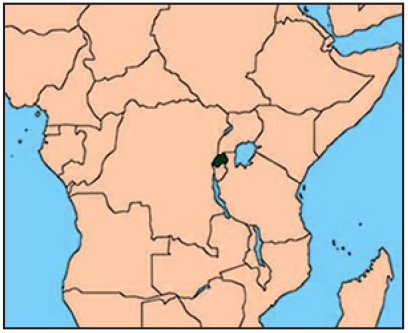
I. Introduction
After more than five years of testing its existing planning framework on the ground, the City of Kigali has revised the Kigali City Masterplan (2013) with the support of Singaporean planning and architectural firm, Surbana Jurong. This revision reflects the need to operationalize the mammoth document and ready it for implementation, as well as to close gaps in the original plan – including its apparent inflexibility in responding to existing planning and building practices in the Rwandan capital.(1) The 2013 City Masterplan, based on a Singaporean township model, has been made more granular and gradual, taking into account regulatory conflict between the masterplan and the stipulations of building codes and land-use plans, and harmonizing discrepancies in implementation in Rwanda’s decentralized governance system. At the same time, district development plans for Kigali’s three districts (Gasabo, Kicukiro and Nyarugenge), and for secondary urban areas across the country, have been reviewed to accord with land-use master planning, and the green development principles demanded by the partnership between national planning bureaucracy and international expertise. The revision process has been billed as consultative and participatory, ostensibly aimed at taking into consideration the views of a wider swathe of the urban population. Yet consultative meetings on urbanization and the 2050 masterplan (held in 2018–2019) have been mainly attended by high-level experts, with only limited community input from dwellers of informal settlements and a dearth of large-scale participation of the city’s lower-income residents.(2)
In this article, we analyse the tenuous nature of urban citizenship in Kigali, where planning and building according to the dictates of new planning regimes renders residence within the capital precarious and often untenable for dwellers of the city’s informal settlements – which are deemed to be “unplanned” according to official terminology. Looking at the expropriation and demolition of informal settlements in Kigali to make way for the demands of master planning, we scrutinize contestation of the directives of city-scale urban planning, particularly in the context of Rwanda’s strong multi-tiered governance.
Demonstrating the scalar nature of these claims in the context of Kigali’s master planning process, in the second section of this article we consider the case of the Kangondo/Kibiraro informal settlement (also named Bannyahe(3)) as a limit case (or meaningful outlier) of urban contestation. Located in the affluent area of Nyarutarama, the Bannyahe settlement has faced expropriation and demolition in 2019–2020 to match the requirements of the masterplan and the designs of state-sanctioned private property developers. Sited on valuable real estate, the settlement has been earmarked to be replaced by a US$ 56 million high-end development by a Rwandan–Finnish investment consortium working according to the zoning requirements of the Kigali masterplan.(4) Drawing on multiple site visits and interviews with residents in various parts of the Bannyahe settlement, we found that ideas of “good citizenship” are being foisted upon low-income dwellers of the city’s informal settlements in cooperating with the masterplan’s requirements, in order that the city might benefit from higher-value forms of use and the greater “public good”.
Focusing on the closely circumscribed nature of contestation in Kigali under a uniform regime of master planned reconstruction, where overt opposition to the city’s replanning has been limited to local skirmishes and veiled battles over territoriality and expropriation procedures, we take Bannyahe as emblematic of what we term the silent boundaries of open contestation in the capital. We detail the unprecedented legal case of 728 property owners from this settlement who from 2017 to 2019, in contrast to their expected compliance, took the District of Gasabo in the City of Kigali to court(5) in order to contest the means through which their expropriation had been handled by district authorities. In this case, the law represents an apparent avenue of appeal through which property owners in the settlement have been able to contest their expropriation on procedural grounds, and have staked claims to their right to remain,(6) despite their inability to openly challenge the political vision of spatial change in the capital.
Primary research for this article was conducted between August 2018 and February 2019 and included multiple visits to the Bannyahe settlement. Interviews were conducted with approximately 40 residents, a mix of property owners and tenants purposively selected to represent all sections of the settlement (Kangondo I and II and Kibiraro I). To collect additional information on local experiences with the legal case underway, some interviews were also arranged using snowball techniques with property owners and longer-term residents of the settlement. Additional interviews were conducted with government officials, NGO workers and development partners working on informality in Kigali. Further information was gathered from local newspapers and through attendance at sessions of the court case before it was dismissed in early 2019.
a. Examining the limits to urban contention
We draw out the case of the Bannyahe informal settlement (Photos 1A and 1B) at a time of large-scale urban change in Kigali, in order to highlight forms of opposition that residents have taken in the face of the overt authority of the local state – in this case, the municipal administration in Gasabo District. The expectations were that residents of the informal settlement – like others in settlements expropriated before them – would use lower-level local government channels to arrive at an agreement. Property owners in Bannyahe, however, in effect subverted these official expectations through their rights claims and contests over property valuation. Rather than agreeing to their expropriation with local administration at the level of the village (umudugudu), cell (akagali) and sector (umurenge) – as would be expected of compliant urban subjects – they took their case to the district level (akarere) under the ambit of the District Court of Gasabo. In so doing, this group of Bannyahe property owners violated certain boundaries in the negotiation of consensus in the capital. Claiming that discussions with district authorities had failed due to a lack of adequate consultation, residents then organized locally instead, under a sub-group of property owners who spearheaded the group’s legal challenge and hired legal counsel.(7)
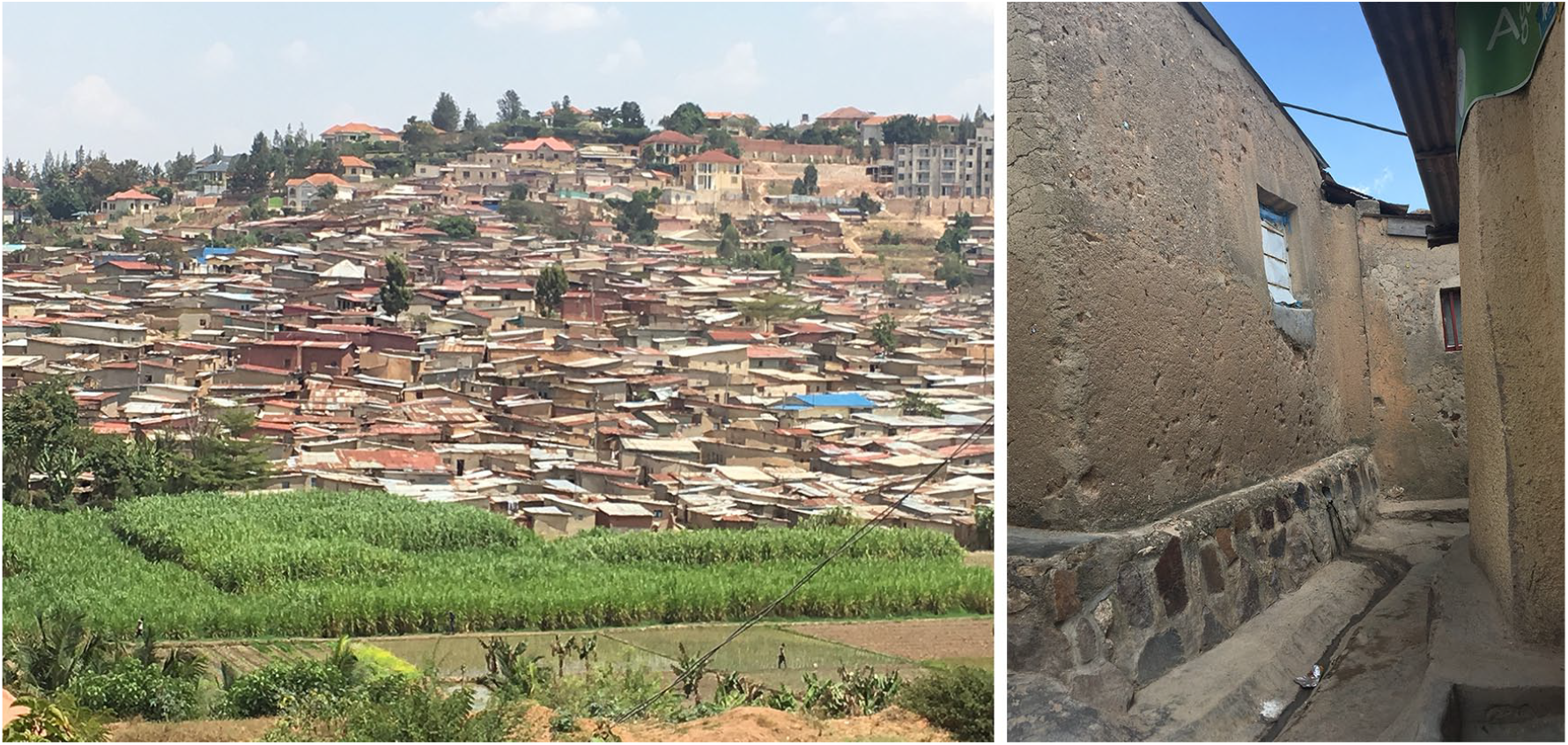
Overview of the settlement of Bannyahe
In detailing the possibilities and limits of contestation over expropriation revealed in the Bannyahe case, we focus on this activist sub-group of owners precisely because of the greater possibilities of voice and agency suggested by their structural position. Whereas the settlement’s tenants lacked legal documents, voice and representation, and were unable to claim compensation from acts of expropriation, the property owners we interviewed possessed legal title – largely as a result of the extensive land titling and tenure regularization programme conducted by the state from 2007 onward. The owners’ acts of contestation were an expression of their claims of urban citizenship, exercised through the civil legal process at a local level, but they also highlighted the limits to contestation in contemporary Kigali. By focusing here on dissent on an urban stage, we contribute to calls to rethink representations of resistance in post-genocide Rwanda.(8) Not only has the Bannyahe case been a visible exception to contestation over expropriation and relocation in the capital, normally expressed through private dissent outside the public realm, but here petitioners have kept their contestation to procedural questions over the Expropriation Law (2015, replacing the 2007 law). This has involved both petitioning and negotiating for monetary compensation rather than relocating to apartments built at a considerable distance from their existing homes.
The claims by Bannyahe resident property owners have highlighted the exclusionary planning norms within the Kigali masterplan, which envisions a “modernized”, formalized capital city with relatively little space for the perceived disorder of the informal settlement. Despite the nature of their claims, residents of the settlement limited their overt contestation of the masterplan, which has been presented as an all-encompassing framework of urban change. Property owners in Bannyahe distinguished between their local struggle over the legality of the expropriation procedure and larger criticisms of the masterplan. Instead, in several cases, residents alluded to the masterplan’s contribution to the “greater public good”, and expressed a reluctant willingness to defer to this spatial plan.
In articulating the “silent boundaries” to urban contention expressed through the case of the Bannyahe settlement, we argue that negotiation over the limits and forms of dissent enables contestation in contemporary Kigali as well as delimits it. These boundaries are spatial and scalar, centred on the “customary citizenship”(9) and differentiated spatio-legal rights of the informal settlement as a marginalized space in Kigali’s new urban order. At the same time such boundaries form discursive limits that urban residents navigate when they contest their relocation in terms of the law, valuation, and procedural irregularity, rather than openly challenging master planning and spatial change as political visions for the capital and the nation. The scholarship on “hidden transcripts” as forms of circumscribed discontent(10) is useful here in representing these boundaries as a means of navigating contestation in a tightly regulated political environment. In the case of Bannyahe, the law and legal process stand as alternative limits of appeal and conditions of possibility for claim-making by property owners in relation to displacement and compensation.
These limits of contestation in Bannyahe, we argue, demonstrate that criticism of the capital city’s masterplan can indeed be seen as expressing opposition to the overarching political vision of spatial reordering or change imposed upon informal residents of the capital. In this case, the scale of contestation situates and delimits rights claims in Kigali at the local level. In contributing to an examination of the implications for spatial justice in Kigali as Rwanda urbanizes,(11) this article provides evidence and analysis of forms of contemporary contestation in the capital.
II. The Built Environment and The Frontier of the Il/Legal
a. Spatial-legal regimes of the future city
Kigali has long been a city of many neighbourhoods or quartiers, each with its distinctive characteristics and local histories. For instance, Nyamirambo is a characteristically Muslim quartier with its own sub-local geographies of affiliation; Muhima is home to a range of immigrants arriving in the city from other parts of the country; and Nyabugogo is a buzzing mass of life around the old market and bus terminal. Upon this heterogeneity of histories, narratives and spatial organizations, master planning increasingly imposes a unified, homogeneous spatial order. It arguably functions as a large technological system,(12) with its harmonized edifices of zoning and legal provisions, which segment and integrate space and social life. What becomes of the informal settlement and the “hybrid infrastructures” of daily life(13) amidst mammoth urban renewal? As Kigali is reconceptualized, elite and official positions on the need for planned urbanization and practices of dispossession and relocation have operated in tandem. Discourses on the urban transformation of Kigali frequently rely on tropes of “crisis”, focusing municipal anxieties on migration to the capital and increased pressure on infrastructure, space and housing provision as an outcome of perceived urban overpopulation. With the focus on the need for adequately planned urbanization to cope with these distributional anxieties, the informal settlement becomes the spatial target of intervention – a hybrid socio-spatial order increasingly under threat from planning law and regulation oriented to the vision of a “world class” city.(14)
We consider spatial citizenship to be a useful analytic in situating differentiated spatial and legal orders within this capital city under renewal, building upon conceptualizations of existing struggles over urban citizenship in various urban geographies of the global South.(15) We conceive of such spatial citizenship as conditioning possibilities of voice, contention and rights-claiming in relation to service delivery, security of tenure and the right to remain. It is important to examine forms of spatial citizenship operative in Kigali particularly because the current masterplan determines such possibilities of inclusion in the future city. Drawing on “right to the city” discourse,(16) we take spatial citizenship here as significant in staking claims to remain as space is rezoned and as expropriation in the interest of large-scale planning proceeds apace. The result is a differentiated political geography of dispossession and relocation in the city.(17)
b. Informality and planning in Kigali
The geography of inequality in Kigali is not necessarily new, but its colonial-era contours have been altered in the post-genocide period by a rapid and differentiated urbanization. While Rwanda was just over 8 per cent urban in 1994(18) – with the capital largely seen as an elite enclave and with the country having a deeply entrenched urban-rural divide – the socio-spatial contours of the national urban landscape have changed. From April to July 1994, the genocide of approximately 800,000 ethnic-minority Tutsis and the deaths of moderate Hutus(19) were followed by large numbers of refugees and displaced people moving or returning to the capital and shaping its spatial and demographic geography anew. Departing from the historic rural focus of the pre-genocide period under the Habiyarimana government and the spectre of structural adjustment,(20) the period since 2000 has seen efforts at national modernization with the capital city as a central focus – a form of spatial and social reordering that envisions a country that is 35 per cent urban by 2024.(21)
Planning in Kigali began in the early 2000s. The redevelopment of older urban areas as well as attempts to resettle returning diasporic refugees after the genocide, set the framework for the capital city as a low-density space, interspersed with informal settlements.(22) The Surbana 2013 city masterplan for Kigali’s three districts, based on a Singaporean township model and closely following an earlier conceptual plan by the US firm Oz Architects, pitted Kigali’s informal vernacular against the modernized veneer of imported urbanism. Although the Kigali masterplan has been revised, with various options under review for addressing affordable housing, the idea of the “unplanned” haunts the capital’s master planned visions and the country’s utopian urban brand. For the large part, the space of “unplanned” informal settlements also remains an underdeveloped store of value that groups of elite urban Rwandans, backed by local and foreign investment, compete to capitalize upon and transform, despite the documented limitations on demand in Kigali.(23)
Literature on informality in Kigali includes the treatment of informality as a mode of economic transaction as well as vernacular dwelling.(24) It is estimated that over 60 per cent of contemporary Kigali comprises informal or “unplanned” settlements.(25) These settlements for the most part are anything but “unplanned” or “spontaneous”, but rather have considerable histories of development in tandem with the formalized, modernized and wealthier areas of Kigali. Some of these informal settlements date back to the colonial period: Kiyovu cy’abakene (“poor people’s Kiyovu”), which used to be located near the central business district before it was demolished, developed alongside its colonial settler counterpart, providing services and labour. Vernacularized as akajagari or “disordered” in both spatial and social terms, unplanned settlements have borne an increased burden of visibility with the reform of land tenure. This was conducted under the Land Tenure Registration Program, which began as a pilot in 2007 and was followed by the issuing of land titles by the Rwanda Natural Resource Authority (RNRA) from 2009 to 2013. This process of formalizing land titling in the country means that currently approximately 97 per cent(26) of the country’s landholdings are formally titled, a rapid departure from earlier years: a formal cadaster in Kigali was first started in 2002 and the first formal building code was only instituted in 2007.(27) Subsequently, the 2015 Building Code, a document of over 700 pages, set out stringent regulations for construction, in effect rendering much of the city irregular in these terms.(28)
c. Expropriation and “planned” relocations
The bid to emphasize the illegitimacy of informal dwelling in Kigali as both unmodern and irregular according to planning regulation deserves further attention. It is here that the built sphere of the informal and the regulatory frontier of the irregular merge in the capital: urban dwellers of informal settlements must navigate the dual spatial and regulatory exclusion that segments their settlements.(29) These are spaces mapped by GIS software and earmarked through master planned zoning for expropriation and demolition. Large areas of informal settlement in Kigali have further been rendered problematic through the language of environmental protection and degradation, and through categorizations of risk and vulnerability made by officials seeking to intervene.(30) As a result, the livelihoods of large numbers of residents in these areas are rendered precarious, with compensation uncertain for many living in high risk zones (HRZs).(31) As low-income human settlements and the preservation of nature compete for legitimacy and space, the “bare life”(32) of urban residents living in informal settlements designated as HRZs is put at risk not only from flooding and landslides in hilly areas, but also from the impulse to modernize the city through reconditioned wetland parks and urban greening.
As laws and regulations in urban areas displace and dispossess increasing numbers of low-income residents in Kigali today, many are forced to reconsider their precarious livelihood and dwelling options, and they struggle to remain within the city’s boundaries. Rwanda’s Expropriation Law, promulgated in 2007 and revised in 2015, was first applied to the demolition of Ubumwe Cell (Kiyovu cy’abakene), where residents were given the alternative of relocation to the Batsinda housing estate in 2007/2008.(33) Of the 362 households expropriated, 120 chose to relocate to Batsinda, where the unit cost of approximately US$ 6,000 for a home far outstripped the expropriation compensation received. In fact, Wakhungu and coauthors(34) reported that loans offered by the Rwanda Housing Bank were difficult to accept due to their stringent terms and the relocated families’ shifting livelihood options. The distance between Ubumwe’s central location and the peri-urban locale of Batsinda in Gasabo District, with its attendant travel costs, and the restrictive design of the small units in Batsinda were also problems for relocated residents.
The pace of expropriation has, however, been quietly questioned by developers, architects and planners working in Kigali. Several of these remarked on the amount of time taken between government expropriation of areas like Ubumwe and Kimicanga and their redevelopment by investors: “Much of Ubumwe is still lying vacant, with no development”, one professional commented, adding that the ability of the city to attract investment commensurate with the pace of expropriation posed a problem.(35)
d. Debates over affordable housing and relocation to Busanza
The Busanza project has been under construction for the relocation of property-owning households from the Bannyahe settlement (Photos 2A and 2B). Located in Kanombe Sector, Kicukiro District, it sits several kilometres past the Kigali International Airport (Map 1). The first phase of construction consists of approximately 1,040 apartments(36) located in several three-story blocks on 7 hectares of land. The remainder of the 22 hectares awaits future relocation projects. Whilst the Expropriation Law (2015) stipulates that monetary compensation must be available as an option to households expropriated (Article 35), the procedural differences between law and policy are apparent on the ground. A housing official explained that a new policy of relocation to replacement housing had been adopted on the basis of the official valuation of the property held in the previous informal settlement: “If you compensate people they simply move to another informal settlement in a similar area, and you don’t stop the tide of informal settlements in Kigali.”(37)
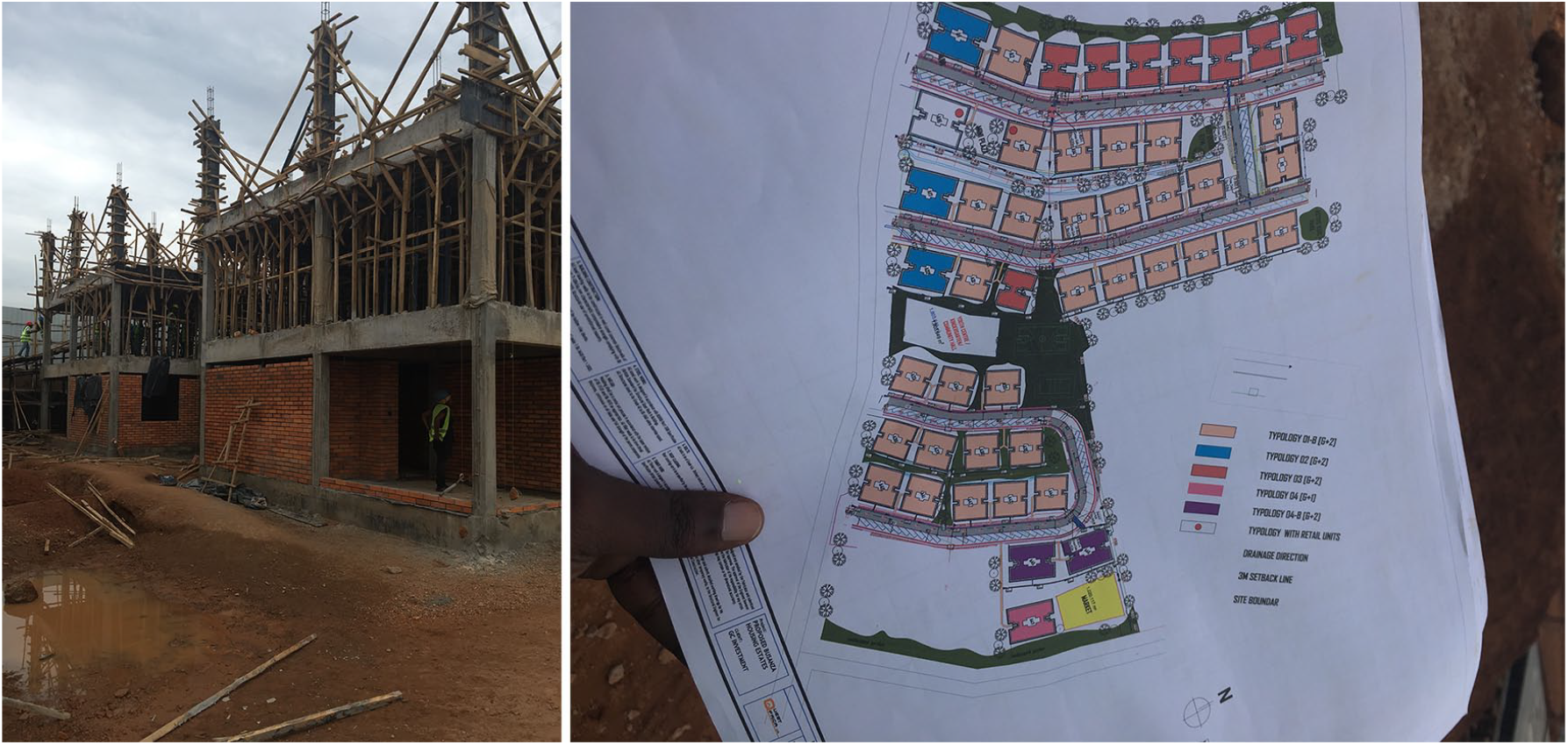
Construction on the resettlement site of Busanza
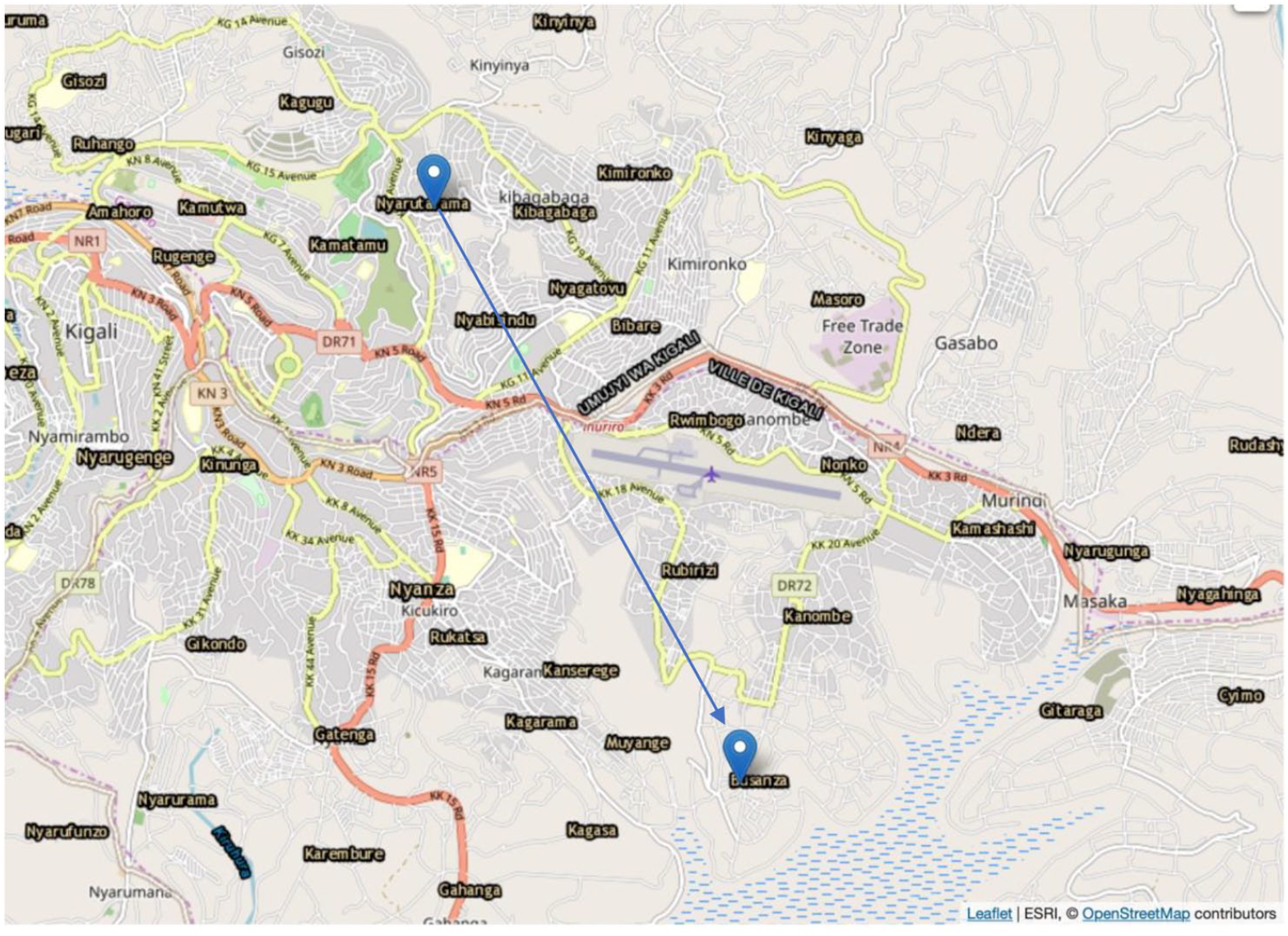
The scale of the planned relocation from the Nyarutarama area to Busanza, near the international airport
Priced at Frw 10–25 million in 2019 (approx. US$ 11,000–27,000),(38) units in Busanza are beyond the reach of individuals in the informal sector, requiring many to take out optional loans offered to cover shortfalls. Annual market demand for affordable housing in Rwanda’s urban centres far outstrips the available supply of 22,000 units currently under construction.(39) A presentation on the Kigali housing market estimates demand in the capital city alone at just above 450,000 dwelling units by 2022.(40) Debates over how “affordable” the existing approach to affordable housing has been are even more urgent when informal-sector workers and low-income earners are actively considered.
The City’s vision and its fascination with the vertical urbanism of Singapore means that the future of mass housing in Kigali lies in the construction of apartments. This vision poses concerns for many lower-income earners who are not used to the concept of apartment living. “Rwandans don’t feel secure unless they are living in their own home, and that home has to have a yard with it, and be constructed close to the ground”, commented an academic interlocutor.(41) The traditional homestead (urugo) with its forecourt and back garden, fenced and located on one level, which has for generations formed the basis of a traditional sense of security, is now under threat from such vertical designs. Unsurprising, therefore, were the conclusions of an article in the Kinyarwanda-language newspaper Umuseke, which described a visit by Bannyahe residents to Busanza to view the apartments they had been allocated. Reflecting the perceived transitional character of the planned development in contrast to the lived-in spaces of their existing homes, the article reports: “Bannyahe residents visited houses being built for them at Busanza, they said that they are like a refugee camp”.(42) In the face of the fervour for planning, the spectre of the “unplanned” and the informal settlement hence remain unsolved planning and policy problems, as the urban poor are moved further and further from the city’s core.
III. Contemporary Urban Contention
The case of Bannyahe is central to the themes developed in this article: it demonstrates both the potential of petitioning power in the context of tight governmentalized state control, and the limitations of this circumscribed contestation in relation to visions of urban spatial change. In this section we provide an overview of the settlement and its internally differentiated structure, leading up to the hearings at the District Court of Gasabo in 2018–2019.
a. The anatomy of an uncertain settlement: surveying Bannyahe
Describing the anatomy of a planned expropriation and demolition is challenging, not least in terms of the temporal difficulties faced in reconstructing the settlement in a time of transition. In recognition of this uncertainty, this article proceeds in the present tense.
The Bannyahe settlement is divided into three administrative areas – Kangondo I and II, and Kibiraro I. And as recent petitioning shows, it is divided further in more ways than one. Located in the Remera Sector of Gasabo District, Bannyahe sprawls over a hill and, at the time of writing, holds more than 1,600 households (estimates range up to 2,300 households). A main set of market streets occupies the highest parts of Kangondo and then descends into medina-like mazes of small streets and alleyways with single-storey mud and concrete houses and occasional shops. The gradient is increasingly steep as one reaches the bottom of the area, which then links to an access road near the portion of Bannyahe known as the administrative area of Kibiraro I. Wetlands and marshes are located below the boundaries of this area, and residents often fetch water from here when water supply to communal taps is intermittent. The area contains three health posts, a number of schools and at least two market areas, as Kibiraro I also hosts small market streets. In various further reaches of the settlement are small churches, mostly Protestant and Pentecostal in denomination. Income-generating groups, such as cooperatives, are evidence of a strong social fabric and collective life.
Most residents of Kibiraro I are tenants. Property owners hold multiple dwellings in the area – some live on site and others outside the settlement as absentee landlords. Rents range from below Frw 30,000/month (US$ 32) to above Frw 150,000/month (US$ 162) for the most expensive housing. Many residents in the lower areas of Kibiraro I are unemployed and most are underemployed; they find it difficult to afford rental payments, while balancing the other costs of trying to retain a foothold in the city. It became apparent in the course of interviews that residents moved to the settlement from different areas of the city and beyond – from Muhanga and Rusizi, as well as from informal settlements that had been subject to demolition and displacement of residents in prior years. All these residents have sought to remain in the city close to existing livelihoods and employment opportunities, especially given the costs and uncertainties of moving elsewhere.
b. Studies on a divided settlement
According to an organization working in the area, the Bannyahe community has been divided over relocation and compensation. Over the course of interviews in all three of the settlement’s sections, it became apparent that most of the tenant-residents in Kibiraro I were – according to the organization’s leader – “praying for relocation” to Busanza, even though according to the Expropriation Law they had no legitimate claim to the apartments offered in lieu of compensation by the municipal authorities. Many tenants in the settlement have faced precarious futures in the city due to rising living costs, and several have already begun to leave as the legal case progresses, leaving behind their empty houses looking for new occupants. In this article, we have chosen to focus primarily on resident property owners because they constitute the activist sub-population in the settlement, and face the greatest potential monetary losses from the expropriation. Over the course of our multiple visits, resident property owners of Kangondo I and II in the Bannyahe settlement revealed their reluctance to move because of the losses they would incur from relocation to an area far from the city centre, where apartment units are smaller, precluding or limiting rental prospects.
We consider evidence from interviews and case studies on struggles over valuation as indications of circumscribed contestation, where these kinds of claims are among the politically possible forms of contestation over rights to remain. Claims over valuation are enabled by the law and its procedures; in effect the law forms an alternative to more overt forms of urban dissent that involve politics and policy. Interviews with property owners in the Kangondo I and II areas of the settlement, who had land title papers, showed that they did not want to leave, instead seeking to negotiate their claims and stake their case.
We illustrate these arguments with two main interview case studies, beginning with the case of elderly Mr K and his younger wife, Mme E, conducted in late 2018:
Case I: Kangondo II
Located in a side alley, down a set of steep steps, Mr K’s house is large but somewhat dilapidated, with stone floors, glass windows, and a sofa set and table in the salon. Mr K first speaks about the history of his tenure in Kangondo: “I am from Kacyiru and have lived my whole life in Kigali; relocating is not an option for me. Where would I go?” Having lived in Kangondo for over 80 years, Mr K is nostalgic: “This place [Bannyahe] has changed a lot over time. It started as a place for farmers who had cattle, and this was their plot. I lived uphill and later on I moved further downhill. This started as my father’s plot of land and I inherited it. People started coming to this area in the 1980s, but at first there were very few. Many people started to come later on after 1994 from different areas to buy land as it was cheap. For Frw 20,000 [approx. US$ 22] you could get a small plot here in 1994. After the genocide, a plot sold for Frw 100,000 [US$ 110].”
The discussion with Mr K and his wife, Mme E, becomes animated as the relocation case pending with the District of Gasabo is brought up. Mme E offers to bring her papers and legal documents to demonstrate her claims. Sifting through land titles and correspondence regarding the government determination of land value, she remarks on the way that value was determined for the houses to be expropriated in this area.
“We have our own house and other houses for rent on this plot of land. We are not happy with how the value was determined for our property. For example, the windows have metal frames, but they put the value as timber rather than metal. The assessors did not include metal doors and the timber roof in their calculations. This house has four rooms and a sitting room, but they did not include the full size of the house and the tiles on the floor outside and other elements that are missing in the valuation. They valued our total property at Frw 16 million [US$ 17,297]. Before this case was launched, a private buyer came and offered us Frw 30 million [US$ 32,432] but we were not interested as this offer was too low, so we rejected it. We rent out some houses in this compound – we have six other houses on this plot, but when the valuation came out, it was for only Frw 16 million [US$ 17,297]. We were told if you are not satisfied, employ a private valuer and produce an alternative valuation and bring it to us.”
Mme E shows us other letters they received and her original land title. She shows that only two of their six houses were included in the official valuation, and when they wrote to complain, the District responded that since they had not employed a private valuer, the government considered that they had agreed to the official valuation. According to the District, its decision could not be changed. She shows us the national land centre receipt, her land title document and a letter from Akarere ya Gasabo (District of Gasabo).
“We were offered one house in Busanza in exchange for our plot and six houses. This apartment has three rooms and is valued at Frw 35 million (US$ 37,838). We would have to pay Frw 19 million [US$ 20,541] in addition to that amount to get that house in Busanza. We don’t know where to get this money and would have to take it from them as a loan. In addition, we would have no rental properties to pay back this loan. The amounts we can charge now for rents has been reduced, because tenants have left … If we have to move, we can’t leave Kigali because we have lived here our whole life. We can move around Kigali and its suburbs, to farm and live.”
She ends by referring to the masterplan: “We don’t know much about the Kigali masterplan but we are told it is in the public’s interest and has to be implemented.”
Case 2: Kangondo I
Mrs M has lived in the area for a long time and owns a large house with a spacious courtyard behind several shops. Her house is well-kept, with a television, plush sofa set and carpet in the living room. An adjoining dining room has a full dining table and drapes on the windows. She rents out several rooms leading off a nearby corridor. M was born in Gacuriro, Kigali in 1952, and got married before moving to Kangondo in 1962. Her husband was also born in Kigali. They have been living in the settlement since 1969 and were amongst the first families here. “There were about three households here at first and there were only bushes in the area. First, we stayed uphill, and then we moved further down later on; there were no people here at that time.”
She continues: “People started moving to this area around 1986, and before 1994 there were only a few people here. I don’t know where people came from, but plots of land here were cheap and so people came here looking to settle and get land. At the time, around 1994, plots were between Frw 50,000 [US$ 54] and Frw 200,000 [US$ 216] for a small plot. The value kept increasing, and now there are no more vacant plots, but small houses can cost above Frw 1 million [US$ 1,081] when they come up for sale.”
Turning to the relocation situation, Mrs M exclaims, “I am not happy with what they are giving us in terms of etages [apartments] in exchange. I want the money in exchange instead if we have to move. How am I going to go upstairs in these The case started because government officials came and told us that here there is a businessman who is going to do business here. No consultative meetings were held, or consensus developed…We have been offered Frw 30 million [US$ 32,432] for our houses, but we know they are worth more than this. In Busanza I was offered one house with two chambres [rooms] and one salon. Here, however, I have my own house, and 16 houses for renting including shops on the other side of the road. When the official valuers came to my house, they did not take into account the total value of all the houses and the materials that were included. I believe our case will be successful. And if I have to move, I can get another house nearby if they give me money. I can’t live outside the city; I am from the city and belong here. My source of income is from rental properties at the moment. Formerly, I used to farm. But now with this situation, most of the tenants have started leaving my houses here. The banks won’t accept my legal titles for the houses I own as collateral because they think we will have to leave soon. Tenants prefer to move somewhere else and it doesn’t affect them as much, but owners of large houses are more affected.”
Further information from interviewees in Kangondo II corroborates this:
“Our property was valued at Frw 7 million [approx. US$ 7,868] by the government. As an exchange, we were offered an apartment in Busanza valued at Frw 14 million [over US$15,135].
We would have to pay the balance of Frw 7 million to the government through a loan to get this one house. We don’t think it is a fair deal.”
“We currently get rental income which enables us to pay school fees for the children and if we moved to Busanza, school fees would be unaffordable as we wouldn’t have rental income there.
Many tenants from Bannyahe have moved already because of the case and the value of the houses in terms of rental amounts has decreased as a result.”
As these interviews demonstrate, the grievances of property-owning residents interviewed in Kangondo against the local state include not only the inadequate consultation over the expropriation, but also the way in which properties have been valued, and the overall transparency of the process. According to these respondents, various inconsistencies have come to light: not only were the correct number of units not represented on valuations, but improvements such as tiles, wooden ceiling frames and metal window casements were not taken into account, despite being of investment value to the Kangondo residents. As Bhan argues,(43) a theory of Southern urban practice must take into account not just the formal architectural, legal and policy modalities of legitimate planning, but also the local idioms of practice visible in informal settlements. Thus, “repair”, one idiom of local practice that differentiates itself from formalized vocabularies of “build” and “construct”, has valence because it recognizes the processes of incremental construction undertaken by local residents as valid in augmenting the value of space and the legitimacy of claims to specific places.(44) These local additions and housing augmentations in Bannyahe take on importance through similar mechanisms, enhancing place-based claims to legitimacy and the right to remain.
c. Following the progression of the case
The case against the District of Gasabo began in late 2017 with a group of property owners coming together to challenge the process of expropriation on the basis that the Expropriation Law (2015) was not followed in terms of giving the residents the option of monetary compensation. Although the revised law asserts the primacy of the masterplan and land-use planning in determining expropriation directives in the “public’s interest”, Article 35 indicates that mutual agreement must be arrived at between the expropriating and expropriated parties over the form of compensation – whether cash or in kind. In insisting that the case should go before the court to allow them to argue for their right to monetary compensation, these residents bypassed traditional mediation and circumvented the power of local government leaders. The owners in Kangondo were at first eager to talk about the case. Eventually, after the first hearing date was set for 7 November 2018 in the District Court of Gasabo, the same individuals became more hesitant to speak, fearing information leaks and surveillance.
Located in the Kabuga cell of the Rusororo sector, a few metres from the main Kigali–Rwamagana road, the District Court of Gasabo was crowded on the first hearing date, with people waiting for the trial to begin. The residents’ lawyer was missing at this initial hearing, and the case was postponed due to procedural irregularities involving the filing of court documents. In early December, the case reconvened. The proceedings this time were faster, the prosecutor arguing that the case should be broken up by individual litigants rather than taken as group litigation. Finally, the case was dismissed by the district pre-trial court in Gasabo on 11 February 2019 on account of procedural errors in filing the case. In effect, the court ruled in favour of the prosecution in determining that residents could not bring a group-based case but would have to refile their cases as separate claims. At the time, many in attendance vowed to regroup and follow the procedure demanded by the court when appealing.(45) Others complained about the unfairness of being dismissed on procedural grounds when they were certain they had consulted all required national and local governmental institutions.(46) In the aftermath of the case’s dismissal, the path forward for residents remains unclear and the momentum behind the case appears to have dissipated. While recent reports indicate that a smaller group of property owners will refile individual claims, the absence of the group claim as the basis for collective action effectively makes them more vulnerable to dismissal and subject to individual pressures. Individuals pursuing their claims have, for instance, been described by the media as “greedy local leaders” with whom the local government must effectively “deal”.(47)
IV. Discussion
The court case offers pause for reflection on the location of contestation and negotiation in Kigali for residents of the “grey spaces” of informal settlements.(48) In the instance of the Bannyahe settlement’s legal challenge, it has been significant that residents wanted to claim civic rights in the district-level courts, rather than settle for the mediation of lower-level authorities and inevitable compromise. Nonetheless, a lack of clarity in the legal process as well as the difficulty faced by the petitioners in filing a collective lawsuit points to the limitations in staking spatial claims through the law in the context of differentiated spatial citizenship in the changing city.
Emerging from these “unplanned” spaces in Kigali, the property owners of Bannyahe have sought to stake claims in the public domain. At the same time, many residents of the settlement have been hesitant to openly contest master planning as the framework within which their expropriation and relocation can be situated. Property owners expressed fear of relocation and frustration that their tenants had already begun to leave the settlement, even before their case against the district had been decided. They nonetheless preferred to localize their claims in terms of geographic scale and legal ambit, limiting contestation to questions of procedural justice over the Expropriation Law rather than larger criticisms of master planning as the overarching framework of urban change. Property owners hence responded to the situation within carefully delimited silent boundaries: they circumscribed their forms of contestation to those that appeared less confrontational and not directly at odds with portrayals of good citizenship and respect for authority. These contentious subjects hence maintained boundaries that were localized in multiple senses: both spatially localized and legally delimited to the procedural, in the absence of the ability to contest the dislocation in the larger context of the masterplan, as a city-wide spatial plan as well as a national political vision. We have argued here that the law has represented an alternative arena of contestation, enabling property owners to claim they were entitled to stake their rights and negotiate over value, yet also demonstrating the contextual limits of juridical contention through the legal system.
“If the case fails, we don’t know what we will do”, one resident of Bannyahe commented. “We respect the masterplan and the public’s interest, but we want the process to be followed so that we can afford to move elsewhere.”(49) In a context where the capital’s masterplan forms part of a larger vision of national urban-led socio-spatial change, localized contestation and claims centred on the scale of the neighbourhood appear to represent the current limits of overt public confrontation and political claim-making in contemporary Kigali.
V. Conclusions
In demonstrating the increasing marginalization of the hybrid spatial-legal arrangement of the informal settlement in the context of city master planning in Kigali today, we have examined struggles to retain forms of spatial citizenship and a foothold in the city through negotiation, rights claims and the law. Urban contention in the Bannyahe settlement currently serves as a limit case illustrating the possibilities and boundaries of contestation over urban redevelopment in contemporary Kigali. Further research is needed on the varieties of experience of displacement, with or without organized relocation, occurring within the framework of contemporary urbanization and master planning. These experiences might generate popular counter-narratives to the overarching developmentalist master narrative of modernization-as-salvation that is currently attached to programmes of transformation in Kigali.
Footnotes
Acknowledgements
The authors would like to express thanks to the editors of Environment and Urbanization and three anonymous reviewers. Thanks also to Lana Salman and Zahra Hayat for their helpful comments.
Declaration of Conflicting Interests
The authors declare that there is no conflict of interest.
Funding
The authors disclosed receipt of the following financial support for the research, authorship, and/or publication of this article: Shakirah Esmail was funded by research grants from the following sources: the Wenner-Gren Foundation’s Dissertation Research Grant, the John Simpson Memorial Dissertation Research Fellowship from the UC Berkeley Institute for International Studies, and the Rocca Dissertation Research Grant from the UC Berkeley Center for African Studies.
1.
Interviews with planning officials and planners in private practice, Kigali, January–March 2019.
2.
Interviews with civil society representatives and residents of low-income and informal settlements, 2018–2019.
3.
“Bannyahe” means “where are the toilets?” in colloquial Kinyarwanda. This refers to the nature of improvised sanitation in the settlement and is frequently considered impolite terminology by officials and planners working on the renovation of the capital. This paper uses the term “Bannyahe”.
4.
Niyonzima, Oswald (2018a), “Has Kigali City failed to explain to “Bannyahe” residents the relocation plan?”, KT Press, 17 April, available at  .
.
5.
Case number PST RAD 00020/2018/TGI/GSBO. Niyonzima, Oswald (2018b), “ ‘Bannyahe’ slam residents sue City of Kigali”, KT Press, 13 July, available at .
7.
See reference 4.
8.
Manirakiza, V and A Ansoms (2014), “‘Modernizing Kigali’: the struggle for space in the Rwandan urban context”, in A Ansoms and T Hilhorst (editors), Everyday Forms of Land Grabbing in the Great Lakes Region of Africa, James Currey; also Rollason, W (2017), “‘Buying a path’: rethinking resistance in Rwanda”, Journal of Eastern African Studies Vol 11, No 1, pages 46–63.
9.
Obarrio, J (2014), The Spirit of the Laws in Mozambique, University of Chicago Press; also Doughty, K C (2016), Remediation in Rwanda: Grassroots Legal Forums, University of Pennsylvania Press.
10.
Scott, J C (1990), Domination and the Arts of Resistance: Hidden Transcripts, Yale University Press.
11.
Nikuze, A, R Sliuzas, J Flacke and M van Maarseveen (2019), “Livelihood impacts of displacement and resettlement on informal households - a case study from Kigali, Rwanda”, Habitat International Vol 86, pages 38–47; also Uwayezu, E and W T de Vries (2019), “Expropriation of real property in Kigali City: scoping the patterns of spatial justice”, Land Vol 8, No 2, page 23.
12.
Hughes, T P (1987), “The evolution of large technological systems”, in The Social Construction of Technological Systems: New Directions in the Sociology and History of Technology, MIT Press, page 82.
13.
Simone, A (2004), “People as infrastructure: intersecting fragments in Johannesburg”, Public Culture Vol 16, No 3, pages 407–429; also Jaglin, S (2015), “Is the network challenged by the pragmatic turn in African cities? Urban transition and hybrid delivery configurations”, in Beyond the Networked City, Routledge, pages 200–221.
14.
Roy, A and A Ong (editors) (2011), Worlding Cities: Asian Experiments and the Art of Being Global Vol 42, John Wiley & Sons.
15.
Ong, A (2006), Neoliberalism as Exception: Mutations in Citizenship and Sovereignty, Duke University Press; also Holston, J (2009), Insurgent Citizenship: Disjunctions of Democracy and Modernity in Brazil, Princeton University Press; and Doshi, S (2013), “The politics of the evicted: redevelopment, subjectivity, and difference in Mumbai’s slum frontier”, Antipode Vol 45, No 4, pages 844–865.
16.
Lefebvre, H (1996), Writings on Cities, Blackwell, Cambridge, MA; also Harvey, D (2008), “The right to the city”, New Left Review Vol 53, pages 23–40.
18.
World Development Indicators (undated), Rwanda, World Bank, available at .
19.
Prunier, G (1997), The Rwanda Crisis: History of a Genocide, Columbia University Press.
20.
Verwimp, P (2013), Peasants in Power, Springer Press.
21.
Ministry of Infrastructure (2019), “Rwanda target 35% of urbanization rate by 2024”, 2 August, Republic of Rwanda, available at http://www.mininfra.gov.rw/index.php?id=100&tx_news_pi1%5Bnews%5D=345&tx_news_pi1%5Bcontroller%5D=News&tx_news_pi1%5Baction%5D=detail&cHash=9b2a9c91713af86023df7371b7ee526f; also Republic of Rwanda (undated), 7 years Government Programme: National Strategy for Transformation (NST1), available at .
22.
Manirakiza, V (2014), “Promoting inclusive approaches to address urbanisation challenges in Kigali”, African Review of Economics and Finance Vol 6, No 1, pages 161–180.
23.
Goodfellow, T (2017), “Urban fortunes and skeleton cityscapes: real estate and late urbanization in Kigali and Addis Ababa”, International Journal of Urban and Regional Research Vol 41, No 5, pages 786–803.
24.
See reference 11, Nikuze et al. (2019) and Uwayezu and de Vries (2019); also see reference 22; Benken, E E (2017), “Nowhere to go: informal settlement eradication in Kigali, Rwanda”, thesis, University of Louisville; Finn, B (2018), “Quietly chasing Kigali: young men and the intolerance of informality in Rwanda’s capital city”, Urban Forum Vol 29, No 2, pages 205–218, Springer Netherlands; Goodfellow, T and A Smith (2013), “From urban catastrophe to ‘model’ city? Politics, security and development in post-conflict Kigali”, Urban Studies Vol 50, No 15, pages 3185–3202; and Michelon, B (2016), Douala et Kigali: Villes Modernes et Citadins Précaires en Afrique.
25.
Rwanda Housing Authority (2012), Urban Planning and Development Sector Profile, available at http://www.rha.gov.rw/index.php?id=181; also Manirakiza, V, L Mugabe, A Nsabimana and M Nzayirambaho (2019), “City profile: Kigali, Rwanda”, Environment and Urbanization ASIA Vol 10, No 2, pages 290–307.
27.
Ilberg, A (2008), Beyond Paper Policies: Planning Practice in Kigali, N-AERUS, Edinburgh, available at .
28.
These policies work together in a constellation, along with the 2015 Informality Policy, the 2012 National Housing Policy, and a 2009 Rural and Urban Settlement Framework.
29.
Bhan uses the term “planned illegalities” to describe the interaction of planning, eviction and the law in Delhi. Bhan, G (2013), “Planned illegalities: housing and the ‘failure’ of planning in Delhi: 1947-2010”, Economic and Political Weekly Vol 48, No 24, pages 58–70.
30.
Wakhungu, J, C Huggins, E Nyukuri and J Lumumba (2010), Approaches to Informal Urban Settlements in Africa: Experiences from Kigali and Nairobi, African Centre for Technology Studies (ACTS), Nairobi.
32.
Agamben, G (1998), Homo Sacer: Sovereign Power and Bare Life, Stanford University Press.
33.
See reference 30.
34.
See reference 30.
35.
Interview, October 2018.
36.
See reference 4.
37.
Interview, October 2018; also Karuhanga, James (2018), “Talks between CoK officials, slum residents hit deadlock”, The New Times, 25 January, available at .
38.
Exchange rate as of 9 September 2019: US$ 1 = Frw 925.
39.
Interview with Rwanda Housing Authority officials, November 2018; also Ministry of Infrastructure (undated), Housing Sub- Sector, Republic of Rwanda, available at .
40.
Cuevas, M (undated), Housing Market Demand, Housing Finance and Housing Preferences for the City of Kigali, Ars Progetti, available at .
41.
Interview, August 2018.
42.
Umuseke (2018), “Aba ‘Bannyahe’ basuye inzu bari kubakirwa mu Busanza, ngo ni nk’inkambi”, 12 December, available at .
43.
Bhan, G (2019), “Notes on a Southern urban practice”, Environment and Urbanization Vol 31, No 2, pages 639–654.
44.
See reference 42.
45.
Sabiiti, Daniel (2018), “Kigali: 360 families to be relocated from ‘Bannyahe’ slum”, KT Press, available at .
46.
Field notes and interviews, February 2019.
47.
The New Times (2019), “Editorial: New Mayor needs to deal with greedy local leaders in earnest”, 30 August, available at .
48.
Yiftachel, O (2009), “Theoretical notes on gray cities: the coming of urban apartheid?”, Planning Theory Vol 8, No 1, pages 88–100.
49.
Interview, December 2018.