




Abstract
Local Chinese governments have been experimenting with a form of top-down “co-production” under different names and for various purposes. This paper examines practices in four Chinese cities to understand the process by which this co-production is introduced, its implementation and its outcomes. We found that in these cities, co-production is imposed on urban communities by the higher authorities, with the state playing very active roles in initiating, financing and facilitating the process. Despite the much-improved community environment, communities are not participating to the extent that the state would like. Nonetheless, we argue that this top-down approach has its merits. It may be an efficient way to ignite the co-production process and to some extent sustain it. When these practices are embedded in an authoritarian hierarchy, however, local officials involved are unavoidably evaluated by two separate performance assessment systems, the hierarchical and the horizontal, which so far have not been compatible.
I. Introduction
Co-production has generally been defined as a cooperative approach to delivering public goods and services(1) – a shift away from single-provider (state, market or NGO) delivery of public goods and services and towards more bottom-up participation and political influence on the part of the people receiving these services.
In China, a form of co-production has been actively encouraged since Xi Jinping and Li Keqiang came to power in 2012. In the Report of the 19th Communist Party Congress, Xi stressed that local governments should further improve the self-governance of urban and rural communities, and that model projects should be rolled out nationwide.(2) This explicit advocacy for self-governance implies that grassroots participation will educate the public towards more responsible citizenship, improve the quality of local governance, and contribute to community development. For the Chinese government, co-production is a tool for both service delivery and social governance.(3) It also has financial implications, with the potential to relieve the state, particularly at the bottom of the administrative hierarchy, from the responsibility for direct service provision, by leveraging resources from outside the government system.
The co-production of community public goods and services in China has not been systematically investigated, despite a broad interest in community governance and participatory budgeting.(4) This is likely because this form of co-production is still in the pilot stage. However, its promotion and outcomes are relevant to international debates on the topic. This paper examines co-production in four cities and explores how it emerged in China, what role the state has played, what has been achieved thus far, and what the problems and challenges of these practices are. Ultimately, are these Chinese practices relevant to the international discourse on co-production?
In the following sections, we first discuss the concept of state-led co-production as used in China and outline its differences from the forms of co-production discussed in the existing literature. We then elaborate on how co-production is organized in China, using the four case studies to show what has been achieved and what the problems have been.
Our findings suggest that state-led co-production in China has promoted substantial local initiatives, involving multiple stakeholders in the local public policy decision-making process and forming a new paradigm of interest reconciliation among multiple actors. However, it has not yet been able to nurture grassroots initiatives as intended, and it is difficult to foresee it becoming a site for the construction of electoral democracy in the political arena.
II. “State-Led Co-Production”: Co-Production With Chinese Characteristics
There are multiple forms and definitions of co-production. In the delivery of public services at community level, it has been seen as a response to the failure of local governments – the argument being that the state cannot meet all social needs or assume unlimited responsibility for social problems. Even when the state attempts to play such a role, it can be inefficient or unresponsive to increasingly diverse human needs.(5) In this context, co-production is a multi-stakeholder approach in which public goods and services are provided not only by professionals, but also by users as members of communities.(6) As a by-product, co-production has also been found to change the relationship between individuals and communities, stimulating the formation of a dynamic civil society.(7) It is perceived, therefore, not only as a way to organize production, but also as an alternative to conventional styles of public administration.(8)
Co-production may also aim to achieve political effects. Mitlin(9) studies “co-production – with state and citizens working together – as a grassroots strategy to secure political influence and access resources and services”. Here, it is primarily a strategy to change the state–society relations. In this context, the state is criticized for disenfranchising residents, preventing them from defining and participating in meeting their own needs.(10) Co-production is a solution to this problem. Figure 1 illustrates how these different co-production models relate to each other and who takes the lead.
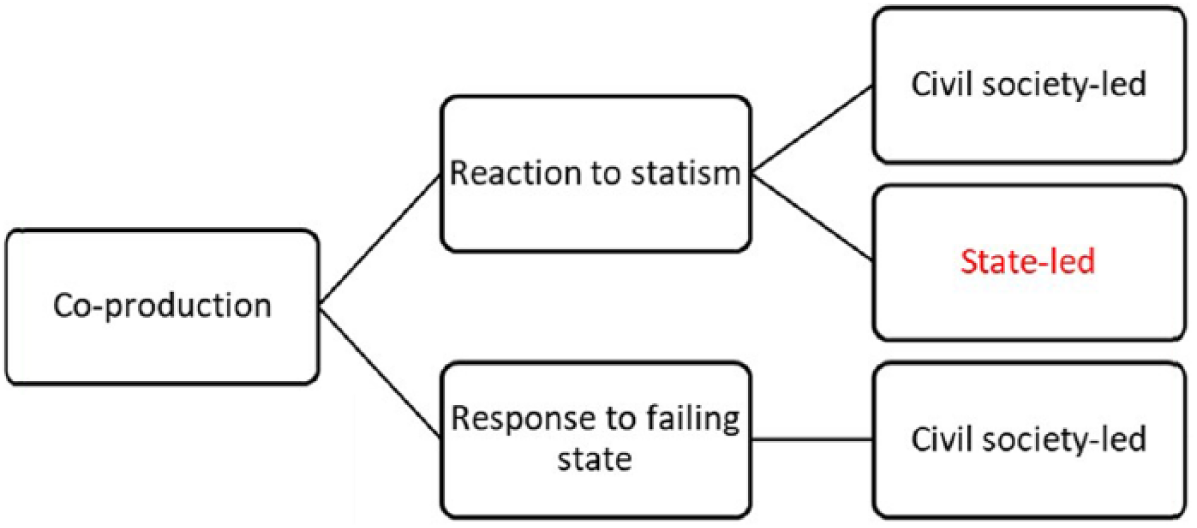
Co-production: purposes and initiators
In lower-income countries, co-production may not be an ideological choice on the part of government agencies or the result of bargaining between civil society and the state. It relates more to the state’s inability or unwillingness to assume responsibility for providing certain necessary public services and goods. Civil society has often taken a role because the state is not playing its part, as would be expected in higher-income countries. In this sense, the starting point can be very different (marked in red in Figure 1).
As noted by Sicilia et al.(11): “Co-production has been recommended at all stages of the public service cycle. However, previous empirical studies on co-production have neglected the question of how to make this happen.” In this paper, we try to examine how civil engagement and participation may be developed in communities where the civil society is weak to begin with.
In China, except for some local co-production projects initiated by NGOs or by elites, often educated abroad, co-production is rarely initiated by members of a community. (The term “community” in this context refers to administratively defined urban neighbourhoods.) On the contrary, “co-production”, a concept borrowed from abroad, has become a popular term for local government. Co-production in this context, introduced by the government, has multiple purposes: more responsive service provision, infrastructure improvement and community building through state-enabled decision making, self-organization and self-service delivery on the part of communities. Co-production is also intended as an approach for building better social governance or maintaining social stability.(12)
The emergence of this type of co-production in China is underpinned by a few factors:
China does not have the problem of an unwilling government. The active state in China faces rapid social change caused by economic growth, and must find ways to cope with the functional deficiency of public services. It views co-production as a means to strengthen rather than weaken Communist Party authority and to boost trust in the government.
Coming from a central planning system, civil society was closely monitored and controlled for years until 2010, when social organizations were formally invited by the state to participate in social service delivery.(13) Before that, a paternalistic state had been keen to monopolize social service provision. Even when there were civil society initiatives, local government officials had a tendency to interpret these as an attempt to reveal the state’s incompetence and therefore made it difficult for these initiatives to become significant.
These factors in tandem help explain the lack of momentum at community level to carry out self-service provision and self-governance. When the government wants people’s engagement, it has to deal with the legacy of heavy control over citizen attempts to mobilize, which has resulted in civil passivity.
“State-led co-production” has been introduced as a solution. The government plays an active role in initiating, financing and facilitating community-based co-production, in which users, NGOs and private businesses become planners and providers of social services and infrastructure. The process of provision has thus become more participatory than it was and, in many cases, it has resulted in a co-productive process. Although this approach deviates from a grassroots co-production strategy, it is intended to inspire and ignite such co-production. An account of this approach may contribute to learning for other countries facing similar issues of inactive or unsustainable participation.
a. Co-production to enhance social integration in rapidly urbanizing cities
Forms of co-production have been used to address a range of social concerns in China. In this paper, we focus on one of the most challenging areas of urban governance: the social integration of rural–urban migrants into urban communities. In the context of rapid urbanization, cities have an influx of migrant workers and relocated peri-urban farmers, and residents of urban neighbourhoods are less likely to know each other than in the past. Urban governance has become much more difficult in this context and there are some particular challenges:
Improving social integration and a sense of belonging for residents from different social and economic backgrounds. Migrants are not always treated equally in Chinese cities, and those without permanent resident status or urban household registration (hukou) may lack access to the usual social services. Nor do rural migrants always identify with urban citizens.(14) Their lack of a sense of belonging is particularly severe when they have had direct experience of unfair treatment.(15)
Improving the living environment and public safety in migrant-heavy neighbourhoods. In urban migrant enclaves – including older residential neighbourhoods, “villages in the cities”, and peri-urban informal housing settlements – the absence of social services and basic infrastructure can mean poor living conditions and higher crime rates.(16)
The pressure placed on urban governments to resolve these issues is unprecedented. New policies have tried to address some of the social challenges by relaxing hukou control and providing better social services and more affordable housing.(17) However, policy changes cannot solve all the problems urban communities face, and there are limits to the state’s capacity to improve governance.
In 2010, the central government decided to actively promote good governance at the community level by freeing up the registration of social service organizations and encouraging social innovation at the grassroots level. From the central government’s perspective, endorsing a policy is only the beginning – extra effort must also be invested to realize this policy. Changing governance is about changing the way people behave – not only how government officials behave. The benefits of self-governance and social management have mostly been learned from the experiences of other countries and via the literature. How self-governance and social management can best be applied in the Chinese policy system, and whether it can be seamlessly integrated into this system, remains a work in progress.
Once the national agenda had been set in response to the 2010 decisions, local governments developed their responses, often in consideration of local circumstances. Despite the different names for these models, they share some standard features. The government introduces new actors to the governance system with the aim of reducing government responsibility for direct service provision and funding allocations. It seeks to replace the old governance approach at community level so that the state can redirect some of the pressure to other actors. Co-production contributes to this aim if it can help reduce the pressure faced by local bureaucracy.
III. Methodology
a. The four cities studied
The cities selected for this research are all considered active in piloting participatory decision making, and all have growing migrant populations. Guiyang, Chengdu and Xiamen are capital cities, while Taicang is a county-level city. In Xiamen, our research focuses on Haicang District, the fastest-growing district outside the city centre, which used to be a rural county. Guiyang and Chengdu are in western China, and Haicang and Taicang are in coastal provinces. Coastal cities have always attracted migrants from different parts of the country, but Guiyang and Chengdu only started to have a net gain in the migrant population after 2010. In each city, we selected three residential communities with a mixed urban migrant population, the migrant residents having lost their land because of land acquisition. These were all neighbourhoods that had started to experiment with co-production.
b. Data collection
Data collection took place primarily between 2015 and 2016:
Primary data collection: Focus group discussions and interviews were carried out in the four cities, with neighbourhoods and participants selected in consultation with local officials in charge of coordinating the co-production. Focus groups with government officials usually included 10–18 people from the government departments involved. After the discussions, in-depth interviews were conducted with some individual officials from each department. Local officials also helped arrange for one focus group in each selected community, with representatives from community groups and social organizations. In each community, 10–20 residents were interviewed individually as well.
Secondary sources: Government regulations and campaign documents concerning co-production and policy training were examined, as well as official statistics and webpages showing the background and local practices of co-production. These documents helped clarify both the introduction and outcomes of co-production processes.
Since 2016, we have continued to follow up with the communities we visited and to collect local statistics and official documents for updated information.
IV. Research Findings
a. How co-production began in each city
As already discussed, co-production as a governing strategy was not initiated by community members, but was decided centrally. However, as in many policy areas in China, the central government only provided the guiding principles, while planning and implementation were determined by the local governments. Provincial governments in this context were mainly concerned with passing messages downwards or upwards. City-level governments played a much bigger role in initiating and coordinating the changes. The four cities had different starting points.
In Chengdu, co-production was forced into existence by a major earthquake that brought urgent needs for disaster relief and reconstruction. As the state struggled to deal with the disaster, social organizations from all over the country came to provide volunteer support. The local government began to understand how large a role social organizations could play in easing the pressure they faced. During this period, the general public also demonstrated its capacity for self-governance and self-servicing. As a result, the city government was quite willing to engage with social organizations and try out various self-governance initiatives.
Taicang’s practices resulted directly from dealing with the pressure of rapid urbanization. The fastest-growing population in this small city was farmers who had recently lost their land. By the end of 2015, almost half the population was made up of these rural migrants, two-thirds of whom lived in newly constructed urban neighbourhoods.(18) The local government, finding it hard to cope with the new pressures, decided to take on the governance innovation challenge, as encouraged by the county government and academic researchers from the Chinese Academy of Social Sciences.
In Haicang and Guiyang, changes in local leadership played an important part. New Party secretaries in both cities had led community governance reforms in their previous postings and hoped to implement similar models in their new jobs. Guiyang City’s new Party secretary, who had formerly worked in Beijing, managed to attract social organizations and funding from there. For instance, ZR, a social work organization based in Beijing, was one of the earliest to set up a professional social work organization in Guiyang, with the support and encouragement of this Party secretary.
Despite the fundamentally shared principles, each city tried to come up with a distinctive approach in the hope of being recognized by the higher authorities as a unique model for community building:
Haicang’s model, labelled “Joint Production” (gongtong dizao), was an approach through which local public goods were decided, funded, designed or even produced by community members. The government intended to be a facilitator and possibly a fundholder only. Chengdu’s model, called “Three Social Interactions” (sanshe hudong), identified three pillars: the society (or community), social organizations and social workers. The government was supposed to strengthen these pillars by developing an enabling environment for self-governance and self-provision of services. Taicang’s model, called “Interaction between the Government and the Society” (zhengshe hudong), involved government promoting the rule of law and assisting the development and independence of self-governing social organizations, such as resident-organized activity groups and social work organizations. Guiyang’s model, “One Core and Multiple Actors” (yihe duoyuan), stressed Communist Party leadership and multiple actors working together.
b. An overview of the focus of co-production activities
Since all of the researched communities had a high concentration of migrants, their co-production activities had a lot in common. The goals tended to include the following areas:
c. How the new policies were promoted
China has a hierarchical authoritarian system, and lower-level officials are in theory expected to follow the commands of higher-level officials unconditionally. The reality is quite different. Intermediate-level officials may pass on a top-down requirement to lower-level authorities, but implementation is up to these local officials.
At the national, provincial, city or district level, the government may set up a special task force or even a special office to implement a new intersectoral task, with staffers “borrowed” from the relevant departments. From the district to the municipal level, we found dedicated officials working on policy initiatives. However, at the community level, it was clear that local agencies had too few staff members to carry out changes effectively. A neighbourhood service centre with 20–30 staff members might be expected to provide all types of services to tens of thousands of people. An extreme case of understaffing was the Huaguoyuan Community in Nanming District, within Guiyang Municipality, with nearly 132,000 households, or over 500,000 residents. Buildings are on average 44 storeys high, with nine households living on each floor. In 2018, this giant housing complex was governed by 16 Residents’ Committees with fewer than 130 staff members in total.(19)
When a new task was introduced, especially when it was not yet formally established, it meant a larger workload for those at the bottom of the administrative hierarchy. There was little motivation, as a result, to implement the new policies – an enormous barrier to introducing change. The further down the administrative hierarchy a policy travelled, the less enthusiastic the officials became. To overcome the resistance, strong promotional campaigns were implemented in all four cities.
An important feature in this chain of co-production responsibility is the Residents’ Committee, which serves as a bridge between residents and sub-district level governments, coordinating service provision. Residents’ Committees, first introduced in the 1950s, were meant to be self-governing bodies of urban residents. For many years, however, they functioned almost as a government office – their staff members were paid by government and they carried out tasks allocated by the sub-district government. Starting from 2010, Residents’ Committee members (seven to nine of them in each committee) have instead been elected by community residents. Depending on the size of the community, they have assistants who are recruited by the sub-district. Generally representing between 1,000 and 5,000 people in large cities, Residents’ Committees have in recent years become responsible for larger numbers, as housing complexes have grown in size. Now it is not uncommon for one Residents’ Committee to be responsible for more than 10,000 people. The past practice was simply to hire more assistant staff when communities grew too large. These days, extra Residents’ Committees can be introduced to ensure that members remain close to the residents they serve.
There were several elements in policy promotion:
d. Implementing co-production projects
The implementation of co-production projects began with collective decision making at the community level. This could involve a wide range of projects, including road maintenance, house renovation, sewage system upgrading, and green space design and construction. In the past, developing and providing community infrastructure had been the unilateral responsibility of local governments. The process took place without consulting or negotiating with residents, and specific projects were inevitably one-sided and arbitrary. When they did not dovetail with residents’ needs, there were many complaints. Critical community infrastructure might be needed immediately, but residents had to wait until the government decided to spend money on it. With the co-production, this problem would be reported at a residents’ meeting organized by the Residents’ Committee, which could apply for funding to a sub-district or township government to carry out the project. The government might just give a “go-ahead” to the community, which could get started on the work using its own money or labour. Reimbursement would only come later, and community members had the incentive to save money in case government decided not to pay for a certain item.
Recently, information and communication technology (ICT) has played a more significant role in gathering residents’ opinions. Residents’ Committees sometimes make a list of projects and ask residents to choose. Local governments would then prioritize the projects that receive the most votes.
The local officials we interviewed noted that taking account of resident preferences reduces the uncertainty of service provision. In the past, for instance, roadworks might be carried out without notifying residents beforehand. When this was inconvenient, residents might complain by calling government hotlines, writing online messages, or contacting the media to criticize work. These complaints were counted in local governments’ performance indicators and might interfere with the responsible officials’ promotion. As a result, work often had to be postponed or even cancelled. Since each family might have its own reason to complain about the roadworks, local government had to negotiate with each family individually. The whole process could be extremely time-consuming, and in the end, the parties might not even reach an agreement. With collective decision making by residents, local governments know which projects are likely to succeed and which are bound to fail, and can plan accordingly.
Collective decision making does not always eliminate difficulties in service provision or project implementation. Sometimes, Residents’ Committee decisions reflect the opinions of most, but not all, residents, and several may still complain about services or projects. Nonetheless, most residents now support government tasks, and those who object to collective decisions face peer pressure. Local governments and residents can join forces when they negotiate with the holdouts, which reduces the time spent on negotiations and increases the chances of success.
There are also cases where co-production projects start from a crude but innovative idea put forth by one or two residents. For instance, as urbanization gradually reached peri-urban villages, it became increasingly popular for villagers to sell their unused land to real estate developers, who transformed it for commercial use. In return, villagers obtained quick cash. In Yuanqian Village in Haicang District, several residents had a different idea, and believed it would be much more beneficial to the entire community if they could develop the land by themselves and construct tourist attractions. They would be able to earn cash income by providing catering and accommodation services to tourists, and this would be better than a one-off gain from selling the land. Despite initial objections from other residents, they were able to persuade them to accept this idea, which later became the consensus.
e. Financing co-production projects
Depending on the types of services being co-produced, the funding model can vary greatly. For established services, such as a community safety watch or garbage collection, the state would provide full funding based on its historical spending. Interviewees reported, however, that this government funding concentrated more on hardware than on staff costs, for which government expected NGOs and other local groups to find alternative sources of funding. However, the sustainability of this model was challenged. As the pay was low, the social organizations found it hard to maintain a well-trained staff.
In many cases, co-production has been used to deliver services that are not regular, pre-budgeted government items, such as villager resettlement services or community cultural activities. Depending on the project, the government might finance it fully, partly or not at all. Especially when there are more projects than government can afford to fund, it might reevaluate the situation later and increase the reserved funds the following year.
The government may also provide such in-kind support as training, staffing or a venue. In all cities, a coordinating office was established by the municipal government to steer, coordinate and monitor the co-production financing at the city level. The office included officials from the multiple government departments. The same arrangement was set up at the district level. Initiatives proposed by communities would be submitted to sub-district or township governments and then passed on to the district coordinating office, where officials would review the applications and make decisions on funding. The relevant government bureau (such as Civil Affairs for schools and community governance, or Health and Family Planning for environmental cleaning) would consider the suitability of funding provision, following municipal funding guidelines, while the Bureau of Finance provided a proportion of the funding based on the recommendations of the other two bureaus. (Figure 2 shows the relationships among the different stakeholders.)
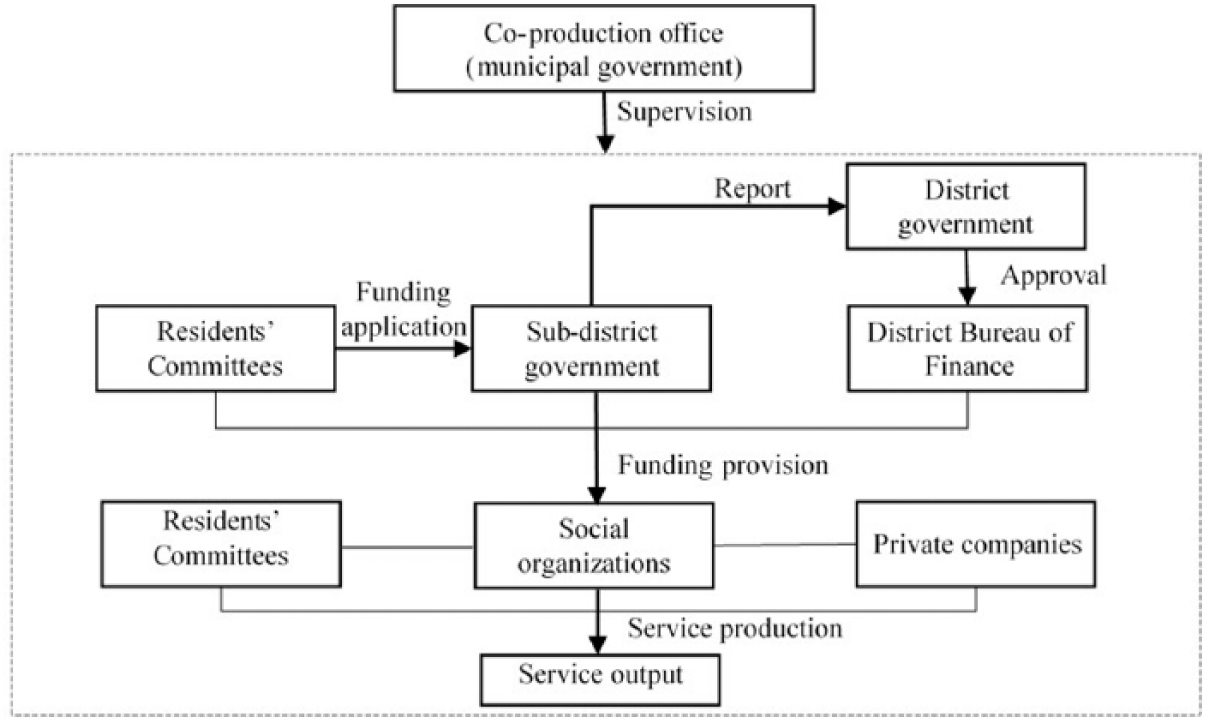
Financing a co-production project with multiple stakeholders
While the district government estimates the total costs needed to complete the project, it does not cover all the costs. Instead, sub-district/township governments and residents are expected to contribute a share of the funding as well. Stakeholders’ contributions vary in different localities. In most cases, local communities contribute 30 per cent of the estimated costs, while local governments contribute the remainder. Of this government share of the financing, the district government contributes 40 per cent, and the sub-district or township government contributes 60 per cent. For sub-districts or township governments lacking the financial capacity, the ratio is reversed.
The flow of financial resources in the next stage depends upon the specific services. For infrastructure development services, funding is provided to construction companies. For such community-based services or facilities as local libraries, gyms, elderly care centres or entertainment activities, the funding is provided to the responsible Residents’ Committees or NGOs, which sign a contract with local government.
In Guiyang and Haicang, funding was given to Residents’ Committees, which would then contract social organizations or professional organizations to carry out approved projects. In Taicang, however, the local government kept the funds and asked the social work organizations to claim them item by item. This was only possible as the city was small.
Resident contributions are handled differently in different situations. Sometimes residents make in-kind contributions rather than financial ones. In Chengdu, for instance, where increasingly communal garden and green space is “adopted” by residents, they spend time maintaining the gardens. To avoid the problem of free-riding, the Residents’ Committee provided name tags for each adopted plot, indicating whose responsibility it was.
Not all residents are interested in contributing to the community building. As a resident from Taicang said: “Volunteers were asked to help out (with street cleaning); however, it is not possible to use volunteers to do the cleaning all the time…Volunteers might be useful for cleaning once or twice before hygiene inspections. However, on a daily basis, the service should be provided by the government.” Similar issues were raised in Chengdu and Guiyang. After all, a core question is why, after paying tax, residents should be asked to contribute to the finance of such basic projects. A recent policy change in Chengdu reflects these concerns. The Chengdu government decided to set aside dedicated funds for community development and governance,(20) which would be allocated based on the number of residents in a community and ringfenced for community governance innovations. The government, meanwhile, would not withdraw funding from its existing services. With the secure funding, the residents could still decide on, deliver and monitor the progress of the projects. With co-production, the fundraising responsibilities rest with the district and municipal-level governments rather than with the community members.
In all the cities, most of the funding for co-production activities was dedicated to infrastructure or public space improvement. For example, according to Haicang’s internal statistics, in 2014, around 90 per cent of government funding for co-production was spent on infrastructure and housing-related projects, of which approximately US $3.8 million was spent on sewage upgrading, and about US$ 2.4 million on housing renovation. The local government interviewees suggest that spending was concentrated in these two areas because residents preferred for public funding to be spent on these costly items.
f. Social outcomes of co-production
Apart from the infrastructure and services delivered, the social outcomes of co-production are of great interest. Communities of strangers have become friendly communities. People went from attending activities organized by the Residents’ Committees or professional NGOs, to organizing activities themselves. They went from attending activities that benefitted their own wellbeing to participating or even volunteering at events that would benefit others. New services emerged as relations changed among different groups.
In the past, government-funded community services were constrained by the earmarked funding model – it was challenging to move beyond administrative restrictions. Often, the migrant population and longer-term urban residents received different treatment, which divided them. In an economic climate in which government resources were abundant, people were willing to help migrants. But when resources were limited, local people felt less generous with newcomers. In large cities, tensions had already escalated in association with the availability of educational resources.
The co-production model has shown it can also work the other way, with services provided for migrants becoming available to other residents as well. A good example has been the emergence of after-school programmes in urban communities. This service was particularly needed by migrant parents who could not rely on grandparents to care for their children. Initially, some retired schoolteachers volunteered to offer after-school programmes to migrant children, an activity identified as a good practice by local governments. The Wenzhou government in Zhejiang Province decided to encourage urban communities to provide some funding and facilities to support the care of migrant children. This practice was picked up by other cities and communities, although the providers may have been different. In Chengdu, for example, the Student 430 Project was established in 2013 for students from low-income, single-parent and migrant families or primary school students. Children were helped to complete homework on time and had access to organized crafts, sports and film watching. Schoolteachers could participate but only as volunteers. In Guiyang, the government established “Half-Past Four Schools”, operated by existing community social workers (working for Residents’ Committees), who were hired to do other jobs. The service was often cancelled after the initial enthusiasm waned, when the social workers found that they could not spare so much time for this extra task. Later, as social organizations started to contract to provide the services, Half-Past-Four Schools were revived. Social organizations could package the service with other projects, such as activity centres, community libraries or reading rooms, which allowed them to obtain extra funding from the governments and become financially viable. After-school projects emerged out of migrants’ needs, but the services became available to the locals as well. When migrants could inspire the improvement of social services that could also benefit the non-migrant urban population, and when the local government as the fundholder listened to the advice of the service providers and residents and adapted the services accordingly, social tension was eased.
Co-production could also result in a stronger sense of community and responsibility among newcomers. In rural areas, farmers from the same village had lived together for generations. The situation changed when they moved to the city. As the head of a community service centre in Haicang recalled: “When they [relocated farmers] first moved here, it was a mess. The residents were from different villages. They kept the old habits from rural areas even though they were now living in an urban community…Chickens, ducks, green vegetables, a dirty environment and bad traffic habits…”
It was apparent that something needed to be done to improve their sense of belonging. The community service head continued: “We first set up a community Elderly Association to start various activities…The purpose was to make the residents feel united…After the activities, they started to become familiar with each other…Later, we felt that there was no point for us to organize activities all the time. We started to ask residents what they needed…They told us the most important thing was that they had nothing to do during the day and were bored. So, we encouraged the elderly to set up a Tai Chi Association. We helped to invite a teacher. With all these activities, they were much more identified with the community.”
According to this social worker, these efforts paved the way for later self-service and governance. There were even volunteers to patrol the neighbourhoods. At the time of our field research, the community was in good shape, and we did not see the “mess” the social worker described.
There are no official statistics on whether the co-production has reduced the number of conflicts in urban communities. The community social workers we interviewed reported that they were spending less time dealing with complaints in resettlement communities. They felt these complaints were often psychologically based. Some farmers had trouble adapting to the urban environment; they might be unemployed, or feeling lonely; and they showed their anger to community social workers. The activities encouraged by co-production helped them to feel emotionally more associated with their new residential communities. Volunteering also made them feel both useful and cared-for. As a result, the social workers are dealing with fewer hostile residents than in the past.
g. Problems with state-led co-production
Despite the achievements, there are some problems with the Chinese practices. Co-production has only changed the governing structure at the grassroots level; there are conflicts at the intersection of the vertical public administration system and the horizontal level where multiple stakeholders work together. In theory, with community self-governance and self-service provision, grassroots officials should expect to have a lower service burden or to face less conflict. In reality, our interviewees complained that their workload had increased. They had to complete the key performance indicators (KPIs) set by the higher authorities for the conventional services they were responsible for, but also to monitor the co-production activities at the same time.
The initial idea was to transform each government official’s way of thinking and working; however, governments were eager to see hard results, especially in places designated as good examples of reform in action. Higher-level authorities established KPIs and carried out formal evaluations to motivate the lower-level authorities and communities to deliver the outcomes that the higher-level authorities wished to see. This official evaluation determines how the co-production is perceived and whether it will continue. Our research found that, in consequence, what motivated local officials the most was the visibility or measurability of the activities, which are most likely to be counted towards their KPIs.
These visible activities also look good when there are inspections. Complaints from some social organizations confirmed this point. They reported that once they were granted a licence to deliver a service, before they could properly establish its operation, the government officials began to bring in visitors to present the outcomes. The staffers had to cooperate by showing the visitors around – putting on a show became part of their daily job. At some point, these organizations also began to game the system by focusing on the more visible public events. As a result, in some communities, a large amount of public funding was devoted to organizing parties. Residents for the most part were not against this as they enjoyed the events, so the practice was not challenged. But there were indeed questions about whether it should be the responsibility of the government to fund so many parties every year.
Government promotion of co-production gave non-governmental actors a larger role, mobilized their resources and encouraged self-governance. Therefore, it changed the relationship between the government and the stakeholders in the community. However, the hyper-energetic push from the top, especially in the cases of Haicang and Guiyang, may have resulted in cynical responses at the local level, where people believed that the campaign would be like other campaigns in the past. Either they felt it would not last or they might assume a disguised government intention to withdraw from specific social policy responsibilities. Some services were given to community self-governance organizations without any government support, which resulted in a lack of organization, conflict or even the end of service provision. State-led co-production can also be stretched to its limits if the multiple stakeholders are reluctant to cooperate.
V. Conclusions
The cases we have studied showed how co-production is promoted, financed and managed in urban districts in China by the state in order to address some acute social challenges. There is growing international recognition of co-production as a grassroots strategy. However, for co-production to be driven from below, certain conditions need to be realized: it requires a sense of community that is strong enough for people to be able to work together towards a common goal. It also implies the presence of institutions that allow people to play a meaningful role in co-producing public goods and services. When these conditions are not met, one cannot assume that co-production will be successful, even in situations where the state is less dominant.
We contend here that government can also be an initiator of co-production. A lead role on the part of the state can be useful in communities that are essentially societies of strangers. This is the case for communities with a large proportion of new migrants, where residents lack a strong sense of community, depend on the state to provide public goods and are unable to express their needs collectively. The state in this situation can inspire collective action by financing or contributing to the delivery of co-produced public services or goods. The state can also play a role in institutionalizing co-production efforts so that the resulting projects will last even if other stakeholders do not continue to play a part over time.
This kind of state-led and state-promoted co-production and support for civil self-governance may facilitate public deliberation and public participation at the grassroots level, creating a horizontal level at which local interests, resources and services are mediated through mechanisms of negotiation and cooperation.
It is premature to claim that the thriving experiments in co-production described in this paper will facilitate political democratization in China. These pilot models have taken place only in a social microenvironment and are confined to non-politicized social affairs and public services. Without question, however, they help to make local management more effective and to reduce the pressures faced by local governments. Indirectly, this co-production also contributes to stabilizing Communist Party rule at the local level, changing the state’s role from that of a single provider to that of intermediary regulator, organizer and coordinator. The state is only one of multiple actors in co-producing public services; however, it probably remains the most important actor.
Footnotes
Acknowledgements
The authors take full responsibility for the views expressed in this paper. The United Nations Research Institute for Social Development (UNRISD) is not responsible for these views.
Funding
This paper is based on fieldwork from a research project funded by UNRISD, in which Bingqin Li and Lijie Fang are the chief investigators.
1.
Pestoff, V (2012), “Co-production and third-sector social services in Europe: some crucial conceptual issues”, in V Pestoff, T Brandsen and B Verschuere (editors), New Public Governance, the Third-sector and Co-production, Routledge, New York and London, pages 13–35; also Cepiku, D and F Giordano (2013), “Co-production in developing countries: insights from the community health workers experience”, Public Management Review Vol 16, No 3, pages 317–340.
2.
Xi, J P (2017), Report to the 19th CPC National Congress, available at  .
.
3.
See reference 2.
4.
Cabannes, Y and Z Ming (2014), “Participatory budgeting at scale and bridging the rural–urban divide in Chengdu”, Environment and Urbanization Vol 26, No 1, pages 257–275; also He, B (2011), “Civic engagement through participatory budgeting in China: three different logics at work”, Public Administration and Development Vol 31, No 2, pages 122–133; and Wu, Y and W Wang (2011), “The rationalization of public budgeting in China: a reflection on participatory budgeting in Wuxi”, Public Finance and Management Vol 11, No 3, pages 262–283.
5.
Preuss, U K (1988), “The concept of rights and the welfare state”, in G Teubner (editor), Dilemmas of Law in the Welfare State, de Gruyter, Berlin, pages 151–172.
6.
Bason, C (2010), Leading Public-Sector Innovation: Co-creating for a Better Society, Policy Press, Bristol, 278 pages; also Brandsen, T and V Pestoff (2006), “Co-production, the third sector and the delivery of public services”, Public Management Review Vol 8 No 4, pages 493–501.
9.
Mitlin, D (2008), “With and beyond the state – co-production as a route to political influence, power and transformation for grassroots organizations”, Environment and Urbanization Vol 20, No 2, pages 339–360, page 339.
10.
See, for example, reference 6, Brandsen and Pestoff (2006); and Fyfe, S R (2005), “Making space for ‘neo-communitarianism’? The third sector, state and civil society in the UK”, Antipode Vol 37, No 3, pages 536–557.
11.
Sicilia, M, E Guarini, A Sancino, M Andreani and R Ruffini (2016), “Public services management and co-production in multi-level governance settings”, International Review of Administrative Sciences Vol 82, No 1, pages 8–27, page 8.
12.
Ma, B and X Ren (2011), “From social management to social governance: challenges and change”, Learning and Exploration Vol 3, pages 95–99.
13.
Howell, J (2012), “Civil society, corporatism and capitalism in China”, Journal of Comparative Asian Development Vol 11, No 2, pages 271–297.
14.
Jiang, S, M Lu and H Sato (2012), “Identity, inequality, and happiness: evidence from urban China”, World Development Vol 40, No 6, pages 1190–1200.
15.
Li, B, C Chen and B Hu (2016), “Governing urbanization and the new urbanization plan in China”, Environment and Urbanization Vol 28, No 2, pages 515–534.
16.
Liu, Y, S He, F Wu and C Webster (2010), “Urban villages under China’s rapid urbanization: unregulated assets and transitional neighbourhoods”, Habitat International Vol 34, No 2, pages 135–144.
17.
Huang, X, M Dijst, J van Weesep and N Zou (2014), “Residential mobility in China: home ownership among rural-urban migrants after a reform of the hukou registration system”, Journal of Housing and the Built Environment Vol 29, No 4, pages 615–636; also Meng, X (2012), “Labor market outcomes and reforms in China”, The Journal of Economic Perspectives Vol 26, No 4, pages 75–101; and Huang, Y and R Tao (2015), “Housing migrants in Chinese cities: current status and policy design”, Environment and Planning C: Government and Policy Vol 33, No 3, pages 640–660.
18.
Wang, H, P Zhu, X Chen and S Swider (2017), “Land expropriation in urbanizing China: an examination of negotiations and compensation”, Urban Geography Vol 38, No 3, pages 401–419.
19.
Department of Civil Affairs of Nanming District, Guiyang (2018), “Announcement on the completion of extra residents’ committees in the Huaguoyuan Community” [Nánmíngqu-mínzhèngjüwánchéng hua-guoˇyuán shèqu- xı-nshè ju-weˇihuì, 南明区民政局完成花果园社区新设居委会], accessed 20 June 2018 at .
20.
Chengdu Social Governance Commission (2018), “Suggestions on securing funding for innovation of the governance in urban and rural community development” [Gua-nyú chuàngxı-n chéngxia-ng shèqu- fa-zhaˇn zhìlıˇ jı-ngfèi baˇozhàng jı-lì jı-zhì de yìjiàn, 关于创新城乡社区发展治理经费保障激励机制的意见], accessed 20 June 2018 at .