




Abstract
The failure of the conventional public and private (market-based) water policies to improve urban water access in the global South has prompted growing interest in alternative models such as community–state co-production. However, there is little evidence of whether co-production can improve water service delivery in the informal settlements of sub-Saharan Africa where a disproportionately high percentage of the urban poor lives. This paper uses household surveys, key informant interviews, and focus groups to examine the impact of co-production on household water access and service delivery in the informal settlements of Lilongwe, Malawi. Co-production increased water accessibility, reduced the cost of water, increased the number of community water kiosks, and resulted in more effective financial management and accountability. However, challenges related to poor infrastructure and limited community capacity threaten the long-term sustainability of the co-production model. Urban informal residents lamented worsening water-supply interruptions and longer waiting times after co-production, challenges that require state intervention.
Keywords
I. Introduction
Access to water remains a critical challenge in the urban areas of sub-Saharan Africa (SSA), especially in the informal settlements where most urban residents live.(1) These settlements are projected to grow in size and number, and water demand will rise amid declining supply. Water sources in informal settlements are often unreliable, intermittent supply is widespread, and residents pay more for water than those in core urban areas.(2) Without affordable and reliable water sources, many poor residents use multiple, often unreliable, unsafe water sources, including water sold by vendors at high prices.(3)
Both centralized (public) and private (market-based) policies have failed to address growing urban water insecurity in the region.(4) Water access challenges related to governance failure are still pervasive, and social, political and institutional weaknesses underlie poorly maintained water distribution systems, ageing infrastructure, and poor drinking water allocation.(5) Despite its inefficiencies, public water supply is still the predominant mode of delivery in SSA. But this tends to only benefit wealthier neighbourhoods in core urban areas, and capital investment for infrastructural expansion is often abysmal in the water sector.(6) Privatization of water services has fared no better than public systems, failing to deliver the much anticipated improvements in access and increased investment.(7)
In light of both growing water insecurity and failure of the conventional public and private water systems to satisfy demand, attention is increasingly turning to alternative institutional arrangements based on community–state co-production. Proponents of co-production argue that the engagement of citizens and the state together in service delivery can enhance service delivery while at the same time improving state–citizen relationships.(8) Other scholars argue that co-production can also improve environmental sustainability.(9) However, although co-production has been extensively studied in the public management literature, there is little evidence of whether it leads to improved water access in urban informal settlements. This paper seeks to examine this question in informal settlements in Lilongwe, Malawi’s capital city.
In 2006, the government of Malawi, in an attempt to address chronic water scarcity in urban informal settlements, promoted community–public partnerships (CPPs), a form of service co-production in which state water utilities work together with community-elected water user associations (WUAs). This new model of water delivery came on the heels of broad decentralization reforms that aimed to empower local communities by involving them in the governance and management of natural resources. In Lilongwe, two nongovernmental organizations, WaterAid and the Center for Community Organization and Development (CCODE), and the Lilongwe Water Board (LWB), a public water utility, mobilized community leaders to form WUAs. The goals of the partnerships were to enhance water supply in underserved urban settlements and create opportunities for communities to participate actively in water service delivery. The CPPs, thus, provide a mandate for the community-elected WUAs to manage revenue from water sales, oversee community water points (or kiosks), organize community elections to appoint representatives, and report community complaints about service delivery to the LWB. LWB, in turn, supplies water to WUA communities, provides technical assistance, and manages Lilongwe’s main water infrastructure.
This article explores the impact of these co-production arrangements on water access and delivery in Lilongwe’s informal settlements. Specifically, it: 1) examines the impact of CPPs on household water access; 2) compares water user expectations and satisfaction before and after WUA introduction; and 3) interrogates socio-institutional dynamics and their influence on observed water access outcomes and perceptions. Malawi’s community–public partnerships are an appropriate case study for addressing the bigger question of whether co-production is feasible in urban informal settlements, whether it has potential to improve service delivery, and what limitations and barriers could undermine such models in better underserveding urban environments. By analysing user perceptions and the role of institutional dynamics, we also contribute to better understanding the impact of co-production on everyday water challenges from the standpoint of users. The findings are relevant to broader questions about possibilities, potential and limits of co-production and the opportunities and challenges of participatory water governance in urban settings.
II. Co-Production and Citizen Participation in Public Service Delivery
There are diverse interpretations of co-production, but the core of the concept is citizen participation in service delivery with the state or public agencies. Elinor Ostrom defined co-production as “the process through which inputs used to provide a good or service are contributed by individuals who are not in the same organization”.(10) Citing a divide between government and civil society as problematic, Ostrom argued that rarely is one single public-sector agency responsible for all the inputs into a service-delivery system. Since the work of Ostrom(11) and others(12) in the 1970s and 1980s, co-production has been studied extensively in the public management literature.(13)
Co-production can involve partnerships between multiple state and non-state actors: community groups, public agencies, private firms, and civil society organizations.(14) The definition we adopt is institutionalized co-production: “the provision of public services (broadly defined to include regulation) through a regular long-term relationship between state agencies and organized groups of citizens where both make substantial resource contributions”.(15) This is an appropriate framework for our study because it recognizes communities as active participants in service provision within complex policy arrangements where long-term goals and relationships are constantly being negotiated. Malawi’s urban CPPs involve community-elected representatives and state water-delivery agencies over an indefinite period: communities primarily oversee the management water services and revenue collection, while the utility manages infrastructure, delivers water to community pipes, and provides technical assistance.
Community–state co-production is predicated on the view that that top-down (centralized) service delivery is inefficient, and that citizen participation leads to better outcomes. Partnerships and interactions between multiple stakeholders can potentially enable constant negotiation between actors, enhancing synergies between them.(16) In the process, communities can participate in decision-making, seek accountability, and contribute resources to service delivery – benefits that centralized systems do not offer. Co-production also enhances community social capital,(17) increases the commitment of public agencies, reduces community costs,(18) and increases community knowledge, empowerment and trust in public agencies.(19)
Despite these advantages, co-production of public services is vulnerable to the same pitfalls that undermine community-based natural resource management (CBNRM) and participatory governance in general. The underlying assumptions regarding sustainability, empowerment, and equitable distribution of social benefits can be problematic.(20) The conditions for successful collective action do not always hold across different local contexts, nor are the rules, norms, and institutional arrangements immune to relations of power.(21) In recent decades, scepticism over CBNRM has grown as it has by and large failed to deliver benefits to local communities,(22) resulting instead in undue state intrusion that often disrupts social relations and allows the most powerful to capture benefits.(23) Some advocates romanticize “community” as a homogenous unit, often ignoring the unequal power and hegemonic relations that community mobilization is frequently prone to.(24)
III. Co-Production and Citizen Participation in Urban Water Services Delivery
Recent work in the urban water and sanitation space demonstrates the importance of co-production to service delivery. In the particular case of informal settlements, co-production benefits both residents and public agencies: the former secure better services, and the latter work with a more committed citizenry.(25) In Caracas, the capital and largest city of Venezuela, co-production of water and sanitation services improved accountability and enhanced flow of information between service providers and users through community technical committees.(26) In Mumbai, residents of middle-class apartments successfully co-produced solutions to intermittent water supply in partnership with the municipal water agency in a decentralized water system.(27) Other evidence demonstrates that co-production of water enables urban communities to play a more active role in water policy formulation, sometimes even granting them autonomy and ownership over service delivery.(28) It may also open up economic opportunities where willing participants create businesses to respond to the deficiencies of public water service delivery.(29)
Despite the advantages of co-production, policies based on the concept can be flawed, particularly when participants fail to act in good faith. Community–state partnerships are easily undermined by conflicting actor interests(30) and in some situations may reinforce or legitimize unequal power relations between utilities/public agencies and communities.(31) The state may use community involvement to advance a neoliberal, market-based agenda while shirking its service delivery responsibility.(32) While invoking the idea of community, the state can pursue commercialization of water and other basic services.(33) Elite capture is equally common in co-produced water systems,(34) and committees may prioritize the water needs of certain communities over others.(35) Poor technical capacity of communities may undermine better service provision and stall infrastructural development, as in cases in Colombia and Bolivia.(36) Community–state co-production may be justified by idealized notions of community yet be designed to enhance economic efficiency – no different than neoliberal attempts by states to privatize water services and roll back their core mandate towards service provision.(37) Community-centred models of water delivery are not faultless alternatives. Outcomes are contingent on numerous factors, both local and external to communities.(38)
IV. Co-Production of Water Supply in Lilongwe Through Community–Public Partnerships
Malawi appears to have made significant progress towards improving overall water access. According to the WHO/UNICEF 2015 Joint Monitoring Programme (JMP) report on drinking water and sanitation, over 40 per cent of Malawi’s population gained access to improved sources of water between 2000 and 2015,(39) although many view the JMP’s urban figures as misleading.(40) In Lilongwe and Blantyre, the country’s two major cities, the population since the early 1960s has exploded from just over 200,000 to over 2 million people. Water infrastructure has weakened with increased water demand.
Lilongwe, the most populous city, exemplifies unequal water access across most cities in the global South. In the informal settlements, interruptions in water supply and inequalities in access are widespread, sources are routinely contaminated, and women especially spend considerable time walking and waiting for water.(41) The Lilongwe Water Board is the main water utility provider for the city, responsible for supplying commercial customers and households through private connections, as well as pumping water to community water kiosks. But it struggles to meet the growing demand. Supply is intermittent, disconnections are frequent, and nearly a third of bulk water from treatment plants is unaccounted for (i.e. non-revenue water).(42) Water access is highly uneven, and the utility prioritizes the needs of wealthier neighbourhoods over low-income areas.(43) Kiosks remain the most common source of water in Lilongwe’s informal settlements, but residents also have to draw from alternative sources (private household taps, wells, boreholes and rainwater) to meet their daily water needs.(44)
Broad decentralization programmes in Malawi, beginning in 1998, were aimed at enhancing grassroots development, reducing widespread poverty, strengthening capacity of local institutions, and increasing local participation in governance.(45) Driven by these programmes, the government encouraged community–public partnerships as an alternative water-delivery model to address chronic scarcity in informal settlements in Lilongwe and Blantyre. The partnerships were formed between state-based, parastatal water utility companies and water user associations that represented different informal settlement communities. NGOs, traditional leaders, respected community leaders, and civil society organizations played critical roles in the formation of partnerships.
The CPPs are structured such that the Lilongwe Water Board (LWB) supplies bulk water to communities, and WUAs sell and co-manage the service within their respective jurisdictions. LWB, a parastatal agency established in 1947 to supply water to Lilongwe City,(46) makes independent decisions but is accountable to the Ministry of Irrigation and Water Development, the National Water Resources Board, and the Lilongwe City Council (Figure 1). LWB owns the main water infrastructure (treatment plants, etc.), and communities own public standpipes or water kiosks that are managed by their respective WUAs. Each community has one WUA that is expected to represent the interests of all water users. The utility provides technical expertise to WUAs through trained plumbers and other certified workers. WUAs collect revenue from water sales and pay the utility on a monthly basis. LWB benefits from this organized, streamlined revenue collection system and can operate more efficiently, not having to supervise and pay for employee (vendor) salaries.
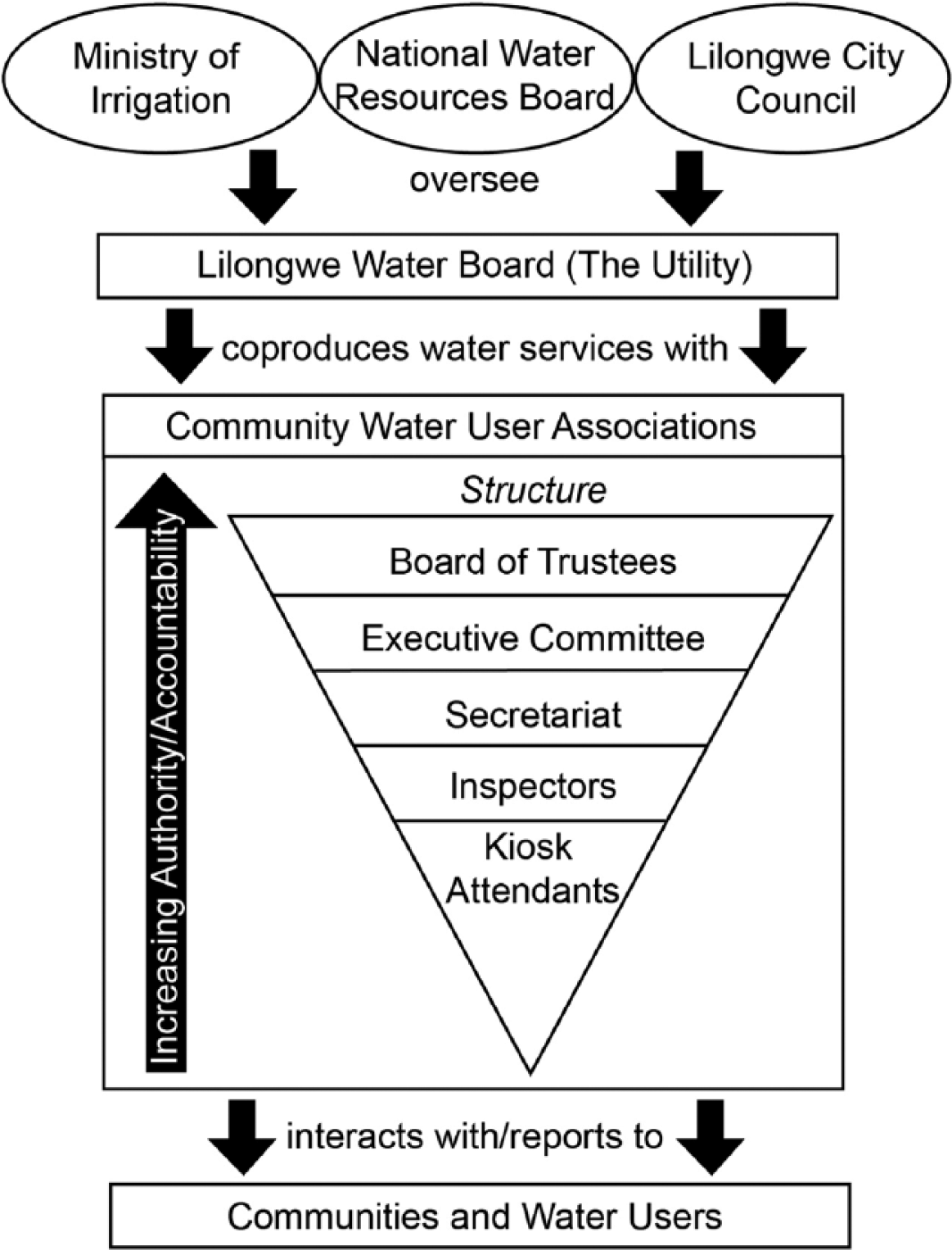
Structure and actors in the community–public partnerships in Lilongwe, Malawi
Each WUA (Figure 1) typically comprises of an appointed board of trustees that is the final decision-making body and disciplinary arm; an executive committee that is voted into office to oversee the day-to-day running of the association; a secretariat with employees headed by an administrator; inspectors who audit water meter readings and report faults to the WUA office; and water vendors who sell water at the kiosks. Community member customers contribute financially to the WUAs by purchasing water and they participate in the election of executives.
V. Methods
a. Data collection procedures and site characteristics
The study primarily draws on household surveys (N=649), with supplementary data from interviews with Lilongwe Water Board employees, WUA officers, NGOs, and government agency workers, recruited with a combination of snowball and purposive sampling. We also conducted focus group discussions (approximately six participants each) with WUA executive members in Kauma and Mtandire, two sites where there has been co-production of water since 2006. Topics covered in the interviews and focus group discussions included the structure and functions of WUAs, WUA relationships with external actors, membership and decision-making dynamics, and major successes and barriers.
Through the household surveys, we gathered water access information including sources of water, time and physical burdens for daily water fetching, water use and storage, and costs of water. We gauged households’ expectations of water access before the CPPs started and their assessment of improvements following CPP introduction. The household questionnaire was designed in English, translated into Chichewa, the main local language, and pretested. Final changes were incorporated with help from research assistants and translators before data collection. The Michigan State University Institutional Review Board provided ethical clearance.
We sampled households from three informal settlements (Kauma, Mtandire and Area 36) that predominantly depend on communal water kiosks and have similar socioeconomic and demographic characteristics, high poverty rates and high population densities. We employed a two-stage cluster sampling technique. In the first stage, we selected two (Kauma, Mtandire) out of six settlements where co-production is currently operational. We then chose a third site currently without a CPP (Area 36) as a control to test differences in water access. Communal water kiosks in Area 36 are managed and owned either by the utility, or by private operators who own their own kiosks and pay the utility for water – rather than through a formal co-production arrangement.
After the target communities had been sampled, we randomly selected households in proportion to the estimated number of households in each settlement. Using the power sampling method at a 5 per cent error margin, 99 per cent confidence interval, and average household size of five (as specified by the most recent census), we sampled a total of 645 households, distributed across the three neighbourhoods as follows: Kauma=155, Mtandire=258 and Area 36=232 (Map 1). Households were then selected through systematic sampling, first using a central location and then walking along the cardinal directions (east, west, north and south) in equal spacing. This was determined on the ground and distributed across the cardinal directions based on the sample size per site.
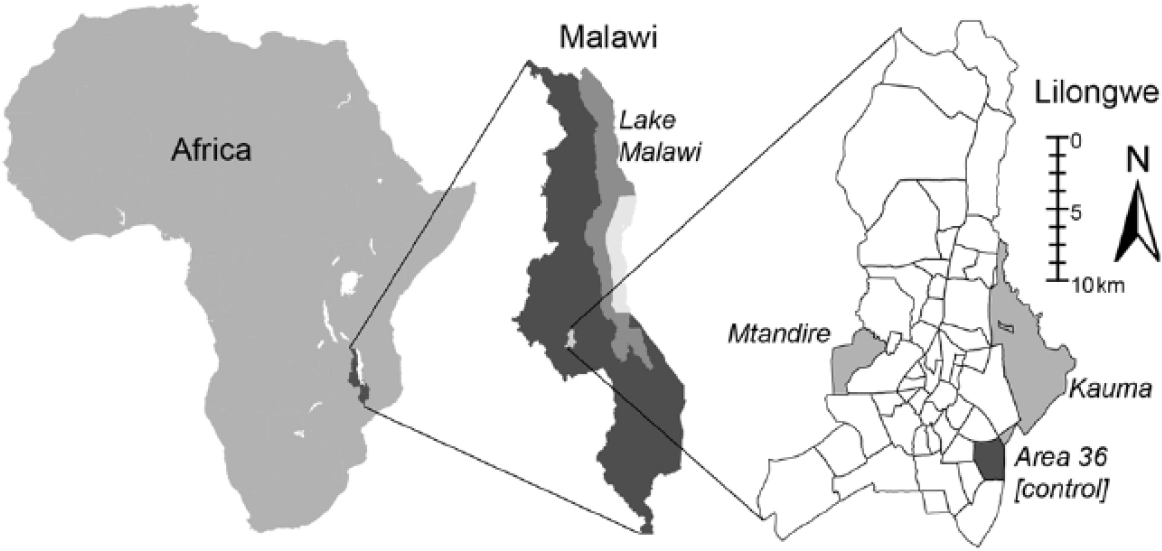
Study areas
b. Data analysis
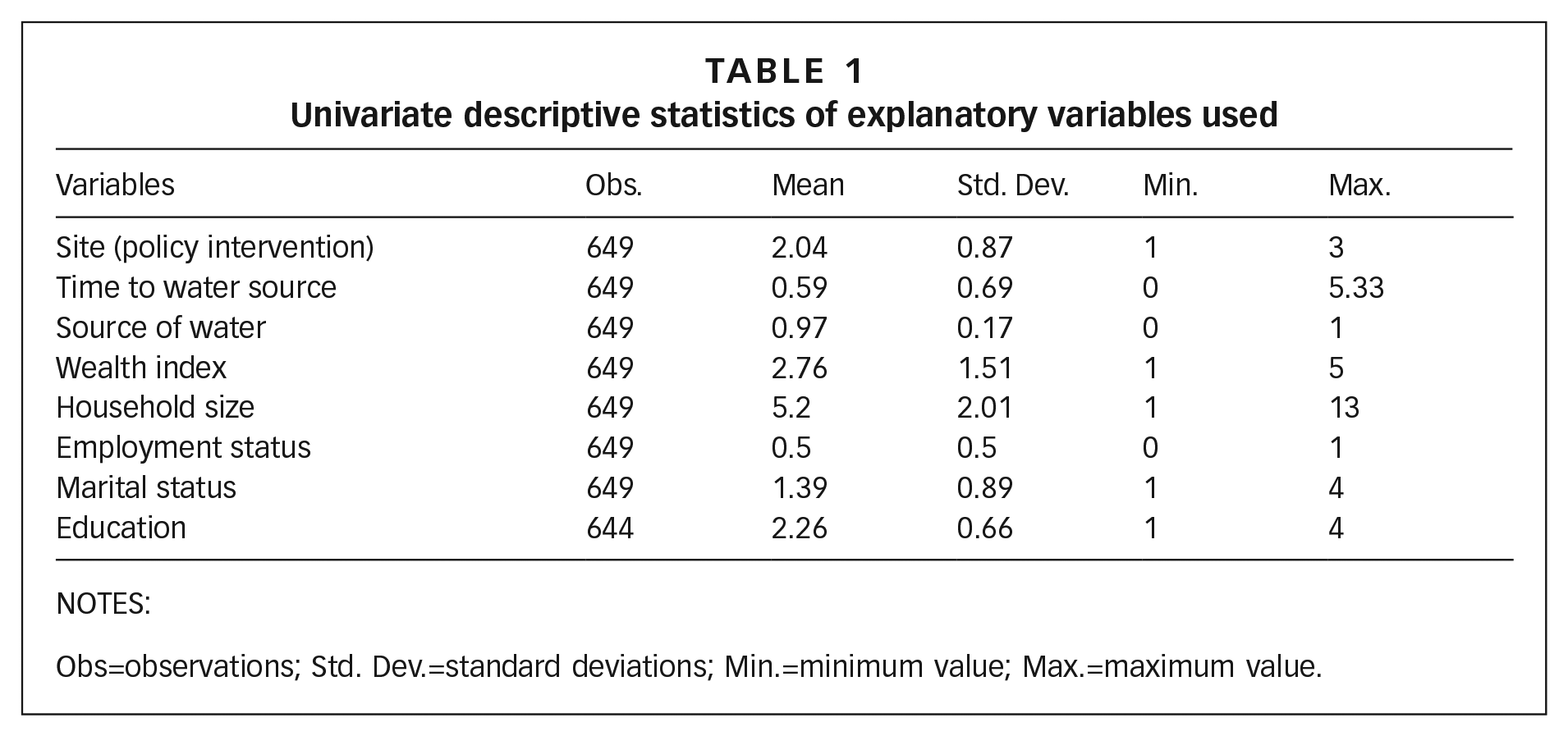
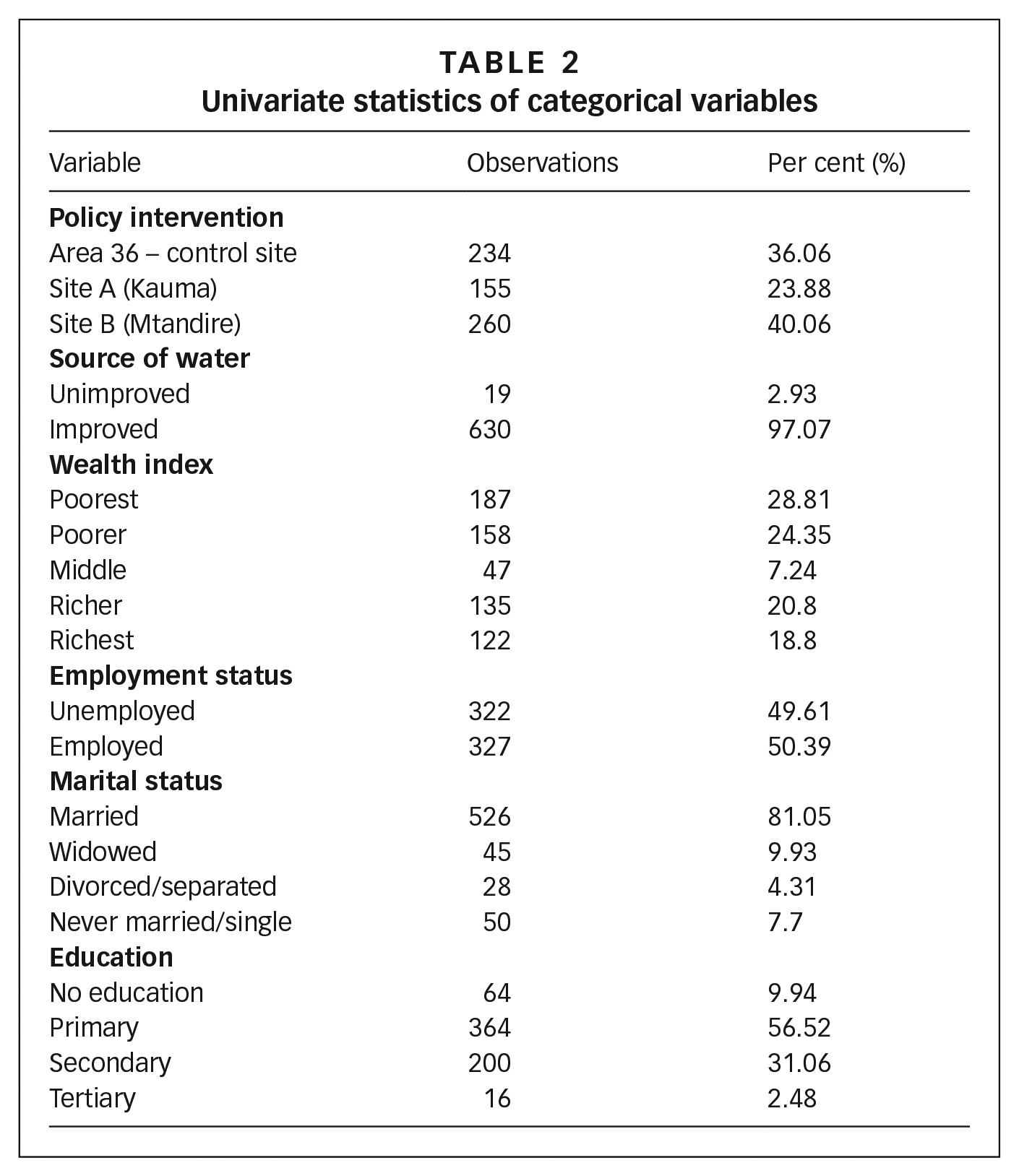
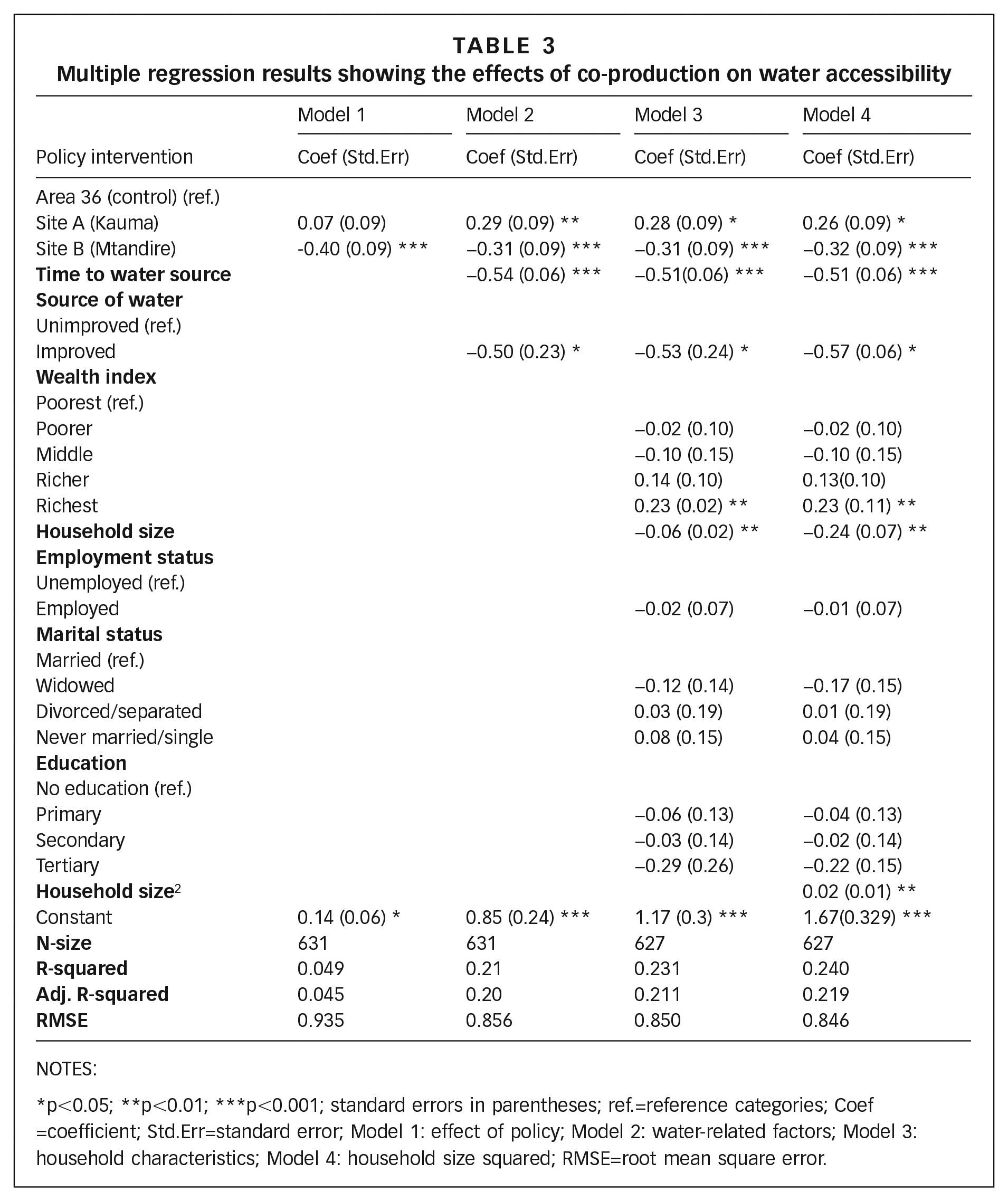
We employed both descriptive and quantitative multivariable analyses. The survey data were analysed using multiple linear regressions. Interview and focus group information was analysed through a grounded theory approach,(47) first by transcribing audio files, reading for common themes in the transcripts and handwritten notes, and ultimately identifying meanings, relationships and relevant concepts from the data. Survey data were examined using descriptive, bivariate and multiple regression techniques. We calculated the means and standard deviations for all the items, identifying their minimum and maximum values (Table 1), and we examined proportions for the categorical variables (Table 2). For the multiple linear regression, we developed four nested models. For Model 1, we examined the effect of co-production on water accessibility in two sites and compared the outcomes with the control site. We then adjusted for the effect of water-related factors, such as the time to the water source and the primary source of drinking water, in Model 2. In Model 3, we adjusted for socio-demographic factors including wealth index, household size, education, employment, and marital status. In Model 4, to account for the non-linear relationship between household size and water accessibility, we added the square of household size.
Univariate descriptive statistics of explanatory variables used
NOTES:
Obs=observations; Std. Dev.=standard deviations; Min.=minimum value; Max.=maximum value.
Univariate statistics of categorical variables
Measures of water access
To determine whether households in communities with co-produced water delivery have better water access than communities without, we examined the household survey data and grouped relevant variables into outcome and independent variables. The outcome variable, water accessibility, was measured as a factor score of water access indicators, developed from five survey questions respondents answered on a scale of 1–5. The questions were on affordability [d3]; distance to the primary source of water [d4]; regularity of the flow from this source [d7]; satisfaction with the frequency of water supply from the primary source [d9]; and quality of water from this source [d11]. Higher scores indicated more positive experiences of water accessibility. The main independent variable for this study was the existence of a co-production (community–public partnership) arrangement. This variable consisted of three categories representing the three study sites and coded as follows: (1) households in Area 36 (no co-production); (2) households in Kauma (first site with a co-production arrangement); and (3) households in Mtandire (second site with a co-production arrangement). Category 1 was then used as the reference category against Categories 2 and 3 to test for the impact of co-production on water accessibility.
VI. Results
a. Univariate and bivariate results
We present univariate descriptive statistics in Tables 1 and 2. Participants reported spending a mean of 0.6 hours acquiring water on a return trip, with a range of 0–5.3 hours (zero for those with water on their premises and a maximum of 5.3 hours for those who collect water elsewhere). The mean household size was 5.2. Out of the 649 surveyed participants, 23.9 per cent lived in Kauma (Site 1 with co-production), 40 per cent in Mtandire (Site 2 with co-production), and 36.1 in Area 36 (the control site). 28.8 per cent of the respondents were classified as the poorest, while 18.8 per cent were in the richest wealth quintile (Table 3). Most participants interviewed used water from improved sources (97.1 per cent). Improved water sources are defined as those that, by design and construction, are more likely to deliver safe water or are less prone to contamination. Also, 56.5 per cent of the sample had primary education, with one of every two participants employed, and 81.1 per cent of our sample were married (Table 3). The bivariate results show that compared to the control site, where there is currently no co-production, Kauma had higher water accessibility scores (0.13) while Mtandire had lower water accessibility scores (-0.22). Across all sites, there was no significant relationship between water accessibility and employment status, marital status, and level of education.
Multiple regression results showing the effects of co-production on water accessibility
NOTES:
p<0.05; **p<0.01; ***p<0.001; standard errors in parentheses; ref.=reference categories; Coef =coefficient; Std.Err=standard error; Model 1: effect of policy; Model 2: water-related factors; Model 3: household characteristics; Model 4: household size squared; RMSE=root mean square error.
b. Multiple linear regression results
Adjusting for all the independent variables, households in Kauma had increased scores on water accessibility by a factor of 0.28, while households in Mtandire had decreased accessibility scores by 0.31, relative to households in Area 36 with no co-production policy. Across all sites, an increase in the time to the water source was associated with a significant decrease in water accessibility scores (Table 3). However, respondents who used improved water sources compared to unimproved had a 0.53 decrease in their water accessibility scores. Similarly, an increase in household size was associated with a significant decrease in water accessibility scores. As expected, an increase in wealth was associated with an increase in water accessibility scores.
c. User perceptions of changes in water access after co-production arrangements
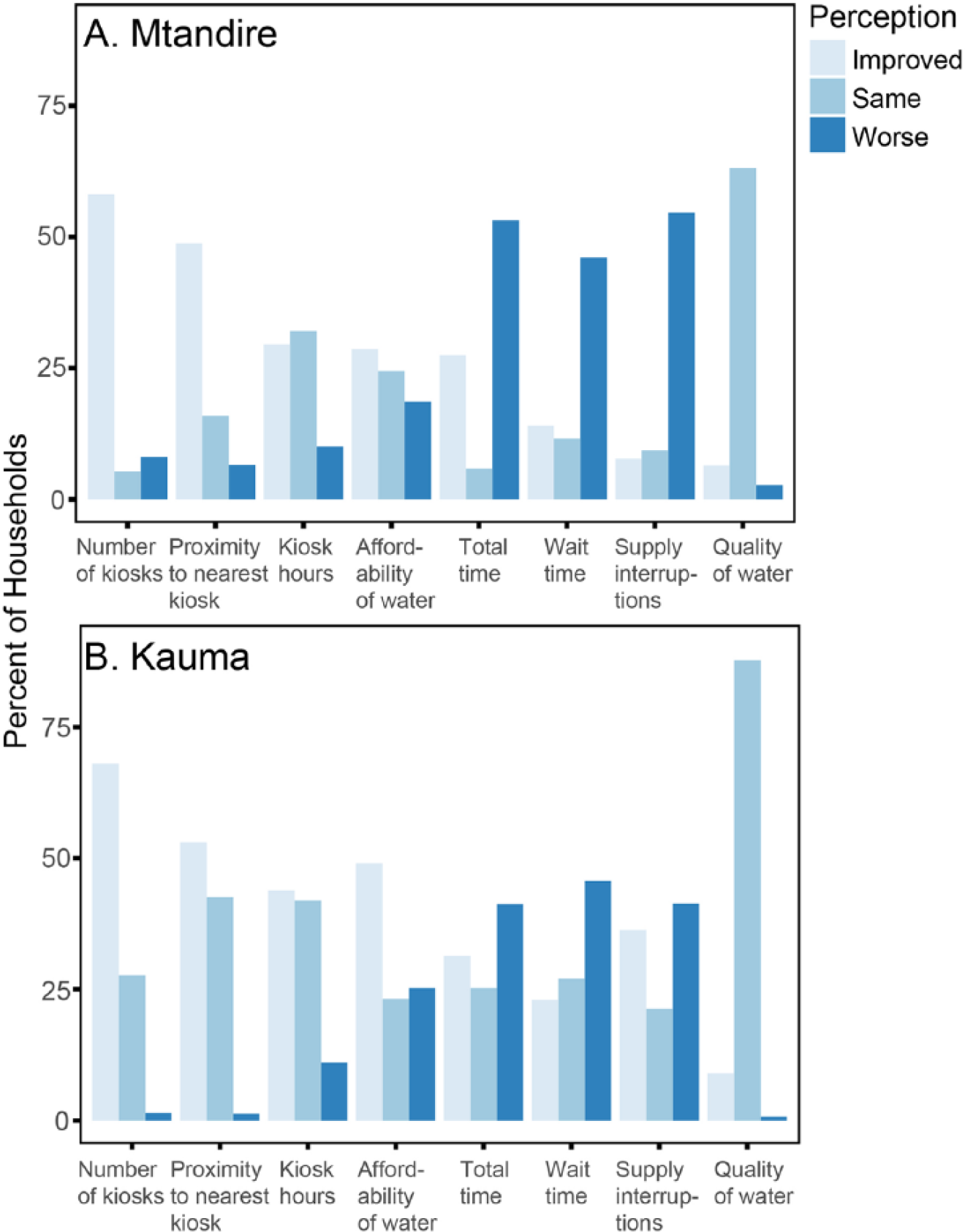
For more nuance in understanding of the quantitative results, we also asked households in Kauma and Mtandire to evaluate whether access to water has improved, stayed the same, or worsened since the introduction of community–public partnerships. Survey respondents evaluated access across seven metrics: interruptions in water supply, waiting time, water kiosk operating hours, number of water kiosks, quality of water, proximity to the nearest water kiosk, and the total time taken to get water. We also asked residents to evaluate whether overall water supply has improved or worsened given their assessments of access across the seven metrics. Figure 2 describes in detail the perceptions of water users on dimensions of water access that improved, stayed unchanged, or worsened following the introduction of CPPs.
User perceptions of water access changes in the two sites with co-production
The results on perceptions of access are consistent across the two sites and corroborate some of the results from the quantitative analysis. In Kauma, most residents observed that access to water had improved in terms of kiosk operating hours (43.8 per cent), cost of water (49 per cent), and proximity to the nearest water kiosk (53 per cent). However, 41.3 per cent noted worsening interruptions in water supply, 45.6 per cent indicated longer waiting times, and 41.2 per cent complained that total time spent fetching water had worsened despite observed improvements to the new management system. On overall water-supply improvements, 31 per cent said access had not improved, and 32.9 per cent said they considered that access had improved overall, while 36 per cent were undecided.
While perceptions of water access changes following co-production were generally similar across the two sites, more households in Mtandire observed worsening trends in interruptions in water supply and the total time taken to get water, which is consistent with the results from the linear regressions. About 30 per cent thought the price of water was lower, 58 per cent saw an increase in the number of community water kiosks, and 49 per cent indicated shorter distances from their households to the nearest water kiosks. On poor access indicators, 54.6 per cent noted worsening interruptions in water supply, 46 per cent experienced longer waiting times, and 53 per cent lamented that the total time taken to get water had increased significantly. In terms of overall water supply, 18.2 per cent thought access had improved (in contrast with 32 per cent in Kauma), 16.7 per cent said access had worsened, and 65 per cent were undecided.
d. Institutional arrangements and stakeholder perceptions of co-production
Interviews and focus group discussions showed that the institutional configurations of the CPPs have been critical to stable water pricing and other benefits in the co-produced system. Some of the stakeholders indicated that prior to the partnership, water delivery in Malawi’s poor urban and peri-urban settlements was fraught with price abnormalities, as private operators and vendors freely overpriced water. Poorer peri-urban residents paid more for water as no upward accountability arrangement existed to stabilize pricing. In the current model, the co-setting of prices by WUA executives and the Lilongwe Water Board is another example of how service delivery is co-produced by both parties. The water utility has also set up a Kiosk Management Unit (KMU) to facilitate interactions and management of operations with communities. The KMU has a kiosk manager, technical assistants, accountant, inspectors and driver.
Stakeholder views on successes and limitations of the partnership were mixed, but largely favourable regarding its long-term potential. A member of the KMU of the Lilongwe Water Board compared WUAs with previous models:
“Since WUAs started, there have been no closures of kiosks due to non-payment of bills as was the case in the years prior to formation of WUAs. Consistent payment of bills has been the case since WUAs started.” (Interview with Kiosk Manager, 5 September 2014)
According to an executive member of CCODE, an organization instrumental in the formation of the partnership:
“The system has worked properly. Most of the debts have been paid off and bills are being paid promptly. Some of the WUAs have created reserve revenue to finance new water kiosks and other needs.” (Director, CCODE Malawi, 11 September 2014)
In Kauma, which most stakeholders celebrate as the most successful example of the CPP arrangements, the administrator shared some achievements:
“Since we started working together with the water board, we have managed to increase water kiosks from 19 to 34, completed our own office building and now furnishing it. Our only challenge that we struggle with is low water pressure, which affects our water sales.” (Administrator, Kauma Water User Association, 2 September 2014)
At the Ministry of Water and Irrigation Management, the head of operations expressed cautious optimism about the co-production arrangement:
“Since the introduction of WUAs; it has been our vision to see piped systems being managed together with local structures. Notable achievements made at construction phase have translated to better access because WUAs bring operations and maintenance closer to the users, hence reducing the down-time for facilities. However, the government is aware that poor coordination at local level and lack of proper backstopping to local management structures can affect their operations.” (Head, water, sanitation and hygiene (WASH) operations, Ministry of Irrigation and Water Management, 2 October 2014)
Yet some stakeholders also revealed serious challenges that could potentially undermine the future growth and sustainability of the model, including occasional cases of financial embezzlement by community WUAs. A member of the Kiosk Management Unit of the Lilongwe Water Board noted:
“There have been cases where secretariat workers have altered figures to steal money, given forms/documents to executive members to sign without any understanding of the figures. We realized later that all those signed documents had serious financial flaws.” (Kiosk manager, 5 September 2014)
Some stakeholders expressed a concern shared by some community WUA executives – that the water utility wields excessive power over WUAs, granting them limited autonomy around decisions. WUA officers also complained about the utility’s poor coordination of activities, such as responses to breakages. Some respondents in Kauma accused WUAs of intentionally conniving with the utility to deny their applications for household taps as a strategy to safeguard the profitability of water sales at kiosks. Water is sold at kiosk centres at commercial rates while rates for household taps are lower.
Other stakeholders were pessimistic about the partnership because of weak water infrastructure. The chief engineer of the Ministry of Irrigation and Water Development cited frequent electrical power failures as part of the bigger access problem in informal settlements and expressed concern that this outdated infrastructure could affect the effectiveness of CPPs. Without reliable electricity for the large water pumps and treatment plants, utility companies struggle to meet water demand. The chief engineer revealed that the CPPs were managing a system that has barely benefitted from improvements since colonial times.
VII. Discussion
The findings, more nuanced than expected, showed commendable successes with co-production while also highlighting its failures, complexities and limitations in urban informal settlement settings. Based on regression results, residents in Kauma had higher scores on water accessibility than the control site, while Mtandire residents had lower scores. Residents in both CPP communities observed reductions in the cost of water, increased numbers of water kiosks, and shorter walking distances to water sources, but lamented worsening water-supply interruptions and longer times for getting water from community kiosks. Although challenges were similar, more people in Mtandire noted worsening trends than in Kauma. Differences in performance were related to the extent of community organization and their specific WUA operations. The WUA in Kauma is better organized than other WUAs. Kauma was among the first to pay off water debts, has successfully constructed and furnished office space, and increased the number of community water kiosks from 19 to 34.
The improvements in water service quality, especially in terms of affordability and the number of kiosks in the co-production sites, are a function of professionalization of water governance in WUA communities. This professionalization includes the incorporation of non-voluntary activities based on specialized expertise,(48) such as uniform pricing, financial accountability arrangements, the use of a professional secretariat separate from the elected WUA executive, and steps to improve employee and executive capacity through occasional training.(49) Such practices as the need for three signatures for bank withdrawals and monthly professional auditing have brought checks and balances to the handling of revenue by WUAs. As a result, most WUAs have been able to pay off nearly 35 million Kwacha (approximately US$ 50,000) in total unpaid debts they inherited at formation,(50) and have used surplus funds to sponsor new water kiosks and provide social services in their communities.(51) WUAs have also influenced the Water Board to allocate additional new kiosks funded by the European Investment Bank. To successfully bid for these, WUAs have to demonstrate that they have sufficient local resources and labour, and a plot of land for the new kiosk.
Accountability and transparency arrangements remain critical to the success of the partnership. The hierarchical, internal, institutional structure of community WUAs (Figure 1) instills some level of discipline in how revenue is handled. Focus group discussions revealed disciplinary measures to deal with vendor embezzlement of money, including hefty fines, salary forfeiture, and in extreme cases, termination of employment. Any vendor who fails to account for revenue from water sales is summoned to appear before the executive board, and in some cases given up to two weeks to repay or lose their job. By constitution, each WUA is required to have a bank account to deposit water sales daily or weekly. Salaries for WUA secretariat workers are commensurate with weekly water sales, so that WUAs pay what their revenue can sustain. Internal audit committees monitor and evaluate financial inflow and outflow and also handle cases of embezzlement. When a case is beyond the committee, the water utility steps in. These findings are consistent with what other studies have revealed about the advantages and prospects of community–public partnerships in sub-Saharan African countries and the conditions that enable them to thrive.(52)
While co-production through CPPs in Malawi has led to considerable improvements in some aspects of water access and delivery, potential shortcomings of the model in complex urban and informal settlement water systems are also evident, related to such limitations as weak infrastructure and low technical capacity of communities. These challenges have also been observed elsewhere. In Caracas, Venezuela, technical water committees have failed to address deep-seated water problems with technical infrastructure, despite enhancing equity in service delivery and improving relationships between the utility and communities.(53) Findings from Colombia also show that although community-managed aqueducts led to better tariff system management, more affordable water, enhanced citizenship and social capital, and greater community autonomy, insufficient capital for infrastructure threatens their long-term sustainability.(54)
Households in the WUA communities admitted that the number of water kiosks has increased significantly, and walking distances have shortened significantly; yet they complained about worsening water-supply interruptions and longer waiting times than before the CPPs. This is mainly because the capacity of LWB’s water treatment plants has not grown with the number of kiosks. The utility’s two treatment plants constructed in 1966 and 1989 have undergone no major upgrades, despite now supplying water to many more customers (65,000 metered customers and 750 kiosks, having increased the number of community water kiosks in the last decade by nearly 200).(55) Despite the increased numbers of kiosks and customers, high levels of water losses from leakages and illegal connections also compromise the water pressure of the main water distribution system.(56) Continuing to add kiosks will do little, then, to address the waiting time problem. Still, the utility’s main interest remains selling water to the communities and recovering revenue, rather than expanding infrastructure.
Our findings draw attention to the need for more holistic solutions to urban water insecurity, targeting both institutional weaknesses and biophysical conditions. Community WUAs have the will to address deep-seated problems with water infrastructure, but this is not an easy fix. They inevitably have to deal with factors beyond their capacity and issues within the jurisdiction of the water utilities they work with – including limited or spotty electricity to pump treated water, and unplanned urban and peri-urban settlements, which pose a formidable challenge to pipe-system extension. Even if WUAs were willing to improve infrastructure, a bureaucratic partnership arrangement constrains their decision-making autonomy. In the long term, these community-based piped systems will not improve water service delivery without sufficient backstopping to local communities and sufficient coordination within the CPP partnership.
The results highlight that successful co-production of urban services may be undermined by forces and resources that communities cannot control. The aspects of service delivery that improved were related to local management and professionalization; those that did not improve were infrastructural, with responsibility for fixing resting in higher tiers of government or outside the control of the communities. Malawi’s example with coproduction example demonstrates the need for state support where communities cannot generate sufficient resources to sustain their water systems and where community water systems are tied to, and dependent on, water supply by the municipal water utility. Even Ostrom, in her foundational work on co-production, acknowledged the complexity of urban water and sanitation systems as the reason public-sector management is often favoured over community/citizen-based management. She cited limitations associated with the economies of scale and technical capacity of communities as major reasons that citizens may be incapable of handling entire complex systems successfully unless in partnership with the state.(57) Bakker also argues that the long-term sustainability of community–state partnerships hinges on continuous state support.(58)
Given these findings, community-based systems cannot be viewed as perfect models free from governance failure in urban informal settlements. A case study in Cochabamba showed community-based models with limited state support in underserved areas producing two tiers of vastly unequal water service delivery to the wealthy and the poor.(59) LWB has also been accused of diverting water meant for these low-income areas to wealthy neighbourhoods, at the behest of high-ranking officials and politicians, and neglecting complaints from low-income urban areas.(60) The utility’s operations are excessively driven by cost recovery, with communities expected to recoup its operational costs. It wields considerable power over WUAs and their communities, to the point of denying applications for household taps in order to generate more revenue at commercial rates.
There are limitations to this study. A more effective method to estimate the impact of co-production would have been to measure water access before and after implementation. However, only the water utility agency has the data necessary to measure this difference, and it was unwilling to share. We chose to instead measure access in areas with co-production and compare this with access in a control population with a similar socioeconomic background. However, we took steps to ensure data validity and to ameliorate potential biases by also using perceptions of residents to examine observed changes in water access following the introduction of CPPs.
VIII. Conclusions
We investigated whether co-production through community–public partnerships lead to better household water access and improved service delivery in urban informal settlements of Lilongwe, Malawi. The co-production model: 1) contributed to improved water accessibility relative to previous water-supply arrangements, especially in terms of affordability and the number of communal water kiosks; 2) enhanced management effectiveness, financial accountability, and transparency in the management of water services; and 3) cleaned up and formalized an originally messy system historically fraught with mismanagement, embezzlement of funds, corruption and inefficiencies. Nevertheless, fundamental challenges remain, most notably issues related to poor infrastructure and limited capacity of informal settlement communities to address problems. Co-production is thriving; yet irregular water supply, waiting times, and the total time taken to fetch water have all worsened, undermining efforts to improve access across all dimensions.
Our study suggests that the outcomes of community–public partnerships are context-specific and contingent on local conditions, and it is therefore too early to argue that they are broadly applicable. Under limiting conditions, including deficient technical expertise, community involvement under these partnerships led to certain improvements but also exposed the limitations in the context of piped water systems in urban informal settlements. Although it is too early to judge the long-term sustainability of the relative success of coproduction, without further longitudinal analysis, some of the early results are promising. The conditions that accounted for the successes – in uniform pricing, accountability, transparency, and better management of community kiosks – can be summed up as professionalization.(61)
We argue that co-production through community–public partnerships in Malawi has been largely successful at improving water service delivery compared with previous water supply models by private operators. While the utility has been overly focused on cost recovery, profit, and revenue generation, our evidence shows, contrary to other claims,(62) that cost recovery has not necessarily undermined cost reductions. Instead, commercialization and cost recovery have been central to the short-term successes of the model.(63) Yet urban water systems are too complex for the state to act passively. There are clear areas where informal settlement communities are incapable of solutions by themselves, where changes can only happen at higher tiers of government, and where support remains critical.
Footnotes
1.
Adams, E A (2017), “Thirsty slums in African cities: household water insecurity in urban informal settlements of Lilongwe, Malawi”, International Journal of Water Resources Development, 19 pages; also Dos Santos, S, E Adams, G Neville, Y Wada, A de Sherbinin, E M Bernhardt and S Adamo (2017), “Urban growth and water access in sub-Saharan Africa: progress, challenges, and emerging research directions”, Science of the Total Environment Vol 607, pages 497–508.
2.
Mapunda, D W, S S Chen and C Yu (2018), “The role of informal small-scale water supply system in resolving drinking water shortages in peri-urban Dar es Salaam, Tanzania”, Applied Geography Vol 92, pages 112–122.
3.
Nganyanyuka, K, J Martinez, A Wesselink, J H Lungo and Y Georgiadou (2014), “Accessing water services in Dar es Salaam: Are we counting what counts?”, Habitat International Vol 44, pages 358–366.
4.
Allen, A, P Hofmann, J Mukherjee and A Walnycki (2017), “Water trajectories through non-networked infrastructure: insights from peri-urban Dar es Salaam, Cochabamba and Kolkata”, Urban Research & Practice Vol 10, No 1, pages 22–42; also Adams, E A, D Sambu and S L Smiley (2018), “Urban water supply in Sub-Saharan Africa: historical and emerging policies and institutional arrangements”, International Journal of Water Resources Development, 24 pages.
5.
Bakker, K (2010), Privatizing Water: Governance Failure and the World’s Urban Water Crisis, Cornell University Press.
6.
Allen, A, J D Dávila and P Hofmann (2006), “The peri-urban water poor: citizens or consumers?”, Environment and Urbanization Vol 18, No 2, pages 333–351; also Moretto, L and M Ranzato (2017), “A socio-natural standpoint to understand coproduction of water, energy and waste services”, Urban Research & Practice Vol 10, No 1, pages 1–21; and Adams, E A and K E Halvorsen (2014), “Perceptions of nongovernmental organization (NGO) staff about water privatization in developing countries”, Human Geographies Vol 8, No 2, pages 35–49.
7.
See reference 4, Adams et al. (2018); also Prasad, N (2006), “Privatisation results: private sector participation in water services after 15 years”, Development Policy Review Vol 24, No 6, pages 669–692.
10.
Ostrom, E (1996), “Crossing the great divide: coproduction, synergy, and development”, World Development Vol 24, No 6, pages 1073–1087, page 1073.
11.
Ostrom, E, R B Parks, G P Whitaker and S L Percy (1978), “The public service production process: a framework for analyzing police services”, Policy Studies Journal Vol 7, No S1, pages 381–389.
12.
Whitaker, G P (1980), “Coproduction: citizen participation in service delivery”, Public Administration Review Vol 40, No 3, pages 240–246.
13.
Wiewiora, A, R Keast and K Brown (2016), “Opportunities and challenges in engaging citizens in the co-production of infrastructure-based public services in Australia”, Public Management Review Vol 18, No 4, pages 483–507; also Osborne, S P, Z Radnor and K Strokosch (2016), “Co-production and the co-creation of value in public services: A suitable case for treatment?”, Public Management Review Vol 18, No 5, pages 639–653; and Needham, C (2008), “Realising the potential of co-production: negotiating improvements in public services”, Social Policy and Society Vol 7, No 2, pages 221–231.
14.
Brandsen, T and V Pestoff (2006), “Co-production, the third sector and the delivery of public services: an introduction”, Public Management Review Vol 8, No 4, pages 493–501; also Batley, R and C Mcloughlin (2010), “Engagement with non-state service providers in fragile states: reconciling state-building and service delivery”, Development Policy Review Vol 28, No 2, pages 131–154.
15.
Joshi, A and M Moore (2004), “Institutionalised co-production: unorthodox public service delivery in challenging environments”, Journal of Development Studies Vol 40, No 4, pages 31–49, page 31.
16.
See reference 15; also Bovaird, T (2007), “Beyond engagement and participation: user and community coproduction of public services”, Public Administration Review Vol 67, No 5, pages 846–860.
17.
See reference 10; also McMillan, R, S Spronk and C Caswell (2014), “Popular participation, equity, and co-production of water and sanitation services in Caracas, Venezuela”, Water International Vol 39, No 2, pages 201–215.
18.
Pilo, F (2017), “ ‘Co-producing affordability’ to the electricity service: a market-oriented response to addressing inequality of access in Rio de Janeiro’s favelas”, Urban Research & Practice Vol 10, No 1, pages 86–101.
19.
See reference 13, Needham (2008); also Fledderus, J, T Brandsen and M Honingh (2014), “Restoring trust through the co-production of public services: a theoretical elaboration”, Public Management Review Vol 16, No 3, pages 424–443.
20.
Cleaver, F (2000), “Moral ecological rationality, institutions and the management of common property resources”, Development and Change Vol 31, No 2, pages 361–383.
21.
Mosse, D (2006), “Collective action, common property, and social capital in South India: an anthropological commentary”, Economic Development and Cultural Change Vol 54, No 3, pages 695–724.
22.
Cleaver, F (1999), “Paradoxes of participation: questioning participatory approaches to development”, Journal of International Development Vol 11, No 4, pages 597–612; also Blaikie, P (2006), “Is small really beautiful? Community-based natural resource management in Malawi and Botswana”, World Development Vol 34, No 11, pages 1942–1957; and Harvey, P A and R A Reed (2006), “Community-managed water supplies in Africa: sustainable or dispensable?”, Community Development Journal Vol 42, No 3, pages 365–378.
23.
See reference 22, Blaikie (2006); also Nelson, F and A Agrawal (2008), “Patronage or participation? Community-based natural resource management reform in Sub-Saharan Africa”, Development and Change Vol 39, No 4, pages 557–585; and Rusca, M, K Schwartz, L Hadzovic and R Ahlers (2015), “Adapting generic models through bricolage: elite capture of water users associations in peri-urban Lilongwe”, The European Journal of Development Research Vol 27, No 5, pages 777–792.
24.
See reference 21; also Bakker, K (2007), “The “commons” versus the “commodity”: alter-globalization, anti-privatization and the human right to water in the global south”, Antipode Vol 39, No 3, pages 430–455; and Morinville, C and L Harris (2014), “Participation, politics and panaceas: exploring the possibilities and limits of participatory urban water governance in Accra, Ghana”, Ecology and Society Vol 19, No 3, Article 36.
25.
McGranahan, G (2015), “Realizing the right to sanitation in deprived urban communities: meeting the challenges of collective action, coproduction, affordability, and housing tenure”, World Development Vol 68, pages 242–253.
27.
Button, C (2017), “The co-production of a constant water supply in Mumbai’s middle-class apartments”, Urban Research & Practice Vol 10, No 1, pages 102–119.
28.
Llano-Arias, V (2015), “Community knowledge sharing and co-production of water services: two cases of community aqueduct associations in Colombia”, Water Alternatives Vol 8, No 2, pages 77–98.
29.
Annala, L, A Sarin and J Green (2018), “Co-production of frugal innovation: case of low cost reverse osmosis water filters in India”, Journal of Cleaner Production Vol 171, pages S110–S118.
33.
See reference 24, Bakker (2007); also Harris, L M, J A Goldin and C Sneddon (2015), Contemporary Water Governance in the Global South: Scarcity, Marketization and Participation, Routledge.
35.
Walnycki, A (2017), “Contesting and co-producing the right to water in peri-urban Cochabamba”, in S Bell, A Allen, P Hofmann and T-H Teh (editors), Urban Water Trajectories, Springer, pages 133–147.
36.
See reference 28.
38.
See reference 4, Adams et al. (2018); also Bakker, K (2008), “The ambiguity of community: debating alternatives to private-sector provision of urban water supply”, Water Alternatives Vol 1, No 2, pages 236–252.
39.
UNICEF and WHO (2015), Progress on Sanitation and Drinking Water – 2015 Update and MDG Assessment, accessed 11 July 2018 at  .
.
40.
Onda, K, J LoBuglio and J Bartram (2012), “Global access to safe water: accounting for water quality and the resulting impact on MDG progress”, International Journal of Environmental Research and Public Health Vol 9, No 3, pages 880–894; also Smiley, S L (2013), “Complexities of water access in Dar es Salaam, Tanzania”, Applied Geography Vol 41, pages 132–138.
41.
See reference 1, Adams (2017); also Alda-Vidal, C, M Kooy and M Rusca (2018), “Mapping operation and maintenance: an everyday urbanism analysis of inequalities within piped water supply in Lilongwe, Malawi”, Urban Geography Vol 39, No 1, pages 104–121; and Adams, E (2018), “Intra-urban inequalities in water access among households in Malawi’s informal settlements: toward pro-poor urban water policies”, Environmental Development.
42.
Harawa, M M, Z Hoko, S Misi and S Maliano (2016), “Investigating the management of unaccounted for water for Lilongwe Water Board, Malawi”, Journal of Water, Sanitation and Hygiene for Development Vol 6, No 3, pages 362–376.
43.
Government of Malawi (1998), The National Decentralization Policy, Malawi, accessed 12 May 2018 at .
44.
See reference 1, Adams (2017); also Velzeboer, L, M Hordijk and K Schwartz (2018), “Water is life in a life without water: power and everyday water practices in Lilongwe, Malawi”, Habitat International Vol 73, pages 119–128.
45.
See reference 43.
46.
Government of Malawi (1995), The Water Works Act, accessed 10 May 2018 at .
47.
Charmaz, K and L L Belgrave (2007), “Grounded theory”, in The Blackwell Encyclopedia of Sociology.
48.
Adams, E A and L C Zulu (2015), “Participants or customers in water governance? Community-public partnerships for peri-urban water supply”, Geoforum Vol 65, pages 112–124.
51.
See reference 48.
52.
Nzengya, D M (2015), “Exploring the challenges and opportunities for master operators and water kiosks under Delegated Management Model (DMM): a study in Lake Victoria region, Kenya”, Cities Vol 46, pages 35–43.
54.
See reference 28.
55.
Lilongwe Water Board (2018), Background Information, accessed 24 April 2018 at .
56.
Manda, M A (2009), “Water and sanitation in Urban Malawi: Can the Millennium Development Goals be met? A study of informal settlements in three cities”, Working paper, International Institute for Environment and Development, London.
57.
See reference 10.
59.
See reference 35.
61.
See reference 48.
62.
See reference 48.
63.
See reference 48.