




Abstract
In the mid-1990s, the grassroots movement Muungano wa Wanavijiji emerged from Nairobi’s many slums aiming to resist forced evictions by the Kenyan government. Muungano confronted a nexus of politicians, government administrators and elites all seeking to acquire city land occupied by informal settlements – and in doing so challenged antipathetic attitudes to informality. Joining global advocacy, Muungano has pushed locally for recognition of slums as human settlements, later designing models for upgrading living conditions. Throughout this evolution, the Kenyan state has been the single most prominent precipitant for the strategies Muungano has employed. This paper describes the correlations between a social movement and the state, set within broader changes in state–civil society relations in Kenya. In doing so it seeks to bring out the complexity of a relationship that has varied from conflict to contestation, partnership to collaboration, and separate but parallel efforts to address common issues.
Keywords
I. Introduction
“I think unity is the key, unity is the key for all people in the settlements. To be able to make a change you have to be united. Speak many, speak in one voice for it to be heard.” (Nancy Njoki, Muungano Mathare)
Slums(1) occupy 2 per cent of Nairobi’s land yet are home to half the city’s population. A comparison of early and more recent surveys of informal settlements(2) reveals that while their populations have doubled, the space they occupy has not increased. The rate and scale of improvements in the slums – to living conditions, services, infrastructure, and tenure security – have failed to match their unrelenting densification and consolidation. Today, Nairobi’s population is reaching 4 million, and without new land its informal settlements have begun to change in new ways: densifying upwards as slum shacks become storeyed, and as landlords, through “market-based evictions”, replace shacks with often dangerously substandard tenement buildings for which they can charge higher rents.
In 1996, the grassroots slum dweller movement Muungano wa Wanavijiji (Swahili for “united slum dwellers”) emerged from Nairobi’s many informal settlements with the aim of resisting forced evictions by the Kenyan government. Muungano confronted a nexus of politicians, government administrators, and elites all seeking to acquire city land occupied by the settlements – and in doing so the movement challenged antipathetic attitudes to informality. Muungano spread to towns and cities throughout Kenya in the early 2000s, and in 2001 it federated and joined the global Shack/Slum Dwellers International (SDI) network. In 2003, the Kenyan federation designed and built its first upgraded houses in Huruma, east Nairobi, and established its funding and financial services institution, Akiba Mashinani Trust (AMT).(3) Joining global advocacy around slums, Muungano has pushed locally for their recognition as human settlements, and has progressed to designing models for upgrading living conditions.
Throughout this evolution, the Kenyan state(4) has been the most prominent precipitant for Muungano’s strategies. This paper explores the progress of Muungano’s relationship with the state, set within broader changes in Kenya’s state–civil society relations. Over the years, Muungano has challenged the state directly and indirectly; taken advantage of opportunities and spaces created by the state’s actions; and worked to create or encourage new practice and policy. We seek to bring out the complexity of a relationship that has varied from conflict to contestation, partnership to collaboration, and separate but parallel efforts to address common issues. Particularly in its later years, Muungano’s agenda has tended towards changing practice, but it has also influenced policy and legislation.
Section II traces the conditions Muungano emerged from and its broad institutional changes over 20 years, from its early strategies of contestation to, today, building alternative practices and leveraging resources from the state. We have characterized Muungano’s evolving institutional approach and relationship with the state in four slightly overlapping phases; yet this broad view fails to capture the complexity in its history. At any particular point, there have been multiple concurrent engagements with state bodies – sometimes even different kinds of engagement with the same government organ – and there is a layered nature to this relationship, each layer representing a strategy, experience, or connection that remains alive in the movement’s “toolbox”. In 2004, for instance, while Muungano was actively developing the Huruma slum upgrading with the Nairobi City Council, it also staged demonstrations to challenge council plans that would displace residents of another slum, Soweto Kahawa.
In Section III, therefore, we look beyond what Muungano has done to explore how this relates to the state’s positions towards slums, focusing on two dimensions of change: community mobilization and state attitudes, and approaches to designing responses to informality.(5) Finally, we seek to apply Muungano’s experience to current definitions of co-production in the literature, and by doing so, to extend them. Taking the long view, our conclusion is that co-production can occur even when the state and its citizens do not share one organizational structure, or focus on the same specific project or even the same set of locations.
We have sought to go beyond narrating Muungano’s internal workings to focus on the broader question of how the movement has touched the lives of slum dwellers in Kenya generally, regardless of whether they have ever heard about the federation. If we consider scale or presence, community savings groups – Muungano’s vehicle in slums – are one good measure. They have grown from 37 groups in a handful of settlements in 2001, to almost 1,000 groups today in over 400 informal settlements in many of Kenya’s cities and towns. All these savings groups represent a call to collective action – an amplification of women’s and men’s voices as they seek communal responses to whatever issues they face. Whether or not they continue today, they have all made a contribution. If we consider measures of physical change, Muungano has played a part in delivering 7,000 homes, has improved access to water and sanitation for 40,000 slum families, and has secured land rights for communities occupying 140 hectares – leveraging slum improvements of US$ 200 million. In converting community savings to development finance, Muungano’s project financing models have leveraged resources, often from the city or state, at ratios as high as 1:50.(6) Given operational costs of under US$ 10 million and capital inputs of US$ 5 million over its 20 years, it is clear that Muungano has been an efficient vehicle for delivering change. Yet these improvements have touched less than 10 per cent of Kenya’s informal settlement population.
With a conviction that the movement has also had more general impacts, and seeking a more fitting lens for examining these, we therefore examine what we have called “correlations” between what Muungano has done and how this has influenced the state’s positions towards slums. These positions become the context in which all slum residents find themselves. Muungano’s early experiences with forced evictions illustrate this kind of impact. From 1996 to 1997, it prosecuted – and lost – 24 land cases in court, resisted demolition attempts in many settlements, rebuilt demolished slums, and held numerous street demonstrations. At the end of 1997, the state announced a moratorium on forced evictions, and while this was still often ineffective, a reduction in forced evictions was felt in slums throughout Kenya.
In part, we can measure these correlations by recording points of contact between the movement and the state. These go beyond the early activism and confrontation to include joint projects; shared platforms; participation in state programmes, workshops and other types of meetings; and the individual relationships that unfolded along the way. Even when engagement with the state was not direct, there have been times marked by significant concurrences in thinking, plans, and approaches of Muungano and the state. As we narrate the state’s evolving attitudes in relation to the evolution of the federation’s own strategies, it is clear to us that cross-transfusion of ideas has often happened in less obvious places or ways.
By documenting past experiences, the community-based federation and its professional support organizations Akiba Mashinani Trust and SDI Kenya – collectively sometimes called “the Alliance” – have sought to explore how a constantly changing political economy in Kenya and its cities has, over time, transformed the strategies they employ. (The authors of this paper are associated with SDI Kenya.) This paper draws extensively on a detailed working paper(7) charting the federation’s history. This was based on an oral history project(8) for which, in 2016, a Muungano team interviewed 50 slum dwellers, activists, professionals, and civil society partners present at different stages along Muungano’s journey. Some of their voices are scattered throughout this paper.
II. A Brief History Of Muungano
a. Before Muungano: urban Kenya, 1963–1996
“You could find an entire village [informal neighbourhood] sold to one person in government. There used to be plans in City Hall showing that villages were not occupied, but the reality was that families were living there…To force them out, they used means like burning houses, demolition, or paying rogue young men.” (Peter Chege, Muungano Kambi Moto, Huruma)
Urban spatial development in Kenya was inequitable from the start, visible early in racially segregated colonial residential patterns.(9) City growth after independence in 1963 continued in this mould, with the basis for spatial inequality just shifting from race to wealth and class.(10) Autocratic leadership, poor governance by the elite, and only intermittent urban policy and planning structures further entrenched this segregation and exclusion of the poor.(11) Most slums emerged after independence, as restrictions were lifted on Africans working and living in towns.(12) Cities grew rapidly, and as affordable housing supply and service provision lagged behind,(13) low-income urban migrants and existing households increasingly resorted to finding, constructing or renting makeshift housing in informal settlements.(14) Spontaneous, unplanned settlement occurred on unoccupied land, public or private, and by 1993, half of Nairobi’s then 1.8 million inhabitants lived in slums, in improvised structures with little or no basic service provision.(15) Private landlordism was widespread. In newer settlements in the 1990s, owner occupation was often combined with subletting, but the increasingly dominant pattern was absentee landlordism by middle-class entrepreneurs.(16) Nairobi’s slums have tenancy rates often over 90 per cent(17) – within a context of commercialization in which, according to Huchzermeyer, “a complex structure of economic stakeholders…have acquired a degree of social legitimacy to extract profit out of the trade of inadequate basic necessities to the poor”.(18)
Until the late 1970s, official Kenyan policy was to demolish informal settlements despite the lack of alternatives for many. The 1980s saw a more permissive approach, with forceful eviction only where settlements conflicted with plans for the formal city, such as road installation.(19) Introduction of multiparty politics in the early 1990s upset this hesitant coexistence of formal and informal sectors, when, faced with strong parliamentary opposition, the ruling party started using land as prime currency in procuring support.(20) Informal settlements were not officially recognized as human habitations – Kibera in Nairobi, home in the 1990s to 270,000 people on 600 acres, was represented on city maps as a forest. Forced evictions spiked as the political elite found the city land they had been given was occupied.(21) In one particularly brutal instance in 1990, two large Nairobi slums, Muoroto and Kibagare, were demolished, displacing 30,000 people.(22) The oppressive regime reached through layers of urban governance in informal settlements, where land and community life were controlled by area chiefs and youth movements connected to the ruling party.(23)
b. Phase 1 (1996–2002): activism, evictions and protest
“We fought until the government heard our voice. We knew that one person cannot be heard, but if we join and make noise and disturb them every day, they’d say, ‘Let’s hear them.’ They started acknowledging us: ‘There is Muungano in slums, they are people who are fighting’…Korogocho and Kibera people came to fight for Kamae and Soweto; if you had a case, all Muungano members would come to court. And that’s why I say Muungano is strength: if it was not for Muungano I don’t know whether there could exist any slums in Nairobi or elsewhere. That was the first step, to retain those slums. The second step is to develop those slums.” (Anastasia Wairimu, Muungano Soweto Kahawa)
Muungano began in 1996 (the year the Habitat II conference was held in Istanbul) with the coming together of occupants of Nairobi’s informal settlements and markets. The social movement emerged organically, actively resisting forceful evictions with protest, solidarity, grassroots activism, and legal challenges. People fought to secure their homes and businesses, and for recognition of the existence of slums and those living in them.
“Eviction was all over the city. They were demolishing informal areas, informal markets. We had very many slums where people were going for legal support to Kituo Cha Sheria…This is when we started knowing each other, because while we were waiting for lawyers’ advice we talked. ‘Where do you come from?’ ‘I come from Mathare.’ ‘Where do you come from?’ ‘Mukuru industrial area.’ ‘What’s the problem?’ ‘The chief has evicted us…he wants the grabbers to take the land.’ So we started asking ourselves, what can we do to protect our rights of doing business and our homes in the slums? We said we must come together.” (Ezekiel Rema, Muungano Toi market, Kibera)
Many Kenyan civil society actors in the 1990s were focused on multiparty democracy, urban poverty, and the threat of slum demolitions and evictions. The early Muungano movement – at this point a far looser grouping of activists than today’s federation structure – drew on their efforts. Support came from Kituo Cha Sheria, a legal aid organization that facilitated community organizers to train and mobilize slum residents into Muungano. Support also came from human rights activists, and Catholic priests brought in a liberation theology perspective.
“We would use liberation songs that helped animate the activities and protests. Before the meeting we would do a play, just remind people what happened – stories about eviction. It was easy to connect with people in informal settlements because, landless as they were and threatened with evictions, they had reasons to come out and feel connected. After the meeting, people would ask ‘How do we participate?’ And community organizers would encourage them to join the settlement networks.” (Joseph Kimani, SDI Kenya)
Pressure on the state increased in the late 1990s: internationally, around human rights issues relating to land grabs and evictions; and nationally, as civil society demanded legislation to protect slum communities.(24) The first significant state response to slums was the Nairobi Informal Settlements Coordination Committee (NISCC), established in 1996; some of Muungano’s early supporters sat on its civil society advisory group. In 1997, the NISCC issued a moratorium on forced evictions of settlements (on public land), which had some, limited, effect.(25)
c. Phase 2 (2000–2006): organizing, rituals, learning and innovation
“While we were busy saving, [we] discovered that this land belonged to City Council…In the past it was a huge problem to get a plot of land for yourself, so if the council would allow us, we would develop our pieces of land…It was not easy: it was a long journey for us before we started to build, or even before we began the enumerations…All the meetings we held, before they finally agreed to give us land and support us in the process.” (Susan Wanjiru, Muungano Kambi Moto, Huruma)
Around 2000, the focus of both the movement and the state began to shift markedly, from slum clearance towards seeking solutions to transform slums into decent settlements of low-cost housing by developing models and methodologies for financing and upgrading.(26) Two of Muungano’s formative projects began in this period: one in 2001 to upgrade 2,500 households in Huruma, with Muungano and civil society partners working with Nairobi city authorities; the second later, around 2004, working with central government and the Kenyan Railways Corporation to design and implement a World Bank-funded relocation plan for 11,000 households living along railway sidings in two large Nairobi slums.
The first significant state-led initiative to provide solutions to informal settlements, the Kenya Slum Upgrading Programme (KENSUP), was launched in 2002 at the first World Urban Forum, in Nairobi. KENSUP was a joint government–UN-Habitat initiative, the latter’s headquarters having just moved to Nairobi, and was to be piloted in Kibera. The first national budgetary allocation for slum upgrading followed in 2003.
Muungano’s first “professional support NGO”, Pamoja Trust, was established, consolidating some of the community organizers and civil society actors who had loosely provided support. In 2001, Pamoja facilitated Muungano’s federation and joining of the global SDI network, through which the Kenyans developed links to other slum dweller movements. Initially, Pamoja coordinated the many civil society groups working with Muungano communities to resist evictions. Its role grew in the mid-2000s as Muungano – realizing that halting an eviction does not in itself present a solution, and seeing opportunities to test upgrading approaches through partnering with the state – began moving away from the primarily conflictual stance of its earlier support networks.
“Things have changed. We moved from the streets, we have gone to the negotiating table. We heard a lot of ‘we sold out’ because we are sitting now with ‘the enemy’. For me, it doesn’t always have to be a fight. If you look at what we have achieved all these years by sitting down, negotiating, collecting information, it’s more than just moving in the streets and saying ‘we don’t have’.” (Joseph Muturi, Muungano Toi market, Kibera)
In Huruma and other settlements, Muungano began learning to wield SDI’s “tools”, which aim to position residents at the centre of slum development: women-centred community organization through networked savings groups; slum profiles and enumerations by communities themselves; learning through peer exchange at local, national and international levels; house modelling; co-production of slum improvement planning with universities and local government; and development of finance models for upgrading – this last with Muungano’s urban poor fund, AMT, established in 2003. The ideology and practical rationale behind SDI’s tools differed from the movement’s initial, predominantly protest-based approach, and this divided Muungano’s original grassroots base. Half its original leaders returned to their settlements to mobilize communities to form savings groups; the rest realigned with other movements, and the name Muungano wa Wanavijiji was shared by different groups in Kenya for a decade. The faction that moved towards savings-based mobilization and searching for upgrading solutions (i.e. the subject of this paper) has endured over time.
In its different phases, Muungano’s leadership has been formed by the demands of the time. In 1996, its core was 45 eloquent, charismatic and brave leaders – mostly men and a few women – drawn from slums in Nairobi and Athi River. The evolution into a federation of settlement-based community savings schemes was in recognition of a need for a greater community mandate. There were indications that the state would begin regularizing land tenure, and if this happened, greater accountability to slum communities would be needed than that provided by the leadership of 45 individuals. More slum residents would need to be involved, and in a fair, transparent way, since slum communities have many competing interests positioning to capture the benefits of land regularization.
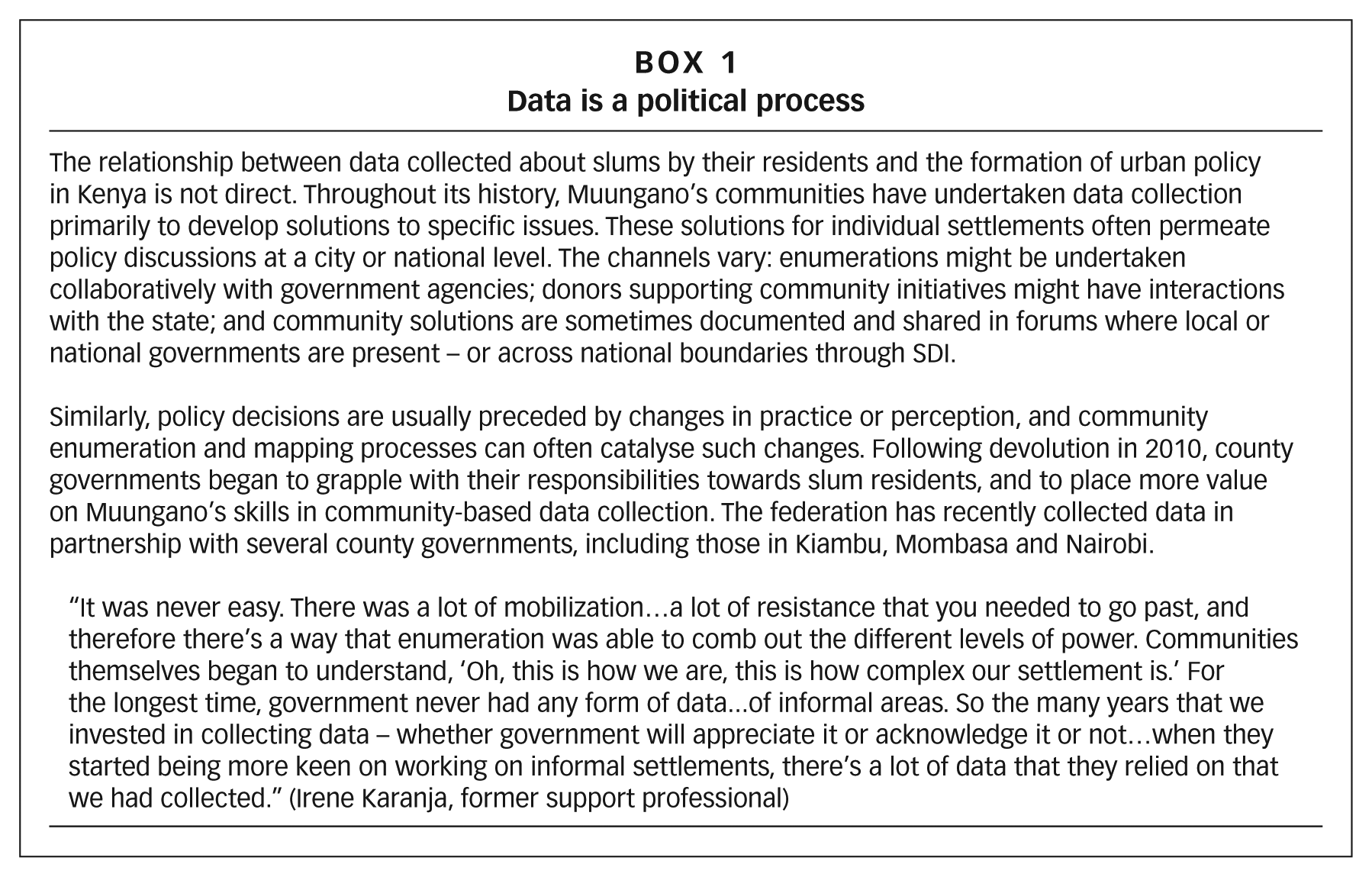
“Self-enumeration”, adopted from the SDI toolkit, was one way that a broader informal settlement population was drawn in. This involved residents visiting, counting and recording details of every household and amenity in their settlements (Box 1 on page 13). In 2001, the first enumeration by slum communities was carried out in Huruma in order to persuade the city government that they should be considered for regularization. It was a rudimentary exercise, and community and NGO staff learned by doing. Some months later, supported by SDI federations from Zimbabwe, South Africa and India, Muungano undertook a far larger enumeration in Korogocho, a big slum next to Nairobi’s city dump. This really tested them, bringing out the power of information, the complexity of informal settlement dynamics, and the knottiness of the issue of entitlement. Structure owners in Korogocho fiercely resisted, feeling it not in their interests for tenants to be counted. Serious violence was only avoided by good preparation: a lot of mediation, a committee combining structure owners and tenants, and mobilizing of politicians to support the process. The enumeration revealed a population of 40,000 people, 90 per cent of them tenants.
Data is a political process
“
From 2003, with the first Huruma houses being built, Muungano felt it had a proven set of tools for designing solutions to transform informal settlements. With this confidence, the federation quickly expanded nationally, ramping up learning exchanges and establishing savings groups in settlements in other towns and cities. The loss of member savings through the leaders of some new groups challenged this growth, but with support from other federations solutions were found by tightening savings systems. However, the Alliance was still in a learning period, and internal reports reveal the realization by the support NGO professionals of their diluted capacity to channel this growth towards complete settlement transformation.(28)
“Whenever you enter a community and you take charge of the first meeting, and you go the second meeting and they take charge of the meeting – that does not make you irrelevant.” (Joseph Kimani, SDI Kenya)
d. Phase 3 (2005–2010): structures, consolidation and leadership
“We lobbied for water in our settlement and it worked: the government took notice of our requests. We lobbied over sanitation facilities in Mukuru, and they heard us. Our advocacy on housing got us meetings with the Minister of Lands…If we want the government to listen to us, we come out in large numbers, and eventually they will listen.” (Nancy Njoki, Muungano Mathare)
With money and strengthened savings systems, but without institutional support to steer them towards upgrading, savings groups’ energy and resources increasingly went into developing smaller solutions for every conceivable slum scenario. Muungano learned how to approach issues like water, sanitation, drains, health, and individual loaning for livelihoods or school fees. In 2005, with AMT loans, the hugely successful Toi market savings scheme purchased land on Nairobi’s outskirts to build homes for 600 families. This was an early exemplar of Muungano’s much-debated greenfield strategy to secure shelter for those urban poor who could afford it by purchasing and building on empty land at the city’s edge.
“Land markets are driven by political narratives…We can use buying as a tactic to tell the state that we are also serious, but if that becomes a philosophy across the movement then it is problematic. Because there are places where we can win concessions merely by being, using other things.” (Patrick Ochieng, civil society activist, Mombasa)
With growing confidence in savings systems, mobilization, city-wide data collection, community-led planning, and upgrading of infrastructure and housing, the Alliance took increasingly technical approaches to designing and financing slum solutions. From 2005–2006, Muungano enumerated all 44,000 slum households living in Kisumu, Kenya’s third largest city.(29) This was a huge project requiring training 800 community enumerators, and honing skills in data collection and presentation and GIS technology. And it was an opportunity to understand a new city in detail and engage with its communities and local government.
Ethnically charged violence swept through Kenya in late 2007 and early 2008, following a disputed presidential election. Urban areas bore the brunt, with the worst violence in poorer neighbourhoods – especially slums – displacing and dividing communities, and destroying homes and businesses, with long-lasting consequences. Muungano communities in Kisumu, Mombasa, Nakuru and Nairobi were affected. In some places where the federation had a strong presence, they held mediation forums. In a few settlements, social cohesion built by savings group networks went some way to effectively shielding communities from violence – for example, peace held in the three Huruma settlements where upgrading had started.
The federation took measures to continue building and consolidating structures and leadership in this phase: sub-settlement-level savings groups were further networked, with most of the support NGO’s budget channelled through nine regional networks; and a youth mentoring programme helped build a new generation of community leaders.(30) In 2009, attempts at national leadership elections revealed tensions within the federation and between Muungano and its professionals, and brought a challenge from SDI to strengthen women’s leadership. SDI’s insistence that women have key roles in every community has been critical to Muungano’s evolving upgrading methodology. But this has been a hard task for a movement that emerged from protest, geared to the assumed masculinity of upgrading tasks.
Driven by the evolving capacities within Muungano and its sense of what professional support its needed, the community base began to reassert its centrality to the Alliance, and in 2010 the federation parted ways with Pamoja Trust, embarking on an ongoing process of redefining its relationship with its support professionals.
“Muungano’s pioneering something that they haven’t got right yet, that all of SDI has to get right, and that is developing a new relationship between professionals and communities…getting the balance right between the role of professionals in a community movement and…the danger of creating vertical power relations that de-link the leaders from their communities.” (Joel Bolnick, SDI secretariat)
e. Phase 4 (2009–present): the federation takes control
“When I joined Muungano, it was about professionals doing everything…They were allocating Muungano members to do things, but not Muungano saying ‘this is what we want to do’…Now it has changed. Where [it] was given that mandate, federation has taken the lead. Everything is more actual than before…You own the process.” (Dorice Moseti, Muungano Mukuru, Nairobi)
Two state initiatives in this phase are noteworthy. A programme of slum improvements launched in 2014 by Kenya’s National Youth Service (NYS) employed many thousands of youths, themselves mainly from the slums – clearing garbage and undertaking small infrastructure projects.(31) But it quickly became bogged down in corruption scandals.(32) In 2011, the state launched its Informal Settlements Improvement Project (KISIP), a US$ 165 million project funded by the World Bank and bilateral donors, which has aimed – with mixed success – to address slum issues of infrastructure and tenure security.
Kenya’s new constitution was adopted in 2010, promising to strengthen local accountability and public service delivery at local levels by mandating new public participation channels for communities to engage county governments on development and civic issues. Muungano must also adapt to this new political reality: existing savings group networks do not map automatically onto the new participatory structures under the constitution, and the federation has begun to explore new models for mobilizing and organizing communities.
“With the new devolved system of government, being in Muungano opened up opportunities. We had mapped our settlement and enumerated ourselves, and the data helped us advocate for land tenure…It was easy for the county to understand who we are.” (Amadi Sudi, Muungano Matopeni, Mombasa)
The Alliance was now working with an increasingly wide range of partners on larger, more ambitious projects. Strong partnerships with Kenyan and international academia allowed different and more powerful access and advocacy. Seeking new ways to advance the land and shelter agenda, the federation’s focus also began to expand into new areas – for example, public health and urban resilience to climate change impacts.
Much of the Alliance’s recent effort has focused on Mukuru, a dense Nairobi slum belt of over 300,000 people living on mostly privately owned land zoned for industrial use. Community mobilization and advocacy began in 2011, supporting residents to successfully contest, with protest and legal challenges, eviction notices threatening households across the slum. From 2013 to 2017, the Alliance and Mukuru communities were part of an international research consortium investigating and proposing solutions for regularizing the slum. Their portrait of Mukuru revealed the “poverty penalty” faced by residents, who pay three–four times more for low-quality available services than nearby wealthier areas pay for their far better provision; and the complex, highly commercialized web of informal power and governance.(33) The Nairobi City County government – which had already worked closely with Muungano in other places – responded positively to the research, and in 2017 declared Mukuru a “special planning area” (SPA). This effectively froze development there for two years, until an integrated development plan is produced by a coalition of actors (including the Muungano Alliance) working together to identify challenges and solutions.
III. The Long View: Correlations And Their Limits
a. Muungano mobilization and state attitudes to informality
“One of [Muungano’s] biggest achievements was just creating an acceptance by the state that informal settlements are here, they are part of our reality, they are a housing solution for the poor, that this housing solution is not sufficient, and that the state must begin to intervene – eviction is not the way to go…And now, the state is beginning to create policies and mobilize money, actual resources, in order to address the slum issue.” (Jane Weru, Akiba Mashinani Trust)
Across its history, Muungano’s struggle has been framing the slum phenomenon as a core issue that the city and the state are responsible for addressing. This is essentially a fight for changed perceptions – for Kenya’s state and citizens to see slums not as a marginal issue, but as core to over (for example) half of Nairobi’s population and in this way affecting the whole city.
In its earliest years, Muungano fought evictions through protest and activism; then, around 2000, the focus began shifting towards seeking solutions. The state correlation here is its gradual, progressive attitude change towards informality – in particular between 1996 and 2003 – recognizing that informal settlements exist and need attention; that their problems relate to land rights, tenure security and land grabbing; and that forced evictions do not represent a solution.
Positive change in the Kenyan government’s perception of urban poverty is evident in state rhetoric – in the 2010 constitution, ruling party manifesto, and national and city strategic plans – and in the continued existence of the two state programmes, KENSUP and KISIP. Yet this changed attitude towards informality has been restricted to housing and infrastructure thus far. A possible exception is the 2014 NYS programme, which briefly provided employment opportunities in slums as well as much-needed small infrastructure, before it collapsed, mired in corruption.
Times have changed, though. The pressure to improve informal settlement conditions no longer falls on Muungano or other civil society groups: the slums are now a significant, restless, demanding voter constituency. And the government’s response has ramped up. The year 2017 was, in a sense, reminiscent of 2002 – when the national government began its KENSUP pilot in Kibera, and Muungano started working in Huruma with city authorities. In 2017, as Kenya’s president declared “affordable and decent shelter” to be one of his four priorities for social and economic transformation,(34) the Mukuru SPA was announced by the Nairobi City County government, working with Muungano and other organizations. The planning process for Mukuru will require strong citizen participation, and it therefore has become Muungano’s arena for exploring new ways of mobilizing the public that respond to – and test – the new constitutional provisions.
The year 2017 therefore started another cycle of change, in which the Alliance hopes to entrench in the Kenyan state and citizens a recognition of the multiple benefits and contributions slums generate for a city, as well as their interdependence.(35) They are a tremendous resource: pulsating with micro businesses and primary markets for industry, as well as providing low-cost accommodation, schooling, health care, and recreation for the mass of the city’s workers, and labourers who care for children, clean, guard and cook for most middle- and high-income homes. They also provide a vital link between urban and rural economies.(36) This recognition would resonate with Muungano’s view that communities themselves must play a central role in transforming informal settlements.
b. Designing responses to informality
“When I worked in the civil service we were meant to carry out planning in settlements and towns with very little consultation. We were government: all powerful, all knowledgeable!…We went to Kibera and tried to map simple things like land use [but] all structures looked similar…Unless you lived in Kibera you would not be able to tell whether this was a small industry, a home, a school. We came up with very good plans, but to our surprise the people did not take [them] up.” (Musyimi Mbathi, University of Nairobi)
Over the years, Muungano has worked with national and city governments, and local and international development partners, to build a spectrum of models and solutions for different slum situations: in-situ, incremental slum upgrades; resettlements where the state provides land; others where communities save to buy land; and various ways to access basic services. Both the state and Muungano have worked to develop and refine slum upgrading approaches. Some advances have occurred in partnership, and some in situations where Muungano and the state were in opposition, perhaps even as a consequence of conflict.
For example, the railways resettlement, Muungano’s biggest housing project to date, started in 2004 with an eviction notice, which elicited much civil society protest; but the precedent-setting policy adjustment that paved the way for successful resettlement of these communities was only achieved when the state required World Bank financing to facilitate privatization of the national railways through a concession. This finance was conditional on the state compensating rather than forcefully evicting encroaching slum residents. Muungano’s contribution was to articulate that “compensation” position for the resettlement – it designed and implemented a methodology through which the state could evaluate project-affected persons’ entitlement to compensation, using community-led enumeration.(37) In Korogocho and elsewhere, the Alliance had already grappled with the practicalities of ensuring tenants’ inclusion in upgrading projects, and the railways resettlement plan it designed paved the way for advances in state approaches to slum resettlement entitlement. This led eventually to a national policy position whereby people without legal title to land – i.e. tenant residents of slums, not just absent investors in slum housing – should be recognized as beneficiaries of slum upgrading opportunities and could be compensated if the state needed the land for public purposes.
State investment in improving informal settlements has grown steadily over the last two decades. To date, the two main national vehicles representing state efforts have been KENSUP, a country-wide, long-term strategy on housing with seed funding from UN-Habitat(38); and KISIP, which is shorter-term, donor-funded, and focused on infrastructure and land tenure in a few municipalities.(39) Both have had limited success. A recent assessment of KENSUP’s efforts in Kibera has pointed to lack of transparency (for example in housing allocation), limited community buy-in, lawsuits by structure owners, and project implementation delays, all undermining relations between the government and project beneficiaries.(40) As KISIP draws to a close, reports reveal its infrastructure component progressing without parallel improvements in tenure security.(41) In the highly commercialized context of Kenyan slums, this is a recipe for gentrification, with donor- or state-funded improvements providing structure owners with justification for raising rents, displacing poorer tenants. In Nairobi, Muungano has observed sites of state investment through KISIP succumbing to immediate value capture by the market. Development projects that lack protections for the target population might change the physical environment positively, but can devastate the community.
“It is not that the economy is bad, but that resources are centralized among the rich and powerful and we, the poor, lack access to them. Muungano is…the reason why you see, these days, that even government has to take inventory of the people, and ask questions like ‘if we evict this slum dweller, where will he go?’” (Margaret Otieno [“Mama Night”], Muungano Toi Market, Kibera)
If Muungano has done anything to influence state methodology, it has been to embed community data collection as the basis for slum upgrading into state practice – starting with KENSUP (in the early stages of which Muungano was a primary community protagonist(42)) and later KISIP. In subsequent years, despite good ongoing contact between the Alliance and the state, approaches have largely diverged. Information is one of the most catalytic resources that organized communities can contribute, but only when communities lend themselves to development processes can citizens’ and city resources be combined in a really transformational way.
Muungano’s offering on community participation falls outside conventional project management frameworks and is markedly different from the structure applied by the state. For Muungano, the entire project infrastructure is designed to respond to the community structure, and the project frameworks the community develops become the primary managers of the slum upgrading. All other stakeholders function as technical support. The starting point has been the tools of savings, enumerations and house modelling. With support from other stakeholders, these have allowed the federation’s energies to move progressively forward: into small- and then large-scale upgrading; from sub-settlement-scale enumeration to city-level data collection and profiling; and from communal to individual services.
These lessons learnt over the years have led the Alliance to recognize that the process is as important as the physical outcomes, and that slum upgrading can only begin once social capital has been built. This represents the key continuing difference between Muungano’s and the state’s approaches to designing co-production solutions to slums.
Looking ahead, Mukuru’s SPA designation indicates the importance to the Nairobi County government of upgrading the area, and the county’s recognition that the available state toolkit for doing this, based on KENSUP and KISIP models, is insufficient. In terms of the evolution of co-production, the shift in Mukuru – to a project where the city invites the partnership of Muungano and 45 other private sector, civil society, and academic institutions to seek solutions – is a significant marker for the years ahead.
c. The long view: co-production
“In the past, you could find that someone had built a concrete wall on a piece of land that did not even belong to him – maybe it even belonged to government. By virtue of being a citizen, I am part of government, and so we would pull down the wall.” (Mama Night, Muungano Toi market, Kibera)
In a sense, Muungano’s 20 years can be said to have been focused on co-production with the state on methodology for slum upgrading. We define co-production in this context as a situation in which the state and citizens come together to find a solution to a challenge, with both parties going beyond their normal processes and building an altogether new solution based on their synergy. In the context of SDI federations, co-production has been described in terms of “deep democracy”(43) – as a political strategy utilized by grassroots groups and federations,(44) opting for a “politics of partnership [with] traditionally opposed groups such as the state”,(45) and offering the possibility of extending the concepts of state–society engagement and empowered participatory governance beyond what has been on offer so far.(46) Drawing on this body of work, this paper seeks to extend these definitions by applying them to Muungano’s experience. This history reveals that for co-production to occur it is not always necessary for the state and its citizens to work under one organizational framework, or to be focused on the same specific project, or even the same geography.
“Within Muungano everything is a process. Everything we do is not a project, the data that we collect, the saving; it is something that has a life of its own, a process that will continue.” (Joseph Muturi, Muungano Toi market, Kibera)
As early as 2004, Muungano accepted that a more accommodating policy environment was not an end in itself and did not automatically translate to improvements in living conditions in slums. It takes three, four, even five years to conceptualize and mature an upgrading project to the point of breaking ground – community vision must be concretized, community organizations capacitated, relationships with the state negotiated and built, a project designed, and a finance strategy developed. The federation’s day-to-day endeavours are situated right here – in processes that reveal new gaps in policy and where new practices will evolve beyond the scope of existing laws, go to scale, and maybe one day constitute more new policy.
Around 2003, confident of the process through which slums could transform, Muungano posited a theory of change: that the state would be compelled to replicate any strong-enough process model, and that the Alliance’s role was therefore to develop and promote such models. Over time, this theory has gradually evolved to a realization that Muungano itself is the process through which slums can transform, and that no upgrading model or plan, just by existing, will change the urban landscape.(47)
IV. Conclusions
“Muungano is a big process. We learn day by day and through earlier mistakes. Twenty years to come, where there are slums there will be permanent houses. I know, because we have already begun…Those who are young now will be old like me and because they have already started learning they will do much better, much more, than we have done.” (Anastasia Wairimu, Muungano Soweto Kahawa)
Our scope for this paper has been the last 22 years of urban development in Kenya and slum dwellers’ efforts to acquire their share of recognition and investment in this development – that is, to have slums accepted as human settlements that the state should improve and service. Muungano’s emergence was a direct response to slum evictions by the Kenyan government, arising from its irregular post-independence land allocations. As the movement evolved, the state has been the most significant factor shaping its focus and actions. This history reveals a deeply complex relationship with the state. Muungano has influenced state practice, directly and indirectly, at times through contestation, at times through dialogue or partnership.
Our starting point is an understanding of state–civil society co-production as a situation in which both parties go beyond their normal processes and end up building an altogether new solution to a challenge, based on their synergy. In this paper, we offer an extended definition. Muungano’s history, we argue, reveals that co-production does not always require the state and its citizens to work under the same organizational framework, or on the same project, or even in the same geography. Muungano points to the need for constant readiness to respond to or take advantage of opportunities – from the state or otherwise – to influence change. It is a testament to the fact that social movements endure not only because the issue they focus on still persists, but also because they can adapt and remain responsive to that issue as it mutates.
Footnotes
Acknowledgements
We are grateful to all those Muungano wa Wanavijiji members, support professionals, and academic and civil society friends who gave us their time and recollections; to four of Muungano’s documentation team, Katelyn Wanjiru, Eva Muchiri, Susan Mwangi and Nicera Wanjiru Kimani, for their help in collecting these memories; and to Jane Weru and Joseph Kimani for their input and support. And last but not least we pay tribute to those women and men who have given their energies and sometimes their lives to bring Muungano into being and nurture it thus far.
Funding
The oral history project that produced findings for this paper was part-funded by SDI.
