



Abstract
This paper undertakes a critical analysis of participation as employed in planning for the Mukuru informal settlements in Nairobi, Kenya. In 2017, these settlements were declared a Special Planning Area (SPA) by the Nairobi City County Government, which triggered a participatory process aimed at developing an integrated development plan for the settlements. The SPA process, examined here as a mode of city-making, is understood as a political project that was aimed at reorienting power relations in the city and redefining the conditions of urban citizenship. It enabled the entry of the inhabitants of Mukuru into official domains of participation from which they engaged with other stakeholders in identifying pressing issues within the settlements, leading to co-produced interventions. The paper examines how participation was understood and tested in the SPA, its transformative aspects and some pitfalls that undermined the process.
Keywords
I. Introduction
Participation is at the core of initiatives oriented at altering power relations in the city.(1) It has been argued and widely accepted for over 50 years that decisions affecting the production of space in the city must be subject to citizen control.(2) Collective action, intrinsic to participatory processes, affirms the city as a public good to be accessed and enjoyed by all. But for the city to realise this aspiration, it must undergo a radical transformation, led by its inhabitants.(3) By claiming a stake in shaping the spaces they occupy, different groups push for more say in decision-making. They participate in the radical restructuring of the city by altering the power relations that define the production of urban space. Struggles for participation in the city are, therefore, an embodiment of struggles for power, which are incomplete without fundamentally altering the decision-making processes. Hickey and Mohan argue for an understanding of participation as a radical political project that must challenge existing power relations and structures of marginalization.(4)
Participation is often invoked but not practised seriously in most cities, a reality that Purcell referred to as the “impoverishment of participation”.(5) Examining participation as a practice of city-making opens avenues for engaging with how individuals and groups experience and exercise planning through participation.(6) Indeed, the effectiveness of the platforms from which city inhabitants can express their views, and the rigour with which participation is deployed by various actors necessitate a closer examination of participation as a concept and a practice. This requires consideration of both its normative and conceptual configurations and the empirical realities that unfold when participation is deployed. From this exercise we can identify practices that do not conform to the realities we would expect to encounter and formulate more durable and contextually suitable models. This exercise can also aid in our (re)imagination of the urban in more just and inclusive forms and facilitate our engagement with the wider systemic issues that produce unequal cities.
This paper undertakes a critical analysis of participation as employed in planning for the Mukuru informal settlements in Nairobi, Kenya. It explains how the concept of participation has been understood and tested in the Mukuru Special Planning Area (SPA), an initiative by the Nairobi City County Government (NCCG) to formulate an integrated development plan for Mukuru informal settlements together with the inhabitants. It does this by presenting the legal openings used by Mukuru stakeholders to advance the goal of including hitherto excluded groups in the spaces for participation employed in the SPA. I focus on the role played by Muungano wa Wanavijiji (Kenya’s affiliate of Shack/Slum Dwellers International, hereinafter ‘Muungano’) in mobilizing Mukuru’s inhabitants to participate in the SPA activities and on how it took advantage of the legal openings presented by the Kenyan Constitution to institutionalize participation among its members and to engage with the relevant government agencies.
The next section of this paper describes the study context, the informal settlements of Mukuru kwa Njenga, Mukuru kwa Reuben and Viwandani (collectively known as Mukuru) and the methodology that the study employed. The paper then examines the question of agency, important in any participatory process, and underlines the need for discursive equality. This section is followed by an elaboration of some of the dilemmas that arise whenever spaces for participation are constructed. The legal and institutional frameworks on public participation in Kenya are then examined, followed by discussion of how public participation has been tested in Mukuru since its declaration as an SPA, its innovative approaches and potential pitfalls. While the aim of this paper is not to prescribe the ‘best’ model for participation, it makes an important contribution by demonstrating how processes rooted in the law can potentially disrupt exclusionary institutionalized practices, making them more accessible and responsive to the needs of traditionally marginalized groups.
II. The Study Context
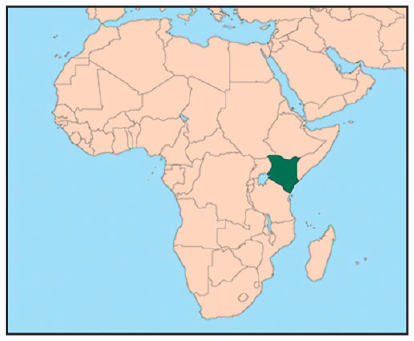
Mukuru informal settlements, spanning 689 acres, are in the eastern part of Nairobi County and have an estimated population of approximately 0.5 million inhabitants. Through a Gazette Notice that was published on 11 August 2017, the NCCG declared the settlements a Special Planning Area (SPA) in response to the recognition by the community and other stakeholders of the insufficiency of conventional planning tools to address Mukuru’s realities. This declaration followed years of persistent agitation by inhabitants because of the numerous unaddressed problems in the settlements. The Gazette Notice notified the public of the participatory process that this SPA declaration would trigger as part of the development of a physical development plan for Mukuru. Eight consortia were established as platforms through which to develop sector plans for the different areas involved, as explained in more detail below.
The declaration of Mukuru as an SPA took place against the backdrop of the Kenyan Constitution’s provisions on public participation, which enshrine the eligibility of the people to participate in governance processes as a “national value”.(7) The declaration responded specifically to Section 23(1), (2) and (3) of the Physical Planning Act (Act No. 6 of 1996, now repealed) which among other things conferred power on the national Director of Physical Planning to declare an area with unique development potential or problems as a Special Planning Area for the purpose of preparing a physical development plan. The SPA declaration facilitated the entry of Mukuru’s inhabitants into official domains from which their involvement was previously precluded. Within the SPA process, they could now access the platforms used to identify local challenges, with the potential for solving them. They ultimately co-produced interventions together with external experts, experiencing themselves as autonomous participants who could engage with the experts as equals, using the participatory platforms to present their imagined alternatives.
III. A Note on Methodology
This study adopted a qualitative case study approach, allowing for a comprehensive assessment of the operation of the participation apparatus within the context of the Mukuru SPA. The selection of Mukuru was informed by the fact that its SPA designation marked the first time in Nairobi’s history that planning agencies acknowledged the insufficiency of conventional planning methods in informal areas and that mechanisms were put in place to facilitate participation by marginalized urban communities.
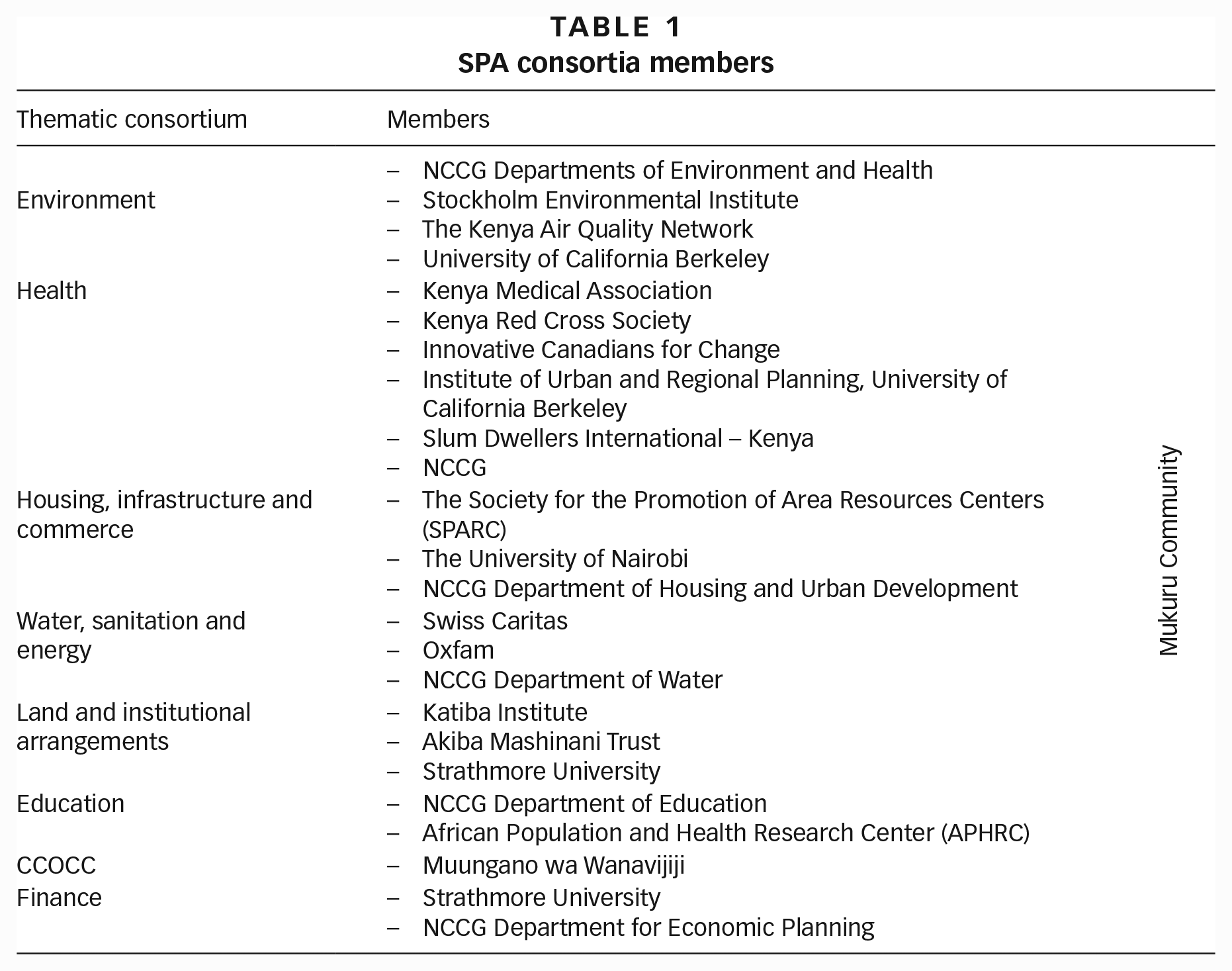
Two types of respondents were identified and interviewed, numbering 40 in all. The first category were ordinary people living and working in the three settlements that constitute the Mukuru SPA. Twenty-eight informants (all tenants) were accessed through purposive sampling – approaching individuals, asking whether they were aware of the SPA process and requesting their participation in the research if they were. Fifteen of the respondents were women, most of them stay-at-home housewives whose husbands worked in nearby industrial plants. The remainder (13) were youth (male and female) engaged in various activities in the settlements. The second category of respondents were members of organizations that played leading roles in the SPA process, especially those tasked with community mobilization for public participation or developing the health sector plan. There were 12 of these key informants, six of whom were community health workers/volunteers, one a health services consortium (HSC) member and five members of the coordination, community organization and communication consortium (CCOCC). The HSC and CCOCC were two of the eight consortia involved in the process, as detailed in Table 1.
SPA consortia members
Data collection consisted of semi-structured interviews with open-ended questions. Interviews with Mukuru residents sought to gauge their awareness of any physical planning initiatives that had been undertaken in their neighbourhoods, including the SPA. Respondents were asked, among other questions, about their participation in any of these initiatives, the nature of their participation in the SPA, the existence of any barriers to their participation, and the effectiveness of channels to relay their feedback. The key informants were asked, among other questions, how the SPA consultation sessions were convened, which groups were invited to participate and what lessons could be learned from collaborating with the communities.
Given the wide scope of the SPA and the numerous stakeholders involved in its formulation, I decided to focus the study on the participation process followed by the HSC, which essentially followed the broader structure and platforms adopted by the larger SPA process. Prior to the commencement of the community consultation sessions, the CCOCC had clustered the villages in Mukuru into 13 segments. The HSC subsequently organized three consultative sessions per segment, convening a total of 39 meetings to identify the underlying health challenges in the settlements and to develop a health sector plan.(8)
Prior to this study I had since 2013 collaborated with several organizations working in Mukuru, including Muungano. I have engaged with these organizations on different projects and have also observed them from the sidelines, with particular interest in their strategies for challenging exclusion in the city, their crafting of alternative spaces for traditionally excluded groups and their willingness to push the limits of the law. Throughout this work, I have also conversed with community leaders in Mukuru, members of other social movements and academics. During the SPA process I was a member of the land and institutional arrangements consortium. I have thus benefited both from an insider’s look at participation in action, and from the deep insights of various stakeholders. I have also reflected on my position and privileges as a middle-class Kenyan man and how this might have influenced my approach to this research. I have tried to avoid assuming that I have any advantage in my capacity to ‘see’ the situation. To this end, I positioned myself as an outsider seeking critical insights from respondents, whom I treated as experts, signalling that the research was a co-produced undertaking.
IV. Locating Agency In Participation
The search for durable models of participation within contexts of deprivation has been dogged by doubts about the dominant approaches habitually deployed in development discourses.(9) Low-income groups have been on the receiving end of numerous development projects that have participatory aspects. These often romanticize and sanitize their agency in arrangements of co-option framed as ‘partnerships’.(10) Gaventa notes that in many of these arrangements, these groups have been used as testing grounds for new concepts and relegated to subordinate roles.(11) Hardly any effort is directed at learning how they perceive their rights, what the barriers are to accessing these rights, how they act on them and how they are bounded by issues of knowledge and representation.(12) Thus, Cornwall indicates that inclusion has been transformed into a rhetoric that legitimates the subordination of community needs to those of powerful forces inside and outside the community.(13) As a consequence, meaningful changes have rarely been attained. Instead, these arrangements often guarantee the reproduction of old paternalistic structures and the suppression of the agency of low-income groups.(14) There is a need for critical empirical investigation into how these spaces for participation are structured, how interests are mapped and how they converge or diverge. More attention also needs to be accorded to examining how deprived communities express their agency and how they make use of legal and political openings to assert their agency and contribute to planning through participation.
Gould notes that participation in decision-making is the “most adequate means for the expression of agency”.(15) Through its practice, individuals signal that they have a stake in local matters and the right to shape local affairs. In so doing they assert their personhood. The practice of participation also contributes to individuals’ autonomy, which Rousseau equated with giving an individual freedom.(16) The nature of this relationship brings Saati to the conclusion that participation acts as both a means and an end in enhancing an individual’s potential and agency.(17) When structured properly, participation can facilitate the development of the individual capacity to negotiate with the powerful, effectively putting communities in direct control of decisions that affect their lives.(18) How participation facilitates the development of this capacity in groups with lengthy histories of marginalization is an important subject which has received inadequate attention in the literature. This study contributes to filling this gap by examining the Mukuru SPA process and demonstrating that the inhabitants’ participation in the process was both a manifestation of their agency and a means of building their agency.
In literature exploring the capacity of participation to improve the well-being of communities, focus has been directed at barriers that inhibit actuation of agency. Mattern is of the view that eliminating these barriers would ensure that the opportunities provided for citizen participation are responsive to local needs and allow for meaningful participation.(19) For Bhan, this requires attention to be directed at the challenges that arise from the limited recognition of citizenship and the consequent suppression of the ability of marginalized urban groups to express themselves fully and to participate in urban governance and planning.(20) Blomley suggests that this is an acknowledgement that urban governance and planning are platforms in which citizenship claims can be sketched, reformulated or denied.(21) It is also an acknowledgement of the gatekeeping roles that the framing of urban citizenship can play in denying individuals access to rights in the city. Urban citizenship, as currently structured, adopts a form that is largely inegalitarian and highly exclusionary to low-income urban inhabitants.(22) It has been used to disenfranchise and impoverish these groups by denying them the right to the city and the attendant rights that accrue from recognition and belonging.
V. Framing the participant and the terms of participation
Any assessment aimed at understanding the dynamics of participation must examine not only the existing mechanisms for public involvement, but also how participation works in practice. For Cornwall this means “treating participation as a situated practice”.(23) Her approach to participation demands that we take a closer look at how participants are imagined and constructed, how these participants construct their engagement and entitlements within these spaces (or how these engagements are constructed for them), what spaces are given to them and what spaces they occupy as their own.
This Mukuru study builds on understandings by Bhan of citizenship as a key mediator of participation.(24) The way citizenship is understood offers important insights for understanding how participants are framed, especially in spaces that are traditionally closed. The attractiveness of this concept as an analytical tool springs from its political and aspirational character, particularly within contexts of historical exclusion.(25) My understanding of citizenship here follows that of Purcell, i.e. that it is a political project whose goal is to challenge existing power relations and structures that produce exclusion. In his work, those who inhabit and use space in the city are understood as its citizens and hence are eligible for participation.(26) Bhan expresses the view that the emphasis on residence or inhabitancy as the primary attribute of citizenship implies the city as the scale for the determination of citizenship.(27) The city offers the appropriate platform from which citizenship claims can crystallize and be ‘scaled up’ to the national level. It is also within the city that more substantive forms of citizenship can be formulated.(28) Furthermore, inhabiting a place signals an individual’s stake in a given locality and their commitment to objectives that resonate with those of others within their localities.(29) Individuals inhabiting a common space can therefore be drawn together into participatory spaces to identify common challenges and co-produce appropriate interventions.
Urban citizenship plays a crucial role in facilitating individuals’ participation in urban planning processes. Marcuse invites an understanding of urban citizenship that goes beyond participation in democratic processes like elections, to one that engages with communities’ control of decisions that produce urban space.(30) This requires a clear understanding of who the subjects of urban citizenship are. A key challenge that emerges, and that has received inadequate attention in the literature, is the question of framing the participant or subject of participation. This challenge is particularly prominent within contexts in which urban citizenship has been defined in a limited sense, often within the bounds of spatial legality.
Within these contexts, eligibility to participate in spatial governance has often been pegged to private ownership of land.(31) This excludes many urban residents from participation, the most affected being the inhabitants of informal settlements. This has been evident in Nairobi during the development of Nairobi Metro 2030, a master plan formulated in 2008 by the then Ministry of Nairobi Metropolitan Development, and in the Nairobi Integrated Urban Development Master Plan (NIUPLAN), developed by the Japan International Cooperation Agency (JICA) for the NCCG. Legally recognized residency and ownership of private land were in these and other accounts taken as important entry points to urban citizenship, and seen as a licence to participate in planning.(32) NIUPLAN was the first master plan developed for the city of Nairobi under the 2010 Constitution, which called for public participation in all spheres of governance. Paradoxically, its formulation has been cited as exclusionary and technicist, one of its key consequences being a regeneration gaze directed at low-income neighbourhoods in the city.(33)
The diverse nature of cities calls for invention and innovation that can counter exclusionary formulations of citizenship. As Blokland et al. point out, rethinking the urban this way makes us appreciate cities as sites of possibilities and opportunities, where struggle can be employed to challenge dominant regimes of differentiated citizenship and expand citizenship and the ‘urban citizen’ beyond its traditional limits.(34) Space must occupy a central place in our understanding of citizenship as it is within space that identities are formulated and enacted.(35) Identity will also be properly understood when taken within the wider citizenship project, with the city being set as the central stage for this exercise.(36) With these understandings in mind, urban citizenship will be treated here as a process or struggle that is entangled with what Yiftachel called the “materiality, identities and politics of urban life”, with the urban citizen occupying a central place in this struggle.(37)
However, Yiftachel is also of the view that assessing who is eligible to participate must be carefully navigated, with due attention to internal homogeneity and diversities within contexts.(38) Within spaces for participation, it is common to find predetermined amorphous groups lumped together,(39) despite their underlying differences.(40) This is particularly problematic within contexts of historical marginalization, as lumping groups together is likely to obscure the views of certain members and deepen the inequalities within these marginalized groups. It speaks to what Cooke and Kothari(41) observe as the challenge of simplistic understandings of communities, which often result in grouping together individuals with different interests and needs.
As Cottrell points out, how participants participate is also an important factor that convenors of participatory sessions must consider.(42) This warrants attention to how participation discourses are constructed and framed. In some instances, the subjects of participation are only involved in processes pre-designed by external actors, taking no part in the diagnosis and formulation of action plans. Jürgen Habermas in his theory of democracy reiterated the importance of guaranteeing participation at each stage of democratic processes in arrangements that deem participants as autonomous legal subjects.(43) For him, these kinds of engagements give participatory processes a sense of legitimacy.(44) Creating conditions in which participants can freely express their views at every stage of the participatory process is an important accountability safeguard. These are key considerations that will be employed in examining how participation in the Mukuru SPA unfolded.
VI. The legal and institutional frameworks of public participation in kenya
Since the goal of this paper is to determine the effectiveness of the SPA in engendering participatory urban planning, and to assess whether it provides the optimal conditions for participation, it will aid our analysis to position this statutorily mandated process against the legal frameworks that underpin it.
To begin with, prior to the enactment of the Constitution in 2010, the urban planning framework in Kenya was characterized by overlapping mandates for various agencies, which presented difficulties with regard to accountability. Planning regulations that were prescribed by these agencies demanded high standards of development for infrastructure, effectively excluding low-income neighbourhoods from accessing services.(45) The 2010 Constitution, specifically its provisions on public participation as a national value and a right, necessitated a different approach that corresponds with what Bhan refers to as “new expectations and practices of state–citizens relations”.(46) The Constitution frames public participation as a logical necessity in governance processes,(47) elevating it as a national value and a principle of governance.(48) Articles 35 and 56 specifically elevate the participation of minorities and marginalized people in governance. Through these provisions, the Constitution aims to rebalance the power relations in the country and redefine the conditions of citizenship in the city. The Nairobi City County Public Participation Act of 2015 also requires that NCCG establish the conditions that will facilitate public participation, including devoting resources to this end.
The declaration of Mukuru as an SPA in 2017 was effected by NCCG’s Executive Member for Lands and Urban Planning, who subsequently placed an advertisement in the local daily newspapers to notify the public. The declaration was in keeping with the planning mandates conferred upon NCCG by the Fourth Schedule of the Constitution. This important exercise would test the constitutional provisions on participation by marginalized groups. The SPA declaration also served the important purpose of conferring recognition on inhabitants whose occupation of land in the settlements had previously been unrecognized. It aided in their citizenship project as, through it, the inhabitants’ eligibility to participate in planning was given legal recognition. NCCG now had a legal duty to facilitate the inhabitants’ participation in formulating a development plan. Resorting to legal pathways for entry into planning spaces plays the important role of reconfiguring participation from a means for implementing urban planning to a form of practical planning in its own right.(49) In this way, participation becomes a mode of planning that can aid individuals and communities in asserting their right to the city.
a. Interpreting the Constitution on participation
To understand how participation is envisaged by the Constitution, and to assess whether the SPA processes met the requirements that are stipulated in it, we need to examine how courts have interpreted the constitutional precepts on participation and test these prescriptions against what we encountered on the ground with the SPA. Courts have been called upon to provide clarity, and to protect or demarcate the content, scope and extent of such entrenched rights as the right to public participation.(50) The meanings that the court chooses to assign to the concept of participation will be a good starting point and a prelude to assessing how these meanings have been taken up by various levels of governance, and how they have shaped practical realities. These meanings do not, however, remain static and may change, given that courts are often guided by prevailing conditions.
Courts have affirmed public participation as a founding principle in Kenya’s constitutional democracy. Their dominant view is that what counts as public participation will depend on the particular context, and that what matters is that “the public has been offered an adequate opportunity to know about the issues and to express themselves on the same”.(51) The High Court has in the past held that “public participation must not only be real; it must also be effective, to meet the constitutional standard” and that it cannot be a matter of presumption or conjecture.(52) The Supreme Court in Attorney-General & 2 others v. Ndii & 79 others (Petition 12, 11 & 13 of 2021) enumerated some of the components that must exist for public participation to be considered meaningful. These are: clarity of the subject matter to the public; clear and simple structures and processes of engagement; opportunity for balanced influence from the public; commitment to the process; inclusive and effective representation; integrity and transparency of process; and capacity to engage on the part of the public.
Some important principles that can facilitate our understanding of public participation as envisioned by Kenyan law were also outlined by the High Court in Constitutional Petition No. 305 of 2012. In this case, it was the court’s view that public participation needs to be structured in a manner that conforms with the need for innovation and malleability, depending on the circumstances. The courts in Kenya borrow extensively from South African jurisprudence on participation,(53) which leads them to the conclusion that public participation cannot be determined with arithmetic precision and that a reasonable test must be used.(54) Determining what is reasonable leads the court to consider whether the public (and other interested parties) are offered a reasonable opportunity to know about the issues and have an adequate say.(55) The duty to facilitate consultation with the public in as many forums as possible is placed on whatever bodies are so mandated.
VII. Participation In The Mukuru Spa Process
Together with external actors, the inhabitants of Mukuru made use of the legal openings that have been outlined above and the political opportunities presented prior to the 2017 general elections.(56) By the time Kenyans took part in these general elections, the Constitution was already seven years old, and the institutions that it established, including the county governments, were firmly in place. With the impending elections, civil society actors and social movements like Muungano identified a political opportunity to get the county administration to declare the Mukuru settlements an SPA.(57) Section 23 (1) (2) and (3) of the Physical Planning Act, which provides for the declaration of an SPA, had not yet been utilized in the context of informal settlements. Working with professional groups, the inhabitants of Mukuru were able to identify this provision as a viable entry point into planning processes.(58)
Upon the declaration of Mukuru as an SPA, NCCG, with support from Muungano, engaged professionals and academics, grouped into eight consortia, with the aim of identifying, together with the inhabitants, the pressing issues in the settlements that called for planning interventions, and then co-producing interventions to address these challenges.(59) Muungano took the lead in convening the membership of these consortia, drawing on its extensive reach among academics, civil society organizations (CSOs) and other actors to identify volunteers for the SPA process, as detailed in Table 1. Each consortium was tasked with formulating frameworks for community and stakeholder engagement, data collection and validation. The CCOCC played the overall role of mobilizing the inhabitants to participate in the activities of the other consortia and provide venues for the participatory sessions.(60) The remaining seven consortia were tasked with developing sector plans relevant to their thematic area. The seven sector plans would then collectively be adopted as the integrated development plan for the Mukuru SPA. The platforms employed by the consortia to enable participation will be examined below.
Eligibility to participate in the SPA was contingent on an individual’s residence in Mukuru.(61) The logic employed here seems to follow the principle laid out in Mui Coal Basin Local Community, a case determined by the High Court of Kenya, that those most affected by an action must have more of a say on the matter and that their views must be more deliberately sought and considered.(62) Adopting this position essentially disqualified individuals who resided elsewhere in the city from participating. Horn et al. endorse this view, explaining that the SPA process sought to situate the local communities at the centre of planning,(63) thereby according reasonable opportunity to those most affected by the issues under deliberation, as required by law. Having played critical roles in stimulating the growth of grassroots participatory structures in Mukuru, Muungano’s participation in the SPA would prove to be integral. As an institutionalized participatory process, the SPA could now easily build on the participatory structures that Muungano, its affiliates and its partners had already established in Mukuru.
a. Geographical representation of participants
Settlement profiling and enumeration, undertaken as part of the SPA’s community mobilization processes, provided data that aided in mapping the community organization structures within the SPA.(64) Leadership structures were identified, as well as the geographical organization of the residents, from the household level to the sub-cluster, and ultimately the segment/neighbourhood association levels. This structuring was driven by the need to put disproportionately affected inhabitants at the centre of relevant participatory processes(65) and ensure that those brought together had similar interests on which to deliberate.(66) Thus, processes were overtly structured in favour of tenants, the category of stakeholders most affected by challenges in the settlements. As one member of the CCOCC remarked: “We wanted to develop a structure of representation at the household level as opposed to having organisations doing the representation. This is because we wanted to hear from the households, and we wanted to build a representation that speaks to the issues.”
Within the health services consortium (HSC), on whose participation process I focused, profiling and enumeration facilitated data gathering on the social determinants of health at the household level and the distribution and quality of health care resources within the settlements.(67) This community-led process “facilitated the mapping out of all the available services and challenges that the community is facing and enabled the understanding of the nature and quality of services that are available”.(68) These inventories created by the communities include household situational analyses which can facilitate development of targeted interventions for each unique case.(69) Ultimately, community-led enumeration and profiling processes challenge the assumption that Mukuru inhabitants are helpless actors, unable to articulate their needs or act upon them. This co-production of data promotes local buy-in to participatory processes by communities, which is integral if such processes are to be sustainable.(70)
By orienting participation in favour of the tenants, the SPA process grounded itself in local realities and sought to undo the history of marginalization.(71) It placed a group who had historically been severed from urban discourses at the heart of spatial planning and challenged the exclusionary conceptions of the urban citizen. It ultimately enabled a collaborative exercise aimed at the co-production of interventions to address the identified challenges. Ultimately, the SPA’s foregrounding of the household as the primary unit for participation ensured that other dominant actors, like structure owners and service providers, did not monopolize the discourse.(72) Figure 1 illustrates the various geographical platforms for participation in the SPA.
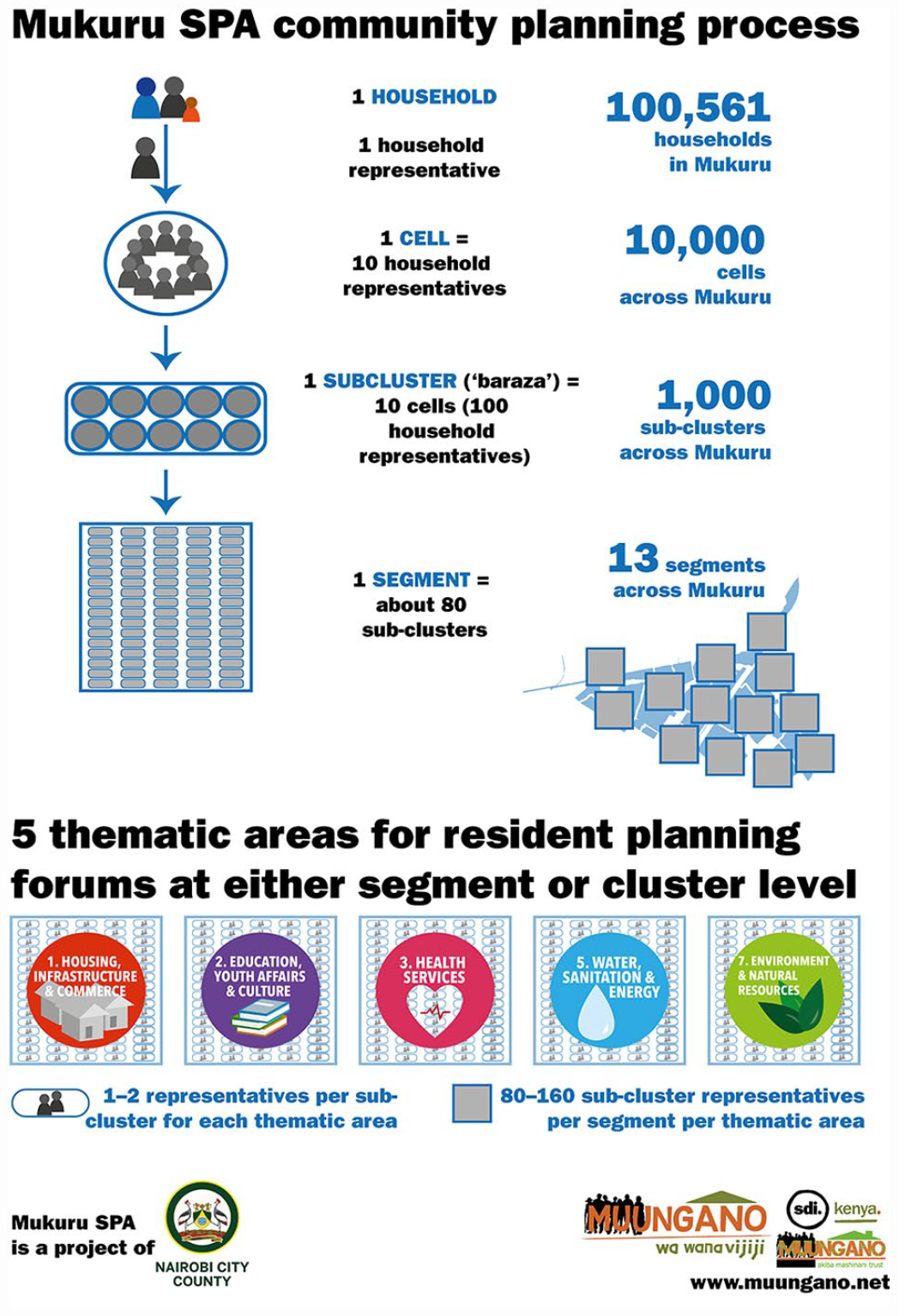
Mukuru SPA Community Planning Process
Figure 1 shows both the vertical and horizontal organization of participation in the SPA. Vertical organization places the inhabitants, through their households, as the starting point. This builds up to the segment level. Horizontal collaboration substitutes for the traditional top-down approaches, providing a communal sense of ownership, as individuals in the “socially autonomous” groups are likely to be driven by a shared purpose.(73) For instance, by bringing households together, the HSC facilitated identification of the risk factors within their environment and their shared health values, enabling the formulation of interventions like the adoption of better household sanitation practices.(74) The operation of both the vertical and horizontal platforms also suggests the existence of accountability mechanisms, with the individual actors guided by reciprocal responsibility.(75) Horn et al. have extolled this model for safeguarding residents from undue influence from external actors like structure owners and other entities with commercial interests in the settlements.(76) With the adoption of these platforms, the SPA signalled its valorization of decentralized, more inclusive approaches to participation.
b. Participation through saving groups: who is invited?
Financial contributions and participation through saving groups have been a key mobilization tool that Muungano has adopted over the years in Mukuru. Members’ financial contributions are used in negotiating for in situ upgrading of settlements.(77) Through the SPA, new community saving groups were mobilized along with existing ones, with the anticipation that all these groups would ultimately invest in upgrading settlement infrastructure.(78) It is also presumed that the (supposed) ‘transient’ nature of the inhabitants would dissipate once they acquired a financial stake in the area. According to a representative from a Mukuru-based social movement; “For you to be an active participant in your residential area, you must have a sense of belonging. For the tenants who don’t own the structures, coming to the participatory sessions as a constituency or a group of community savers would mean that they are stakeholders in the settlements.”(79)
Enabling community participation through platforms like the saving groups helps generate local expertise and provides individuals with the capacity to confront local challenges rather than requiring external help.(80) Drawing on experiences from Slum Dwellers International (SDI) and the Asian Coalition on Housing Rights, Mitlin et al. document the educational role that community saving groups can play, arguing that these groups can develop new skills in their members, ultimately expanding members’ individual and collective capacities.(81) Bottom-up participation through saving connects residents within a given neighbourhood and across neighbourhoods and settlements and facilitates the development of collective action.(82) During the SPA, the HSC facilitated useful exchanges of knowledge between Mukuru saving groups and those in other informal settlements.(83) “Scaling out” to other settlements is a key objective which Horn notes that the SPA sought to achieve.(84) Indeed, there are ongoing conversations on the use of saving groups to facilitate planning in Mathare informal settlements, pointing to the transformative potential of the Mukuru SPA.
VIII. The Pitfalls of participatory planning in the mukuru SPA
The declaration of Mukuru as an SPA followed from a lengthy history of struggle and transgression by Mukuru’s inhabitants, who have claimed, contested and, with the SPA, presumably secured recognition of their citizenship. The Mukuru SPA process created a mandate for community representation that incorporated voices from the grassroots.(85) It provided a space for the negotiation of a new form of citizenship by an increasingly politically articulate and cohesive group, albeit with the net effect of destabilizing the existing order. This does not imply, however, that the process was without its difficulties and setbacks. Even a progressive understanding of the right to participation was insufficient to ensure that the process would fully meet the aspirations residents had for it. Some of the pitfalls that were encountered during the SPA process are examined in this section.
Barnes stresses that issues of knowledge control and power imbalance must be addressed head-on when configuring spaces for participation.(86) This assessment requires us to question whether safeguards have been employed to protect against the negative implications of existing knowledge asymmetries within the spaces. As Miraftab notes, providing these safeguards will mean that communities are shielded from ideological coercion by the dominant interests.(87) This will be especially relevant where spaces for participation have been structured by external actors, including CSOs. Following from Miraftab’s argument, care must be taken as the external actors may artfully (mis)appropriate community-generated discourses and make them inaccessible to the intended beneficiaries. Such tendencies ultimately reinforce the exclusionary practices that processes like the SPA aim to eradicate.
The SPA process has been understood here as an invited space for participation. It relied heavily on the discursive frames and concepts employed by the CSOs and NGOs that helped structure the process. However, the collaborations initiated by the SPA also facilitated the cross-fertilization of ideas between communities and these external actors and helped marginalized groups realise key outcomes.(88) These same engagements, if not properly structured, can also produce or sustain power imbalances by establishing hierarchical relationships with affected communities at the bottom. As Modiri hints, arrangements that depict marginalized groups as impoverished, vulnerable or deprived may end up denying them the agency to be self-representing and self-defining.(89) This was a problem in the target communities, as will be further discussed.
Overly structured processes can equally eclipse the everyday, seemingly mundane, acts of participation that happen in the margins of or outside the structured processes.(90) These ‘mundane’ acts, which the SPA failed to capture in Mukuru, include the inhabitants’ participation through informal channels and genres of knowledge production. Musila cites rumours as a fertile channel through which individuals can engage with what could be shared sentiments within a given context.(91) Rumours can be a useful genre from which credible intelligence on the lives of communities can be made legible. These kinds of informal channels can also be important for bringing politics back into elite-led participatory processes. Indeed, Miraftab argues that an overreliance on knowledge production genres that are primarily driven by elitist actors can obscure social complexities within a given context.(92) Had the SPA engaged with a broader array of epistemic registers, stakeholders might have gained greater insights into what became an unfolding crisis of community dissatisfaction with some of the SPA outcomes, including the displacements induced by the implementation of certain infrastructural projects in the settlements. Yet, while rumours can play a useful role, they can also have less positive effects. This was the case when some of the consortia, as discussed below, failed to conduct validation meetings. This rendered the participatory process incomplete and left room for speculation, which contributed to conflicts. These kinds of outcomes point to the shifting nature of informal channels which, while playing important roles in expanding the representation of voices, may also interrupt community-based processes.
Apart from the Gazette Notice issued by NCCG, there appears to have been no other invitation from the County to the residents to participate. No financial resources were provided by NCCG to cater for the costs associated with convening public consultation sessions.(93) It has been noted that the only instance in which NCCG facilitated any SPA-related activity was at a retreat in Mombasa (a coastal city located approximately 500 kilometres from Nairobi) for the external experts in the various consortia.(94) This was a closed session, inaccessible to the majority of Mukuru residents. Communication with the residents was largely through the CCOCC, led by Muungano, and in both Kiswahili and English, the two national languages of Kenya.(95) This was done through announcements in public spaces like markets, and through use of posters and information sessions that were carried out through Reuben FM, a radio station which broadcasts in Mukuru.(96) Other respondents indicated that they obtained information by word of mouth, especially from their neighbours.(97) By leaving mobilization mostly to the CCOCC, NCCG fell short of discharging its statutory duty to provide and disseminate relevant information to all individuals who would be affected by the SPA. It should be recalled that the Supreme Court in Petition Attorney-General & 2 others v. Ndii & 79 others stated that it is the duty of the convening agency to ensure the participating public is sufficiently informed to have the capacity to participate. In the SPA case, this duty rested with NCCG.
As noted above, the CCOCC, the communication consortium, was tasked with mobilizing the community for participation and facilitating the participatory sessions.(98) Horn et al. stated that the consortium “acts as a gatekeeper who controls the community participation process, overseeing who goes to Mukuru and for what purpose”.(99) The influence of actors with existing relationships within the community can pose a danger. Muungano, for instance, has worked in Mukuru for over 20 years and has established networks and patterns within the community,(100) which could lead to differential access to the platforms for participation, posing disadvantages to less connected individuals. When I raised this issue with a Muungano representative, they were of the view that the validation meetings planned under the SPA would safeguard the process from undue influence from more dominant actors in the SPA.(101) However, there was a growing perception among Mukuru residents that the SPA process was hijacked by powerful actors, especially at its implementation stage.(102) One respondent remarked that “participation started well, but we were soon forgotten. Now we see things being implemented without any input from us.”(103)
Data validation would have ensured integrity and integrated greater reciprocity into the process.(104) However, budgetary constraints prevented some SPA consortia from holding validation meetings.(105) This led to problems, especially with the entry of the Nairobi Metropolitan Services (NMS), the institution that implemented most of the SPA proposals.(106) The NMS was established in March 2020, three years after the SPA process had commenced. It quickly took charge of implementing the SPA proposals, particularly those that related to the functions that had been transferred to it by NCCG. Tensions became rife in Mukuru over what one resident termed “NMS’s heavy-handedness” in the implementation of some proposals.(107) Most respondents claimed that consultation did not happen prior to implementation.(108) One resident noted that the waning of consultative conventions at crucial stages of the SPA eroded the goodwill towards the process that the inhabitants had previously held.(109) The fact that the SPA sessions were largely held on working days was also cited as exclusionary for those engaged in full-time work elsewhere.(110) Some residents also took issue with the fact that some meetings were convened at inaccessibly distant locations.(111) When they raised the matter with CCOCC members, more accessible venues were identified.(112)
The fact the SPA participants received a small payment to facilitate their attendance at consultation forums could also have undermined the process. A major defect of this approach is its risk of deflecting attention from critical deliberations, as participants, for fear of reprisal, may choose to be subservient to the convenors’ whims. Some respondents also noted that some of those tasked with mobilizing people to attend consultation sessions would only call friends and family members when they expected payments to be disbursed at the end of these sessions.(113) Issuing cash tokens to participants also attracted many people who had little interest in the actual contents of the consultations.(114) We are led to Arnstein’s suggestion that in effect such individuals may have only “participated in participation”.(115) The predicament here is the alternative risk of assuming that all participants have disposable time to lend to the participatory activities. These kinds of presumptions can work to deepen the very inequalities that we seek to address within these impoverished contexts.(116) There is thus a need for a cautious and reflective approach whenever questions of remunerating participants arise.(117)
During the Mukuru SPA, certain community meetings were organized under the auspices of saving groups as a strategy to avoid scrutiny from structure owners in the settlements, and the possibility of being punished with actual or threatened eviction.(118) Whenever members met, they would say the meeting was to discuss savings group affairs, while in reality they would discuss the ongoing SPA.(119) This approach also generated collective solidarity, which Pieterse argues is important in altering the power relations in decision-making processes.(120) However, the exclusionary perils of using the saving groups cannot be ignored. Anecdotal evidence suggests an uneven distribution of these groups within Mukuru, increasing the likelihood of exclusion.(121) A public consultation scheme cannot rest entirely on such platforms, given the increased risk of entrenching power asymmetries when individuals who cannot afford to contribute to the saving groups are excluded from participation. Contact with other arenas for participation must then be maintained to make the engagements as far-reaching as possible.
IX. Conclusion
The SPA process, examined as a mode of city-making, has been understood here as a political project aimed at reorienting power relations in the city and redefining the conditions of urban citizenship. The process provided new discursive spaces for marginalized Mukuru inhabitants to participate in planning. By identifying the legal and political openings that could advance their planning needs, the inhabitants of the SPA settlements expressed their agency, contributing to an expanded recognition of urban citizenship. The participation of these previously excluded urban inhabitants signalled a recognition of their voices and perspectives in the creation of the city. It enabled their entry into official domains of participation from which they engaged with external actors and government agencies. The inhabitants’ participation in the SPA became the “very practice of planning”,(122) allowing them to share their lived experiences through the various platforms and exchanges.
The case provides insights into how co-produced processes can contribute to building the agency and effective participation of historically marginalized groups. Prior to the SPA, the inhabitants’ lengthy history of struggle through protests, petitions, litigation and engagements with external experts had equipped participants with the vocabulary to identify, name and challenge the exclusionary norms in the city.(123) Their struggles for citizenship and a just city, and their understanding of the city as a site for possibilities, led them to explore legal openings and political opportunities to assert their eligibility to participate in planning as urban citizens. Inhabitants connected with each other and with the issues affecting them through the SPA platforms, including savings, mapping and enumeration exercises, and were able to challenge the presumption that they are helpless actors, unable to articulate and act upon their needs. The SPA thus realised a critical empowerment objective.
The SPA also tested previously unused provisions of the Physical Planning Act and the constitutional stipulations on public participation. Its structuring provided insights into the achievement of meaningful participation within a group historically marginalized and denied citizenship in the city, despite being national citizens. Under Kenyan law, participation must provide clear, simple, transparent structures and processes of engagement that provide opportunities for meaningful engagement and balanced influence from the public. The SPA’s eight consortia ensured the potential for engagement on various matters that affected inhabitants, with the CCOCC providing a platform for communication, sensitization, feedback and complaints.
Nevertheless, certain gaps have been identified here in the public participation model that the SPA adopted, which undermined its transformative potential. To begin with, the different SPA stakeholders – particularly the CCOCC which was charged with participant mobilization – should have explored mechanisms to hold NCCG to its legal obligation to facilitate public participation. Leaving such important processes to be entirely driven by non-public entities closes spaces that the public can use to hold NCCG accountable (given that the duty to facilitate participation in this case primarily rested with NCCG). Failure to hold data validation meetings prior to implementation of the SPA proposals has also been shown to have been detrimental to the SPA process. As noted earlier, and true to Saati’s analysis, the lack of a sense of ownership in these kinds of processes can foster distrust among actors, leading to conflicts.(124) Guaranteeing participation of affected communities at every stage cultivates their ownership of the processes and ultimately reduces the number of grievances that arise during and after these processes. The shortcomings discussed above reflect the inherent complexities and conundrums that will often be encountered when a participatory process is convened, especially in deeply marginalized contexts. Highlighting them underscores the importance of remaining sensitive to the intricacies of specific contexts.
Footnotes
Acknowledgements
I would like to thank the residents of Mukuru kwa Njenga, Mukuru kwa Reuben and Viwandani for taking part in this research. Thank you to my key informants for their invaluable contributions. I thank the anonymous reviewers and editors of Environment & Urbanization for their constructive comments on earlier drafts.
8.
Interview with member of HSC, 9 October 2020.
15.
Gould (1988), page 217;  .
.
50.
51.
Commission for the Implementation of the Constitution v. Parliament of Kenya & Another [2013] eKLR.
52.
Petitions No. 282 of 2020, 397 of 2020, E400 of 2020, E401 of 2020, E402 of 2020, E416 of 2020, E426 of 2020 and 2 of 2021.
53.
2006 (2) SA 311 (CC).
54.
Constitutional Petition No. 305 of 2012, paragraph 62.
55.
2006 (2) SA 311 (CC). Para. 630.
58.
Interview with member of CCOCC, 6 October 2020.
59.
The eight consortia were: Housing, infrastructure and commerce; Land and institutional arrangements; Education; Coordination, community organization and communication consortium (CCOCC); Health services consortium (HSC); Water, sanitation and energy; Environment; and Finance.
62.
Constitutional Petition No. 305 of 2012.
66.
Interview with member of CCOCC, 6 October 2020.
67.
Interview with member of HSC, 9 October 2020.
68.
Interview with member of HSC, 9 October 2020.
70.
Interview with member of CCOCC, 6 October 2020.
71.
Interview with member of CCOCC, 6 October 2020.
72.
Interview with member of CCOCC, 6 October 2020.
74.
Interview with member of HSC, 9 October 2020.
77.
Weru et al. (2020).
79.
Interview with member of CCOCC, 2 October 2020.
83.
Interview with member of HSC, 9 October 2020.
88.
Interview with member of CCOCC, 6 October 2020.
93.
Interview with member of CCOCC, 6 October 2020.
94.
Interview with member of CCOCC, 2 October 2020.
95.
Interview with member of CCOCC, 2 October 2020.
96.
Interview with member of CCOCC, 2 October 2020.
97.
Interview with resident Mukuru kwa Reuben, 13 October 2020.
98.
Interview with member of CCOCC, 6 October 2020.
101.
Interview with member of CCOCC, 6 October 2020.
102.
Interview with various residents Mukuru kwa Reuben and Viwandani.
103.
Interview with resident Mukuru kwa Reuben, 13 October 2020.
104.
Interview with resident Mukuru kwa Reuben, 13 October 2020.
105.
Interview with resident Mukuru kwa Reuben, 13 October 2020.
106.
Interview with resident Mukuru kwa Reuben, 13 October 2020.
107.
Interview with respondent Viwandani, 27 September 2020.
108.
Interview with various respondents Mukuru kwa Njenga, Mukuru kwa Reuben and Viwandani.
109.
Interview with respondent Mukuru kwa Reuben, 13 October 2020.
110.
Interview with respondent Viwandani, 27 September 2020.
111.
Interview with respondent Viwandani, 27 September 2020.
112.
Interview with respondent Viwandani, 27 September 2020.
113.
Interview with resident Mukuru kwa Reuben, 13 October 2020.
116.
118.
Interview with member of HSC, 9 October 2020.
119.
Interview with a member of CCOCC, 2 October 2020.