




Abstract
A social practice approach to household consumption examines socially produced patterns of practice, and understands these to be composed of technology, knowledge and meaning. This approach challenges many of the assumptions made about how consumers who are supposedly economically rational behave in large-scale municipal water supply systems. Yet for an emerging body of scholarship that is sensitive to the effects of context, research on social practices is notably short of studies beyond wealthy liberal democracies. In this paper we examine the key practices of daily water consumption for households in Shanghai, China. We identify boiling water, filtering water, and buying water as the three key practices associated with daily water consumption in the home, and explain the way each is the result of combinations of knowledge, meaning and technology. We also consider short-term and longer-term shifts in practices, and explain the influence of the materiality of pollution, information and trust on these changing practices.
I. Introduction
China is a particularly compelling place to study the social practices of water consumption. It has a rapidly growing urban middle class with changing consumption patterns, it has built mega water supply and storage projects to ensure the water security of cities like Beijing, Tianjin and Shanghai, and it has widespread pollution problems. While there is a growing body of social science research that asks questions about how water is supplied and managed in China, this literature is largely framed by questions of power, institutional change, and techno-natures.(1) Specific to Shanghai, there are many studies that consider drinking water contamination and treatment(2) or risks to water security,(3) but very little discussion of how individuals or groups of people actually use drinking water. Beyond Shanghai, studies that consider Tibetan ceremonial uses of water,(4) the work of local bureaucrats in trying to secure drinking water for rural communities,(5) and the hydrosocial relations of premium supply networks(6) only incidentally touch on some of the questions raised by practice theory.
In this paper we draw on the idea of embodied, materially interwoven practices, organized around shared practical understanding,(7) to examine the daily water consumption practices of households in Shanghai. By focusing on socially constructed patterns of practice, as is typical of social practice research, our study reorients analysis of municipal water supply systems towards the actual ways in which groups of people consume water.
In doing so we hope to provide an alternative perspective on the broader technopolitical waterscape of a Chinese megacity. We pose two primary questions: 1) what are the materials, competences and meanings that constitute everyday practices of drinking water consumption in Shanghai; and 2) how are these practices changing? In the following section we explain how and why we have applied practice theory to everyday water consumption in Shanghai.
II. Conceptual Framework: A Social Practice Approach
Practices are the routinized ways in which, according to Reckwitz, “bodies are moved, objects are handled, subjects are treated, things are described and the world is understood”.(8) A practice approach treats the field of practices as the place to study the nature and transformation of a particular phenomenon, such that knowledge, meaning, human activity, science, power, language, social institutions and historical transformations occur within and are aspects of the field of practices.(9) When applied to water consumption, social practice research focuses not on the isolated individual, but on patterns of practice that include technologies, knowledge and meaning. Practices are understood to be socially constructed: according to Warde, “the substantive forms that practices take will always be conditional upon the institutional arrangements characteristic of time, space and social context”.(10) This includes the nature of the municipal (or other) water supply system in question and the political system that governs it. A practice approach therefore complements and extends the broader literature on drinking water choice that is primarily concerned with perceptions of health risks.(11)
A social practice approach has begun to reorient the way geographers think about the reproduction of economic space, emphasizing how diverse actors organize materials, as well as produce, consume and derive meaning from the economic world.(12) While there are examples of practice-oriented scholarship on diverse economies in postsocialist states,(13) the majority of studies that consider household consumption do so in wealthy, liberal socioeconomic contexts. This includes research on environmentally sustainable consumption,(14) the intersection of materials and social practices in household adaptation to climate change,(15) and the relations among users, objects and large systems such as Australia’s municipal water supply.(16) Far less has been written about social practices in non-liberal socio-political systems.
That is not to say that practice theory has not been productively applied to China. Iossifova(17) considers the coexistence of various systems of sanitation and diverging everyday practices of sanitation in a spatially unequal Shanghai, while Liu(18) uses domestic food practices as a lens for examining gendered food-based work and intimacy in urban Guangzhou. Nonetheless, there is surprisingly little scholarship on the everyday practices of water consumption in China. In this paper we seek to provide such evidence, examining the key practices associated with daily water consumption of households in Shanghai.
III. Background: Shanghai’s Waterscape
Situated at the mouth of the Yangtze River, with the Huangpu River cutting through the city, Shanghai has a seeming abundance of surface water for its residents to consume. But the city’s available surface water is highly polluted. The most widely known pollution incident occurred in 2013, when over 16,000 dead pigs floated down the Huangpu River, at the time the city’s most important water source.(19) According to Shanghai’s Water Affairs Bureau,(20) 54 per cent of monitored sections of the river are worse than Grade III (the minimum level for potable use according to the Chinese grading system for surface water quality). Yet Shanghai is a leading industrial, technological and financial city that in 2014 generated 3.7 per cent of China’s GDP.(21) With rising incomes, it can be assumed that Shanghai’s 24 million residents are increasingly concerned about water quality and other quality of life issues such as food safety.(22)
Under China’s 2002 Water Law, Shanghai, as a centrally administered municipality, is responsible for improving domestic water supply and has its own regulations and laws governing local water issues.(23) The management of the city’s water is the responsibility of the municipal government and its various departments, including the Shanghai Water Affairs Bureau and the Shanghai Environmental Protection Bureau, as well as key water supply companies (all state-owned except for Shanghai Pudong Veolia, a joint venture between Shanghai’s municipal government and the French company Veolia).
With the aim of improving water quality, Shanghai has embarked on two major projects in recent years. First, as pollution in the Huangpu River became more serious, authorities sought to shift the city’s reliance to the cleaner Yangtze River. While there was an existing reservoir on the Yangtze – the Chenhang, with an eight-day supply – the much bigger Qingcaosha reservoir (68-day supply) was completed in 2011, so the Yangtze now supplies 70 per cent of Shanghai’s water.(24) While the Yangtze is cleaner than the Huangpu, the city’s 36 public water treatment plants(25) must still contend with eutrophication, chemical pollution, and saltwater intrusion in the Yangtze. Second, Shanghai’s municipal government has since 2007 also started to upgrade its network of pipes, water pumps, underground water tanks and rooftop tanks in a further bid to improve water quality. According to a 2016 newspaper account, contamination through secondary facilities accounts for over half of total water quality problems.(26)
Given these changes, do Shanghai’s increasingly wealthy residents consider the water delivered to their homes to be safe, and if not, what do they do with it? Zhen et al.(27) found that the vast majority of 5,000 residents surveyed had a low to medium perception of risk (67.5 per cent and 24.4 per cent respectively): only 4.3 per cent perceived no risk, and 3.8 per cent perceived high risk. Chen et al.’s(28) survey of Yangpu District residents tells us more about how people use water. In 2011, 58.25 per cent of respondents were drinking tap water, 22.5 per cent barrelled water (water bought in bulk and used with a water dispenser), 16 per cent filtered water, and 3.25 per cent bottled water. Of those using filtered water, about 15.63 per cent replaced their filters at least once every three months, 43.75 per cent annually, and 40.63 per cent less than annually. The authors also investigated the influence of demographic factors and risk perception on the types of water used by residents of Yangpu District. They found that higher-income respondents and young people were more likely to use sources other than tap water.(29)
Shanghai’s water is polluted, its residents consider it to be risky, and most either treat the water or seek out alternative sources. But many more questions could be asked of drinking water consumption in Shanghai: Why is the use of tap water so entrenched despite strong perceptions of risk, and why has there not been higher uptake of filtered and barrelled water? In what circumstances do people seek out other options and what reasons do they give for choosing one option over another? What meanings do people attach to particular behaviours? To begin to answer these questions, this study examines the key practices associated with daily water consumption in the home in Shanghai – boiling water, filtering water, and buying water – through the lens of social practices. Before discussing our results, we briefly outline the methods used in this study.
IV. Research Design
The primary data used for this study were collected through 64 semi-structured interviews with Shanghai residents of diverse backgrounds to elicit detailed information about the use of drinking water. Participants were drawn from most of Shanghai’s districts (Map 1). In terms of demographics, our respondents also reflect the diversity of Shanghai society: 40.6 per cent are female and 59.4 per cent are male; their ages range from 18 to over 70; education levels range from primary school only to master’s level or above; household income ranges from less than RMB 100,000 (US$ 15,842) per year to more than RMB 400,000 (US$ 63,366) per year; and the majority (61 per cent) own their own home, while others rent or are provided with workplace or university accommodation. Another characteristic is hukou or residency status: approximately two-thirds of respondents had local Shanghai registration (either rural or urban), while the other third were registered outside of Shanghai (either urban or rural). Those without local hukou tend to have more insecure livelihoods given their lack of access to local social services and social security benefits.
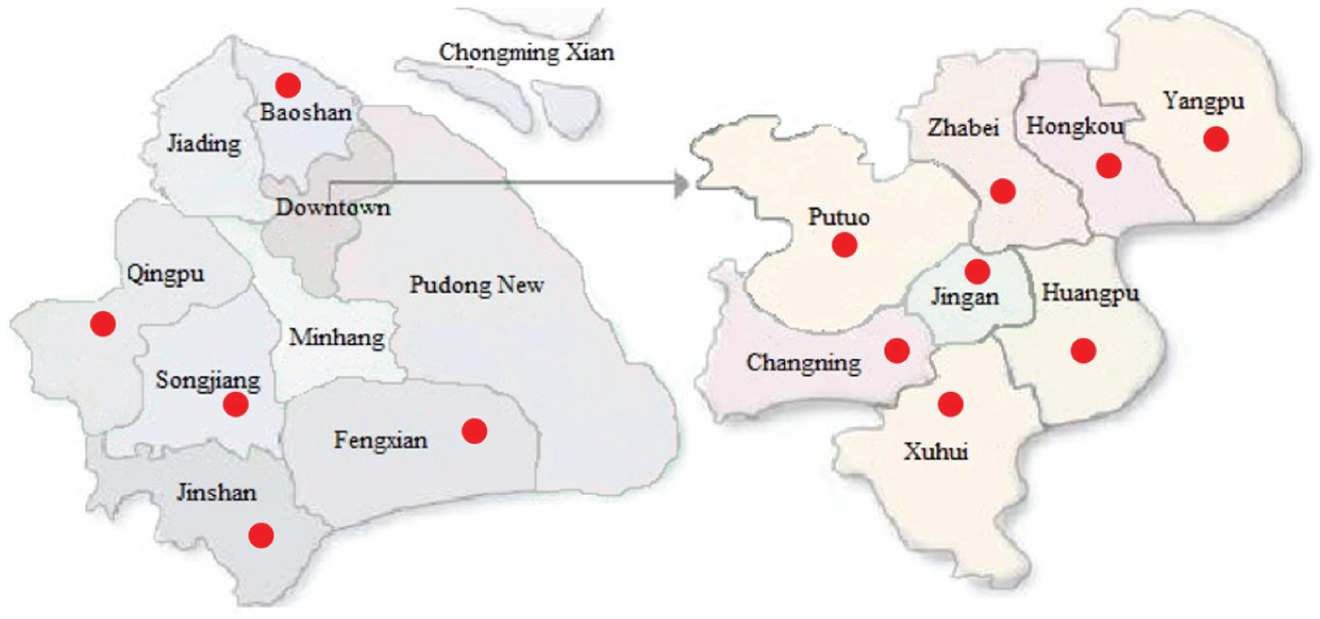
Shanghai’s districts (interviews conducted with residents in marked districts)
Face-to-face, semi-structured interviews were carried out in Mandarin by the first author between March and July 2015. The respondents were asked about their daily water consumption practices and reasons for their practices as part of a larger study of political trust and water consumption in Shanghai.(30) Where respondents were visited in their homes or communities, images were collected of the key technologies employed in drinking water consumption. The target respondents were people older than 18 years who had been living in Shanghai for at least one year. Our 64 participants represent a broad range of Shanghai’s population, but are not a perfectly representative sample. For instance, the floating population of migrant workers registered outside of Shanghai accounts for about 41 per cent of Shanghai’s total population, while in our sample they are only 33 per cent. There is also a higher level of educational attainment, as participants were selected through the snowball method: this began with the first author’s direct contacts, who were asked to introduce friends, colleagues and relatives. Participants were also recruited from local neighbourhood parks to try to balance what might otherwise have been a more highly educated, higher-income selection. Since the aim of this study was to understand how and why people develop certain water consumption behaviours, a generally varied sample was considered sufficient.
The software package NVivo was used to organize and code the interview data on water consumption behaviours and reasons for water use behaviour. Three key drinking water practices were identified – boiling water, filtering water, and buying water – with a collection of technologies and ideas surrounding each. Buying water includes the purchase of barrelled water as well as smaller bottles of water.
Following Shove et al.,(31) the analysis of our data is presented along two broad strands. First, we outline the elements of drinking water practices in Shanghai. These include technologies (household filters, purification machines, barrels, pipes, kettles, etc.), competences and meanings. Second, we consider how particular bundles and complexes of practice in Shanghai have persisted, and how others have disappeared. In the discussion we then reflect on the ways that an examination of everyday drinking water practices in Shanghai (an authoritarian political context and a highly polluted environment) both speaks to and challenges existing social practice scholarship.
V. Findings: Drinking Shanghai’s Water as a Field of Practice
In this first section of our results we discuss – as per Shove et al.(32) – the materials (things, technologies, entities), competences (skills, know-how, techniques), and meanings (symbolic meanings, ideas, aspirations) that constitute everyday practices of drinking water consumption in Shanghai. We consider how behaviours, materials and ideas coalesce around the primary ways of consuming water, which are boiling tap water, filtering tap water, buying water, or some combination of these.
But before outlining the elements of each of these practices, it is important to note that we did not identify a routinized practice of drinking “raw” or unboiled tap water (生水 shengshui). One respondent suggested it was fine to drink a few mouthfuls, while another said that to drink it occasionally would have no health effects. Out of 64 respondents, only one, a 24-year-old migrant worker in Putuo District, appeared to regularly drink unboiled tap water in hot weather: “sometimes I drink cold tap water, sometimes I boil the water. In the hot weather, people [like me] just drink tap water directly.”
a. Boiling water
Boiling tap water using a standard household kettle is by far the most common approach to drinking water consumption among our sample (about 45 per cent of respondents report it as their only method, and 62.5 per cent as combined with other methods). It was also the most common method cited in the 2013 survey data outlined in Zhen et al.(33) This practice is fundamentally shaped by habit and appears to be fairly entrenched. A 29-year-old female respondent from Xuhui District did not dare to drink the cold tap water: “I was educated to drink boiled water and that is what I always do. I think it is safe to drink after boiling.” Another replied, “it’s life experience, traditional life experience; after trying different [methods], I still think boiling tap water is the best”. Indeed boiling is so common that it is not really considered to be treating the water. As a 59-year-old man from Changning said: “It’s all tap water…no treatment, just boil it a bit”. It is clear that this habitual practice is shaped by people’s past experiences, and by the practices learned from those around them: “I always think, after so many years of being used to not drinking unboiled water, you now want me to drop this habit? I think that’s impossible…In China, for example in one’s childhood, [if you were] thirsty and turned on the tap to drink directly, your family would say don’t drink cold water, you’ll get diarrhoea; so you have this feeling, like it’s not safe to drink unboiled water.” (30 years old, male, Hongkou) “Maybe the water quality is better than before, maybe. [If you] drink unboiled water [you’re] unlikely to have diarrhoea; but because you’re thinking the raw water is not drinkable, then you don’t drink it. From a young age, the family education or school education was ‘don’t drink the [raw] water’, so you don’t drink it.” (59 years old, male, Changning)
People have particular routines for boiling Shanghai’s water. As a 23-year-old male respondent in Songjiang explained, “I won’t drink tap water directly, unless it is boiled, and boiled for a while. Every time I use the water I will turn on the tap and leave it running for one to two minutes, then I collect the water and boil it.” A 35-year-old man in Baoshan District said that first thing in the morning, his household collects a basin of water and throws it out or uses it to wash vegetables, and only then starts using the tap water.
Boiling water is more than just habitual: a number of respondents gave immediate safety concerns as a reason for boiling tap water. This includes concerns about the water itself, but also the larger municipal water infrastructure: “Just drink it straight [from the tap]? Certainly can’t drink it like that. Definitely boil it and then drink…[One] knows that filtered tap water is not necessarily very clean; there can be bacteria in it. At home there are children, so you can’t do this kind of thing [drink from the tap], or it will cause trouble for the children.” (28 years old, male, Songjiang) “Public announcements say [the tap water] is not clean; there are also poisonous, harmful elements in the tap water. The tap water contains pollution from pipes, chlorine, bleach powder, impurities. It is transported from distant places, comes down to households from water tanks; several times it passes through pollution…Boiling alleviates it a bit, the chlorine will be less.” (57 years old, male, Changning) “You can’t directly drink the tap water, it has bacteria. In my childhood you could drink the tap water directly; after reform and opening up, the tap water is not good to drink; [there is] calcification, tap water has alum or something in it; unboiled water has a flavour.” (59 years old, male, Zhabei) “If you’re drinking tap water in your home, and a pipe is quite old, [the water] contains microorganisms; there are probably quite a lot of impurities.” (30 years old, male, Hongkou)
There is also a clear cultural preference for consuming boiled water. A 28-year-old male respondent in Putuo District said: “I still boil it; after installing the water purifier, I still boil it to drink…I’m accustomed to this.” He later explained that for Chinese people it was not ‘suitable’ to drink water straight from the tap. A 37-year-old woman in Songjiang was asked why she still boils purified water, and does so on the stove: “because my husband wants to make tea, the water has to be really boiling…like the temperature of water from an electric kettle is not hot enough; the water has to be [on a rolling boil]”. There is a common perception in China that drinking water that has a similar temperature to the body is better for one than drinking something cold. It is not possible to conclude whether these cultural preferences preceded, or developed in response to, concerns about water safety, but the practice of boiling filtered water is associated with a strong preference for consuming hot water.
But beyond convention and safety concerns, people’s living conditions and economic situations also fundamentally shape their practices. Some of these responses speak to the aspirations attached to particular ways of consuming water in a highly unequal city (primarily divided along the lines of registered residents and migrant workers). Other responses speak to the precedence of other aspects of life: “Here we are all migrant workers…if we were long-term residents here then we could buy that kind of filter, install it on the house’s main tap… that would be good. Us migrant workers, the whole family only has one tap…This year we’re here, next year we might not be; it’s not like we’re preparing to put down roots here…” (27 years old, female, Huangpu) “Other people drink Evian, I would also like to… but I don’t have the money; I just have to drink boiled tap water.” (40 years old, male, Zhabei) “We don’t have the conditions to be fussy [about water]…I just want to make more money and send it back to my family…the conditions in our dormitory are very poor.” (24 years old, male, Putuo)
The consumption of boiled tap water is also shaped by negative perceptions of the other options available: store-bought water and various forms of filtered water. As a 55-year-old man from Yangpu explained, “We don’t buy large [barrels of] bottled water; it is said that nothing is better than tap water. The news on the Internet said that about 60-70 per cent of bottled water does not reach the quality standard, so I think tap water is better; we always boil tap water.” A 47-year-old man in Songjiang explained why his family had not installed a filter: “we just boil water to drink…the cheap [filters] are useless, the expensive ones are several thousand [RMB]”. Another respondent suggested that tap water at least reached some standard, whereas barrelled or spring water included some “inferior brands” and you did not know where the water came from. It might be produced in a “small workshop”, which means the quality is not certain. Others suggested that some bottling plants were running “black” operations. Yet another respondent explained his hesitation with reference to “flow”: “I think tap water is better than bottled water. Tap water flows; in contrast, you do not know how long bottled water has been stored for, or where it is from. Sometimes if you cannot use it up in 10 days it goes mouldy… I think tap water in Shanghai is better than before. It used to have some strange taste and impurities; now the sediment is less than before.” (65 years old, male, Changning)
Clearly, a key element of the practice of boiling water is information gleaned from different sources about the safety and trustworthiness of tap, bottled and filtered water. It is interesting to note that these sources do not typically include the government. As a 30-year-old man in Jingan District noted, “Even if the government knows that some [pollution] indicators exceed the standard, they won’t tell the public because it is not good for maintaining social stability [维稳 weiwen]”. An 80-year-old woman in Yangpu explained that she only drinks boiled tap water because a health expert on a TV programme said that boiled water is the healthiest water. She also followed the programme’s advice to collect tap water in a bucket and let it stand for one–two minutes, then boil it, and once boiling, open the lid for one–two minutes to release the chlorine. A 37-year-old woman in Songjiang District, by contrast, was told by a friend who works in a water plant that there are no big differences between tap water and filtered water; the main pollutants are still there after filtration. So she stopped using a water filter and now boils tap water instead. So here we see an everyday practice – boiling drinking water in Shanghai – enabled by various entities such as taps, kettles and pipes, particular forms of knowledge (drawn from different sources) such as custom and markers of safety, and particular meanings such as aspiration, and stagnation versus flow.
b. Filtering water
There is a large and growing water purification industry in China. Hundreds of water filter brands (see for instance Figure 1) are heavily marketed to a rapidly urbanizing population. Household filters are now common in Shanghai, but our data show that they are not necessarily used on their own, nor are they used for all household purposes. A 60-year-old man in Changning District explained that, whereas before he had drunk boiled water, for the past two years he had used a water filter: “there are quite a few kinds of filters – installed on the faucet, also pot [jug] filters - I use both of these”.
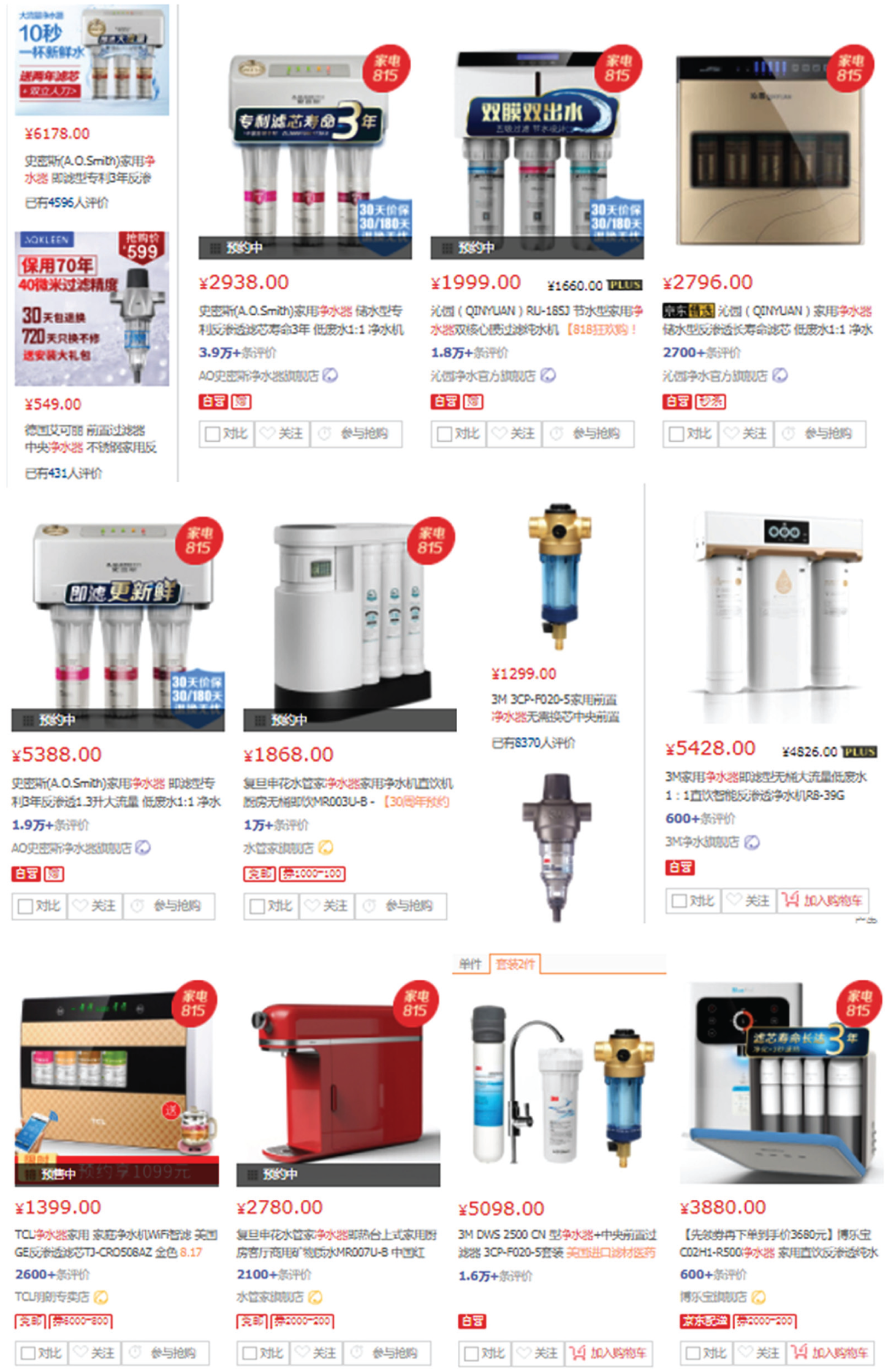
Screenshot from JD.com showing examples of household filters available from online stores
As a key material element of everyday practice, water filters themselves warrant attention. Some users have adjusted their behaviour and manage the filters without any problems. For others though, the use of (often imported) filters in Shanghai presents problems, which tend to accumulate over time: “Now people’s environmental consciousness has increased, people demand higher-quality water. Our house, we installed a filter, fourth generation, imported from the US. [We] drink directly from the tap…once a year we change the small [filter] core, after four years we scrap it.” (57 years old, male, Changning) “The house has a purified water system installed inside. It was in use from October last year, but now I don’t dare to use it; it’s said that the core needs to be changed once every six months; I haven’t called anyone to change it, so now it’s useless; we still use the tap water.” (37 years old, female, Songjiang) “Those domestic water purifiers you buy from Germany, they say the filter needs to be changed once every six months. But in China, after three months [the filter is] already very dirty; in this kind of situation you know that the tap water is very dirty, how could you dare to drink it?” (30 years old, male, Jingan)
Concerns are also emerging about the quality and trustworthiness of household filters, though not to the extent of concerns about bottled water (see Section Vc). When asked why he had not installed a household filter, a 35-year-old man from Baoshan said: “At first, last year, I thought about it; later I discovered these things are a gimmick. Recently isn’t it said that some water filters do not comply with standards? [this kind of news]…it’s shared on WeChat Moments [an instant messaging function].”
Another filtration option in some parts of Shanghai is coin-operated community purification machines, through which mains water is filtered into large bottles (Photo 1). Not all communities have them, and they do not appear to be widely used: only five respondents were using this option as their main source of drinking water. A 30-year-old man from Putuo uses the community machine instead of boiling tap water: “A post on the Internet compared tap water and purified water, and the conclusion was that purified water is cleaner. You can see the dirty things collected by the filter. So I buy the community-purified water.” He also considered it to be a cheaper option than store-bought water: “There is a purification machine in the neighbourhood, a very big machine; all the neighbourhoods around here have them. It’s cheaper than barrelled water… I use this for my drinking water; but for cooking, washing vegetables etc, I still use tap water. The neighbourhood [machines] are very cheap, 100 RMB for more than half a year of drinking water.”
These community machines also fit into people’s seasonal preferences. A 38-year-old woman in Xuhui had a coin-operated filter in her neighbourhood. She said that while her household normally consumes boiled tap water, in summer they will occasionally use the machine for cold water that can be consumed straight away. She considered it to be about the same as store-bought spring water.
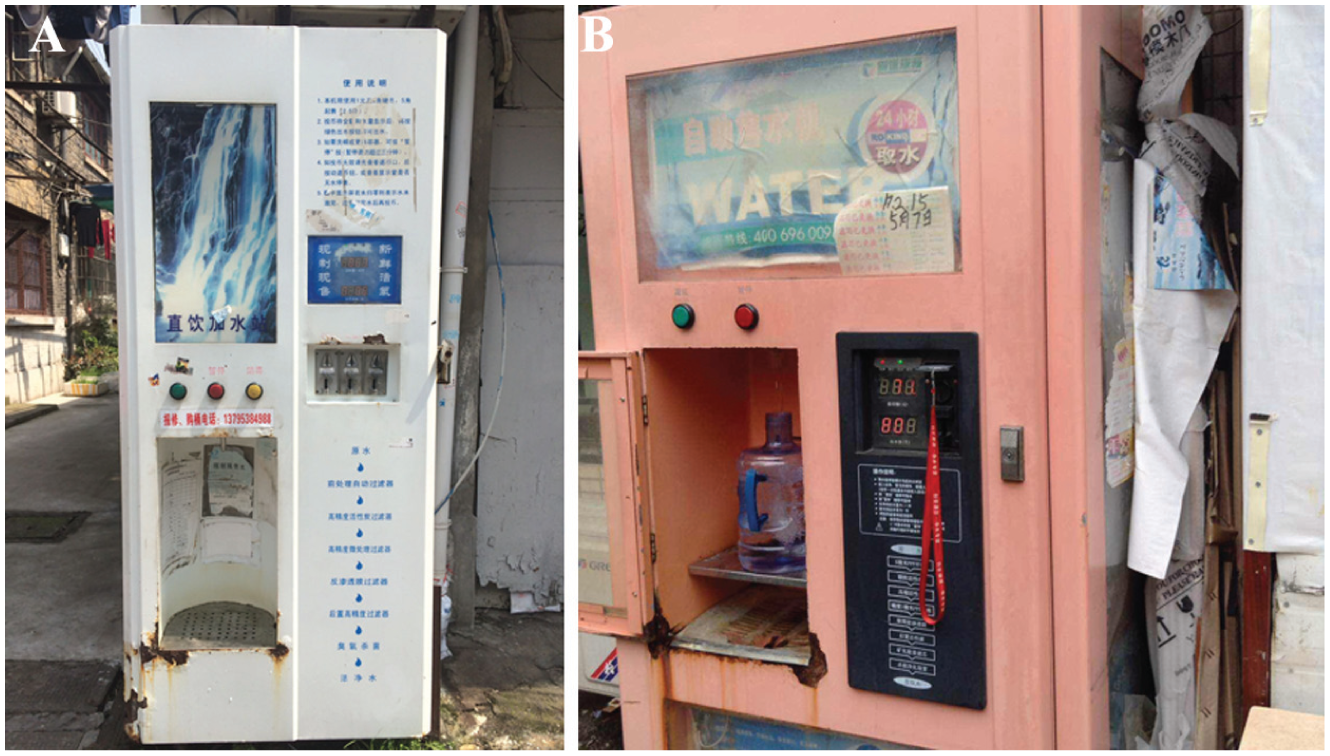
Community coin-operated water filters
Some respondents, though, considered the machines, while cheap, to be inconvenient. A 27-year-old woman in Huangpu did not use her community’s machine as she lived on the sixth floor with no lift, and did not want to carry the heavy bottles upstairs (she drank boiled tap water instead). Others rejected these community purifiers outright, saying that they did not trust that they were properly maintained, and that boiling or filtering tap water was a better option. The installation of these machines is supposed to be reported to the health department and maintenance is the responsibility of the franchisee, but it seems that not all machines are reported or properly maintained.
So the practice of filtering water again brings together a set of objects – local and imported household filters, filter cores, community filters – with questions of trust in these objects, and new behaviours centred on the maintenance of filters. This practice also raises questions of competence and agency, in terms of the successful treatment of the water.
c. Buying water
The practice of buying water includes the purchase of both small bottles and larger barrelled water connected to a water dispenser used in homes and offices (Photo 2). Typically, people still boil this water for drinking, particularly in winter. A relatively small number of respondents interviewed in 2015 engaged exclusively in this practice. A 64-year-old man in Huangpu had become accustomed to drinking barrelled water: “because tap water, to some extent the city adds some kind of bleach to disinfect [the water]; this is our understanding of it”. A 48-year-old woman in Hongkou used only bottled water for both drinking and cooking. She said: “We feel that the tap water is not quite clean, so we started to use barrelled water with a water dispenser for drinking and cooking; for many years… If you boil water and drink it, it has a distasteful flavour. Bottled water does not have that tap water flavour.”
Others, such as a 75-year-old woman in Huangpu, purchased water for drinking, but would change to tap water for cooking: “tap water has a flavour, even after boiling I still feel it has some flavour. Shanghai’s water is not very clean, not clean, not clean.”
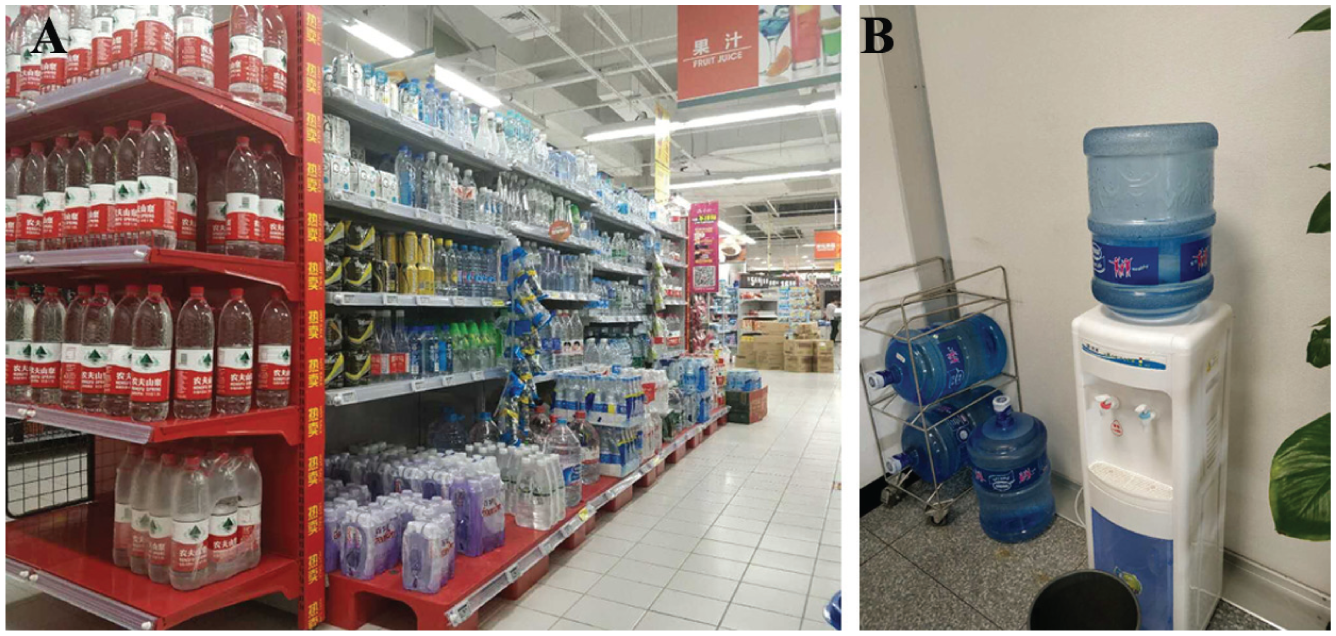
Bottled water in a shop (A); barrelled water in a respondent’s home (B)
Again, the use of store-bought water can be seasonal, or otherwise sporadic. As a 30-year-old male respondent in Hongkou explained, “bottled water and tap water are used fifty-fifty [in my home]. In winter we usually drink hot water [boiled tap water]. In summer we just buy bottled water and drink it directly.” A 36-year-old woman from Xuhui, while primarily using barrelled water for drinking, expressed some reservations: “it seems that with pure barrelled water, a lot of materials [i.e. beneficial minerals] are lost through the filter; to continuously drink [this water] is not healthy, right? So [we] also boil tap water to drink. [We] don’t drink unboiled tap water.” Purchasing water was also a short-term response to well-publicized events: “At that time, a chemical industry ship capsized on the Huangpu River - chemical pollution - during that time, [I was] a little uneasy; occasionally [there are] emergencies… at that time for several days I drank bottled water; after some time had passed, I again used tap water.” (28 years old, male, Songjiang) “If these large-scale pollution incidents happen, I should change [what I drink]…for a concentrated time I might go to the supermarket and frenetically buy bottled water, for those few days; after that, the supermarket runs out… I’ll go back to traditional tap water. Even if [the pollution incident is] influential, it’s only like that for a few days.” (49 years old, male, Songjiang)
There is some evidence to suggest that people are shifting away from the practice of buying water. One reason given was cost: “Before, when Nongfu Mountain Spring [a popular bottled water brand] was cheap, we would buy Nongfu to drink; it’s natural water, right? Natural water is certainly good. Now, Nongfu doesn’t have those big packages, [I] feel that the quality-price ratio is not high, so I just use a jug filter.” (53 years old, male, Hongkou)
Indeed, there are huge discrepancies in price. In Shanghai, popular brands of 19-litre bottled water range in price from RMB 15 to 24 (US$ 2.38–3.80), while community purified water costs about RMB 1.5 (US$ 0.24) per 7.5-litre bottle. By comparison, in 2015, Shanghai’s residential water cost RM 0.00345 (US$ 0.00055) per litre. This might help to explain the prevalence of the practice of boiling tap water. But regardless of cost, it appears that people are increasingly concerned about the quality and trustworthiness of store-bought varieties: “Tap water compared to barrelled water, even compared to mineral water, is cleaner, because tap water, everyone is using it [so] it circulates; that barrelled water, you can’t see how long it’s been stockpiled, how it has been treated, where it has been transported from. Have additives been put inside? If not, how can it be stored for that long?…so now Shanghai even has some barrelled water that is bottled here [using] tap water that has been filtered a bit, or secretly using wells on the outskirts.” (60 years old, male, Changning) “At the beginning [bottled water] wasn’t bad; now don’t you look at the quality available outside [and think] they’re all fake brands? We don’t have confidence in them…it’s all just bottled tap water, right?” (47 years old, female, Putuo)
While buying water can be an exclusive practice, it is not as prevalent as boiling or filtering tap water. Rather, it is more commonly something that people resort to at particular times – when cold water is desired or when pollution incidents cause concern about tap water – or for taste preferences. While safety concerns are also evident for tap water and filtered water, our data show a shift in attitudes towards bottled water, with significant concerns about where the contents of these bottles and barrels are sourced from, and how this water is treated.
d. Formation, persistence, disappearance
In this second section of our results we consider how particular practices of drinking water consumption have formed, persisted and disappeared. Our data provide primarily a snapshot in time, but respondents did also reflect on their past practices, pointing to certain changes in Shanghai. The results of other studies, particularly Zhen et al. and Chen et al.,(34) also provide some insight into changing everyday practices.
What is evident from our analysis is that certain ideas and meanings that constitute everyday practice in Shanghai are highly durable. These include a preference for consuming hot water, a belief in the efficacy of boiling water, and a belief that untreated tap water is not safe for consumption. The practice of boiling water is routinized through repeat performances, and further ingrained by the way drinking water consumption is shaped from childhood. Of course for some people the durability of certain practices was not about ideas, but about other practices not forming. Some migrant workers, for instance, simply did not have the option of installing filters or purchasing water.
Not all practices prove so durable. While the 2011 and 2013 surveys outlined by Chen at al.(35) and Zhen et al.,(36) respectively, point to much higher rates of purchasing water, our 2015 interviews suggest that the consumption of bottled water is declining. And, importantly, our interviews show some of the reasons why this might be happening. One of these is the rise in recent years of filtration as an industry – reportedly growing by 40 per cent per year(37) – which is making local and imported filtration products widely available for household use. The other is changing perceptions of the quality and trustworthiness of bottled water. Given nascent concerns about unregulated water purification devices, though, it is unclear whether the filtering of tap water will endure as an important everyday practice. Much will depend on the performance of material entities enrolled in this practice and the ways that people adapt to the demands of these technologies. Much will also depend on trust in providers of filters, in providers of bottled water, and in government data on water quality or reports of chemical spills – a defining feature of Shanghai’s waterscape.
Because of the physical (polluted) and political (authoritarian) environment in which people live, the everyday practices of drinking water consumption in Shanghai are fundamentally shaped by how people manage and understand risk. Thus, particular markers of safety and danger, such as smell, taste, residue, flow and stagnation, are widespread in people’s responses, making Shanghai’s water practices markedly different to those in developed countries where people can generally expect to be provided with safe drinking water. People in Shanghai understand that the water is not safe. While many respondents were sanguine about the improvements to water supply, others expressed fairly despondent views. As a 57-year-old man in Changning said: “So now China has a saying: ‘if you don’t eat you will starve to death, if you eat you will be poisoned to death’. Nowadays there are too many unhealthy things: gutter oil, melamine…” Or as a 30-year-old man in Putuo said: “Even officials admit that the tap water all contains pesticides and heavy metals…Diarrhoea is a trivial matter. Now people are scared that after drinking it for five, six years they will get leukaemia, get cancer.”
With this knowledge it then becomes a question of treatment options at the household scale, and the efficacy of these options. People go to great lengths to treat their drinking water, and respond to particular events and new information by changing their behaviour. These behaviours are shaped by a variety of influences including online discussions, TV programmes, family and friends, and personal experience, all of which interact with materials, habit, customs, and questions of convenience and cost. The micro-scale adaptations pursued in households perhaps give people a sense of agency. As a 36-year-old woman in Songjiang explained: “if the water quality is not good, we have no way [to respond]. Report? Report to whom? About the water, except for filtering by ourselves, there are no other ways.” When asked about the quality of water from the Huangpu River, a 54-year-old man from Fengxian said: “there’s nothing we can do about it; otherwise what will we drink? There’s no other way but to treat it.”
While it is not possible to predict future practices, what respondents themselves raised was the sustainability of treatment options. “Now there are a lot of methods of treating [the water], for instance those filter machines and filter jugs; I believe these can treat [the water] well, but how to resolve this question of sustainability? These [methods] aren’t permanent” (60 years old, male, Changning). Expressed in terms of expectations of service and progress against some kind of external benchmark, a number of people also considered the widespread provision of safe tap water to be unnecessary: “It is not necessary to have directly drinkable tap water. It is too costly and there will be a lot of waste. Except for drinking, the water is also used for showering and washing, and it is unnecessary to bring the water to a drinkable level; too much waste.” (50 years old, male, Hongkou) “I don’t have such high expectations for tap water. I usually just wash vegetables; for this [purpose] the water quality is enough. I bought a purification system myself, I think it’s not necessary to change the pipes; the government claims that after changing the pipes [you will be able to] drink directly, but I still would not feel at ease.” (30 years old, male, Hongkou)
Even if Shanghai were to supply safe, drinkable water to its residents, it is likely that people’s everyday practices would still be fundamentally shaped by perceptions of risk, trust, the convention of consuming boiled water, and the varying services water provides.
VI. Discussion
The lens of the economically rational consumer offers a narrow understanding of water consumption behaviour. As Browne(38) argues, there needs to be greater understanding of “the diversity of reasons that people currently do practices that use water, the societal trends that underpin them, and how these practices might change over time in unexpected and chaotic ways that will influence water consumption”. By examining everyday practices of drinking water consumption in Shanghai, this article has given insight into why people boil, filter and buy drinking water. But using a social practice approach in an authoritarian political context demands some reflection. While our findings largely align with the existing literature, we do raise several points of contention.
In line with existing literature we find that a practice approach sheds light not just on behaviour, but on broader societal shifts. In Shanghai, as elsewhere, it is the habits of interaction with taps, filters and bottles that provide a crucial analytical link between people and the wider socionatural network of storage and distribution.(39) In this case, Shanghai’s socionatural or technopolitical waterscape reflects much larger questions of pollution, trust and social order. Discussions of filtration devices and bottled water are shot through with distrust: of the companies that produce these products and the methods they use, and of the government’s ability to supply safe water. Further, it is widely accepted that the water is undrinkable, but people tend to distrust government sources, seeking out information about water quality online or from their social network. People also tend to use coping mechanisms within the household to reduce the risk of consuming polluted water. However, imported household filters sometimes prove ineffective, or must be adapted by end-users, while new technologies such as community purifiers are introduced but not widely adopted. These standalone technologies are overlaid onto Shanghai’s reticulated, but polluted, water supply; thus analysis of how water technologies and society are co-produced must be multilayered.
Shanghai’s socionatural water network also speaks to questions of sustainability, but in ways peculiar to China. People in Shanghai simply do not drink cold water from the tap, which raises questions about the overall aim of municipal water supply.
Over the next decade the city’s already massive population is projected to increase further, as is its demand for water. But it is treatment capacity, not surface water availability, that is the key constraint on the city’s ability to meet this future demand.(40) Tao and Xin(41) suggest that by using water purifiers in the home, China can avoid the technological lock-in of wasting potable water on other domestic uses. From a social practice perspective that recognizes the different services water provides (washing vegetables in untreated water, drinking treated water in cold or hot weather, preparing tea, etc.), this is not an unreasonable proposition. Nonethless, there is a need to understand how these purification technologies become enrolled in people’s everyday lives and how they can be made sustainable.
While this paper has begun to illuminate these processes and potential hurdles, there is more work to be done in understanding end-user practices of cleaning and replacing filter cores, and the networks that produce and deliver these materials to people’s homes. These processes are not well accounted for in the existing practice-oriented literature on consumption. Nor is there any research that looks at the interplay of sanitation and drinking water practices in China.
One final reflection is that we should not lose sight of questions of access. Social practice scholars argue that variation in behaviour results from contrasting understandings, levels of competence and degrees of involvement, not simply socio-demographic factors.(42) We do not dispute this, but in emphasizing the embodied and material nature of bundles of technologies, knowledge and meaning, there is a risk that questions of inequality fade too quickly into the background. As Iossifova(43) concludes in relation to sanitation in Shanghai, everyday practices and perceptions of these practices are manifestations of socio-material inequalities, particularly for low-income elderly residents and rural migrants. China’s hukou system entrenches inequality within cities, including in access to safe drinking water. Some of the migrant workers interviewed for this study were living in temporary, poor-quality accommodation, and simply did not have access to household or community purification systems. Everyday practices have a social context, and in Shanghai this context is one of institutionalized discrimination against migrants, amidst an increasingly polarized society. It is therefore imperative that a practice-oriented epistemology incorporates meaningful approaches to power, such that it can help us to understand how everyday practices constitute, reproduce or transform structural forms.(44)
VII. Conclusions
Considering rapid urbanization, growing public concern with quality of life issues, and increasing environmental stress in China, existing scholarship on institutions, governance, and technopolitical systems could be usefully complemented by studies that centre people’s practices. This article has adopted a social practice approach to examine drinking water consumption in Shanghai, outlining the complex motivations and material and social elements that shape daily water consumption in the home. It has highlighted the stability of particular bundles of practice, namely boiling tap water, and flux in others. While elements of everyday practices such as convention, knowledge and technology have been extensively described by research in other places, this paper draws attention to distinct features of everyday consumption in China: the materiality of highly polluted water in its interaction with technologies and behaviours, and the pervasiveness of (dis)trust in shaping everyday practices.