




Abstract
Tanzania’s urban citizens are still insufficiently supplied with safe drinking water by their water utilities. However, instead of collectively clamouring for improvements, citizens channel their protests individually to water authorities. This paper aims to shed light on citizens’ protest strategies and the responses they elicit from the water authorities. It draws on extensive fieldwork carried out in a Tanzanian town, which revealed four protest strategies employed by citizens: “stay and speak up”, “speak up and leave”, “resignation” and “leave and remain silent.” The study reveals a substantial mismatch between citizens’ protest strategies and the formal/informal complaint mechanisms of the water authority. This has negative implications for underprivileged citizens and for broadly defined “access to water”.
I. Introduction
Public water services in Tanzania have failed urban citizens. Coverage and access are now worse than in 1990,(1) despite the legal obligation of Tanzanian water utilities to be service-oriented and economically viable. The final Millennium Development Goal (MDG) assessment for access to water in Tanzania reported “limited or no progress”, while the percentage of the urban population with piped water dropped from 31 per cent in 1990 to 28 per cent in 2015.(2) Smiley(3) concluded that “Tanzania’s water landscape is unjust, inequitable and uneven.” The population in low-income urban areas(4) is forced to rely on informal providers offering water of uncertain quality at unregulated prices.(5)
The new Sustainable Development Goals (SDGs), which replaced the MDGs, set the bar for water access much higher. SDG 6 targets the “availability and sustainable management of water and sanitation for all” by 2030 (as opposed to halving the proportion without access). SDG 6 also extends the MDG focus on just “improved” sources of drinking water to sustainable management and universal access. The SDG indicator refers to the “population using an improved drinking water source which is located on premises, available when needed and free of faecal (and priority chemical) contamination”.(6) However, accessing water from improved sources “when needed” remains a challenge even for those with piped drinking water on the premises, given the realities of irregular service. Monitoring progress towards SDG 6 will also probably remain a challenge in low- and middle-income nations.(7)
Fundamental to complying with the principle of universality in water access is water authorities’ capacity to listen and respond positively to all citizens, not just those who are better off. A better understanding of citizens’ protest strategies could help in assessing the extent to which local water providers are listening and committed to improving access.
Studies in sub-Saharan Africa(8) documenting the interplay between government neglect and civilian protest(9) concentrate on macro and structural issues (e.g. neoliberal reforms). In Tanzania, the focus has also been on processes of urbanization, and on responses to poor water access in formal and informal settlements.(10) Studies across Tanzania have shown that collective protest as a response to declining service delivery is rare.(11) More recently, Hooper and Ortolano(12) found that in Dar es Salaam, slum dwellers’ motivation to participate in urban social movements was especially low among renters. The authors argued that citizens with no opportunities to express discontent often ended up in “deep resignation”. While these studies touch upon the behaviour of Tanzanian citizens in relation to deteriorating services, they do not address the effectiveness of individual citizens’ protest strategies in their micro-level encounters with water officials. Unless we understand these micro-strategies and their effect on service improvement, we will not be able to amplify them with the information and communication technologies (ICTs) that the influential World Development Report(13) and other publications (14) claim are important to further progress. ICTs do not work well when they bypass or undermine service providers, but are typically effective when they operate through them.(15) As Toyama(16) has argued, it is citizens’ “voice, not the technology, which is the primary cause of change”.
Inspired by Hirschman’s work on citizen responses to organizational shortcomings,(17) the study reported on in this paper asks: “Which strategies do citizens use to protest the failure of urban water services and how do water providers respond?” We focus on micro-level, face-to-face encounters between citizens as urban water consumers and front-line officials of the urban water authority (the fictionalized “MUWSA”) in “Mashujaa”, a Tanzanian town. The rest of the paper is organized as follows. Section II outlines the empirical context. Section III describes the theoretical approach and Section IV presents research methods. Results are presented in Sections V (customer perceptions) and VI (customer strategies), followed by discussion and conclusions in Section VII.
II. Empirical Context
a. Mashujaa
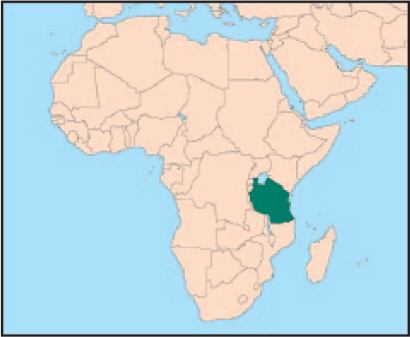
Mashujaa (a fictitious name)(18) is the capital and main commercial centre of one of the poorest districts in Tanzania. Half of its population of about 50,000 is under 15 years old, according to the 2012 national census. Apart from a few affluent citizens active in wildlife tourism, most citizens depend on petty commerce for their livelihood, or work for local government.
Mashujaa has three main residential areas: the town centre, the periphery and the outskirts. Only the first two are served with MUWSA’s piped water, and thus relevant here. The town centre includes small markets and public services such as schools, health facilities, banks, a police post, old houses, and new hotels and tourist lodges. The periphery’s dispersed houses are intermingled with small farms and bushland and MUWSA’s headquarters.
b. MUWSA
MUWSA became the official water provider in Mashujaa in response to Tanzania’s decentralization policy(19) and the National Water Policy of 2002 (NAWAPO),(20) which aimed to transform water utilities into efficient and financially sustainable service providers. The town’s ageing piped water network, constructed in the early 1970s to last for 20 years, still serves a growing town population. In 2015, the water authority was serving only 30 per cent of the targeted population. National performance criteria require service to 100 per cent of the targeted population.(21) But MUWSA’s water supply suffers from low pressure, frequent supply interruptions due to power cuts, and poor water quality.
The raw water source, a nearby lake, is heavily polluted, and there are no water treatment facilities. High energy costs caused by worn-out infrastructure and the long distance to the water source mean monthly electricity pumping costs of four times the water sales revenue. The water transmission main from the water intake to the storage tanks has been vandalized, either for the valuable metal resources, or out of frustration over the chronic water supply issues. Seventy per cent of produced water is unaccounted for due to leakages and vandalism, and only one-third is billed to customers. MUWSA’s operation and maintenance costs are largely paid by the district council through grants from the central government. Although the council pays 90 per cent of its electricity cost, MUWSA is highly indebted to its electricity suppliers.
The water authority manages about 1,000 domestic connections and serves an estimated 10,000 users. It supplies 40 institutions (including a district hospital) and 50 businesses, representing an additional 15,000 users. In 2009, the central government funded a project, now well behind schedule, to rehabilitate the water network. At the time of fieldwork (spring 2015), only the first phase of construction had been completed, and the high hopes of water customers were replaced by cynicism. In May 2015, the project was inaugurated although water was not yet flowing. Critics dubbed this strategy “buying votes” given that national presidential elections were scheduled for October 2015.
MUWSA reports on its performance monthly to the Ministry of Water, and each quarter to the Energy and Water Utilities Regulatory Authority (EWURA). In 2015, EWURA awarded the lowest performance category (E – unsatisfactory) to MUWSA, along with 22 of Tanzania’s 69 urban water utilities.
c. MUWSA’s water billing process
About 40 percent of MUWSA’s customers do not pay their bills. To increase revenues, MUWSA attempted to digitize billing and fee collection, but could only secure funds to hire a student software developer, whose electronic system did not live up to expectations and was quickly abandoned. Bills and receipts are electronically printed, but billing is still conducted manually. Meter readers visit customers’ homes monthly and record the readings in water meter books. At the office, readings are entered into a computer. The business manager prepares bills and prints a copy for the customer and one to file. Bill attendants and meter readers inspect bills for mistakes, and sort them for house-to-house distribution. A cashier collects fees from customers at MUWSA offices.
The process is hindered by poor records: customer names, account and meter numbers, addresses, water consumption and bill payment are all poorly recorded. Bill attendants distributing 100 bills a day have to memorize footpaths and local landmarks and confirm customer names.
The inspection and sorting of water bills are lengthy and laborious. Five officials read more than a thousand bills and ensure that the information printed corresponds to meter readings. Officials expect to see steady water consumption, except for months with known fluctuations in supply. They flag all suspect changes in consumption and speculate on causes: a customer selling water to neighbours,(22) or an error in reading the meter, recording the reading, or typing it into a computer. When technicians cannot agree, they ask the business manager for advice. The first author witnessed this exchange:
“This bill says the customer has used 86 units of water [1 unit = 1,000 litres]. Is it possible? This is too much even if he sells water.”
“Just write the bill as it is. This is your job. Do not speak on behalf of the customer. If there is something wrong, the customer should complain.”
d. MUWSA’s formal customer complaint reporting mechanism
MUWSA’s Commercial and Customer Care Department maintains a paper-based customer complaint register. The business manager explained the challenges: “to enable MUWSA to enhance customer satisfaction and retention, we need to ensure that customer complaints are received and registered, then routed to the appropriate department. And we need to be able to track the resolution of customer complaints and give appropriate feedback to customers.”
The complaint register includes the customer’s name and address, the date and description of the complaint, and the name of the official assigned to handle it. It includes columns for the date of complaint resolution, the handling official’s signature and “remarks”. An examination of 67 registered complaints showed the “remarks” column was empty in 88 per cent of cases. Nevertheless, some follow-up occurs informally, when a customer meets a water official face-to-face for other matters.
III. Theoretical Approach
MUWSA’s water infrastructure loses 70 per cent of produced water, making it at least twice as expensive as necessary. Customers are forced to pay for dilapidated, vandalized infrastructure and an overstaffed bureaucracy. This kind of organizational deterioration might be expected to trigger a response from customers. Hirschman, in his seminal treatise Exit, voice and loyalty,(23) suggested that customers of a service or product have two possible reactions towards a decline in quality: exit and voice. A dissatisfied customer is said to have exited a service when he/she stops buying a product or paying for a service, and to have exercised voice when he/she complains about the quality of a service, anticipating a constructive response from the provider.
Young(24) argued that voice is more efficient than exit when: (i) the service provider is a monopoly; (ii) the public services are not differentiated (as in this case: poor and economically stable customers pay the same price for water from the piped scheme) and those with weak voice gain from the vocal few; and (iii) the service is ill defined and therefore difficult to evaluate. Paul(25) argued that several factors inhibit voice: (i) informational asymmetries, e.g. service providers possess information not available to the public; (ii) the government’s ability to restrict the public’s access to information; (iii) legal and institutional barriers, e.g. some user groups are not recognized and are denied the right to sue public service providers; and (iv) social barriers (lack of income and education) that limit the ability to use voice.
Voice is an information-rich form of preference expression, rewarding in its own right and scalable from domain to domain. A citizen’s acquired skill in exercising voice regarding water services can be applied to other services as well. Hirschman argues that exit and voice are not mutually exclusive;(26) they can be combined in multiple ways that can vary in intensity and form.(27) It is precisely these multiple voice–exit combinations (protest strategies) that we set out to capture using the four cells along the EXIT and VOICE axes in Figure 1.
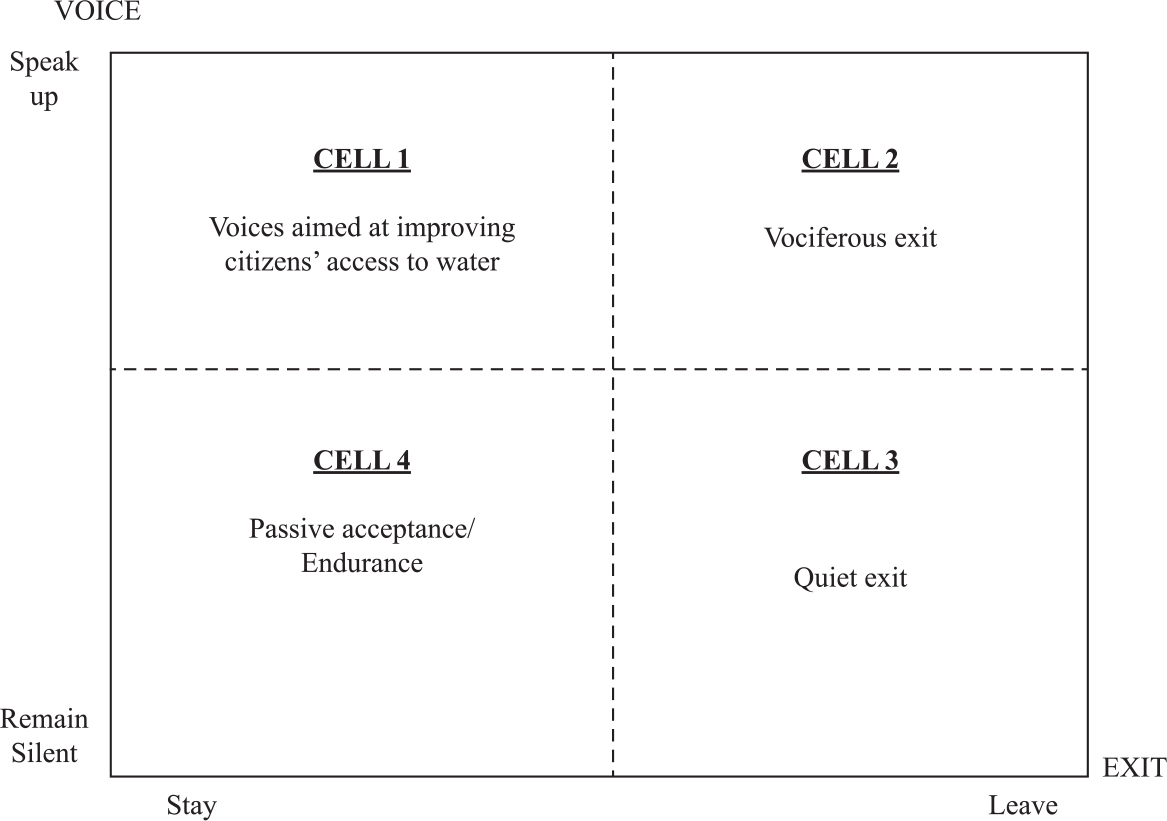
Potential customer responses to a service provider’s decline
IV. Methods
Data collection methods in this research included a review of MUWSA’s records; in-depth interviews with customers and MUWSA officials; observation of interactions between customers and officials, both at customers’ homes and at the MUWSA office; and the use of video and audio recordings of conversations from the previous year.
Records: Records reviewed included registers of customers, meter reading, bill payment and customer complaints from 2011 to 2014; a customer care manual (labelled as a draft); 2013 annual progress report (particularly regarding customer complaint management); and newspaper excerpts on the new water project.
Interviews: Interview participants included eight MUWSA officials purposively selected to reflect their roles: managing director, business manager, cashier, technical manager, two water technicians, and two water meter readers. Twelve piped water customers were also selected purposefully and opportunistically to reflect a range of characteristics relevant to the study (Table 1); these were interviewed by the first author at their homes for 30 to 45 minutes. The first author met eight customers at their homes by accompanying water technicians while distributing water bills. Five participants (C01, C02, C08, C09 and C10) agreed to participate and were interviewed during a separate visit. Four participants were recruited through snowballing (identifying other houses with MUWSA water connections): C02 referred C03 and C04, while C10 referred C11 and C12. Respondents C03 and C06 lived close to the first author’s hotel and were recruited following informal interactions. The participants did not include the few affluent citizens who have their own improved water sources (wells) and are not MUWSA customers.
Participant customers
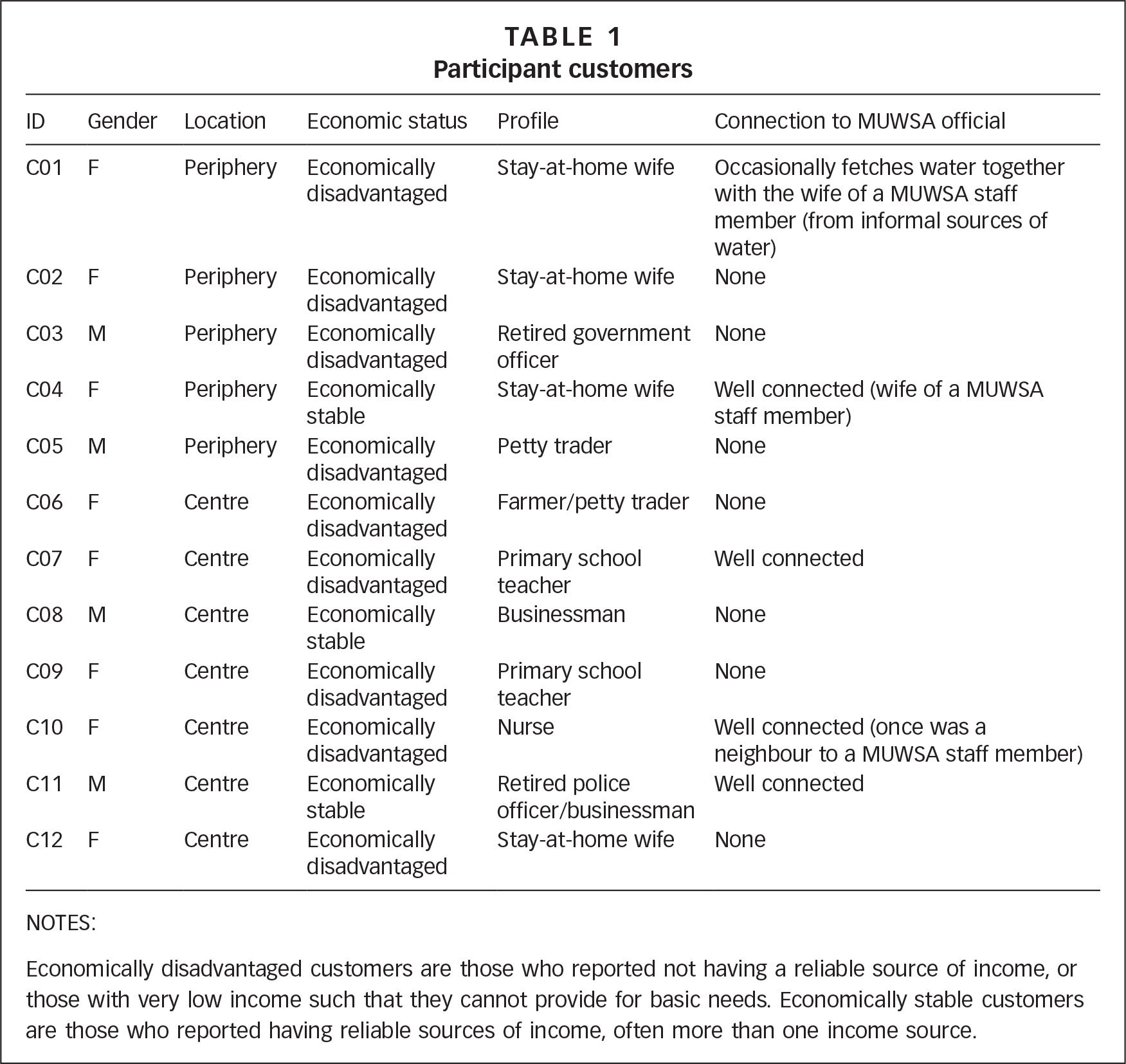
NOTES:
Economically disadvantaged customers are those who reported not having a reliable source of income, or those with very low income such that they cannot provide for basic needs. Economically stable customers are those who reported having reliable sources of income, often more than one income source.
Observations: In addition to interviewing participants, the first author observed interactions between water technicians and eight customers at their homes as well as with two customers and officials at the office. Also observed were interactions between staff members at the office.
Secret video and audio recordings: Officials also gave us access to an unusual dataset – 11 video and audio files of conversations between water technicians and customers at customers’ houses, 5–10 minutes long, and recorded secretly with mobile phones in the previous year. We cannot confirm the socioeconomic status of these secretly interviewed water customers. However, the use of the English language by some of these customers indicates – most likely – that they have better education and are more privileged than average, while others’ complaints about having to spend a whole day walking long distances to distant water sources probably indicate less privileged customers. The dataset offered a unique opportunity to analyse genuine, disintermediated citizen voices in their interactions with water technicians at their homes. MUWSA officials resorted to this strategy to find out why customers were not paying water bills and to confirm whether fee collectors’ claims (“customers do not pay us”) were true. Collectors retain 10 per cent of collected fees, a coveted source of extra income. Officials suspected that some kept all of the collected money, depriving MUWSA of a significant increase in revenue. Because this dataset was collected by the water authority without the consent of water users, we anonymized the town to protect the privacy of informants. All interviews and citizens’ conversations with water technicians were transcribed from fieldnotes and video and audio files, then translated to English from Swahili. The transcripts were read line-by-line and free (open) codes were assigned to excerpts for analysis.
V. Customers’ Perceptions of Water Services
Customers expressed discontent with MUWSA services on all dimensions of water access including quantity, quality, availability, safety, affordability and convenience. Customers also expressed their dissatisfaction with the behaviour of MUWSA officials, citing examples of hostility, harassment and indifference. Almost all customers were unhappy about the quantity of water they received, given the crumbling state of the water infrastructure. According to Customer 5, a petty trader living in the periphery, “I only got 2.4 units for the whole month. How do you expect us to live? I have a family of six people. They drink, they eat, they wash, they shower […] I have chickens that also have to drink water. Now tell me, you need me to buy water from private vendors while I have a water connection here. Is this pipe for ornamental purposes?”
Customer 10 was more accommodating: “they [MUWSA] should give us water at least once per week. This is the dry season and the sun is very hard on us. We shall use tap water for drinking and cooking. For […] toilets, we can get water from the ponds.” A primary school teacher (C07) expressed her discontent with the time of collection. “My husband has to wake up at night to accompany me to fetch water. I am a very lucky woman, not many men from our tribe can do that.” (In her tribe, water collection is often regarded a role for women only.) Customer 12 also complained about the time of collection for water: “we are searching for water at night as if we are witches”.
Customer 4 complained about the inconvenience of long walks to alternative water sources and her humiliation around neighbours and friends: “today I planned to go to school [there is a deep well near a school] to wash my clothes. There is no water closer to here. And when I am there they always laugh at me that MUWSA offices are just next to my house but I walk several kilometres searching for water.”
Water customers say they can afford to pay for MUWSA water services, but feel that the water authority is dishonest. “We have not had water for more than two months now. They [MUWSA] failed to pay the electricity bill for the pump house. They are big thieves”, said Customer 6 in an interview. In Tanzania, urban residents who cannot afford the piped network often buy water from their neighbours. MUWSA prohibits this practice, however, affecting the affordability of water for customers. “Most of our neighbours don’t sell water because they fear that they will be fined by the water authority” (C09, interview).
Location can somewhat affect the quality of MUWSA water services. In an interview Customer 3 complained, for instance, that their taps get less water than a neighbouring street whose “distribution pipe also goes to the district commissioner and the district hospital”. Moreover, as noted by MUWSA’s managing director, customers in the outskirts no longer had access to water, after the pipes were uprooted to benefit customers in the centre of the town: “The [water authority] depended on government grants. When these were not forthcoming the district had no money for repairs. [Officials] would […] uproot pipes sending water to villages and use them as spare parts downtown.”
Otherwise, water problems are almost the same throughout the town.
VI. Customer Strategies in Reponse to Poor and Declining Water Services
a. Formally reporting problems to the office
Customers lodge complaints through letters, telephone calls, emails and personal visits. The water authority lacks a dedicated phone line for customer complaints, but given the small size of the town, customers know the mobile phone numbers of officials. Officials also call customers for billing and water fee collection as an alternative to using their physical addresses, and complaints are lodged then.
Only two participants said they had reported their problems at MUWSA offices, one an economically stable retired government employee living in the town centre (C11); the other economically disadvantaged, and living in the periphery (C05). It is not possible to relate formal complaints to customers’ economic status more generally, since MUWSA’s complaint register does not specify economic status or the medium of communication customers use to report complaints.
In 2014, MUWSA recorded an average of 70 complaints per month, or about 7 per cent of all customers, assuming there are not repeat complaints from the same customer. It should be noted, however, that a significant number of complaints are never recorded due to poor recordkeeping. A secretary used to handle customer care: “We had a very smart lady. She was a university graduate, so her salary was higher than most of the staff here [out of a MUWSA staff of 15, only two have university education]. Many staff members were unhappy about that, so they conspired to frustrate her. After only a few months she could not take it anymore, she left. Since then, we have not been able to get someone to deal with customer complaints” (MUWSA official, interview).
Participants cited a fear of negative responses from officials as a reason for not reporting problems. As Customer 1 explained in an interview: “I won’t make a phone call, I am very angry with [them], I will not manage my temper and they will sue me for insulting them. By the way, I did call sometime back. I got the number of a lady official from the water vendor outside the MUWSA office. I called the number and the only thing she could ask was where I got her number. […] The lady was very angry and she said she didn’t want people to get her phone number. I promised not to call her again.” Some customers fear repercussions for “demanding too much”: “I am alone, they [MUWSA staff] won’t listen. They say that smart women are very troublesome. If they ask for my tribe and hear that I am a [she mentions the name of a vociferous tribe] they will treat me with contempt. They always say that [my tribe] is stubborn because we are the only ones who complain” (C02, interview).
MUWSA’s responses to complaints are seldom satisfying to customers. When customers reported their complaints at the office, MUWSA officials were observed to respond with hostility and indifference:
“I have come to report that we have not had water for almost a week now.”
“We do not have water either. There is a problem with the machines.” [Inside sources stated that Electricity Company had disconnected power going to the pump house as a result of MUWSA not paying bills.]
“When are we going to have water?”
“We are working to solve the problem. The whole town has no water. Even the district hospital where people die has no water.”
[The customer leaves the office. The business manager does not record the complaint.]
Customer complaints are filtered by MUWSA in three ways. First, not all reported complaints are recorded. Second, based on our review of the records, most recorded complaints are incomplete and meaningless for accountability. Commonly left blank are the date of resolving a complaint, the signature of the recording officer, and the remarks column, all relevant to the resolution of the complaint. Third, the complaints that are formally registered are not followed up. According to the 2012/13 MUWSA annual report, 650 registered customer complaints about water quality were ignored, and technicians spent about 80 days attending only to breakdowns and leaks. Omnipresent in the register are complaints about long periods without water, often several months, while information on causes or efforts to resolve problems is missing. Apparently, complaints are recorded only to fulfil bureaucratic requirements, and officials appear to respond positively only when this generates income for MUWSA or when they benefit privately.
b. Refusing to pay bills
Customers receive bills even when they do not get water, since MUWSA charges a fixed service fee. Almost half of those interviewed, particularly the economically disadvantaged living in the periphery, refused to pay their bills until the water was flowing again. “They should come to uproot their pipes, I am fed up. I am not going to pay this bill. I have never had water for the past three months and they bring me this bill, for what?” (C01, interview). Their refusal is not out of an inability to pay, but rather resistance to MUWSA’s injustice. “If they sue me,” said Customer 2 in an interview, “I am going to tell the court that MUWSA has not given me water.”
MUWSA gives customers 10 days to pay their bills, and sends warnings after the deadline: “We threaten to disconnect their water supply if they don’t pay after a given date. […] At the same time, we give water to the nearby neighbourhood. So when they realize that their neighbours get water, they usually come to pay” (bill attendant). This carrot-and-stick approach suggests that officials prioritize solutions that will extract money from customers irrespective of service quality.
c. Angry outbursts at officials during routine home visits
Customers commonly express their anger to water officials during routine home visits for meter reading and distribution of bills, as indicated by both the utility’s secret recordings and our own observations. “Just think about it. For the whole month, we only received two units [equivalent to 2,000 litres of water]. How do you think I survive the rest of the days? I have to buy water. I am now tired of buying water. Tell your people that we voice our opinions. Tell them that we complain about scarcity of water. Are you happy that our wives come to assemble at your office and you get to see their buttocks [when they go to collect water from a standpipe at MUWSA offices]” (water customer, audio recording).
Some customers accuse MUWSA of ripping them off: “I sent a child twice [to MUWSA offices with money to pay the bill], and I had to pay for a motorbike [transport to and from the water authority office]. You conned us. I need to see the director” (water customer, audio recording).
While water technicians feel that their role is only to read meters and distribute water bills, customers demand that they also clarify roles and responsibilities of the water utility and customers, as in this audio recording:
“You have not come to do any ‘service’. You told me a long time ago that my meter is broken […]”
“You are supposed to buy a new one.”
“Why should I buy? What about the money I pay you?”
“It pays the money for me coming to read a meter.”
“Which meter are you talking about? You are paid for doing this work.”
“Then I should make you read the meter and bring the reading to the office.”
“Don’t worry, I am fine with that. I am close to here, only those who live far cannot afford that. I think I will do a better job than you. I will give a reading on exactly the 30th [last day of the month]. What date is today? You come to read my meter on the 21st, we have several days until the end of the month.”
Contestation over who owns which parts of the piped water network is common. Customers feel they own water meters because they buy these from private spare part stores. The water authority claims the opposite, citing the contracts signed by customers and the following regulation: “When water is supplied by quantity as ascertained by meter [sic], the meter shall be the property of and kept by the water authority, who is hereby authorized to charge a rent for the meter in accordance with such scale of charges as may be prescribed.”(28) An audio recording shows this disagreement:
“The service we are talking about … the network that comes to your house. That is the service.”
“But I paid for that. I paid for the pipes connecting my house.”
Customers do not refrain from cursing: “I only pay 10,000 [Tanzanian shillings (US$ 4.5)]. But you guys… You know what… you will burn in hell […]. You are charging me 14,000 [shillings (US$ 6.3)], for what? I don’t have any debt. The good thing is that I reported [to the Managing Director] that I do not have water. So what debt are you talking about? I don’t owe you anything […]. God will burn you. You will burn!” (water customer, audio recording).
d. Covert resistance
A classic form of covert resistance, or what Scott(29) calls the “weapons of the weak”, is tampering with water meters, which may be understood as either a form of voice to express dissatisfaction or a decision to first plunder and then exit from the official water supply. The recorded conversations include the following video-recorded exchange between a water technician and customer:
“Your meter [has] been tampered with. I mean this meter has been ‘de-valved’ [i.e. reversed] and you can see it yourself. [The evidence] is the direction of water in the meter [pointing to a screen of a water meter], you see this arrow, this arrow shows the direction of water. It was supposed to show that water is flowing in the direction of the jerry can. And there is a thing too [pointing at the meter], you see that the numbers count in reverse, 9, 8, 7…”
The customer claimed he was unaware of meter tampering but admitted hiring a private technician to clean the meter.
Another common form of resistance is for customers to lock their gates and pretend to be at work, which makes reading water meters impossible. However, this strategy places them on MUWSA’s “radar” and they have other ways to contact such customers: “We call our customers who have not paid their water bills or customers who lock their gates when our staff visit their houses for purposes of reading water meters or distributing water bills” (MUWSA business manager, interview).
e. Bribery
While only Customer 11 admitted using bribery as a strategy (referred to as a “facilitation fee”), five other participants (C01, C02, C03, C05 and C12), all economically disadvantaged, accused others of taking this route, pointing to the economically stable customers who can afford this extra expense. The secret recordings also suggest bribery is not uncommon. Customers regard it as a private coping strategy that produces straightforward and temporarily positive outcomes, whether to win a favour, elicit a positive response from MUWSA officials, or conceal the water tampering from the authority. Two video recordings show such incidents:
“Should I give you this money? […]”
“Yes, but the problem is that the meter has been reversed. And […] the consumed water is not paid for. Contact me so that I can help [conceal it from the authority].”
Another video recording shows two water technicians receiving a bribe to cover up a customer’s deliberate reversal of a water meter.
[Water Technician I completes his work and moves away from the house. The customer follows.]
What do you say mum? We are about to leave. [He is still walking away from the house. He then stops by the hedges of the house.]
I am listening, just say it. [The woman responds but with a very low voice and it is difficult to hear what she is saying.]
Just take what she has. Help her.
What? Please raise it. Add ten thousand [US$ 4.5].
[The woman walks near Water Technician II and looks left and right before she hands money to him. The water technician counts the money and walks away.]
Petty businessmen were also reported to resort to bribery: “It was discovered that some water technicians who were managing water rationing received bribes from people making bricks. They would release water at midnight when almost everyone is asleep, to allow brick makers to get enough water” (C02, interview).
f. Capitalizing on friendships with officials
In some cases, transactions with water technicians are more positive and friendly. Some customers pay their bills directly to water technicians they trust: “Yes, I told her that she can pay if she trusts me. Because she has a debt from the past” (water technician, interview). Where relations are good, technicians may offer to “help” customers with problems they identify during the visits, including broken pipes, unsettled water bills and advice on purchasing spare parts. This is most often the case for the better-connected residents. In a small town like Mashujaa, water customers are often neighbours or relatives of officials at MUWSA or the district council. A female informant said: “Before we shifted to this place, one of the water technicians used to be our neighbour. He is now like a friend, so whenever there is a problem my husband calls him. For instance, he just told us that there is no water because MUWSA owes forty million [US$ 18,180] to TANESCO [Tanzania Electric Supply Company Limited]” (C10, interview). A woman married to a MUWSA official (C04) said she reports problems to her husband, who responds or contacts colleagues.
g. Cooperation
MUWSA officials respond preferentially to customers who can pay for repairs, as shown by the response times recorded in the complaint registers. A complaint from a customer in October 2013 was resolved within two days, and the “remarks” column read “the water pipe was broken, the customer bought spare parts and we repaired the pipe”. Officials also blame delays on those who cannot afford parts: “We are very efficient in responding to customer complaints. We are not the only ones who cause delays. You see, many problems require customers to buy spare parts and if a customer delays to buy them, the whole process will be delayed” (MUWSA business manager, interview).
h. Passive acceptance
Chronic water problems lower customer expectations and can lead to passive acceptance. As explained in an interview, Customer 10 preferred untreated water or a rationed water supply to complete deprivation: “They [MUWSA] should give us water at least once per week. This is the dry season and the sun is very hard on us. We shall use tap water for drinking and cooking. For […] toilets, we can get water from the ponds.” Customers are likely to welcome any service or to believe promises of improvement, although they often lose faith: “Do you think things will change if I complain? Let me tell you, our neighbour works at the water office and he doesn’t have water. Every morning I see him passing here with his bag on his way to work. We feel pity for his wife; she walks long distances searching for water while her husband works at the water office… So tell me if they do not care about their own people, what will make them listen to me?” (C01, interview).
Some customers sympathize with front-line officials, particularly the bill attendant and water technicians: “We should not blame the water technicians because they only receive orders from above. They are told to send water to this street and they cannot refuse [usually the distribution of water is done by zone, and mostly priority water customers such as the hospital are within the same distribution pipeline]” (C03, interview). Affection discourages the voicing of discontent. Customers who are government employees themselves or have personal relations with officials sympathize and may pay just to maintain social relations.
i. Contemplating an exit
A few customers threaten to exit MUWSA, a protest strategy that would mean buying water from informal water vendors or fetching water from unimproved sources such as shallow wells: “I am not going to pay the water bill. It is better I give that money to a water vendor who will get me water” (C12, interview). An economically stable retired police officer from the town centre took a longer view and expressed a desire for a different provider – another form of exit. He aspires to a complete privatization of urban water supply,(30) similar to the privatization of telecommunications that fixed corruption:
“You know what, TTCL [Tanzania Telecommunications Cooperation] played similar games. They switched telephone bills [among customers]. It caused a lot of chaos in marriages. Couples would quarrel over a call made to India. But when the company entered into a new contract [when TTCL was privatized], most of those corrupt guys lost their jobs. Now we have phones in our hands. […] The same will happen to the water authority. If [water is privatized] you will lose your job” (C11, interview).
j. Contemplating collective action
Customers’ individualistic relationships with the water utility weaken the motivation for collective action. A homemaker, economically disadvantaged and from the periphery, said she would be willing to engage in collective protest to the water authority, but as follower, not initiator: “I am willing to join a demonstration in case there is someone who can organize it” (C01, interview). Participants acknowledged the difficulty of effective organization, and one pointed to need for a “guide” on collective action. Many customers, however, remain pessimistic about the potential of collective efforts: “I don’t think it is possible to organize customers to voice our concerns to MUWSA. Everybody solves his or her own problem with their own means” (C06, interview).
Customer C05 exhibited an interest in collective action – voting out the then member of parliament for failing to improve water services, as promised during elections. He was convinced that many other customers share his political stance, but without specifying how they plan to organize themselves. While not certain whether change of a political figure will result in any significant improvements, he was determined to take this “long route of accountability”.(31) “We don’t expect much to change, however, it will be better to have new faces. We are fed up with these thieves [MUWSA staff]” (C05, interview).
k. Resorting to water from inferior sources
Almost all customers simply resort to inferior and/or more expensive sources of water, including boreholes and ponds. Location plays a role here. Customers in the town centre have a wider choice of coping strategies than those in the periphery, including access to deep wells often owned by the affluent who run businesses requiring reliable supplies. In the outskirts, citizens depend on overcrowded public hand pumps, which are scarce and often in disrepair.
VII. Discussion and Conclusions
The costly or inferior alternatives customers have for accessing water, their individualistic relationships with utility officials, and the sympathy they feel for the officials’ predicament inhibit collective action. The only such action we observed was the significant local shift in voter preference to the opposition candidate in the October 2015 presidential elections – following the failure of the outgoing MP to fulfil a promise to end water woes in Mashujaa. The town collectively blamed the ruling party for its woes, not MUWSA’s management. The only hope for improved service delivery is through the new water project, still under construction, and the repair of dilapidated and vandalized water infrastructure. But without procurement transparency for large water projects and legal sanctions for vandalism, improvements are unlikely.(32) And without resolving dysfunctional internal operations within the utility, improvements are futile.
MUWSA’s monopoly and the bleak state of its services leave little potential for effective and lasting protest from customers, who are forced to pay for failing infrastructure, incompetent bureaucracy, and blatant injustice and dishonesty. Their four main protest strategies are illustrated in Figure 2. The first,
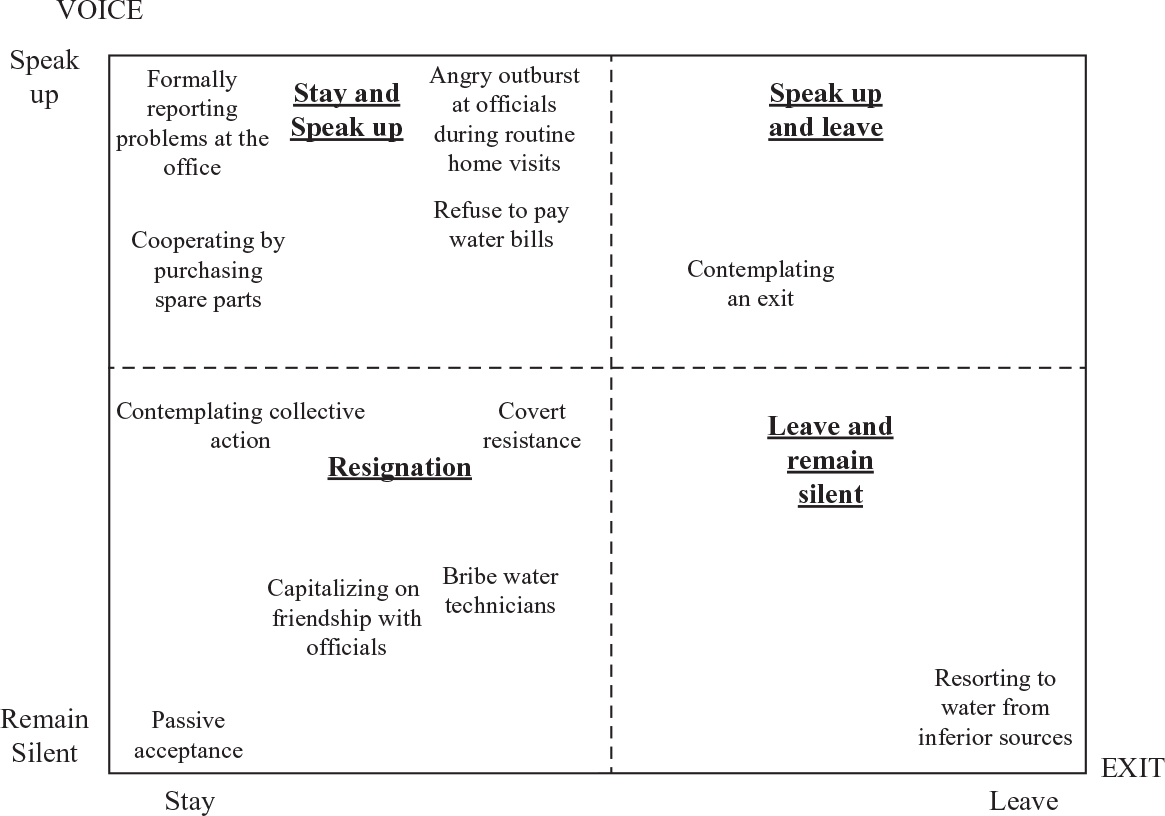
Voice and exit: protest strategies of customers to failing urban water supply
In Figure 2, most strategies pertain to the cells
Official responses to customers’ strategies are predominantly negative, and include threatening to expel customers, secret surveillance, responding to friends and bribers only, carrot-and-stick approaches to extract payment, and looting the network. More supportive responses, such as explaining the process to customers, tend to occur as an afterthought.
Why do protest strategies elicit primarily negative responses? First, Mashujaa’s piped water network is, informally, a “differentiated” service: improvements do not benefit every customer. Paul(34) argued that “when there is scope for product differentiation in a service, externalities enjoyed by the weaker segment of the public (low voice) will tend to disappear and the use of voice by the stronger segment will not improve accountability for all”. The poor do not gain from the “voice” of those who can bribe or pay for repairs unless external assistance can ensure that the poor benefit as well. Second, both citizens and officials know that the service is in a dismal state. There are no informational asymmetries that would make voice a preferred strategy,(35) while chronic underperformance lowers customers’ expectations and increases the negativity and frustration of the water authority.
Despite the dismal state of water supply, no legal and social barriers to voice are evident in Mashujaa. Most customers, whether economically disadvantaged or stable, seem capable of speaking up, which may be considered a form of empowerment. Nevertheless, institutional barriers do exist. The design of the customer complaints register, its management, and the recordkeeping at MUWSA are utterly inadequate. MUWSA officials listen to customers, but conditionally. They value customers’ voice when it serves short-term interests of the water authority or their own self-interest. This form of exclusion mirrors the findings observed in India,(36) where the middle class perpetuates the exclusion of poor people in accessing basic urban services.
Protest strategies of citizens who are better off (and can afford to buy spare parts or pay bribes) or are connected to officials (as friends, relatives or work colleagues) are successful, however, with temporary results. Earlier studies also show that monopolistic and rent-seeking behaviours characterize small and collapsing water providers.(37) However, our findings suggest that citizen protest does not help to improve services significantly. Customers’ individualistic relationships with the water utility weaken the motivation for collective action.(38) The shift in voter preference may suggest that customers took their efforts outside the water utility, demonstrating that they recognized the limitations of protest. These findings are consistent with those of Selormey,(39) who found that voice alone is not sufficient to ensure that service providers will listen and respond by improving service delivery. On the positive side, it is encouraging that customers “stay and speak up”. Citizens are aware of their entitlements and are willing to exercise voice and “speak truth to power”, even if only in personal interactions with officials.
Face-to-face protest strategies in the “stay and speak up” cell suggest that citizens are loyal not to the water provider as an institution but to selected individuals within the organization. These less formal practices, which are “invisible to the eyes of [the urban water authority]”,(40) make the monitoring and achievement of SDGs more difficult. Finally, although Pastore(41) suggests that mobile phone-based ICT platforms may be useful for formally reporting failures in public services in urban areas, we are less optimistic regarding their potential in small towns like Mashujaa, given the dominance of face-to-face interactions between customers and service providers. Mobile phones are more likely to support useful informal rather than formal interactions. This finding is consistent with the work of Chen,(42) who also warned that ICT alone cannot address pervasive systemic constraints.
This study aimed at answering the research question, “which strategies do citizens use to protest the failure of urban water services and how do water providers respond?” The findings largely corroborate those of other studies. Even though these customer protests cannot bring about changes immediately, in the long term, citizens use any opportunity to express their disapproval of the authority in particular and the management in general. In the end, these grievances may contribute to action for leadership change.
Footnotes
Acknowledgements
We would like to thank the anonymous reviewers for their valuable comments and suggestions to improve the quality of the paper. We are also grateful to the editor, Dr. Sheridan Bartlett, for her insightful comments and significant contribution to the sharpening of the paper’s argument.
Funding
We gratefully acknowledge the financial support of the research programme, Sensors, Empowerment and Accountability (SEMA) in Tanzania, funded by the Netherlands Organization for Scientific Research - Science for Global Development (NWO-Wotro).
1.
2.
See reference 1, page 75. As Satterthwaite shows, these figures understate the problem as the definition used to measure who uses drinking water sources on premises does not consider water quality (water that is safe to drink) or “sustainable access” (reliable water supply). Satterthwaite, D (2016), “Missing the Millennium Development Goal targets for water and sanitation in urban areas”, Environment and Urbanization Vol 28, No 1, pages 99–118.
3.
Smiley, S L (2016), “Water Availability and Reliability in Dar es Salaam, Tanzania”, The Journal of Development Studies Vol 52, No 9, pages 1320–1334, page 1320.
4.
It should be noted that aggregate statistics also hide the condition of the most marginalized and low-income communities. See Cheng, D (2013), “(In)visible urban water networks: the politics of non-payment in Manila’s low-income communities”, Environment and Urbanization Vol 25, No 1, pages 249–260.
5.
Nganyanyuka, K, J Martinez, A Wesselink, J Lungo and Y Georgiadou (2014), “Accessing Water Services in Dar es Salaam: Are we counting what counts?”, Habitat International Vol 44, pages 358–366.
6.
The proposed version of February 2015 included “and/or regulated by a competent authority”. United Nations (2016), Goal 6: Ensure access to water and sanitation for all, available at http://www.un.org/sustainabledevelopment/water-and-sanitation. Also see  , Methodological note: Proposed indicator framework for monitoring SDG targets on drinking water, sanitation, hygiene and wastewater.
7.
Low- and middle-income nations lack adequate data gathering systems to monitor provision for water. When policy mandates target underserviced areas, locational information on “who has inadequate provision and where they live” is more relevant than current aggregated indicators at national or city level. See Satterthwaite, D (2016), “Missing the Millennium Development Goal targets for water and sanitation in urban areas”, Environment and Urbanization Vol 28, No 1, pages 99–118, page 115.
8.
Furlong, K (2010), “Neoliberal Water Management: Trends, Limitations, Reformulations”, Environment and Society: Advances in Research Vol 1, No 1, pages 46–75; also Marson, M and I Savin (2015), “Ensuring Sustainable Access to Drinking Water in Sub Saharan Africa: Conflict Between Financial and Social Objectives”, World Development Vol 76, pages 26–39.
9.
Gwebu, T D (2002), “Urban water scarcity management: civic vs. state response in Bulawayo”, Habitat International Vol 26, No 3, pages 417–431; also Aubriot, J (2014), “Conflicts over water in South Africa: Inequalities, social mobilizations and the use of law”, Actes De La Recherche En Sciences Sociales Vol 203, pages 136–146.
10.
Kombe, W J (2005), “Land use dynamics in peri-urban areas and their implications on the urban growth and form: the case of Dar es Salaam, Tanzania”, Habitat International Vol 29, pages 113–135; also Kombe, W J (2000), “Regularizing housing land development during the transition to market-led supply in Tanzania”, Habitat International Vol 24, pages 167–184.
11.
Hydén, G (1980), Beyond Ujamaa in Tanzania: underdevelopment and an uncaptured peasantry, London, University of California Press, Berkeley; also Hydén, G (1999), “Top-down democratization in Tanzania”, Journal of Democracy Vol 10, No 4; and Kjellén, M (2006), From Public Pipes to Private Hands: Water Access and Distribution in Dar Es Salaam, Tanzania, Illustrated edition, Department of Human Geography, Stockholm University.
12.
Hooper, M and L Ortolano (2012), “Motivations for slum dweller social movement participation in urban Africa: a study of mobilization in Kurasini, Dar es Salaam”, Environment and Urbanization Vol 24, No 1, pages 99–114.
13.
14.
World Bank (2016), World Development Report 2016: Digital Dividends, World Bank, Washington, DC. The UN sees ICTs as “essential to achieve the 17 Sustainable Development Goals”. See United Nations (2015), ICTs for a Sustainable World, available at .
15.
Welle, K, J Williams and J Pearce (2016), “ICTs Help Citizens Voice Concerns over Water – Or Do They?”, IDS Bulletin, Vol 47, No 1, pages 41–51; also Fung, A (2011), “Why technology hasn’t revolutionized politics”, 3 March, Stanford Center on Democracy, Development, and the Rule of Law, available at .
16.
Toyama, K (2016), “Global computing: Internet and inequality”, Communications of the ACM April 2016 Vol 59, No 4, pages 28–30, page 30.
17.
Hirschman, A O (1970), Exit, voice, and loyalty: responses to decline in firms, organizations, and states, Harvard University Press, Cambridge, MA.
18.
Our experiences in the case study, and in the country in general, call for anonymization of our data sources, particularly government staff, to protect them from inconveniences resulting from the information we have shared in this paper.
19.
Venugopal, V and S Yilmaz (2010), “Decentralization in Tanzania: An assessment of local government discretion and accountability”, Public Administration and Development Vol 30, No 3, pages 215–231.
21.
22.
MUWSA discourages its customers from selling water to their neighbours by charging them a higher water tariff compared to a normal domestic water connection. While we did not observe MUWSA customers selling water to neighbours or MUWSA officials charging fines, both MUWSA officials and water customers reported such practices.
23.
See reference 17.
24.
Young, D R (1974), “Exit and voice in the organization of public services”, Social Science Information Vol 13, No 3, pages 49–65.
25.
Paul, S (1991), “Accountability in public services: exit, voice and capture”, WPS 614, World Bank, Washington, DC; also Paul, S (1992), “Accountability in public services: Exit, voice and control”, World Development Vol 20, No 7, pages 1047–1060.
26.
See reference 17 (as cited in Barry, B (1974), “Review Article: ‘Exit, Voice, and Loyalty’”, British Journal of Political Science Vol 4, pages 79–107).
27.
See reference 17 (as cited in Keeley, M and J W Graham (1991), “Exit, voice, and ethics”, Journal of Business Ethics Vol 10, No 5, pages 349–355).
28.
29.
Scott, J C (1985), Weapons of the Weak: Everyday Forms of Peasant Resistance, Yale University Press, New Haven.
30.
Budds, J and G McGranahan (2003), “Are the debates on water privatization missing the point? Experiences from Africa, Asia and Latin America”, Environment and Urbanization Vol 15, No 2, pages 87–114.
31.
See reference 13.
32.
Peal, A (2014), “Reducing vandalism of water and sanitation infrastructure: Experience from Zambia’s Copperbelt”, Topic Brief 13, Water & Sanitation for the Urban Poor, available at .
36.
Chaplin, S E (1999), “Cities, sewers and poverty: India’s politics of sanitation”, Environment and Urbanization Vol 11, No 1, pages 145–158; also Chaplin, S E (2011), “Indian cities, sanitation and the state: the politics of the failure to provide”, Environment and Urbanization Vol 23, No 1, pages 57–70.
37.
Lovei, L and D Whittington (1993), “Rent-extracting behavior by multiple agents in the provision of municipal water supply: A study of Jakarta, Indonesia”, Water Resources Research Vol 29, No 7, pages 1965–1974.
38.
Booth, D (2012), Development as a collective action problem: Addressing the real challenges of African governance, Synthesis report of the Africa Power and Politics Programme, Overseas Development Institute, London.
39.
Selormey, E E (2012), “Rethinking citizen voice: The case of radio call-ins in Accra, Ghana”, Africa Power and Politics Programme (APPP) Working Paper 26, Overseas Development Institute, London.
40.
Allen et al. argues that failure of the “private and public sectors” to recognize and support informal water and sanitation provision makes the needs and practices of the poor invisible to policymakers, consequently restricting efforts to improve access among the poor. Allen, A, J D Dávila and P Hofmann (2006), “The peri-urban water poor: citizens or consumers?”, Environment and Urbanization Vol 18, No 2, pages 333–351.
41.
Pastore, M C (2015), “Reworking the relation between sanitation and the city in Dar es Salaam, Tanzania”, Environment and Urbanization Vol 27, No 2, pages 473–488.
42.
Chen, M A (2016), “Technology, informal workers and cities: insights from Ahmedabad (India), Durban (South Africa) and Lima (Peru)”, Environment and Urbanization Vol 28, No 2, pages 405–422.