




Abstract
This paper examines area-based approaches (ABAs) in urban post-disaster contexts. After introducing the main features of ABAs, the paper discusses current practice in humanitarian response, and the need within urban areas to draw lessons from urban development approaches, from which ABAs have emerged. The paper then presents lessons from research concerning the application of ABAs in relation to phases of the project management cycle: assessment and design, implementation, and monitoring, evaluation and learning. The paper ends with a brief discussion. Overall, it argues that for ABAs to be effective, they need to draw on longstanding lessons from urban development, plan for a longer timeframe for their actions than is otherwise often the case in recovery operations, and consider the need to scale up actions for wider city application.

I. Introduction
Area-based approaches (ABAs) have gained traction in recent years among humanitarian aid agencies seeking to provide better responses in urban areas following a disaster. This is in response to existing approaches that have struggled with urban complexity, including (but not limited to) complex governance systems, a multiplicity of stakeholders, density, infrastructure, variations between wealth and poverty, and the presence of markets.(1)
ABAs have been most recently defined as being geographically based in a specific area, engaged in participatory project management methods, and multi-sectoral in nature.(2) An additional aspect argued for in this paper is the need to scale up, i.e. the replication of an ABAs in other geographical areas, and also the adoption of ABAs in city management policy. A key, defining factor of an ABA is that it “focus(es) on communities in defined spatial contexts”(3); or, as one key informant (KI) put it for this study, an ABA means “looking at reality; the way people live, how we look at the past, where we want to get to in this community” (KI1). In reflecting on the multi-sectoral aspect of ABAs, another KI said they were about “getting to integrated programming as quickly as possible” (KI2). Alcock writes that an attraction of the approach is that it aims to address the “problem of the ‘silo mentality’ … [because] the lives of citizens are not broken down into these separate silos, nor therefore should the public agencies serving them be”.(4)
ABAs, it is argued, improve clarity and understanding of programming effectiveness.(5) ABAs have been used in some recent disaster recovery operations to good effect. Following efforts to enact post-disaster housing following Typhoon Haiyan, which struck the Philippines in 2013, Stodart records that a benefit of a settlements perspective is that it “involves the consideration of other aspects of community life beyond shelter and how these aspects all fit together physically and functionally”.(6) Following the 2010 Haitian earthquake, which caused widespread devastation to Port-au-Prince as well as other locations, UN-Habitat advocated that urban recovery take a place-based approach, in that wherever possible, communities should rebuild in the locations they were originally based in if it is safe to do so.(7)
A number of organizations have backed ABAs as a good approach. For example, the Inter-Agency Standing Committee’s (IASC’s) Reference Group on Meeting Humanitarian Challenges in Urban Areas(8) advocates adopting ABAs, arguing, “Higher impacts are possible if activities are designed and coordinated through geographical/spatial, community-city-based and inter-sectoral approaches, which better link where people live and work, markets, basic services and availability of social safety nets”. And the submission of the Global Alliance for Urban Crises (GAUC)(9) to the HABITAT III conference in October 2016 advocated the need to “Adopt area-based approaches to programming and coordination” in relation to recognizing “the nature, scale and complexity of urban crisis”.(10)
A particular attraction of ABAs is that they emerge from an urban background, in contrast to the largely rurally derived approaches currently in use.(11) Urban planners working on renewal have used “area-based initiatives” as an approach to enacting improvements in poorer areas since the 1960s and 1970s, in urban programmes and community development projects.(12) ABAs in development programmes have been known broadly by a number of different names, including integrated development programmes, slum upgrading, sites and services projects,(13) neighbourhood and settlement approaches, and multi-sector planning.(14) The United States Agency for International Development’s (USAID’s) Office of US Foreign Disaster Assistance(15) in particular has promoted the idea of shelter and settlements, arguing that it is necessary to consider the wider spatial needs of “settlement-based assistance” and a “neighbourhood approach” that aim to engage with communities in a holistic manner, rather than being driven by one sectoral priority, such as shelter.
Discussions on “space” and “place-making” in relation to urban crises also find traction with ABAs. For example, the Project for Public Space’s “eight reasons place should matter to humanitarians”(16) emphasize that place relates to (community) identity, which can be at risk of being ignored in post-disaster recovery,(17) and that focusing on places can force a multi-sectoral response: “There are few successful public spaces that are programmed for just one activity”. Focusing on place therefore presents a challenge to traditional humanitarian approaches, which can at times focus on individuals without considering their locations. As the IASC warns, “typically humanitarian partners target aid based on individual beneficiaries, with little understanding of the structure and dynamics of the affected community within a given territory and of the implications of aid delivery on such dynamics”.(18)
a. The current system and learning from urban development approaches
Broadly speaking, the current humanitarian aid system is based on the goods and services that are delivered by aid agencies for communities, embodied in particular through the cluster approach, initiated in 2006 through the Humanitarian Reform Agenda.(19) The cluster approach was developed to improve coordination between implementing agencies, and to date has been largely successful.(20) However, while it is an improvement on what happened before, the deficiencies of the cluster approach are well documented. These include weak coordination between operational actors, as well as insufficient engagement with local structures, and with local and national government.(21) These challenges are compounded in towns and cities. As the International Rescue Committee (IRC) concludes in a 2015 position paper, “The traditional cluster system does not lend itself to the complexity of needs, services and systems across an urban landscape with humanitarian agencies struggling to deal with the complexity, density and built environment of towns and cities or [un]able to take full advantage of the potential a city has to offer”.(22)
In enacting urban responses that truly engage with neighbourhoods and achieve good outcomes, there is much to learn from the development literature, which over a number of decades has made the case for people-centred approaches that are holistic and that use the language of empowerment, enablement and participation (for example in the work of Chambers(23), Hamdi(24) and Moser(25), who are referred to later in this paper). There is evidence of ABAs drawing on this approach. For example, according to the IRC, an ABA “ensures support is surged to local municipalities, local partners and civil society, complementing existing governance systems and accommodating the multi-sector and multi-stakeholder approach cities and towns require”.(26) This of course is not to say that the history of participation has been uniformly positive: critiques of participation, including the additional demands placed on poorer people who may already be time poor, are well known.(27) However, as this paper goes on to discuss, the risks associated with failing to meaningfully engage people front and centre in decisions that affect them far outweigh any arguments against genuine inclusion.
Effective approaches also take time, which is something humanitarian action struggles with, principally perhaps driven by the belief that response needs to be fast. Aid organizations, donors, and sometimes national governments may also tend to impose tight timeframes. As United Cities and Local Governments (UCLG) notes, “The current humanitarian architecture is built around sector-specific planning and short-term funding and program cycles. This is not appropriate in the highly complex and dynamic environments witnessed in urban crises, where humanitarian best practices point instead to holistic, longer term action and higher levels of engagement with sub-national actors”.(28)
While quick action is of course necessary in immediate relief actions such as search and rescue and emergency medicine, and for meeting basic needs such as warmth, food, water and life-saving health care, recovery actions post-emergency need to take on a different pace. A study by Anderson et al. of the experiences of some 6,000 people with humanitarian relief and recovery operations in a number of disasters found that what people needed was less speed, and more consideration. The study found that “many feel that ‘too much’ is given ‘too fast’ ”; it also found that “very few people call for more aid: virtually everyone says they want ‘smarter aid’ ”.(29) More recently, a study by the Inter-Agency Common Feedback Project three months after the (first of the) two Nepal earthquakes of 2015, looking at how well agencies were engaging with communities, found that ‘‘almost half of respondents feel they are not heard at all”. And “When women were asked if their particular problems are being addressed, nearly three quarters (73%) said ‘very little’ or ‘not at all’ ”.(30)
Approaches that “rush” recovery actions do little therefore to foster community-level ownership, which is something that ABAs need to inculcate if they are to be successful. The lessons from this are made clear in the development literature, summed up by Robert Chambers’ provocative question, “Whose reality counts?” In other words, is it the reality of the aid provider that matters to deliver items fast, or of local people themselves, and the timeframes they need?(31) Chambers unsurprisingly argues that what matters is the latter, if meaningful and lasting interventions are to occur.
b. The need to scale up
ABAs also need to be able to scale up, to be replicated in other neighbourhoods, and also, if successful, to be adopted in wider city policy, and perhaps beyond. This is for a variety of reasons. First, after a disaster the need is great, and currently humanitarian aid often reaches only a small number of affected people. Second, a critique of ABAs points to its uneven approach, wherein one area receives assistance, while the one next to it does not. One KI interviewed in research for this paper called this “the area problem”, where, for example, “the issue may be a rich agency in one area, and a poorer one leading another” (KI3). Addressing this, the World Bank’s review of ABAs following the 2010 Haiti earthquake concludes, “Concentration of assistance in discrete areas reduces equity, coverage, and sustainability. In contrast, area-based interventions led by local authorities or communities can have wide-ranging benefits, and should be encouraged.”(32) ABAs need therefore to consider at the design stage how scale-up will be achieved, for example though finding co-funding with local sources,(33) planning actions to address spontaneous scaling-up,(34) and ensuring as much local ownership as possible.
In summary, ABAs are a manifestation of the gradual evolution of humanitarian aid responses towards adopting, and adapting, developmental approaches.(35) They involve a shift away from narrow, sectorally driven delivery towards a multi-sectoral approach based on strong inter-sectoral collaboration. ABAs represent a focus on people in geographically defined areas, which means linking with and working through local governance structures. And, as this paper argues, ABAs need to be able to scale up if they hope to make a significant impact in a wider city setting. These points are illustrated in Figure 1, where people and local governance take centre stage.
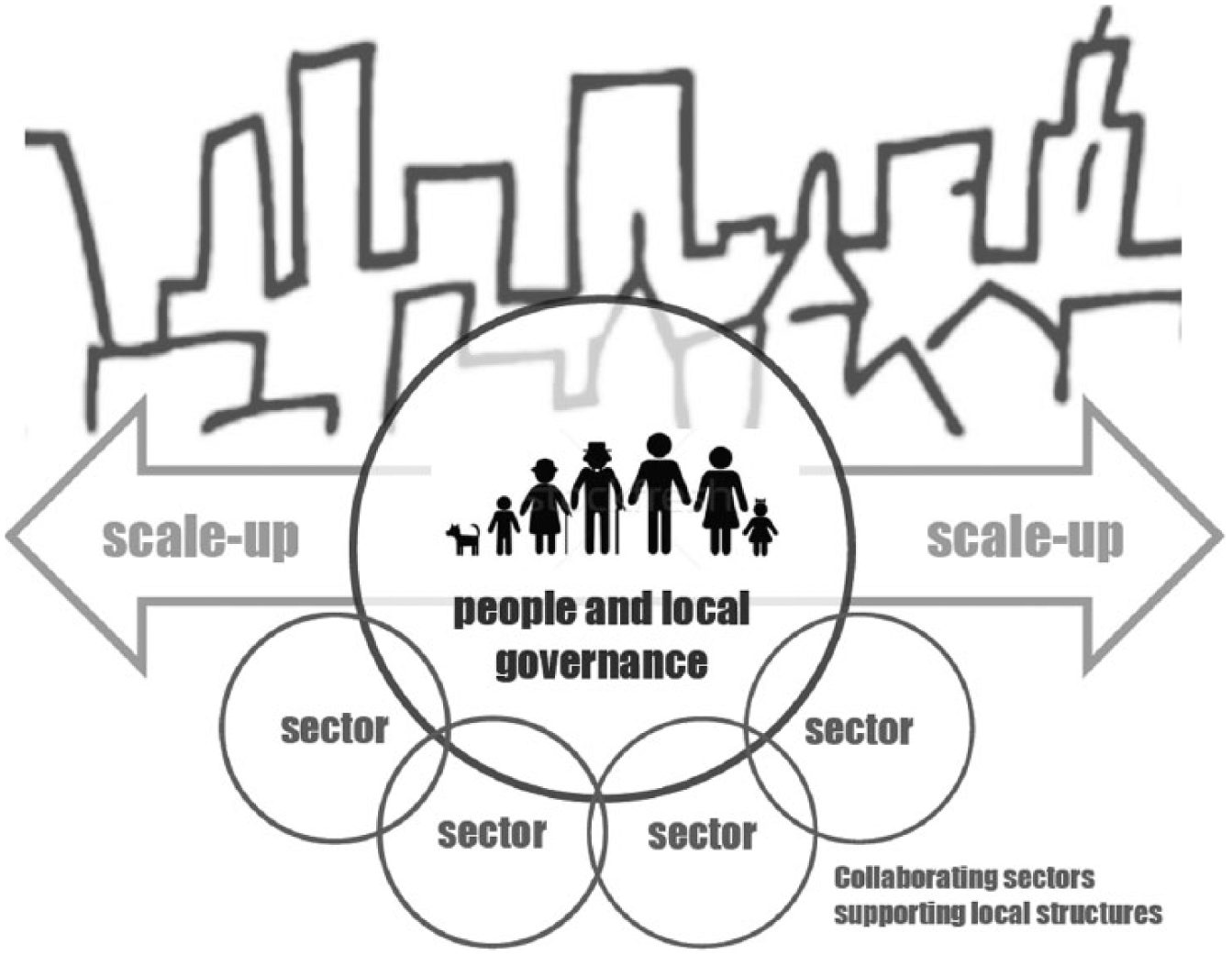
An urban ABA approach
II. Research Approach
For the research that led to this paper, three methods were used to gather data: a review of the literature, interviews with key informants, and a focus group discussion. The literature review comprised peer-reviewed journal articles, publications and “grey literature”, such as the post-disaster evaluations and reports produced by operational aid agencies. A keyword search was undertaken, using such terms as area-based approaches, area-based initiatives, integrated development, slum upgrading, integrated slum upgrading, neighbourhood or community approach, sites and services, settlements approach, multi-sectoral programming, humanitarian, urban and crises. Literature was primarily sought on development and humanitarian thinking relating to low- and middle-income countries; however, literature was also reviewed from other sources, including for instance that from the UK relating to social deprivation and the use of ABAs. Findings were reviewed, and key points, challenges and lessons were identified around implementing ABAs in urban humanitarian crises (conflict, displacement, fragility and natural hazard-related shocks).
While there are a number of documents in the humanitarian literature describing ABAs, and a growing number of publications relating to urban programming (especially since the 2010 Haiti earthquake), the authors found very little information in the academic literature or in agency grey literature on the programming practicalities of implementing ABAs. Parker and Maynard’s 2015 review of ABAs(36) came to the same conclusion, which appears to be backed up to some degree in the non-humanitarian literature related to urban programming. For example, a 2013 paper on ABAs in urban regeneration in the UK and Denmark concludes, “despite the focus on process development and innovation in governance of municipal urban regeneration, evidence of innovative regeneration outcomes, of benefits to residents in disadvantaged neighbourhoods, still remains elusive”.(37)
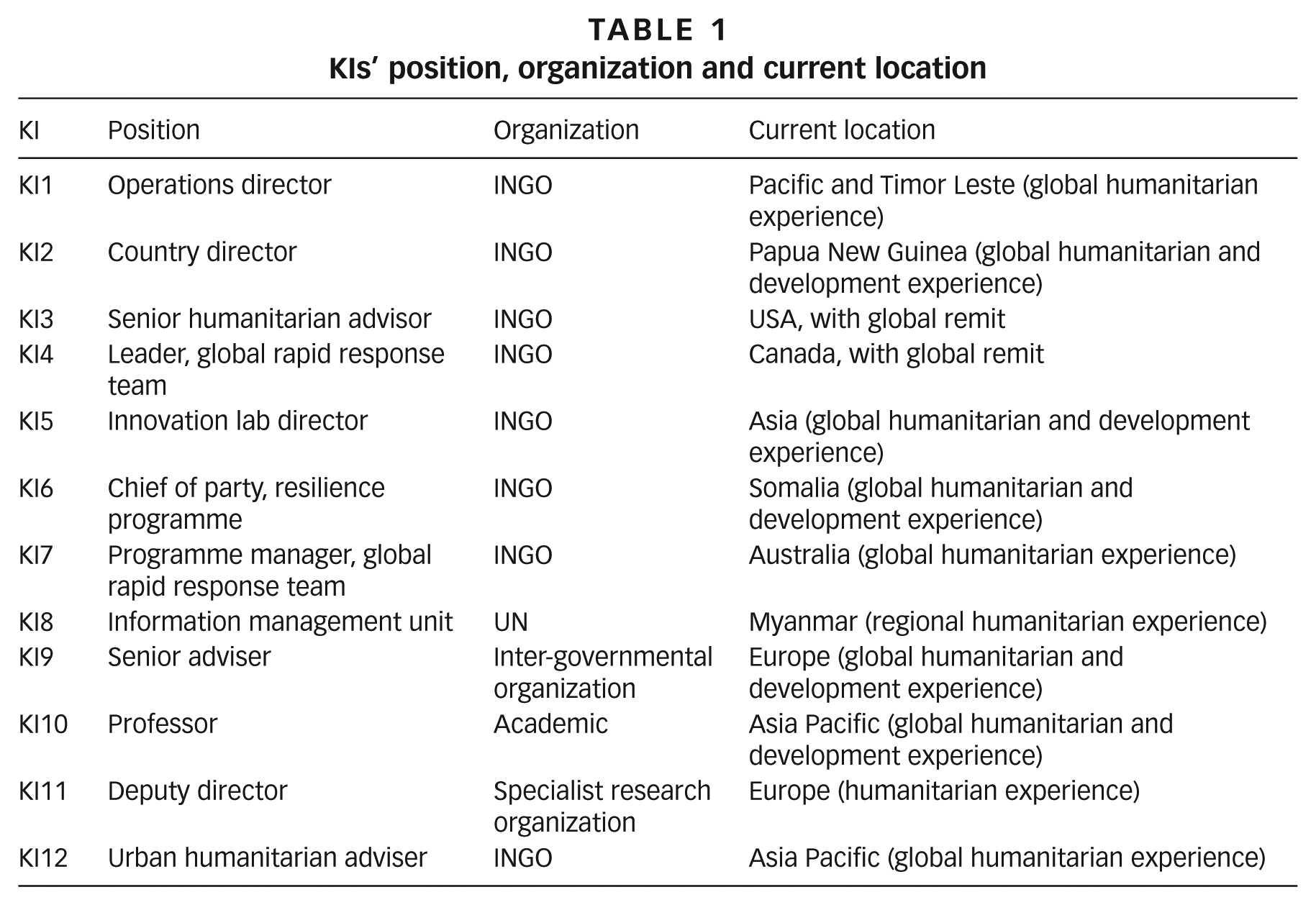
To supplement the limited literature in this area, and to ensure that findings were closely tied to practice, 12 key informant (KI) interviews were conducted. KIs primarily comprised experienced senior aid personnel, selected for their experience (5–30 years) in managing complex relief and recovery programmes. Others were identified based on their specialist work in urban disaster settings. Each KI from an operational background had worked in a number of contexts. KIs were drawn from international NGOs (INGOs), a specialist research organization, a university, the United Nations and an inter-governmental organization. The interview questions related to the practical challenges and opportunities associated with the implementation of urban recovery programmes, including the challenges of using programme tools and the operational challenges, both within and between organizations. Questions related to stages of the project management cycle (assessment and design; implementation; and monitoring, evaluation and learning). A subsequent focus group discussion was held with seven practitioners experienced in implementing ABAs. This discussion, held on Skype, included research and programme personnel from Kenya, Iraq, Philippines, Zimbabwe and Switzerland. Initial drafts of the findings of this paper were shared with a smaller group of key informants for their critical feedback and comment.
Table 1 summarizes the KIs interviewed and identifies quotes and views used within this paper.
KIs’ position, organization and current location
III. Implementing Abas within The Project Management Cycle
This section organizes findings from the KI interviews and literature according to the broad stages of the project management cycle commonly used in humanitarian (and development) programme delivery: assessment and design; implementation; and monitoring, evaluation and learning.
a. Assessment and design
Assessment here refers to post-disaster assessments used to gather information to design relief/recovery programmes, undertaken either jointly by agencies, such as the Multi Cluster/Sector Initial Rapid Assessment (MIRA)(38) and Post-Disaster Needs Assessments (PDNAs), as well as assessments undertaken by agencies. Design refers to the process of putting together a project or programme, and the tools used, such as building logical frameworks (logframes).
Multi-sectoral needs assessments
It is widely acknowledged that assessment approaches undertaken by humanitarian agencies in urban areas need to be improved. A study by Mohiddin and Smith of a number of needs assessments approaches in urban settings notes that “disasters in urban contexts are challenging (current) needs assessment approaches for a number of reasons including but not limited to: population heterogeneity, cultural and linguistic diversity, density and dynamism, physical and geographical scale of urban environments, range of stakeholders and political interest”.(39)
For this research, several KIs (1, 3, 4, 6) observed that ABAs underscore the need to undertake a multi-sectoral needs assessment, because, as one KI put it, “what’s happening on the ground is not a sector conversation” (KI4). Another KI emphasized the need to do an “overall [assessment] of the whole area, not just your sector” (KI2). Skills identified included multidisciplinary people and good listeners; one KI noted that ABAs “make you see the bigger picture, and step out of a particular box” (KI7).
Patel et al.’s systematic review of urban targeting approaches recommends taking a multi-sectoral approach:
“Sector-based vulnerability analyses and targeting approaches are ill suited to complex urban crises, where needs are interrelated. A population’s needs for shelter, WASH [water, sanitation and hygiene], health, food security and livelihoods do not exist in isolation from one another. Rather, needs interact to shape vulnerability, and must thus be met with a multi-sectoral approach to guide targeting.”(40)
Good post-disaster assessments make a series of trade-offs, which include the ease with which tools can be used by assessors, time taken for assessments, access to people, collection of data and its subsequent analysis. The Sphere Project’s guide to urban programming indicates that ABAs can assist in assessments.(41) Yet too often the risk in assessments is a reductionist approach to complex lives that can be overly simplistic.(42) Urban assessments need to be cognizant of the complex reality of day-to-day life. Recognizing the urban aspects of city living, ACAPS’ “Rapid Humanitarian Assessments in Urban Settings” technical brief, for example, uses an urban language that includes density, diversity, fluidity, mobility, complexity and industry as key characteristics of urban space.(43)
Participatory assessments
Patel et al.’s systematic review found that community engagement works: “Evidence reveals some success in identifying the most vulnerable through community-based targeting, which leverages local knowledge and contextual understanding.” This is “critical to urban response”.(44) Assessments based on developmental approaches can also be adapted for use in urban ABAs. A key assessment approach, developed by Chambers, and widely used in both urban and rural settings, is Participatory Rapid Appraisal (PRA) and its varying offshoots, such as Participatory Learning and Action (PLA).(45) PRA’s central aim in information gathering is to “put people before things, and poor people and their priorities first of all”.(46) Concerning post-disaster assessments, “poor people” might be replaced with “the most vulnerable” (while acknowledging the difference between poverty and vulnerability).
PRA and similar participatory approaches are often thought to be inappropriate in humanitarian action on the basis that they take too long. However, they can find traction in designing relief to recovery efforts – for example, following damage caused by Typhoon Haiyan, the NGO ActionAid undertook PRA exercises to enable communities to self-identify their needs to NGOs, to allow them to remain in the “driver’s seat” on what they thought was most required.(47) The case for better people-oriented assessment approaches in disaster response is made in the 2016 International Federation of Red Cross and Red Crescent Societies (IFRC) World Disasters Report,(48) which argues in the chapter on “measurement and evidence” that a top-down, technocratic “quest for quantification” makes it harder to hear the true needs of people, which takes time and involves using techniques and tools such as those listed above.(49)
Design
Several KIs (1, 2, 4, 6, 7) identified a tension between hiring skilled sectoral personnel versus multidisciplinary staff. As one KI said concerning a child-focused programme, “it’s a mindset issue; what if you hire WASH people who are not trained in talking to children?” (KI2). Another KI mentioned the urgent need to “think horizontal, i.e. across sectors, to go with the vertical, i.e. within sectors” (KI2).
Several KIs (1, 2, 4) discussed the complexity of ABAs in relation to the relative simplicity of single-sector programming. One KI lamented, “because [an ABA] is complicated it gets attacked … the humanitarian aid system likes simplicity … urban life however is not [simple]!” (KI1). Another KI stated, “If there was a simpler approach then we’d be doing it!” (KI6). This is an important point, in situations where humanitarian action needs to embrace the complexity of programming that complex environments deserve. One KI (7) described a failed urban ABA following the 2013 Typhoon Haiyan in the Philippines: an INGO had designed an ABA programme working with local government to develop parcels of land for building medium-density housing with retail space, linked with livelihoods programming and WASH, and making use of a revolving fund. When there was a change in management, however, the programme was cancelled because, according to the KI, the programme was considered “too complicated” and the new leadership was insufficiently invested in the programme. As a result, recovery operations followed a traditional single-sector, input-driven approach.
Engaging the organization’s human resources and finance in the design process
Several KIs (1, 3, 10) emphasized that engaging human resources and financial personnel in the design of a programme leads to a smoother functioning of support services in the programme’s subsequent implementation, allowing for the development of better metrics for performance and for budget lines that provide sufficient flexibility within the life of a programme. The impetus here is the “need to ensure the finance manager is not a bookkeeper, but rather understands what the [programme’s] intent is” (KI3). A significant challenge, also noted by a number of KIs, concerns the need within INGOs for flexibility in programming and accountable finance systems. As one KI (1) noted, “finance puts barriers around complexity, to simplify servicing the system”. The resulting risk for an ABA is that servicing the finance function (in terms of accountability to the donor on expenditure) can unwittingly shape the programme. A similar note relates to human resources, whereby job performance indicators, for example, may relate to the outputs of a particular sector, but not to the wider activities that an ABA might demand.
Flexibility in organizational systems
Human resource functions need to be flexible. Job descriptions may need to be written to be highly adaptable to changing circumstances, because, as one KI (3) noted, “people put their energy into what they’re measured on”. In an ABA, skills that were relevant for the logistical delivery of relief items may not be relevant (and in fact may be an obstacle) to longer-term engagement and facilitation. An example of this is provided in the relief to recovery operations of one INGO following the 2005 Pakistan earthquake. The team assigned to deliver relief materials in the immediate relief phase later had to deliver more complex recovery activities, but without adequate support in technical skills. This led to a programme that relied on the monitoring of inputs rather than the measuring of community or individual benefits resulting from the interventions.(50)
A seemingly obvious but no less important point, raised by a number of KIs (1–7), relates to having qualified managers in place. This was labelled “a major challenge” by one KI (1). Given that urban ABAs represent a substantial shift away from “business as usual”, for example the delivery of goods and services to rural areas, this is a critical point. One KI (6) named this the “Achilles’ heel”, stating, “we over-design and we under-invest in complex management at operational level”. For urban programing, therefore, staff management profiles might resemble more of a combination of social entrepreneur, negotiator and networker rather than of an engineer, say, or a house builder or logistician. Such open-ended and flexible jobs therefore need to translate into job descriptions for more successful ABA implementation.
An example may lie in the development of “adaptive management”, described as “a programming approach that combines appropriate analysis, structured flexibility, and iterative improvements in the face of contextual and causal complexity”.(51) In a pilot of six case studies(52) undertaken by IRC and Mercy Corps across six locations in Africa and Asia, the key components of adaptive management were: dynamic and collaborative teams; agile and integrated operations; appropriate data and reflective analysis; trusting and flexible partnerships; and responsive decision-making and action.(53)
The use of logframes
The logframe analysis tool (and its variations across agencies and donors) remains the “industry standard” for aid programme design and management. When used correctly, logframes provide a clear project focus (the purpose), a clarity of accountability (the indicators), and a testing of potential project risks (the assumptions). Logframes however are all too often misused (or their intention misunderstood), which can lead to reduced effectiveness and efficiency in implementation. According to several KIs (1–3, 10) three common issues in the misuse of logframes that can hinder an ABA are:
Logframes with a single sectorally focused purpose, which force implementers at project level to focus exclusively on achieving that purpose. A single-sector purpose results in a singular metric of success, which by definition forces single-sector approaches throughout a project, from inception to implementation and monitoring and final evaluation.
Indicators that measure inputs, not outputs – for example, “3,000 houses built” – which, if not accompanied by other output indicators that measure quality (for example, “degree of satisfaction of users”), lead to programmes with little incentive to monitor project benefits (this is discussed below).
Inflexible logframe usage, whereby implementing agencies cannot make adjustments to changing circumstances once a project is underway (noting the quick-changing nature of urban programming). This issue touches on a wider use of logframes as part of a contract between donor and implementer, leading to a risk of programming becoming inflexible.
While many remain critical of logframes, this paper argues that they are not incompatible with ABAs. As with probably all tools, the issue is using the tool correctly to achieve the desired outcome. A key issue, for example, would be to craft a purpose to align with the components of an ABA. For instance, the purpose could be to increase implementers’ joint actions and engagement.
b. Implementation
One KI (10) noted that ABAs are about “embracing complexity” within neighbourhood dynamics. In programming terms, this suggests a less tight control over day-to-day actions, with greater autonomy of action in the hands of others. Such an approach resonates with developmental approaches advocated earlier(54) – such as working with partial information or, as Chambers calls it, optimal ignorance. Or, as one KI (12) noted, “a partial understanding is as good as it gets”.(55)
Partial understanding of the issues forms one of the key tenets of action planning, an approach from development for working in urban low-income urban settings.(56) Action planning originated as an approach to implementing neighbourhood improvement initiatives that embrace the complexity of urban life. Hamdi and Goethert’s 10 characteristics of action planning provide valuable guidelines for enacting ABAs, and are summarized in Box 1.
Characteristics of action planning
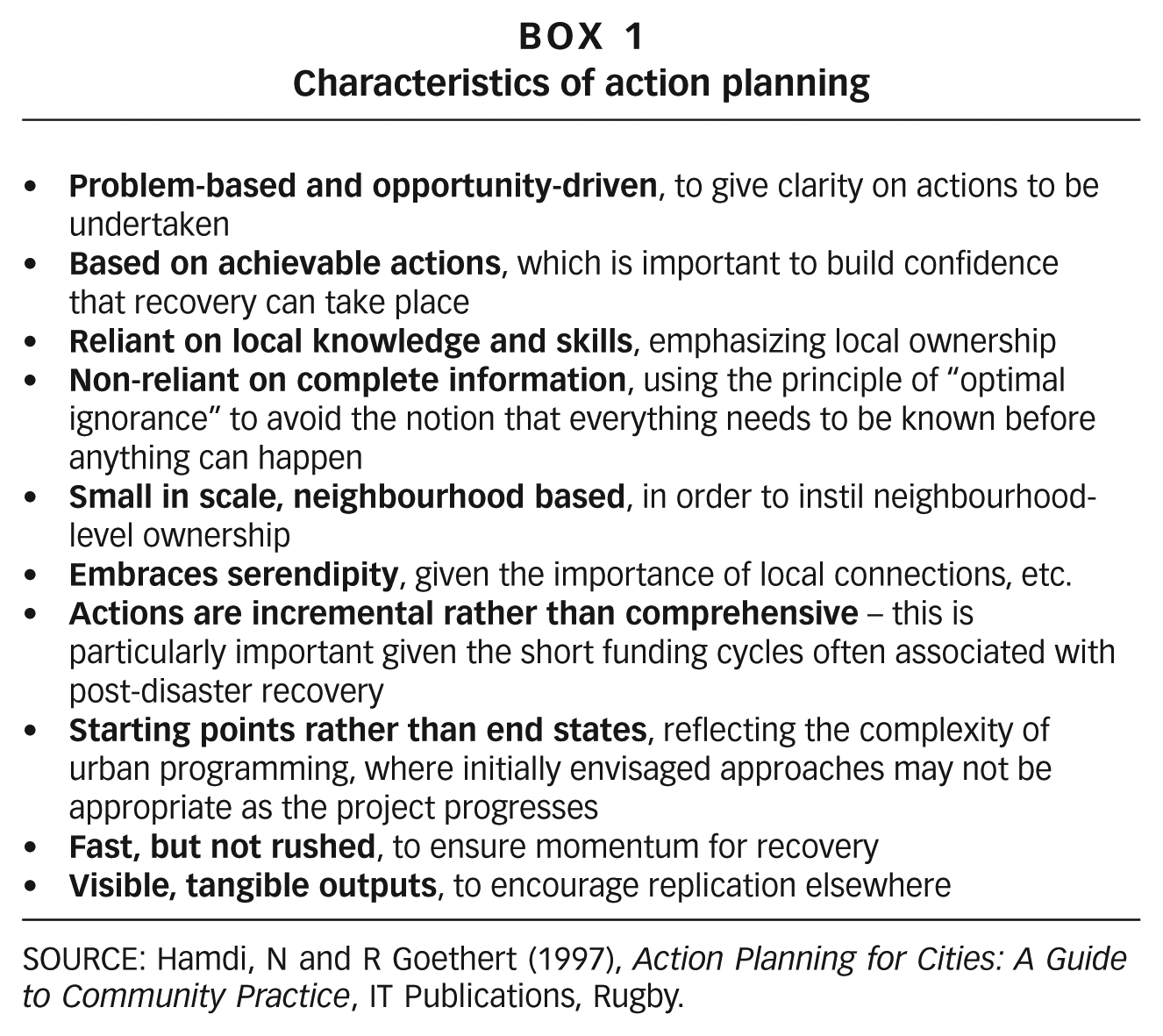
SOURCE: Hamdi, N and R Goethert (1997), Action Planning for Cities: A Guide to Community Practice, IT Publications, Rugby.
An important element of action planning concerns the role of the “outsiders” (such as project staff in an aid agency), who “have a strategic role to play as convenors, disseminators, catalysts, facilitators and policy formulators … creating opportunities for discovery and a context for work which can be understood by all”.(57) This understanding resonates in the findings from this research; one KI (5) noted the importance of strategic approaches to engagement beyond implementation, i.e. a need to “move back from the operational”, and more towards facilitation. Another KI (3) observed that the art of good implementation is to “operationalize and not over-engineer”. A similar conclusion is drawn in the Sphere Project’s urban guide: “Depending on the capacity of the local authorities, the humanitarians’ role may be more about facilitation and enabling than direct service provision”.(58)
Agencies need to also engage better with city authorities and other governance structures(59) – and not to create unnecessary parallel structures that may undermine existing ones.(60) A number of KIs noted that an important element of ABAs concerned effective collaborations and partnerships. As one KI (12) put it, “it’s not just about you; it’s a partnership”, pointing out that what matters is the eventual outcome of operations, rather than individual project outputs (this is discussed in Section IV). The case was made for regular coordination meetings between sectors, and a constant, concerted effort to ensure that programme personnel did not just spend time in their own sectors.
A critical point made by several KIs concerned the need to be better connected within their own organization. A number cited as a barrier to this an overly strong focus on the outputs of a particular project by individual project teams, instead of clarity on the overall vision of the organization, which risked being lost in the day-to-day achievement of any particular funded project. One KI (2) noted that the need was to “look to the higher purpose, and reinforce that constantly. The grant doesn’t define who we are; it’s the overall mission, vision, purpose.” Informants pointed to a need therefore to “turn around” organizations whose operations are based on implementing grants alone. For many KIs, this issue inevitably called for stronger leadership, and to “reinforce the messaging of who we are as a whole”.
c. Monitoring, evaluation and learning
Monitoring indicators (such as those found in logframes) need to be better attuned to the ambitions of ABAs; one KI (3) stated that monitoring and evaluation needs to measure what is “user-centred and problem-based … and move away from [counting] buckets”. Given the multi-sectoral nature of ABAs, indicators that are suited to monitoring more than one sector are preferable. This point is confirmed by the Sphere Project’s urban guide.(61)
An issue relates to measuring outputs (which, using logframes, are achieved during a project’s contractual period), as opposed to measuring outcomes and eventual impact (which may be some years later), which are rarely, if ever, measured by aid agencies. This is important for ABAs because of the need for local ownership to determine success, which is often borne out over time. If ABAs involve a longer timeframe than that of conventional, current recovery programmes, then there is the opportunity to consider longer-term monitoring. Agencies and donors may therefore need to consider “keeping the books open” on a project longer than is currently usual, looking for its “return on investment” some years down the track, to determine relative levels of success. This is important if the case for ABAs is to be made through the accumulation of evidence over time of what works, and what does not.
Such an approach can have strong implications for learning about what really happens – or as one KI (1) put it, “an ABA puts reputations on the line”. In a study following the 2001 Gujarat earthquake in India, 10 post-disaster housing reconstruction settlements were visited 10 years after the earthquake to determine outcomes. The study found that the reputation of the implementing INGO/private sector consortium was extremely poor, due to the low quality of the completed houses and the perceived failure by many members of “the company” (as the consortium was known) to return to make good on any problems.(62)
As noted earlier, a key ingredient of successful ABAs needs to be their capacity to scale up. There is an opportunity for this to occur in a shift from single-agency measurement of attribution (correlating the activities of one project to community benefits) to multi-agency measurement of contribution (how a project may have helped as part of a wider effort). This determination of a programme’s success is a better fit with the ethos of ABAs. Focusing on contribution helps to shift the emphasis away from individual, isolated projects, and towards addressing overall issues and challenges. The publication Contribution to Change,(63) which provides the steps for implementing this approach, identifies the basic challenge that is thereby addressed: “Existing impact evaluations often focus on outputs achieved or on qualitative assessments of the assistance received by members of affected populations. They tend not to look at the contribution of interventions towards the overall process of recovery.”
Monitoring can go further than measuring sectorally aligned activities and should move towards the assessment of benefits to affected populations. The use of livelihoods-based approaches drawn from urban development can provide pointers in this area. Moser’s work on poverty and vulnerability in urban areas, for instance, used individual and community assets as the basis for measuring improvements relating to interventions. Assets include: belongings (physical assets); cash (financial assets); power (political assets); and networks and engagement (social assets).(64) Moser proposes a simple relationship, wherein “The more assets people have, the less vulnerable they are, and the greater the erosion of people’s assets, the greater their insecurity”.(65) Using assets as the basis for measuring improvements subsequently formed the basis for livelihoods-based approaches that were popular from the mid-1990s onwards.(66)
An asset-based approach provides a highly viable way to monitor and evaluate ABAs. It does not tie monitoring (and eventual evaluation) to a sectoral input, but rather probes the relative state of individual and collective assets. This potentially powerful approach is disconnected from sectoral delivery, and geared more towards the impact for people’s everyday lives. The tools for measuring assets can be be found within the PRA toolkit (discussed in Section IIIa) and include for example the use of spider diagrams as a visual and subjective means of community self-assessment of progress. This has formed the basis for the subsequent development of other monitoring tools, including the ASPIRE tool by Arup.(67)
IV. Discussion
The essential elements of ABAs have been a mainstay within development practice for a number of decades. It has long been recognized that successful improvements rely on people-centred approaches that take time and involve negotiation with local governance structures.(68) Given the complexity of urban disasters, it is no surprise that humanitarian action is now looking to ABAs as a suitable approach. Humanitarian action could also look further into the lessons from urban development – namely that actions need to be driven by local populations (local communities and local governance structures), and that recovery takes time. Currently, the humanitarian aid architecture is not well set up for either of these. A genuine commitment to ABAs will require a rethinking of how agencies engage with local actors and how they determine the time it takes to “get the job done”.
ABAs require good coordination between sectors if they are to succeed. A key issue in this regard is, once again, how success is measured. The shift in emphasis away from the logistically derived system of delivery equalling success, and toward a concern with improvements in the lives of urban dwellers, is fundamental. The tools exist for measuring this (for example using Moser’s asset vulnerability framework as noted earlier), but it requires a shift in thinking and an engagement by sufficiently trained monitoring and evaluation programme personnel, coupled with effective management.
If ABAs are to work, then their management needs to be flexible, iterative and nimble. And if individual projects have any hope of being scaled up, then local ownership must be planned for. For this to happen, the tools humanitarian actors currently use need to be adapted to reflect a recognition of this reality. One example is measuring contribution rather than attribution, as discussed above. New, flexible approaches need to be developed, such as adaptive management, described in Section IIIa.
Is the humanitarian system willing to adopt these changes? The timing is right. The 2016 World Humanitarian Summit acknowledged that humanitarian aid has to “do much more far better”.(69) At the same time, the authoritative 2016 report Time to let go: remaking humanitarian action in the modern era concludes, “the formal system faces a crisis of legitimacy, capacity and means, blocked by significant and enduring flaws that prevent it from being effective”.(70) With regard to urban programming in particular, a wide-reaching review of urban response approaches concludes, “Urban programming is taking place but tools and guidelines are lagging behind”.(71) Serious consideration of how humanitarian response needs to adapt to meet the needs of urban engagement is also appropriate. ABAs may be a step in the right direction.
Footnotes
Acknowledgements
This paper draws on research undertaken by the author with Dr Pamela Sitko, Urban Technical Adviser, Disaster Management at World Vision International. (A guidance note, published by the International Institute for Environment and Development [IIED] and comprising 10 core principles for enacting ABAs in post-disaster contexts, also resulted from this research. This is available at  .) The author is grateful to the key informants for the generous sharing of their experience.
Funding
This paper is funded by the UK Department for International Development (DFID) through the Urban Crises Learning Fund. The fund is part of DFID’s Urban Crises Programme on the urban aspects of humanitarian action, which involves IIED and the International Rescue Committee (IRC).
1.
Mohiddin, L and G Smith (2016), “A Review of Needs Assessment Tools, Response Analysis Frameworks, and Targeting Guidance for Urban Humanitarian Response”, IIED working paper, London; also Sanderson, D and P Knox-Clarke (2012), Responding to urban disasters: Learning from previous relief and recovery operations, Overseas Development Institute, London.
2.
Parker, E and V Maynard (2015), “Humanitarian response to urban crises: a review of area-based approaches”, IIED working paper, London.
3.
4.
Alcock, P (2004), “Participation or Pathology: Contradictory Tensions in Area-Based Policy”, Social Policy and Society Vol 3, No 2, pages 87–96, page 89.
5.
See reference 3.
6.
Stodart, V (2016), “Regulatory barriers and the provision of shelter in post disaster situations: housing, land and property (HLP) issues in the recovery of Tacloban after 2013 Typhoon Haiyan”, in D Sanderson, J Kayden and J Leis (2016), Urban Disaster Resilience: New Paradigms from International Practice in the Built Environment, Routledge, New York.
7.
Clermont, C, D Sanderson, A Sharma and H Spraos (2011), Urban disasters – lessons from Haiti: Study of member agencies’ responses to the earthquake in Port au Prince, Haiti, Disasters Emergency Committee.
8.
9.
The GAUC is a coalition of “more than 65 organizations– from local authorities, humanitarian, development, and urban actors – to prevent, prepare for and respond to urban crises”. GAUC (2016a), HABITAT III: The New Urban Agenda – Key Messages, Geneva, available at .
10.
GAUC (2016b), URBAN CRISES: Recommendations, presented at HABITAT III, available at .
11.
Sanderson, D, J Kayden and J Leis (2016), Urban Disaster Resilience: New Paradigms from International Practice in the Built Environment, Routledge, New York.
12.
See reference 4; also Muscat, R (2010), Area Based Initiatives – do they deliver?, Centre for Local Economic Strategies, Manchester.
13.
Hamdi, N (1989), Housing without Houses: Participation, Flexibility and Enablement, Van Nostrand Reinhold, New York.
14.
See reference 3; also Mountfield, B (2016), Using the Sphere Standards in urban settings, The Sphere Project, Geneva.
15.
16.
Saliba, S (2017), “Eight Reasons Place Should Matter to Humanitarians”, Project for Public Spaces, 24 January, available at .
17.
Sanderson, D, A Sharma and J Anderson (2012), “NGO permanent housing 10 years after the Gujarat earthquake: revisiting the FICCI-CARE Gujarat rehabilitation programme”, Environment and Urbanization Vol 24, No 1, pages 223–247.
18.
19.
OCHA (2005), Humanitarian Response Review, UN Office for the Coordination of Humanitarian Affairs, available at .
20.
Humphries, V (2013), “Improving Humanitarian Coordination: Common Challenges and Lessons Learned from the Cluster Approach”, Introduction, The Journal of Humanitarian Assistance, available at .
21.
See reference 20.
22.
IRC (2015a), Humanitarian Action in a New Urban World, 3–4 February, World Humanitarian Summit Regional Consultation, Europe and Others, page 4, available at .
23.
Chambers, R (1995), “Poverty and livelihoods: Whose reality counts?”, Environment and Urbanization Vol 7, No 1, pages 173–204.
24.
See reference 13.
25.
Moser, C (1998), “The asset vulnerability framework: reassessing urban poverty reduction strategies”, World Development Vol 26, No 1, pages 1–19.
26.
See reference 22, page 4.
27.
See for example Cooke, B and U Kothary (2001), Participation: The New Tyranny?, Zed Books, London.
28.
29.
Anderson, M, D Brown and J Isabella (2012), Time to Listen: Hearing People on the Receiving End of International Aid, CDA Collaborative Learning Projects, Cambridge, MA, page 2.
30.
Inter-Agency Common Feedback Project (2015), Community survey, available at .
31.
See reference 23.
32.
IRC (2015b), Humanitarian Crises in Urban Areas: Are Area-Based Approaches to Programming and Coordination the Way Forward?, New York, page 5, available at .
34.
WHO (2010), Nine steps for developing a scaling-up strategy, World Health Organization, available at .
35.
This is evidenced, for example, in the growth in recent years of the concept of resilience, which has been explicitly adopted in some agencies to bring closer together development and emergency approaches. (See for example Sanderson, D and A Sharma (editors) ( 2016), 2016 World Disasters Report, International Federation of Red Cross and Red Crescent Societies, Geneva; and Ashdown, P (2011), Humanitarian Emergency Response Review (HERR), London.)
36.
See reference 2.
37.
Larsen, J (2013), “Area-Based Approaches to Urban Regeneration: Innovation in Vain? A comparison of evidence from the UK and Denmark”, in E Leary and J McCarthy (editors), The Routledge Companion to Urban Regeneration, Routledge, London.
40.
Patel, R, J King, L Phelps and D Sanderson (2017), What are the practices to identify and prioritize vulnerable populations affected by urban humanitarian emergencies?, Systematic review, Humanitarian Evidence Programme, Tufts University, Cambridge, MA, page 31, available at .
43.
ACAPS (2015), “Rapid Humanitarian Assessments in Urban Settings”, Technical brief.
44.
See reference 40, page ii.
45.
See reference 23.
46.
See reference 23, page 174.
47.
Sanderson, D and Z Delica Willisen (2014), Philippines Typhoon Haiyan response review, Disasters Emergency Committee and Humanitarian Coalition, London and Ottawa.
49.
Gaillard, J and R Jigyasu (2106), “Proving the case: measurement and evidence”, in D Sanderson and A Sharma (editors), 2016 World Disasters Report, International Federation of Red Cross and Red Crescent Societies, Geneva.
50.
Hasan, A, R Ranaweera, A Saeed and D Sanderson (2009), ASPK-61 Appeal Earthquake Recovery and Rehabilitation – Pakistan, Evaluation, ACT Alliance, Geneva.
51.
Chambers, R and B Ramalingam (2016), Adapting aid: Lessons from six case studies, IRC and Mercy Corps, page 2, available at .
52.
See reference 51.
53.
See reference 51, page 6.
55.
Chambers, R (1992), Rural Appraisal: Rapid, Relaxed and Participatory, IDS Discussion Paper 311, Institute of Development Studies, Sussex.
56.
Hamdi, N and R Goethert (1997), Action Planning for Cities: A Guide to Community Practice, IT Publications, Rugby.
57.
See reference 56.
59.
Local governance structures can include national and local governments, dedicated urban governance institutions, unofficial gatekeepers, militias and criminal gangs (Cross, T and A Johnston (2011), Cash Transfer Programming in Urban Emergencies: A Toolkit for Practitioners, CaLP, Oxford). Aid of course should not go to strengthen non-legitimate structures, such as gangs.
60.
See reference 47.
62.
See reference 17.
63.
Few, R, D McAvoy, M Tarazona and M Walden (2014), Contribution to Change: An approach to evaluating the role of intervention in disaster recovery, IT Publications, Rugby.
64.
See reference 25.
65.
See reference 25, page 24.
66.
Carney, D (editor) (1998), Sustainable rural livelihoods: What contribution can we make?, UK Department for International Development, London.
67.
EAP (2013), ASPIRE, Engineers Against Poverty, available at http://www.engineersagainstpoverty.org/site/engi/templates/general.aspx?pageid=36&cc=gb.
70.
Bennett, C (2016), Time to let go: remaking humanitarian action in the modern era, Overseas Development Institute, London.