




Abstract
While traditionally an instrument of government power, enumerations are increasingly conducted by urban communities themselves to gain recognition and negotiate with city authorities. Most literature focuses on the productive relationship between communities and government enabled by enumerations, and how enumerations transfer power to communities. However, in highly unequal informal settlements, it is very important to understand who within the community gets such power. Through the ethnographic account of an enumeration promoted by a slum-upgrading project in Nairobi, this paper makes a contribution to the analysis of power in enumerations. The article reveals the strategies of local elites to shape the exercise in their favour. Often, local elites present themselves as representatives of the wider community and draw on this power and legitimacy to advance their specific claims. Therefore, rather than looking only at the relationship between state and community, analyses of enumeration processes should also pay more attention to the complexity of internal communities’ dynamics and conflicting interests, and how these play out in the relationships with the state.
Keywords
I. Introduction
Government censuses and enumerations have always been much more than mere technical data collection processes. They have consistently raised political issues and have been resisted and challenged. In African contexts, they were often perceived as a tool of the colonial government and associated with other policies of forced labour and forced migration. Censuses implemented by independent governments have also been political because data were used to identify constituency borders, for purposes including resource allocation.(1) A number of analyses have adopted a Foucauldian perspective and conceptualized censuses and enumerations as the state’s attempts to render a population “legible” for the purpose of government.(2) Global policies in relation to informal settlements have shifted from evictions and demolitions to planning development in situ, and this has meant that these settlements have more and more been the targets of government enumerations. Over the last 15 years, self-organized residents structured around savings groups have increasingly conducted their own “participatory enumerations” to ensure they are taken into account and to engage with local authorities.(3)
Sometimes residents have produced their own data to counter government figures.(4) By using enumerations as a tool to negotiate with the state, urban communities participate in the co-production of development.(5) As already noted, the literature on state enumerations tends to emphasize the dimension of governmentality and analyse the process from this perspective. For example, in Seeing the State, Corbridge et al. explore encounters between the state and the rural poor and examine how through such multiple encounters the poor become co-producers of the state itself.(6) Corbridge et al. reject restrictive interpretations of Foucault regarding the concept of governmentality, but adopt Foucault’s view of “dispersed practices of government”,(7) rather than conceptualizing the state as a discrete and singular entity. Following Fuller and Harriss,(8) they look at the state as “bundles of everyday institutions and forms of rule”.(9) They argue, “We can learn about the practices of government by attending to the diverse ways in which the state is experienced and understood by differently placed individuals, including by its own employees.”(10) To do so, Corbridge et al. contend that we need to focus on the performance of these encounters between the state and the citizens.
This journal has dedicated considerable space to the discussion of participatory enumerations, including a special issue.(11) These papers document and analyse the work of Shack/Slum Dwellers International (SDI), a global network of affiliated community-based organizations promoting community-led slum upgrading(12) through federations of the urban poor, structured around women-led savings groups and participatory enumerations. The papers acknowledge the importance of dealing with internal unresolved issues and disagreement on eligibility between different groups of residents, such as tenants and owners, different family members, long-term residents and newcomers,(13) or those with different interests, in participating in community initiatives on the basis of social class.(14) However, the main relationship explored in the special issue articles is that between “the community” and the government. While there may be conflicting views between the two, often, it is argued, participatory enumerations facilitate productive cooperation and, as restated more recently, generate “authentic partnerships between communities and local government”.(15) Sometimes, potential conflict within a community is said to be the result of a misunderstanding of the intentions of the enumeration process, but once implementers have explained the advantages for the whole community to “opinion leaders”, the process tends to be smooth.(16)
However, with reference to Kenya, Weru(17) describes resistance by part of a community to a participatory enumeration, and Karanja(18) explains the process of participatory enumeration and the potential problems that may arise. Even though these papers do not give a detailed account of the micro-politics of carrying out such processes and do not explore local dynamics deeply, they reveal the conflictual nature of such processes.
The papers in Environment and Urbanization and elsewhere show how enumerations are used by “the community” to make its demands for the right to live in a location and for services to the government. Some accounts mention “dialogue” between “the community” and “the government”; others report that community-generated data can challenge the legitimacy of government data. However, there is seldom an in-depth analysis of internal conflict. Despite enumerations being considered participatory research to learn more about the diversity within a community, the authors analysing enumeration processes often present the residents of a settlement as a single actor. For example, Livengood and Kunte argue, “This process [community mapping and data collection] has helped to open and sustain a dialogue between the residents of informal settlements and city government around “slum” upgrading”.(19) They also mention how different steps were taken “with settlement leaders”.(20) Banana et al. explain how “community representatives” played an active role in mapping and enumerations.(21) However, there is no mention of who these leaders are, to which social group they belong, how they became leaders, and so on. The community is treated as one undifferentiated unit, with undisputed and legitimate leaders, common goals, and clear requests to make.
There are, of course, more nuanced representations(22) in which potential challenges are presented, but in such cases insufficient detail is provided for a full understanding of the complexity of the process. While conflicts within communities have not been the main subject of published articles about their experiences, the members of Shack/Slum Dwellers International are very aware of the internal conflicts generated by enumerations and the types of strategies that can be adopted by various actors to manipulate enumerations.
My analysis in this article owes a lot to the insights provided to me by members of Shack/Slum Dwellers International, who I met and interviewed on different occasions relating to other upgrading projects. This paper contributes to the debate on participatory enumerations in informal settlements by analysing the micro-politics of counting people and the importance of this process in local struggles. Grasping micro-politics – which involves exploring issues of social diversity and power relations between different groups and people – is widely recognized to be a significant issue in any community-driven process. Documenting such dynamics may help to gain a deeper understanding of the process of counting people in highly unequal settlements and its impact on (in)equality, which is particularly important when such counting is linked to the distribution of benefits/assets. Moreover, by providing an account of a government-initiated process, this article aims at complementing previous literature, which was mostly focused on enumerations initiated by the federations of the urban poor.
Finally, this paper engages critically with work looking at the politics of knowledge, which presents the community knowledge of urban subaltern groups as consensual and underpinned by a shared rationality and interest, which are in conflict with those of the state.(23) It does so by drawing on insights from the anthropology of development as well as gender literature on the conflictual and plural nature of local and community knowledge.(24)
After briefly presenting the case study in Sections II and III, the paper analyses in Section IV how the elite of Kwa-maji,(25) a Nairobi informal settlement, operated to simplify an enumeration exercise and gain control over the process. The ethnographic account reveals the strategies deployed by local elites and the failure of the project to counter elite capture. The paper makes a contribution to the analysis of power in this type of census process, whose outcome is described in Section V. While enumerations are indeed a “technology of government”, a government’s attempt to render an area “legible” through the collection of data may be shaped by the agency of residents. Some residents know how to manipulate the process and provide the government with their own “reading” of the community.
This article draws on published analyses of slums and slum upgrading in Kenya; official documents and reports from the Kwa-maji Urban Development Project (KUDP); 16 months of fieldwork, which involved participant observation of several important events connected to the project, as well as participation in the everyday life of the settlement and the implementation of the project; 24 semi-structured interviews and many informal interviews; and a subsequent fieldwork stint of two weeks. For two years before the research, I also worked in the area in a different capacity.
II. Kwa-maji and the Upgrading Programme
In the 1970s, a wave of forced relocations of residents from more central areas of Nairobi to Kwa-maji led to the establishment of the settlement, which today covers an area of half a square kilometre. Local leaders temporarily allocated plots of land to these initial settlers, which allowed them to construct temporary structures. Progressively, they built additional rooms to rent. The government remained the owner of the land but an informal market was established around the structures. These processes led to the creation of the main social division in the settlement, that between structure owners(26) and tenants. The profitability of the rental market in Kwa-maji attracted external investors as well as allowing some of the residents to move to more affluent areas of the city. These became the so-called absentee structure owners. At the beginning of the KUDP, Kwa-maji was believed to house between 100,000 and 120,000 people. This is the figure reported in initial project documents, including the socioeconomic survey mentioned below. However, the enumeration analysed in this paper identified 34,000 residents.
In 2000, a civil society-led attempt to upgrade the informal settlement was initiated with the intention of giving the land to the residents. In this context, the key political issue was around who should get the land. Should public land be transferred to all residents, structure owners and tenants? Or should the informal ownership of the structure owners, many living outside the settlement, be recognized as legitimate? The two groups have different resources in terms of political capital, self-organization and money, and these inequalities played out strongly in the upgrading process. One of the initial steps of the upgrading process was an enumeration organized by a local NGO with the support of some groups of residents and government authorities. However, a powerful group of structure owners felt that their claims would be undermined by such an exercise and violently mobilized against it to the extent that enumerators needed police protection. The enumeration was completed but the upgrading project was abandoned shortly after, when this group of structure owners filed a court case against the government. This was at a stage in which the upgrading had just started and no decision on land allocation was made.
A second and more structured attempt, the KUDP, started in 2008. The project was led by a government ministry (Lead Agency), funded by a bilateral agency (AIDX), and involved the technical support of a UN agency (UNX).(27) Its objective was to provide security of tenure and infrastructure. As an initial step, the project team conducted community elections to create a Residents’ Committee, which would help the government in taking key decisions regarding the upgrading and avoiding the conflict and failure of the previous attempt. Using their better resources and stronger power, the structure owners succeeded in gaining a strong majority of the places in the 48-member Residents’ Committee despite being a minority of the residents. They were a powerful elite group further legitimized by their new role in the committee.(28) A key activity of the KUDP was a participatory enumeration. Once again, this ran into difficulty. While an enumeration is normally an initial activity for any upgrading, its sensitive nature in this case meant that it was postponed and only completed towards the end of the second year of the project. By exploring the subsequent implementation of this enumeration, this article analyses the politics of counting people on the ground.
III. The Participatory Enumeration
Drawing on community and academic experts from different countries, UN-Habitat’s report Count Me In: Surveying for tenure security and urban land management discusses the importance of enumerations.(29) It starts by clearly stating that collecting people’s information in informal settlements is not a neutral exercise.(30) If carefully conducted, a participatory enumeration can challenge “the actions of powerful elites within a settlement” and “marginalised groups (women, tenants, seasonal contract workers, backyard dwellers, etc.) can be included in the upgrading and development processes”.(31) However, if carried out poorly, enumerations can “favour only particular groups or classes of residents, at the exclusion and expense of others”.(32) The report points out that enumerations are a potential source of conflict:
“Enumerations bring to the fore, and invite discussion, on the often underlying and hidden factors of how a community is organized. Who owns the land and buildings? What are the relationships between landlords and tenants? What resources exist in a community and who controls those? What are the systems distributing or sharing these resources? And so on. The prospect of exposing these issues for discussion is contentious. This is because in informal settlements assets and resources are usually very inequitably distributed.”(33)
The UN-Habitat report forecasts that enumerations may also face other challenges such as people refusing to be counted or cooperate, and residents providing false information, or trying to prevent the survey from taking place. Their description of a common attitude of people in informal settlements perfectly fits the Kwa-maji situation:
“Often their right to live where they [people in informal settlements] are is very uncertain, and they fear being told to move elsewhere. Many have already been forced to move – some more than once. Justifiably, many people do not trust what others are planning for them.”(34)
Kwa-maji, as noted, was formed after different waves of evictions from more central settlements; therefore, in the experiences of some residents, government intervention was linked to evictions, followed by years of abandonment. The enumeration in the previous upgrading attempt had generated conflict. Residents were therefore sceptical of external intervention and even more reluctant to provide personal information to third parties.
Enumerations are generally a comprehensive and relatively costly exercise. However, if properly conducted, they can provide the data needed to plan slum upgrading and support decision-making regarding who should be entitled to what. What data are collected and the level of detail depends on the prospective use of the enumeration.(35) In some cases, establishing the total number of residents may be enough. But in others, including Kwa-maji, a careful identification of all households was paramount because the enumeration aimed at identifying project beneficiaries. Therefore, any error might lead to the exclusion of legitimate recipients. While specific eligibility criteria were not formalized, there was a shared understanding that property ownership and at least 10 years of residency in the settlement would have been key to prioritize beneficiaries.
The following sections describe the process of the enumeration in Kwa-maji and how the local elite of structure owners, whose leaders had visited India to understand enumeration processes, deployed a range of strategies to counter the emancipatory and redistributive potential of an enumeration aimed at recognizing all residents.
a. The implementation
While the Lead Agency had negotiated to be the main implementer of the project, UNX was considered by the donor to be both expert and neutral, and thus retained the sensitive task of carrying out the enumeration. However, the Residents’ Committee insisted that the community did not trust this external agency and pushed to have the enumeration conducted by the Lead Agency under the close supervision of the committee.
Data collection in Kwa-maji was divided into three separate processes: the numbering of structures; a socioeconomic survey; and the enumeration of residents. The first consisted of the assignment of a number to every structure and identification of the name of the owner (no information on tenants or other residents was collected). This information was linked to a physical map of the area. This was followed by a socioeconomic survey of a sample of 540 households and 77 business owners. Before a private contractor carried out the socioeconomic survey, the Residents’ Committee reviewed its contents and eliminated any questions on controversial issues, specifically on the relationship between structure owners and tenants.
When key stakeholders noted that the project was intended to also benefit long-term residents, and that therefore a full enumeration was needed, the Residents’ Committee agreed, as long as it was implemented under the committee’s control by the Lead Agency.
The more information is collected on the residents, the easier it is to devise appropriate eligibility criteria, identify beneficiaries fairly, and include them in a programme. The design of the enumeration form was based on that used by the UN and the Government of Kenya in other enumerations, in particular the one carried out in the informal settlement of Kibera. In similar enumerations, forms are normally several pages per household, but the Kwa-maji enumeration adopted a very basic form of one page per structure. Figure 1 shows the form that was used. Since each structure has multiple rooms occupied by different households, the enumeration collected several times less information than other exercises with similar aims.(36) Instead, there was an attempt to rely on the information from the socioeconomic study based on a limited sample. This meant that issues and needs could be identified at the level of the settlement as a whole, but particular people in need would not be registered for special intervention. For instance, the enumeration form did not contain information on disabilities, family composition and so forth, which could have been used to identify priority groups and design targeted social policy interventions. Moreover, the form did not offer the possibility to differentiate between a vacant room and one where residents were away when the enumerators called, making it very difficult to attempt to get missing data at a later stage.
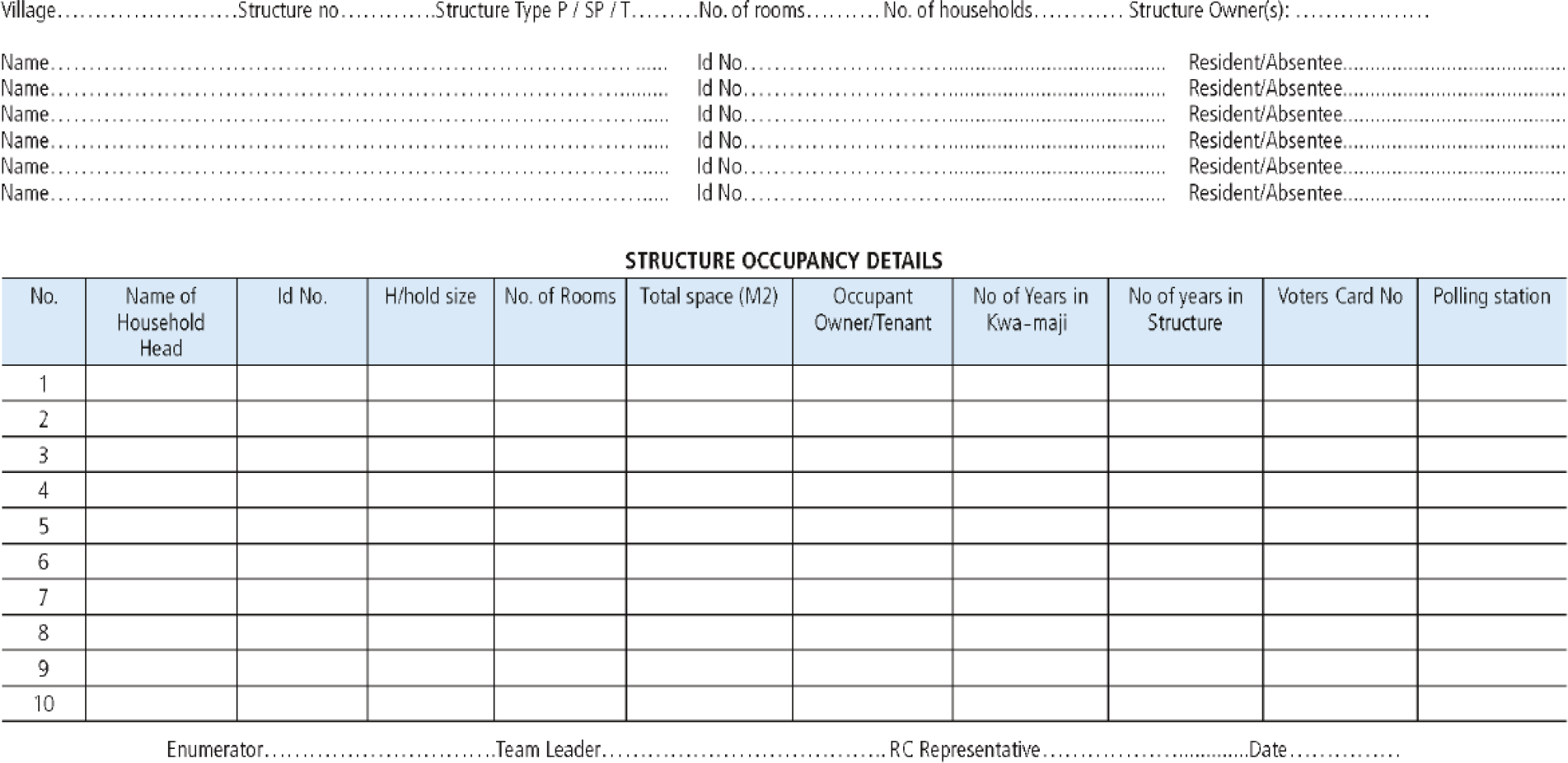
The enumeration form used in the KUDP
When I asked UNX personnel why they agreed to such a simplified exercise, I was told that in Kibera the analysis of the collected data took more than a year and they could not afford such a “waste” of time and resources. In Kwa-maji, UNX staff already had socioeconomic data gathered through the socioeconomic survey, and therefore thought that they only needed a list with information relating to the number of residents, property ownership, and number of years in the settlement. Unfortunately, the data presented in the socioeconomic survey were inconsistent and full of errors, and even the final draft contained illegible graphs drawn manually from non-specified data sets.
As a researcher I joined one of the two enumeration teams in its work to enumerate the second most populous of the eight villages that compose Kwa-maji. Most of the ethnographic details and information on the conduct of the enumeration are taken from the observations and conversations recorded in my own fieldnotes.
Each team was formed of a Lead Agency officer, two members of the Residents’ Committee, and one to three young female enumerators, depending on the time of day. The team would call at every door and ask for the ID and voting card of whoever was there. A form was quickly filled out in the street outside the dwelling. The process took place between 10:30am and 3pm on weekdays, when many residents were away.(37) Sometimes neighbours were approached for information; however, in most cases they refused to provide information on other people. I asked what the enumeration team would do to get the missing information in order to avoid excluding from the list of beneficiaries those who should be included. The team leader answered that they were doing their best but an error was “normal”, and they did not have a plan to verify data and include the missing households.
For each room, only the name of one person was collected, supposedly the head of household. But as I observed, some structure owners pushed to register themselves as living in the room and have their name taken because they knew that in other slum-upgrading projects, non-residents benefitted less than the residents. Since the form could only fit one name per room, tenants – unaware of the importance of the process – lost the opportunity to be registered as residents. More importantly, registering only one name per household, generally of the man, means that if the relationship were to break down, the woman would no longer be a project beneficiary.(38)
IV. Analysing the Process: Capture and Exclusion
a. The exclusion of “everyday bureaucracy”
This section examines how the social exclusion of certain groups of residents was achieved. The account of the enumeration process so far has shown a certain level of carelessness in the recording of information. The enumerators were young female graduates on short-term contracts: one enumerator had a short contract with the Lead Agency for other secretarial needs of the project, which was due to expire in less than a month’s time and which was eventually not renewed; the others were recruited for the purpose of the exercise and complained about the slim chance of having their contracts renewed. They did not have the power or the incentive to challenge the Residents’ Committee members who gave them directions and information.
The timing of the enumeration was designed to fit into normal working hours. The employees of the Lead Agency met at the office in the city centre and their driver took them to Kwa-maji, on the outskirts of the city, through the morning traffic jams, meaning that they started at around 10.30am. They typically finished around 3pm with a short briefing, before going back to the city centre office in time to avoid the afternoon traffic and the afternoon rain typical of the season. The work was physically tiring, as it involved standing and writing under the sun for about five hours.
Each morning the car had to go back to the office for a second round to pick up the remaining staff members, who joined the team around mid-day. We started with only one enumerator in each team, which increased to a maximum of three during the day. One morning, I followed closely the work of an enumerator who was under a considerable amount of pressure to increase the pace of her work because the plan was to complete enumeration of the village that day and she was the only enumerator present. I observed that the newly recruited graduate’s attempt to comply with the request was achieved at the cost of accuracy. She could not wait for the tenants to go and collect their documents, for children to call their parents, or even to properly knock on every door. On one occasion, a frightened young girl was invited to provide the information on behalf of her father, who was not there. As long as some households residing in the structure were listed on the form, it seemed that this was considered sufficient. The level of accuracy on that morning was significantly lower than that of the same enumerator the previous day, when three enumerators were present and more time per structure was allowed.
While the enumerators considered it strange that people would not provide details about their neighbours since “they only live a thin wall of mud apart” (fieldnotes), residents did not feel comfortable taking the responsibility for revealing details about others to the government. In this situation, the enumerators would sometimes ask to be told at least the ethnicity of the head of household and put this as the name of the head of household on the form. Ethnic affiliation was considered to be in the public domain and generally provided to the enumerators. Ethnicity was used as a way of identifying project beneficiaries and avoiding leaving the form blank. However, knowing that, for instance, a Kikuyu household was living there is not a very valuable piece of information for the preparation of a list of residents, considering that more than half of the households are Kikuyus.
I also noticed that respondents would not automatically include little children when saying how many people lived in a household. Only when the enumerator insisted that they count all the people who slept in the house, including small children, would people re-count carefully and provide the correct figure. This latter question was not asked systematically, leading to possible underestimation of household size. A number of inconsistencies emerged in the forms and were somehow adjusted quickly on the spot rather than through accurate data verification. A common inconsistency was that the number of rooms in a particular structure did not correspond to the number of households listed on the form.
The work was organized in the following fashion: The team leader had the village map detailing all the structures. As the team approached a structure, he marked it on the map so that even if the team left with incomplete data, the structure would appear to have been enumerated. The lack of interest of the Residents’ Committee members and the enumerators in collecting complete and correct information led to many residents not being counted correctly. In summary, the exclusion of marginalized groups was achieved through little omissions and a lack of accuracy in compiling the forms. However, there were other contributing factors. The simplification of the data collection tool has already been described. In what follows, I analyse the strategies of structure owners, information asymmetry, and the avoidance of checks and data validation.
b. Structure owners’ strategies
Structure owners shaped the process to their advantage and countered the redistributive and empowering effects of enumeration through a range of strategies. An NGO worker with long experience of enumerations and slum upgrading immediately pointed out to me in an interview that “when you talk of enumeration nowadays, and especially government [enumerations], people know you are talking about [land] allocation”. In many other interviews with slum-upgrading professionals, I was told that everyone in the informal settlements is aware that the government, especially in a foreign-funded programme, has no interest in allocating a large piece of land to one person, even if he or she owns multiple structures. Therefore, the typical structure owner in such circumstances conceals property concentration by registering his/her relatives as owners, starting with his/her offspring, siblings or cousins, and even using trusted non-relatives. It is not surprising therefore that the initial numbering of structures in Kwa-maji showed little concentration of property ownership.
The programme implementers interpreted the data to mean that in Kwa-maji there were no large structure owners, unlike in other Nairobi informal settlements (e.g. Kibera, Mathare). Instead, I argue that the data are indicative of structure owners’ knowledge of development interventions and their capacity to use this knowledge strategically to protect their personal interests. Certainly the amount of property held by some important structure owners did not emerge from the data collected in the numbering of structures.(39)
Moreover, structure owners were aware that the government-preferred criteria required land to be allocated equally among beneficiaries, rather than according to how much they informally owned. One tactic adopted by a significant number of small structure owners was to insist on having their structure registered with two owners, usually them and their sons. The enumeration data showed more than one owner for over a third of the structures. Structure owners were thus not only trying to conceal property concentration, but to disperse ownership amongst as many beneficiaries as they could.
The other key strategy, as noted, was to prevent tenants from registering by registering in their place members of the structure owner’s household or other relatives as tenants. An interviewed NGO worker, speaking as if she were the structure owner, explained what happens during enumerations. She referred to the enumeration conducted in a settlement near Kwa-maji several years before.
“Legitimately, I own these structures […] during enumeration I will mobilize my big children [and tell them] to come and stand here. And the tenants are silenced. […] You would find somebody standing at the door waiting to be enumerated. But then, when we insisted to get in[side the house], she doesn’t want to get in because she doesn’t belong to that house. She has everything: if you need an ID, she has it here. She has been waiting for enumeration. […] So we could be having fewer tenants or many structure owners or owners just because they were able to organize themselves prior to the enumeration. So they distribute. I can even tell you, come, we are being enumerated and I don’t want my house to go to tenants. Sit and say you are the owner of this structure.”
In a rigorous enumeration you need to enter every room so that you can check if the person actually lives there. But in Kwa-maji no verification inside the dwelling was ever made, and thus it was not possible to know whether the person at the door was the resident, or a relative of the structure owner sent to get registered.
In many other cases, the information on tenants was provided by the structure owner, who also provided the answers to the delicate issues of household size and the number of years a tenant had been living in the settlement (the latter being a key criterion for inclusion as a beneficiary at that stage of the project). The structure owners knew that the enumeration was going to take place and some of them were ready, waiting with the relevant documents, outside a given structure. On one occasion, a structure owner had all the documents ready (ID and voting card) for all the people he claimed to be his tenants. It was not uncommon for a single individual to answer for all the households of one structure.
Another strategy reported by NGO staff is that structure owners list tenants as belonging to their own household rather than registering them as independent households. This was a practical way of excluding them, since only the name of the head of household was recorded on the form.
In one particular instance, a structure owner told the enumerators that there were no tenants in his structure. A female tenant living in a neighbouring structure, who had just been enumerated, heard the conversation and said, “He is lying. There are tenants and these are their names.” She went on to list their names. This was followed by a sort of verbal conflict and, at the end, the enumerators wrote down the names given by the woman. However, the tenants were not present and therefore they could not be fully registered.
As tenants have no security and can be evicted anytime without reason, they were particularly cautious about speaking up, and the lack of an organized tenant response is not surprising. The socioeconomic study (with a sample of residents) provided limited information on the conflict between structure owners and tenants, since most relevant questions had been removed from the survey by the Residents’ Committee. The survey data did indicate, however, that tensions between structure owners and tenants were the major cause of conflict among the people of Kwa-maji. The categories of “land issues” and “rent issues” together accounted for 28 per cent of the causes of conflict, followed by the more general category of “insecurity issues” (27 per cent).
One of the ways to counter all these practices and obtain an enumeration database that can help avoid abuses during the exercise and in the subsequent allocation of benefits is to take a photograph of each entire household in front of the door of their dwelling, as is routine practice for the federations of the urban poor. Such a picture is very useful for verifying the data at a later stage and during the allocation process. While the photo technique will not always include all household members, taking pictures is a well-established practice in these types of enumerations and, through the use of digital support, it is not particularly expensive. However, no such measure was ever considered in Kwa-maji.
One important issue debated in the programme and in particular among the Residents’ Committee was which policy to adopt in relation to absentee structure owners. According to the enumeration under discussion here, in Kwa-maji, just over half of the structure owners reside outside the settlement, and own 55 per cent of the structures as a profitable investment. The objective of the KUDP was purportedly to benefit the residents, not just those owning property in the area. Still, many members of the Residents’ Committee, including some very prominent ones, were actually living outside the settlement.
Some structure owners who normally reside outside Kwa-maji were informed about the enumeration and came to be enumerated. On the form, the choice between marking an owner as “resident” or “absentee” was particularly delicate, since it was likely to have an impact on the inclusion/exclusion from the project’s benefits. In one case, Residents’ Committee members argued that one owner, who was at the time participating in the enumeration process, did not live in the area. The latter tried to explain that while he had moved out, his son was now living in the structure and therefore he had to be considered as resident. Another issue was that when a structure owner was not there he was often considered an absentee, but it was not possible to know whether he was absent, resident in another structure in the settlement, or simply not there at that particular moment. This also revealed different degrees of power amongst the structure owners, between those connected with Residents’ Committee members and those who were not.
c. Checks and balances
The UN-Habitat report regarding enumerations and the interviews I conducted with experts recommended a series of checks and controls to counter elite strategies. But even the simplest checks recommended by international best practice were deemed unnecessary by the Lead Agency.
NGO staff members who had worked on other enumerations explained during interviews that to counter structure owners’ strategies there is a need to create a wider process around the enumeration, to “strengthen the tenants so that they are able to question, they are able to challenge, that’s what eventually gives you a more valid [residents’] list, but if you do an enumeration and disengage then obviously you will never get [a valid list]”. In this particular interview, the NGO officer also underlined the importance of a process of data verification supervised by a neutral actor. Such verification, it was suggested, must take place after equally crucial processes of empowerment and education for the tenants.
However, the Lead Agency and the UNX representative saw no need for such checks and controls. They argued that the Residents’ Committee, in theory composed of legitimate community representatives, would prevent abuses, and that further checks would have implied a lack of trust on the part of government. Yet clearly the composition of the Residents’ Committee represented a conflict of interest that called for accurate checks.
d. Information asymmetry
Another assumption of UNX and other programme staff was that since the programme had been ongoing for about two years at the time of the enumeration, all residents should have been aware of the slum-upgrading programme, the role of the enumeration and the criteria to become a beneficiary. When interviewed before the enumeration, programme workers said they expected that they would obtain an inflated number of residents, all of them claiming that they had been residing in Kwa-maji for more than 10 years – a criterion discussed at that time for land allocation eligibility. However, this did not happen, as information was unequally disseminated among the population.
The power of the leaders is connected to their access to information that is strategically guarded to maintain their position, often as brokers/gatekeepers. The slum-upgrading programme did not involve all residents equally; many lacked information and viewed the programme with scepticism as one of many development initiatives that took place in the area. Analysing these dynamics in the Indian rural context, Corbridge et al. pointed out that “some people also know more than others and are able to control, in some degree, how information circulates across a space-economy”.(40) Control of the circulation of information in Kwa-maji was absolutely crucial in elite strategies.
The enumeration outcome was also influenced by the social networks of the different structure owners. We mentioned inaccuracies resulting from the strong pressure to accelerate the enumeration process. However, the Residents’ Committee members made sure that the important structures owned by people they knew were attentively enumerated, checking the compiling of the forms closely, in some cases dictating the information directly to the enumerator. At one point, a Residents’ Committee member working with a particular enumeration team came to check that the forms relating to some of the structures owned by her relatives were compiled the way she wanted and, when she realized that her brother-in-law was marked as an absentee structure owner, she got the team to change the form. By contrast, a small structure owner living in a nearby settlement, who had invested his savings in a structure in Kwa-maji, had no idea what was going on, or what the criteria were for benefitting from the programme. He also had no connection to any member of the Residents’ Committee. During the enumeration, the Residents’ Committee members present held the list containing the names of the owners; this gave them significant influence over the process. Moreover, by collecting data on the ownership of structures, members of the Residents’ Committee themselves implemented a process of verification of the data that had been collected months before during the numbering of structures.
Awareness of the importance of the enumeration and other information on how and when residents were being counted could be gained through acquaintance with at least one Residents’ Committee member. However, being enumerated or not also depended on physical location. The residents on the main roads saw the enumeration team arriving and had time to call other family members and prepare documents. By contrast, many people residing on the small walkways deep into the settlement were not ready. Sometimes if the head of household was not there, the people found by the enumerators offered to go and call the head of household. Children, in particular, asked to go and find their parents, who were generally working somewhere within Kwa-maji (often at their vending stalls). They were told that the team was in a hurry and could not wait. The enumerators collected the little information available from those who were present and left. But such information was not supported by documents. Another advantage was that if someone was residing close to the main road and was momentarily away, other people were able to go and tell him/her that they were enumerating his/her house, because the process was very visible. However, when the team was deep into the small walkways this did not happen.
Full information about why the enumeration was being carried out and why it was important did not reach everyone equally. Some people were very keen to be registered and they were ready and waiting with their documents, while others were completely unaware of the importance of the exercise. The availability of information was one of the factors that determined whether someone was enumerated or not, thereby establishing whether he/she would be a beneficiary or not. The power of community leaders was strongly based on their role as information brokers; this was particularly relevant because, according to the socioeconomic study, “word of mouth” was considered the main form of communication in the settlement by 68 per cent of the respondents. In the context of the prevalence of this means of communication, structure owners’ role in the Residents’ Committee as a conduit between implementers and the “community” reinforced their power as gatekeepers and information brokers.
V. The Outcome
“Communities are not homogeneous: power disparities exist within them, and empowerment for the most disadvantaged is a major challenge. Enumeration is likely to include conflict: who controls resources, who owns land, what are the boundaries, who holds which proof? […] It is difficult to ensure that the interests of marginalized groups such as tenants or women are adequately reflected in an enumeration, as there is a danger that the results may solidify an already unequal distribution of rights, assets and access to resources.”(41)
The experts brought together by UN-Habitat for the Count Me In report recognized that to ensure adequate representation of vulnerable groups, an enumeration needs to be designed and implemented meticulously. In Kwa-maji the enumeration was rushed, the data collection tool was too simple, and no household verification inside dwellings was undertaken.
The resulting household count was significantly lower than both existing estimates and the result of the previous enumeration. The enumeration conducted in 2001 counted 18,537 households. The KUDP enumeration only identified 10,581 households, and the socioeconomic study commissioned by UNX just a few months before the enumeration found that the population inside the settlement had continued to grow over the previous 10 years.(42) But no one questioned this inconsistency. When I raised this issue, I was told that because the “community” through the Residents’ Committee oversaw the process, the results must be correct.
The enumeration also revealed information on ownership and the phenomenon of absentee structure owners. The 3,268 structures recorded apparently belong to 4,343 structure owners, over half of whom were enumerated as absentee. The data show that amongst the households resident in Kwa-maji, about 20 per cent are of structure owners and 80 per cent are tenant households.(43) The evidence suggests, however, that the tenant households are undercounted. But more important than the total number of residents or the proportion of tenants is the fact that poor data collection means that there is no information on a significant number of households and therefore it is not possible to identify them as project beneficiaries.
VI. Conclusions
Kwa-maji’s structure-owning elites had learned from their previous involvement in other upgrading attempts and were aware of the potential of enumerations to challenge power relations. Therefore, they shaped the exercise in their favour by, for instance, simplifying the socioeconomic survey and enumeration form, and were helped by the implementers’ desire to finish quickly and avoid conflict with the elite.
What was intended by government as an attempt to render the community “legible” was manipulated by local elites and shaped by specific interests; it tended to exclude certain groups of residents. Government officers deliberately allowed this in order to create a “legible representation” that would be accepted by both the government and by the local elite, who could otherwise have sabotaged the programme. This is a good example of the negotiated and co-produced nature of development. The enumeration served an important purpose in the project; it is significant that this was not despite its inaccuracies but because of them. In fact, the enumeration accommodated (and was itself the product of) different interests, while at the same time, it allowed the project to claim a rigorous and scientific data collection process.
The findings of this study align with Appadurai’s argument that enumerations are a tool for group formation, a ritual that builds a community.(44) However, it is important to be aware that the communities so built can be very unequal or exclusive and can reproduce and enhance pervasive inequalities. As Appadurai points out, “Self-enumeration takes this power away from external agencies such as the state and puts it back where it truly belongs, which is within the community itself’ and therefore it can be an important part of ‘the process of deep democratization.”(45)
However, the question of who within the community has the power to influence the process is of the utmost importance. In highly unequal contexts – and informal settlements are some of the most unequal settlements – who is going to rebalance the inequalities within communities? The first step is to avoid idealized notions of communities and to recognize internal heterogeneity and conflict between residents. Too often, local elites present themselves as representatives of the wider community and draw on this power and legitimacy to advance their specific claims. Therefore, rather than looking predominantly at the state/community relationship, analyses of enumeration processes should also pay more attention to the complexity of internal communities’ dynamics and conflicting interests, and how these play out in the relationships with the state.
Footnotes
1.
For example, see Campbell’s in-depth analysis of the Nigerian case. Campbell, I (1976), “The Nigerian census: An essay in civil/military relations”, The Journal of Commonwealth & Comparative Politics Vo1 4, No 3, pages 242–254.
2.
Rose, N S (1999), Powers of freedom: Reframing political thought, Cambridge University Press, Cambridge, pages 215–230; also Scott, J C (1998), Seeing like a state: how certain schemes to improve the human condition have failed, Yale University Press, New Haven.
3.
Chitekwe-Biti, B, P Mudimu, G M Nyama and T Jera (2012), “Developing an informal settlement upgrading protocol in Zimbabwe – the Epworth story”, Environment and Urbanization Vol 24, No 1, pages 131–148; also Farouk, B R and M Owusu (2012), “ “If in doubt, count”: the role of community-driven enumerations in blocking eviction in Old Fadama, Accra”, Environment and Urbanization Vol 24, No 1, pages 47–57; Huchzermeyer, M (2009), “Enumeration as a Grassroot Tool Towards Securing Tenure in Slums: Insights from Kisumu, Kenya”, Urban Forum Vol 20, No 3, pages 271–292; Karanja, I (2010), “An enumeration and mapping of informal settlements in Kisumu, Kenya, implemented by their inhabitants”, Environment and Urbanization Vol 22, No 1, pages 217–239; Muller, A and E Mbanga (2012), “Participatory enumerations at the national level in Namibia: the Community Land Information Programme (CLIP)”, Environment and Urbanization Vol 24, No 1, pages 67–75; Patel, S, J Arputham, S Burra and K Savchuk (2009), “Getting the information base for Dharavi’s redevelopment”, Environment and Urbanization Vol 21, No 1, pages 241–251; Patel, S, C d’Cruz, and S Burra (2002), “Beyond evictions in a global city: people-managed resettlement in Mumbai”, Environment and Urbanization Vol 14, No 1, pages 159–172; and Weru, J (2004), “Community federations and city upgrading: the work of Pamoja Trust and Muungano in Kenya”, Environment and Urbanization Vol 16, No 1, pages 47–62.
4.
Ghertner, D A (2010), “Calculating without numbers: aesthetic governmentality in Delhi’s slums”, Economy & Society Vol 29, No 2, pages 185–217; also Livengood, A and K Kunte (2012), “Enabling participatory planning with GIS: a case study of settlement mapping in Cuttack, India”, Environment and Urbanization Vol 24, No 1, pages 77–97.
5.
Mitlin, D (2008), “With and beyond the state – co-production as a route to political influence, power and transformation for grassroots organizations”, Environment and Urbanization Vol 20, No 2, pages 339–360.
6.
Corbridge, S, G Williams, M Srivastava and R Véron (2005), Seeing the State: Governance and Governmentality in India, Cambridge University Press, Cambridge.
7.
See reference 6, page 5.
8.
Fuller, C J and J Harriss (2001), “For an anthropology of the modern Indian state”, in C J Fuller and V Benei (editors), The everyday state and society in modern India, C Hurst & Co Publishers, London, pages 1–30.
9.
See reference 6, page 5.
10.
See reference 6, page 8.
12.
The term “slum” usually has derogatory connotations and can suggest that a settlement needs replacement or can legitimate the eviction of its residents. However, it is a difficult term to avoid for at least three reasons. First, some networks of neighbourhood organizations choose to identify themselves with a positive use of the term, partly to neutralize these negative connotations; one of the most successful is the National Slum Dwellers Federation in India. Second, the only global estimates for housing deficiencies, collected by the United Nations, are for what they term “slums”. And third, in some nations, there are advantages for residents of informal settlements if their settlement is recognized officially as a “slum”; indeed, the residents may lobby to get their settlement classified as a “notified slum”. Where the term is used in this journal, it refers to settlements characterized by at least some of the following features: a lack of formal recognition on the part of local government of the settlement and its residents; the absence of secure tenure for residents; inadequacies in provision for infrastructure and services; overcrowded and sub-standard dwellings; and location on land less than suitable for occupation. For a discussion of more precise ways to classify the range of housing sub-markets through which those with limited incomes buy, rent or build accommodation, see Environment and Urbanization Vol 1, No 2 (1989), available at  .
.
13.
Patel, S, C Baptist and C D’Cruz (2012), “Knowledge is power – informal communities assert their right to the city through SDI and community-led enumerations”, Environment and Urbanization Vol 24, No 1, pages 13–26.
14.
Hooper, M and L Ortolano (2012), “Motivations for slum dweller social movement participation in urban Africa: a study of mobilization in Kurasini, Dar es Salaam”, Environment and Urbanization Vol 24, No 1, pages 99–114.
15.
Dobson, S, H Nyamweru and D Dodman (2015), “Local and participatory approaches to building resilience in informal settlements in Uganda”, Environment and Urbanization Vol 27, No 2, page 617.
16.
Makau, J, S Dobson and E Samia (2012), “The five-city enumeration: the role of participatory enumerations in developing community capacity and partnerships with government in Uganda”, Environment and Urbanization Vol 24, No 1, page 39.
21.
Banana, E, B Chitekwe-Biti and A Walnycki (2015), “Co-producing inclusive city-wide sanitation strategies: lessons from Chinhoyi, Zimbabwe”, Environment and Urbanization Vol 27, No 1, pages 35–54.
23.
Jacobs, F, D Jordhus-Lier and P de Wet (2015), “The Politics of Knowledge: Knowledge Management in Informal Settlement Upgrading in Cape Town”, Urban Forum Vol 26, No 4, pages 1–17.
24.
For example, Pottier, J, A Bicker and P Sillitoe (2003), Negotiating local knowledge: power and identity in development, Pluto, London.
25.
This is a pseudonym, as is the Kwa-maji Urban Development Project (KUDP). The names of the settlement and the project are intentionally kept anonymous. Many institutional actors were represented by a limited number of staff members, who would be easily recognizable if I were to mention the actors and the settlement. This would violate research ethics guidelines as it would threaten the anonymity that I committed to granting to my informants and interviewees. Moreover, the project deals with one of the most problematic political issues in Kenya: the distribution of land. This issue generated conflict in the settlement; this and other papers I have authored on this case study contain sensitive information. As of November 2016, the project is ongoing and the research itself could create internal conflicts among the actors.
26.
They are not called landlords as they only own the structures rather than the land – which, in this area, is formally owned by the government.
27.
The actors here are intentionally kept anonymous.
28.
Rigon, A (2014), “Building Local Governance: Participation and Elite Capture in Slum-upgrading in Kenya”, Development and Change Vol 45, No 2, pages 257–283.
30.
See reference 29, page 3.
31.
See reference 29, page 8.
32.
See reference 29, page 118.
33.
See reference 29, page 140.
34.
See reference 29, page 3.
35.
See reference 29.
36.
As a reference, in an enumeration undertaken for similar purposes and documented by Karanja (see reference 3, ), the following information was collected: name of owner, owner ID, gender, age, level of education, occupation, daily household expenditure, marital status, religion and relation to household head; type of plot ownership (purchased, allocated by government, inherited or moved onto) and whether they had a title deed or other evidence of ownership; land/house use; plot size; details of all occupants and whether they were land/structure owners or tenants; size and quality of house; years of residence; distance to work; main source of water, time needed to collect it and how much is used in a day; and availability of services. See also reference 28.
37.
Other NGO workers as well as academic researchers, who had conducted household surveys in Nairobi settlements, were keen to explain that they needed to work at night or on weekends in order to find people at home.
38.
This issue had also been identified in relation to the slum upgrading in Kibera, where the list of beneficiaries was composed by taking the names of heads of households from the enumeration. Flores Fernandez, R and B Calas (2011), “The Kibera Soweto East Project in Nairobi”, IFRA Les Cahiers d’Afrique de l’Est Vol 44, pages 129–146.
39.
The multiple informal discussions but also formal interviews with community members confirmed the following information. Whereas the situation had changed compared to 20 years before, when a single person used to own almost all the structures in a village that had his name (later renamed), there were still some big owners, and people named them to me. Triangulating the information provided, I can confidently say that some people owning more than one structure did not appear as multiple owners in the enumeration. The local member of Parliament and high-level Provincial Administration officials were named by people amongst those who had owned many properties in the area that they sold at the end of the 1990s, when they feared that policy changes might undermine their investments. However, due to the sensitivity of this information and the informality of such transactions I could not personally verify this.
What has to be recognized in the claim of project implementers is that Kwa-maji does indeed have more resident structure owners possessing a relatively small number of structures than in other settlements where extensive informal commercial renting is prevalent (e.g. Kibera). This is due to Kwa-maji’s specific history of temporary allocations granted to people evicted from other areas. Syagga, P, W Mitullah and S Karirah-Gitau (2001), Nairobi Situation Analysis, Consultative report, UN-Habitat and Government of Kenya, Nairobi.
40.
See reference 6, page 131.
41.
See reference 29, page 141.
42.
While previous estimates used in project documents indicated 100,000–120,000 residents, likely to be an exaggeration, the enumeration only counted 34,000 people, probably an underestimation.
43.
Gulyani et al. find that the average for Nairobi informal settlements is 92 per cent tenant households and 8 per cent owner-occupier. Gulyani, S, E M Bassett and D Talukdar (2012), “Living Conditions, Rents, and Their Determinants in the Slums of Nairobi and Dakar”, Land Economics Vol 88, No 2, pages 251–274.
44.
Appadurai, A (2012), “Why enumeration counts”, Environment and Urbanization Vol 24, No 2, page 640.
45.
See reference 44, page 640.