




Abstract
This paper contributes to the understanding of processes by which small-scale entrepreneurs who provide household waste collection in informal settlements succeed in formalized co-production of such services. The paper draws on the social and solidarity economy and social and environmental entrepreneurship theoretical frameworks, which offer complementary understandings of diverse strategies to tackle everyday challenges. Two questions are addressed: How do informal waste collection initiatives get established, succeed and grow? What are the implications of this transition for the entrepreneurs themselves, the communities, the environmental governance system and the scholarship? A case study is presented, based on three waste picker entrepreneurs in Kisumu, Kenya, who have consolidated and expanded their operations in informal settlements but also extended social and environmental activities into formal settlements. The paper demonstrates how initiatives, born as community-based organizations, become successful social micro-enterprises, driven by a desire to address socio-environmental challenges in their neighbourhoods.
Keywords
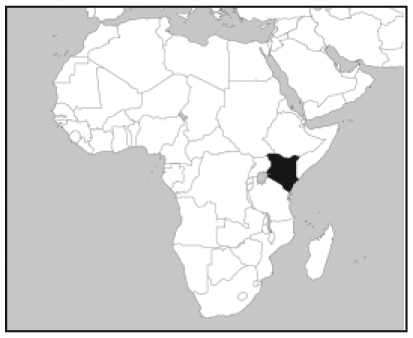
I. Introduction
The main objective of this paper is to study the process by which socio-environmental entrepreneurs (SEE), providing critical solid waste collection services in informal settlements, succeed in consolidating their operations through the institutionalization of co-production of such services. In an increasingly urbanized world, more than one-third of the urban population in the global South is living in informal settlements.(1) Because of the weakness of local governments, many of these neighbourhoods are poorly connected to basic services, such as collection and management of household waste.(2) However, low-income residents do not remain passive regarding the deteriorating environmental conditions within their neighbourhoods. Driven by the desire to maintain a clean and healthy environment, they initiate and support activities focused on provision and improvement of waste management services, creating new opportunities for livelihoods.(3) An extensive informal sector of waste pickers, in some countries up to 1 per cent of the urban population, is thus involved in collecting and separating household waste.(4) In doing so, informal waste pickers make a significant contribution to improving the health of low-income residents, recovering resources, creating jobs and income among the poor, and even reducing the carbon footprint of cities.(5)
Even so, waste pickers in the informal sector represent one of the most widely excluded, impoverished and disempowered segments of society.(6) Waste pickers are exposed to toxic materials,(7) suffer from prejudice and stigmatization, experience difficulties in creating formal cooperatives or associations, lack access to official microfinance and funding opportunities, are susceptible to price market oscillations, and are subject to exploitative relations with intermediaries.(8) All these difficulties lead to persistent poverty and at the same time to inconsistencies in the waste collection services provided by this sector.(9)
In response, informal waste pickers of the global South establish themselves in many different ways: as small groups, extended family groups, cooperatives or associations, micro-enterprises or community-based organizations (CBOs).(10) To organize in any of these forms requires persistence, leadership, knowledge of formal procedures, and often also financial resources. In many countries, for example, the formation of cooperatives involves the payment of fees as well as complex, tiresome and time-consuming procedures, which often hinder the waste pickers in formally constituting a cooperative. In most cases organized waste pickers have received some form of financial support or technical advice from an NGO, a university, or the local government that has helped the organization of the group. Yet one of the most significant challenges for all these waste picker organizations is how to continue with their operations and survive once the projects or funds that initially supported them have dried up.
In this paper we describe and analyse the transformation of three informal waste pickers into waste entrepreneurs, in Kisumu, Kenya. Their initiatives are characterized as social micro-enterprises that have managed to survive and grow. Based on these cases, the two main questions we address in this article are: How do informal waste collection initiatives get established, succeed and expand? And what are the implications for the entrepreneurs themselves, the communities, the governance system and the scholarship? In the specific context of Kisumu, waste recyclers collect, sort and sell scrap metals, plastics, waste paper, used bottles, and cans. Recyclers differentiate themselves into scavengers (locally called Chokora), who sort out recyclables from waste scattered in the settlements or at the city dump, and waste pickers, waste entrepreneurs, or CBOs who collect waste from households and businesses and then sort out recyclables. In this paper we only focus on waste entrepreneurs and CBOs.
The next section introduces the literature on social, environmental and institutional entrepreneurship. The methodology section then outlines the means by which data were gathered and analysed. Then the findings are presented in the form of three life stories of waste entrepreneurs, followed by a discussion of the two research questions. The paper concludes by emphasizing important characteristics for the formation and consolidation of successful micro-enterprises and underlining some of the social and environmental contributions of these entrepreneurs to the wider community.
II. Multiple Rationalities of Socio-Environmental and Institutional Entrepreneurs
a. Social entrepreneurship
Social entrepreneurs in the waste management sector are part of the emerging experiences, most prominent in the global South, that fall under the literature on the social and solidarity economy.(11) This theoretical framework offers strategies to address some of the challenges such entrepreneurs face in their everyday operations. Social enterprises are defined primarily by the fact that “some person or group […] aim(s) at creating social value, either exclusively or at least in some prominent way”.(12)
Social entrepreneurship is broadly defined as “a process involving the innovative use and combination of resources to pursue opportunities to catalyse social change and/or address social needs”.(13) Zahra et al.(14) focus on how social entrepreneurs discover and take advantage of opportunities for the purpose of promoting social wealth via the creation of new ventures or by the recombination of existing organizations. Others have emphasized social entrepreneurs’ ability to provide goods for specific deprived market segments in the context of base-of-the-pyramid entrepreneurship in emerging markets and developing economies.(15)
A specific type of social entrepreneur has been defined by the term “social bricoleur”,(16) which resonates with the nature of the waste entrepreneurs in our study. The term bricolage was introduced by Lévi-Strauss as the process of “making do with what is at hand”.(17) The theoretical concept has been applied to different disciplines and contexts. Social bricoleurs usually operate in the context of small-scale, local social needs. They draw on locally available resources to solve neighbourhood problems and to leverage new opportunities. Often, social bricolage involves social networking activities or spontaneous collective action for rapid responses to specific social or environmental problems.(18) Zahra et al.(19) recognize the unique position of this type of entrepreneur in discovering the local social needs. Social bricoleurs respond to unmet needs of communities by creating something out of resources not perceived as such before. They often use improvisation and lateral thinking based on their expertise and available personal resources to create and enhance social wealth in the community. In so doing, they perform vital social functions in informal settlements in different parts of the world.
b. Environmental entrepreneurship
Related terms are environmental entrepreneurship(20) and ecopreneurship,(21) whose core motivation and goals are to earn money in the course of contributing to solving environmental problems, such as the lack of solid waste collection services in informal settlements. Informal settlements have been forgotten by urban planners in many of the large cities in the global South. The absence of basic public services in informal settlements is often related to economic liberalization processes, which come with public management reforms.(22) Diverse forms of private initiative arise to deliver the missing public services, some of which emerge as environmental enterprises in sanitation, water and waste services.(23) These environmental enterprises, following Dean and McMullen,(24) create markets for resources, such as household waste collection in the case at hand, through entrepreneurial actions that result in the development of property rights over solid waste and solidarity amongst the actors to fight for space and recognition within the sector. Unlike social entrepreneurs, environmental entrepreneurs are thus primarily driven by business opportunities, which lead to the enhancement of environmental conditions.
c. Institutional entrepreneurship
Several authors have also looked into specific situations of social entrepreneurs who have gone beyond simply “making do” with available resources towards a proactive entrepreneurial stance with, in Baker and Nelson’s words, “refusal to enact limitations”.(25) Refusing to be constrained can take many different forms, e.g. with entrepreneurs trying out solutions to counteract certain limitations imposed by institutional or political settings or the absence of government.(26) In connection to these studies, Chant has argued that informal economies are generative spaces of experimentation, particularly for youth.(27) When these experimental niches or young entrepreneurs succeed in expanding, they enter processes of institutional entrepreneurship to transform the wider institutional contexts that usually limit, constrain and shape their operations.
When new environmental services, such as waste management in informal settlements, emerge, consolidate and become institutionalized, new rules, practices and rationalities are established.(28) When this happens, the ambitions of the social and environmental entrepreneurs to change institutional settings link to what has been coined “institutional entrepreneurship”.(29) Hardy and Maguire argue that institutional entrepreneurs “work to bring change in terms of three themes: the mobilization of resources; the construction of rationales for institutional change, including the discursive processes through which new practices are framed and legitimated; and the forging of new inter-actor relations to bring about collective action”.(30)
Occasionally, the institutionalization of new environmental services in collaboration with socio-environmental entrepreneurs can respond to models of co-production, whereby services are the result of joint production between social entrepreneurs and the public sector.(31)
d. Intermixed economic, environmental and social rationalities
The predominant emphasis on the entrepreneurial side in development programmes, policies and projects, under what has been termed entrepreneurial developmentalism,(32) tends to describe social problems as economic, turning citizens into customers and transforming youth hustlers into entrepreneurs.(33) The risk of such policies, as Barinaga(34) points out, lies in the depoliticization of the social and the alignment with neoliberal agendas. The social dimension of entrepreneurship needs to be problematized,(35) for example, by discussing the ways in which these entrepreneurs contribute to social and environmental changes in their communities.
Most of the literature on social entrepreneurship is about its definition and typically discusses whether the social or the economic dimension comes first. However, recent research has revealed that socio-environmental entrepreneurship is dynamic, not static or fixed. Schaltegger and Wagner(36) show how social entrepreneurs can become institutionalized and extend their scope towards broader markets and groups. Similarly, Belz and Binder(37) discovered how the so-called triple bottom line(38) of ecological, social and economic goals of entrepreneurs has so far not been integrated simultaneously, but rather sequentially.
In this paper we explore the transition of waste collection entrepreneurs through different phases and discuss how they fit into the concepts presented in this section. Drawing on the multiple rationalities of neighbourhood entrepreneurs as described above, we conceptualize a group of socio-environmental entrepreneurs (SEE) broadly to include all types of organizations(39) that seek to influence financial, social, environmental and institutional outcomes. The goal or rationale that predominates will vary from one instance, organization or context to another. Following Granovetter,(40) we believe that economic rationalities are embedded in social relations and everyday social life. From this perspective, social, environmental and economic rationalities are intertwined and the everyday practices of SEE are driven by a realignment and anchoring of their commercial and social relations to the shifting economies of their communities, rather than by a simple pursuit of economic profit.(41)
III. Research Method
The paper centres on a case study of Dickens, Elvis and Silas, three waste picker entrepreneurs in Kisumu, Kenya, engaged in social household waste collection micro-enterprises. These individuals started as members of community-based organizations (CBOs) within their neighbourhoods and have succeeded in consolidating their operations in informal settlements and extending them into formal areas. We selected these three based on their long trajectories as entrepreneurs and because they followed similar patterns of starting out in CBOs in an informal settlement and then transforming their operations into micro-enterprises. They were also identified as “successful models” during our fieldwork.
The larger study(42) from which this case study is drawn made use in its data collection of in-depth interviews, observations, focus groups, organization of and participation in clean-up exercises and stakeholder workshops, and document analysis. Interviews and workshops covered a wide range of stakeholders, including residents, waste pickers, waste entrepreneurs, CBOs, NGOs, public officials from the ward, city, county and state levels, UN-Habitat staff, and development aid representatives acting on behalf of donors and programme teams, as well as a former mayor of Kisumu. All interviews, workshops and focus groups were organized and conducted by researchers from five universities, Kenyan, Swedish and Canadian, including some of the authors of this article. The interviews were recorded for detailed analysis.
Several focus groups were held with residents and waste pickers in two informal settlements in Kisumu, Nyalenda and Obunga. Clean-up exercises were also organized in Obunga. For the specific purpose of this paper, in-depth interviews were conducted with Silas, Elvis and Dickens, the three waste picker entrepreneurs described above. The interviews with the entrepreneurs followed a life story format where, in a very open dialogue, they recounted their personal stories as entrepreneurs over two rounds of interviews. Later there was a joint meeting to discuss our preliminary analysis with them. Dickens, Elvis and Silas are co-authors of this paper since they have not only provided the data through the interviews, but have also been crucial in the implementation of our research project and in the preliminary analysis and data interpretation.
Inspired by the social and solidarity economy and social and environmental entrepreneurship theories, we have analysed our data (mostly transcriptions of interviews) through creative abduction in back-and-forth moves between sorting, coding, and probing the data and collecting new data until the stories of the three entrepreneurs were reconstructed.(43) The emergent categories were collapsed into an evolutionary model that explains the development of the nascent CBOs into socio-environmental enterprises through sequential accumulation of new economic and socio-environmental rationalities in their operations.
IV. Research Findings and Analysis
The city of Kisumu lacks capacity to provide adequate services to its more than 500,000 inhabitants, especially within informal settlements where waste management services are either ineffective or absent. Of the 400,000 tonnes of solid waste generated daily in the city, an estimated 20 per cent is collected.(44) The remaining waste is left in back streets, along roadsides and in open spaces, leading to appalling conditions not only in poor neighbourhoods but in the city in general. Limited accessibility further challenges the provision of basic waste management services in informal settlements. Here, the waste from households is never collected, except through a few public clean-up exercises that may be organized by some CBOs, private collectors, individual waste pickers, or institutions in the Kisumu County, with and without external funding.(45) The existing solid waste management laws, policies and programmes have not yet succeeded in creating the desired impacts within the informal settlements.(46)
One such program was the SIDA-funded Kisumu Integrated Solid Waste Management Project (KISWAMP), which involved the Municipal Council of Kisumu, the NGO Practical Action, and local residents as key players. Practical Action supported the formation of social waste enterprises in informal settlements, committed to serving the wider public and encouraging collective action and participatory decision-making.(47) At the same time, a community initiative was started through the formation of the Manyatta Resident Association (MRA). MRA was essential for the implementation of community clean-ups, involving youth groups that began cleaning up their neighbourhoods and educating and creating awareness among the residents, who often later supported them to sustain their initiatives. Prior to KISWAMP, other NGOs such as Sustainable Aid in Africa International (SANA) and World Vision (WV) had supported the creation of youth groups for the provision of waste management services.
The following section describes the history and evolution of the three specific cases in which participating youths became entrepreneurs, each starting a business in household waste collection, which then developed into a micro-enterprise generating employment and socio-environmental benefits. The life stories of Silas, Dickens and Elvis as entrepreneurs are summarized in Table 1. Their individual stories are presented primarily in this tabular form for the sake of brevity. The information is then contextualized and discussed in the main text.
Life stories of three waste entrepreneurs in Kisumu
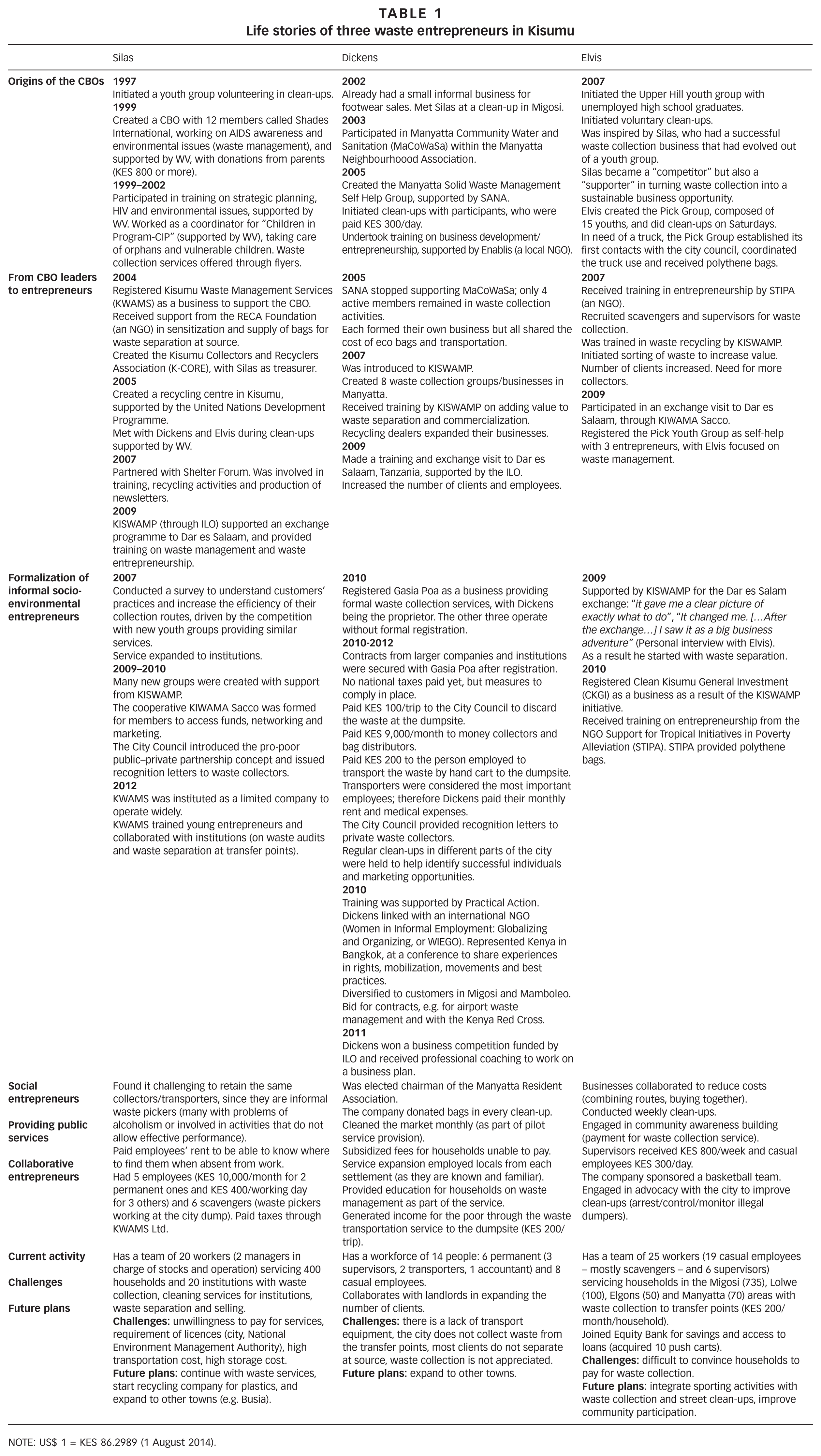
NOTE: US$ 1 = KES 86.2989 (1 August 2014).
a. CBOs: the soil for waste entrepreneurs
In Kisumu, community or youth groups, originally created with the support of NGOs, were sometimes intended for other purposes, such as increasing the awareness of AIDS prevention measures. These youth groups often expanded their activities into organizing clean-up events in their neighbourhoods. The first ideas about starting remunerated household waste collection services were sparked during such initiatives. The clean-ups resulted in visible and much-needed improvements to local conditions, prompting residents’ support of solid waste collection activities. The activities supported by NGOs and CBOs also created the necessary networks and organizational infrastructure for these youth groups to start providing paid waste collection services.
Silas, Dickens and Elvis, through participating in these CBOs and living in the neighbourhoods, were familiar with local conditions and the need for a cleaner and healthier environment. They could tap into the locally available assets and resources (NGOs and CBOs) as well as understanding the low-income residents’ financial situation. The combination of local or tacit knowledge and the understanding of existing resources to solve problems, such as an unhealthy environment and the lack of employment, is inherent in the concept of social bricoleurs,(48) which fits the case of the waste entrepreneurs in Kisumu, denoting resourcefulness and adaptability within the context of everyday life in an informal settlement. Initially some youth groups were created specifically to provide the missing waste collection service. These groups adopted a collective organizational form close to a cooperative, but did not formalize. Initially, the number of participants was quite high, with work and revenues being equally distributed. In all cases, seed capital was necessary for bags and equipment, sometimes provided by an NGO (e.g. WV or SANA), but also by neighbours or relatives.
b. Transition from CBO leaders to environmental entrepreneurs
Silas, Dickens and Elvis, as the main actors of their CBOs, had already shown robust leadership but also visions beyond the provision of waste collection services. These young leaders were heading these groups, and taking on responsibilities for planning and implementation of activities. However, as the services provided by the large groups of youths offered very low profits, most members abandoned the groups after some time.
Although this may have been disappointing from a community perspective, it pushed the three leaders to evolve towards more business-like organizations in search of the necessary economic efficiency. Different programmes (e.g. KISWAMP, Practical Action, WV and SANA) also actively supported this transition in some informal settlements, such as Nyalenda and Manyatta. Small and medium-sized enterprises (SMEs) were equipped with tools, and Silas, Dickens and Elvis all received specific training in solid waste management and entrepreneurship.
Similar to other social enterprises, the waste picker organizations thus emerged from the nonprofit sector and set out to solve a socio-environmental problem by applying business management skills, in this way producing financial, social and environmental returns to their communities (the so-called triple bottom line(49)).
Even if these initiatives were originally born with the ambition of addressing a contaminated and unhealthy environment in the informal settlements, the waste entrepreneurs acknowledge that from the very beginning their participation was motivated by both social and economic ambitions. Silas and Elvis started working with CBO groups directly after finishing school. Dickens already had a small informal business for footwear sales, but decided to participate in the CBO as he saw an opportunity for future work. Although the three of them started within CBO organizations supported by NGOs, their desire was, from the beginning, to provide a social for-profit waste collection service.
c. The formalization/institutionalization of socio-environmental entrepreneurs
In a third phase, the enterprises evolved from informal to formal businesses. As their collection activities grew, they needed to obtain the necessary legal permissions to expand outside the original settlement and to engage in provision of waste collection services for public institutions and private companies.
Continuous training has been significant for such expansion. External funding from development programmes, such as KISWAMP, has allowed entrepreneurs to participate in trips to best-practice initiatives, for example in Dar es Salaam. Silas and Dickens agree that it was important to see these best practices, to provide them with new visions to rethink and reimagine the size and nature of their activities. Beside Elvis, Dickens and Silas, many other individuals who later became entrepreneurs in Kisumu have also attended numerous training sessions on different entrepreneurial skills provided by various organizations.
Currently, the three entrepreneurs described in our case study (Table 1) run well-developed operations, which include waste collection once or twice a week, recycling activities, distribution of plastic bags, collection of fees and promotion to expand the business. As collection activities have expanded in informal settlements, it has also become necessary for the entrepreneurs to maintain cleanliness in the neighbourhoods to add appeal to the waste collection service for which households were paying. Along with supporting clean-ups, this includes self-subsidized or even free collection services for the very poor. In other words, the social contribution to the community has been maintained even after the enterprises became more formal for-profit organizations.
The successful operation of the abovementioned activities relies heavily on a very detailed understanding of the local context, including the intricate and fluid spatial, social, cultural and economic aspects. Not only do the entrepreneurs themselves benefit from being local, they also recognize the importance of recruiting local staff. Elvis, Dickens and Silas have been networking to make household waste collection services more efficient, e.g. by swapping households among themselves, optimizing the collection routes; collectively negotiating prices for equipment; advocating/contesting policies; and developing stronger negotiating power vis-à-vis other actors.
On a similar note, the Kisumu Waste Management Association (KIWAMA) and the KIWAMA Savings and Credit Co-operative (SACCO) were formed with the support of KISWAMP for members such as Silas, Dickens and Elvis to access funds, networking and marketing. A seed money fund linked to a credit-guaranteed scheme was created to be managed by the SACCO. Unfortunately, only a few entrepreneurs benefitted but, because of the weak financial management structures and non-competitive interest rates, the SACCO has since remained dormant. Although the association has not been fully active in the last few years, it is used as a joint voice by these entrepreneurs to lobby the administration when necessary, for example when they filed a complaint against the county to prevent a multinational waste corporation from obtaining a monopoly over waste collection in the city.
The visits to witness best practices and other activities have also facilitated the collaboration with municipal officers working with environmental and waste services, and the ties among waste entrepreneurs, city officials, NGOs and international development organizations have been strengthened. This process signals the institutionalization of new decentralized waste environmental services in Kisumu’s informal settlements as the predominant waste governance model.
A characteristic of many social entrepreneurs is the ability to inspire, assemble and mobilize the efforts of others in the pursuit of addressing a socio-environmental ill.(50) Silas, Dickens and Elvis, and their stories, have started to motivate other young entrepreneurs to create CBOs delivering waste collection services. The replication of this model in other parts of the city is another sign of the institutionalization of decentralized household waste collection in informal settlements.
Decentralized household waste collection models and the associated entrepreneurship has become a new trend in other parts of the world as well,(51) supported by international organizations to address the lack of household waste collection services in informal settlements. Unlike in other cities, where the model has collided with existing practices, infrastructures, routines and vested interests,(52) the new entrepreneurial model was accommodated well in Kisumu as it filled a gap in the existing municipal services. The key challenge in Kisumu, however, has been the failure of the municipality to collect the waste from the waste transfer point containers, which is essential for local waste entrepreneurs.(53) In Kisumu, unlike in other cities with a more robust and resourceful waste management system, the participation of socio-environmental entrepreneurs as an integral part of the waste management system seems to be stabilizing and becoming institutionalized, rather than fading away, as is the case in Managua. New waste management programmes, such as those now starting up under the Kisumu Urban Project (KUP),(54) seem to draw from these existing practices in expanding to other parts of the city.(55) However, such donor-run programmes also pose a threat to the already successful operations of local waste entrepreneurs by opening up the market for multinational waste corporations that are able to bid for large-scale waste management schemes.
V. Discussion
In this section we answer our research questions based on the findings presented above.
a. Waste entrepreneurs: social, environmental and institutional entrepreneurs?
Our first question was: How do informal waste collection initiatives get established, succeed and expand? The short answer is through the transition of social initiatives organized initially as CBOs, into socio-environmental small-scale businesses, and then into institutional entrepreneurial initiatives. Informed by the case of Kisumu, our findings show how these social initiatives born as CBOs succeeded in consolidating and expanding by bringing in a stronger entrepreneurial orientation and evolving towards more grounded business models.
As social entrepreneurs do, these youth groups mobilized local or tacit knowledge and existing resources to solve such problems as an unhealthy environment and the lack of employment typical of the informal settlements.(56) Without these waste entrepreneurs, many households’ needs would remain unaddressed. The entrepreneurs take advantage of opportunities and market failures by filling gaps for underserviced clients, benefitting from being below the radar of larger corporations, and not challenging the existing system, but providing solutions to those parts of the city that are not supplied by the formal services.
As local entrepreneurs, they are embedded in socio-spatial and commercial relations of proximity and trust in the neighbourhoods they are from, making use of available social capital.(57) This is a characteristic of many informal and social entrepreneurs who provide services for their neighbours and relatives, within a close and well-known market and networks of trust. Once these entrepreneurs are established, some of them gain strength from their local embeddedness,(58) to grow and expand into other settlements.
In order to grow and stabilize, entrepreneurs need to create robust institutional structures that are integrated into local governance arrangements (e.g. licences or recognition documents to operate, agreements for regularly emptying waste transfer points, specific partnership arrangements in support of the service provision, etc.).(59) Otherwise, there is a high risk that local governments will remain suspicious of the role entrepreneurs can play, or will simply not fulfil signed agreements.(60) The constitution of waste picker networks, the growth in the number of licensed waste pickers in the city, and the tightening of the relations with the municipality are some signs of the creation of a combined system of services provided by these entrepreneurs and the formal waste management system. This hybrid service provision fits into what Ostrom(61) has called “co-production” and what has more recently been discussed in the context of urban service provision.(62)
The transformation of socio-environmental entrepreneurs and their consolidation through processes of institutionalizing their enterprises have resulted in the generation of a new environmental service model for Kisumu that has become the norm, referred to in policy documents as a best practice in the region. This model supports a decentralized waste collection service in informal settlements led by community entrepreneurs where the government does not provide this critical service.(63)
In our case study, the social, ecological, economic and institutional goals of the three entrepreneurs were not integrated simultaneously but in a sequence. The research findings confirm that the sustainability of entrepreneurship is a dynamic and not a static or fixed characteristic.(64) The rationale that predominates will vary from one case and context to another. The economic, social, environmental and institutional rationales/goals are intertwined as the entrepreneurs are embedded in the natural environment they serve, the everyday social life of the neighbourhoods where they live, and in the social and commercial relationships of their neighbours, friends and customers.
b. Implications for social change and the marketization of public services
Our second research question is: What are the implications for the entrepreneurs themselves, the communities, the governance system and the scholarship?
Following Barinaga,(65) the social dimension of social entrepreneurs cannot be taken for granted. This poses the question of whether we can determine the extent to which these initiatives have contributed to further developing social capital and driving socio-environmental change within the communities they serve. Our interviewees all acknowledge genuinely that their main motivation in providing these services is economic. Yet as a result of their activities these entrepreneurs make significant socio-environmental contributions to the local communities they serve and, even further, they induce socio-environmental changes. For example, they educate households to convince them to use waste collection services to clean the neighbourhood environment and improve health, and they also organize clean-up activities as part of their marketing strategy. Even if economic gain is a main driver, the entrepreneurs also displayed concerns that went beyond pure business considerations.
The entrepreneurs were deeply embedded in neighbourhood associations, NGOs and other community structures, strengthening existing community networks or creating new ones. These initiatives have also inspired other young people in the neighbourhood and the entrepreneurs have become role models, supporting local youth groups. Finally, the waste picking businesses provide regular employment, and sometimes even housing, for informal low-income waste pickers, the most socioeconomically excluded inhabitants of Kisumu.
Yet there are of course some downsides in the waste collection service delivered by small and medium-sized enterprises (SMEs). Frediani, Walker and Butcher point out in a report produced in collaboration with the NGO Practical Action that “while the new system of service delivery through SMEs was intended to have a ‘pro-poor’ focus, in practice it has become exclusively based on a ‘citizen as consumer’ model. Operating on an individual basis, the model does not encourage the development of a collective strategy to manage public spaces, which is critical, given that waste disposal practices have effects beyond the individual household level”.(66) The authors further underline the persistent challenge of possible clientelistic relationships between some entrepreneurs and their customers. As some residents are unable to pay for waste collection services and thus do not participate in decision-making processes, they are not represented by the SMEs. The report challenges these implicit power dynamics between some SMEs and their clients.
The entrepreneurial transformation described in this paper also has consequences for the environmental governance of cities and informal settlements, addressing the last part of our second research question. As with many other social enterprises, the CBOs were born in domains with scant governance and oversight,(67) and addressed the problem of household waste collection in informal settlements, until then unaddressed by business and governmental organizations. These entrepreneurs have played a vital role in improving living conditions in informal settlements where resource scarcity and corruption severely limit government attention despite the critical social needs.(68)
The predominant paradigm of privatization and marketization of public services has pushed international agencies to support local NGOs and CBOs to address the gap in the provision of these critical services. As waste has become a lucrative business, in some cases informal recycling is challenged by competition from private waste sector enterprises that have no social or environmental mission, but are primarily profit oriented. Fahmi and Sutton(69) describe the circumstances of Cairo’s waste recyclers, driven out of business by waste management privatization and the takeover of the sector by large-scale corporations.
In the case of Kisumu, there is no doubt that the local small-scale, private initiatives provide a waste collection service that would not otherwise be available in many informal settlements. Yet critical voices question whether the promotion of these private models for waste collection is institutionalizing and perpetuating the privatization of basic services in informal settlements. Social needs are transformed into market opportunities, following the predominant neoliberal paradigm that is directly or indirectly promoted by international development agencies via their social entrepreneurship programmes.(70) In Kisumu, the focus on the business model has made waste-focused social entrepreneurs shift their services away from the poorest residents and settlements where the population cannot afford to pay the already low fees. Obunga, one of the poorest neighbourhoods in the city, for example, was left unserviced and abandoned by CBOs, NGOs and aid development programmes, since the pro-poor business model of social entrepreneurship could not be anchored there (the settlements where the entrepreneurs operate combine different social groups to guarantee the financial sustainability of their operations and also serve to self-subsidize the service with a lower price for poorer residents).
Concerns related to the ethics of the social entrepreneurship practice are also raised. Some commentators argue that the growing emphasis on efficient and profitable market models can contradict the original ambitions pursued by NGOs, international agencies or the public sector when promoting these social entrepreneurship models.(71) Other critics argue that business models that promote competitiveness and efficiency can be inconsistent, or could erode values of community participation, transparency or stewardship.(72) The co-production of critical services by private entrepreneurs perpetuates the privatization of the public service paradigm and frames a new system dominated by rationalities of the market and efficiency that can leave many residents of the poorest parts of the city unattended, or attended with lower-quality services and higher rates. The fact that a number of programmes supported, organizationally and financially, the transition toward micro-enterprise models, instead of, for example, other cooperative alternatives more rooted in values of transparency and solidarity, has definitively shaped the path dependency of the provision of critical services through private operators.
Another challenge is associated with the disabling environment under which these entrepreneurs operate. The report of Frediani, Walker and Butcher reiterates concerns about gaps in the existing governance structure in Kisumu, where these entrepreneurs exclusively bear the risks associated with investments in waste management: “the By-laws do not contain any provisions to ensure government support for SMEs if they incur financial losses… This inequality in the public-private partnership with regard to risk management compromises the financial sustainability of SMEs and limits their ability to invest in public functions as social enterprises.”(73)
Finally, there is the risk that the workers performing the public service of solid waste collection receive low salaries that perpetuate their poverty. There are similar situations in many contexts in the global South, with separate waste collection performed by organized and informal recyclers. Most of the time these workers are poorly remunerated for this service. Institutionalization bears the risk of reinforcing exploitation, particularly if the job performed by these individuals is not compatible with decent working conditions.
VI. Conclusions
The findings reveal features that are important for the formation and consolidation of micro-enterprises in waste collection and recycling in poor neighbourhoods. In the case of Kisumu, external funding from NGOs and relatives has been key in supporting the emergence of these community-based small businesses in settlements not serviced by regular formal waste collection. Other characteristics identified as critical for these initiatives to survive include leadership skills, residents’ goodwill, and support based on common interests. Kisumu’s solid waste collection entrepreneurs resemble what has been termed “social bricoleurs”,(74) in that they discover and address small-scale local social needs with whatever resources are at hand.
The second important finding is that many of these micro-enterprises in the waste sector make important social and environmental contributions, often beyond what is needed for their business success. In our study, while the entrepreneurs acknowledged that social and environmental aims were not central in their business pursuits, they were nevertheless a consequence of the initiative. Transmitting information to household members on waste collection and separation, for example, has diminished littering in the informal settlements, and also reduced associated health risks. Collective engagement, stimulated through the implementation of community clean-ups driven by these entrepreneurs, is also crucial to building social wealth (education, awareness, health, sustainability, community cohesion, etc.).
These entrepreneurs often have to operate under disabling conditions, for example, related to the bureaucratic licensing process, insecurity around annual renewal of their tender, the lack of skips to deposit the collected waste or their irregular emptying by the city, and transportation-related issues, among other concerns in the governance of the new waste management structure. In fact, the third important finding of this research is that for social–environmental entrepreneurs to flourish they must become institutional entrepreneurs,(75) creating the necessary institutional arrangements to operate and become recognized and supported by the municipal authorities as autonomous service providers.
These results resonate with previous research on SEE, which finds that social, environmental and institutional rationales for this work emerge in stages and then become intertwined, as the entrepreneurs are embedded in the ecological, economic and socio-cultural environment in which they operate.(76) The everyday experiences of social–environmental entrepreneurs, as discussed in the context of this case study, highlight the potential for these initiatives to go beyond service provision and become drivers for socio-environmental change(77)) and the social and solidarity economy. Governments need to recognize this opportunity and facilitate institutional structures in support of hybrid co-management solutions.
A final result refers to the consolidation of a decentralized model of co-production of waste collection services in informal settlements provided by socio-environmental entrepreneurs in collaboration with the municipality. Critical aspects such as the institutionalization and normalization of the privatization of critical public services, the risk of clientelistic relationships, the erosion of collective solutions for the development of neighbourhoods and cities, and the abandonment of the least affluent residents and settlements have to be taken into account when examining these findings.
Footnotes
Funding
This work was supported by the Swedish Research Council under Swedish Research Links Grant number 348-2013-6689 and the Swedish International Centre for Local Democracy.