




Abstract
Social movements are purposeful, organized groups of people addressing the creation and reproduction of inequality, rights and access issues, seeking to transform sectoral policies. In the context of the COVID-19 pandemic, social movements have been acting in articulation with government and private companies and through other actions formulated within their networks, as service deliverers to the poor and vulnerable populations most heavily affected, often filling a gap created by unfulfilled policies. Our research with waste picker organizations in Brazil illustrates how their struggle for recognition has taken action in this context. Academic and government documents, social media and online material (blogs, posts, websites, etc.) and virtual meetings inform this research. We found that multiple actors have contributed to mitigate the urgent needs of waste pickers during the pandemic, but that at the same time, pre-existing challenges in waste management and the lack of wide-ranging social and economic inclusion have been further intensified.
Keywords
I. Introduction
Social movements, understood as formally organized groups with shared identities, have historically been important drivers in improving the delivery of public policies (including on services and infrastructure), particularly to such vulnerable populations as those affected by lack of housing, basic infrastructure or services, or by unsecure land tenure, environmental impacts due to development projects, or an absence of minority rights.(1) Waste pickers in different parts of the world are among those that have organized as social movements, pressing for recognition and fair pay for the services they provide.(2) With their work and reach into local communities, waste pickers are well placed to tackle several of the United Nations Sustainable Development Goals (SDGs).(3) The Brazilian waste pickers’ movement, the focus of this field note, is a classic example of one such social movement.
Waste pickers, along with other vulnerable populations, are among those most affected by the negative effects of the COVID-19 pandemic, and frequently remain invisible and difficult to reach by emergency policies.(4,5,6) Drawing on a case study of waste picker organizations (WPOs) in the metropolitan region of São Paulo, Brazil, where most of the authors have been working since 2008, this field note focuses on how this particular social movement has acted as a service provider during the COVID-19 pandemic to fill the gap of undelivered government policies. The organizations’ actions have involved the coordination of fundraising campaigns, the elaboration of funding proposals, the promotion of sanitary and safety education, and coordination with government and private companies, among other actors. Based on data publicly available via social media and online material, we analyse the ways these organized waste pickers (cooperatives, associations and the national waste picker movement) have been involved in mitigating COVID-19 impacts and have addressed urgent needs emerging among these vulnerable populations.
By demonstrating how this waste pickers’ movement has interacted with the government and private sector, we thus contribute to recent research questioning the traditional understanding of social movements, by highlighting their ability to provide services and goods outside of (and usually confronting) regular political institutions. This case shows a networked structure aimed at delivering such services – the result of years of interaction with public and private actors, including the participation of waste pickers in the formulation and implementation of public policies and corporate strategies. These policies are framed by the vision of waste pickers in convergence with both public goals (such as greenhouse gas emission reductions) and private goals (such as the development of circular economy business models) in their demands for fair pay, safe working conditions, social protection and legal rights, as well as a voice in decision-making aspects covered under a social restorative circular economy.(7)
In the following section, we provide some background for this field note, including both conceptual clarifications and a description of the specific geographic/historical context of our study. We then describe the research methods, outlining our research tools and data collection process. The next section presents and discusses the main results, highlighting some challenges due to the pandemic, the actions initiated by waste pickers and the resilience and adaptation of their organizations. In the conclusions we highlight key findings and reflections based on the experiences from the Brazilian waste pickers’ movement in their struggle for inclusive waste governance that may also apply to other geographic situations.
II. Background
Some initial discussion of social movements, the social and solidarity economy, and the sphere of waste governance, as they relate to WPOs in Brazil, provides a useful context for this study.
a. Social movements in Brazil
Social movements emerge in reaction to injustices, exploitation, disruptions, negligence, deficiencies or absences in the social, economic and political systems. Their demands are a result of what Foweraker termed the “failure and inadequacies of the institutions of interest intermediation”.(8) Groups act in response to structural economic and political conditions and actors mobilize to protect economic interests and livelihoods, challenging governments and legislation.(9) Baumgarten and colleagues note that applying a cultural lens has expanded the understanding of social movements, addressing questions of “how people make sense of their world and actions, how they render cultural products meaningful, and how they interpret their grievances as political for themselves and others”.(10) The struggles, often shaped by strong collective social, economic and cultural identities among the participants, are not merely over production and consumption but rather over values, representation and communication.(11) Social movements in cities emerge as a response to what Manuel Castell has termed the “urban contradictions”, most often coupled with many different forms of social inequality(12) and very much driven by the search for recognition and identity. Foweraker(13) defines a social movement not as a group of any kind, but as a process, and according to Frank their formation is cyclical, emerging and gaining momentum, particularly during crisis situations.(14) The social movement of waste pickers can be understood as a hybrid of these two theories, with struggles for recognition and fair pay for their services as the key agenda of this movement.(15)
Social movements deepened their organization in Brazil after 1985, during a period of re-democratization, marking an important milestone for collective movements; bringing to the fore grassroots innovations, middle-class alliances,(16) non-governmental organizations (NGOs), new social movements (e.g. the landless movement, MST) and various other urban anti-violence and environmentalist movements.(17) In the social movement framework, citizenship extends far beyond legal and political definitions to include social and economic indicators, with hunger, violence and the lack of land often singled out as signs of non-citizenship. In this sense, the call for citizenship in Brazil is a social justice rights claim, based on the organization of social movements claiming citizenship as part of their agenda, and seeking to extend active citizenship to unorganized, excluded sectors.(18) Citizenship in this context is seen as active political and economic participation, in the sense of Thomas Humphrey Marshall’s full citizenship concept (civil, political and social rights),(19) in which framework inclusion is valued more positively, although this is not without its contradictions.(20)
In Brazil, waste pickers (as collectors of paper, cardboard, metal and glass) first gained recognition in the early 1970s, although rag and food scraps collectors had already long existed. However, the first organizational initiatives of such workers through associations or cooperatives only emerged in the 1980s.(21) In São Paulo, after earlier meetings in the Community Centre for Street Sufferers (Centro Comunitário dos Sofredores de Rua), they created the Association of Paper Recyclers (Associação dos Catadores de Papel). In 1985, and in a political conflict with the municipal administration, members organized a demonstration, demanding the right to circulate with their carts in the city centre. This is considered the first highlight in the organization of waste pickers, even before the creation of a social movement. In 1989, the Cooperative for Autonomous Waste Pickers of Paper, Cardboard, Scrap and Reusable Material (Cooperativa de Catadores Autônomos de Papel, Papelão, Aparas e Materiais Reaproveitáveis, COOPAMARE) was created as the first waste picker cooperative in Brazil, and it still retains a leadership position within the movement.
A national survey conducted in 2013 identified 398,348 waste pickers in Brazil, 68.9 per cent of whom were male and 31.1 per cent female.(22) By then, over a third (39 per cent) were organized in cooperatives or associations, mostly in the south and southeast, the country’s richest regions. There are large differences among the waste picker groups in income, availability of infrastructure, equipment and level of organization. While most waste pickers come from poor and Afro-Brazilian backgrounds (66.1 per cent black, 33.9 per cent white), and have had little opportunity for education (20.5 per cent are illiterate, compared with a 9.4 per cent national average), some have achieved significant personal and professional growth over the recent decade due to development opportunities made available through their movement. Today the average monthly income of organized waste pickers is around one minimum wage (R$ 1,212 or US$ 250) to a maximum of two minimum wages for some groups and the quantity of materials they separate per person per day is based on the WPO’s success in attracting funding and capacity-building support. Throughout the 1990s, the prospects for income generation and autonomy brought about by the organization of these professionals led to the creation and extension of WPOs throughout Brazil. During a meeting in September 1999, the National Waste Pickers’ Movement (Movimento Nacional dos Catadores de Materiais Recicláveis, MNCR) was founded. Major achievements by the movement include the input it provided to the National Solid Waste Legislation (Política Nacional de Resíduos Sólidos, PNRS), which, after 19 years pending approval, became law in 2010, and recommended the incorporation of waste pickers into municipal waste segregation and separate collection schemes.(23)
b. Social and solidarity economy
The waste pickers’ movement in Brazil is linked to the social and solidarity economy (SSE), an approach to economic development that prioritizes the welfare of people and the planet over growth and profits.(24) During the World Social Forum III (2002), social movements connected to SSE in Brazil created a task force to expand the national role of the SSE and called for the creation of a National Secretary of Solidarity Economy (SENAES). This was then created, and the Brazilian Forum of Solidarity Economy (FBES) formed. This cluster of new platforms enabled a deepening of the political clout in support of SSE in Brazil, with a set of priorities related to solidarity finances, the elaboration of a legal framework for SSE enterprises, training, education, democratization of knowledge and technology and the social organization of SSE initiatives.
The SSE favours social and labour inclusion, generating work and income, and the governance structure of SSE initiatives tends to be inclusive, democratic and community-driven, giving voice to different stakeholders.(25) The approach allows beneficiaries more direct control over decision-making, implementation and evaluation processes and supports collective action, community empowerment and demand-driven local service delivery, establishing important connections between the SSE approach and social movements.(26)
According to Tarrow, it is the “participants’ recognition of their common interests that translates the potential for a movement into action. By mobilizing consensus, movement entrepreneurs play an important role in stimulating such consensus. But leaders can create a social movement only when they tap into and expand deep-rooted feelings of solidarity or identity.”(27) Such elements are usually found in the experiences of waste pickers. Organized in small groups spread all over the country, connected with regional and national networks and a national movement, and sustained by local leadership that is familiar with the members’ livelihood conditions, members are able to deliver services that the government does not provide. Waste pickers are inserted into a public–private productive chain and policy network, with the participation of government (national, states, municipalities), private companies (middle persons, large waste generators, recycling industries) and civil society (universities, NGOs). More importantly, members, groups, networks and the national movement share the values of solidarity, collaboration and mutual help present in SSE, as distinct from networks of private sector companies, which stress the value of competition.(28)
Since 2016, federal policies and structures reflecting SSE values have been gradually dismantled in Brazil. Responsibilities have been transferred to the National Secretariat for Social and Productive Urban Inclusion (SENISP) of the Ministry of Citizenship, which absorbed some of its structures and bureaucracies from SENAES. In the course of these structural changes, SSE became associated with policies of social assistance rather than with “productive inclusion”.(29) As for WPOs, these ideas, promoted by the former government of Jair Bolsonaro, have translated into the perception that the dignified inclusion of WPOs in waste management systems is technically and economically unviable. It will require deliberate efforts to rebuild these SSE support structures under the new federal government, starting in 2023.
c. Waste governance and the waste regime
Waste governance concerns the instruments, modes, procedures and actors involved in regulating waste-related issues, including all the different relations and forms of cooperation (or lack thereof) involved in the act of governing these services and infrastructures.(30) The concept of the waste regime(31) describes the multifaceted aspects of governance and waste management, and both the technologies and the waste–society relationships involved in the production, circulation and transformation of waste and waste management. Beyond issues of governance and management, it further considers the economic, social and cultural logic of the generation of waste. Waste regimes are dynamic, historically contextualized and geographically situated, challenging normalized assumptions about waste.
A widespread waste regime in the western, neoliberal world is focused on privatization of public waste management services, low levels of public participation, and waste management technologies which prioritize large-scale solutions. Waste is primarily landfilled or incinerated; only a small proportion is recycled. In lower-income countries, large numbers of waste pickers are involved in material recycling. In fact, they are often the main actors in resource recovery for municipal waste. However, their working conditions are improvized and they are often exposed to severe health risks. Local politics is often disconnected from the social realities of these workers, who remain exploited and excluded, resulting in what Harvey has termed “accumulation by dispossession”,(32) as exemplified by Samson(33) in the case of waste pickers in South Africa.
The mounting environmental and socioeconomic challenges related to waste reveal severe deficiencies and flaws in the prevailing waste regime, demanding urgent changes. The recent pandemic gave rise to serious concerns related to socioeconomic inclusion and public health, highlighting health risks for waste pickers.(34)
Brazil’s waste regime is currently shifting from primarily dumping and landfilling towards greater formal resource recovery and recycling. Over the past two decades, several federal policies have been developed to stimulate the participation of waste pickers. The contribution of these policy shifts to the SDGs still need to be recognized.(35,36)
In 2007, the federal government established the CATAFORTE I funding programme, with a four-year budget of approximately R$ 60 million (US$ 22.6 million) to support organized waste pickers. CATAFORTE I aimed to create 35 networks, linking WPOs in 22 states with expanded capacity-building.(37) In 2010, CATAFORTE II was launched to support the integration of recycling networks into public policies and to implement “reverse logistics” (extended producer responsibility) under which manufacturers, importers, distributors and traders are required to recycle as much as possible and to dispose of waste in environmentally correct ways.(38) In 2014, CATAFORTE III was launched to build the capacity of WPOs for separate collection, classification, diversion and value-adding as well as to participate in reverse logistics programmes.(39)
On 23 December 2010, the federal government established Pró-Catador (degree number 7.405), a programme to integrate and articulate federal government actions aimed at supporting and promoting the social and economic inclusion of waste pickers, improving working conditions and expanding selective waste collection, reuse and recycling with WPOs. In line with this programme, the National Solid Waste Legislation (PNRS), in 2010, kickstarted reverse logistics with specific regulations and sectoral agreements, such as that with ABHIPEC (the Brazilian association of packaging producers for cosmetics and cleaning goods) which were explicitly designed as partnership programmes between industry and WPOs. Many cooperatives and networks throughout Brazil have established agreements with ABHIPEC, which rewards waste pickers with equipment, infrastructure, professional assistance and development services for diverting materials to the recycling industry.(40)
Despite the many advances of organized waste pickers in Brazil, there are still challenges. Government bodies created to support them during previous governments have recently been dismantled and waste pickers remain underrepresented. After 2014, no new funding calls were launched under the Pró-Catador programme. Currently, the formulation of sectoral agreements for reverse logistics is dominated by private companies, and waste pickers have little participation in negotiations. Finally, the directive stipulating that all recyclable materials generated in public federal institutions be sent to WPOs has not been fulfilled.(41)
According to Brandão,(42) the greatest achievement of Brazilian waste pickers is their level of organization, a result of support from the National Waste Pickers’ Movement (MNCR) and by previous governments, as well as by the National Forum on Waste and Citizenship (Fórum Nacional Lixo e Cidadania, FNLC), created in 1998 to promote social mobilization.(43) This multi-scalar reach is a consequence of the organizational structure of the waste pickers’ movement, which is characterized by small WPOs dispersed throughout the country in first-level organizations (cooperatives, associations) which are connected through networks that aggregate some of these WPOs at the state and country level.
III. Research Methods
This field note takes a qualitative research approach to answering the research question: How has the work of WPOs in the metropolitan region of São Paulo been affected by the COVID-19 pandemic; what have been the key challenges in this regard; and what actions have been implemented by different actors to cope?
The research builds on previous community-engaged research(44) with WPOs in the region and was adapted to the constraints related to the COVID-19 pandemic. Since its onset, we shifted our interactions with WPOs to online communications and virtual meetings to take into account restrictions.
Data were collected from online meetings (webinars, web conferences) and focused on the current situation of waste pickers; via material created as blogs; and through other social media sources used by waste pickers and their networks. Some of the social media groups were created during the pandemic, to communicate and to propose emergency actions.
The survey of social media took place between 8 April and 25 May 2020, and included three WhatsApp groups, 10 news websites, four Facebook pages, three TV online news outlets, eight webinars and three Instagram pages. Data were also collected from social media sources created prior to the crisis, to better understand the everyday issues waste pickers and their networks had been dealing with. Additional information was gathered through social media and media coverage from waste picker groups in other regions of Brazil, allowing for a wider context. All facts mentioned in social media conversations were double checked by consulting internet-based sources and, in some cases, this provided additional information.
Research also included a survey of official government documents related to COVID-19 (including emergency regulations and policies) and news from the local and regional press. Content analysis(45) was conducted to interpret the collected information. In our analysis we specifically wanted to identify and qualify: (1) COVID-19 impacts and challenges on WPOs, and (2) coping strategies applied by WPOs. All collected data were compiled using Excel spreadsheets to aid in thematic organization and theme-coding.
Because of the research team’s previous collaboration with some of the waste picker groups, there was a smooth transition to online research. The existing ethical consent was adapted to online research under the renewed protocol (number 17-193), provided by the University of Victoria’s Ethics Board.
Social media communication allowed us to reach into the demographic of waste pickers and meant that their behaviours, attitudes and perceptions were readily observable. There are certainly limitations to our methods, however. Among vulnerable populations, access to online communication can be a barrier for those with fewer resources, and we are aware that only those waste pickers with access to mobile phones and internet are included in our data. Also, the frequency with which people use social media can vary, depending on their familiarity with the platform, peer activity or the availability of mobile devices.(46) Under social distancing measures, it is also the case, however, that the frequency of online communication among those who do have access to a device and to internet has tended to increase.
We acknowledge also the more general limitations of social media-based research with regard to validity and representativeness.(47) There is a common argument, investigated by different scholars,(48) that online research may not reflect the “real world” because people may behave differently online, possibly expressing more exaggerated or impulsive views. Some authors(49) ask for caution when interpreting data collected online, as not all social groups are equally represented. Online research methodology also poses crucial ethical issues related to consent and anonymity that need to be considered. Scale is another challenge in online research when it comes to linking and integrating distinct data sets and findings. Despite these unavoidable limitations we found these online sources to yield rich data.
IV. Findings
In Brazil the COVID-19 crisis started in March 2020. The government’s response was fragmented and uncoordinated. Social isolation and lockdown measures were promoted by state and city governments, not by the federal government. Brazil’s economic activity dropped sharply after the end of March. Within just a month (April to May 2020) the country’s already negative economic growth spiralled further, from -2.96 per cent to -5.12 per cent, with a tendency to worsen further over the following weeks and months.(50) Electricity consumption in April 2020 dropped 1.3 per cent compared to April 2019 and only in July 2020 did consumption levels slowly recover.(51) Overall, the unfavourable economic developments directly affected the lives and activities of waste pickers.
We divided our data into two primary categories: macro-level and micro-level actions. In order to visualize and understand the various actions, they were also categorized by the type of actor responsible for the action. The four key actor categories are: government, NGOs, private companies and WPOs. The social movements that address and impact waste pickers’ concerns are active on both macro- (e.g. through national, state and municipal policies or industry association agreements) and micro-levels (e.g. through the organization of local groups, neighbourhood associations and the establishment of local partnerships).
Waste picker leaders are actors who organize politically, aiming to transform waste management systems by way of the policy network they engage with, in ways that fit their shared values, identities and interests – from getting better prices for their products to pressing federal government for social benefits. The COVID-19 crisis, however, has unsettled this state of affairs, changing the behaviour of various actors involved in the multilevel governance of the network.(52) The actions, challenges and opportunities in this context became the major focus of our findings. We classify these actions into different categories based on the insertion of the waste pickers’ movement into interactions and networks involving government (national, state, municipal), private companies (waste management service providers, recycling industry, medium and small intermediaries, large waste generators) and civil society organizations (universities, NGOs) (Figure 1).
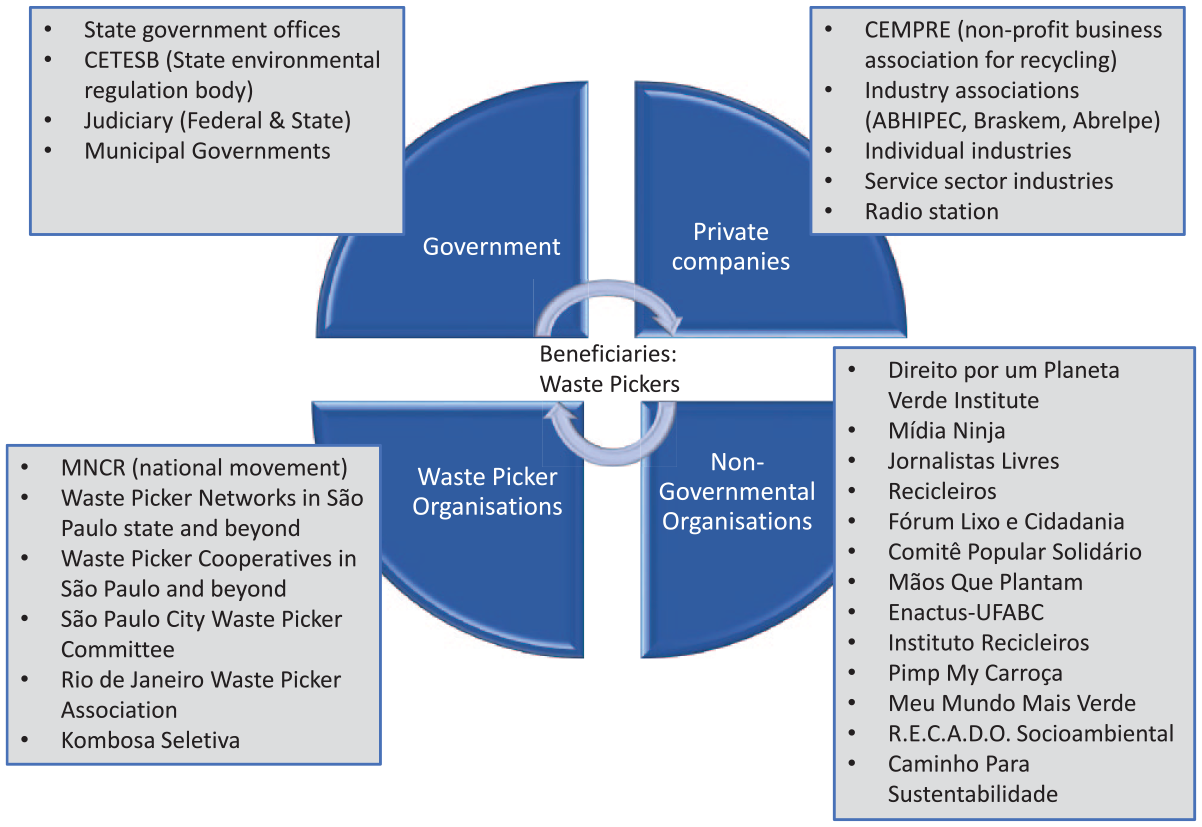
Macro- and micro-level actors and actions, by type of organization
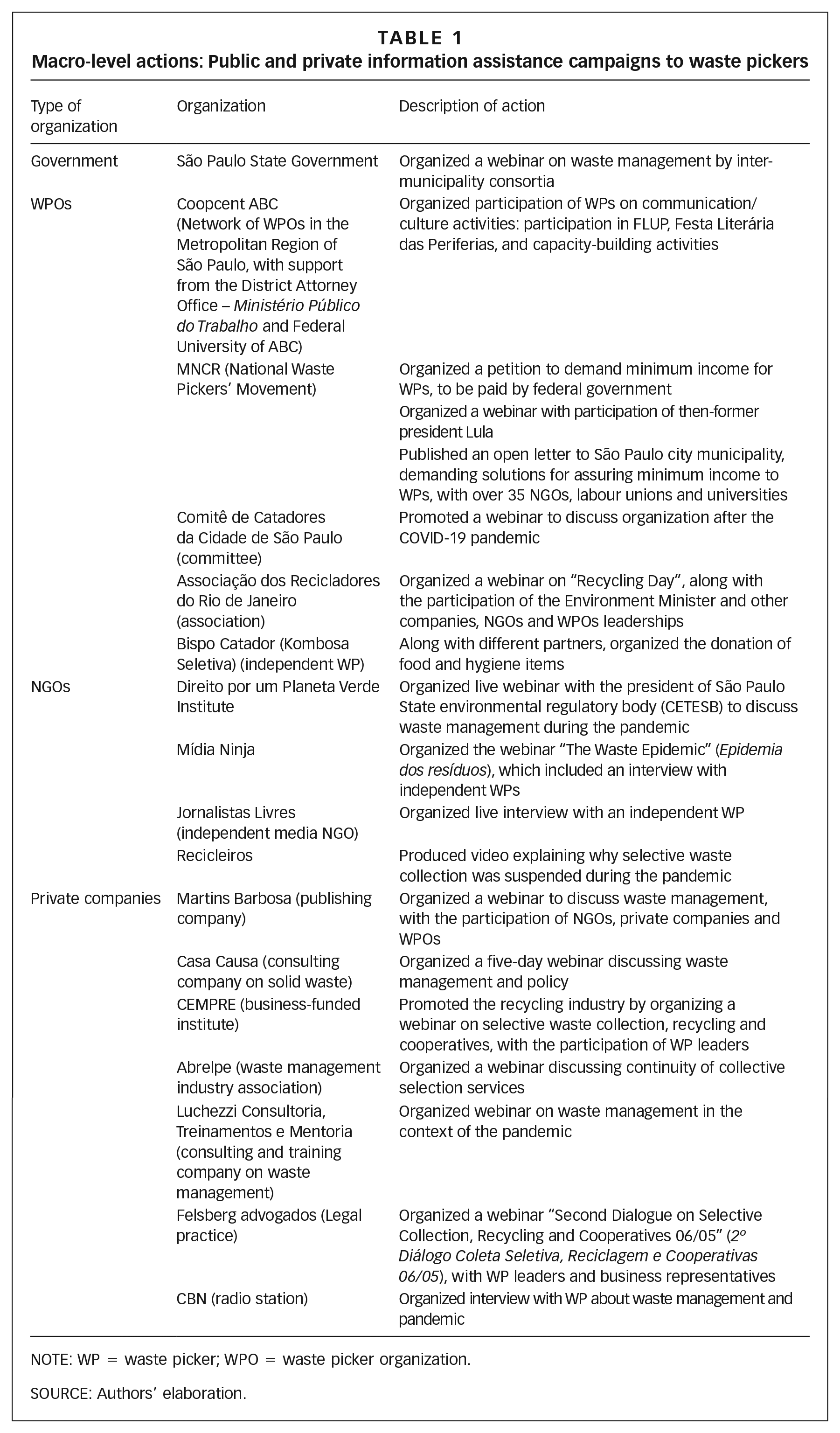
Table 1 provides some background on macro- and micro-level actors and actions, based on the type of organization.
Macro-level actions: Public and private information assistance campaigns to waste pickers
NOTE: WP = waste picker; WPO = waste picker organization.
SOURCE: Authors’ elaboration.
On the macro level, actions were taken by national and state governments, large private companies/national associations and national/state WPOs, and included the creation of emergency regulations by state regulatory bodies. These included the suspension by the state environmental regulation agency CETESB (Companhia de Tecnologia e Saneamento Ambiental) of the reverse logistics agreements in place with industry associations, allowing landfills to receive larger amounts of waste than previously licensed.
Business associations and large companies (e.g. ABIHPEC; Braskem, a petrochemical company; Coca Cola) started to provide support in the form of financial aid and food baskets to approximately 24,000 waste pickers previously involved in reverse logistic services. As we explain below, these regulatory bodies can also create new challenges, as they also respond to demands from other actors in the waste regime whose interests are in conflict with those of waste pickers.
The Judiciary and the State Public Defender’s Office, together with the State Justice Attorneys’ Offices, recommended that state and municipal governments maintain payments to waste pickers equal to at least the minimum wage, during the suspension of their activities.(53) Since the beginning of the crisis, members of the Congress have pressured for a federal emergency programme providing a minimum income to all informal workers of approximately US$ 82 per month, over nine months. Although the programme was implemented, to obtain this benefit informal workers needed to access the internet and register, a difficult hurdle for vulnerable populations.
The National Waste Pickers’ Movement (MNCR) organized a private donation campaign to raise funds for food and hygiene products, based on consultations with local cooperatives. MNCR also organized support for waste pickers who lacked internet access, helping them apply for the government’s emergency pay. During the pandemic, the MNCR also published an open letter to the city of São Paulo, demanding recognition and support as essential service workers.(54)
It is important to note that the benefits to waste pickers in the context of COVID-19 provided by some governmental bodies, private companies and the judiciary were also the result of decades of organized struggle by WPOs (MNCR, local networks and cooperatives), which promote dialogue with these organizations. Moreover, in order to facilitate the access to public and private aid during the crisis situation, WPOs have been actively communicating with local waste picker groups.
Also on the macro level, several online information sources and social media communications were created by different actors, in part stimulated by the lockdown measures. These have included safety instructions for waste pickers under COVID-19 (particularly hygiene measures and risk prevention). A number of social media and webinar discussions also looked to the future, focusing on the need to transform the waste management system in the longer term. Better public policy in this regard is important for this social movement, given the fragility of the role of waste pickers in the waste management system, as evidenced by the crisis. The discourse on technical innovation in waste management (automatization and incineration), meaning the introduction of systems that are more capital- and less labour-intensive, had gained momentum, with arguments of safety raised by the COVID-19 context. Finally, the information and sensitization campaigns run by waste pickers were focused on making the general public more aware of their situation, educating people about segregation of waste by households before it is collected, and reducing risks caused by inappropriate disposal.
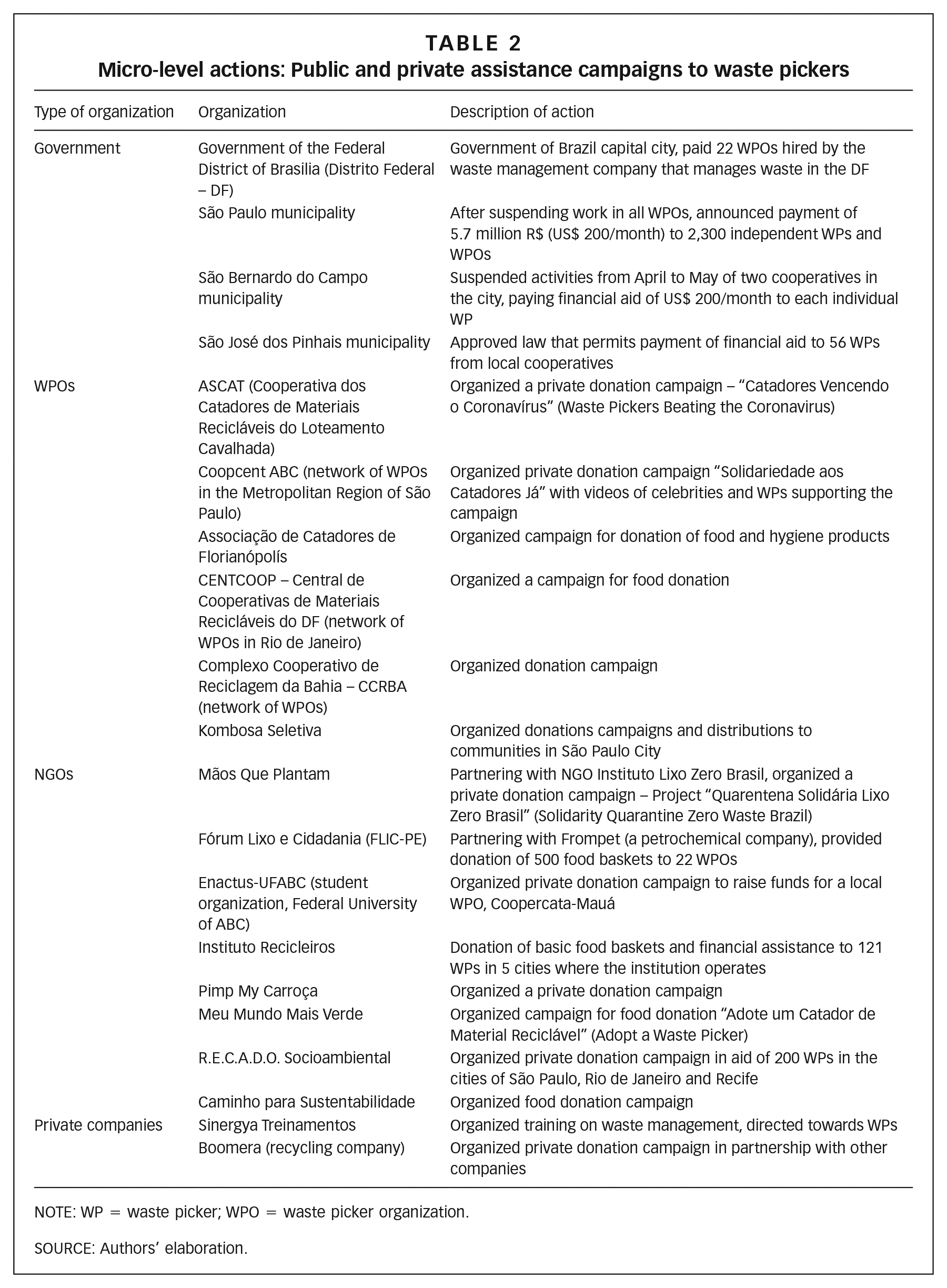
At the micro level, we observed a variety of initiatives organized by various actors to alleviate the effects of the COVID-19 crisis (see Table 2). These actions have mobilized solidarity between public and private agents and helped to generate financial and material aid to waste pickers. A positive spillover of these campaigns is that they contributed to publicize the work and needs of waste pickers, which in the long run is strategic for their movement.
Micro-level actions: Public and private assistance campaigns to waste pickers
NOTE: WP = waste picker; WPO = waste picker organization.
SOURCE: Authors’ elaboration.
The uncertainties during the initial phase of the pandemic resulted in most WPOs being unable to continue to provide the service of separate waste collection to the community. They were forced to stop or to significantly limit their work in order to comply with government health regulations. The immediate result was lack of income. Therefore, waste picker actions have largely entailed fundraising campaigns to buy food and hygiene items and organize their distribution. Government actions for emergency help were primarily focused on the suspension of work in the cooperatives and the payment of small amounts of financial help (ranging from a one-time payment of US$ 100 to US$ 200 per person), handed out to those cooperatives with municipal waste management contracts. Private companies also organized donation campaigns. Finally, NGOs and activists that had long been working with waste pickers also participated in fundraising to buy and distribute basic items.
Information about possible infection passed through waste circulated fast among the workers, which made them more aware and cautious and was one of the reasons why the initial infection rate at work was relatively low among waste pickers. The last important group of actions were directed to improving safety and hygiene among those WPOs that continued with their work during the crisis. It was very common for these cooperatives to take specific different measures to protect their workers, from regularly sanitizing heavily used workspaces, wearing protective equipment, reducing the number of workers per shift, or excluding the vulnerable members in their cooperative from certain activities. Some WPOs also provided COVID-19 tests for symptomatic people, paying out of the cooperative’s budget.
WPOs informed the public about how to properly dispose of COVID-19-related waste (masks, gloves, wipes and so on). The government has also published safety instructions for WPOs, and in some cases provided support for the implementation of protective measures. Private companies donated hygiene items; NGOs developed hygiene instructions and campaigns for the donation of hygiene products.
V. Discussion
During the lockdown most municipalities stopped their selective waste collection programmes and paused existing contracts with waste picker cooperatives.(55) Those groups that were still operating had formally suspended from work those individuals who were part of high-risk groups (for instance, those older than 60 years, and those with certain medical conditions such as cardiovascular conditions or diabetes). However, our study results suggest that approximately half of them were still working.
Prices for recyclable materials dropped significantly after the beginning of the crisis.(56,57) According to a waste picker leader, prices paid in April were generally 30 per cent below the average range before the pandemic. Another challenge that many waste pickers identified on social media was the fact that, once they resumed work, sanitary standards would become stricter, and they considered that most WPOs might be unable to comply with new regulations. This change, however, also provided opportunities to restructure WPOs, with the necessary support of public policies. In exchanges on several online discussion forums, members of WPOs emphasized the fact that they are professionals providing an essential service to the public, and that it is up to the government and supporting companies to make their work safer (providing protection equipment, tests and so on). The pandemic only made the government neglect and the exploitation of these workers by companies more evident.(58) Yet waste pickers continue to play a pivotal role in city health and sustainability, they help keep cities clean and are often the only ones providing critical services in neighbourhoods which have no formal waste collection.(59)
Collection, sorting and recycling are subject to legal and normative provisions applicable to basic sanitation and must be considered essential services since they embody measures that ultimately aim at the prevention of disease and the promotion of public and environmental health, along with the need to preserve fundamental human rights, quality of life and human dignity, as was also expressed by the National Waste Pickers’ Movement.
Many WPOs have acquired new organizational assets and skills as a consequence of being forced to communicate online. This has been an opportunity to use and become familiar with communication software and new online platforms and websites. This in itself can be seen as a gain in capacity. It is important to observe that in the pre-pandemic context of waste pickers’ everyday routine, action was very much directed towards the operation of their recycling businesses, with little time for activities such as the discussion of economic and political situations or long-term planning. These new skills, generated by the burst in online communication between waste pickers, have had the potential to stimulate workers’ participation in management discussions, thus improving governance inside these organizations.
The new communication channels used since the outbreak of COVID-19 have allowed waste pickers to keep in touch, to support each other and to initiate solidarity actions, such as collecting for donations, organizing campaigns and sharing information. New leadership has emerged out of these constraining and challenging circumstances, stimulated by the participation in webinars, open classrooms and debates on and beyond waste management issues.
Keeping in touch through social media has helped many waste pickers maintain a sense of community. By connecting regularly, they were able to deal better with the isolation and social distancing imposed by lockdown, which had negative mental health effects. Furthermore, WPOs have widely disseminated information about risk prevention measures, making personal protective equipment (PPE) available to their members. Even before COVID-19, many WPOs had encouraged the use of PPE, however in most cases the workers did not comply. The level of compliance with wearing protective equipment at work has now increased. This could be temporary, and a fall back is possible once COVID-19 is past. However, waste pickers have been continuously exposed to information on health risks and how to mitigate these at work, which suggests that adaptation could happen.
Interview responses and social media analysis have shown that, from the start, waste pickers were aware of the possible risks of contamination from incorrect disposal of COVID-19-contaminated household waste. Lack of awareness on the part of their customers at the household level regarding proper material segregation at the source has resurfaced in their discussions and demands.
Political challenges at the macro level have gained a specific momentum with the right-wing government which has been in power since 2016. As a social movement, a great challenge during the COVID-19 crisis was the difficulty of mobilizing physically against unfavourable policies. As an association leader stated in a WhatsApp conversation, “waste pickers are paralysed, but their competitors are still at work . . . So, we should fight to make sure we can get back to work in appropriate conditions, supported by public policies.” Current policies follow a tendency towards the privatization of public services and infrastructure. For instance, the incinerator lobbyists are organizing to influence the government to facilitate the implementation of large incinerator projects.(60) A shift towards waste incineration means a long-term diversion of resources away from recycling, affecting the work of waste pickers. Nevertheless, while the legal framework for incineration was approved, the regulation is still pending and there are many uncertainties.
Our research shows that waste picker movements mobilize an extensive network of actors, at both macro and micro levels, and under different institutional settings (government, corporate, not-for-profit) and scales (municipality, states, federal government). The analytical approach we have taken allows us to identify how social movement actors circulate and communicate their demands, sometimes by agreeing and collaborating with localized interests and objectives (such as government objectives of service delivery, or corporate objectives of environmental governance). Our research challenges traditional understandings of social movements by demonstrating how in a crisis situation, such as that generated by the pandemic, WPOs have sought diverse partnerships to address the imminent challenges posed by COVID-19, which were not addressed by the government. Social movements also act inside institutions at several levels – not by a confrontation strategy, but rather by collaborating and by adopting a common understanding of problems and solutions, demonstrated by the tangible actions described in this field note.
Similar to what has been highlighted by Mitlin(61) in the case of urban social movements, organized waste pickers have also drawn on a mix of approaches with different tactics, responding to changing circumstances. They have taken advantage of political opportunities arising from within the corporate sector to access the funding and resources necessary for their survival. At the same time, they have disengaged with the federal government due to its agenda in relation to furthering incineration.
VI. Final Considerations
This field note based on a study conducted with WPOs in Brazil provides the following insights.
First, our data show the immediate negative effects of the COVID-19 pandemic on the livelihoods of the waste pickers,(62) directly affecting their sources of income, their work conditions, their personal health and well-being, while at the same time further privileging capital- and technology-intensive waste management solutions, particularly stimulated by the federal, state and municipal governance and policy schemes.
Second, the research identifies a political shift on the part of the federal government over the period of the COVID-19 outbreak, prioritizing capital- and technology-intensive waste management solutions. This development emphasizes privatization and public–private partnerships for infrastructure solutions to the detriment of the services provided by waste pickers, thus interrupting previous ideas of the Pró-Catador programme. In the past, WPOs and MNCR have been able to influence and, to a certain degree, transform the waste regime in Brazil, with the most obvious example being their input into the National Solid Waste Legislation (PNRS). For many years waste pickers have strongly advocated for separate collection, recycling and resource recovery, and have been major drivers of a social restorative circular economy. During the pandemic, due to a surge in online communication, which connected individual waste pickers and their organizations, topics of citizenship and environmental sustainability have resurfaced in many of the online conversations and webinars.
Third, the study provides insights into how the actions of different actors involved in the social movement of waste pickers have addressed the challenges posed by the pandemic. Based on the common values and identities among the waste picker social movement, waste picker leaders have implemented numerous measures to reduce the vulnerability of these workers. Their actions also demand their recognition as public service providers and policy deliverers, as also highlighted in a previous study.(63) On the one hand, these results show the effectiveness of waste picker leaders in reducing the vulnerability of workers and, on the other hand, call into question the failure of government policy to allow for the broad social and economic inclusion of waste pickers as proclaimed under the Pró-Catador programme.
We can further conclude that at the macro level WPOs formulate and press for the implementation of public policies. In webinars and WhatsApp group conversations, the National Waste Pickers’ Movement (MNCR) has led the discussions on the future of selective waste collection, emphasizing the need for the incorporation of health and safety measures in the collection routine, greater involvement of cooperatives in the fulfilment of reverse logistics programmes and the expansion of appropriate technologies that include them, aiming at local solutions which have economic benefits for waste pickers, local communities and the environment. These discussions have also involved legal advisers, local government agents and companies interested in selling solutions with reverse logistics.
At the micro level waste pickers participate in social networks and social media, conquering new platforms for articulation and new opportunities for partnerships. They share news (sometimes also internationally) about their organizations, about separate collection schemes, and about emergency assistance or social technologies and innovations.
Looking ahead, waste pickers will have to rethink their strategies for acting and working – from accessing new communication tools (online conversations and webinars) to the claiming of space in the debates about collection, transformation and recycling, which are usually dominated by industries. This niche of grassroots innovation and accumulated local knowledge has been recognized, highlighting the waste pickers’ creative skills, allowing them to design and develop specific technologies of processing and ways of organizing.(64) Waste picker leaders have been engaged in encouraging changes in work practices, from demanding the correct use of PPE, to requesting that charges be made to cities and private clients for the essential services waste pickers provide.
Greater organization of waste pickers is urgently needed given the private business interests involved in expanding large-scale sorting and incineration operations. Private and large-scale initiatives have a strong interest in waste, encroaching on resources that waste pickers have long been involved in recovering. The temporary interruption of the work of WPOs has given rise to serious concerns for the waste pickers, as they perceive the thread of losing access to waste, which they consider a common pool resource.
Our study also observes a certain convergence of the social movement with the interests of governments and corporations, demonstrated by partnerships and collaboration between waste pickers and these sectors, which raises critique about possible co-option of the social movement. We question to what extent the publicity around these efforts – including, among others, a general call for support for waste pickers, the business partnerships established with waste pickers, and mayors delivering equipment to waste pickers – is also a strategy for greenwashing the image of companies like Braskem and ABIHPEC, who number among the biggest polluters on the planet. Likewise, we question to what extent collaborating with governments results in keeping policy monopolies as they are (namely large-scale contracts, made mostly with the contractors and landfill operators). We suggest that these collaborations briefly described here as well as the decision-making procedures and power relations be further scrutinized with in-depth studies.
WPOs are SSE organizations that offer comparative advantages, particularly during crisis situations, addressing social, economic and political challenges and channelling emergency support measures. Working within the SSE context allows for alternative perspectives and practices to surface, prefiguring other realities that contest the capitalist status.(65) They provide the opportunity to experiment with new approaches that shift the current waste regime.(66) Indirectly, WPOs tackle the SDGs and can also contribute towards social cohesion, empowerment and the recognition of a pluralistic economy. SSE therefore becomes even more important at times of crisis since the solutions will require, among other aspects, more inclusive and overall sustainable approaches.
Footnotes
Funding and Acknowledgements
We would like to acknowledge funding support from the Social Sciences and Humanities Research Council of Canada (SSHRC Grant No 890-2016-0098). We thank the following graduate students of the Federal University of ABC (UFABC) for their support in this research: André de Luiz Torres, Daniele Tadeu de Oliveira, Lucas Mathias Ribeiro and Mariana Carvalho Mendes. Finally, we also want to acknowledge all anonymous participants involved in the social media communication generating the information that has enabled this research.
