




Abstract
This paper draws on sanitation innovations in Blantyre (Malawi), Chinhoyi (Zimbabwe), Dar es Salaam (Tanzania) and Kitwe (Zambia) driven by slum(1)/shack dweller federations to consider what an inclusive approach to sanitation would involve. This includes what is possible for low-income households when there is little or no external support, no piped water supply and no city sewers to connect to. The paper discusses low-income households’ choices in situations where households can only afford US$ 3–4 per month for sanitation (for instance between communal, shared and household provision). It also considers the routes to both spatial and social inclusion (including the role of loan finance in the four cities) and its political underpinnings. In each of the four cities, the community engagement in sanitation intended from the outset to get the engagement and support of local authorities for city-wide sanitation provision.
Keywords
I. Introduction
This paper reports on an action research project currently underway in four African cities in response to the failures of conventional approaches to urban sanitation. Aware that the percentage of urban residents with access to improved sanitation in sub-Saharan Africa, as defined by global monitoring programmes, has remained at only 41 per cent between 1990 and 2010, this project explores ways to address sanitation needs at scale.(2) The project is being led by federations and networks of community organizations and residents’ associations, and aims to develop approaches that their members will take up, supported by public authorities and private providers. The project implementers recognize that solutions need to be appropriate for very low-income households in diverse circumstances and potentially feasible at a scale that includes all those in need (city-wide). This action research project is designed to offer the potential for scalability, adaptation and replication across the global South.
The project, begun in 2011, has three phases: i) an assessment of the nature and extent of existing provision, including community-led sanitation profiling in informal settlements and some community-led enumerations (surveys); ii) precedents to extend understanding of possible solutions that address immediate needs in a particular location and offer potential for scaling up; and iii) work (ongoing) with the local authorities to plan the extension of existing provision and secure more inclusive sanitation.
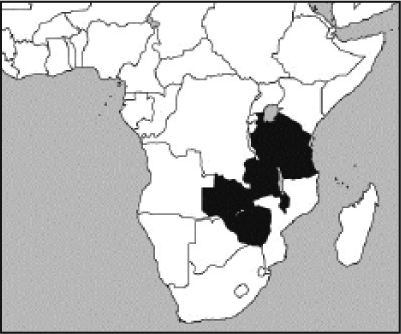
The project is being undertaken in Blantyre, Malawi; Chinhoyi, Zimbabwe; Dar es Salaam, Tanzania; and Kitwe, Zambia, with the city federations of Shack/Slum Dwellers International (SDI) affiliates in those countries.(3) Work is supported by the International Institute for Environment and Development (IIED) and the SDI secretariat. Affiliated federations use savings-based organizing to build social relations between neighbours (primarily women), both to address immediate needs and to enable them to work together to address their development priorities. While the primary activities have been based in these four African nations, actions have also included the work of other SDI affiliates in India, Namibia and Uganda.
To be meaningful to the large numbers without access to adequate sanitation, this action research project has to be relevant for the lowest-income households, reflecting the focus on “inclusion” and “inclusiveness” in current development discourse. These terms are increasingly common in book titles, papers, internet discussions, research programmes, and post-2015 Sustainable Development Goal (SDG) drafts.(4) What does this commitment to inclusion mean, and how does the term relate to such concepts as “pro-poor”, “equitable”, “social justice”, “social exclusion” and “adverse incorporation”? This action research project provides a lens through which to consider this current shift in discourse and action towards the inclusive and inclusionary and offers an opportunity to explore interpretations of these terms. As project activities are rooted in the realities of informal settlement residents, the organizations that they form, the priorities that they establish and the goals that they seek (both individually and collectively), the project is also a chance to explore what these terms mean for grounded actions and experiential learning.
II. Reflections on Inclusion and its Relationship with other Aspirational Terms and Objectives
Inclusion is synonymous with “for all” or universal, and an inclusive approach has to provide for everyone. This focus is relevant to the initial purpose of current “city-wide” action research and its ambition to think through and plan an approach offering sanitation at the city scale. As argued by Hickey,(5) such an approach has substantive political implications and the shift from “pro-poor” to “inclusive” is significant in both conceptual and relational terms. The underpinning conceptualization for action shifts from poverty reduction to social justice, from welfare to rights. This is no longer about helping particular groups in need without attention to scale but about recognizing that all are entitled to receive provision. In terms of the Millennium Development Goals (MDGs), it is the shift from reducing the number living in slums to reaching everyone.
The significance of working at a scale in which the criteria shift from limited to universal, built into state policies and programmes, is substantive. This reduces the realm of discretionary decision-making and replaces it with a public intent to reach all within a politically defined area. The orientation towards substantive scale with an inclusive approach changes the relations between disadvantaged groups, which no longer have the incentive to compete for access to programmes limited in scale, a scarcity in provision that underpins clientelist political relations.(6)
In the context of basic infrastructure such as sanitation, investments are spatial rather than targeted to particular social groups, as in pensions for the elderly for example. MDG 7c undoubtedly provided impetus for stakeholders to focus on sanitation deficits.(7) Nonetheless, it has been critiqued for its focus on reducing by half those without access to sanitation, a target counterproductive to equity and inclusion for the most marginalized groups.(8) Now that the draft SDG focuses on universalizing access to sanitation, debates and discussions around what inclusion and universal access mean in practice have come to the fore. At an international level, UN General Assembly Resolution 64/292 promotes a universal right to safe, clean, accessible and affordable sanitation for all. While global human rights provide useful imperatives for action, their translation into a justiciable process that reflects the complex social and economic factors that lay the foundations for exclusion has long been recognized as challenging. Utilities in the global South often fail to look beyond the extension of traditional, waterborne sanitation infrastructure, although they lack the resources to replicate this approach. Municipal providers are unwilling to recognize and explore alternative sanitation solutions that might be more effectively scaled up. Water Aid(9) attempts to bridge this gap in its policy framework, which advocates inclusion and equity as part of a rights-based approach. Equity is understood here as the principle of fairness and fair access, locally, nationally and internationally; inclusion is understood in terms of both improving access and incorporating marginalized groups into the political system to secure entitlements and input into planning for water and sanitation services.
Reflecting more generally, discussions about inclusion are frequently linked to those related to addressing social exclusion. As illustrated by Chakravarty and D’Ambrosio,(10) social exclusion may be conceptualized at both individual and collective scale; i.e. it may involve definitions about the exclusion of individuals, or may be defined more broadly to consider exclusionary social relations that result in processes of marginalization leading to economic deprivation and various forms of social and cultural disadvantage. What is the relationship between the concepts of inclusion and exclusion? A society that has combatted forms of collective exclusion would be considered inclusive, i.e. without processes of marginalization, and an inclusive society would in general be considered to be one with minimal exclusion. However, in practice many discussions and programmes addressing social exclusion have focused on the needs of particular groups (i.e. people with disabilities). If they involve the particular (individual) rather than the general (collective), then the emphasis may not be inclusive as it is insufficiently broad in scale.
We understand inclusion as a first step forwards greater equity. An equitable approach is inclusive; however, an inclusive approach is not necessarily equitable. Inclusion does not mean that everyone is treated fairly (although in many cases the term is used in that way). Previous events suggest that without inclusion, campaigns to improve provision and address rights are limited in both conception and practice. If everyone is incorporated into receiving even a basic service, then there will be a greater potential for equitable provision. If groups are excluded from access to provision, there is a danger that efforts to improve the quality of provision will ignore their needs and focus on those who already have access. For example, the campaign against water privatization in Cochabamba, Bolivia focused on the fears of those with access to water that costs would increase and the 600 community water systems would be passed to the concession holder Bechtel; hence it ignored the situation of those not connected to the piped network.(11) If those not connected had been included in the campaign, it is likely that there would have been efforts to make water provision more responsive to local needs. Such experiences highlight the need to focus on political inclusion, as a way of both recognizing different groups and incorporating them into encompassing, non-discriminatory political relations, and as a potential route to improved state actions in areas such as sanitation. An inclusive society provides opportunities for policy engagement at multiple scales. If all groups secure political inclusion and can hold public agencies to account, then the outcomes of political processes are more likely to be inclusive. However, we cannot assume that political inclusion is easy to achieve. In terms of efforts towards improved access to basic services, progress is likely to depend on the nature and quality of political relations and the ability of representative structures to manage in the context of resource scarcity and the proliferation of clientelist relations. Substantive political inclusion has proved hard to achieve and multiple forms of exclusion are evident.(12)
This discussion of the inclusion and equity in service provision where resources are scarce brings to the fore the tension between the breadth and the quality of provision. A frequent response to inadequate service provision is the introduction by local authorities and utilities of regulations to ensure particular standards, which exacerbates this tension. An inclusive approach focuses on the breadth of provision. The enforcement of universal high standards may jeopardize breadth by increasing costs. Standards place a minimum requirement on what is acceptable, with little attention to the resulting limits in scale and creation of exclusions (i.e. neighbourhoods and households that are not part of the improvement).
Within this research project, the commitment to achieve scale, and hence inclusion, meant a need to support diverse approaches. This diversity takes into account cultural perspectives on the appropriate treatment of human waste, reflects individual preferences, and prepares all those involved in planning and implementing urban services to adapt to future needs with and without such external dynamics as the changing climate. As argued by Simone, “…there is perhaps a greater need to reinvigorate the plurality of effort that once constituted the path toward durability, this time through a greater plurality of tools and media.” ( 13 )
Applied to sanitation this suggests the following: first, sanitation that addresses the needs of particular groups (such as people with disabilities) makes an important contribution to reducing social exclusion but is not in itself inclusive; second, sanitation provision that takes place at scale is not inclusive if it does not also take into account the specific needs of particular groups; and third, the goal of inclusive sanitation implies that it is a worthy goal even if informal settlements are not fully upgraded with all services. In practice, sanitation services are most effective delivered alongside a number of other public services.(14) However, the logic of this action research project is that it is a valid goal to pursue inclusive sanitation irrespective of other domains of disadvantage such as education.
Fourth, we recognize that standards in water and sanitation have been the focus of a particular literature. Jaglin analyses such needs in Cape Town and argues that, rather than multiple standards resulting in a “splintered urbanism”, a more differentiated approach enables greater inclusion in terms of access to improved basic services.(15) However, she limits the relevance of this approach to the specificity of Cape Town and recognizes that this may formalize intra-urban inequalities “with a risk of locking deprived communities in substandard supply systems dissociated from premium networked areas.”(16) McGranahan argues that in general, standards have been absorbed almost unconsciously in urban development projects such that “a pilot sanitation project set up by an NGO will be treated as a failure if the facilities are not considered to be of acceptable quality, at least in the short run (sustainability, like affordability, is often sacrificed).”( 17 ) An alternative approach is to reach everyone with something, i.e. to abandon standards; or, as was the case in the Million Housing Programme in Sri Lanka, to have a routinized process in which the local residents determined the standards they found acceptable.(18)
With respect to this debate, this research action project has involved multiple reflections on advancing sanitation planning at the city scale. Federation members and other researchers have explored meanings of inclusion and lessons in the context of developing community knowledge, strengthening political voice, identifying solutions usable by all (social breadth), and strategizing how to achieve universal coverage (spatial breadth). Within SDI, however, rather than a focus on “inclusion”, an increasing emphasis is being placed on interventions that are “city-wide”. This does not mean the actual implementation of programmes at this city-wide scale in each urban centre. Rather, it implies, first, an aspiration against which new models, tools and approaches are tested (i.e. what it will take for this to go city-wide); and second, a practice to be followed wherever possible (e.g. the collection of data (profiling) about all informal settlements within the town or city). We return to the relationship between these concepts in the conclusion.
III. Methodology
As summarized above, this action research project is being realized with a community-led transnational network of federations with base organizations in informal settlements. The objective is to secure a model for the realization of pro-poor, city-wide sanitation through four scalable examples in project cities. City-wide sanitation is not viewed as a realistic direct objective within the three-year project period; rather, the objective of the action research project is greater inclusion in the planning of sanitation services. The project is nested within other activities at both affiliate and network level. SDI’s own mission is “to build the voice and agency of slum dweller communities, with a special focus on the role of women, in order to achieve inclusive cities in which the urban poor are to be at the centre of strategies and decision-making for equitable urban development.”(19)
In all four cities, federations and their membership groups were already active before the project began and this three-year programme draws on the methods that SDI communities have developed over the years to address informal settlement upgrading and housing challenges.(20) In the first year, affiliates undertook situational analyses that included profiling and mapping sanitation and water facilities in informal settlements. Federation members surveyed their peers through a sanitation enumeration to deepen their understanding about the situation in informal settlements across the cities.(21) Additional information was gathered from a range of agencies to understand potential resources as well as city-scale difficulties. These analyses were used to strengthen relations between the city federations (and support NGOs) and the local authorities and (in some cities) utilities. In the second year, federations identified and then constructed a range of sanitation solutions to share learning with local authorities and utilities and explore what might be required to scale up solutions. Affiliates developed a structured assessment tool to identify the strengths and weaknesses of their sanitation solutions. Solutions had to both be affordable and take into account the lack of piped water (even where there are pipes) in many informal settlements. Existing federation revolving loan funds helped to multiply the project capital and reach more households.
The cities were selected based on federation relations with their local authorities. Supportive local government is critical if the sanitation challenges facing informal settlement residents are to be overcome. The situation analyses (and ongoing work) enabled SDI affiliates to strengthen these relations, and formal agreements and Memorandums of Understanding (MOUs) helped to advance more participatory planning processes with local authorities. In this, its final year, affiliates are preparing city-scale plans for more inclusive sanitation with their local authorities and (in some cases) utilities. Reflections and understandings have been strengthened through regular exchanges at both the national and regional levels with community leaders and local government officials. SDI affiliates, IIED and the SDI secretariat have participated in documenting the action research processes.
IV. The Experiences of Sanitation Provision
This action research project seeks to address sanitation needs through identifying and overcoming obstacles to developing and implementing effective city-wide sanitation strategies. Drawing on existing research, a preliminary list of key obstacles has been identified: a lack of community organization; an overly sectoral and technical approach; unaffordable technologies and payment systems; and poor community–government relations.(22)
Summary results from the first two phases of the project are given in the tables. Table 1 highlights the appalling situation faced by residents in informal settlements in each city. Definitions of “inadequate” draw from the WHO-UNICEF categorization of improved and unimproved sanitation; but for the affiliates, inadequate sanitation also includes traditional pit latrines in a state of disrepair without anywhere clean or safe to sit or stand, all modern sanitation facilities (pour flush, ventilated improved pit latrines (VIPs), sewered toilets) that are in a state of disrepair, and communal/public facilities that are not maintained. Shared and communal/public facilities that are well maintained are judged to be adequate, and are widely used.
The sanitation situation
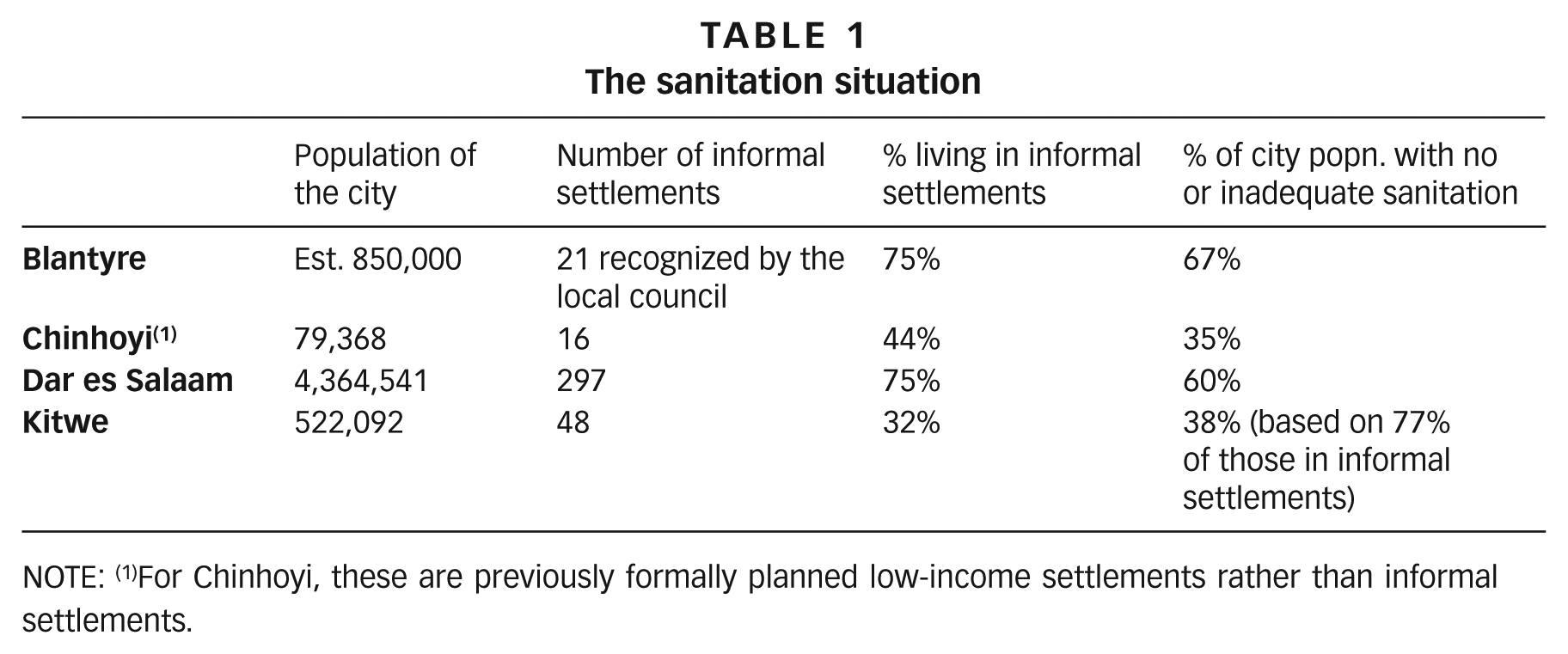
NOTE: (1)For Chinhoyi, these are previously formally planned low-income settlements rather than informal settlements.
Table 2 summarizes the organizing processes of the SDI affiliates in each of the cities, in terms of both the scale of organizations (columns one and two) and the numbers involved in actions to secure improved sanitation (columns three and four). Federation savers are generally the women in the household.
The grassroots organizing process
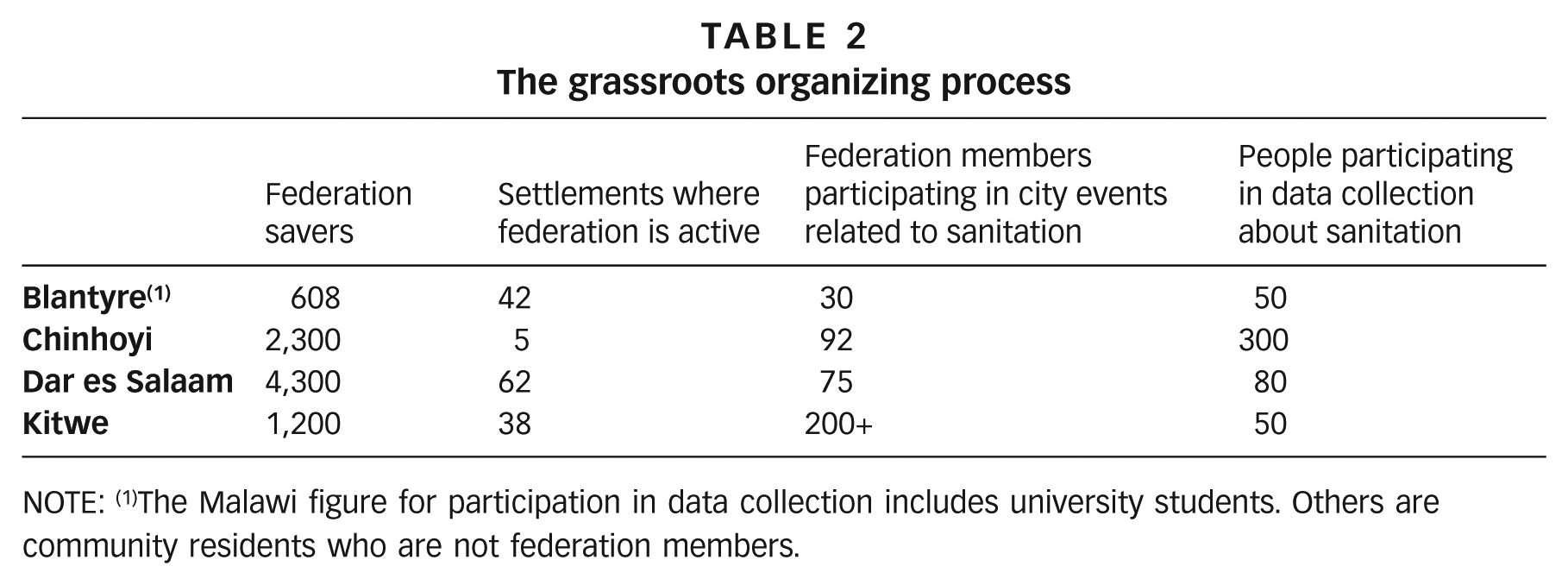
NOTE: (1)The Malawi figure for participation in data collection includes university students. Others are community residents who are not federation members.
Table 3 summarizes the numbers reached by SDI sanitation investments in the four cities.
Households reached with SDI sanitation interventions
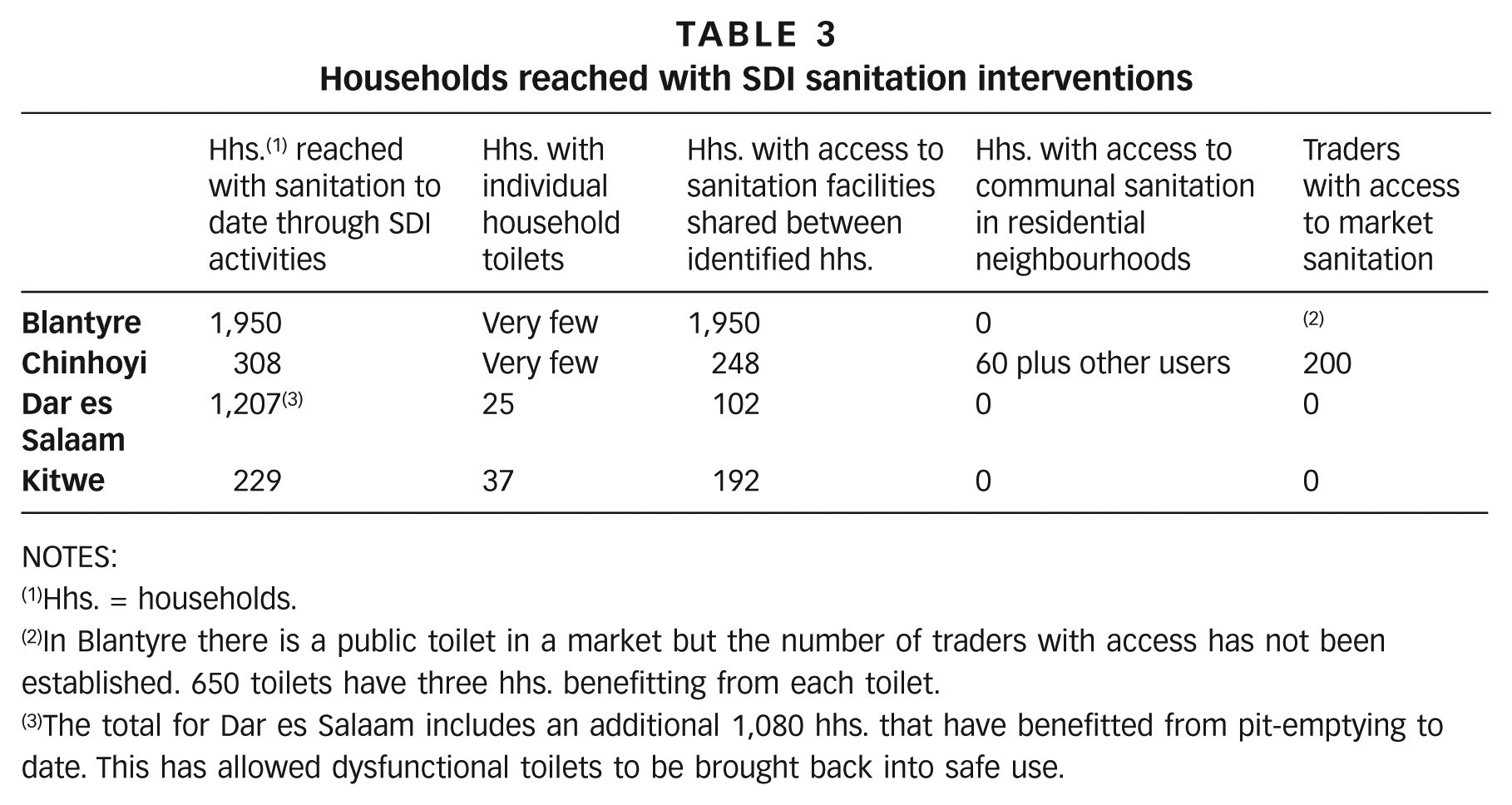
NOTES:
hhs. = households.
In Blantyre there is a public toilet in a market but the number of traders with access has not been established. 650 toilets have three hhs. benefitting from each toilet.
The total for Dar es Salaam includes an additional 1,080 hhs. that have benefitted from pit-emptying to date. This has allowed dysfunctional toilets to be brought back into safe use.
Most households benefitting from these investments have financed some or all of the costs through a loan from a revolving fund established with federation savings and contributions from external agencies. Other costs have been covered by savings. Project finance has been used for the learning exchanges, data collection, planning and project meetings, and documentation. Some project funds have contributed to capitalizing the federation loan funds. To date, none of the four cities has seen a substantial increase in the scale of sanitation provided by the local authority or other responsible agencies such as the utility. The largest number of units has been provided in Blantyre but finance has been from development agencies, not from the city. Nevertheless there have been a number of positive experiences with respect to improving inclusion, as well as some fairly intractable obstacles. As noted above, the purpose of these improvements has been to catalyse local authorities and others to rethink present contributions and to develop a critical mass of relationships and experiences such that there can be a planning process to improve access to sanitation at scale.
a. Federation membership and alliance-building
Building political momentum requires linking across households and settlements. SDI affiliates practice savings-based organizing, which also encourages inclusion within low-income settlements.(23) The emphasis is on the regularity of the process (daily saving), rather than the amount saved, which risks being exclusionary. Once low-income citizens are linked through finance (the very resource that they lack), they gain the assets and capabilities they need to challenge the basis of their exclusion (financial capital, evidence of financial management capacity).
As federation groups have placed greater emphasis on the upgrading of informal settlements, they have realized the importance of reaching beyond their own savers. Drawing particularly on experiences in South Africa (and the alliance between the federation and a group of more traditional grassroots organizations called the Informal Settlement Network) and the longstanding dual form of organizing in India (with Mahila Milan and the National Slum Dwellers Federation), new practices are emerging. Affiliated federations are encouraged to continue strengthening savings practices within women-led associations, at the same time creating broad alliances with other organizations. In the case of our Sanitation and Hygiene Applied Research for Equity (SHARE) cities, the Blantyre Federation is in close partnership with the Blantyre City Council, the University of Malawi, the Polytechnic and the Blantyre Water Board, and has plans to reach out to other water, sanitation and hygiene (WASH) organizations in the city to share experiences and avoid duplicating efforts. In Dar es Salaam, the federation offers sanitation loans to both its members and other households. The Zambian Federation has collaborated with the Nkana Water and Sewerage Company, the commercial utility mandated to provide water and sanitation to the city. Federation artisans provided technical assistance in the design and construction of ecological sanitation (ecosan) toilets, and trainings were held at the federation housing site in Kawama under the Nkana Water Supply and Sanitation project.
b. Inclusion as a political act
As noted in Section II, one meaning of inclusion is in terms of political relations with respect to both universal suffrage and inclusive participatory processes, with an emphasis on the active engagement of different kinds of groups. A number of aspects are relevant to this project. As noted above, the first phase was a situational analysis that included data collection on the specific situation of households in sanitation need. This provided the basis for federations to engage with their local authorities over the conditions in informal settlements. For example, a federation member in Blantyre explained: “I think the government is not being honest and is painting a very wrong picture about how we live… Maybe this is why it is doing nothing to improve our plight in the informal settlements. Let the people that compile this data come to our community and see how we live, not just guess the figures from their offices…”(24)
Information collection is a means to strengthen political voice through a public representation of need, providing a data platform for participatory planning and budgeting and co-production of basic services. Information collection also helps to bring different organizations together, and the aggregation of grassroots groups helps to ensure their legitimacy. Community organizations that seek some formality in their relations with the local authority are often challenged for demanding special favours and might be dismissed as one among many – if the council included them it would have to include others. An aggregation of community organizations helps to challenge such arguments and ensure that informal settlement dwellers are included in local authority deliberations.
For the groups involved in this research, information collection has been a way for community leaders to understand and represent the sanitation situation in informal settlements. The community activists gain confidence from what they are doing and feel more able to articulate the benefits of aggregation. Loveness Mposa, a community leader in Blantyre, spoke about her own shock at the conditions she observed during the processes of data collection. In a meeting with the local authority in Kitwe,(25) the deputy mayor observed the report of conditions in one settlement and said that he was appalled and would himself see that the residents were relocated to another informal settlement with better conditions. The federation was able to present further information, showing that conditions were as bad in other areas, and arguing that the only solution was the upgrading of all informal settlements. The deputy mayor agreed that relocation did not make sense because of the lack of alternatives.
The catalytic potential of an information data base has been shown in the nature of responses to SDI profiling and enumeration. In Blantyre, for example, the demonstration of the sanitation need enabled the federation to negotiate successfully with its member of Parliament and receive a new health centre. The relatively neutral placing of information in the public domain offers local groups and their needs some legitimacy in the eyes of authorities, who nominally recognize their own responsibility for these areas.
A further process through which an inclusive politics can be realized is through the co-production of basic services by organized communities and the state. The experiences of co-production have been well documented.(26) Co-production, when coordinated by associations of informal settlement dwellers, provides a route through which low-income households can be more proactive in engaging with the state. In practice, information collection has been co-produced (as local authorities have been drawn into participating in activities) and, to a more limited extent, sanitation interventions, as local authorities have assisted with planning permission, regulatory reforms and technical assistance.
The emphasis of SDI affiliates on political inclusion has had two direct institutional impacts in these four cities. First, there have been attempts to establish working committees including both council staff and federation members. This has been successful in Blantyre, Chinhoyi and Kitwe with the focus on informal settlements; more recently, municipal fora have been set up in Dar es Salaam to consider a number of issues including sanitation. Such committees are seen as supplementing a representative political process. Public meetings are attended by both council officials and political representatives. In three of the cities there are elected representatives. In Blantyre there were no elected councillors but there are traditional leaders who engage systematically with federation members and have been active in sanitation discussions with the council and in their own settlements, encouraging residents to take out loans for sanitation investments. Local councillors have now been reintroduced in Malawi.
Second, in Blantyre, a participatory budgeting process was introduced in 2012 and is still continuing. This enables stakeholders, including the federation, to influence budget priorities. Such processes provide a route through which groups not generally involved in political decision-making can make their voice heard, help to identify common priorities and have these priorities realized. Federation leader Mphatso Njunga reflected on what the federation leaders have learnt from these experiences: “The first year, we went there and they were telling us what has been done. This year it was different. Community leaders were asking council about where they get the money.”(27)
c. Inclusion and sanitation investments
Any strategy to secure inclusion has to address the need to raise resources at a scale that is appropriate to need. Of course, the scale of resources required relates to the particular strategy through which sanitation is to be provided. As illustrated by Hasan, Orangi Pilot Project strategies are considerably more cost-effective than traditional waterborne sanitation approaches.(28) Reusing existing resources more effectively may be considered complementary to securing additional resources; arguably both will be needed to provide sanitation at scale.
As shown in Table 3, there has been slow progress in extending sanitation services at the scale required for city-wide inclusion. It should be emphasized that city-wide sanitation was not a direct objective of the action research, which focused rather on greater inclusion in the planning of sanitation services. Experiences have highlighted multiple constraints to the scaling up of sanitation including the high cost of sanitation, limited state budgets and limited loan funds. Planning for city-wide sanitation requires low-cost solutions that can be rolled out relatively easily; ideally there are minimal initial investment costs, and when households are financially secure they can make additional improvements.
In a context in which state budgets have been limited, affiliated federations focus on ways to reduce the unit cost of existing solutions rather than identifying new and alternative approaches that may be more cost-effective when implemented at greater scale. For example, as shown below, considerable emphasis has been given to reducing the cost of ecosan; however, it is evident that if a significant number of households within any neighbourhood invested in sanitation services at the unit cost of ecosan (US$ 250–500 per unit), then other options such as piped sewers would become affordable. The lack of subsidies means that federation groups have been used to thinking that investments will be limited and planning accordingly. Without subsidies, affordability is a major constraint. Individual household toilets are particularly expensive and shared facilities or public (communal toilets) are cheaper. Sanitation provision potentially involves two kinds of sharing: shared toilet facilities and shared waste management processes. Individual waste management is known as on-site and collective waste management is known as off-site; the exception is septic tanks shared between a couple of households, which are likely to be “on-site” for one of them.
In terms of models with on-site waste management (with individual or shared toilet facilities), SDI affiliates in Southern Africa have been investing in an ecosan model known as “skyloos” in which the toilet is raised to facilitate access to the dried faeces and reduce risks from flooding. This model emerged from Malawi and has since spread to Zambia and Zimbabwe. The model does not require a public sewer network, an asset for federation groups. The Zimbabwean Federation has innovated considerably to reduce the ecosan to US$ 250 per unit (suitable for being shared among up to three households). It has experimented with models costing as little as US$ 100 but has concluded that these are not hygienic as they are not raised high enough to prevent flooding in the rainy season. In many cases, these ecosan toilets are provided for individual plots on which both landowners and tenants are living. The Malawi Federation has also used them in a market toilet (see Section VIe) but other experiences suggest that this is a difficult design for people to use without education and monitoring to ensure the separation of urine and faeces, and the use of ash to maintain the necessary dryness for the composting process and reduction of the smell. In Harare, ecosan toilets shared among five households or more proved difficult to maintain for this reason. Alternative innovations continue to be sought; of potential relevance is a sanitation project being undertaken by the federation in Kenya in a greenfield development. The waste from ecosan toilets in each dwelling is collected each week and processed in one location within the settlement.
Other individual or shared plot toilet technologies have also been used. In Kitwe, the intention to share septic tanks did not work out for logistical reasons, but they were installed for individual households. Improved pit latrines have been used in Dar es Salaam. In Chinhoyi, in a few neighbourhoods, households can connect to a sewer line, but this is exceptional in our four cities. All such examples may involve sharing between landowners and tenants occupying one plot. There have long been concerns that such investments are associated with increased rents. The federation in Dar es Salaam introduced an agreement for landowners receiving federation loans for sanitation, whereby rents will not increase for existing tenants for at least three years after the toilet is built.
In terms of the treatment of sanitation waste, collective septic tanks and other forms of decentralized wastewater treatment provide further options and are of interest to SDI affiliates. The use of decentralized wastewater treatment is attractive at the settlement level because of the potential economies of scale and improved affordability but also the possibility of on-plot toilet facilities. There are collective organizational challenges, i.e. it has to be maintained, but SDI savings schemes have demonstrated the capacity for local organization. The federation in Dar es Salaam has an existing treatment pond in a greenfield site but the construction costs were very high. The SDI affiliate in Malawi has invested in two treatment plants, but both are in greenfield areas that are being developed by the federation for rental to lower-middle income households. The Blantyre Federation is impressed by the decentralized wastewater treatment and is working to replicate this technology in an informal settlement. Two issues have emerged in addition to affordability: water availability and the required access to land, particularly in the case of informal settlements. Despite such issues, this technology continues to be of interest. The federation in Dar es Salaam is also looking to build on its experience of developing a decentralized wastewater treatment plant in a greenfield development (see above) with a smaller scheme for 20 plots in an existing settlement adjacent to waste ponds; and a decentralized waste water treatment is also being considered for Epworth, a small town settlement in Zimbabwe with quasi-legal status.
There has been some experimentation with more public solutions that offer access to tenants whose landowners cannot or will not pay for on-plot sanitation, and for households that cannot afford the investment. In Chinhoyi, an existing public toilet block for households renting from the council is being upgraded in a very dense area with no room for in-house toilets. Communal toilet blocks have been constructed by councils in residential areas in Namibia, but experiences are not positive and most members prefer shared toilets if individual toilets are not possible.(29) Management is particularly difficult as the population is dispersed, with plots of at least 200 square metres. The problem of supervising communal facilities is noted by federations in all four cities. Federation groups in Mumbai’s dense informal settlements have successfully managed public toilet blocks in residential areas; here state subsidies are available and hence local residents only have to cover the costs of maintenance and not repay the capital cost of construction.(30) Across the Mumbai Metropolitan Region, over 900 blocks have been provided, servicing 865,000 people. The high densities within informal settlements further encourage Indian households to support such provision. Mahila Milan (a network of women’s savings schemes) has designed a community-managed block with separate areas for men, women and children and live-in caretakers; it offers a monthly subscription for residents costing only one to two dollars. Small toilet blocks are now being developed in Kampala, but this only began in 2014 and it is too early to assess their potential. These blocks are to serve a smaller number of households (the densities in Kampala are lower than those in Mumbai) and the best management solutions still have to be identified. Following an exchange visit to Mumbai, the Kampala Federation believes that monthly subscription charges are important for affordability.
d. Affordability and inclusion
In the absence of state subsidies, low-income households find it difficult to accumulate the funds needed for sanitation investments. In general, households lack the available capital and seek access to loan funds.(31) SDI tools include the establishment of national and/or city-based loan funds that are capitalized by both members’ savings and donor contributions. Considerable efforts have been put into securing monies from national and city governments, but in the four SHARE cities, that has not yet been successful. The Harare City Council has worked with the Zimbabwe Federation to establish a jointly capitalized loan fund for upgrading; but this has not yet been replicated in Chinhoyi.
In all four cities, there has been significant lending activity to increase the affordability of sanitation investments. Loans are typically for between one and three years at 1 per cent a month interest. Amounts borrowed vary between US$ 150 and US$ 625 across the four cities, with the average loan ranging from US$ 220 (Chinhoyi) to US$ 450 (Dar es Salaam). The local federation group works with applicants to complete an affordability assessment. A new challenge faced by local groups, with their expanding activities, is requests for loan finance from households that are not federation members and have no savings records. As a result of earlier access to African Development Bank funds to improve access to piped water, the federation in Blantyre already had experience lending to non-members. Drawing on these experiences, in Chinhoyi and Dar es Salaam, sanitation loans are now being made available to non-federation households.
Lending experience varies across the four cities. In Blantyre, over 600 sanitation loans have been made to both federation and non-federation members. Here systems are strong and the funds are being recycled; 78 per cent of loans are repaid on time. In other locations, loan repayment ranges from 30 to 45 per cent, in part because of the rising costs of construction and the need for additional monies to be raised to cover construction costs. Some of these loans have been made to landlords, and federation loan managers believe that weak repayment collection systems and borrowers who are not very committed to repayment may be problems in this case, rather than financial difficulties. Particular difficulties have been experienced in Chinhoyi, where sanitation is being provided to very vulnerable groups. In Zimbabwe a further concern is that some households are overextended, having also borrowed for housing improvements. The monitoring systems of the national loan fund here are currently being restructured with stronger emphasis on the purpose of the fund and the introduction of loan officers to monitor disbursement and loan management.
Ongoing discussion within the SDI network suggests that most households are unlikely to be able to afford more than US$ 3–4 per month. Very crudely, this assumes monthly household incomes of about US$ 50 (one person working), with about US$ 10 going to rent and the remainder to food and essentials. The very low incomes of large numbers of informal settlement dwellers mean that many households cannot afford ecosan, as the general assumption within SDI is that such loans should be paid off within two years. If local authorities invest in bulk infrastructure, i.e. piped water, sewers and waste treatment plants, then the affordability of adequate sanitation facilities is greatly increased. In the absence of such support, federations have been encouraged to consider communal solutions.
e. The challenge of diversity
As noted above, inclusive solutions need to account for heterogeneous populations and multiple contexts across towns and cities of the global South. Work in Chinhoyi in particular has had to deal with significant spatial diversity. Some households are close to sewers and have successfully connected their homes. Distance and a lack of water for piped systems has provided further stimulus for taking up ecosan in Chinhoyi and across Zimbabwe. In both Chinhoyi and Kitwe there have been sanitation loans for households in formal areas.
Different households also have different needs. The design of the sanitation block constructed by the Ugandan Federation in Kinawataka Market (Kampala) sought to reflect the needs of people with disabilities, with a ramp rather than steps, and a toilet designed for easy wheelchair access. However, the access paths through wooden market stalls make it very difficult for wheelchairs to approach the block. In Malawi, a bench-type toilet with ramp is in use in public toilets. And communal toilet blocks in India have provided for children with small toilets with handlebars. The emphasis on individual toilets within the four cities has reduced the focus on particular needs. Households with particular requirements adapt designs as required. In Tanzania, for instance, members with disabilities have been using a pour flush design rather than the ecosan toilet because of the difficulties of access.
Traders and market users also require access to sanitation facilities. In many cases they come in from rural areas for the day, and the public market areas have limited opportunities for open defecation. Public or communal toilet blocks have been successfully introduced by several African SDI affiliates in market areas. There are well-established market toilets with effective management models in Mbare (Harare) and in Blantyre. The federation in Blantyre is replicating its successful model in two other sites, and in Kitwe, the federation has been promised market sites by the authority but progress has stalled. The primary emphasis in the four cities has, however, been on residential sanitation, rather than those needing employment-based facilities.
V. Conclusions
What does this action research project suggest in terms of our understanding of inclusion, and what it takes to be inclusive? Using the existing methodologies and approaches of a transnational network, this project has provided a chance to reflect and further develop approaches that help SDI affiliates as they seek to engage with city authorities and jointly develop approaches to sanitation that are relevant at the city scale.
Our experiences highlight that inclusion is a multi-faceted concept that needs to be unpacked if it is to be achieved. Inclusion as political involvement, even if not fully recognized by local authorities, resonates with SDI practices. As elaborated above, the project began by building on SDI’s existing data collection practices to analyse the scale of need across the four cities. Federation leaders recognize the importance of a platform around which existing community groups and unorganized households can come together, increase local authority and utility recognition of the needs of those in informal settlements, and demonstrate the commonality of their experience. Federation groups willingly reached beyond their own membership to build a process of data collection in informal settlements across the four cities. While they continue to emphasize the importance of savings-based organizing, they also recognize the importance of extending their networks to increase their visibility, and support greater numbers of low-income households to come together and influence the state.
In terms of the nature of sanitation provision, and drawing on Jaglin’s earlier conclusion that differentiation allows more inclusive access to improved basic services, it is evident that local communities have their own views about what is progressive in terms of sanitation provision, and that their views change with their experiential learning. Within this action research project, identified precedents in each city have provided a chance to rethink existing sanitation solutions and challenge traditional relationships between state and household. The potential contribution of ecosan has been recognized and groups have worked with local authorities to ensure it is an acceptable option, compliant with regulations. Local groups have also worked hard to demonstrate that communities can manage communal toilet blocks, despite the scepticism of local authority staff. Through such efforts, local authority staff and politicians at multiple levels have been drawn in to play an active part, particularly in Blantyre, Chinhoyi and Dar es Salaam, where engagements have strengthened during the course of this project. New solutions to sanitation have helped to improve provision, particularly for those households that are not close to existing sewers.
However, experiences also highlight the challenges as efforts are made to provide universal access. Most notable are difficulties with affordability. This is evident at the household level with difficulties in repaying loans, and is exacerbated by the lack of public finance to support the extension of sanitation systems at the scale required. And while modifications to existing designs have been made, there has been limited investigation of designs that are suitable for people with limited mobility.
There are concerns about equity within all four affiliates. These are manifest in particular in discussions about dissuading landlords from increasing the rents as a result of taking on sanitation loans, and in concerns about tenants whose landlords refuse to improve the sanitation. They are also manifest in attempts to reduce the cost of existing models for sanitation, particularly ecosan. Such concerns are also evident on a bigger scale; federation leaders have recognized that the emphasis in the project on scale has been important in shifting their own horizons.
What is notable is that it is not the word that matters but the vision encapsulated by that word. The shift to scale matters – be it represented by “city-wide”, “inclusion”, “universal” or any similar word; it demands a different way of seeing and doing, with implications for both learning and action.
Footnotes
Acknowledgements
1.
The term “slum” usually has derogatory connotations and can suggest that a settlement needs replacement or can legitimate the eviction of its residents. However, it is a difficult term to avoid for at least three reasons. First, some networks of neighbourhood organizations choose to identify themselves with a positive use of the term, partly to neutralize these negative connotations; one of the most successful is the National Slum Dwellers Federation in India. Second, the only global estimates for housing deficiencies, collected by the United Nations, are for what they term “slums”. And third, in some nations, there are advantages for residents of informal settlements if their settlement is recognized officially as a “slum”; indeed, the residents may lobby to get their settlement classified as a “notified slum”. Where the term is used in this journal, it refers to settlements characterized by at least some of the following features: a lack of formal recognition on the part of local government of the settlement and its residents; the absence of secure tenure for residents; inadequacies in provision for infrastructure and services; overcrowded and sub-standard dwellings; and location on land less than suitable for occupation. For a discussion of more precise ways to classify the range of housing sub-markets through which those with limited incomes buy, rent or build accommodation, see Environment and Urbanization Vol 1, No 2 (1989), available at  .
.
3.
SDI is a transnational network of federations of the homeless and landless urban poor working in more than 400 towns and cities and 34 countries across the global South. The affiliates of SDI involved in this action research project are the Malawi Homeless People’s Federation and the Centre for Community Organisation and Development in Malawi, the Tanzania Federation of the Urban Poor and the Centre for Community Initiatives in Tanzania, the Zambia Homeless and Poor People’s Federation and People’s Process on Housing and Poverty in Zambia, and the Zimbabwe Homeless People’s Federation and Dialogue on Shelter in Zimbabwe.
4.
Goal 6 draft at December 2014: “Ensure availability and sustainable management of water and sanitation for all”. Goal 6.2: “by 2030, achieve access to adequate and equitable sanitation and hygiene for all, and end open defecation, paying special attention to the needs of women and girls and those in vulnerable situations”. Available at .
5.
Hickey, S (2013), “Thinking about the politics of inclusive development: towards a relational approach”, Effective States and Inclusive Development working paper, University of Manchester, Manchester, pages 3–4.
6.
Mitlin, D (2014a), “Politics, informality and clientelism – exploring a pro-poor urban politics”, Effective States and Inclusive Development Research Centre, University of Manchester, Manchester.
7.
MDG Target 7c: “By 2015, halve the proportion of people without sustainable access to safe drinking water and basic sanitation”.
8.
Lane, J (2012), “Barriers and opportunities for sanitation and water for all, as envisaged by the New Delhi statement”, IDS Bulletin Vol 43, No 2, pages 13–20.
9.
Gosling, L (2009), Equity and inclusion: A rights-based approach, WaterAid, London.
10.
Chakravarty, S R and C D’Ambrosio (2006), “The measurement of social exclusion”, Review of Income and Wealth Vol 52, No 3, pages 377–398.
11.
Perreault, T (2006), “From the Guerra Del Agua to the Guerra Del Gas: Resource Governance, Neoliberalism and Popular Protest in Bolivia”, Antipode, Vol 38, No 1, pages 150–172.
12.
Roberts, J M and N Crossley (2004), “Introduction”, in N Crossley and J M Roberts (editors), After Habermas: New Perspectives on the Public Sphere, Blackwell Publishing, Oxford, pages 1–28.
13.
Simone, A (2014), “ ‘We Are Here Alone’: The Ironic Potentials and Vulnerabilities of Mixed (Up) Districts in Central Jakarta”, International Journal of Urban and Regional Research Vol 38, No 4, pages 1509–1524, page 1522.
14.
McGranahan, G (2013), “Community-driven sanitation improvement in deprived urban neighbourhoods: meeting the challenges of local collective action, co-production, affordability and a trans-sectoral approach”, SHARE working paper, London School of Hygiene and Tropical Medicine, London.
15.
Jaglin, S (2008), “Differentiating networked services in Cape Town: Echoes of splintering urbanism?”, Geoforum Vol 39, No 6, pages 1897–1906, page 1902.
16.
See reference 15, page 1905.
17.
See reference 14, page 28.
18.
See PLA Notes CD-ROM 1988–2001, Chapter 14, accessed 6 December 2014 at .
19.
Shack/Slum Dwellers International Strategic Plan 2013-7, page 5.
21.
For more information on SDI data collection tools and methods, see Environment and Urbanization (2000), Vol 12, No 1, available at .
22.
See reference 14.
23.
Mitlin, D, D Satterthwaite and S Bartlett (2011), “Capital, capacities and collaboration: the multiple roles of community savings in addressing urban poverty”, IIED Poverty Reduction in Urban Areas, Working Paper 34, International Institute for Environment and Development, London; also d’Cruz, C, S Cadornigara Fadrigo and D Satterthwaite (2014), “Tools for Inclusive Cities: The Roles of Community-Based Engagement and Monitoring in Reducing Poverty”, Human Settlements working paper, International Institute for Environment and Development, London.
24.
25.
April 2013.
26.
Mitlin, D (2008), “With and beyond the state — co-production as a route to political influence, power and transformation for grassroot organizations”, Environment and Urbanization Vol 20, No 2, pages 339–360.
27.
Mitlin, D (2014b), “Achieving universal sanitation: Sharing the experience of the SDI affiliate in Blantyre, Malawi”, IIED blog post, 27 October, available at .
28.
Hasan, A (2008), “Financing the sanitation programme of the Orangi Pilot Project–Research and Training Institute in Pakistan”, Environment and Urbanization Vol 20, No 1, pages 109–119.
29.
Gold, J, M Namupolo and Namibia Housing Action Group CLIP team (2013), Sanitation Issues in Namibia, Research report, SHARE, London.
30.
See the article in this issue from S Patel and the SPARC team.
31.
In Namibia, members of the Shack Dwellers Federation avoid loans and use their savings to connect to sewerage networks laid by both municipalities and their own organized communities.