




Abstract
In two informal settlements in Johannesburg, South Africa, stormwater drainage interventions were investigated and compared. In the case of Elias Motsoaledi settlement, the intervention was state-led; in Slovo Park settlement it involved community-based initiatives. Both settlements are vulnerable to runoff-related disturbances. State-led stormwater management interventions in informal settlements are embedded in a context that can create various concerns and contradictions, participatory challenges, and political influence. Community-initiated approaches can also have limitations and coping strategies can be minimally effective. The state’s central role is clear from both cases and it highlights the need for integration between the state-led and communitarian approaches towards co-producing meaningful drainage and infrastructural intervention in informal settlements.
I. Introduction
In this post-millennial period, informal settlements are gaining greater attention from actors in the urban realm in low- and middle-income countries. Part of this attention is focused on the delivery of the kinds of services and infrastructure that are available in formal urban areas. Stormwater drainage is an important component of the infrastructure that needs to be improved in informal settlements.
Infrastructural interventions and service provision are usually undertaken by the state, through the local government and municipal agencies. Residents in low-income neighbourhoods, organized through local community-based groups, also undertake initiatives to supply lacking services and infrastructure, especially stormwater drainage. This can happen with or without external assistance. Communities often draw on their own resources to meet this and other critical needs.(1)
Despite both state-led and community-initiated contributions, infrastructural inadequacy is still widespread, and the gap in provision in many cities is still wide. State-led service delivery and development routes have not effectively reached the urban poor, who are often located in informal settlements.(2) On the other hand, community-initiated interventions are generally characterized by the inability to scale up as well as by slow pace of delivery, low quality of infrastructure delivered, inadequate funding, and intra-communal dissension that can negatively affect outcomes.(3) John Parkinson and colleagues show that drainage interventions in informal settlements that over-emphasize community involvement or principally utilize a non-participatory state-led/technical approach usually get derailed.(4)
Given these shortcomings, this paper draws attention to the need to explore the potential synergies of coordinated interventions, matching “direct attempts by the urban poor to address their needs through collective processes and activities”(5) with state-managed, professionally-directed, at times internationally-funded approaches to infrastructural delivery in informal settlements, or supplementing community-based initiatives with public utilities/resources.(6) This paper reports on two different stormwater drainage interventions in informal settlements in the City of Johannesburg (CoJ), one state-led, the other community-initiated. It reveals shortcomings and points to the role that co-production could have played in these situations.
II. Urbanization, Changing Climate and the Stormwater Challenge in Informal Settlements: A Reflection on Johannesburg
Urban growth increases the need for well-managed stormwater drainage systems. As cities grow, more areas are covered with buildings and impermeable paving, increasing the amount of water to be removed by drainage during or after precipitation. In the course of construction, vegetation removal and change in soil conditions (mostly through compaction) reduce soil’s capacity to retain water and resist erosion. In Johannesburg, Botha observed that removal of natural vegetation and its replacement with lawned gardens and paved areas resulted in polluted water entering the Fourways Spruit and erosion of its streambed.(7) Hydrological consequences following these urban land use/land cover changes imply, quantitatively, increased volume of runoff peak and reduced time to runoff peak and, qualitatively, the degradation of natural habitat/water courses.
Challenges associated with stormwater management are pronounced in an urbanizing African city like Johannesburg. Weak urban planning and management, poorly enforced development control mechanisms, population growth and poverty often give rise to low-income, informal settlements. These settlements, in Johannesburg and other South African cities, emerge with little or no consideration for drainage, thus presenting problems for the management of stormwater.(8) In these informal settlements, stormwater is usually contaminated by greywater, which might contain elevated faecal bacterial loads.(9) The stormwater challenge is also exacerbated by extreme weather occurrences attributable to change in the global climate system. A climatic element like precipitation directly and indirectly influences stormwater management in Johannesburg.
Notwithstanding the inconsistencies that at times characterize climate projections in Africa, available evidence shows increasing variability in precipitation events. A few studies have focused on Johannesburg. Analysis of historical weather data from the OR Tambo weather station for the period 1960–2009 shows a significant decrease in the number of thunderstorms and a decrease in total rainfall over the study period in Johannesburg, but a highly significant increase in the average rainfall per storm.(10) The highest number of days with heavy and very heavy rain from 1977 to 2009 occurred in January.(11) Trends in precipitation were also investigated as part of the City of Johannesburg’s Climate Change Adaptation Plan. Based on data from the Krugersdorp weather station, climate models analysed indicate that “rainfall may be expected to increase moderately, but significantly, into the future”, which “would potentially be accompanied by a lengthening of the rainy season, particularly into early autumn and potentially starting earlier in spring as well, and an increase in both the frequency and intensity of rainfall”.(12)
The increase in average rainfall per precipitation event, supposedly as predicted, has been a notable factor in flooding in Johannesburg. Most victims of these city-wide occurrences are from informal areas. A review of press reports and government statements from 2009 to 2014 identifying flood impacts in informal areas of Johannesburg (Table 1) confirms this post-rainfall flooding pattern. Presently, upgrading and maintenance of stormwater infrastructure are under-resourced in the city. Increased pressure from more rainfall would increase the risk of flooding as the under-efficient system might be overwhelmed, so that poorly drained informal settlements become more vulnerable.
Flood impacts on informal settlements/areas in Johannesburg (2009–2014)
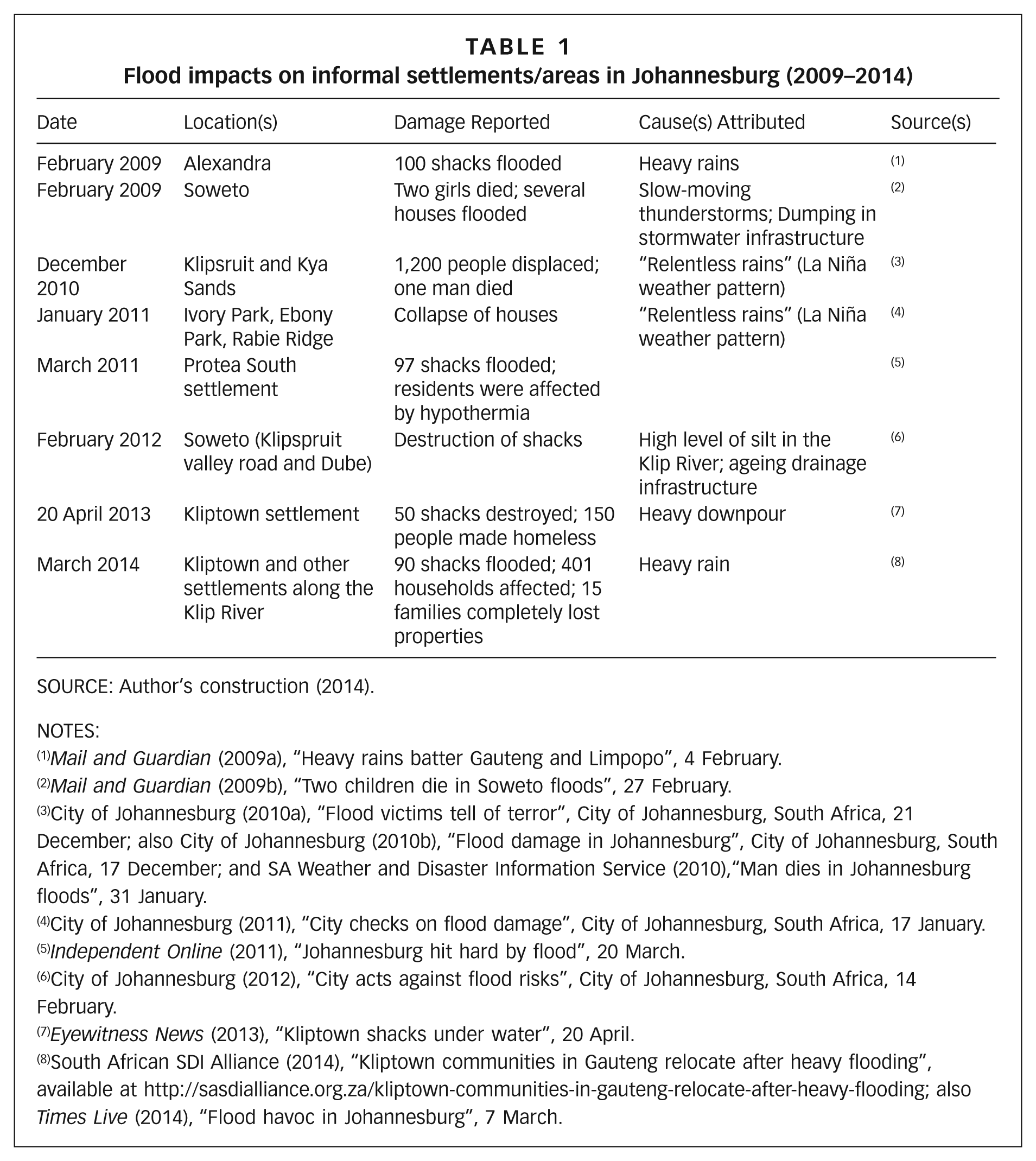
SOURCE: Author’s construction (2014).
NOTES:
Mail and Guardian (2009a), “Heavy rains batter Gauteng and Limpopo”, 4 February.
Mail and Guardian (2009b), “Two children die in Soweto floods”, 27 February.
City of Johannesburg (2010a), “Flood victims tell of terror”, City of Johannesburg, South Africa, 21 December; also City of Johannesburg (2010b), “Flood damage in Johannesburg”, City of Johannesburg, South Africa, 17 December; and SA Weather and Disaster Information Service (2010),“Man dies in Johannesburg floods”, 31 January.
City of Johannesburg (2011), “City checks on flood damage”, City of Johannesburg, South Africa, 17 January.
Independent Online (2011), “Johannesburg hit hard by flood”, 20 March.
City of Johannesburg (2012), “City acts against flood risks”, City of Johannesburg, South Africa, 14 February.
Eyewitness News (2013), “Kliptown shacks under water”, 20 April.
South African SDI Alliance (2014), “Kliptown communities in Gauteng relocate after heavy flooding”, available at http://sasdialliance.org.za/kliptown-communities-in-gauteng-relocate-after-heavy-flooding; also Times Live (2014), “Flood havoc in Johannesburg”, 7 March.
In light of runoff challenges accompanying increased rainfall, Burke and Mayer recommend that stormwater management be approached at a catchment scale,(13) since this would include informal settlements that are usually located on riverbanks in the city. Green infrastructure, as a component of a sustainable urban drainage system (SUDS), is also relevant in this context. Button et al.’s project in Monwabisi Park settlement, Cape Town,(14) is telling in this regard. Based on an understanding that proper stormwater drainage in informal settlements should ideally combine informal interventions and SUDS methodologies, and collaboratively involve all stakeholders, the project involved a system where vegetation covering swales (low-lying land tracts) redirects runoff from unwanted areas. Soakaways, incorporating a layer of bio-filters (plants), absorb excess nutrients and minerals while redirecting excess water (runoff, greywater) to the wetland. Although a one-off academic project with no quantitative evidence of reduction in storm runoff, their work shows the potential of social collaboration combined with physical (SUDS) interventions in future water-related adaptation strategies in informal settlements.
III. Study Area and Methods
The two case-study settlements, Elias Motsoaledi and Slovo Park informal settlements, are located south of Johannesburg’s Central Business District (CDB). They serve as examples, respectively, of state-led and community-initiated approaches to stormwater drainage intervention. The two cases contribute to an understanding of the pitfalls and potential of each, as well as the possibility of synergy between the two approaches in the context of vulnerability to runoff-related disturbances.
The Elias Motsoaledi settlement is located between Chris Hani Baragwanath Academic Hospital and the Devland industrial area in Diepkloof, Soweto. It contains 3,368 households, according to a 2008 community survey,(15) and is presently undergoing state-led “formalization” through the establishment of a new township. The Diepkloof River runs across the north-western side into the Orlando Dam, which makes the area prone to flooding; hence the concerns about stormwater management and drainage. I spent time in the settlement and on the construction site of the new township in the course of seven field visits between August 2012 and November 2014, during which transect walks and semi-structured interviews with 13 residents were conducted. Both the site manager (a civil engineer) and a project supervisor, at different times, guided me around the construction site, explaining the project, including the stormwater drainage interventions.
Slovo Park settlement is located next to the Nancefield industrial area, and lies between Nancefield, Eldorado Park and Bushkoppies. It covers approximately 47.46 hectares of land –the greater portion of which the residents believe is publicly owned. A 2011 informal community survey showed there are over 1,600 households and more than 5,000 people there.(16) The settlement is located on dolomitic land. The presence of dolomite rock (karst) beneath soil can lead to dangerous dolines/sinkholes when water (for example, from leaking water-bearing infrastructure or poorly managed surface water) ponds on such land and dissolves the rock. The Klip River passes through the settlement, creating one of its wetlands on the north-eastern side, which is a flood hazard zone. The need to manage both dolomitic and flood risk conditions makes stormwater drainage especially significant in the settlement.
Over eight field visits were made to Slovo Park between September 2012 and November 2014, during which semi-structured interviews were conducted with 12 residents. Two of the visit days fell between the end of South Africa’s dry winter and the onset of rainy spring. The first rains provided an opportunity to observe drainage challenges and stormwater management activities put in place by the residents. During one of the field visits, I participated in a Community Development Forum leaders’ meeting that served as a short focus group discussion session. At another time, I participated in a settlement-wide community meeting, where the ward councillor was in attendance. I also made a transect walk through the settlement. This provided an opportunity for first-hand observation and visual analysis of the existing drainage systems.
In addition to interviews with settlement residents, I conducted 15 semi-structured interviews with people affiliated with formal governmental and non-governmental institutions. They were purposively selected based on their involvement with intervention in, and management of, informal settlements in the city. They are affiliated with the municipality’s departments and sub-departments responsible for housing, water (Johannesburg Water), roads and drainage (Johannesburg Road Agency), NGOs working in informal settlements (through which I gained unhindered access for the study), the partnering university (a course lecturer and some students) and an engineering firm.
IV. Intervention Frameworks for Stormwater Management in Johannesburg
State-led stormwater management initiatives are based on certain frameworks, depending on the institution involved. Interventions by different levels of the state (national, provincial and local/municipal government) are based on a number of legal provisions, guidelines and institutional arrangements. For example, the South African national constitution places the responsibility for stormwater management with local governments and municipal institutions.(17) The National Water Act, one of the national provisions, stipulates that no township can be established or residence(s) developed on a space that falls within the 1:100 flood line. This represents a flood risk area where there is a 1% probability of a flood occurring in any given year.(18) The National Disaster Management Act also prescribes the state’s prompt response to the situation and to victims of runoff-related disasters, for example flooding.(19)
Certain documents and policies at the municipal level build on national and provincial (where available) provisions related to stormwater management. Some of these touch on informal settlements. For example, the City of Johannesburg Metropolitan Municipality Water Services Bye-laws prohibit the ingress of runoff into sewerage installations and the introduction of foreign substances into stormwater drains, rivers, streams or natural water courses.(20) This is based on the municipality’s principle of separately conveying stormwater and sewerage through different channels. Also, the 2010/2011Spatial Development Framework for the city recognizes the need to address stormwater runoff at catchment scale because “development patterns and stormwater runoff are significant contributors to the degradation of riverine environment”.(21) Such degradation to an extent emanates from the poorly serviced informal settlements that are usually located along riverbanks. The Wetland and Riparian Protection and Management Plan(22) captured in the catchment management strategy points out the need to rehabilitate and conserve wetlands upstream through intervention in informal settlements and low-income townships.(23)
Responsibility for stormwater management in Johannesburg officially lies with the Johannesburg Road Agency (JRA). This municipality-owned agency is responsible for ensuring that developers, contractors and property owners comply with the municipality’s stormwater management bye-laws and policies. At the core of JRA’s stormwater management policy is the attenuation of stormwater on or off site “such that the pre-development flows for the 1:5 as well as 1:25 – year storm events are not exceeded”.(24) JRA also fulfils its stormwater management mandate as part of interventions to formalize informal settlements, as will be shown later in the case of the Elias Motsoaledi settlement.
Mention must be made of shortcomings in the implementation of these policies and guidelines. Nationally, stormwater management is still poorly integrated with the whole urban water cycle.(25) In Johannesburg, some property developers are not fully aware of the municipality’s policy and the supporting national/provincial legislative requirements, resulting in stormwater management practices that are deemed unacceptable.(26) The extant policy in Johannesburg has also been criticized because it only seeks to regulate stormwater discharge in terms of volume (quantity) without adequate consideration of runoff quality.(27)
Municipal interventions in stormwater management infrastructure in Johannesburg’s informal settlements are embedded in the context of what is referred to as “formalization”. Formalization involves the process of township establishment for an informal settlement on land other than that which it presently occupies. The new land can be a piece adjoining or adjacent to the old settlement or at a distance of sometimes over 30 kilometres from the present location. In the new township, permanent services and infrastructure are installed and top structures (houses) with secure tenure are developed for residents of the former informal settlement. In Johannesburg, township establishment can take place through two legal frameworks: the Town-Planning and Township Ordinance Act of 1986 and the Less Formal Township Establishment Act (LFTEA) Act of 1991. The City of Johannesburg utilizes the former, while the Gauteng provincial government, through its Members of Executive Committee (MEC), grants approval for new townships through the latter.
Provisions within the two frameworks are not exactly the same, especially in relation to stormwater management intervention. Under the LFTEA, beneficiaries move into newly established townships before all services are installed. When the entire township is laid out and serviced with at least water and sewerage, the benefitting informal settlement residents can take occupation. They build the top structures themselves. Roads and stormwater management systems may also come after occupation.(28) However, under the Township Ordinance Act, all services (including stormwater drainage) must be installed and the houses completed before the beneficiaries move in. Applicants for a new township through the Township Ordinance Act may be required to make financial contributions toward stormwater drainage as part of services in the new area. In this situation, the contribution is determined through “administrator guidelines”,(29) although the payment may not be feasible when townships are established for informal settlements because of their usually low-income status.
Through the Township Ordinance Act, the detailed plan and layout (including for stormwater drainage) are only made after approval for a township is granted or an affirmative outcome is in sight. Township establishment in Johannesburg normally includes what I call the “pond and pipe” drainage system. That is, runoff is conveyed from each stand through conduit pipes to attenuation ponds, which serve as temporary storage before ground absorption or transfer to a receiving water body takes place. The municipality’s housing department usually commissions the design for stormwater infrastructure along with roads in a new township. This, however, must be approved by JRA, which upon completion solely takes over its operation and maintenance.
No form of stormwater management intervention is made in informal settlements that have not been proclaimed a township, whether formalization/upgrading can take place on that land or not. It is stated that the municipality will not spend anything on land not designated for formalization or privately owned(30) because the Municipal Finance Management Act No. 56 of 2003 (MFMA) does not allow budgeting or expenditure on land not legally recognized or that does not belong to the government.(31) Interventions in such settlements are limited to the provision of “interim services”, which include grading of gravel roads, communal water pipes, interval waste collection and chemical toilets (usually the Ventilated Improved Pit ones).(32) Interim services are provided by the government, through the municipality, until a new township is completed and people are relocated. There is no specific timeline for township establishment and relocation. There is also presently no significant form of community participation in provision of these services.
a. State-led intervention: the case of Elias Motsoaledi
Elias Motsoaledi is an example of stormwater drainage intervention in an informal settlement through “formalization” by the City of Johannesburg. The settlement has been a beneficiary of “interim services”. Through JRA, roads within the settlement were graded, which not only improved vehicular access, but also minimally enhanced stormwater drainage through gullies on the sides of the graded streets. The gullies serve as a channel for runoff flow by gravity to the riverside, thus reducing ponding of water on such roads. Pikitup, the municipal entity in charge of waste management, collects packaged waste at intervals from designated drop-off points. Despite this arrangement, refuse dumping close to the river still happens. As a result, the area around the river is polluted and the garbage can block the passage of runoff.
Stormwater drainage in the new project follows the “pipe and pond” system. Runoff from each stand would be conveyed by gravity through underground concrete pipes to 11 attenuation ponds scattered around the riparian corridor of the Diepkloof Spruit. The ponds were proposed in order to accommodate spilling runoff from the adjoining Chris Baragwath Hospital into the settlement.(33) In keeping with the National Water Act regarding the 1:100 year flood line, no buildings were to be erected in the riparian corridor. The area within the 1:100 year flood line is reserved to support wetland rehabilitation and ecosystem conservation; land outside the 1:100 year flood line but still within the corridor is to serve as public open space with children’s playgrounds and community parks. The attenuation ponds are designed to be shallow and bevelled so that they can function as children’s playgrounds when dry. These riparian corridor developments serve as landscape enhancement as well as for stormwater management.
The interviews and time spent in the settlement suggested that the residents are not meaningfully involved in the project. They explained that they were merely informed about the new housing and that units will be allocated to qualifying households when ready. The formalization project is not usually discussed during community meetings. One resident noted that “we don’t know much” and that the municipality is not truthful regarding the project.(34) However, poor community involvement in this case may not only be the fault of the state (municipality). Some residents have no interest in the housing project, especially those who do not qualify for housing.(35) This includes residents who migrated from other provinces and who have already received a subsidized house, and residents with monthly household incomes above the ZAR 3,500 (US$ 300)(36) bracket, who might have to pay rent for new rental units to be developed. While the number of non-qualifiers and their proportion in the settlement was not ascertained, it is clear that they are not interested in the ongoing fully subsidized housing development and would not mind if it derails.(37)
Some residents were employed as unskilled labourers in the construction phases already completed. However, the motivation for this was to make use of nearby sources of labour rather than to involve the community in project implementation and the future operation of the infrastructure in question. Residents’ participation in future stages of the project cannot be ascertained as at the time of this study.
V. Community-Based/Self-Help Initiatives: The Case of Slovo Park
Slovo Park is an example of community-based thrusts around the improvement of stormwater management in an informal settlement. The democratically elected Slovo Park Community Development Forum (SPCDF), in response to delayed state intervention, is making efforts intended to catalyse in situ upgrading that incorporates stormwater drainage and other infrastructure.
Different self-help measures have been deployed to cope with storm runoff. The five categories identified are building-related practices, water channels, rainwater harvesting, vegetation and intervention in the adjoining Klip River/wetland.(38) Building-related practices (for example heaping sand/stones against or adding mortar to a dwelling’s wall base) generally seek to prevent the incursion of runoff into dwellings while also improving their stability against windstorms. Walkway pavements, usually made from recycled bricks, provide stable ground for pedestrians when everywhere else is marshy or flooded. Open ditches serve as channels for runoff and surface water, collecting runoff and greywater (sullage) from the individual plots/stands, and empty it along the road. The ditches are usually widened and deepened when the rainy season starts. There are also shallow open pits within some plots into which runoff and greywater flow. These are a potential breeding ground for disease-vector organisms and are unsafe for children because they are uncovered. Slovo Park’s dolomitic condition also does not make this a safe solution.
Residents of the settlement inadvertently support the stormwater management system through the common practice of home-based farming. The cultivation process and plants improve the ground’s absorption of runoff to some extent, thus increasing permeability and reducing the volume and velocity of the runoff. It is also important to mention the case of a resident who exploits the resource potential of stormwater, harvesting rainwater from the roof of his shack to irrigate his home garden. This also reduces the volume of runoff.
Some residents voluntarily keep the Klip River’s flow smooth in order to prevent flooding by clearing the bridge’s channel of junk materials flowing from upstream. Farming in the wetland area also minimally manages runoff. Old vehicle tyres were arranged as a base for cultivated plants in the wetland, forming a retaining wall acting as a barrier to runoff, so that the cultivated area and the settlement are not easily flooded. These measures have, however, been overwhelmed by the increased volume of runoff reaching the wetland. The appropriateness of farming in the wetland, rather than conserving it, is also questionable.
As mentioned earlier, community-initiated efforts intended to catalyse in situ upgrading incorporate stormwater management. The SPCDF, on behalf of the community, engages with relevant professionals and non-governmental agencies on technical support for service provision and infrastructure development, for example, the 1:1 Agency of Engagement (an NGO) and two universities in Gauteng. With their assistance, the SPCDF is able to engage with the state. Students in one of the universities, based on informal workshops and other modes of community engagement, produced an urban design/integrated framework for in situ upgrading. Certain aspects of the framework, especially proposals for open spaces, livelihood strategies and the wetland, touch on stormwater drainage and management through the creation of green infrastructure.
An engineering consulting firm was also involved in the development thrust. On a pro bono basis, the firm undertook a design for infrastructure (including stormwater drainage), based on the settlement’s existing layout and a consideration of the dolomitic condition. The design, which is to be implemented through an incremental approach, built on the students’ engagement with the community, and is based on the understanding that movement of shacks and relocation from present stands would be minimal.
The funding mechanism for this community-initiated upgrading project is not yet clear. It is certain, however, that the state will not fund it alone. Securing appropriate tenure is crucial to raising funds. The community continues to engage with the state around tenure, but the SPDCF leaders report that the process is slow and seemingly deadlocked by politicking and bureaucracy. The municipality is averse to in situ upgrading on this site, and promised years ago to resettle the residents to a yet-to-be-established township that would not be close to the present location. After almost two decades of democratic rule in South Africa, however, this promise remains unfulfilled.
VI. Discussion
a. Concerns and contradictions
The legal and institutional provisions addressing stormwater management in Johannesburg and South Africa at large are de jure imbued with concern for the prevention of environmental degradation and development of livable urban environments. However, the de facto experience points to certain contradictions. For example, in Johannesburg, the municipality generally discourages, and is apathetic to, community-initiated efforts to catalyse in situ settlement upgrading. This fact emerged from my interaction with some of the city’s officials. However, Slovo Park residents suspect the municipality of underhand dealings, and accuse it of reluctance, undue politicking, unfulfilled promises and delays with respect to substantive interventions in informal settlement communities. The case of Elias Motsoaledi also adds to concerns about delay. People invaded and started living there from the late 1980s. Some of the qualifying residents were promised a subsidized house in a new township around 1995, and were registered to receive it, but at the time of fieldwork between 2012 and 2014, the promised houses had not yet been delivered.
Allegations of corruption and misappropriation have over time trailed the fading prospects of in situ development in Slovo Park and informal settlements in general. The South African public protector sheds some light on this through a report on an investigation into alleged unethical conduct on the part of the Department of Public Works (DPW) in relation to security upgrades at the president’s private residence in Nkandla. The report shows the reallocation of ZAR 20 million (US$ 1.72 million) from the Dolomite Risk Management Programmes to a “prestige capital project”(39). According to the report, “Due to a lack of proper demand management and planning, service delivery programmes of the DPW were negatively affected”, which violated section 237 of the constitution and the Batho Pele White Paper, “and accordingly constitutes improper conduct and maladministration”(40). Slovo Park settlement’s upgrade might well have benefitted from the dolomite risk programme.
Another contradiction emerges when comparing positions of the Municipal Finance Management Act (MFMA) and Disaster Management Act (DMA). The MFMA forbids budgeting and spending on informal settlements located on land not owned by the municipality or not yet designated for formalization.(41) However, the DMA prescribes prompt intervention in such informal settlements when runoff-related disasters take place.(42) So, while the MFMA prohibits investment in substantive stormwater infrastructure that would have prevented flooding, the DMA prescribes expenditure of the same city’s resources to assist flood victims. The fact that legislation precludes the expenditure of public resources in informal settlements is understandable as a means against misappropriation. But this is not totally justifiable. In Johannesburg, it is only through township establishment (formalization) that a settlement can significantly benefit from municipal budgeting. However, the process leading to it is often long and entangled in politicking. Since these low-income communities contribute (perhaps informally) to the city’s economy, they deserve a timely and appropriate benefit from public resources, not only for stormwater drainage (to prevent runoff-related disasters), but to improve their lives and environment.
b. Technical consideration
While the cases of Elias Motsoaledi and Slovo Park represent different approaches, they both drew on a considerable level of professional and technical expertise. Elias Motsoaledi’s drainage intervention was commissioned by the state, while that of Slovo Park emerged out of community action with professional support. Although it is beyond the scope of this paper to analyse the technical adequacy of each intervention, it is certain that the nature of each project would affect the outcomes for the beneficiary settlement. With different funding sources and institutional processes, the infrastructural outcome would not be the same. Elias Motsoaledi involves a one-off capital investment, informed by an intention to replicate what is obtainable in formal areas of the city. In Slovo Park, where incrementalism is proposed and funding is to be mobilized from a variety of sources, it may not be possible to exactly replicate what is offered in formal areas. Attaining a decent human living environment would suffice. Reliance on improvisation and local knowledge inputs is assumed here, since fiscal resources are not as readily available and abundant as in the state-led case.
c. Community participation
The absence of residents’ meaningful involvement in the Elias Motsoaledi case is not without its downsides. One can hope that the Elias Motsoaledi project will not turn out like the Kosovo settlement upgrade in Cape Town, where stormwater drains installed as part of upgrading by the municipality (City of Cape Town) failed to curb flooding. The failure was linked to inadequate participation: since the residents were not meaningfully involved in decision-making and implementation, they were not equipped or made to commit to work with new infrastructure.(43) However, there are still opportunities for meaningful community involvement in the Elias Motsoaledi project. According to Imperato and Ruster, when upgrading schemes are not built around participation from their commencement,“elements of participation need to be introduced at a later stage to ensure feasibility of project implementation”.(44)
On the other hand, Slovo Park’s community-initiated development efforts are potentially promising. The bottom-up approach is reminiscent of the dialogic involvement of Mumbai informal settlement dwellers, after the 2005 monsoon flood, with planning of the city.(45)
In Slovo Park, community-initiated bottom-up thrusts should however be seen in their true form– as potential. The full realization of that potential depends on the community leaders’ success at negotiating with the state, their continued engagement with appropriate professionals and non-governmental organizations, and how well the community’s diversity is harnessed.
d. The politics of informal settlement intervention: when elections drive delivery
As South Africa prepared for the 2014 elections, informal settlements, being hotspots of political activities, were not spared the flurries associated with the election season. The speed of construction at the Elias Motsoaledi Housing Project, which included the stormwater drainage intervention, increased as the elections drew near. The objective was to move the settlement residents into new houses a few weeks before the election – to show that the ruling party had delivered on its promise of building formal houses for informal settlement residents. The stormwater drainage system was proposed to be in place by then. Another phase of 600 dwelling units was also to kick off in the new township, just before the elections.(46)
In Slovo Park, engagement with the state for in situ settlement upgrading, and the improvement of stormwater management therein, intensified. The months preceding the election were marked by settlement-wide public fora, protests, political alignment and re-alignment, negotiations, press releases, court sessions and so on. All these happened to compel in situ upgrading and development in the settlement. The municipality stepped up engagement to show that it was listening and concerned and had plans for the settlement.
These case studies support the proposition that the main impediments and drivers for sustainable stormwater management systems in both formal and informal urban areas are social and institutional rather than technological.(47) The two case studies show that municipal functioning with respect to informal settlement intervention is entangled in the prevailing political “ambience”, a component of the socio-institutional domain. Although community action also achieves some results, it can be inferred here that community-driven stormwater drainage improvements in informal settlements are also a function of the politically influenced socio-institutional domain.
VII. Conclusions
The two approaches examined in this paper are telling. Self-help strategies to cope with stormwater are minimally effective and at times technically inappropriate. Proposals for substantive stormwater drainage, as part of in situ upgrading in Slovo Park and township establishment for Elias Motsoaledi, are both informed by technical considerations. But differences in approach would have an influence on delivery and outcome. The state’s one-off intervention in Elias Motsoaledi has been less participatory and slow. On the other hand, Slovo Park’s engagements with the state (municipality) have not yielded the desired results. They therefore keep coping with the menace of runoff. The case of Slovo Park contributes to the existing examples in literature on the limitations and potential of community initiatives in infrastructure delivery that form part of informal settlement upgrading. In the same vein, Elias Motsoaledi reveals the outcomes and problems inherent in state-led interventions. These add to current understandings on upgrading project planning and implementation in informal settlements where vulnerability to runoff-related disturbances is high.
The state’s central role is clear in both cases. Whether intervention is made by the municipality or the community, the state plays a critical role in meaningfully developing informal settlements. To respond to the challenge of stormwater in this context, the state needs to be positively responsive to and supportive of community-led, -initiated or -based approaches. State engagement with informal settlements making efforts towards in situ upgrading should be honest and responsive. State interventions, when they happen, need to be speedy, transparent and participatory.
Although playing a critical role, the state’s top-to-bottom approach in itself is not sufficient, but neither is the community’s bottom-up effort. A comparative analysis of the two cases and approaches shows the potential of state-led as well as community-initiated approaches, and points to the possibility of synergy between the two. There is a need for integration between state-led and communitarian efforts for sustainable stormwater drainage in informal settlements. The synergy between them might not only overcome the inherent shortcomings in each, but will also, as apparent in the two cases, allow the co-production of suitable solutions that bridge the gap between what works for the poor and what formal infrastructural provision involves.
Footnotes
Acknowledgements
Many thanks to 1to1- Agency of Engagement, and those affiliated with it, for supporting this study in one of the settlements and to Prof Marie Huchzermeyer for guidance. Financial assistance from the DST/NRF Research Chair in the School of Architecture and Planning, University of the Witwatersrand, Johannesburg is hereby acknowledged. Opinions expressed and conclusions arrived at are those of the author and are not necessarily to be attributed to the DST/NRF.
1.
Cairncross, S and E Ouano (1990), “Surface water drainage in urban areas”, in S Cairncross, J Hardoy and D Sattherthwaithe (editors), The Poor Die Young: Housing and Health in the Third World, Earthscan, London, pages 158–168; also Parikh, P, H Parikh and A McRobie (2013), “The role of infrastructure in improving human settlements”, Proceedings of the ICE – Urban Design and Planning Vol 166, pages 101–118.
2.
Dagdeviren, H and S Robertson (2011), “Access to water in the slums of sub-Saharan Africa”, Development Policy Review Vol 29, No 4, pages 485–505.
3.
Sohail, K, S Cavill and A Cotton (2005), “Sustainable operation and maintenance of urban infrastructure: myth or reality”, Journal of Urban Planning and Development Vol 131, No 1, pages 39–49; also Galuszka, J (2014), “Community-based approaches to settlement upgrading as manifested through the big ACCA projects in Metro Manila, Philippines”, Environment and Urbanization Vol 26, No 1, pages 1–21.
4.
Parkinson, J, Tayler, K and O Mark (2007), “Planning and design of urban drainage systems in informal settlements in developing countries”, Urban Water Journal Vol 4, No 3, pages 137–149.
5.
Sattherthwaite, D (2008), “Editorial: The social and political basis for citizen action on urban poverty reduction”, Environment and Urbanization Vol 20, No 2, pages 307–318, page 307.
6.
McGranahan, G (2013), Community-driven sanitation improvement in deprived urban neighbourhoods: meeting the challenges of local collective action, co-production, affordability and a trans-sectoral approach, SHARE research report, London School of Hygiene and Tropical Medicine.
7.
A spruit is a small stream in Southern Africa; see Botha, N (2005), Stormwater management and related urban environmental issues along the Fourways Spruit, Master of Arts in Environmental Management Dissertation, University of Johannesburg, Johannesburg.
8.
Armitage, N (2011), “The challenges of sustainable urban drainage in developing countries”, Proceedings of the SWITCH Paris Conference, Paris, 24–26 January; also Hetz, K and A Bruns (2014), “Urban planning lock-in: implications for the realization of adaptive options towards climate change risks”, Water International Vol 3, No 6, pages 884–900.
9.
Carden, K, N Armitage, O Sichone and K Winter (2007), “The use and disposal of greywater in the non-sewered area of South Africa: Part 2 – Greywater management options”, WaterSA Vol 33, No 4, pages 433–441; also Winter, K, A Spiegel, N Armitage and K Carden (2010), Sustainable options for community-level management of greywater in settlements without on-site water borne sanitation, Water Research Commission Report No. K5/1654, Pretoria.
10.
Fatti, C and C Vogel (2011), “Is science enough? Examining ways of understanding, coping and adapting to storm risks in Johannesburg”, WaterSA Vol 37, No 1, pages 57–65.
11.
Dyson, L (2009), “Heavy daily-rainfall characteristics over the Gauteng Province”, WaterSA Vol 35, No 5, pages 627–638.
13.
Burke, J and X Mayer (2009), Strategic guidance towards prioritising stormwater management research in human settlements, Water Research Commission Report No. 1670/1/09, Pretoria.
14.
Button, K, E Jeyaraj, R Ma and E Muniz (2010), “Adapting sustainable urban drainage systems to stormwater management in an informal setting”, Bachelor of Science Qualifying Project, Worcester Polytechnic Institute, Cape Town.
15.
Tau, P (2012), “Housing Project promises not kept”, The Star, 29 March, accessed 28 September 2012 at  .
.
16.
Tissington, K (2012), “Towards greater community participation in informal settlement upgrading: A case study from Slovo Park, Johannesburg”, in Putting Participation at the Heart of Development // Putting Development at the Heart of Participation, Good Governance Learning Network publication, Cape Town, pages 50–61.
21.
22.
See reference 21.
23.
25.
Fisher-Jeffes, L, K Carden, N Armitage, A Spiegel, K Winter and R Ashley (2012), “Challenges facing implementation of water sensitive urban design in South Africa”, Proceedings of the 7th International Conference on Water Sensitive Urban Design, Melbourne, 21–23 February.
26.
See reference 7; also Aldous, M (2007), The Perceived Economic Impact of the City of Johannesburg’s Storm Water Attenuation Policy on Private Property Developers, Magister Scientiae Built Environment Treatise, Nelson Mandela Metropolitan University, Port Elizabeth.
27.
Buys, F and M Aldous (2009), “The perceived economic impact of the city of Johannesburg’s stormwater attenuation policy on private property developers”, Acta Structurila Vol 16, No 2, pages 18–45.
28.
Personal communication with Official 3, 12 October 2012.
29.
30.
Personal communication with Official 1, 24 August 2012.
32.
Personal communication with Official 6, 4 September 2012.
33.
Personal communication with Official 9, September 2012.
34.
Personal communication with Residents 5 and 10, December 2012 and November 2014.
35.
An informal settlement resident qualifies for a house fully subsidized by the government when he/she is over 18 years; is a South African permanent resident; has at least one dependent; has monthly household income of less than ZAR 3,500; does not own a property; and has never benefitted from a government housing subsidy.
36.
Based on the December 2014 exchange rate.
37.
Personal communication with Site Officer, 21 February 2014.
38.
Adegun, O (2013), “Sustainable Stormwater Management in Johannesburg’s Informal Settlements”, Master of the Built Environment Research Report, University of the Witwatersrand, Johannesburg.
39.
Madonsela, T (2014), Secure in Comfort. A Report (No 25 of 2013/14) of the Public Protector, Public Protector South Africa, Pretoria, page 151.
40.
See reference 39, page 62.
41.
See reference 31.
42.
See reference 19.
43.
Armitage, N, R Beauclair, N Ashipala and A Spiegel (2010), “Draining the shanty towns: lessons from Kosovo informal settlement, Cape Town, South Africa”, Proceedings of the NOVATECH 2010 International Conference, Lyon, 27 June–1 July.
44.
Imperato, I and J Ruster (2003), Slum Upgrading and Participation, World Bank, Washington, DC, page 36.
45.
Stecko, S and N Barber (2007), Exposing vulnerabilities: Monsoon floods in Mumbai, India. Case Study prepared for Revisiting Urban Planning, Global Report on Human Settlements 2007, Earthscan, London.
46.
Personal communication with Site Officer, 21 February 2014.
47.
Brown, R and M Farrelly (2009), “Delivering sustainable urban water management: A review of the hurdles we face”, Water Science and Technology Vol 59, No 5, pages 839–846; also Armitage, N, K Winter, A Spiegel and E Kruger (2009), “Community-focused greywater management in two informal settlements in South Africa”, Water Science and Technology Vol 59, No 12, pages 2341–2349; and Mun, J (2012), “Efficient management of rainwater and stormwater runoff and wastewater to face extreme weather events including flooding”, Submission for 6th World Water Forum, Marseille.