




Abstract
The concept of urban resilience has so far been related mainly to climate change adaptation and disaster management perspectives. Here we aim to broaden the discussion by showing how the framework of urban resilience should be related to wider sustainability challenges, including i) climate change and natural hazard threats, ii) unsustainable urban metabolism patterns and iii) increasing social inequalities in cities. Using three case studies (flood risk management in the Dutch polders, urban–rural teleconnections driving the Bolivian quinoa market, and spatial diversity in the adaptive capacity of Kampala slums),(1) we draw out significant insights related to scales and sustainability, which will push urban resilience research forward. The key “move” is to consider both spatial and temporal interactions, in order to shift from the mainstreaming of the resilience-building paradigm toward a critical understanding and management of resilience trade-offs. While urban resilience emerges not necessarily as a normatively positive concept anymore, we argue that addressing multi-scale and temporal aspects of urban resilience will allow greater understanding of global sustainability challenges.
Keywords
I. Introduction: From Building the Resilient City to Framing Urban Resilience
The goal of becoming a “resilient city” has been crucial for climate-proofing cities, yet arose before the concept of resilience was translated from diverse disciplines into a coherent framework for urban systems(2) in the scientific context. The concept of resilience has undergone a gradual sprawl and a simplification in both its meaning and its application. This has happened because of the lack of research and a poor understanding of how to operationalize the metaphor of resilience in the particular context of cities. Both factors, we argue, have weakened the potential of the concept of urban resilience.
In terms of the simplification of the meaning, resilience is often seen as the opposite of vulnerability.(3) The paradigm of “the more resilient the less vulnerable” could be considered as the earliest simplification of the meaning of the concept, hiding the complex relationship between vulnerability and resilience.(4) This simplification has rooted strongly in the context of urban environments, following the natural hazards approach where, as Blaikie et al. explain it, vulnerability is a “hypothetical and predictive term, which can only be ‘proved’ by observing the impact of the event when, and if, it occurs”.(5) Vulnerability, and therefore resilience, from this perspective is therefore a specific product of a certain place and time period. By contrast, resilience scholars define “general resilience” as the capacity of the system to withstand shocks and stresses while retaining system properties, and “specific resilience” as the system’s capacity to cope with a determinate shock or stressor.(6)
We could say then that specific resilience contributes to reductions in specific vulnerabilities, and that it could be considered the flipside of vulnerability. However, the social–ecological understanding of resilience(7) emphasizes another perspective as well. In addition to the idea of specific resilience, it considers the generic and emerging properties of complex adaptive systems, which are capable of adapting, transforming and learning while navigating unpredictable evolution trajectories.(8) From this point of view, urban resilience is far from being merely the flipside of vulnerability,(9) and should not be addressed solely from the climate-proofing point of view but rather in the context of broader sustainable development, where adaptation and transformation of complex systems play an important role.
Regarding the second simplification around the applications of resilience, it is still unclear whether the operationalization of resilience should refer to the engineering perspective, which defines it as the speed with which a system bounces back to a precedent equilibrium state,(10) or to the social–ecological perspective of the concept.(11) Walker and Salt(12) argue: “when you hear managers and planners using the term resilience […] it is unclear which meaning these professionals have in mind. Often they may be thinking about ‘engineering resilience’ in which the aim is to bounce back quickly to business as usual following a small disturbance.” When considering the flipside of vulnerability, and focusing on disaster risk reduction strategies, urban resilience approaches neglect the evolutionary(13) and cross-scale effects(14) that the concept embodies. In suggesting that the key question of “resilience of what to what?” should be clearly defined in order to properly understand a system’s resilience, Carpenter et al.(15) remind us that “the history of human cultural evolution has been the story of cross-scale subsidies”. Knowing that resilience at one scale or in one time period may be achieved at the expense of other scales, time periods or other systems,(16) trade-offs within these scales and systems are a key feature for assessing and managing resilience.(17)
This paper builds on the concept of urban teleconnections, defined as “the distal flows and connections of people, economic goods and services, and land use change processes that drive and respond to urbanization”.(18) In this context, teleconnections provide critical insights on the still poorly understood nature and consequences of resilience trade-offs (between and within scales). These insights will be supported by three case studies, addressing different dimensions of potential trade-offs related to addressing resilience at different temporal and spatial scales. The cases are about i) transitions in flood risk management in the Netherlands, ii) urban–rural trade-offs in response to global market influences on the Bolivian quinoa market, and iii) the heterogeneous adaptive capacities that give rise to resilience trade-offs between community and individual scales in Ugandan slums.
II. Sustainability Challenges Framing Urban Resilience
There is increasing evidence of anthropogenic impacts on ecological systems, and the growing human population now represents the main driver of planetary changes.(19) With an expected increase in urban population of 25 per cent by 2050, leading to a global population of 9.3 billion,(20) the challenge of global sustainability rests in large part on urbanization processes.(21) As mentioned above, the concept of urban resilience has mostly had uptake within the context of climate change and disasters alone.(22) However, the concept has the potential to be applied to a larger set of global sustainability challenges. Building on previous work by the authors,(23) this paper considers three interconnected sustainability challenges related to i) the built environment, ii) urban metabolism (within and outside of city boundaries), and iii) liveability and quality of life. Different resilience perspectives and principles can be framed within each of these challenges.
The first challenge is related to the resilience of urban structure and provided services. There is a need to accommodate an increasing urban population(24) while at the same time providing a safe built environment in the face of both foreseen and unexpected impacts of climate change and natural hazards.(25) The resilience perspective related to this challenge needs to be rooted in spatial planning (for more resilient and secure infrastructure networks), and within policies and legal frameworks aimed at the reduction of specific vulnerabilities, especially those experienced by the urban poor living in high-risk areas.(26)
The second challenge, related to urban metabolism, concerns inefficient and unsustainable resource use, both in cities – as a consequence of consumption rates and the generation of waste/pollution – and at the planetary level, as driven by cities, because of teleconnections.(27) Different accounting methodologies and reporting methods make precise figures difficult, but it can be estimated that cities contribute between 30 and 80 per cent of global emissions, often being highly dependent on external resources and technologies.(28) Addressing this challenge of urban metabolism requires a resilience perspective related to the long-term socio-technical transition toward sustainability(29) (involving technologies, innovation, development patterns of production and consumption chains), along with social, political and behavioural changes.
The third challenge relates to the social aspects embedded within urban dynamics. Over the past three decades, globalization has indirectly caused an increase in social stratification, conflict and the inequitable distribution of resources.(30) Some of the most evident social impacts of urbanization globally emerge in the slums of rapidly urbanizing cities, specifically around the social vulnerability of different groups. Financial and global markets shape the dynamics of growing and shrinking cities, with direct consequences for both people’s well-being and local development potential. This challenge requires resilience to foster short circuit economies as local responses to external stresses. It also requires, from a social justice perspective, the empowerment of vulnerable groups so that they can manage the necessary transition and innovation for sustainability.(31)
Responding to these sustainability challenges requires, we argue, an integrated framework for urban resilience that incorporates sustainability,(32) and deals with cross-scale implications (trade-offs) among systems, capacities, vulnerabilities and time periods.
Ernstson and colleagues(33) contribute theoretically to this discussion by highlighting the importance of considering slow variables in urban regimes, the multi-scalar dimension of cities, and the importance of harnessing innovation. We build on this work, taking a further conceptual step to explore the relationships and implications of scales and resilience trade-offs. In so doing, the insights we provide regarding resilience trade-offs line up with the more emerging line of research around resilience and sustainability. The three case studies are used here to describe and give examples of both temporal and spatial scale dimensions of trade-offs, and each refers in part to the three sustainability challenges just outlined in this section.
III. Addressing Temporal Scale Implications for Urban Resilience Strategies
In this part of the paper, which draws on the case study of the Dutch polders, we build critical understandings of the implications of different resilience strategies over time. We explore both possible “lock-ins” and opportunities for learning while approaching thresholds and changing system trajectories, and draw critical insights from resilience trade-offs between time periods.
a. Temporal scale implications: lock-in or learning for change?
Scales are “the levels at which phenomena occur both in space and time”.(34) Resilience thinking involves exploring interacting hierarchies of nested systems: higher-level systems are driven by slow variables and lower-level systems are driven by fast-changing variables.(35) Currently, most urban resilience research focuses on the societal capacity to respond and adapt to natural disaster events.(36) These processes, oriented around maintaining security and stability, are most often viewed from a short-term engineering resilience perspective, referring to the time needed for a system to return to a stable equilibrium state. However, there is an increasing interest in exploring how to incorporate approaches around longer-term systemic transformation (incorporating risk mitigation within the recovery processes).(37) The main criticism of the engineering “bouncing back” perspective relates to the probability that old and unsustainable urban patterns will be maintained. The need to return to a stable state prevails over possible transformation and a long-term view, which sustainable development requires. A generalized example of a hidden “lock-in” (mainstreaming old patterns of consumption) is the dependency on energy consumption and its consolidation through installing air conditioning when adapting buildings to increasing temperatures. Unfortunately there is a disjuncture between the academic view of multi-equilibrium patterns of development(38) and practitioners’ interpretations and simplifications, as explained in the introduction of this paper.(39) Those simplifications interpret resilience as the implementation of (hard or soft) mechanisms to bounce back to and maintain the regime, or the status quo. As argued by Engle et al.,(40) it is “human nature to resist change and strive to maintain the status quo, thus resilience is invoked to produce a sturdy, robust, or stalwart state of affairs, one that can quickly bounce back to its initial conditions”.
The following case study, a good example of different phases and overlapping resilience approaches, illustrates temporal trade-offs and thus, the need to consider longer-term thresholds, learning and transformation capacities in the context of risk management.
b. Dutch delta urbanism and polder evolution in the Netherlands
After an extensive reclamation of land from the Wadden Sea, 75 per cent of the Dutch coastline is now occupied by sandy dunes, while 15 per cent consists of hard construction (such as flood barriers) to protect 9 million inhabitants from both environmental and climatic stressors.(41) These bits of protected, densely urbanized low-lying lands, below sea level, are called “polders”. Navigating along the timeline of Dutch urbanism, Schuetze and Chelleri identified different phases in its evolution,(42) corresponding to a water management approach that has been “natural” (7th to 10th century), “defensive” (10th to 15th century), “offensive” (15th to 19th century) or “manipulative” (20th century). For instance, while the first towns in the Netherlands took advantage of natural topography for water protection (natural water management approach), further urban growth was allowed by the building of sand dikes (defensive water management). The invention of windmills made it possible for large wetlands to be intensively drained (offensive water management), opening the door to the urban sprawl and agricultural development of the 19th century. Nowadays, there is intensive engineering landscape management (manipulative water management). The famous Deltaworks project, for instance, was a multi-decade programme of building dams, sluices, dikes, levees, and storm surge barriers (Figure 1), aimed at fortifying the coast in response to the dramatic 1953 flood.(43) It represented the maximum expression of the manipulative water management practices, as well as the Dutch confidence in modern engineering.
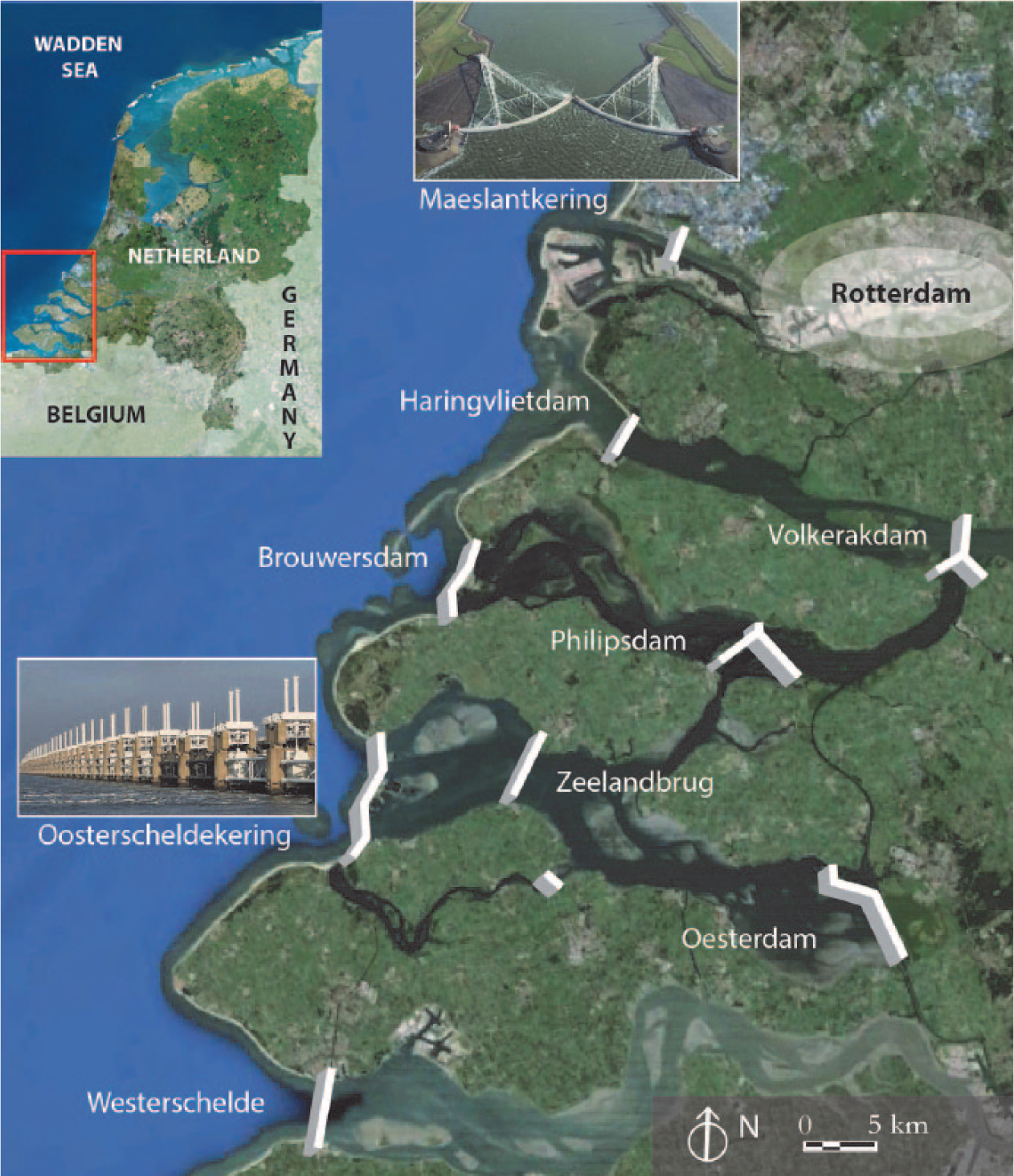
Graphical illustration of the magnitude of the Dutch Deltaworks programme
This evolution contains a lesson regarding lock-ins versus learning and changing. This comes from the increasing complexity and costs associated with the long-term maintenance of a highly engineered system, built around a “keep lands dry” policy. A tipping point was approached in the 1990s,(44) when Deltaworks was near completion. In 1993 and 1995, the Rhine, Meuse and Waal Rivers flooded due to an unexpected Alpine snow melting. While Deltaworks could protect land from seawater, it was not designed to respond to flooding rivers. These events led to a paradigm shift in the Dutch water management philosophy. The Room for the River programme (45) was launched in 2006 as a programme leading to 34 river widening projects, with different “de-engineering” measures.(46) By means of spatial planning-driven interventions, the programme aimed to progressively “depolderize”(47) the Dutch landscape, transitioning toward a self-sufficient water management approach.(48) This transition consists of hard and soft measures. Hard measures involve creating land and urban spaces that accommodate water in the case of flooding, and in so doing decreasing the flood risk in the most vulnerable areas. As for soft measures, this process has indirectly involved a slow (and critical) socio-cultural process of water acceptance.(49)
c. Framing different resilience approaches related to time scale
According to the different possible long-term scenarios related to any short-term decision, building resilience in social–ecological systems never fully removes vulnerabilities, but can alter the configuration of system resources and capacities, which implies a shift in space and time of system vulnerabilities.(50) Focusing on temporal scale implications, resilience trade-offs imply that a determinate resilience approach can open or close the windows of opportunity for different patterns of development. In the Dutch case, three different resilience approaches can be distinguished. Figure 2 presents a conceptual scheme focusing on the dynamic nature of a system state. Along the time axis (from short-term to long-term), each approach is presented in relation to the system threshold, making sense of the corresponding resilience ball-in-a-basin metaphor, and also comparing the definitions that different scholars use for each approach.
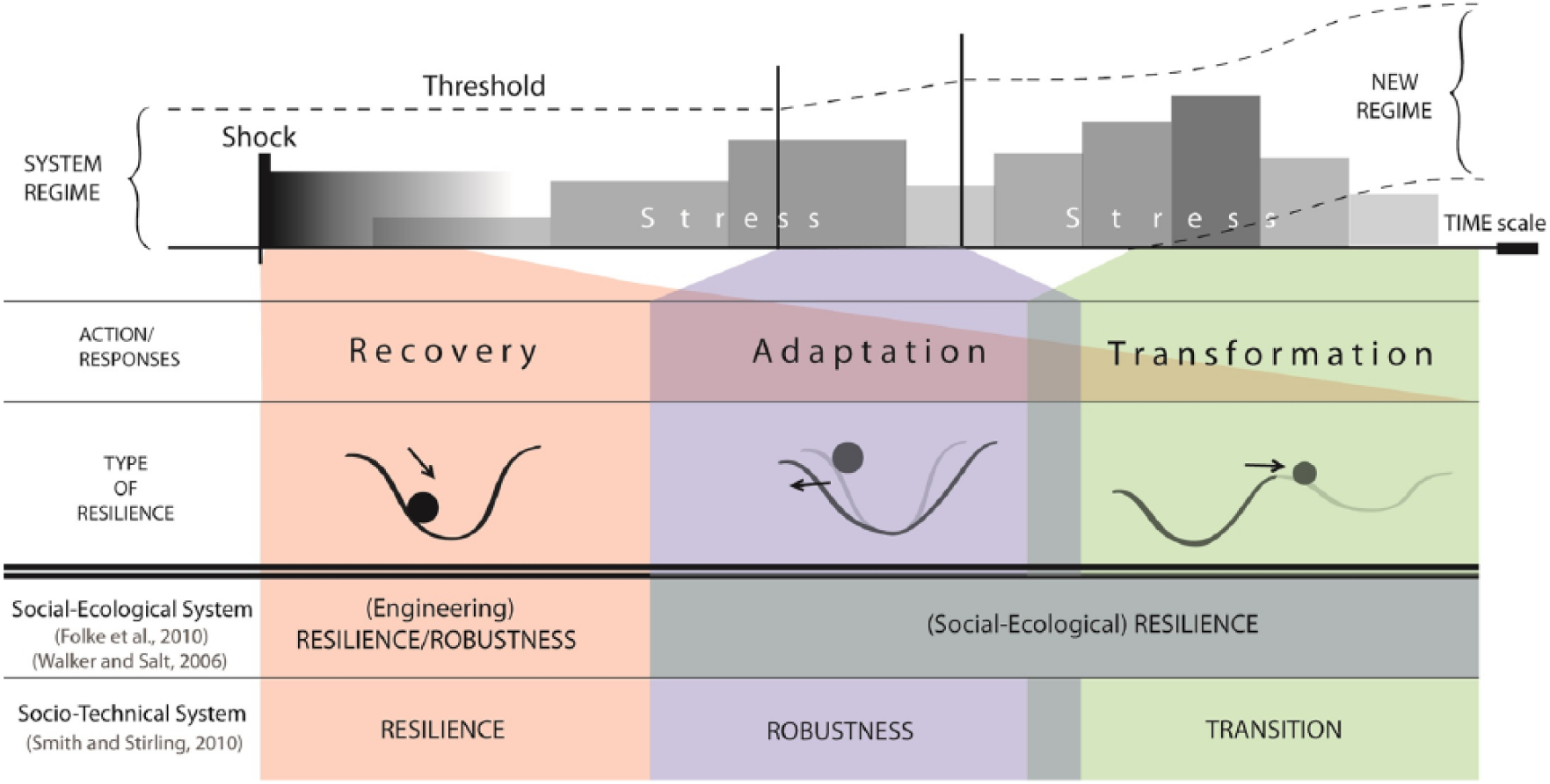
Three (partially overlapping) stages of resilience related to short-, medium- and long-term perspectives
The first approach is the recovery perspective. Recovery is indeed mainly related to system shocks (internal or external) and rooted in the engineering resilience view (i.e. bouncing back to a normal safe state after, in this case, a flood). It should be recognized that although recovery is related to shocks, disasters and emergency,(51) structural long-term transitions can also result from the reconstruction process.(52) After a flooding, recovery occurs in the short term thanks to emergency and rescue actions, often leading to a second phase of reorganization and rebuilding where subsequent shocks can be mitigated or adapted to, thanks to different patterns of development. (For example, after a flood and the immediate emergency recovery, a process of building higher dikes or floating homes can be planned within the long-term recovery strategy of rebuilding.)
The second approach is adaptation, understood as the processes of adjustment to actual or expected changes and its consequences, disregarding system boundaries by moving thresholds in order to make the system persist within the same regime.(53) Dutch examples of the adaptation approach are the rising dikes during the Deltaworks and the Maeslantkering moving storm surge barrier protecting Rotterdam harbour. However, adaptation can accommodate change in very different ways, and so potentially overlap with transformative long-term processes.
A third approach is longer-term structural transformation (transitions), which refers to the alteration of fundamental attributes of the system, which will allow it to enter a new regime.(54) Shifting adaptation toward this transition to new regimes is a critical and complex socio-political choice, and usually happens once the system is approaching dangerous thresholds. In the Dutch case, this shift occurred when adaptation through the protection-from-water strategy became complex, costly and risky, and a transition to a different water management strategy was stimulated through the Room for the River programme and building of floating homes. As previously mentioned, this kind of longer-term, complex process is a matter of slow social, economic and political transformation toward sustainability,(55) and aims at mitigating previous regime stresses.
The importance of deepening understandings and framing meanings and applications of resilience is increasingly recognized within different disciplines,(56) partly because of those potential but not accounted-for trade-offs. The bottom part of Figure 2 explains some contested definitions of resilience approaches. A classic example is robustness versus resilience. The social–technical systems literature(57) relates robustness to properties aimed at adapting long-term responses to stresses, which social–ecological definitions relate, in turn, to resilience.(58) The tensions between conservation- and transformation-oriented approaches (emerging as the main difference between engineering and ecological resilience) are embedded within the same time scale.
Because of the overlap between the adaptation and transformation perspectives in dealing with regimes and system thresholds, and the multidimensional nature of recovery, it is important to recognize that short-, medium- and long-term resilience strategies coexist as essential, sometimes conflicting, components of urban dynamics.(59) Within these insights, we claim that there is not sufficient understanding of and accounting for such temporal scale resilience trade-offs when the concept of urban resilience is put into practice.
Through the Dutch case study we learn that the maintenance, monitoring and control of dikes for the safety of people and the city coexist with the processes of gaining room for rivers and building floating homes in preparation for long-term transitions. This highlights that: i) a focus on multiple temporal scales is required when framing urban resilience, and ii) managing urban resilience is about balancing these multi-scalar coexisting approaches, and the powers, interests and inertia behind each of them. Due to the potential conflicts, managing resilience requires complex long-term processes involving economic, social and environmental sustainability dimensions. In the Dutch example, we recognize three features of resilience: the persistence of each urban configuration, the reorganization and innovation from one phase to the next, and the continuous learning process. This highlights learning as another key feature that confers long-term sustainability on resilience approaches.
IV. Spatial Scale Implications: Globalization, Teleconnections and Resilience Trade-Offs
Globalization is a complex phenomenon, and the formation of global interdependencies has been accelerating over recent decades.(60) At the same time, the emerging global market has started to significantly shape the development and dynamics of urbanization processes worldwide. As functional nodes of these global networks, cities represent strategic management hot spots, where large-scale resource exchanges occur, and where global commodity chains and world city networks meet.(61) The impacts and influences of such nodes over faraway territories have been recently conceptualized as “teleconnections”.(62) From a complex system perspective, four main changes have enabled this to occur: i) an increasing connectedness, ii) the speeding up of global connections through improved communication and transport, iii) the spatial stretching of policy decisions and iv) a declining social and ecological diversity. At the same time, there are mixed vulnerabilities and opportunities associated with rapid globalization and urbanization processes. Certain inherent capacities might be eroded, such as ecological knowledge and flexible social institutions.(63) Social vulnerability may increase, for example with the growth of informal settlements and slums.(64) However, there also could be opportunities for adaptation and increasing resilience.(65) Certain shocks and situations can create opportunities for communities to leverage globalization in favour of increasing adaptive capacity. The challenge will be for trade-offs between resources, and resilience across scales, to be well understood.(66)
In order to push this understanding forward, we use two case studies that exemplify cross-scale and between-scale trade-offs in efforts to address urban resilience. The first case describes the relationship between an emergent cereal market at the national scale (in Bolivia) and the uncontrolled growth of a specific crop (quinoa). This led to large-scale migration fluxes from the city to rural areas at the cost of local ecosystems and local cultural capital. The second case describes heterogeneous vulnerabilities and adaptive capacities within the slums of Kampala (Uganda), resulting in trade-offs that emerge both spatially (within the same scale) and between individual and community resilience outcomes.
a. The Bolivian quinoa market: impacts of global market on rural–urban resilience
Cities are concentrated centres of production and consumption that drive land use and global environmental changes.(67) Global consumption chains are often driven by the demands of these cities, and trends and fashions can quickly turn any good into a sought-after product – in this case, a crop like quinoa, which has become a trendy organic health food consumed in Europe, North America and other markets.
Quinoa is the main subsistence crop of Andean farmers, cultivated at altitudes of more than 3,500 metres. For the indigenous land use management of the Southern Bolivian Altiplano, plains covered by shrubs are dedicated to grazing activity, while quinoa is planted on bare slopes and hillsides. Quinoa has been the best subsistence autochthonous crop here for thousands of years, being resistant to temporal droughts; saline, sandy and eroded soils; frost; and high wind conditions.(68) In the present day, quinoa is sold globally and Bolivia has become its largest producer and exporter, with 46 per cent of the total global market production.(69)
The globalization of this product is due to a number of factors, mainly at the scale of international markets and institutions. In 1986 the Food and Agriculture Organization defined quinoa as a strategic food for the Andean region, and numerous articles were published internationally about the nutritional and health benefits of this crop. This opened a window of opportunity for crop speculation.(70) In 1991, the International Plant Genetic Resources Institute and the Inter-American Institute for Cooperation on Agriculture recognized the potential of the quinoa market, trying to set an international price for the crop. As years passed, the price of the crop drastically increased, with a three-fold increase from US$ 862/tonne in 1999 to US$ 2306/tonne in 2008.(71)
Meanwhile, in Bolivia, these drastic shifts have led to different positive and negative outcomes, which have occasioned what we illustrate in this section and understand as rural resilience trade-offs. The resilience of rural areas is defined by the capacity of the region to adapt to external changes in order to maintain satisfactory well-being of the population, while balancing ecosystem, economic and cultural functions of the rural regions(72) (which might often be more vulnerable to changes). On the one hand, the international recognition of the benefits of this crop and its potential on the market have led to an increase in income of between 55 and 85 per cent for the families living in Oruro and Potosi Districts.(73) On the other hand, however, the effects on the ground are more complex. In combination, the promotion of quinoa led to rural land use changes and social behavioural change in those rural areas, as farmers were principally looking for the benefits of the market. As farmers sold more of their quinoa, they changed their nutritional habits, buying less nutritious food for themselves. Moreover, looking for the most effective way to achieve higher economic benefits, they shifted to more intensive and less sustainable production methods.(74) In the Andes, intensive monocropping led to a decrease in soil and water quality.(75) Evidence from fieldwork in the municipality of Tomave has already revealed that soil erosion and water scarcity are occurring and that desertification in the near future is a hazardous potential consequence of this new regime.(76) Furthermore, local ecological knowledge has tended in the last decade to be displaced, as subsistence livelihoods have shifted to more market-dominated regimes with intensively mechanized production systems.(77) This market-oriented shift has also resulted in the large migration from urban to rural areas in Bolivia, as wealth-seeking families saw in quinoa an opportunity for economic growth. It is apparent that adaptation to these opportunities opened up through global markets, i.e. at the international scale, might result in unexpected and uncontrolled changes at the regional scale. This would apply especially, in our case, to the local agro-ecosystem, bringing adverse impacts to the sustainability and resilience of the rural region generally. In line with the panarchy model,(78) adaptation at one scale may result in transformation at lower scales, which might have negative impacts in the short and medium term. In this case, the market-dominated shift has generated a mixture of benefits and risks for the resilience of the system – increasing well-being for local farmers, but undermining wide-scale rural resilience.
This case study provides a good example of how cross-scale interactions and drivers may produce a series of trade-offs within different systems. Importantly, if ecosystem, economic and cultural functions are jeopardized, the overall system resilience is compromised. Crop production is a key aspect of rural resilience,(79) but if ecological resilience, and the underlying biological diversity, is undermined, so too will be the resilience of the entire agro-ecosystem.(80) The crucial point about these cross-scale trade-offs is that the onus for maintaining resilience of the agro-ecosystem falls on local actions in adapting to stimuli at diverse scales. As market demand is not linked to local ecological carrying capacity, the urban system plays a crucial role within the relationship between the global market and the local agro-ecosystem. This is because the city, by virtue of its position within the network as the locus for the convergence of local and global interests, has the power to enforce laws and policies driven by the political will.
As mentioned, the large-scale migration from towns to quinoa farming lands is another pressure that is exerted locally from this cross-scale interaction. This migration produces temporary and “stable”(81) farmers, interested only in maximizing the yield of quinoa fields in order to increase their profit. Furthermore, they are characterized by a lack of environmental awareness, which contributes to damaging the already fragile ecosystem. Sustainability concerns, and the responsibility (and opportunity) to manage these trade-offs, lie at both the government and local levels.
b. Resilience trade-offs within cities and between individual and community scales
Cases 1 and 2 have shown respectively how temporal trade-offs and cross-scale trade-offs can occur in the pursuit of urban resilience. By examining areas of rapid urbanization and extreme potential vulnerability, this final case demonstrates again the existence of cross-scale trade-offs, but at a finer scale. It also shows how resilience trade-offs can occur within the same scale due to stark heterogeneities in adaptive capacity within a given population.
On the one hand, slums are subject to a range of shocks and stresses, and residents are often more exposed because they are located in marginal areas,(82) where housing and infrastructure are poor.(83) As well as being more exposed to natural hazards,(84) slum residents are often excluded from the formal economy, and lack a political voice.(85) Furthermore, a lack of tenure means residents are less likely to invest in adaptation measures, and they also experience a lack of provision for such basic services as water and sanitation.(86) Despite this critical barrier of a lack of basic infrastructure, slum residents show remarkable levels of resilience. This is manifested not only in their coping strategies (such as moving items to high places when it floods), but also in their adaptation initiatives and mechanisms (such as networks and savings groups, and in some cases a reliance on high levels of trust).(87)
Along with sensitivity and exposure, adaptive capacity is a critical determinant of overall system resilience, and the adaptive capacity of individuals, communities and regions affects the “resilience landscape” of any city. Moreover, in slums and informal settlements, where exposure is high and the state-provided adaptation measures seen in more developed nations are lacking, bottom-up sources of resilience are critical. (These state-provided measures, such as insurance or infrastructure, are also described as accumulated resilience.)
What is important in terms of trade-offs is that these capacities are often unequally distributed across a city, including in slum areas, some of which are better provided for than others.(88) Where sources of adaptive capacity differ by area or population group, there is the possibility of distinctly different levels of resilience to shocks. It is therefore important to understand what builds adaptive capacity, and what barriers or limits may exist to potential adaptations.(89) Out of these heterogeneities, trade-offs emerge that challenge the notion of resilience as always being normatively positive, as Waters argues.(90) The previous Bolivian example shows how interactions across scales and different systems may result in resilience trade-offs, whereas here the focus is on resilience dynamics within cities. The following case study of adaptive capacity in three slums in the city of Kampala, Uganda(91) demonstrates these complexities, providing another example of a cross-scale trade-off like the Bolivian example, as well as introducing the notion of spatial trade-offs in social resilience.
c. Heterogeneous adaptive capacities across the slums of Kampala, Uganda
This research on which this case study is based was carried out in the city of Kampala, Uganda, a country with a high urban growth rate (5.2 per cent).(92) Residents of the slums of Kampala, much like other cities in low-income countries, face a range of shocks and stresses, and adaptive capacity is a fundamental attribute for survival. Adaptive capacity is also a useful entry point for assessing resilience at the individual and community levels, taking insights from both vulnerability and resilience approaches.(93) Given that individuals and households face a diverse range of challenges (for example, flooding, sudden loss of income, disease, etc.) that often act in concert, this adaptive capacity must cover a suite of responses. For this reason, generic adaptive capacity (i.e. across a range of shocks) was examined. A few studies have examined determinants of resilience at the city scale and have concluded that factors such as institutions, assets and knowledge, among others, are important.(94) This study focused on the individual level, so that differences in adaptive capacity could be analyzed according to individual characteristics. Subjective as well as objective determinants of adaptive capacity were measured, given their importance in determining adaptation decisions at the individual level.(95)
A comparison of a number of slums in the city of Kampala found very different levels of adaptive capacity,(96) and we take a slum on the periphery of the city and one in the inner city as examples. Individuals on the periphery showed low capabilities for dealing with shocks, such as innovation and self-efficacy, but had relatively strong social networks. Residents here received more help and had stronger attachment to place – features representing greater community cohesion. By contrast, the inner-city slum showed higher levels of adaptive capacities for each individual, but little community cohesion, as expressed in levels of help given in times of crisis. Aided by insights from focus groups and in-depth interviews, these results were found to match other characteristics of the two areas. The inner-city slum contained many residents who were there to seek out work, often as migrants. These individuals appeared less interested in forming links with the community (given their motives for living there), and their duration of residence was shorter. The very present threat of eviction in this inner-city area, with its capacity to destroy social networks, also contributed to a lack of social cohesion. While the peripheral slum was less socially fragmented, it contained individuals “stuck” there, lacking the opportunities of the inner city.
This difference is important for understanding the resilience landscape of poor urban areas within a city: the lesson is that areas that on first glance could be considered to have similar socioeconomic status and resilience profiles may in fact have great heterogeneity. Given this reality, assessments of urban resilience must carefully consider spatial diversities, as well as the possibility of very different strengths and weaknesses in different slum areas.
The second lesson from this analysis, as in the Bolivian case study, is the need for an awareness of possible trade-offs in urban resilience between spatial scales – in this case between individual and community resilience. Specifically, it was observed that individual-level adaptability strengths may trade off against community-level benefits of social cohesion. Differences in levels of community resilience may be due to individuals’ specific motives for living in those areas or the behaviour of adaptive individuals in times of crisis. As discussed by Waters,(97) a good example of this was found in one particularly flood-prone slum, where especially adaptive individuals were able to move out during flood events to minimize economic and livelihood impacts from the floods. This makes sense from an individual resilience perspective, but moving out during a time of crisis, taking their individual capabilities with them, reduced the potential “pool” of resources and skills, and with it, the community’s resilience. Meanwhile, less adaptive individuals coped by just moving their belongings. In this way, high levels of individual resilience may not necessarily translate into high community resilience in a slum area.
Building an understanding of urban resilience across multiple scales requires an awareness of both spatial diversities in adaptive capacities and trade-offs in resilience between different scales.
V. Limits and Challenges of Urban Resilience: Insights from the three Study Cases
Lewis Mumford’s first essays on the history and culture of cities encapsulate one of the unique aspects of urban life: “Before the city, the village, the cave and the cairn, there was an essential disposition to social life … [The city] begins as a meeting place.”(98) The cultural and social identity of cities has long persisted, and cities are still places of special significance. However, city structures have been subjected to tremendous shocks and reconfigurations, and have collapsed and been reshaped by wars, technological innovations, economic shocks and environmental changes.(99) Moving to the present, global sustainability rests on major challenges that urbanization processes must tackle. Urban resilience, as we conceptualize it in this paper, offers different opportunities for adaptation and transformation, implying complex, unexpected and not accounted-for temporal and spatial scale trade-offs of capacities and vulnerabilities.
In certain contexts, it has already been argued that a focus on broader general resilience, rather than resilience to individual specific shocks, is necessary.(100) As we argue with the three case studies, taking such a general resilience view implies a proper understanding and evaluation of resilience trade-offs at both temporal and spatial scales.
The example of the Dutch polders demonstrates that it is crucial for urban resilience research and practice to advance beyond snapshot responses to consider cross-temporal dimensions of sustainable development. Recovery, adaptation and transformation-oriented approaches coexist within urban regimes, and the Dutch experience is used to underline that building urban resilience is about managing different coexisting strategies that frame the corresponding medium- and longer-term lock-ins or windows of opportunities for change. In order to embrace change, the main challenge lies within political and power interests, and the inertia behind each of them (constituting the main inertia of current urban system regimes). These are indeed key factors for managing resilience and possible time scale-related trade-offs.
Because the urbanization process is nested within a global dynamic deeply influenced by networks of resource and commodity flows,(101) the case studies from Bolivia and Uganda highlight the spatially related resilience trade-offs, building on the assumption that addressing resilience at one scale alone may lead to an erosion of adaptive capacities at another. In the first case, global market opportunities are seen to re-shape local transformations, neglecting the carrying capacity of ecosystems. Urban–rural interdependencies become redefined in ways that bear little relation to normative sustainability goals, as an autonomous and complex set of actors try to adapt to external drivers of change. Looking to finer-scale dimensions of urban systems, resilience trade-offs are once again observed, illustrated through the third case study in Uganda. This example from Kampala examines the heterogeneous vulnerabilities and spatial diversities of resilience at the local scale. We argue for the need to consider fine-scale differences in adaptive capacity, in order that positive transformations do not come at the expense of other areas, or even at the expense of resilience at the community level (e.g. if adaptable individuals simply leave). In order to address the current limitations and challenges in understanding cross-scale dimensions of resilience, we will need more of a multidisciplinary, sustainability-focused, equity-oriented and cross-boundary approach for tackling development and sustainability challenges.
VI. Conclusions
This paper has shown the importance of urban resilience when it comes to tackling global sustainability challenges. It aims to push urban resilience research and practice a step forward, by: i) encouraging an approach focused on broader scale shocks and stresses, as well as cascading impacts across multiple scales, including situations where trade-offs in resilience may occur, and ii) stressing the fact that resilience per se is not the goal in efforts toward sustainability, and that resilience within a particular context may not always share the positive connotations of sustainability.(102) Because of this, we argue that a sustainable transformation should be the long-term goal, operationalized through the management of (different scales and approaches of) resilience.
Evidently, further research is required in this regard. We have used just three examples of existing trade-offs. Others related to, for example, planetary resource limits (water, energy, land), urban consumption habits, technology development, urban ecosystem services, industrial development, and climate change mitigation and adaptation, to name a few, should be addressed. This is particularly needed in order to advance our understanding of the drivers of trade-offs, as well as the way in which trade-offs can affect potential and alternative sustainable urban adaptations and transformations.
Further research is also required to understand key urban resilience features at multiple scales. Understanding long-term alternative transformation pathways and transformative capacities will also be key, as significant transitions become more urgent and likely both in ecological systems affecting urban systems’ resilience and in rapidly changing urbanizing areas. As Lauer and colleagues(103) point out, some of these shocks may in fact provide potential for positive transformations for urban residents. Cities are a major driver of negative global environmental change, as well as having the capacity to generate the potential solutions, given the innovation they can harness.(104) By engaging with the complexities of scales and trade-offs, pursuing urban resilience in theory and practice has the potential to greatly contribute to the urban and planetary sustainability challenges.
Footnotes
Acknowledgements
The authors would like to thank two anonymous reviewers for their comments that have enriched this paper. Anna Kunath, Luca Salvati, Thorsten Schuetze, Charles Redman and Niki Frantzeskaki also provided key insights during productive discussions while this paper was being developed. Last but not least, fieldwork could not have been realized without the help and support from local people in the Netherlands, Bolivia (and in particular Carlo Krusich and the NGO ACRA-CCS) and Uganda.
1.
The term “slum” usually has derogatory connotations and can suggest that a settlement needs replacement or can legitimate the eviction of its residents. However, it is a difficult term to avoid for at least three reasons. First, some networks of neighbourhood organizations choose to identify themselves with a positive use of the term, partly to neutralize these negative connotations; one of the most successful is the National Slum Dwellers Federation in India. Second, the only global estimates for housing deficiencies, collected by the United Nations, are for what they term “slums”. And third, in some nations, there are advantages for residents of informal settlements if their settlement is recognized officially as a “slum”; indeed, the residents may lobby to get their settlement classified as a “notified slum”. Where the term is used in this journal, it refers to settlements characterized by at least some of the following features: a lack of formal recognition on the part of local government of the settlement and its residents; the absence of secure tenure for residents; inadequacies in provision for infrastructure and services; overcrowded and sub-standard dwellings; and location on land less than suitable for occupation. For a discussion of more precise ways to classify the range of housing sub-markets through which those with limited incomes buy, rent or build accommodation, see Environment and Urbanization Vol 1, No 2 (1989), available at  .
.
2.
Chelleri, L (2012), “From the ‘Resilient City’ to Urban Resilience. A review essay on understanding and integrating the resilience perspective for urban systems”, Documents d’Anàlisi Geogràfica Vol 58, No 2, pages 287–306.
3.
For perspectives from the vulnerability and disaster management literature on resilience see Adger, W N, T P Hughes, C Folke, S R Carpenter and J Rockstrom (2005), “Social-Ecological Resilience to Coastal Disasters”, Science Vol 309, No 5737, pages 1036–1039; also see Manyena, S B (2006), “The concept of resilience revisited”, Disasters Vol 30, No 4, pages 434–450.
4.
Two recent papers explore the differences and synergies between vulnerability and resilience, comparing their scope, frameworks and approaches related to risk reduction and sustainability; see Miller, F, J Osbahr, E Boyd, F Thomalla, S Bharwani, G Ziervogel, B Walker, J Birkmann, S Van der Leeuw, J Rockström, J Hinkel, T Downing, C Folke and D Nelson (2010) “Resilience and vulnerability: complementary or conflicting concepts?”, Ecology and Society Vol 15, No 3, Art 11; also see Turner, B (2010), “Vulnerability and resilience: Coalescing or paralleling approaches for sustainability science?”, Global Environmental Change Vol 20, No 4, pages 570–576.
5.
Blaikie, P, T Cannon, I Davis and B Wisner (1994), At Risk: Natural Hazards, People’s Vulnerability, and Disasters, New York, Routledge, 284 pages, page 48.
6.
Carpenter, S, B Walker, J M Anderies and N Abel (2001), “From metaphor to measurement: resilience of what to what?”, Ecosystems Vol 4, No 8, pages 765–781.
7.
For a comprehensive description of the conceptual evolution of social–ecological resilience see Folke, C (2006), “Resilience: The emergence of a perspective for social–ecological systems analyses”, Global Environmental Change Vol 16, No 3, pages 253–267.
8.
For a deeper understanding of the cross-scale system interactions and evolution model see Holling, C S, L H Gunderson and G D Peterson (2002), “Sustainability and Panarchies”, in L H Gunderson and C S Holling (editors), Panarchy: Understanding Transformations in Human and Natural Systems, Island Press, Washington DC, pages 63–102; for an illustration through study cases of the emerging properties and different points of view about social–ecological resilience see Walker, B and D Salt (2006), Resilience thinking: sustaining ecosystems and people in a changing world, Island Press, Washington DC, 192 pages.
9.
For a comprehensive discussion about vulnerability and resilience, from different scholars, see reference 4, Miller et al. (2010); also see reference 4, Turner (2010); and Gallopín, G C (2006), “Linkages between vulnerability, resilience, and adaptive capacity”, Global Environmental Change Vol 16, No 3, pages 293–303.
10.
For a deeper understanding of engineering resilience features see Pimm, S L (1984), “The complexity and stability of ecosystems”, Nature Vol 307, No 5949, pages 321–326.
11.
Davoudi, S, K Shaw, L J Haider, A E Quinian, G D Peterson, C Wilkinson, H Funfgeld, D McEvoy and L Porter (2012), “Resilience: A Bridging Concept or a Dead End? “Reframing” Resilience: Challenges for Planning Theory and Practice Interacting Traps: Resilience Assessment of a Pasture Management System in Northern Afghanistan Urban Resilience: What Does it Mean in Planning Practice? Resilience as a Useful Concept for Climate Change Adaptation? The Politics of Resilience for Planning: A Cautionary Note”, Planning Theory & Practice Vol 13, No 2, pages 299–333. In this essay Prof. Davoudi et al. address different points of view supporting and interrogating the usefulness of an engineering perspective versus one of social–ecological (in the paper defined as evolutionary) resilience.
13.
See reference 11.
14.
See reference 8, Holling et al. (2002); the notion of a cross-scale effect has been introduced by Holling et al., referring to their panarchy model. Also see Lauer, M, S Albert, S Aswani, B S Halpern, L Campanella and D La Rose (2013), “Globalization, Pacific Islands, and the paradox of resilience”, Global Environmental Change Vol 23, No 1, pages 40–50; Lauer et al. indirectly introduce the notion of vulnerability trade-offs, by means of illustrating the cross-scale influences that provide opportunities to change.
15.
See reference 6, page 766.
16.
See reference 8, Holling et al. (2002); also see Walker, B, C S Holling, S R Carpenter and A Kinzig (2004), “Resilience, Adaptability and Transformability in Social–ecological Systems”, Ecology and Society Vol 9, No 2, Art 5.
17.
18.
Seto, K C, A Reenberg, C G Boone, M Fragkias, D Haase, T Langanke, P Marcotullio, D K Munroe, B Olah and D Simon (2012), “Urban land teleconnections and sustainability”, Proceedings of the National Academy of Sciences Vol 109, No 20, pages 7687–7692, page 7687.
19.
See the main publications about planetary boundaries, such as Rockström, J, W Steffen, K Noone, Å Persson, F S Chapin, E F Lambin, T M Lenton, M Scheffer, C Folke, H J Schellnhuber, B Nykvist, C A de Wit, T Hughes, S van der Leeuw, H Rodhe, S Sörlin, P K Snyder, R Costanza, U Svedin, M Falkenmark, L Karlberg, R W Corell, V J Fabry, J Hansen, B Walker, D Liverman, K Richardson, P Crutzen and J A Foley (2009), “A safe operating space for humanity”, Nature Vol 461, No 7263, pages 472–475.
20.
21.
Seto, K C and D Satterthwaite (2010), “Interactions between urbanization and global environmental change”, Current Opinion in Environmental Sustainability Vol 2, No 3, pages 127–128.
22.
The first publication (and one of the most important) on how to build resilient cities from a climate (and disaster reduction) oriented perspective is Prasad, N, F Ranghieri, F Shah, Z Trohanis, E Kessler and R Sinha (2009), Climate Resilient Cities: A Primer on Reducing Vulnerabilities to Disasters, World Bank, Washington DC, 184 pages.
23.
The outcomes of a first international workshop aiming at re-framing urban resilience from a very different range of perspectives and disciplines has been synthesized in Olazabal, M and L Chelleri (2012), “Why urban resilience?”, in L Chelleri and M Olazabal (editors), Multidisciplinary perspectives on Urban Resilience: A workshop report, Bilbao, Basque Centre for Climate Change (BC3), pages 7–21. This edited book underlines the potentialities of urban resilience in addressing synergistic long-term urban and global sustainability challenges.
24.
For a deeper understanding of the challenges related to the increasing urban population see Buhaug, H and H Urdal (2013), “An urbanization bomb? Population growth and social disorder in cities”, Global Environmental Change Vol 23, No 1, pages 1–10.
25.
One of the World Bank publications providing guidelines, and a clear method, for addressing urban vulnerability assessment is Dickson, E, J L Baker, D Hoornweg and T Asmita (2012), Urban Risk Assessment. Understanding Disasters and Climate Risk in Cities, World Bank, Washington DC, 256 pages.
26.
Wheeler, D (2011), “Quantifying Vulnerability to Climate Change: Implications for Adaptation Assistance”, Working Paper 240, Center for Global Development, Washington DC, pages 1–53; also Baker, J L (2012), Climate Change, Disaster Risk, and the Urban Poor: Cities Building Resilience for a Changing World, World Bank, Washington DC, 322 pages.
27.
For a deeper understanding of the global impacts of cities see Newman, P (2006), “The environmental impact of cities”, Environment and Urbanization Vol 18, No 2, pages 275–295; also see reference 18 for the conceptual bases of the cross-scale links between urbanization and environmental impacts.
28.
A recent estimation of the impact of mitigation strategies of European cities, for example, can be found in Reckien, D, J Flacke, R J Dawson, O Heidrich, M Olazabal, A Foley, J J P Hamann, H Orru, M Salvia, S De Gregorio Hurtado, D Geneletti and F Pietrapertosa (2014), “Climate change response in Europe: what’s the reality? Analysis of adaptation and mitigation plans from 200 urban areas in 11 countries”, Climatic Change Vol 122, No 1–2, pages 331–340.
29.
Loorbach, D (2010), “Transition Management for Sustainable Development: A Prescriptive, Complexity-Based Governance Framework”, Governance Vol 23, No 1, pages 161–183; from a socio-technical system perspective, this paper emphasizes the long-term sustainability goal that socio-technical transition should have.
30.
For multidisciplinary and critical details of this assumption of social and economic globalization, see Sassen, S (2011), “La ciudad global es un espacio de contradicciones”, Universidad de Los Andes Honorary Lecture, 18 November 2011.
31.
Leach, M, J Rockström, P Raskin, I Scoones, A C Stirling, A Smith, J Thompson, E Millstone, A Ely, E Arond, C Folke and P Olsson (2012), “Transforming innovation for sustainability”, Ecology and Society Vol 17, No 2, Art 11.
32.
Chelleri, L and M Olazabal (2012), “Findings and final remarks”, in L Chelleri and M Olazabal (editors), Multidisciplinary perspectives on Urban Resilience: A workshop report, Basque Centre for Climate Change (BC3), pages 67–75.
33.
For a better understanding of urban resilience related to cities’ long-term transitions, see Ernstson, H, S van der Leeuw, C L Redman, D J Meffert, G Davis, C Alfsen and T Elmqvist (2010), “Urban Transitions: On Urban Resilience and Human-Dominated Ecosystems”, AMBIO Vol 39, No 8, pages 531–545.
34.
Young, O R (2002), The Institutional Dimensions of Environmental Change: Fit, Interplay, and Scale, MIT Press, 244 pages, page 26.
36.
See, for example, Vale, L J and T J Campanella (2005), The Resilient City: How Modern Cities Recover from Disaster, Oxford University Press, 376 pages; also see Wallace, D and R Wallace (2008), “Urban Systems during Disasters: Factors for Resilience”, Ecology and Society Vol 13, No 1.
37.
See reference 11.
39.
40.
See reference 39, page 651.
41.
Meyer H, I Bobbink and S Nijhuis (editors) (2010), Delta urbanism: the Netherlands, Chicago, American Planning Association, 208 pages is a comprehensive book on Dutch urbanism and planning strategy evolution.
42.
Schuetze, T and L Chelleri (2011), “Climate adaptive urban planning and design with water in Dutch polders”, Water Science and Technology Vol 64, No 3, pages 722–730.
43.
Gerritsen, H (2005), “What happened in 1953? The Big Flood in the Netherlands in retrospect”, Philosophical Transactions of the Royal Society A: Mathematical, Physical and Engineering Sciences Vol 363, No 1831, pages 1271–1291.
44.
For a deeper understanding on the phases and tipping points of Dutch water management, see Van der Brugge, R, J Rotmans and D Loorbach (2005), “The transition in Dutch water management”, Regional Environmental Change Vol 5, No 4, pages 164–176.
45.
A review of the Room for the River Directive and its spatial planning implications can be found in Rohde, S, M Hostmann, A Peter and K Ewald (2006), “Room for rivers: An integrative search strategy for floodplain restoration”, Landscape and Urban Planning Vol 78, No 1, pages 50–70.
46.
For the governance and management practices implications see Wolsink, M (2006), “River basin approach and integrated water management: Governance pitfalls for the Dutch Space-Water-Adjustment Management Principle”, Geoforum Vol 37, No 4, pages 473–487.
47.
For a better understanding of what “depolderize” means and implies see Schut, M, C Leeuwis and A van Paassen (2010), “Room for the River: Room for Research? The case of depoldering De Noordwaard, the Netherlands”, Science and Public Policy, Vol 37, No 8, pages 611–627.
48.
The self-sufficiency of polders is a key feature for flooding resiliency; see reference 42 for an illustration.
49.
The acceptance of water is a critical behavioural challenge for Dutch society, since people have fought for centuries against water, losing hundreds of lives while learning how to protect themselves and their lands from flooding.
51.
For an exploration of the evolution of the term resilience and the different ways in which this word is used in the field of disaster risk reduction, see Alexander, D E (2013), “Resilience and disaster risk reduction: an etymological journey”, Natural Hazards and Earth System Sciences Vol 13, No 11, pages 2707–2716.
52.
For papers assessing the evolution of the resilience concept from disaster and security perspectives, see respectively reference 3, Manyena (2006), and Coaffee, J (2013), “Towards Next-Generation Urban Resilience in Planning Practice: From Securitization to Integrated Place Making”, Planning Practice & Research Vol 28, No 3, pages 323–339.
54.
See reference 16, Walker et al. (2004), page 5; also Folke, C, S R Carpenter, B Walker, M Scheffer, T Chapin and J Rockström (2010), “Resilience thinking: integrating resilience, adaptability and transformability”, Ecology and Society Vol 15, No 4, Art 20.
55.
Grin, J, J Rotmans and J Schot (2010), Transitions to sustainable development: New directions in the study of long term transformative change, Routledge, New York and London, Routledge, 397 pages; also Loorbach, D and J Rotmans (2006), “Managing transitions for sustainable development”, in X Olsthoorn and A J Wieczorek (editors), Understanding Industrial Transformation, Springer, pages 187–206.
56.
See reference 3, Manyena (2006); also see reference 6; reference 51; reference 52, Coaffee (2013); and McEvoy, D, H Fünfgeld and K Bosomworth (2013), “Resilience and Climate Change Adaptation: The Importance of Framing”, Planning Practice & Research Vol 28, No 3, pages 280–293.
57.
For a deeper analysis of the meanings of resilience and robustness from a socio-technical system perspective see Smith, A and A Stirling (2010), “The politics of social-ecological resilience and sustainable socio-technical transitions”, Ecology and Society Vol 15, No 1, Art 11.
58.
59.
See reference 32, which underlines the need for conceptualizing and accounting for these different but coexisting resilience approaches shaping urban dynamics.
60.
Robertson, R (1992), Globalization: Social theory and global culture, Sage Publications Limited, 244 pages, page 8.
61.
The relationships between cities’ networks and global commodity chains is a new research field, needing further research in order to assess the implications for both markets and governance. Some first assumptions are expressed in Sassen, S (2009), “Global inter-city networks and commodity chains: any intersections?”, Global Networks Vol 10, No 1, pages 150–163.
62.
See reference 18.
63.
Young, O R, F Berkhout, G C Gallopin, M A Janssen, E Ostrom, E and S van der Leeuw (2006), “The globalization of socio-ecological systems: An agenda for scientific research”, Global Environmental Change Vol 16, No 3, pages 304–316.
64.
See reference 26, Baker (2012); also Mitchell, J K (1999), Crucibles of hazard: mega-cities and disasters in transition, United Nations University Press, 535 pages.
65.
Kraas, F (2007), “Megacities and global change: key priorities”, The Geographical Journal Vol 173, No 1, pages 79–82.
66.
67.
Grimm, N B, S H Faeth, N E Golubiewski, C L Redman, J Wu, X Bai and J M Briggs (2008), “Global Change and the Ecology of Cities”, Science Vol 319, No 5864, pages 756–760.
68.
García, E (2008), “Estado de conservación de la agrobiodiversidad”, in C B de Morales and M O Ribera Arismendi (editors), Estado Ambiental de Bolivia 2007-2008, La Paz, Lidema, pages 397–434.
69.
70.
Brenes, E R, K Madrigal and A Condo (2001), “Reporte Final del Proyecto: Agrotecnologiía en Bolivia”, Andean Competitiveness Project working paper.
71.
See reference 69.
72.
For a deeper understanding of the rural resilience definition and features see Heijman, W, GHagelaar and M Heide (2007), “Rural resilience as a new development concept”, in D Tomicć and M M Ševarlić (editors), Development of Agriculture and Rural Areas in Central and Eastern Europe, Novi Sad, Serbia, 21–23 June, pages 1–16.
73.
See reference 70.
74.
Jacobsen, S E (2011), “The Situation for Quinoa and Its Production in Southern Bolivia: From Economic Success to Environmental Disaster”, Journal of Agronomy and Crop Science Vol 197, No 5, pages 390–399.
75.
For an exploration of the feasibility of mantaining crop diversity while ensuring farmers’ market benefits see Hellin, J and S Higman (2005), “Crop diversity and livelihood security in the Andes”, Development in Practice Vol 15, pages 65–174.
76.
Félix, D and C Villca (2009), Quinua y territorio. Experiencias de acompañamiento a la gestión del territorio y a la autogestión comunal en la zona Intersalar del altiplano boliviano, Plural editores, La Paz, 156 pages; also Jaldín Quintanilla, R (2010), Programa de Investigación Ambiental Producción de quinua en Oruro y Potosí, Fundación PIEB, La Paz, 100 pages.
77.
For a deeper understanding of anthropologists’ definition and use of indigenous knowledge see Sillitoe, P, A Bicker and J Pottier (2002), Participating in development: approaches to indigenous knowledge, ASA Monographs No 39, London, Routledge, 270 pages.
78.
79.
See reference 72; also Wilson, G (2010), “Multifunctional ‘quality’ and rural community resilience”, Transactions of the Institute of British Geographers Vol 35, No 3, pages 364–381.
80.
An extensive review of the concept of biodiversity in agricultural areas has been prepared by Clergue, B, B Amiaud, F Pervanchon, F Lasserre-Joulin and S Plantureux (2005), “Biodiversity: function and assessment in agricultural areas. A review”, Agronomy for Sustainable Development Vol 25, No 1, pages 1–15.
81.
This category of farmers represents those people who have moved to the countryside to grow crops, but without disrupting their relationship with the urban area.
82.
See reference 26, Baker (2012); also Chatterjee, M (2010), “Slum dwellers response to flooding events in the megacities of India”, Mitigation and Adaptation Strategies for Global Change Vol 15, No 4, pages 337–353.
83.
Hardoy, J and G Pandiella (2009), “Urban poverty and vulnerability to climate change in Latin America”, Environment and Urbanization Vol 21, No 1, pages 203–224.
84.
Bicknell, J, D Dodman and D Satterthwaite (editors), Adapting Cities to Climate Change: understanding and addressing the development challenges, London, Earthscan, 384 pages.
85.
Zimmer, A (2009), “Social Relations in the Waste Waterscapes: The Case of Delhi’s Informal Settlements”, UGEC Viewpoints Vol 2, pages 9–12.
86.
Revi, A (2008), “Climate change risk: an adaptation and mitigation agenda for Indian cities”, Environment and Urbanization Vol 20, No 1, pages 207–229; also Moser, C, S Georgieva, A Norton and A Stein (2010), “Pro-Poor adaptation to climate change in urban centers: case studies of vulnerability and resilience in Kenya and Nicaragua”, Report No. 54947-GLB, World Bank, Washington DC, 84 pages.
87.
Carpenter, J P, A G Daniere and L M Takahashi (2004), “Cooperation, trust, and social capital in Southeast Asian urban slums”, Journal of Economic Behavior & Organization Vol 55, No 4, pages 533–551.
88.
See reference 82, Chatterjee (2010); also Adger, W N, S Agrawala, M M Q Mirza, C Conde, K O’Brien, J Pulhin, R Pulwarty, B Smit and K Takahashi (2007), “Assessment of adaptation practices, options, constraints and capacity”, in M L Parry, O F Canziani, J P Palutikof, P J van der Linden and CE Hanson (editors), Climate Change 2007: Impacts, Adaptation and Vulnerability, Contribution of Working Group II to the Fourth Assessment Report of the Intergovernmental Panel on Climate Change, Cambridge University Press, Cambridge, UK, pages 717–743; and Adger, W N, S Dessai, M Goulden, M Hulme, I Lorenzoni, D R Nelson, L O Naess, J Wolf and A Wreford (2009), “Are there social limits to adaptation to climate change?” Climatic Change Vol 93, No 3, pages 335–354.
90.
Waters, J J J (2012), “Reconsidering resilience in rapidly urbanising areas” in L Chelleri and M Olazabal (editors), Multidisciplinary perspectives on Urban Resilience: A workshop report, Bilbao: Basque Centre for Climate Change (BC3), pages 59–65.
91.
Waters, J J J (2013), “The role of ecosystem services and adaptive capacities in the resilience of poor urban areas”, Thesis submitted for the degree of Doctor of Philosophy to the School of Environmental Sciences of the University of East Anglia.
92.
See reference 90.
93.
See reference 39.
94.
Adams, H, S Bennett, P Deshingkar, J Sward and J Waters (2012), “Impact of migration on urban destination areas in context of climate change”, Paper commissioned by Foresight, UK Government Office for Science; also Jones, L, S Jaspars, S Panvanello, E Ludi, R Slater, A Arnall, N Grist and S Mtisi (2010), Responding to a changing climate: Exploring how disaster risk reduction, social protection and livelihoods approaches promote features of adaptive capacity, Overseas Development Institute Working Paper 319.
95.
Grothmann, T and A Patt (2005), “Adaptive capacity and human cognition: the process of individual adaptation to climate change”, Global Environmental Change Vol 15, No 3, pages 199–213; also Kuruppu, N and D Liverman (2011), “Mental preparation for climate adaptation: The role of cognition and culture in enhancing adaptive capacity of water management in Kiribati”, Global Environmental Change Vol 21, No 2, pages 657–669.
96.
See reference 91.
97.
See reference 90.
98.
Mumford, L (1968), The city in history: Its origins, its transformations, and its prospects, Harcourt, Brace & World, New York, 657 pages, page 5.
99.
100.
See reference 90.
101.
See reference 61.
102.
See reference 90; also Derissen, S, M F Quaas and S Baumgartner (2011), “The relationship between resilience and sustainability of ecological-economic systems”, Ecological Economics Vol 70, No 6, pages 1121–1128.
104.
See reference 33; also see reference 67.