




Abstract
Throughout human history, people have coped with, and adapted to, their environment. This accumulated capacity at local level is increasingly recognized to be critical in improving resilience and transformation. Nevertheless, city dwellers’ coping and adaptive practices are little known, poorly documented and often not taken into account in the work of municipal authorities and aid organizations. Against this background, this study provides a systematic overview of urban residents’ coping and adaptive practices, presents critical insights into their risk-reducing effects and discusses their role in the development of policies and projects to increase resilience. It shows that coping should not automatically be seen as maladaptive. The success or failure of urban societies in building resilience and moving towards transformation does not necessarily depend on the effectiveness of individual coping strategies but on the flexibility and inclusiveness of coping/adaptation systems at the individual, household and community level (i.e. the combined set of strategies). Therefore, it is crucial to support the ability of urban communities to negotiate their needs and rights in order to increase the flexibility and inclusiveness of these systems and make them more viable in today’s context.
Keywords
I. Introduction
Climate change and an increasing number of disasters are among today’s most serious risks to sustainable urban development. Worldwide, the number of disasters has almost quadrupled in the last 30 years and there is widespread consensus that urban disasters are increasing exponentially,(1) resulting in escalating human and economic losses.(2) While, historically, cities have been – and often still are – perceived as places of refuge and buffers against environmental change, today, they are better described as hotspots of disasters and risk.(3) Recent years have been characterized by a rapid succession of major urban disasters, and even more city dwellers have lost their lives in the many small-scale disasters.(4)
Throughout human history, people have coped with and adapted to their environment.(5) This accumulated capacity at the local level is increasingly recognized to be critical in reducing risk and vulnerability.(6) However, city dwellers’ coping and adaptive practices are little known, poorly documented and often not taken into consideration in the work of municipal authorities.(7) Furthermore, the current environmental changes faced by humanity are taking place at a previously unseen rate and magnitude, which inevitably places new demands on adaptive capacities.(8)
Without adequate support from municipal authorities and aid organizations, people may not be able to fully use their adaptive capacity. Even worse, inadequate assistance can result in municipal authorities and urban citizens obstructing each other’s adaptation efforts.(9)
Against this background, this study offers a critical insight into the positive and negative consequences of city dwellers’ local coping and adaptation efforts, and their role in the development of policies and projects aimed at improving resilience and transformation. Specifically, it aims to:
provide a systematic overview of city dwellers’ short- and long-term efforts to reduce and adapt to urban risk;
assess the strengths and weaknesses of related capacities, notably in a context of climate change; and, on this basis,
discuss the importance of taking city dwellers’ adaptive capacities into account in attempts to increase resilience and move towards urban transformation.
II. Methodology
The research was carried out in four steps. First, theory and concepts on disaster and climate risk were reviewed, to link the notion of adaptive capacity to a conceptual understanding of disaster risk reduction and climate change adaptation. Second, coping and adaptive practices were assessed through case studies carried out between 2006 and 2012 in marginal at-risk settlements in San Salvador (El Salvador) and Rio de Janeiro (Brazil) (hereafter called Rio). Third, a meta-study of international adaptation practices was conducted, including cross-country(10) and single-case or single-country(11) studies. Fourth, the primary and secondary data from these studies were contrasted and synthesized.
The research presented in this paper was carried out in the context of two broader research projects, namely “Forecasting Societies’ Adaptive Capacities to Climate Change”, funded by the European Research Council;(12) and “Cities, Disaster Risk and Adaptation”, supported by Routledge and the Resilient Regions Association.(13)
III. Conceptual Framework
The term “disaster risk” refers to risk related to climatic and non-climatic hazards; the term “climate risk” only refers to risk related to climatic hazards, which include floods/precipitation, windstorms, droughts, fires, (extreme) temperatures, sea level rise (water surges) and landslides.(14) Non-climatic hazards include earthquakes and volcanic eruptions. Here, the term “disaster risk” (or simply “risk”) is used throughout the text.
The United Nations Office for Disaster Risk Reduction (UNISDR) defines disaster risk as “… the potential disaster losses, in lives, health status, livelihoods, assets and services, which could occur to a particular community or a society over some specified future time period.”(15) This definition reflects the concept that a disaster is the outcome of continuously present conditions of risk. Risk (R) is often expressed as a product of so-called “natural” hazards (H) and vulnerability (V).(16) Accordingly, disasters are commonly understood as the result of an interaction between hazards (H) and vulnerability conditions (V).(17) In other words, hazards alone do not cause disasters. Disasters include here large-scale and everyday disasters and can arise from both climatic extremes and variability.
In contrast to the term “hazard”, the concept of vulnerability is more complex and multifaceted. In simple terms, disaster vulnerability is the extent to which communities or societies are “… susceptible to the damaging effects of a hazard.”(18) It describes the conditions, characteristics and circumstances of an area exposed to one or several hazards. From this perspective, a highly vulnerable area is unable to resist hazard impacts.(19) The terms “vulnerability” and “risk” refer thus to different concepts.
While the analyses presented in this study are based on the understanding of risk and vulnerability promoted by UNISDR, it is important to note that there exist other interpretations. This relates to the fact that both terms are used in the fields of disaster risk reduction and climate change adaptation, which have until recently largely developed independently.(20) While there is an increasing overlap between the two fields, differences in conceptual approaches remain. The climate adaptation literature typically presents (outcome) vulnerability as a function of exposure, sensitivity and adaptive capacity (Figure 1),(21) which is similar to the risk description given above. In the risk reduction literature, exposure is conceptualized in terms of hazard. As defined by UNISDR, exposure means “… people, property, systems or other elements present in hazard zones that are thereby subject to potential losses”.(22) Furthermore, in the risk reduction literature, sensitivity and adaptive capacity are mostly captured by the concept of vulnerability (Figure 1). This understanding of vulnerability sometimes features as contextual vulnerability in the climate adaptation literature.(23)
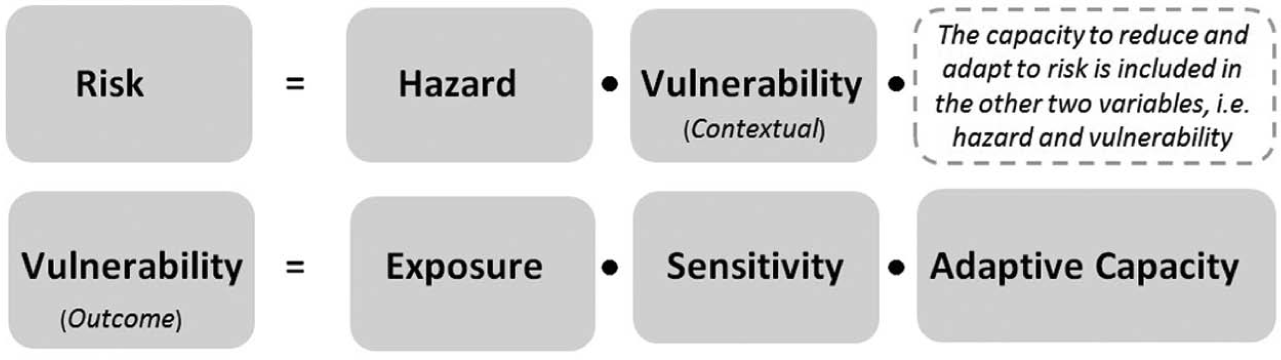
Making sense of seemingly contradictory concepts used in disaster risk reduction and climate change-related literature
The concept of capacity (i.e. the capacity to reduce and adapt to risk) probably creates most confusion and misunderstanding (Figure 1). This is because it is used in two different contexts with different meanings.(24) In the context of a risk assessment of a specific area, it typically refers to existing risk reduction measures.(25) In other words, it is the (already) used capacity of stakeholders to reduce or adapt to disaster risk, seen in the form of the actions taken.(26) By contrast, in the context of the identification of potential risk reduction, risk treatment or adaptation measures, the term “capacity” refers to the potential of people and institutions to reduce and adapt to risk.(27) In other words, it goes beyond institutionally based measures and people’s local coping strategies that are already in place; it also includes capacity that may be used in the future to reduce and adapt to disaster risk.
The terms “coping capacity” and “adaptive capacity” generally include both used and unused capacities. Coping capacity is defined by UNISDR as “… the ability of people, organizations and systems, using available skills and resources, to face and manage adverse conditions, emergencies or disasters …” which can “… contribute to the reduction of disaster risks.”(28) While the term “adaptive capacity” is not included in the UNISDR glossary,(29) a definition can be found in the introduction to the Intergovernmental Panel on Climate Change’s (IPCC) Fourth Assessment Report, which states that “… adaptive capacity is the ability of a system to adjust to climate change [including climate variability and extremes], to moderate potential damages, to take advantage of opportunities or to cope with the consequences.”(30)
Measures taken by city dwellers to reduce and adapt to urban risk are, in this study, called coping and adaptive practices. In the literature, they are also expressed in other terms (such as coping strategy,(31) coping mechanism,(32) individual risk reduction practice,(33) private adaptation,(34) autonomous adaptation,(35) adaptive response,(36) and adaptive behaviour and practice(37)). They all express used adaptive capacity. Some academics differentiate between coping (i.e. local adjustments to deal with extreme weather events) and adaptive practices (i.e. longer-term or fundamental changes made to systematically reduce potential harm or take advantage of opportunities arising from weather changes).(38) As was later confirmed by this study, their differentiation is however not clear-cut and is very context specific.(39)
Knowledge of city dwellers’ coping and adaptive practices is vital, given that cities that move towards resilience (and transformation) have an active (and integrated) adaptation policy and institutional structures that encourage and support action and fundamental system change at all levels and by all sectors and agencies.(40)
IV. How City Dwellers Reduce and Adapt to Urban Risk
City dwellers employ a wide range of proactive measures to reduce and adapt to their level of disaster risk, both well in advance of and shortly before potential hazard impacts. Moreover, during and following hazard impacts they deploy ad hoc response and recovery measures.(41) To better understand the range and diversity of city dwellers’ coping and adaptive practices, these were categorized on the basis of their objectives into:
hazard reduction and avoidance: to limit or avoid current and future hazards;(42)
vulnerability reduction: to reduce current and future vulnerability to hazards;(43)
preparedness for response (or ad hoc action): to provide functional and flexible mechanisms and structures for disaster response; and
preparedness for recovery (or ad hoc action): to provide functional and flexible mechanisms and structures for disaster recovery.
The definition of these measures is based on the conceptual understanding presented in Section III (Figure 1, upper part). As risk is understood here to be a product of hazard and vulnerability, the first measure listed above addresses hazards, while the others tackle vulnerability (Figure 1). In the context of this study, the identified measures were then assessed in relation to their thematic foci (i.e. physical,(44) environmental, social, economic or institutional). They were also reviewed on the basis of underlying patterns of social behaviour (i.e. individualistic, communitarian, hierarchical or fatalistic).(45) “Individualistic” behaviour can be characterized as self-help or fixing things oneself. “Communitarian” or “egalitarian” behaviour is based on the belief that everyone sinks or swims together, and is characterized by communal efforts. “Hierarchical” patterns relate to the belief in, and reliance on, authorities and strong leadership that provides assistance, control and organization. “Fatalistic” behaviour is a “non-strategy” for survival, based on the idea that taking action (or not) has the same (negative) result. Finally, it was assessed whether measures were:
taken well in advance or shortly before potential hazard impacts;
planned or ad hoc;
intentional/deliberate or unintentional (i.e. intended to reduce or adapt to risk or not); and
supported by any authorities or aid organizations or not.
The following sections present the systematization of city dwellers’ coping and adaptive practices. Note that the categorization of specific measures and strategies (presented in sub-sections IV a–d and Tables 1–6) is not always clear-cut and there are surely overlaps.
Coping and adaptive practices for hazard reduction and avoidance(1)
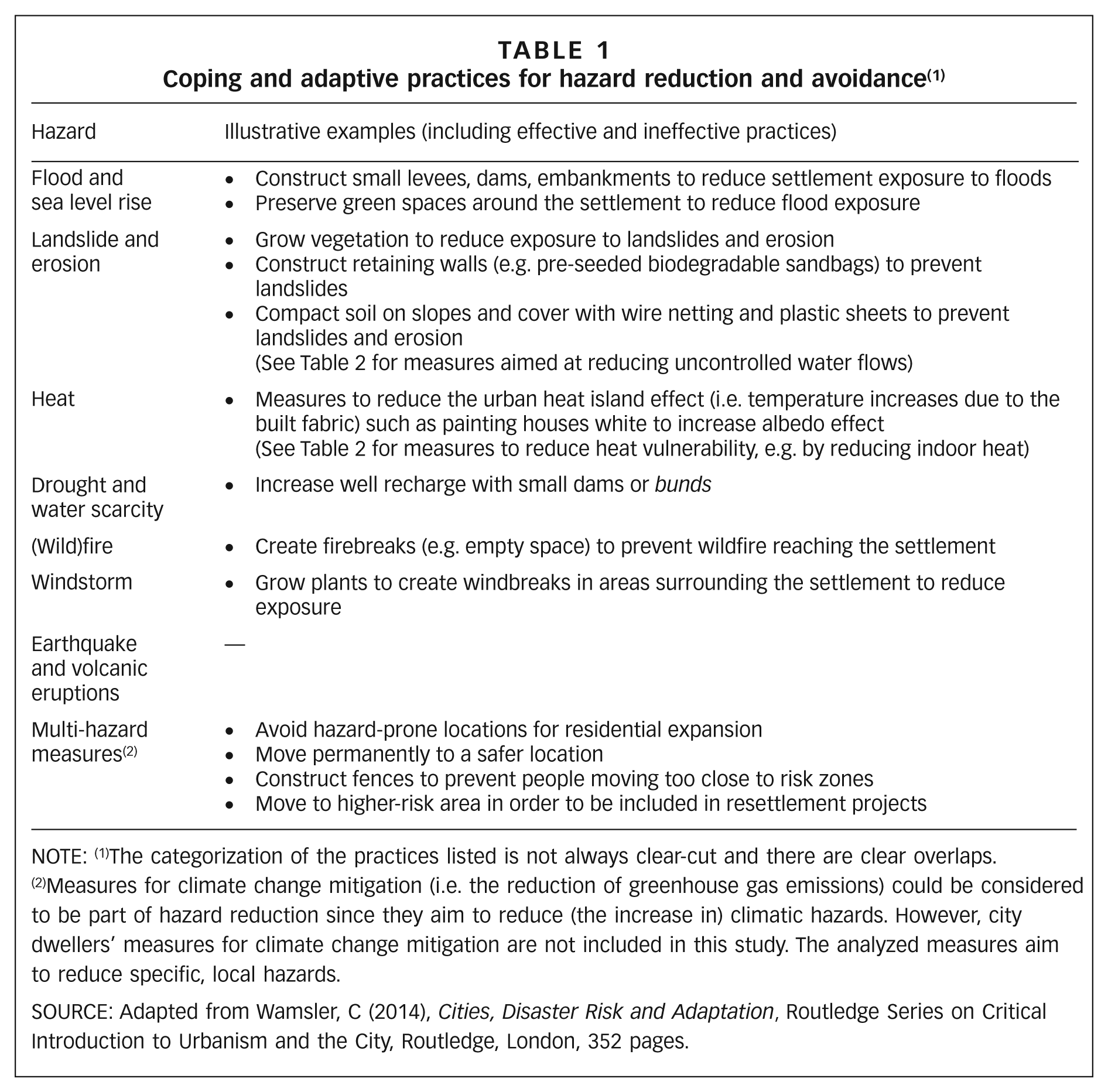
NOTE: (1)The categorization of the practices listed is not always clear-cut and there are clear overlaps. (2)Measures for climate change mitigation (i.e. the reduction of greenhouse gas emissions) could be considered to be part of hazard reduction since they aim to reduce (the increase in) climatic hazards. However, city dwellers’ measures for climate change mitigation are not included in this study. The analyzed measures aim to reduce specific, local hazards.
SOURCE: Adapted from Wamsler, C (2014), Cities, Disaster Risk and Adaptation, Routledge Series on Critical Introduction to Urbanism and the City, Routledge, London, 352 pages.
Hazard-specific coping and adaptive practices for vulnerability reduction(1)
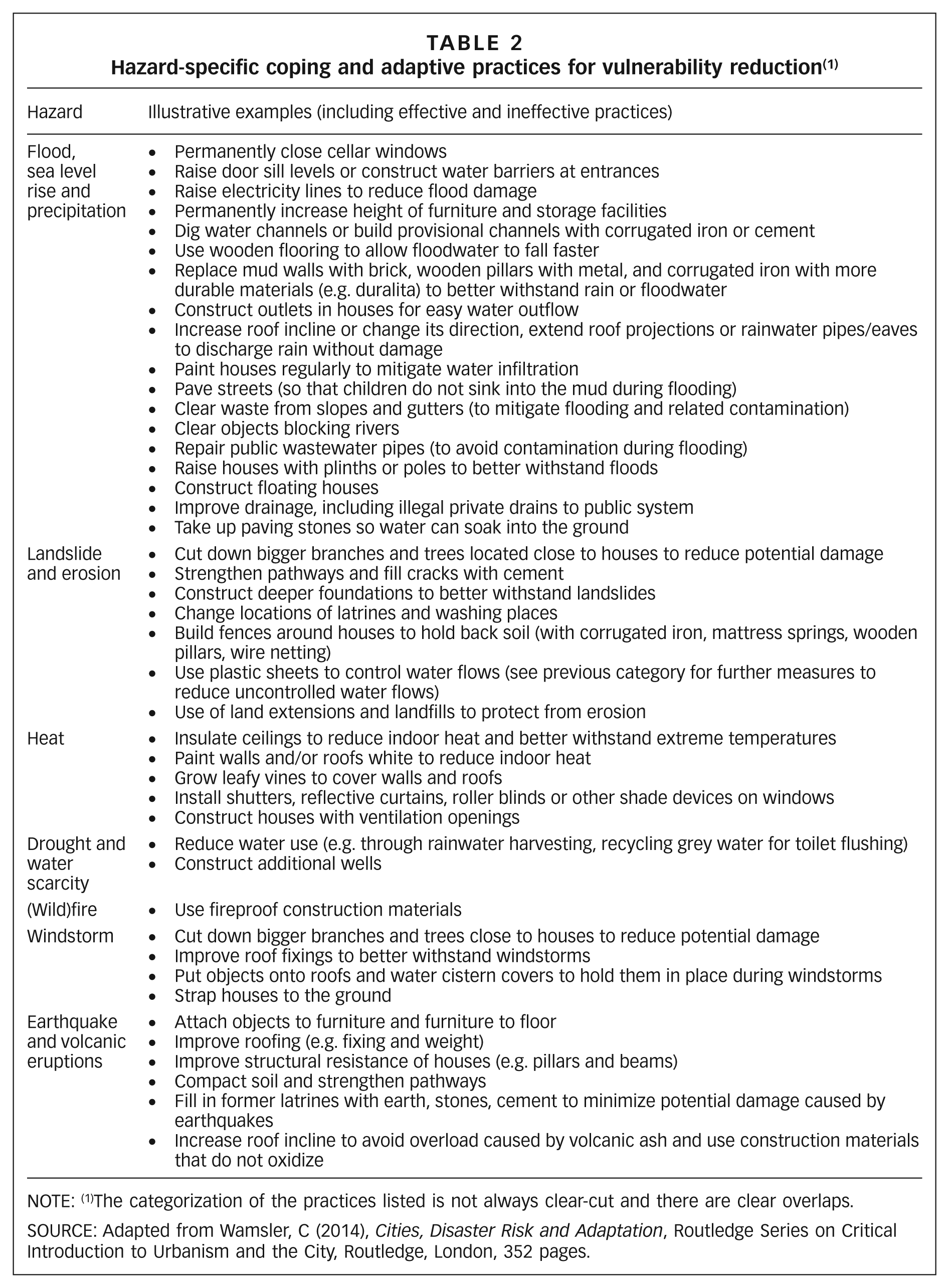
NOTE: (1)The categorization of the practices listed is not always clear-cut and there are clear overlaps.
SOURCE: Adapted from Wamsler, C (2014), Cities, Disaster Risk and Adaptation, Routledge Series on Critical Introduction to Urbanism and the City, Routledge, London, 352 pages.
NOTE: (1)The categorization of the practices listed is not always clear-cut and there are clear overlaps. (2)Most of the non-hazard-specific practices listed positively influence all types of risk reduction measures.
SOURCE: Adapted from Wamsler, C (2014), Cities, Disaster Risk and Adaptation, Routledge Series on Critical Introduction to Urbanism and the City, Routledge, London, 352 pages.
NOTES: (1)The categorization of the practices listed is not always clear-cut and there are clear overlaps. (2)Ad hoc measures for hazard/disaster response are also included.
SOURCE: Adapted from Wamsler, C (2014), Cities, Disaster Risk and Adaptation, Routledge Series on Critical Introduction to Urbanism and the City, Routledge, London, 352 pages.
NOTES: (1)The categorization of the practices listed is not always clear-cut and there are clear overlaps. See also Table 3 for non-specific measures that relate to response preparedness. (2)Ad hoc measures for hazard/disaster response are also included.
SOURCE: Adapted from Wamsler, C (2014), Cities, Disaster Risk and Adaptation, Routledge Series on Critical Introduction to Urbanism and the City, Routledge, London, 352 pages.
NOTES: (1)The categorization of the practices listed is not always clear-cut and there are clear overlaps. See also Table 3 for non-specific measures that relate to recovery preparedness. (2)Ad hoc measures for hazard/disaster recovery are also included.
SOURCE: Adapted from Wamsler, C (2014), Cities, Disaster Risk and Adaptation, Routledge Series on Critical Introduction to Urbanism and the City, Routledge, London, 352 pages.
a. Reducing and avoiding hazards
“I ran away with my children and got separated from my husband, because he never wanted to leave this place.”(46) “I got old car tyres from my neighbour’s repair shop to build a floodwall next to the river. But if the situation gets worse, I consider moving away.”(47)
Urban dwellers around the world use a variety of measures to reduce their hazard exposure (Table 1). People build small embankments to reduce flood exposure or construct retaining walls to reduce landslide hazards. Materials include bricks, cement, stones, nylon bags filled with soil and cement, compacted soil, old tyres or a combination of old tyres, stones, cement and soil.(48) In Medellín (Colombia), residents fill biodegradable sandbags with soil and seeds, which transform over time into green retaining walls when the sandbags burst under pressure from the growing plants.(49) Simply growing certain plants also stabilizes the soil, counteracts soil erosion and can create a windbreak. Another measure is to compact soil on slopes and to cover these with wire netting and plastic sheets to prevent landslides, a common practice in both San Salvador and Rio.
Residents also take physical measures to reduce both hazards and vulnerabilities simultaneously. Examples include the reduction of uncontrolled water flows that can be the (single) cause of landslides; improvements to electrical connections that may cause fires; and measures to reduce the heat island effect that also reduce vulnerability to higher climate-related temperatures.
Furthermore, residents deploy hazard avoidance measures. For example, they do not expand their homes into known hazard-prone locations; they move to a safer house or location; or they build fences to prevent children from accessing at-risk zones. In San Salvador, residents, in a diametrically opposite approach, actually moved into risk areas in the hope of being included in post-disaster resettlement programmes – risk reduction through increased hazard exposure.
Table 1 provides an overview of hazard reduction and avoidance measures. Most of these are focused on physical or environmental improvements taken at an individual level, but there are also examples of community-based action. For example, residents work together to obtain construction materials or to build simple flood or retaining walls; this is commonly seen in marginal settlements that are at risk from floods or landslides.
b. Reducing (contextual) vulnerability to better withstand hazards
“Since we have changed the direction of the roof incline, I have fewer problems with water infiltration …”(50) “… people have learned the hard way. If you go around the compound now, people are using burnt bricks or cement blocks because houses built from these are stronger.”(51) “Our furniture has been custom made to help keep our things dry from the water.”(52)
Most deliberate risk reduction measures aim to improve physical hazard protection and mitigate potential hazard impacts (Table 2). The construction and maintenance of buildings always, to a greater or lesser extent, takes into consideration protection from rain, floods, landslides, windstorms, earthquakes, cold and heat. Important factors include the depth of foundations, the length of roof projections, the height of door sills, the use of shutters and regular house-painting to prevent water infiltration.
Climatic changes have forced residents to further improve their living conditions by replacing doors with more flood-proof ones; increasing roof inclines to improve rainwater run-off; changing the orientation of roofing so that water run-off does not cause damage; improving wall and roof insulation; and even constructing additional drains, sometimes illegally connected to adjacent sewers. In Medellín (Colombia), residents protect their houses from flooding and water infiltration with projecting pipes/eaves (so-called “urban showers”) in order to discharge rainwater into the street.(53)
Innovative examples of physical vulnerability reduction measures can be found for nearly all types of hazard. Examples include floating houses;(54) wooden flooring and the creation of outlets at the rear of the house to improve drainage in flood conditions;(55) and construction on poles or other techniques to increase the height of the floor, in order to mitigate the impact of floods and improve ventilation.(56) In Nigeria, people use plastic bottles filled with dry soil or construction waste such as bricks (that would otherwise be clogging waterways and landfills) to construct earthquake-resistant houses.(57)
In addition to structural improvements, residents employ many other physical measures to mitigate potential hazard impacts. Examples include using wood or bricks to secure the roof during windstorms; glueing objects onto furniture to prevent them from falling during earthquakes; or permanently increasing the height of furniture in flood-prone areas. Measures to reduce vulnerability to increasing temperatures in cities include hanging curtains made of brightly coloured material; painting houses white;(58) or creating ventilation holes that are covered with materials (such as empty cement bags) that also provide protection against mosquitoes (Table 2).(59) Another measure is giving vulnerable household members (e.g. the elderly or disabled) the least dangerous (or more accessible) bedrooms (Tables 3 and 5).
Physical and environmental measures are often combined. In Rio and Dhaka (Bangladesh), residents grow potted and creeping plants (such as passion fruit vines) to cover walls and roofing to help protect themselves from the heat.(60) Trees and other plants are often used to reduce landslide risk (Section IV and Table 1). However, trees can create other problems in densely populated settlements, as falling branches may injure people and damage infrastructure during adverse weather conditions. Consequently, they are often cut down to prevent damage (Table 2).
Residents also use environmental measures to protect themselves from potential floods, landslides and water scarcity, for example taking up paving stones to create a “soakaway”. They also draw upon their knowledge of the local environment to decide how best to construct their houses.(61) Water scarcity is dealt with through a range of measures that reduce water use. For example, freshwater is channelled off roofs into small containers (for household use) and larger tanks (for communal use).(62)
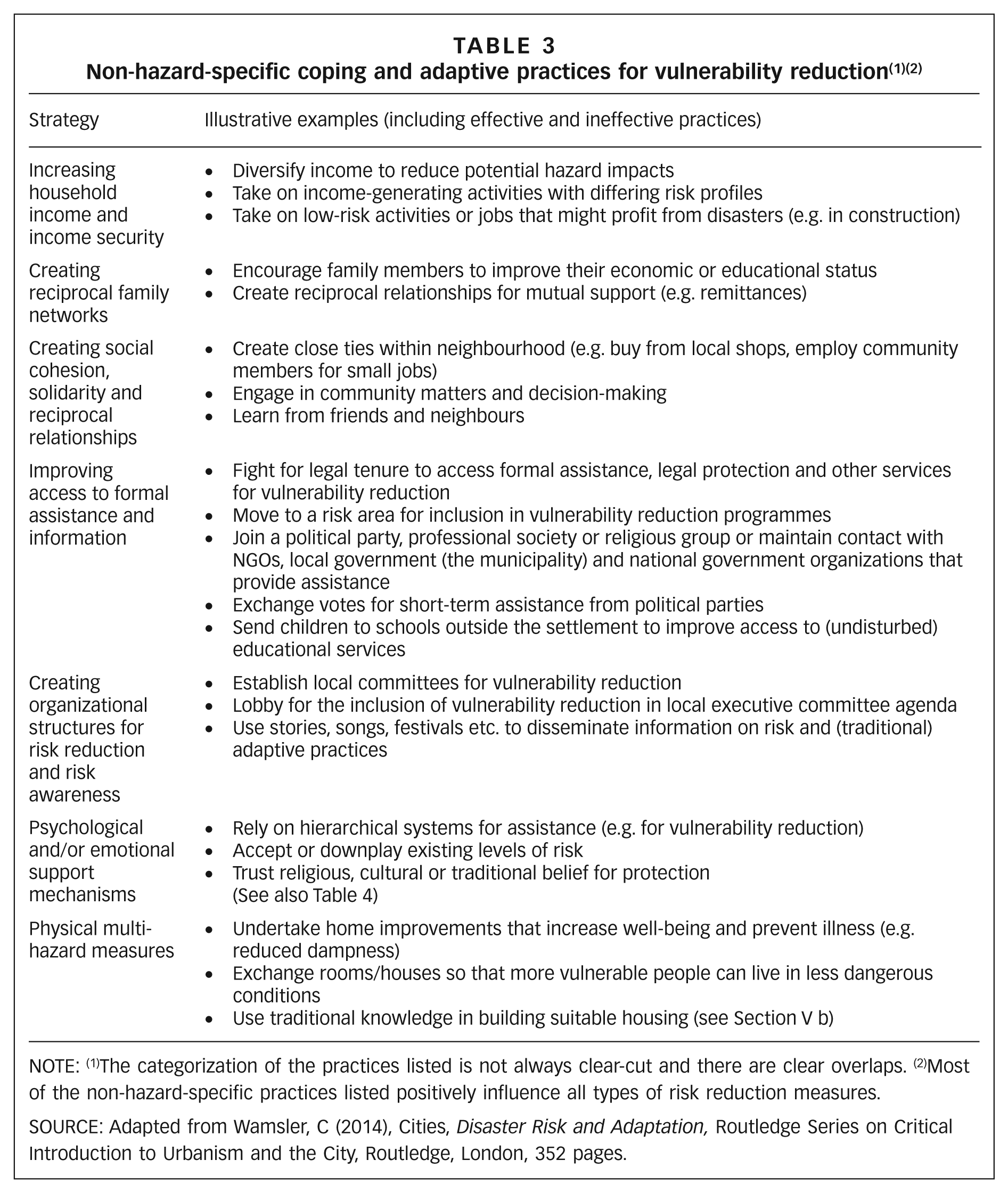
Residents also deploy economic measures aimed at increasing household income and income security, to reduce their contextual vulnerability (and at times other risk factors) (Table 3). They include economic diversification at individual and household level and taking low-risk jobs or jobs with different risk profiles to reduce potential hazard impacts.(63) Economic diversification means that residents and their families undertake many different income-generating activities – renting out rooms, running a home-based business, having various service sector jobs, often in parallel. Examples can be found worldwide.(64) Economic diversification is vital given the potential impact of disasters on livelihoods, as illustrated by the following quote from hurricane-prone Caye Caulker, Belize:
“It’s not whether it hits or it doesn’t. As long as it is expected to hit anywhere around, the tourists are immediately going to avoid this area for a good two to three weeks, even if the hurricane has passed. And that does a huge amount of damage to your revenue and business total. A hurricane affects, whether it hits or it doesn’t.”(65)
Economic diversification is a practice that not only helps people to be less affected in the case of hazards/disasters, it also enables city dwellers to recover more quickly from hazard impacts (Section IV d).
The identified socially oriented measures can be related to all kinds of risk-reducing measures, not least vulnerability reduction. They include the creation of solidarity and reciprocal relationships with neighbours and other community members, thus forming the foundation for local networks and structures such as risk reduction committees, and communal actions such as “community cleaning days” to reduce the risk of waste and branches blocking water channels (Tables 2 and 3). Other measures relate to education and include sending children to study outside the settlement or investments in children’s education.
City dwellers also organize themselves in order to give the community a more powerful voice in lobbying for services that make them less vulnerable to hazards. This was the case in Brazil and El Salvador, where local interests were represented by residents associations or local committees. Another social/institutional measure is the fight for legal tenure and access to formal assistance or credit offered by national or local authorities, banks or aid organizations. With legal tenure, residents are not in constant fear of eviction and are therefore more motivated to address vulnerable conditions.(66)
Finally, residents in at-risk communities adopt emotionally oriented strategies. They simply accept or ignore the risk, seek emotional support from their social networks (family, relatives, neighbours, religious group etc.), or rely on their faith (Table 3). As Alberto, a resident of hurricane-prone Caye Caulker, Belize states:
“Just the thought [of my home and possessions being damaged] scares me … So I hope that doesn’t happen. I pray.”(67)
Others place their faith in hierarchical structures and depend wholly on their assistance, leading to the same passive behaviour.
c. Reducing (contextual) vulnerability by improving response preparedness
“Make sure you have your documents all in one place; that you know where your money is, [that] you have access to money. Money is more important than anything – money is more important than a can of beans.”(68) “[…] our tables are very high and so also are our wardrobes; they are made in such a way that we can climb and sit on top of them.”(69)
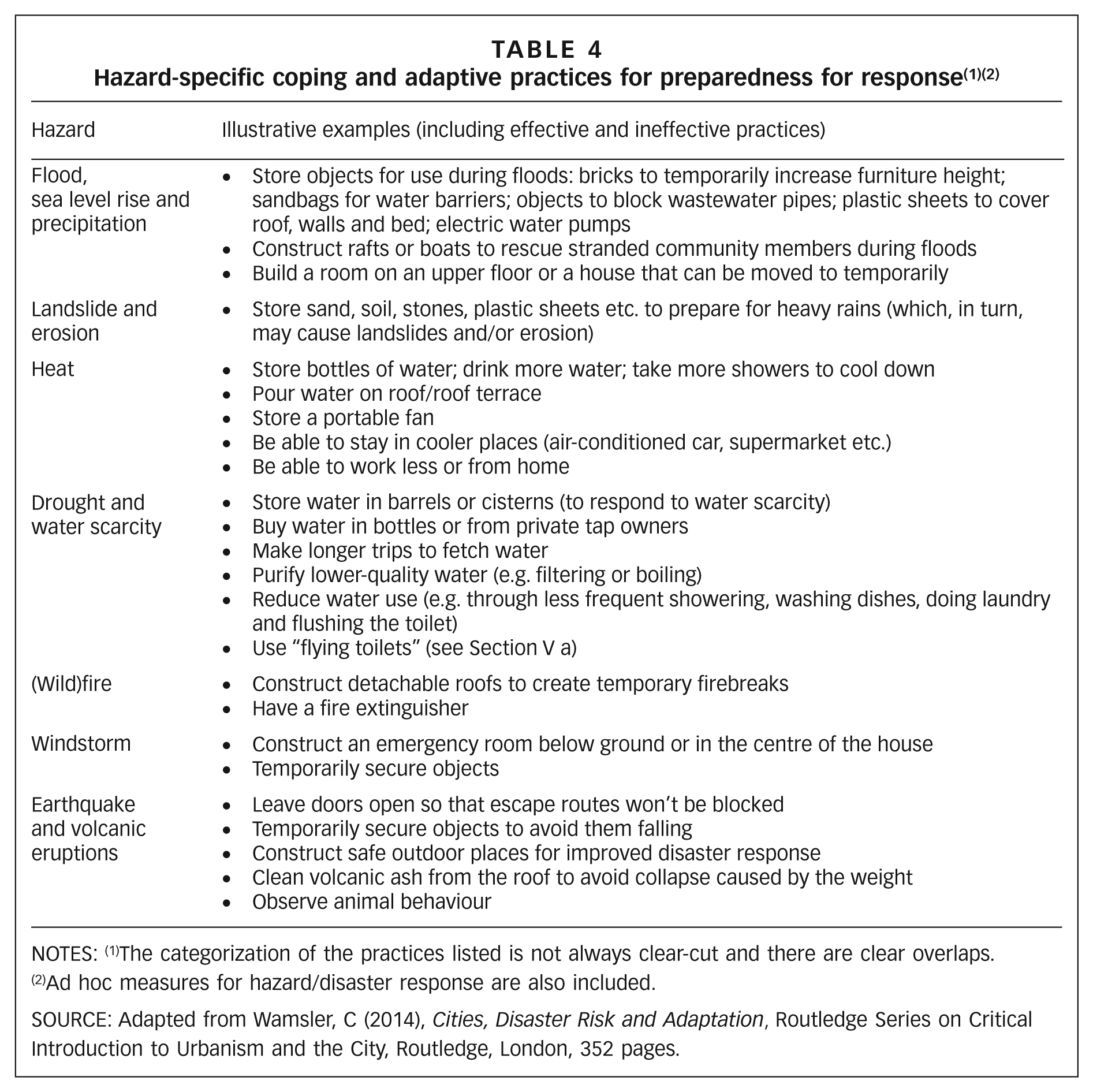
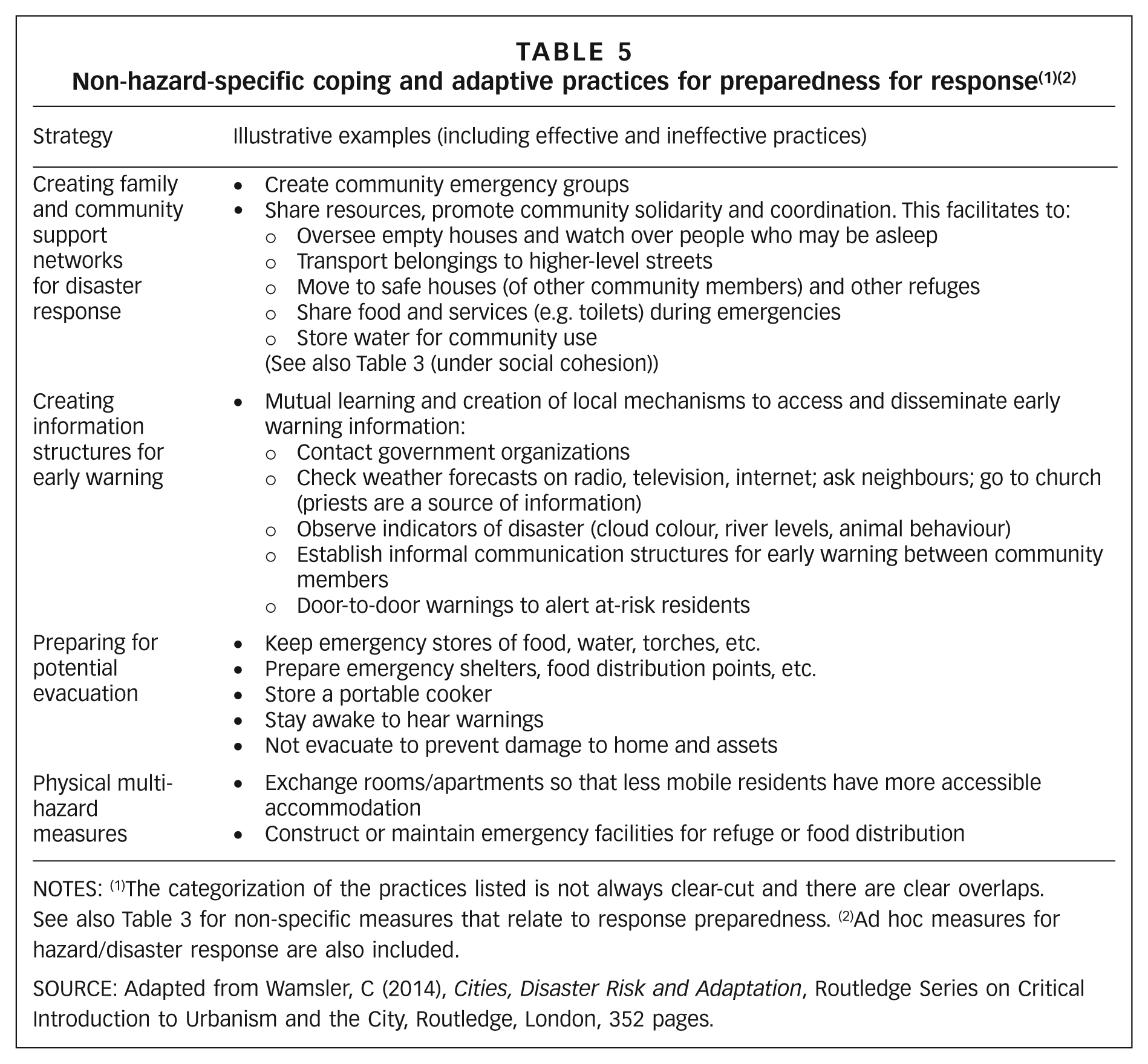
City dwellers take a range of measures in preparation for potential emergencies and temporarily adapt their behaviour to changed circumstances. Some preparations are made throughout the year, others only shortly before a potential hazard impact (e.g. following a warning). Typical examples include storing food and water; having such equipment as a portable fan (Table 4) or a portable hotplate or cooker (Table 5); and storing plastic sheets, sandbags, electric pumps, objects that can help to temporarily raise furniture, and other items that can block wastewater pipes and prevent backflow if water levels rise.(70)
Physical response preparedness measures include temporary improvements, such as sandbags (used as floodgates), and temporary or permanent structures that provide a refuge during an emergency, whether these are emergency rooms in a building or dedicated emergency shelters (sometimes organized or constructed by the whole community). Some Rio residents buy or rent an extra house, within or outside their settlement, where they can take shelter if necessary. In the earthquake-prone Kathmandu Valley of Nepal, local tradition provides for open, public spaces in the urban fabric, where people can escape falling rubble. These spaces have proven to be crucial in past earthquakes.(71)
There is a range of other, non-hazard-specific response preparedness actions (Table 5). As mentioned in Section IV b, they often positively influence all types of risk-reducing measures. In the context of response preparedness, a common measure in many low-income settlements is the creation of local emergency groups, such as those established in Central America following Hurricane Mitch in 1998, often with support from national and international NGOs.(72)
Similarly, the creation of social cohesion, solidarity and community networks forms the basis for various response preparedness measures (Table 5) and can facilitate mutual aid during and in the immediate aftermath of disasters. In Rio and San Salvador this consists of door-to-door advice and evacuation procedures; guarding of empty houses; transportation of belongings to higher ground; provision of temporary accommodation by community members living in more secure areas; and sharing food and services, such as toilet facilities (Table 5). Similar measures have been identified in other areas.(73)
Another important aspect of response preparedness is the anticipation and monitoring of hazards. Social cohesion and community networks are crucial for the rapid diffusion of hazard information and the provision of early warnings. Information sources include television, radio, the internet, the local priest or church, people’s own observations and traditional monitoring systems (Table 5). In San Salvador, residents monitor flood risk by observing the river’s water level, clouds and the noise created by rain uphill. Similarly, a woman in the Alajo settlement in Accra, Ghana, states:
“As soon as the clouds gather I move with my family to Nima to spend the night there.”(74)
In Rio, the appearance of clouds and an increase in the number of cockroaches entering houses are used to forecast heavy rain. Communities in the Limpopo River basin in Mozambique predict floods by observing ant activities. When ants leave their underground nests, people know that the water level is rising.(75)
While Tables 4 and 5 show the wide range of preparedness measures taken in advance of potential emergencies, there are also many ad hoc responses. For example, in excessive heat people take several showers a day, work less, work from home or drink more water to cool down. In case of water scarcity, ad hoc measures include the purchase of overpriced bottles of water or a reduction in the amount of water used for drinking, cooking, cleaning and washing, which in turn may create health and hygiene risks.
d. Reducing (contextual) vulnerability by improving recovery preparedness
“[When the 1988 earthquake struck] the only thing on my mind [at] that time was to rebuild my house and start a normal life again. For that I needed money, so I worked for others for the money and managed [to get] some amount from my relatives as a loan from them.”(76) “During the 2000 floods, I lost everything. My house was destroyed, including the latrine, and everything. That is why I do not have a bed. My neighbours suffered too, but they managed to save their goods. Because of my age and being without a husband, I couldn’t remove my goods and leave the area ... I survive because of family support.”(77)
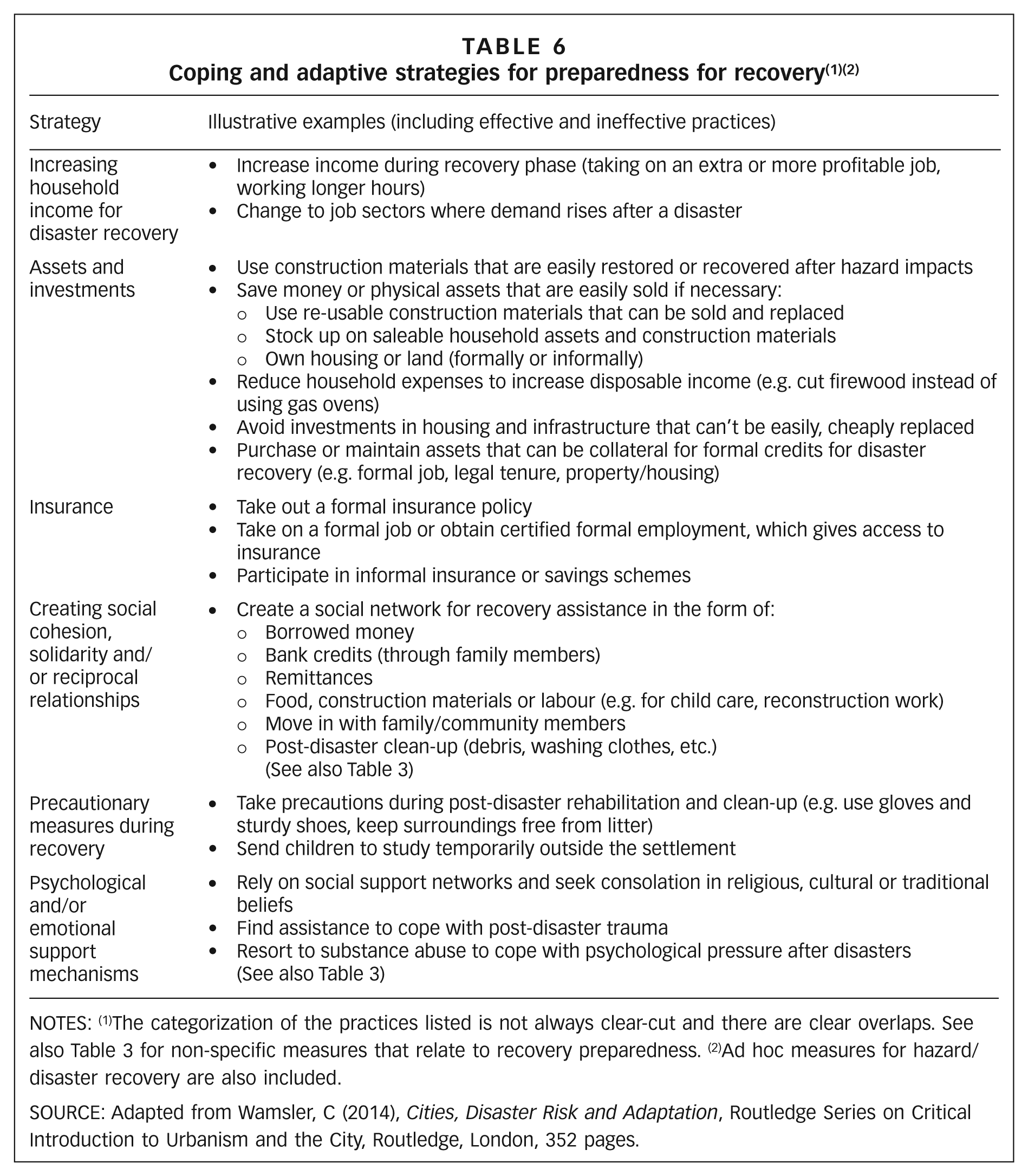
City dwellers deploy various preparedness measures to help them to recover quickly from the impact of a hazard/disaster (e.g. damage to housing, loss of income or injury) and bounce back to their former, or even better, living conditions. At individual and household level, this is called “recovery preparedness” or “self-insurance”. People create formal and informal security systems that provide them with access to any necessary post-disaster assistance (Table 6).
Financial assistance for post-disaster reconstruction and rehabilitation comes from various sources, including formal bank loans, informal credit from friends or employers, savings accounts, community-based savings schemes, donations, the sale of assets or payouts from insurance policies.(78) In urban low-income settlements, people also save money under the mattress, work extra hours or take an additional job, and stockpile assets (such as construction materials) that can be sold quickly if necessary. A San Salvador resident, in order to raise money following Hurricane Mitch, sold his corrugated iron roofing sheets and then re-roofed his home with the body of an old car:
“I never nail down the iron sheets that I use for roofing my house, so that I can sell them if I want; if I need some money, like [I did] after Hurricane Mitch.”(79)
Urban dwellers with limited financial resources tend not to invest in their housing, so losses can be replaced more cheaply and easily. However, legal home ownership is one of the most important “self-insurance” strategies and a household’s main asset, as it serves multiple purposes in risk reduction and adaptation. The home can be sold if money is short, and provides access to formal reconstruction assistance and bank credit, and other benefits such as income generation.(80)
Formal employment is another strategy that reduces vulnerability and improves recovery preparedness. It typically means a more secure income (even when disasters result in many lost working days); access to life, health, unemployment or disaster insurance; a retirement pension; direct post-disaster assistance or credit from employers; and other worker’s benefits (such as a yearly thirteenth month bonus, paid sick leave etc.). The importance of a secure income is illustrated by this quote from a resident of Caye Caulker, Belize, who describes Hurricane Keith in 2000:
“We didn’t work for like a whole month … like two months. For two months, everyone was fixing up, getting back together, trying to get back.”(81)
Residents of Rio and San Salvador who were formally employed stated that they were at less risk and better prepared to recover from disasters than those who depended solely on informal structures and services. Some residents of low-income areas in San Salvador made deals with business owners to illegally obtain employment certificates, as this enabled them to access insurance schemes and credit.
Both legal home ownership and formal employment ultimately help to speed up recovery, especially when informal systems are weak or non-existent. However, total reliance on hierarchical structures for social protection also has its shortcomings, especially in the context of climate change.
“A lot of people are insured, and they got damaged, but they didn’t pay them, so it’s just a rip-off. So most of the people now, they just quit that insurance.”(82)
Non-financial assistance is also needed to recover quickly from a disaster – help in taking care of children, labour to repair damage and reconstruct houses or simple post-disaster clear-up, such as the removal of mud and debris (Table 6).
Being informed about the risks and secondary hazards of recovery is a vital, but rare, preparedness measure. The Rio case study showed that people walking in floodwater commonly stepped on sharp items or dangerous animals or caught a disease. Even after the water has receded, poisonous animals such as spiders, snakes and scorpions remain in homes, seeking refuge in dry places. Those who are better prepared use gloves and sturdy shoes when cleaning up, keep children out of the floodwater, keep the area outside the house free from litter at all times and keep food in closed containers (safe from rats and floodwater).
The creation of social cohesion, family and community support networks and good relations with aid organizations is crucial for different risk reduction measures, including access to both financial and non-financial post-disaster assistance. Aid organizations include government and non-government agencies, local committees, and religious, professional and political groups.
Another preparedness measure is the use of construction materials that easily recover (or can be recovered) after hazard impacts. For example, wooden flooring resists contact with water and is less prone to water-logging.(83)
V. Coping Strategies: Strengths and Weaknesses
Further analysis of the coping and adaptive practices presented in the previous section shows huge differences in their effectiveness(84) (Tables 1−6); these include both forward-looking solutions and short-lived and even harmful measures.
a. Effective coping and adaptation
Coping and adaptive practices that work well at an individual or household level may be counterproductive at a larger scale. For example, during times of drought and hot weather (when water is already scarce), San Salvador residents store large amounts of water from private or public sources, while in Rio people repeatedly drench their rooftops with water to reduce the temperature indoors (Table 4). Both practices result in growing pressure on water supplies. Similarly, in Rio during hot weather, the increased use of informally connected fans and air conditioners frequently causes electrical connections to short-circuit, resulting in power outages and fires (which can spread quickly in dense settlements). Electric fans and air-conditioning also increase energy consumption. Another example is the so-called “flying toilets”, used in informal settlements throughout the world, including the Rio case study area. When toilet facilities are unavailable or cannot be flushed due to a lack of water, residents relieve themselves into a plastic bag and toss it out of the window – at great risk to both the environment and public health (Table 4).(85) Other examples from San Salvador include flood defence walls, land extension and landfill (Tables 1 and 2), which can increase downstream flood risk. Land extension and landfill can also destabilize properties and pollute the environment, as illustrated in the following statement from a resident of Caye Caulker, Belize:
”In years gone by, people used to use household waste to fill their property … 20, 30, 40 years ago, we didn’t really realize how much that damages the environment. But [some] people continue to do it.”(86)
Other practices seem ineffective in both the short and long term and at all levels, including passive behaviour (i.e. a total reliance on hierarchical structures or a belief in divine forces) (Table 3); resorting to substance abuse to cope with disaster losses (Table 6); and inappropriate measures such as roofing houses with loose corrugated iron weighted down with heavy objects, which can endanger neighbours during strong winds (Table 2). Other examples are traditional beliefs or social relations that lead to the exclusion of certain groups,(87) as illustrated by this quote from an informal settler in Zambia:
“The frequent heavy rainfalls that come year after year, and the heat, including the sudden shifts between the two weather conditions are clear signs of a curse. Women must stop wearing trousers, playing football, boxing and going to taverns. They should respect their husbands.”(88)
Gender relations can increase risk, and the exclusion of certain groups from decision-making related to risk reduction and adaptation generally creates barriers to resilient transformation. Traditional social relations and hierarchies that subordinate women are particularly worrying, as in many cultures they may have exclusive knowledge.(89)
Coping and adaptive practices that may be effective in the short term but are likely to prove ineffective in the long term include borrowing at high interest rates (e.g. from moneylenders); selling off assets cheaply in the post-disaster period (Table 6); spending money on temporary arrangements (e.g. short-lived water barriers and channels); cutting down trees for firewood (Table 6); or covering slopes with plastic sheets that pollute the environment and can block rivers (Table 2).
Coping and adaptive practices that (in combination with other measures) may be effective in both the short and long term include working with neighbours and local committees (e.g. for mutual help or early warning) (Tables 3 and 5); learning from friends and others (Table 3); growing (suitable) plants and preserving green areas to reduce heat, flood and landslide risk (Tables 1 and 2); accumulating collateral or assets for post-disaster sale without making a loss (Table 6); reducing unnecessary expenses (Table 6); saving, taking out loans at reasonable rates or participating in insurance schemes where access is conditional on risk reduction (Table 6); implementing incremental and/or flexible physical measures such as building floating houses that rise with the water level (Table 2) or using detachable roofs as firebreaks (Table 4); improving waste/wastewater management (Table 2); increasing involvement in decision-making for adaptation planning (Table 3); and investing in and increasing access to formal education (Table 3).
The importance of formal education was identified in both the San Salvador and Rio case study areas, where it was revealed that educational levels have a positive effect on city dwellers’ risk-reducing strategies,(90) influencing the following factors, which are particularly relevant to efficient coping and adapting:
formal employment (Section IV d and Table 6);
opportunity or interest in moving to a lower-risk area within or outside the settlement (Section IV a and Table 1);
awareness and understanding of current risk levels (Table 3);
access to, and provision of, information on risk reduction and adaptation measures (Sections IV c and V b, and Tables 3 and 5); and
acceptance and appropriate use of institutional support (Table 3).
San Salvador and Rio residents consciously apply physical or economic practices (e.g. improvements to housing and surrounding areas, savings, taking out credit). However, a more detailed examination showed that it is mainly those with a higher level of education who actively use additional measures, some of them directly related to education:
sending children to study outside the settlement temporarily, following a disaster (Table 6) or longer term (Section IV b and Table 3);
improving physical access to schools (Section IV a and Tables 1 and 2);
encouraging dependents to study (Section IV b and Table 3);
taking a (formal) job outside the settlement (Sections IV b and IV d, and Tables 3 and 6);
being able to change employer (e.g. in response to demand, which can be influenced by climatic extremes and variability) (Section IV d and Table 6); and
staying aware of current risks by using different sources of information (Sections IV c and V b, and Tables 3 and 5).
b. Effective coping and adaptation in a context of climate change
The rate and magnitude of current environmental change have various negative impacts on the effectiveness of city dwellers’ coping strategies. People are faced with a new starting point from which to cope. In the Rio case study, residents reported that heavy rains, increasingly frequent outside the rainy season, made floods and landslides harder to predict and reduced the time available for preparation and recovery. The greater need to cope with more frequent and severe hazards consumes resources that would otherwise be available to meet subsequent coping and adaptation needs.(91) It can also bring challenges for better-off community members, leading them to opt out of solidarity- and community-based mechanisms. In the words of a resident of Caye Caulker, Belize, who is the owner of a hotel where at-risk neighbours frequently seek refuge during hurricanes:
“The people affect us more, because they are not prepared, they can do more damage than the hurricane.”(92)
This statement refers to the fact that disaster victims often overstay their welcome, which for the hotel owner means an increased workload, stolen goods and a feeling of responsibility that prevents her from leaving the island during emergencies.(93)
In a context of climate change, the trend towards individually oriented measures is furthermore likely to become stronger in urban communities, reducing adaptive capacities at household and community level. Community-based strategies based on solidarity and reciprocity have been found to work best in settlements where family members live close to each other; where there is little disparity in residents’ income; where family members or other dependents are not simultaneously affected by disasters (including climatic extremes and variability); and when disasters do not occur too frequently and have mostly short-term impacts.(94)
In urban areas (and especially urban marginal areas), such conditions seldom apply and are likely to become even less applicable in a context of climate change – for example due to the increased frequency and intensity of disasters and rising migration levels.
Another negative effect of climate change is that it can make traditional knowledge and conventional mechanisms for coping and adapting either obsolete or no longer viable,(95) and can outpace the ability of locals to adapt to changing conditions through a process of testing and modification. Citizen-to-citizen knowledge transfer is inherent in many of the practices presented in the previous Sections IV a–IV d. Urban residents learn from their neighbours, friends, parents and ancestors, and transfer local knowledge horizontally, which compensates for a lack of institutional support and information. Examples of such local knowledge are storm routes, wind patterns, cloud formations, rain corridors or animal behaviour, which enables people to prepare and reduce their risk. Taking wind patterns into account in the design of buildings can help to reduce damage; knowing the colour of clouds that carry hailstones can provide an early warning to run for cover.(96) A telling example of how traditional knowledge can become obsolete comes from a Mozambican community that had always been able to predict floods based on the behaviour of ants (Section IV c). In 2000, unusual cyclone activity resulted in floods that arrived so rapidly that there was no time for the ants to react, resulting in more than 700 fatalities.(97)
In order to deal with new living conditions, city dwellers develop new information channels that enable horizontal knowledge transfer, such as internet-based forums or online groups. An example is the “Inteligencias Colectivas” (Spanish for “collective know-how”). This free database and horizontal learning system collects and promotes technical know-how on informal construction techniques, many of which relate to risk reduction and adaptation.(98) In addition to knowledge exchanged at the individual level, there are cases where whole communities have organized themselves to exchange knowledge with others in different areas. These exchanges become crucial when living conditions change. An illustrative example is Shack Dwellers International, a network of community-based organizations in 33 countries in Africa, Asia and Latin America,(99) which has created horizontal information flows on such issues as disaster-resistant building practices, waste management and drain maintenance. In Brazil, the organization is active in the states of São Paulo and Pernambuco, and has arranged exchange visits both between communities in these states and with member countries in Africa.(100) International or national NGOs also support knowledge exchange between communities. An example is the Salvadorian NGO called Foundation for Salvadorean Development and Affordable Housing (FUNDASAL), which organizes visits and exchanges between at-risk communities in San Salvador.(101)
c. From coping and adaptation to resilience and transformation
While the effectiveness of individual coping and adaptation measures is important, it cannot be taken either as an indicator of the adaptive capacity of individuals or households or of its role in improving resilience and transformation. This study indicates that a short-term measure for one person or household can be a long-term solution for another, depending on the context and conditions and the set and combination of measures. Income diversification might mean increased working hours and burnout for a woman already overloaded with other tasks; for another woman, it might translate into increased independence, money, a retirement pension, insurance cover and better social networks. Renting out a room could leave a household worse off (if it receives less money than it has invested or has to move family members who previously lived in the now-rented room to higher-risk areas); but for another household it might generate the resources needed for long-term change, such as obtaining a better or safer house or investing in health, education and business.(102) A single coping strategy, not particularly effective on its own, can be a vital complement to other strategies, which together create a sustainable coping/adaptation system. Coping and adaptation thus overlap significantly; they are closely connected, there are synergies and trade-offs, and their related capacities play a key complementary role.
While the effectiveness of a single coping strategy might be low, the same strategy may thus be vital in complementing other measures that can only create a sustainable coping/adaptation system in combination. A sustainable coping/adaptation system is here understood as a system that can assist an individual, household or urban community to reduce their level of risk, while maintaining or enhancing local adaptive capacities both now and in the future, and thus not compromising the ability of future generations to meet their own needs. This study has identified two crucial attributes in a context of climate change and uncertainty that determine the sustainability of coping/adaptation systems, namely flexibility and inclusiveness. Flexibility relates to both the number and diversity(103) of measures that address each risk factor(104) and thus to the redundancy in the coping system. Simply put, the more redundant and diverse the back-up measures provided by a system for addressing a specific risk factor, the more flexible that system is. Inclusiveness relates to the use of all four of the potential risk reduction and adaptation measures, to ensure that all types of risk factors are addressed (Sections IV a−b). Flexible and inclusive systems translate into the ability to change in response to altered circumstances and to carry on functioning even when individual parts fail.
The El Salvador and Rio case studies showed that formal education can have a positive influence on both the flexibility and inclusiveness of coping/adaptation systems.(105) It was not only the number of strategies but also the use of different types of strategies that characterized people of different educational levels. Moreover, an increased level of education tended to translate not only into increasingly diverse coping strategies but also more flexible and forward-looking measures (Section V b).
Nevertheless, both city dwellers’ coping and adaptive practices and related coping/adaptation systems are limited in their ability to achieve resilience and transformation. Sustainable change is limited by general issues concerning community-based risk reduction and adaptation, namely:
coping and adaptive practices are focused on the local level, while risk is shaped by factors operating at larger scales;
they are based on events that have happened and therefore not on unpredictable events;
they often ignore structural issues leading to political and institutional shortcomings; and
the needed risk-reducing infrastructure is often beyond city dwellers’ capacities and resources.(106)
VI. Conclusions
People have always coped with and adapted to their environment, and this capacity is recognized as being critical to improving resilience and transformation. However, little is really known about city dwellers’ coping and adaptive practices, and they are seldom taken into account by authorities and organizations.
How marginal, at-risk settlements are seen influences how they are treated. Municipal authorities and aid organizations may choose to only see how appalling conditions are, and look for options to clear or replace such settlements. Or they can choose to see the richness of community life and local capacities, along with its pressing needs. These different perspectives have implications for their actions and support for increasing urban resilience.
This assessment of urban dwellers’ practices to reduce and adapt to increasing risk shows the immense richness and diversity of their adaptive capacities. It provides a systematic overview of coping and adaptive practices, presents critical insights into their positive and negative consequences, and indicates the importance of taking local capacities into account when preparing policies and projects.
Coping with climatic extremes and variability should not automatically be seen as maladaptive. Whether (or not) urban communities manage to achieve resilience and move beyond, towards transformation, does not depend on the effectiveness of individual practices but on the flexibility and inclusiveness of coping/adaptation systems at the individual, household and community level (i.e. the combined set of measures).
Actions based on these findings mean that support must be provided to urban communities (to negotiate their needs and rights), to increase the flexibility and inclusiveness of these systems and make them more viable in today’s context. Concrete measures may include improving and accelerating the learning mechanisms that are inherent in communities, raising education levels, encouraging or scaling-up existing coping strategies and offering new or alternative strategies.(107) Consequently, transformation might consist of a combined set of incremental improvements that transform coping systems from within.
In order to support adaptive capacities that lead to increasing urban resilience and transformation, they first need to be identified. This study provides municipal authorities and aid organizations with a framework for examining coping and adaptive practices (and related coping/adaptation systems) based on an assessment of their:
objectives (i.e. hazard reduction and avoidance, vulnerability reduction, preparedness for response and recovery, and ad hoc measures to respond or recover);
thematic foci (i.e. physical, environmental, social, economic or institutional);
hazard focus (i.e. hazard specific or non-hazard specific);
underlying patterns of social behaviour (i.e. individualistic, communitarian, hierarchical or fatalistic);
timing and stages (i.e. pre- or post-disaster; taken well in advance or shortly before potential hazard impacts);
awareness (i.e. planned or ad hoc; intentional/deliberate or unintentional);
financial implications;(108)
support (i.e. carried out with or without institutional support);
knowledge transfer (i.e. information channels used to learn from, communicate and transfer coping mechanisms to other members of a community or external to it);
effectiveness (i.e. long- or short-term increase of adaptive capacities); and
related (unused) capacities (Table 7).
Framework for the systematic analysis of city dwellers’ coping and adaptive practices – including both individual strategies and related coping/adaptation systems
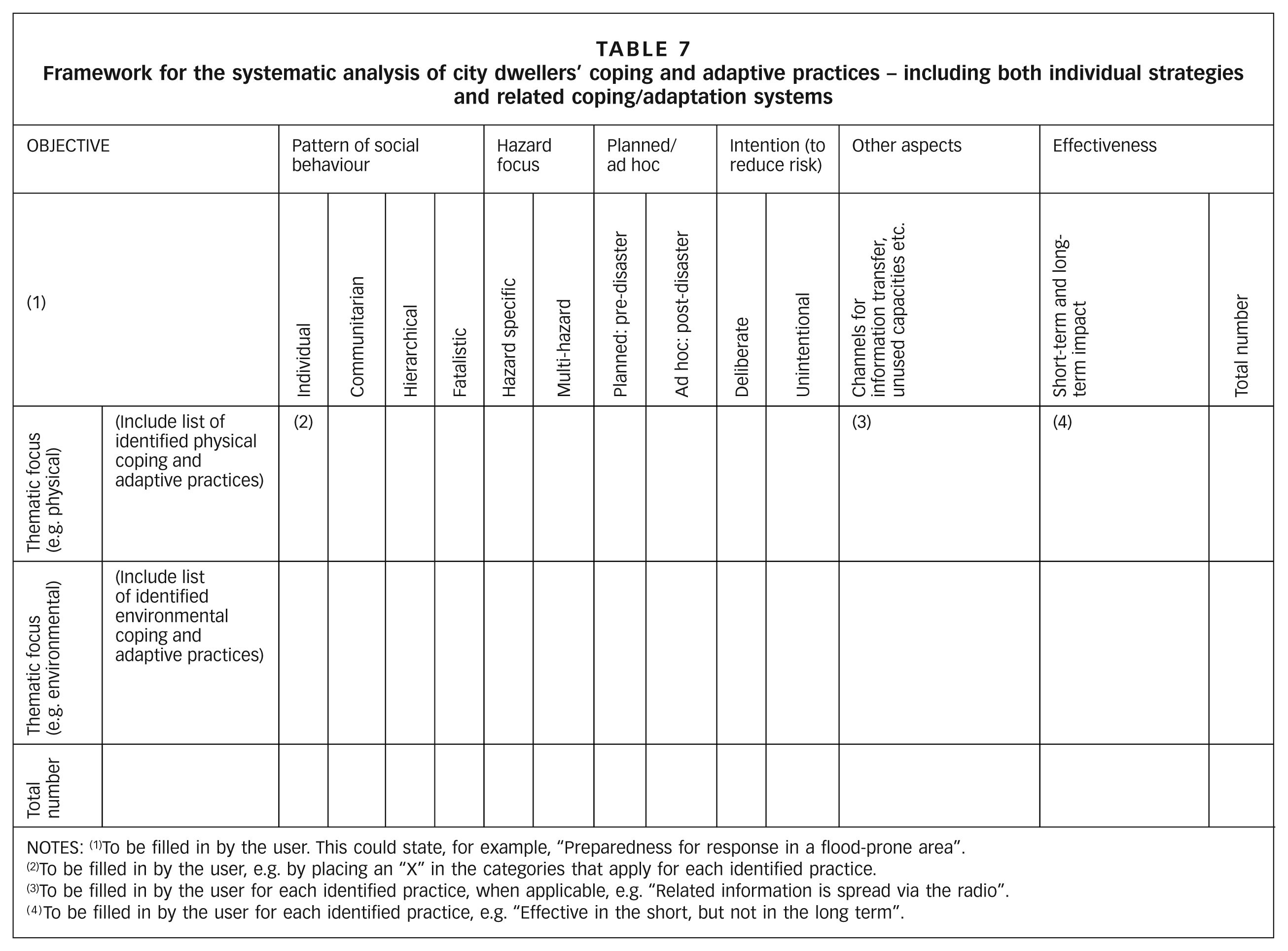
NOTES: (1)To be filled in by the user. This could state, for example, “Preparedness for response in a flood-prone area”.
To be filled in by the user, e.g. by placing an “X” in the categories that apply for each identified practice.
To be filled in by the user for each identified practice, when applicable, e.g. “Related information is spread via the radio”.
To be filled in by the user for each identified practice, e.g. “Effective in the short, but not in the long term”.
If put into practice, this analysis framework enables municipal authorities and aid organizations to take advantage of local capacities and information channels in order to:
provide assistance relevant to urban communities;
ensure that measures are context specific and can be implemented and maintained;
extract transferable principles to other locations; and ultimately,
build flexible and inclusive structures for risk reduction and adaptation.
It contributes to meeting the “… unmet demand for … tools, methods and guidance on implementing risk reduction.”(109) In this context, the concept of transformation is also useful in the sense that it helps stakeholders understand that urban resilience is not a static condition that can be achieved by timely interventions, but a transformative process that requires ongoing risk reduction and adaptation. However, it should not become a new pretext for external interference. Ultimately, it is not a choice between local or external institutional systems, but a question of finding the most appropriate approach for each situation.
Footnotes
1.
This is despite a lack of global data on urban disasters, due to a lack of emphasis on the urban environment in development and disaster risk research and policy; see Pelling (2007); also  .
.
3.
Pelling (2003); also UN−Habitat (2011); and .
5.
6.
Dodman and Mitlin (2011); also Eriksen, Aldunce, Bahinipati, Martins, Molefe, Nhemachena, O’Brien, Olorunfemi, Park, Sygna and Ulsrud (2011); McAdoo, Moore and Baumwoll (2009); Soltesova, Brown, Dayal and Dodman (2014); Wamsler (2014); Wamsler (2007); Shaw, Sharma and Takeuchi (2009); Shaw, Takeuchi, Uy and Sharma (2008); and .
7.
8.
9.
Ahammad (2011); also Hamza, Smith and Vivekananda (2012); and .
10.
11.
These included research from Bangladesh, Belize, the Dominican Republic, Ghana, Guyana, Haiti, India, Kenya, Mozambique, Nepal, Nigeria, the Philippines, Uganda, Vietnam and Zambia; see Alam and Rabbani (2007); also Audefroy (2011); Ayers and Forsyth (2009); Carcellar, Rayos Co and Hipolito (2011); Esdahl (2011); Jabeen, Johnson and Allen (2010); Johnson (2011); Khan (2008); Ramachandraiah (2011); Simatele (2010); Thompson (2011); McAdoo, Moore and Baumwoll (2009); and .
12.
Lutz (2008). The results of this project are also presented in Wamsler, Brink and Rantala (2012).
13.
See http://www.resilientregions.org. The results of this project are also presented in Wamsler (2014) and .
17.
Wisner, Blaikie, Cannon and Davis (2004); also IPPC (2012a); and .
20.
UN−IATF/DR (2006); also UNISDR (2008a); and .
21.
See, for example, Brenkert and Malone (2005); also IPCC (2001); Smit and Wandel (2006); IPPC (2012a); and .
22.
UNISDR (2009), page 6. Exposure is defined similarly by as “… the presence of people; livelihoods; environmental services and resources; infrastructure; or economic, social or cultural assets in places that could be adversely affected” (page 5).
23.
For a more elaborated discourse on outcome and contextual vulnerability, see O’Brien, Eriksen, Nygaard and Schjolden (2007).
25.
See, for example, ISO (2009). In the context of risk analysis, however, the term capacity is not always mentioned explicitly when referring to the assessment of existing measures, conditions or structures in place; see, for example, .
26.
This meaning of the term capacity is also used in the definition of disasters as being the result of “… insufficient capacity or measures to reduce or cope with potential negative consequences”; see , page 9. Notably, capacity, which is visible in the form of concrete measures, includes both those that are functioning and sustainable as well as non-functioning or unsustainable ones.
27.
See, for example, the definition of “adaptation assessment” in IPCC (2012b); also the definitions of “disaster risk management” and “disaster risk reduction” in , page 10.
28.
In the UNISDR terminology, the definition given is followed by the following comment: “The capacity to cope requires continuing awareness, resources and good management, both in normal times as well as during crises or adverse conditions. Coping capacities contribute to the reduction of disaster risks”; see , page 8.
31.
33.
See, for example, Shaw, Takeuchi, Uy and Sharma (2008).
35.
See, for example, Hamza, Smith and Vivekananda (2012); also .
37.
See, for example, CARE (2011); also Pelling, High, Dearing and Smith (2008).
38.
See, for example, Cutter, Barnes, Berry, Burton, Evans, Tate and Webb (2008); also Gallopín (2006); IPCC (2012a); and .
39.
42.
The term “hazard” relates here only to the types of hazards that are listed in Tables 1–6 and/or described in Section III. In climate adaptation literature, related measures are captured under “reduction of exposure” (). Further note that hazard reduction also includes the reduction of greenhouse gas emissions to reduce (the increase in) climatic hazards. However, city dwellers’ measures for climate change mitigation were not part of the focus of this study.
43.
44.
Physical changes include engineering or constructive measures as well as small-scale changes to the urban fabric.
45.
This categorization has been established by “cultural theory”; see Thompson, Ellis and Wildavsky (1990); also .
46.
From the El Salvador case study; see Wamsler (2014), page 191; also Wamsler, Brink and Rantala (2012).
48.
52.
From an Accra/Ghana case study; see Douglas, Alam, Maghenda, Mcdonnell, McLean and Campbell (2008), page 197.
55.
See, for example, Douglas, Alam, Maghenda, Mcdonnell, McLean and Campbell (2008); also Jabeen, Johnson and Allen (2010).
56.
See, for example, Douglas, Alam, Maghenda, Mcdonnell, McLean and Campbell (2008); also Pelling (2011); andJabeen, Johnson and Allen (2010).
57.
See Hattam (2011); also . This technique is commercially supported.
58.
63.
69.
From an Accra/Ghana case study; see Douglas, Alam, Maghenda, Mcdonnell, McLean and Campbell (2008), page 197.
70.
73.
77.
From a Maputo/Mozambique case study; see Douglas, Alam, Maghenda, Mcdonnell, McLean and Campbell (2008), page 198.
78.
84.
Effectiveness relates here to the number of deaths and injuries as well as losses and damage to property, environment and livelihoods.
85.
“Flying toilets” are also used as a strategy to avoid the risk of sexual violence when using a public toilet or another place outside the home; see UN Water (2007); also .
91.
Adger (1996); also .
94.
Morduch (1999); also .
98.
See, for example, http://www.inteligenciascolectivas.org, including Inteligencias Colectivas (2011a) and .
99.
Shack/Slum Dwellers International (SDI) is a network of community-based organizations representing the urban poor in 33 countries in Africa, Asia and Latin America. It was launched in 1996 when “federations” of the urban poor in countries such as India and South Africa agreed that a global platform could help local initiatives to develop alternatives to eviction while also having an impact on the global agenda for urban development. In 1999, SDI became a formally registered entity; see .
103.
This relates, for instance, to their thematic and hazard-oriented foci and their underlying patterns of social behaviour.
104.
These are existing hazards, location-specific vulnerabilities, deficiencies in response mechanisms and structures, as well as deficiencies in recovery mechanisms and structures.
105.
See Wamsler, Brink and Rantala (2012) for details.
107.
Discouraging a specific supposedly short-term solution – without taking into consideration the entire coping system – might result in reduced adaptive capacities.