




Abstract
As processes and patterns of organized violence across different contexts continue to take new and complex turns, this paper takes stock of some of the most important trends to emerge in research on gangs in recent years. Shifting social, political and economic conditions and diverse systemic shocks continue to interweave with often dynamic and flexible organizational and operational gang structures, contributing to ever more complex landscapes of violence. In addition, the increasingly blurred boundaries between violent groups at local, national and even regional scales have complicated attempts to disentangle and distinguish different violent actors and institutions. The paper grapples with contemporary dynamics of violence, conflict and gangs, considering both change and continuity. It highlights the need to continue developing research and interventions that move beyond pre-existing, inappropriate or exaggerated understandings of gangs, by engaging with the increasing blurring between different violent groups and the complex relationships between gangs, the state and society, so capturing the fluidity of gang identities and motivations.
I. Introduction
“In October 2009, two heavily armed drug gangs clashed in Morro dos Macacos, a Rio favela (slum) that, like many others, is controlled by gangs. When the police sent in a helicopter, small arms fire forced a crash-landing that killed three of the officers inside. Days of subsequent street battles with the police and military left dozens of gang members, favela residents and police dead or wounded. The intensity of the fighting, although unusual for Rio, fits a pattern of persistent gang violence in the city’s poorer slums.”(1)
So begins the Small Arms Survey 2010, an important yearly report dedicated in this instance to the theme of “gangs, groups and guns”. The choice of topic is not surprising given the increasing concern over what would appear to be escalating and progressively complex organized violence in many cities throughout the world. The quotation is also revealing of a number of alleged characteristics of contemporary gang violence, notably: the relationship between extreme violence and urban marginality; the increasing organization, power and influence of gangs; a battle for institutional legitimacy between gangs and the state; and the serious, deleterious effects of this conflict on the local population and social stability. Yet, it also alerts us to the danger of sensationalizing and universalizing extremes of gang violence. As Hazen warns: “… current discussions of urban violence and gangs tend to dramatize the problem, over-generalize about violence, simplify the nature of gangs and justify a heavy hand by governments.”(2)
Indeed, it is conceded that the event described above is rare (even) for Rio, yet it speaks to growing fears of an impending gang “insurgency”,(3) where the state’s monopoly over violence is challenged by an increasing number of non-state actors.
The notion of a gang insurgency finds no support in the great majority of research. Yet it is certainly true that the boundaries between different types of gangs and organized armed groups have become increasingly blurred in many contexts, and there are concerns over street gangs evolving into more organized, “institutionalized” and increasingly violent groups, perhaps even with supranational reach.(4) Other street or youth gangs remain relatively temporary and disorganized in comparison, while still others seem to be more fluid, experiencing sporadic or temporary reshaping of their function or organization. It seems important to ask why such variation exists, and what may be some key elements underlying the emergence and transformation of gangs in contemporary cities across the world. Moreover, why is it that gangs do not always emerge or persist in what appear to be suitably deleterious conditions?
The paper begins with a broad overview of research on gangs in different contexts, and then considers some important emerging issues in the field of violence and conflict as related to gangs on an international scale. Drawing in part on first-hand research on marginalization and youth violence in Central America spanning over a decade, it reviews broad trends and developments in the field. It highlights the need for more dynamic approaches to gangs, which engage with the increasing blurring between different violent groups, the complex relationships between gangs, the state and society, and the concomitant fluidity of gang identities and motivations, in order to avoid research and intervention based on pre-existing, inappropriate or exaggerated understandings of gangs.
II. Background: Gang Research in a Global Context
Although urban gangs are found across the world, it is true that US-style gangs and gang research have for a long time defined thinking. Some neglected aspects of gangs that have been addressed in more recent literature include race, religion and gender in terms of the performance of gang identities, together with such emerging issues as the complexities of spatial reconfigurations in global cities in relation to gangs.
Internationally, research on gangs has been concentrated in a small number of identifiable bodies of work (apart from the US, most notably in Central America, Brazil and South Africa),(5) together with more isolated studies of emerging gang or organized violence issues elsewhere.(6) Each of these has made particular contributions to the literature. In general terms, this contemporary “global” research has considerably enriched understandings of gangs by bringing to light their relational and organizational aspects: gangs ought not to be viewed in isolation but, rather, in terms of their relationships with state and society; nor should they be understood as “aberrations” but, rather, as coherent, logical and functional groups immersed in local institutional landscapes and responding to structural disadvantage at different scales. Changes in precisely these aspects of gangs underlie much of the discussion that follows.
One important example of such organizational shifts involves the changing scale and nature of gang networks. Specifically, there is concern that increased transnational interconnectivity may lead to national problems of violence and conflict spilling over into other (western) nations,(7) or indeed that a range of once-local gangs are increasingly involved in criminal networks that link them far beyond the neighbourhood. A case in point is that of the maras of Central America – the so-called “transnational” gangs born in the streets of Los Angeles and now with local cells, or clikas, throughout northern Central America. The actual extent of their international networks is debatable, and their transnational elements may be more relevant as a vehicle of gang identity than as evidence of any significant transnational organization.(8) Yet their very existence and apparent transmutability speaks of a new kind of gang, born of the intertwining of new and complex global–local processes.
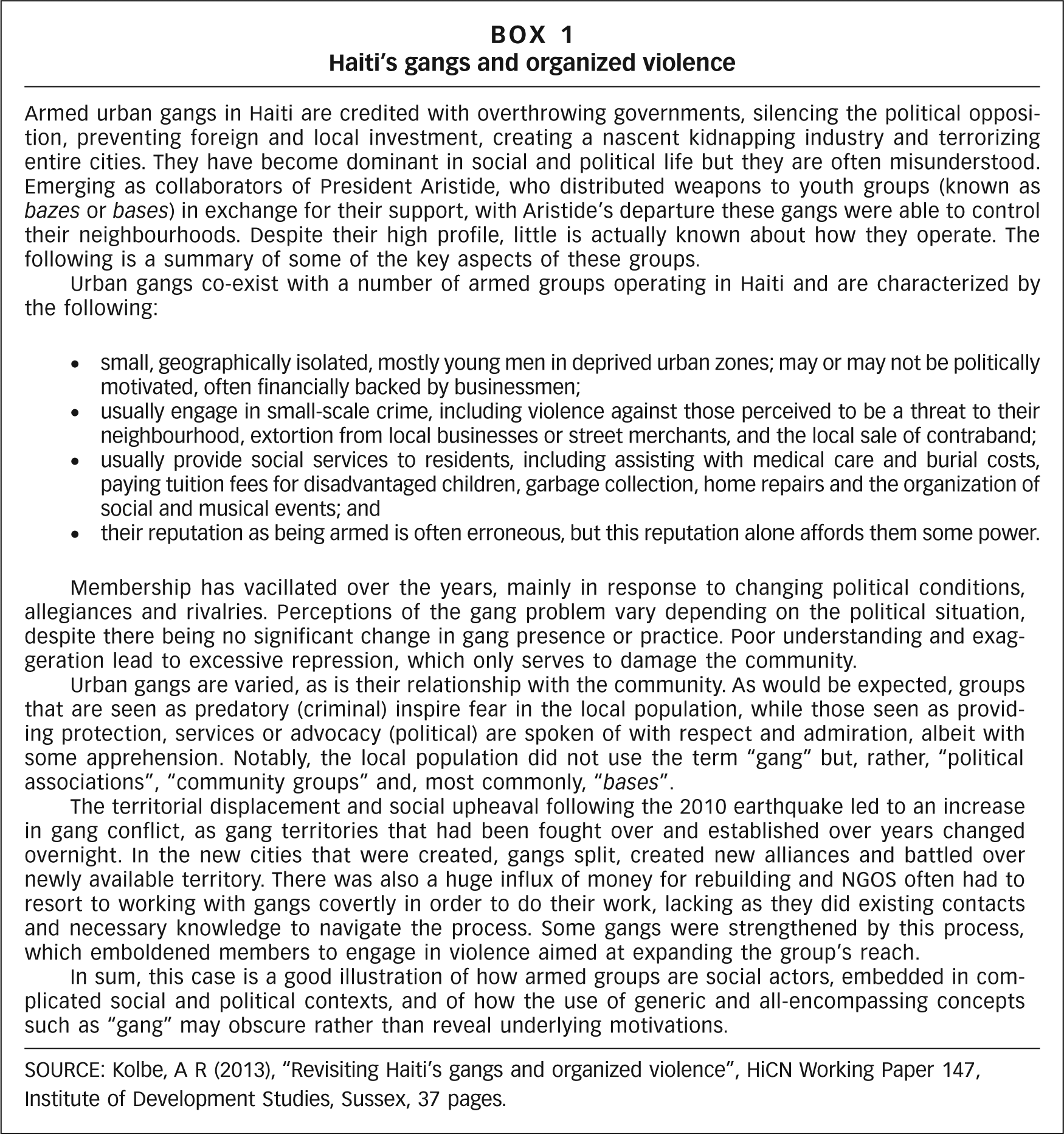
Gang research in Latin America in particular has been important in highlighting cultural identity performances enacted by gangs,(9) a theme recently taken up in emerging work on the link between gangs and the strengthening of essentialist identities in contemporary capitalist society (see below). Also emerging from this literature is the notion of gangs as embedded, as part and product of the social environment, not separate from it.(10) While the relationship between gangs and community is complex, in situations of entrenched institutional and social marginalization the gang is often a key institution, part of how residents endow their world with form and meaning.(11) Sometimes, they even provide key social services (see, for example, Box 1 on Haiti). This is an important break with disorganization theory, which once dominated understandings of the relationship between gangs and their environment. Recognizing the embedded aspects of gangs has also been important for analyzing a recent shift towards increasingly disembedded and violent gangs.(12)
The increasingly complex array of organized violent groups in many contexts, coupled with some gangs’ apparent capacity for adaptation and transformation have challenged previously held assumptions about gangs as interstitial groups, focusing attention towards previously neglected organizational aspects of gangs. Gangs cannot be considered in isolation from the neighbourhoods they operate in, nor in many cases from other armed groups alongside which they co-exist (Box 1). All these relational, organizational aspects of gangs, emerging from the recent shift towards a more international focus in gang research, have made obsolete many previous, narrow understandings of youth gangs.
III. Comparative Cross-Cultural Perspectives on Gangs
Growing interest in different armed groups across the world and their impact has led to attempts to bring together research on gangs from different contexts, either retrospectively in specially edited collections,(13) or in prospective comparative cross-national studies, for example the Eurogang project(14) and the Children in Organized Armed Violence (COAV) study led by Luke Dowdney.(15) This international focus brings with it significant promise for tracking and explaining patterns of gang violence across contexts, but also challenges in terms of comparing very varied empirical contexts and approaches.
The first challenge is defining what “gang” actually means. It is generally accepted in the literature that what distinguishes gangs from other groups of young people, and other delinquent groups, is the use of systematic (rather than sporadic) and socially meaningful (rather than instrumental) violence.(16) Distinguishing youth gangs from other groups engaged in organized violence, while also recognizing their fluidity and the connections between them, is a difficult balance to reach. Definitions used in the three comparative studies mentioned above represent key schools of thought in the field. The consensus definition reached by members of the Eurogang network is the most “traditional” of the three, based as it is on the US criminological tradition: “… a street gang (or a troublesome youth group corresponding to a street gang elsewhere) is any durable, street-oriented youth group whose own identity includes involvement in illegal activity.”(17)
This definition – although intended to be broad – was found too limiting when applied to Europe,(18) where the dynamics of youth violence lay outside the narrow definition. Gang research is beginning to move beyond traditional US-based criminological approaches to grapple with the variety of organized violent groups across the world.
In this vein, John Hagedorn(19) advocates a more global focus in gang research, arguing that the American paradigm is not only far too narrow but also increasingly surpassed by fundamental changes in the social, economic and political organization of urban life at a global scale. The simple distinctions drawn in Table 1 explain how this approach differs from the previously dominant paradigm.
Hagedorn’s framework for defining gangs
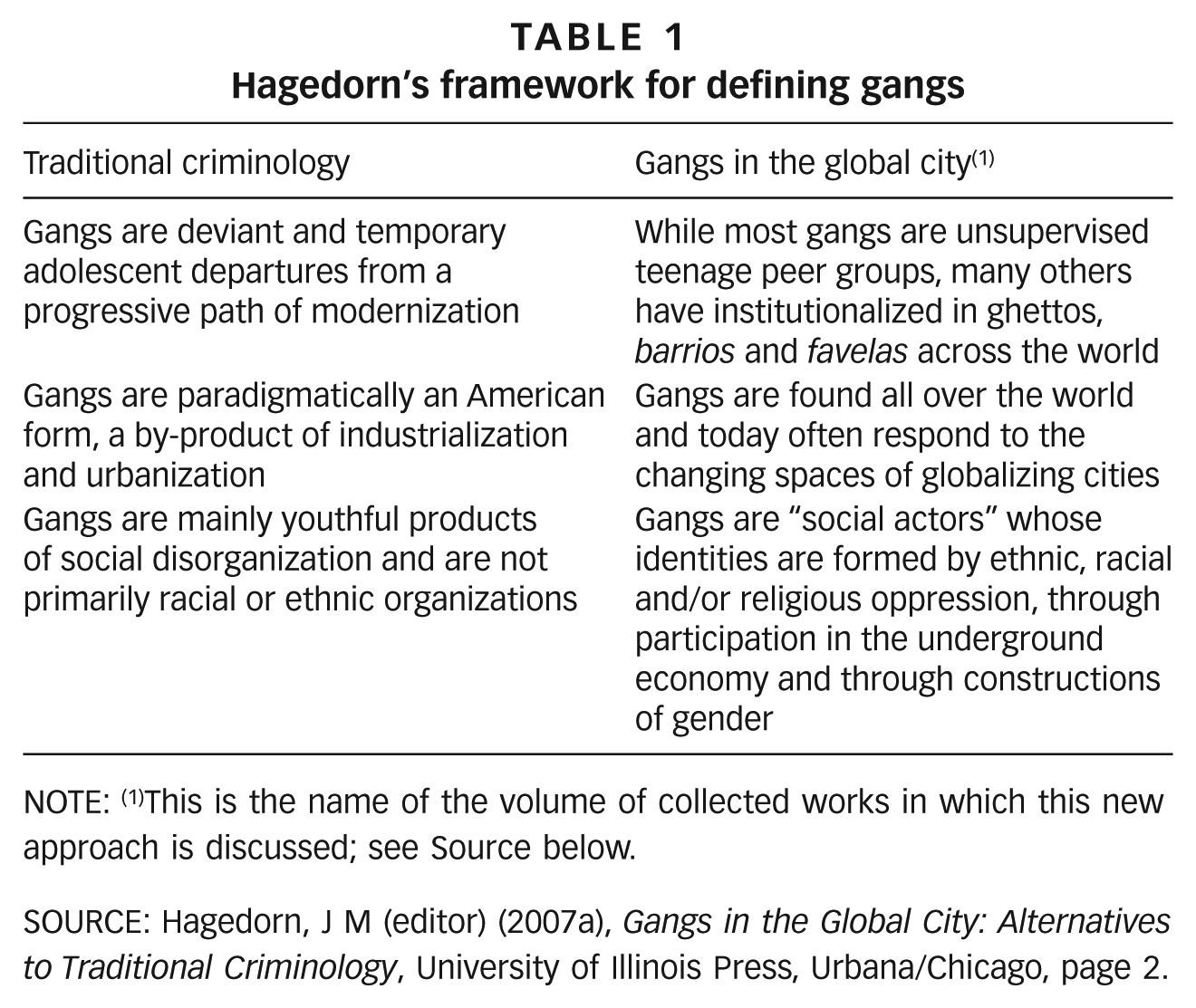
NOTE: (1)This is the name of the volume of collected works in which this new approach is discussed; see Source below.
SOURCE: Hagedorn, J M (editor) (2007a), Gangs in the Global City: Alternatives to Traditional Criminology, University of Illinois Press, Urbana/Chicago, page 2.
Hagedorn contends that approaches rooted in modernity have little explanatory power in late-modern, globalized cities; gangs are not observers of these developments but, rather, “… institutional actors within this new urban drama.”(20) These structural changes merit further discussion (see below), but in essence gangs are seen as part of fundamental societal changes that must be reflected not in narrow definitions but, rather, as something much more amorphous: “… they are simply alienated groups socialized by the streets or prisons, not conventional institutions.”(21)
This approach may seem radical in the context of other US gang research, but in fact it just brings it into line with much literature from other contexts, particularly in the global South, where these structural issues have long been studied and understood in relation to gangs and violence. Indeed, it seems increasingly futile to keep trying to standardize and delimit something that appears to defy definition. Accordingly, it seems that the term “gang” itself is increasingly being replaced with more adaptable, yet often more precise, terms.
The COAV team took just such a pragmatic approach (at least in part as a result of direct engagement with the population). Faced with an enormous diversity of armed groups in the different study sites,(22) using the concept “gang” to delimit the research was inappropriate: “… whether it be the maras of Central America or the ethnic-militia of Nigeria, the groups investigated in this study undoubtedly share commonalities in causality and function. However, to treat these groups or the people that make them up solely as homogenous entities would be problematic.”(23)
A key aim of the work was precisely to investigate slippage and links between different groups of armed youth. Thus, the team reached a majority consensus on a working definition not of gangs but, rather, of “… children within non-war situations of group armed violence …”(24) as follows: “Children and youth employed or otherwise participating in organized armed violence, where there are elements of a command structure and power over territory, local population or resources.”(25)
This definition is intentionally broad in the type of groupings covered, but specific enough in terms of their structure to provide clear guidance in the field. Within the groups covered by this general definition there is considerable diversity, both between and within the groups, and we are pointedly warned that the multiple identities of the young “gang member”, pandillero or drugs faction employee must not be lost in generalizations that serve the purpose of comparison and policy-making. The idea is to analyze how these groups differ from one another in key aspects (organization, use of violence, links with the state, among others), rather than to over-generalize and exclude. The question now, given such diversity, is how we might begin to identify common factors contributing to the emergence and persistence of gangs.
IV. Global Urban Restructuring: A Pre-Condition for the Emergence of Gangs
Pinpointing specific factors that explain gang mobilization and membership is a challenge. Reified “determinants” and proximate factors such as family fragmentation, domestic abuse or psychological constitution do not appear to be consistently significant. To understand why and how gangs emerge and survive, we must first try and comprehend the structural conditions in which they exist (keeping in mind that these are contextual, not causal, factors).(26)
A couple of truisms help to put this section in context. First, although gangs do not correlate with poverty per se, they tend to emerge more in contexts of (multiple) marginalization.(27) Second, they are responsive to changing economic and political structures. As new global processes exacerbate existing inequalities and create new ones, then, gangs may be seen as a barometer of increasingly widespread societal failings. Particularly with reference to urban contexts marked by political and economic upheaval, the literature abounds with accounts of the structural dynamics that create ideal conditions for the emergence of urban violence. Yet within this array of ills, certain aspects of globalization have been particularly associated with the emergence of gangs.
Foremost among these are the economic processes that have repositioned the world of work for the disadvantaged, specifically new employment regimes of peripheralization (with increasingly dead-end, low-wage jobs and an absence of job mobility). These changes in the labour market hit young people particularly hard, dramatically affecting their life course, and are compounded by the “youth bulge” in many urban areas (there are more young people in the world now than ever before).(28) The logical, inevitable by-product of this crisis is a thriving informal economy, including the global growth of organized crime.
Not surprisingly, such extreme exclusion has repercussions beyond the economic realm. Young people with dead-end jobs may turn to an alternative (ethnic, racial, etc) identity for a sense of meaning, to be somebody. As Young notes: “… the acute relative deprivation forged out of exclusion from the mainstream is compounded with a daily threat to identity: a disrespect, a sense of being a loser, of being nothing, of humiliation.”(29)
This, in turn, it is argued, leads to the formation of exaggerated identities of resistance, formed not through vertical oppositions (with the rich) but, rather, through the amplification of horizontal divisions (based on gender, ethnicity, territory, etc.). Moreover, as the holders of an unsatisfactory social identity, some youths will “leave” their own cultural, ethnic or racial group and seek affiliation with another group.(30) These processes have long been recognized in the Central American literature, for example – in contexts of manifold alienation and deprivation, some young people may find in a gang the social recognition and prestige, economic reward, well-being and power otherwise unavailable. In this analysis, then, we begin to see the foundations of youth gangs not in terms of criminality, but more in terms of identity politics and resistance in a wider context of exclusion.
These same processes can be viewed through another analytical lens: that of the intersection of different types of violence (structural, symbolic, direct, among others) in urban ghettos or slums. Such an analysis obliges us to look beyond violence as individual, isolated, socially aberrant acts, towards an understanding of violence as a structuring, intrinsic force in contemporary urban settings. Thus viewed, structural violence (for example, exclusion from legitimate means to make a living) and symbolic violence (for example, stigma) are intimately linked with direct expressions of violence by a range of actors. So, as Nateras argues in the case of Latin America, myriad violence becomes a “… language in the geography of the metropolis”,(31) such that violence – far from being an aberration – in fact makes sense within daily practices. Perhaps, muses Hagedorn, violence itself has been informalized and sub-contracted and is no longer the sole preserve of the state, such that “… the proliferation of groups of and networks of armed young men thus may be a normal feature of late modernity.”(32)
A final aspect of note here is the impact of the spatial transformation of cities, whose dynamics and characteristics are particular to each urban form but which plays a key role in the (re)production of gangs across contexts. In particular, violent spatial processes of segregation, gentrification and forced relocation, and spatial polarization all have a profound effect on social structures. This spatial violence, the dual expulsion−concentration of the socially excluded, is compounded by the (symbolically violent) social stigmatization of these spaces. Exclusionary processes thus become self-reinforcing: in such spaces it is more likely that gangs emerge and also that they gain legitimacy as social institutions, and therefore become more institutionalized.(33) Once such spaces are constructed as “deviant” as a result, it becomes possible to wage a territorial war on crime and violence (i.e. gangs).(34) As Jensen(35) finds in the case of South Africa, such wars become “psycho-politico-military” incursions into “problematic” spaces.
As already noted, none of these structural factors explain gangs. They may be useful in contextualizing gangs in a broad sense but do not explain exactly how and where they emerge (nor why not all excluded neighbourhoods have gangs), why young people join (nor how the majority resist) and how gangs are sustained. For this, it is necessary to get a bit closer, to see how gangs function. Work of this nature is rare in the field but the following section identifies some key work and emerging ideas.
V. Emerging Trends in Gang Organization
Some of the most interesting work to have emerged in recent years has been concerned not with why gangs exist per se but, rather, with the ways in which they differ from each other and why and how they persist. This work, in other words, concerns the mechanisms of gangs themselves. There are two key, related processes at play: how gang identities and motivations shift over time; and how gangs are but one of an increasingly complex array of non-state armed actors. Exploring these processes exceeds the explanatory limits of existing gang theory, and alternative frameworks have been sought in other fields, principally conflict studies, which has the potential to lend analytical clarity to contemporary gang studies.
In this nascent field, armed groups are compared based on certain characteristics, including: the relationship of the group to the state, to the community and to the legal economy; the group’s use of violence; and the territorial presence and reach of the group. Thinking about armed groups as falling along a continuum that captures these different characteristics is more useful than using fixed labels. This approach underscores the fluidity of these categories and the fact that particular armed groups may move across the spectrum over time.(36) While the framework may not be directly transposable to the study of gangs, the notion of a continuum has the potential to deconstruct restrictive categories of gangs, something welcome given the inherent difficulties with definition. It is also an approach that encourages us to analyze gangs not in isolation but in terms of their social location in relation to state and society. In this sense, efforts in this direction in the field of gang studies may advance understanding.
The relationship between gangs and the state has been the topic of much debate in the literature, and broadly speaking has been framed in terms of gangs as insurgents or (potential) revolutionaries. It seems that this notion is exaggerated in practice. The discourse on gangs as a security threat includes warnings of gangs developing into fully-fledged warring entities,(37) yet the key characteristic that distinguishes gangs from other non-state armed groups in conflict studies is precisely that they do not seek to overthrow the state.(38) By the same token, while a view of gangs as “… proto-revolutionary vanguards …”(39) has continued to inform the analyses of some gang researchers over the past few decades,(40) and gangs themselves often use revolutionary narratives, the following conclusion is a familiar one: “In the final analysis, gangs in both Managua and Cape Town are really not fighting ‘for’ anything but themselves. Although they can plausibly be said to be fighting ‘against’ wider structural circumstances of economic exclusion and racism, most of the time the behaviour patterns of gang members are clearly motivated principally by their own interests rather than the active promotion of any form of collective good.”(41)
Revolutionary rhetoric may be seen more as self-legitimation than any real revolutionary conviction. In the end, conditions of acute social expulsion and exclusion may make gangs “… doomed to reproduce their own oppressed location” as Brotherton fears.(42) Gangs are, after all, generally concerned more with survival than with political change.(43)
Indeed, it is also well-documented that among gangs that did in fact begin as politically motivated groups, or that participated in political actions, the overwhelming trend is for these motivations to give way to economic priorities and increased participation in the informal (drugs) economy.(44) Moreover, gangs that were once based primarily on the social benefits of belonging are increasingly found to be shifting towards economic “organizations”, with important implications for the neighbourhoods where they operate (increasingly confrontational, disembedded) and the state itself (as a destabilizing force). Gangs, indeed, seem to be much more flexible and persistent than previously thought.
A useful category for the continuum, then, may be how far gangs operate in terms of survival vs. expansion. Gang mutability certainly points to survival strategies, as they respond to changing conditions (e.g. increased police repression) based on available opportunities (e.g. informal economy, drugs trade). For example, concerns that the maras are transforming into mafia-style organized criminal groups are generally considered to be overblown. Research shows that their current organization (economically driven, illegal economy; less visible, more organized) is more a survival strategy, largely in response to repressive mano dura (“hard fist”) policies (see below). Nor is this to say that gangs share some kind of evolutionary path and that all gangs will “institutionalize” in this way. Indeed, many remain short-lived, or socially motivated, or less structured, or shift their activities and focus depending on changing local circumstances and opportunity (Box 1). Nor is the longevity of gangs something new – see, for example, Chicago’s decades-old Crips and Bloods or the Chinese Triads that have existed for centuries. But it seems that more gangs than before are following this pattern,(45) suggesting that, despite significant local variation, there are global processes at play.(46)
These developments point to another key concern in the contemporary literature: the increasing complexity of organized, violent groups at local level in many cities, including militia groups, organized criminal groups, paramilitary and organized social cleansing groups, youth gangs, violent state actors and private security guards. Boundaries between these groups are often blurred, some marked by conflict, others by collusion; this is both a response to and a cause of a deepening urban governance crisis in many cities across the world. Particularly important for the present discussion are the multiple actors involved in violent repression of youth gangs, and the alleged links between drug cartels and youth street gangs. With reference to the repression of gangs, it has been documented that zero tolerance policies legitimize general violence against suspected gang members, increasing the incidence of social cleansing and even collusion between state authorities and local social cleansing groups.(47) Indeed, such conditions (far from eliminating gangs) may in fact lead to their increased “institutionalization” whereby, as a means of survival, they increasingly link with organized crime, as noted above. This is more likely to involve cooperation between the two groups than it is the transformation of the gang into an organized criminal group, but it is nonetheless very significant in terms of the organization of the gang, which shifts from a social (more embedded) to an economic (more disembedded) logic, leading to fundamental shifts in how and where the gang operates.(48)
Another key shift in gang structure has been their spatial diversification. Perhaps the most overt example of this is the role of prison in street gang organization. Once thought to be largely separate from other gangs, prison gangs have been found to blur into street or youth gangs and organized criminal groups in different ways. At times, what begin as prison gangs gradually morph into organized criminal groups;(49) prison gangs also begin to operate territorially outside the prison;(50) and finally, the prison may become an extension of street gang territory (the maras in Central America(51)), whereby the increasing incarceration of gang members has meant prisons have become alternative spaces of organization where gang members from different areas come together and become a “… sort of standing assembly where they [can] debate, make pacts and decide on structures, strategies and ways to operate.”(52) Thus, mass incarceration serves not to dismantle gangs but, rather, to reinforce and transform the way in which they operate: prison becomes a space crucial for gang survival, a site away from the territory of the barrio but nonetheless intricately tied to its spaces.(53) Indeed, repression and incarceration link gangs in the streets with gangs behind bars and stabilize both.(54)
This description of gang organization and the features that mark gang environments is not comprehensive, nor are the dynamics described necessarily representative of gang dynamics in cities across the world. Rather, these elements may be useful in rethinking the way we approach gangs in any context, suggesting in particular that gangs should be analyzed in their social, spatial and institutional context, and that rather than fixed definitions, we may think about proposing new frameworks that work with categorical spectrums. The study by Luke Dowdney, discussed below, is an excellent contribution to this emerging field.
VI. Engaging with Gangs Themselves: The Children and Youth in Organized Violence (COAV) Approach
On the whole, gang research is very thin on detailed in-depth studies with gang members themselves and their neighbourhoods.(55) The COAV study(56) aimed to generate in-depth comparative information about children in organized armed violence, with an explicit view to treating the problem. To start with, faced with an enormous diversity of organized violence groups, the team classified these according to the following criteria: date of origin, type of origin, whether urban or rural, type of command structure, estimated number of members, level of organization, links or not to the prison system, use of death penalty within the group, relations with the community, involvement of the state, main economic activities, whether or not members were salaried and type of armed violence.(57) This approach avoids generalizations about gang structure that complicate effective interventions, but also gives different characteristics of gangs analytical importance. The 10 study sites all had existing problems with children and youth in organized armed violence (as opposed to the Eurogang studies, for example), and the in-depth fieldwork was carried out by local researchers in each site. The real value of the work (aside from the fact that it is based not on macro analysis or conceptual conjecture but on detailed work with young people themselves) is that it attempts to engage with the crucial question that still remains: in situations of equal structural disadvantage, what is it that makes some people join gangs and others not? As Kolbe(58) reminds us, and as is true in the majority of outbreaks of organized violence worldwide, most people in high-risk communities never turn to violence. Rather, the complex interaction of concentrated risk factors may lead to violence among sub-sets of the population.
Dowdney understands this phenomenon thus: children’s responses to risk factors will differ according to personal contexts of the relationships, influences and options that a child or young person may have within his/her immediate social circle that affect this decision-making process. This insight is not new, but what is interesting in this case is that this statement of fact is used as the basis for an operational framework for research and intervention. Furthermore, it moves beyond other seemingly comparable ecological approaches to violence reduction (such as those popularized by WHO and PAHO) in the following ways: through mapping the pathways; the inclusion of the dynamics of the armed groups themselves; its cross-national/in-depth focus; and its inclusion of young people (albeit a reduced number) who were not members.
The results of the study are fascinating, but perhaps one of the most important findings (particularly in terms of intervention) concerns group members’ desire to leave their armed group or not. Responses were mixed but some definite trends emerged. The most common reasons given for not wanting to leave the group were: belonging; excitement of group lifestyle; fatalistic acceptance; and no choice. In almost all cases where respondents expressed a desire to leave, they said they would do so only on condition that something else took its place, for example if they got a job or if the state/society/community offered support and alternatives. Also crucial in terms of intervention were young peoples’ self-perceptions: “… although vague and non-committal about their own futures, the fact that most respondents felt strongly about not wanting younger siblings or other children to become involved is a clear indication that many did not see their lifestyles or their groups as positive.”(59)
In addition, although leaving was potentially dangerous, in the groups investigated it was possible for members to leave as long as they left in the correct manner and were given the right support: “With the exception of one or two of the investigated groups, the main obstacle to young people taking such a step is not their group, but continued repression, prejudice and potential danger from the police, society and rival groups.”(60)
This is good news, in the sense that the majority of young people involved in armed gangs would leave if it were viable. The challenge, of course, is to provide that viable option. The final section below will briefly discuss the challenges of prevention and rehabilitation.
VII. Working with Gangs: A Brief Note on Intervention
It is important not to lose sight of the fact that a fear of gangs might be grounded in real experience of crime and violence. Yet the overwhelmingly suppressive and punitive state response to gangs has been deeply counter-productive. In Central America, for example, a first round of extremely drastic punitive measures are widely seen to have accelerated and diversified gang criminality rather than reduce it.(61) More recently, there have been signs that softer, more community-based initiatives are receiving some support. These involve a range of activities, including: voluntary weapons collection; temporary firearms-carrying restrictions and alcohol prohibitions; environmental design in slums; and targeted education and public health initiatives focusing on “at-risk youth”. Community policing is also increasingly popular, although it has had mixed results. These so-called “second generation” initiatives, part of a new conceptual consensus within policy circles, are being heavily promoted by multilateral and bilateral development agencies working in the region, which have in general attempted to distance themselves from a rhetoric that criminalizes youth.(62)
It will take time to see whether the rhetorical shift is matched in practice, but there remains a need to establish best practice for more holistic interventions. Such second generation interventions are often patchy, which makes their effects also patchy and likely short-lived. NGO interventions with gangs are widespread, and the most successful seem to have been open to working with the structure of the gang rather than trying to dismantle it (for example, Viva Rio in Brazil and Haiti, Homies Unidos in El Salvador, SerPaz in Ecuador). But the success and longevity of these programmes depends on their ability to intersect with community and, ultimately, state institutions; without this, they may be able to function but they remain fragile, and their impact minimal in the long-term. As Johnston(63) notes in the case of SerPaz in Ecuador, the successes appear grounded in the limited economic means of most Ecuadorian gangs, the absence of the threat of police action, and the commitment of a wide spectrum of public and private stakeholders. In other, less favourable conditions, intervention becomes much more complicated. There is a need not just for more comprehensive intervention strategies but also more rigorous planning, monitoring and evaluation of these in specific contexts.
A promising model is presented in Figure 1.This model is interesting in a number of ways: it is explicitly multi-scalar, not just multi-sectoral; it includes the juvenile justice system as an integral part of the solution; and perhaps most significantly, it advocates direct engagement with armed groups through conflict resolution. If we see gangs as forming part of communities, however complex and damaging the relationship may be, it would seem crucial to engage with gangs as groups (rather than as individual gang members) in any intervention. Yet, this is fraught with difficulties and very real dangers. As Wolf notes: “… scores of studies have insisted that suppression is counter-productive and a comprehensive gang strategy is required, yet it remains unclear how prevention and rehabilitation programmes can be tailored to local conditions and implemented under inauspicious circumstances.”(64)
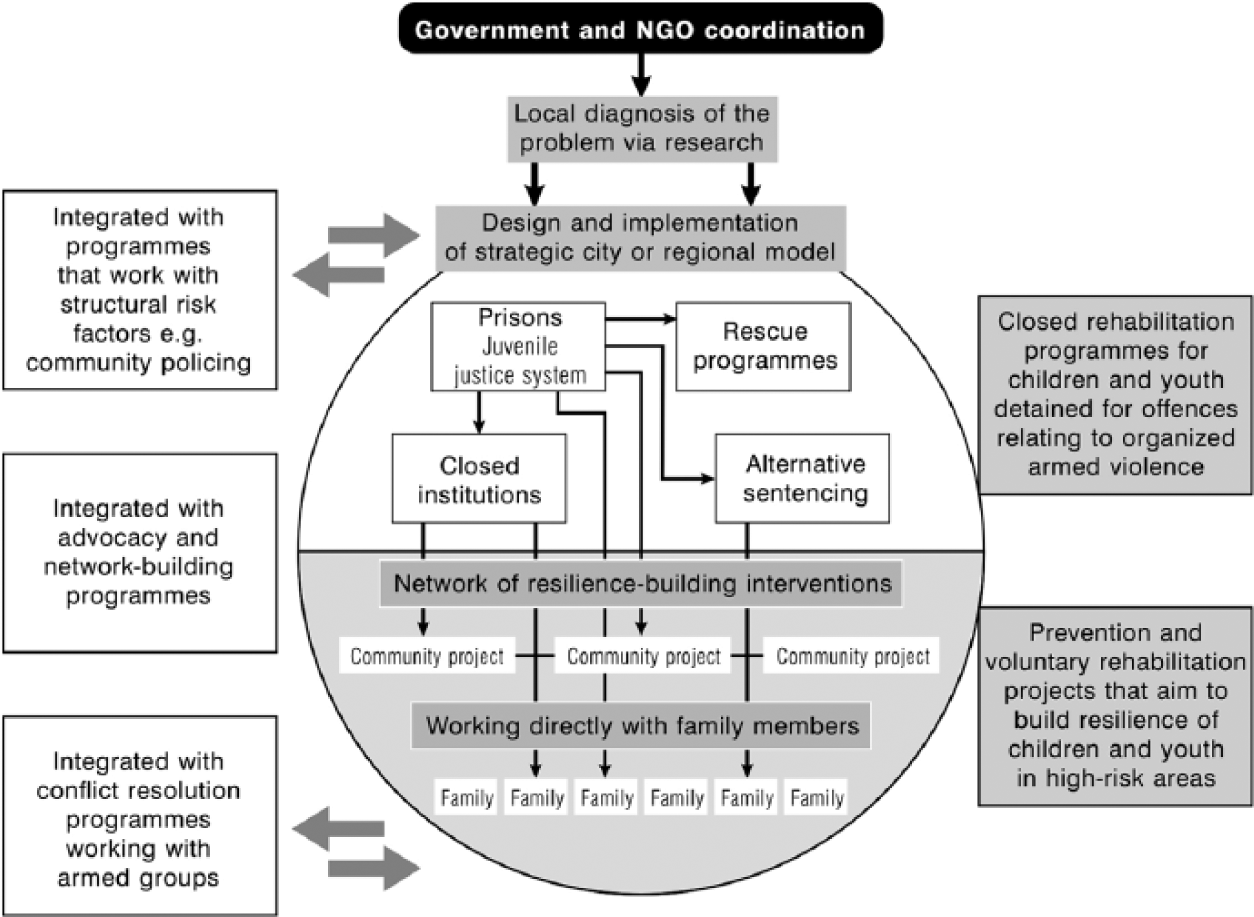
City/regional model for Children and Youth in Organized Armed Violence (COAV) intervention initiatives
VIII. Conclusions
Despite many decades of research on gangs, theoretical rigidity and rapid empirical change have made it hard to keep up and make sense of how and why a range of gangs emerge and persist. The field is rife with theoretical disagreement; even defining gangs seems an impossible task. There are many aspects of gangs about which we still know relatively little, and gaining this knowledge is among the most pressing current priorities in the field – specifically about where, why and how gangs persist, adapt and transform over time, and why the majority of young people at risk of gang membership do not join gangs. While knowledge in these areas may be limited, it has been possible here to highlight some key shifts in global urban structures and processes that have interacted with, and fundamentally changed, the local environments in which gangs operate, which in turn have shaped the mechanisms and internal logic of gangs.
Yet, it is also clear that gangs are strongly context specific, and that making sense of contemporary gangs requires the development of more flexible, open approaches. Gangs, on balance, seem to be much more adaptable and persistent than previously thought. Viewing gangs as just one of many (potentially) violent groups in different contexts is crucial in order to avoid research and intervention based on pre-existing, inappropriate or exaggerated understandings. The challenge now is to continue to build on knowledge accumulated over decades of gang research across contexts, not to create universal, exact theories but, rather, to generate flexible frameworks for understanding gangs and informing policy. The discussion here has been an attempt to look at gangs with new eyes, to take stock and see where new possibilities may lie to help us make sense of the complexities of contemporary gangs.
Footnotes
Acknowledgements
The author would like to thank the two anonymous reviewers and the editors of this edition for their helpful comments on an earlier draft of the paper.
1.
Lebrun, E and G McDonald (2010), “Introduction”, in Small Arms Survey Geneva, Small Arms Survey 2010: Gangs, Groups and Guns, Cambridge University Press, Cambridge and New York, page 1.
2.
Hazen, J (2010), “Understanding gangs as armed groups”, International Review of the Red Cross Vol 92, No 878, pages 369−370.
3.
Bunker, R J and J P Sullivan (2011), “Integrating feral cities and third phase cartels/third generation gangs research: the rise of criminal (narco) city networks and BlackFor”, Small Wars and Insurgencies Vol 22, No 5, pages 764–786; also Manwaring, M G (2005), “Street gangs: the new urban insurgency”, Special Series: Insurgency and Counter-Insurgency in the 21st Century, Strategic Studies Institute, Carlisle, Pennsylvania, 54 pages.
4.
The work of John Hagedorn is pioneering in the field of global gang research and he is one of few researchers working towards new, more dynamic and global understandings of gangs in the context of contemporary cities. His arguments have been influential in the elaboration of this paper.
5.
Rodgers, D and G A Jones (2009), “Youth violence in Latin America: an overview and agenda for research”, in G A Jones and D Rodgers (editors), Youth Violence in Latin America: Gangs and Juvenile Justice in Perspective, Palgrave Macmillan, New York, pages 1–24.
6.
For example, on Timor-Leste, see TLAVA (2009), “Groups, gangs and armed violence in Timor-Leste”, TLAVA Issue Brief No 2, 8 pages; also, on Nigeria, see Matusitz, J and M Repass (2009), “Gangs in Nigeria: an updated examination”, Crime Law and Social Change Vol 52, pages 495–511; and on Haiti, see Kolbe, A R (2013), “Revisiting Haiti’s gangs and organized violence”, HiCN Working Paper 147, Institute of Development Studies, Sussex, 37 pages.
7.
Orjuela, C (2011), “Violence at the margins: street gangs, globalized conflict and Sri Lankan Tamil battlefields in London, Toronto and Paris”, International Studies Vol 48, No 2, pages 113–137.
8.
For example, Zilberg, E (2004), “Fools banished from the kingdom: remapping geographies of gang violence between the Americas (Los Angeles and San Salvador)”, American Quarterly Vol 56, No 3, pages 759–779.
9.
For example, Perea Restrepo, C M (2004), “Pandillas y conflicto urbano en Colombia”, Desacatos Vol 14, pages 15–35; also Valenzuela Arce, J M (1984), “El cholismo en Tijuana: antecedentes y conceptualización”, Revista De Estudios De La Juventud No 1, pages 37–68.
10.
See reference 5.
11.
Wacquant, L J D (2007), “Three pernicious premises in the study of the American ghetto”, in J M Hagedorn (editor), Gangs in the Global City: Alternatives to Traditional Criminology, University of Illinois Press, Urbana/Chicago, pages 34–53.
12.
See reference 5.
13.
For example, Hagedorn, J M (editor) (2007a), Gangs in the Global City: Alternatives to Traditional Criminology, University of Illinois Press, Urbana/Chicago, 368 pages.
14.
For example, Klein, M W (2011), “Who can you believe? Complexities of international street gang research”, International Criminal Justice Review Vol 21, No 3, pages 197–207.
15.
Dowdney, L (2006), Neither War nor Peace: International Comparisons of Children and Youth in Organized Armed Violence, Viva Rio/ISER/IANSA, 342 pages.
16.
See Hagedorn, J M (2007b), “Gangs, institutions, race and space: the Chicago School revisited”, in J M Hagedorn (editor), Gangs in the Global City: Alternatives to Traditional Criminology, University of Illinois Press, Urbana/Chicago, pages 13–33; also see reference 2.
17.
Klein, M W, F M Weerman and T P Thornberry (2006), “Street gang violence in Europe”, European Journal of Criminology Vol 3, No 4, page 418.
18.
Indeed, it is reported that in general, “… European youths aged 14–21 were not engaged in very troublesome rates of violent offending …”, see reference 17,  , page 418. It is worth noting that this research was prompted more by academic curiosity than by an observed social problem with youth gangs and violence in Europe. There may be a discussion to be had regarding how far it is advisable for youth to be analyzed through a gang framework a priori. It might be more useful in these cases to seek to explain why gangs are not generally such a problem in Europe.
19.
Hagedorn, J M (2007c), “Introduction: Globalization, gangs and traditional criminology”, in J M Hagedorn (editor), Gangs in the Global City: Alternatives to Traditional Criminology, University of Illinois Press, Urbana/Chicago, pages 1–10.
21.
Hagedorn, J M (2008), A World of Gangs: Armed Young Men and Gangsta Culture, University of Minnesota Press, Minneapolis MN, page 31.
22.
The project included research in Colombia, El Salvador, Ecuador, Honduras, Jamaica, Nigeria, Northern Ireland, Philippines, South Africa and the United States, all countries with known problems with organized armed groups.
23.
See reference 15, page 11.
24.
See reference 15, page 15.
25.
See reference 15, page 15.
26.
This section draws particularly on the following texts: Barrios, J L (2007), “Gangs and spirituality of liberation”, in J M Hagedorn (editor), Gangs in the Global City: Alternatives to Traditional Criminology, University of Illinois Press, Urbana/Chicago, pages 225–247; also Jütersonke, O, R Muggah and D Rodgers (2009), “Gangs, urban violence and security interventions in Central America”, Security Dialogue Vol 40, No 4–5, pages 373–397; Moore, J W (2007), “Female gangs: gender and globalization”, in J M Hagedorn (editor), Gangs in the Global City: Alternatives to Traditional Criminology, University of Illinois Press, Urbana/Chicago, pages 187–203; and Sassen, S (2007), “The global city: one setting for new types of gang work and political culture?”, in J M Hagedorn (editor), Gangs in the Global City: Alternatives to Traditional Criminology, University of Illinois Press, Urbana/Chicago, pages 97–119.
27.
Vigil, J D (2006), “A multiple marginality framework of gangs”, in A Egley Jr, C L Maxson, J Miller and M W Klein (editors), The Modern Gang Reader, Roxbury Publishing, Los Angeles, third edition. pages 20–29.
28.
See reference 5.
29.
Young, J (2007), “Globalization and social exclusion: the sociology of vindictiveness and the criminology of transgression”, in J M Hagedorn (editor), Gangs in the Global City: Alternatives to Traditional Criminology, University of Illinois Press, Urbana/Chicago, page 79.
31.
Nateras Dominguez, A (2007), “Adscripciones juveniles y violencias transnacionales: cholos y maras”, in J M Valenzuela Arce, A Nateras Dominguez and R Reguillo Cruz (coordinators), Las Maras: Identidades Juveniles al Límite, Universidad Autonoma de México/El Colegio de la Frontera Norte/Casa Juan Pablos, Mexico, page 131.
32.
Hagedorn, J M (2007d), “Gangs in late modernity”, in J M Hagedorn (editor), Gangs in the Global City: Alternatives to Traditional Criminology, University of Illinois Press, Urbana/Chicago, page 298.
33.
Hagedorn, J M (2001), “Globalization, gangs and collaborative research”, in M W Klein, H J Kerner, C Maxson and E E M Weitekamp (editors), The Eurogang Paradox: Youth Groups and Gangs in Europe and America, Kluwer, Amsterdam, pages 41–58.
34.
Puerto Rican gangs in Chicago have been defined by a 40-year battle against several waves of gentrification (see reference 16, Hagedorn (2007b)), while forced resettlement programmes in Johannesburg and Cape Town under apartheid have had a profound effect on the structure of gangs there; see Jensen, S and D Rodgers (2008), “Revolutionaries, barbarians or war machines? Gangs in Nicaragua and South Africa”, Socialist Register: Violence Today Vol 45, pages 220–238; also Jensen, S (2010), “The security and development nexus in Cape Town: war on gangs, counter-insurgency and citizenship”, Security Dialogue Vol 41, No 1, pages 77–97.
36.
See reference 2.
37.
See reference 7.
38.
See reference 2.
40.
For example, the work of David Brotherton and Luis Barrios.
42.
Brotherton, D C (2007), “Toward gangs as a social movement”, in J M Hagedorn (editor), Gangs in the Global City: Alternatives to Traditional Criminology, University of Illinois Press, Urbana/Chicago, page 271.
43.
Also well documented has been the co-option of gangs by the authorities in many countries for a range of purposes, whereby government or political parties mobilize gangs for political purposes and to instigate strategic violence. Gangs in this case in fact legitimize dominant institutions (c.f. Castells (1997) in , see reference 32).
44.
For example, on Brazil, see Holston, J (2009), “Dangerous spaces of citizenship: gang talk, rights talk and rule of law in Brazil”, Planning Theory Vol 8, No 1, pages 12–31; also, on Soweto and Chicago, see reference 32; and on Nicaragua, see Rodgers, D (2006), “Living in the shadow of death: gangs, violence and social order in urban Nicaragua 1996–2002”, Journal of Latin American Studies Vol 38, No 2, pages 267–292.
45.
See reference 19.
46.
For a schematic model of a gang’s possible evolutionary pathway, see Ayling, J (2011), “Gang change and evolutionary theory”, Crime Law and Social Change Vol 56, pages 1–26.
47.
For example, Cruz, J M (2003), “Violencia y democratización en Centroamérica: el impacto del crimen en la legitimidad de los regímenes de posguerra”, America Latina Hoy Vol 35, pages 19–59; also Harris, B (2003), “Spaces of violence, places of fear: urban conflict in post-apartheid South Africa”, Paper presented at the Foro Social Mundial Tematico, 16–20 June 2003, Cartagena, Colombia.
48.
Rodgers, D, R Muggah and C Stevenson (2008), “Gangs of Central America: causes, costs and interventions”, Occasional Paper of the Small Arms Survey, GIIDS, Geneva, 44 pages.
50.
For example, the Mexican mafia; see Pyrooz, D C, S H Decker and M Fleisher (2011), “From the street to the prison, from the prison to the street: understanding and responding to prison gangs”, Journal of Aggression, Conflict and Peace Research Vol 3, No 1, pages 12–24.
51.
Cruz, J M (2010), “Central American maras: from youth street gangs to transnational protection rackets”, Global Crime Vol 11, No 4, pages 379–398.
52.
See reference 51, page 392.
53.
Winton, A (2012), “Analyzing the geographies of the ‘transnational’ gangs of Central America: identity, space and scale”, Investigaciones Geográficas Vol 79, pages 136–149.
54.
See reference 32.
55.
There is some interesting work on particular aspects of gangs and religion from different perspectives: for example, see reference 26, Barrios (2007); also see reference 6, Matusitz and Repass (2009); and Wolseth, J (2008), “Safety and sanctuary: Pentecostalism and youth gang violence in Honduras”, Latin American Perspectives Vol 35, No 4, pages 96–111; also, on gender: see, for example, Hume, M (2008), “The myths of violence: gender, conflict and community in El Salvador”, Latin American Perspectives Vol 35, No 5, pages 59–76; also Moestue, H and J Lazarevic (2010), “The other half: girls in gangs”, in Small Arms Survey Geneva, Small Arms Survey 2010: Gangs, Groups and Guns, Cambridge University Press, Cambridge and New York, pages 185–207; and Miller, J (2001), One of the Guys: Girls, Gangs and Gender, Oxford University Press, New York, 263 pages; and some detailed ethnographies: for example, see reference 44, .
56.
See reference 15.
57.
See reference 15, page 23.
59.
See reference 15, page 124.
60.
See reference 15, page 124.
61.
For example, Hume, M (2007), “Mano dura: El Salvador responds to gangs”, Development in Practice Vol 17, No 6, pages 739–751.
63.
Johnston, V (2010), “An Ecuadorian alternative: gang reintegration”, in Small Arms Survey Geneva, Small Arms Survey 2010: Gangs, Groups and Guns, Cambridge University Press, Cambridge and New York, pages 209–227.
64.
Wolf, S (2012), “Central American gang violence: foregrounding the silences”, Journal of Human Security Vol 8, No 1, page 94.