




Abstract
After the return to democracy in the late 1980s, Brazil developed a new system of water governance with a decentralization of responsibilities and the formation of participatory, deliberative institutions that characterized the governance reforms in general. Tripartite “water basin committees”, with an equal representation of state, municipal and civil society actors, are now responsible for water resource management in each basin and for decisions that affect urban water governance. However, state representatives come from entities established long before the reforms, raising the question of whether the new participatory bodies can change water management practices. This paper suggests that despite the process of transition in water governance, the underlying power inequalities have not been addressed and major decisions are still being taken outside the new deliberative bodies. Technocratic government actors maintain a claim on authority through their economic superiority and their use of expert knowledge, ultimately inhibiting the influence of other actors.
Keywords
I. Introduction
In January 2011, record floods killed more than 800 people and made thousands homeless in the southeast of Brazil.(1) Most victims were from the low-income favelas. In the municipality of Guarulhos, which is part of the Metropolitan Region of São Paulo, many were affected. The city of São Paulo has since constructed a dyke along the Tietê River, which marks the boundary between Guarulhos and São Paulo, and the inhabitants of Jardim Pantanal, a São Paulo neighbourhood that remained flooded for more than a month in 2011, are now protected. The people in the Guarulhos floodplains on the opposite side of the river fear the consequences of this dyke for their homes and safety, since more water will come their way when the river rises again. The municipality of Guarulhos was not involved in the construction of this infrastructural work, which has significant consequences for its stormwater management. An even larger project is planned, the Tietê Linear Park mega-project, sponsored by the state government and partially funded by the Inter-American Development Bank (IDB), which could alleviate floods in the most urbanized area around the Tietê River in the municipalities of Guarulhos, São Paulo and its surroundings. This park, encompassing eight municipalities and reaching around three million people, with a planned investment of US$ 875 million, is intended to recuperate the floodplains of the Tietê River and regulate floods as well as provide an area of leisure for the local residents.(2) However, it will require the removal of families living in the region’s floodplain districts, including residents of Guarulhos.
In recent years in Brazil, both longer periods with no rainfall and short but intense storms have become more frequent and have sometimes led to water shortages or flooding. Climate change is expected to contribute to extreme events such as heavy rainfall, drought and an increase in temperature range, representing an overall increase in risks but especially for the poor.(3) This paper looks at the governance issues relevant to these changes, focusing specifically on the water governance system of Guarulhos and the Alto-Tietê Basin where it is located.(4)
This paper is part of a set of five papers published in this Journal, of which the first, published in the previous issue, provides the analytical framework.(5) The four subsequent papers (published in this issue of the Journal), of which this is one, apply this framework to four different case study cities. The framework is based on the work of Mark Pelling,(6) who distinguishes three modes of adaptation to climate change risks – resilience, transition and transformation – defined by the extent to which they challenge the status quo. Resilience is characterized by maintaining the status quo; transition by changes in governance processes, which might call into question the existing power structures but without profoundly changing them; and transformation processes include a move towards integrated, holistic world views and new political discourses with strong sustainability goals. This implies addressing existing power structures, but also requires a fundamental shift in the values underpinning current governance practices. Another important aspect of Pelling’s classification is the role of learning. In resilience, learning is restricted to technological innovation. In transition, social learning plays a role through exchanges of views and the development of a common understanding. In transformative processes, world views and values can be debated, when diverging views are confronted in deliberative processes and underlying values are questioned.(7)
The work in Guarulhos and the Alto-Tietê Basin is based on a series of semi-structured interviews conducted in 2012 and 2013, participant observation during meetings of the decentralized participatory water governance institutions, and an analysis of policy documents. The paper first offers a brief overview of the types of water-related problems faced by Guarulhos and the Alto-Tietê Basin. We then discuss the water governance reforms, followed by a presentation of the resulting new water governance landscape. The fourth part of the paper discusses the extent to which the newly created bodies offer opportunities for exchanging views, questioning underlying values, and leading to more integrated visions and even a change in power relations in line with Pelling’s framework. Finally, we provide a brief conclusion.
II. Water Problems in Guarulhos
Guarulhos is located in the northeast section of the Metropolitan Region of São Paulo (MRSP) and has a population of more than 1.2 million inhabitants.(8) It is the second city in São Paulo State in terms of GDP,(9) but inequalities in wealth and a demographic explosion have led to social exclusion. Guarulhos is spread over two large river basins: the Alto-Tietê Basin – delimited by a brown line in Map 1 – and the Paraíba do Sul Basin. Most of the municipality falls within the first river basin,(10) which covers virtually the entire territory of the MRSP.
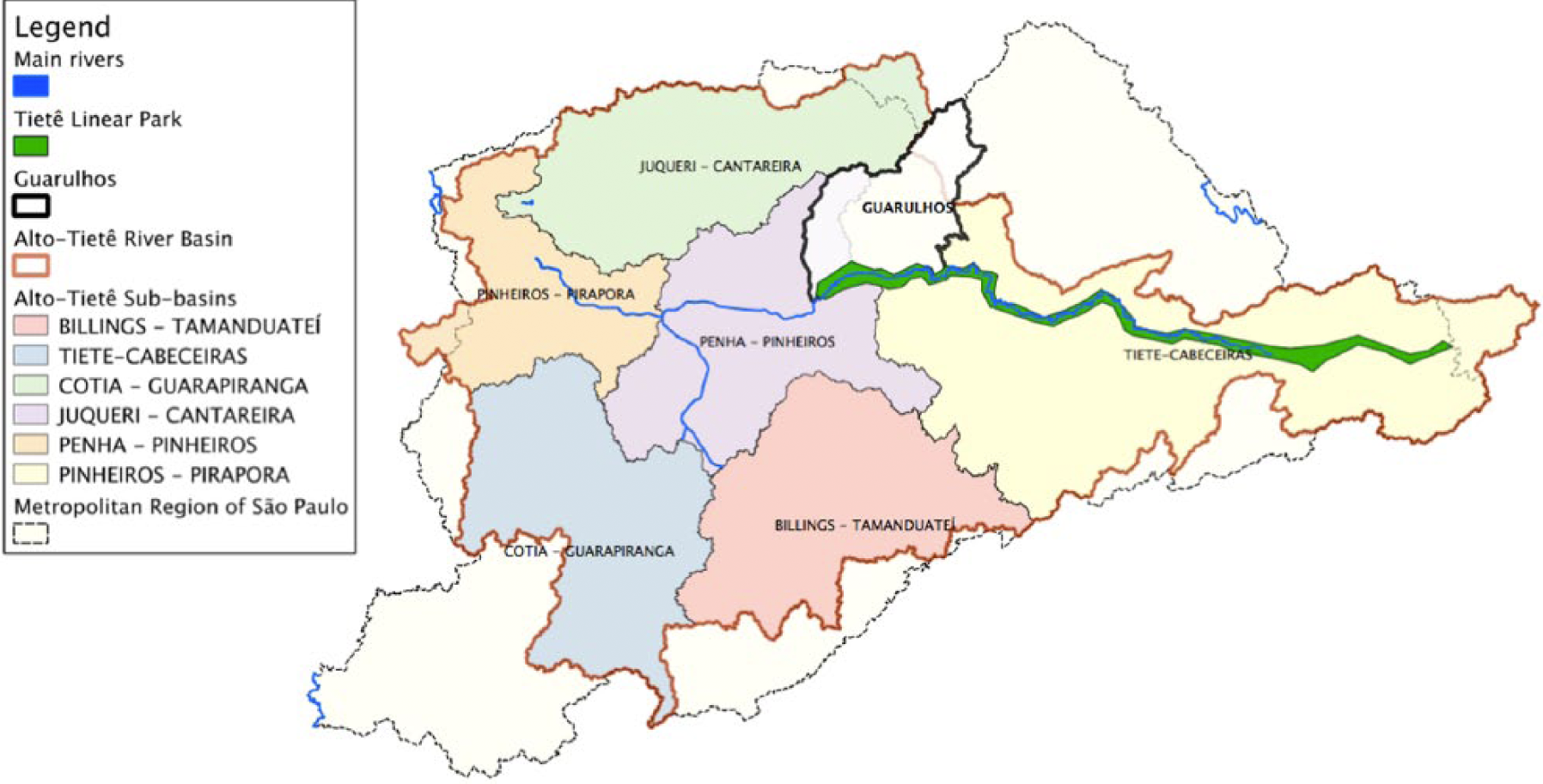
Location of Guarulhos within the Alto-Tietê Basin and the Metropolitan Region of São Paulo
In what seems like a contradiction, Guarulhos faces both water scarcity and floods. The risk of flooding and mudslides in many parts of the Alto-Tietê Basin is aggravated by human actions, which lead to soil impermeability, the occupation of floodplains and urban development that disregards environmental characteristics. At the same time, although there is a large quantity of water, it is insufficient for the population that has to be served.(11) The municipal water and sanitation company, SAAE (Autonomous Water and Sewage Service), buys in bulk 87 per cent of the water it distributes from SABESP, the São Paulo State Water and Sanitation Company. Yet even with this bulk supply, the SAAE is unable to provide the inhabitants of Guarulhos with a full-time supply and it uses a rotational system of provision in the entire city.(12) This system was first implemented in peripheral neighbourhoods after municipal elections introduced a left-wing government (the Partido dos Trabalhadores) that focused on the needs of less-developed areas in the municipality. The reform was also prompted by intense popular protests, because in the early 2000s water scarcity was part of daily life in many neighbourhoods in Guarulhos. Although connected to the public water supply network, some were occasionally left unserved for 15 consecutive days.(13)
In this context, water losses are a significant cause for concern. The infrastructure is old and leaking pipes are the problem most often reported, despite better maintenance.(14) According to several respondents affiliated to the municipal government, water losses in Guarulhos are aggravated by irregular uses, such as illegal wells (even on the part of large users such as hotels and industries) as well as clandestine connections to the water supply network by residents.
This situation is made worse by the population’s alleged limited awareness of water scarcity. A respondent affiliated to Instituto Trata Brasil (ITB), a civil society organization aiming to raise awareness on basic sanitation, says people are bombarded from a young age with information on Brazil’s copious water supply;(15) no one mentions that this water is in the Amazon, not the MRSP. The increasing scarcity of water is driving up water fees, and lower-income citizens, who get no form of subsidy, are the most affected.(16)
Over the last decade, the SAAE has increased the number of tube wells in Guarulhos as the population has grown,(17) but local aquifers produce insufficient water to meet demand and it appears that water is being extracted at a pace exceeding the speed of recharge. Water scarcity in the Alto-Tietê Basin has been alleviated by importing water from the Cantareira system in the neighbouring Piracicaba–Capivari–Jundiaí (PCJ) Basin, through a permit from the Department of Water and Hydropower (DAAE) of São Paulo State. A DAEE director claimed that the MRSP requires up to 80 cubic metres of water per second and on average the PCJ Basin produces 31 cubic metres per second for the MRSP and five cubic metres per second for its local usage.
Water scarcity in the Alto-Tietê Basin is also an issue of quality, as many water bodies have become too polluted for public consumption. Guarulhos is located upstream of the Tietê River – the largest river in the state – and its contribution to the river’s pollution affects millions of inhabitants downstream. Lack of sewage treatment is considered the main source of contamination. Since 2008, the SAAE has invested heavily in sewage plants and treatment. By 2011, sewage was being collected for 82 per cent of the population, but the first sewage treatment plant opened only in 2010. By the end of 2011, it was treating 35 per cent of total sewage and it aims to treat 80 per cent by 2017.(18) The high level of investment required has meant that the SAAE could not finance universal services solely with water tariffs and municipal funds. A significant amount of the investment comes from the federal government.(19)
The complexity of the “waterscape” of Guarulhos and the variety and severity of its co-existing water-related problems are due, to some extent then, to an inadequate water governance system.
III. Reforms in Water Governance
After the military dictatorship in Brazil, a hostile attitude towards centralized power and the national government led to a significant reduction in the latter’s power. The 1988 Brazilian Constitution devolved many responsibilities to more local levels of government, and the shift led to a number of reforms in Brazilian water governance.
In 1997, the National Water Act(20) created the national water resources policy. This was based on the São Paulo State Water Act(21) passed in 1991, which established the current state-level water policy framework. At the heart of this policy is the idea that water governance should be decentralized, participatory and integrated.(22) The legislation recognizes water as a public good with economic value and as a limited natural resource – contrary to Brazil’s traditional popular vision of water’s inexhaustibility.(23) Water governance is carried out at the scale of the river basin, reflecting the fact that extracting water from one part of the basin affects availability in other parts, just as pollution upstream has consequences downstream.
Another notable reform of the Brazilian legal framework is Law No 11.445 of 2007, which established national guidelines for basic sanitation and determined the National Basic Sanitation Plan (PLANSAB),(24) aimed at universalization and improvement of the governance of basic sanitation services. Historically, basic sanitation provision was planned through PLANASA (National Basic Sanitation Plan), founded in 1967, which disbursed funds to states that created state companies and gave priority to urban areas.(25) These state companies signed agreements with municipalities for the provision of services. Municipalities had jurisdiction over provision, but many delegated these services to state companies.(26) While there were great advances in terms of coverage, the process was highly centralized and authoritarian according to a director from ARSESP.(27)
Under the 2007 law, the provision of basic sanitation services still falls under municipal jurisdiction.(28) Most municipalities still delegate the responsibility to a state company (such as SABESP in São Paulo) or to a private company; but some, such as Guarulhos with the SAAE, have opted for municipal provision. This allows them to retain some control and also allows more autonomy from state or federal bodies, which may not be politically aligned with local authorities. Basic sanitation investments and services also involve significant economic resources and can become very complex and contentious, involving disputes among economic groups, political bodies and public agencies.
IV. The New Water Governance Landscape: Decentralization and Participation
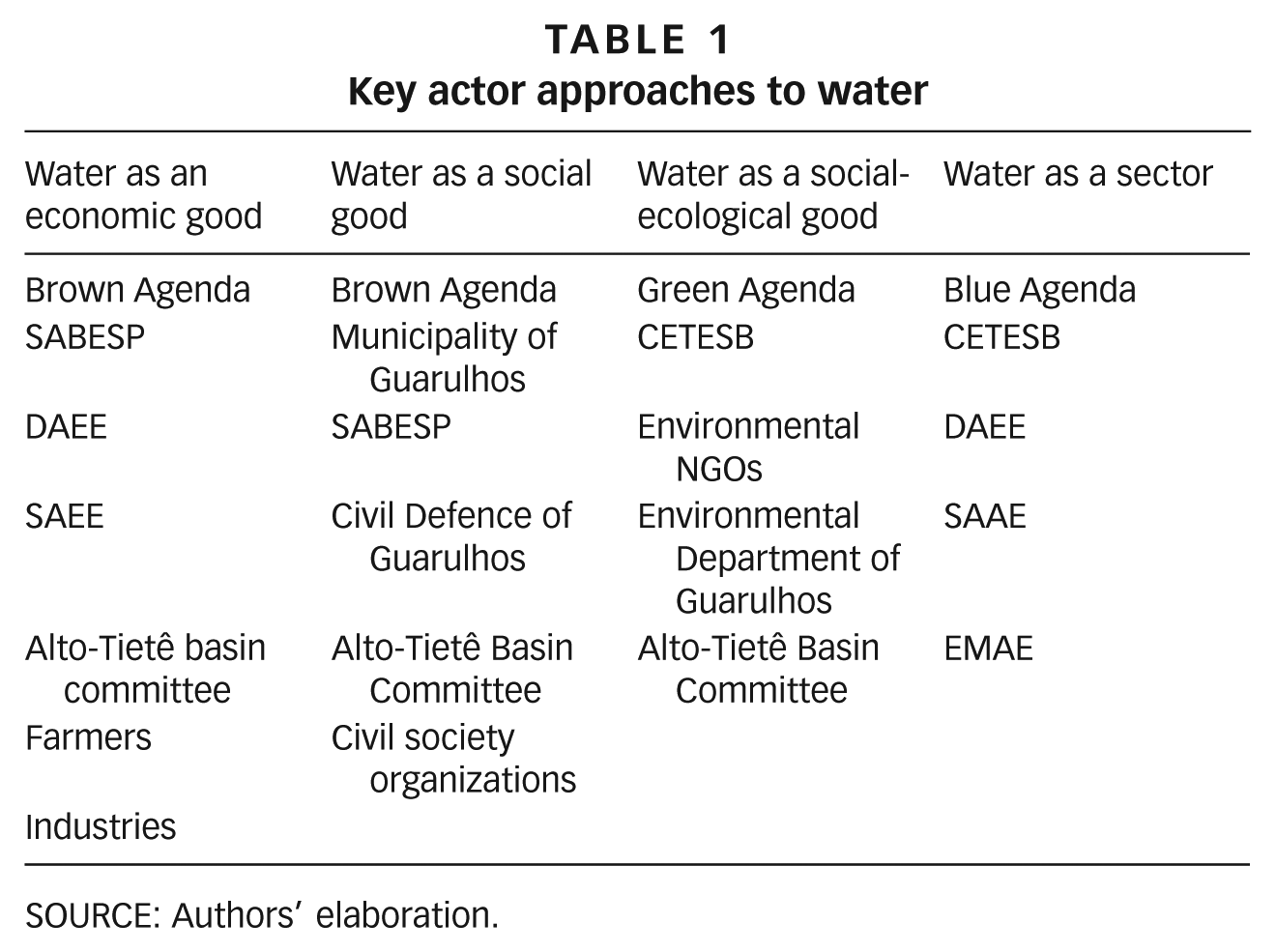
The reforms discussed above changed the water governance landscape by creating new actors, changing the roles of existing ones and stimulating a shift in the discourse on water. Nowadays, water is governed by assemblages of public, private and civil society actors who can have different approaches to water, shaping not only how they address problems but also how they interact with other actors. The approaches distinguished by Hordijk et al.(29) were water as a sector, water as a commodity, water as a social-ecological good and water as a human right. In this governance context, the municipality of Guarulhos has to fulfill certain functions related to water within its own jurisdiction, but also to interact more intensively in participatory bodies set up at different levels of the river basin (Table 1).
Key actor approaches to water
Source: Authors’ elaboration.
At the municipal level, the important actors are the SAAE, the Environmental Department and the Civil Defence, which already represent different approaches to water – seeing it first and foremost as a sector but also, incorporating some of PLANSAB’s principles around basic sanitation provision, as a social good.
The Environmental Department of Guarulhos approaches water as a social-ecological good. It develops the municipal environmental policy together with the other municipal departments and with the participation of organized civil society through public hearings and consultations. It also promotes environmental education activities, raises funds for environmental projects, develops the ecological economic zoning of the municipality and is involved in the municipality’s protection of micro basins and areas where springs are located. Moreover, municipalities are entitled to make decisions on land use and land occupation, which indirectly influence water quantity and quality.(30) They are also responsible for the micro basins and the areas where there are springs within their territory.
In cases of floods or other disasters, the Civil Defence of Guarulhos intervenes through actions that largely require the use of scientific knowledge and technical expertise, such as meteorological data and risk assessments.
A number of other municipal departments are also relevant for water governance, including the Department of Urban Development and the Housing Department, because of Guarulhos’s high levels of urbanization, the lack of adequate housing and the large proportion of the population living in areas at risk. These concerns can overrule the Environmental Department proposals. Moreover, since municipalities do not allow water and sanitation companies to connect houses in irregular settlements to the public network, to a certain extent housing policies determine service provision in poor peripheral neighbourhoods.
Residents of Guarulhos themselves are also important stakeholders in local water governance. They can join neighbourhood associations and other community-based organizations to make their voices heard. However, the research revealed that they were largely excluded from decision-making processes.
This overview of actors and mandates within the municipality suggests that they have a significant influence on water governance within the municipality’s jurisdiction. The remainder of the paper will analyze to what extent they can actually exert this influence.
Most key actors at the state level have strong ties to the state government. The DAEE (Department of Water and Hydropower), the state body for water management,(31) addresses water resources – both surface water and groundwater – and grants water use permits. It also undertakes studies, projects and works related to macro drainage and flood control, and is responsible for the governance of the Tietê River and such projects as the dredging of the river and the Tietê Linear Park.
A high-level DAEE official explicitly recognized the combination of a sectoral and human rights-based approach to water. He stated: “We do not call water ‘water’; we call it a ‘hydrological resource’ because it is a resource that is appropriated for people’s development.” He argued that the discussion of water resources should focus on “… the rational use of water, re-using water, controlling losses and efficient uses …”, and recognized a more “human-centric view” (Brown Agenda), which he contrasted with the environmentalist bias (Green Agenda) of civil society organizations.
Yet projects such as the Tietê Linear Park seem to reflect a shift in the approach to water. Indeed, by combining flood control, the preservation of floodplains and local biodiversity, as well as leisure for local residents, this project integrates different interests and values of water. Interestingly, the DAEE was made responsible for the park by the state government, despite this not being within its mandate.
Other state-level actors include SABESP (São Paulo State Water and Sanitation Company) and CETESB (São Paulo State Environmental Agency).(32) CETESB, created in 1968, approaches water as a social-ecological good but with a strong technical and sectoral orientation, describing its agenda as one of environmental management from the point of view of sustainability.(33) SABESP is a government-sponsored, publicly traded water and sanitation company (51 per cent owned by the state and 49 per cent owned by stockholders), and provides services to most of the MRSP,(34) 363 of the 645 municipalities(35) and around 25 million consumers.(36) In line with the PLANSAB targets, the company aims to universalize basic sanitation services by 2018 within the areas where it operates.(37) It is funded through water fees and, since 2002, has been listed on the stock exchanges of São Paulo and New York. The municipal company SAAE, as noted earlier, depends on SABESP for its bulk supply.
According to SABESP’s 2008 Code of Ethics and Conduct, its business model is based on the sustainable development paradigm, taking account not only of economic viability but also social justice and environmental preservation.(38) Yet at its core, SABESP remains a business dedicated to profit. As a SABESP official explained: “SABESP has a business vision. It has shareholders. It is listed on the stock exchange. So this is a business and should be treated as such.” It uses concepts such as “production”, “consumption”, “distribution” and “loss” of water, thus equating it with a consumption good. A researcher from the University of São Paulo explained:(39)
“SABESP is a company that aims for profit. For instance, its concept of ‘loss’ is the difference between the water that it treats and the money it receives for this treated water. So if there is an illegal connection, this company does not consider this a ‘use’ of water. It considers it a ‘loss’ because it is not compensated for it.”(40)
International institutions such as the World Bank and the Inter-American Development Bank have also played significant, yet largely indirect, roles through the influence of their principles and frameworks on national and sub-national guidelines and through the financing of large projects (often contingent on the adoption of these principles). These actors contribute to shaping water policies at the national level by shaping discourses, providing “expert” knowledge through consulting services and technical assistance, and by generating and legitimizing water-related and environmental knowledge. For instance, the decentralization of water governance to the river basin level illustrates the influence of the Dublin Principles’ calls for the devolution of power within water governance(41) and participatory management of water resources. Brazil is probably the country that has taken this furthest.
a. Deliberative water governance institutions: the basin level
States have established basin committees that are responsible for water resources management within their territory, based on the principles of decentralization, participation and integration. The Alto-Tietê Basin Committee, established in 1994, was the second committee to be implemented in São Paulo State.(42) It is sometimes referred to as the “metropolitan committee” due to the basin’s overlap with the MRSP. An Alto-Tietê sub-committee participant explained the difficulties of decentralization:
“Dividing the state of São Paulo into river basins was challenging because the Tietê River is 1,000 kilometres long. Therefore, the [Alto-]Tietê Basin was divided in smaller portions called ‘hydrographical units of water management’ (UGRHI). We have 22 UGRHIs in the state and they are all managed by a basin committee.(43) The Tietê River crosses five UGRHIs, which are separated by dams.”
As can be seen in Figure 1, the Alto-Tietê Basin Committee occupies a central role in water governance and involves many key actors at different scale levels. The committee is composed of 18 state representatives, 18 municipal representatives(44) and 18 organized civil society representatives, all elected through regular elections, which ensures a democratic process and allows for fresh perspectives and enthusiasm. Civil society representatives come from NGOs, user associations, neighbourhood associations, business or industry associations and more,(45) thus representing diverse yet fragmented interests. This weakens their ability to come together as a group. The basin committee is led by a president, a vice-president and an executive secretary. The president is always a mayor of one of the basin’s municipalities, the vice-president is a civil society representative and the executive secretary is a state representative (either from the DAEE or CETESB). State representatives are technical experts and their leadership position is based on this expertise and their involvement in the water governance system.(46) The DAEE seems to be very influential in the river basin committees. Although CETESB held the executive secretary position in the Alto-Tietê Basin Committee at the time of this research, one respondent claimed that the DAEE controlled this position in 18 out of 21 committees in São Paulo State.(47)
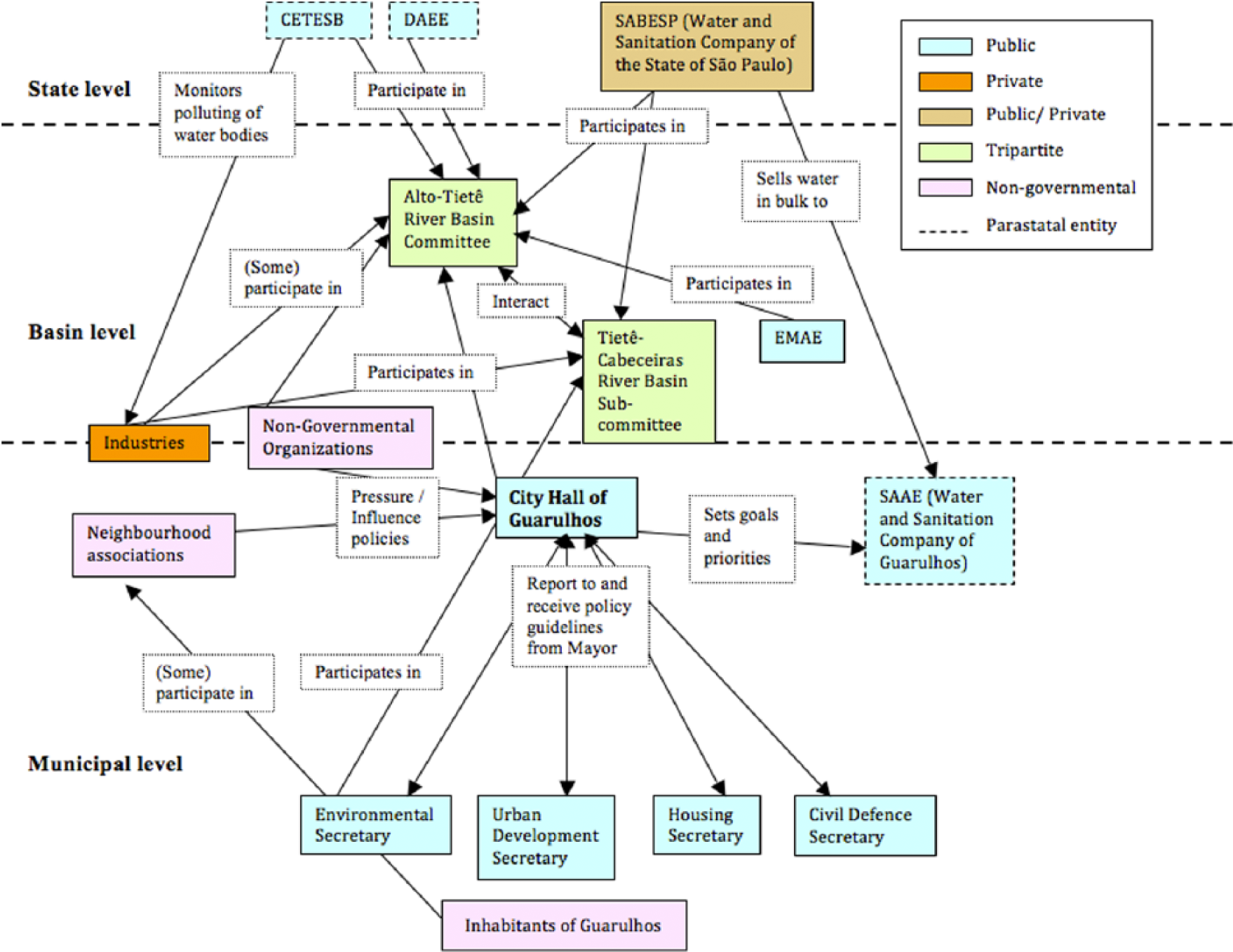
Actors in water governance in Guarulhos
The National and State Water Acts define water as a public good with economic value and as a limited resource, and the basin committee system is based on these approaches. Economic value underpins instruments such as compensation mechanisms for municipalities that have environmentally protected areas, or the charging system for the use of water.(48) This system applies to all users who capture water directly from water bodies or who discharge effluents into them (agricultural producers, water supply companies, power generation companies, industries, etc). However, as of 2012, only three basin committees in São Paulo State had implemented this system.(49) In 2013, the Alto-Tietê Basin Committee had yet to do so, after years of negotiation.
The Alto-Tietê Basin is further divided into sub-basins with sub-committees, which also have a tripartite composition. They have the same responsibilities as the main committee in terms of water resources management, as well as for the regulation and implementation of headwater conservation, protection and recuperation policies at the local and regional levels. Guarulhos is located within the Tietê-Cabeceiras sub-basin.(50)
As the production of electrical energy for the metropolitan region’s 20 million inhabitants represents an important use of the basin’s water, the EMAE (Metropolitan Company for Water and Hydropower) is also an important stakeholder. EMAE is a hydropower generation concessionary in the MRSP, linked to São Paulo State. It operates a number of hydroelectric plants through dams located south of the city of São Paulo.
b. Deliberative bodies: state level and federal level
Several institutions play major roles at the state level. First, the State Council for Water Resources (CRH), created by the State Water Act of 1991 to define state water policy, is a tripartite body with deliberative powers and equal representation of the state, municipalities and civil society (11 members from each). Through negotiations and consensus-seeking, this deliberative forum establishes the priorities for actions and investment and promotes the environmental restoration of river basins and the balanced use of water resources.
The main actors at the federal level are influenced by the National Water Act of 1997. The National Council on Water Resources (CNRH), the highest organ of this system, is deliberative and participatory as it is made up of representatives from the federal government (29 members), the state councils on water resources (10), users of water resources (12) and civil society organizations (6). Despite this diversity, it overwhelmingly represents government interests. This organ links water planning with planning at various levels and sectors, decides on major issues and settles larger-scale disputes. The CNRH also determines the creation of river basin committees for rivers pertaining to the federal union.(51)
The resulting institutional framework for water governance relevant to Guarulhos is a dense network of relationships that is summarized in Figure 1. The municipality of Guarulhos is represented in two basins and has a seat on one sub-basin committee. For the state actors SABESP, CETESB and the DAEE, the new governance system implies participation in all basin committees of São Paulo State. Figure 1 implies both horizontal and vertical integration, or at least coordination; in fact, the reality turns out to be more complex.
c. Diversity of actors, deliberation, values, learning
As has been argued by Hordijk et al.,(52) river basin councils are expected to offer platforms where diverging views can be debated, even putting underlying values under scrutiny, and allowing for different kinds of knowledge to be integrated. The diversity of actors and their approaches to water are evident in the basin councils. A respondent from the Environmental Secretariat of Guarulhos illustrated this diversity of approaches by stating that:
“The SAAE sees water as a resource, a business. The Secretariat of Urban Development sees water as a guideline for drainage. We [the Environmental Secretariat] see water as the fluvial landscape.”
These diverging views can lead to disagreements, tensions and conflicts. SABESP and the SAAE, for instance, have had conflicts with CETESB, the Public Prosecutor’s Office and environmental NGOs over their failure to treat sewage waste sufficiently, instead releasing it into water bodies. SABESP and other advocates of the Brown Agenda argue that it is essential to provide basic sanitation services in informal settlements, not only because they represent a basic need but also because it will greatly reduce the contamination of water sources. The counter-argument of CETESB, the Public Prosecutor’s Office and Green Agenda advocates is that installing basic sanitation in these informal settlements would only encourage people to live in protected areas.
But the Alto-Tietê Basin Committee has also created a platform to discuss and address issues of common concern. A high-level DAEE official illustrated this with an example from Guarulhos:
“The absence of sewage treatment in Guarulhos eventually led to a discussion within the Alto-Tietê Basin Committee. The Environment Secretary of São Paulo politicized the debate by arguing that even if São Paulo invested a ton of money in cleaning the Tietê River it would be pointless since the neighbouring municipality did not treat its sewage. This created political pressure and the federal government lent funds for the implementation of the treatment plants.”(53)
Thus, pressure eventually contributed to action on this issue, although it took many years of negotiations and the intervention of the Public Prosecutor’s Office through a conduct adjustment agreement. Furthermore, the inter-basin water transfer from the PCJ Basin to the Alto-Tietê Basin has created a conflict, as the PCJ Basin argues that more water should remain for local use and development. Negotiations for the permit renewal for 2004–2014 for the transfer of water between the two basins should have been administered by the CRH but seem to have been largely coordinated by government-affiliated entities such as the DAEE. The process was therefore centralized, probably to the disadvantage of the PCJ Basin. Nevertheless, the renewal of the permit imposed a number of restrictions and new requirements on SABESP, which was blamed for the contamination of water bodies, contributing to the situation of scarcity. Consequently, the PCJ Basin Committee representatives considered the outcome of the process to be positive.
Another issue that has been given attention through the basin committees is the protection of areas where springs are located, as these have become contaminated as a result of rapid and irregular urbanization patterns, thus affecting the availability of water for human consumption and other uses. The State Headwaters Protection Law, passed in the mid-1970s, aggravated this irregular expansion.(54) According to a professor in urban planning from Mackenzie Presbyterian University in São Paulo, this law had a reverse effect. It prevented planned urbanization, but in the absence of adequate monitoring measures, illegal settlements with no access to basic infrastructure and services multiplied rapidly, resulting in the accelerated contamination of the springs. Through the efforts of the Alto-Tietê Basin Committee, the law was later revised to facilitate the upgrading of informal settlements, the installation of basic infrastructure and thus a reduction in the contamination of springs. Committees can now create “specific laws” for the protection of springs that enable a greater compromise with Brown Agenda needs. These laws are developed and implemented by the sub-committees of the sub-basins where the springs are located. This process was underway in the Tietê-Cabeceiras sub-basin at the time of this research but measures had not yet been implemented. While this legal reform is an important achievement, the majority of decision-making on environmental policies, such as licensing and regulation in areas with protected springs, remains centralized in CETESB.
Both interviews and sessions of the river basin councils revealed that most actors show a mix of approaches to water. It is difficult to assess in hindsight the extent to which this blending can be attributed to discussions in the deliberative bodies, the popularization of international (IWRM) or national (PLANSAB) policies, or to other factors. We did, however, find that many actors claim that everybody should have access to water, but they also often see water as having an economic value, or believe that attaching economic value to it is beneficial for water governance and would facilitate the expansion of service coverage. Some also emphasize the importance of protecting water resources (from contamination, overuse, etc.).
Some respondents, however, explicitly mentioned the pedagogical role of the councils in this process. A high-level official from the DAEE explained:
“You cannot expect society to preserve [water] if it is not educated to preserve. […] So the council is a process and the more you internalize this discussion the better you can preserve this resource.”
This same respondent also explicitly acknowledged that:
“It is a bit difficult. It is a power play. You do not always agree with others. That is why the committee is balanced. So every time you want to pass something in the committee, a decision, it has to be negotiated, that is its role. It is important that these different interests are represented and that they can negotiate, because they all have some type of influence on water management. The most democratic form for society to participate in this is to participate in the discussions. […] Because, actually, the public authority gave up some of its decision-making power so that society could participate in this. That is why the executive secretariats are generally from public entities.”
We can thus conclude that the river basin councils do foster innovative approaches to water governance and that different approaches to water are taken into account (as exemplified in the negotiations on inter-basin transfers, compensation mechanisms for municipalities providing environmental services and the protection of areas where springs are located). For some it is clear that values (gradually) change when debates in the councils become internalized.
Respondents were less positive, however, about knowledge exchange and learning. Respondents from the municipality of Guarulhos indicated that there was still a lack of knowledge integration on water issues within the municipality itself, although they noted clear signs of improvement. Opinions on the lack of vertical exchange of information were even stronger. Guarulhos respondents felt they did not receive adequate information from either the municipality of São Paulo (partly attributed to political rivalries) or state-level institutions. Guarulhos’ decision to found its own water and sanitation company is seen as a source of tension with SABESP, which also results in important information not being shared. Within the basin committees, knowledge asymmetries also exist. The development of the river basin plan – the committee’s main management instrument – is based on extensive studies of basin characteristics and requires the use of scientific expertise. It is developed by technical experts from CETESB, the DAEE, municipal departments (less frequently) and other committee participants. This document is produced through workshops and discussions and is then submitted to the committee plenary for approval. A former president of the Alto-Tietê Basin Committee suggested that although the documents are developed through a participatory process, they are almost entirely created by technical experts based on technical knowledge.(55) In fact, a study by Abers et al.(56) showed that 56 per cent of the representatives of the Alto-Tietê Basin Committee had graduate-level education. Even when their technical/scientific knowledge is shared in decision-making processes, it is not always accessible. The use of language that is understandable by all participants is necessary for non-hierarchical relations. This is not always respected and certain actors are thereby excluded from discussions. As the executive secretary of one of the Alto-Tietê’s sub-committees explained:
“[In the basin committees], state and municipal representatives tend to be technical experts. They have a discussion and civil society representatives are not always at the same level for that discussion. If you do not watch yourself, you start talking in technical terms, and it may seem like everyone is following you but they are not.”
V. Transition or Transformational Change?
In theory, water governance actors should have comparable power and the system should have become more inclusive as a result of all these changes. In practice, however, there are mixed feelings about how well these goals have been achieved. Water policy reforms have transformed the relations between actors from being centralized and hierarchical towards a more networked model, as Figure 1 illustrates. However, most respondents agreed that government actors still dominate.
State entities such as SABESP and the DAEE retain the greatest influence in water management, by carrying out mega-projects and bypassing basin committees and municipal authorities. In the case of the Tietê Linear Park, respondents affiliated to the municipal government of Guarulhos, the Alto-Tietê Basin Committee and Tietê-Cabeceiras sub-committee had little or no information about this project aside from what they could observe themselves. A Civil Defence respondent emphasized that he did not know about the next steps in this project, which might include the eviction of thousands of households living within the planned limits of the park:
“There is zero discussion surrounding the Linear Park between the DAEE and the Civil Defence of Guarulhos. Not even during that big flood did we sit down and discuss this project. At that moment, the DAEE presented the park as the solution against floods and they initiated the mandatory evacuation process of the area. To us they showed a sketch that served as an advertisement. It was not even a technical plan, just a pamphlet.”
Besides a lack of information exchange and cooperation, transformative change is also limited by the differences in the financial resources that various actors mobilize. It is not entirely surprising that the Alto-Tietê Basin Committee is overshadowed by state entities. SABESP’s 2011 revenue, for instance, was approximately US$ 5.6 billion. The total budget of the committees is more difficult to evaluate as they receive funds from a number of sources. However, an Alto-Tietê Basin Committee respondent explained that the charging system for water use would represent a considerable proportion of the funds available to the committee, and he estimated it would bring in approximately US$ 25 million. This is a fraction of the financial power of large entities such as SABESP, which operates not only in more than half of the municipalities in São Paulo State but also internationally.
VI. Conclusions
The municipality of Guarulhos made an important choice by opting to provide water and sanitation through its own municipal company (SAAE). However, it lacked the resources and conditions to give real meaning to this autonomy and was unable to respond to the demands of residents of Guarulhos. In the last few years, the municipal government has made considerable efforts towards universalizing its services, with the support of the federal government and pressure from state- and basin-level actors.
The change from authoritarian rule to a democracy that strives to become deliberative can be considered a transformative change, as it has led to shifts in values and core principles underpinning governance and to the creation of new bodies to facilitate a more deliberative and participatory governance process. Participation is highly valued. With respect to water governance, this has led to the creation of the deliberative river basin councils in a manner that creates opportunities for questioning not only governance structures and principles but even underlying values. For the municipality of Guarulhos this means that they have one of the 13 municipal seats on the Alto-Tietê Cabeceiras sub-committee and one of the 18 seats on the Alto-Tietê Basin Committee. These deliberative bodies can certainly be considered an important innovation in water governance structures and a stark break with the authoritarian and centralized past. That the need for participatory and deliberative governance seems to have been internalized by many of the actors, including the more classic “sectoral” actors, can be considered a sign of the change in underlying values.
In terms of outcomes, we can state that the committees and sub-committees have contributed to important changes, such as changes in the law on areas with protected springs and the renewal of the inter-basin agreement. The participatory spaces are bringing together different views on water in discussions and debates where knowledge can be shared and integrated.
However, despite these changes, there does not seem to have been the significant shift in power structures that is core to Pelling’s characterization of transformation. Some actors – such as the DAEE and SABESP – still have significant influence on the agenda-setting and outcomes of discussions and debates within the basin committees, while civil society representatives sometimes remain on the margins.(57) Expert-led approaches prevail, as seen in the continued dominance of state agencies in almost all aspects of water management decision-making spaces. There is thus a discrepancy between water governance discussions in deliberative spaces and actual decisions taken in sectoral water management. That the municipality of Guarulhos was not informed about the dyke built in the Tietê River and that all actors in Guarulhos said they lacked information about the planned Tiete Linear Park mega-project is a clear indication that major decisions are being taken outside the deliberative bodies.
This also indicates how complex and convoluted the organizational structure can be, with overlapping deliberative bodies among sectors and along the whole hierarchy (municipal, state, federal), making it challenging to implement decisions and encourage broad participation in a transformative sense. Water governance structures are by their very nature inert and difficult to transform because the implementation of transformative decisions often implies large-scale infrastructural works. The fact that the Brazilian system shows signs of transformation in the governance layer can already be considered an important achievement. Whether in the long run this will also translate into changes in the power balance in water management, particularly in large infrastructural decisions, remains to be seen.
Footnotes
Acknowledgements
The authors wish to thank and acknowledge the help of Raquel dos Santos of UNESCO–IHE for her useful comments and suggestions.
This article is part of the EU-funded Chance2Sustain research programme (2010–2014) in 10 cities in India, South Africa, Brazil and Peru (http://www.chance2sustain.eu). The main focus of the programme is the potential contribution of participatory knowledge management to sustainable development. CEBRAP (in São Paulo) is the Brazilian consortium member of Chance2Sustain, and research was conducted in cooperation with members of CEBRAP ( ).
).
1.
Viana, Natalia (2011), “Floods in Brazil are a result of short-term planning”, The Guardian Online, 2 February.
2.
DAEE (n.d.), “Parque Várzeas do Tietê: o mayor parque linear do mundo”, available at http://www.daee.sp.gov.br/index.php?option=com_content&view=article&id=565:parque-varzeas-do-tiete-o-maior-parque-linear-do-mundo&catid=48:noticias&Itemid=53.
3.
Miranda Sara, Liliana, Michaela Hordijk and Rommy Torres Molinas (2011), “Water governance key approaches: an analytical framework”, Chance2Sustain Working Paper 4, 23 pages, available at .
4.
In total, 27 key actors were interviewed, including members of the municipal department of Guarulhos, the Alto-Tietê River Basin Committee and two of its sub-committees, SABESP, the DAEE, NGOs, ARSESP, FABHAT, research institutions and EMAE.
5.
Hordijk, Michaela, Liliana Miranda Sara and Catherine Sutherland (2014), “Resilience, transition or transformation? A comparative analysis of changing water governance systems in four southern cities”, Environment and Urbanization Vol 26, No 1, pages 130–146.
6.
Pelling, M (2010), Adaptation to Climate Change: From Resilience to Transformation, Routledge, London, 224 pages.
7.
See reference 6.
8.
IBGE (2010), Censo Populacional, available at ].
9.
10.
As the large majority of Guarulhos – including its entire urbanized area – is located within the Alto-Tietê Basin, we will not focus on the Paraíba do Sul Basin.
11.
The Alto-Tietê Basin has water availability of only 201 cubic metres/ inhabitant/ year. The UN defined as being in a critical situation those regions that have water availability below 1,500 cubic metres/ inhabitant/ year; see Jacobi, Pedro and Ana Paula Fracalanza (2005), “Comitês de bacia hidrográfica no Brasil: desafios de fortalecimento da gestão compartilhada e participativa”, Desenvolvimento e Meio Ambiente Vol 11/12, Editora UFPR, page 42.
12.
13.
da Costa, S S, L Heller, L R S Moraes, P C Borja, C H de Melo and D Sacco (2006), “Successful experiences in municipal public water and sanitation services from Brazil”, published by ASSEMAE (National Association of Municipal Services of Water and Sanitation), see .
14.
Ferreira, Roberto dos Santos (2011), “Gestão das águas urbanas em Guarulhos”, Dissertação (Mestrado) Universidade de São Paulo, 160 pages.
15.
Brazil holds 12 per cent of the world’s freshwater resources.
16.
In Guarulhos, residents pay R$ 15.78 for a monthly water consumption of up to 10 cubic metres, whereas SABESP in São Paulo charges R$ 15.94 for the same quantity to regular households, and R$ 4.12 and R$ 5.40 to households in informal settlements and in social housing, respectively; see SAAE (n.d.), “Sobre o sistema de água”, available at http://www.saaeguarulhos.sp.gov.br:8081/sistema-de-agua; also SABESP (n.d.), “Tarifas e serviços”, available at . Interviews with residents of peripheral neighbourhoods of Guarulhos further revealed that residents living in higher-altitude areas, such as hilltops, paid water bills sometimes 5–10 times higher than residents in lower-lying areas. Residents blamed a pumping system that was installed to push piped water uphill and that filled the pipes with air, consequently making the water meter turn faster.
17.
See reference 14, page 26.
18.
SAAE (2013), “Coleta de esgoto eficiente, maior qualidade de vida”, available at http://www.saaeguarulhos.sp.gov.br:8081/sistema-de-esgoto. SABESP aims to universalize all basic sanitation services by 2018; see SABESP (2013), “Institucional: missão e visão”, available at .
19.
Figueiredo, Cecília (2012), “Guarulhos garante abastecimiento de água e tratamento de esgoto”, Teoria e Debate, 13 July, available at . The universalization of sewage services is estimated to require between US$ 600 million and US$ 750 million. The funds that the SAAE receives from the federal government are long-term loans with interest rates below market level.
20.
Decreto Lei Federal No 9.433.
21.
Decreto Lei Estadual No 7.633.
22.
Alvim, Angélica (2003), “A contribuição do comitê do Alto-Tietê à gestão da bacia metropolitana: 1994–2001”, PhD thesis FAUUSP, São Paulo, 549 pages. The principle of integration considers three important aspects: the integration of surface and subterranean waters so as to guarantee public water supply; the quantity and quality of available water; and the integration between users, the public authority and civil society (the representatives within the basin committees).
23.
Benjamín, Antonio Herman, C L Marques and C Tinker (2005), “The water giant awakes: an overview of water law in Brazil”, Texas Law Review Vol 83, No 7, page 2199.
24.
Heller, Leo (2011), “Panorama do saneamento básico no Brasil”, Elementos Conceituais para o Saneamento Básico Vol 1, Ministério das Cidades, 645 pages. The concept of basic sanitation adopted in the Brazilian Law No 11.445 “… includes the classical components of water supply and sanitation services but also integrates the collection, treatment and disposal of solid wastes, stormwater drainage and control of vectors of transmittable diseases”; see Castro, Jose Esteban and Leo Heller (editors) (), Water and Sanitation Services: Public Policy and Management, Earthscan, UK and USA, page 321.
25.
Lancieri, Filippo Maria (2011), “Modelos organizacionais e normatividade institucional: estudo de caso da SABESP S.A.”, Law School thesis published online by Fundação Getulio Vargas, São Paulo, 103 pages, available at .
26.
“This arrangement was institutionalized through the establishment of a contractual relationship between the municipalities and the state governments, where municipalities granted a concession to provide water and sanitation services in their jurisdictions to state-owned companies.” See reference 24, , page 323.
27.
ARSESP is the state regulatory agency for water and sanitation services.
28.
“It is up to municipalities to organize and provide for, directly or by means of concession or permission, the public services of local interest.” Item V, article 30, Federal Constitution.
29.
See reference 5.
30.
Formiga Johnsson, Rosa Maria and K E Kemper (2005), “Institutional and policy analysis of river basin management: the Alto-Tietê River Basin, São Paulo, Brazil”, World Bank Policy Research Working Paper 3650, 53 pages.
31.
Although the DAEE is autonomous, it is linked to the State Department of Sanitation and Water Resources (SSRH).
32.
CETESB is an autonomous branch of the State Secretariat of the Environment (SMA).
33.
CETESB (n.d.), “Institucional – a nova CETESB”, available at .
34.
Guarulhos is one of seven municipalities in the metropolitan region where a company other than SABESP provides these services.
37.
SABESP’s goal to universalize water and sanitation services concerns only households officially registered in the municipalities. According to the concession contracts signed with the municipalities, SABESP is not allowed to provide services to households living in illegal settlements. However, these illegal settlements represent water loss (in terms of quantity and quality) to SABESP, which motivates the company to expand services to these locations.
38.
SABESP (2008), “Código de ética e conduta”, available at . This document states that beyond compromising in order to universalize public sanitation services, SABESP will aim for the improvement of environmental conditions in cities where it operates and in the quality of life in communities; also to rehabilitate water sources and invest in education so that people will learn how to use water conscientiously.
39.
A geographer focusing on sanitation and participatory water management.
40.
It should be noted that respondents affiliated with SABESP claimed that the company’s primary concern in terms of water losses related to leakages, and when it came to irregular usage, large users such as industries and hotels were much more problematic in terms of volume of water than residents.
41.
ICWE (International Conference on Water and the Environment) (1992), The Dublin Statement and Report of the Conference, 26–31 January, Dublin, Ireland, available at .
42.
Batata, Adriane (2011), “Identidade ambiental metropolitana como instrumento à governabilidade”, Doctoral thesis, Universidade Estadual de Campinas, 532 pages.
43.
Although there are 22 UGRHIs, there are only 21 basin committees as the geographic characteristics of two neighbouring basins led to the local leadership opting for a common committee.
44.
As the Alto-Tietê Basin is composed of a large number of municipalities (36), the committee’s statute establishes 18 municipal representatives and 18 municipal substitutes. Elections determine which municipalities will have a representative during a specific mandate. However, the municipality of São Paulo has a permanent seat on the committee.
45.
Concerned individuals can attend meetings but have no voting rights.
46.
A state representative of one of the Alto-Tietê’s sub-committees argued that the decision to have state representatives as executive secretaries was also often due to the resources of each of the three sections. The executive secretariat is in charge of organizing and hosting committee meetings and other activities. According to him, civil society representatives often do not have headquarters, while municipalities face financial difficulties as they are frequently covered in debt. State entities, on the other hand, are more structured.
47.
This number varies as a result of elections.
48.
This system is considered fundamental to the concepts of “user payer” and “polluter payer” and to combating the wasting and polluting of water.
49.
The Paraiba do Sul Basin Committee, the Piracicaba-Jundiaí-Capivari Basin Committee and the Sorocaba and Medio-Tietê Basin Committee.
50.
This sub-basin extends from the east of the Metropolitan Region of São Paulo (MRSP), where the headwaters of the Tietê River are located, to the northeast of the city of São Paulo.
51.
Ambiente Brasil (2012), “Sistema nacional de gerenciamiento de recursos hídricos”, available at .
52.
See reference 5.
53.
This financial assistance, mentioned earlier, requires municipalities to develop a Municipal Basic Sanitation Plan by 2014.
54.
State Law No 898 of 1975 and No 1.172 of 1976.
55.
Hordijk, M A, F van den Brandeler and E Filippi (2013), “Facing the floods: community responses to increased rainfall in Guarulhos (Brazil) and Arequipa (Peru)”, presentation at the International Workshop on Living in Low-income Urban Settlements in an Era of Climate Change: Processes, Practices, Policies and Politics, 9–10 September, University of Manchester, UK.
56.
Abers, R N, R M Formiga-Johnsson, B Frank, M E Keck and M C Lemos (2006), “Stakeholder councils and river basin management in Brazil: democratizing water policy?” III Encontro da ANPPAS, 23–26 May, Brasília-DF.
57.
da Cunha, Fernando Monteiro (2004), “Desempenho institucional na gestão de recursos hídricos: o caso dos subcomitês de bacia hidrográfica Cotia-Guarapiranga e Billings- Tamanduateí na Região Metropolitana de São Paulo”, MSc in Environmental Science, PROCAM/Universidade de São Paulo.