




Abstract
Delegating state responsibilities for the management of water resources to regional bodies and the provision of drinking water and sanitation to local governments has led to new configurations in urban water governance. Drawing on case studies from four cities in the global South (Guarulhos, Arequipa, Lima and Durban), this article analyzes recent changes in these configurations, with particular attention to the role and power of the municipality in this process. This paper explores to what extent these new configurations reveal a move towards resilience, transition or even transformation. It concludes that there are clear indications of transition in all cases, and in Guarulhos and Durban even some signs of transformation. Given that transformative changes in the legal and institutional framework, and even in values and attitudes, have not yet affected the existing power structures, the question is to what extent these signs of transformation will reach their full potential.
I. Introduction
Globally, water governance practices are shifting from a hierarchical, state-led and sectoral approach to a more integrated and participatory approach. The rescaling of responsibilities has included increased participation by non-state actors in decision-making and a shift away from public ownership of water supply infrastructure, or strict regulation of its provision.(1) The provision of water and sanitation often became a municipal responsibility, guided more by the general impetus for decentralization than by specific challenges in the water sector.(2) The general trend towards privatization of urban services has also meant varying degrees of ownership or control over different aspects of urban water provision and sanitation. Neither privatization nor increased municipal control has, as yet, resulted in access in all cities to water and sanitation services through a universalized network.(3) In virtually all cities in the South, part of the population still relies on alternative water provision, either through water vendors, private wells, boreholes or by buying packaged water.
Water is an important input for agriculture, non-agrarian production processes, hydropower generation, ecosystem services and recreation, as well as household consumption. The Integrated Water Resource Management (IWRM) principles, which have significant global influence, stipulate that river basins or catchments are a more appropriate unit for managing water than the administrative boundaries of political systems, and can strike a balance between these competing uses. River basin management is a well-established concept,(4) however, it focused previously on human use only. Its current conception has broadened the scope to include environmental concerns and the importance of non-consumptive uses of water. It is argued that the river basin or catchment presents water’s own natural boundaries, which is a better spatial unit for water management than administrative boundaries designed by sociopolitical systems. The growing popularity of “participation” and consequently the need to involve a wide array of actors in river basin management has also been part of the revival of the concept. There have been attempts to set up river basin organizations in many countries and the International Network of Basin Organizations (INBO) has regionalized branches. With the diversity of actors in river basin organizations, the river basin has become a wider political arena where contrasting interests and approaches to water can be debated and reconciled, potentially challenging conventional decision-making and expertise that are insufficient to tackle increasingly complex water-related problems.(5)
Drawing on four case studies(6) – Guarulhos (Brazil), Arequipa and Lima (Peru) and Durban(7) (South Africa) − this paper uses an analytical framework developed by Pelling(8) to answer the following questions:
What are the main consequences of recent changes in the institutional framework and rescaling of responsibilities for urban water governance, with specific attention to the mandates and roles of municipalities?
To what extent do the new institutional structures and responsibilities foster social learning and knowledge generation in water governance?
To what extent do the new arrangements and the social learning processes foster resilience, transition or even transformation?
II. Resilience – Transition – Transformation
Pelling’s classification of adaptation practices(9) identifies three levels of adaptation: resilience, transition and transformation, distinguished primarily by the extent to which they challenge the status quo. This framework is useful for assessing changes in water governance, given that water is a primary medium through which climate change will affect daily existence and ecosystems.(10) Water governance systems will have to adapt to a range of possible climate impacts, including increased flooding, heavy rainfall events or droughts.
The defining quality of resilience, in Pelling’s classification, is the desire to maintain functional integrity. “Adaptation as resilience” focuses on improving existing practices without questioning underlying assumptions,(11) and can hence allow unsustainable or socially unjust practices to continue. Short-term and partial remedies dominate because they best serve established value priorities.(12)
Transition involves incremental changes in governance systems, but with overarching norms, principles and sociopolitical regime remaining unchanged. Rules and decision-making are altered but norms and principles are not. Transition requires reflection on how problems are framed(13) but can also result from renegotiation of policy priorities.(14)
Transformation requires a regime change, in which underlying values are questioned from the level of individual behaviour to the mechanisms and structures of the global political economy. Transformation addresses the root causes of vulnerability and deprivation, requiring an understanding of the environmental crisis in the context of our relation with the earth. This echoes Freire’s statement that “… we are not only ‘in’ the world but also ‘with’ the world, that is, we are essentially related to it.”(15) Understanding the environmental crisis as an internal crisis and an expression of our distorted relation with the world requires a profound shift in our world view, in how we understand our relations with nature and the social world and our role in the political processes that shape our social-ecological relations. Transformation requires strong sustainable development goals, which can only be achieved through radical changes in the value system underpinning the dominant capitalist production system, including the public−private dichotomy that has favoured private actors and marginalized the role of the state.(16)
The main characteristics of the three modes of adaptation are summarized in Table 1.
Modes of responding to external threats or disturbances
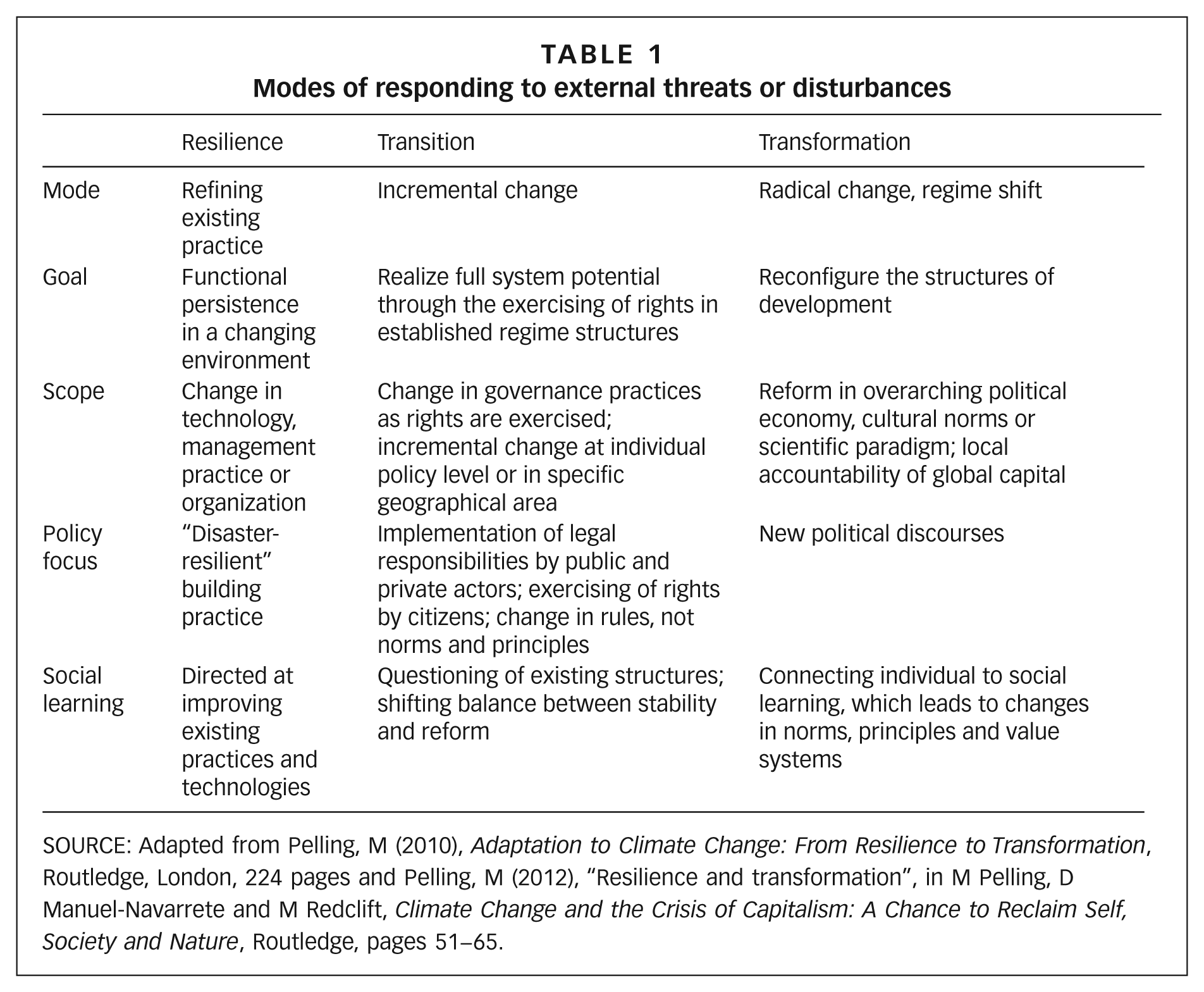
Source: Adapted from Pelling, M (2010), Adaptation to Climate Change: From Resilience to Transformation, Routledge, London, 224 pages and Pelling, M (2012), “Resilience and transformation”, in M Pelling, D Manuel-Navarrete and M Redclift, Climate Change and the Crisis of Capitalism: A Chance to Reclaim Self, Society and Nature, Routledge, pages 51−65.
a. Social learning: an essential component of adaptation
Pelling considers social learning as essential to all three forms of adaptation, but with a different focus and outcome in each case.(17) In resilience, it is directed at improving existing practices, for instance through technological innovation or changes in institutional practice, whereas in transition and transformation it fosters changes in organizational frameworks and institutions. The necessary conditions for change are trust, a willingness to take risks and experiment, and an active engagement with civil society. Where strong levels of organization cause institutional inertia, change is impeded. Where emergent social structures foster experimentation and innovation, transition or even transformation can be achieved. Pelling argues that critical reasoning, a cornerstone of deliberative democracy, is essential for transformation.(18) Critical reasoning inspired by Freire’s political pedagogy(19) supports dialogue between the marginalized and those in power. Transparency is also needed to challenge embedded values.
There are considerable knowledge deficits around the complexity of social-ecological systems and the non-linear interactions between processes at multiple scales. The need to face this complexity and uncertainty with incomplete knowledge(20) gave rise to the adaptive management paradigm, an approach in which learning is expected to take place among scientists, resource managers and policy makers through deliberate experimentation, constant monitoring, joint action and reflective practice, presumably leading to improved decision-making.(21)
However, social-ecological systems theory has been criticized for being “power blind” and a-political,(22) neglecting power differences between actors taking part in the decision-making process. Originally, the learning was mainly restricted to the professional community, but with the growing importance of environmental movements and indigenous communities in resource management, it has started to incorporate “local knowledge” or “lay knowledge”. It is important to distinguish between practices that are restricted to professionals and those where a wider variety of actors are incorporated, opening up social learning to a multiplicity of world views and enabling values to be questioned. The growing influence of a rights-based approach to development and the call for greater participation in resource management led to the development of collaborative management.(23) The inclusion of a wider variety of actors in resource management implied an imperative for learning; to participate meaningfully in decision-making, participants need to be knowledgeable. Social learning within this context expands on the learning within adaptive management, depending on deliberation and sustained interaction between individuals, sharing knowledge, perspectives and values in a trusting environment.(24) However, it is important to recognize that power and knowledge asymmetries, as well as practical concerns such as time constraints and variability in attendance at meetings, may seriously affect the outcomes of such processes.(25) Adaptive and collaborative management are also distinguished by the relationship between learning and action. In adaptive management, joint action leads to reflection and learning, which improves the next joint action. In collaborative management, learning through deliberation implies that actors are exposed to differing values, have to analyze and debate alternatives and create a common ground for collective action.(26)
III. Water Governance: Different Approaches and their Associated Discourses
Water governance, or the range of systems for developing and managing water resources and services, is much broader than just water management.(27) Actors at multiple levels – including government, business, political parties, civil society, international agencies – are involved in confrontations and debates around how river basins and water services should be governed.(28) We use the term “water governance” to refer to the multi-actor processes through which objectives are set (hence the political and often conflictual processes), and the term “water management” for the administration, implementation and functioning of water infrastructure.
Differences in power or conflicts of interest can underlie struggles over water, but Castro argues that it is also about how actors value it.(29) The most dominant discourses in water governance debates are around “water as an economic good/commodity” and “water as a common good and human right”. Other approaches, namely “water as a social-ecological good” and “water as a technical sector” are also important (Table 2).
Four approaches to water
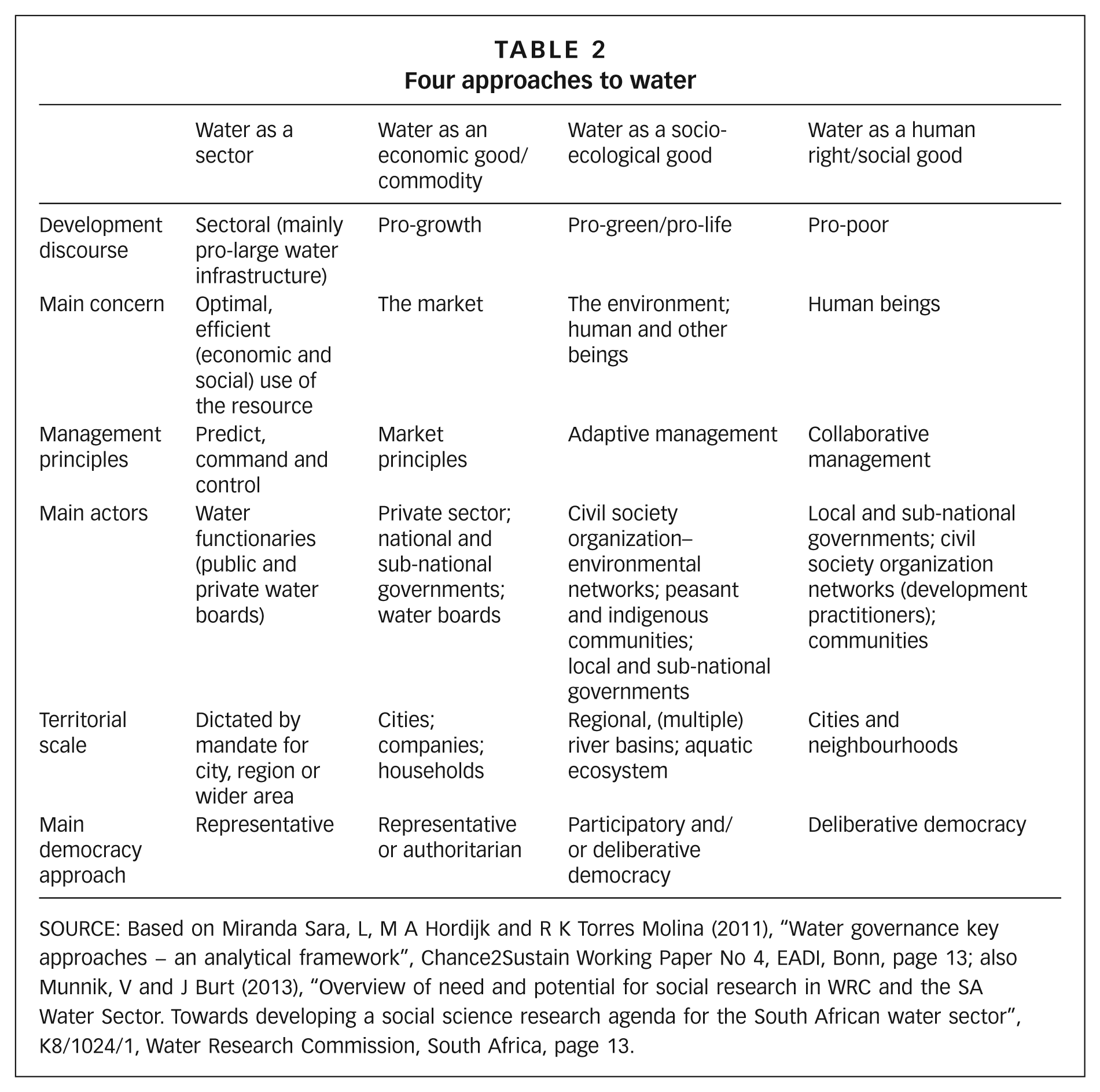
Source: Based on Miranda Sara, L, M A Hordijk and R K Torres Molina (2011), “Water governance key approaches − an analytical framework”, Chance2Sustain Working Paper No 4, EADI, Bonn, page 13; also Munnik, V and J Burt (2013), “Overview of need and potential for social research in WRC and the SA Water Sector. Towards developing a social science research agenda for the South African water sector”, K8/1024/1, Water Research Commission, South Africa, page 13.
Since the 1980s, “water as an economic good” has become the dominant approach in water governance and management, treating water as a “resource” with an economic value. According to this approach, water should be priced, water delivery should be open to the market, and for hard-liners water sources should be privately owned.(30) Neo-liberal principles of the capitalist global economy dominate. Cost-recovery is a central concern in urban water provision and the ability to pay has to be factored into services.
This market-based approach stands in stark contrast to the “water as a human right” approach. In 2010, after decades of debate, clean drinking water and sanitation were declared essential human rights,(31) and universal access to sufficient water for basic needs is considered a non-negotiable priority, with governments and other actors accountable for ensuring its availability and affordability. The state is required to generate policies that guarantee access via subsidies or other instruments and puts provision under democratic control and state regulation. Proponents of this approach, often from a “pro-poor”, “development” or “brown agenda” background, support a preference for collaborative management principles, in which processes of deliberative decision-making in governance networks ensure that the voices of a wide variety of actors, including the marginalized, are heard.
The “water as a social-ecological good” approach supports the position that water is essential to all living beings, and it extends the right to water to nature as a whole, with an emphasis on the finite nature of water and a concern for future generations and ecosystem health. Key proponents are associated with the green (or “pro-life”) agenda and are sometimes called “anti-development”. The related discourse has gradually become embedded in public policy in the South, particularly in Latin America,(32) and adheres to the principles of adaptive management, in which experimentation, monitoring and reflection play a major role.
The last approach is the traditional “water as a technical sector”, and includes a strong pragmatic emphasis on water management, infrastructure and provision, as well as concerns for the productive uses of water based on “predict, command and control”, where solutions are sought in infrastructure developments. The financing of infrastructure investments and the efficient management of water and sanitary services is thus a central concern. This approach is confined to water management, with decisions taken by managers and engineers, often based on policy goals set by other actors.
Social learning and knowledge are perceived differently within these approaches.(33) Both the technical and economic good approaches premise a level of certainty and predictability, implying that “command and control interventions” based on sound science can engineer solutions to water problems. Knowledge comes from a technocratic/scientific rationale, based on quantitative indicators of either physical/natural and technical conditions (water engineers) or financial/economic efficiencies.(34) Learning, conceived mainly as an individual process attained through formal education or inputs from science, is limited to professionals and directed at “how to engineer the environment out there”. As Baud et al. have noted, this is very much in line with Tovey and Bruckmeier’s “elitist model” of knowledge-building.(35)
Within the “water as a human right” and “water as a social-ecological good” approaches, social learning is more participatory and deliberative, with multiple views and values contested and debated to achieve some level of social and ecological justice. Actors supporting these approaches construct their knowledge from a wide range of philosophical, theoretical and moral perspectives, resulting in multiple “truths” and a reflexive process. The questioning of underlying values, which Pelling argues is necessary for transformation, occurs through these more deliberative processes. Within sectoral or economic good approaches, existing practices are merely refined, or incremental changes made without altering underlying structures.
IV. Shifts in Water Governance in the Case Study Cities
a. The city contexts
The four case study cities differ considerably in population size, economic base and geographical characteristics (Table 3), but they share some important characteristics in terms of water governance, which allow for comparisons in relation to Pelling’s three categories of adaptation. Although all but Durban are in water-abundant countries, they all face water scarcity. Water resources are highly unevenly distributed within Peru and Brazil, and the management and distribution of water resources in South Africa is problematic due to a lack of bulk infrastructure. Water governance in Guarulhos is constrained by a lack of sufficient water in the São Paulo Metropolitan Region;(36) Lima is situated in a desert area with less than nine millimetres of rainfall per annum; and the Andean highlands around Arequipa are also dry. Durban is located in the wettest region of a water-scarce country, but South Africa’s apartheid legacy and the lack of planning have hampered the development of the bulk infrastructure required in a fast-growing city.
Main characteristics of the case study cities
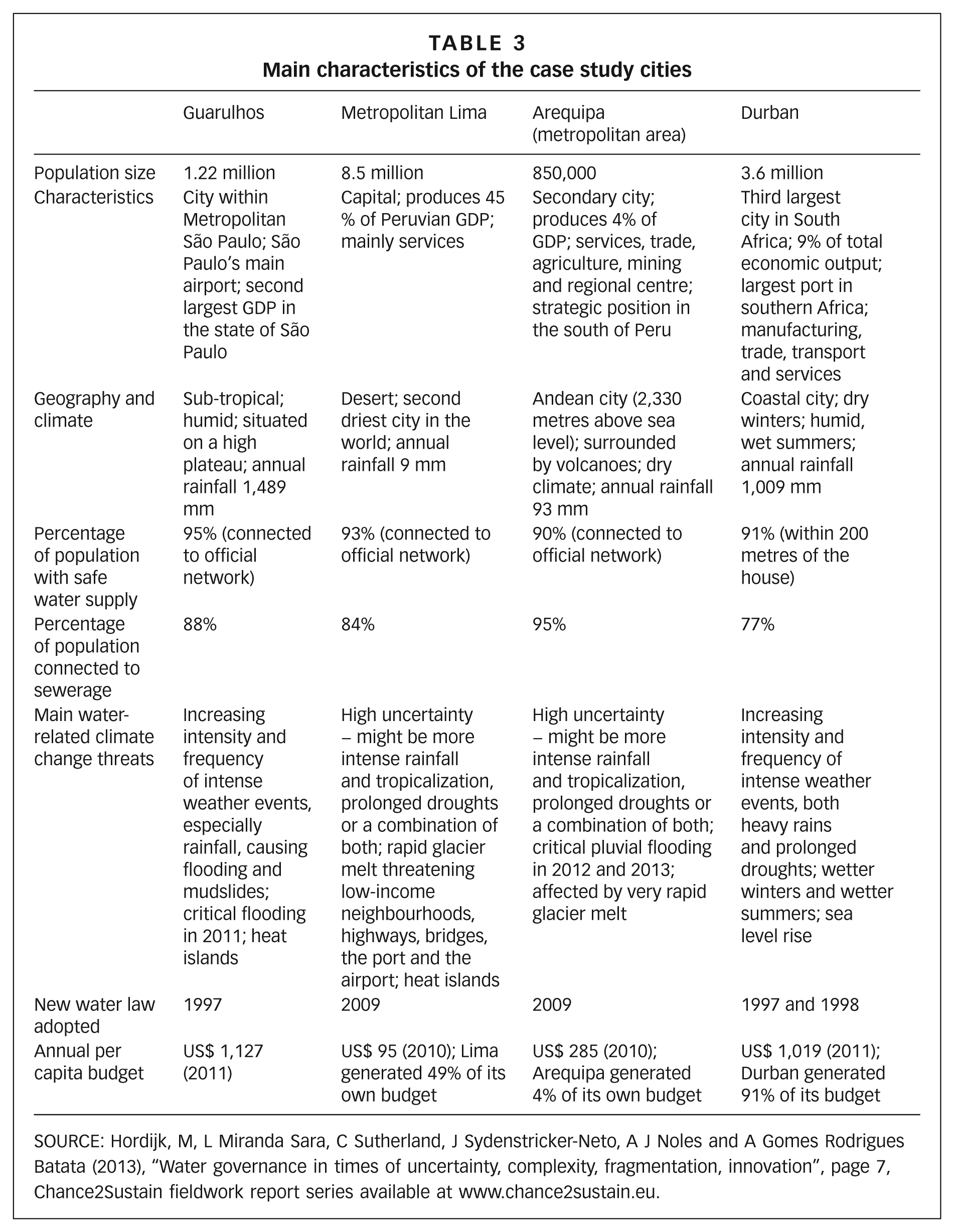
SOURCE: Hordijk, M, L Miranda Sara, C Sutherland, J Sydenstricker-Neto, A J Noles and A Gomes Rodrigues Batata (2013), “Water governance in times of uncertainty, complexity, fragmentation, innovation”, page 7, Chance2Sustain fieldwork report series available at www.chance2sustain.eu.
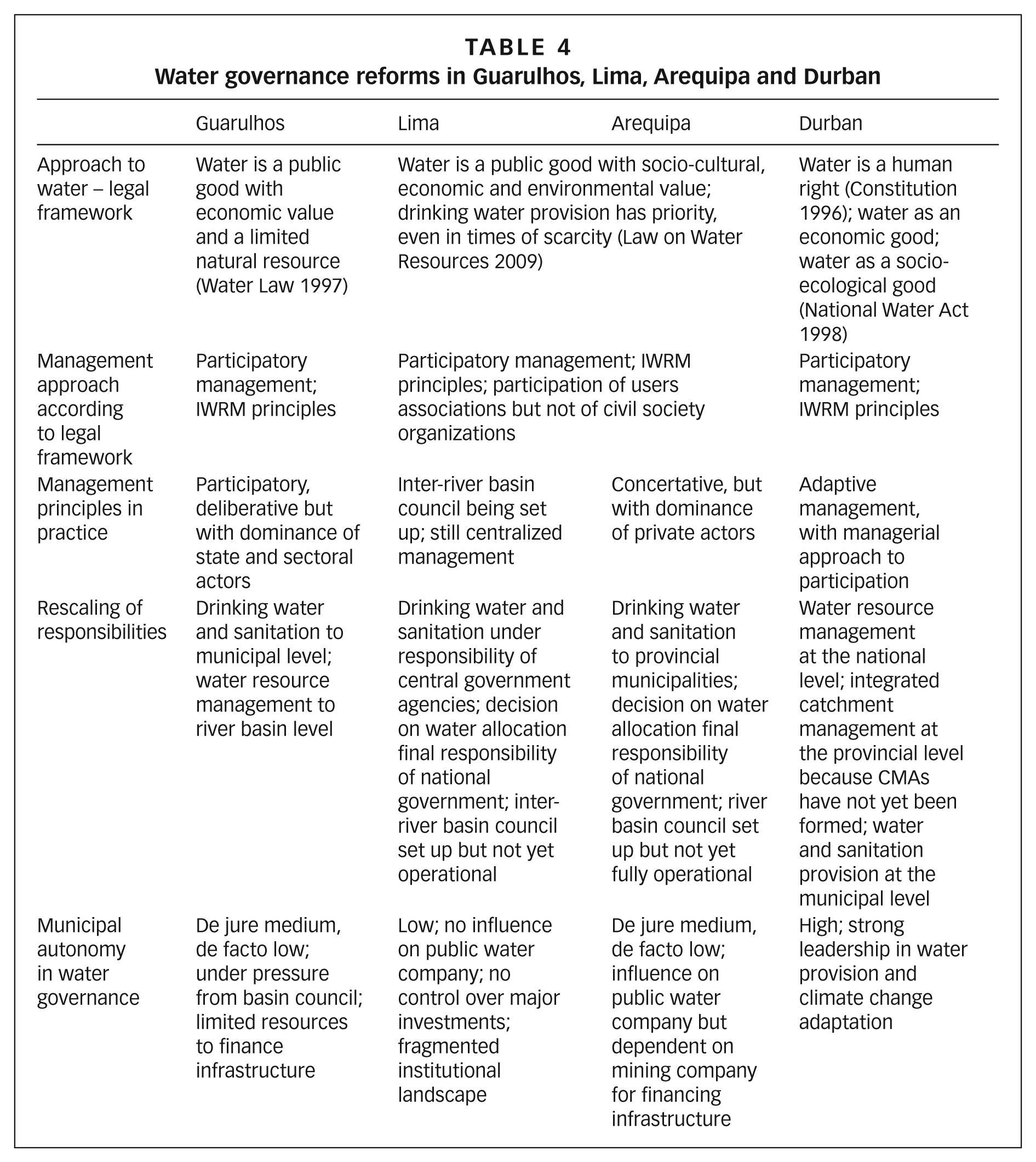
Internationally driven discourses and reforms, a shift towards democracy and pressure on scarce water resources have shaped the development of new water governance structures in all four cities. All three countries have experienced a significant change in water governance structures either after a return to democracy (Brazil and Peru) or the establishment of democracy (South Africa), which resulted in a decentralization of mandates and responsibilities in water governance and management and an increased emphasis on participation. These changes in water governance, and the extent to which they reflect resilience, transition and transformation, are explored in all four cities below (Table 4).
Water governance reforms in Guarulhos, Lima, Arequipa and Durban
b. Shifts in water governance arrangements: decentralization and diversification of actors
i. Guarulhos, Brazil
Decentralization, participation and use of the water basin as a unit for water governance are most strongly evident in Brazil. The provision of water and sanitation was decentralized as early as 1967, and municipalities could opt for public, private or para-statal provision. Guarulhos opted to establish its own municipal water and sanitation company (SAEE); however, they buy bulk water from the state level water and sanitation company SABESP, which provides 56 per cent of São Paolo State municipalities with water, and has strong control over prices for raw water. Both SAEE and SABESP approach water mainly as an economic good, and to a lesser extent as a sector. The new Brazilian Water Law of 1997 however characterizes “… water as a public good with an economic value and a limited natural resource”,(37) which should be managed in a participatory manner. This initiated a participatory system of water basin management, implemented from the national to the sub-basin level. The National Council on Water Resources(38) sets the parameters for 180 basin committees. These committees have representatives from municipalities, civil society organizations and the state. The presidency of the basin committee is always held by one of the mayors, whereas the executive secretary is always a state organization representative. The basin committees form a platform to address issues of common interest, informed by members’ positions, backgrounds and approaches to water. Environmental NGOs that view water as a socio-environmental good can find themselves at odds with the Department for Water and Hydropower (DAEE), which has a sectoral approach. However, the formation of alliances is also possible. Until 2010, none of the sewage in Guarulhos was treated, leading to serious pollution of the Tiête River and problems for downstream municipalities. Combined pressure from the Alto Tiête Basin Committee and DAEE forced the Municipality of Guarulhos to invest in sewage treatment, and by the end of 2012 it treated 35 per cent of its sewage. The Alto Tietê Basin Committee also worked on the formulation of a new state headwaters protection law, which enables committees and sub-committees to create specific laws for areas where springs are located. The basin committees have also developed a charging system for water use, to compensate for ecosystem services provided by municipalities in protected areas and to create revenue for the committee. In the past, these kinds of decisions were taken by state or national actors alone. However, major investment decisions are still taken outside the committees. State government, for instance, constructed a megaproject − the Tiete Linear Park, with significant implications for the riverbanks in Guarulhos − without municipal actors being consulted or even informed. Guarulhos was not consulted regarding the dyke built on the São Paulo side of the Tiete riverbanks, which increases flood risks for inhabitants in the Guarulhos flood plains.(39)
ii. Lima and Arequipa − Peru
The decentralization of water governance in Peru is similar to the Brazilian model, but with some significant differences. The new water law was only adopted in 2009, 12 years later than in Brazil. The Peruvian law states that water is a public good, the property of the state(40) and should be managed in an integrated and participatory manner. The National Water Authority (ANA), which now falls directly under the Ministry of Agriculture,(41) also has responsibility for ensuring that climate change adaptation plans are developed at local, regional and national level.(42) Although local water authorities (Autoridades Locales de Agua, ALAs) are responsible for advising on the administration and regulation of water quantity and quality at basin level, final decisions are taken by the ANA. The new water law has also tightened control of previously more autonomous user associations.(43) In parallel to the ALAs, river basin councils have been formed. But, whereas in Brazil all organized civil society can participate, in Peru participation is limited to water users. Peasant and indigenous communities can partake as user associations but other community-based organizations cannot. According to the law, regional authorities, local authorities and water users only participate and monitor in coordination with the ANA, and they have substantially less influence than in Brazil. As in Brazil, major infrastructure decisions are taken outside the councils, often without any consultation with local stakeholders.
The new reforms work out differently in Lima and Arequipa. Lima’s territory covers three different basins; a process is underway to set up a council covering all three but there has been little success so far. Metropolitan Lima consists of two provincial municipalities, Lima(44) and Callao, with 43 and nine district municipalities, respectively, each with its own urban planning, environmental issues and disaster management departments. Coordination is weak. The public water company SEDAPAL provides water and sanitation to both Lima and Callao,(45) and is the only water company in the country operating under the Ministry of Housing and Construction and the National Fund for Financing Economic Activities of the State, FONAFE, rather than the provincial municipality. The ministry has refused to have representatives of the municipalities of Lima and Callao on its board, and responds more to the demands of large real estate investors and small-scale land invaders than to the needs and demands of local governments. Metropolitan Lima has very little influence, then, on how water governance is shaped in its territory.
Arequipa has a relatively well-functioning, effective, informal, participatory water governance system that has operated for three decades, with “participation” limited to water users and the main water infrastructure managers. In 1983, after a serious drought, the principal water users (the public electricity company EGASA, the mining company Cerro Verde and the users association of the large-scale farmers) created a multi-sectoral committee that included a number of public actors: the water and sanitation company SEDAPAR;(46) the authority overseeing the large-scale irrigation project Majes−Siguas; AUTODEMA (which managed dams);(47) and others. Despite this public influence, the committee remained dominated by the large-scale users. Major decisions on infrastructure investments were taken by this informal body, with the agreement that the principle partners (the mining company, the electricity company and the large-scale farmers associations) would finance a share relative to their economic power. In the first decades of its existence, they mainly decided to construct dams. But since 2004, the mining company in particular has financed infrastructure for urban water provision, extending the network to poorer more peripheral areas and constructing a new water plant. Over the last decade, the mining company has invested more in new city water infrastructure than the water company has. The river basin council created as a result of the new law consists mainly of the same actors, although the water company SEDAPAR and the electricity company EGASA have chosen to be represented by the mining company, which is the major player in economic terms. As a result, the dominant approach frames water as an economic good and considers it to be an infinite resource. No consequences are anticipated from climate change on the premise that new infrastructure can always channel water from elsewhere. The Municipality of Arequipa has a stronger influence on its public water company than Metropolitan Lima, but has made itself dependent on the mining company for infrastructure provision.(48)
iii. Durban – South Africa
Significant post-apartheid legislative and policy reforms provided opportunities for change in water governance arrangements in South Africa. The right to sufficient water was enshrined in the new Constitution and the ANC government rapidly developed policies to address racial inequalities and backlogs in service delivery, simultaneously decentralizing service delivery to local government level. The Water Services Act (1997) and the National Water Act (1998), which reflect Integrated Water Resource Management (IWRM) principles,(49) explicitly highlight both sustainability and equity as overarching principles; also, a National Water Policy (2001) stipulates that all poor South Africans are entitled to a free basic water supply, a right that would be fulfilled by the ability of each local government to supply free basic water.(50) Water in South Africa is therefore recognized as a social good, supporting the country’s pro-poor agenda. Cost-recovery and efficient provision and management, however, are also principles of the National Water Act, raising concerns as to the tension between cost-recovery and social and environmental justice.(51)
Participation is a cornerstone of the National Water Act, which promotes the establishment of catchment management agencies that are designed to be representative and include communities in decision-making.(52) However, to date, few of these agencies have been established and none in KwaZulu-Natal (where Durban is located). Here, the provincial branch of the national Department of Water Affairs oversees responsibilities. In 2013, the uMgeni Ecological Infrastructure Partnership (UEIP) was formed, with a range of actors led by eThekwini Municipality’s Water and Sanitation Unit (EWS) and Environmental Planning and Climate Protection Department (EPCPD). It aims for an integrated approach to climate and water governance, and management at the regional scale, focused on ecological infrastructure enhancement and regional climate change adaptation; hence, using the approach of “water as a social-ecological good”.
Following the British model, South African local governments, including eThekwini Municipality,(53) have a relatively high level of autonomy and revenue-generating competency.(54) As a result of strong leadership and capacity, and in the absence of a functioning catchment management agency, eThekwini’s EWS has played a leading role in shaping water governance both in Durban and in the country as a whole, taking full advantage of this autonomy. Durban was the first South African city to supply free basic water, which then prompted the national government to draft the national free basic water policy. EWS translated its national legal obligation to provide all households with a free basic supply – a recommended 6,000 litres per month per household − into 9,000 litres per indigent household per month.(55) This differentiated service provision approach has substantially reduced backlogs and almost universal coverage of basic water supply has been achieved. Sanitation provision has been more challenging, but EWS continues to adopt an innovative, research-driven and adaptive approach in dealing with these challenges. Waterborne sewerage and full-pressure water system connections to all households are both financially and environmentally unsustainable and have not been extended to peripheral areas,(56) provoking criticism about perpetuating existing inequalities, as most households outside the urban core are poor.(57) EWS has developed a wide range of technical participatory processes that enable the water and sanitation entity within local government to engage with citizens and other actors around these challenges and issues.
c. Participation, learning and knowledge-building in water governance in Guarulhos, Lima, Arequipa and Durban
Participation is a cornerstone of water governance in all three countries. The new legal institutional framework for Brazil and Peru stipulates the creation of participatory and concertative(58) bodies at river basin scale, and the catchment management agencies in South Africa are designed to offer channels for participation.
If conducted in a managerial or technical manner, participation tends to lead to resilience, maintaining the status quo, rather than transition or transformation. Transition can be fostered through “learning-by-doing”, with experimentation and constant monitoring as practiced in adaptive management. Most often, this does not address power relations nor put underlying value systems under scrutiny. When participatory processes support deliberation and social learning takes place, then possibilities for transformation begin to open up.
The Brazilian river basin councils offer an excellent opportunity to debate different approaches to water, to learn, and to integrate knowledge from different sources. The diversity of actors in these councils did indeed encourage deliberative processes, leading to a diversification of approaches. Actors explicitly acknowledged that water is more valued than in the past, its finite nature gradually being recognized. This change was attributed to environmental education in general, not to the council. Most respondents placed high value on participatory processes themselves, a considerable break from the authoritarian rule of the past. However, participatory knowledge production turned out to be difficult in practice, since technical knowledge still dominates discussions. Management and policy documents were based on codified knowledge provided by experts, and civil society organization representatives lacked the necessary capacities to engage meaningfully in this technical knowledge production. This still reflects an elitist model, implying that because of knowledge asymmetries, deliberation occurs among a limited set of actors. The councils’ functioning also suffers from the practical concerns mentioned previously, such as time constraints and variability in attendance.
In Lima, the mandated basin council, still in the process of being established, is not yet achieving the co-production of knowledge. However, two positive processes have run in parallel in recent years. In the first, initiated by a German−Peruvian research programme,(59) a small group of actors (including representatives from the water company SEDAPAL, NGO representatives, a representative from the Cities for Life Forum and German specialists) gathered to run scenario-building processes for the water sector. Initially, this was a relatively closed process, focusing on scientific and technical knowledge. It gradually broadened in terms of actors and the inclusion of practice-based professional knowledge,(60) and the dominant approaches to water as a sector and as a commodity were being counterbalanced by the discourse of environmental NGOs.(61) Some of the results of this process were taken up by the Municipality of Metropolitan Lima once a new, more human rights-oriented local government came to power. The discourse became more pro-poor and a pro-green climate change adaptation strategy slowly gained more influence. Different scenarios have now been debated in a variety of settings, both closed and fully open to the public, in technical gatherings and in political debates. A group of professionals have built a shared knowledge base as an outcome of this process and a sound platform for implementation has been prepared through numerous discussions.
In Arequipa, the situation is very different. The knowledge base is fragmented and less powerful actors acknowledge that they protect their information. Representatives from the water authority realize this, and they are working on a knowledge system that aims to process reliable up-to-date data from different organizations as a base upon which decisions can be taken, and with open access. However, this initiative is very recent and has as yet not yielded results. For the time being, “participation” is mainly limited to the old power holders in the comité multisectorial, who take the major infrastructure decisions.
eThekwini Municipality presents a strong example of integrating information and learning at the local government scale. EWS chooses not to operate under one overarching policy, so as to allow maximum flexibility in decision-making and to foster learning-by-doing. The staff within EWS and in the research institutions that support them are encouraged to be innovative by the head of the unit, and operate within a culture of experimental governance. The dynamic nature of the practices undertaken by EWS in service delivery reflects the continual adaptation within the unit in response to experience. For example, EWS has revised its free basic water policy twice in the past six years, in response both to concerns raised through participatory forums about the basic water needs of poor households(62) and to cost-recovery concerns raised within the municipality. EWS was an early adopter of GIS (in 2000/2001) and information in this system comes from and is shared among the municipality’s different departments. The information available is trusted and provides a strong basis for action but is highly technical and codified.(63) “Lay knowledge” is incorporated insofar as it concerns complaints about malfunctioning infrastructure and the provision of services at the community level.(64) Due to its managerial and technical nature it cannot be classified as “participatory” knowledge production, as it does not reflect the co-production of knowledge between different actors.
V. Conclusions
All the case studies discussed in this paper show substantive reforms in water governance, aligned with and reflecting the changing political regimes at the national level. Some reforms can be considered a sign of “transformation”,(65) based on the radical shifts that have taken place, such as the change from a central, hierarchical organization of water governance to a decentralized and more participatory system. The shift to the basin as a territorial unit for integrated water management is also a paradigmatic change. In Brazil, the radical change from an authoritarian to a democratic regime was marked by a strong emphasis on participation and deliberation in general, hence a change in development goals towards a more inclusive society. This is reflected in the importance given to participation and deliberation in water governance. In South Africa, both the transformation of post-apartheid society and the focus on human rights in the Constitution strongly influenced water governance. In Peru, decentralization and concertación were emphasized during the return to democracy, but are less apparent in the new water governance framework. The changes here in the mode and goal of governance are more characteristic of “transition”, implying changes in governance structures within the existing regime structures. In Lima, despite demands for more decentralized water management, centralized decision-making continues although more deliberative processes are influencing recent thinking. In Arequipa, the new structures formalize pre-existing informal structures.
A narrower knowledge base, reflected in the sectoral and economic approach to water, can be overcome by the diversification of actors participating in water governance. In three cases (Guarulhos, Lima and Durban), a diversification in approaches adopted for water governance was identified, as was an increase in the legitimacy of “water as a social-ecological good”. In Guarulhos, there was a growing awareness of water’s value and finite nature. These changes can be taken as important shifts as a result of social learning. Yet this is still limited to the “elite” in water governance, and sectoral actors still dominate decision-making. An essential element of deliberation in the Freirian sense is that it includes a true dialogue between the powerful and the marginalized. None of our cases showed this form of deliberation. We did not find any incorporation of “lay knowledge”, except in the participatory forums established by EWS in Durban, where incorporation of community knowledge occurs within a managerial frame.
The research reveals that the locus of power has not shifted towards the new participatory or concertative institutions. Although Guarulhos opted for an autonomous water company, its actual decision-making power is weak because it depends on outside bulk water supply and outside finance for infrastructure, and major infrastructure decisions are still taken outside the councils. Metropolitan Lima exerts very little influence over its water company and it cannot influence water infrastructure decisions. And although municipalities in Arequipa have a stronger hold on their municipal water company, they made themselves dependent on finance from the private sector for infrastructure provision. There are signs of transition, or even transformation, in water governance, but water management decisions are still based on classic sectoral and economic interests and knowledge, maintaining the status quo. No signs of local accountability for large infrastructure investment decisions were evident.
The case of eThekwini Municipality, where national reforms significantly strengthened municipal autonomy, offers an interesting counter-example. Before the reforms, local governments already enjoyed relatively high levels of autonomy and more financial independence than the other case study municipalities. EWS took full advantage of the new legal framework and translated transformative national policy goals into innovative policies in service provision. The other municipalities are in a dependent situation regarding bulk water supply; in Durban, this power relation is more balanced. Learning is also strong in eThekwini Municipality and is characterized as deliberate experimentation and learning-by-doing. The municipality has been criticized for being inward-looking and the development of the UEIP is potentially an important shift towards a regional perspective, with results remaining to be seen.
Although the radical changes in the political regime in Brazil and South Africa occurred almost two decades ago, their impact on the practice of water governance might need more time to reach its full potential. Water governance is a particularly inert system, since the hard infrastructure of pipes and dams determines to a large extent the room to manoeuvre for the soft infrastructure of the governing institutions. The crucial question for the transformation of water governance systems in all cases will be whether, in the long run, participation and deliberative decision-making are extended to decisions about hard infrastructure and the provision of local water and sanitation services, and whether local powers are indeed empowered to hold the approach of “water as an economic good” to account.
Footnotes
Acknowledgements
The authors would like to thank Dr Sheridan Bartlett for her excellent editing support and Professor Dr Isa Baud and two anonymous reviewers for their comments on the paper.
1.
Bakker, K (2003), “Archipelagos and networks: urbanization and water privatization in the South”, The Geographical Journal Vol 169, No 4, pages 328−341.
2.
Foster, V (2005), “Ten years of water service reform in Latin America: toward an Anglo-French model”, Water Supply and Sanitaiton Sector Board Discussion Paper Series No 3, World Bank, Washington DC, 32 pages.
3.
In Durban, universal provision of free basic water has been achieved, albeit with criticisms about the amount provided (9,000 litres per household per month), which is still considered too low for large households and for households that include members with illnesses such as HIV/AIDS and TB.
4.
For an historical account, see Molle, F (2009), “River basin planning and management: the social life of a concept”, Geoforum Vol 40, No 3, pages 484−494. Some argue that most river basins are no longer natural; see Graefe, O (2011), “River basins as new environmental regions? The depolitization of water management”, Procedia − Social and Behavioural Sciences Vol 14, pages 24−27.
6.
The full breadth of the reforms and the dynamics these have created in the different cities and basins are treated in more detail in four accompanying papers, which will be published in Environment and Urbanization Vol 26, No 2 (October 2014). They all draw on the analytical framework presented in this paper. These papers are part of the research programme “Urban Chances – City Growth and the Sustainability Challenge. Comparing Fast-growing Cities in Growing Economies”, funded under the 7th European Union Framework Programme (Project No 244828). The partners in this programme are the European Association of Development Research and Training Institutes (EADI), Germany; Amsterdam Institute of Social Science Research (AISSR), University of Amsterdam (The Netherlands); French National Centre for Scientific Research (CNRS), France; School of Planning and Architecture (SPA), India; Cities for Life Forum (FORO), Peru; Centro Brasileiro de Analise e Planejamento (CEBRAP), Brazil; Norwegian Institute for Urban and Regional Research (NIBR), Norway; and the University of KwaZulu-Natal (UKZN), South Africa. For more information on the research programme, see  .
.
7.
eThekwini Municipality is the official name of the large metropolitan municipality on the east coast of South Africa that manages the city of Durban. In this paper, Durban is used when referring to the place or city and eThekwini Municipality when referring to the local government or administrative entity.
8.
Pelling, M (2010), Adaptation to Climate Change: From Resilience to Transformation, Routledge, London, 224 pages; also Pelling, M (2012), “Resilience and transformation”, in M Pelling, D Manuel-Navarrete and M Redclift, Climate Change and the Crisis of Capitalism: A Chance to Reclaim Self, Society and Nature, Routledge, London, pages 51−65.
9.
See reference 8.
10.
Heath, T T, A H Parker and E K Weatherhead (2012), “Testing a rapid climate change adaptation assessment for water and sanitation providers in informal settlements in three cities in sub-Saharan Africa”, Environment and Urbanization Vol 24, No 2, page 619.
12.
Pelling, M, D Manuel-Navarrete and M Redclift (2012), Climate Change and the Crisis of Capitalism: A Chance to Reclaim Self, Society and Nature, Routledge, London, page 5.
15.
Freire, P (1972), Pedagogy of the Oppressed, Penguin Books, Harmondsworth, page 51, cited in M A Hordijk (2012), “Citizenship, local governance and democracy”, in N Pouw, I S A Baud and T Dietz, Local Governance and Poverty in Developing Nations, Routledge, London page 203.
17.
19.
See reference 15.
20.
Cundill, G and R Rodela (2012), “A review of assertions about the processes and outcomes of social learning in natural resource management”, Journal of Environmental Management Vol 113, page 9.
21.
See reference 20, page 9.
22.
Davoudi, S, K Shaw, L J Haider, A E Quinlan, G D Peterson, C Wilkinson, H Füngfeld, D McEvoy and L Porter (2012), “Resilience: a bridging concept or a dead end?”, Planning Theory and Practice Vol 13, No 2, page 306.
23.
See reference 20; also Munnik, V and J Burt (2013), “Overview of need and potential for social research in WRC and the SA water sector. Towards developing a social science research agenda for the South African water sector”, K8/1024/1, Water Research Commission, South Africa, unpublished report, 62 pages.
24.
See reference 20.
25.
See reference 20, page 10.
26.
present the “adaptive co-management” literature as the newest kid on the block, in which the learning-by-doing and experimentation from adaptive management is combined with the emphasis on deliberation and inclusive decision-making. Here, social learning is viewed as a long-term, self-organizing process. In their review, they found, however, very limited references in the literature to this newest approach; see reference 20, pages 10−11.
27.
Rogers, P and A W Hall (2003), “Effective water governance”, Global Water Partnership, Stockholm, 48 pages; also Franks, T (2006), “Water governance: solution to all problems?”, Final Seminar of ESRC-funded seminar series, Water Governance – Challenging the Consensus, page 3, accessed 4 December 2013 at .
28.
Castro, J E (2007), “Water governance in the twentieth-first century”, Ambiente y Sociedade Vol 10, pages 97-118, cited in Miranda Sara, L, M A Hordijk and R K Torres Molina (2011), “Water governance key approaches – an analytical framework”, Chance2Sustain Working Paper No 4, EADI, Bonn, 23 pages.
29.
See reference 28.
30.
Langford, M (2005), “The United Nations concept of water as a human right: a new paradigm for old problems?”, International Journal of Water Resources Development Vol 21, No 2, page 274.
31.
UN General Assembly (2010), “Resolution on the human right to water and sanitation”, A/RES/64/292, 28 July, accessed 6 October 2013 at .
32.
Several Latin American countries consider that the environment is a legitimate user of water. This means that a certain quantity of water resources should be allocated to environmental uses and the ecosystem. Ecuador has this enshrined in its Constitution.
33.
Castro, J E (2007), “Water governance in the twentieth-first century”, Ambiente y Sociedade Vol 10, pages 97−118.
34.
See reference 33, page 111.
35.
Bruckmeier, K and H Tovey (2008), “Knowledge in sustainable rural development: from forms of knowledge to knowledge processes”, Sociologia Ruralis Vol 48, No 3, pages 313−329, cited in I S A Baud, K Pfeffer, J Sydenstricker-Neto and D Scott (2011), “Developing participatory ‘spatial’ knowledge models in metropolitan governance networks for sustainable development: literature review 1”, EADI, Bonn, page 7, accessed 18 September 2013 at .
36.
The Alto-Tietê Basin – virtually equivalent in terms of surface area and population to the São Paulo Metropolitan Region − has water availability of only 201 cubic metres per inhabitant per year. The average in Brazil is 40,000 cubic metres per inhabitant per year and the UN defined those regions that have water availability below 1,500 cubic metres per inhabitant per year as being in a critical situation; see Jacobi, P R and A P Fracalanza (2005), “Comitês de bacias hidrográfica no Brasil: desafios de fortalecimento da gestão compartilhada e participativa”, Desenvolvimento e Meio Ambiente, Editora UFPR, 9 pages, accessed 4 December 2013 at .
37.
van den Brandeler, F, M A Hordijk, K von Schönfeld and J Sydenstricker-Neto (2014), “Decentralization, participation and deliberation in water governance: a case study of the implications for Guarulhos, Brazil”, Environment and Urbanization Vol 26, No 2 (2014), forthcoming.
38.
There is also an independent National Water Authority, whose sole responsibility is to define the water uses in federal water bodies.
39.
See reference 37 for more details.
40.
This same principle was a basic principle of the previous law of 1969.
41.
Previously, water allocation (from river basins) was under the Ministry of Agriculture; drinking water and sanitation was under the Ministry of Housing and Sanitation; water quality fell under the Ministry of Health; and water contamination by extractive industries was located under the Ministry of Energy and Mines; see Budds, J and L Hinojosa-Valencia (2012), “Restructuring and rescaling water governance in mining contexts: the co-production of waterscapes in Peru”, Water Alternatives Vol 5, No 1, pages 119−137.
42.
It shares this responsibility with the Authority of Environment (Article 89 of the Law on Recursos Hidricos 29338).
44.
Expanding eastwards, towards the Andean mountains, Lima’s growth is now starting to spill over into the neighbouring province of Huarochiri.
45.
Recently, SEDAPAL started to extend its services to Huarochiri.
46.
Servicio de Agua Potable y Alcantarillado de Arequipa. In contrast to the Limenean case, the Board of Directors of SEDAPAR consists of representatives from both the provincial capital, Arequipa, and its district municipalities. Their ownership of the water company is in proportion to the number of water connections in each of their jurisdictions.
47.
AUTODEMA: Autoridad Autonoma de Majes−Siguas.
48.
For more detail on the Arequipa case study, see Filippi, M E, M A Hordijk, J F Alegría and J D Rojas (2014), “Knowledge integration: a step forward? Continuities and changes in Arequipa’s water governance system”, Environment and Urbanization Vol 26, No 2 (2014), forthcoming; also Hordijk, M A, L Miranda Sara, C Sutherland, J Sydenstricker-Neto, A J Noles and A Gomes Rodrigues Batata (2013), “Water governance in times of uncertainty, complexity, fragmentation, innovation”, page 7, Chance2Sustain fieldwork report series available at .
49.
Brown, J and P Woodhouse (2005), “Pioneering redistributive regulatory reform. A study of implementation of a catchment management agency for the Inkomati water management area, South Africa”, in M Minogue and L Carino (editors), Regulatory Governance in Developing Countries, Edward Elgar, pages 227−256.
50.
Muller, M (2008), “Free basic water − a sustainable instrument for a sustainable future in South Africa”, Environment and Urbanization Vol 20, No 1, pages 67−87.
51.
Sutherland, C, M A Hordijk, B Lewis, C Meyer and S Buthelezi (2014), “Water and sanitation discourses in eThekwini Municipality: a spatially differentiated approach”, Environment and Urbanization Vol 26, No 2 (2014), forthcoming.
52.
53.
Breetzke, K (2009), “From conceptual frameworks to quantitative models: spatial planning in the Durban metropolitan area, South Africa − the link to housing and infrastructure planning”, unpublished case study prepared for the Global Report on Human Settlements 2009, 22 pages accessed 4 December 2013 at .
54.
Wasrud, K (2010), “Participation, equality and water: the clash of human rights values and neoliberal principles in Durban, South Africa”, MA thesis, University of Oslo, 172 pages, accessed 4 December 2013 at .
55.
For more details, see reference 51.
56.
The urine diversion toilets that were provided as an alternative are considered a low-cost environmentally friendly option.
57.
Bond, P (2011), “Durban’s water wars, sewage spills, fish kills and blue flag beaches”, in P Bond and A Desai, Durban’s Climate Gamble: Trading Carbon, Betting the Earth, UNISA Press, Pretoria, pages 75−116.
58.
The term “concertative” derives from the Spanish word concertación. We have argued earlier that “… the concept concertación is difficult to translate. It goes beyond consultation and brings the different actors around the table so that solutions can be negotiated and responsibilities assigned. This includes conflicting interests, where these exist”; see Miranda Sara, L and M A Hordijk (1998), “Let us build cities for life: the national campaign of Local Agenda 21s in Peru”, Environment and Urbanization Vol 10, No 2, pages 69−102.
60.
Miranda Sara, L and I S A Baud (2014), “Knowledge-building in adaptation management: concertación processes in transforming Lima’s water and climate change governance”, Environment and Urbanization Vol 26, No 2 (2014), forthcoming.
61.
See reference 60.
62.
Lewis, B (2013), “A justice perspective of water and sanitation service delivery”, MSc thesis, Department of Geography, Planning and International Development Studies, University of Amsterdam.
63.
Baud I S A, D Scott, K Pfeffer, J Sydenstricker-Neto, E Denis and L C Muguruza Minay (2013), Spatial Knowledge Management in Urban Local Government: e-governance in India, Brazil, South Africa and Peru, WP5 Fieldwork Report, EADI, Bonn, 134 pages, accessed 4 December 2013 at .
64.
Tap points and ablution blocks have unique identifiers that customers with a complaint have to provide; hence, they can be directly tagged in the GIS database.
65.
See reference 8, Pelling (2010) and ().