




Abstract
The new Peruvian Water Law (2009) inaugurated a transition phase in the country’s water governance model, in theory changing the power relations among the actors involved in the decision-making process. Formerly excluded actors were invited to participate and bring their particular views into multi-stakeholder spaces. While this diversity of actors, informed by different types of knowledge, has been highlighted as an attribute of more adaptive systems, it does not necessarily lead to a real change in the constellation of power. The case of Arequipa illustrates this shift towards a new water governance system, with the creation of a river basin council based on a prior (and exceptional) example of informal multi-stakeholder water management. Yet the growing participation of a large mining company in financing water-related infrastructure, and its alliances with other actors, might challenge the potential of the new participatory body to represent equally the interests and views of all its members, and therefore to question the existing norms to bring about transformative change.(1)
Keywords
I. Introduction
The complexities and uncertainties of climate change pose a real challenge to growing cities in the global South, not only in relation to water availability but even more so in the way water, river basins and essential water services should be governed to deal with water-related vulnerabilities. As a result, new forms of urban water governance have been conceived, under the assumption that changes in sociopolitical structures and institutional arrangements can be the engines of adaptation to climate change. As Pelling(2) argues, adaptation modes might vary from resilience to transition and transformation depending on the extent to which the status quo is challenged. Whereas resilience is characterized by maintaining the status quo, and innovations are limited to improved technologies, transition in Pelling’s framework entails changes in governance processes, which might question the existing power structures without really changing them. There might be incremental change at the level of individual policies, or some changes in the rules, but not in the norms and principles, nor a real regime shift. Key characteristics of transformation processes are a move to integrated, holistic world views and new political discourses with strong sustainability goals. This implies addressing existing power structures, but also requires a fundamental shift in the values underpinning current governance practices. A move to more social learning processes, in which different world views and their underlying value systems can be debated, is conducive to transformation processes.(3)
The inability of states to run their cities and deliver services effectively called for a shift in the governance model in the post-1980s era.(4) Since then, the need for climate change adaptation has also called for a new urban governance model with a broader space for participation and deliberation, decentralization processes with their polycentric and multi-layer arrangements, and the recognition of new rights.(5) The governance model that has been encouraged,(6) however, shows its limitations. Broadening the range of actors involved in decision-making raises various issues, especially around building up a common understanding.(7) The various groups involved in decision-making usually have different types of knowledge, informed by diverse values and constructed through disparate processes that might result in contrasting views, and in the case of water governance, in different approaches to water.(8)
Arequipa is the second largest metropolitan area in Peru, which is the world’s third most vulnerable country to the impacts of climate change on precipitation and water availability according to the Tyndall Centre for Climate Change Research.(9) Historically, water in Peru has been managed within a centralized and hierarchical administrative system,(10) mainly focused on irrigation in the coastal area.(11) But in the 1990s and 2000s, decentralization and regionalization processes were combined with the simultaneous creation of more participatory and inclusive institutions. In this paper, we examine the changes in the water governance system in Arequipa and the extent to which they foster the integration of disparate knowledge and contrasting views. In addition, we assess the extent to which the changes imply a move towards a resilience, transition or transformation mode of adaptation. More specifically, this paper aims to analyze the transition from a predominantly public, hierarchical and centralized water governance system to a more mixed, networked and decentralized governance model, by paying particular attention to the following questions:
To what extent have recent changes in the water governance system in Arequipa led to a diversification of the participating actors?
Which approaches to water and what knowledge do these actors represent in the water governance system, and to what extent are certain types of knowledge legitimated over others?
To what extent is the knowledge of the various actors integrated?
We argue that incremental changes have been made in water management practices but without significantly changing the traditional power structures. In this sense, the newly created river basin council can either evolve to formalize traditional power relations or represent an opportunity to challenge them by incorporating new values and approaches to water. Knowledge integration – understood as the process whereby the knowledge of different actors is synthesized to produce new knowledge – appears to be key in the potential of the system for transformation.
Section II describes the methodology used for this case study. Section III provides background on Arequipa and its main water vulnerabilities. This is followed by a description of the transition process in the water management model (Section IV). Section V introduces the main actors in urban water governance and their mandates, and focuses specifically on their knowledge. Section VI turns the attention to power relations and the evolving protagonist role of a mining company. Section VII addresses the barriers to knowledge integration in the new water governance system. Finally, the main conclusions are presented. This paper is one of a set of four papers in this volume that use a common conceptual framework(12) to analyze different case studies.
II. Methodology
The field research on which this paper is based was undertaken between February and May 2012. Semi-structured interviews were combined with a non-probability sample of 23 respondents representing key actors from Arequipa’s water governance system. Respondents’ knowledge about water issues was assessed in an open-ended way, principally through the identification of the main water-related problems at district, city and river basin levels. Based on the classification by Miranda Sara et al.(13) and Hordijk et al.,(14) we classified different approaches to water – as an economic good, a social good, a socio-environmental good or a sector. These different approaches might be based on individual experiences (lay knowledge), on-the-job practice (embedded knowledge) or scientifically collected data (scientific knowledge). Often, scientific or codified knowledge is valued over the other types of knowledge.(15)
During the interviews, respondents were asked to identify the main water-related problems and to locate them on printed maps of the city and river basin.(16) In half the cases, only one map was used, usually at the scale most relevant to the respondent. In total, the exercise was replicated in 13 maps of the city and in 12 of the river basin. The maps had very few references, and in most cases respondents added these to orient themselves and to explain the problems. This mapping exercise turned out to be a useful tool for discussing the water-related problems that respondents identified, for identifying respondents’ approach to water and for analyzing the extent of respondents’ spatial knowledge on water-related problems. The maps that resulted from the exercise were scanned and some were digitized using ArcGIS to produce the maps included in this article. These maps are not meant to represent comprehensively the water-related problems in Arequipa, but rather to explore the extent to which knowledge on water-related issues converged or diverged among key actors, as well as among different members within one organization.
The findings presented in this article are also informed by a workshop held in September 2012, the main objective of which was to bring together the respondents who were individually interviewed or other individuals who could represent their organizations. Participants discussed the expected impacts of climate change on the water-related problems in the city and were asked jointly to rank the most relevant water governance actors in two dimensions: power and interest in climate change.
III. The Case of Arequipa
Arequipa is the second most populous city in Peru after Lima, with more than 844,000 inhabitants.(17) It is organized not as a single metropolitan municipality but as a provincial municipality and 17 district municipalities.(18) Located in the Pacific coastal desert at 2,330 metres above sea level, Arequipa’s water situation is similar to that of other cities in Peru’s Pacific basin. Surface water is abundant but unequally distributed in space and time. The Pacific drainage basin, where 70 per cent of the population is concentrated, accounts for only two per cent of the total water available. Its 62 rivers flowing west from the Andes supply the bulk of the water to the coastal region, where the country’s major cities are located. By contrast, the Atlantic drainage basin has more than 97 per cent of all available water but only 26 per cent of the total population.(19)
Arequipa extends along the Chili River, part of the Quilca-Chili basin, which provides water for all uses: drinking water for the city,(20) irrigation for approximately 30,000 hectares, hydropower generation (172 MW), industrial use and mining activities.(21) The river basin has an arid and semi-arid climate – there is hardly any rainfall except in the upper basin area – so water is artificially regulated, either transferred from the adjacent basin, Camaná-Majes-Colca,(22) or stored in reservoirs(23) during the rainy season. However, both mechanisms are already threatened. In the first case, the Alto Colca sub-basin is affected by the retreat of glaciers,(24) increasing the risk of conflicts with neighbouring regions over the transfer of water. In terms of water storage capacity, there has been decreasing precipitation in the Quilca-Chili basin since 1964.(25) Precipitation deficits and the disappearance of approximately one-quarter of the glaciers supplying coastal watersheds since 1970 pose a serious challenge to Arequipa’s long-term water supply.(26)
Despite water constraints in the region, agriculture is important and accounts for 80 per cent of the water used in the Pacific drainage basin.(27) A major problem in Arequipa, however, is the pollution of the Chili River. Most wastewater is discharged into the river without treatment. Only eight per cent is partially treated by the Chilpina wastewater treatment plant, making the quality of downstream water questionable and increasing health risks.(28) Many farmers live downstream from Arequipa and use water from the Chili River to irrigate their land. This creates health risks for both the farmers and the consumers of their products.(29)
Further pressures come from the rapid expansion of mining in the region. Mining uses only an estimated two per cent of the water in the Pacific drainage basin,(30) but this low figure masks the significance of this use. Many mining concessions are located in headwater areas in the high Andes, and the adverse effects of mining on water quality can extend well beyond the mining site, relayed by rivers and aquifers. They can also extend over time, lasting generations.(31) More than half of the major rivers used for water supplies in Peru are contaminated by accumulated mining wastes, hydrocarbons and human waste.(32) Sociedad Minera Cerro Verde SAA (SMCV), located southeast of the city and operating since 1973, is the largest mining company in Arequipa and the third largest in Peru. Cerro Verde uses almost nine per cent of the water from the Chili River, well beyond the two per cent estimated for the Pacific drainage basin and much closer to the 11.5 per cent stipulated for domestic use.(33) Not much pollution has been reported except by environmental NGOs and residents living in the areas where the mining company operates.(34) Officially, only two incidents were reported in 2012 by the National Environmental Evaluation and Inspection Office (Organismo de Evaluación y Fiscalización Ambiental – OEFA).(35) Most of the complaints relate to air and soil pollution, with references to water contamination being extremely rare.(36)
An extraordinary period of rainfall was taking place when the field research for this article was conducted. In February 2012, a 500 per cent increase in precipitation was registered.(37) Torrential rains in early 2013 led to floods even worse than those in 2012. Referring to precipitation scenarios, the Regional Adaptation Strategy to Climate Change(38) anticipated that favourable periods, which used to last between six and nine years, would be shortened to four to six years. Unfavourable periods would increase in frequency and last longer. Both positive and negative scenarios for the 2071–2100 period foresee a reduction in precipitation – mainly in higher areas where glaciers are located – closely related to a projected increase in regional average temperatures.(39)
Water in Peru is treated and delivered by public water and sanitation companies (Empresas Proveedoras de Servicios – EPSs), supervised by the National Superintendancy of Sanitation Services (Superintendencia Nacional de Servicios de Saneamiento – SUNASS).(40) The water and sanitation company active in the Arequipa region is Water and Sanitation Services of Arequipa (Servicio de Agua Potable y Alcantarillado de Arequipa – SEDAPAR). Eighty per cent of its clients are located in the city of Arequipa; however, SEDAPAR has been unable to provide all residents with a water connection. Many neighbourhoods on the outskirts of the city depend on truck water or public taps for their daily water needs, especially the poorest settlements in the north and higher parts of the city; the households there that do have a connection often receive water for only part of the day.(41)
IV. Rescaling responsibilities? From the comité multisectorial to the consejo de cuenca
Historically, the Ministry of Agriculture was responsible for water resources management in Peru and acted as a national water authority. Within a centralized and hierarchical administrative scheme, the National Institute of Natural Resources (Instituto Nacional de Recursos Naturales – INRENA), under the Ministry of Agriculture, supervised the Water Resources Intendancy (Intendencia de Recursos Hídricos) which, in turn, oversaw the districts’ technical offices for irrigation (Administraciones Técnicas de Distritos de Riego – ATDRs) (Figure 1).(42) For decades, the sectoral approach to water resources management had a clear agricultural bias with a consequent focus on irrigation in the coastal area.
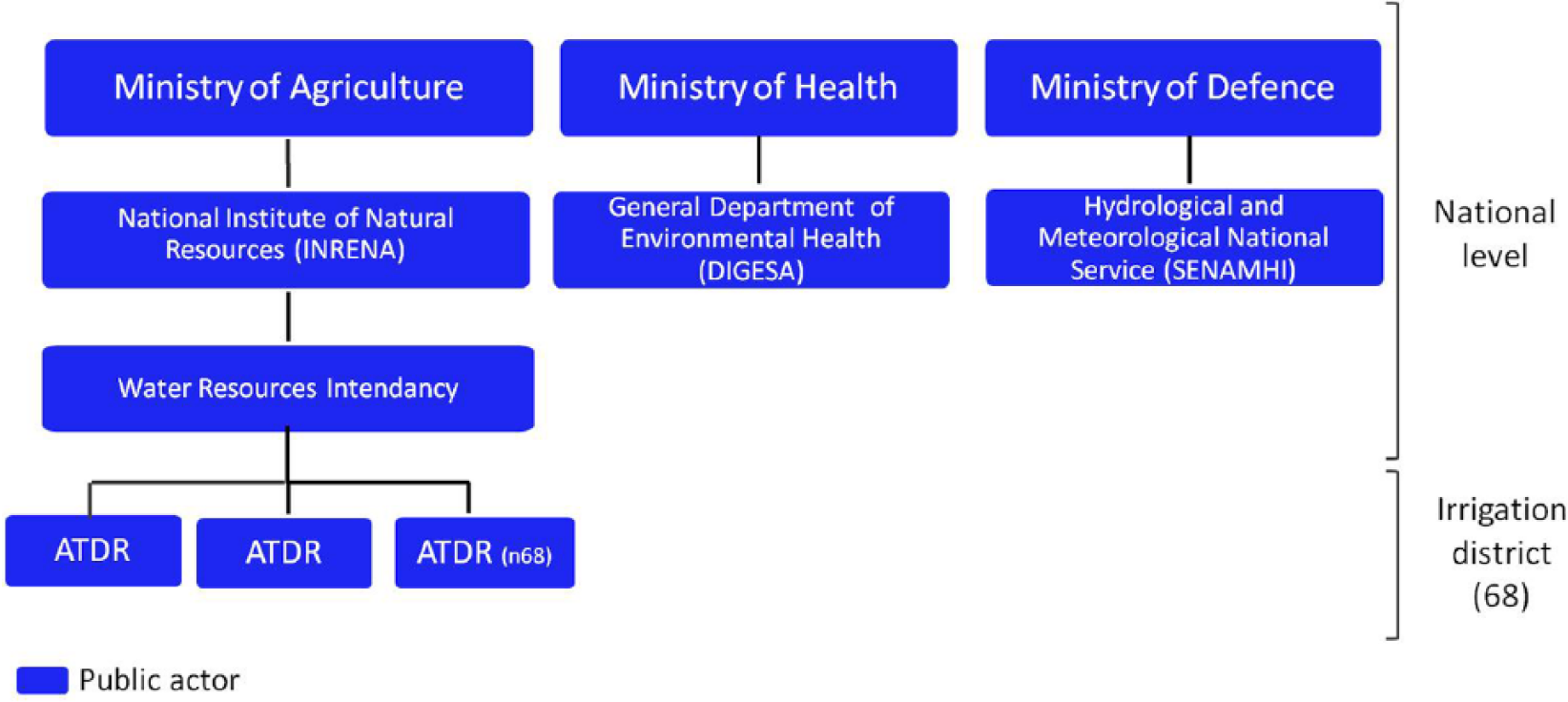
Former institutional structure: General Water Law (1969–2009)
It was not until the creation of the National Water Authority (Autoridad Nacional del Agua – ANA) in 2008 and the sanction of the new Water Law (2009) that Peruvian water management, inspired by international and domestic(43) trends, underwent a major transformation. The new Integrated Water Resources Management (IWRM) implied a change in the basic management unit from a specific sector (agriculture) to the river basins of the country. It also meant that water quantity and quality as well as hydro-meteorological information would be administered in an integrated manner by a single water authority rather than separately by different actors (Ministry of Agriculture, Ministry of Health and Ministry of Defence, respectively). Finally, this broadened the space for the participation of public and private actors in the management of the basin through river basin councils (Consejos de Recursos Hídricos de Cuenca – CRHCs).(44) On paper, this created favourable conditions for transition or transformation, as defined by Pelling.(45) The domination of one sector would be reduced, knowledge would become integrated and, through a greater inclusion of a variety of actors, different approaches to water could be debated in concertative spaces, which could increase the chances that underlying values and principles would be discussed and hitherto excluded approaches and knowledge would be legitimated.
Reality turns out to be different. First, it should be noted that the new law sets clear limitations on who can participate in the councils, favouring formal institutions and large-scale water users’ associations.(46) Second, authority over water still falls under the Ministry of Agriculture, and the CRHC councils are set up as a parallel institution. Although ANA operates throughout the country by means of the 14 administrative water authorities (Autoridades Administrativas de Agua – AAAs) and local water authorities (Autoridades Locales de Agua – ALAs), final decisions on water uses remain the responsibility of the National Water Authority and thus remain centralized and sectoralized (Figure 2).
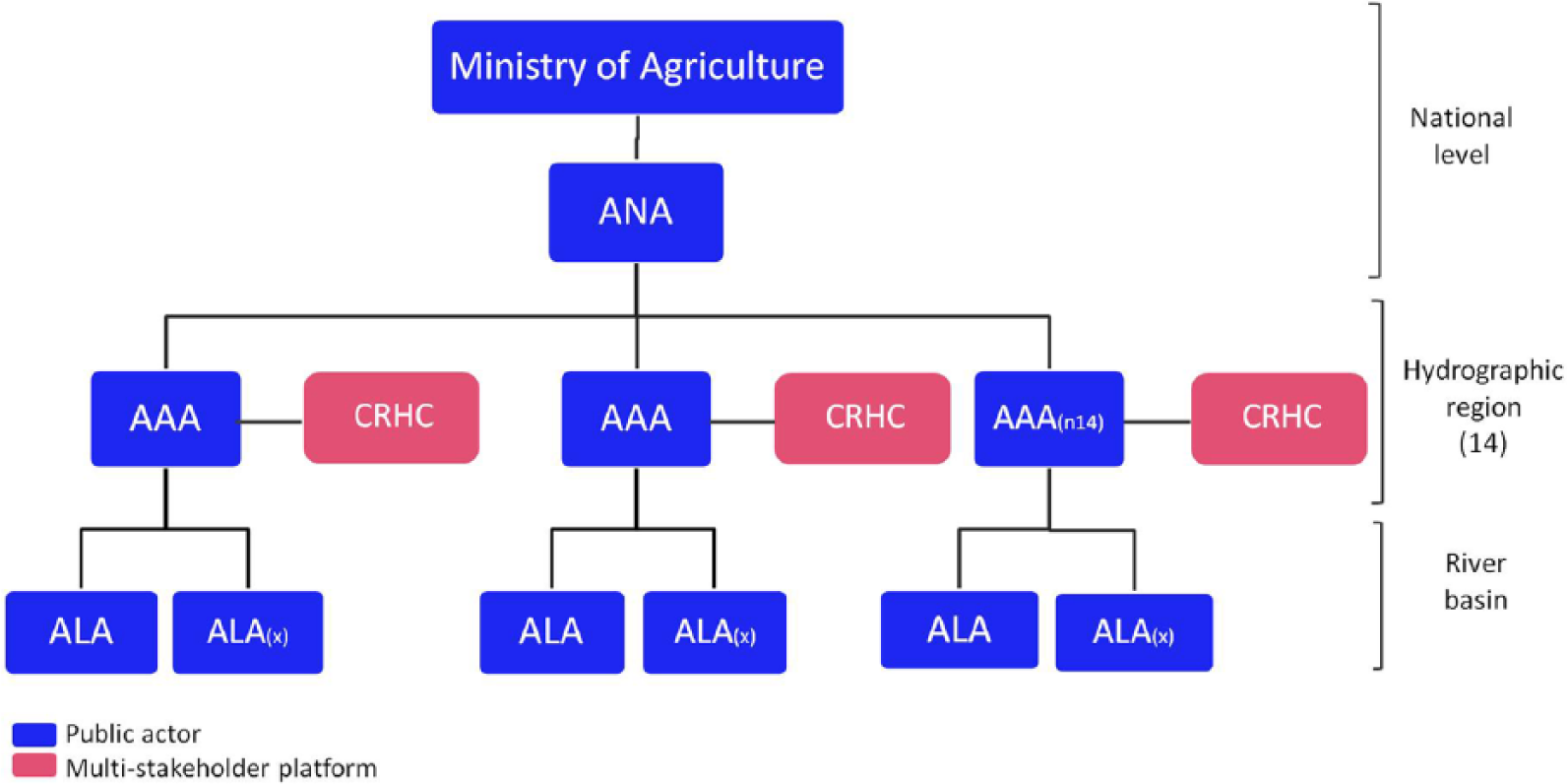
New institutional framework: Water Resources Law (2009)
The case of Arequipa, however, is paradigmatic as it pre-empted the multi-stakeholder approach. In 1983, in response to a devastating period of drought, the main water users in the Chili basin established a multi-stakeholder platform to decide how water should be distributed among the main different uses. For almost three decades the Chili basin regulated system(47) has essentially been managed in an informal ad hoc manner by the resulting Comité Multisectorial.
The Comité Multisectorial has been an exceptional experience in Peru, as it has had neither official recognition nor legally binding resolutions. Nevertheless, decisions were taken and members complied with the agreements. The principal functions of the comité were to stipulate the water discharge volumes from the dams and oversee the maintenance of hydraulic infrastructure.
Because of this previous experience, the Quilca-Chili basin was one of the six pilot basins selected by ANA for the implementation of the Water Management Modernization Project (Proyecto de Modernización de la Gestión de los Recursos Hídricos – PMGRH). This project mainly entails the creation of CRHC councils, one of the main pillars of the new integrative, participatory and basin-scale water management model.(48)
The legitimacy of CRHC Chili, legally constituted on 8 May 2012, was not immediately recognized by the Comité Multisectorial. As part of the transition process, both multi-actor spaces co-existed at least until the end of 2012,(49) resulting in a highly complex water governance system.
V. Key Actors: Who is Who and Who Knows What?
Figure 3 is a graphic representation of the current water governance system in Arequipa, its main actors (public, private or multi-stakeholder platform) and the scale at which they operate.
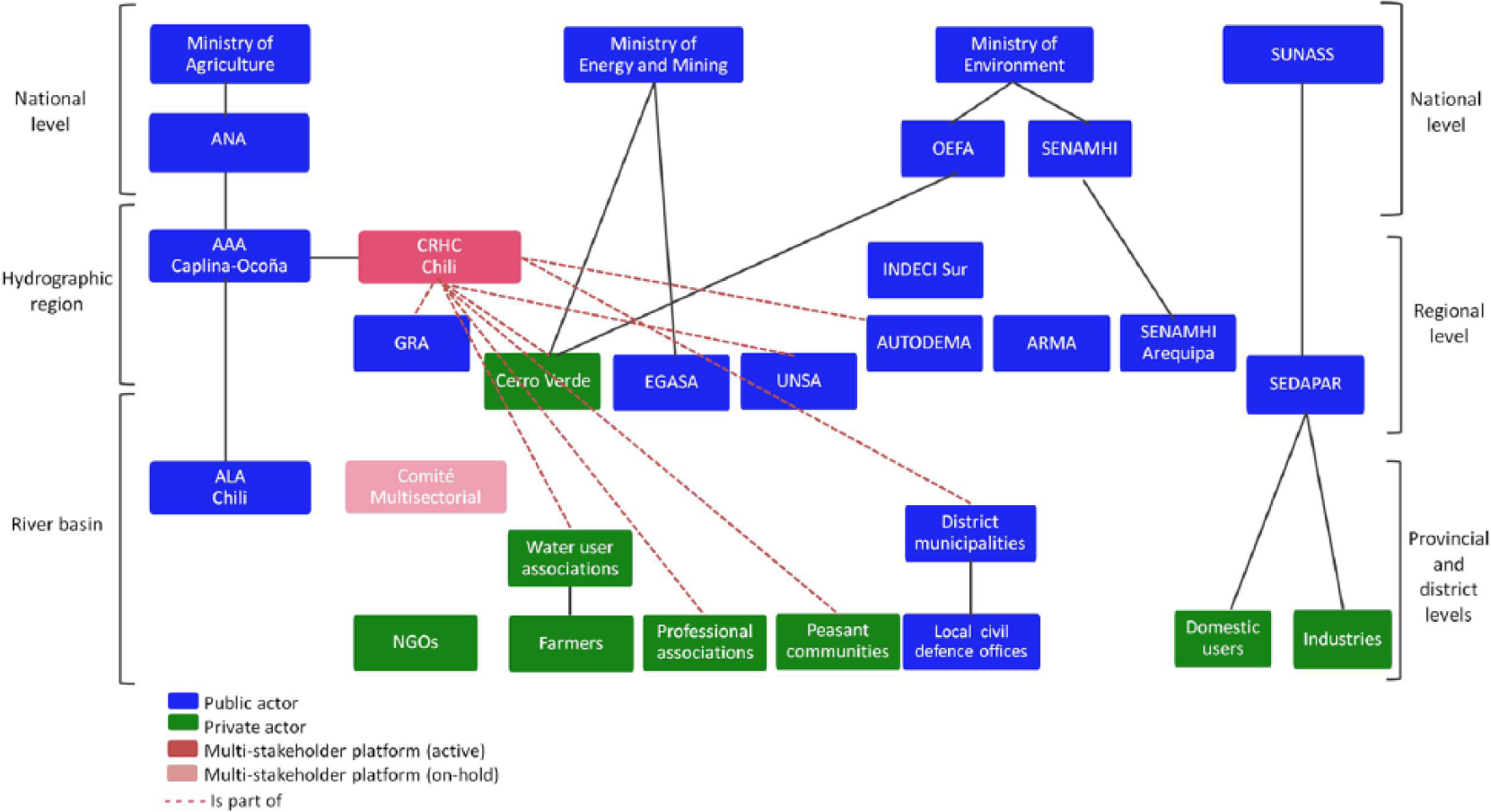
Water governance system of Arequipa
The four major users in the river basin are SEDAPAR (domestic and industrial uses),(50) farmers (represented by independent water users’ associations called juntas de usuarios), the electricity company Empresa de Generación Eléctrica de Arequipa (EGASA) and the mining company Cerro Verde. While SEDAPAR operates according to regulations sanctioned by SUNASS, EGASA and Cerro Verde are directly overseen by the Ministry of Energy and Mining.(51) In the case of farmers, public irrigation infrastructure is under the jurisdiction of the Regional Agricultural Office (Gerencia Regional de Agricultura – GRA).
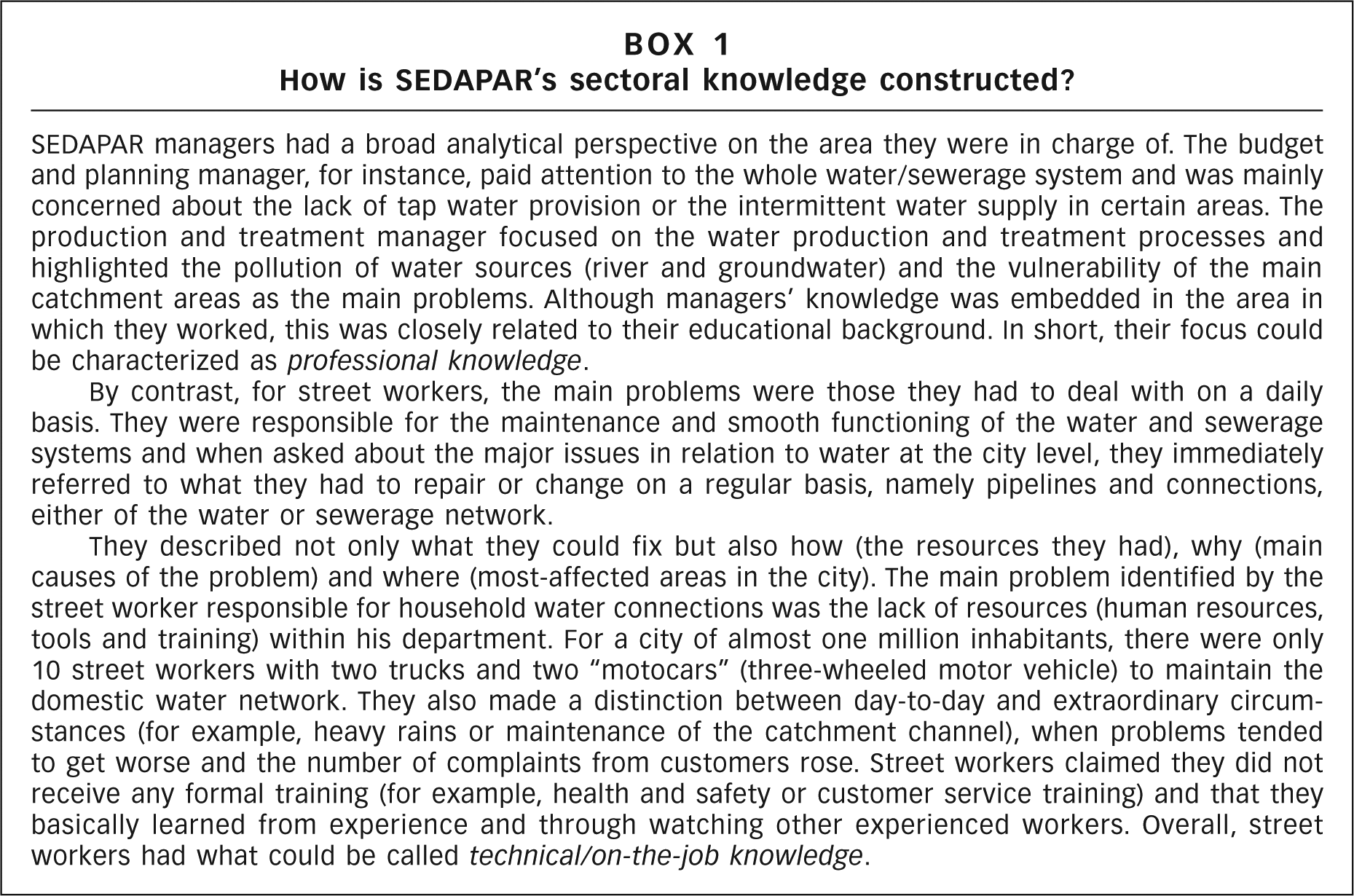
SEDAPAR respondents – both managers and street workers – tended to perceive water mainly as a sector. Their main concern was the functioning of the water and sewerage system in the city and the efficient supply of both services to the whole population. Their ultimate goal was to provide a constant tapped water supply and proper sanitation to all Arequipeños. The fact that they considered these as “services to be paid for” shows that they also considered water a commodity. When referring to water vulnerabilities, both managers and street workers identified the obsolete, often leaking, pipelines(52) but also pointed at a lack of sanitary education.(53) Respondents emphasized that the recent heavy rains intensified the problems, leading to the collapse of the sewerage network due to the lack of a drainage system. In general, the knowledge of SEDAPAR respondents was at city level – almost no-one referred to problems in the river basin – and it was focused on downstream water and sanitation supply. Water availability was not seen as a problem for the future. For these respondents, there is enough water – the issue is how to get it or treat it through proper infrastructure investments. Despite this common understanding, there were knowledge differences depending on the job position of SEDAPAR employees (Box 1), whose spatial knowledge is synthesized in Map 1 (managers) and Map 2 (street workers), respectively.
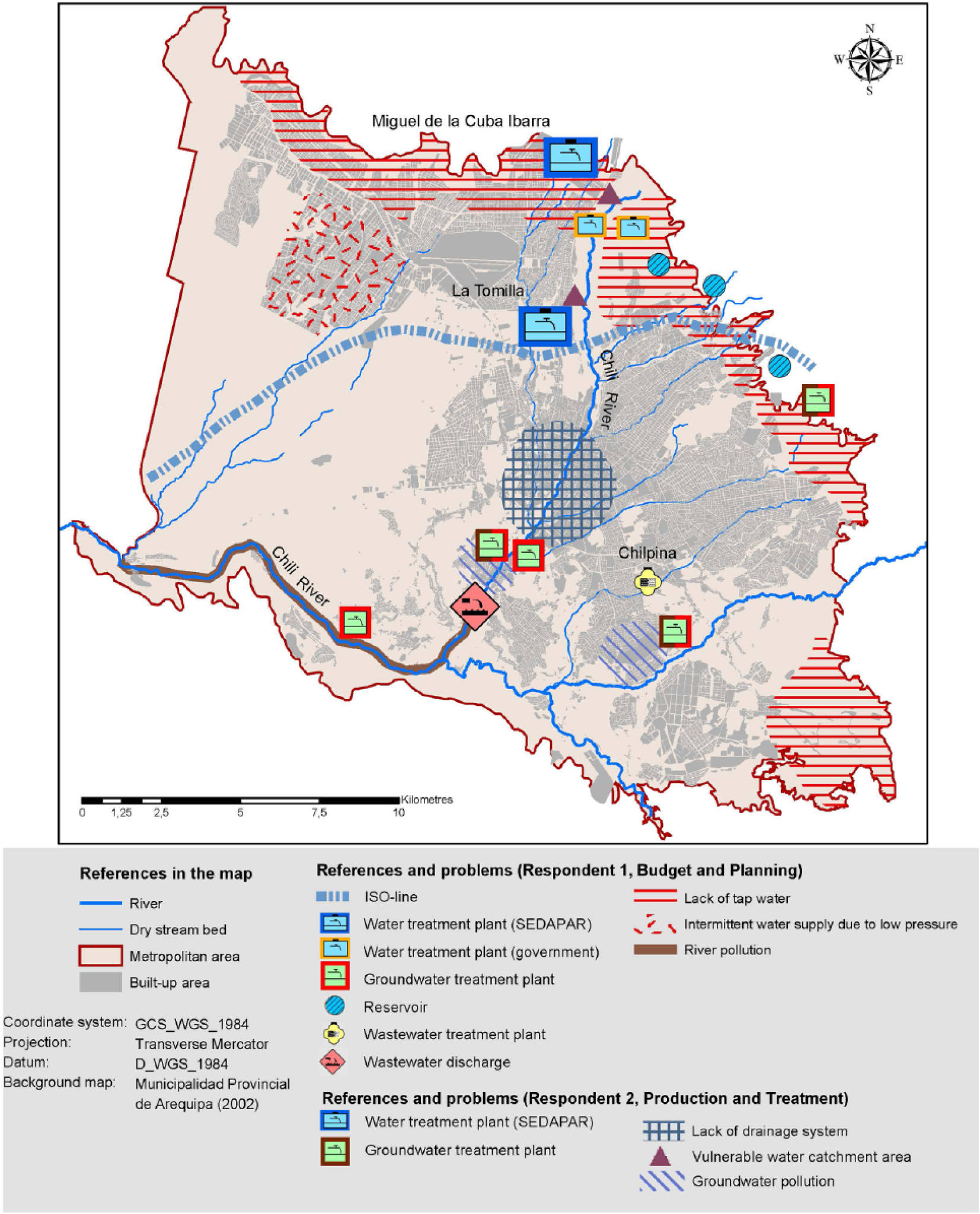
Water-related references and problems by SEDAPAR managers
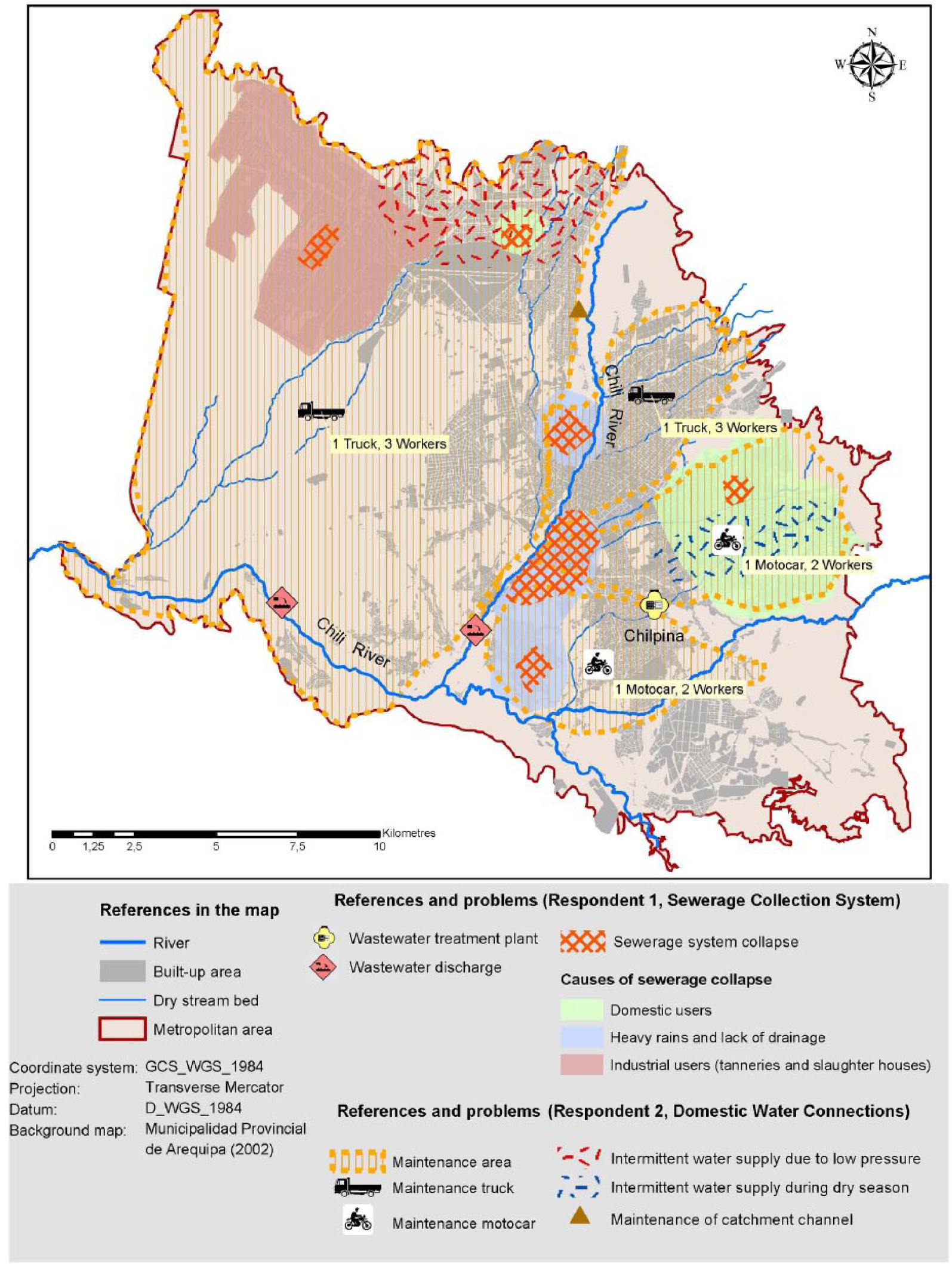
Water-related references and problems by SEDAPAR street workers
The administrators and regulators have a very different approach to water. ANA, the governing entity of the national water resources management system, is also the principal technical and normative authority on water resources, sanctioning norms, setting procedures and issuing sanctions to guarantee an integrated and sustainable water resources management. The city of Arequipa falls under the AAA Caplina-Ocoña and the ALA Chili.(54) All respondents from ANA(55) embraced a holistic and systemic approach and concentrated on problems in the Quilca–Chili basin – which they conceived as part of a multi-basin system. They agreed on four main issues: desertification in the upper basin area, mainly caused by deforestation and overgrazing;(56) the expansion of drought areas due to glacial retreat; inefficient use of water by farmers, leading to water pollution,(57) salinization(58) and mudslides downstream; and water resources management in general. As ANA is the organization in charge of approving new water rights, they recognized the potential conflicts associated with distributing water among diverse users.
ANA’s representatives thus considered water as a socio-ecological good: they not only paid attention to ecosystems and the full hydrological cycle but also to human water consumption. Most of them envisaged a drop in precipitation levels in the basin and recommended natural mechanisms (e.g. forestation) or small-scale infrastructure projects (e.g. micro-dams in the upper basin) to regulate the water cycle rather than large-scale infrastructure projects. They acknowledged that Arequipa was already experiencing water stress (less than 547 cubic metres/person/year) due to excessive concentration in one city and around a single river. The retreat of glaciers in the adjacent basins did not make this scenario less alarming (Map 3).
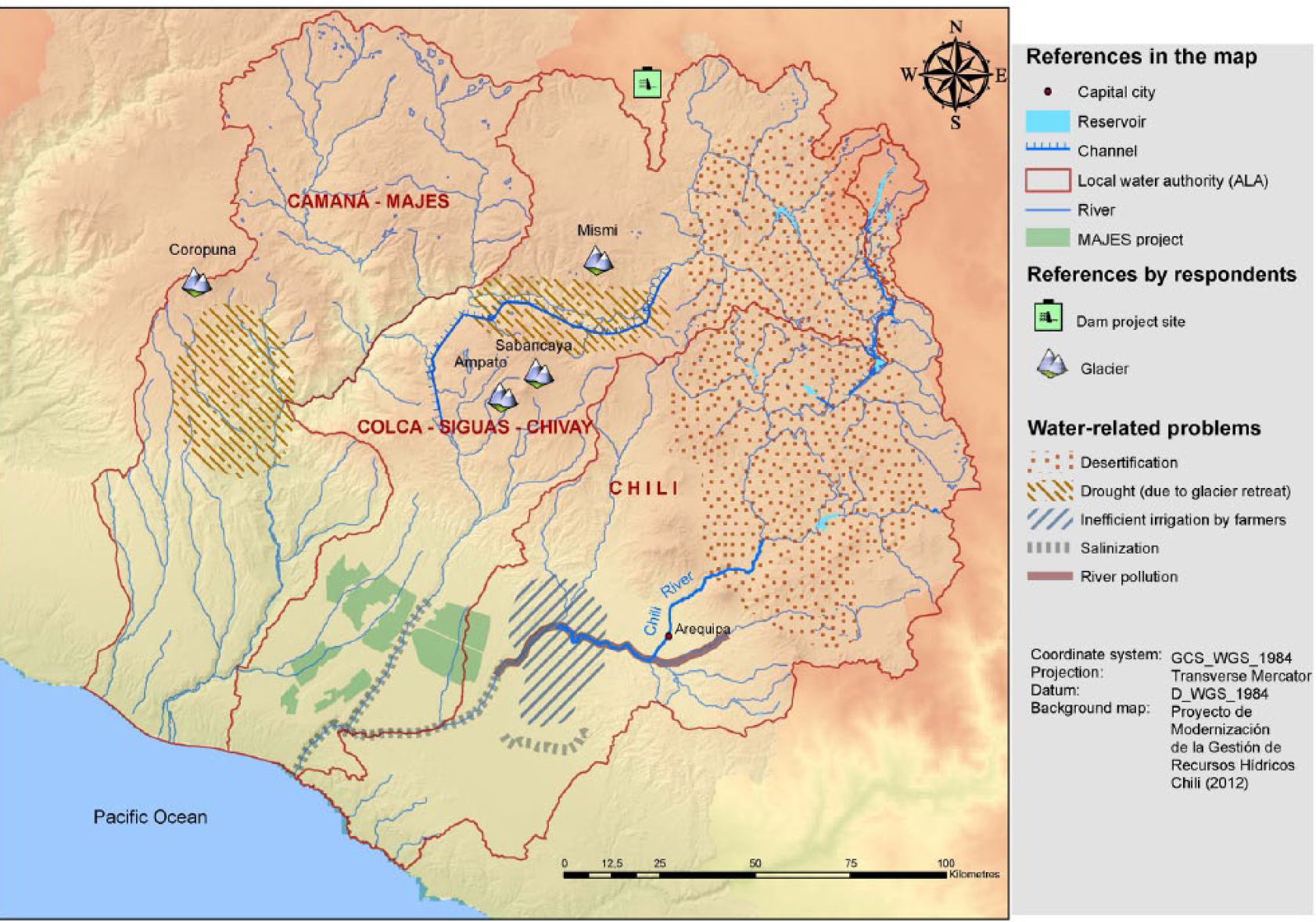
Water-related references and problems by ANA respondents
Several actors monitor the water situation in the region. The Majes Autonomous Authority (Autoridad Autónoma de Majes – AUTODEMA)(59) administers the dam system in the whole region and generates hydrological and meteorological information from its own stations.(60) The Hydrological and Meteorological National Service (Servicio Nacional de Meteorología e Hidrología – SENAMHI) is responsible for the generation of hydro-meteorological information in each administrative region.(61) The Institute for Mining, Geology and Metallurgy (Instituto Geológico Minero y Metalúrgico – INGEMMET), a national institute with an office in Arequipa, conducts some research on glaciers and hydro-geology in addition to its focus on geological risks in the region. Finally, public universities such as the Universidad Nacional San Agustín (UNSA) (National University of San Agustín) receive a share of the tax revenues from mining companies, which can be invested in research on water-related topics.(62)
The National Institute of Civil Defence South (Instituto Nacional de Defensa Civil Sur – INDECI Sur) is responsible for preparation, response and rehabilitation around disasters in the southern regions of the country.(63) However, the executive role falls primarily on local governments,(64) with mayors as principal authorities heading the working groups for disaster risk management in their districts. Civil defence respondents,(65) as well as a member of the NGO PREDES, referred to pluvial flooding as the main water-related problem. Respondents considered both bio-physical and social vulnerabilities (e.g. illegal occupation of the torrenteras,(66) farming activities in floodplains) and recommended measures such as the resettlement of residents living in torrenteras, trash removal in torrenteras and the demarcation of floodplains. These respondents had a short-term perspective and focused on the district or city levels where most people live.
Problems discussed by respondents from the government varied depending on their jurisdictions. The mayor of Alto Selva Alegre(67) was concerned with implementing pro-poor policies regarding access to water and sanitation services and the reduction of residents’ vulnerability to forecasted rains. He was especially worried about problems after the last heavy rains (e.g. flooding, the collapse of water and sewerage systems) and the likelihood of residents blaming him for the lack of preventive measures. His vision was short-term, linked to his mandate period.
The representative of the Regional Agricultural Office (Gerencia Regional de Agricultura – GRA) also stressed the need to reduce the vulnerability to pluvial flooding of the farmers he represented.(68) By contrast, the respondent from the Regional Environmental Authority (Autoridad Regional Ambiental – ARMA) considered water as a socio-ecological good and was mainly concerned with water conservation measures in the upper river basin and the participation of all actors, rather than just one sector, in decision-making. They shared the idea that fresh water is a finite and scarce natural resource but diverged on ways to address the resulting problems. While efficiency combined with technology (e.g. re-use of treated wastewater in agriculture) was the main solution for the respondent from the GRA, the ARMA respondent proposed conservation of the upper basin areas and payment for environmental services.
According to the Cerro Verde representative, the main problem was the illegal occupation of land in areas where water and sanitation services cannot be delivered. The respondent suggested that rather than unequal access to services, the problem was created by residents themselves.(69) A second problem discussed by the respondent was the inefficient use of water by farmers, resulting in less water being available for other (economic) uses. Water was conceptualized as a resource that can be generated through technology (e.g. dams, re-use of wastewater), with large-scale infrastructure projects being especially important. In general, the focus was at the city level, with no discrimination between problems in the city and the river basin.
The different water governance actors in Arequipa thus represent the different approaches to water outlined by Hordijk et al.(70) (Table 1).
Key actors’ approaches to water
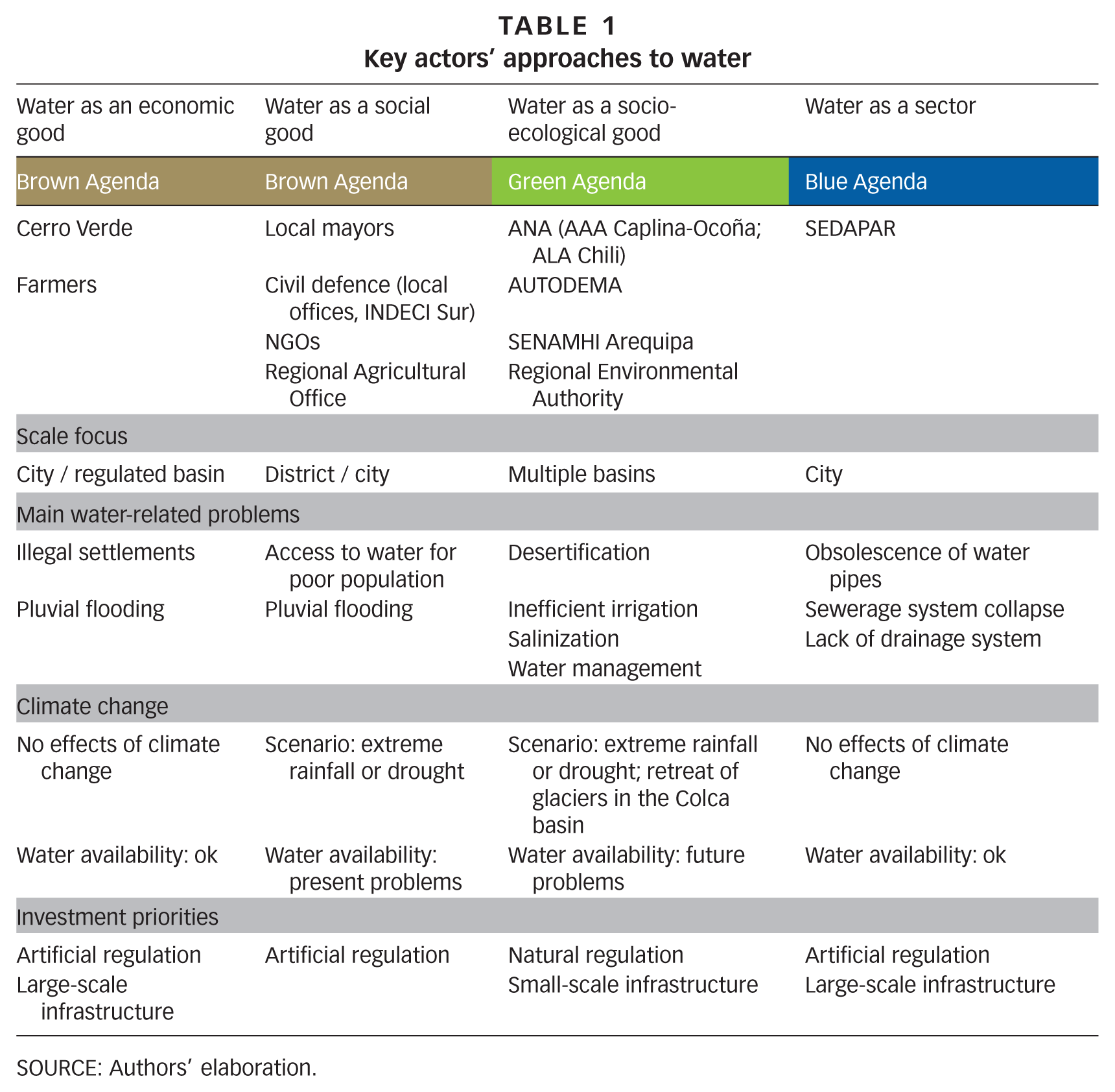
SOURCE: Authors’ elaboration.
The CRHC Chili, which includes many of these public and private actors, could in theory function as a platform on which these diverging approaches could be debated. Thus far, however, the diverging views have resulted in stalemate. For instance, after the floods in 2012, the main administrators could not agree on what measures to implement. The GRA proposed the rehabilitation of river defences; the ANA representatives suggested micro-dams in the upper basin. Meanwhile, the mining company has assumed the active role (Photo 1). This is a recurring pattern in water management in Arequipa.
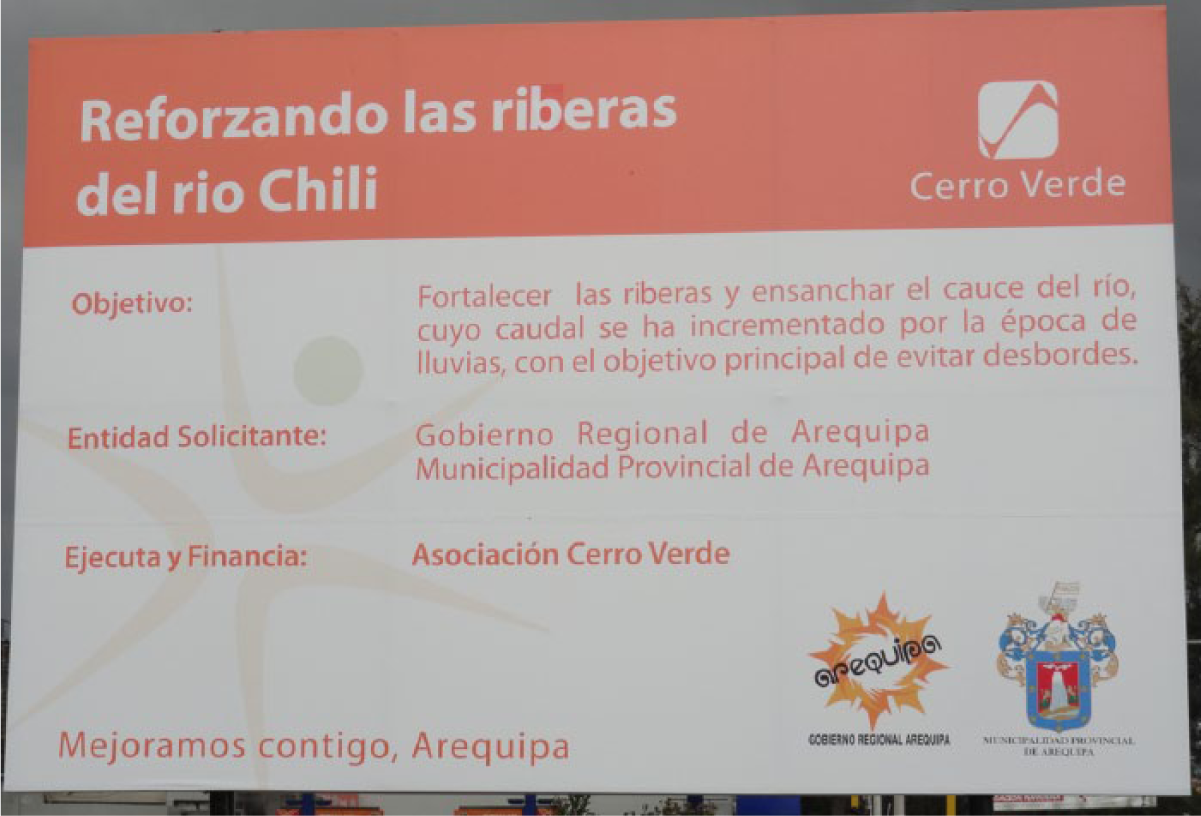
This street sign is located next to the Bajo Grau bridge, which was severely affected by floods in 2012, and announces works on river defences financed by Cerro Verde. Similar signs can be found along the Chili River across the city
VI. The Locus of Power in Arequipa’s Water Governance
In terms of their formal mandates, public actors have a key role in both the administration and regulation of water resources in Arequipa and the Chili basin, in the provision of water-related services (drinking water, sanitation and hydropower generation) and in the prevention of and response to water-related disasters. This is in line with the public character of the ownership and use of water as stated by the new Water Law (2009).(71) De facto, however, the mining company Cerro Verde, a private actor, has been financing water infrastructure, dams and river defences, while also monitoring water resources with its own meteorological stations.
As a member of the Comité Multisectorial, Cerro Verde has played a key role since 1983 in deciding which infrastructural projects should be implemented in the basin. In the absence of rules, agreements in this informal comité were made in more informal, tacit ways, and building up strategic alliances was key. Cerro Verde allied itself with those who historically controlled water resources, the farmers, as well as with its main energy provider, EGASA. The formation of these alliances was fostered by the shared understanding of water as an economic good. Decisions were taken in favour of these three users and their economic activities, ignoring the water demands of other users and the full hydrological cycle of the basin. Although the Comité Multisectorial consisted of both public and private actors (Figure 4), it favoured private users in its internal informal rules. Representatives of private users outnumbered public representatives (14 versus 11), and agreements were made by a show of hands and by simple majority. The financing of agreed-upon infrastructure projects had to be done according to the economic capacity of the actors, greater in the cases of EGASA, Cerro Verde and the water users’ associations.(72)
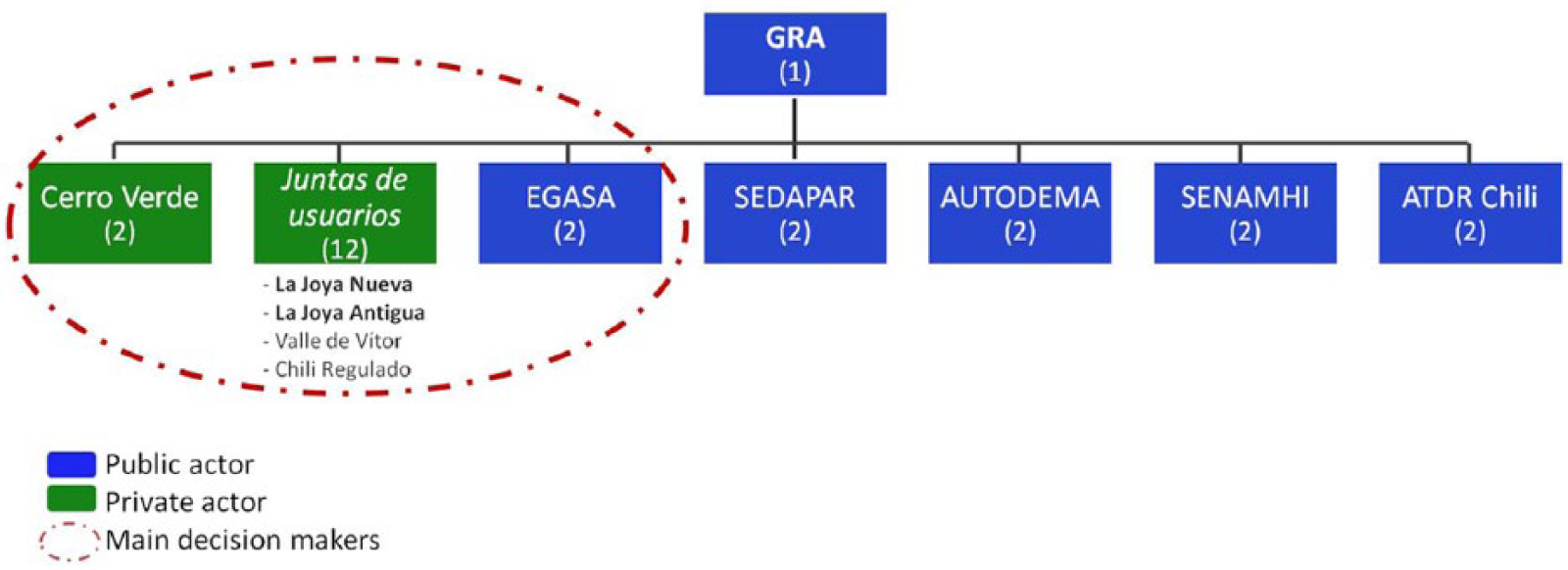
Comité Multisectorial: composition, number of representatives and main decision makers
In 2004, the mining company agreed with EGASA to fully fund the Bamputañe dam (US$ 13.1 million) in exchange for preferential energy tariffs, and to partially finance the Pillones dam (US$ 12.4 million, 40 per cent) in exchange for 60 per cent of its water.(73) Decisions on water uses also tended to favour the mines:
“Once, when I was working in AUTODEMA, I had to represent the organization in the Comité Multisectorial. And I claimed that the way they were distributing water was not technical. The distribution should be made according to the demand of each use […] Instead, they are dependent on the hydropower company’s whim […] If you look at the decisions taken in the Comité Multisectorial, it is mostly how much water should be discharged from the Aguada Blanca dam […] This discharge does not consider all the users’ demand but only the hydropower generation for the mining company. As much water is discharged, more energy for the mine …” (High-ranking official, PMGRH Chili, authors’ translation)
When mining profits started to escalate, the beneficial tax regime(74) in Peru came under public pressure. At the same time, social protests around mining – and especially the pollution of water – put several mining concessions in the country on hold. In 2004, Cerro Verde announced it planned an expansion. Local populations living near Cerro Verde’s mines claimed the right to compensation for the damage they expected. In 2006, 10,000 Arequipeños – including the district mayors – marched in protest when Cerro Verde announced a more substantial expansion, and the pollution of the Chili River remained an unresolved issue. In the aftermath of these protests, the mining company signed an agreement committing itself to financing a water treatment plant for the city.(75) In 2007, the national government and the main private mining companies signed the Mining Programme of Solidarity with the People. Instead of paying income tax on their escalating profits, the mining sector agreed to set up a fund, one consequence of which is that it is the mining sector that decides how the fund is spent, not the state. One of the largest projects financed from this solidarity fund is the water treatment plant in Arequipa. Local governments, in turn, committed themselves to financing a wastewater treatment plant. In 2006, Cerro Verde also created its own foundation – Asociación Cerro Verde (ACV) – which spearheaded various smaller-scale community projects as part of the company’s corporate social responsibility programme. A sum of US$ 1.2 million invested in 2006 to bring water to 3,000 households in the Santa Rita de Siguas district and for the rehabilitation of river defences to protect farmers from the 2012 floods are examples of projects led by ACV.(76) When it turned out that only three or four local governments had deposited the funds promised for the wastewater treatment plant, Cerro Verde made a new proposal to finance and operate the plant for two years in addition to covering the pumping costs for as long as the plant functioned. Estimated costs for the plant were US$ 250 million. This proposal would provide Cerro Verde with one cubic metre/second of the treated wastewater needed for its production processes.(77) An overview of Cerro Verde’s financing of water infrastructure is given in Figure 5.
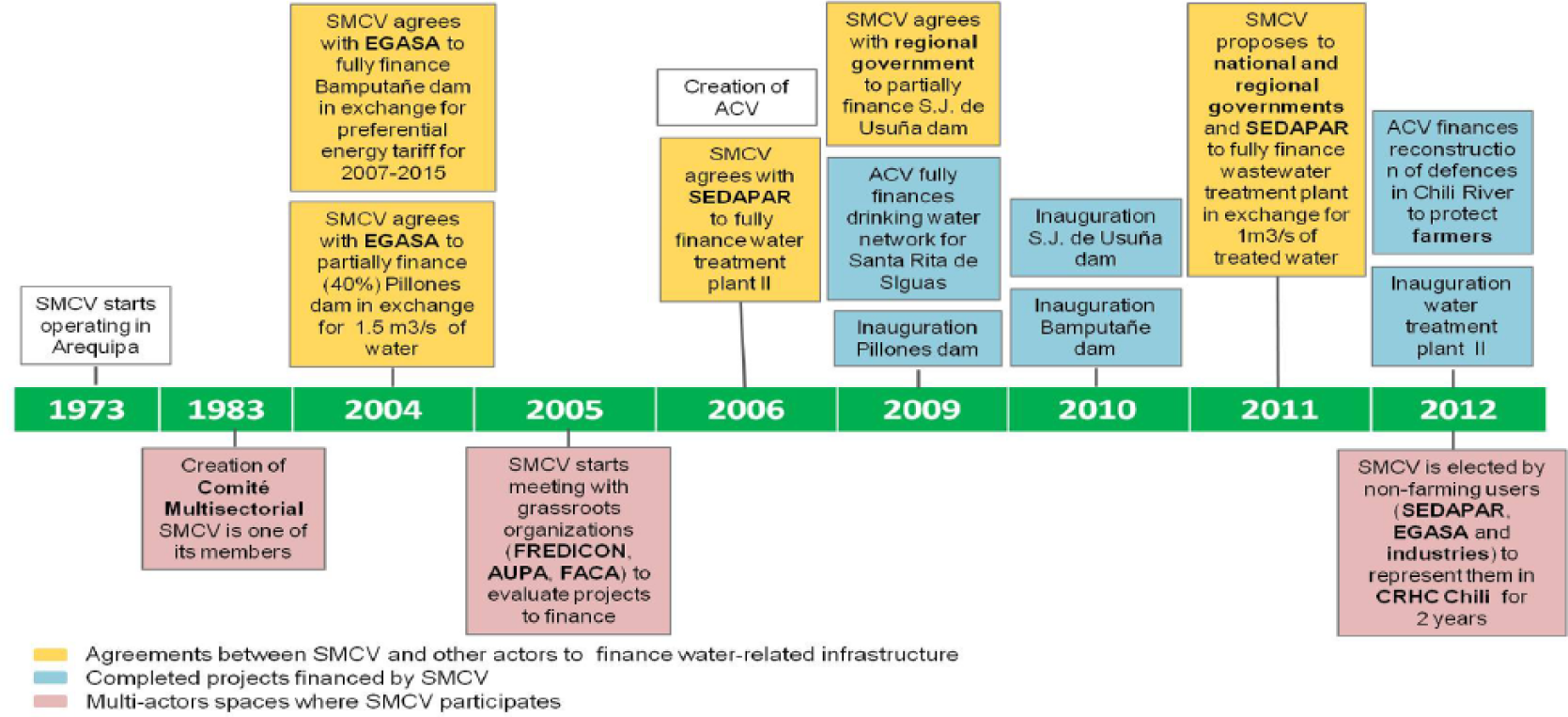
Sociedad Minera Cerro Verde (SMCV): financing the Chili basin water management
Through this financing, the mining company has ensured sufficient water and energy for its operations and has simultaneously appeased the population through the employment and income it generates for the city(78) and the investments in the city. Protests have faded, with dissenting voices mainly coming from NGOs. When key actors were asked to rank their peers according to the level of influence they exercised in the water governance system, there was consensus that the mining company was the most influential actor, with only the president of the Arequipa region having a similar level of influence. The water company and local municipalities were ranked substantially lower but still above other governing bodies. The recently created river basin council was ranked almost lowest.(79)
There are at least four explanations for why Cerro Verde is, de facto, taking on other key actors’ official mandates. One is the way in which decentralization processes have taken place – what Deutsch Lynch defines as “… devolution of responsibilities coupled with centralization of authority and resources”.(80) Various laws (Ley de Bases de la Descentralización, Ley Orgánica de Gobiernos Regionales and Ley de Recursos Hídricos)(81) transfer water management responsibilities to the regions, but authority and resources remain largely with the national ministries.(82) Second, political-administrative and water management decentralization have been designed and implemented as two separate processes. This poses a serious challenge to a clear definition of each actor’s role, as authority is fragmented between competing government agencies with different degrees of power. Third, the new water law does not place any organization in charge of the planning and financing of hydraulic infrastructure projects. Finally, some actors (and their knowledge) have been systematically excluded from decision-making, for instance, the users of the non-regulated part of the basin, those involved in disaster risk management and those with a monitoring role.
VII. The River Basin Council: The Way Forward?
The river basin councils, each headed by a representative of the regional government and with eight other members from different organizations, are intended to overcome the under-representation of previously excluded actors in water governance. The objective is to bring key actors together in a formal, institutionalized space to develop a water resource management plan for the basin in a concertative manner. Yet the CRHC Chili runs the risk of institutionalizing previously implicit power relations. First of all, recent changes in the national law set further criteria on the level of formalization of the juntas de usuarios as operators of water infrastructure, favouring the large-scale users over small-scale, more informal users.(83) Second, the appointment of the director of the GRA as the president of the CRHC Chili seems to consolidate agricultural interests in the council. Farming users are represented by a junta de usuarios of the irrigation farming in the lower basin area, and farmers from the upper, non-regulated part of the basin are once more ignored. Most surprising is that all non-farming users are grouped under one heading. The public water company, the public electricity company and industries have opted for Cerro Verde to be their representative on the council. Having domestic users represented in the same group as the mining, hydropower and industrial users does not seem to guarantee that the priority domestic users have by law will be upheld. The participation of GRA, Cerro Verde and farmers from the Joyas irrigation districts calls to mind the former composition of the Comité Multisectorial (Figure 6).
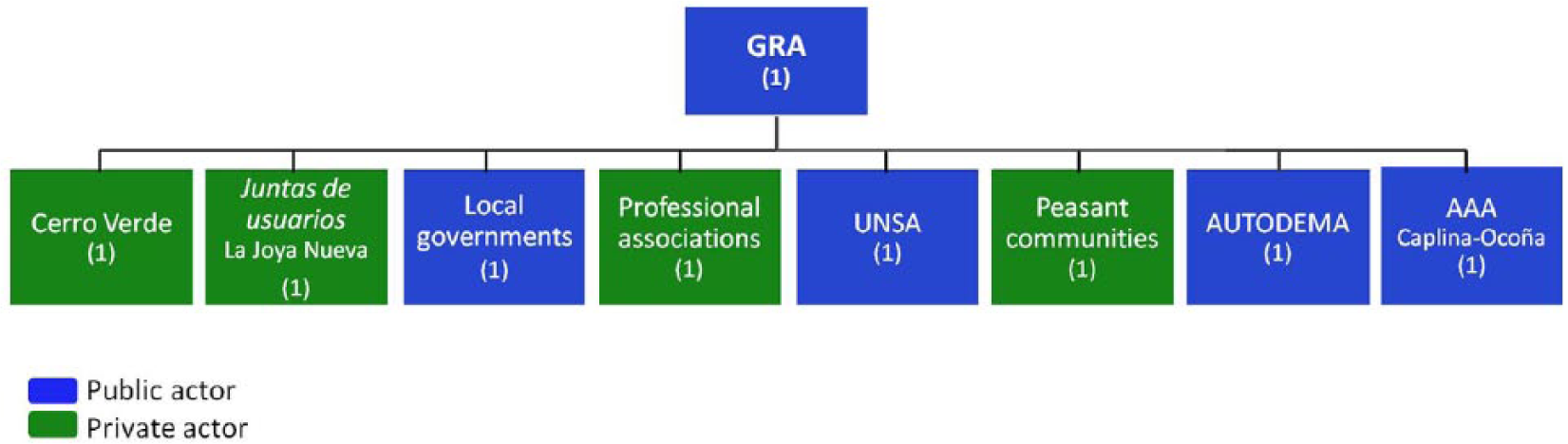
CRHC Chili: composition and number of representatives
Respondents agreed that effective water management in Arequipa is seriously hampered by the fragmentation of the knowledge base. Much of the knowledge on water-related issues derives from their professional careers or on-the-job experience and is usually embedded in the organization they are part of, generated and transmitted within the organization but not codified nor shared outside this context. The codified knowledge – for instance in the monitoring system – is not always shared because actors want to charge for its use or because it is also a source of power:
“As an organization, we do not have the political weight or the economic resources. But, whoever has the statistics is the king. And we do have the statistics. If we have the statistics of precipitations, temperatures and river volumes, then our organization is important […] Simply put, the hydro-meteorological information is the base for the planning and development of every single infrastructure project that the private sector or the state wants to develop. Without that data, they cannot do it.” (High-ranking official, SENAMHI Arequipa,(84) authors’ translation)
Without the required information, it is quite difficult to generate knowledge. Furthermore, when knowledge cannot be generated from inside, the usual response is to turn to external advisors. This could explain why, for example, the assessment and management plans for the Quilca-Chili river basin were not developed by the river basin council itself but by an international consultant group. Under these circumstances, the only role of the river basin council was to approve both plans but without any real involvement in their development. However, this trend seems to be reversing in 2013, with members of the CRHC Chili and specific working groups meeting to discuss the management plan. The main constraint appears to be the limited budget of ANA to finance the creation of the required technical secretariat in charge of facilitating this participatory process within the council.(85)
VIII. Conclusions
The water governance system in Arequipa offers a very interesting opportunity for analyzing trends in water governance, given the unusual dominance of the mining company in financing many different aspects of the water infrastructure for the city and the basin. This infrastructure includes dams, a water treatment plant, infrastructure for drinking water provision to part of the city, river defences to protect inhabitants from flooding, and a future wastewater treatment plant. Cerro Verde has herewith created a privileged position for itself, ensuring that it has sufficient water to keep functioning even in periods of drought. It is important to note that among Arequipeños, there is overall appreciation of Cerro Verde’s investments in water infrastructure. More water is available, more inhabitants are connected to drinking water and sewerage infrastructure, and potentially more wastewater will be treated than would have been without Cerro Verde’s intervention. Negative side-effects are taken as a necessary evil. Dissenting voices come mostly from environmental NGOs, which criticize the privileged position of the company. Either because of being co-opted by Cerro Verde’s investments or because of the centralized character of large-scale mining environmental monitoring, local governments – and even NGOs – have seen their watchdog status weaken. Just as important, this has implied a lack of knowledge that would otherwise have helped to counteract powerful positions.
A second interesting feature is the early adoption of a “multi-stakeholder” management model in the basin a decade before Integrated Water Resources Management (IWRM) became the dominant paradigm in water governance. The Comité Multisectorial decided on water allocation and investments in water infrastructure in the regulated part of the basin for three decades without any formal mandate or rules regulating its functioning. Given the composition of the comité and the economic power of three of its main actors – the electricity company, the mining company and the farmers in the irrigated lower basin – the interests of productive uses have dominated water management. Although the public water company SEDAPAR was a member of the Comité Multisectorial, it was not considered relevant when it came to financing arrangements.
In 2012, the river basin council was created as part of the new nationwide institutional set-up for water governance in Peru. Although most of the actors that formed the Comité Multisectorial are also represented on the new council, the comité did not initially accept the legitimacy of the council. Consequently, two water management systems – one informal, one formal – operated in parallel during the transition phase – and might still be doing so. In theory, through the new council, both the interests and knowledge of the hitherto excluded actors should be included. Yet residents have no direct voice in this new council, and the public water company, which might be expected to represent residents’ interests, has opted to be represented by the mining company.
The informal system had been unable to overcome a persistent problem in water governance in Arequipa, namely the lack of knowledge integration. Highly relevant knowledge is dispersed among actors, many of whom are unwilling to share on the premise that “knowledge is power”. It is too early to tell whether the creation of the new council will be able to address this fundamental weakness. The new council represents a greater diversity of actors, with more diverging views on water. Real deliberation may expose further interests and views, such as the value of water for the ecosystem and its finite nature, or the interests of the unrepresented farmers and their lay knowledge of water cycles in the local ecosystem. Yet what is clear is that the changes in water management in Arequipa have not affected the long-existing configuration of power peculiar to its water governance system, with a mining company being the most powerful actor as well as being an important financer of urban water infrastructure. Although the institutional changes suggest a transition in governance structures, many of the features of the system suggest that it does not, in Pelling’s terms, go beyond achieving “resilience”, since they strengthen the status quo. Fostering knowledge integration in a way that emphasizes the legitimacy of the different understandings, different concerns and hence different solutions might be a first step in challenging this power asymmetry as a trigger for transformation.
Footnotes
Acknowledgements
We would like to thank especially IDS Urbam and the GIS specialist from PMGRH Chili for providing us with the original GIS shape files required for the digitizing process; also Marco Mazouzi for developing the maps used in this article.
1.
This article is part of the EU-funded research programme Chance2Sustain (2010–2014) (http://www.chance2sustain.eu), which examines 10 cities in India, South Africa, Brazil and Peru. The main focus of this research programme is the potential contribution of participatory knowledge management to sustainable development. Research was conducted with the support of Asociación Civil LABOR (http://www.labor.org.pe/), a member of the Cities for Life Forum ( ) in Arequipa.
2.
Pelling, M (2010), Adaptation to Climate Change: From Resilience to Transformation, Routledge, London, 224 pages; also Pelling, M (2012), “Resilience and transformation”, in M Pelling, D Manuel-Navarrete and M Redclift, Climate Change and the Crisis of Capitalism: A Chance to Reclaim, Self, Society and Nature, Routledge, London, pages 51−65.
3.
See reference 2, Pelling (2010) and .
4.
Beall, J and S Fox (2009), Cities and Development, Routledge, London, 267 pages; also Goodwin, M and J Painter (1996), “Local governance, the crises of Fordism and the changing geographies of regulation”, Transactions of the Institute of British Geographers New Series Vol 21, No 4, pages 635–648.
5.
Lebel, L, J M Anderies, B Campbell, C Folke, S Hatfield-Dodds, T P Hughes and J Wilson (2006), “Governance and the capacity to manage resilience in regional social-ecological systems”, Ecology and Society Vol 11, No 1, Article 19.
6.
Treib, O, H Bähr and G Falkner (2007), “Modes of governance: towards a conceptual clarification”, Journal of European Public Policy Vol 14, No 1, pages 1–20.
7.
Baud, I, K Pfeffer, D Scott and J Sydenstricker (2011a), “Knowledge production in urban local governance systems”, Policy Brief, Chance2Sustain Working Papers, EADI, Bonn, 4 pages.
8.
Hordijk, M A, L Miranda Sara and C Sutherland (2014), “Resilience, transition or transformation? A comparative analysis of changing water governance systems in four southern cities”, Environment and Urbanization Vol 26, No 1, pages 130–146.
9.
Bebbington, A and M Williams (2008), “Water and mining conflicts in Peru”, Mountain Research and Development Vol 28, No 3, pages 190–195.
10.
Deutsch Lynch, B (2011), “Equity, vulnerability and water governance: responding to climate change in the Peruvian Andes”, Schools of International Affairs and City and Regional Planning, Georgia Institute of Technology, available at .
11.
Autoridad Nacional del Agua (2009), Política y Estrategia Nacional de Recursos Hídricos del Perú, available at .
12.
For the common framework, see reference 8.
13.
Miranda Sara, L, M A Hordijk and R K Torres Molina (2011), “Water governance key approaches – an analytical framework: literature review”, Chance2Sustain Working Papers, EADI, Bonn, 23 pages.
14.
See reference 8.
15.
Baud, I, K Pfeffer, D Scott and J Sydenstricker (2011b), “Developing participatory ‘spatial’ knowledge models in metropolitan governance network for sustainable development: literature review”, Chance2Sustain Working Papers, EADI, Bonn, 20 pages; also Brooks, S, C Sutherland, D Scott and H Guy (2010), “Integrating qualitative methodologies into risk assessment: insights from South Durban”, South Africa Journal of Science Vol 106, No 9/10, pages 55–64.
16.
In addition, in the case of local actors (district mayor and local civil defence), a map of the district was also used.
18.
Municipalidad Provincial de Arequipa (2002), Plan Director de Arequipa Metropolitana 2002–2015: Ciudad Oasis, page 22, available at .
19.
Guerra, A and V Saco (2008), “El derecho y la problemática del agua en el Perú”, in A Guevara Gil (editor), Derechos y Conflictos de Agua en el Perú, CONCERTACIÓN/WALIR/Departamento Académico de Derecho/PUCP, Lima, page 15.
20.
The Chili River is the main source (85 per cent) of drinking water supply in the city, followed by the La Bedoya spring (14 per cent) and other underground water sources (one per cent); see Jiménez, P, J Amézaga, T Rötting and E Guzmán (editors) (), El Río Chili: Cuenca Árida con Presencia Minera, IRECA-UNAS/LABOR, Arequipa, page 82.
21.
See reference 20, page 37.
22.
Specifically, water is transferred through a bypass channel from the Alto Colca sub-basin.
23.
Dams are located in the upper basin, where precipitation is higher and occurs mostly (90 per cent) between December and April; see reference 20.
24.
Seventy per cent of the world’s tropical glaciers are in Peru. Their size is currently shrinking rapidly.
25.
See reference 20, pages 42–43.
26.
Bebbington, A and J Bury (2009), “Institutional challenges for mining and sustainability in Peru”, PNAS Vol 106, No 41, pages 17296–17301.
27.
See reference 11, page 27.
28.
See reference 20.
29.
Besteman, M (2010), “The risks and opportunities for the re-use of grey water in Arequipa, Peru”, MSc thesis, Department of Geography, Planning and International Development Studies, University of Amsterdam.
30.
See reference 11, page 27.
31.
See reference 9, page 191.
32.
See reference 26, page 17298.
33.
Interview with Cerro Verde representative, March 2012.
34.
Some even suggest that it is not clear whether residents raise complaints to denounce mining pollution or to get economic compensation as a result of their districts being declared part of the mining influence area.
35.
La República (2012a), “OEFA sanciona a Cerro Verde por contaminar aire y suelo”, accessed 30 April 2013 at http://www.larepublica.pe/24-04-2012/oefa-sanciona-cerro-verde-por-contaminar-aire-y-suelo; also La República (2012b), “Minera Cerro Verde podría seguir contaminando, advierten ambientalistas”, accessed 30 April 2013 at .
36.
According to the Regional Environmental Authority (Autoridad Regional Ambiental – ARMA), part of the problem lies in the centralized management (from Lima) of large (e.g. Cerro Verde) and medium-scale mining companies. Traditionally, the environmental monitoring of these companies has been part of the remit of the Ministry of Energy and Mining. Now, their environmental assessment is the responsibility of OEFA – part of the Ministry of Environment. Only small-scale and informal mining activities have been passed to regional governments for oversight; see Autoridad Regional Ambiental (2011), Diagnóstico Ambiental Regional – Capítulo III, pages 20–23, available at http://181.65.129.43/arma/index.php?option=com_content&view=article&id=1176%3Adiagnostico-ambiental-regional-capitulo-iii&catid=115%3Aplaneamiento-ambiental&Itemid=499
37.
The normal level for February is 30.2 l/m2 and that year it reached 152.4 l/m2. Arequipa had never before registered such levels of precipitation for February. The previous highest record was 89 l/m2, registered in February 1989 (Interview with high-ranking official, SENAMHI Arequipa, March 2012).
38.
Autoridad Regional Ambiental (2009), “Estrategia regional de adaptación al cambio climático en la región Arequipa”, Working Paper, page 21, available at http://181.65.129.43/arma/index.php?option=com_joomdoc&task=doc_download&gid=2&Itemid=.
39.
See reference 38, page 19.
40.
Berg, S and C Lin (2008), “Consistency in performance rankings: the Peru water sector”, Applied Economics Vol 40, No 6, pages 793–805.
41.
Interview with high-ranking official, Department of Budget and Planning, SEDAPAR, April 2012.
42.
Poder Ejecutivo (1969), Decreto-Ley N° 17752: Ley General de Aguas, available at .
43.
In the domestic arena, the Ley General de Servicios de Saneamiento/Water and Sanitation Law (1994), Ley de Bases de la Descentralización/Decentralization Law (2002) and Ley Orgánica de Gobiernos Regionales/Organic Law of Regional Governments (2002) would be the basis for decentralization in the water sector. The Water and Sanitation Law gave service responsibility in urban areas back to the provincial municipalities. The new legal framework has clearly been influenced by Integrated Water Resources Management (IWRM) principles and, furthermore, its implementation receives substantial support from the World Bank and the Inter-American Development Bank.
44.
Congreso de la República (2009), Ley No 29338: Ley de Recursos Hídricos, available at http://www.ana.gob.pe/media/316755/leyrh.pdf; also Autoridad Nacional del Agua (2010), Reglamento de la Ley de Recursos Hídricos, Ley No 29338, available at .
45.
See reference 2, Pelling (2010) and .
46.
Budds, J and L Hinojosa-Valencia (2012), “Restructuring and rescaling water governance in mining contexts: the co-production of waterscapes in Peru”, Water Alternatives Vol 5, No 1, pages 119−137.
47.
There is also an unregulated part of the basin and actors here have been systematically excluded from both formal and informal decision-making structures.
48.
In the case of the Quilca-Chili basin, this project is being financed by the World Bank. The involvement of the World Bank in the water management of the country can be traced back to 2004 when it financed a national project for the formalization of customary water rights. Later, in December 2009, it agreed with ANA to finance the PMGRH in three river basins: Quilca-Chili, Lambayeque-Chiclayo and Chancay-Huaral. The Inter-American Development Bank is financing the same project in three other basins. It should be noted that all these river basins are part of the Pacific basin, where export agriculture and large-scale mining activities are concentrated.
49.
At the time of writing (November 2013), it was unclear whether the Comité Multisectorial was still functioning – something we can relate to its informal (and even confidential) nature.
50.
Apart from water provision for domestic and industrial uses, SEDAPAR is also in charge of wastewater collection and treatment – although currently only eight per cent of the wastewater is treated before being discharged into the Chili River. Since 2011, the Ministry of Housing and Sanitation together with SUNASS have clarified the role of the EPSs to oversee and ensure compliance with industrial effluents discharge standards. However, SEDAPAR has yet to begin implementing the monitoring and penalizing of industries.
51.
Large mining companies such as Cerro Verde are directly overseen by the Ministry of Energy and Mining – except regarding environmental regulation as they are currently being assessed by the Ministry of Environment; see reference 36.
52.
Pipelines are too old and are inadequate for current population densities.
53.
When referring to the lack of sanitary education, they pointed to residents of recently constituted settlements – pueblos jóvenes – as well as industrial and commercial users (e.g. tanneries, slaughterhouses, restaurants, lube centres) as those most responsible for regular pipeline blockages.
54.
The jurisdiction of the ALA Chili should only include the Quilca-Chili basin, but as it still maintains the delimitation of the former ATDR Chili, it also embraces a portion of the Colca basin.
55.
Our sample includes representatives from AAA Caplina-Ocoña, ALA Chili and PMGRH Chili.
56.
ANA’s representatives explained the causal link as follows: deforestation and overgrazing reduce the soil’s water absorption capacity, increase the level of erosion, accelerate the sedimentation of dams’ reservoirs and impact on the cost of drinking water treatment and consequently on users’ tariffs. In other words, according to them, the hydrological cycle is altered and the natural hydraulic regulation is destroyed.
57.
Respondents mentioned that the runoff usually carries polluting fertilizers and pesticides to streams and rivers.
58.
Salinization was defined as the rise in saline groundwater and the build-up of salt on the soil surface in irrigated areas.
59.
Originally created to implement and administer the Majes-Siguas irrigation project.
60.
61.
SENAMHI Arequipa operates one automatic and 13 conventional meteorological stations as well as four hydrological stations in the Chili River basin; see reference 60.
62.
Mining companies in Peru have to pay income tax and royalties (known as canon minero), which is distributed among the districts and regional government where the mining companies operate. From the 25 per cent of the canon minero that goes to the regional government, 20 per cent is devoted to public universities.
63.
Puno, Moquegua, Tacna and Arequipa.
64.
A good example is their principal responsibility for drainage infrastructure to control pluvial flooding within their jurisdictions.
65.
Representatives from Alto Selva Alegre Civil Defence Office as well as from INDECI Sur were interviewed.
66.
Torrenteras are water-carved gullies or dry stream beds characteristic of the uneven topography of the city. They have an irregular discharge, dependent on precipitation levels, and run through densely populated areas.
67.
The selection of Alto Selva Alegre district to illustrate the approaches to water from a local government perspective goes hand in hand with a second part of the research held at the community level – informal low-income settlements exposed to water-related problems.
68.
Strategies mainly involved the rehabilitation of river defences and irrigation infrastructure.
69.
It is very interesting to note that several actors already indicated an urban edge in Arequipa (see ISO-line in Map 1), beyond which full service provision would become too expensive. The demarcation of this urban edge was based on professional experience, not on a sophisticated analysis as in Durban; see Sutherland, C, M A Hordijk, B Lewis, C Meyer and S Buthelezi (2014), “Water and sanitation provision in eThekwini Municipality: a spatially differentiated approach”, Environment and Urbanization Vol 26, No 2, available at .
70.
See reference 8.
71.
Water resources cannot be privately owned; see reference 44, Congreso de la República (2009), Artículo 2; also , Artículo 2.
72.
The four juntas de usuarios in the Comité Multisectorial were all from the regulated basin. The two existing juntas de usuarios of the non-regulated part were not represented.
73.
Takano, G (2012), “Chance2Sustain WP2”, Fieldwork Report, Arequipa, unpublished.
74.
Peru has a number of programmes that encourage corporate social responsibility and communal investments – for instance in the mining industry – in exchange for tax exonerations. For more details, see Campodónico, H (2008), “Renta petrolera y minera en países seleccionados de América Latina”, Project Document, ECLAC, Santiago, Chile, 108 pages, available at .
75.
A revealing detail is that in the first agreement, the popular movement was among the signatories; the second agreement on the same topic was only signed by Arequipa’s mayor and the water company. In the last version, only the water company was a signatory; see reference 73.
76.
Besides water-related infrastructure, Asociación Cerro Verde has been financing projects that focus on education and training, health, cultural preservation and sustainable development. In total, for the 2006–2009 period, Asociación Cerro Verde contributed US$ 44,711,000 to social projects in the region; see Cerro Verde (2009), Concentrating Efforts, Building Our Future, Report to the Community, page 12, available at .
77.
El Búho (2012), “Iniciarán construcción de planta de tratamiento de La Enlozada en 2013”, available at .
78.
Forty-four per cent of the Municipality of Arequipa’s tax income stems from the so-called canon minero, royalties on the mining activities.
79.
Hordijk, M A, L Miranda Sara, C Sutherland, J Sydenstricker-Neto, A Jo Noles and A Gomes Rodrigues Batata (2013), “Water governance in times of uncertainty: complexity, fragmentation, innovation”, Chance2Sustain Working Paper, EADI, Bonn, page 51.
80.
See reference 10, page 10.
81.
See reference 43.
82.
For instance, the 14 AAAs are accountable to the National Water Authority – which falls under the Ministry of Agriculture – and not to regional or local governments; see reference 44, Congreso de la República (2009), Artículo 22; also , Artículo 22.
83.
Ministerio de Agricultura y Riego (2013), “Decreto Supremo Nº 011-2013-MINAGRI: Disposiciones para la formalización de juntas de usuarios como operadores de infraestructura hidráulica pública”, available at .
84.
It should be noted that SENAMHI Arequipa – one of the key actors generating hydro-meteorological data – does not participate in the river basin council.
85.
Some have argued that ANA is quite concerned about the creation of new river basin councils (besides the six pilots currently being financed by the World Bank and Inter-American Development Bank) as there are not enough funds in the budget.