




Abstract
The rescaling of responsibilities in water governance in South Africa has enabled strong water services authorities, such as the eThekwini Water and Sanitation Unit (EWS) in eThekwini Municipality, to play a leading role in shaping water and sanitation policy in South Africa. Yet water governance in the city is complex, shaped by the interactions of multiple social, economic, political and environmental relations in a transforming, fast-growing city that still reflects the legacy of apartheid. This paper identifies and explores the four dominant water governance discourses evident at present in the municipality, namely “water as a human right”, “water as an economic good”, “the spatial differentiation of service provision” and finally, “experimental governance and incremental learning”, which frame the current approach adopted by EWS. These discourses provide the context for the reforms undertaken in water and sanitation provision post-apartheid in eThekwini Municipality.
I. Introduction
The eThekwini Water and Sanitation Unit (EWS) in eThekwini Municipality(1) has played a leading role in shaping water and sanitation policy in South Africa, and has received several international and national awards for best practice in water and sanitation services delivery.(2) However, civil society groups and some community members argue that the municipality does not adequately support “the right to water” enshrined in the South African Constitution.(3) This paper explores the complexity of water governance in the city, which is shaped by the entanglements of multiple social, economic, political and environmental relations in a transforming, fast-growing city that is still struggling to address the impacts of apartheid. The paper also briefly refers to Pelling’s typology as a means of classifying the nature of water governance in eThekwini Municipality.
Research on water governance in eThekwini Municipality was conducted between 2012 and 2013 as part of an EU-funded project titled Chance2Sustain. Multiple actors in the water and sanitation governance arena, including politicians, officials, consultants, researchers, civil society activists and community members were interviewed. Data were collected from four case study sites that represent different types of sub-standard settlements in the municipality.(4) A spatially differentiated discourse of water and sanitation services provision emerged in the municipality post-democracy (1994) and this paper focuses on the material, social, economic and political relations that underpin this discourse. It also introduces a new discourse(5) of “experimental governance and incremental learning”, which reflects the innovative and flexible approach adopted by EWS for water governance in the municipality.
The paper provides a brief overview of water governance in the South African context and describes the geographical context within which water governance takes place in eThekwini Municipality. It then identifies and explores the four dominant water governance discourses evident at present in the municipality, namely “water as a human right”, “water as an economic good”, “the spatial differentiation of service provision” and “experimental governance and incremental learning”. This paper is part of a set of four papers in this volume, which use a common conceptual framework.(6)
II. Rescaling Water Responsibilities in South Africa
South Africa, one of the most unequal countries in the world, faces a persistent and, by some measures, widening gap in inequality.(7) Both national and local government experience the tension of addressing both the pro-growth and pro-poor agenda, which underpin the juxtaposition of a rights-based discourse and neo-liberal cost-efficiency discourse in service provision. Inequality has a strong spatial form, and the geography of apartheid, with its system of racial segregation, is still evident in most South African cities despite continued efforts by the post-apartheid state to address these inequalities.(8) Poverty and unemployment in the country are high, and despite slight improvements, the depth of poverty has remained severe. Non-monetary well-being, including access to potable water, sanitation, electricity and housing as part of the “social wage”, has, however, continued to improve since 1994.(9)
Considerable progress has been made in water and sanitation service delivery in South Africa, where legislative and policy frameworks for water services are some of the most progressive in the world. Water is considered a social good, fundamental to transformation and development in the country. The Constitution of South Africa (1996) provides everyone with the right to sufficient water within available resources and this is reflected in the country’s Free Basic Water Policy (2001). However, free basic water and sanitation are not provided equally or evenly across South Africa.(10) The rights-based discourse adopted for water and sanitation services provision is tempered by the neo-liberal cost approach to service delivery. The commodification of services implies that not everyone will be able to afford to pay for the right to have sufficient access to water and sanitation,(11) which raises concerns as to whether the focus of service delivery is on cost-recovery or on social and environmental justice.
Responsibility for water and sanitation provision has shifted between national and local government over the past 20 years. In the first five years post-democracy (1994), the water supply programme was driven and implemented by the Department of Water Affairs and Forestry (DWAF). After 2000, when new local government institutions were established as a result of the national municipal demarcation process, water services functions were delegated to the local level. Under the Municipal Structures Act (1998, Act 117), the responsibility for service provision is delegated to water services authorities (WSAs), which in most cases are municipalities. Each WSA has to produce a plan to progressively ensure efficient, affordable and sustainable provision of water and sanitation services.(12)
Although service provision is a local government function, water resource management responsibilities are held at a central level. According to Muller, this “… helped to maintain the integrity of rivers as management units by establishing an institutional counterbalance between local government as water users and central government and its regional agencies as custodians of the resource.”(13) The proposed National Water Services Regulation Strategy (2008) has shifted the role of national government from provider to regulator and referee, in an attempt to close the regulatory gap in the country where water systems and water delivery were not being adequately regulated and managed.
Delegation of water services provision to the local level without adequate fiscal support from national government has resulted in pressure on municipalities to be financially self-sufficient and to recover service-related costs from all areas, in effect commodifying water.(14) The government provides a subsidy for the installation of basic services, including water and sanitation via the Municipal Infrastructure Grant (MIG). However this subsidy is not adequate(15) and WSAs have to make up the shortfall. The challenge for municipalities is to balance socially and environmentally just water provision with fiscal sustainability. The ethics and principles around water disconnections and water restrictions also require careful consideration, given the harsh manner in which these are applied in some municipalities in South Africa.(16)
By 2000, eThekwini Municipality had started to explore innovative approaches for providing water to more than half a million residents who lacked access to water services, by setting a tariff structure that recognized the social, political and economic costs of pursuing payment for water. It began to restrict demand by installing small bore pipes and yard tanks that controlled the access poor households had to water, while at the same time providing free basic water (6,000 litres per household per month) to all users of this restricted access system.(17) According to Loftus, Durban had shown “… apparent disregard for the discourse of water commodification at both the international level and the national level in South Africa”(18) through this shift in water provision. The bold decision to provide free basic water to households across the municipality ran counter to the neo-liberal cost-recovery approach. Some civil society representatives argue that this decision was made based on the savings the municipality gained by bringing the poor into the formal water system, suggesting that the motive was more about cost-recovery than social justice.(19) Durban showed that it was possible to cross-subsidize water provision and make it “… financially feasible to provide a basic supply of water, free of charge”,(20) in itself a transformative intervention even if it implied financial gains for the municipality.
In 2001, following eThekwini Municipality’s example, the South African government made a policy decision to provide 6,000 litres of free water per household per month to poor citizens.(21) This formed part of the government’s poverty alleviation strategy and the “social wage” or social security framework that was being developed by the national government as part of its redistribution agenda. The cholera outbreak in KwaZulu-Natal in December 2000 also provided impetus for the decision to provide safe free water.(22) The free water policy was controversial because, according to Muller, it “… ran contrary to the conventional wisdom at the time, which was that water, as an economic good, should be paid for. It also represented a substantial deviation from the original policies of the ruling African National Congress (ANC) party, which reflected this international consensus.”(23) The policy and its implementation have also been criticized by civil society “… for failing to reach all the poor, including too many non-poor users, for providing insufficient water and for charging too much for water supplied beyond the free amount.”(24)
The broader water policy objectives in South Africa were based not only on social distribution and welfare goals, they were also an attempt to ensure the efficient and environmentally sustainable use of water.(25) Water was therefore considered to be a social and economic good as well as a critical natural resource that needed to be used wisely and efficiently, given the high level of water scarcity in South Africa and the acknowledgement of the need for adaptation policies and practices as a result of the increasing risk associated with climate change.
III. Water and Sanitation Governance in eThekwini Municipality
The vision of eThekwini Municipality as “Africa’s most caring and liveable city”(26) by 2030 is challenged by the wide range of socioeconomic and environmental issues that play out in a context of severe resource limitations. The municipality is home to 3.6 million people in a city that sprawls outwards from its original centre adjacent to the port of Durban. It contains urban, peri-urban and rural populations within its boundaries and has to deal with social, economic and environmental challenges within very different contexts. The city is growing fast, with natural increase accompanied by approximately 150,000 people moving into the city each year.(27) This exacerbates challenges related to unemployment (43 per cent, excluding those employed in the informal economy), poverty (41.8 per cent) and housing and services backlogs (more than 400,000 people live in informal settlements).(28) Furthermore, the city has a small tax base with less than half of the population contributing to the municipal coffers.
The municipality has a steep topography and nearly 75,000 hectares of open land, mostly on its periphery, which forms part of the Durban Metropolitan Open Space System (D’MOSS) with its associated environmental services. This provides a significant buffering effect against the negative impacts of climate change for local communities and infrastructure. However, the natural environment is under continual pressure and many environmental systems have been affected by inappropriate development, rapid and uncontrolled urbanization, landscape change, invasive alien species and pollution.(29)
In this complex and challenging context, four discourses have emerged that frame eThekwini Municipality’s water governance and, hence, service provision. These are presented in Table 1 and explored in more detail in the following sections.
Discourses of water governance in eThekwini Municipality
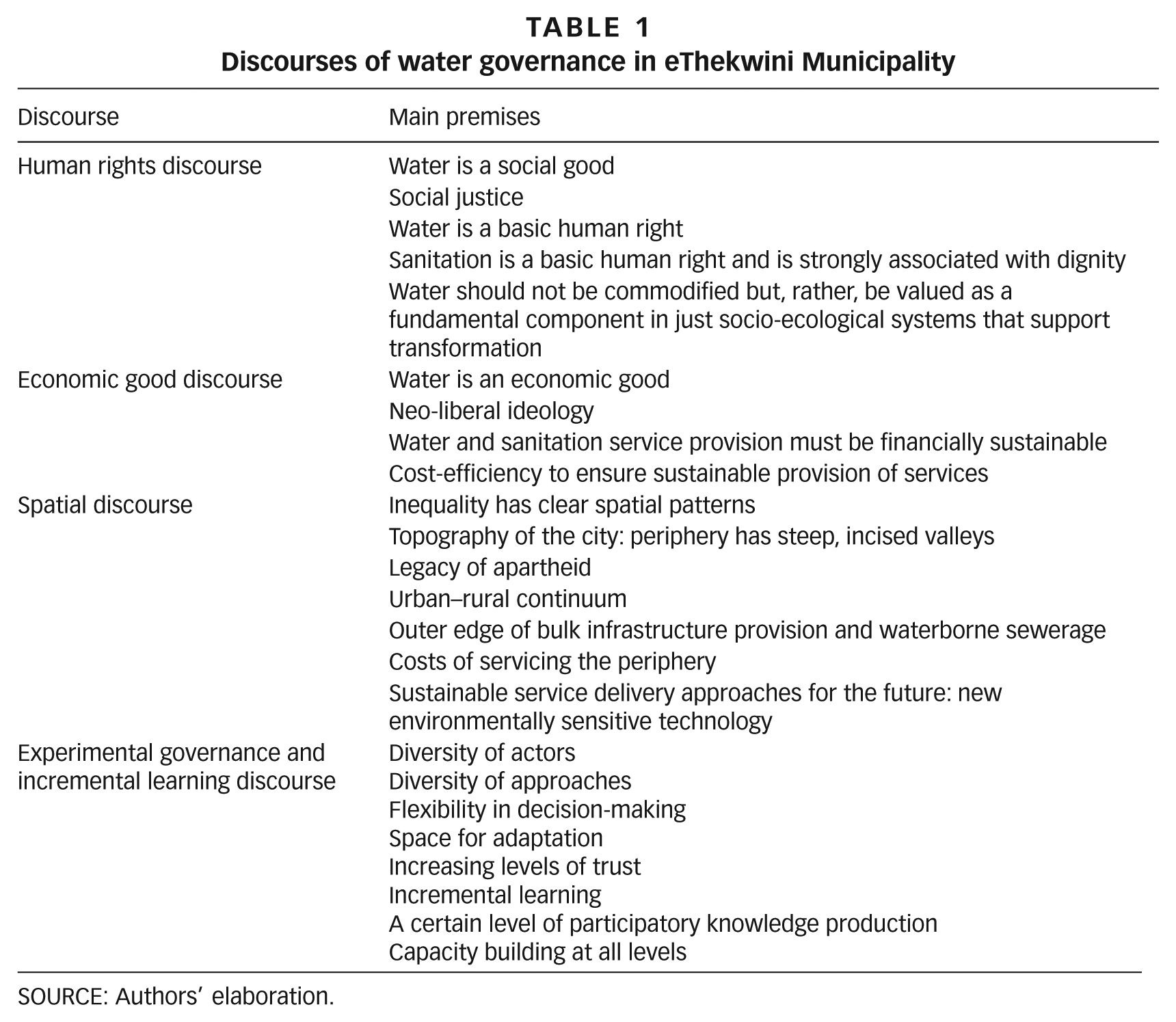
SOURCE: Authors’ elaboration.
a. Water as a human right and as an economic good
The two discourses of “water as a human right” and “water as an economic good” emerged post-democracy at the national level in South Africa and they are now strongly institutionalized within the policy and practice of eThekwini Municipality. The municipality receives its bulk water from Umgeni Water, an entity established by the apartheid state in the 1970s to provide bulk water supplies within a commercialized framework. eThekwini Municipality is Umgeni Water’s major client and the two entities are therefore mutually dependent.(30) According to Loftus,(31) this relationship places pressure on the human rights discourse for water provision, as bulk water has been commodified and brought into the circuits of capital as an accumulation strategy for Umgeni Water. EWS policy recognizes the need:
“… to regulate access to water services in an equitable way, taking into account financial, technological, socioeconomic and conservation factors; the duty of customers to pay reasonable charges; the right of the water services authority to limit or discontinue the provision of water services if there is a failure to comply with reasonable conditions set for the provision of such services.”(32)
Through its positioning of citizens as customers, EWS also draws ordinary people into the language of capital.
Water governance in the municipality is shaped, then, by two well-established discourses, namely “water as a human right” and “water as an economic good”, as state officials attempt to address the inequalities of service provision from the past and meet the demands of a fast-growing city, while remaining financially responsible and sustainable.(33) EWS has shown its commitment to the “human rights” discourse by significantly addressing backlogs in water provision post-1994 (Figure 1), also leading the decision to provide free basic water and supporting participatory approaches to water governance in the city.(34)
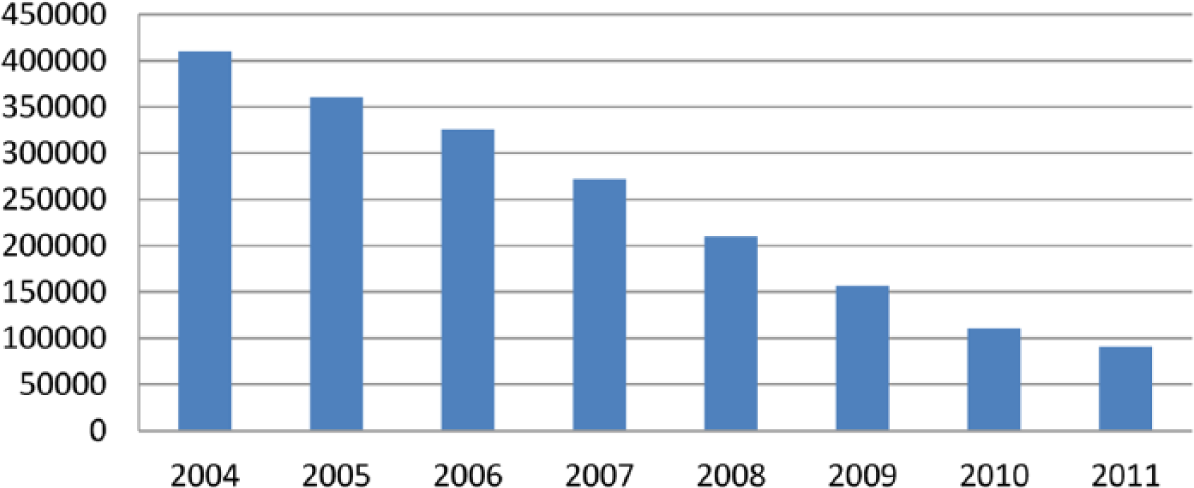
Number of people with access to water below RDP(1) levels in eThekwini Municipality, 2004–2011
The tension between free basic services and the need for cost-recovery is ever present in water governance in the municipality. However, a third discourse has emerged, namely “the spatial differentiation of service provision” discourse, which represents the juxtaposition and entanglement of “water as a social good” and “water as an economic good” discourses.
b. The emergence of a “spatial differentiation of service provision” discourse
The social geography of the city, strongly influenced by both apartheid planning and the 2000 national municipal demarcation process, with its resultant municipal restructuring, provides a particular spatial context within which approaches to water and sanitation provision in the municipality have evolved. This section outlines the main spatial determinants that have resulted in the development of a “spatial differentiation of service provision” discourse.
Durban has had a long history of segregation and spatial inequality. Figure 2 shows the racial zoning plan produced by the Durban City Council in 1944. Large areas zoned for whites were located close to the city centre, with the mission reserves on the periphery of the city zoned for “rural” Africans. These developed into the large townships of Umlazi, Inanda and KwaMashu, which epitomized apartheid spatial planning. During the apartheid era, the homeland of KwaZulu, which was formally established in 1970 and received self-government status in 1977, was located immediately adjacent to the city of Durban. Rural Africans, who were excluded from living in the formal urban area of Durban under the Group Areas Act (1950), moved as close to the boundary of the city as possible. This created areas of both rural and peri-urban housing on the periphery of the city.
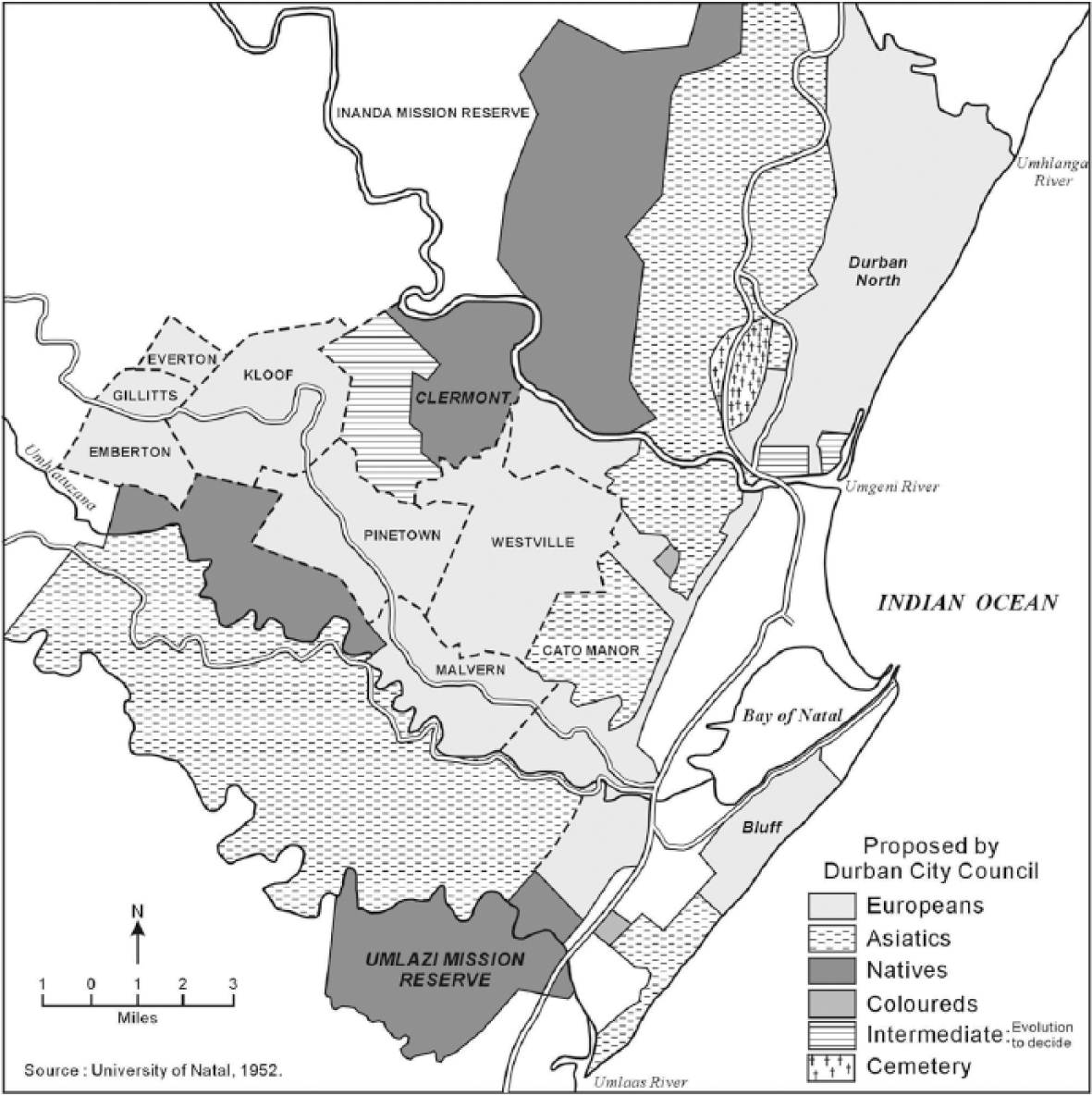
The 1944 racial zoning plan of the Durban City Council
Apartheid planning continued to influence the structure and form of the city of Durban, which by the 1980s had become known as the Durban Functional Region (DFR). The Durban Metropolitan Area was demarcated in 1995 as a result of technical and political negotiations that took place in the city in 1994, resulting in a slightly smaller municipal entity that tended to follow the old KwaZulu homeland boundary,(35) thereby creating a metropolitan area that was urban with a poor rural hinterland.
In 2000, the national municipal demarcation process in South Africa led to the reconfiguration of municipal administrative boundaries. This process was part of post-apartheid spatial restructuring, which created wall-to-wall municipalities designed to reduce socioeconomic inequalities by spatially integrating underdeveloped and poor rural hinterlands with better resourced cities and towns, allowing for cross-subsidization.(36) In Durban, this process(37) led to the formation of the administrative area of Thekwini Municipality, adding 67 per cent more land to the city, most of which consisted of underdeveloped rural and peri-urban areas under Traditional Authority(38) (Figure 3). It also added 75,000 rural households, 60,000 of which did not have access to the city’s basic services.(39) Figure 3 reveals the extent to which the boundaries of the city shifted and also the clear spatial pattern that has come to characterize what is considered “urban” and “rural” in the municipality today.
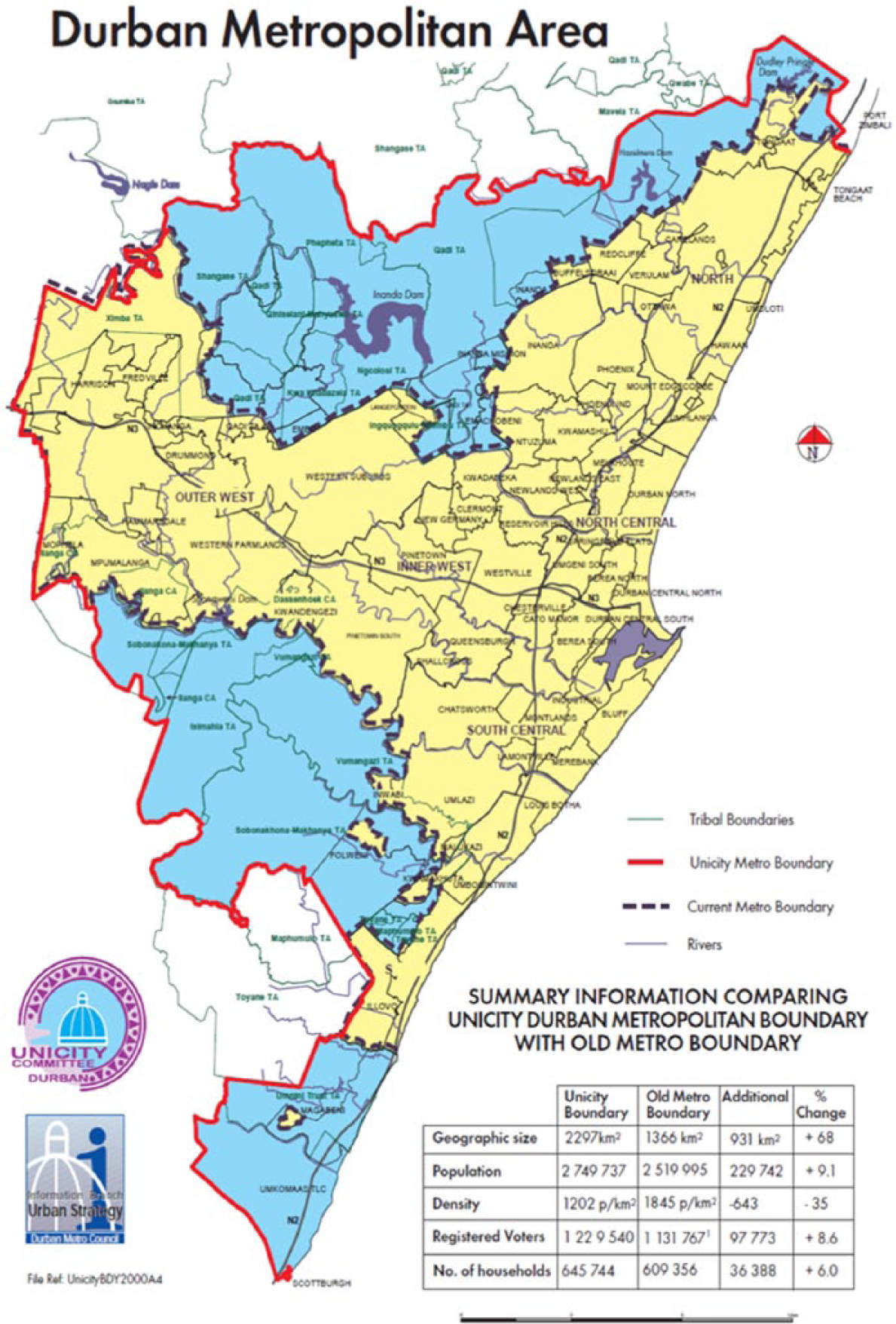
The old Durban Metropolitan Area boundary and the new unicity boundary of eThekwini Municipality, 2000
The inclusion of a large rural hinterland within the municipality resulted in a mixed typology of housing. This continuum of living environments from deep rural to high-density urban challenged local government authorities to redefine the meaning of “urban” in eThekwini Municipality and raised questions about the practicality of providing access to full urban services within the municipal boundary (Figure 4 and Figure 5). The rural areas of the city cover 1,500 square kilometres of the hinterland and they are located in the northwest and southwest of the municipality.(40) There are also peri-urban areas adjacent to the N2 and N3 corridors.(41) These areas, which are extremely poor and with many people relying on social grants, contain dispersed settlements of traditional homes. The past five years have seen an intense densification of these areas.(42) Communities in peri-urban and rural areas live at a close interface with the environment and rely on environmental services to meet their service needs and to sustain themselves. The political arrangements of the rural periphery are also complex. eThekwini Municipality administers the entire metropolitan area but, at the same time, in large parts of the peri-urban and rural areas, the Traditional Authority (the Ingonyama Trust(43)) has authority over the land and its people.
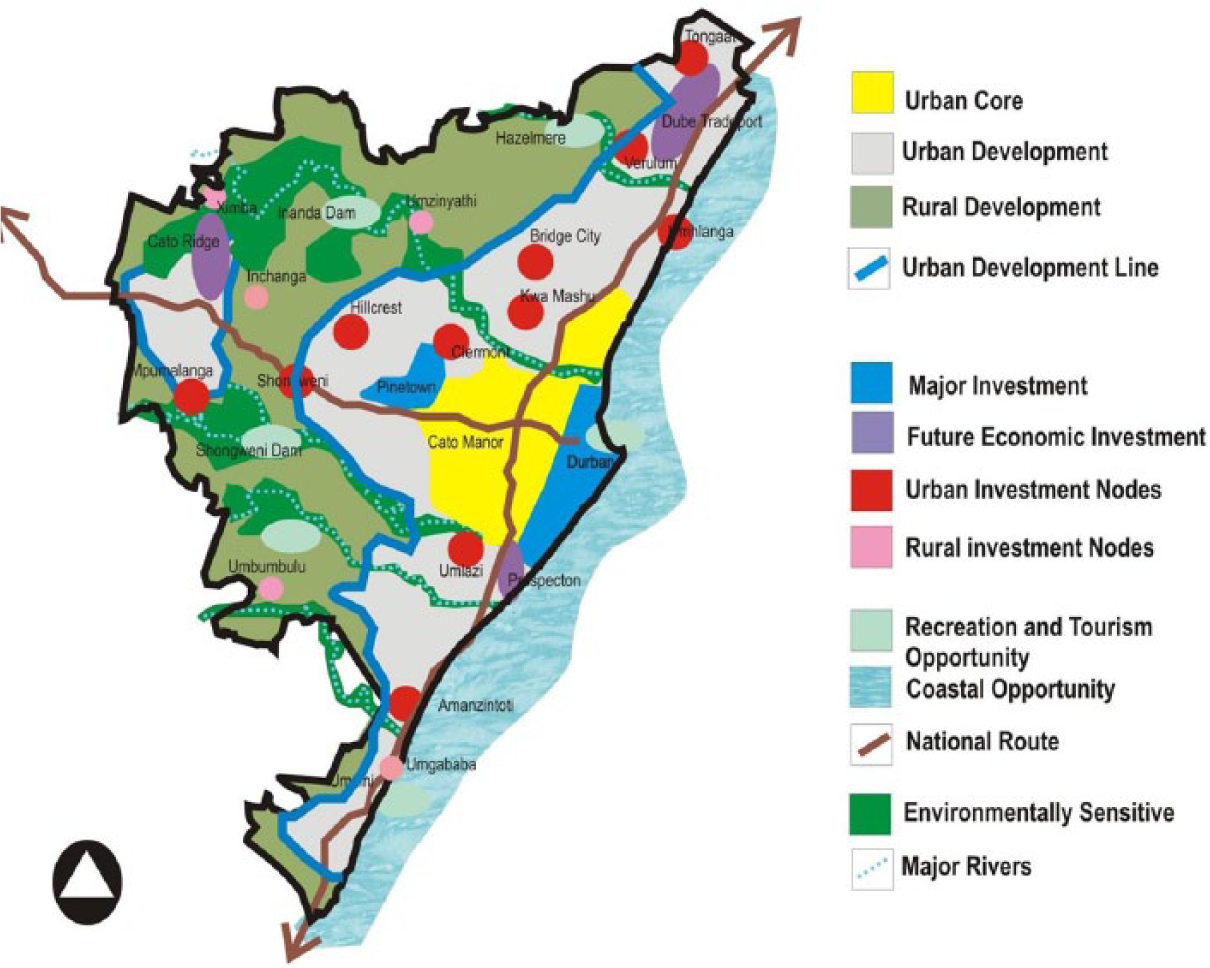
The Spatial Development Framework of eThekwini at the broad scale
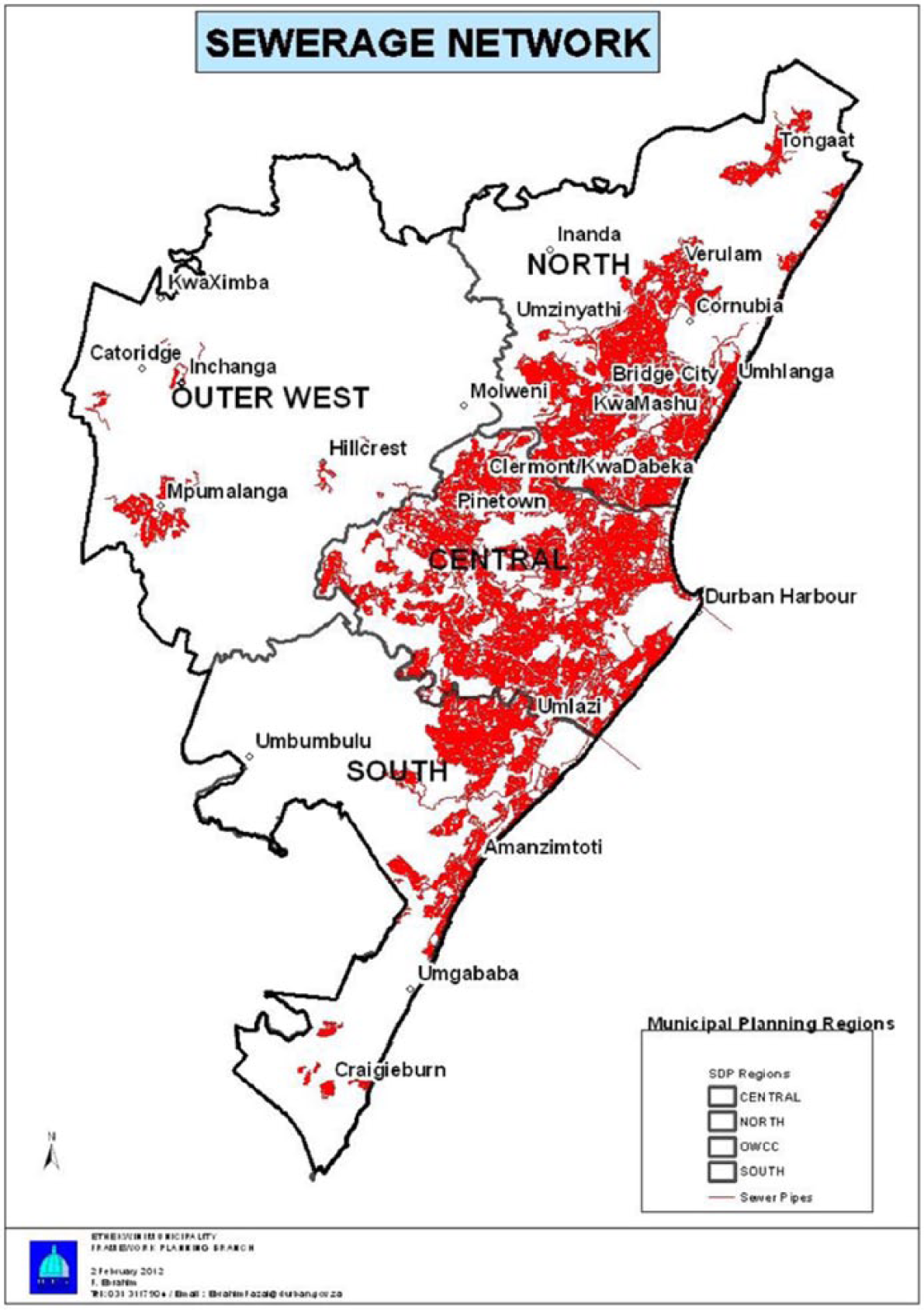
The outer boundary of the waterborne sewerage network in eThekwini Municipality that has informed the development of the urban edge and the more recent Urban Development Line (UDL)
Over the past decade, a strong spatial discourse around city administration and management has emerged in eThekwini Municipality, encapsulated in the concept of the Urban Development Line (UDL). The UDL, which is represented in maps that inform policy-making and development in the municipality, including the Spatial Development Framework for eThekwini, defines the urban and rural development zones of the municipality (Figure 4). Its purpose is to promote a more compact, efficient and sustainable urban form, as it demarcates the spatial limit of development based on infrastructure availability and protects the agricultural resources and environmental services in the rural periphery upon which many households rely.(44)
The UDL plays a critical role in negotiations around the future development of the city, as it informs spatial planning, service provision, engineering, infrastructure development and environmental management.(45) It is an extension of the original spatial planning concept, the urban edge, a physical line that defined the outer limits of waterborne sewerage provision and bulk infrastructure in the municipality (Figure 5). The UDL aligns closely with the former Durban Metropolitan Area boundary (Figure 3 and Figure 4). The eThekwini Municipality states that, as a concept, the UDL “… implies that there is a rural hinterland different in character and servicing needs, and which supports different lifestyles and densities”(46) in the city. The UDL also signals the outer extent of urban development and full urban service provision in the city. This spatial boundary defines different levels of development and services and has been used to classify different regions of the city according to their position on the urban–rural continuum.
The history of different spatial boundaries within eThekwini Municipality has culminated in the demarcation of the outer boundary of the municipality, which has been fixed since 2000, and the development of the UDL within the municipality. These various boundaries and the spaces contained within in them have played an important role in shaping water and sanitation provision in the municipality.
It is now useful to examine the service backlogs in the municipality and to reflect on their spatial location. Table 2 presents the service backlogs in eThekwini Municipality and provides an indication of the time frames required to address them.
Service backlogs in eThekwini
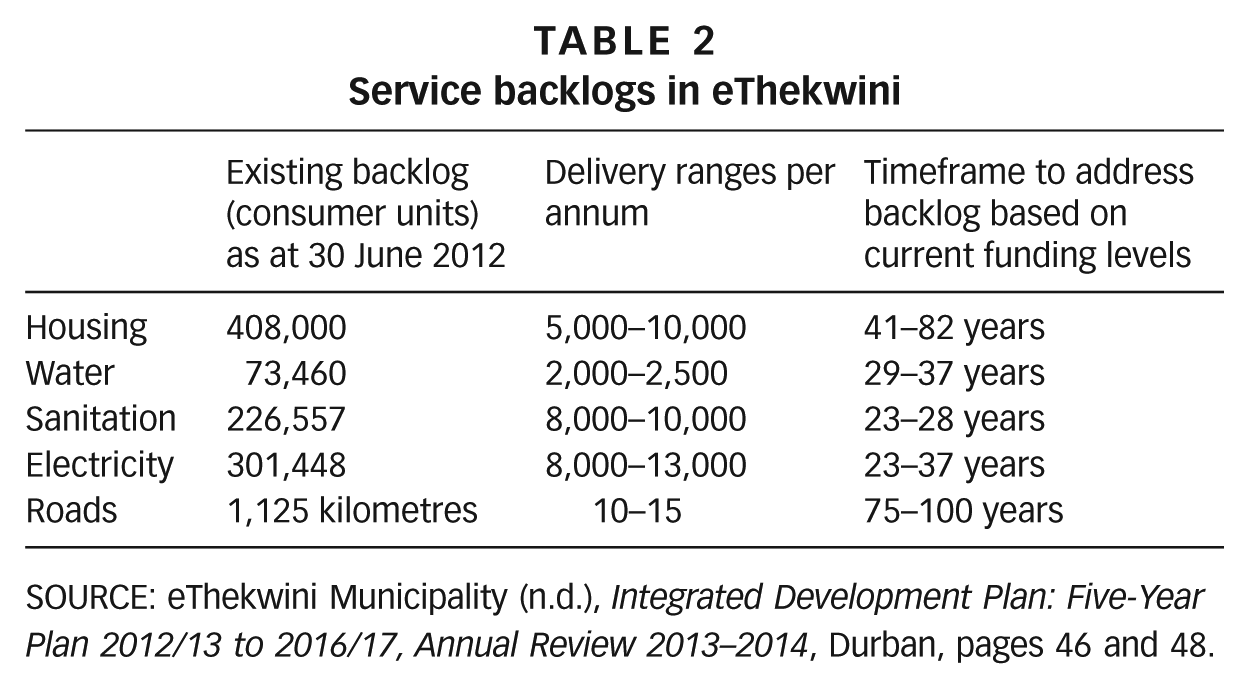
SOURCE: eThekwini Municipality (n.d.), Integrated Development Plan: Five-Year Plan 2012/13 to 2016/17, Annual Review 2013–2014, Durban, pages 46 and 48.
The spatial patterns associated with these backlogs are presented in Figure 6, which reveals that the areas of greatest need are located along the urban edge. The high density of “need” along the urban edge reflects the location of informal and peri-urban settlements in the city, which were, and still are, developed here as poor people attempt(ed) to obtain the greatest access to urban opportunities both during and post-apartheid.
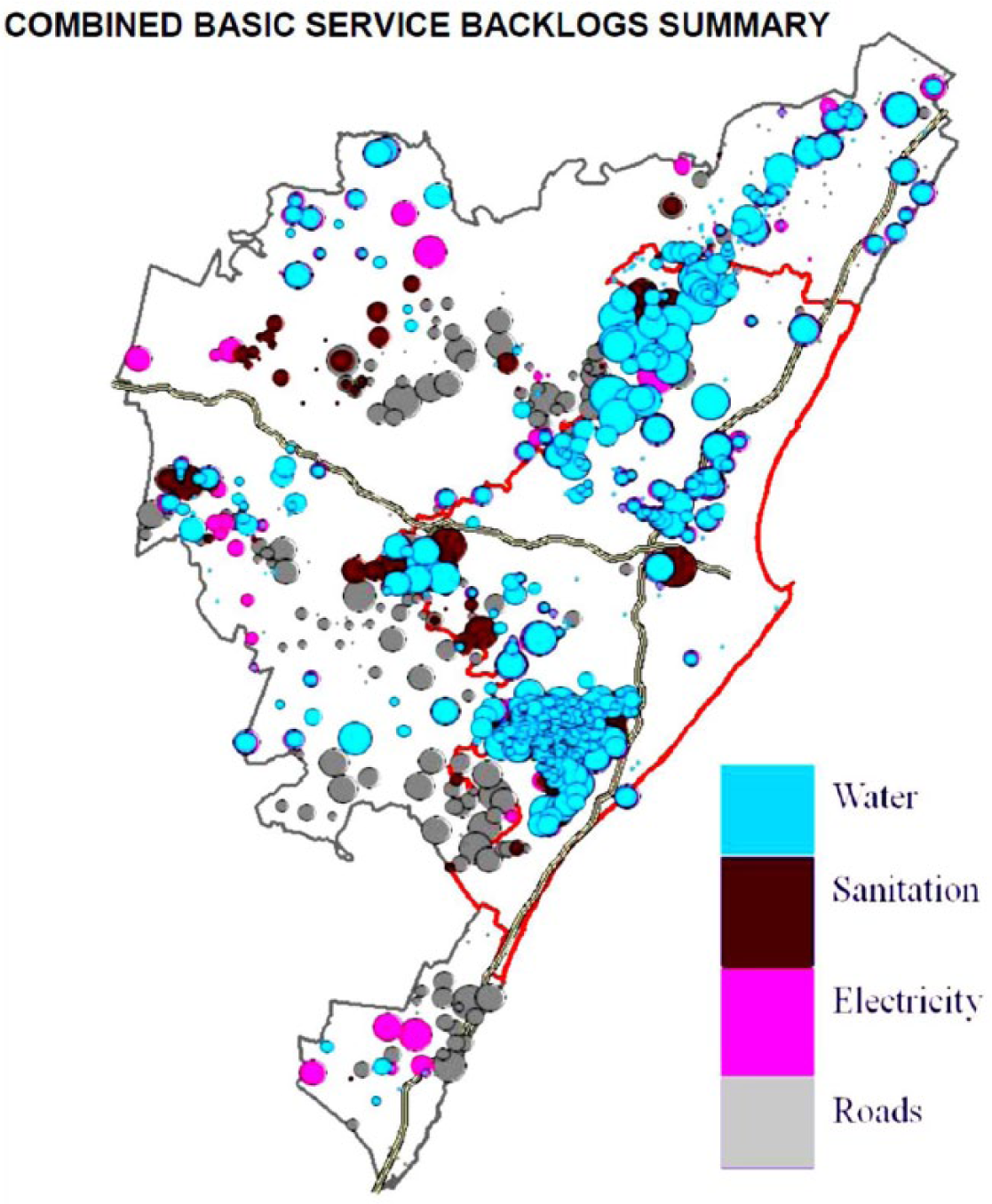
Combined service backlogs in the eThekwini Municipality
Residents of eThekwini Municipality aspire to an in-house, full-pressure water supply and flushing toilets linked to waterborne sewerage and wastewater treatment.(47) EWS argues that the provision of this level of services across the municipality, including the rural periphery, is not feasible as a result of technical, financial, environmental and political constraints. According to officials from EWS, peri-urban areas and the rural periphery raise the most significant challenges due to land ownership falling under Traditional Authority, also lower housing densities, population mobility, high servicing costs and the inaccessible and steep terrain.(48) The increasing cost of providing services to the periphery is reflected in the cost surface model developed to guide planning in the municipality (Figure 7).
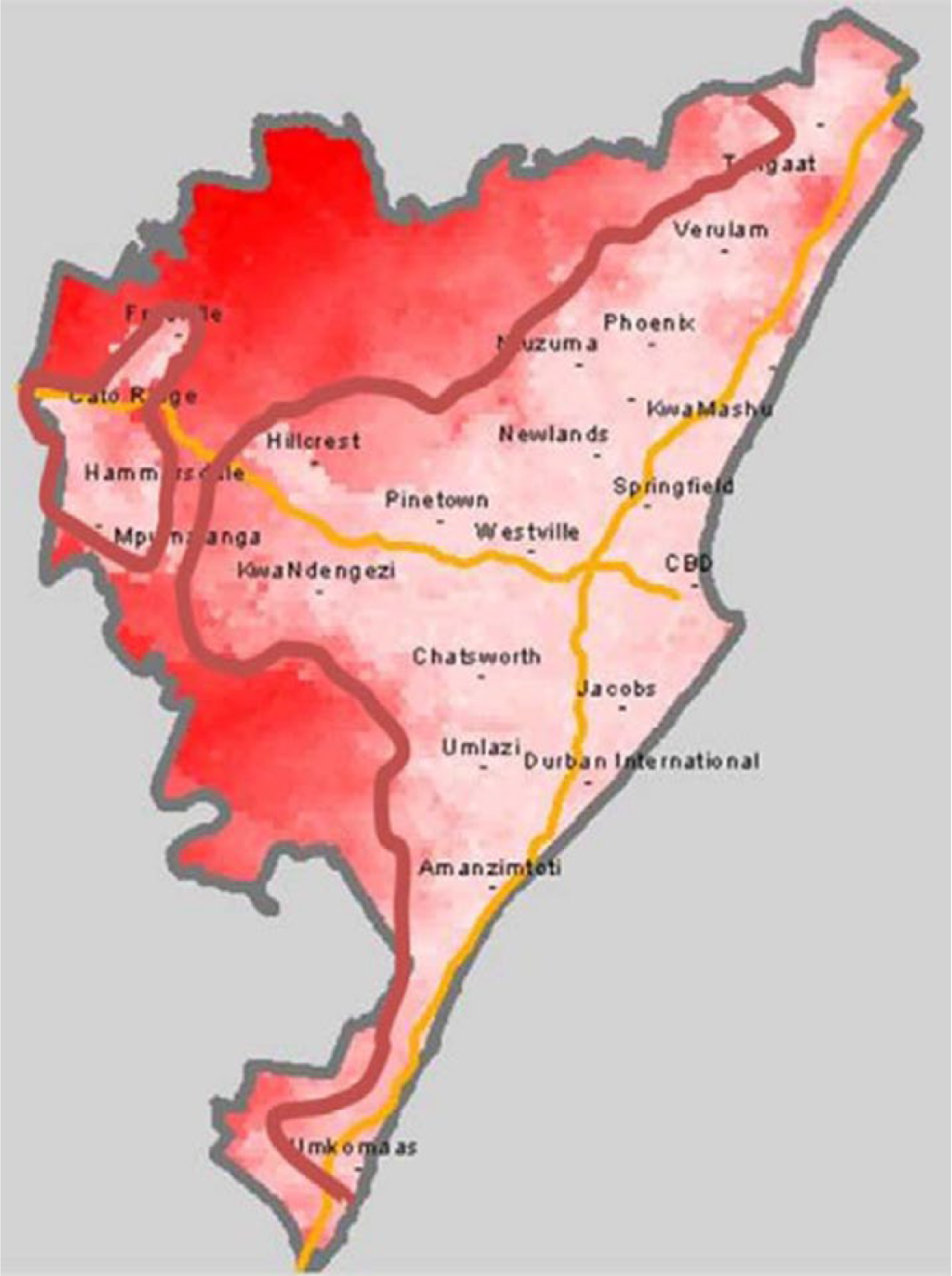
The increasing cost of providing service infrastructure to the periphery. The darker the red the higher the service costs
However, within these constraints and challenges, EWS commits itself to providing all citizens within eThekwini Municipality with access to “… appropriate, acceptable, safe and affordable basic water supply and sanitation services.”(49) It argues that these services must be equitable, with adequate services provided fairly to all people; also affordable, to ensure that no one is excluded from access to basic services because of cost; and efficient and effective, so that water and sanitation provision is socially, institutionally and financially sustainable.(50) In order to meet this commitment within the financial, physical and environmental context of the city, EWS has developed a spatially differentiated model for service provision. In eThekwini Municipality, residents in the urban core, in the transition zone along the UDL and in the peri-urban or rural periphery receive different levels of services (Table 3). Residents both within the urban core and the UDL, unless they live in informal settlements, receive full-pressure water services and have flushing toilets linked to bulk wastewater treatment or privately installed septic tanks. However, those in the rural periphery receive a range of water services. Rural communities receive free basic water of 300 litres per day (9,000 litres per month) either via a ground tank or yard taps. Ground tanks can be replaced privately by yard taps. Semi-pressure roof tank systems are installed in state-provided low-income houses and these households pay a lower tariff. When customers who receive full-pressure water services default on payments, a flow limiter is installed in consultation with the household and the household is trained to understand how it works.(51) Sanitation in rural areas consists of state-provided ventilated pit latrines (VIP toilets), which are de-sludged by the city; also urine diversion toilets(52) or dry toilets, and community-built pit latrines. In informal settlements, (unlimited) water is provided through communal taps, and sanitation is either absent, with residents using open land around the settlement, or is provided through state- and community-built pit latrines and communal ablution blocks. The new Interim Services programme that has been introduced by Engineering Services, which includes EWS, within the municipality provides flush toilets and communal taps and showers in male and female community ablution blocks in informal settlements.
Different levels of service provision across the municipality
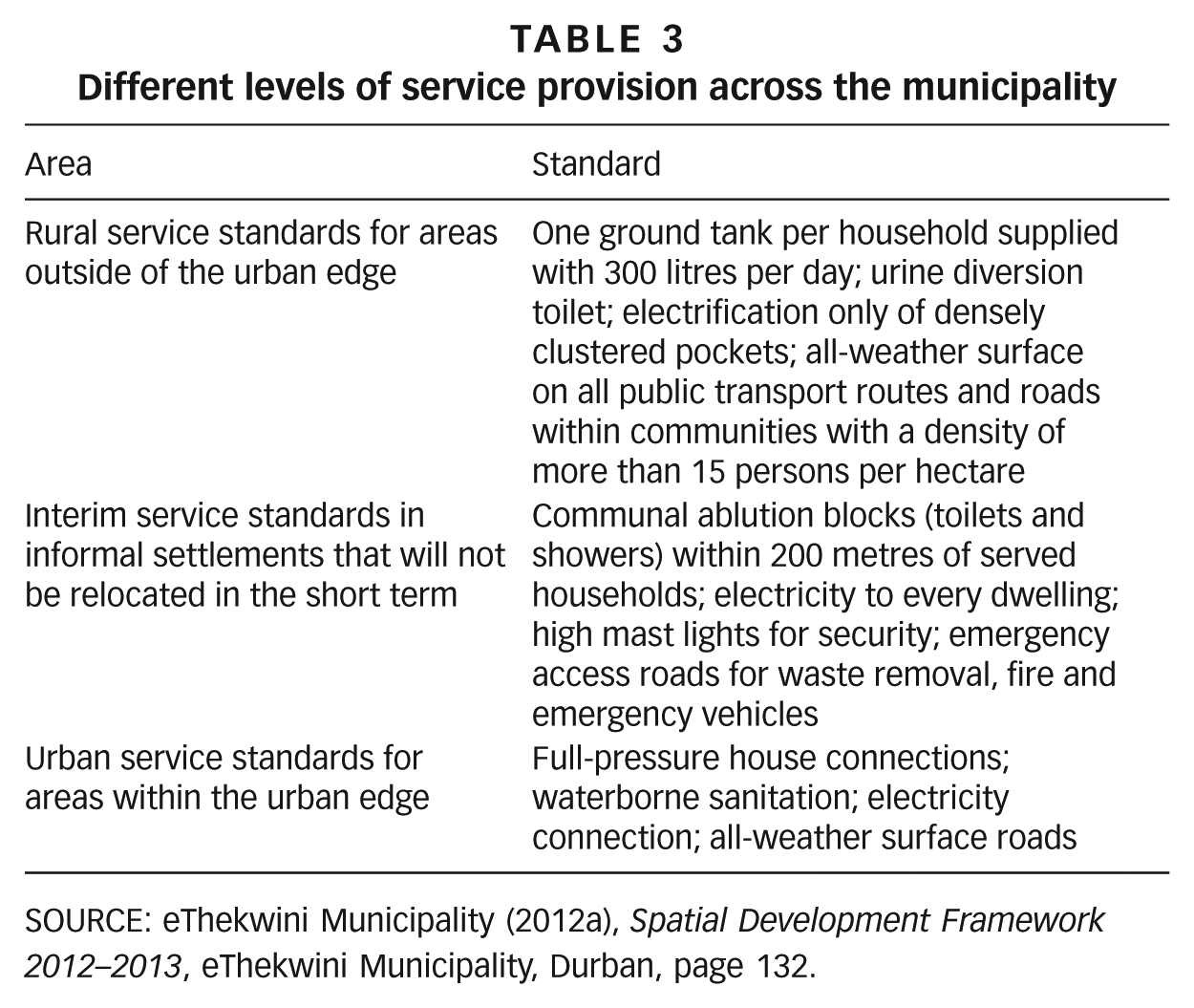
SOURCE: eThekwini Municipality (2012a), Spatial Development Framework 2012–2013, eThekwini Municipality, Durban, page 132.
The maps and data presented in this section reveal that historical and current socioeconomic and environmental factors underpin the “spatial differentiation of service provision” discourse that has emerged in eThekwini Municipality. These factors include the under-development of townships and ex-homeland(53) areas during apartheid; the steep topography of the periphery; the lack of planning for bulk infrastructure; the cost of providing services to the periphery; the limit of the provision of waterborne sewerage to the urban edge; significant environmental constraints, such as a shortage of water in the city; and fiscal constraints. Swilling(54) has argued that the future development and provision of services in South African cities cannot follow the technical development trajectories of the past, as these have resulted in the production of environmentally unsustainable ways of living. According to Swilling, cities need to adopt innovative and sustainable technologies and services in upgrading poor areas if they are to be sustainable into the future. The unequal provision of services has therefore been “rendered technical” and can therefore be defended using the spatial logic that has been presented above.(55) This “spatial differentiation of service provision” discourse is well established in the municipality and has become institutionalized, although it is contested by civil society and community-based organizations as well as some other municipal sectors. It is presented in the latest Integrated Development Plan 2012–2013 and Spatial Development Framework 2012–2013(56) and has become embedded in the development of the city, as it is aligned with the UDL concept. It is therefore a discourse not only about service delivery but also about broader development. Recently, a fourth discourse is emerging within the municipality, namely that of “experimental governance and incremental learning”.
c. The “experimental governance and incremental learning” discourse
The “spatial differentiation of service provision” discourse provides a rationale for determining what is possible in terms of service provision in the municipality, balancing the “water as a human right” and “water as an economic good” discourses. It reflects why a differentiated discourse has been developed in the context of a spatially divided and unequal municipality. The “experimental governance and incremental learning” discourse frames the approach adopted by EWS to support social learning and innovation.(57)
Hordijk et al.(58) argue that in order to foster transitionary or even transformative processes, social learning needs to be developed through collective leadership, trust, the willingness to take risks, and the development of social structures that foster experimentation and innovation. EWS, under the leadership of its Head, Neil Macleod, purposefully adopts a flexible policy framework to ensure adaptability in service provision and the room to manoeuvre.(59) Consequently, water governance in eThekwini Municipality is flexible and adaptive both in terms of process and practice. The organizational culture at EWS has developed around an openness towards learning, support for experimentation, a lack of fear of being innovative, and of learning from mistakes. This organizational culture develops confidence among EWS officials at all levels to open up the space to discuss, among different actors, what is and is not working in water and sanitation provision and how research or community engagement might improve the policy and practices of the state.
Incremental learning thus forms a core part of the business of EWS. This learning results from engagement with research and civil society organizations and communities. The state has adopted a diversity of approaches to secure access to water and sanitation for the poor, experimenting with technologies that are both affordable and environmentally sustainable, albeit socially challenging. For instance, EWS has recently been engaged in research to ascertain the viability of re-using grey water for potable water in the city, which has proved to be a controversial but nonetheless very real option in the face of water scarcity. The knowledge base underpinning these experiments is built up internally and through engagement with other actors. EWS was one of the early adopters of Geographic Information Systems (GIS), and thus spatial knowledge has played a critical role in shaping policy and practice.
EWS also supports a certain level of participatory knowledge production; however, this is controlled by the local state and thus may be deemed “managerial” participation rather than deep participation. EWS has developed a number of important initiatives, including the establishment of focus groups and user platforms,(60) the publication of a widely available customer services charter and the development of service-level standards. The Raising the Citizen’s Voice project, user platforms and focus groups as well as research in communities have created platforms that enable interactions between the local state and its citizens. An outcome of this interaction has been the increase by EWS in the basic supply of free water from 6,000 litres per household per month to 9,000 litres, based on community concerns that 6,000 litres was not sufficient for larger households. These platforms are also a way of ensuring that customers enter the formal system rather than participating in the practice of illegal connections.(61) Empirical evidence suggests that this engagement between the local state and its “customers” influences water policy, albeit reflecting the “client” (or neo-liberal) relationship that the local state has with those it provides services to.(62) This example reflects the fact that EWS adopts a “learning from experience” approach, or experimental governance.(63)
The level of trust between ordinary citizens and the state around water issues, and the provision of water services in particular, has improved significantly since 1994.(64) Members of civil society organizations that actively engage with the local state around water rights acknowledge a positive relationship and recognize what has been achieved in the context of the challenges the municipality faces.(65) However, there are high levels of mistrust of the local political system; communities do not always feel that they can depend on their elected councillors to address their development needs.(66) The state empowers and co-opts communities through material provision but disempowers them in its engagement with ordinary citizens through the ward committee system, which was designed post-apartheid to ensure participatory democracy but that has not met its goals.(67)
However, communities are actors and they shape the outcomes of state policy and practice in a multitude of ways.(68) Loftus states that communities respond to water “injustices” through “everyday” actions that reflect a “resilience and reworking” of the waterscape to create their own just systems, “… ensuring genuinely free access to water.”(69) Evidence of adaptation by communities reveals both a “coping poor” and a “mobilizing poor” who have acted to ensure that the technical provision of water and sanitation by the state addresses social and political concerns.(70) Hence, the provision of a basic supply of water at the household level is a result of both state and community agency. In Durban, communities have tended to navigate and alter the unequal services provided to them through their own innovative action rather than through social protest that has been evident elsewhere in the country.(71)
IV. Conclusions
This paper has presented the dominant discourses that are shaping water governance in eThekwini Municipality. The first two discourses, “water as a human right” and “water as an economic good”, are well established in debates about water governance in South Africa and in eThekwini Municipality.(72) Two more recent discourses have also emerged within the socioeconomic, political and environmental context of eThekwini Municipality, namely the “spatial differentiation of service provision” discourse and the “experimental governance and incremental learning” discourse.
The “spatial differentiation of service provision” discourse is underpinned by a number of material, economic, political and environmental arguments and is reflected in the municipality’s UDL. According to Sutherland and Lewis,(73) this spatially differentiated discourse may be a necessary step in the post-apartheid transformation of eThekwini Municipality, given the vast challenges in service provision produced by both apartheid and the national demarcation process. However, they and Sim et al.(74) argue that it is important to open up a space to deliberate the construction, position and value of the UDL, if the water and sanitation provision model that is shaped by this construct is to adapt to become more socially, politically and environmentally acceptable and sustainable in the future.
The “experimental governance and incremental learning” discourse reveals both a local state and citizenry that are attempting to move towards greater sustainability through experimental governance and adaptation. Within the approach framed by this discourse, the politics of service provision has been opened up, sometimes in both a contested or controlled and structured manner. The relationship between the local state and citizens around service provision has been strengthened through the creation of channels of communication, allowing each to better understand the position of the other. Through this engagement, citizens have come to appreciate the technical challenges faced by the local state in addressing the issue of service inequality. Similarly, the local state has become more responsive to the circumstances of the poor and has sought ways to tackle the more challenging social problems associated with service delivery. Incremental learning and flexible or adaptive management have also played a critical role in ensuring greater sustainability in service provision within the municipality.
Transitions in water governance are complex, long-term, societal changes involving multiple actors.(75) Water governance in eThekwini Municipality can be categorized as being in a phase of experimental governance. Most of the shifts that have taken place can be attributed to good leadership, high levels of capacity throughout EWS and the co-production of knowledge through the engagement of a multiplicity of actors in the water governance arena. The leadership in EWS is of a generation about to retire and hence there will soon be a shift in the management regime. The future will reveal whether the shared discourses and the integrated knowledge and praxis that have been developed and that have placed EWS on the international stage of best practice in water delivery will survive a leadership change. However, change also provides new opportunities for a greater shift towards an approach framed by “social-ecological” thinking and greater equality, something that EWS under its current leadership is already beginning to tackle.
Footnotes
Acknowledgements
The authors would like to thank the EU 7th Framework Programme for funding the research for Chance2Sustain (Project No 244828); also the South African Chance2Sustain team and two anonymous reviewers for their most helpful comments. The partners in Chance2Sustain are the European Association of Development Research and Training Institutes (EADI), Germany; Amsterdam Institute of Social Science Research (AISSR), University of Amsterdam (the Netherlands); the French National Centre for Scientific Research (CNRS), France; the School of Planning and Architecture (SPA), India; Cities for Life Forum (FORO), Peru; Centro Brasileiro de Analise e Planejamento (CEBRAP), Brazil; the Norwegian Institute for Urban and Regional Research (NIBR), Norway; and the University of KwaZulu-Natal (UKZN), South Africa. For more information on the research programme, see  .
.
1.
eThekwini Municipality is the administrative name for the city of Durban, including the newly incorporated rural areas.
2.
This includes two United Nations Awards for 2007 and 2011.
3.
Bond, P (2005), “Reclaiming water pricing for participatory public services”, available at http://www.waterjustice.org/uploads/attachments/pdf68.pdf; also Loftus, A (2006), “Reification and the dictatorship of the water meter”, Antipode Vol 38, No 5, pages 1023–1045.
4.
See Sutherland, C and B Buthelezi (2012), Addressing Sub-standard Settlements: Durban, South Africa, Chance2Sustain WP3 Settlement Fieldwork Report, November, Chance2Sustain, EADI, Bonn, 184 pages.
5.
In comparison to the three other papers on water in this issue of the Journal, this paper has focused on the discourses of water governance in eThekwini Municipality rather than on the approaches adopted, and the discourses identified are evident in the debates, policy documents and deliberation around water governance that are present in the municipality.
6.
For a description of this common conceptual framework, see Hordijk, Michaela, Liliana Miranda Sara and Cathy Sutherland (2014), “Resilience, transition or transformation? A comparative analysis of changing water governance systems in four southern cities”, Environment and Urbanization Vol 26, No 1, pages 130–146.
7.
Seekings, J and N Nattrass (2005), Class, Race and Inequality in South Africa, Yale University Press, 464 pages; also Leibbrandt, M, I Woolard, A Finn and J Argent (2010), “Trends in South African income distribution and poverty since the fall of apartheid”, OECD Social, Employment and Migration Working Paper No 101, OECD Publishing, 91 pages; and Pieterse, E (2010), “Filling the void: towards an agenda for action on African urbanization”, in African Centre for Cities, Urbanization Imperatives for Africa, Transcending Policy Inertia, pages 6–27.
9.
Statistics South Africa (2012), Census 2011, 78 pages, see http://www.statssa.gov.za.; also see reference 7, .
10.
Muller, M (2008), “Free basic water – a sustainable instrument for a sustainable future in South Africa”, Environment and Urbanization Vol 20, No 1, pages 67–87; also Tissington, K, M Dettmann, M Langford, J Dugard and S Conteh (2008), “Water services fault lines. An assessment of South Africa’s water and sanitation provision across15 municipalities”, CALS, COHRE, University of Oslo, 88 pages.
11.
Bond (9 March 2012), cited in Meyer, C (2013), “Negotiating water values. The role of key actors’ positionalities and knowledge networks in the water governance arena of eThekwini, South Africa”, Masters in Development Studies, University of Amsterdam, pages 65–67.
12.
15.
Gounden, T, B Pfaff, N Macleod and C Buckley (2006), “Provision of free sustainable basic sanitation: the Durban experience”, Paper presented at the Conference on Sustainable Development of Water Resources, Water Supply and Environmental Sanitation, 32nd WEDC International Conference, 6 November 2006, Colombo, Sri Lanka, 4 pages.
17.
See reference 3, Loftus (2006); also see reference 10, .
19.
Interview with M Galvin, Director of Umphilo waManzi, 25 July 2012.
21.
Department of Water Affairs and Forestry (2002), “The free basic water policy, Q & A brochure”, August, 4 pages, available at .
27.
30.
See reference 3, Loftus (2006); also see reference 11, .
32.
33.
See reference 3, Bond (2005); also see reference 3, Loftus (2006); see reference 10, Muller (2008); Naster, M and V Ramasar (2012), “Transition in South African water governance: insights from a perspective of power”, Environmental Innovation and Societal Transitions Vol 4, pages 7–24; and Sutherland, C, S Buthelezi, C Meyer, K Geesink, B Lewis and N Ngetar (2012), Water Governance in eThekwini Municipality (Durban), South Africa, Chance2Sustain Fieldwork Report, November, Chance2Sustain, EADI, Bonn, 47 pages.
34.
Interview with B Ashe, civil society activist, 7 September 2012; also interview with M Galvin, Director of Umphilo waManzi, 25 July 2012 and 18 January 2013; see reference 33, Sutherland et al. (2012); and Lewis, B (2013), “A justice perspective of water and sanitation service delivery: a case study of water vulnerabilities in three sub-standard settlements of eThekwini Municipality, South Africa combined with an analysis of eThekwini water and sanitation unit’s ‘official’ channels of participation”, Masters in Development Studies, University of Amsterdam, 131 pages.
35.
McCarthy, J (1995), “Greater Durban Metropolitan Area”, 2 pages, available at .
36.
Baud, I S A, D Scott, K Pfeffer, J Sydenstricker-Neto, E Denis and L C M Minyaya (2013), Spatial Knowledge Management in Urban Local Government: e-governance in India, Brazil, South Africa and Peru, WP5 Fieldwork Report, EADI, Bonn, 146 pages.
37.
For more details on this process, see reference 36.
38.
Land that was located in the homeland of KwaZulu was governed under Traditional Authority. This land continues to be held by the Ingonyama Trust and hence is still communal land governed by the Traditional Authority. However, eThekwini Municipality is responsible for service provision on this land as it is located within the municipality’s boundaries.
39.
41.
The N2 and N3 are two national roads that shape the geography of the city. The N2 runs north to south and the N3 runs east to west.
43.
The Ingonyama Trust is a management entity responsible for the administration of about 2.8 million hectares of land across the province of KwaZulu-Natal. The Trust has responsibility for managing the land on behalf of people who live in traditional areas and is headed by Zulu King, Goodwill Zwelithini.
45.
Sim,V, C Sutherland and D Scott (2014), “Pushing the boundaries – urban edge challenges in eThekwini Municipality”, Paper presented at the South African Cities Conference, 27–28 March, Witwatersrand University, Johannesburg (n.p.).
46.
See reference 45, page 12.
47.
See reference 15.
48.
Breetzke, K (2009), From Conceptual Frameworks to Quantitative Models: Spatial Planning in the Durban Metropolitan Area, South Africa – The Link to Housing and Infrastructure Planning, Report prepared for UN–Habitat (2009), Revisiting Urban Planning: Global Report on Human Settlements 2009, 22 pages, available at .
49.
eThekwini Water and Sanitation Unit (n.d.), “eThekwini customer charter 2013–2014”, page 1, available at .
50.
See reference 49.
51.
Interview with T Gounden, EWS official, 15 March 2013, as part of the Chance2Sustain research project.
52.
The municipality has developed urine diversion (UD) toilets as a new approach to providing sanitation in rural and peri-urban areas that are not connected to the waterborne sewerage system and where households cannot afford to provide their own private septic tanks.
53.
In the case of eThekwini, the homeland of KwaZulu was located immediately adjacent to, and on the periphery of, the “white” urban area of Durban.
54.
Swilling, M (2006), “Sustainability and infrastructure planning in South Africa: a Cape Town case study”, Environment and Urbanization Vol 18, No 1, pages 23–50.
55.
Murray Li, T (2007), The Will to Improve: Governmentality, Development and the Practice of Politics, Duke University Press, London, 374 pages.
56.
The Municipal Systems Act (No 32) of 2000 requires that local government structures prepare Integrated Development Plans (IDPs). The IDP serves as a tool for transforming local governments towards facilitation and management of development within their areas of jurisdiction. The IDP guides development over a five-year period and contains the vision and strategic priorities for the municipality, including specific projects and their associated budgets, and it is spatially represented in the Spatial Development Framework.
57.
Sutherland, C and B Lewis (2012), “Water and sanitation delivery in eThekwini Municipality: a spatially differentiated model”, Opinion Paper No 6, December, Chance2Sustain, 4 pages, available at .
58.
See reference 6.
59.
Interview with N Macleod, Head of EWS, 25 April 2012, as part of the Chance2Sustain research project.
60.
The user platforms are water forums that have been established by EWS as a result of the ‘Raising the Citizen’s Voice’ project. Interview with M Malakoana, 23 October 2012, as part of the Chance2Sustain research project.
61.
EWS believes that their customers will enter the formal administrative water system rather than obtain water through illegal connections if they are provided with a sufficient basic supply of free water.
62.
Interview with M Malakoana, 23 October 2012; also Geesink, K (2013), “Introducing ICT in the public sector; e-government in eThekwini”, Masters in Development Studies, University of Amsterdam, 67 pages; and see reference 34, .
63.
Pelling, M (2011), Adaptation to Climate Change: From Resilience to Transformation, Routledge, London, 224 pages; also see reference 6.
64.
See reference 33, Sutherland et al. (2012); also see reference 34, Lewis (2013); and see reference 11, .
65.
Interview with M Galvin, Director of Umphilo waManzi, 25 July 2012 and 18 January 2013; also interview with B Ashe, civil society activist, 7 September 2012; and interview with D Khumalo of Umphilo waManzi, 21 January 2013, as part of the Chance2Sustain research project.
66.
Stoorvogel, L (2011), “Community activism across generations in eThekwini Municipality”, unpublished Masters dissertation, University of Amsterdam, 73 pages; also see reference 33, Sutherland et al. (2012); and see reference 4, .
67.
Sutherland, C, G Robbins, D Scott and V Sim (2013), Durban City Report, Report prepared for Chance2Sustain, 94 pages, available at .
68.
See reference 57.
70.
Sinwell, L (2011), “Is ‘another world’ really possible? Re-examining counter-hegemonic forces in post-apartheid South Africa”, Review of African Political Economy No 38, Vol 127, pages 61–76; also see reference 34, .
72.
See reference 3, Bond (2005); also see reference 3, Loftus (2006); see reference 10, Muller (2008); and see reference 33, .
73.
See reference 57.
74.
See reference 45.