




Abstract
This paper suggests that what may appear to be insoluble problems of urban poverty and exclusion in Asian cities can be solved; and that the greatest force to do this already exists, in rough form, in the people who experience that poverty and exclusion themselves and have the greatest motivation to change it. It notes how most government programmes and formal development interventions ignore this force or seek to suppress it, so it remains a potential, not an actual, force for change. The paper describes how the Asian Coalition for Community Action (ACCA) programme, using a few simple tools and conditions and a modest, flexible budget, is trying to unlock that force at scale, opening up new space, new collaborations and new possibilities that are beginning to resolve these problems. The paper describes several of the tools and conditions that are part of the ACCA intervention – the support for collective processes, partnerships, finance and land tenure; for many initiatives on the ground; for moving to work at city scale; for communities prioritizing what gets support; and for building a platform for negotiation and partnership in each city. These are helping people to solve their problems and pave their own literal and metaphorical pathways to freedom, and to legitimate and valued citizenship in their cities.
I. Introduction
The Indian economist and Nobel laureate Amartya Sen describes development as “…a process of expanding the real freedoms that people enjoy.”(1) It is hard to imagine how Asia’s urban poor could be less free than they are or more thoroughly excluded from Asia’s prosperity and new democratic openings: looked down upon by their local governments and better-off neighbours as illegals in their homes and livelihoods; denied access to the city’s most basic entitlements; evicted, demolished, pushed outside the boundaries of all that is considered legal and legitimate because they cannot afford formal market housing. Nobody can enjoy those freedoms without decent housing and secure tenure, without access to clean water or without the ability to take part in the life of their cities. Some 600 million Asians are now living in squalor and insecurity in urban informal settlements. Despite all the poverty reduction programmes, the housing initiatives, the development theories, the billions being poured into urban development and the efforts of governments and development professionals, their problems are not being addressed. Many development agencies or professionals now ignore a problem that seems insoluble, while others call for nothing less than a revolution in the entire social, political and economic order.
We argue that it is possible to solve these problems and the greatest and potentially most effective problem-solving force already exists, within those “slum”(2) settlements. The energy, resourcefulness and motivation of low-income households and communities to bring about change in their own lives constitute a substantive problem-solving force. But it is a force that is constantly being constrained, coerced, co-opted and suppressed by mainstream development practice. As a result, the urban poor themselves end up believing that they have no power to make change.
The Asian Coalition for Community Action (the ACCA programme) whose different aspects are described in other papers in this issue is an attempt to liberate that force. It seeks to do so by finding ways to help low-income and otherwise disadvantaged communities take action to tackle and solve these problems themselves, in their own ways, at scale and by taking action to liberate themselves, to make their own freedom. After three years, the programme is showing that this is possible, and how a few simple tools and conditions and a very modest budget – that comes with a clear direction but without imposing a model – can unlock that force at scale, opening up new space, new collaborations and new possibilities that are beginning to resolve these enormous problems (Box 1). This paper examines some of these tools and conditions that are part of the ACCA intervention, and looks at how they are helping people to solve their problems and pave their own pathways to free, legitimate and valued citizenship in their cities.
II. Pathways to Freedom
As noted in Boonyabancha and Mitlin,(3) one of the most striking aspects of the small projects supported by ACCA in its first two years is the number of communities that chose to build paved roads and pathways; of the 543 small projects, 126 were roads and pathways (23 per cent of the total).
Why are so many communities deciding on this kind of project? A road is used by and benefits everyone in the community; it is a communal improvement. But besides providing access, a road – even a very narrow one – provides a common open space in a crowded community, which can function as a playground, meeting place, market, workshop or festival venue. A block of toilets or a water supply system can certainly improve conditions but a paved road has a greater symbolic power to change both internal and external perceptions of a community. A community with a proper road is part of the larger society. Most informal settlements are isolated, even when they are in the middle of a city. A paved road is a visible improvement and a potent symbol of connectedness, physically and symbolically linking the quasi-invisible community with the formal city. A good road also makes a strategic pioneering improvement, since other municipal services such as piped water and electricity often follow.
The ACCA programme begins with the belief that the poor are our equals in the truest and most human sense, as full of talents and foibles, dreams and history, ideas and resourcefulness. The energy and creativity with which the urban poor manage to feed, clothe and house their families, in extremely difficult circumstances and with no help from anyone, constitutes extraordinary survival strength. While this is not in itself a surprising conclusion, many formal development projects are designed and carried out without recognizing this. The urban poor are taken to be helpless, ignorant, uncooperative and untrustworthy, and so have to be trained, motivated, “conscientized” and capacitated, as though poverty was a behavioural problem and not the result of deep structural inequities in our societies. This explains why so much development money is spent on training and capacity building, while so little is available for actual projects that enable low-income families to make improvements to their housing or living conditions. This also explains why the urban poor are almost never allowed to manage the money or make any of the important decisions, and why if they are allowed to participate at all, their “participation” is usually limited to being allowed to consent to, pay for or provide free construction labour to projects that were planned and conceived by someone else. The condescension, disrespect and mistrust present in formal development projects is so universal that we sometimes stop seeing it for what it is.
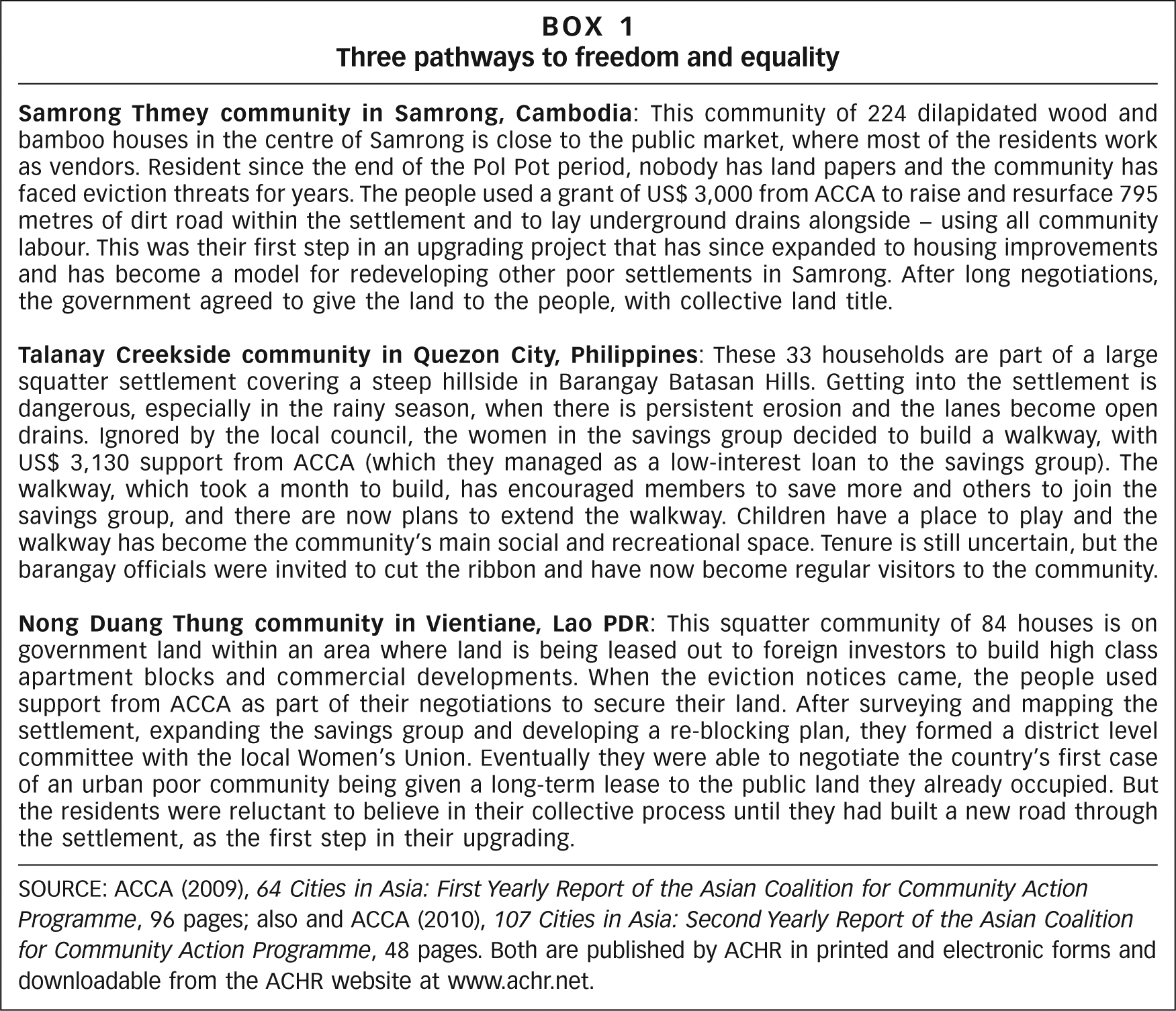
Three Pathways to Freedom and Equality
Development interventions take a different form if they begin with an appreciation of the knowledge and capacities of the poor who survive in such extremely difficult circumstances; and with a recognition that the thoughts and actions of the urban poor are valid, that they are capable and that they have the potential to lead their own change process from the very beginning. But their environment makes realizing that potential extremely difficult; the space for them to start making change is not ready, and various factors keep their energy and resourcefulness in check. The urban poor need support so that they can recognize, capture and channel their ability and strength to achieve better living conditions, stronger and more nurturing communities, greater legitimacy and full citizenship.
III. Collective Action, Collective Change
It is in the nature of poverty that poor people cannot survive alone, for as individuals they have no power. Individualism may work for the affluent and the middle class, and it may be the prevailing social and economic paradigm of our commercial age, but it is not the way of the poor. Their communities, their families, their support networks and their survival systems all operate on the principle of mutual help and represent a kind of rough collectivism – a collectivism that is essential to getting on in a harsh and unequal city without much money. The only way they can attain all the things they need is by helping each other and by working together in a collective process, in which the power of their numbers takes the place of the missing power of money.
The power of those collective support systems that poor people create and utilize to resolve their needs is actually another kind of wealth – a social wealth. For the poor on the ground, the collectivity, the relationships and the interdependence that make up this social wealth are all quite natural. This collectivity in poor communities is not perfect but it is one of their greatest assets in moving beyond the current reality of their lives. Any intervention that is individualistic, suggesting that people only need to think about and address their individual problems, is not going to bring about any significant change. These kinds of individually targeted and welfare-oriented programmes, in which the principal relationship is between the outside agency and the individual beneficiary, end up damaging this collective social wealth as they divide individuals or communities into mutually resentful camps of beneficiaries and non-beneficiaries.
Those involved in ACCA have found that getting those social relationships in communities to work better, and building them into a new strength is relatively easy when that powerful strength is explicitly channelled into concrete development activities that people do together. ACCA activities, planned and undertaken by the residents of informal settlements themselves, all emphasize this collectivity and strengthen it in different ways:
IV. Starting Immediately with Many Concrete Activities
Donor funding for “software”, such as capacity building, training, meetings and human rights awareness raising, is often much easier to obtain than funds to support any real material projects to improve housing and neighbourhoods – the “hardware”. Despite training and capacitating, communities are seldom able to move to change-making action that takes some concrete form. ACCA began with the “hardware”, allowing large numbers of small but concrete projects to be implemented by people in each city. These people are also engaged in many other ways, surveying and mapping their settlements, setting up savings groups and city development funds, organizing meetings to share stories, set priorities, make plans and discuss which communities are in most need of what upgrading projects, negotiating with the city for land, for resources and for various kinds of support, and implementing housing projects. All these activities address real needs and create a powerful organizational and political momentum, both within communities and in the city as a whole.
V. Starting the Process in a City with a Survey and Mapping
Poverty isolates, geographically and socially, and most low-income people are too concerned with surviving to give much thought to others in their city. But when people come together and start surveying the other slums in the city, they realize they are not alone, they make new friends and recognize the value in solidarity.(4) The survey is the first step in developing a larger and more structural understanding of the city and the various problems faced by the urban poor. Comparing the similarities and differences between informal settlements, a crucial part of a citywide survey, is the best way for communities to develop that kind of wider understanding about the problems and about their own place in the city. The information enables a collective strategy for tackling these problems, of how to prioritize and select who needs what most urgently; and citywide surveying and mapping are powerful ways of challenging isolation and invisibility. We see many examples of this kind of breakthrough in the ACCA cities.
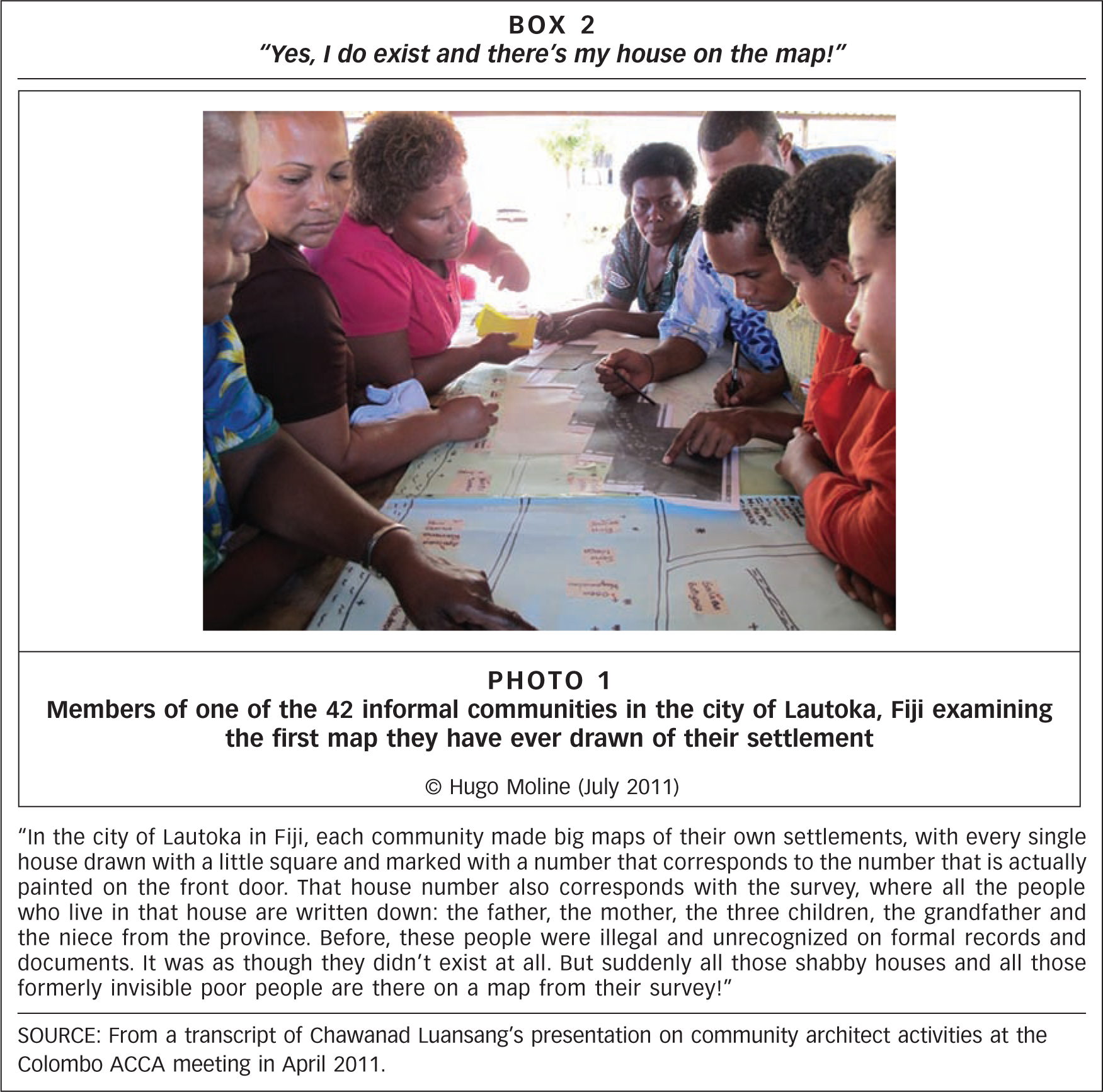
“Yes, I do exist and there’s my house on the map!”
VI. Communities Prioritize and Select Projects Collectively
When professionals, development agencies or governments plan something in a city, they are most often the ones who select the project, the target communities and the beneficiaries, and only they know what the agenda or the criteria are or why those communities or those people were chosen. Poor people find themselves either being selected or ignored. Within ACCA, the power of prioritizing and selecting the projects lies with the communities and their networks. This selection process by communities themselves is almost always a little painful. All the problems poor communities face are important for those who experience them directly and personally, and all communities need assistance. The collective, agreed-upon decisions about the selection of projects are never easily made. But there are several reasons why this is a very important process for the poor in a city to go through together.
The selection of projects is an important learning opportunity, in which people become the subject of development and not just the “object” or the passive beneficiary of someone else’s decisions and someone else’s analysis of what they need. When outsiders retain the power of selection, they create divisions and competition between communities. Resources usually go to the communities that are already strong or to those with good contacts. But when these decisions are informed by a good citywide survey process, the situation is quite different. Through the survey, people come to realize that they are not the only ones with serious problems. This citywide perspective helps people look beyond their own predicament and helps transform a pattern of competition into one of sharing and mutual support. The process of making decisions also helps develop a practice of achieving a consensus in understanding, rule setting and sharing scarce resources. People will think that it is good that they selected a certain community, and because everyone will watch that project, participate in it and learn from it, one settlement’s transformation becomes a showcase project that belongs to all the communities in the city.
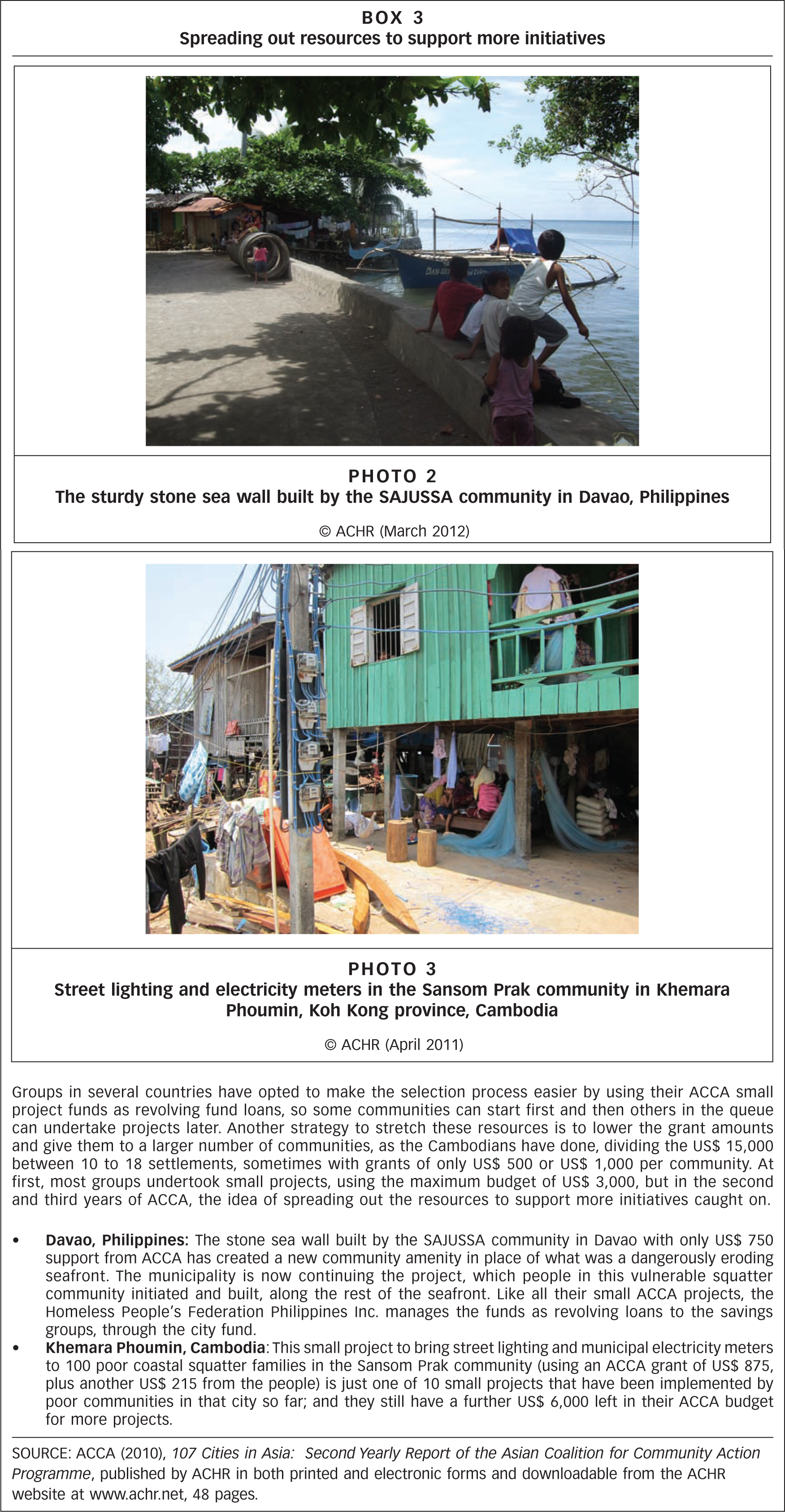
Spreading out resources to support more initiatives
VII. Making Budgets that are flexible and accessible – but small
ACCA sets very modest budget ceilings for most activities that it funds, such as US$ 15,000 for a city that must support at least five small upgrading projects, US$ 40,000 for one big housing project and US$ 3,000 for the various city process activities. These ceilings help make the programme’s finance system simple and clear to everyone, and by de-emphasizing the budgetary aspect allows groups to think more about the real substance of their citywide upgrading process. The ceilings allow the programme’s budget and opportunities to reach as many communities and cities as possible. Although the budgets are small, they are easy and accessible and the groups have a lot of flexibility in how they use these small resources to address the diverse needs in their cities. Paradoxically, the lower the budget, the more seems to get done.
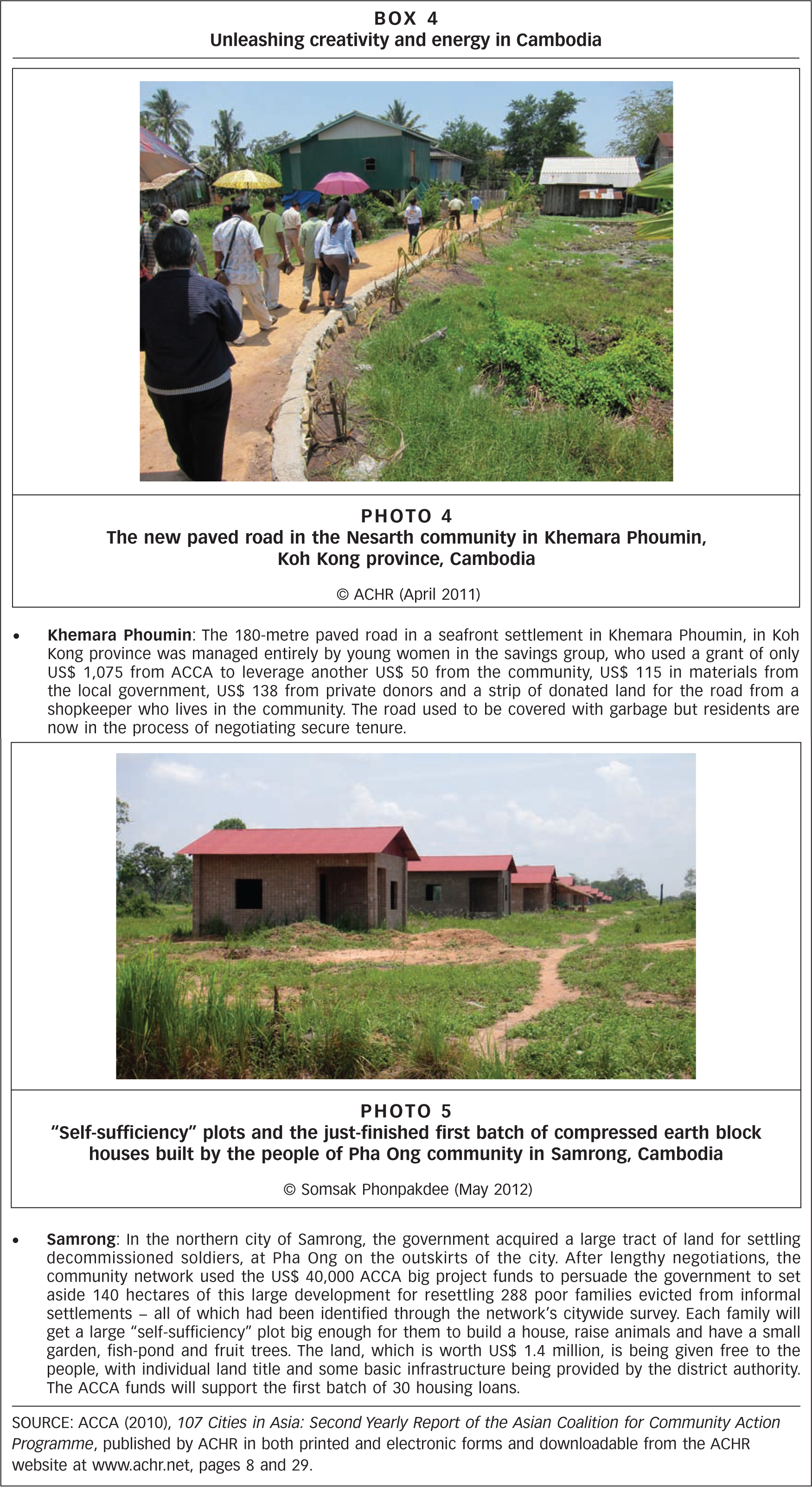
Unleashing creativity and energy in Cambodia
VIII. Activating the Funds that People Control Themselves
Finance is one of the most powerful tools in encouraging people’s problem-solving capacities, and the ACCA programme supports the strengthening of community-controlled finance systems in several ways. A savings group is, in many ways, a poor community’s first step towards freedom and equality; this is a step they can taker as soon as a few people agree to put small sums into the common pot. When the poor save together and use their collective savings to give each other loans for their various individual and collective needs, they move beyond the economic limitations they face as individuals. When a community has its own fund like this, they have a new freedom to think about what they would like to do, with the help of their friends in the savings group. At the same time, they learn to work together, to manage money together and develop skills they need in their struggle for secure land and shelter.
There is a significant political dimension to community savings and to the funds that are managed by individual communities and by networks of communities within a city. Most of the systems in our societies – economic and otherwise – have a central top-down authority that establishes rules around use and access. Community savings comes from people who have accumulated and pooled their financial resources either in community savings groups and/or in community-managed city funds. When a network of communities in a city has a strong savings process as its base, the savings represents a power that is built from the ground up. The funds that those communities control are a financial system that the urban poor manage. The finance that comes from people on the ground creates its own legitimacy, and the financial systems poor people create represent an institutionalization of that power that comes from the ground.(5)
IX. Implementing as Many Projects as Possible that Resolve Real Needs
By the end of the second year of ACCA, 549 small upgrading projects in 549 communities in 102 cities in 15 countries had been approved, and by now, most of them are finished. The most obvious purpose of these small projects is to allow communities to make a few much-needed improvements in their settlements. But this is seen as a starting point for the real transformation, a transformation in which low-income and marginalized communities in a city come together to analyze their situation, determine what they need, design a solution and succeed in carrying out that solution with their own hands. It is rare for that kind of power to be given to the poor, and for most of the communities implementing these small projects, this is their first experience of it. So besides solving some immediate problems, the communities are energized through action. This collective process is one in which people change from being dependents to being the ones who undertake initiatives themselves, determining their own needs and resolving them right away. The realization of small projects builds confidence and almost always leads people onto other projects and other activities such as savings, land negotiations with the local authority and new partnerships.
Savings builds participation, but it is unlikely that everyone will choose to save and members tend to be scattered. A physical upgrading project such as a walkway or a water supply system that affects everyone in the neighbourhood is a powerful means of reaching out to those not taking part. Participation is flexible and families may contribute cash or materials, loan tools, provide construction labour or help cook lunch for the workers.
Political contexts vary. Many use the small projects as an opportunity to open up a dialogue with their local government and solicit support – a “gentle” beginning to a longer-term relationship. Others construct their small improvement projects without asking permission and use the projects as part of their negotiating strategy. Either way, the small projects are highly visible and that visibility manifests a new political agenda. This can create tension. When people make these infrastructure improvements they are in some ways challenging their cities and showing an alternative system for delivering services that the city has failed to deliver. But in general, that tension leads to dialogue, to greater visibility and to engagement with the city.
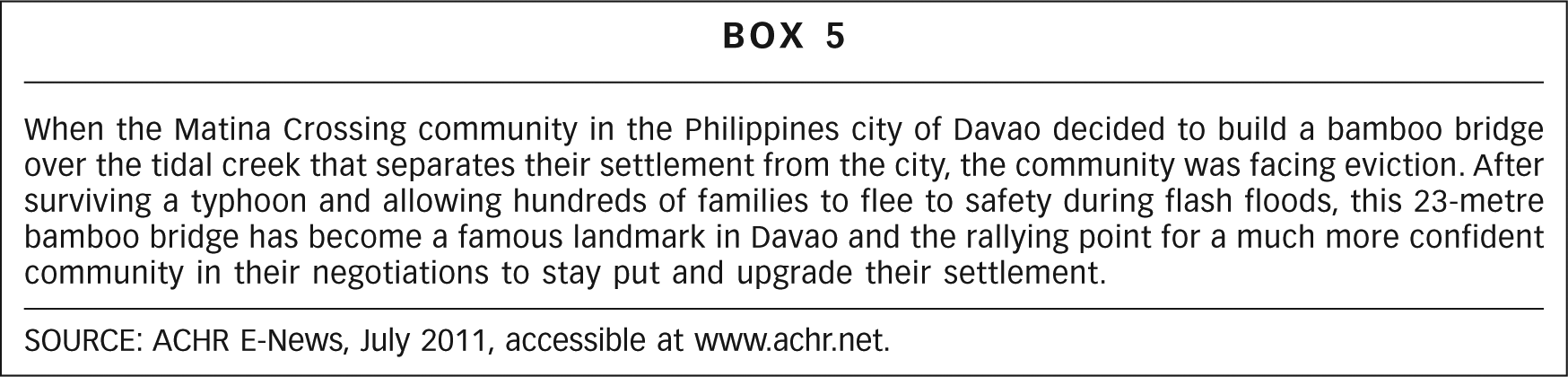
The small upgrading projects catalyze a process for the residents of informal settlements to change their status and to secure land. These small projects are even more powerful when several communities in the city undertake them at the same time and they are accompanied by other elements – the flexible finance, the savings, the collectivity, the citywide information and the housing projects.
X. Building A Platform for Negotiation and Partnership in each City
Collectivity and self-organizing are important within communities and within networks, but it is also crucial that low-income community organizations and networks engage with their local governments and influence the people who make the decisions and set the policies. This starts with them demonstrating that they are capable, serious and are prepared to go ahead and solve their problems. Initially, the activities supported by ACCA may not bring about any big change. But when those activities are conceived and carried out at a citywide scale, the city government starts noticing. In most cases, the city authorities link with this community activity.
The small projects help build that crucial relationship, and are “stepping stones” to the more difficult issues such as land. Land is of primary importance to the urban poor, because having secure, legal land tenure leads to legitimacy, legality, equality, entitlements and citizenship in a city. To be able to negotiate successfully for land, communities need to be prepared and to have built their collective power. They also need friends and allies in the government who are on their side and who believe in their capacity to bring about change. Public events that mark and celebrate milestones are an important part of this. In cities all over Asia, communities have learned how to stage public events to celebrate the completion of their projects and other milestones. The city officials are always invited as honoured guests to sit on the dais, be draped with garlands, introduced and invited to say a few words. To outsiders, these events may look more like theatre than progress, but they are crucial manoeuvres in a proactive political process of making friends, cultivating allies, fortifying negotiations, changing mindsets and publicizing what people can do.
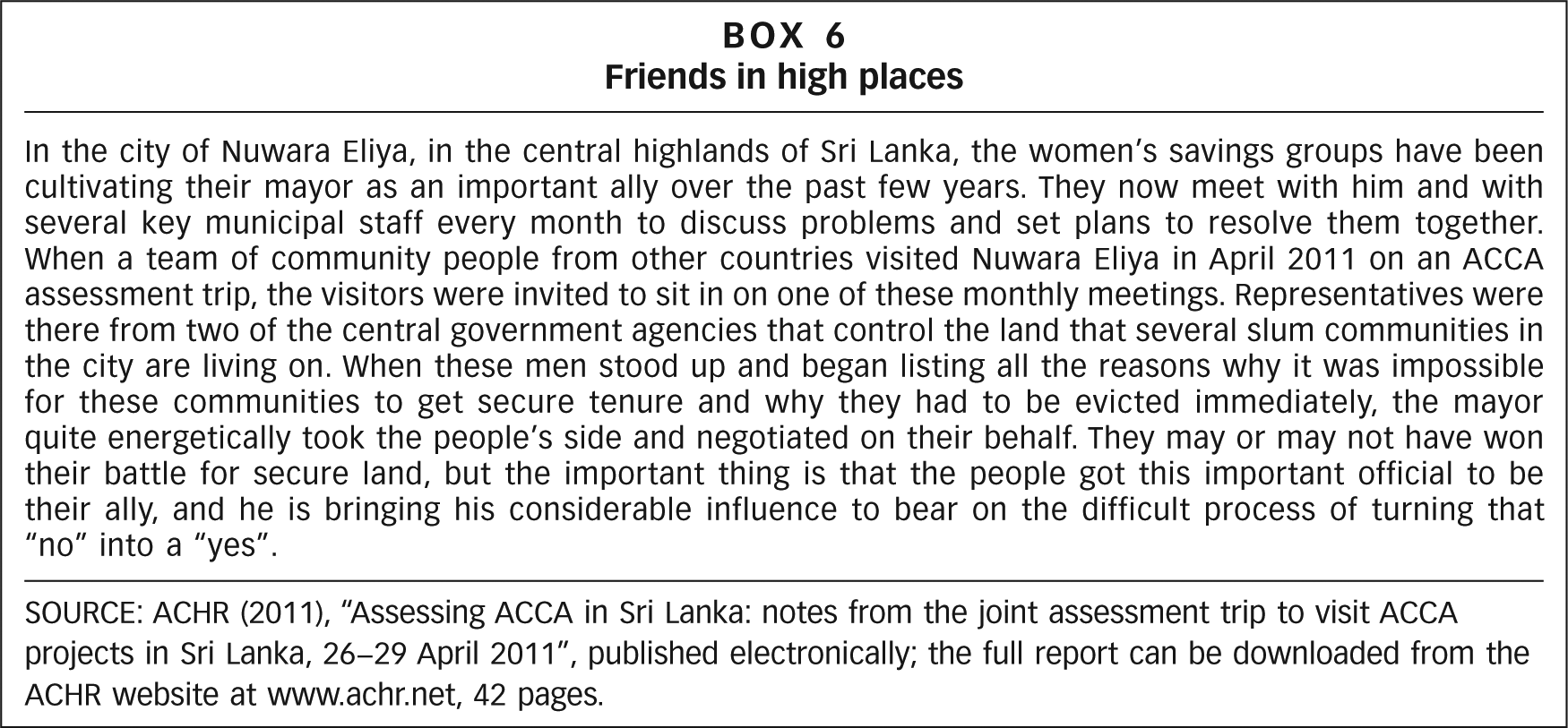
Friends in high places
XI. Building Networks of Poor Communities at City and National Level
All ACCA programme activities focus on building a citywide slum upgrading process that is owned and led by low-income communities – not by individual communities in isolation but by strong and well-linked city networks of communities. Networks are essential for several reasons. A community network challenges isolation, linking together scattered squatter settlements and providing a supportive platform. With a community development fund, a network can provide stronger assistance and larger resources to communities and to savings groups for development initiatives too large for their own savings pools. Networks can also play an important balancing role in helping communities to deal with difficult problems or internal conflicts.
A network is also a platform for dealing with the larger and more structural issues of poverty that communities cannot deal with alone – especially the crucial issues of land and access to services. A network is the only mechanism by which the political status of the poor, who have no power as individuals or as isolated communities, can be strengthened and accepted by other stakeholders in the city as a viable development partner, particularly by the local government, where much of the power over those structural issues lies. Networks can bargain; a large network of poor communities represents a vote bank that is difficult for any politician or local authority to ignore. Development projects, NGOs, funding priorities and donor interests change, but a strong community network can assess emerging opportunities and make best use of them, while providing continuity and a buffer that prevents these changes from undermining the community process.
Networks represent a new scale and a new political dimension for community organizations in cities. To have a national impact requires more than one or two cities. The learning and the possibilities expand greatly when this process is taking place in several cities within a country simultaneously, and networks at the national level – that link all the city level networks – are important. When city networks link with groups in other cities, the breadth and depth of their understanding about what is possible expands considerably.
XII. Implementing at least one Housing Project to show a Concrete Solution to Land and Housing
Most ACCA cities start immediately with one housing project, which is perhaps the most concrete and comprehensive process to further equality and full citizenship. More than anything else, secure, decent, legal housing gives residents full status as registered, legitimate citizens in their cities. A breakthrough in the first housing project is very significant in several ways.
The small projects are important but they are not the central objective for low-income residents; the core objective remains secure land and housing. Undertaking at least one housing project requires community networks to understand the structural issues that housing entails and to demonstrate an actual implementation of housing by people, with support that is as broadly based as possible. When a community undertakes a housing project, whether it is on-site or a relocation, they have to manage the structural issues of land, zoning, trunk infrastructure, access, planning standards, building by-laws and permissions. The housing projects function as intense, hands-on training for people in how their cities and governments function, because in the course of planning and constructing their housing they have to deal with so many rules and regulations and so many agencies and departments. This is training by doing.
The systems that deliver formal housing in our societies today – the market sector developers and the public sector national housing authorities – reinforce the idea that housing is too complicated and difficult for people to produce themselves. However, once one project is completed successfully, other communities understand that they too can begin to address their housing needs directly.
The most crucial issue is land. Access to land most clearly defines who is legal and accepted and who is illegal, not accepted and denied access to benefits. ACCA experience shows that acquiring secure land for housing is not that difficult when people work together and use their survey information, their network strength and their allies to bolster their negotiations. In many ACCA cities public land has never before been given to the poor for housing, but the communities have managed to negotiate for it successfully under a variety of tenure arrangements, even in cities with a bitter history of eviction and antagonism between the poor and their local governments. Most city governments have no information about the number of informal settlements or low-income people in their cities and they have no policy for how to use vacant land or land already occupied by informal settlements. ACCA’s experience is that governments almost always have land, despite the denials they invariably offer.

From squatters to citizens
The housing projects enable communities in a city to see how the process of planning the new community and new houses (either in situ or on new land) can transform communities. As noted above, low-income communities may have vertical authoritarian power structures, social fragmentation and individualism. A participatory planning process can be another positive way of addressing these problems by making space for everyone to take part and to have a share in creating a new, more horizontal, more equitable and sustainable social system. Planning is a very concrete process, and community people are always much more comfortable in action than in abstraction and concepts. With help from a good architect, planning can be a way for people to unlock their own freedom and to re-set their social system together. As people tape together house models, push around pieces of coloured paper representing scaled house plots on a plan and make decisions about the size and allocation of plots and open spaces, they are giving physical form to that new social system.
XIII. Conclusions
The experiment that the ACCA programme represents is built around a set of principles and tools that allow poor people and poor communities to take action immediately and on many fronts – to develop and demonstrate an alternative development process in which the people who have been ignored and marginalized in their cities in every possible way are at the centre of a process of transforming their lives, settlements and position in the city.
The programme has been designed to channel the energy, resourcefulness and motivation that already exist within poor communities into a larger, more focused and more collective force to address the large problems of housing, land, access to basic services and to finance at scale, within their communities, their cities, their countries and the Asia region. The programme’s tools allow the urban poor to take concrete action, to experiment and, by learning from their experiments (and from those of their neighbours), to build their confidence to take on new activities together. Within this they can then move to the next level in a development process, which is the claiming of their basic rights as full and equal citizens in their cities. In the process of surveying their city’s slums, setting up savings groups and city development funds, linking into community networks, implementing small upgrading projects and larger housing projects, negotiating for land and cultivating working relationships with their local governments, the urban poor can see themselves becoming the makers and the deliverers of the development needs that their societies have never provided them with.
In the past three years, the development activities supported by ACCA in more than 150 cities around Asia have created a large pool of new possibilities and ideas for the urban poor, who are often locked by poverty within the limited horizons of their own settlements and their own struggles to survive. Albert Einstein said that “the only source of knowledge is experience”; and what was true for the physicist who changed the way we look at the world is also true for Asia’s urban poor, who are likewise struggling to change the way development happens. This growing pool of new development possibilities and alternative development practice is showing the urban poor that they are not alone, that all these problems can be solved, and that the poor can deliver their own solutions to problems of housing, land, income and services that are cheaper, faster, more efficient, more appropriate and larger in scale than anything the state or the development profession have been able to deliver in the past.
Footnotes
1.
Sen, Amartya (2000), Development as Freedom, Oxford University Press, page 3.
2.
The term “slum” usually has derogatory connotations and can suggest that a settlement needs replacement or can legitimate the eviction of its residents. However, it is a difficult term to avoid for at least three reasons. First, some networks of neighbourhood organizations choose to identify themselves with a positive use of the term, partly to neutralize these negative connotations; one of the most successful is the National Slum Dwellers Federation in India. Second, the only global estimates for housing deficiencies, collected by the United Nations, are for what they term “slums”. And third, in some nations, there are advantages for residents of informal settlements if their settlement is recognized officially as a “slum”; indeed, the residents may lobby to get their settlement classified as a “notified slum”. Where the term is used in this journal, it refers to settlements characterized by at least some of the following features: a lack of formal recognition on the part of local government of the settlement and its residents; the absence of secure tenure for residents; inadequacies in provision for infrastructure and services; overcrowded and sub-standard dwellings; and location on land less than suitable for occupation. For a discussion of more precise ways to classify the range of housing sub-markets through which those with limited incomes buy, rent or build accommodation, see Environment and Urbanization Vol 1, No 2, October, available at  .
.
3.
See the paper by Boonyabancha and Mitlin in this issue of the Journal.
4.
The April 2012 issue of Environment and Urbanization was on mapping, surveying and enumerating informal settlements and included many papers on how the residents of informal settlements and their community organizations had key roles in this.
5.
See the paper by Diane Archer in this issue of the Journal.