




Abstract
Disaster recovery and risk reduction are most effective when the state can provide an enabling environment to support community action. Following the 1999 earthquakes in Turkey, there were many initiatives undertaken by civil society to fill the gaps left by government programmes that did not reach tenants who had lost their homes nor support livelihoods and social recovery of the people. Now, 11 years later, this paper looks at how these community-based recovery initiatives have transformed into initiatives around larger issues of building resilience and risk reduction. It examines the nature of their relationships with the state and with each other. The research is based on a cross-case analysis of three civil society organizations that were active in Düzce, one of the disaster-affected regions. It finds that while the community-based initiatives working in this area have built up the capacity of groups to demand change from the government, the lack of government support has meant that these groups have not been able to effectively act in partnership or cooperation with the government, which has impacted on their ability to scale up.
Keywords
I. Introduction
The two earthquakes that devastated the Marmara and Bolu regions of Turkey in the latter half of 1999 offered a window of opportunity for civil society to take a greater role in shaping development of the region. The earthquakes and the destruction they caused exposed the deficiencies of the government in protecting its people from harm and being able to help them in their moment of need. Most of the almost 18,000 deaths and more than 50,000 serious injuries resulting from the two earthquakes were attributed to improperly built mid-rise construction, the quality of which should have been ensured by the government. This, coupled with the government’s inability to effectively respond to people’s immediate needs in the weeks following the earthquakes, necessitated that civil society, in all of its different forms, step in to take immediate action to rescue people and assist in meeting basic needs for shelter, medical attention, food and livelihoods. The government did eventually take control of the situation and exerted its power over the organizations, effectively curtailing their roles in many cases.
As the earthquake recovery progressed, there emerged a continued need for civil society initiatives that could address areas of the recovery where the government was lacking. The government’s approach to reconstruction was to focus on large-scale infrastructure projects and mass housing targeted at homeowners. But there was a need also for social programmes that supported people’s livelihoods, and support for tenants and people who lived in dwellings without clear legal tenure and who were thus left out of state programmes.
Following the earthquakes, scholars drew attention to the fact that they opened up a place for civil society initiatives in development, and there was a lot of discussion about whether or not civil society’s place at the table would be sustained over the long term.(1) It has been 11 years now since the earthquakes, and there have been many changes and fluctuations in Turkish politics and the economy at the macro level, including: a change of government to the mildly-Islamic Justice and Development Party (AKP) in 2002; many legal reforms to meet EU accession demands, both in terms of human rights and government procedures; the economic crisis in 2000; and then steady and sustained economic growth over the decade.
This paper looks specifically at three of the civil society initiatives in Düzce, one of the towns that were impacted by both the 1999 earthquakes (17 August and 12 November) (Figure 1). The purpose is to draw out what these groups have been able to achieve in the 11 years since the earthquakes and, specifically, to consider the challenges they faced in working with the government and how this has affected the scaling up of these activities. This paper argues that, while there are kernels of civil society activity related to resilience that have been sustained since the earthquakes, the scaling up of collective processes at grassroots level into something that could meaningfully contribute to building resilience in the region has been stifled by a lack of local government support.
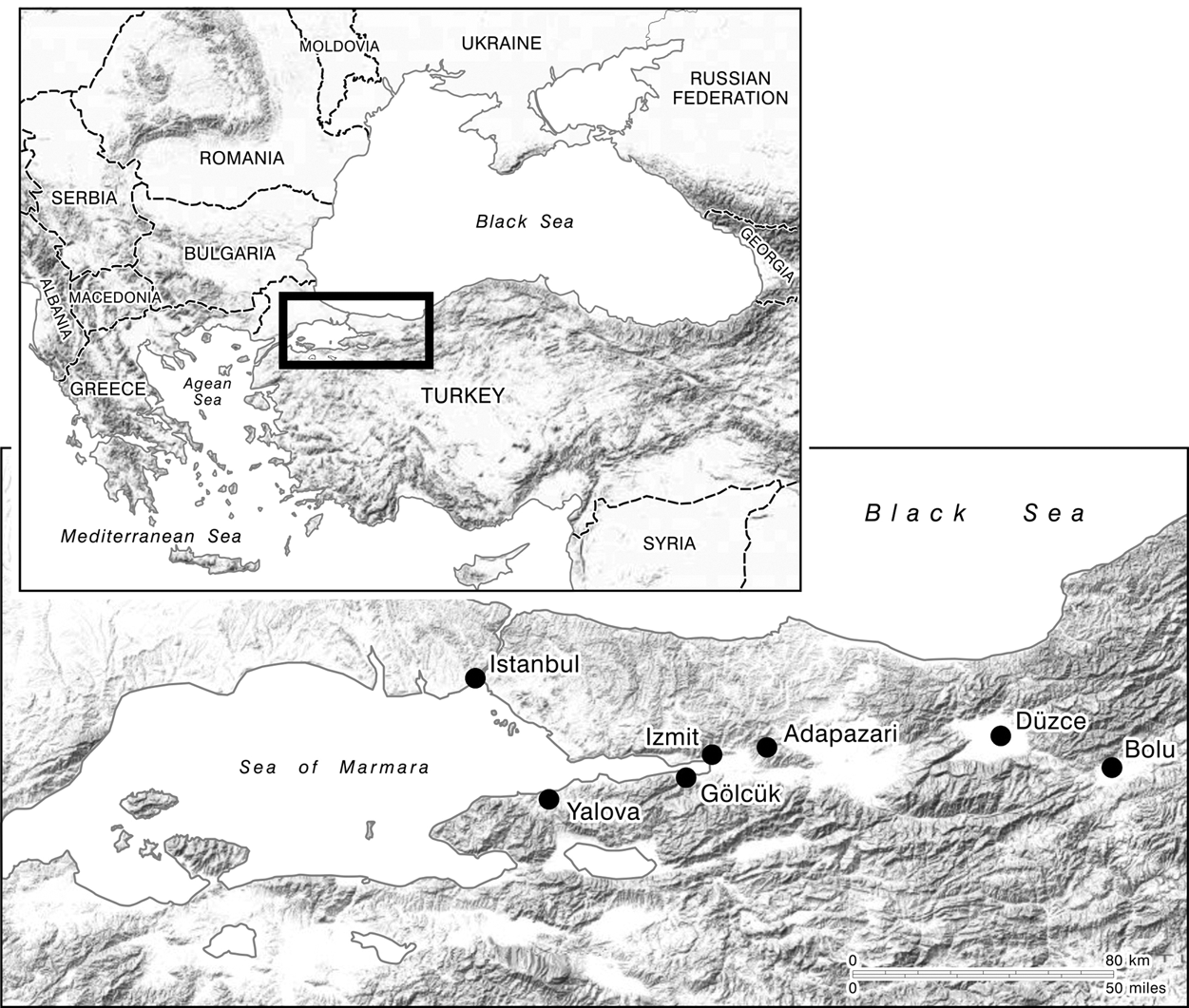
Towns and cities in the Marmara region of Turkey that were impacted by the 1999 earthquakes
How states and civil society respond to disasters provides insights into the political nature of their relationship. A disaster event brings about an opportunity to change the structure of society–government relations and, in some instances, these new relations can bring about more effective forms of community governance. For example, Cuny notes that:
“. . .a disaster traumatically brings into focus all the basic problems in a society. It reduces all issues to their fundamental level and strips away the ancillary issues that obscure or confuse the fundamental questions that must be faced [. . .] For the society, disasters often bring changes in the structure of community leadership. New organizations may be born out of the necessity to deal with the disaster and remain to continue work of bringing economic change to the community. New leaders often emerge [. . .] to replace those who have proved ineffective or unable to cope with the aftermath of a disaster.”(2)
Disaster recovery and risk reduction are most effective where the state supports and complements community action through a devolution of power and resources to the local level.(3) However, in order for this to happen, civil society requires an enabling environment from the state and from local government that is strong enough to support communities’ visions and involvement in resilience building.(4) A wider engagement of civil society with the political and institutional structures of the city opens up important political space for community level groups to make changes.(5)
In order to address the needs of all people, it is necessary that state–civil society relations are both
Understanding the traditional power relationships and how they are being challenged and permanently altered through civil society action is key to understanding how civil society is contributing to resilience.(7) Power manifests itself in different observable and obscure ways.(8) Thinking about aspects related to power, the following questions can be posed. Did civil society involvement really open up spaces where a multiplicity of civil society groups could have an influence in shaping recovery and risk reduction? And have these contributions simply re-legitimized the status quo or are they really contributing to transforming patterns of exclusion and social injustice and to challenging power relationships?
Ii. Method
This research starts by looking at civil society groups that were involved in the earthquake recovery in one town, Düzce, where the author has been involved in research and work since 2000.(9) The three groups selected here are ones generally well-known to be active in Düzce, and were chosen because they have been active not only in one aspect related to recovery, i.e. housing or livelihoods, but also have expanded their activities toward building resilience in all of its different facets. The length of time since the earthquakes allows for a long-term perspective on recovery, from which viewpoint very little has been published, especially in English and related to Turkish cases. Two of the groups are grassroots organizations, initiated and led by the people. The other group is an Istanbul-based NGO that initiates and advises locally based groups, which then become autonomous organizations.
The research included seven in-depth interviews conducted between August 2010 and February 2011 with group leaders and group members. The interviews were open-ended yet based on a standard set of questions about the groups’ activities, relationships with the state and other actors, politics and internal functioning. The information derived from the interviews was supplemented by published material based on other empirical research on the same groups. The case studies presented here are a reconstitution of the interviews coupled with data from these other publications (as referenced). The method is not comparative in nature across the cases but, rather, compiles the cases to develop a general narrative about the landscape of civil society involvement in resilience. The discussion draws together the findings across the case studies and also includes findings from other published case studies on Turkey and civil society, providing analytical insights into civil society–state relationships, cooperation and plurality among civil society, and the importance of information and transparency. The conclusions make links back to the general literature, reflecting on the sustained changes in power relations and the capacity of the state to encourage and enable community action.
Iii. Case studies
a. Case 1: DepDer Düzce(10)
DepDer Düzce is one of seven Disaster-affected People’s Associations (referred to as DepDer in Turkish) founded in the months after the earthquakes. Like other DepDers that were founded in the surrounding towns of Kocaeli, Gölcük, Adapazarı, Değirmendere, Halıdere, Yalova and Avcılar, DepDer Düzce is a civil organization struggling for housing rights of people affected by the earthquakes. It was formed in response to a situation where people felt that the state was unable to solve their problems. DepDer Düzce currently has about 1,000 members, about 100 of whom are regularly active and are the driving force in the association. The central focus of DepDer Düzce has changed over the years, and those who are now left are people wanting to be part of the association for political reasons, or those without property, or those who lost someone in the earthquakes.
Many of the first members of DepDer Düzce were property owners before the earthquakes, and the initial work of the association was to ensure that proper legal procedures were being followed and also to help people gain access to the new government-provided housing. However, two years after the earthquakes, there were still many families living in prefabricated houses or tents. These were people who used to be tenants before the earthquakes, or who had lived in informal settlements and therefore did not qualify for the government-provided post-disaster housing. In 2001, when the municipality began demolishing the prefabricated houses without solving the housing problems of their inhabitants, the role of DepDer Düzce shifted to defending the housing rights of those who were not owners. Together with DepDer Kocaeli, they questioned the government’s policies, which only considered those with housing assets or property to be “victims” of the earthquakes, while renters and those from informal housing were sidelined in the government-aided recovery process. These people, whom the associations call evsiz (without house), held a mass demonstration in Ankara in 2001. One of the proposed solutions was to work together to get cheap land and also loans from the government, and to build cooperative housing. They founded the Disaster-affected Homeless People’s Cooperative (Evsiz Depremzederler Kooperatifi), and members of the association remained in Ankara for 75 days to meet the necessary politicians and responsible people, a process that ended with the detention of some of its members. During 2001–2002, three other cooperatives were granted large plots of well-located land on which to build houses for non-owners. At one point, the municipality promised the evsiz a piece of land that had been given to the municipality by the Ministry of Housing. However, it ended up being turned over to the Mass Housing Administration (generally referred to by the acronym TOKI).
Thus in September 2003, the cooperative started a lawsuit contesting the fact that other associations had better access to land and that the distribution of these resources was not equal. In early 2011, after a long struggle, a positive verdict was delivered – they had won their lawsuit, and are to be awarded by TOKI a piece of land with infrastructure, enough for 570 houses,. They are currently negotiating which piece of land they will be allocated and are seeking sources of financing to support a self-building process. Many issues have yet to be settled between TOKI and the cooperative concerning the land and the layout of the infrastructure, because the cooperative’s self-build approach is very different from TOKI’s mass housing tower block approach. In the years before the verdict, activities were generally quite slow and sometimes it was difficult to maintain members’ interest in the cooperative. Most members suffer from economic hardship and live as tenants or in villages far away, and thus it was difficult to keep up regular meetings. However, the cooperative has plans to do many things that will employ many of its members – beyond building houses they are intent on helping each other, employing each other and generally showing solidarity.
Besides these activities for the evsiz, DepDer Düzce is also engaged in local disaster risk reduction initiatives. For example, they are working to shape the current land use plans prepared by the municipality, with the aim of improving the city’s resilience. The association is active in collecting information about their neighbourhoods and they organize meetings in the neighbourhoods to discuss the fact that the interests of property owners and the need for a resilient city are not always compatible. The municipality now comes and observes these meetings. The association also stands against on-going practices that they oppose, for example TOKI’s construction of five-storey houses on land that is deemed to be unsafe. The aim of DepDer Düzce is for the city to have a central information centre on disaster risks and building, which they foresee could be managed either by the municipality or by Düzce University (the university in Izmit is involved in a similar project).
DepDer Düzce has good partnerships with other civil society organizations. They regularly work with the DepDers in Kocaeli and Gölcük and also with the Chamber of Architects and the Chamber of Civil Engineers. However, the relationship between DepDer Düzce and the municipality has not been an easy one. Generally, they feel that the municipality has tried to suppress the association (and in general, people who wanted to do something about earthquake risk), by not listening and by ignoring them for a long time. DepDer Düzce feels that the municipality’s reluctance to discuss the earthquakes related to illegalities in the distribution of the money and also with inadequate disaster management prior to the earthquakes. However, with the new municipal government (elected in 2008), this has changed. The government in power doesn’t feel responsible for what happened after the earthquakes and there is no longer any interest in money; this opens a window to begin discussing prevention and risk management once again. However, generally the organizations feel that the municipality is too slow and lacks the necessary staff to properly manage safe development. (In part this is related to the fact that Düzce only became a province after the earthquakes.) In 2009, with a directive from central government, the municipality founded a Disaster Directorate (Il Afet Acil Durum Müdürlügü) and a Civil Defence Unit (Sivil Savunma). With this new municipal government and dedicated staff, the association can now obtain information more easily, for instance concerning progress on a GIS that is being developed for the city.
b. Case 2: Solidarity (IMECE)(11)
IMECE was formed after the earthquakes as a grassroots rebuilding initiative for three villages (Aksu, Çayköy and Hacisüleymanbey) in the Düzce region. In total, 57 houses were built between 2002 and 2005 in “solidarity” style (imece in Turkish) – meaning a collective process of villagers working together and with people from outside the villages. The process was much more straightforward than the work of the cooperative described above, because the land on which the houses were built belonged to the villagers prior to the earthquakes. The construction of each house cost 13,000 Turkish Lira (US$ 8,500) and was financed by a government subsidy of 6,000 Turkish Lira (US$ 3,500) per house with additional funding from international sources secured by IMECE.
The driving forces behind the construction of IMECE houses are both external and local. There were external volunteers, from Istanbul, who came to assist, and one in particular who acted as a champion for the project. There were also international volunteers who came to the village to help with construction. Local women played an important role in the process – they attended meetings, took part in the decisions and also helped to build the houses. The villagers decided collectively who was going to have an IMECE house (one voice per household) and also worked together on the design of the houses.
The houses were finished and the infrastructure rebuilt by 2005, so the project’s aims were achieved. However, this did not offer a sustainable solution to livelihoods. Many of the villages’ young people finished university just after the earthquakes, yet remained unemployed for a long time due to the ensuing economic crisis in 2000. Now they are leaving the village, as there is little chance of earning a living from hazelnut farming. Basically, the public institutions provided tents, food and credits after the earthquakes, but did not support any local initiative for recovery and strengthening of livelihoods. Thus, there are some unfinished projects that IMECE sees as integral to the recovery process, yet they continually come up against various barriers, especially related to government support, which prevent these projects from being realized.
For example, to help the recovery process after the earthquakes, one of IMECE’s ideas was to strengthen the local economy, which is based largely on hazelnut farming. The price for one kilo of hazelnuts prior to the earthquakes was about 6.50 Turkish Lira; this dropped to 2.50 Turkish Lira in 2004 (a state company bought the hazelnuts prior to 2004, but it was privatized) and now hazelnuts are sold at about 3–4.50 Turkish Lira a kilo. The idea was to develop direct links to European markets and to produce organic hazelnuts. For example, one hazelnut producer made attempts to sell them to the Netherlands directly, but a lack of state support meant that this idea has not yet been realized.
Another project is the social centre that IMECE constructed, which was to house a hospital, a library, a guesthouse and a meeting room to do work with children and women. When asked why the building was standing empty, the local leader (muhtar) explained that they did not manage to get it through the bureaucratic process for political reasons. So even though the building has been built, the local government did not support the project so the necessary permissions for use have never been granted.
Overall, members of IMECE are frustrated with having to deal with the state to obtain permissions (for the hospital–social centre), and generally they are not interested in working with public institutions anymore. They say that even for the housing project, it would have been better neither to have used state funds nor worked together with the state at all. Perhaps what also contributes to this perception of the state is that many of the villagers belong to an ethnic minority from the Georgian Republic and Abkhazia, who came to the region after the Crimean War. They feel that significant barriers are constantly being raised against them and they experience racist behaviour.
Although IMECE is no longer an active organization, it did create an informal space for engagement. Many of the people who participated in IMECE are now active in other organizations, either trying to get proper housing for evsiz people or mobilizing against the hydroelectric plants planned for the valley where all the villages are located.
Currently, there is a plan for five hydroelectric power plants to be built in the valley where the earthquakes took place, with one of the plants actually being built on the fault line of the 1999 earthquakes. Resistance to the project now dominates discussions in the villages. It will take away 90 per cent of the water that flows through the valley, which is both drinking water and water for agriculture. There will be deforestation, leading to erosion and flood risk; in fact, increased flooding has already occurred in the areas that have been cleared. Villagers also believe this will eventually lead to their displacement, because the villages’ livelihoods (agriculture and small-scale forestry) will become impossible.
The links established between the villagers are strong; the community still undertakes a lot of activities together and many people have a very positive memory of the IMECE construction process. Since the earthquakes, the political power of the villagers has been awakened; they are going to meetings, discussing their common needs, working together in solidarity, meeting and linking with people from abroad. This interest and experience is visible in the action against the plans for the hydroelectric power plants – and meetings on these are clearly dominated by the three villages and by people who know each other from the “earthquake time”.
Although they are not interested in working with the government, they do have partnerships with other organizations. Recently, the group formed a positive partnership with Düzce University – whose scientists did an analysis for them of the impacts of the hydroelectric power plants project. Düzce University will probably also move into the unused IMECE social centre.
c. Case 3: Foundation for the Support of Women’s Work (Kadin Emegini Degerlendirme Vakfi – KEDV)(12)
The Foundation for the Support of Women’s Work (Kadin Emegini Degerlendirme Vakfi – KEDV) was established in 1986 as a civil society organization with the mission to provide “. . .support to poor women so that they could organize to respond to basic needs and to develop the capacities to improve their own lives and communities.”(13) Prior to the earthquakes, the organization had experience in operating child care centres in several low-income neighbourhoods, with support from the Social Services and Child Protection Administration (SHÇEK) and also from the Bernard Van Leer Foundation in the Netherlands. Immediately after the earthquakes, KEDV emerged as an organization that was capable of helping the women to organize and assist in the response. Sengül Akçar, Executive Director of KEDV claimed that the earthquakes increased the visibility of the organization and also its networks: “Our approach was acknowledged and we had the opportunity to try out our strategies.”
In the days and months following the earthquakes, KEDV set up centres, first of all in the tent cities and then in the temporary settlements, where women could have a place to come together to share information and offer mutual support. As KEDV had an ongoing partnership with SHÇEK and also because they had in the past signed a protocol with the regional administration, KEDV already had a high degree of legitimacy, which helped speed up the bureaucratic procedures for obtaining access to space. The idea was that these centres could help women to play a role as key agents in the relief and recovery process. The women used the centres as living rooms, as workspaces, as places to receive guests and to run support groups. It quickly became clear that generating income was their main concern in the weeks following the earthquakes, as many needed to earn money to support their families, and they became involved in the centres in many very practical activities, especially around income generation. For example, they organized teams to sell collectively made products to local merchants, and secured downtown stores from municipalities and obtained stalls in two national chain department stores. They set up woodworking shops where they made wooden toys and also screens and windows for doors, which were in high demand in the settlements. In response to the need for repairs and services, the centres trained women to become plumbers and electricians to service the temporary housing settlements.
During the reconstruction, women became concerned about the earthquake safety of the new permanent housing and also about the lack of inclusiveness in the way the government-run projects were being carried out. Following a visit from a women’s NGO from India (Swayam Shikshan Prayog–SSP), the women systematically started to map information about the people in their settlements, about the housing subsidies they were receiving, and about people’s livelihood concerns and other settlement-related problems. Collecting and owning this information, which the government did not have, provided the women with an asset they could use in negotiations. At one centre, they discovered construction errors in some of the new permanent housing blocks in their district. This contributed to their concern that some of the developers of the new housing were the same ones who had built the buildings that had collapsed during the earthquakes, calling into question how the government was selecting contractors.
In time, each of the women’s centres established its own formal identity as an autonomous women’s group, so they could continue negotiations with authorities and access resources on their own without relying on KEDV. By early 2003, six of the eight women’s centres were consolidated as autonomous service production cooperatives and four of these cooperatives are still active today. The situation after the earthquakes was extraordinary and full of movement; many things were possible and there was a clear gap to be filled by the women. Now, things are more or less back to normal but the cooperatives that still exist are important sources of livelihoods for the women involved. While the cooperatives are autonomous, they do keep in contact with the main KEDV office, which supports them in things such as writing funding proposals.
Sustained leadership has been a problem for the continued viability of the cooperatives. Once the women had moved into permanent housing they were less compelled to take part in the cooperatives’ activities. Also, once the temporary housing had been dismantled, the women who were renting moved into the city centre in search of housing, making the cooperatives, which were located on the periphery, too far for them to reach easily.
A change in government leadership since the earthquakes has also limited the cooperatives’ activities. After the earthquakes, it was the central state that was responsible for the recovery, not the local government. Post-recovery, when responsibility for development was back with the local government, the support structures, networks and contacts changed completely. This weakened civil society organizations such as KEDV, which had been strongly allied with the central government, as they were no longer supported in the same way by the local government. Today, the cooperatives are struggling because some of the municipalities want to take back the land and prefabricated buildings that they had allocated to the cooperatives’ centres, because it has become valuable for redevelopment. In Düzce and other towns, the municipalities want to redevelop the sites for other uses and do not recognize the importance and value of the buildings’ social function.
Furthermore, by 2003, women from the KEDV autonomous service production cooperatives had established four separate cooperatives for housing in three of the disaster-affected provinces. As with the other housing cooperative discussed in Case 1 (the Disaster-affected Homeless People’s Cooperative (Evsiz Depremzederler Kooperatifi)), the idea was to build housing for tenants who were not included in the government’s housing programme. The cooperatives had to be very pro-active and vigilant in order to obtain land and funding for housing, however they had several advantages over the organizations described earlier in this paper:
“For example, during their visits to public agencies, the women learned that the Ministry of Public Works and Housing was considering auctioning off land in temporary housing settlements to cooperatives that had been set up by tenant groups for building apartments. Even though site selection would be based on each settlement’s tenure composition, the women had already gathered this information and could supply it to the ministry. One outcome of this process was a promise from the regional coordinator of the Ministry of Public Works to give the women’s cooperatives priority in land allocation.”(14)
KEDV has also recently become active in disaster risk reduction activities, particularly in two Istanbul districts (Kartal and Kağıthane) where there were already active women’s groups associated with KEDV. One of the women’s activities in the neighbourhoods is to undertake a community needs assessment, which all the women’s groups in all the neighbourhoods do when they first come together. What has been added to this process in Kartal and Kağıthane is mapping the environmental risks and the livelihoods at risk in the neighbourhoods. Once the risks have been mapped, the idea is to take this information to the planning stage, working with municipalities. In Kartal district, the women’s groups were already managing green spaces and parks, and so had already established a good relationship with the mayor. The mayor supports their interest in working together on planning for resilience and risk reduction, although they are at the very early stages of cooperation. KEDV is also cooperating with Istanbul Technical University to prepare a manual about risk assessment and community needs assessment that all the groups can follow, which will reduce the training time needed for each of the women’s groups.
The idea is to develop mechanisms for community-based resilience as an alternative or complement to the technocratic disaster planning currently being carried out by municipalities. KEDV points out that household level preparedness has been prioritized over collective initiatives; for example, the Istanbul Seismic Mitigation and Emergency Preparedness project has piloted a project for disseminating information to the community about preparing your household for disaster. What is absent, however, is information about the risks that need to be addressed by the collective. For example, the greatest risks identified by the community have been: petrol stations close to housing areas; lack of space to gather in case of evacuation; knowledge about safe construction techniques; and small businesses at risk. Most of the risks are related to preparing for earthquakes, but people are also thinking about chemical explosions and, more recently, about flooding, as this is becoming an increasingly greater risk in Istanbul.
Although they are in the initial stages of this process of integrating risk reduction into their work, KEDV foresees that the greatest challenge for scaling up will be that the municipalities will fail to see the connections between this approach of community-based resilience and the more traditional approach to disaster management centred around response strategies, such as fire brigades and search and rescue. Despite taking part in training sessions offered by Istanbul Technical University, municipalities either do not recognize the legitimacy of community-based resilience or are not equipped to integrate it into their institutional processes:
“Local, community-based initiatives, such as those by autonomous women’s groups, do not get any support from disaster agencies. Disaster mitigation is still considered to be an area of technical expertise and a matter of training individual ‘heroes’, rather than community organizing and development.”(15)
When asked about how they could improve this situation, Sengül Akçar of KEDV explained:
“First of all, we think the partnership with the university may be helpful, as it is more likely that the municipality will listen if it is the university talking; secondly, there is a need to have good examples to show how this approach can work, pilot projects, which is what we are trying to achieve now. Third is the need to have a presence to legitimize our approach. We have 30,000 women in Turkey as members of the cooperatives, so this lends some power.”
Iv. Summary of main findings from the case studies
a. Relationships with the state
Özerdem and Jacoby briefly characterize the relations between civil society and the state in Turkey as follows:
“[The state] is not a Leviathan that harasses society; historically, the image of the Turkish state has been that of a distant and omnipotent system that ordinary citizens would do well to avoid at most times. Simultaneously, though, it is also assumed to have infinite means and resources to distribute through benign largesse giving it an overall ambivalence revealed in the paternalism of the commonplace term Devlet Baba [Father State]. The result is, for many commentators, a ‘passive–exclusive’ state whose internal contradictions and weaknesses in regulatory and distributive capacities combine to form an administration which ‘neither combats nor promotes civil society.’(16) In other words, Devlet Baba thus signifies both distance and authority through which the patrimonial attitude of the public sector has continued the centrist and elitist mentality of the Ottoman pashas, thereby posing a considerable obstacle in the development of a civil society.”(17)
The case studies presented here, and also supported by other published case studies on the 1999 earthquakes recovery in Turkey,(18) show that there are kernels of community-based and civil society movements, including initiatives for disaster recovery and risk reduction, which are challenging the mainstream actions of the strong central government in Turkey. However, the scaling up of collective processes at grassroots level is stifled by a lack of government support at the local level. While this lack of support may in some ways be related to political interests or the validation of the needs and rights of the groups, it is also related to local government capacity to effectively respond to civil society initiatives and demands.
The case studies illustrate that for the most part,
These case studies also make it clear that there are organizations that are
Recently, since the last municipal elections in 2009, there appears to have been some shift in this system of state patronage. For example, in Istanbul, several of the district municipalities have elected mayors from the Republican People’s Party, based on a populist platform of support for the minority groups living in informal settlements (gecekondu in Turkish). In Sariyer municipality of Istanbul for example, a union of neighbourhood organizations has been formed, which represents 17 gecekondu neighbourhoods within the district. The union meets regularly with the municipality to promote the needs of the neighbourhood associations directly with the district mayor. In Kartal district, on the Asian side of Istanbul, the central government has planned to replace several of the informal settlements with projects developed by the Mass Housing Administration (TOKI), which will displace the existing residents. The district municipality of Kartal (the same one that is working with KEDV on community-based resilience) has joined with the neighbourhood associations to resist and to negotiate with the central government regarding the upgrading of informal settlements. In April 2010, the municipality also granted legal tenure to 150 households located on lands under municipal ownership.
In addition to the system of state patronage, the case studies suggest that
b. Cooperation and plurality among civil society
All the groups consider cooperation with other groups to be an important element in enabling their activities and building the strength of the movement. DepDer Düzce was strongly aligned with the other DepDer organizations in the region and used this linkage to share information. Both IMECE and DepDer Düzce have linkages with Düzce University, which has been supporting their activities with technical expertise. KEDV formed a network of women’s centres and these have acted together closely, sharing information, experience and strategies when necessary. The groups have also cooperated with external organizations, which has been helpful for funding and also for building solidarity. However, it is cooperation with local organizations that has been important for building the capacity of the groups.
It appears that the associations and organizations choose to cooperate with somewhat selective groups. They were more likely to cooperate with groups that have similar political outlooks, or that are aligned across ethnic or gender lines. Kubicek points out that civil society in Turkey is very pluralistic and deeply divided along political and ethnic lines; for instance, there are liberals and conservatives, secularists and Islamists, nationalists and Kurdish activists.(24) This pluralism means that civil society is fragmented in terms of its aims; groups do not have a collective ideology about what they are fighting for and thus civil society does not stand as one mass of people against the state. This hampers the ability to push for broad social and political change. Furthermore, the lack of a singular focus means that the state can play favourites and collaborate with non-threatening groups.
Yarar comments that DepDer Düzce was the most controversial and challenging movement in Düzce after the earthquakes, and was thus criticized by main power groups and homeowners who did not believe tenants and others should have rights to housing in the earthquake recovery.(25) This echoes similar debates in Istanbul, where state and private housing developments are displacing informal gecekondu settlements based on a rhetoric that denies informal settlers any occupancy rights.(26)
c. Information and transparency
One of the main issues for an enabling environment for risk reduction is the availability of information about planning and development, and mechanisms to share this information across state and civil society groups. In Turkey, there appears to be a need for better access to information and greater transparency in government processes. The lack of access to information about planning and building and about disaster risk was highlighted by all of the groups. The main goal of many of the DepDers was access to information and education of the public. They wanted to represent the poor, disabled, women and renters and to act as pressure groups on the local governments. KEDV became involved in developing and sharing its own information among its members (and sometimes the state).
Transparency was also an issue after the earthquakes, and continues to be so. The allocation of land to cooperatives was not transparent; information about the hydroelectric power plants project in Düzce and about plans for urban development in the region were not made public. Relevant to this concern is the DepDer’s intention to develop a central point for information about earthquake risks, planning and building, which would be available to the public.
Information available at the local level and two-way communication about planning was further hampered by the fact that the local government was not responsible for the recovery. Normally, local and provincial governments are mandated to prepare local level settlement plans within their jurisdictions. However, Article 8 of Development Law No 3194 allows the ministry to intervene in the preparation and revision of plans that relate to disasters. Within days of the earthquake, the ministry invoked the authority granted by this article, announcing that it would prepare local level plans as well as plans for permanent housing areas in the earthquake zone. This meant that local government officials and civil society groups and community-based organizations who were nearest to the disaster location and who knew the local conditions the best were divorced from the planning processes.
d. Final reflections: unpacking the limitations to scaling up
Although the initiatives described in this paper have been very important for the people involved in terms of building solidarity, networks and capacity to act, they remain quite small in scale. It seems necessary to reflect on three points introduced earlier in the paper in order to understand what limits the capacity to scale up. First, Twigg raised the issue that in order for the (local) government to provide an enabling environment for community participation in resilience, it needs to be sensitive to the perspectives, needs and rights of the people concerned.(27) This is a crucial issue because it appears that the government is failing to legitimize or validate the perspective of the groups, sometimes because they are too controversial. For example, the demand for housing for renters, as put forward by the DepDer, is contradictory to the basic principles of the housing market in Turkey. As Yarar points out: “For them, if the state begins to distribute houses to the tenants and poor, this becomes a starting point for everyone living in Turkey to make the same claim from it.”(28) The women’s groups that are active with KEDV in Istanbul also experience difficulty having their perspectives validated by local government.
The second point is that for the state to engage meaningfully with civil society, it needs the institutional systems and capacity to do so. The new laws regarding citizen councils are a positive step but still, government needs capacity to really address this in a meaningful way. It seems that municipalities in smaller urban centres such as Düzce generally lack the capacity to interact with community-based organizations or to develop better forms of communication that would enable more participation in the development process. However, to be sure of this more research needs to be done in Turkey, focusing on local government capacity to engage with civil society especially around the areas of urban planning and risk reduction.
The third point concerns power. Certainly, in terms of challenging the power relations these groups are adept at acting in an adversarial way to demand change. But has this transformed the patterns of exclusion and social injustice? It appears that while there have been some small steps, this has not yet happened in a meaningful way. Have the groups opened up spaces where they can influence recovery and risk reduction? There have certainly been attempts by all of the groups to do so, whether through demands for sharing information or attendance at meetings. However, generally the groups still lack open and influential forums where they can engage with the government in decision-making.
Footnotes
Acknowledgements
The author is grateful to Julia Strutz for her efforts in conducting the interviews and in doing translations, as well as her contributions to the paper. Thank you also to all of the groups and people who generously gave their time for the interviews in support of this research.
1.
Özerdem, Alpaslan and Tim Jacoby (2006), Disaster Management and Civil Society: Earthquake Relief in Japan, Turkey and India: Chapter 3: The Marmara Earthquake, I B Tauris, London, 142 pages; also Kubicek, Paul (2002), “The earthquake, civil society and political change in Turkey: assessment and comparison with Eastern Europe”, Political Studies Vol 50, pages 761–778; and Jalali, Rita (2002), “Civil society and the state: Turkey after the earthquake”, Disasters Vol 26, No 2, pages 120–139.
2.
Cuny, Fred C (1983), Disasters and Development, Oxford University Press, pages 11–13.
3.
Maskrey, Andrew (1989), Disaster Mitigation: A Community-based Approach, Oxfam, Oxford, 100 pages; also Pelling, Mark (2003), The Vulnerability of Cities: Natural Disaster and Social Resilience, Earthscan, London, 256 pages; Dodman, David, Diana Mitlin and Jason Rayos Co (2009), “Victims to victors, disasters to opportunities; community-driven responses to climate change in the Philippines”, International Development Planning Review Vol 32, No 1, pages 1–26; and Wamsler, Christine (2007), “Bridging the gaps: stakeholder-based strategies for risk reduction and financing for the urban poor”, Environment and Urbanization Vol 19, No 1, April, pages 115–142.
4.
Twigg, John (2009), “Characteristics of a disaster resilient community. A guidance note”, Version 2, Aon Benfield UCL Hazard Research Centre, London, 84 pages.
7.
The word “resilience” is used because it puts emphasis on the overall capacity of all the systems to cope with any type of event, including emphasizing what communities can do for themselves in addition to and in cooperation with the capacities of the state.
8.
Gaventa, John (2006), “Finding the spaces for change: a power analysis”, IDS Bulletin Vol 37, No 6, pages 23–33.
9.
Johnson, Cassidy (2007), “Impacts of prefabricated temporary housing after disasters”, Habitat International Vol 31, No 1, pages 36–52; also Arslan, Hakan and Cassidy Johnson (2010), “Turkey: can small actors overcome the absence of state will?”, in Michal Lyons, Theo Schilderman and Camillo Boano (editors), Building Back Better. Delivering People-centred Housing Reconstruction at Scale, Practical Action, London, pages 263–284.
10.
The information for this case study is based on interviews with Ays¸egül S¸enol, lawyer and member of DepDer Düzce, and S¸ener Sıddıka from the Steering Committee of the Disaster-affected Homeless People’s Cooperative (Evsiz Depremzederler Kooperatifi). Both interviews were conducted by Julia Strutz in August 2010.
11.
The information for this case study is based on interviews conducted by Julia Strutz with the muhtar (village headman) of Çayköy and with Erbay Yücak (one of the active members of the association); also informal interviews with the villagers during one of their meetings in August 2010.
12.
Information for this case study is based on interviews conducted by the author and Julia Strutz with Sengül Akçar and Berrin Tenice, leaders of KEDV, in January and February 2011; also Yönder, Ays¸e, Sengül Akçar and Prema Gopalan (2005), “Women’s participation in disaster relief and recovery”, SEEDS Pamphlet Series No 22, Population Council, New York, 37 pages.
13.
See reference 12, Yönder, Akçar and Gopalan (2005), page 21.
14.
See reference 12, Yönder, Akçar and Gopalan (2005), page 26.
15.
Yönder, Ays¸e and Handan Turkoğlu (2010), “Post-1999 development in disaster management in Turkey”, draft case study prepared for a background paper entitled “Creating an enabling environment for reducing disaster risk: recent experience of regulatory frameworks for land, planning and building in low- and middle-income countries” for the UN International Strategy for Risk Reduction (ISDR) 2011 Global Assessment Report, page 13.
16.
Kalaycıoğlu, Ersin (2001), “Civic culture in ‘secular’ Turkey”, Institute of Ismaili Studies, London, accessed 26 May 2011 at  .
.
18.
Demirel, S (2005), “Production of space in the post-earthquake region: three cases from Düzce”, unpublished Masters thesis, METU, Ankara, Turkey; also Ganapati, Emel N (2009), “Rising from the rubble: emergence of place-based social capital in Gölcük, Turkey”, International Journal of Mass Emergencies and Disasters Vol 27, No 2, pages 127–166; Yarar, B (2005), “Civil struggle for the ‘housing right’ after the earthquake: a case study on the ‘DepDer’ in Düzce”, 7th European Sociological Association Conference “Rethinking Inequalities”, Torun, Poland, 9–13 September 2005; see reference 1, Kubicek (2002); and see reference 1, ;
20.
See reference 18, Ganapati (2009); also see reference 1, Kubicek (2002); and see reference 18, .
26.
Gündogdu, I and J Gough (2008), “Class-cleansing in Istanbul’s world city project”, in Libby Porter and Kate Shaw (editors), Whose Urban Renaissance? An International Comparison of Urban Regeneration Strategies, Routledge, Abingdon, pages 16–24.
27.
See reference 4.