



Abstract
In Dhaka, three urban poor networks play a central role in advocating for the rights and entitlements of low-income settlement residents. Despite their numerous achievements, this article outlines how attempts to scale participation via these networks are limited by three overlapping state–civil society processes: (1) the politicization and increased monitoring of non-governmental organizations (NGOs); (2) shifting donor preferences towards service delivery and the creation of new community-based organizations (CBOs); and (3) the ongoing dominance and paternalism of NGOs towards low-income settlement residents. By situating these findings within existing understandings of in/formal governance and political participation, it can be argued that attempts to scale may struggle to evade or transform deep structures of dependency, patronage and intermediation. Recognizing that scaling can and does occur under these conditions, the article outlines opportunities to support the city-wide networks and alternative forms of organizing, to address pressing needs and priorities.
Keywords
I. Introduction
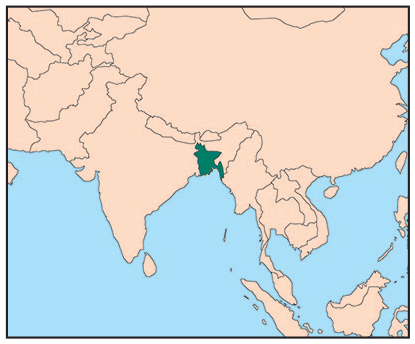
In Dhaka, Bangladesh, more than five million people live in bostis(1) – low-income, informal settlements with poor access to basic services, land tenure and housing security, and where residents have limited political voice. Chronically neglected in government policy, planning and practice, bosti residents remain partial or invisible citizens,(2) reliant upon a number of state and non-state intermediaries to meet their daily needs. Collective action among low-income settlement residents, as seen with Slum/Shack Dwellers International (SDI) and the Asian Coalition for Housing Rights (ACHR), is one way to access affordable urban services and, more broadly, an agenda of redistribution, recognition and representation.(3) Yet little is known about how Dhaka’s bosti residents organize at scale, and the extent to which this can bring about pro-poor political and material change.
This article centres on the formation and evolution of three city-wide urban poor networks (BBOSC, NDBUS and NBUS).(4) It outlines limits to, and opportunities for, scaling participation up (from projects and precedents into policy and programming), out (into new settlements and spatial areas), within (from one household to another in the same settlement), across (from one service to another, e.g. water and sanitation to housing) and through (applying capabilities learned from one activity to new projects),(5) to address multifaceted and pressing priorities for bosti residents in Dhaka. Drawing on key informant interviews and field observations, I offer a significant, historically grounded experience of what has been done (including partial scaling out and through), what has not worked and why (compared to other contexts with active urban poor federations), and what could be done, to scale in complex urban environments.
I demonstrate how attempts to organize at scale, especially around land tenure, housing and political representation, are limited by three overlapping state–civil society processes: (1) the politicization and increased monitoring of NGOs; (2) shifting international donor funding preferences towards short-term, technical service delivery and the creation of new CBOs; and (3) ongoing dominance and paternalism of NGOs (including a cadre of middle-class professionals) towards low-income settlement residents. Of these, the latter two have received particularly limited attention to date.
By situating these findings within existing understandings of in/formal governance and political participation in Dhaka, Bangladesh, and across South Asia (most notably India), it can be argued that attempts to scale via existing networks and organizations of and for low-income residents, or the creation of new ones, may struggle to evade or transform deep structures(6) of dependency, patronage and intermediation that underpin and cut across the state, market and civil society. However, focusing on the narratives of BBOSC, NDBUS, NBUS leaders and their NGO partners, I also highlight how bosti residents and their representatives negotiate and manoeuvre within these structures (including via accessing external donor funding) to achieve a range of individual and collective goals. Building on these experiences, and the knowledge that scaling can occur and has occurred under similar conditions,(7) I conclude by outlining potential opportunities to scale participation via BBOSC, NDBUS and NBUS, multi-sectoral coalitions, and (female and youth-only) cooperatives.
II. Shifting State–Civil Society Relations in Bangladesh
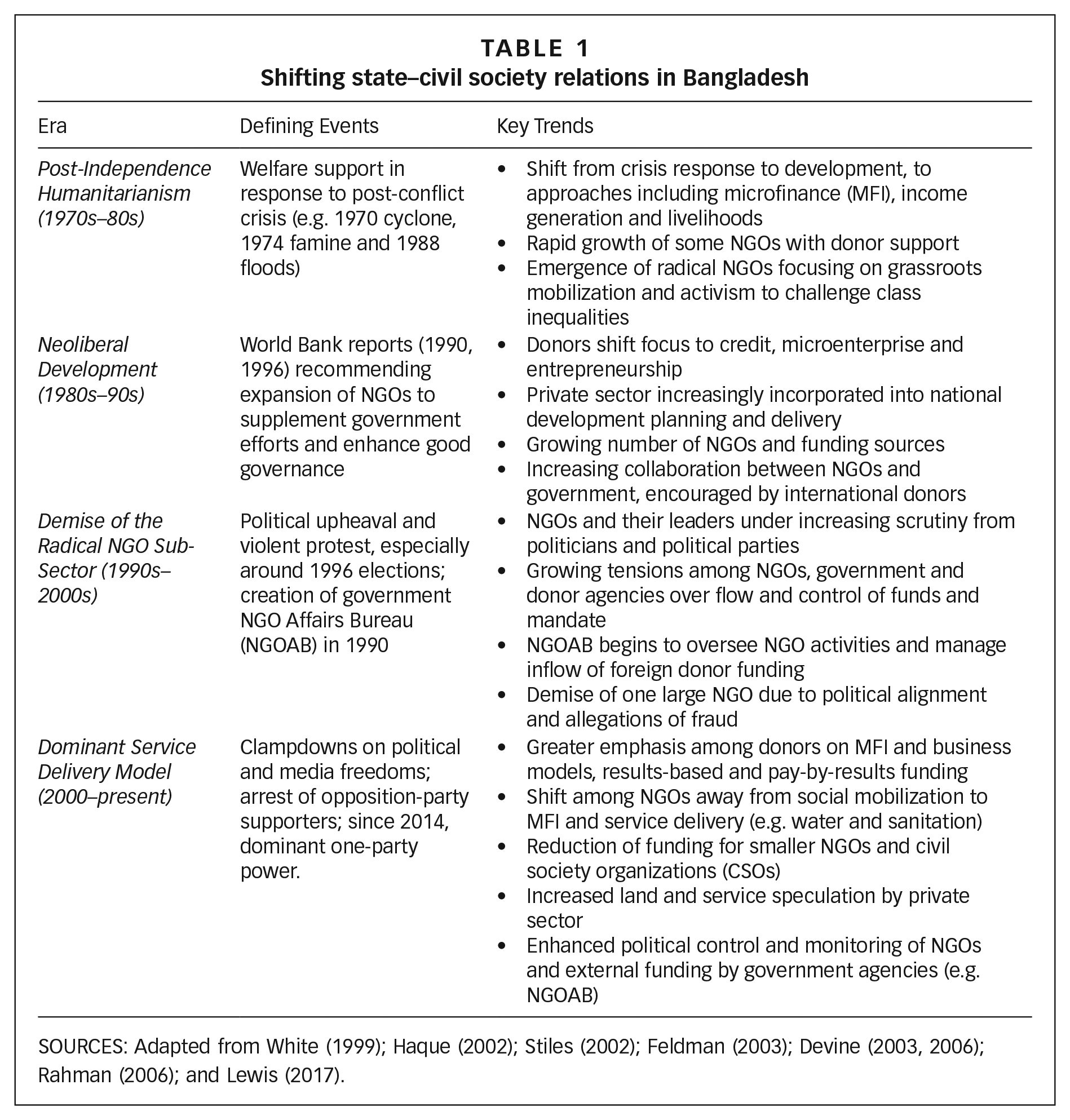
This section outlines four historical eras in state–civil society relations (Table 1) that have had particular implications for scaling participation up, out and across in Dhaka. I outline the dominant role that NGOs have come to play in Bangladesh, with implications for new forms of patronage and intermediation. But I also explore a broader shift – triggered by international donors and political competition – away from social mobilization toward collaboration in short-term, technical service delivery projects.
Shifting state–civil society relations in Bangladesh
SOURCES: Adapted from White (1999); Haque (2002); Stiles (2002); Feldman (2003); Devine (2003, 2006); Rahman (2006); and Lewis (2017).
As indicated in Table 1, NGOs came to play an increasingly prominent role in Bangladesh in the 1980s, often posited by international donors as better able than the government to distribute resources and welfare support.(8) Within this period, Lewis notes that the government and donor “vogue for NGO ‘partnership’ mainly took the form of sub-contracting relationships in service delivery, in keeping with the neoliberal vision of functional division of labour between government and NGOs”.(9) With the rise in NGOs came a local (and international) cadre of development professionals – educated, middle-class men and women – who sought to empower low-income groups.(10) Whilst bringing about improvements in rural Bangladesh (the area of operation for the majority of NGOs at this time), these processes resulted in the bureaucratization of the NGO sector and what Eade describes as a growing tendency to “mobilize money over people”, based on the donor-driven “need for sustainable funding, long-term employment for staff and activities that ensure measurable results”.(11)
During this time, there was a gradual realization that, as opposed to being challenged, patron–client relations(12) prevailed in Bangladesh, and, according to Devine, were “more likely to accommodate and adjust to the arrival of new organizations, such as development NGOs”.(13) For some scholars,(14) NGOs and their staff became new patrons, replacing dependency on more traditional forms of authority, including moneylenders and – in the case of service provision in bostis – mastan (musclemen) and illegal vendors. For others,(15) however, these new patrons would not replace but simply enter the mix of existing intermediaries (elaborated in Section III), who would manoeuvre to accommodate, manipulate and enter into relationships with any new organizations. For example, local political leaders previously referred to as mastan(16) might become the elected leaders of an NGO-created CBO in a water and sanitation project.(17)
Throughout the political turmoil of the 1990s (Table 1),(18) the role of large and radical NGOs and their leaders came under increasing scrutiny.(19) Conflicts over donor funding, and the intensification of political patronage under electoral democracy, made NGOs more vulnerable to allegations of co-option and malpractice.(20) At this time, the government reassessed NGO relations, guided by the new mainstream policy discourse that involved the government–NGO collaboration noted above, but motivated primarily by the need to exert political control over NGO activities, and to deter opposition movements.(21) The demise of one large NGO – referred to here as Sangstha (meaning “agency” or “organization” in Bengali)(22) – became emblematic of fraught state–civil society relations at this time. Overt support by the NGO founder for the (now) ruling party (at that time in opposition), including an attempt to personally enter politics, had significant implications for the credibility of the NGO sector.(23) In addition – as I examine in Section V – it complicated the credibility of BBOSC, whose leaders were involved in mobilizing bosti residents in a voter-education programme.
Following this crisis, many NGOs shifted their focus from social mobilization to service delivery and microfinance(24) to avoid direct confrontation with the state. Even when the ruling party returned to power in 2009, government officials remained suspicious of NGOs that could mobilize large numbers of people.(25) Contemporary trends (Table 1) indicate the increased control and regulation of NGOs by the NGO Affairs Bureau (NGOAB), the ongoing prioritization of MFI and service delivery, and the almost total disappearance of the radical subsector in Bangladesh.(26) A service delivery model increasingly dominates, with a shift among NGOs from contestation to collaboration.(27) Rahman notes, quite rightly, that this shift “results from the combination of international donor pressure with a domestic environment inimical to political activism”.(28)
Within this context, international donors, NGOs and CBOs(29) have come to play a particularly prominent role in legal water and sanitation delivery in Dhaka’s bostis (operating via a common project model).(30) But they remain hesitant to engage around land and housing tenure, material redistribution or political representation. Notwithstanding the dire need for basic services and the possibility of hydraulic citizenship,(31) a cost-saving model(32) dominates in Dhaka, with implications for scaling participation up, out and – especially – across. Section III elaborates on how these shifting state–civil society relations are negotiated and reconfigured at the local level in Dhaka’s bostis, with particular implications for scaling up, out and within.
III. In/Formal Governance and Intermediation in Dhaka’s Bostis
Once known as a town of 52 markets and 53 lanes,(33) Dhaka has undergone rapid urban transformation(34) in the past 400 years to become a megacity of 19 million people, predicted to reach 28 million by 2030.(35) As a primary city – the seat of political and administrative power in Bangladesh – Dhaka has seen significant population growth from an influx of economic migrants and climate refugees. Whilst numbers remain disputed, an estimated 35–40 per cent of Dhaka’s population live in bostis, with 4,966 settlements recorded in 2005,(36) rising to 6,489 in 2014.(37) Between 1975 and 2003, and again in 2008, large-scale evictions took place to reclaim public land from bosti occupation. Smaller, incremental evictions were also common around key political events.(38) In recent decades, aggressive real estate speculation and land grabbing, linked to high land values, have had major implications for access to affordable housing and services across the city, with rising rent and bills for bosti residents and the middle class alike. Despite the need for secure housing and services, city officials continue to regard bostis as unwanted elements – physical manifestations of poverty and criminality to be removed.(39)
Whilst formal voting rights given to the urban poor in 1994 (thanks in part to the efforts of BBOSC, Section V) acted to strengthen political participation and accountability, the quality, depth and outcomes of participation in Dhaka’s bostis remain questionable.(40) A lack of clearly defined roles and responsibilities, large ward sizes (65,000–100,000 residents)(41) and political apathy mean that ward councillors, members of Parliament (MPs) and mayors – the closest representatives to low-income settlement residents – rarely engage directly with bosti dwellers. Instead, the representatives use politically affiliated local leaders living within and outside bostis to manage these relationships. These leaders(42) – largely male house and business owners – commonly exert their authority over residents via bosti committees.(43) The committees are historically aligned to one of the two main political parties,(44) with the distribution of power, resources and opportunities confined to a relatively small elite circle.(45)
These in/formal governance arrangements mirror not only the shifting party politics outlined in Section II, but deeper social relations in Bangladesh, a patriarchal and gerontocratic society,(46) and in Dhaka, a city that Sultana describes as “largely homogeneous in terms of race or ethnicity (Bengalis) and religious composition (Muslim) due to the spatio-religious partitioning of South Asia during the British colonial rule and postcolonial nationalism”.(47) Taking this further, Basu et al. note how deep structures – entrenched patron–client relations mediated by caste, class, religion and kinship formed in an agrarian, pre-capitalist and pre-democratic Bangladesh (and South Asia more broadly(48)) – continue to confine low-income groups within relationships of dependency.(49) Rather than challenge these relationships and risk losing vital support, clients – in rural and urban areas alike – continue to rely on a number of state and non-state intermediaries(50) to access basic services, jobs, information and protection.
Within Dhaka’s bostis, an array of intermediaries, including local political leaders, low-level bureaucrats, political patrons (ward councillors, MPs, mayors), private landowners, business owners and NGO staff, are engaged in a constant struggle for control over resources, political power and the increasingly valuable land.(51) As this article will examine in Sections V and VI, these deep structures present an array of challenges to scaling participation up, out and – especially – within (beyond well-connected leaders). However, they also present a number of opportunities, based on the understanding that dependency, patronage and intermediation can also form recursive relationships with collective action,(52) and that bosti residents and their representatives negotiate and manoeuvre within these structures to achieve a range of individual and collective goals. Section IV outlines the methodology deployed in the study, before elaborating on the limits to and opportunities for scaling participation in this context, via a detailed account of the formation and evolution of BBOSC, NDBUS and NBUS.
IV. Methodology
The article draws on nine months of fieldwork conducted in Dhaka in 2014–2015, with a follow-up visit in 2018. Dhaka was chosen as an illustrative case,(53) as little is known about how bosti residents mobilize at scale, and how the leaders and members of city-wide urban poor networks, and their NGO partners, perceive scaling processes. Whilst informed by qualitative and ethnographic enquiry in three bostis,(54) the quotes and narratives presented here draw primarily on 59 city-wide key informant interviews (KIIs) and field observations. These KIIs were conducted with the leaders of BBOSC, NDBUS and NBUS (n=12(55)); NGO staff members (n=27) and donor staff (n=6) from organizations funding or running urban poverty reduction, water and sanitation, MFI and savings programmes; and researchers based at urban think tanks/centres (n=4) and government officials (n=5), including a slum development officer and Department of Cooperatives representative. The remaining interviews (n=5) were conducted with two members of the ACHR secretariat in Thailand and one Dhaka-based member of the ACHR-affiliated Community Architects Network, the manager of a women’s multi-purpose savings cooperative and a representative of the Bangladesh Urban Forum, a stakeholder platform for dialogue and action on urban challenges. These interviews provided key insights into regional perspectives on scaling, and different forms of organizing in Dhaka.
To gather a range of perspectives, I interviewed participants across gender, age and organizational role – for example, both executive directors (referred to here as EDs) and project managers, and both CBO leaders and general members.(56) Whilst I interviewed English-speaking participants independently, my research assistant (RA) conducted interviews in Bengali with me present. Informed consent was obtained in written or verbal form and the interviews were recorded using a dictaphone. Interviews were then transcribed into English for analysis, involving thematic coding and identification of key quotes. Triangulated with settlement-level and secondary data, the KIIs provided data for a well-rounded analysis of the limits to and opportunities for scaling participation within and beyond Dhaka. In addition to conducting KIIs, my RA and I participated (upon invitation) in five internal meetings with BBOSC, NDBUS and NBUS(57) and two external events involving NDBUS, including a high-level Urban Policy Forum on the Government of Bangladesh’s (GoB’s) Five Year Plan (May 2015) and a water, sanitation and hygiene (WASH) fair (June 2015) involving ward councillors and a number of NGOs. Throughout fieldwork, and in our follow-up visits in 2018, we were also frequently invited into the homes of BBOSC and NBUS leaders for informal discussions, where they would also share photos and stories. These encounters provided valuable insights into the achievements of these networks, as well as challenges to scaling and sustaining their activities. Section V elaborates on these achievements and challenges in greater detail.
V. Formation and Evolution of Bbosc, Ndbus and Nbus
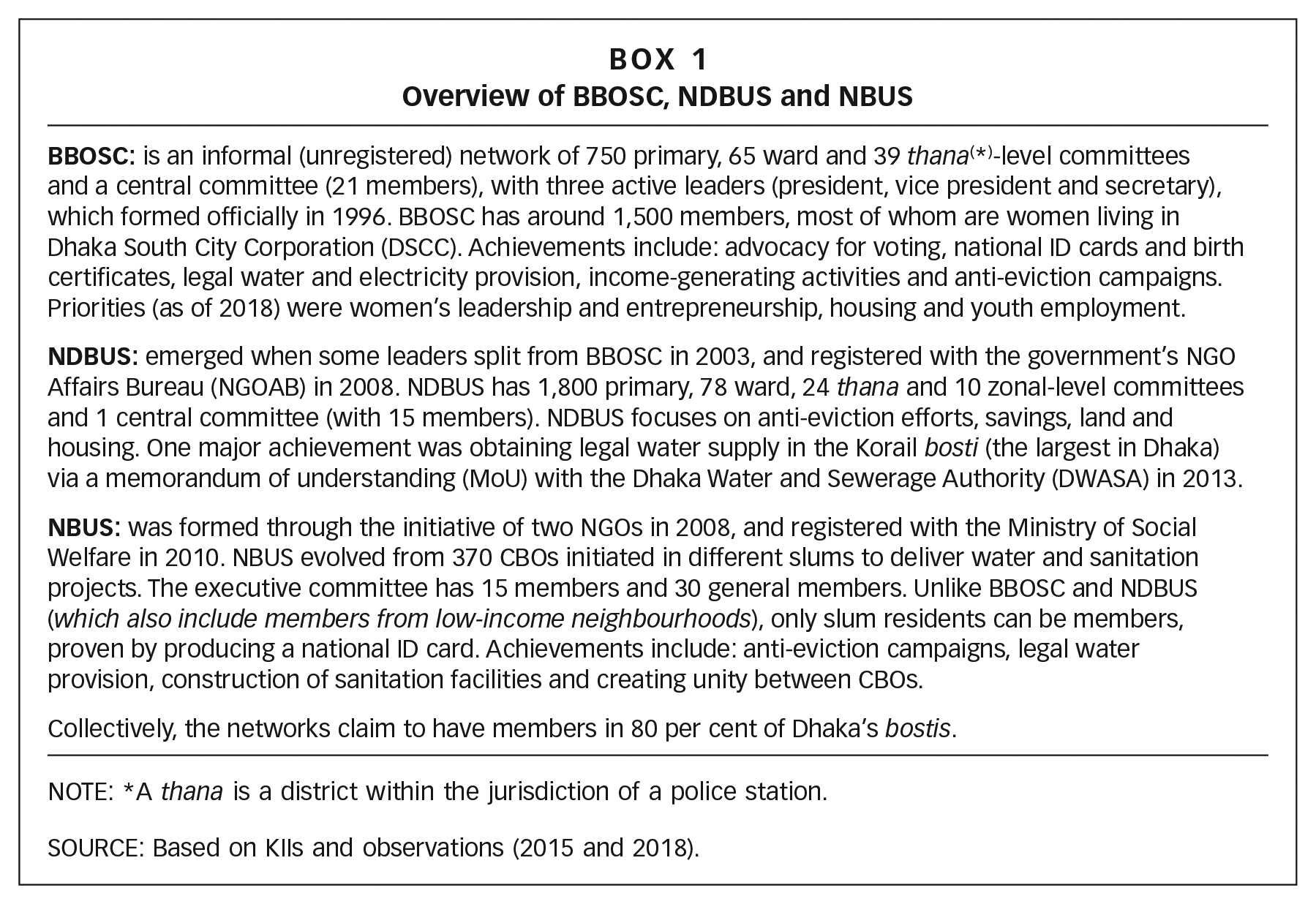
This section provides an overview of the formation and evolution of BBOSC, NDBUS and NBUS in Dhaka from the perspective of the leaders and their NGO partners. Despite initial scaling out (outlined with short biographies in Box 1) and evidence of scaling through (with leaders applying capabilities learned from one activity to new projects), I outline how attempts to scale participation up, out, across and within via these networks are constrained by broader state–civil society processes noted in Section II, and the deep structures (that underpin these processes) outlined in Section III.
Overview of BBOSC, NDBUS and NBUS
NOTE: *A thana is a district within the jurisdiction of a police station.
SOURCE: Based on KIIs and observations (2015 and 2018).
Throughout the 1980s, a small group of NGOs with support from human rights lawyers and researchers began mobilizing bosti residents to resist eviction and pursue rights to land, services and shelter. At this time, Sangstha (the NGO introduced in Section II) created an Urban Poor Development Programme, the first of its kind in Dhaka, to support residents in over 2,000 bostis with healthcare, education, sanitation and tube wells. Sangstha obtained funds from the Ford Foundation, and began to form committees (BBOSCs) with the intention to build a city-wide urban poor network. “We spent countless nights with the slum dwellers…We told them that if they unite, they will be very strong” (interview with a Sangstha project manager, 2015).
In 1989, staff from Sangstha and other NGOs formed the Coalition for Urban Poor (CUP), an umbrella organization for NGOs working in Dhaka. The executive director (ED) explained why CUP emerged: “in 1985 to 1989 the government started to evict the bostis inhumanely and randomly. We wanted to advocate in favour of the urban poor, and resist the harsh policies of the government” (interview, 2015). Throughout the 1980s and 1990s, the number of NGOs working in Dhaka increased with the realization that bosti residents (not only rural dwellers) were in dire need of healthcare, credit and basic services, including legal water supply. In 1992, CUP registered with the NGOAB to access foreign donations. Whilst registration provided opportunities for project implementation and organizational sustainability via regular staff salaries, some CUP members believed it triggered a shift in the organization’s approach. The ED of one member NGO noted how “we wanted to keep fighting on the streets to establish the rights of the urban poor, but CUP registered with [the] government, and the government could stop their funding any time” (interview, 2015). Similarly, the Sangstha founder argued that: “They [CUP] are either afraid or don’t want to take the challenge. Because they feel what happened to [us], in facing the state power, so they want to be [a] little bit safe…They would have seminars, conferences, study visits, but not the real work. So in a way CUP is only a shadow of its former self. . .They [the leaders] are turning CUP into a service delivery organization. This is of course needed…but basic problems of the urban poor cannot be addressed without large-scale social mobilization.” (interview, 2015, emphasis added)
As noted in Section II, the apparent collusion between Sangstha’s founder and the (now) ruling party in Bangladesh, and allegations of fraud (elaborated below), had significant consequences for Sangstha and the NGO sector in the 1990s, which are still felt today. The founder elaborated on how, before the 1996 election (Table 1), Sangstha mobilized thousands of rural and urban residents – with support from BBOSC leaders and members – and ran a voter-education programme to challenge the opposition-led government. This “politics of convenience” was a matter of life and death for NGOs in Bangladesh – the opposition parties were regarded as a threat to secularism, women’s rights and the “very survival of NGOs”(58) (interview, Sangstha founder, 2015). Sangstha organized a large rally in Dhaka with over 100,000 people to demand open, democratic elections. The ruling party narrowly won the election and, when they came to power, “NGOs gave a huge sigh of relief” (interview, Sangstha founder, 2015).
However, the re-election of the opposition party in 2001 had significant consequences for Sangstha and BBOSC – “when [the opposition party] came to power, our entire fund was shut down. 31 projects had to suffer” (interview, project manager, 2015). The founder was also criticized by other NGO staff and researchers for using bosti residents and, allegedly, funds directed for their welfare, to “get into politics”, rather than for any agenda-setting purpose (i.e. housing and land rights). “CBOs [referring to BBOSC] are constantly under pressure either to become supplementary delivery mechanisms, aids, co-opted into becoming political foot soldiers or vehicles for local power figures” (interview, head of an urban research centre, 2015).
The change to an opposition-led government (2001–2006) did not only impact Sangstha. The ED of another urban NGO working on housing and land remarked that, in 2001, “the new government put pressure on NGOs, and CUP shifted its strategy to avoid confrontation. . .we [also] strategically shifted our focus from street fighting to negotiation. We now fight on the table with government officials and policy makers” (interview, 2015). It was during this period that a group of leaders split from BBOSC(59) and CUP to form their own network, NDBUS. This move – still a source of tension between BBOSC and NDBUS leaders – was an attempt by the latter to disassociate from partisan politics (noted above) and actively seek foreign donor funding (noted below) via registration at the NGOAB, something NDBUS did during the military-backed caretaker government (2007–2009). Shortly after this, another urban poor network (NBUS) emerged from a different NGO initiative, obtaining registration from the Ministry of Social Welfare in 2010 after the return to power of the ruling party in 2009. One NBUS leader remarked that they had initially sought registration under the name City Citizen Action Committee, but this was rejected (the term citizen was not agreeable to the registering authorities). The rejection led to the current name, Urban Slum Development Agency (field observations, 2015).
Even with the return to power of the ruling party in 2009, NGOs working with bosti residents in Dhaka remained hesitant to engage in potentially contentious issues such as land, housing or social mobilization, for fear of losing their registration and funding. As one NGO ED remarked, “NGOs cannot speak against the government decision. NGOs cannot do [social] movements with freedom and raise their voice [and]. . .donors do not accept if an NGO speaks about different issues from its course of work” (interview, 2015). Another noted that “the government strategy is divide and rule…government knows that if all three groups [BBOSC, NDBUS and NBUS] raise their voice then it will be big trouble…If they are separated, political parties will use them [as a vote bank]” (interview, 2015). In recent years, there has also been a growing tendency for government authorities to exert control over NGOs and foreign funding in Dhaka via the NGOAB. One government official shared that “the decision to organize and coordinate the NGOs came from the higher authority” (interview, 2015).
Fieldwork revealed two other undocumented yet important trends with implications for scaling – the shift among international donors and some larger NGOs to forming their own CBOs and city-wide networks for project implementation, and the registration of CBOs as NGOs or cooperatives to enhance their financial capacity and sustainability. This trend was noted especially in relation to water and sanitation projects, with a proliferation of WASH CBOs involved in short-term service delivery at the settlement level.(60) This was also the case with the United Nations Development Programme (UNDP) Urban Partnerships for Poverty Reduction Project (UPPRP), which formed female-dominated Community Development Committees (CDCs) at the settlement level, and had plans to create a national federation.(61) One UPPRP official noted that bypassing NGOs had three benefits. It: 1) reduced dependency on NGOs and brought the community closer to local government; 2) enhanced cost efficiency; and 3) encouraged sustainability (interview, UPPRP manager, 2015). However, the UPPRP approach also created tensions with some smaller NGOs, BBOSC and NBUS, whose leaders and members regarded themselves as central to community mobilization and CBO formation in bostis. As one NGO ED remarked, “donors are facilitating registration of CBOs and making them into NGOs. Instead of working with NGOs, they are more interested to work with [their own] CBOs” (interview, 2015). During one dialogue event with the three urban poor networks, the president of NBUS also stated: “We have a message to all NGOs. Whoever is working in any settlement needs to work with the existing CBOs, and not create new CBOs, because a large quantity of different CBOs creates rifts among the dwellers. If NGOs work through the same CBOs, our unity will sustain. This rift is created by NGOs. We are not creating a rift. We want to be united.” (field observations, 2015)
This also resonates with another NGO ED’s comment that “some civil society organizations perceive CBOs as competitors. . .Bangladeshi NGOs are famous for delivering services, not for strengthening CBOs” (interview, 2015). At the time of fieldwork, these NGO–CBO dynamics were a source of ongoing tension between the urban poor networks. Although all groups were part of another national federation,(62) there were clear divisions within and among BBOSC, NDBUS and NBUS. This reflected conflicts over political influence, organizational identity (as a CBO, grassroots network or NGO), and funding.
Whilst BBOSC remains unregistered and reliant on CUP for logistical and financial support (which it now rarely receives due to a wider funding crisis(63)), NDBUS and NBUS are registered organizations that can, in theory, obtain foreign donor funds. One BBOSC leader remarked that “NDBUS has become an NGO now, and NGOs and CBOs can’t work together” (interview, 2015). Contrary to this opinion, on numerous occasions, including during a speech at a WASH fair, the NDBUS cashier stated, “we are not an NGO. We are an autonomous organization . . . many CBOs work under the patronization of other NGOs. We used to work with the assistance of others [i.e. CUP] but now we are working independently” (field observations, 2015). During the annual general meeting (AGM), one NBUS leader also remarked, “our organization is not a project! It is our own initiative. NBUS is not formed like an NGO. An NGO has fixed project duration, once the duration is over they leave, the committee they organize is also lost. NBUS is a product of our own hard work” (field observations, 2015). However, the same leader also highlighted that “a small tree [BBOSC, NBUS] could not grow if it is underneath the shadow of another, larger tree [NDBUS]. . .they sustain their organization, whereas we are depending on others” (field observations, NBUS AGM, 2015). Though active, all of the groups operated at low capacity at the time of our fieldwork, and would rarely meet together of their own accord.
Whilst leaders across the three networks sought to establish clear, autonomous identities and mandates, some researchers, government and donor officials ultimately regarded them as “pocket organizations of NGOs to make money” (interview, DNCC-UPPRP town manager, 2015). Even NDBUS, which was at the time of fieldwork partnering with UNDP and the local government to mobilize residents into savings groups for the UPPRP, was criticized for having “no capacity” – “these people are illiterate. . .they are not up to the mark” (interview, DNCC-UPPRP town manager, 2015). Referring to NBUS, one government official also remarked that “it is not an organization of slum people. . .there is no such organization who can lead or work [at] city or national level” (interview, 2015). Whilst these testimonies neglect the personal aspirations, sacrifices and motivations of leaders and members of BBOSC, NDBUS and NBUS – the majority of whom are unpaid volunteers – some were involved in local politics and land speculation, owning multiple houses or flats to rent out to tenants, or collectively purchasing land. The leaders were ultimately well connected to local and international NGOs, and to political patrons who would run activities, including voting campaigns with their support. For instance, “[the former mayor] started his voting campaign from our NDBUS” (field observations, 2015). Many had been leaders in these networks for a long time, countering calls from NGOs for regular elections, and they aspired to a more comfortable life. As one BBOSC leader reflected, “if you work [for] NGOs, you get many things” (field observations, 2015). Drawing on these empirical insights, Section VI elaborates on the limits to and opportunities for scaling participation in Dhaka, and the broader implications for research, policy and practice.
VI. Limits to and Opportunities for Scaling Participation
An analysis of existing literature and the trajectories of BBOSC, NDBUS and NBUS indicates that attempts to organize at scale via these networks, especially around land tenure, housing and political representation, are limited by three overlapping state–civil society processes: (a) the politicization and increased monitoring of NGOs; (b) shifting international donor funding preferences towards technical service delivery, and the creation of new CBOs for this purpose; and (c) ongoing dominance and paternalism of NGOs (which include a cadre of middle-class professionals) towards low-income settlement residents. I elaborate here on these processes, and their implications for scaling, in greater detail.
a. Politicization and monitoring of NGOs
Building on existing observations,(64) Section V outlined how partisan political alignment by the founder of a large NGO (Sangstha) – one of the first to provide vital support to bosti dwellers – had lasting consequences for the NGO sector and the urban poor networks(65) in Dhaka. A number of respondents recalled how NGOs and CBOs that had registered with the government NGOAB increasingly turned away from social mobilization around land, housing and political participation (which were seen to be too contentious) and towards collaboration, especially in service delivery. Increased monitoring, funding scarcity and the ongoing fear of losing registration to access foreign donations mean that any NGO-led mobilization around these pressing urban challenges remains unlikely. As indicated in Sections II and V, however, these shifts can be attributed not only to politicization and increased surveillance by state authorities, but also to a shift in international donor funding preferences and associated opportunities.
b. Shifting donor funding agendas
Changes in donor funding agendas and the influence this has had on NGOs are well documented in Bangladesh.(66) What has received less attention, however, is the shift to creating and registering new CBOs for project delivery, and the way NGO staff and the leaders of BBOSC, NDBUS and NBUS perceived and responded to these changes in Dhaka. In the 1990s and 2000s, CUP, NDBUS and NBUS all sought to capture foreign funding opportunities via registration as formal entities. However, some NGO staff also note a gradual shift in approach in the mid- to late 2000s, with some donors and NGOs preferring to create and register their own CBOs (as seen in the UPPRP) at the settlement, city and even national levels, bypassing existing NGOs, BBOSC and NBUS. Only NDBUS was involved in some way in this process – receiving funding to mobilize bosti residents into savings groups, a task criticized by the DNCC-UPPRP town manager. This changing funding landscape brought both benefits and challenges. These shifts fuelled tensions between NGOs (heavily reliant on donors themselves for staff salaries and project implementation) and the urban poor networks, which all competed for increasingly scarce funds. Within this context, the dilemmas for unregistered networks like BBOSC are twofold – continue to rely on NGOs and donors for financial and logistical support (which is rarely given), or become an NGO (registering with the NGOAB) or other registered entity to obtain foreign funds. Either approach exacerbates the dominance and paternalism of NGOs towards bosti residents in Dhaka, and does not guarantee organizational sustainability.
c. NGO dominance and paternalism
Despite their differences, BBOSC, NDBUS and NBUS are ultimately part of the “same tree” (interview, NGO ED, 2015) – a tree for which the seed was planted by NGOs. Many of the achievements (Box 1) would not have been possible without the vital funding and capacity-building support from NGOs in Dhaka. However, the dominance and paternalism of some NGO staff towards BBOSC, NDBUS and NBUS (and the subsequent dependency of some leaders on these staff) raise questions about who these networks were formed by, who they represent, and whose interests they serve.
Whilst spending considerable (mostly unpaid) time and money on sustaining these networks, the leaders involved in BBOSC, NDBUS and NBUS do not also necessarily represent the large diversity of needs, interests and priorities in Dhaka’s bostis. Whilst some, during the time of our fieldwork, still lived in bostis (especially NBUS members, for whom this was a requirement, Box 1), others no longer did. Many of these leaders aspired to more comfortable lives for themselves and their families, and regarded work in the development sector to be one way to achieve this. However, the largely middle-class, educated professionals who work in this sector – in NGOs, but also in government and donor agencies – did not necessarily see the leaders in the same light, as the DNCC-UPPRP town manager implied. This indicates deep-rooted class prejudice, and a general mistrust towards bosti residents and their representatives.
d. Synthesis
Taken together, the overlapping processes outlined above have particular implications for scaling participation up, out and – especially – across in Dhaka’s bostis. The vital importance and political nature of urban services and infrastructure, including opportunities to scale through (with leaders applying their extensive knowledge and skills to new projects or initiatives), must be acknowledged. But the increasing involvement of NGOs, CBOs and the urban poor networks (especially NBUS) in short-term, technical service delivery limits scaling out across settlements where numerous NGOs and CBOs are operating at once (undermining coordination and fuelling conflict), and across from water and sanitation to land and housing. These issues remained central concerns for bosti residents, but few NGOs were willing to engage with them for fear of reprisals from government authorities and donors for stepping outside mandated activities. Whilst approaches varied between NGOs, with some attempting to build in autonomy and scaling via savings or skill development,(67) without a strong financial base, BBOSC, NDBUS and NBUS ultimately relied on NGOs and donors to sustain their activities. These processes, coupled with a general apathy towards bosti residents among government and city officials, ultimately limit the scope (financially and organizationally) to scale up from projects and precedents to influence wider policy and programming.
Returning to Section III, it is clear that deep structures of dependency (on NGOs and donors), patronage and intermediation (from/by politicians, NGO staff and the leaders of the three urban poor networks) underpin and cut across all of these intersecting state–civil society processes. These structures have particular implications for scaling within and out from settlements beyond well-connected leaders (with those most able and willing to mobilize often dominating CBOs(68) and the city-wide urban poor networks). There are also ramifications for scaling up (with little incentive for patrons and intermediaries of various types to support scaling processes that might undermine their interests, i.e. accumulation and protection of resources, votes and land).
However, by focusing explicitly on the narratives of BBOSC, NDBUS and NBUS leaders and their NGO partners, we can also see how bosti residents and their representatives negotiate and manoeuvre within this challenging environment to achieve a range of individual and collective goals. Examples include co-production in legal water supply (Box 1), entering into partnerships with donors (such as UPPRP), and working with political (i.e. mayors) and NGO (i.e. Sangstha) patrons. Building on these experiences, and the knowledge that scaling can occur and has occurred under similar conditions, I conclude with some potential opportunities to support scaling processes via BBOSC, NDBUS and NBUS, multi-sectoral coalitions, and the formation of (female and youth-only) cooperatives.
VII. Conclusions
Collective action can play a central role in improving access to affordable services and – if scaled – a broader politics of redistribution, recognition and representation. Recognizing this, as well as the numerous achievements and aspirations of BBOSC, NDBUS and NBUS to date, this article has sought to shine a light on what has been done (including partial scaling out and through), what has not worked and why (compared to other contexts with active urban poor federations), and what could be done to scale participation among bosti residents in Dhaka. In doing so, the article addresses a significant knowledge gap around limits and opportunities to scaling in Dhaka, drawing on a historical analysis of state–civil society processes, and the formation and evolution of BBOSC, NDBUS and NBUS and their NGO partners.
I demonstrated how attempts to scale via these networks are limited by three overlapping state–civil society processes that are, in turn, underpinned by deep structures of dependency, patronage and intermediation. Whilst acknowledging the significant challenges these conditions bring for existing networks and organizations – and the creation of any new ones – I also acknowledge that low-income settlement residents, and their representatives, deploy a range of strategies at both the settlement and city levels to address a diversity of needs and priorities. I concluded with potential opportunities to support scaling processes across and beyond the city.
Whilst the findings presented here resonate in particular with the South Asian (especially Indian) context, broader processes identified – including increasing surveillance of NGOs and the dominance of neoliberal service delivery models – have implications far beyond Bangladesh and South Asia. Residents of slums, favelas, shacks and low-income neighbourhoods across the global North and South continue to struggle to obtain basic services, land, housing and political recognition in increasingly unequal urban environments. What are the limits to and opportunities for scaling in these contexts? Who initiates scaling processes, and to what ends? And what alternative forms of collective action have emerged, or can emerge, in line with different political and economic opportunities? Future research, advocacy and activism are urgently needed to answer these critical questions.
Footnotes
Acknowledgements
I would like to thank all participants in the research who agreed to share their time and perspectives, especially the leaders and members of BBOSC, NDBUS and NBUS. A special thank you also to my research assistant and academic hosts (BRAC Institute of Governance and Development). Thanks also to friends and colleagues within and outside Bangladesh, for your invaluable feedback on the initial drafts.
Funding
Thanks to the Rory and Elizabeth Brooks Foundation for funding this PhD scholarship.
1.
Following  , bosti is used in this paper as opposed to basti, bastee or bustee (also commonly used), because it is close to the local pronunciation of the word by native speakers of Bengali. This term also takes into account the desire by some participants to be defined as bosti (settlement) residents, rather than busteebashee (slum dwellers).
The term “slum” usually has derogatory connotations and can suggest that a settlement needs replacement or can legitimate the eviction of its residents. However, it is a difficult term to avoid for at least three reasons. First, some networks of neighbourhood organizations choose to identify themselves with a positive use of the term, partly to neutralize these negative connotations; one of the most successful is the National Slum Dwellers Federation in India. Second, the only global estimates for housing deficiencies, collected by the United Nations, are for what they term “slums”. And third, in some nations, there are advantages for residents of informal settlements if their settlement is recognized officially as a “slum”; indeed, the residents may lobby to get their settlement classified as a “notified slum”. Where the term is used in this journal, it refers to settlements characterized by at least some of the following features: a lack of formal recognition on the part of local government of the settlement and its residents; the absence of secure tenure for residents; inadequacies in provision for infrastructure and services; overcrowded and substandard dwellings; and location on land less than suitable for occupation.
2.
3.
Fraser (1997; 2005). See also .
4.
BBOSC: Bangladesh Bosti Basheer Odhikar Surakha Committee (Bangladesh Slum Dwellers Rights Protection Committee), NDBUS: Nagar Daridra Basteebashir Unnayan Sangstha (Urban Slum Dweller Rights Development Agency) and NBUS: Nogor Bostibashi Unnyan Sangstha (Urban Slum Development Agency). Note that BBOSC is referred to as BOSC in earlier publications [e.g. Banks (2008); ], but the leaders noted a preference for BBOSC to acknowledge their country-wide linkages.
5.
Typology developed by Horn et al. (2018) and .
6.
Wood (2000, 2003); Devine (2006); .
11.
Eade (2000), cited in Feldman (2003), page 22. See also .
12.
13.
Devine (1999), cited in Devine (2003), page 235. Some scholars argue that patron–client relations can be challenged and renegotiated by civil society actors [Mosse (2010); ].
14.
15.
For examples in India, see Ward (2010); Krishna (2011); and .
16.
For analysis of the changing role of mastan in urban Bangladesh, see Jackman (2018, ).
18.
Since the democratic transition in 1991, election results (up to 2013) indicated that politics in Bangladesh had evolved towards a de facto two-party political system [Hassan (2013)] dominated by two main parties – referred to in this article as the ruling party (currently in power) and opposition party. During the two-party era (1991–2013), these parties cultivated a pyramidal system of pervasive patron–client relations across the country to enlist and reward supporters, leading to a patronage-based electoral politics in a post-military setting, and frequent violent protest in the form of hartals (enforced shutdowns) from opposition supporters [Lewis (2011, 2017); ].
19.
White (1999); Devine (2003, 2006); Rahman (2006); Lewis (2011, ).
20.
White (1999); Devine (2003, 2006); Rahman (2006); Lewis (2011, ).
22.
Some NGO and research centre names are anonymized.
23.
Rahman (2006, page 461), notes how “any political action is conflated with partisan support for opposition parties, and ultimately reduces the legitimacy and efficacy of NGOs to serve as the voice for the poor”. See also .
24.
, page 712) note how “more recently, accusations of corruption and the forced resignation of Mohammed Yunus from the Grameen Bank. . .are widely recognized as a government response to his post-Nobel prize attempts to create a ‘people’s’ political party to foster change in the country’s political culture”.
26.
Lewis (2017); .
29.
30.
Detailed in Hossain and Ahmed (2014); and Cawood and Rabby (2021a, ).
31.
32.
It is widely acknowledged that CBOs created by NGOs or donors for service delivery often dissolve post-project due to a lack of internal capacity, insufficient financial autonomy and limited incentives for continued participation [Jaglin (2002); Kyessi (2011); Das (2015, )].
36.
Angeles et al. (2009). The survey conducted by Angeles et al. (2009) also indicated that over 77 per cent of the 4,966 bostis identified were located on privately owned (as opposed to government or NGO) land. Aside from levying high rent and bills, some private landlords (including business owners and politicians) have been found to block NGO and CBO activities to maintain a monopoly on service provision and deter organization among tenants [Banks et al. (2011); Roy and Hulme (2013); ].
38.
41.
Dhaka is divided into two administrative zones – Dhaka North City Corporation (DNCC), where 70–80 per cent of bostis are thought to be located, and Dhaka South City Corporation (DSCC). Each corporation is headed by a democratically elected mayor, and 90 wards (in 10 zones) are each headed by a democratically elected ward councillor [].
42.
Many of those in leadership positions are long-term urban residents – rarely recent migrants or short-term tenants, of which there are a growing number across Dhaka [see Banks et al. (2011); Roy and Hulme (2013); and for details].
44.
The shift since 2013 to a one-party era (Table 1), with the ruling party effectively quashing political opposition, has acted to consolidate ruling-party power in rural and urban areas, including Dhaka’s bostis. For details, see Jackman (2018, 2019); and .
45.
47.
48.
Fuller and Harriss’s (2001) discussion of the everyday state and notion of political society are particularly useful in demonstrating how low-income groups do not rely on formal rights and entitlements bestowed by a benevolent civil society, but rather on relationships with a range of (political) intermediaries to meet their daily needs.
50.
See Jackman (2018, 2019); Basu et al. (2018); Manor (2000); Harriss (2010); and for further debate on the role of brokers, fixers and other political intermediaries in South Asia.
51.
Many of these intermediaries already own land within or outside Dhaka, including land occupied by bosti residents, from which they collect rent or votes. In DNCC, for example, one MP had a settlement named after them, and various relatives involved in political mediation in the area. See also Banks et al. (2011); Fattah and Walters (2020); Lata (2020); Banks (2008, 2015); Hackenbroch and Hossain (2012, 2013); .
52.
For example, these relationships can be formed via patron-led claim-making [Auyero et al. (2009)] or collective clientelism, involving negotiation, bargaining and alignment between a group (e.g. well-connected local leaders) and politician/s [Bénit-Gbaffou (2011)]. See also for discussion on patronage and local association formation among slum dwellers in India.
54.
This included, in total, 3 community profiles (including transect walks), 3 mini-censuses, 213 semi-structured questionnaires, 21 in-depth interviews and 6 focus group discussions, including with some leaders and members of BBOSC, NDBUS and NBUS.
55.
Out of the 12, four leaders were female and eight were male – all had been involved in the networks for many years.
56.
57.
The internal meetings included a dialogue between BBOSC and Sangstha, BBOSC central committee meeting, NBUS executive board and annual general meeting (AGM), and BBOSC, NDBUS and NBUS dialogue.
58.
According to the Sangstha founder, after the 1991 election, NGO schools, health centres and staff were targeted in arson attacks by opposition-party followers who regarded them a threat to religious and cultural sentiments.
59.
It has been assumed that BBOSC evolved into NDBUS, but fieldwork indicates a split – with some leaders remaining, and others leaving.
60.
In one field site, there were five NGOs and CBOs involved in water and sanitation provision and management, leading to frustration among residents that their concerns over land and housing were being overlooked. For details, see Cawood and Rabby (2021a, ).
61.
The UPPRP national federation aimed to unite all town federations across Bangladesh, and to encourage greater linkage between bosti residents and government. However, one (other) international donor official remarked how such initiatives will fall on “closed ears” – “who would they talk to, the same people in urban policy we already talk to, and don’t listen?” (interview, 2015).
62.
Distinct from the UPPRP federation, this national federation was created by NGOs to bring together the urban poor networks and other CBOs working for bosti residents across Bangladesh. For key differences to community mobilization and scaling in SDI and the Indian Alliance, see Appadurai (2001); and .
63.
During a return visit in 2018, some NGO staff and BBOSC leaders shared concerns that funding opportunities for urban poverty reduction programmes were shrinking due to Bangladesh nearing “middle-income” status (resulting in fewer donor funds) and the ongoing Rohingya refugee crisis, with central government, donor and NGO resources redirected to humanitarian aid.
64.
White (1999); Devine (2003, 2006); Rahman (2006); Lewis (2011, ).
65.
66.
White (1999); Devine (2003, 2006); Rahman (2006); Lewis (2011, ).
68.
This challenge is also highlighted in relation to the UPPRP CDCs. See Banks (2008; 2015); Hackenbroch and Hossain (2012); Hossain (2013); .
69.
72.
See reference 62.