



Abstract
This paper reflects on how the city of Manizales, Colombia, is incorporating climate change adaptation into its plans, and how this can build on the foundations of the city’s long-established urban environmental policy (Biomanizales) and local environmental action plan (Bioplan) that have guided urban development and have developed incorporating disaster risk reduction into local development policies and local land use plans. The success is rooted in coherent, multi-level governance, including capacity to integrate disaster risk reduction, climate change adaptation, land use and territorial planning within a holistic view of development that includes the views and capacities of multiple stakeholders. As the process matures, an acknowledgment of weaknesses leads to improved ways of addressing climate-related risks and adaptation challenges.
Keywords
I. Introduction
Urban areas and their governments are crucial players in climate change adaptation. Many are affected by floods, landslides, heat waves and other hazards that climate change is expected to aggravate. Often, there is a mismatch between a city’s rapid expansion and its institutional capacity to manage the implications of this expansion.(1)
This institutional capacity has considerable influence over the level and distribution of risks within a city. Well-governed urban centres, even those most at risk, are in general more resilient.(2) Much of what is required in the face of climate change is to address “old” problems related to everyday needs: access to water and sanitation, good drainage systems, good quality housing, health care services, communication and transportation networks.(3) But many city governments still struggle to fulfil these basic responsibilities and higher levels of government seldom provide the necessary support for adaptation. National governments have only just started to develop their own national climate change adaptation agendas. Uneven, skewed development and inadequate governance structures hinder the ability of urban populations and authorities to adapt to present and future climate change.(4)
Adaptation has to do with a system’s ability to adjust, moderate potential damage and cope with the effects of climate change (including climate variability and extremes).(5) For urban areas, this requires adequate governance structures and institutional capacity, but also services and infrastructure and a long-term development plan that includes disaster risk reduction (hereafter DRR). Transparency and accountability are guiding principles, as are the implementation of pro-poor policies. “Mainstreaming” DRR and adaptation is just an initial step in consolidating an alternative vision of development, which should include these parameters from the outset.(6)
This paper, one of three city case studies that look at constraints facing municipal governments in Latin America in developing adaptation plans, analyzes the case of Manizales in Colombia.(7) In each of these papers, we consider what should be included in adaptation programmes and plans, how these relate to other city programmes and plans, what support is available,(8) the necessary institutional and regulatory framework, and how the community gets involved.
It is challenging to identify cities with adaptation plans and programmes that are more than nice-looking statements of intent. As it becomes more “politically correct” to have adaptation plans, there is an increased risk of cities embarking on a process they do not understand. Not all local governments fully appreciate the benefits of holistic planning, which often clashes with traditional ways of managing urban areas and calls for revising institutional arrangements and long-standing policies. Relatively few local governments globally have made important advances in adaptation or gone beyond very preliminary steps,(9) and we suggest in the other papers in the series why this may be so.(10)
In selecting case studies, we looked for cities offering certain conditions: effective governance; institutional capacity; innovative planning and legal frameworks; holistic approaches to urban environmental problems and local development issues; the capacity to work with the urban poor; and an engaged civil society. These create a strong basis for including adaptation in local environment and development agendas, whether or not this has been made explicit. An effective climate change adaptation strategy also needs financial resources and well-trained government specialist staff to organize and encourage the engagement of relevant departments and sectors.(11) In other words, effective urban climate change adaptation needs appropriate urban climate governance(12) – not governments making decisions in isolation, but negotiating with those affected by its decisions.(13) This is not an easy task.
II. Research Background
Manizales was chosen for various reasons:
Internationally recognized for its long-established urban environmental policy (Biomanizales) and local environmental action plan (Bioplan), it offers an example for integrating adaptation into local policies and plans.
Because of its location, the city faces permanent disaster risk no matter how well it prepares. It has a good DRR system and plans, supported by a national system and embedded within urban environmental planning.
The city has strong participation mechanisms and stakeholder involvement, especially concerning the environment and disaster risk.
It is both the municipal seat and capital of the Department of Caldas, and the co-existence of municipal and state level authorities favours interaction. There are several universities and research centres, and private and civil society organizations with a commitment to community service, favouring coordination and dialogue.
Colombia has been a regional leader in developing a disaster risk system, and the National Plan of Adaptation to Climate Change currently being developed will lead to municipal and departmental plans. It also has environmental legislation that supports DRR and adaptation actions.
Decentralization over the years (despite ups and downs) has strengthened local innovation.
After initial contact in November 2010, a local team was set up in Manizales to support fieldwork and to prepare background material, coordinated by IIED–América Latina.(14) In July 2011 and February 2012, background material was assessed and analyzed to prepare for interviews in March 2012. The guidelines for the interviews pointed to key issues to cover (including local development, environmental planning, DRR, water issues, bio-engineering and participation) but also called for open dialogue to allow participants to share their thoughts on the improvement of urban environmental governance in general and climate change adaptation in particular. Participants were drawn from government, the private sector and civil society, and took part in group interviews with two to eight participants, which lasted about two hours. Response and participation were very good.
III. Characteristics of Manizales
a. History and location
The city of Manizales was founded in 1849, one of several small settlements, sometimes transient, that developed on top of the mountain ridge to protect gold mining areas; this explains the location of urban areas that are in inaccessible places, on steep slopes. The Department of Caldas was created in 1905, with Manizales as its capital. The settlements became permanent, and what is today known as the eje cafetero (the coffee axis) was consolidated. This is a network of intermediate urban centres and rural settlements with some of the highest quality of life in Colombia. Coffee production transformed the region socially, economically and environmentally, and between 1920 and 1930, Manizales became the second most important city in Colombia in terms of economic development and political power. Fires in the late 1920s destroyed the city but it was completely rebuilt in just a few years, totally modifying the local topography. A coffee crisis in the 1930s put a hold on development but Manizales remained politically important, and the regional campuses of national universities helped develop the academic and cultural profile of the city. A coffee boom in the mid-1970s again fostered economic development in the city and the region, but increased the pressure on its fragile ecosystems.(15)
Located on a high ridge between the Chinchiná and Olivares rivers (Map 1), Manizales originally occupied a narrow plateau but in time expanded over steep slopes, despite zoning constraints.(16) The municipality now covers 507 square kilometres and comprises an incredibly diverse group of eco-regions as a result of the natural layering at altitudes ranging from 870 to 4,050 metres above sea level. Most of the urban area of the municipality is located in tropical mountain rainforests with more than 289 rainy days a year and very fragile soils.
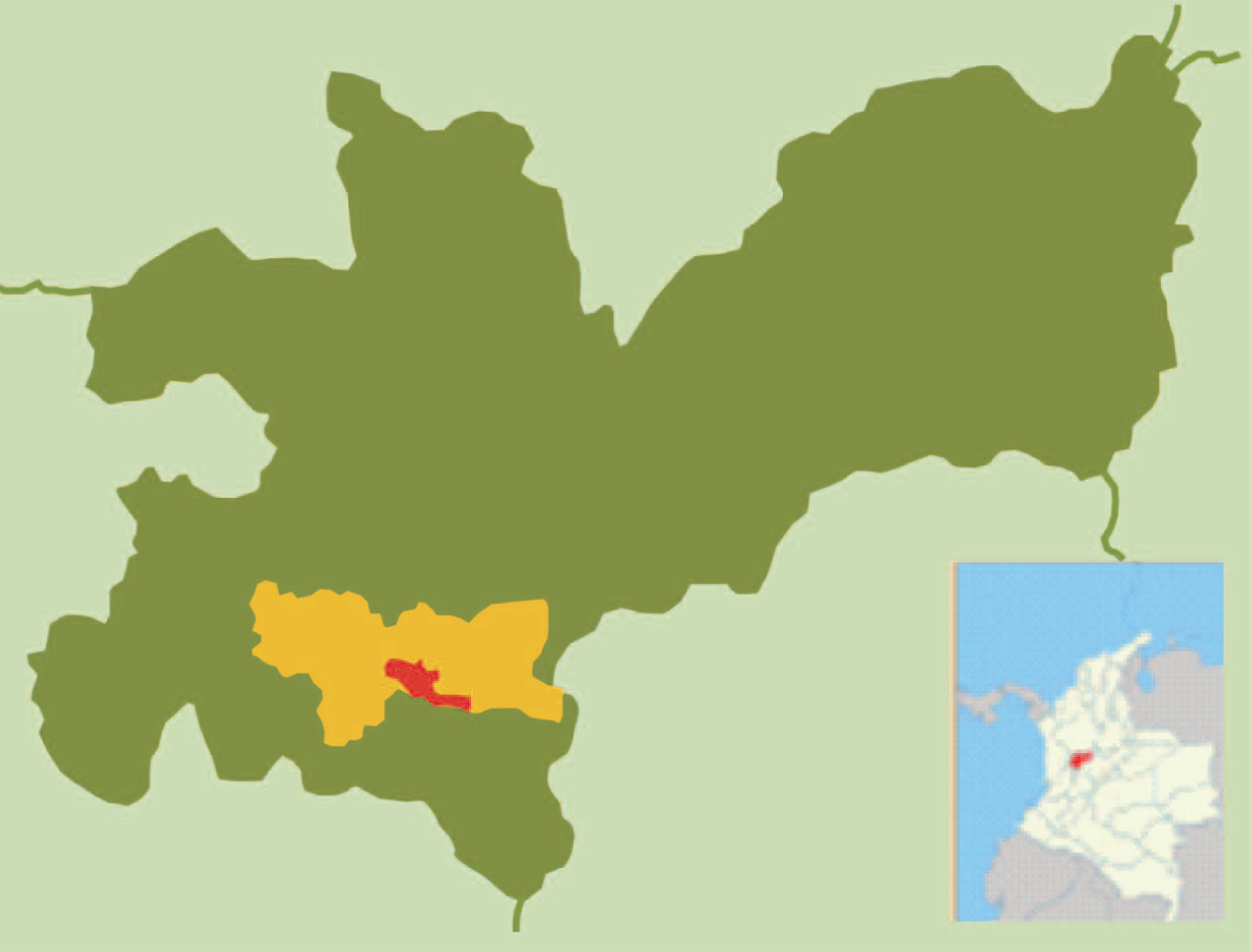
Location of the city and the Municipality of Manizales within the Department of Caldas
The average mean temperature is 18° C and average rainfall exceeds 2,000 millimetres, distributed in two rainy seasons of three months each (coinciding with the equinoxes). Precipitation is often intense, contributing to erosion, landslides and, in a few places, flooding. There is also the risk of earthquake and volcanic activity. The eruption of the Nevado de Ruiz in 1985 left 25,000 dead, isolated the area and resulted in large economic losses.
In the last decades, internal population displacements due to armed conflict and rural poverty have added to pressure on the fragile mountain ecosystems around the city. Difficulties in buying into the official land market, and the existence of illegal developers, have resulted in the occupation of environmental preservation areas that are needed to prevent disasters, protect areas that provide valuable ecological services and to maintain green space.(17) The occupation of river basins and steep slopes has increased the number of landslides, resulting in important economic and infrastructure losses, even though the city has assigned almost 12 per cent of its current budget over the last 10 years to structural work, corrective measures and mitigation, with additional resources from Corpocaldas(18) and national level entities during emergencies.(19)
b. Political and administrative context
The city of Manizales (population 342,620) heads the Municipality of Manizales (population 368,433) and is the capital of the Department of Caldas.(20) Although 90 per cent of the municipality’s territory is rural, the population is mostly urban. Almost all of the population has electricity, piped water and sewerage services.(21) Those with unsatisfied basic needs average 10 per cent for the municipality and nine per cent for the city (the national average is 27.78 per cent).(22) One of the city’s main problems is the lack of a sewage treatment plant and it is negotiating with neighbouring Villamaría for the installation of one.(23)
Manizales’s mayor, who will hold office until 2015, belongs to Partido de la U, one of the parties supporting the governing coalition Acuerdo de la Unidad Nacional. The municipality’s independent control entities, the Contraloria and Personería, oversee government actions together with the local council. There is also a 12-member Territorial Planning Council, assigned by the mayor from a list presented by civil society. The Constitution of 1991 incorporated participatory mechanisms such as the voto programático, which obliges elected officials to turn their campaign proposals into development plans, acuerdos (agreements) at the municipal level and ordenanzas (by-laws) at the departmental level. Their implementation is mandatory.
Municipal autonomy, supported by Colombia’s decentralization process, has been important for Manizales.(24) However, most decisions involve other levels of government, either to finance, coordinate, support or implement policies. There is good cooperation, however, between the three government levels. In Colombia, most resources transferred to municipalities are earmarked (by law) for areas such as health, education and water management, and only a small percentage is left to cover other responsibilities. Municipalities vary in their capacity to raise income through local taxes.(25)
During the 1980s, when political and administrative decentralization started to gain ground, mayors were for the first time elected by popular vote and given responsibility for such key services as water and sanitation, solid waste management, schools, hospitals, roads, housing and urban transportation. However, this transfer of responsibilities and funds was not accompanied by technical and human resources, and several services were affected. The 1991 Constitution redefined roles and functions but national government continued to define how resources were spent. It also established the popular election of governors of the departments, although their role and mandate remain weak and unclear.(26)
IV. Climate Strategy in Colombia
Over the last years, especially after the IPCC’s Fourth Assessment Report, Colombia has devoted more energy to the modelling of climate change scenarios and data collection to provide specific regional information about climate change.(27) As in most countries, initially Colombia concentrated its efforts on preparing greenhouse gas emissions inventories and on mitigation aspects, aligned with international diplomacy. With time came the recognition that as a country, Colombia should concentrate on environmental conservation and adaptation.(28)
Awareness of climate change has been growing in Colombia, which is working to consolidate the institutional framework, embrace and coordinate actions and integrate a diversity of mitigation and adaptation initiatives by different stakeholders. The Ministry of Environment and Sustainable Development (MADS) and the National Environmental System (SINA) oversee environmental policies, and within MADS, an Office of Climate Change (Dirección de Cambio Climático) is responsible for preparing climate change policies, plans and programmes and advising on their implementation. The Institute of Hydrology, Meteorology and Environmental Studies (Instituto de Hidrología, Meteorología y Estudios Ambientales – IDEAM) manages a national network of meteorological stations and prepares national communications for the UNFCCC.
Since 2010, four climate change strategies have been incorporated into the National Development Plan 2010–2014, including the National Adaptation Plan (Plan Nacional de Adaptación al Cambio Climático – PNACC),(29) which governors and mayors will incorporate into land use and environmental protection plans. Colombia has also created the Climate Change National System (Sistema Nacional de Cambio Climático – SISCLIMA) to coordinate initiatives generated by different levels and sectors of government and by local communities.(30) Climate change management is viewed as a continuous, cross-cutting process,(31) centred on the concept of sustainable environmental management. This is the guiding principle of the National Development Plan, local land use plans (POTs), plans for the management of water catchment areas (POMCAS) and the municipal and departmental plans of adaptation,(32) all predicated on the assumption that increased capacity to adapt to future climate change risks relates to current capacity to manage disaster risk and emergencies.(33) These efforts are fairly recent and climate change still needs to be incorporated as a cross-cutting issue. Much work is still needed on adaptation understanding, planning and action.(34)
Another climate-related initiative is the Inter-institutional Network on Climate Change and Food Security (Red Inter-institucional de Cambio Climático y Seguridad Alimentaria – RICCLISA) based in the Ministry of Agriculture and Rural Development; this works through regional nodes and brings a territorial perspective to the issues.
National financial resources are crucial for adaptation. So far, the Adaptation Fund (Government Decree 4819 of 2010) has concentrated its resources on recovery and reconstruction after the recent La Niña winter emergency in 2011. Increased political support could bring about needed changes in the national and sub-national institutional architecture overseeing climate change adaptation, resulting in better integration of programmes and actions and an increased emphasis on adaptation in the development agenda.
At the regional level, Corpocaldas is the authority responsible for natural resource management, applying national environmental policies and supporting municipal governments. It is actively engaged in DRR and over recent years has indirectly incorporated climate change issues in its activities. The winter emergency made this more explicit and systematic, for example they are revising land use norms according to new climate parameters. The main challenge is the areas that are already inhabited and increasingly at risk, where they have lagged in prevention.(35) Corpocaldas also handles river basin management, protection of catchment areas, management of water resources and protected areas, glacier retreat monitoring, and education and awareness-raising. Most activities are implemented in partnership with other stakeholders (municipal government, universities, the Chamber of Commerce, civil society groups etc.). Corpocaldas is also involved in mitigation projects related to REDD+, carbon markets and CDM,(36) and is an active member of RICCLISA.
At the municipal level, concern with environmental issues, including disaster risk management and climate change, is reflected in the current Municipal Development Plan, which aims for the social and environmental sustainability of Manizales. The Environmental Secretariat was recently created with a budget to coordinate environmental projects and give environmental issues more visibility within the municipal structure.(37) The plan is to update Manizales’s environmental profile in view of potential climate change-related impacts and formulate an agenda on climate change that is compatible with regional and national plans. Local councillors also see the need to strengthen links between environmental policies, DRR and climate change.
V. Local Urban Environmental Planning
The development of Manizales’s environmental policy (discussed at length in several papers(38)) began in 1990 with an environmental profile and assessment of the disaster risks associated with urban development. A collaborative process involving municipality and universities along with other stakeholders culminated in the development of Biomanizales (the city’s urban environmental policy) in 1993, the approval of the Bioplan (the city’s local environmental action plan, or a broad-based Local Agenda 21) in 1995, and the local disaster risk plan, all stitched together within the city’s development plan. The formulation of territorial plans (Law for Territorial Order – Ordenamiento Territorial, Ley 388/97) also integrated the environmental dimension as an organizing axis, and was incorporated into urban development plans. Environmental policies and community participation mechanisms were features of all environmentally related programmes and projects. A few examples of the concrete actions undertaken include the eco-parks network (ecoparques),(39) the environmental observatories (observatorios ambientales)(40) and the environmental indicators (semáforos ambientales),(41) the elaboration of the Environmental Plan for the Comuna Olivares (Biocomuna Olivares(42)), and the design and implementation of environmental education programmes such as the Biociudadanos.
The process in Manizales, which became the basis for the preparation of Colombia’s urban environmental policy, developed in parallel with actions at the national level, including the creation of the Ministry of Environment in 1993 (Law 99/1993) and the National Environmental System (Sistema Nacional Ambiental – SINA), the development of urban environmental profiles and local environmental agendas for urban areas, and decisions regarding increasing the national environmental budget. By law, Colombia has a 1.2 per cent tax on urban and rural properties, known as sobretasa ambiental, and municipalities have to invest the revenue in solving key local environmental problems.(43) In Manizales, this tax provided a specific budget for environmental issues.(44)
Manizales has benefited from the constant work and support of the National University of Colombia in Manizales, the University of Caldas and their research institutes, along with the involvement of the local community through such bodies as local community committees, civil society organizations and business organizations. Public policies do not always follow technical recommendations, however, and both Biomanizales and Bioplan have had ups and downs in terms of local government support. Without a high-ranking secretariat responsible for coordinating and promoting cross-cutting environmental issues, the process lost support.(45) Although previous local administrations neglected to fully institutionalize environmental concerns,(46) a focus on disaster risk and environmental concerns was maintained at least within the civil society agenda and in the academic sector.
The present administration aims to recover and re-evaluate the city’s multiple environmental and disaster risk experiences with their participatory and sustainability approach. In this context, the current Municipal Development Plan(47) includes the following:
participation in the Territorial and Management Plan of the Chinchiná River Basin (Corpocaldas is responsible for the plan’s coordination and implementation);
strengthening the ecoparques network and developing a coherent management plan;
creation of the municipal Secretariat of Environment and strengthening inter-institutional cooperation;
implementation of the Municipal Environmental Management System (Sistema de Gestión Ambiental Municipal – SIGAM);
development of the Municipal System of Protected Areas (Sistema Municipal de Areas Protegidas – SIMAP);
evaluation and updating of the Manizales environmental profile and the Manizales environmental agenda (Bioplan) to reflect potential climate change impacts;
formulation of the municipal climate change plan; and
strengthening the environmental observatories in partnership with the universities.
The academic sector, civil society and the private sector have been engaged consistently in Biomanizales and on specific environmental projects. For example, the Chamber of Commerce has supported environmental education programmes (Biociudadanos, Biotaxistas and Biocomerciantes) as well as developing, together with Corpocaldas, services such as the Green Window (Ventanilla Verde) and the Environmental Window (Ventanilla Ambiental)(48) and coordinating the regional node of RICCLISA (the climate change and food security network).
Universities have helped develop the theoretical and methodological framework for Biomanizales and the environmental indicators collected through the observatorios ambientales. A group from the National University of Colombia in Manizales has been monitoring glacier retreat in the Nevado de Ruiz since 1997, and manages the hydro-meteorological stations that gather atmospheric and river behaviour data as part of the early warning system. Both IDEA(49) at the National University of Colombia in Manizales and the University of Caldas provide scientific support to the government of Manizales and to Corpocaldas in defining areas to be protected, in consolidating the management of eco-parks and in environmental education programmes (both within universities and with the community).(50)
VI. Disaster Risk Reduction (DRR)
a. Colombia’s DRR strategy
Colombia experiences one of the highest rates of natural disasters in Latin America, with the highest concentration in the densely populated Andean region.(51) Disasters are most commonly generated by hydro-meteorological events (floods, landslides, mudslides and sedimentation) but also by earthquakes and volcanic eruptions.
In response to the eruption of the Nevado de Ruiz, in 1989 Colombia developed a National System for the Prevention and Attention to Disasters (SNPAD), based on principles of inter-institutional coordination, decentralization, autonomy, participation and integrated disaster response. This was a model for the region, aiming to replace a limited and fragmented emergency response approach.
DRR is taken seriously – legislation makes politicians personally liable for ensuring that their constituents are safe from disasters.(52) Evaluations have pointed to good technical capacity and knowledge at the national level, good flood and landslide mapping in several cities, the incorporation of disaster risk into land use planning, and efforts to include disaster risk in education curricula, training of officials and communities and in public communications.(53) However, the following weaknesses were also identified:(54)
There is little comprehensive understanding of vulnerability, risk and hazard; the focus is more on emergency response activities and preparation than on ex-ante risk reduction and post-disaster reconstruction.(55) SNPAD was first established when DRR had a high political profile and the agency operated out of the President’s Office. It later lost power and was located in the Ministry of the Interior and Justice.(56)
Only a few major cities are capable of innovative, integrated disaster risk practices.
A number of municipalities have not yet created the local disaster management committees required by legislation.(57) Most local level governments lack resources and capacity to carry out risk assessments and DRR, and the Regional Committees for Prevention and Attention to Disasters (CREPAD) have high staff turnover, limited technical skills and weak information management systems.(58)
Although municipalities are responsible for disasters, they show little independence in allocating funds for disaster risk activities, and un-earmarked local funds are often diverted to other priority areas.(59) At the same time, central government transfers for disaster risk activities have been inadequate.(60)
The National Disasters Fund depends on national budget allocations and its income has been volatile and declining.(61)
Overall, the system has suffered from fragmentation, a lack of clarity about responsibilities, lack of participation by the private sector, lack of risk reduction consideration in sectoral plans, and a tendency in major disasters to create parallel organizations to SNPAD (the national disaster system) to manage the response.(62)
Spurred on by the evaluations and recent disasters such as the floods and mudslides of 2011 that occurred throughout Colombia, a new law was passed (Law No 1523 – Ley Sistema Nacional de Gestión de Riesgos, April 2012) establishing a new Disaster Risk Management Unit (Unidad Nacional de Gestion del Riesgo de Desastres – UNGRD), which again operates out of the President’s Office, with financial and administrative autonomy. The new law focuses explicitly on prevention and applies to all entities at all levels that play a role in prevention. A national council works through three committees (risk knowledge, risk reduction and disaster management), a structure that is to be replicated at district and municipal levels, where governors and mayors are directly responsible. These councils replace the regional and local disaster committees. The new law requires a section on risk management in all territorial planning tools and development plans, and defines decentralized financial mechanisms.(63)
In 1985, the eruption of the Nevado de Ruiz triggered new approaches to disaster risk management in Colombia. Today, it is the effects of La Niña of 2011 that highlight the weaknesses of the system and have set in motion actions to improve it. The National Development Plan 2010–2014 (Plan Nacional de Desarrollo 2010–2014 Prosperidad para Todos) incorporates these improvements in an effort to strengthen environmental risk reduction policies in the country and to focus on the possible negative effects of climate change.
The new disaster risk management law places the focus, as with the PNACC (the National Adaptation Plan), on the integration of DRR in land use and environmental planning (POTs and POMCAS), as well as in all interventions related to housing, infrastructure, mobility, services, industry, agriculture etc. The aim is to go from a sectoral to a cross-cutting focus and to integrate sustainable development, climate change adaptation and disaster risk management at national and sub-national levels.
b. Disaster risk management in Manizales
In many ways, Manizales is ahead of other cities with regard the new disaster law because disaster risk and environmental policies have been incorporated into the local and territorial development plans since the 1990s.(64) The Municipal Office for Disaster Prevention and Response (OMPAD) evaluates and responds to risks, generates information for development and territorial plans and coordinates the local emergency committees (which are being replaced by local disaster risk councils according to the new disaster risk management law). Local DRR work, implemented in collaboration with Corpocaldas, incorporates DRR in the local land use plans (POTs), implements structural measures such as slope stabilization and carries out disaster risk awareness campaigns. Partnerships with local universities and national and regional institutes have been key in the development of relevant technical–scientific information and of planning tools and actions to reduce vulnerability. Civil society and community groups have been key in relocation processes and protecting at-risk areas and environmental assets.
A number of measures have been implemented in Manizales:(65)
Meteorological stations for disaster prevention capture real-time information, essential for early warnings.
A risk management index, developed and applied by the university, is used to assess local risk management performance.
Since the introduction of the 1997 Territorial Planning Law (Law 338), good advantage has been taken of geological, seismic and geomorphological information to define land use types and integrate risk into the city’s development plan.
There has been reforestation of the Cinchiná River Basin, both for its risk reduction benefits and as a Clean Development Mechanism.
Slope stabilization and water drainage work have been implemented since the 1970s by Corpocaldas together with the local government, in coordination with the local disaster prevention and response committee.
Housing relocation for those living on steep slopes or in flood-prone areas has been implemented with local communities. Over recent years, more than 1,500 families have been relocated from land now converted into neighbourhood parks, green areas and eco-parks, with measures to stabilize the slopes.
A voluntary collective insurance premium is charged as a percentage of the property’s cadastral value, alongside property taxes. Through cross-subsidy, higher-income sectors cover the costs for low-income groups(66) or organizations working for the public good. The municipality has also developed other mechanisms such as tax reductions for those who reduce housing vulnerability in areas at risk from landslides or floods.
Risk prevention is part of schools’ curricula.
The “slope guardians” (Guardianes de la Ladera) programme involves training women who live in or near high-risk zones to maintain slope vegetation, control drainage channels, monitor slope stabilization projects, report problems and changes in land use, register families living in at-risk areas and offer solutions to those already settled. On average, 100 women participate along with 10 experts and programme administrators.(67) The programme has been successful but there are insufficient funds for more guardians.(68)
Corpocaldas, the Municipality of Manizales and IDEA at the National University of Colombia in Manizales have together initiated the Integrated Risk Management Programme of Manizales (Programa de Gestión Integral del Riesgo de Manizales), which aims to strengthen policies, strategies and tools used to identify risk, reduce risk and manage disasters, integrating these actions into territorial planning and sustainable development, and strengthening the culture of prevention through awareness-raising and capacity-building in disaster risk management. Part of the environmental tax funds this initiative.
c. Weaknesses in Manizales’s DRR approach
Manizales’s long track record in DRR has been somewhat neglected in recent years. The focus has been largely on traditional infrastructure work (Box 1) and on responding to emergencies, with little work on prevention.(69) Committee meetings are increasingly less well-attended,(70) possibly a sign of the low priority of DRR in the local agenda.
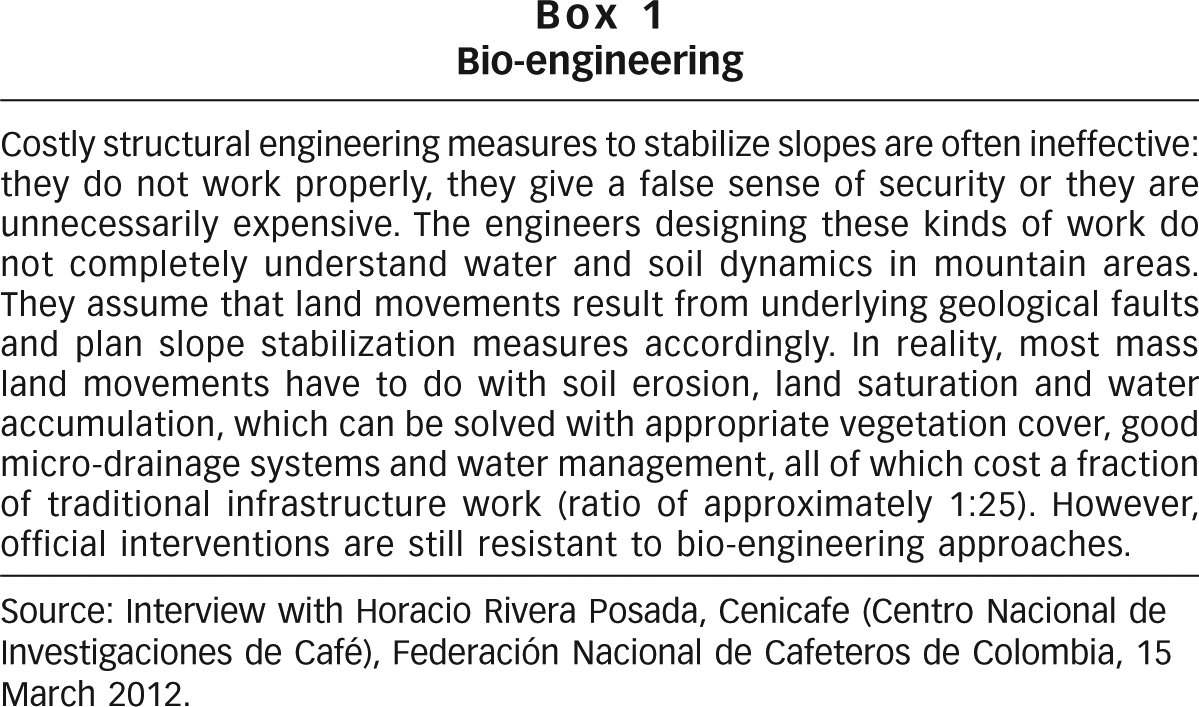
Urban development often entails land movements and landfills, which add instability.(71) As noted, populations displaced by conflict or migration have settled in Manizales, often on steep slopes and other unsuitable areas where illegal developers took advantage of land that could not be formally urbanized. Furthermore, some controversial construction licences have been issued for new urban development or middle- or high-income housing projects in locations that need slope stabilization work. Individuals may buy in ignorance, believing that the project complies with all standards, including the infrastructure work necessary for slope stabilization.(72)
A 2011 census undertaken by OMPAD with the “slope guardians” found that 2,698 houses, housing more than 4,000 families, were still located in the most high-risk areas. Also, in 2012, more than 370,000 inhabitants suffered the consequences of slope failure and mudslides when the pipes carrying water from the water treatment plant of Luis Prieto Gomez to the city were washed away. A second city water treatment plant was not functioning at the time. For 10 days, people had to rely on local spring wells and water trucks. Lack of appropriate prevention, coupled with successive La Niña years, made flaws in the system evident. Political criteria had more weight than technical criteria.(73)
This failure mobilized concerned citizens as well as regional and national government, and a citizens network (Red Ciudadana del Eje Cafetero(74)) was formed to investigate the situation, improve the risk prevention and response capacity of the municipal water company (Aguas de Manizales) and provide technical support to allow it to remain a municipal company and resist pressure to privatize the service or transfer it to other government levels. As a result of the crisis, Aguas de Manizales is restructuring its response to disaster risk, improving the aqueduct system and adopting necessary measures to avoid a future collapse.(75) This crisis was in part the result of years of insufficient investment in protective measures.(76)
Protecting water sources also involves protection work in catchment areas as well as river basin management, risk assessments and environmental education. This last item is implemented through the Guardianes de Agua, who are junior high school students trained by Aguas de Manizales in team work, organization, leadership and technical water and environmental issues. In turn, they train younger students to work within their communities. Aguas de Manizales also has a network of monitoring stations to evaluate and monitor water reserves.(77)
The present administration recognizes the weaknesses in the municipality’s DRR approach and is committed to making it more effective.(78) The Municipal Development Plan aims to target disaster risk conditions through balanced social, economic and environmental development that reduces vulnerability, highlighting the need to guide actions with solid research. A strong emphasis is placed on the articulation of land use, environmental and disaster risk issues and how this relates to climate change. Recently, the municipal government, with support from the local council, temporarily increased property taxes as well as increasing the budget allocated to slope stabilization and DRR.(79) DRR-related actions in the Municipal Development Plan include:(80)
consolidation of an integral disaster risk management system;
reduction of impacts associated with land use;
identification of the causes and effects of climate change and its relation to disaster risk;
reduction in the gap between theory and the implementation of early prevention policies;
strengthening the Municipal Office for Disaster Prevention and Response (OMPAD) and its coordinating role;
identification of risks;
continued promotion of research and cooperation with research institutes and universities;
improvement of the network of meteorological stations (managed by IDEA at the National University of Colombia in Manizales) to improve local early warning throughout the municipality;
continued support for the operation of the SeismicLab (Laboratorio de Instrumentación Sísmica Automática para Manizales – LISA, managed by IDEA at the National University of Colombia in Manizales);
continued updating of the census of houses and families in high-risk zones, with the support of the “slope guardians” (Guardianes de la Ladera);
relocation of families in high-risk zones; and
continuation of the risk transfer programmes (collective insurance collected through municipal taxes).
VII. Participation
Active stakeholder involvement underlies most of the processes described in Manizales and has been key in most urban environmental planning and DRR processes. Even when there has been little support to Biomanizales, or when DRR has been limited to a narrow focus on emergency and structural work, civil society, the universities and the business sector have kept these issues on their agendas, ready to be picked up by engaged governments. Their constant partnership work maintains alliances and develops trust between stakeholders. The fact that no particular group or sector leads the process probably explains why environmental and disaster risk issues continue to guide local development plans 20 years later. It is a model to follow and build upon when designing the Local Climate Change Adaptation Plan. A characteristic of civil society groups is that they usually function independently from party political rhythms. University research groups, for instance, do not depend on municipal government, and their long-term work allows for a constant revision of processes, the systematization of information and knowledge and the registering and archiving of basic data.(81)
Relations between municipal government, service providers, universities, business groups and civil society tend to be good. For example, Aguas de Manizales has handed over the collection of data from their meteorological stations to the university, for them to manage and integrate within the larger network of stations.(82) The Chamber of Commerce develops all its environmental training materials and services in agreement with local policies. The Red Ciudadana del Eje Cafetero provides technical and scientific support for decision-making, seeing their role as working with, not against, government.(83) Most of these groups are members of the Caldas section of RICCLISA, the climate change and food security network.
National legislation supports participation. The urban planning law (Ley de Ordenamiento Territorial 1997) requires that all urban plans are discussed by local planning committees along with members from civil society, universities and institutions, who act as an advisory board during the formulation of development and territorial plans. The process is considered both a citizen right and responsibility, and different sectors assume they are part of the local planning process. Decision makers also recognize the need for participation and transparency to legitimize their plans. The existence of a voto programático certainly helps to increase government’s accountability to the electorate.
Participation and a committed civil society entail the questioning of decisions and procedures and the need for consensus-building. For example, the urban renovation project for San José proposed by the municipal administration of 2008–2011 differs substantially from the original 2003 proposals, and went from urban revitalization (building recycling, participatory planning, selective re-densification, in situ relocation, preservation of the social fabric) to urban renovation, involving the relocation of families to allow for the construction of avenues with retail stores; this increases the value of the land, which will be capitalized on by developers and not the original landowners. The relocation was negotiated individually with each landowner, placing them at a disadvantage as they did not have any collective negotiating power; furthermore, the plan developed no indicators to monitor progress and is incompatible with DRR. The Corporación Cívica de Caldas(84) is requesting a revision of the project, with the support of other actors such as the university and neighbours in San José, resulting in a citizen forum with strong community participation and convened by the Assembly of the Department of Caldas and the municipal council.
VIII. Conclusions: Present and Future Challenges
Despite the ups and downs of its DRR and environmental policies, disaster risk in Manizales has been reduced by “good governance”, which has encouraged and supported the engagement of local and regional government, the private sector, universities and representatives of community organizations. DRR planning was incorporated into local development policies,(85) and good urban environmental planning has worked all along to reduce vulnerability and disaster risk. The basis for all this has been a strong participatory tradition sustained by an informed and committed community and backed up by legislation that promotes participation in both planning and decision-making. The long tradition of reaching agreements between diverse stakeholders is a key asset for climate change adaptation.
Colombia, and in particular Manizales, shows a good track record on DRR, which tends to be renewed in emergency situations. There is a natural tendency to react in response to crises and more work is needed on the prevention side, with a focus on vulnerability reduction and enhancing resilience and adaptation. Today, DRR, environmental management and climate change adaptation are on the agenda of national and sub-national government. There is enough experience and know-how in the country and the city to step up to the challenge of climate change and fully develop plans and programmes to improve disaster risk management, sustainable development and climate change adaptation. There has to be political will and an engaged community.
As in the other city case studies, the actions implemented in Manizales are not identified as responses to climate change but they contribute substantially to climate change adaptation and vulnerability reduction. Manizales is revising its priorities, adjusting policies and procedures to better respond to present and future challenges. Over the years, it has developed an important DRR and environmental planning platform, and most of the plans and actions described in this paper are in the process of being reframed to incorporate climate change adaptation, forming the basis for the municipality’s adaptation agenda. Institutional changes at national level add strength, and support changes at the municipal level. A key challenge will be designing the financial architecture to support cross-cutting issues such as DRR and adaptation, which need to operate from decentralized systems and involve many stakeholders.(86) There is also the risk that the emergence of new institutional units to tackle adaptation to climate change – housed in the Ministry of Environment and Sustainable Development within the Institute of Hydrology, Meteorology and Environmental Studies (Instituto de Hidrología, Meteorología y Estudios Ambientales – IDEAM) and different from those that manage disaster risk – may impede coherence between the two agendas at a time when strong integration at all levels of management is needed.(87)
Footnotes
Acknowledgements
This research was supported by the Rockefeller Foundation within a programme on Advancing Knowledge and Understanding of Action on Urban Adaptation to Climate Change in support of the IPCC’s Fifth Assessment, implemented by IIED. We would like to thank all those who shared their time and knowledge and made this paper possible.
1.
Dodman, D, J Hardoy and D Satterthwaite (2009), “Urban development and intensive and extensive risk”, Contribution to the 2009 Global Assessment Report on Disaster Risk Reduction. Risk and Poverty in a Changing Climate, ISDR, 67 pages.
2.
UN–Habitat (2011a), Global Report on Human Settlements 2011: Cities and Climate Change. Chapter 6: Climate Change Adaptation Responses in Urban Areas, pages 129–162; also Moser, C and D Satterthwaite (2008), “Towards pro-poor adaptation to climate change in urban centres of low- and middle-income countries”, Climate Change and Cities, Discussion Paper 3, IIED, London, 39 pages.
4.
5.
Sharma, D and S Tomar (2010), “Mainstreaming climate change adaptation in Indian cities”, Environment and Urbanization Vol 22, No 2, pages 452–465.
6.
Comments made by Allan Lavell during the “Foro sobre Cambio Climático y Reducción de la Vulnerabilidad; Desafíos, Oportunidades y Prioridades de Acción”, 27 July 2012, Buenos Aires.
7.
The other two city case studies are for Rosario (Argentina) and Chetumal (Mexico).
8.
Bulkeley, H (2010), “Cities and the governing of climate change”, Annual Review of Environment and Resources Vol 35, page 244.
9.
Hardoy, J and P Romero Lankao (2011), “Latin American cities and climate change: challenges and options to mitigation and adaptation responses”, Current Opinion in Environmental Sustainability Vol 3, pages 158–163; also see reference 8.
10.
See Hardoy, J and R Ruete (2013), “Incorporating climate change adaptation into planning for a liveable city in Rosario, Argentina”, Environment and Urbanization Vol 25, No 2, pages 339–360; also Hardoy, J, I Hernández, A Pacheco and G Sierra (2014), “Institutionalizing climate change adaptation at municipal and state level in Chetumal and Quintana Roo, Mexico”, in this issue of the Journal.
11.
See, for instance, Bernard, Susan M and Michael A McGeehin (2004), “Municipal heat wave response plans”, American Journal of Public Health Vol 94, No 9, pages 1520–522.
12.
Anguelovsky, I and J Carmin (2011), “Something borrowed, everything new: innovation and institutionalization in urban climate governance”, Current Opinion in Environmental Sustainability Vol 3, pages 169–175.
13.
Mitlin, D (2004), “Editor’s introduction: Reshaping local democracy”, Environment and Urbanization Vol 16, No 1, pages 3–8.
14.
The local team consisted of Luz Stella Velásquez Barrero, Associate Professor and Researcher at the Institute of Environmental Studies (IDEA) at the National University of Colombia in Manizales and the Universitat Politécnica de Catalunya, who is actively engaged in developing the Biomanizales and similar processes in other Colombian cities and is also coordinator of the Biociudades network; and Juan Manuel Becerra, an independent consultant involved in redesigning the Biomanizales participatory tools such as the semáforos ambientales.
15.
Velásquez Barrero, Luz Stella (2010), El Biomanizales. Manual de Bioarquitectura y Biourbanismo, Universidad Nacional de Colombia, Sede Manizales, Manizales, 109 pages.
16.
Chardon, A (2006), “Un desafío para el desarrollo urbano: amenazas naturales y vulnerabilidad global asociada: el caso de la ciudad de Manizales”, Taller Internacional sobre la Gestión del Riesgo a Nivel Local, Universidad Nacional de Colombia, USAID, 28–29 September 2006, Alcaldía de Manizales.
17.
Velásquez Barrero, Luz Stella (2005), “The Bioplan: decreasing poverty in Manizales, Colombia through shared environmental management”, Chapter 3 in S Bass, H Reid, D Satterthwaite and P Steele (editors), Reducing Poverty and Sustaining the Environment. The Politics of Local Engagement, Earthscan, London, pages 44–77.
18.
Corporación Autónoma Regional de Caldas (Corpocaldas) is responsible for environmental management and sustainable development in the Department of Caldas.
19.
Velásquez Barrero, Luz Stella (2011), “La gestión del riesgo en el contexto ambiental urbano local, un reto permanente y compartido. Caso Manizales, Colombia”, in Medio Ambiente y Urbanización No 75, pages 27–46.
20.
Departamento Administrativo Nacional de Estadísticas (DANE) (2005), Census 2005, available at  .
.
21.
See reference 20.
22.
See reference 20.
23.
Interview with Carlos Enrique Restrepo, Aguas de Manizales, 15 March 2012.
24.
See reference 17.
25.
Scott, Z and M Tarazona (2011), “Decentralization and disaster risk reduction”, Background Paper prepared for UNISDR Global Assessment Report 2011, GAR, Geneva, 53 pages.
26.
See reference 25; also interview with Alfredo Roncancio, Government Secretary, Departament of Caldas, 14 March 2012.
27.
Lampis, A and A Fraser (2011), “The impact of climate change on urban settlements in Colombia”, United Nations Human Settlements Programme (UN–Habitat), Nairobi, 90 pages.
28.
See reference 27.
30.
Artículo 7 de la Ley 1450 (2011), cited in http://www.dnp.gov.co/LinkClick.aspx?fileticket=2yrDLdRTUKY%3D&tabid=1260.
31.
Lampis, A (2012), “Bogota case study”, Background Paper for internal report of IAI-funded ADAPTE project, mimeo, 23 pages.
32.
See reference 31.
33.
Plan Nacional de Adaptación al Cambio Climático, Colombia (2013), prepared by DNP, MADS, IDEAM, UNGRD, published by Dirección Nacional de Planeamiento (DNP), 74 pages.
34.
Cardona, A (2009), “Mapeo institucional, actores relacionados con el abordaje del cambio climático en Colombia. Proyecto integración de riesgos y oportunidades del cambio climático en los procesos nacionales de desarrollo y en la programación por países de las Naciones Unidas”, UNDP, 31 pages, cited in http://www.dnp.gov.co/LinkClick.aspx?fileticket=2yrDLdRTUKY%3D&tabid=1260.
35.
Interview with technical team and directors of Corpocaldas.
36.
REDD stands for Reducing Emissions from Deforestation and Forest Degradation; CDM stands for Clean Development Mechanisms.
37.
Interview with Mayor Jorge Eduardo Rojas Giraldo, 14 March 2012.
38.
Velásquez, Luz Stella (1998), “Agenda 21: a form of joint environmental management in Manizales”, Environment and Urbanization Vol 10, No 2, pages 9–36; also Marulanda, Liliana M (2000), “El Biomanizales: política ambiental local”, Documentación de la Experiencia de Gestión Ambiental Urbana de Manizales, Colombia, Instituto de Estudios de Vivienda y Desarrollo Urbano (IHS) dentro del marco de implementación del proyecto Apoyo para la Implementación de Planes Nacionales de Acción del Habitat II (SINPA), mimeo (n.p.); see reference 17; Hardoy, J, G Pandiella and L S Velásquez Barrero (2011),”Local disaster risk reduction in Latin American urban areas”, Environment and Urbanization Vol 23, No 2, pages 401–413; and see reference 19.
39.
Eco-parks combine recreation, environmental education and conservation while protecting areas at risk from landslides or floods. Environmental conservation is tied to DRR and includes the provision of tax incentives for those protecting areas of ecological importance to the city; see reference 17.
40.
These were created as environmental hubs in strategic places in the city in order to increase community environmental awareness and commitment through the monitoring of socioeconomic and environmental conditions in the 11 comunas of Manizales. They also contribute to government accountability.
41.
This communication and public awareness tool is the visual representation of socioeconomic and environmental indicators.
42.
The urban revitalization and environmental plan for Comuna Olivares–San José applies the principles of Biomanizales in a pilot project.
43.
See reference 19.
44.
Approximately two-thirds went to environmental education programmes, community training and tax incentives, while one-third went to purchase land to use in environmental protection and conservation projects; see reference 17.
45.
See reference 19, Background Report.
46.
This came up in many interviews and is in agreement with the national priorities at the time. There is a perception that Uribe’s administration neglected environmental issues as well as disaster risk reduction issues.
48.
The first aims to support “green” agro-industrial development and reconversion targeting to green markets; the latter supports eco-friendly development processes in the small business sector (energy- and water-saving, waste reduction etc.). Interview with team from Cámara de Comercio de Manizales, 13 March 2012.
49.
IDEA – Institute of Environmental Studies at the National University of Colombia in Manizales.
50.
Interviews with teams from the University of Caldas and IDEA (the Hydraulic Group and the Urban Environmental Studies Group) at the National University of Colombia in Manizales, 13/14 March 2012.
51.
See reference 27.
52.
See reference 25
53.
See reference 27.
55.
Cardona, O D and L E Yamin (2006), “Información sobre el riesgo de desastre a través del estudio de casos piloto: estudio nacional de Colombia”, BID-CEPAL-IDEA, Bogotá (n.p.).
56.
See reference 25.
57.
See reference 25.
58.
See reference 25.
59.
See reference 25.
60.
See reference 27.
61.
See reference 27.
62.
See reference 55.
63.
64.
See reference 55.
65.
Based on
66.
Fay, M, F Ghesquiere and T Solo (2003), “Natural disasters and the urban poor”, in Breve No 23, October, World Bank, Washington DC, pages 1–4.
67.
The team is made up of people from the municipality, Corpocaldas and the universities (covering both the technical and social aspects of the programme).
68.
Interview with Carlos Mejía Salazar, Secretary of Public Works, 14 March 2012.
69.
Interview with Councillor Manuel González Hurtado, 12 March 2012.
70.
See reference 25.
71.
See reference 17.
72.
Interview with Councillor Manuel González Hurtado and with members of the Red Ciudadana del Eje Cafetero, 12 March 2012.
73.
Interview with members of the Red Ciudadana del Eje Cafetero, 12 March 2012.
74.
A citizen network made up of professionals who have political and economic power.
75.
Landslides were the result of slope failure due to deforestation on the slope sides where water infrastructure is located.
76.
Interview with Carlos Enrique Restrepo, Aguas de Manizales, 15 March 2012.
77.
See reference 76. Investments from Aguas de Manizales have concentrated on/have been made in the Macro Proyecto San José and the extension of water provision networks and sewage and drainage provision in some rural areas. Resources allocated to service maintenance have been minimal.
78.
See reference 47; also interview with Jorge Eduardo Rojas, Mayor of Manizales, 14 March 2012 and with Councillor Manuel González Hurtado, 12 March 2012.
79.
Interview with Councillor Manuel González Hurtado, 12 March 2012.
80.
See reference 47; also interviews with Jorge Eduardo Rojas, Mayor of Manizales, José Olarte Osorio, Secretary of Planning and Carlos Mejía Salazar, Secretary of Public Works, 14 March 2012.
81.
See reference 50.
82.
Interview with the Hydraulic Group of the National University of Colombia in Manizales, 13 March 2012.
83.
Interview with Red Ciudadana del Eje Cafetero, 12 March 2012.
84.
A civil society organization comprising both members from the business and industrial sectors and individual members. It has existed for more than 30 years and has participated in the Biomanizales and the Bioplan, including the Biocomuna Olivares proposal. Interview with Patricia del Pilar Ruiz, Director of Corporación Cívica de Caldas.
86.
We are not referring to the broad idea of how to fund these processes but, rather, thinking more about the finer details – there are always gaps and holes in the system with the result that money doesn’t go where it is meant to.
87.
See reference 27.