



Abstract
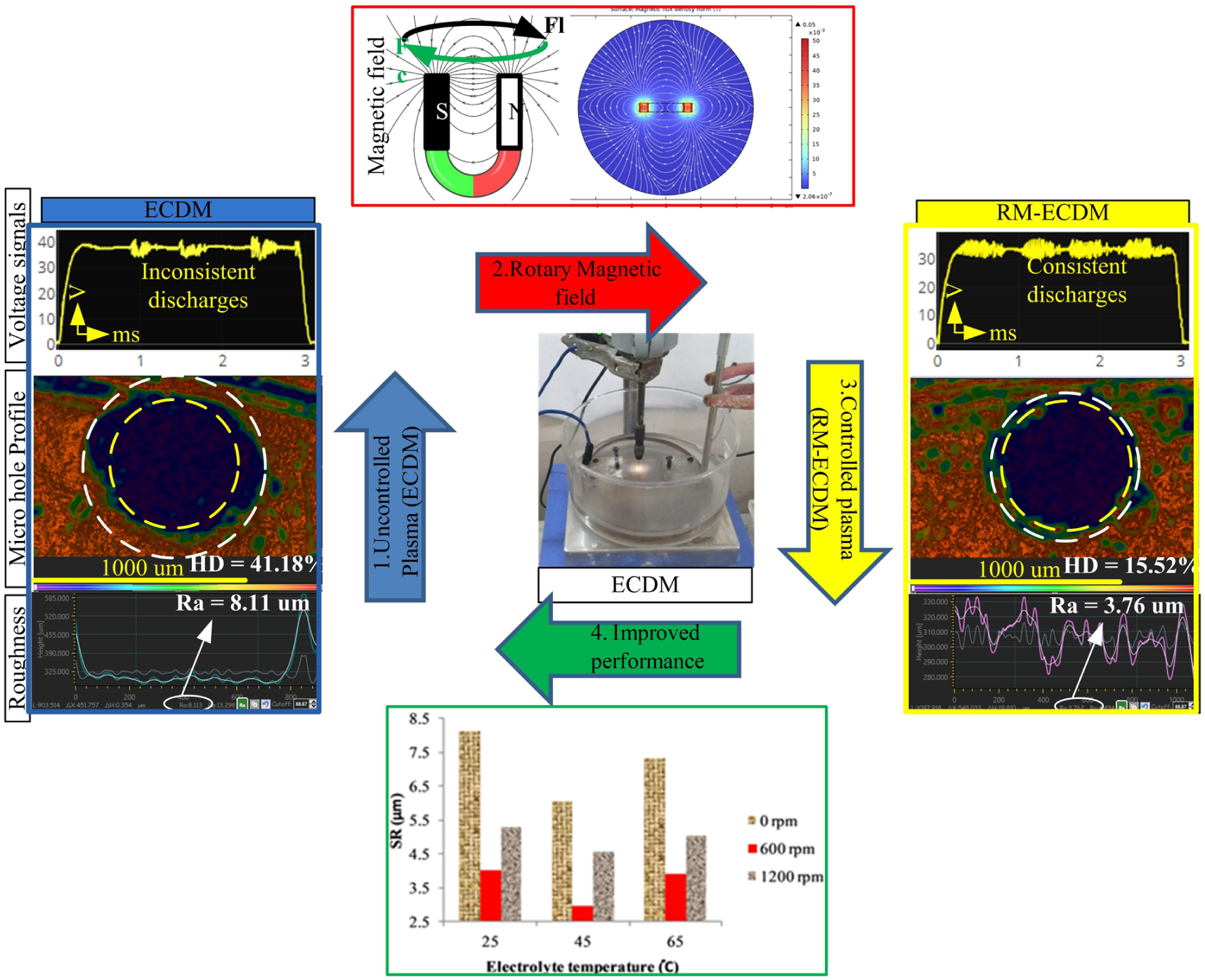
To reduce the wireless transmission losses, glass composite vias (used for Radio Frequency Micro Electromechanical system (RF-MEMS)) is a potential alternative. Electrochemical Discharge Machining (ECDM) is an emerging technique for the micro machining of glass composites, but uncontrolled plasma in the processing zone compromises the quality characteristics. Therefore, the present communication has investigated the assistance of rotary magnetic field in ECDM to improve the quality of micro holes, while enhancing the tool wear ratio. A computational modelling of magnetic flux density on gas film formation and the ionization of plasma was performed to analyze the rotary effects. A Thermogravimetric Analysis (TGA) was performed to assess the thermal behaviour of glass epoxy composite, and a Gaussian based computational model of discharge was simulated to understand the material removal mechanism of glass epoxy composite. The present study conjectured that the assistance of rotary magnetic field in ECDM resulted in the reduction of hole deviation and surface roughness of micro holes by 62.31% and 53.63% respectively, while improving the tool wear ratio by 62.5%. Furthermore, the effect of response characteristics was assessed on the Triple Bottom Line (TBL) that indicated sustainability enrichment by virtue of rotary magnetic field. Consequently, the improvement in quality of micromachining along with sustainability enrichment implied the industrial feasibility of glass epoxy composite vias for RF-MEMS.
Get full access to this article
View all access options for this article.