




Abstract
Model-Based Definition (MBD) is being adopted by the manufacturing industry as a single source for all product information in place of conventional 2D drawings. This paper aims to review the current literature on Model-Based Definition (MBD) and Model-Based Enterprise (MBE) to recognize the main contributions towards the development and implementation of MBD and explore its various perspectives. The publications encompassing technology and applications of MBD are categorized into seven domains. These domains are lifecycle information; design, discrete part manufacturing, and inspection; assembly; maintenance, repair, and overhaul; process planning; engineering change management; and contemporary aspects of digital product definition. The major outcomes of research literature, in these domains, are reviewed and future research directions are identified and formulated. Additionally, the paper highlights the issues and challenges associated with the realization of MBE by the manufacturing industry. These issues are categorized into technical, management, and certification categories. The prevalent issues in each of these categories are further discussed and analyzed.
Keywords
Introduction
Model-Based Definition (MBD) is based upon the shift from conventional 2D drawings to 3D CAD models as a single source of product definition encompassing all the product information and thus eliminating the need for 2D representation. 1 The automotive and aerospace are the leading industries in the adoption of MBD. Though this adoption is not to the fullest and 2D drawings are still being used. The current advancements in the CAD solutions have allowed embedding functional tolerances & annotations (FT&A) which have eliminated the conventional 2D drawings to some extent. However, in the future, all the product lifecycle data is aimed to be associated with the 3D model. This data commences with the requirement of a product until its retirement. 2 An MBD is a digital-product model that defines the requirements and specifications of the product. A Model-Based Enterprise (MBE) uses MBD to define the product requirements and specifications instead of paper-based documents as the data source for all engineering activities throughout the product lifecycle. This also involves working with all the internal and external stakeholders that use product data including the suppliers. Thus in MBE, models are employed to drive all the aspects of the product lifecycle and this data is created only once and then reused for all downstream activities.3,4
The journey toward MBE has many obstacles and challenges, and the industry has to overcome these for being able to get full advantage of the MBD approach. To name a few are high investments, technological limitations, interoperability, authenticity, trustworthiness, and transformational issues. With the development and growth in the capabilities of this technology, MBD has been attracting attention from both academic and industrial communities for the last two decades. However, no comprehensive review has been done, therefore, a review of the current developments is needed to provide academia and industry with the current state of knowledge and future research gaps. This paper aims to present an integrated review of MBD and MBE literature, figure out the key challenges, and ascertain areas where future research is needed.
Analysis of literature review
A variety of sources are used for the literature review in this paper. The keywords “Model-Based Definition” and “Model-Based Enterprise” are used to search the Scopus, Web of Science, and EBSCO databases. The first two are well known for the technology-oriented research while the third one is recognized for business process and management areas of research. The main focus remained on peer-reviewed journal articles, though some important conference papers are also considered. Only the articles in the English language are considered. Although the conference publications are larger in number. However, due to the absence of the peer-review process, a majority of them are not considered in this review. Similarly, several magazine articles are elaborating on technology outbreak but these are also not made part of this review. Though 3D modeling is being used for more than two decades, academic work solely on Model-Based Definition first appeared in 2010. The trend in MBD research is increasing since then which can be observed from Figure 1.
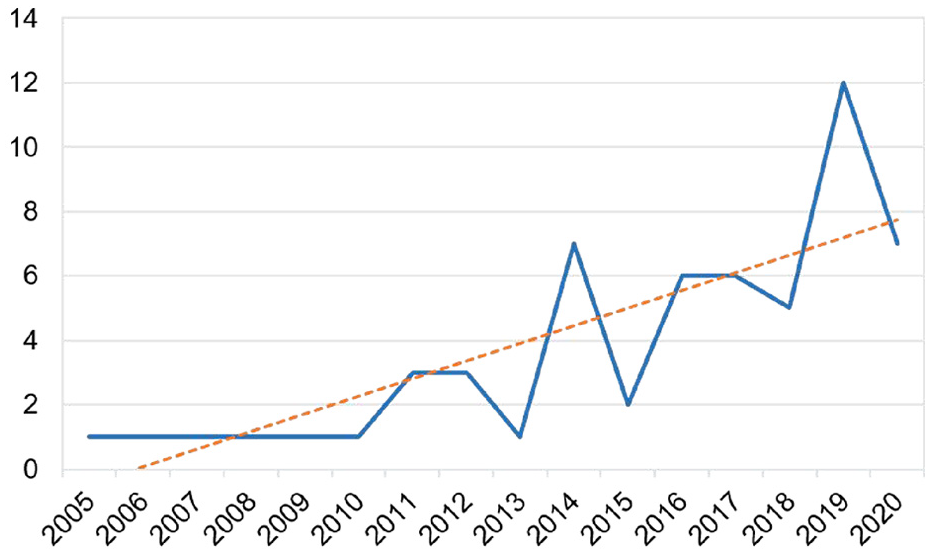
Peer reviewed journal articles.
The two main categories of the articles surround technology and management. The majority of the papers are on enabling technology whereas management is covered by fewer papers and one paper presents the review of the current status of MBD. However, some papers lie in both of these categories. A few articles are found out of context. Those are related to pharmaceutical science, biochemistry, biostatistics, economics, statistics, hydrology, oceanography, and information system architecture, hence, are not part of this review. Figure 2 shows the percentage of each of these.
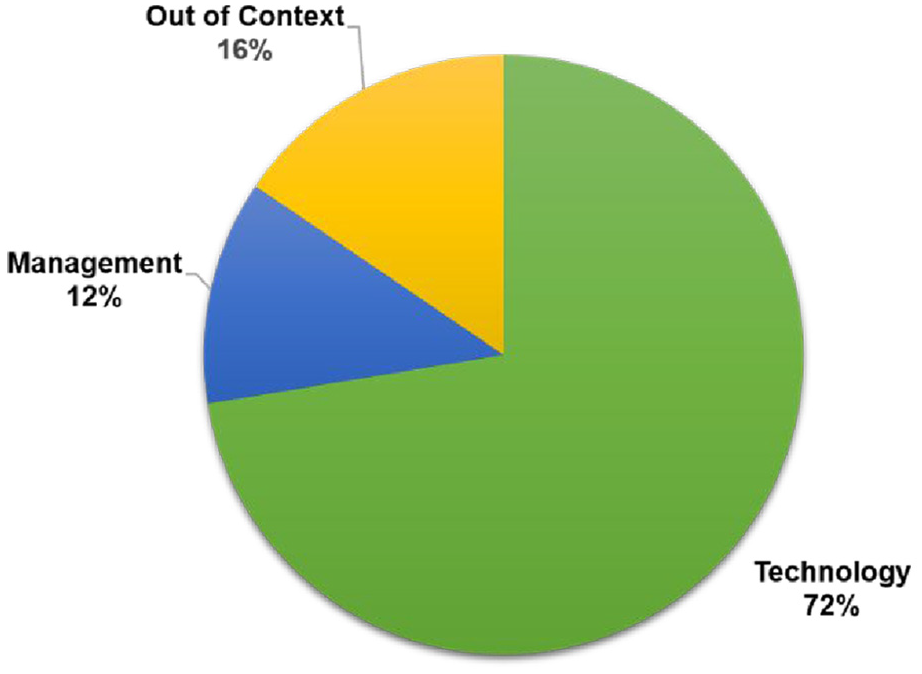
Percentage distribution.
National Institute of Standards and Technology (NIST) is running a Model-Based Enterprise Program. Several projects are undergoing in this program. The program aims at developing and deploying standards, test methods, and measurement science that could allow manufacturers to integrate the system, service, product, process, and logistic models across the enterprise. 5 The institute also conducts the Model-Based Enterprise Summit every year. It provides a key platform for academia and industry to discuss the ongoing challenges in the field of MBD/E. The publications from the MBE Program and the proceedings of the MBE summits provide useful insight to all the prevailing issues of MBD and MBE, therefore, we have included some of the key publications from these sources in this review.
The literature, categorized into management and technology, is explained in the next section. The articles in the category of technology are classified into seven domains of application. The contribution of the researchers is discussed according to these domains. This is done so that, from the manufacturing engineering perspective, the reader can get a quick overview of the research in the domain of their interest. Section 4 has highlighted the issues and challenges associated with the development and application of the model-based definition. Finally, section 5 has ascertained future research directions.
Technology and Management
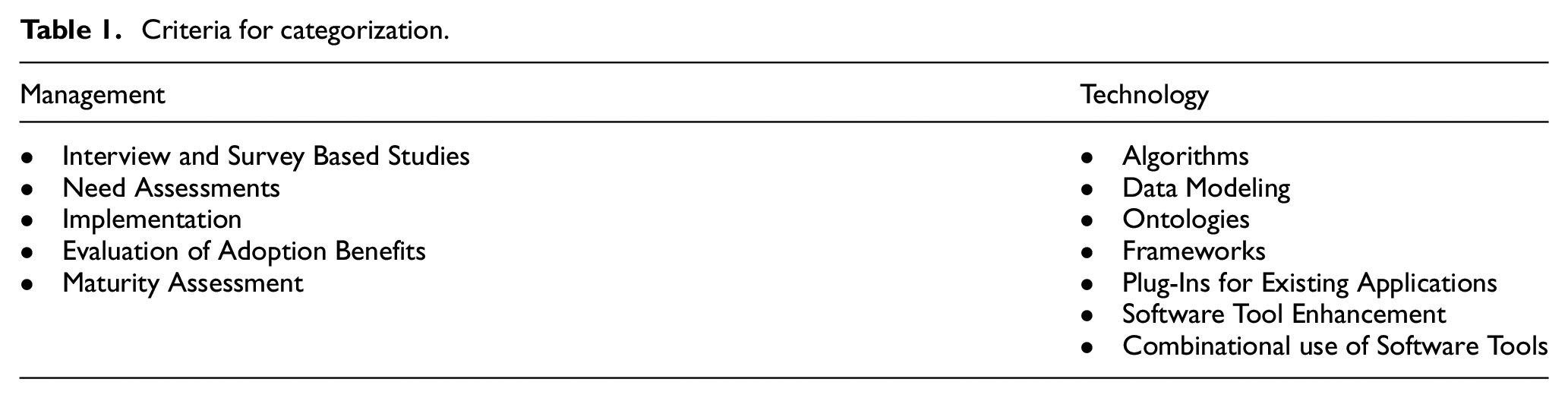
The categorization of management and technology is conducted according to the nature of the research work in the respective articles. This is listed in Table 1. A few articles have some overlapping contexts. These are made part of the category to which the major portion of their work belongs.
Criteria for categorization.
Management
The literature in the category of management has assessed the following questions.
(a) Which elements of product definition from various stages of the product lifecycle should be part of the MBD?
(b) What is the present state of adoption of MBD within the industry?
(c) What are the needs of the future for the complete realization of MBE?
This type of research work helps the reader get an overall view of the penetration of MBD technology in the manufacturing industry. Additionally, tools and frameworks have been found for technology readiness and, the assessment of the organizations for their present state and to target future state. Such tools are particularly very important in the context of new technology adoption. There are considerable developments in building such tools which are discussed in this section.
Quintana et al., 1 based on a study in Canadian aerospace, figured out technical requirements of MBD in terms of data content, accessibility and visualization, and data retention. Another industrial study tried to find out the minimum information a model should essentially carry and, industry’s perspective on the capability of the model to carry this information.6,7 Ruemler et al. 8 contributed to understanding the way models were being used in various workflows in the industry. The purpose was to develop a common information model out of the domain-specific elements. However, the focus of this work was on design, manufacturing, and inspection only; leaving maintenance, sustainment, and decommissioning stages of the product lifecycle. The capabilities of MBD against the requirements have been evaluated by the aerospace and defense sector to highlight the deficiencies in product definition capabilities offered by the various solution providers. 9 These types of industrial insights are useful to understand the technology readiness of the MBD.
Alemanni et al. 2 elaborated three scenarios of adoption of MBD, technology support for them, and their current status. A method was proposed in support of MBD implementation. Bijnens and Cheshire 10 have discussed the advantages and disadvantages of both drawing and MBD philosophies. They have technically evaluated the claimed benefits of MBD adoption. They also have discussed the current state of application of Product and Manufacturing Information (PMI) semantics. Finally, the implications of the use of MBD at the manufacturing shop floor and inspection stages were discussed. Hedberg et al. 3 have compared drawing and model-based definitions by selecting and analyzing three test models that involve machining processes. Both drawing and model-based definitions were created for them. After manufacturing and inspection, the benefits were measured and process gaps were identified. In a more recent work on prototype compressor project conducted by General Electric, MBD was used to drive design, analysis, manufacturing, and assembly of the digital engine. The authors measured and reported significant benefits of this practice. 11 In another research effort, Zhu et al. 12 have described and analyzed Product Lifecycle Management (PLM), MBD, and Computer-Aided Design (CAD) technologies for enabling the implementation of integrated design and manufacturing systems in the aeronautical industry. Fischer et al. 13 demonstrated the capabilities and the value of using a model from CAD-CAM and CAD-CMM with the use of embedded PMI and the barriers towards this adoption. A framework for MBD value stream and evaluation of potential benefits in the adoption of the MBD in aerospace manufacturing engineering was presented by Shehab et al. 14
MBE Capability Index is an assessment tool that has provided the industry a framework to evaluate the present state and target the future state in the adoption of MBD. This type of index provides organizations with common criteria to attain a specific level of capability. Initially developed as US Mantech MBE Capability Index was later extended by the US Army and was adopted afterward by NIST. A few guidelines have also been presented by NIST to improve this index. The same tool has been extended recently to NSE (National Security Enterprise) MBE Maturity Index.15,16 However these indices are needed to be extended further to equip them with technical details and guidelines for each subdomain.
Technology
The literature addressing technological developments as described in Table 1 is divided into seven main categories. The literature has been discussed as per this division. These categories are appended below.
a. Lifecycle Information
b. Design, Discrete Part Manufacturing, and Inspection
c. Assembly
d. Maintenance, Repair, and Overhaul (MRO)
e. Process Planning
f. Engineering Change Management (ECM)
g. Contemporary Aspects of Digitization of Product Definition
Lifecycle information
It is imperative to study each stage of the product lifecycle to get essential elements of the MBD data set as discussed in the previous section. The next stage is the incorporation of all the information to associate with the model. Generally, to associate this information with the 3D model, methods of data structuring, data modeling, and ontologies have been suggested in the literature.
In this regard, Alemanni et al. 2 asserted the need for a common method for the industry to structure the data in a unified and reusable form within the 3D CAD models. To realize it, a methodology was proposed which employed Quality Function Deployment (QFD). To manage the product information consistently across multiple domains, users, and models, Ball and Runge 17 have presented a method based on product ontology. They proposed a system coupling a model library, domain ontology, and an information system that can be used with the existing engineering toolset. The potential benefit of this method could reduce the product development time up to ten times. Model-based activities in design, manufacturing, and system engineering were seen as enablers for the reuse of knowledge, higher quality, and reduced costs. According to the authors, the product model with a perspective of information sciences has the potential to offer a more complete approach.
There are different perspectives on how a model should be defined from various stages of the product lifecycle. A system for quality analysis of part models is a prospect to ensure meeting needs of all these stages. Based on this concept, Yang et al. 18 have proposed a knowledge-based system for analysis of model quality originating from eight stages of the model use. These types of systems would help silo elimination between the designer and the user.
Design, discrete part manufacturing, and inspection
The most discussed areas of the lifecycle in the MBD/E literature are design, manufacturing, and inspection. The literature mainly encompasses comparative studies between conventional drawings and 3D models, development of plug-ins, and software enhancement efforts. These are aimed at increasing the capabilities of the existing tools to accommodate design intent, behavioral information, and reuse of knowledge.
Digital thread, as defined by Hedberg et al., 3 is a combination of MBD, manufacturing, and inspection. They characterized it as the enabler of real-time design and analysis, collaborative process flow development, automated artifact creation, and seamless coordination. Miller et al. 19 emphasized on embedding behavioral information in the MBD model. They argued that only the dimensional context will not be enough in the product definition for life-cycle. The true definition lies in various domains that have to be incorporated for getting the actual behavior of the product. A plug-in for an existing CAD system was presented for it. To capture and reuse knowledge in designing aircraft structural parts Zhou et al. 20 have established a feature-based part information model. The model could use previous cases and rules of design from the knowledge base.
NIST is putting considerable efforts to enable fundamental and applied research to develop technologies and standards that could realize the digital thread across the product lifecycle stages. Helu and Hedberg.21,22 have introduced the concept of product lifecycle test-bed that integrates the present technologies for design, manufacturing, and inspection to serve this objective. This test-bed has used the product model as the interface for connecting information between design, fabrication, and inspection. Along with other potential impacts, this work aimed to extend the efforts of NIST for developing a validation system. The NIST validation system focused on geometric dimensions and tolerancing (GD&T) to check the validation and conformance of CAD to ASME standards for product and manufacturing information (PMI). 23 In another project, NIST collaborated with Manufacturing Technology Center (MTC) to design and implement a specimen fabrication process. The process was formulated to investigate the issues and challenges in linking different stages of design and manufacturing processes. By implementing a small scale model-based enterprise, this project aimed at testing the integration ability of various open standards across the stages of design, manufacturing, and quality assurance. The dataset from this project was added to the SMS (Smart Manufacturing System) test-bed repository and was made available publicly to facilitate the research in smart manufacturing technologies. 24
A few authors have proposed techniques for knowledge reuse to increase the efficiency of various functions in the realization of the product. In this regard, Cicconi et al. 25 have proposed a method for reusing the PMI annotations from the existing design to a new model with similar features. They have created a plug-in for an existing CAD platform. The proposed approach is implemented in a duct design use case. Huang et al. 26 have found an absence of work on machining feature-based part retrieval in 3D modeling. To fill this gap they have proposed an approach for sub-part retrieval in the 3D CAD model for manufacturing process re-use. Huang et al. 27 have also presented a multi-level structured MBD which is based on machining features. This aimed to capture the abstract, detailed feature interaction, and machining semantics information simultaneously.
Camba et al. 28 have put forth an effort to embed design intent into the 3D model by using annotations. They proposed a new annotation structure using the SOLIDWORKS application program interface (API) and integrated it into a PLM system. To improve the working efficiency of technicians in working with the numerical control (NC) program, Zhou et al. 29 have proposed a Mid-Tolerance model. This was done to realize 3D MBD in process design and planning, which currently rely on 2D drawings. The authors intended to meet the requirements of NC tool path generation. Zhao et al. 30 considered processing and manufacturing technology while designing a projectile. They tried to standardize a parametric model with the MBD model and simplified the analytical model. In this way, the consistency between the design, and processing models was ensured. In moving from 2D to 3D model-based definition, the technical implementation journey is reported by Messier-Dowty. 31 for the manufacturing of Boeing-787 Dreamliner landing gear. In a recent work, Ozbolat et al. 32 worked on an interactive and predictive 3D environment to test and analyze the virtual performance of printed circuit boards (PCBs), to support the designers virtually assess their manufacturability before developing physical prototypes. Founding lack of a systematic and efficient digital twin modeling method, Liu et al. 33 proposed a bio-mimicry based method. They have developed multiple digital twin sub-models, that is, geometric, behavior, and process model which could interact with each other to facilitate integrated representation of the actual machining process.
The part inspection stage is the stage where the conformity of the parts is checked against the design specifications. The conventional process of preparing inspection reports consumes considerable time which normally requires reproduction of plenty of information. The same problem holds in the case of programming of the measuring equipment like coordinate measuring machines (CMM). To avoid reproducing the definition for reports and to facilitate measuring equipment and intelligent inspection tooling, MBD has a huge potential in the form of application of semantic PMI. A considerable volume of work has been found in this area. Liu et al. 34 have proposed a framework that specifically integrates the processes within the inspection and generally within the design, manufacturing, and inspection. Different type of data from the inspection process is attached to the MBD model, and a framework of model-based integrated inspection is presented. Based on it, an inspection system was developed by defining its architecture, information flow, and workflow. In another work, NIST. 35 reported a software for Quality Information Framework (QIF) PMI Report (QPR). This software can generate spreadsheets from the QIF files. A QIF is an XML based open standard framework, capable of carrying inspection related PMI to be captured, used and reused throughout the lifecycle in PLM and Product Data Management (PDM) domains.
Assembly
Assembly is the stage where individual parts are combined to get the final products. The assembly stage has its unique requirements. There is a set of assembly and fitting instructions created by manufacturing engineers for assembling each part. Historically, these instructions are based upon 2D drawings and are composed of a huge pile of documents called assembly instructions (AIs) or assembly process information (APIs). Creating and consulting these documents require considerable time, effort, and experience. These documents currently are not getting substantial benefit from the 3D models. There is a lesser focus found from the researchers on this area and only limited assembly requirements are discussed in the literature. The following lines highlight the research in this area.
Assembly jig design relied previously on the designer experience needing huge manual or interactive decision making. Zhang et al. 36 have proposed an intelligent configuration method to drive the jig design automatically. They have presented an information model that integrates jig design knowledge into the 3D model using MBD. The model was comprised of product general information and assembly process information (API).
Geng et al. 37 have worked on lightweight 3D assembly instructions. They have explained the difference between design PMI and assembly process-oriented PMI. The authors proposed a method to get the advantage of 3D annotated instructions at the assembly shop floor. The method was designed to be used with normal computers eliminating heavy hardware and software requirements on the shop floor. Xiao et al. 38 have found a lack of presence of assembly tools and semantic elements in the existing APIs. They have designed an assembly feature recognition algorithm using MapReduce and investigated a dynamic assembly simplification method. They proposed an augmented reality (AR) based method for 3D API construction and transfer by merging information of the assembly scene. Presently assembly phase lacks the real-time features which evolve the need for more structured and complete data. 39 In a recent work, Goher et al. 40 have summarized all the key issues in model-based assembly information. Due to the complexity of assembly operations and the associated documentation, this area is still wide open for future research.
Maintenance, Repair, and Overhaul
This domain comes under the support and service stage of product lifecycle. The documentation for MRO, like assembly, involves huge drawing and text-based information. These are currently off-line demonstrations with no link with the part models. The issues of this area are also rarely discussed in MBD literature. Therefore, it has not yet obtained potential benefits from MBD and considerable research efforts are needed in this regard. There is only one research paper in this area in which a method was proposed for creating 3D lightweight MRO job cards for the aerospace industry. 41 The method was applied in an aerospace right-wing disassembly case and after application, its effectiveness was reported.
Process planning
There is a bias of 3D digital technology research work towards the 3D model and an absence of focus towards process planning. 42 To fill this gap, Zhu and Li have combined MBD and knowledge engineering to propose a process planning method for the digital environment. A general ontology was established for the manufacturing process and special ontology for a shaft. Liu et al. 43 have developed a prototype 3D casting process planning system by proposing a modeling method based on MBD. In another work based on ontology Wan et al. 44 created an MBD process model by getting aid from machining knowledge and tried to obtain machining knowledge from the created MBD process model. In such a way forward and reverse methods for model creation were proposed.
In the context of computer-aided process planning (CAPP) of machining parts, Zhang et al. 45 have put forth a machining process model. To generate this 3D process model, all the phases from design and machining such as surface roughness and tolerance were considered. This was done to support MBD use for machining instructions. The machining instructions currently rely on drawings that are converted from 3D models and creating those instructions is an experience and time-intensive function in manufacturing engineering.
Engineering Change Management
It is a process that involves identification, analysis, modification, update, verification, and approval of the design. This is a formal process and consists of a series of phases. Once designed, it is always a challenging task to get the design changed as per stakeholder’s needs. It has been proved to be a time taking and costly process. MBD is the technology that could offer huge time savings in the process of ECM. Effective use of MBD in engineering change management, however, is studied by only a few researchers. Their research mainly encompassed modeling for MBD data to simplify the engineering change process. In this context, Quintana et al. 46 have proposed the use of the MBD dataset composed of a model created by CAD application and its associated distribution file generated by a visualization application in a lightweight format. This distribution file offered ease of manipulation, interrogation, and review for downstream users, thus acting as an interactive drawing in place of traditional engineering drawing. This aimed to reengineer the ECM process for a drawing less environment. Like other researches, here again, this method is practicable at a part level while the assembly level needs more work. A design change oriented model-based definition (DCMBD) as the sole data source for ECM was proposed by Yin et al. 47 An effort was put for automatic acquiring of product data and evaluating design change dissemination proactively in this research. Quintana et al. 48 have evaluated and quantified the benefits associated with the engineering change order (ECO) process in the context of MBD by using empirical and experimental data. They have developed a solution for ECO and reported the gains in lead time reductions after the adoption of the proposed solution.
Contemporary aspects of digitization of product definition
A model-based enterprise makes use of digital data to enable seamless digital thread across all domains. It means the data set should have the capability to be used across all the applications. The digitization of the data has several other dimensions for research. These include interoperability between various datatypes, systems, languages, products, and processes; data quality; data authentication, authorization, and traceability.
Standards of data structures are needed to be enhanced to ensure interoperability in the exchange of data between various CAD systems and applications within MBE. This will enable semantics, machine readability, and support the tools that could write and read from these standard formats. Moreover, it will avoid data loss in the transfer of the data across different formats. Ramnath et al. 49 have discussed the elements needed for CAD data exchange and the need for translators to resolve some of the issues. They have elaborated capabilities of neutral formats like STEP AP 203 and AP 242 for exchange of data, the elements needed to create STEP AP 242, and the process of extraction of this information for various computer-aided engineering (CAE) applications. The feasibility of model-based-data interoperability through standard-based integration was tested by Trainer et al. 50 There are many barriers and inhibitors in existing tools, standards, and processes in the path towards achieving model-based data interoperability.13,50 Kovalyov 51 has proposed a mathematical framework to support interoperability across different engineering modeling languages and tools for the realization of MBE, by using category theory. The work presented a method to address assembly problems arising in the construction of a product model for a given configuration. Airbus Group Innovation (AGI) has put a considerable contribution by developing the Federated Interoperability Framework (FIF) for PLM interoperability. Tchoffa et al. 52 however found limitations in the previous approach of semantic graphs used in the framework of AGI to address the semantics of PLM. To resolve this, they extended this work with a new approach for composite modeling based on UML2/SysML.
The present-day solutions make use of file-based interoperability, while industrial requirements are supposed to be addressed better through relationship-based interoperability. 53 Peng et al. 54 have worked on sharing geometric tolerance specification information of PMI across different CAx (CAD, CAE, CAM, etc.) and the automatic interpretation of its semantics by computer. They categorized tolerance models into presentation, interpretation, and representation models. The first one can be read and understood by the industry experts, the second one can interpret tolerance in mathematical form without ambiguity still cannot be read by the computer and the third is totally able to be read and understood by the computer. Their work pivots around automatic representation of tolerance specifications.
Current literature and software solutions offer central data repositories with no approach towards standards-based linked data. Hedberg et al. 55 proposed a method based on graph theory to seamlessly link and trace the data across the product lifecycle. The context at different stages (e.g. design, manufacturing, and quality) is different and so is the viewpoint to interact with the data. This results in different information models to support these domains. The proposed method could provide the digital thread with data, system, and viewpoint interoperability across all these phases.
The other areas associated with the digital product definition include product data quality, authentication, authorization, and traceability. These characteristics of the product data are of utmost importance in model-based enterprise for the reliability of use as well as certification requirements. Hedberg et al. 56 have reviewed the use of X509 digital certificates in the 3D models and proposed a solution for embedding them in the models for aerospace application. In another work, an overview of enabling technologies for this purpose is done by Hedberg et al. 57 Besides, a structure of the trust was proposed for a variety of data transactions followed by a case study on configuration management.
Issues and challenges
The researchers have raised several issues in the development and implementation of MBD. Based on these studies and keeping in view the prevalent digital manufacturing scenario, Goher et al. 58 have identified and categorized these issues and challenges. This has been illustrated in Figure 3.
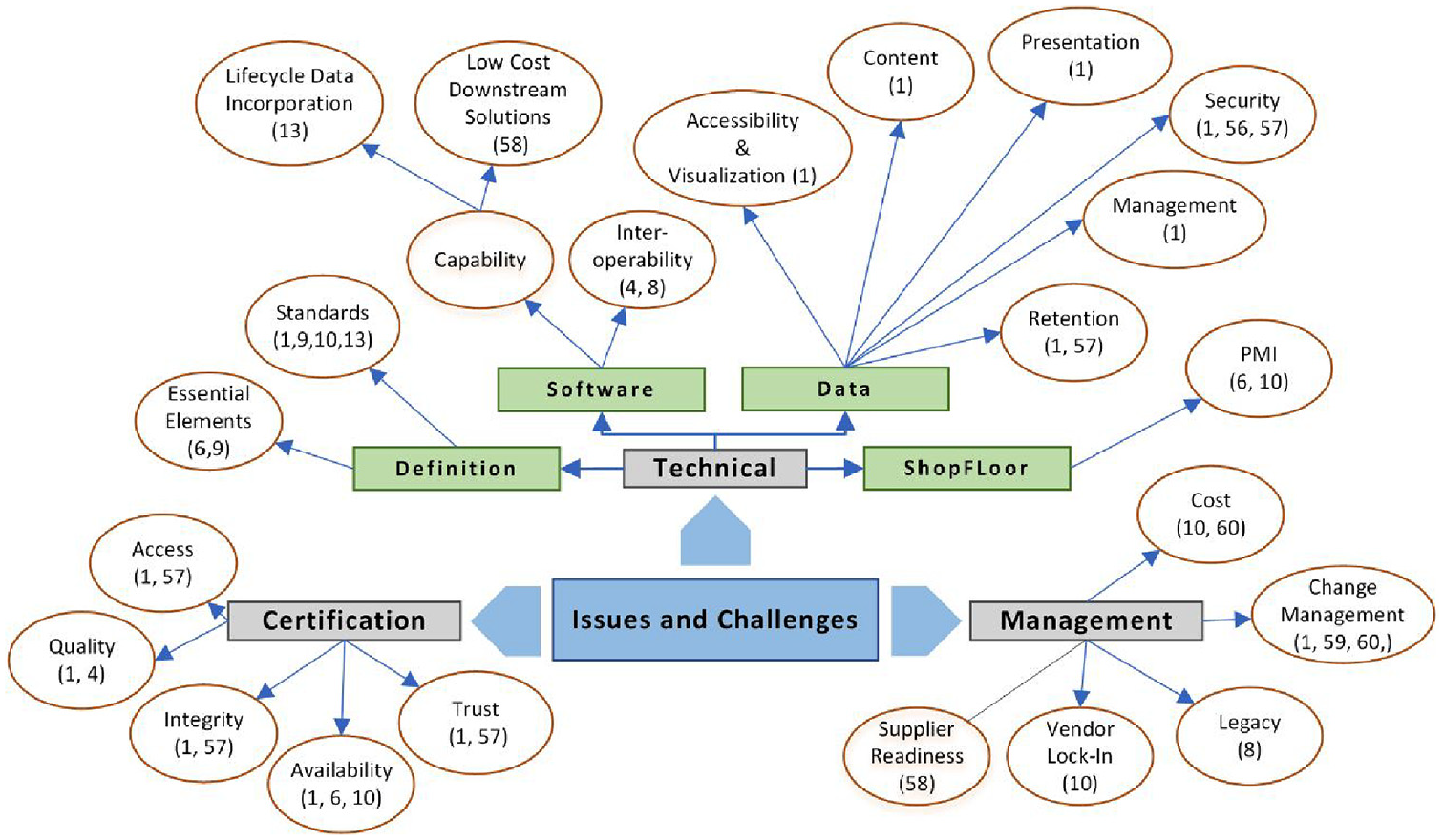
Issues and challenges of MBD.
The main three categories are Technical, Management, and Certification. The technical category is further divided into four sub-categories, as numerous issues are found in this category. These sub-categories are Definition, Software, Data, and Shop floor. Each of the underlying issues in these categories is shown with the reference to the author who raised the issue.
Technical issues
Model definition- It is imperative to know the elements of the product definition that should be part of the model in MBD. To accomplish it, comprehensive knowledge of information flow in the product lifecycle is needed. 6 Many of the part data elements are still unaddressed by MBD standards and tools. 9 Additionally, there is a lack of understanding that out of all elements which information shall be essentially needed in moving from 2D to 3D model, for each workflow in the product lifecycle. 6
To present MBD datasets as an engineering document, agreed-upon international standards are needed. Though standards like ASME14.41 provide guidance, there are some areas to improve. For example, it indicates the type and presentation of drawing annotations for inclusion in the MBD dataset, however, it lacks to mention which MBD data set document format or template is to be adopted. 1 Another example is the incomplete PMI coverage by STEP format. There is also a need for recommended practices to ensure consistent interpretation of the standards and their implementation.9,13
Software- The capabilities of software applications to fully define product data are growing. However, only manufacturing and inspection related information is supported by these applications. The capabilities are still insufficient for the realization of the MBE in all aspects. This includes the capabilities to incorporate elements from all the stages of the lifecycle and the allowance of the semantics of this data. Moreover, to leverage the digital data, the software capabilities of manufacturing and inspection systems (CNC, CMM, and Intelligent Tooling) are also needed to be enhanced. These systems should have features to interpret and consume embedded PMI and other semantic data. There are considerable benefits to the development of such capabilities. 13 Hence, the software capabilities for both the definition as well as the consumption end, are needed to be enhanced. Besides, low-cost solutions are needed to provide easy access to the MBD data to the suppliers and vendors who are unable to invest in expensive software applications.
There is a vast range of applications and data formats that is in use across different domains of the product lifecycle. The integration of these applications is necessary for the realization of MBE. A major challenge lies in the interoperability of these applications. This includes interoperability between various data types, systems, languages, products, and processes. Currently, there is a lack of integration solutions.4,8 Being a critical issue, the interoperability is the topic of many of the current research articles in the field of MBD.
Data- There are a few data-related questions MBD has to overcome. The challenge is to what extent it is capable of addressing them in replacing the role of engineering drawing. 1 Data accessibility and visualization implies the need for methods to define the model such that it is easily accessed and understood downstream. The downstream user has to be confident enough about the contents of the MBD data set that it has all the core elements which were previously available in the form of engineering drawing. There must be international standards for the presentation of data to organize and structure the information in MBD datasets just like drawings. An appropriate method of data management is needed to manage and record revisions. Moreover, data security and retention capabilities are needed to be enhanced to accommodate confidentiality, authentication, integrity, and non-repudiation. Similar requirements of data trustworthiness, authentication, and traceability are also reported by Hedberg et al.56,57 to enable the product lifecycle of trust (PLOT).
Shop floor- There are a few issues associated with the readiness of manufacturing shop floor for the consumption of the MBD dataset.6,10 At present the conventional drawings are easier to use on the shop floor. For MBD models, the hardware is required at the shop floor for visualization, interrogation, and process-related changes in the model. Moreover, the capabilities of software for accommodating machining related changes are still questionable, as the neutral formats are incapable of these changes. The operators have to make machine-related changes for CNC machining/CMM inspection programming. There are only a few machines that are ready to use semantic PMIs which include only inspection equipment. There are two important aspects of the MBD dataset hence. First, the development of better organized and user friendly PMIs is important for ease of use at the shop floor. And the next level is the incorporation of fully semantic PMIs that would enable seamless consumption of the product definition by the manufacturing shop floor.
Management issues
Change of working patterns from the conventional drawing to MBD requires changes in existing procedures, processes, and working practices. 1 This shall require a change in organizational policies and culture, which is a barrier in MBD adoption. 59 There is always some resistance from the workforce to adopt the change and so is the case with MBD. Adoption of MBD will result in a change in all the business-related operations and contracts with the suppliers. 60 Just like every new technology adoption, there is an extra investment involved in the implementation of MBD.10,60 This includes investment in software, hardware, and extra training.
It is easy to adopt MBD in the case of new product introduction (NPI). However, the legacy design data is in older drawing formats in most of the organizations. These designs are still used for the manufacturing and service of proprietary products. The conversion of this data to MBD datasets is a big challenge for high-value manufacturing. It needs a lot of extra effort, time, and involvement of extra cost. 8 Another major challenge is vendor lock-in. 10 Choosing one application will lock every stakeholder in the ecosystem of the application provider. This will result in uncertainty in the life span of the proprietary designs.
Since MBE is aimed at using a single source of product definition. There are questions over the capabilities of the suppliers to access and use this data. All suppliers may not be ready for this change. Therefore, in the adoption of the MBD strategy by high-value manufacturing, they have to access the supplier capability to fit in their MBE structure.
Certification issues
There are some legal requirements of aerospace certification bodies for retention of the design over a certain period. 10 In addition to retention, the design data must also have the characteristics of maintaining availability, accessibility, integrity, quality, and security throughout the product lifecycle. 1 It must also be interpretable by all the versions of applications that were used to create it and thus must ensure long term archival and retrieval.4,6 Equally important is the trustworthiness of the data which is directly related to the model quality. Poor model data quality, obsolete data, or incorrect data puts a question mark against trustworthiness along with disruptions and waste in manufacturing operations. Poor model quality may be caused by an error from the operator, the model development technique, the CAD system, or a translation error. However, regardless of the reason, a model cannot be certified as a master unless it is free from quality defects. 4 This is more important for regulated industries like aerospace and medical, which have to comply with government laws. In addition to quality, the trustworthiness of the data includes security, privacy, safety, reliability, and resilience features. 57
Conclusions and future research directions
From the model definition perspective, there is a need to study domain-specific information from each stage of the product lifecycle that should be part of the MBD data set. Currently, the literature addresses the design, manufacturing, and inspection stages. However, other downstream uses like process planning, assembly, testing, support, and service are the least explored areas. The viewpoint and perspective for model definition changes with the domain. Therefore, it is essential to study these stages and workflows comprehensively to capture the domain-specific requirements. The summary of the recommendations for MBD research is shown in Figure 4. The purpose of this diagram is to systematically show the regions which need further research and development efforts to address each of the issue raised in section 4.
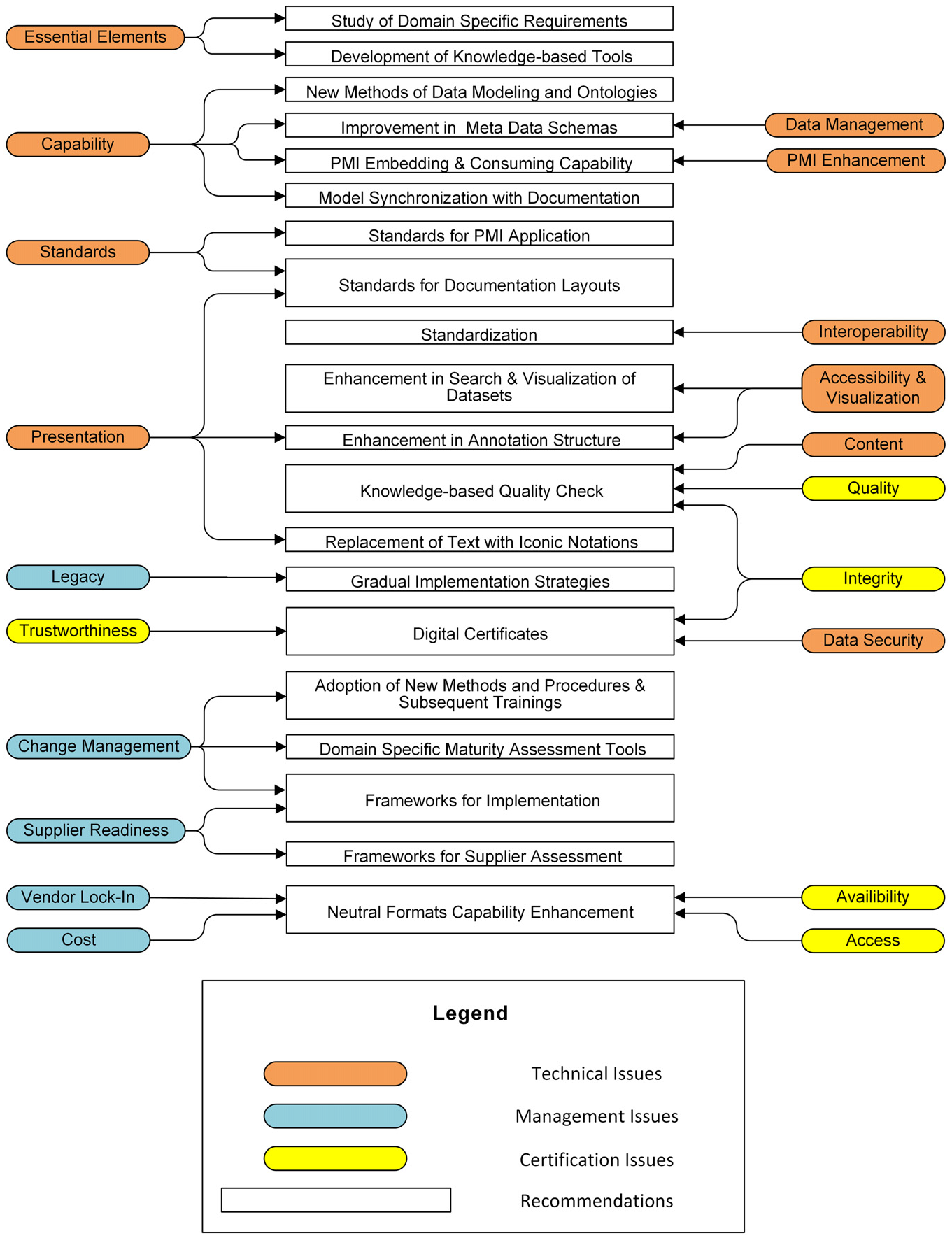
Further research directions in MBD and MBE.
For enhancing the capabilities to incorporate lifecycle data there is a need for a common methodology for structuring the data in a unified and reusable form inside the MBD dataset. The model structures have also to be studied for input-output requirements. This shall enable creating an authority that would allow the automation of downstream deliverables. The prospects of such automation include automatic first article inspection report (FAIR) creation, CNC and CMM programs, process planning, job scheduling, API, and MRO instructions. It would be more effective if the applicability of these models would be discussed with the users to ensure completeness. This could result in diverse proposals on model ontologies in future research. Finally, the need for extension in the 3D CAD model shall remain a continuous phenomenon. This shall enhance searching and visualizing capabilities of different data sets and thus improve the downstream deliverables.
The PMI application methods on the model vary with the designer, which is opposite to the drawings where standards are used. This implies the need for PMI application standards. This is equally important for the presentation and representation PMIs. The development and adoption of such standard practices shall ensure proper association of PMI to the geometry. Moreover, the designers have limited knowledge of domain-specific requirements especially of the later stages of the lifecycle. This results in poor design definition, the correction of which takes a lot of productive time. The designer knowledge can be made synchronized with the domain knowledge by the introduction of tools and mechanisms for the domain-specific feedback. This shall ensure the correct definition and the association of PMI earlier in the product lifecycle.
The annotation structures also need improvement to enable readability from any orientation irrespective of the position of the CAD model. There should be simplified methods for the creation and distribution of annotations in layers and groups. Annotations supporting virtual search is also one of the prospects for research.
Knowledge-based model quality check technology is another prospect for development and improvisation. This may include quantitative analysis of model quality, automatic model quality defect modification, and approaches to generate model quality check schemes automatically. The capabilities of software and hardware need further improvements thus realizing MBE in full. Moreover, working with the MBD environment needs replacement of old methods and procedures.
The assembly stage in high-value manufacturing is the least addressed area of MBD. Though there is the adoption of lightweight assembly instructions in the form of 3D PDF. But these are offline demonstrations only with plenty of text still there. A change in design needs all the assembly documentation to be recreated. It is important to work, therefore, on the synchronization of assembly information with the original design to decrease the production downtime. The same need holds for service and support documentation like MRO Instructions. There is also a need for the introduction of iconic notations to replace the text. Then, suitable layouts are needed to be defined for MBD based assembly information to fit various scenarios. Knowledge-based systems, tools, and frameworks are also needed to convey assembly specific knowledge to the designer. It will minimize the need of corrections and clarifications for assembly related changes in the part definition and the resulting downtime.
Another emerging area for MBD research is process planning. MBD process models based on machining knowledge with reasoning systems are needed to be created. To benefit process planning it is imperative to work on complex ontologies for semantic references. Interaction of the process planning with the CAD environment is also an open area for future work.
The previous MBD research work in ECM area is also focused on the part level which involve quantifying the gains at manufacturing and inspection only. It is essential to evaluate, therefore, each stage of the life cycle to check the domain-specific requirements of MBD data sets to facilitate the ECM process. A need to synchronize CAD and visualization applications is also there to facilitate the process of ECM.
It is needed to integrate digital certificates with various workflows to address data-related challenges such as security, authority, and integrity. In the authorization context, the gaps in standards are to be pointed out. Moreover, a mechanism is to be generated for some automatic processing of authentication and traceability in the common workflows of the enterprises. There is also a need for a complete metadata schema supporting the development of the minimum information model. In this model, the common and domain-specific information elements would unite to characterize the complete set of information that is essential for effective communication of all functions and roles in the product life cycle. To enable automatic traceability, some management-oriented work is also needed for systematic organizational change.
It is seen that every organization has its unique perspective to set its MBE goals and formulize the strategies to achieve those goals. Assessment framework and guidelines are needed to be established by the research community that could define and set milestones of MBE to provide the industry with common criteria of evaluation. In this context, there is a need to work on domain-specific maturity assessment frameworks to formalize the details of what various levels of adoption of MBD meant for different stages. This shall help organizations better assess their preset state and target the future state and thus facilitate their MBE journey. Moreover, this shall help in minimizing the cost of implementation, as the organizations can set short affordable, and achievable goals. In this way, a gradual implementation strategy can be adopted.
Footnotes
Acknowledgements
The authors are thankful to the Higher Education Commission (HEC) Pakistan and Cranfield University, United Kingdom for financial support of this research.
Declaration of conflicting interests
The author(s) declared no potential conflicts of interest with respect to the research, authorship, and/or publication of this article.
Funding
The author(s) received no financial support for the research, authorship, and/or publication of this article.
