




Abstract
Current manufacturing industry has witnessed the trends of socialization, personalization, and servitization, which prompts the appearance of social manufacturing paradigm. This article addresses the personalized production organizing and operating mechanism in social manufacturing. Socialized manufacturing resources spring up in fine-grained markets and self-organize into social communities to participate in different phases of product lifecycle. A socialized production network integrating different socialized manufacturing resources/social communities is organized to create personalized products. The framework and key aspects for socialized production network operating are discussed. The discussion on personalized production organizing and operating mechanism will reveal the future manufacturing philosophy.
Introduction
Current industrial economy has been evolving into experience economy and socialnomics.1,2 Consumers emphasize more on their participation and value embodiment, 3 and their requirements are becoming explosive, complex, personalized, and service-oriented. Thus, consumers are becoming prosumers 4 (producer + consumer), who widely interact with manufacturers and service providers and participate in the product lifecycle to transform their requirements into personalized products and services. Along with the explosive requirements, many socialized manufacturing resources (SMRs) spring up in fine-grained markets, such as micro- and small-sized firms, start-ups, workshops, and even amateurs who have three-dimensional (3D) printers. 5 They provide various production-related or product-related service capabilities to prosumers, which brings advantages of flexibility and responsiveness over traditional big manufacturers. Mention that SMRs may act dual-roles of service provider and service consumer. To enhance their competitiveness and collaboration efficiency, SMRs with similar interests and capabilities always aggregate into social communities (SCs) through social networking and sharing to organize their capabilities autonomously.
The booming of personalized requirements and SMRs/SCs stimulates manufacturing industry to thrive again. This trend also forces big manufacturers to reorganize themselves into small-modular infrastructure 6 or platform-typed enterprises, such as Haier—a household electrical appliances manufacturer in China. This means they are transforming into small SCs and integrate outside SMRs to participate in the fine-grained markets.
Based on that, a socialized production network (SPN) made up of prosumers, SMRs/SCs, and their social relationships can be built for certain personalized production tasks. Within SPN, all the participants interact and collaborate to accomplish the whole product lifecycle activities.
Under these situations, a new manufacturing paradigm called social manufacturing (SocialM) is proposed.5,7–10 At its core, the “social” features of SocialM are reflected in the following three aspects:
The participants in SocialM are socialized, including prosumers, manufacturers, and SMRs/SCs. A special report in the Economist magazine pointed out that socialized resources, especially small-sized firms and individuals, can participate in innovative products production via online communities and 3D printing services. 11
The SMRs self-organization mechanism in SocialM is SC-based, and different kinds of online SCs are generated for sharing and collaboration. Ding et al. 10 studied the configuration and organization of customized SC space at the intra-enterprise and inter-enterprise levels in SocialM.
The supporting information and communication technologies (ICTs) for SocialM include social media, social networking, social computing, and cyber–physical–social systems (CPSS). Hinchcliffe and Kim 12 addressed the transformative social media applications in enterprise’s businesses and listed 10 tenets of social business practice. Andreadis 13 studied a collaborative framework integrating social media for manufacturing.
Although SocialM has drawn much attention from these aspects, the personalized production organizing and operating mechanism, which is vital to transform SocialM from concept to practice, is seldom discussed. Mourtzis et al. 14 discussed the design and planning of decentralized production networks under high product variety demand at the production stage. Errastia et al. 15 organized a special issue on the global production network organization and operation for small and medium enterprises (SMEs). However, these researches did not address the SMRs self-organizing mechanism and the SC-based production operating mechanism in SocialM. These mechanisms emphasize that product lifecycle activities are undertaken by various SCs. In this article, the personalized production organizing and operating mechanism is addressed from the following three aspects:
How SMRs self-organize into different SCs;
How SMRs/SCs self-organize into an SPN for personalized production;
How SMRs/SCs operate and collaborate within the SPN.
SC-based SMRs self-organizing mechanism
There are two kinds of SCs, that is, prosumer SC and SMRs SC (e.g. design SC, manufacturing SC, and transportation SC). Both of them are dynamic, changeable, and led by one or more members with higher leaderships. Prosumers or SMRs can opt in and opt out multiple SCs autonomously according to the similarity of their interests/capabilities. Each pair of members in an SC establishes a social relationship. The relationship tightness can be high or low, determined by their business overlaps.
In prosumer SC, prosumers can interact with each other via social media and make suggestions or requirements to manufacturer to improve product conceptual design. Then, manufacturer responses to them rapidly and transforms their suggestions and requirements into engineered features. Fiat 500 car and Xiaomi cellphone are the examples utilizing crowd intelligence of prosumers to improve product design.
In SMRs SC, the well-thought-of members undertake the daily management of community, for example, allow-in of members, status updates, and topics initiation. The SMRs SC applies outsourced/crowd-sourced tasks by taking the aggregated capabilities of its members as chips. The members collaborate with each other to finish the tasks and social media helps them to collaborate efficiently.
As shown in Figure 1, prosumers, SMRs/SCs, and their social relationships make up a big social manufacturing system (SMS), which is open, stochastic, self-organized, and stimulated by societal policies, dynamic prosumer requirements, and global market changes. The self-organizing mechanism, autonomy mechanism, decision-making mechanism, and others ensure SMS evolves into a dynamical-steady system. Based on the complex network theory, SMS can be described as a complex network

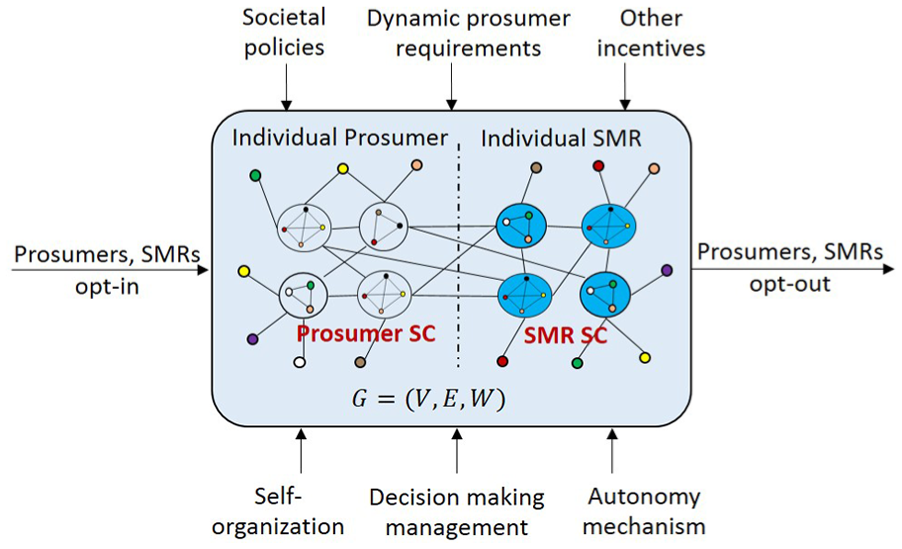
Social manufacturing system.
where
Network nodes self-organize into multi-modal SCs in SMS. The dynamics of SMS is determined by their interactions, which is crucial to understand the structural and functional properties of the complex system. To reveal the prosumer-induced SC structure, an EAGLE algorithm 16 detecting both the hierarchical and overlapping properties of community can be applied, and its main procedures include the following:
1. Generate a dendrogram based on the similarity M between two communities

where
2. Choose an appropriate cut to break the dendrogram into SCs based on the modularity EQ

where
The dendrogram and its cut are depicted in Figure 2. The revealed SCs are the hidden modules of SMS, which is helpful for rapid SMR matching and efficient collaboration. The network dynamics and network coordination should be further studied to reveal the SMRs self-organizing disciplines and to promote the market moving toward ordering.
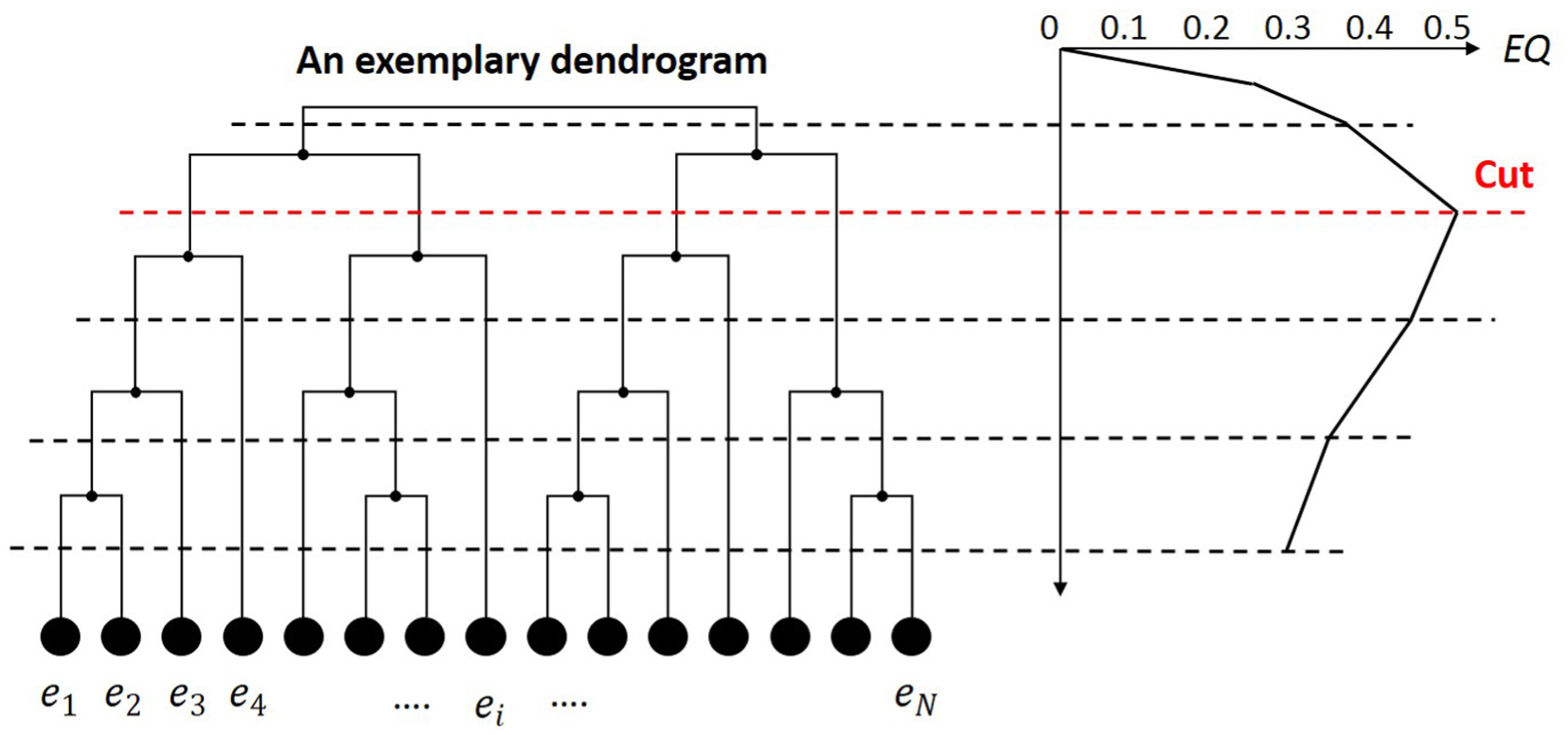
Dendrogram and its appropriate cut. 5
SPN organizing mechanism
From the evolutionary view, production organizing structure evolves from the vertical organization (i.e. traditional manufacturer) to the project/product-oriented virtual organization (i.e. virtual enterprise), and finally to the service-oriented social organization (i.e. SPN). The flexibility, complexity, and collaboration scope of the above three structures range from low to high. In SocialM, the production organizing structure should be SPN, and it includes two main kinds, that is, SPN with core manufacturer and SPN without core manufacturer.
SPN with core manufacturer
As shown in Figure 3, prosumers, core manufacturer, and SMRs/SCs make up a SPN. Prosumers propose personalized requirements in the form of context, video, and other forms of non-structural data in the online prosumer SC. Core manufacturer analyzes their requirements via contextual mining or big data analytics and map them into functions via quality function deployment (QFD) methods. Then, it crowd-sources product design tasks to the design SCs or just to the prosumer SC, utilizing crowd intelligence to rapidly develop the required products. After the product design is accomplished, core manufacturer decomposes manufacturing tasks according to the product Bill of Material (BOM) and outsources them to manufacturing SCs that specialize at various part manufacturing tasks. The negotiation and supplier selection mechanism ensure the selected SCs are optimal for the tasks. The selected SC allocates the outsourced tasks to its members based on their capabilities, which ensure each SMR can win its profit according to its contribution. Meanwhile, the selected SCs provide real-time production data, based on which core manufacturer can synthesize them into comprehensive production progress information to prosumers. Besides, some SCs will undertake manufacturing assistance for others in the form of product-service system (PSS). For example, machine tool service providers from PSS SCs will assist core manufacturer to schedule the machine tools they provide and give operating suggestions to them. In some sense, core manufacturer acts as the system integrator to aggregate different SMRs/SCs and PSS providers for personalized production.
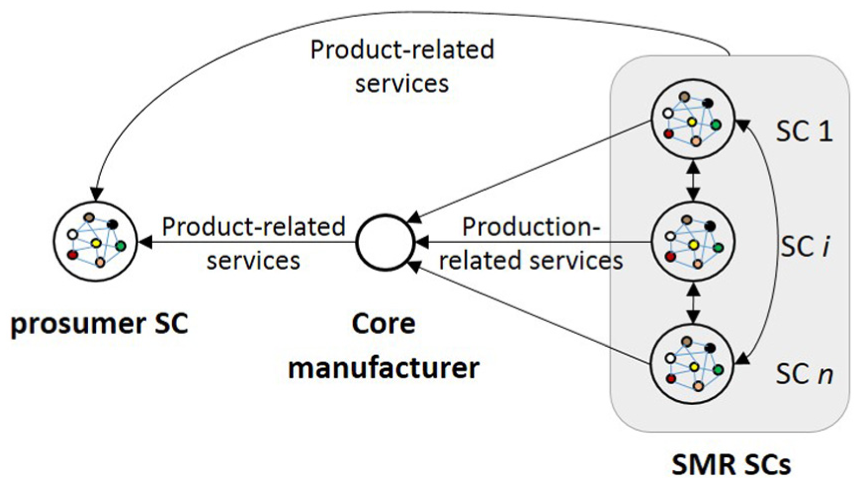
SPN with core manufacturer.
SPN without core manufacturer
As shown in Figure 4, prosumer utilizes SMRs/SCs to develop personalized products without core manufacturer dealing with system integration. That is, prosumer itself acts as the system integrator. This form is previously called Do It Yourself (DIY). All the product lifecycle activities are outsourced to SMRs/SCs and are managed by prosumer. Prosumer proposes the ideas or requirements to the design SCs, then SMRs with design intelligence will apply for it and upload their design schemes to prosumer. The optimal SMR with its scheme will win its rewards. Then, prosumer will outsource manufacturing tasks according to the product BOM, and optimal SMRs from different manufacturing SCs are selected. Other SMRs like transportation service providers from transportation SCs also participate in the product lifecycle activities. Thus, kinds of production-related services and product-related services are provided to prosumer. These design SCs, manufacturing SCs, and transportation SCs with their SMRs together with prosumer make up the final SPN for interaction and collaboration, which realizes the ultimate goal of “co-innovation, co-development, co-manufacturing, and co-operating.” In this form, distributed SMRs/SCs can be efficiently organized and utilized.
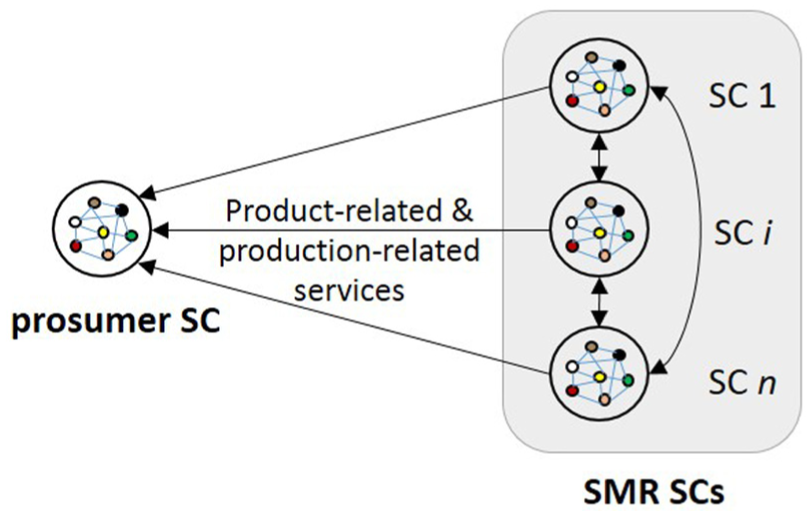
SPN without core manufacturer.
Currently, this kind of SPN mainly lies in the fast-moving consumer goods or DIY products manufacturing. When applied broadly in industrial products manufacturing, it will stimulate SocialM to move toward a mature stage. Note that prosumers in this kind of SPN can be traditional manufacturers too. To some sense, the second kind of SPN is an extension of the first kind.
SPNs are the extractions of SMS, and different correlated SPNs compose the final big system. From the view of evolutionary theory, single cells are the fundamental unit of structure and function in all living organisms, and they specialize into different cell types that are adapted to particular functions. Cells that are similar to each other in appearance and have the same function aggregate into tissues to act as the specific functions. Multiple tissues form the organs of the multicellular organism by the functional grouping. Analogously, SMRs are just like the single cells, SCs are the tissues, SPNs are the organs, and the big SMS is the multicellular organism, as shown in Table 1. Thus, the production organizing of SPNs is conformed to the development of industry toward a stronger one. Future work should be devoted to exploring the evolution-centric production organizing mechanism.
Analogy mapping.
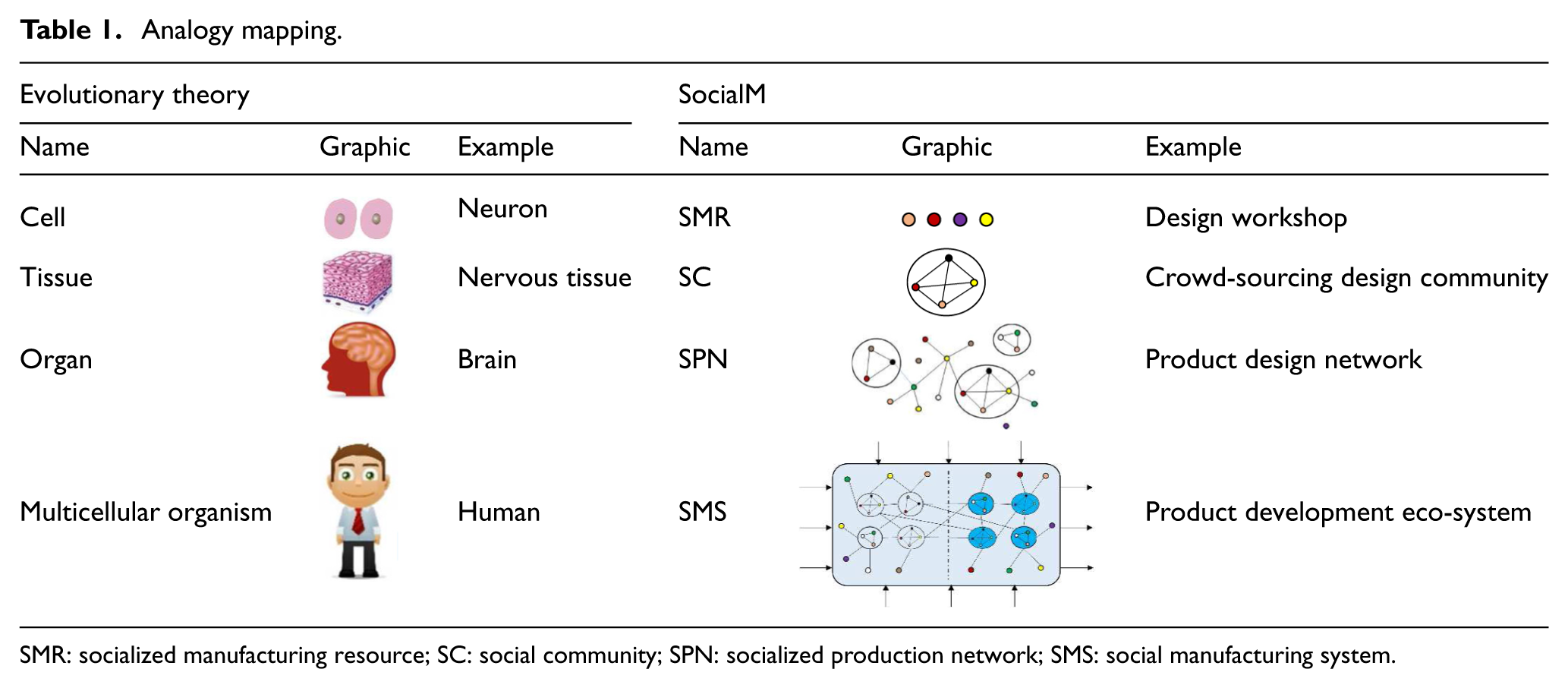
SMR: socialized manufacturing resource; SC: social community; SPN: socialized production network; SMS: social manufacturing system.
SPN operating mechanism
CPSS framework for SPN operating
The wide interconnection of prosumers, SMRs/SCs, and other participants is the core for SPN operating. It is the basis for efficient interaction, collaboration, and sharing. It contains three aspects, that is, physical interconnection, cyber interconnection, and social interconnection. CPSS is the supporting technology and it is built upon cyber–physical systems by adding social factors. The CPSS framework for SPN operating is depicted in Figure 5.
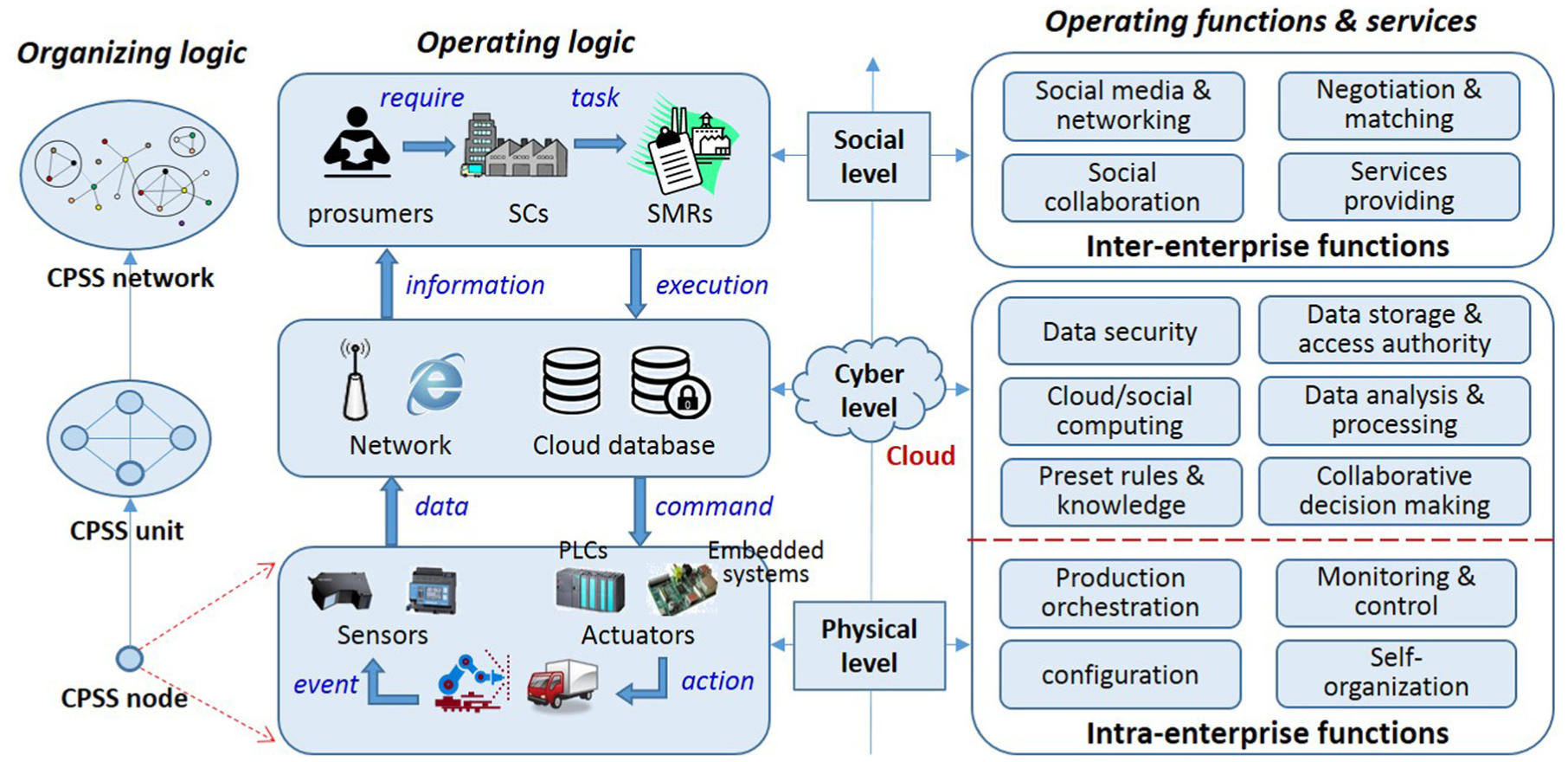
CPSS framework for SPN operating.
From the organizing logic view, SMS can be viewed as a CPSS network, SCs as CPSS units, and SMRs as CPSS nodes. From the operating logic view, at the physical level, intelligent sensors and actuators are integrated in equipments, vehicles, and other CPSS nodes, making them smart objects. Sensors monitor dynamic events and gather real-time operating data, actuators receive commands from the cyber level and execute actions, and CPSS nodes collaborate with each other to execute production operations. At the cyber level, the network infrastructure is cloud-based, and the gathered data, information, and knowledge are stored in the public or private cloud. Cloud computing and social computing are applied to explore the industrial and social big data for assisting decision-making. At the social level, prosumers, SMRs/SCs, and other participants interact with each other via social networking and social media tools, which facilitate the achievement of social business and crowd intelligence. Prosumer’s requirements are mapped into product functions and lifecycle tasks via social communications with SMRs/SCs.
The above three levels ensure the cyber–physical–social interconnection among prosumers, SMRs/SCs, manufacturers, and other participants. Based on that, real-time production data can be gathered and shared among them to realize dynamic and transparent inter-enterprise production control. Thus, SPN can respond in real time to the prosumer needs and the changing conditions in the SMRs/SCs. Note that the cyber level is the link of the social level and the physical level because the latter two levels rely on the data gathering, processing, and analyzing at the cyber level.
Key aspects for SPN operating
Real-time inter-enterprise production monitoring
Because the equipments in an SMR are cyber–physical–social connected as CPSS nodes, real-time production data can be gathered by radio-frequency identification (RFID) devices and sensor network. Thus, material flow of each outsourced task can be transparently monitored. If disturbances (e.g. machine breakdown, quality defects, and task delay) occur, SMRs can perceive them in time and monitor the self-adjustment of CPSS nodes until it needs manual interventions. However, if prosumer’s requirements change, SMRs will rapidly analyze them, re-allocate the changed tasks, and update the production plans.
The SMRs are cyber–physical–social connected too, thus real-time production data from each SMR can be shared among prosumer and other SMRs via authorized data interfaces. Besides, real-time transportation state between two partners can be achieved by RFID and Global Positioning System (GPS). Thus, the total physical flows including material flow and product flow can be monitored transparently.
Dynamic integrated production and transportation control
Based on the real-time inter-enterprise production data, dynamic integrated production and transportation planning and scheduling (IPTPS) can be addressed. IPTPS is important to improve inter-enterprise collaboration efficiency in SocialM. Because prosumer’s partners are scattered around the world, the transportation processes of physical objects among them need to be well planned together with the production processes to save cost and time. The constraints of IPTPS problem are the quality satisfaction and the due date satisfaction of each order. The objective of IPTPS problem is to minimize the total production and transportation cost

where
Social media–enabled interaction and collaboration
Social interaction and mass collaboration are the key ways to realize the above two aspects. With the increasing applications of social networking and social media tools in industries, the synchronous and asynchronous communications among enterprises become easier. Under Web 3.0, semantic web and instant messaging are used to handle enterprises’ daily businesses. For example, prosumer can discuss product computer-aided design (CAD)/computer-aided manufacturing (CAM) model with SMRs/SCs through online meeting, shared document editing, and live-streaming technologies. The inter-enterprise collaboration ranges from the whole product lifecycle activities. For example, designers from design SCs can participate in the manufacturing stage, interacting with SMRs in the manufacturing SCs via social media to co-decide the manufacturing process planning.
From another point of view, social big data generated from intertwined social interaction and mass collaboration are valuable assets. Applying big data analytics, important information such as market trends and prosumer preference can be explored. Social big data analysis helps carry out social product development and predictive manufacturing.
Discussion
This article discusses two kinds of SPN, in which prosumers and SMRs/SCs together with their various smart equipments are cyber–physical–social connected. In future, products will become smart. Since prosumer proposes the product requirements, smart products start to exist. With the requirements information, smart products will autonomously negotiate and communicate with SMRs from different SCs to produce the final themselves. If prosumers change requirements during product lifecycle, smart products will renegotiate with current partners or find new partners. Thus, smart products become the agents of prosumers and carry the social functions to interact with SMRs/SCs and participate in the product lifecycle activities. What prosumers need to do is just to provide requirements. Thus, the position of smart products gradually equals to the humans. They can autonomously interact with humans and other smart objects to accomplish lifecycle activities. SMRs/SCs will only act as the supervisors of the production processes. That is what SocialM looks like in future.
Conclusion
Current manufacturing industry is becoming personalized, socialized, and service-oriented. SMRs are booming in fine-grained markets, and consumers are widely participating in the whole product lifecycle activities. This article discusses the personalized production organizing and operating mechanism in SocialM. The SC-based SMRs self-organization is addressed. Two kinds of SPNs are discussed to explain the production organizing. Furthermore, three aspects for SPN operating are studied based on the CPSS framework. Research on the personalized production organizing and operating mechanism will promote SocialM heading toward practice.
Although SocialM is promising, there are still some issues that hinder it from application, for example, cultural differences in social interaction, data security in social sharing, intellectual properties protection, and the responsibility and legal validity of business.
Footnotes
Declaration of conflicting interests
The author(s) declared no potential conflicts of interest with respect to the research, authorship, and/or publication of this article.
Funding
The author(s) disclosed receipt of the following financial support for the research, authorship, and/or publication of this article: This work was supported by the National Natural Science Foundation of China under grant no. 71571142.