




Abstract
Quality function deployment is a cross-functional decision-making tool that converts customer needs into technical attributes of new products. Fuzzy numbers are usually adopted to evaluate the customer need importance and the customer need–technical attribute relationships. However, the weighted normalized customer need–technical attribute relationship matrix is not always full rank. If the different fuzzy numbers of two technical attributes are defined as the fuzzy negative ideal solutions, both the closeness coefficients are 0, and the traditional technique for order preference by similarity to an ideal solution cannot prioritize the two technical attributes. Actually, the rankings of different fuzzy numbers are not identical. To solve this problem, we present a new technique for order preference by similarity to an ideal solution to prioritize technical attributes in the fuzzy quality function deployment. The fuzzy positive ideal solution, fuzzy negative ideal solution, and distance measurement of the new technique for order preference by similarity to an ideal solution are improved. As a result, the proposed method not only prioritizes various forms of numbers without considering the lower and upper limits, the median, and boundary interval but also deals with the nonfull rank matrix. Besides, the Theory of Inventive Problem Solving is used to solve technical conflicts which are identified by the line-fitting method. The prioritization results from the proposed method can help to reasonably allocate design and manufacturing resources. Finally, a case on phone shell is given to illustrate the application of the proposed quality function deployment method.
Keywords
Introduction
Understanding customer needs (CNs) plays an essential role in the global competitive market. It is necessary to satisfy CNs from the perspective of product development. Quality function deployment (QFD) is a famous decision-making tool which translates CNs into technical attributes (TAs). 1 It originated in the late 1960s in Japan and has been widely used to analyze CNs in various industries. 2 To provide customer-oriented products, CNs are mapped into TAs in the house of quality (HOQ) which is the first basic building block of QFD.
Initially, the input of QFD is treated as crisp numbers which represent the objective evaluation. Chan and Wu 3 and Lin et al. 4 used traditional technique for order preference by similarity to an ideal solution (TOPSIS) to prioritize TAs in the QFD. However, some information in the QFD, such as the CN importance and CN–TA relationship, is derived from human linguistic assessments. 5 People tend to use linguistic and numerical judgments to express their thoughts. The crisp number describes the subjective information difficultly. When Zadeh 6 presented the concept of fuzzy set, the fuzzy set theory seems to be more appropriate to express the linguistic information. Triangular fuzzy numbers (TFNs) are adopted to evaluate the imprecise and vague information in the QFD planning process. Chan et al. 7 and Chan and Wu 5 compared the bounds or/and median of TFNs to prioritize TAs. If the median of TFNs is identical, this method is invalid. In order to make the evaluation more reasonable, TOPSIS is integrated into fuzzy QFD to prioritize TAs. Malekly et al. 8 and Li et al. 9 integrated TOPSIS into QFD to obtain the ranking order of TAs in the fuzzy environment. These methods handle the imprecise and vague information effectively. However, the CN–TA relationship matrix is not always full rank in the fuzzy QFD. When the different fuzzy numbers are defined as the fuzzy negative ideal solutions (FNISs), the traditional QFD cannot prioritize TAs. Moreover, the Euclidean distance employed by the traditional QFD calculates fuzzy numbers inaccurately. 10 Besides, the interdependent among TAs is also considered. Especially, technical conflicts (TCs) among TAs seriously affect the planning of product development 11 and must be solved.
To overcome these challenges, this article proposes a novel TOPSIS method to prioritize interdependent TAs in the fuzzy QFD. The proposed method uses symmetrical triangular fuzzy numbers (STFNs) to evaluate the CN importance and CN–TA relationships, the new TOPSIS method to prioritize TAs, the line-fitting method to identify TCs, and the Theory of Inventive Problem Solving (TRIZ, Russian acronym) theory to solve TCs. Therefore, interdependent TAs without conflicts are prioritized. The proposed QFD can transform qualitative and vague CNs into TAs (e.g. product shape, precision, and material), which will ultimately provide specific requirements for the manufacturing process. In this respect, it ensures that the manufactured products can meet CNs. Furthermore, the proposed QFD can also help to reduce the manufacturing costs of products 12 by planning TAs in the early development phase.
This article is organized as follows: section “Literature review” states literature review of QFD and TOPSIS, section “Proposed QFD method based on fuzzy TOPSIS” provides a detailed process for integrating the new TOPSIS into fuzzy QFD to prioritize interdependent TAs, and section “Case study” uses phone shell to illustrate the proposed method. Comparisons between the proposed TOPSIS and traditional TOPSIS, and the proposed QFD and traditional QFD are also made in this section. In section “Conclusion and suggestions,” we conclude this article and give some suggestions for future work.
Literature review
QFD
QFD translates CNs into TAs in the HOQ originally, and the result is mapped to parts planning, process planning, and production planning to complete new product development. 13 In the four inter-linked processes, the outputs of each process (HOWs), which are generated from the inputs of this process (WHATs), are the new inputs of the next process (new WHATs). Although the four inter-linked processes satisfy CNs step by step, the first process is the most important. It links CNs to TAs and maps TAs to other processes. Moreover, the structures of other three processes are essentially the same as HOQ. QFD is studied in the product design 14 and manufacturing. 15
In the HOQ, CNs are collected by the market survey. Experts analyze CNs and identify TAs to satisfy them. Customers evaluate the CN importance, and experts assess the CN–TA relationship. Zhang et al. 16 adopted crisp numbers to prioritize TAs in the HOQ. The traditional QFD deals with the crisp information effectively. However, some information is often imprecise and vague in the HOQ planning process. For example, CN n is very important; the relationship between CN i and TA j is weak. The traditional QFD handles the imprecise and vague information inefficiently. Some methods, such as the fuzzy set theory and the rough set theory, are integrated into the traditional QFD to deal with the fuzzy information. Chan and Wu 5 suggested STFNs to capture the linguistic evaluation and introduced the entropy to determine priority ratings. Chen et al. 17 proposed the fuzzy weighted average method and fuzzy expected value operator to rank TAs in fuzzy QFD. A fuzzy weighted average method and a consensus ordinal ranking technique are integrated to address human perception and customer heterogeneity simultaneously. 18 Zhai et al.19,20 used rough numbers to express the imprecise information and support product development. They compared the bounds or/and median to prioritize TAs. If the median of fuzzy or rough numbers is identical, the order preference of TAs is not determined. The TOPSIS method ranks various forms of numbers without considering the median, the lower and upper limits, and so on. Besides, the correlations among TAs are also important in the HOQ. The negative correlation is defined as design bottleneck that needs to be solved in the new product development. Ko et al. 21 and Liu and Cheng 22 adopted the TRIZ to address design conflicts. Therefore, TOPSIS and the TRIZ are integrated into fuzzy QFD to prioritize interdependent TAs. The proposed QFD not only prioritizes TAs but also solves TCs among TAs.
TOPSIS
TOPSIS which is presented by Hwang and Yoon 23 is a multiple criteria decision-making tool. The basic principle is to choose the alterative which should have the shortest distance from the positive ideal solution (PIS) and the farthest distance from the negative ideal solution (NIS). 24 The flowchart of TOPSIS is shown in Figure 1, and the calculation process is as follows:25,26
Step 1: normalize the decision matrix. The decision matrix is normalized with the following formula
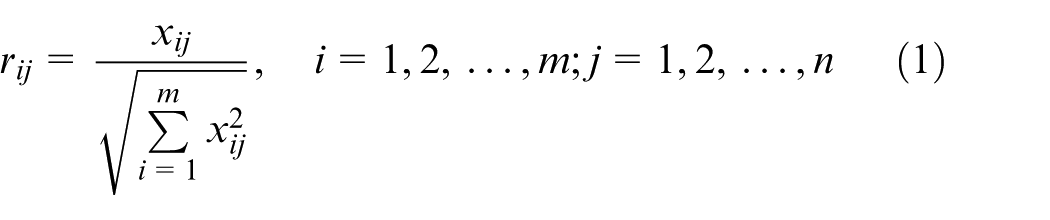
where rij represents the normalized value, and xij is the evaluation value of the ith alternative with respect to the jth criterion.
Step 2: calculate the weighted normalized decision matrix. The weighted normalized value tij is

where
Step 3: define the PIS and NIS. The PIS and NIS are defined as


where for the benefit criterion

and for the cost criterion

Step 4: calculate the Euclidean distance of different alternative versus the PIS and NIS. The distance between each alternative and the PIS is calculated as

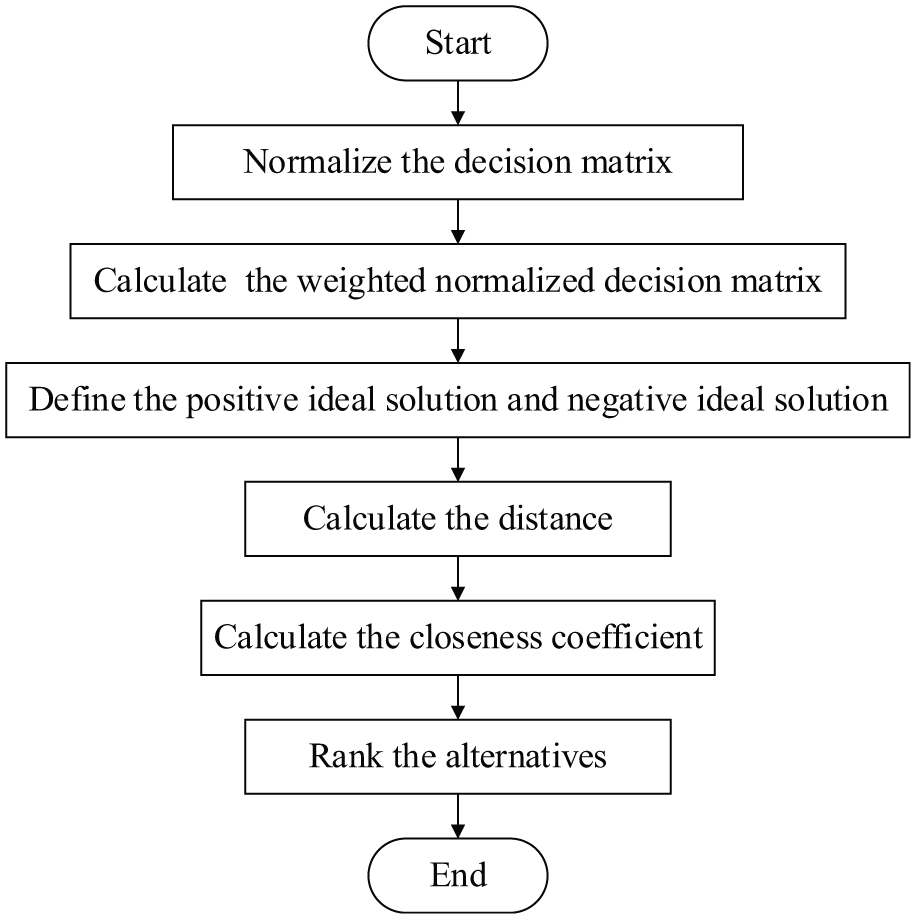
Flowchart of TOPSIS.
Similarly, the distance between each alternative and the NIS is

Step 5: calculate the closeness coefficient (CC). The CC of the ith alternative is calculated as

Step 6: rank the alternatives. According to equation (9), the ranking order of alternatives is determined. The larger the CC, the better the alternative. So, the alternative, which is closer to the PIS and farther from the NIS, is the optimal one.
Traditionally, the decision matrix and the weights of criteria are given as crisp numbers in the TOPSIS.27–30 However, crisp numbers are inadequate to describe real problems. A fuzzy method which expresses the decision matrix and the weight by linguistic judgment is developed. Chen, 31 Chu and Lin, 32 and Remery et al. 33 presented fuzzy TOPSIS to determine the ranking order of TFNs. Zandi and Tavana, 34 Park et al., 35 and Zhang et al. 36 extended fuzzy TOPSIS to rank trapezoidal fuzzy numbers. These fuzzy TOPSIS methods calculate the preference order of fuzzy numbers effectively. However, the CN–TA relationship matrix is not always full rank in the fuzzy QFD. If the different fuzzy numbers of two TAs are defined as the FNISs, the CC will be 0. The two TAs are not prioritized. Besides, Tran and Duckstein 10 verified that the Euclidean distance is not suitable for calculating all fuzzy numbers. The fuzzy positive ideal solution (FPIS), FNIS, and distance measurement of TOPSIS are modified. Therefore, a new TOPSIS is proposed to solve the problems.
From the above literature review, the contribution and limitations of these methods are summarized (as shown in Table 1). The proposed method, which integrates the new TOPSIS into fuzzy QFD, not only prioritizes TAs without considering the median, boundary interval, and lower and upper limits of fuzzy numbers but also deals with the fuzzy information in the nonfull matrix. Besides, TCs among TAs are identified by the line-fitting method and solved by the TRIZ.
Summary of the contribution and limitations of previous methods.
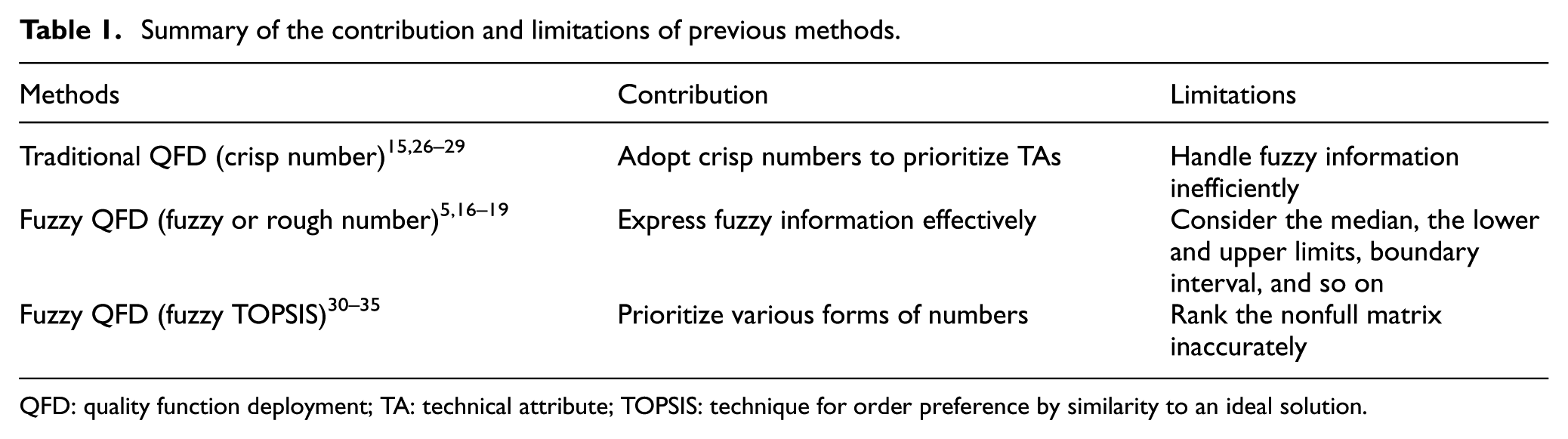
QFD: quality function deployment; TA: technical attribute; TOPSIS: technique for order preference by similarity to an ideal solution.
Proposed QFD method based on fuzzy TOPSIS
In order to determine the ranking order of interdependent TAs, the new TOPSIS and the TRIZ are integrated into fuzzy QFD, as shown in Figure 2. First, CNs are classified, and TAs are identified to satisfy them. Second, TAs are prioritized by the proposed TOPSIS. Customers evaluate the CN importance and experts judge the CN–TA relationships. These linguistic evaluations are converted into STFNs. The fuzzy CN–TA relationship matrix is weighted and normalized. So, the decision matrix is constructed in the fuzzy TOPSIS. The FPIS and FNIS are determined and then the distances of each STFN versus the FPIS and FNIS are calculated. The CC is subsequently calculated, and TAs are prioritized. Finally, TCs among TAs are solved by the TRIZ. The decision system is constructed and then the performances of two TAs are retrieved in the same situation. The lines are fitted by the least square method. So, the average slope is calculated, and TCs are identified. In the contradiction matrix, the TCs are translated into the improved and damaged parameters. The crossing contains some inventive principles. According to the conditions of design, manufacturing, and service, the optimal inventive principle is determined to solve the TC. Besides, the definitions of TA and TC are given in Table 2.
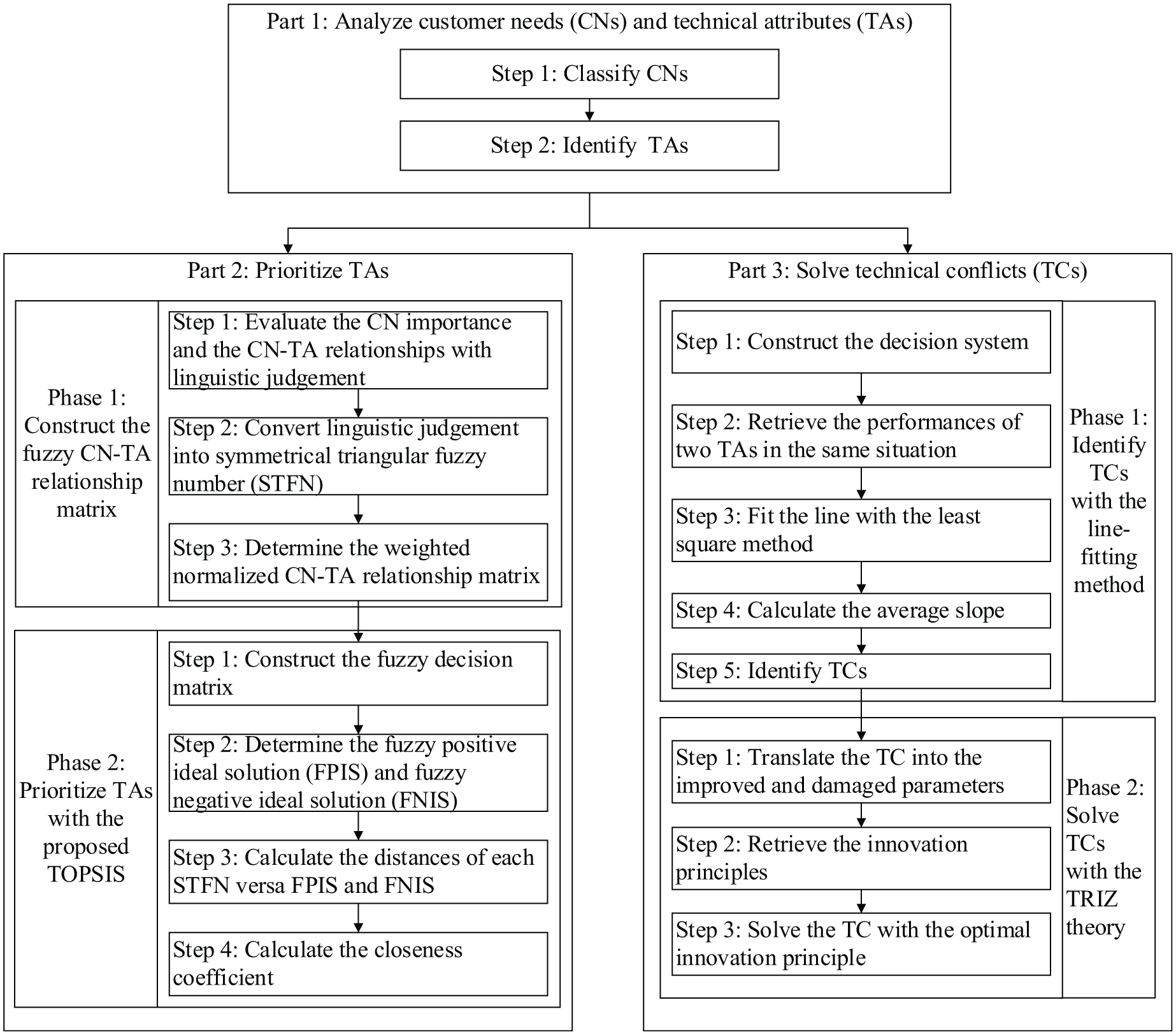
Proposed QFD framework based on fuzzy TOPSIS.
Definitions of TA and TC in this article.

Analyze CNs and TAs
It is necessary to satisfy CNs from the perspective of product development, as well as developing new products from the perspective of customers. Usually, CNs are obtained from the market survey and are classified by some methods and then experts identify TAs to them.
Step 1: classify CNs. CNs, which are also called the voice of customer (VoC), 37 are collected by individual interviews, watching, listening, and so on. Generally, CNs are too general or too detailed to be directly used for new product development. Many methods are chosen to structure CNs into different hierarchical levels, such as an affinity diagram, 38 cluster analysis, 39 Kano et al.’s 40 model, and so on. In order to classify CNs, an affinity diagram is used. CNs are defined as follows

where CN
i
represents the ith CN for the new product.
Step 2: identify TAs. To satisfy CNs, TAs of the new product are identified. TAs are expressed as follows

where TA
i
represents the ith TA of the new product.
In addition, experts define one-to-one and one-to-many relationships to analyze CNs and TAs. The details are described in the following section.
Prioritize TAs
TAs of new product are prioritized by the proposed TOPSIS. According to the fuzzy CN importance and fuzzy CN–TA relationships, the weighted normalized CN–TA relationship matrix is constructed. Then, the ranking order of TAs is determined by the proposed TOPSIS.
Construct the fuzzy CN–TA relationship matrix
The construction of the CN–TA relationship matrix is summarized in three steps as follows:
Step 1: evaluate the CN importance and the CN–TA relationships with linguistic judgment. Customers perceive the CN importance with the 5-point subscale (1, 3, 5, 7, and 9). For example, the numbers 1, 3, 5, 7, and 9 represent very low (VL), low (L), moderate (M), high (H), and very high (VH) importance, respectively. Similarly, experts assess the relationships between CNs and TAs with the 5-point subscale including very weak (VW), weak (W), moderate (M), strong (S), and very strong (VS) relationship. 41 So, the linguistic evaluation of the CN importance and the CN–TA relationships is acquired.
Step 2: convert the linguistic evaluation into STFNs. STFNs are adopted to express the linguistic evaluation. An STFN, in the form of [NL, NH], is one of fuzzy numbers that represents the fuzzy information, where NL and NH are the lower and upper bounds, respectively, and (NH–NL) is the scope. The membership function is the triangular function which is calculated using the following formula
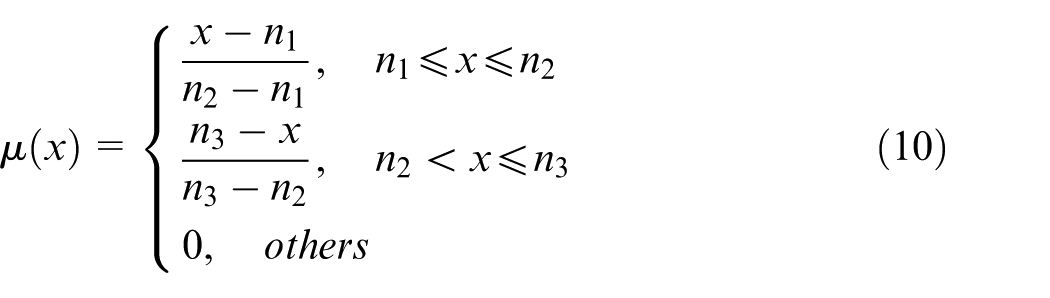
where x is a possible value, n2 is a target value, and n1 and n3 are the lower and upper bounds, respectively.
The linguistic evaluation of the CN importance and the CN–TA relationships is converted into STFNs. They are mathematically represented as follows


where
Step 3: determine the weighted normalized CN–TA relationship matrix. The fuzzy group importance of the ith CN is integrated as follows

where M is the number of customers.
To make the fuzzy weight in [0, 1], it is normalized as follows
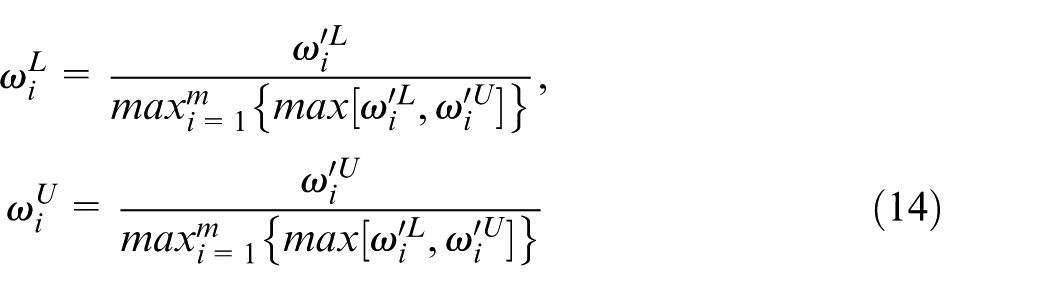
Similarly, the fuzzy group CN–TA relationships are aggregated

where N is the number of experts.
The fuzzy CN–TA relationships are normalized as follows
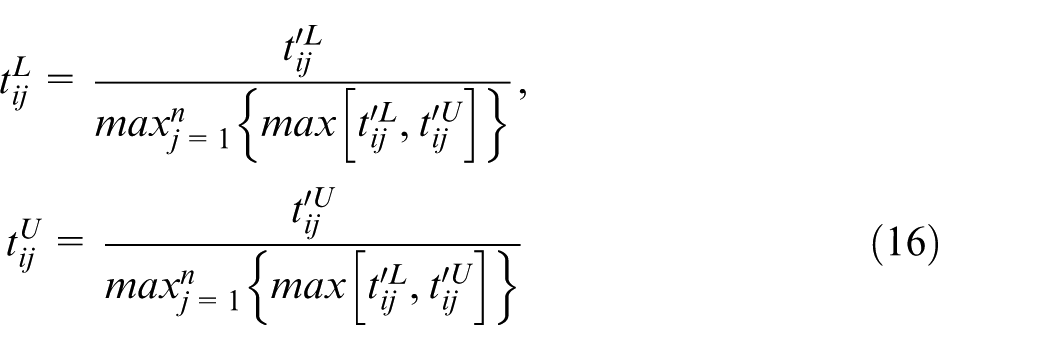
The weighted CN–TA relationships are calculated as follows


Therefore, the weighted normalized CN–TA relationship matrix is obtained.
Prioritize TAs with the proposed TOPSIS
Calculate the distance between two interval forms
The distance between two interval forms is calculated in the following.
Definition 1
The distance d(x, y) between two points satisfies the following three conditions:
d(x, y) ⩾ 0. d(x, y) = 0 iff x = y;
d(x, y) = d(y, x);
d(x, y) ⩽ d(x, z) + d(z, y).
where
Definition 2
The Euclidean distance d(x, y) between two interval forms is given by

where x = [xL, xU] and y = [yL, yU].
The two identical interval forms are defined as follows

However, the Euclidean distance is not suitable for all interval forms. For example, three interval forms are x = [0, 0], y = [−1, 2], and z = [1, 2], respectively. According to equation (19),
Definition 3
The distance between two interval forms is 10
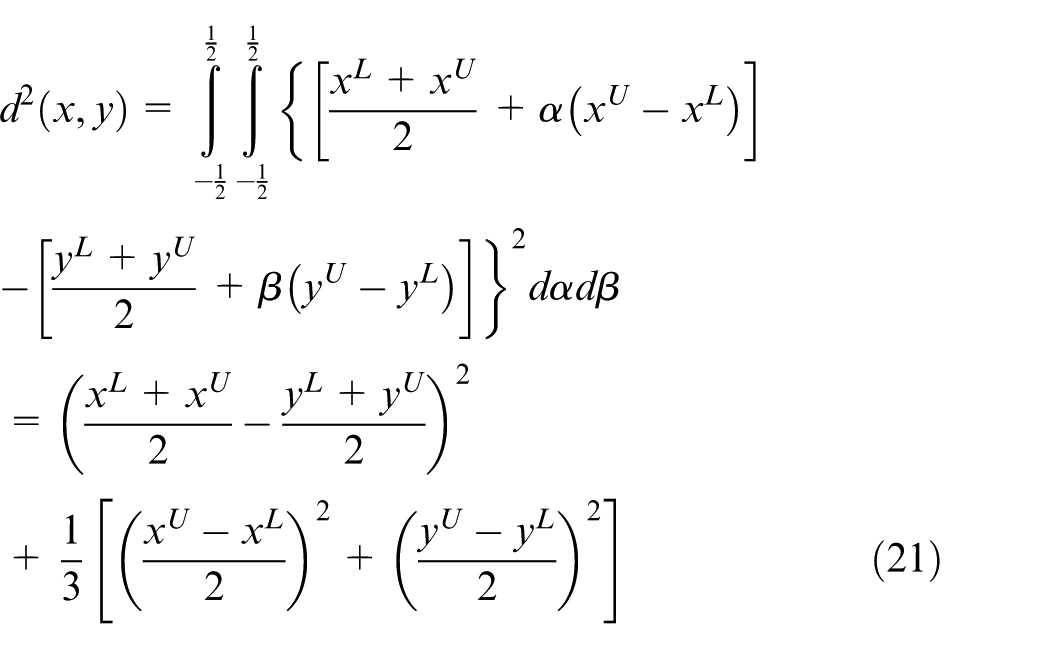
Equation (21) satisfies the conditions which include d(x, y) ⩾ 0, and if d(x, y) = 0, then x = y. Moreover, for the three interval forms,
However, equation (21) cannot satisfy the condition d(x, y) = 0 iff x = y. For instance, two interval forms x = [−1, 2] and y = [−1, 2],
Definition 4
The proposed method of distance measurement is defined as follows
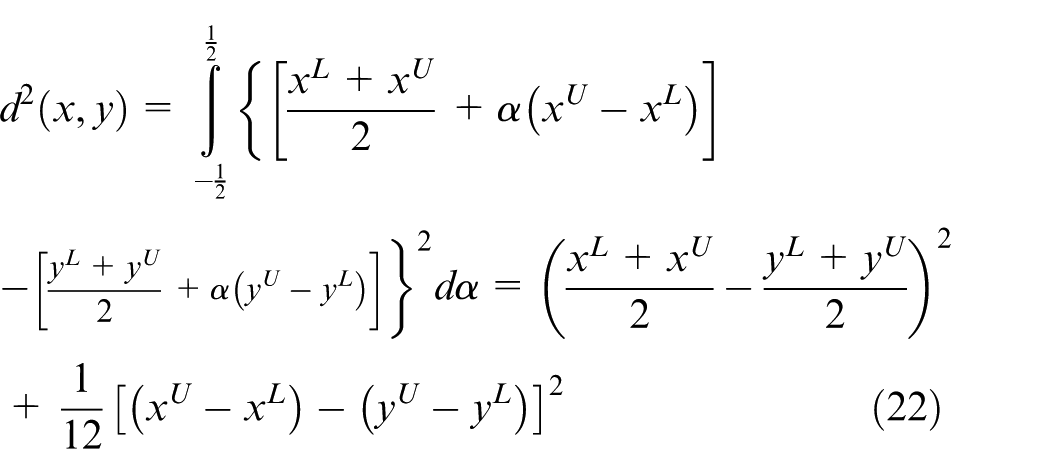
Equation (22) can satisfy the three conditions 1–3, and the proved process is given in the following.
For any three interval forms x = [xL, xU], y = [yL, yU], and z = [zL, zU],



where
According to equation (22)
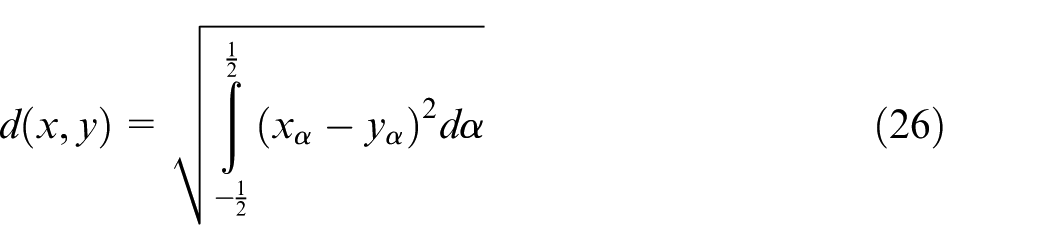
Obviously, equation (26) satisfies two conditions 1 and 2 easily. Here, the Cauchy–Buniakowskii–Schwarz inequality is used to prove that equation (26) satisfies condition 3
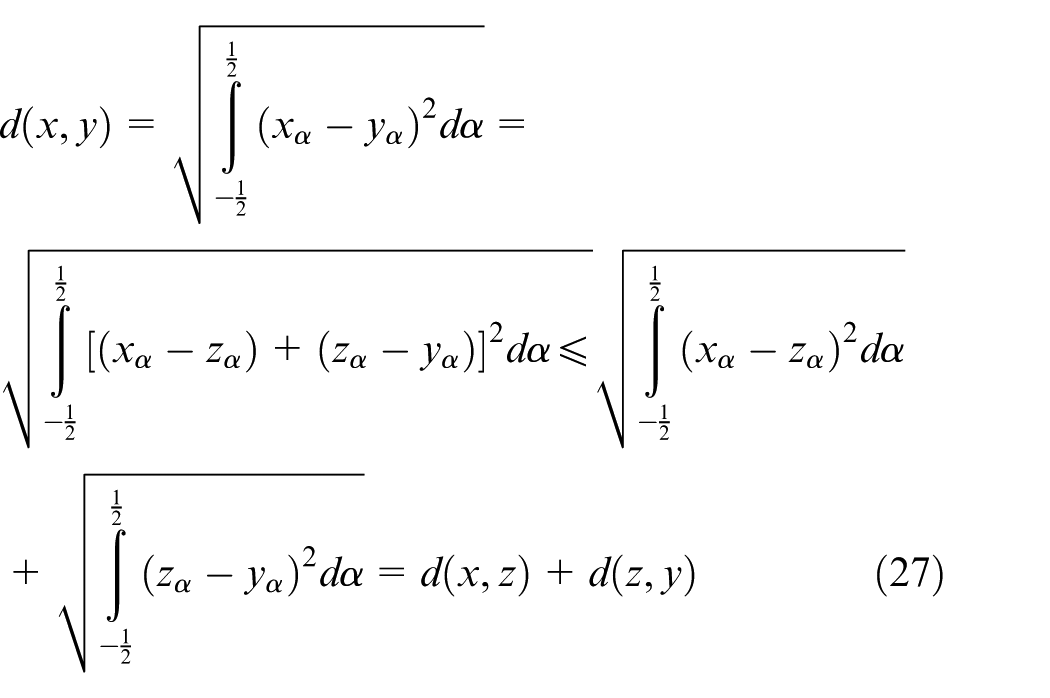
Therefore, Definition 4 fully satisfies the three conditions 1–3.
Determine the ranking order of TAs with the proposed TOPSIS
The ranking order of TAs is determined by the proposed TOPSIS in the following steps:
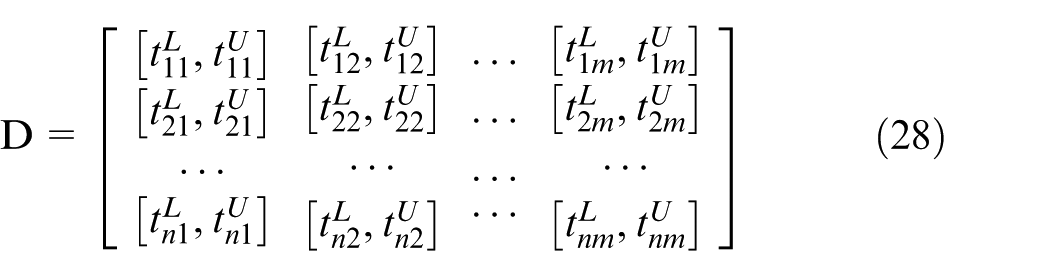
Step 1: construct the fuzzy decision matrix. The fuzzy decision matrix is the transfer matrix of the weighted normalized CN–TA relationship matrix
Step 2: determine the FPIS and FNIS. The FPIS and FNIS are defined as follows


where for the benefit criterion


and for the cost criterion


Step 3: calculate the distances of each STFN versus the FPIS and FNIS. The distance between each STFN and the FPIS is calculated
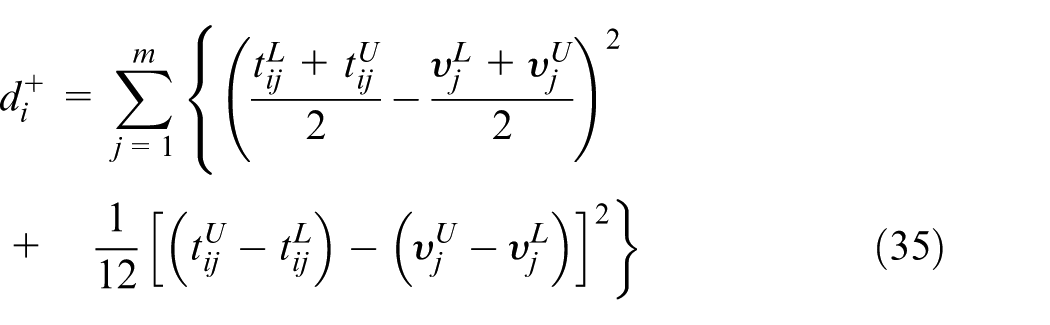
Similarly, the distance between each STFN and the FNIS is calculated
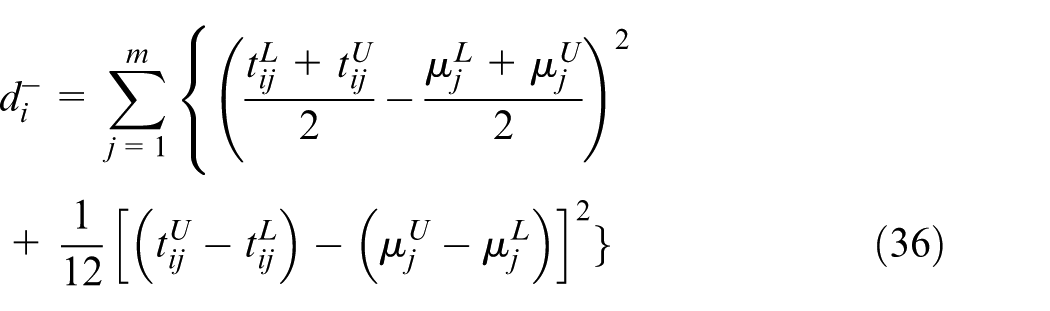
Step 4: calculate the CC. The CC is calculated as follows

Solve TC
After prioritizing TAs of new product, TCs among TAs are identified by the line-fitting method and then solved by the TRIZ.
Identify TC with the line-fitting method
The correlations among TAs are classified as positive correlations, neutral correlations, and negative correlations. That is, in the same situation, if the performance of TA i is improved or damaged, and the performance of TA j would be improved or damaged, respectively, TA i and TA j are a positive correlation. If the performance of TA i is improved or damaged, and the performance of TA j would be unchanged, TA i and TA j are a neutral correlation. If the performance of TA i is improved or damaged, and the performance of TA j would be damaged or improved, respectively, TA i and TA j are a negative correlation. In this article, the first two correlations are ignored, and the last is identified as TCs by the line-fitting method:
Step 1: construct the decision system. Assume that TA i is defined as a decision attribute, while TA n − i, which is a set excluding TA i (TA n − i = TA1, TA2,…, TA i − 1, TA i + 1,…, TA n ), is a conditional attribute. The results, from which different performances of TA n − i affect the performance of TA i , are composed of the decision system. Similarly, experts use the 5-point subscale to judge the performances of TAs. The numbers 1, 3, 5, 7, and 9 represent very poor, poor, moderate, good, and very good performance, respectively.
Step 2: retrieve the performances of two TAs under the same situation. The performances of both TA i and TA j are retrieved when the performances of other TAs are all identical. Moreover, the retrieved performances are defined as the coordinates of a line.
Step 3: fit the line with the least square method. The least square method is adopted to fit the line. Suppose that the equation of the line is

where y represents the performance of TA i , x represents the performance of TA j , and kp is the slope of the pth line.
The deviation dq between yq and (kpxq + h) is defined as follows

The sum of the square of the deviations is

where Q is the number of the performances.
According to equation (40), partial derivatives of kp and h are calculated, respectively, and the results are equal to 0
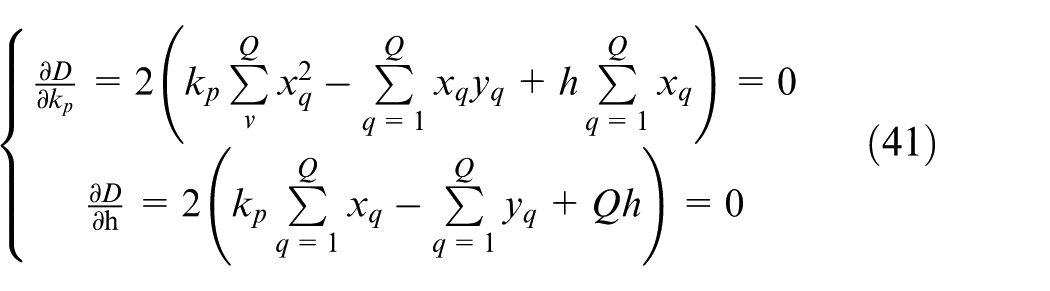
Equation (41) is solved out
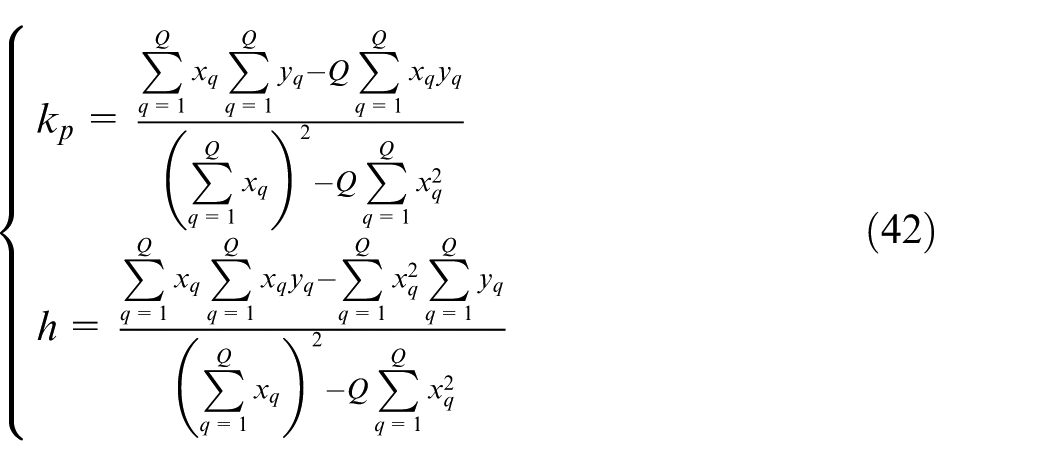
Step 4: calculate the average slope. Repeating steps 2 and 3 until all lines are fitted successfully. The average slope is

where kij represents the average slope and P is the number of lines.
Step 5: identify TCs. TCs are identified by the average slope. If kij > 0, TA i and TA j are a positive correlation. If kij = 0, there is a neutral correlation between TA i and TA j . If kij < 0, the TC between TA i and TA j is identified.
Solve TC with the TRIZ
TCs among TAs are solved by the contradiction matrix which is a problem-solving tool in the TRIZ. The TRIZ, which is first presented by Altshuller and Shulyak 42 in the former USSR, is originated from the analysis of >2 million patents. Altshuller identified 39 engineering parameters to represent all contradictions and concluded 40 inventive principles to solve technical problems in the whole technical fields. When TCs among TAs occur, the contradiction matrix is used. The process is as follows: 43
Step 1: translate the TC into the improved and damaged parameters. When the improved performance of TA i would damage the performance of TA j , the improved performance of TA i is translated into the improved parameter, and the damaged performance of TA j is the damaged parameter.
Step 2: retrieve the innovation principles. The crossing between the improved parameter and the damaged one contains 1, 2, 3, or 4 inventive principles. These inventive principles are prioritized depending on the importance (statistical results of the patent analysis).
Step 3: solve the TC with the optimal innovation principle. Although the inventive principles in the front are preferred, their implementations are limited by the design, manufacturing, service, and so on. The optimal inventive principle should be determined to solve the TC. Note that the optimal inventive principle gives some good directions to explore instead of some solutions.
Case study
To validate the application of the proposed method, the design of phone shell (see Figure 3) in the company H is taken as an example. Company H is a famous cell phone manufacturer in China, and it develops cell phones for 30 years. Currently, it is one of the top 500 enterprises in the world. The phone shell is one of the important components. It can not only protect other systems but also attract the attention of customers. Especially, the beautiful appearance attracts customers to buy. Therefore, the quality and shape are two key factors when designing the phone shell. The information is provided by company H. We spent nearly 3 months to collect the data by several interviews with the engineers in the company H. Besides the interviews, analysis of available reports (e.g. market analysis report and customer survey) was used to collect data.
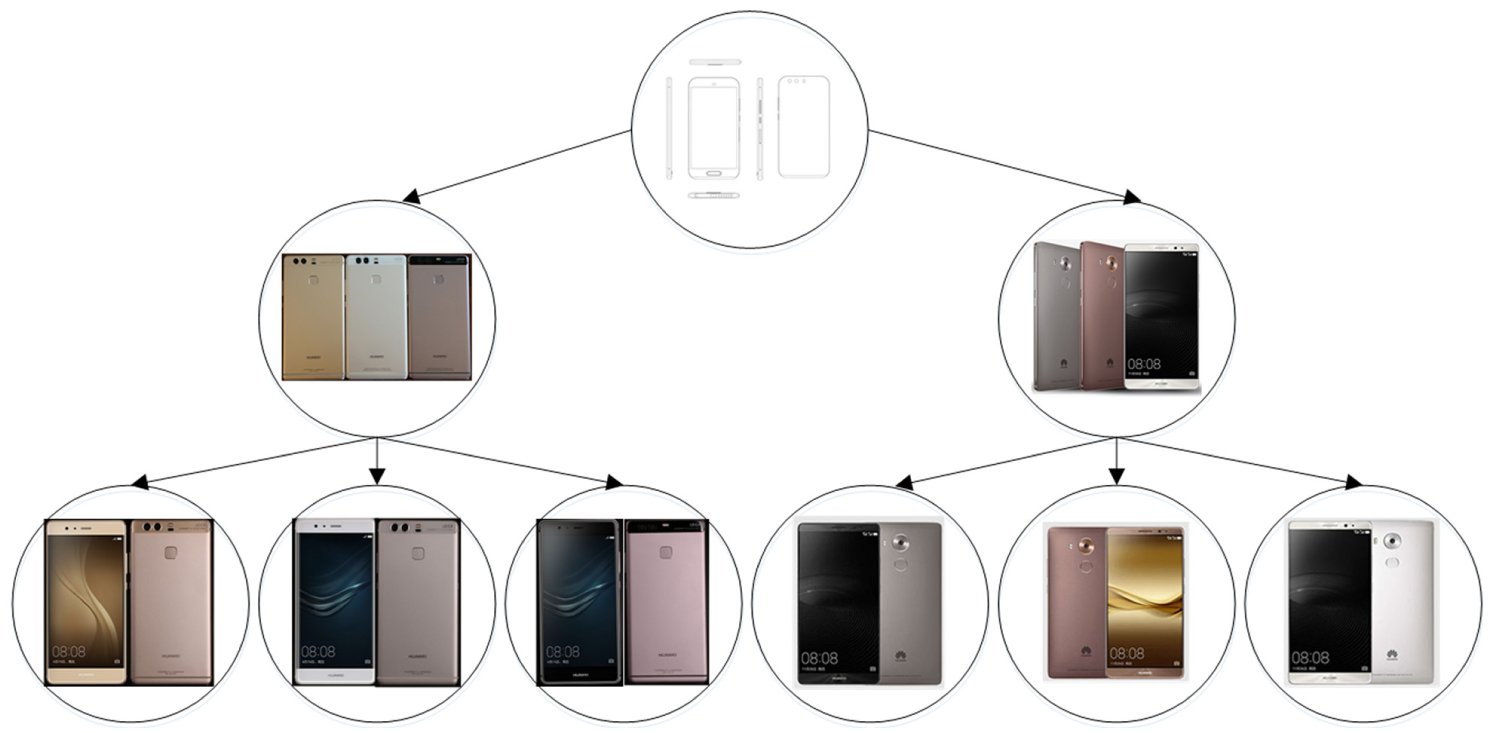
Phone shell.
Analyze CNs and TAs of phone shell
Step 1: classify CNs for phone shell. In company H, CNs are collected by interviews, observation, questionnaire, and so on. The statistics shows that customers pay more attention to multi-style (CN1), comfortable touching (CN2), and the durability (CN3). So, the three key CNs are analyzed.
Step 2: identify TAs of phone shell. Five experts, who are from different teams and develop phone shell >15 years, are invited to participate in the design of phone shell. They identify four key TAs to satisfy the three key CNs, such as the shape (TA1), color (TA2), precision (TA3), and material (TA4).
Prioritize TAs of phone shell
Step 1: evaluate the CN importance and the CN–TA relationships with linguistic judgment. Five sales managers, who are from different companies and sell phones over 10 years, are interviewed. They give the subjective evaluation of CNs with the 5-point subscale (see Table 3). Similarly, the five experts also give their subjective evaluation of the CN–TA relationships with the 5-point subscale, as shown in Table 4.
Step 2: convert the linguistic evaluation into STFNs. In STFNs, [0.0, 0.2] represents very low importance or very weak relationship, [0.2, 0.4] represents low importance or weak relationship, [0.4, 0.6] represents moderate importance or moderate relationship, [0.6, 0.8] represents high importance or strong relationship, and [0.8, 1.0] represents very high importance or very strong relationship. Therefore, the linguistic evaluation of the CN importance and the CN–TA relationships is converted into STFNs.
Step 3: calculate the weighted normalized CN–TA relationship matrix. The weighted normalized CN–TA relationship matrix is calculated using formulas (13)–(18), as shown in Table 5.
Step 4: construct the fuzzy decision matrix. The fuzzy decision matrix is as follows
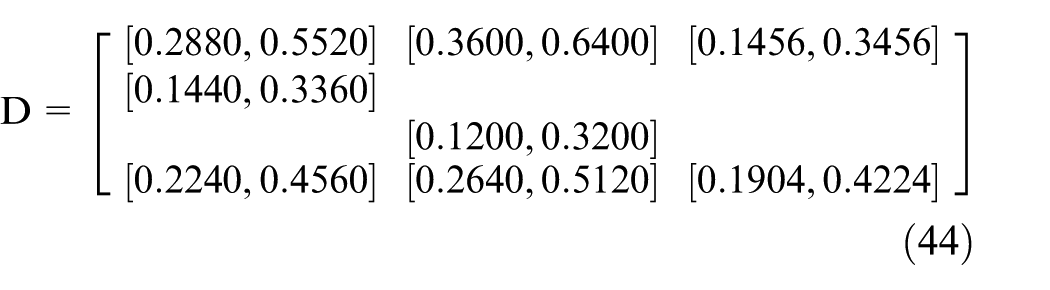
Step 5: determine the FPIS and FNIS. In accordance with equations (28)–(33), the FPIS and FNIS are determined

Step 6: calculate the distances of each STFN versus the FPIS and FNIS. The distances between each STFN and the FPIS and each STFN and the FNIS are calculated using formulas (35) and (36), as shown in Table 6.
Step 7: calculate the CC. The CC is calculated using formula (37) (see Table 6), and the priority of TAs is listed in Table 6. It can be clearly seen that the ranking order of TAs is as follows:
Linguistic evaluation of the CN importance.

Linguistic evaluation of the CN–TA relationships.

Weighted normalized CN–TA relationship matrix.


Solve TCs of phone shell
Step 1: construct the decision system. The performances of TAs are described. The error between theoretical and manufacturing shapes represents the performance of TA1, and the numbers 1 and 9 represent very more and less, respectively. Similarly, the number of colors is the performance of TA2, and the numbers 1 and 9 represent very few and many, respectively. For TA3, the numbers 1 and 9 represent very low and high, respectively. The mechanical property is the performance of TA4, and the numbers 1 and 9 represent very weak and strong, respectively.
H company has spent nearly 10 years to investigate >1000 cases (the development of phone shells) which are provided by 50 companies and obtained the decision tables (see Tables 7–9). Tables 7–9 represent the correlations between TA1 and other TAs, TA2 and other TAs, and TA3 and other TAs, respectively. Note that only some of the information is listed due to space limitations.
Decision table of TA1 and other TAs.
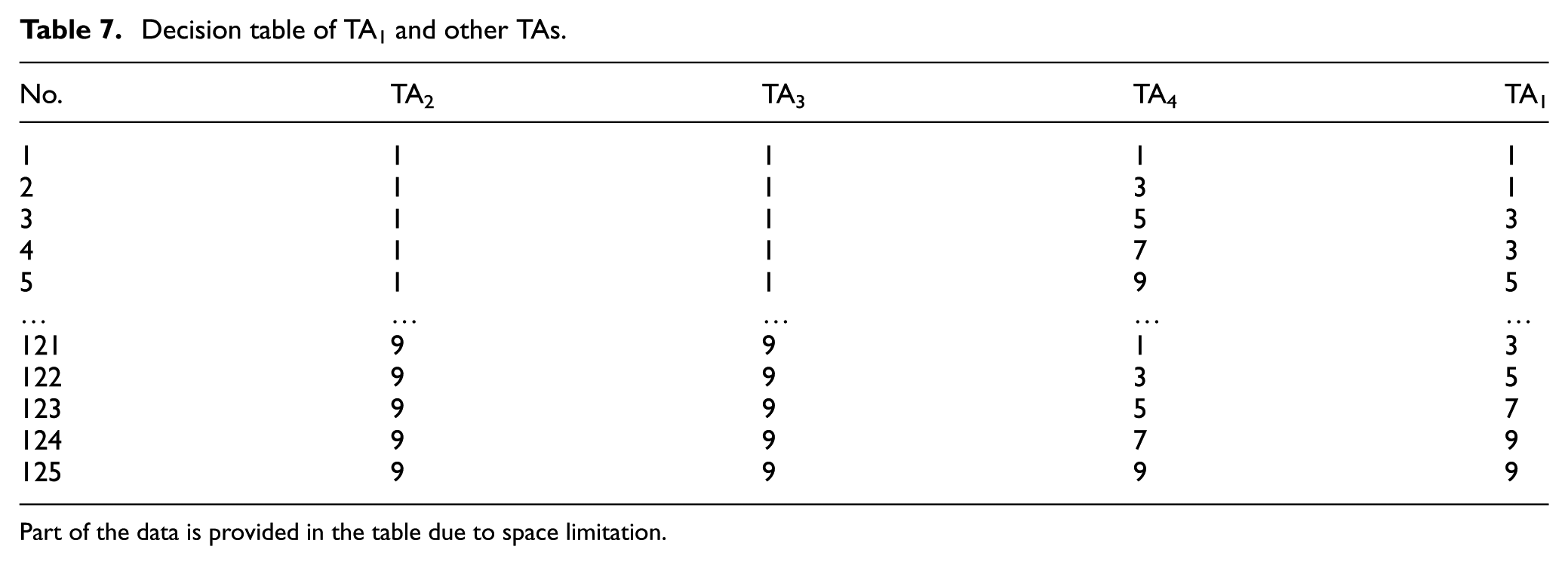
Part of the data is provided in the table due to space limitation.
Decision table of TA2 and other TAs.
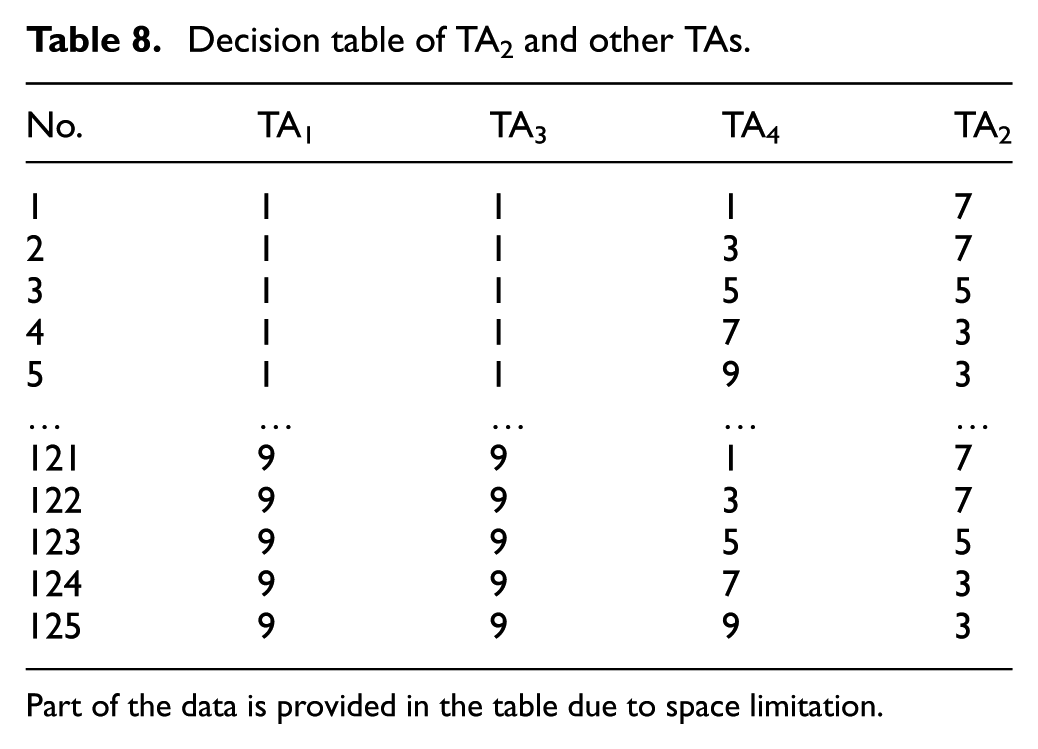
Part of the data is provided in the table due to space limitation.
Decision table of TA3 and other TAs.
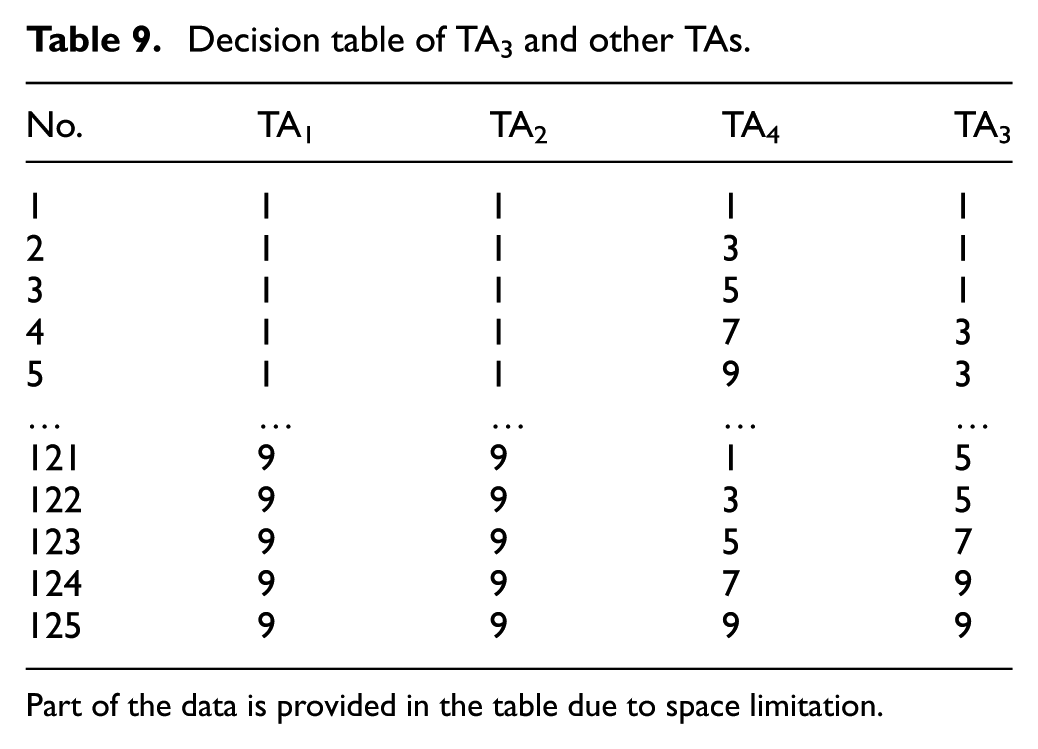
Part of the data is provided in the table due to space limitation.
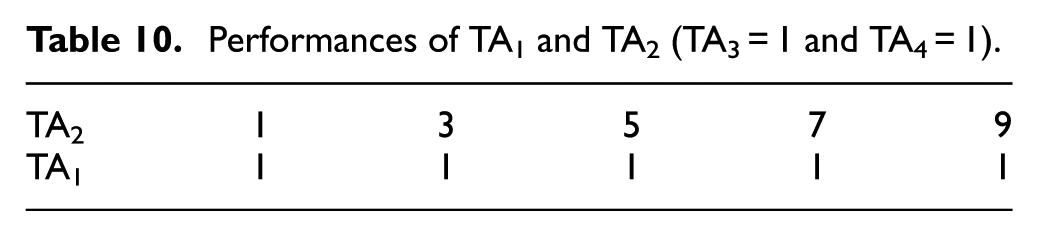
Step 2: retrieve the performances of two TAs under the same condition. TA1 and TA2 in Table 7 are taken as an example. When TA3 = 1 and TA4 = 1, the performances of TA1 and TA2 are revealed in Table 10. Similarly, the performances of TA1 and TA2 are retrieved under other conditions, such as TA3 = 1 and TA4 = 3, TA3 = 1 and TA4 = 5, and so on.
Step 3: calculate the slope. According to Table 8 and equation (42), the slope is calculated, and k = 0. Similarly, other slopes are calculated, as shown in Table 11. The average slope is also calculated using formula (43), as shown in Table 11.
Step 4: identify the TC. When k31 > 0, k41 > 0, and k43 > 0, TA1 and TA3, TA4, and TA3 and TA4 are positive correlations. When k21 = 0 and k32 = 0, TA1, TA2, and TA3 are neutral correlations. When k42 < 0, TA2 and TA4 are a negative correlation. So, the TC between TA2 and TA4 is identified.
Step 5: translate the TC into the improved and damaged parameters. Generally, a type of material has only one color. When customers require multicolor, designers change the color of the material without changing mechanical property. In this situation, a new color is added, and more time is consumed. So, parameter 26 “amount of substance” is an improved parameter, and parameter 25 “waste of time” is a damaged parameter.
Step 6: solve the TC with the optimal inventive principle. In the contradiction matrix, the crossing between parameters 26 and 25 contains four inventive principles in the following order: 35, 36, 18, and 16. Principle 35 “transformation of the physical and chemical states of an object” is chosen, and designers paint the material to change the color.
Performances of TA1 and TA2 (TA3 = 1 and TA4 = 1).
Values of slopes.
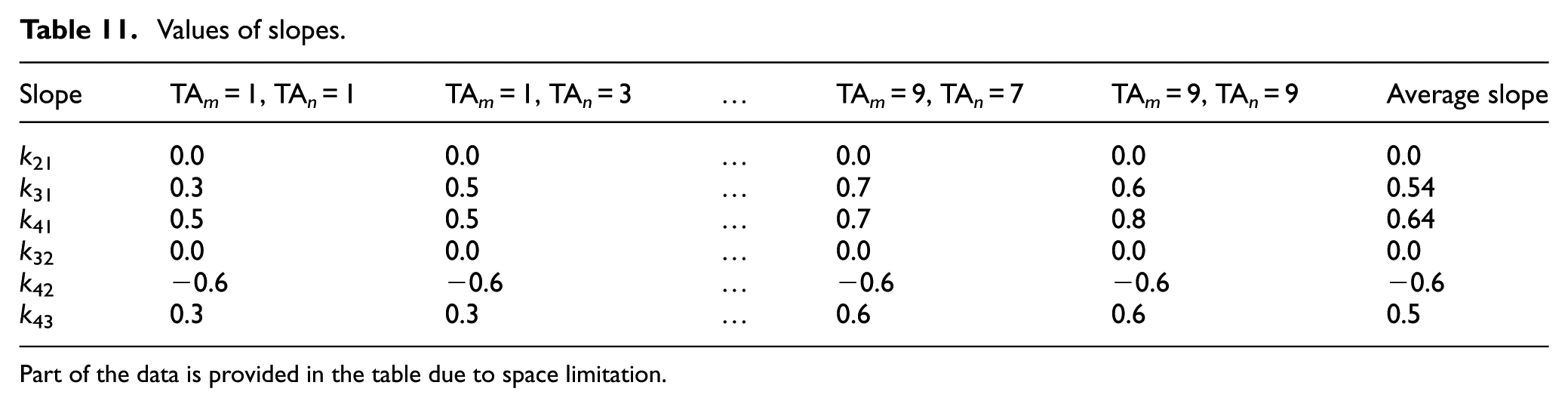
Part of the data is provided in the table due to space limitation.
Comparisons and discussion
To reveal the effectiveness of the proposed method, both the traditional TOPSIS and QFD (using crisp number) are applied in this section.
Proposed TOPSIS and traditional TOPSIS
The traditional TOPSIS is described in section “TOPSIS” and used as follows:
Step 1: determine the FPIS and FNIS. In the traditional TOPSIS, the FPIS and FNIS are determined using formulas (29) and (30). For the benefit criterion


For the cost criterion


So, A+ = ([0.2880, 0.5520], [0.3600, 0.6400], [0.1904, 0.4224]) and A− = ([0.1440, 0.3360], [0.1200, 0.3200], [0.1456, 0.3456]).
Step 2: calculate the distances of each STFN versus the FPIS and FNIS. According to (7)–(8), the distances between each STFN and the FPIS, and the distances between each STFN and the FNIS are


The results are shown in Table 12.

Step 3: calculate the CC. The CC is calculated using formula (37), as shown in Table 12. The ranking order of TAs is
Obviously, the ranking order of TAs is not reasonable in the traditional TOPSIS (see Table 12). The proposed TOPSIS and conventional TOPSIS are compared and discussed, and the advantages of the proposed TOPSIS are summarized.
The FPIS, FNIS, and distance measurement of the proposed TOPSIS are more accurate than that of the traditional TOPSIS. The FPIS and FNIS provided by the proposed TOPSIS can eliminate
The change in the CC obtained by the proposed TOPSIS is more than that of the traditional TOPSIS. The CC of the proposed TOPSIS is

The CC of the traditional TOPSIS is


Similarly,

In accordance with equations (53) and (54), Cpi is calculated

The first and second derivatives of Cti are calculated using formula (55)

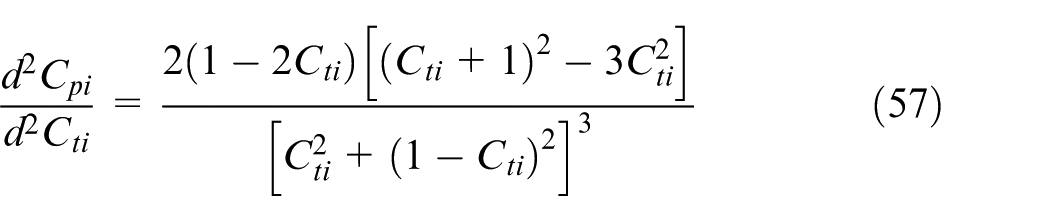
When
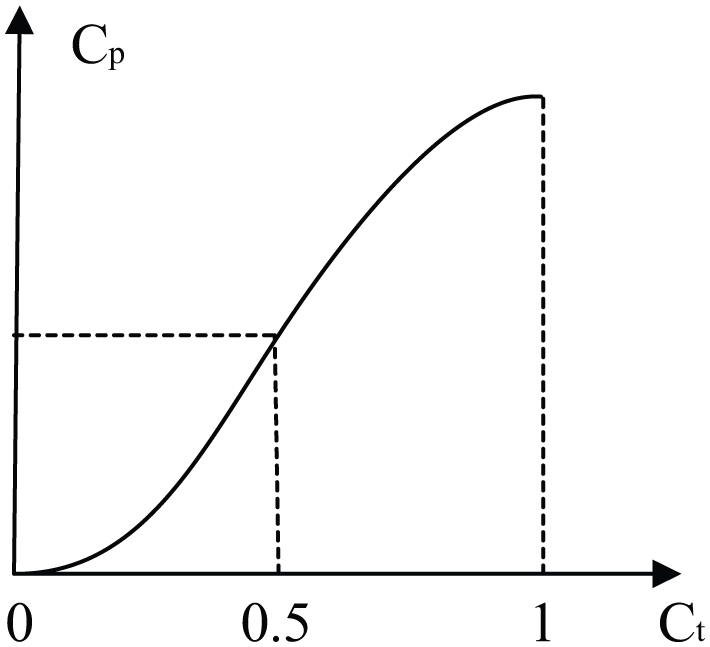
Function of Cp and Ct.
Proposed QFD and traditional QFD
In the traditional QFD, the numbers 0.1, 0.3, 0.5, 0.7, and 0.9 represent very low, low, moderate, high, and very high importance, respectively, or represent very weak, weak, moderate, strong, and very strong relationship, respectively. According to Tables 3 and 4, the weighted normalized CN–TA relationship matrix is determined, as shown in Table 13. The PIS and NIS are calculated using formulas (3)–(6). In accordance with equations (35) and (36), the distances between each STFN and the FPIS and each STFN and the FNIS are determined


Weighted normalized CN–TA relationship matrix (traditional QFD).
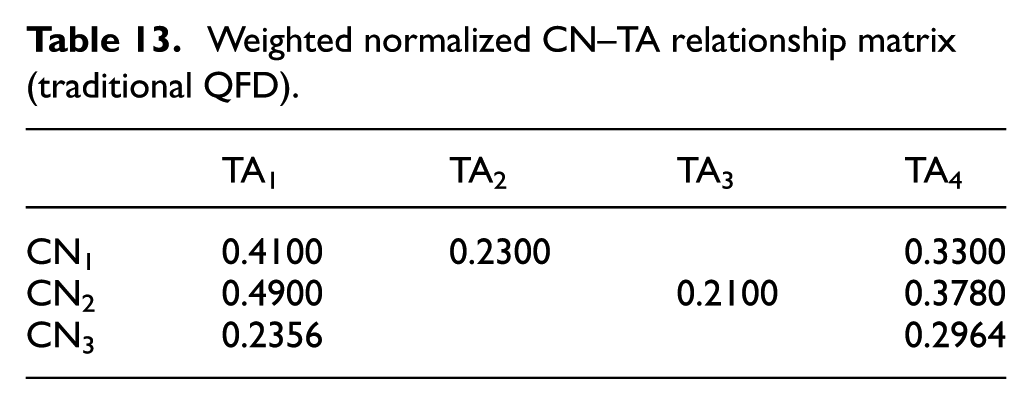
The distances are calculated using formulas (58) and (59), and the CC is also calculated using formula (37), as shown in Table 14. So, the ranking order of TAs is
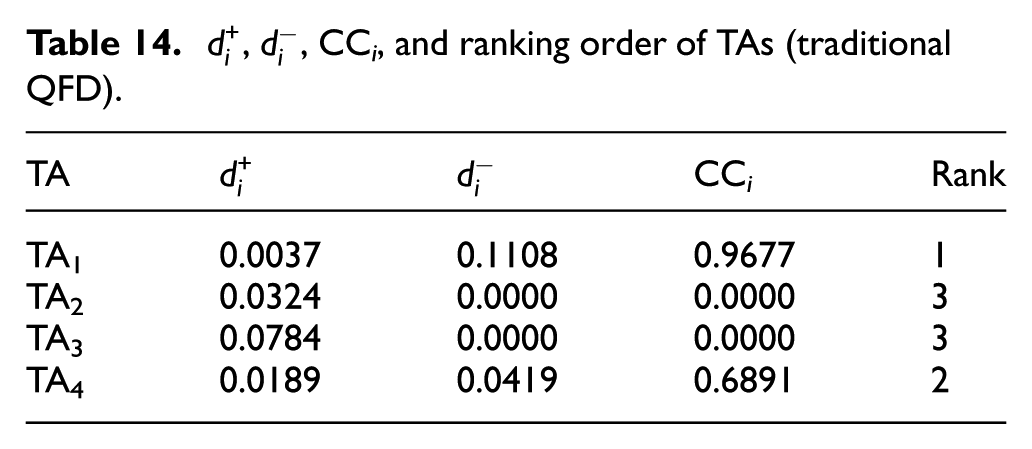
According to Tables 6, 12, and 14, the CCs (CC
i
) of TAs from the proposed QFD, the traditional TOPSIS, and the traditional QFD are shown in Figure 5. The larger the CC, the more important the TA. So, the ranking order of TAs is determined. From Figure 5, the ranking from the proposed QFD is
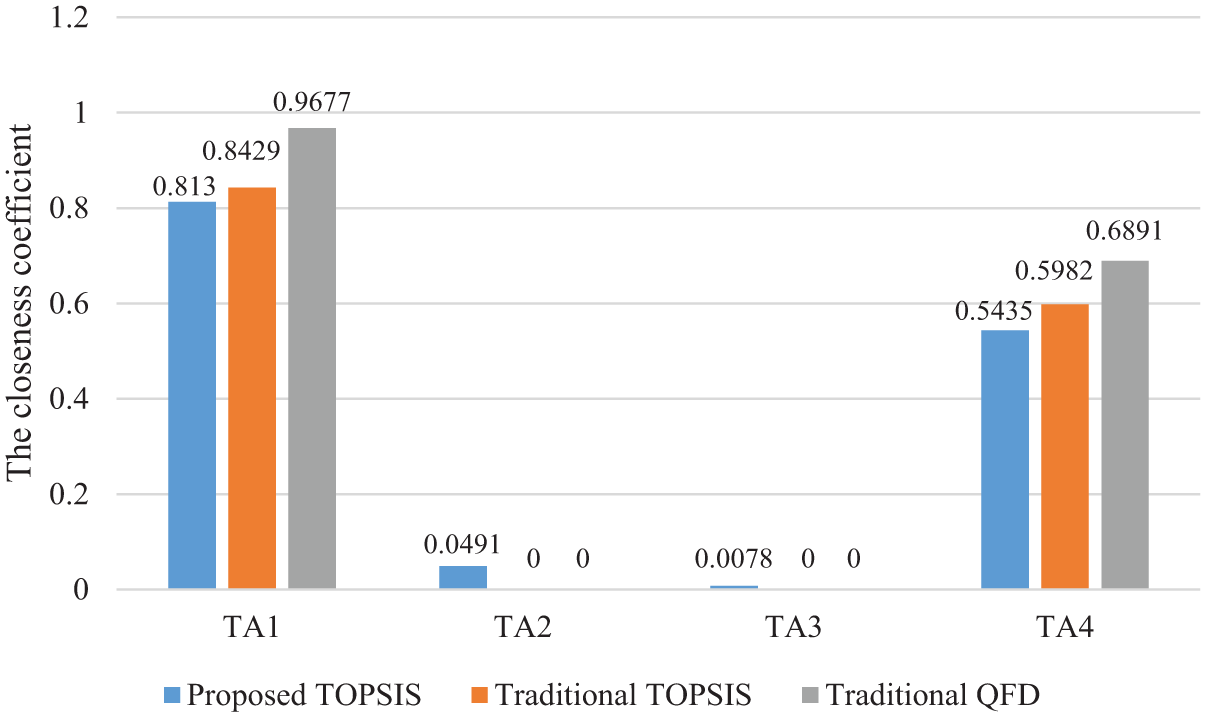
Ranking order of TAs.
Conclusion and suggestions
This article uses STFNs to deal with the vague information, fuzzy TOPSIS to prioritize TAs, the line-fitting method to identify TCs, and the TRIZ to solve TCs. Through integrating the proposed TOPSIS and the TRIZ into fuzzy QFD, the priority of interdependent TAs is determined. The proposed method is an effective decision-making tool for new product development and reveals the following aspects:
In the fuzzy QFD, STFN is adopted to evaluate the CN importance and CN–TA relationships. It is more effective to express the subjective and vague evaluation from customers and experts.
The proposed TOPSIS prioritizes TAs in the nonfull matrix. When the fuzzy decision matrix is not full rank and the alternatives are the FNISs, the traditional TOPSIS cannot rank the alternatives, even if fuzzy numbers of the alternatives are different. The proposed TOPSIS improves the FPIS and FNIS and then avoids the identical ranking. That is, if different fuzzy numbers of the alternatives are the FNIS, the proposed TOPSIS ranks them. Besides, distance measurement of the proposed TOPSIS is modified. It is suitable for calculating all fuzzy numbers.
The line-fitting method is used to identify TCs among TAs. In the decision table, when the performances of other TAs are identical, the performances of two TAs are retrieved. These performances are fitted lines. If the average slope of fitting lines is >0, the two TAs are a negative correlation. So, the TC occurs.
The TRIZ is employed to solve the TC. The TC is translated into the improved and damaged parameters. The contradiction matrix proposes 1–4 inventive principles to solve the TC.
Although the proposed method can provide assistance when developing new products, it has some limitations that need to be studied in future research.
To obtain more detailed information of phone shell, the three key CNs and the four key TAs should be subdivided into more CNs and TAs, respectively. Furthermore, more customers are invited to evaluate the CN importance, and more experts from different companies evaluate the CN–TA relationships.
More information from different companies is collected to verify the decision tables (Tables 7–9). So, a lot of test working will be done.
Footnotes
Acknowledgements
The authors would like to thank the editor and the anonymous reviewers for their helpful comments and suggestions on this article.
Declaration of conflicting interests
The author(s) declared no potential conflicts of interest with respect to the research, authorship, and/or publication of this article.
Funding
The author(s) disclosed receipt of the following financial support for the research, authorship, and/or publication of this article: The work described in this paper was supported by the National Natural Science Foundation of China (Grant No. 71501006). It was also partially supported by the National Natural Science Foundation of China (Grant Nos 71332003, 71632003 and 71420107025) and Shanghai Pujiang Program (Grant No. 16PJ1404500).