



Abstract
This article is aiming at solving an allocation-decision problem of lot-sizing outsourcing orders between core enterprises and multiple cooperative suppliers in service-oriented manufacturing. A one-to-many cooperative stackelberg-game model which is a double-layer framework is proposed in order to obtain an optimal price and delivery time. The upper level dynamic stackelberg sub-game is designed for decision optimization problems of lot-sizing outsourcing orders between an upper level core enterprise and a lower level suppliers’ alliance. The lower level static sub-game is designed for obtaining maximum benefit of the suppliers’ alliance from lot-sizing outsourcing orders. In the game model, the leader is the core enterprise, and the follower is the suppliers’ alliance. Moreover, cost and profit are, respectively, mapping to their revenue functions. A two-level nested solution algorithm using genetic algorithm is proposed to solve the game model. Then, an equilibrium solution of this one-to-many stackelberg-game model is acquired. The analytic hierarchy process method based on contribution degree of each supplier is used for allocating profit reasonably. Finally, an example of lot-sizing outsourcing orders of gear parts validates the feasibility of the game model and its resolving algorithm. The results prove rationality of the proposed game model and correctness of the algorithm.
Keywords
Introduction
Service-oriented manufacturing (SOM), as a new outsourcing-driven cross-enterprise production mode, leads to a new revolution which provides new solutions and expands profit margins for manufacturing industry. 1 The most important features of service-oriented manufacturing system (SOMS), as the external physical manifestation mode of SOM, are just-in-time (JIT) and (nearly) zero inventory. Enterprises try to boost their core competitiveness through integrating decentralized resources, so it is crucial to outsource orders to suppliers in manufacturing service. Thus, the core enterprise faces a problem that how to allocate orders for multiple suppliers in JIT production. Owing to constraints of delivery time, inventory and cost, suppliers have to form an alliance to fight with the core enterprise collectively in order to strive for greater benefits. The alliance’s profit is the result of cooperation among each supplier, which is different from a non-cooperative situation. In the mode of JIT and (nearly) zero inventory, delivery time and inventory cost are key factors to affect problems of outsourcing orders. 2 At the same time, traditional models and algorithms are difficult to solve the allocation decision of lot-sizing outsourcing orders in SOM. In view of the above question, this article put forward a two-level nested one-to-many cooperative stackelberg-game model based on game theory for solving the allocation-decision problem of lot-sizing outsourcing orders in SOMS. The upper level is a dynamic stackelberg sub-game between the upper core enterprise and lower suppliers, and the lower level is a static cooperative stackelberg sub-game among suppliers. In this model, the core enterprise is mapped to a leader, and the suppliers are mapped to followers. The total profit of the suppliers’ alliance needs to be assigned properly when the cooperative game has been accomplished. We choose the analytic hierarchy process (AHP) method for benefit distribution of suppliers’ alliance. In order to allocate profit reasonably, the contribution degree of each supplier is used for measuring respective profit in the cooperative game.
The rest of this article is organized as follows: section “Literature review” reviews some relevant literature briefly. In section “Description of the allocation-decision problem of lot-sizing outsourcing orders in SOMS,” we discuss the allocation-decision problem of lot-sizing outsourcing orders in SOMS. In section “Establishing the one-to-many cooperative stackelberg model of lot-sizing outsourcing orders,” we develop a one-to-many cooperative stackelberg model to reach stackelberg equilibrium. Then, double-layer nested genetic algorithm (GA) is designed for solving this model, and the AHP method is used for allocating profit in section “Double-layer nested GA for solving the one-to-many stackelberg model of lot-sizing outsourcing.” In section “Case simulation and results,” the cooperative game and its algorithm are applied in a case with a gear outsourcing task to demonstrate the validity of the proposed approach. Finally, section “Conclusion” concludes with a summary.
Literature review
This section draws on and contributes to several streams of the literature, each of which we review in the following. In the field of SOM, a lot of qualitative works about concept and development of SOM, integration of manufacturing and services, key issues of SOM and so forth, have been done. In 2007, Sun et al. 3 put forward a new concept of SOM in their article. SOM is a new manufacturing mode which aims to create more benefit in the middle of value chain. SOM emphasizes service and orient to service. They considered that customers involving in the entire process were conducive to win advantages of competition. Gao et al. 4 stated that SOM was a new product pattern and manufacturing paradigm, which combined manufacturing with both producer and consumer services. He et al. 5 discussed the concept and development of SOM in detail and pointed out the key issues that SOM faced. In general, productive services, service production and customer involvement in entire process are the three important aspects of SOM. The development of manufacturing mode has gradually diverted the focus of tangible products manufacture to services. As early as 1966, American economist Greenfield put forward a concept of producer services. Since then, many scholars began to study productive service. In 1988, Vandermerwe and Rada 6 pointed out that many enterprises increasingly offered fuller market packages that included goods, services, support, self-service and knowledge. A lot of manufacturing enterprises obtained a huge benefit from this service-oriented economy and enhanced their competitiveness. Under this background, western scholars such as Chiu et al. 7 proposed the concept of “Service Enhancement” to describe this manufacturing mode. The emergence of many similar and related concepts such as “Product Service System,”8,9“Service Innovation,”10–12“service-oriented architecture”13,14 and “Internet of things” 15 just showed that the integration of manufacturing and service can bring cost advantage and environmental effects. SOM is different from other traditional manufacturing modes. 16
SOM, integrating with producer services and manufacturing industry, has already become the dominant direction of manufacturing development in the developed countries or regions. Most of the companies outsource product parts or manufacturing sector to other manufacturers who have advantages in some certain manufacturing tasks. In the field of outsourcing, many researchers stated that outsourcing was the main strategy to decrease costs, promote value chain and enhance competition of enterprises. 17 Shishank and Dekkers 18 proposed a framework for decision making about outsourcing. McCarthy and Anagnostou 19 discussed the concept of outsourcing and considered that outsourcing can reduce cost and achieve economic improvement. MoosaviRad et al. 20 investigated the effect of international outsourcing on value adding of industries. Leng et al. 21 studied the issue of parts machining outsourcing (PMO) for timely achieving the most beneficial portfolio with the goal of gaining mutual benefit.
In the process of outsourcing, many factors should be considered such as supplier selection and profit allocation. Some related work can be found in the literature below. In the selection of suppliers literature, some works have been conducted on methodologies and evaluation criteria. Various methodologies were utilized on supplier selection and order allocation such as AHP, fuzzy set theory (FST), goal programming (GP), case-based reasoning (CBR) and GA.22–24 Reasonable selection of suppliers can decrease costs and enhance the competitiveness of enterprises. Li and Wan 25 regarded the outsourcing provider selection as a type of fuzzy heterogeneous multi-attribute decision-making (MADM) problem. They developed a new fuzzy linear programming method for solving such MADM problems. Hsu et al. 26 adopted decision-making trial, evaluation laboratory (DEMATEL) and analytical network process (ANP) to select outsourcing providers. FST is often applied in supplier selection and order allocation. Kannan et al. 27 presented an integrated fuzzy multi-criteria decision-making method and a multi-objective programming approach for selecting best green suppliers and then allocating the optimum order quantities among them. Igoulalene et al. 28 developed two new fuzzy hybrid approaches for the strategic supplier selection problem. Mafakheri et al. 29 proposed a two-stage multi-criteria dynamic programming approach for supplier selection and order allocation problem. AHP was employed to address the multi-criteria decision in supplier ranking. Different evaluation criteria to select proper suppliers29–31 are also provided by researchers, such as costs, production, delivery time and inventory. In the above literature, the research on supplier selection and order allocation are often treated as the same problems. In fact, allocating orders usually takes place after selecting suppliers. Profit allocation, which plays a decisive role for sustainable and stable development of the relationship among suppliers, is an important and conflicting issue. In the profit allocation literature, Leng et al. 32 used a generalized Nash bargaining scheme to allocate total profit surplus between two retailers. Chen and Yin 33 studied the possible equivalence of Shapley values and other allocations in specific games.
Last but not least, there is also growing research interest in game theory for deal with outsourcing problems in SOMS. Game theory is a method to find the benefit equilibrium when decision makers’ behavior interacts with each other. On these bases, game theory provides completely theoretical foundation for corporations’ decision problems in SOMS. In the application of game theory, one of the branches is the non-cooperative situation, in which all of the followers act selfishly and are solely driven by their own objectives. 34 The other one is the cooperative situation, in which the followers are willing to negotiate with each other and arrive at a unanimous agreement. 35 In the field of game theory, the research works are primarily concentrating on cooperative game models and algorithms under different backgrounds. Yue and You 36 proposed a bilevel mixed-integer nonlinear programming (MINLP) model for non-cooperative supply chains. Because of the relationship of competition or cooperation between sellers and buyers, Esmaeili et al. 37 proposed several seller–buyer supply chain models of non-cooperative and cooperative games, respectively. In Zhang and Liu’s 38 article, game theory was applied to study four models, namely, cooperative decision making, three-level leader–follower game, stackelberg game I and stackelberg game II. The cooperative game is a natural choice because the profit gained by the suppliers’ alliance is greater than a supplier who competes with others (as mentioned in the Zhang and Liu 38 ). A general characteristic of cooperative game is that players can obtain larger global benefit from pooling their resources than by acting separately. 39 Perea et al. 40 studied a cooperative transportation problem by methods of game theory and graph theory. Geunes and Pardalos 41 modeled the relationship among retailers and supplier as a single-period cooperative game and used Shapley value to allocate profit. All these above literature discussed different applications of game theory, especially the cooperative situation.
Summarizing the brief review above, much literature proposes a lot of related methods and models for supplier selection and order allocation, but they are no longer appropriate for the lot-sizing outsourcing orders especially in SOM. In aspect of SOMS or SOM, these articles are mainly focused on strategies and conceptual frameworks of SOM. It is difficult to achieve full recognition of SOMS effectively. Although the cooperative game theory is applied in many problems such as supply chain partners, previous studies lack a concrete and feasible game model in SOMS. In order to realize JIT production and (nearly) zero inventory in SOMS, this article studies the corresponding model and algorithm to solve the decision-making problem of lot-sizing outsourcing orders.
Description of the allocation-decision problem of lot-sizing outsourcing orders in SOMS
As previously mentioned, the outsourcing process can be viewed as a decision-making problem of orders. The outsourcing process is described below: an outsourcing task of products or parts is assigned to multiple suppliers by an enterprise, which is called the core enterprise. The core enterprise will set some rules for suppliers in order to ensure delivery time and reduce cost. Then, the suppliers also build an alliance against the core enterprise for maximizing revenue as much as possible within these rules. As a consequence, the core enterprise and alliance make decision together until achieving benefit equilibrium of both sides on the premise of delivery time. The allocation is divided into two levels. The upper level is the allocation decision for minimizing the core enterprise’s total cost and maximizing the revenue of the suppliers’ alliance; the lower level is the allocation decision of order ratio of suppliers for achieving the maximal interest of the alliance. We consider the following assumptions in this problem:
Multiple suppliers bid for a kind of part;
Each supplier pursues the maximization of the overall interest of the suppliers’ alliance instead of their own interest. Also, the cooperative suppliers have equal status;
Supplier’s inventory cost caused by earliness or tardiness is considered under the circumstance of JIT production and (nearly) zero inventory;
Inventory is managed by the third party. The inventory cost of raw materials is shared by the core enterprise and suppliers, while other fees are paid, respectively.
Besides, in order to formulate the outsourcing problem and interpret corresponding results efficiently, detailed notations are presented in Appendix 1.
Establishing the one-to-many cooperative stackelberg model of lot-sizing outsourcing orders
In the stackelberg-game model, there are one leader and multiple followers. These followers build an alliance and respond as a whole to the leader at the same time. As the leader, the core enterprise, who knows about the action of each follower, will make a strategic decision to minimize its own cost. As the followers, the suppliers’ alliance takes the leader’s current optimal decision subsequently as input parameters and maximizes their common interest. 42
Considering the above-described problem and notation defined in Appendix 1, we suppose the one-to-many cooperative stackelberg model is a triple as follows

where
El represents the leader (the core enterprise) and
Sl represents a strategy set of El;
Ul represents a revenue function of El; Uf represents a revenue function of suppliers’ alliance. They represent production cost of the core enterprise and common profit of suppliers’ alliance, respectively.
We calculate the cost function Ul of the core enterprise and total revenue function Uf of the suppliers’ alliance in the following.
Revenue function Ul
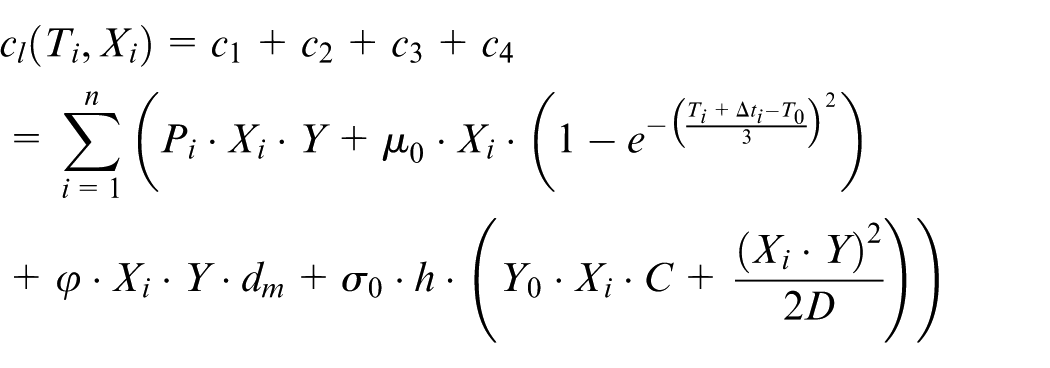
The revenue function is actually the total cost that the core enterprise spends in the entire product outsourcing process. The revenue function of the core enterprise can be described in equation (2)

where the total cost cl contains purchasing cost c1, loss cost c2, transportation cost c3 and third-party inventory cost c4. So, it can be expressed as follows

We calculate these different costs as follows:
Purchasing cost

Loss cost
Weibull’s distribution function is applied to describe the delivery time cost function of the core enterprise. Therefore, the loss cost of core enterprise is given below

Transportation cost

Third-party inventory cost
We also describe it using Weibull’s distribution. It will be shared collectively by the core enterprise and suppliers. The third-party inventory cost of lot-sizing outsourcing orders is calculated as

Therefore, we can obtain the total cost through plugging these cost functions into equations (2) and (3). Then, the revenue function is expressed as
Revenue function Uf
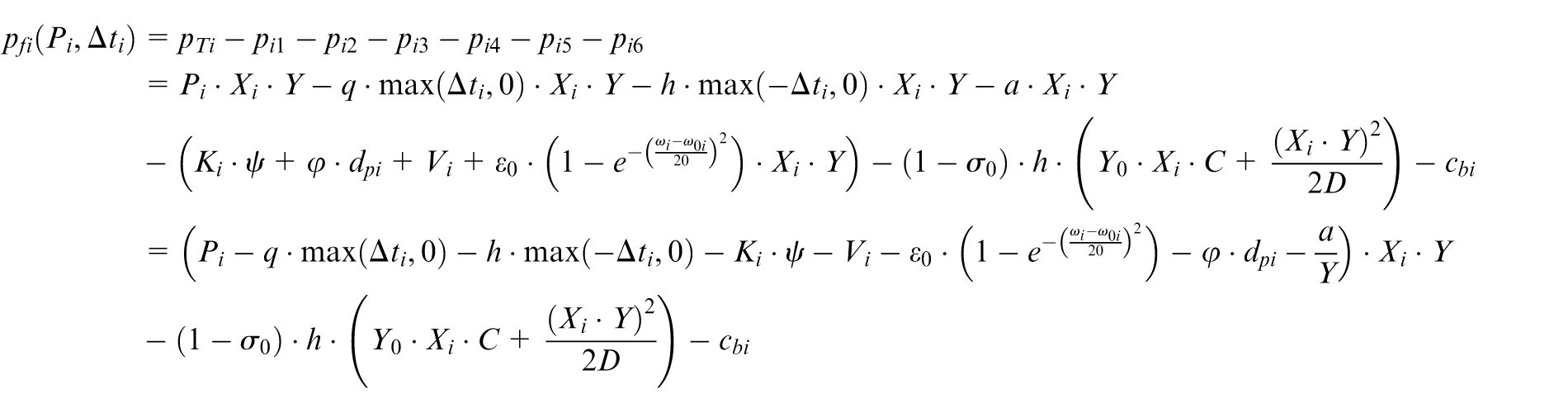
The revenue function of the suppliers’ alliance can be described in equation (4)

where

We calculate these costs as follows:
Total trading revenue

Tardiness penalties cost

Inventory cost caused by completion in advance

Disposable tardiness penalties

Production cost includes raw material purchase, transportation, processing and work in progress (WIP) inventory, which can be calculated as

Third-party inventory

Bid cost

Therefore, we can obtain revenue function of the suppliers’ alliance through plugging these cost functions into equations (4) and (5). Then, the revenue function is expressed as
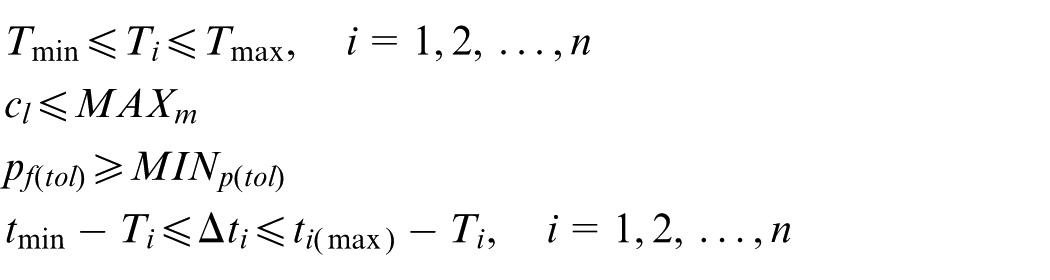
At the same time, equations (2)–(5) should satisfy the following constraints
The framework of the double-layer stackelberg-game model is illustrated in Figure 1. Apparently, the model includes two parts: an upper level dynamic stackelberg sub-game and a lower level static stackelberg sub-game. Supposing there are a set of arbitrary strategy vector s = (sl,
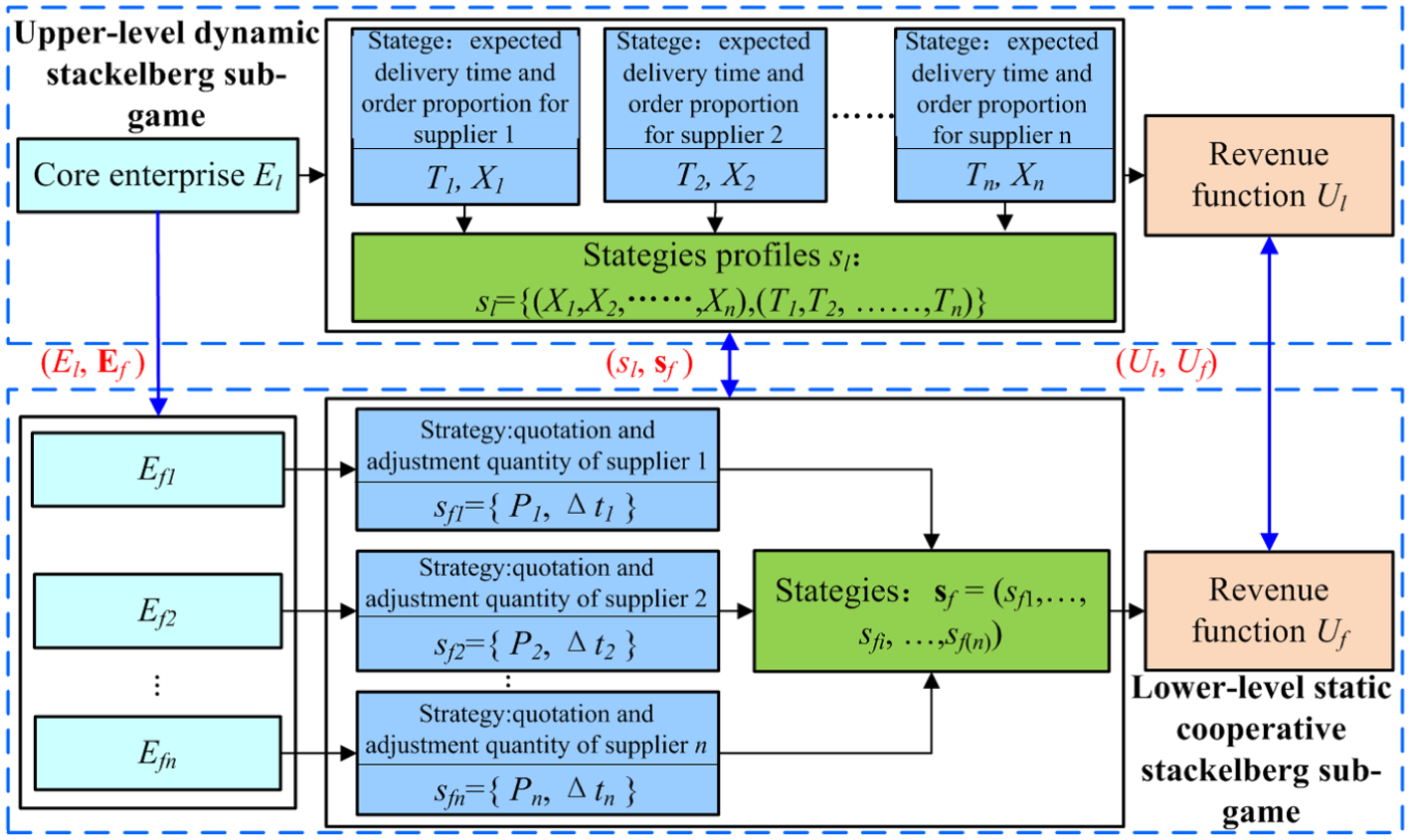
Framework of the one-to-many stackelberg-game model of lot-sizing outsourcing orders.
As can be seen from Figure 1, the upper level core enterprise El will make a decision
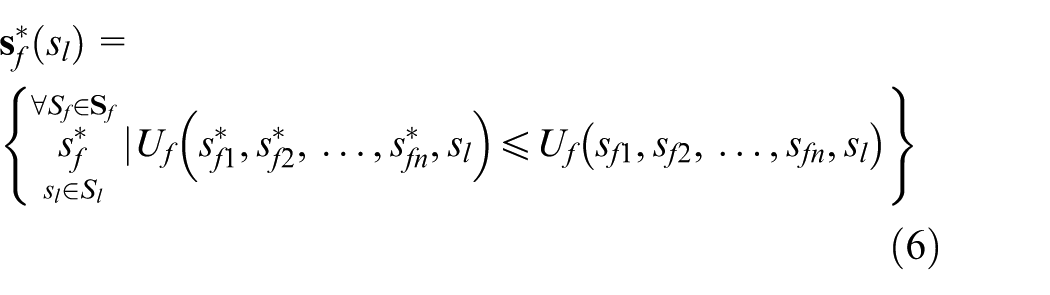

If and only if equations (8) and (9) are satisfied, a stackelberg equilibrium point of the one-to-many stackelberg game will be found. The strategy vector


The delivery time, quotation and order proportion of different suppliers will be decided based on the above game model.
Double-layer nested GA for solving the one-to-many stackelberg model of lot-sizing outsourcing
The allocation-decision problem of lot-sizing outsourcing orders is described as two levels. In the upper level dynamic stackelberg sub-game, we need to consider expected delivery time and order proportion. Similarly, in the lower level static cooperative stackelberg sub-game, we also need to consider quotation and adjustment quantity of the delivery time. It is clear that two levels should be given priority in this one-to-many cooperative stackelberg model. Meanwhile, bilevel GA is more accurate and efficient than monolayer GA. Therefore, a double-layer nested GA is designed to deal with the problems of respective layers in the stackelberg-game model.
In the upper layer GA, the core enterprise will first make a decision, that is, a strategy, according to their own requirements of actual production plan. At this time, the strategy will be encoded as the input of the lower level GA. Then, the lower suppliers’ alliance will also make reaction to the strategy. An optimal decision will be generated by a sequence of operations of the lower level GA and return to the upper level. The upper level GA will reconsider its strategy and enter into another circulation. In this way, we will obtain the optimal solution under given conditions and parameters. The detailed algorithmic design is described below.
Procedure design
For acquiring the equilibrium solution, a procedure of the double-layer nested algorithm based on GA is shown in Figure 2.
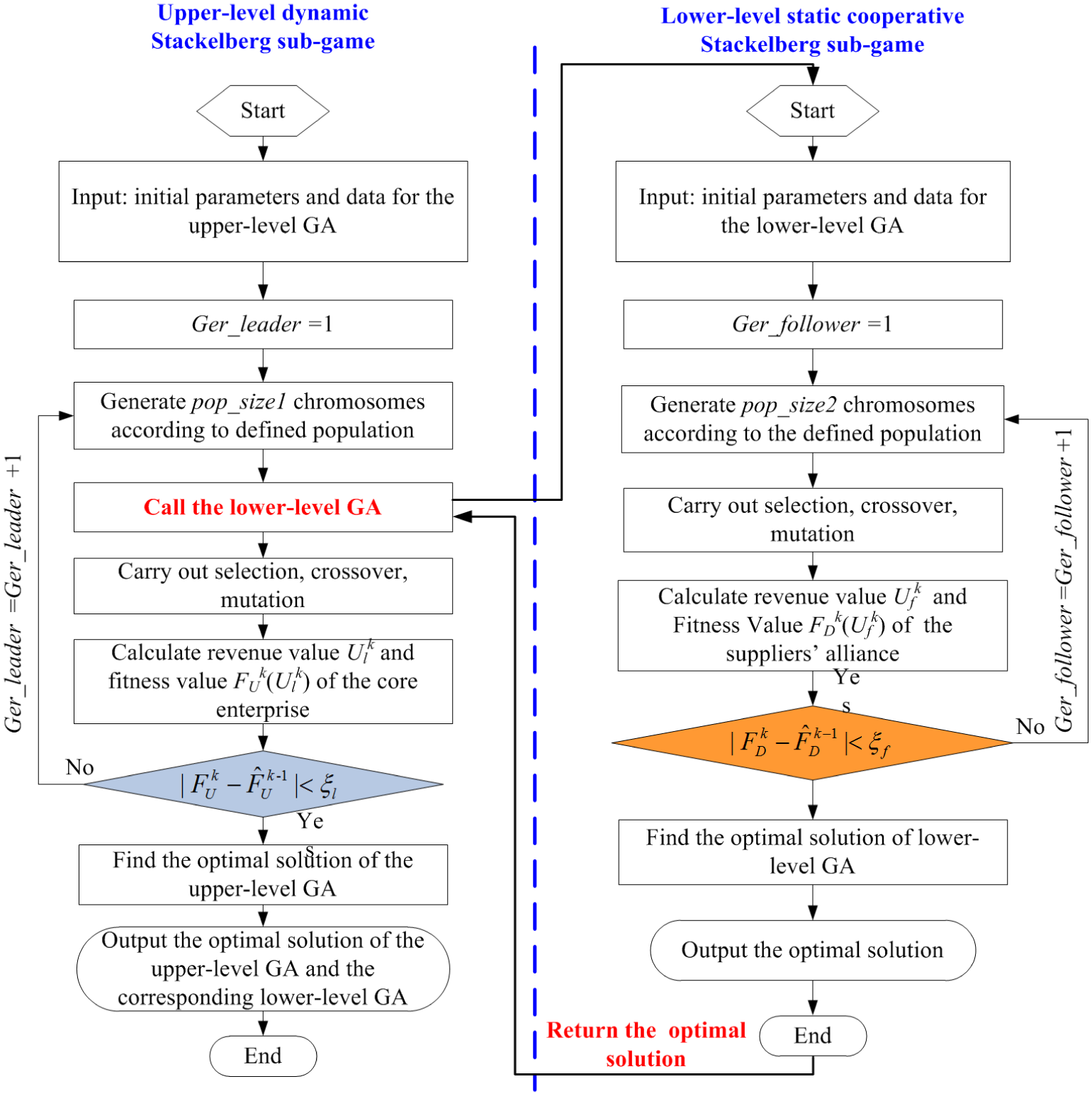
Procedure of the double-layer nested GA for the game.
The upper level sub-game algorithm flow and the nested lower level cooperative sub-game algorithm flow are as follows:
Upper level sub-game algorithm flow: Step 1: Start; Step 2: Initialize parameters of the upper level GA, including population size pop_size1, crossover probability Pcc, mutation probability Pmc and evolution algebra Ger_leader; Step 3: Ger_leader = 1; Step 4: Randomly generate feasible pop_size1 chromosomes x(i), where i = 1, 2, …, pop_size1; Step 5: Call the lower level GA; Step 6: Carry out operations of selection, crossover and mutation for the new generation; Step 7: Calculate the core enterprise’s revenue value Step 8: Judge whether the difference between the kth and (k − 1)th generation of the core enterprise is less than the threshold Step 9: Find the optimal solution of the upper level GA; Step 10: End.
Lower level nested cooperative sub-game algorithm flow: Step 5-1: Start; Step 5-2: Initialize parameters of the lower level GA, including population size pop_size2, crossover probability Pcs, mutation probability Pms and evolution algebra Ger_follower; Step 5-3: Ger_follower = 1; Step 5-4: Randomly generate feasible pop_size2 chromosomes y(i), where i = 1,2, …, pop_size2; Step 5-5: Carry out the operations of selection, crossover and mutation on the new generation; Step 5-6: Calculate the revenue value Step 5-7: Judge whether the difference between the kth and (k − 1)th generation of the suppliers’ alliance is less than the threshold Step 5-8: Find the optimal solution of lower level GA; Step 5-9: Output the optimal solution; Step 5-10: End. Then, go to step 5 and return the lower level optimal solution.
Chromosome design
According to the characteristics of the presented game, we adopt real coding for the upper and lower chromosomes. In the upper level encoding scheme, a chromosome is divided into two parts. The front section is the supplier’s expected delivery time and the back section is the order allocation proportion. In a similar way, in the lower level encoding scheme, the front section is the quotation, and the back section is the adjustment of the delivery time of n suppliers.
Fitness function design
Fitness function of the upper level GA
In upper level sub-game, the objective is to minimize the total cost of the core enterprise. Therefore, the fitness function is shown as follows

where
Fitness function of the lower level GA
In the lower level sub-game, the objective is to maximize the revenue of the suppliers’ alliance. Therefore, the fitness function is shown as follows

where
If the following constraints are satisfied, the stackelberg equilibrium solution which has significance in engineering can be obtained

where
Genetic operations
We operate selection by the proportional method in the game model. For recombining individuals, a two-point crossover scheme is carried out in the two-level GA because of the forms of chromosomes. Similarly, the mutation operation is conducted in the front and back sections because the selected position which is only at certain part is meaningful in each individual. The genetic operation can be referenced in Zhou et al.’s43,44 articles in detail.
Profit allocation of suppliers based on AHP
Actually, there are two situations in the lower level sub-game, that is, the cooperative game and the non-cooperative game among suppliers. When they compete with each other, they will try to guarantee the maximal profit themselves. In a cooperative game, the target of suppliers changes from maximizing their own interest to maximizing the whole alliance’s interest. Proper allocation of the whole profit helps to achieve a higher profit for the suppliers’ alliance.
To allocate the total revenue among the suppliers in the cooperative situation, we adopt AHP documented both in the literature and in practice. AHP has been widely applied for preference analysis in complex and multi-attribute problems. Generally, AHP describes the allocation issue by decomposing it into three-level hierarchical structures, which are targets, criteria and schematics.
AHP is perceived as suitable for this problem, and several reasons are as follows:
The importance of criteria such as delivery time is considered to be different for every supplier in a specific outsourcing task. AHP allows us to set priority weights among different allocation criteria.
Every supplier’s gain is related to the total revenue of the suppliers’ alliance. The supplier who has a greater contribution to the entire alliance should obtain greater gain. Therefore, AHP can be used for calculating the weight of every suppliers’ contribution.
Contribution considering order proportion, delivery time and quotation is qualitative description, which may be difficult to be measured uniformly in profit allocation.
In summary, AHP is considered appropriate in this article. Figure 3 gives the hierarchical structure of profit allocation. At the top of the structure, the objective is contribution degree of suppliers. At the criterion layer, the influencing factors, as described in the one-to-many stackelberg-game model, include order proportion, delivery time and quotation. At the last layer, suppliers form the schematic layer. Finally, each supplier’s contribution can be obtained according to the three parameter values, which have been calculated by the double-layer nested GA. That is to say, the value of contribution also represents the allocation proportion of profit.
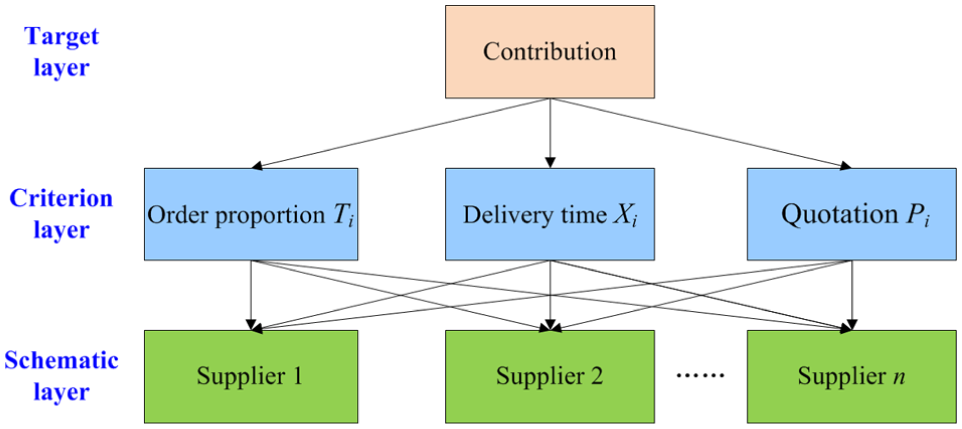
Profit allocation of suppliers based on AHP.
Case simulation and results
A gear outsourcing case between the enterprise Ningxia Dahe Machine Tool Co., Ltd and its suppliers’ alliance formed by Xi’an Fast Gear Co., Ltd; Shaanxi Rui De Sen Transmission Equipment Co., Ltd; and Xi’an Dahua Mining Machinery Factory has been chosen to illustrate how the model works.
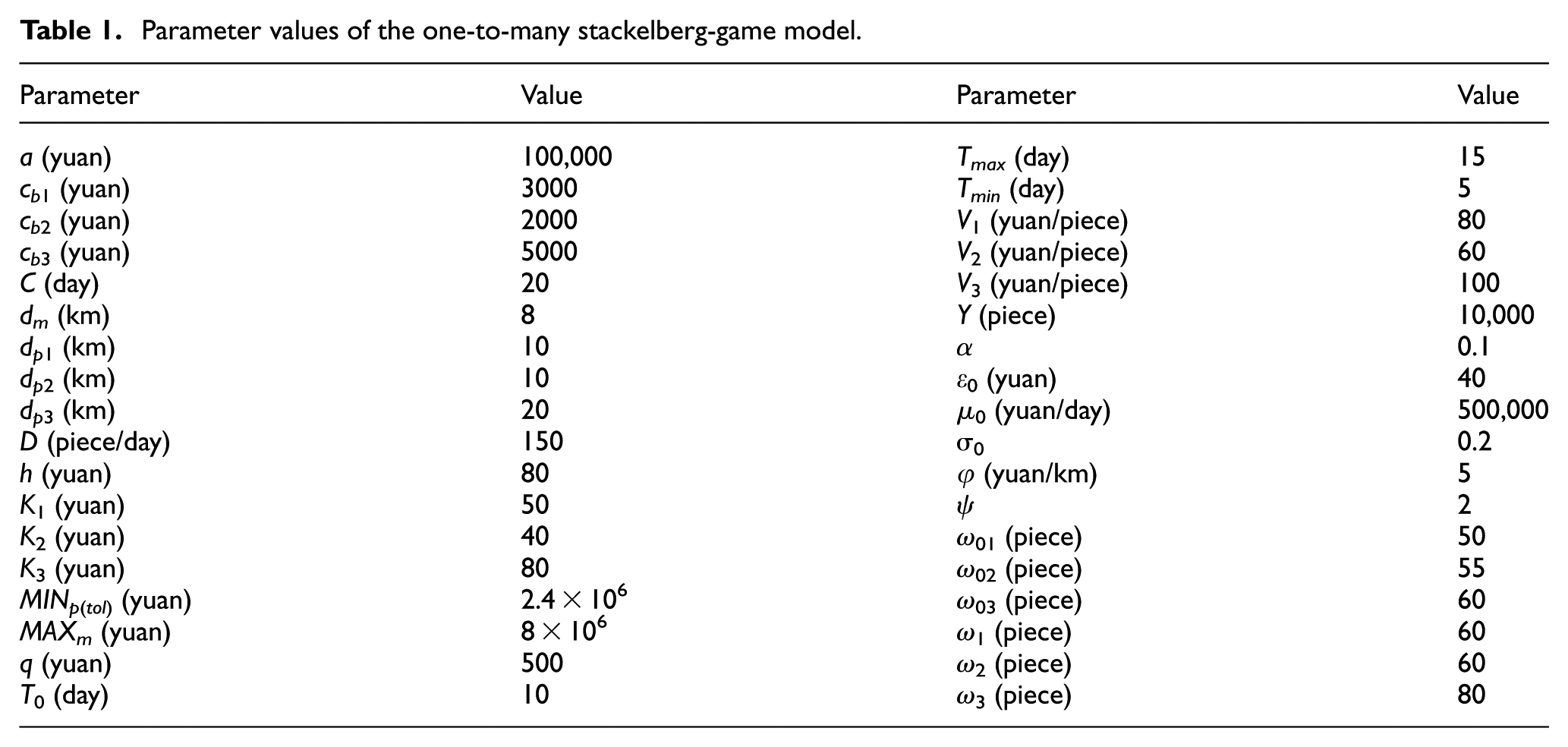
Supposing the acceptable range of delivery time of Ningxia Dahe Machine Tool Co., Ltd is 5–15 days and the three gear suppliers are 6–8, 9–11 and 11–13 days, respectively. Both the core enterprise and suppliers have to input their outsourcing parameters such as cost, delivery time and coefficients to form their strategies, constraints and goals for the game simulation, which are given in Table 1. Associated parameter values of the double-layer nested GA are given in Table 2.
Parameter values of the one-to-many stackelberg-game model.
Parameter values of the double-layer nested GA.
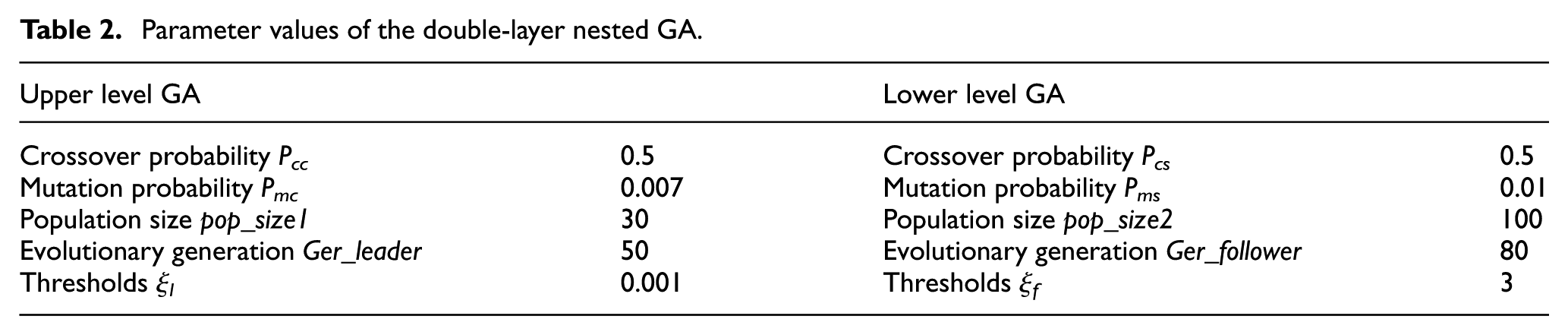
The solution procedure is coded with MATLAB 7.0, which is installed on a computer with Intel(R) Core(TM) i3-2120 CPU 3.3 GHz and 4-GB RAM. Finally, the implementer starts the game simulation algorithm. The best evolution process of the core enterprise and suppliers’ alliance is illustrated in Figures 4 and 5, respectively. To make sure the algorithm is efficient enough, we perform the game simulation 10 times. It takes an average of 33rd and 42nd iterations to find the equilibrium solution.
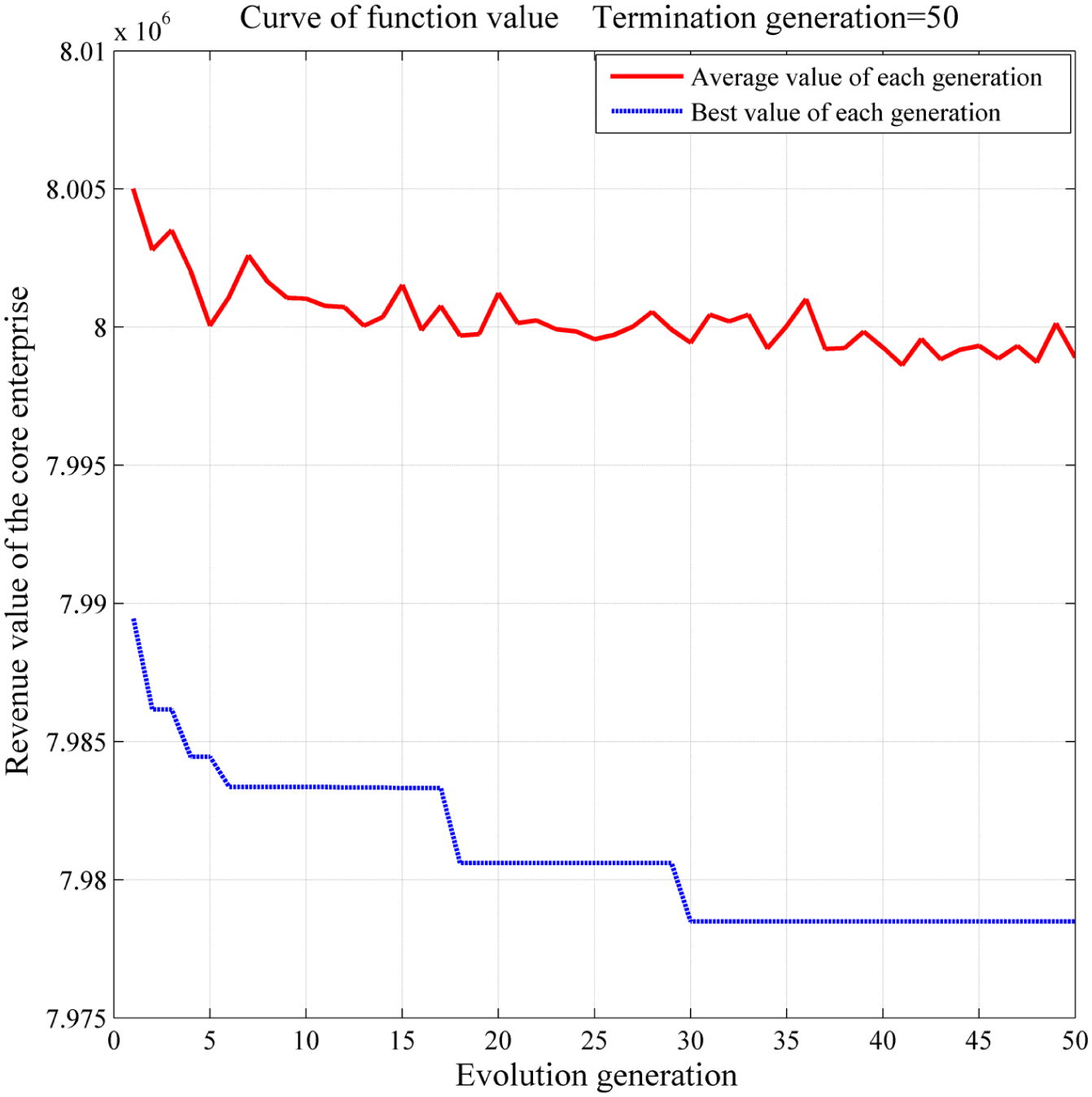
Evolution process of the revenue function of the core enterprise.
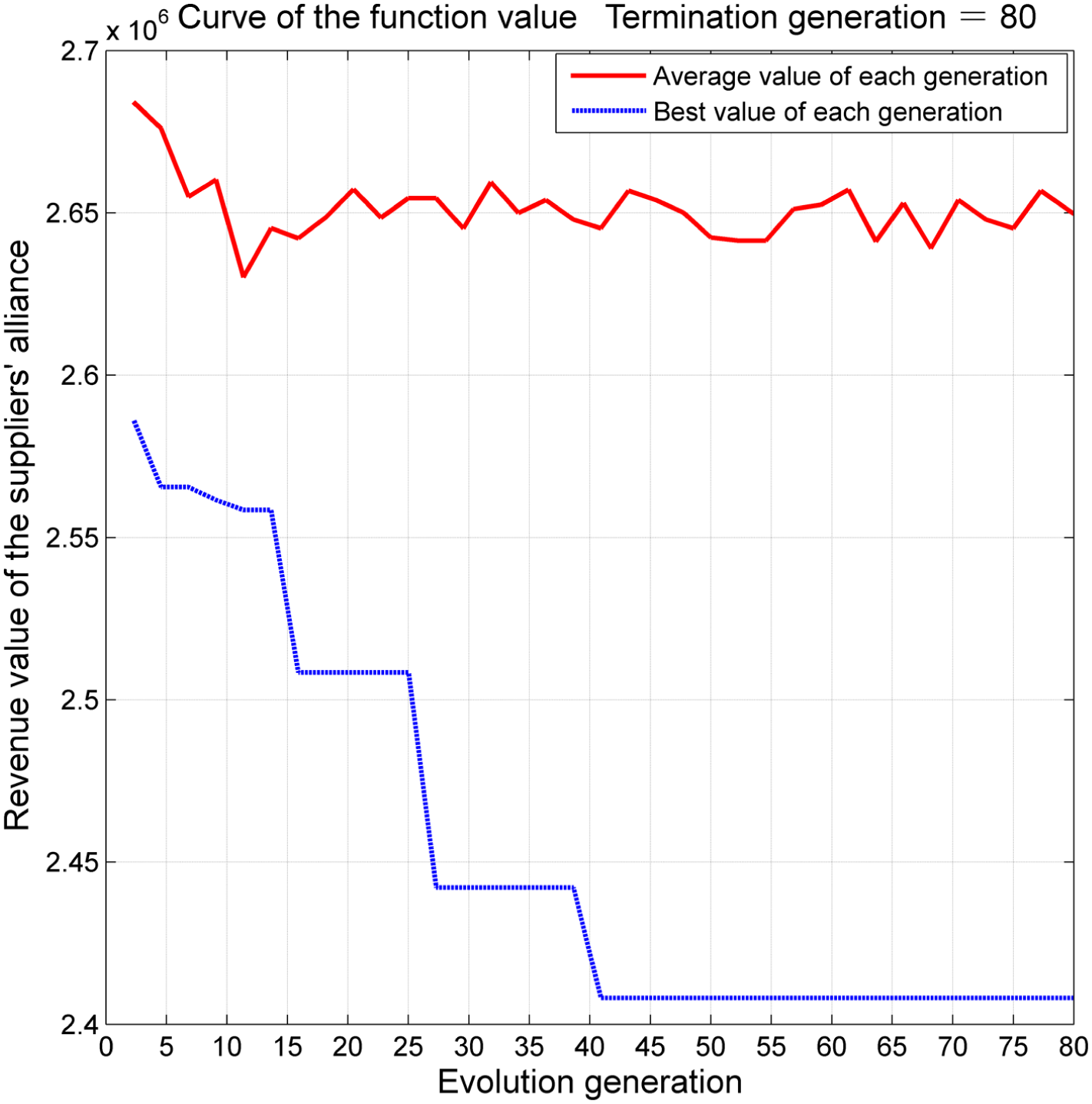
Evolution process of the revenue function of the suppliers’ alliance.
In Figure 4, the blue curve shows the best value of the revenue value of the core enterprise. We can see that the equilibrium appears at about 30th generation, and the value is approximately equal to 7.978 × 10⁶. In Figure 5, as same as Figure 4, the equilibrium appears at about 41st generation, and the value is approximately equal to 2.408 × 10⁶.
The detailed results of the case can be obtained from our algorithm routine. They are listed in Table 3.
Results of the double-layer nested GA.

The results show that the expected delivery time Ti given by the core enterprise is 8, 10 and 11 days, and the order proportion Xi is 0.3748, 0.4636 and 0.1607. The minimum production cost cl of the core enterprise is 7,978,487 yuan. The quotations of the three suppliers are 704, 658 and 816 yuan. The adjustment quantity Δti of the three suppliers is zero, which is indicated that they can meet the expected delivery time given by Ningxia Dahe Machine Tool Co., Ltd. The profit value of the suppliers’ alliance is 2,408,110 yuan.
The contribution degree is calculated according to AHP. The values are, respectively, 0.3169, 0.5792 and 0.1039. Then, the total revenue is allocated by the proportion of contribution. In order to compare the results with a non-cooperative situation in the low level, the assumptions and parameter values remain unchanged. Table 4 gives the revenue values of the three suppliers in the cooperative and noncooperative situations.
Revenue comparison between cooperative sub-game with noncooperative sub-game.

Conclusion
Due to the requirement of SOMS on JIT production and (nearly) zero inventories, the core enterprise needs to outsource orders to different suppliers. Quotation and delivery time are the crucial factors to influent cost and revenue. When suppliers form an alliance to achieve a greater profit, a game between the core enterprise and suppliers will happen. This article focuses on the allocation-decision problem of lot-sizing outsourcing orders in SOMS. Owing to the problem’s complexity and intractability, it is modeled as a one-to-many cooperative stackelberg game. Meanwhile, we design a double-layer nested GA to seek the equilibrium solution. A typical gear outsourcing case is taken as an example to illustrate the proposed solution procedure.
The optimal distribution of outsourcing orders given the factors of delivery time, production costs and so on is realized by game theory in this article. The result of the application case has also shown that the game theory provides theoretical support for interactive decision making between the core enterprises and suppliers completely. Comparing with our previous study and this study, we find that the core enterprise and suppliers will restrict each other when suppliers do not cooperate in the lower level. But if the suppliers form an alliance to fight with the core enterprise together, they will gain more benefit than the noncooperative situation, which is verified in the case study as shown in Table 4. Furthermore, this model we constructed has the feasibility and validity for the allocation decision of lot-sizing outsourcing orders, which is more close to the current service-oriented development trend and has a strong role in guiding configuration methods of SOM.
Although the one-to-many cooperative stackelberg model and double-layer nested GA in this study are beneficial to support allocation issues of lot-sizing outsourcing orders in SOM, it has its own limitations:
The developed lot-sizing outsourcing orders model is a theoretical model, and therefore, further analysis such as network analysis is crucial to study mechanism and smart configuration of SOM. The future steps, however, are required to convert the proposed model to a practical tool which can be used by manufacturing enterprises.
Some parameters of GA in the algorithm are set by experience, which results in a limitation of the proposed one-to-many cooperative stackelberg in satisfying a concrete issue and precision of game results. Other optimization methods and algorithms can be introduced to improve the double-layer nested GA.
These problems should be taken into consideration in future research.
Footnotes
Appendix 1
Declaration of Conflicting Interests
The author(s) declared no potential conflicts of interest with respect to the research, authorship and/or publication of this article.
Funding
The author(s) disclosed receipt of the following financial support for the research, authorship, and/or publication of this article: This research was financially supported by the National Natural Science Foundation of China (NSFC) under grant no. 51175414 and no. 71171156; Program for New Century Excellent Talents in University by China Ministry of Education under grant NCET-12-0452.