




Abstract
The resource service transaction in service-oriented manufacturing systems is one of the key issues in deciding its practical implementation and application. In order to enhance the benefit of the three sides or users (i.e. resource service provider, resource service demander, and resource service agent or operator (agent)) using service-oriented manufacturing systems, the comprehensive utility models consider the revenue, time, and reliability for the three sides in the resource service-transaction process faced with uncertain factors under decentralized decision-making conditions are established first. Then the related comprehensive utility model for the resource service transaction chain of ‘multiple resource service providers – one agent – multiple resource service demanders’ under a centralized decision-making condition is proposed and discussed. The existence of utility equilibrium between resource service provider and agent is studied and proved. As is the optimal decision of a resource service transaction chain under the decentralized decision-making condition, as well as the utility equilibrium between agent and resource service demander. A utility coordination method is proposed, with the aim of improving the comprehensive utility of the resource service transaction chain under a decentralized decision-making condition. The case study illustrates that the proposed approach is practicable and effective.
Keywords
Introduction
The idea of service-oriented architecture (SOA) has been widely researched and applied in the whole process of production in order to realize the manufacturing resource sharing and cooperation work within an enterprise or among different enterprises. Many service-oriented manufacturing (SOM) modes and technologies have been proposed, such as networked manufacturing (NM),1–2 application service provider (ASP),3–5 manufacturing grid (MGrid),6–11 production-service system (PSS) 12 or industrial production-service system (IPS2), 13 wireless manufacturing (WM), 14 crowd sourcing, cloud manufacturing (CMfg),15–17 and so on. These advanced manufacturing models and technologies have played very important roles for the development of modern manufacturing, and SOM has been one of the key developing trends for the manufacturing industry.
The basic principle for the SOM model is illustrated in Figure 1. There are primarily three classes of users in a SOM system, resource service provider (RSP), resource service demander (RSD) or consumer, 17 and resource service agent (expressed as agent hereafter) or operator.
The RSP owns the manufacturing resources and abilities involved in the whole life-cycle of the manufacturing process. It publishes and registers their idle resource, product, manufacturing ability, etc., to the SOM platform, and provides a manufacturing resource and ability service on-demand. The RSP can be a person, an organization, an enterprise, or a third party.
The RSDs are the subscribers of the resource service and ability available in a SOM system or platform. They search the optimal manufacturing resource service and ability and purchase the use of the service and ability from the operator on an operational-expense basis, according to their needs.
The agent operates the SOM platform to deliver service and functions to providers, consumers and the third parties. They deal with the organization, sale, licensing, consulting of the manufacturing service and ability; and provide, update and maintain the technologies and services involved in the operations to the SOM system or platform. 17
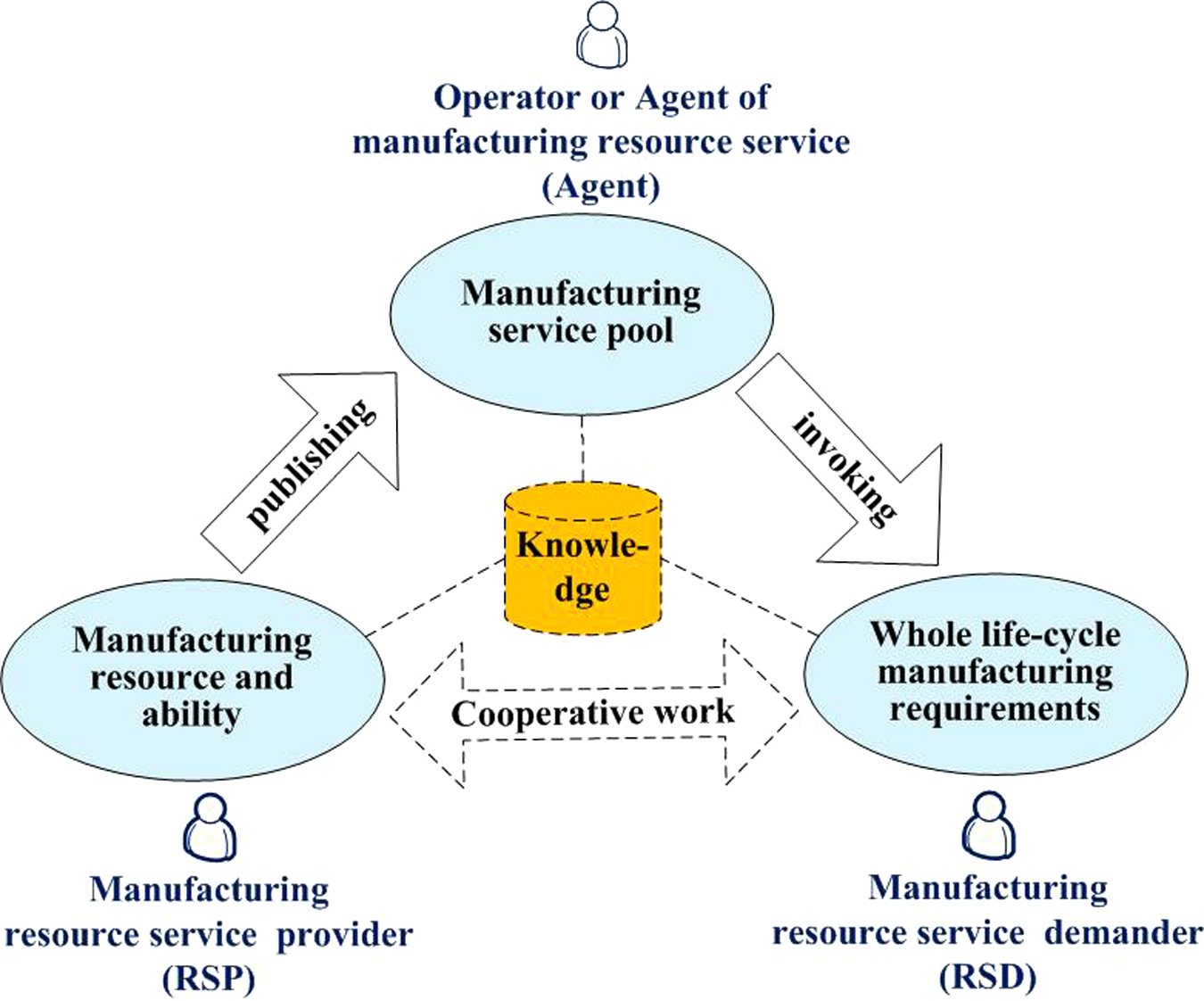
Abstract architecture of SOM.
The SOM system, aims to realize the full sharing and circulation, high utilization, and on-demand use of various manufacturing resources and capabilities by providing safe and reliable, high quality, cheap and on-demand use of manufacturing services for the whole life-cycle of manufacturing. 17 According to the above three classes of users, RSPs publish their services to the agent, and the RSDs invoke the services on-demand from the agent after submitting the service requirements to the agent. The platform of the agent realizes the search and match with registered services of RSPs and the service requirements of RSDs based on this knowledge. Then RSPs and RSDs make the cooperative work through the agent platform. In the resource service transaction flow of SOM, after RSPs publish their available resource and ability services, RSDs submit their service requirements to the agent and search the suitable services of multiple RSPs through the agent platform, then RSPs provide their services to execute the requirements of RSDs under the agent’s scheduling.
Apparently, before a SOM model or system can be fully accepted and used by the three types of users and enterprises, and be successfully and widely applied in the manufacturing industry, the profit and other performance indicators using the SOM system for each side, should be fully considered and guaranteed, especially for the RSP and RSD. However, the existing works and research emphasis for the above proposed SOM model or system (e.g. ASP, NM, and MGrid) are, primarily:
manufacturing resource modelling, virtualization, service encapsulation,20–22 digital description, 23 scheduling, and allocation;24–26
Little work has been emphasized on resource service and ability transaction management, such as:
resource service transaction process monitoring management;33–34
benefit guaranteeing mechanisms and optimal-allocation methods for RSP and RSD;35–36
utility equilibrium among RSD, RSP, and agent,37–38 and so on.
As a result the interest of RSP is not effectively guaranteed, and many RSPs do not want to provide and contribute their idle manufacturing resource and ability to the SOM system or platform, or they have no positive motivation to provide high-quality and reliable resource services. Consequently, without the adequate and available, high-quality and reliable manufacturing services, RSD’s requirements cannot be met and their tasks cannot be well fulfilled via the SOM system. Both RSP and RSD lose their interest and enthusiasm to use the SOM system, and the development and wider practice application of the above mentioned proposed advanced manufacturing modes, are hindered.
Therefore, more attention should be paid to the resource service and ability transaction management in the SOM system. In this article, in order to promote the three types of users’ (i.e. RSP, agent, and RSD) comprehensive utility in the SOM system, so as to enable the SOM system to be accepted and used in practice, and resource service transaction chains (RSTCs) are studied. Three key issues, including utility modelling, utility equilibriums, and utility coordination are emphasized. The main innovative works and contributions of this article are as follows.
The comprehensive utility models considering the revenue, time, and reliability for the three sides, i.e. RSP, RSD, and agent, in the resource service transaction process in a SOM system faced with uncertain factors under decentralized decision-making conditions, are established.
The related comprehensive utility model for the RSTC of ‘multiple RSPs–one agent–multiple RSDs’ under a centralized decision-making condition is investigated and discussed.
The existence of utility equilibriums between RSP and agent, and agent and RSD are proved in the optimal decision of a RSTC under the decentralized decision-making condition.
A utility coordination method is proposed in order to enhance the comprehensive utility for the three type users in the SOM system.
A case study is given out to illustrate the proposed method in this article.
The article is organized as follows. The related works are investigated, and the innovative works of this article are highlighted. The motivation of this article is then defined. The related definitions of resource service utility and the parameters used in this article are presented. The utility modes for RSD, agent, and RSD under decentralized decision-making conditions are then studied, as well as the comprehensive utility mode for the RSTC, i.e. RSD–agent–RSP, in a SOM system. The utility equilibrium between RSP and agent, under decentralized decision-making conditions is investigated, as well as the utility equilibrium between RSD and agent. A utility coordination method is studied with the aim of improving the comprehensive utility of the RSTC under decentralized decision-making conditions. A case study is given before this study is then concluded.
Related works
The immediate quantitative works on the utility of a RSTC in the SOM system are seldom. Some related work can be found in the research field of NM and MGrid. Other related works can be found in the fields of supply chain management (SCM) and the computing grid system.
In the field of the MGrid, a lot of qualitative works about the resource service management system and model, 39 architecture of the cooperation service for transaction chain,40–41 benefit allocation mechanism,42–44 resource service discovery and scheduling mechanism and algorithm, 6 resource service composition, 6 and so forth, have been done, as shown in Table 1. In the field of NM, related works primarily are about the model of multi-agent-based consultation system or model, 45 and operation model for the transaction chain. 46 The operation of a two-level supply chain is investigated from the aspects of revenue and performance evaluation of a resource service transaction in NM.47–48 The concept of utility equilibrium in SOM is expanded from the game theory in economics. Each economic entity makes a decision to get itself maximal utility. The utility equilibrium decision is the optimal decision that makes the utilities of the entities maximal at the same time. If it is not the equilibrium decision, the resource service transaction will be dynamic and unstable so that the entities change their decision to obtain their own maximal utilities. However, how to achieve the utility equilibrium between RSP and RSD while maximizing the utilities for RSP, RSD and the transaction are not fully considered and effectively researched.
Related works in MGrid and NM.
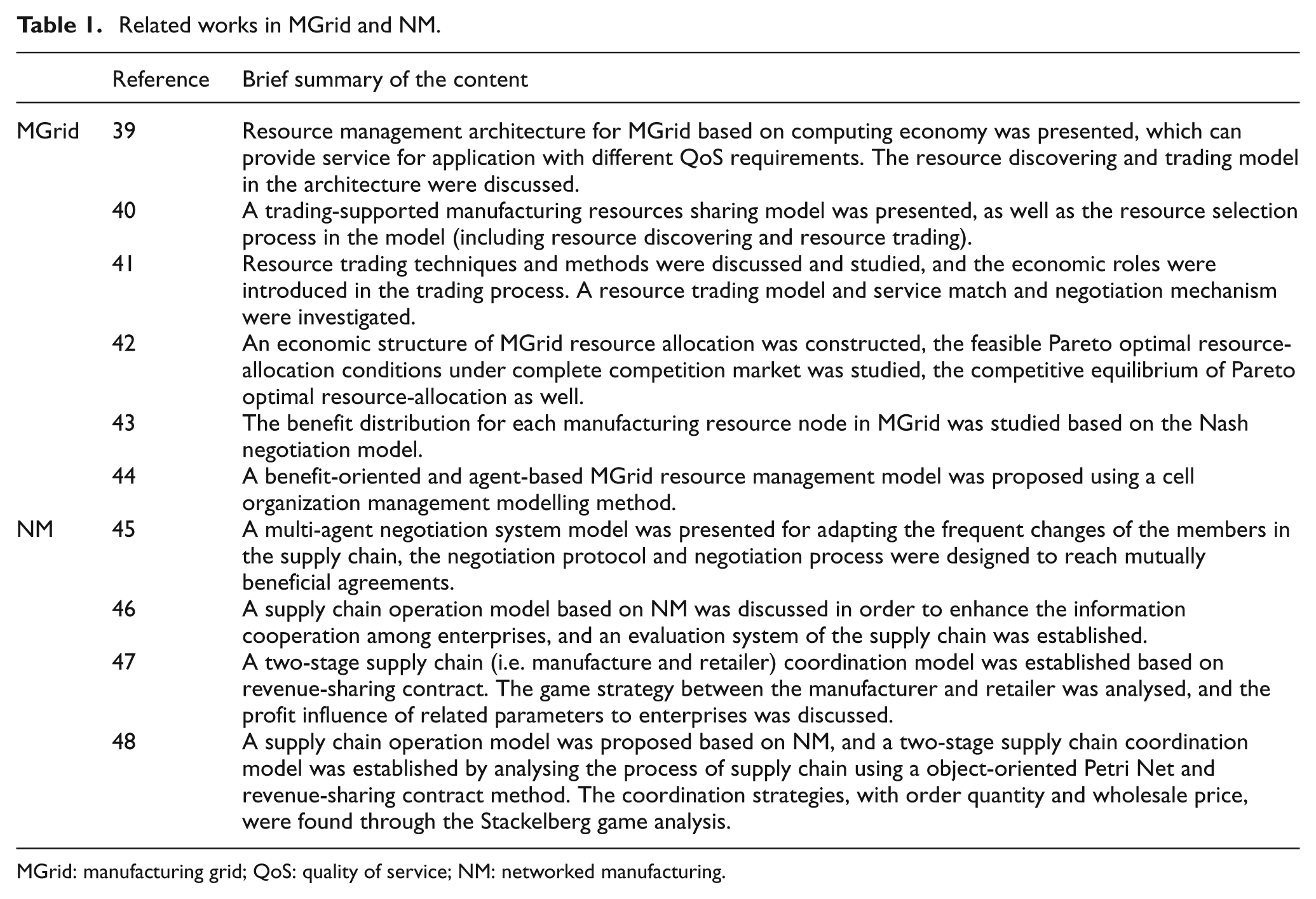
MGrid: manufacturing grid; QoS: quality of service; NM: networked manufacturing.
In the field of SCM, the research works are primarily concentrating on coordination and optimization of the supply chain under supply uncertainty or demand uncertainty environments, as shown in Table 2. The studied supply chain modes primarily are ‘one-to-one’49–50,52,54–56 models (i.e. one manufacture/supplier and one distributor), or ‘multiple–one’ models.51,53,57–58 As an uncertain environment, including supply uncertain, demand uncertain, and supply and demand uncertain, there is not much research about supply chain modes under supply and demand uncertain.49–51,53 However, in a SOM system, the RSTC is a complex model, i.e. multiple RSPs, single agent, and multiple RSDs. The RSTC is under the uncertain supply and demand environment. Therefore, the RSTC model is much more difficult and complex than the literatures of supply chain models in Table 2, the related method and approached in the supply chain models cannot simply and directly be used in the RSTC of a SOM system.
Related works in SCM.
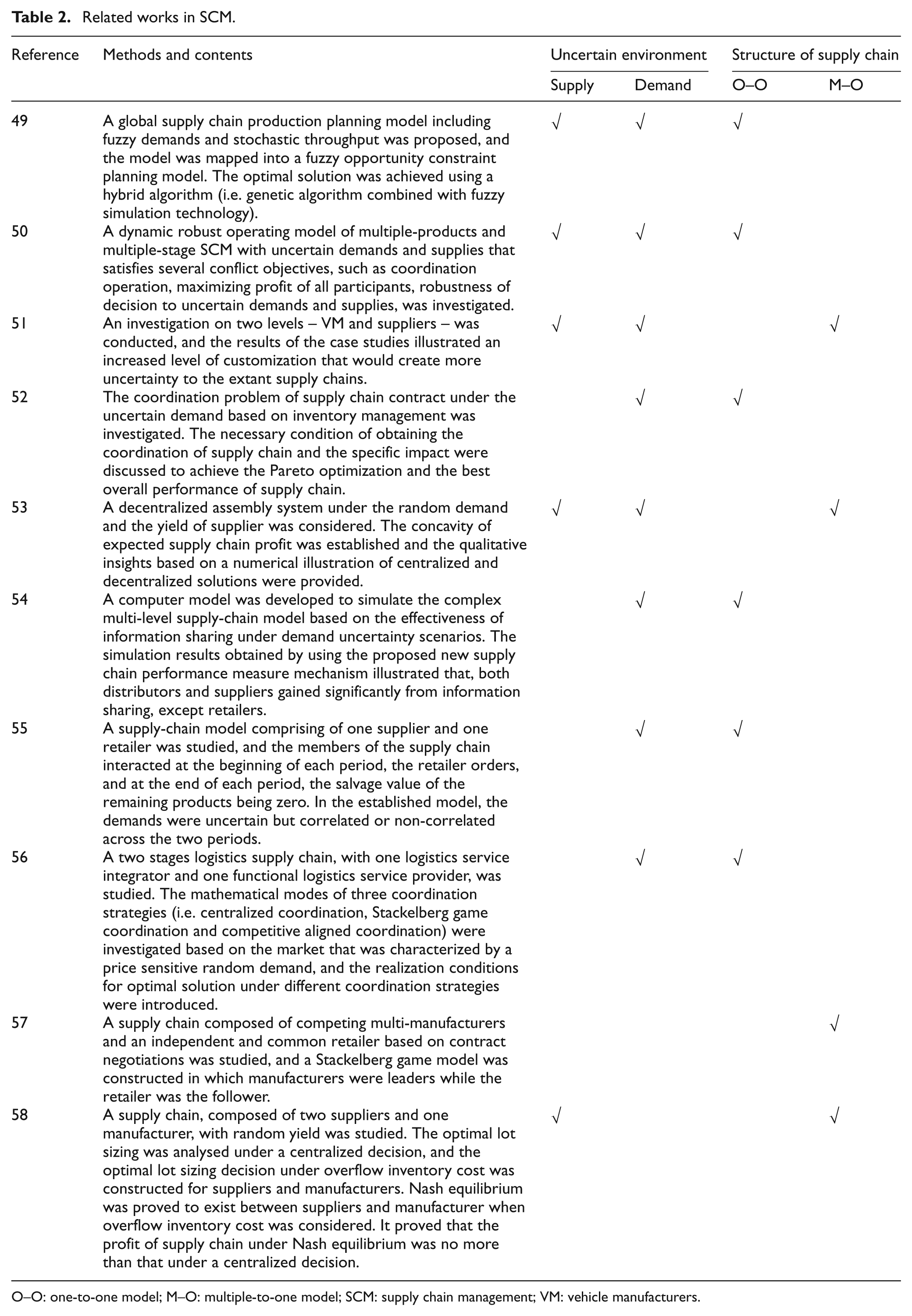
O–O: one-to-one model; M–O: multiple-to-one model; SCM: supply chain management; VM: vehicle manufacturers.
In the field of grid computing systems, some works have been conducted on utility-based resource scheduling and allocation, and the factors considered in the utility are primarily time, quality of service, and budget.59–64 Related works are illustrated in Table 3. Because many grid systems are developed for a community or an organization and aim to share computational resources, such as processor resources, network resources, and storage resources, the benefit among computational resource providers and users are not paid too much attention. As a result, few works can be found about the resource or service transaction chain. As well as the grid computing system, the SOM system also pays attention to both cost and system performance. However, different from the utility of grid computing system, it is much more important to consider reliability and time in the SOM system.
Related works in computing grid system.
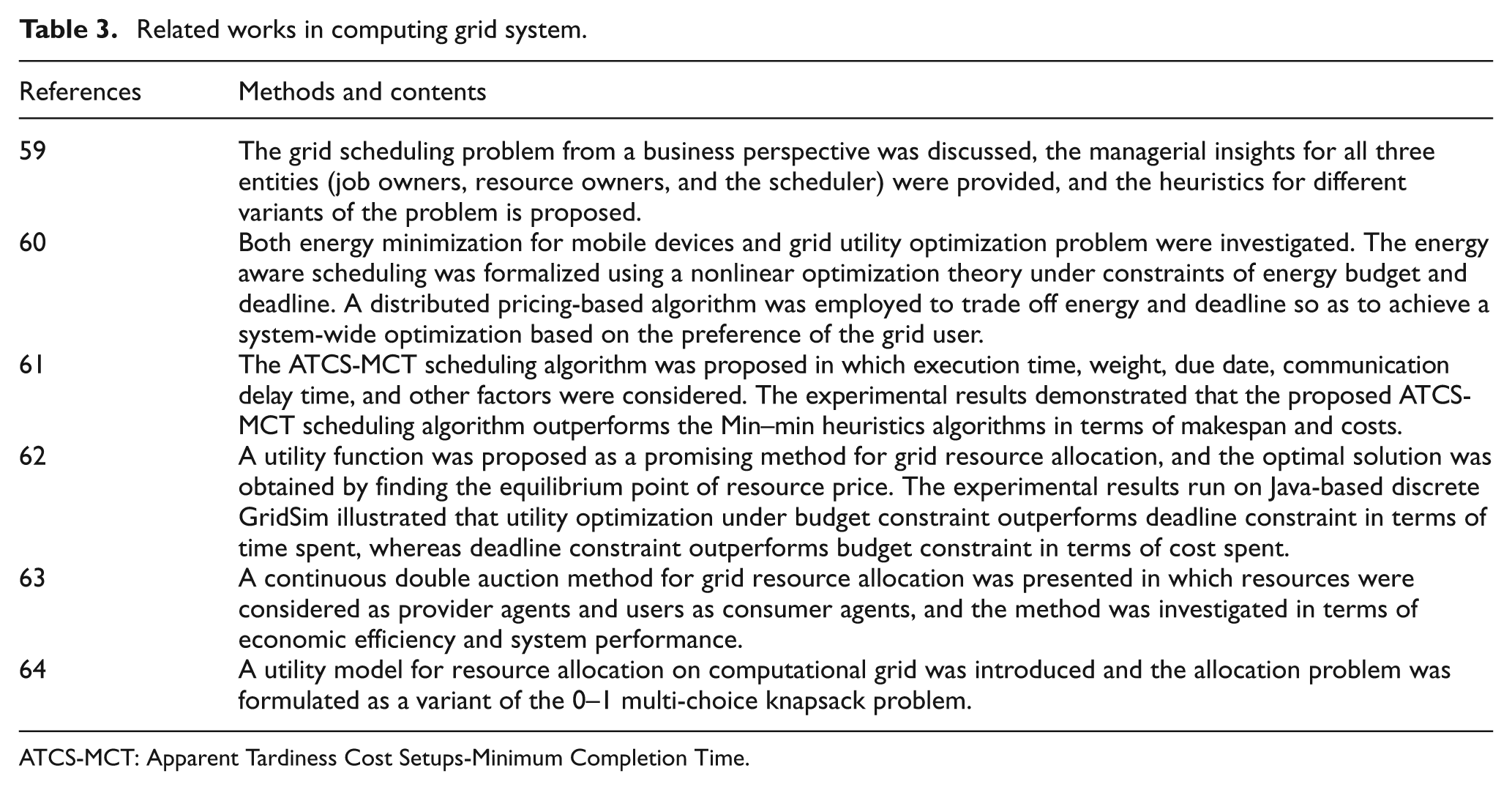
ATCS-MCT: Apparent Tardiness Cost Setups-Minimum Completion Time.
Therefore, in order to promote the three user types (i.e. RSP, agent, and RSD) comprehensive utility in the SOM system, so as to enable the SOM system to be accepted and used in practice, RSTC under uncertain supply and demand environments are studied in this article. Three key issues, including utility modelling, utility equilibriums, and utility coordination are emphasized in this study. According to the utility equilibriums and utility coordination research, the comprehensive utilities of RSTC, RSP and RSD under decentralized decision making are improved. Compared with the current related approaches researches, this article will realize the optimal result of RSTC in SOM with higher revenue, higher reliability, and lower time.
Motivation
According to the abstract architecture of SOM, there are RSPs, agent, and RSDs in these three classes of users in the SOM system. Assuming that there are lots and lots of manufacturing resource services of multiple RSPs published on the agent platform, the RSTC is defined as shown in Figure 2. At first, RSDs with multiple manufacturing requirement tasks submit the service request to the agent platform. The agent then makes the service search and match work for the published services and the requested services based on knowledge. After searching and matching the suitable services, the agent will do the utility evaluation of the services transaction to guide the resource service transaction among RSPs, agent, and RSDs. As to the manufacturing enterprises, they can be the economical entities not only to RSP but also to RSD. The SOM system can be widely practiced under the best service utility evaluation of the agent. The manufacturing enterprises attain many more utilities than the without the SOM system. That is to say, the manufacturing enterprises will all be more willing to share their resource services. The utility equilibrium and utility coordination under the service utility evaluation is much more necessary and important to the system of SOM.
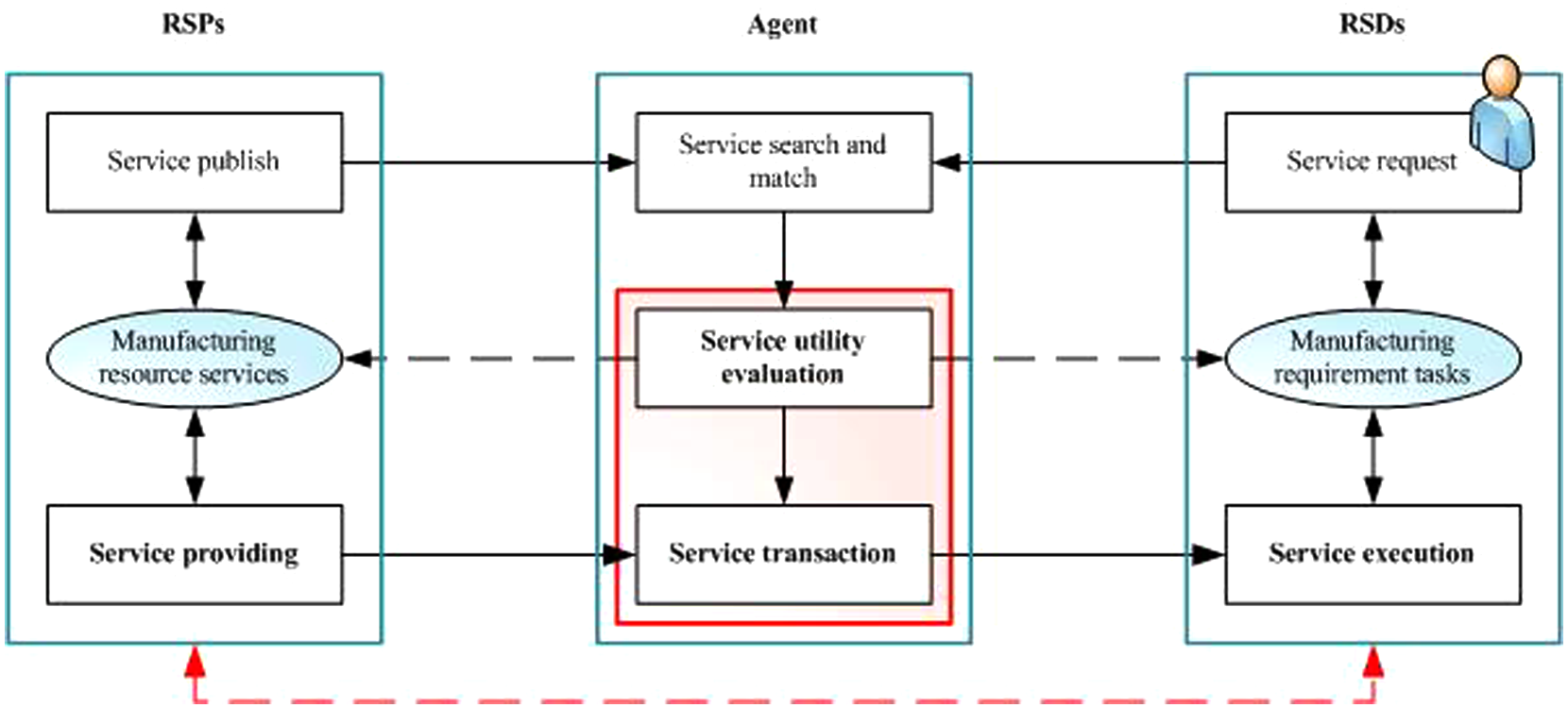
The flow of RSTC in a SOM system.
Related definition
Parameter definition
As the SOM system has the characteristics of being complex, dynamic, and heterogeneous, the whole RSTC is facing many uncertain factors. This article primarily emphasizes:
how to maximize the comprehensive utility for each side (e.g. RSD, RSP, and agent) or the whole system in RSTC;
how to determine their own demand quantity (or supply quantity) of resource service for the RSD and agent (or the RSP and agent), which involves the uncertain supply of the RSP and the uncertain demand of the RSD.
The used symbols in this article are defined in the Appendix.
It is assumed that the demanded quantity of the resource service that RSDi submits to the agent via a SOM system or platform is dj0, the agent issues the request qi0 to RSPi, and the quantity that RSPi can provide to the agent is qi. For the consideration of maximizing their respective utilities, the comparison results of dj0, qi0, and qi is uncertain in the transaction. Furthermore, the amount of resource service that RSPi can provide is dynamic and uncertain. Therefore, the actual quantity that
Definition of utility
In economics, utility is used to describe the degree of consumers’ satisfaction that buying or using something provides. Expanded to the SOM system, the concept of utility evaluat is proposed to describe both the economic efficiency and the comprehensive system performance to provide, use, or transact resource service for RSP, RSD, and agent. In the SOM system, the system of utility evaluation contains many evaluating parameters such as time, cost, reliability, function similarity, security, maintainability, and satisfaction, etc. 28 As to the three sides in the SOM system, they all pay much more attention to solve this problem which is how to get the highest revenue in least time with best reliability. For the consideration of reducing the complexity and ease for computing, only time, cost and reliability are considered in this article, i.e. the comprehensive utility models consist of three parts, the revenue utility, the time utility, and the reliability utility, which is in order to make normalization processing for utility evaluation. They are defined as follows.
The revenue utility:
The time utility:
The reliability utility:
Therefore, the comprehensive utility model considering revenue, time, and reliability of each side in the RSTC is formulated as

Where
The objective function for maximizing the utility for each side in the RSTC in this article is
Utility modelling
The following utility models are based on one resource service transaction, at some time after a class of resource service requirements of RSDs have been submitted.
Utility model under the decentralized decision-making condition
Under the decentralized decision-making condition, each side will consider the expected utility to be the largest, so as to make the best decision. It is assumed that each side is entirely rational, in order to make sure that the requirement of the resource service of the RSD can be met. The total request quantity of the resource service of the agent is bigger than or equal to that of RSD, and the quantity of the resource service centralized by the agent is bigger than or equal to the total supply quantity that the agent provides for the RSD. It means that ∑qi0>∑dj0 and ∑min(qi, qi0)>∑min(dj, dj0). Figure 3 is a schematic drawing of the utility modelling under the decentralized decision-making condition. The comprehensive utility models for RSP, agent, and RSD are investigated in the following subsections.
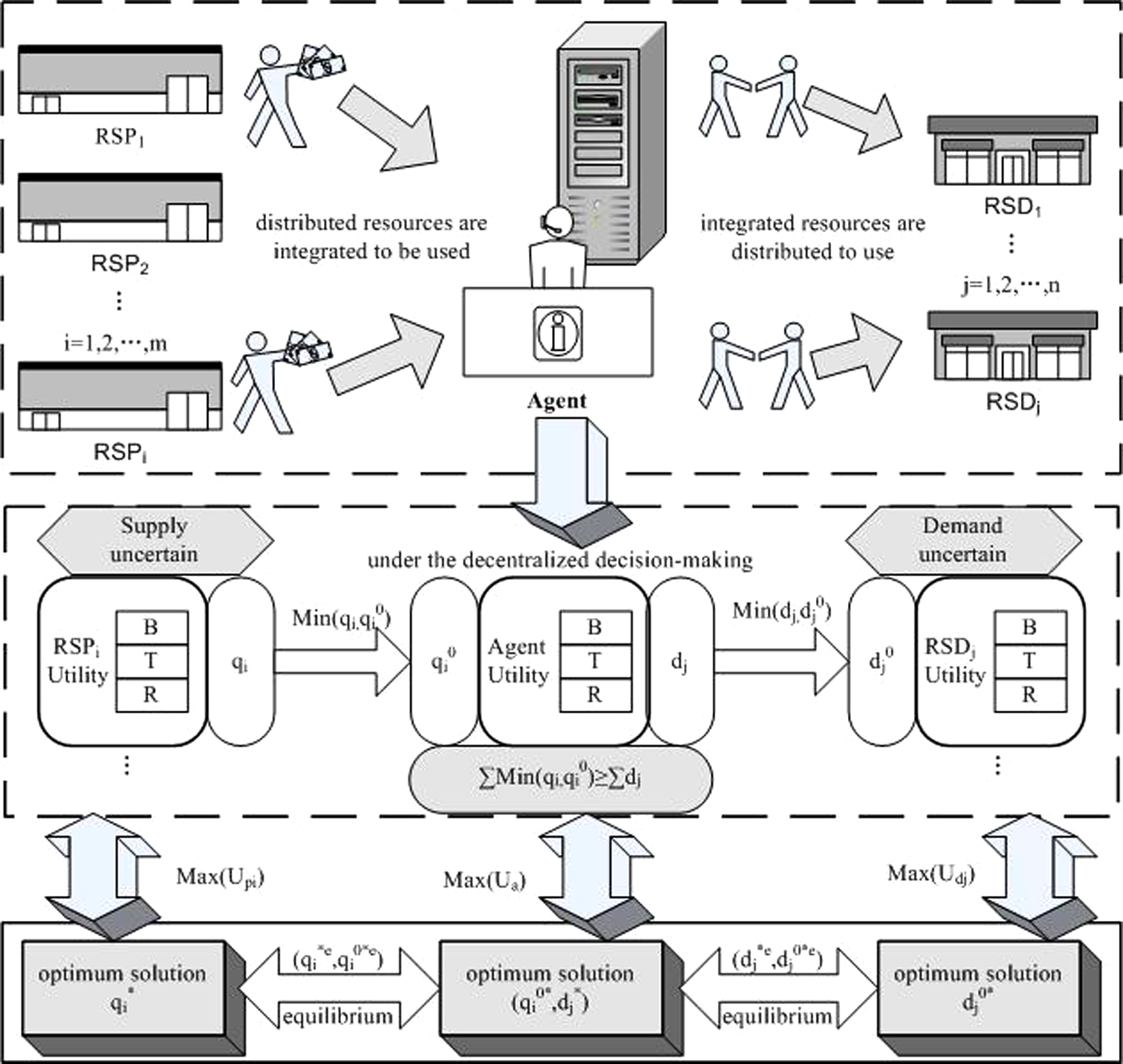
The schematic drawing of the utility modelling under a decentralized decision-making condition.
The comprehensive utility of the RSPi
Faced with the agent issues the request qi0 to RSPi, and the quantity that RSPi can provide to the agent is qi, then the actual quantity that RSPi provides to the agent is min(qi, qi0).
When providing services to the agent, the revenue of RSPi is related to the incomes of providing resource services to the agent, and the cost that includes the fixed cost, the variable cost, punishment to the agent of lacking service (qi < qi0), the overflow cost of service (qi > qi0), and the service fee paid to the agent. Then the revenue of RSPi is

The time of RSPi is consisted of the execution time of providing service and the time of communication to the agent. Then the computing formulate of the time of RSPi is

Considering the communication of RSPi and the agent, RSPi and the agent are regarded as two nodes, then the reliability of RSPi is

According to equation (2)–(4), the comprehensive utility of RSPi is
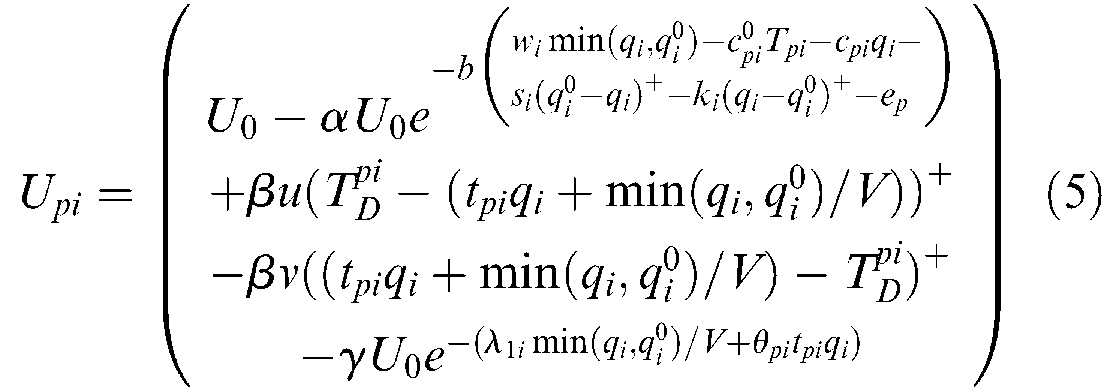
After computing, one has

As min(qi, qi0) has two instances, the constraints of the maximal utility of RSPi are different under each instance. When

When

The comprehensive utility of the agent
The agent is the linkage of RSP and RSD, RSPs and RSDs pay some service fee to the agent. As the actual quantity that RSPi provides to the agent is min(qi, qi0), and the actual amount of resource service that the agent provides to RSDi is min(dj, dj0), the revenue, time, and reliability of the agent are much more complex as follows.
When purchasing services from RSPs and providing services to RSDs, the revenue of the agent is related to the incomes of providing resource services to RSDs, the service fee paid by RSPs and RSDs, and the default punishment of RSDs, and the cost of including the fixed cost, the variable cost, the cost of purchasing services form RSPs, punishment to RSDs of lacking service (dj < dj0), and the overflow cost of service (dj > dj0). Then the revenue of the agent is
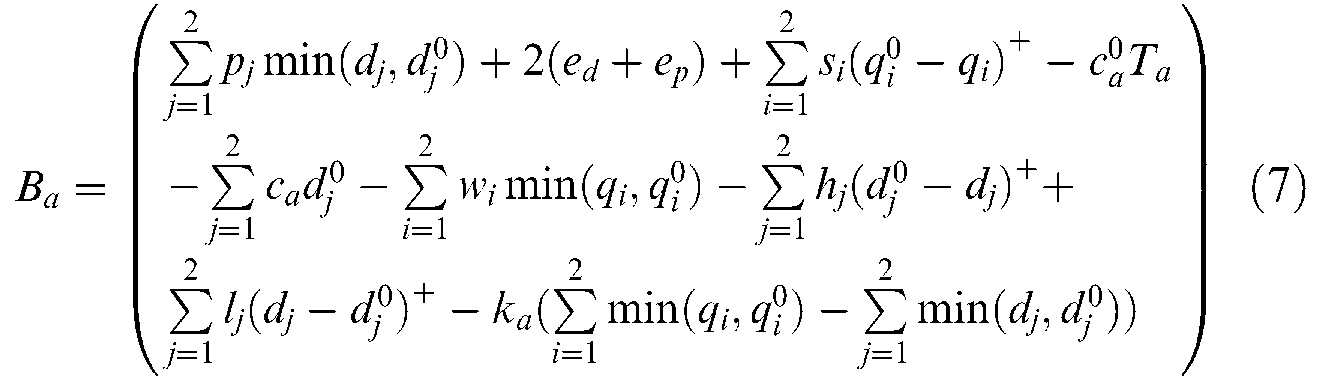
The time of the agent is consisted of the time to communicate with RSPs, the time to communicate with RSDs, and the resource services dealing time of the agent

As well as the communication with RSPs, the agent and RSDs are also regarded as some nodes. The reliability of the agent is

According to equation (7)–(9), the comprehensive utility of the agent is as
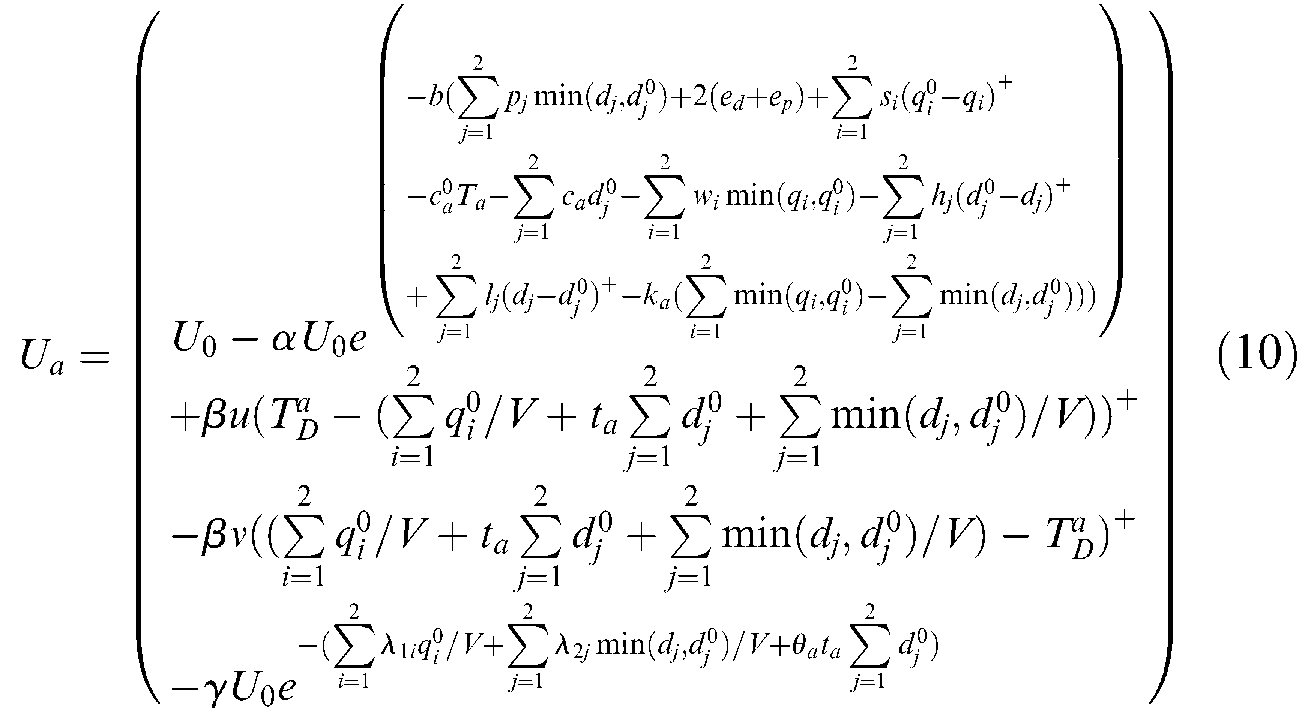
Based on the comprehensive utility model of the agent, the only extrenal solution

Where

Taking the frontier point
The comprehensive utility of RSDi
The demanded quantity of the resource service that RSDi submits to the agent via a SOM system or platform is dj0, and the quantity that the agent can provide to RSDi is dj. Then the actual amount of resource service transaction between the agent and RSDi is min(dj, dj0).
The revenue of RSDi is related to the incomes of executing the service on-demand and the punishment from the agent of lacking service, and the cost that includes the fixed cost, the cost of purchasing service from the agent, and the service fee paid to the agent. Then the revenue of RSDi is

The time of RSDi consists of the time to execute service and the waiting time of sending services request

Similarly to RSPs and the agent’s reliabilities, the reliability of RSDi is

According to equation (13)–(15), the comprehensive utility of RSDi is
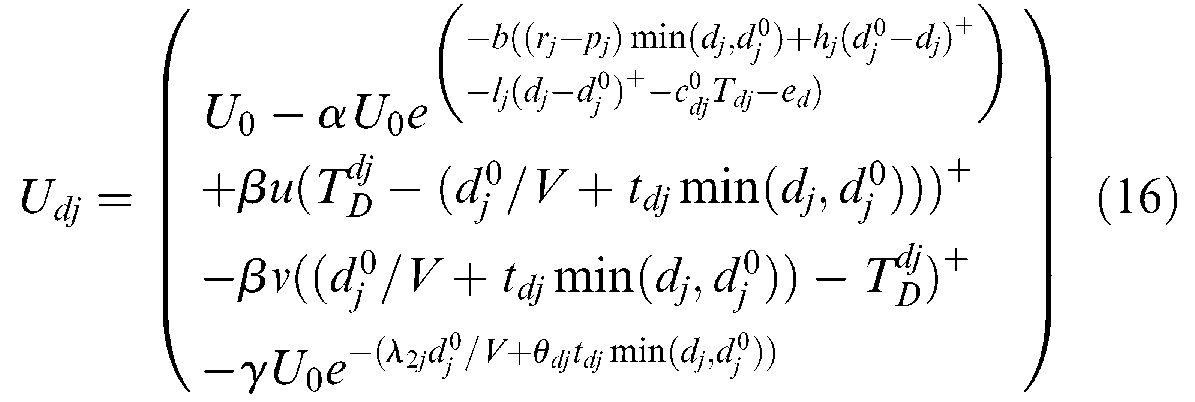
Similarly to the comprehensive utility of RSPi, it is subsistent that

As min(dj, dj0) has two instances, the constrains of the maximal utility of RSDi are different under each instance. When

When

Utility model under the centralized decision-making condition
Under the centralized decision-making condition, the optimal solution must make the utility of the RSTC have the biggest value. RSP, RSD, and the agent discuss together to decide their own demand or supply of resource service, therefore
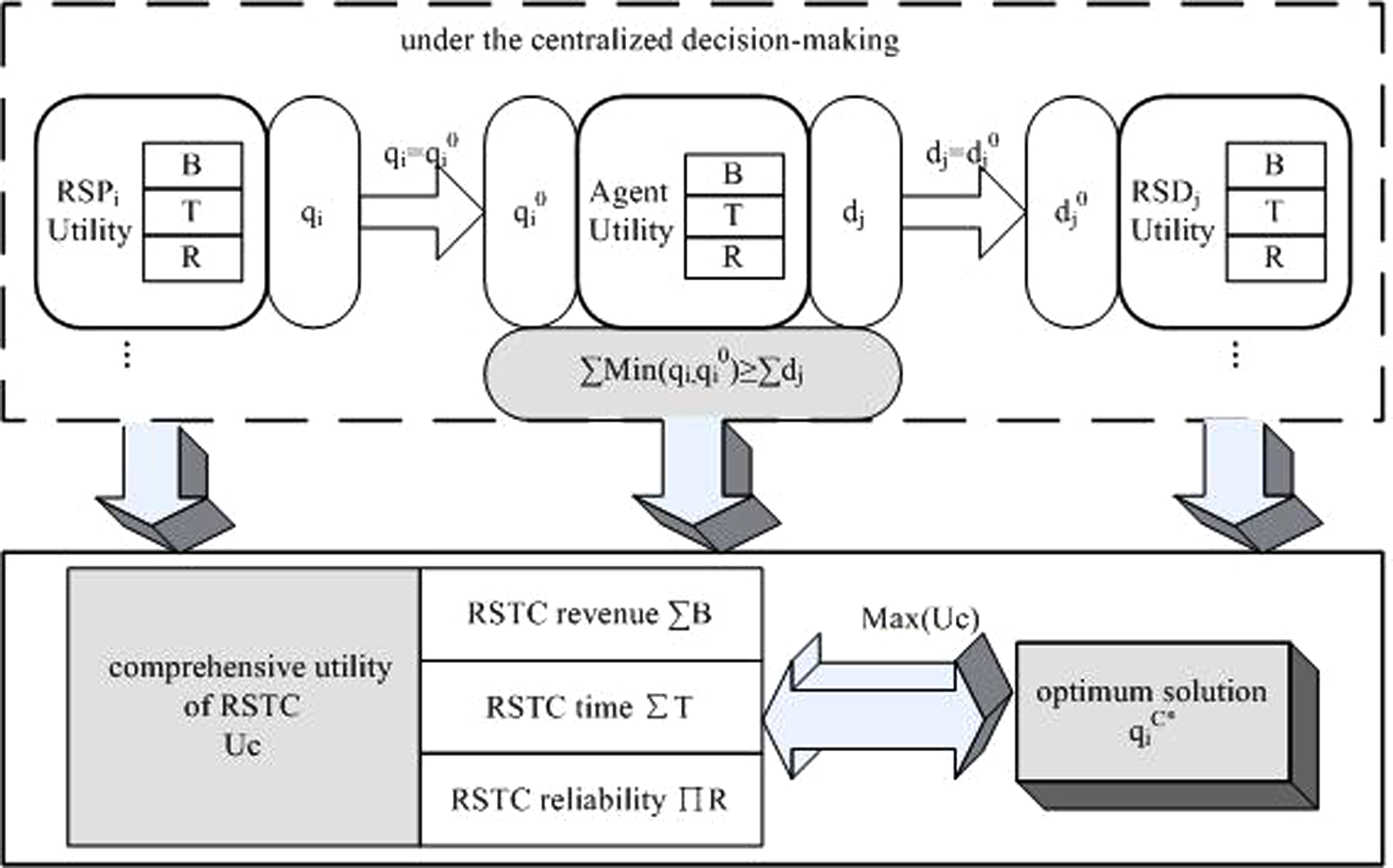
The schematic drawing of the utility model under a centralized decision-making condition.
Under the centralized decision-making condition, the revenue Bc, the time Tc, and the reliability Rc of the RSTC that comprehensively considering RSPs, the agent, and RSDs of the RSTC in the SOM system are formulated as equations (18), (19), and (20), respectively



According to equations (18)–(20), the comprehensive utility model of the RSTC under the centralized decision-making is formulated as
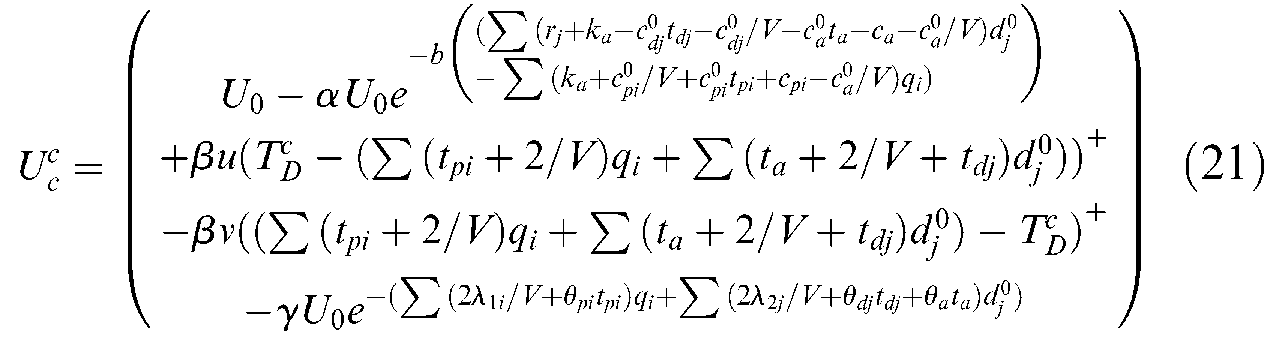
Because the resource service demand information is transparent under the centralized decision-making, and M is certain, therefore, there is only one variable, i.e.
Let

Utility equilibrium
Under decentralized decision-making, each user of the SOM makes the service provider or requirement quantity for their own maximal utility. However, how to find the optimal result that results in the maximal utilities of RSPs, the agent and RSDs at the same time is much more important, then the utility equilibrium is necessary. There are three sides in the RSTC ‘RSP–Agent–RSD’, i.e. RSD, RSP, and the agent, therefore, the related utility equilibrium study can be divided into two parts: the utility equilibrium between RSP and the agent, and the utility equilibrium between RSD and the agent.
The utility equilibrium between RSP and the agent
According to the previous sections, one can know that the optimal solution of RSP and agent can be solved by getting the derivative or partial derivative under the decentralized decision-making. One can get the equations
According to Ma and Li,
58
as to the differentiable function

Therefore the above assumption
The utility equilibrium between RSD and the agent
The optimal solution of RSD and the agent can also be solved by derivative or partial derivative under the decentralized decision-making. One can also get the equations

But according to

Therefore, the assumption also fails similarly to the equilibrium analysis of RSP and the agent, and there is only one set of equilibrium solution
Utility coordination
Under the decentralized decision-making condition, if each side (i.e. RSP, the agent and RSD) decides its demand and supply quantities according to their resource service equilibrium solutions, then each of them will have the biggest utility. However, the comprehensive utility for the whole RSTC under the decentralized decision-making condition would be smaller than (or equal at best) to the maximal utility under the centralized decision-making condition. Therefore, how to improve the comprehensive utility of the RSTC under the decentralized decision-making condition, and enable it close to the maximal or optimal utility of RSTC under the centralized decision-making condition, is a key for realizing added-value of service in the SOM system.
In this article, a coordination method is used to change the single sides comprehensive utility model and break the equilibrium solution under the decentralized decision-making condition, so as to make the comprehensive utility of the whole RSTC close to the maximal utility of the RSTC under the centralized decision-making condition as much as possible, and increase each side’s maximal utility at the same time. The detailed coordination method is that an agreement between RSPi and the agent is achieved first. In this agreement both RSPi and the agent agree to adjust their asking price for the resource service, and let the adjusting coefficient be ai. Furthermore, the cost for the redundant resource service is afforded by RSPi and the agent together, according to a coordination coefficient, and let the adjusting coefficient be bi. After the implementation of the above coordination the revenue models for RSPi and the agent can be updated as equations (26) and (27), respectively.

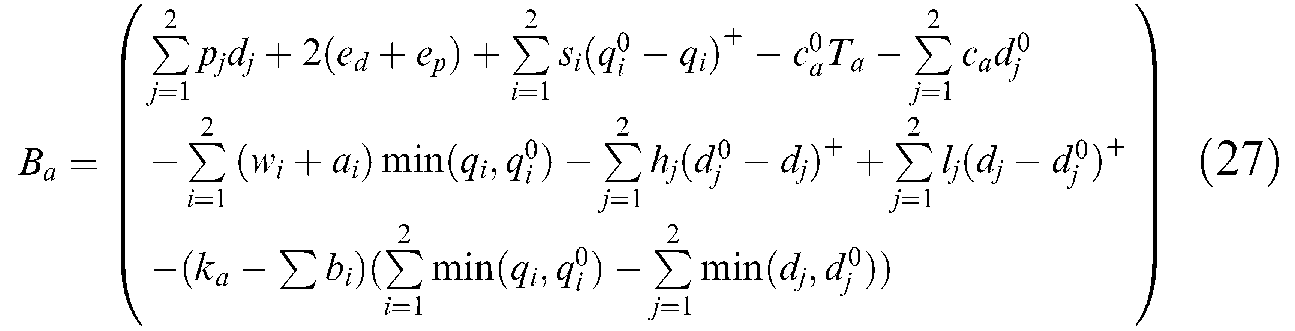
Although the revenue of RSPi and the agent are changed after coordination, the change only takes place within the RSTC, and the total revenue of the chain will be unchanged. In order to make the comprehensive utility of the whole RSTC arrive at the maximal utility value of the RSTC under the centralized decision-making condition, the providing quantity of resource service should equal the optimal decision value qic* that makes the comprehensive utility under the centralized decision-making condition the maximal value. Therefore, let the demand quantity qi0 the agent asked from the RSPi be the optimal solution qic* under the centralized decision-making condition, i.e. set qi0 = qic*. There are only four qi0, qi, ai and bi variables, both in the derivation function

of the utility models after coordination. If set qi0 = qic* and qi = qic*, then the two coordination coefficients, i.e. ai and bi, can be obtained after calculation according to
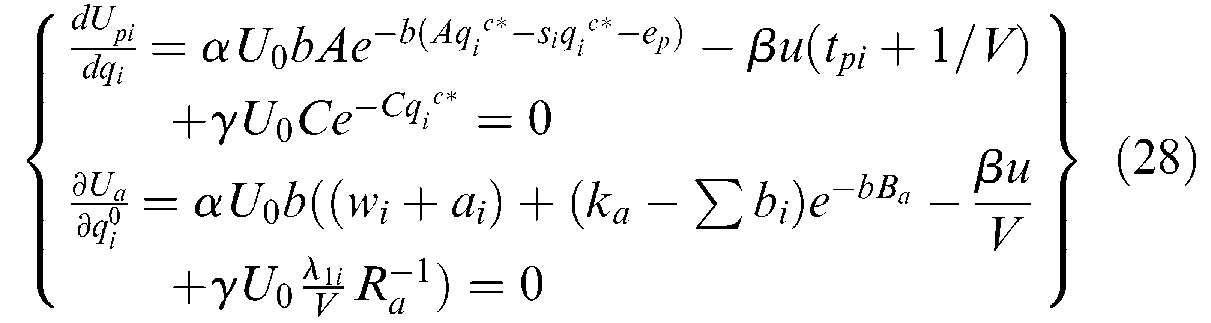
where

It means that the agent sets its demand quantity at qic* and sends it to RSPi first, then RSPi and the agent adjusts the cooperation coefficients ai and bi together so as to make the optimal quantity of RSPi providing the agent with qic* too. As a result, the equilibrium under the decentralized decision-making condition before coordination is broken down, and the comprehensive utility for the whole RSTC has been improved, while the comprehensive utilities RSP and the agent has not been reduced. It realizes the added value of service in the SOM system.
Case study
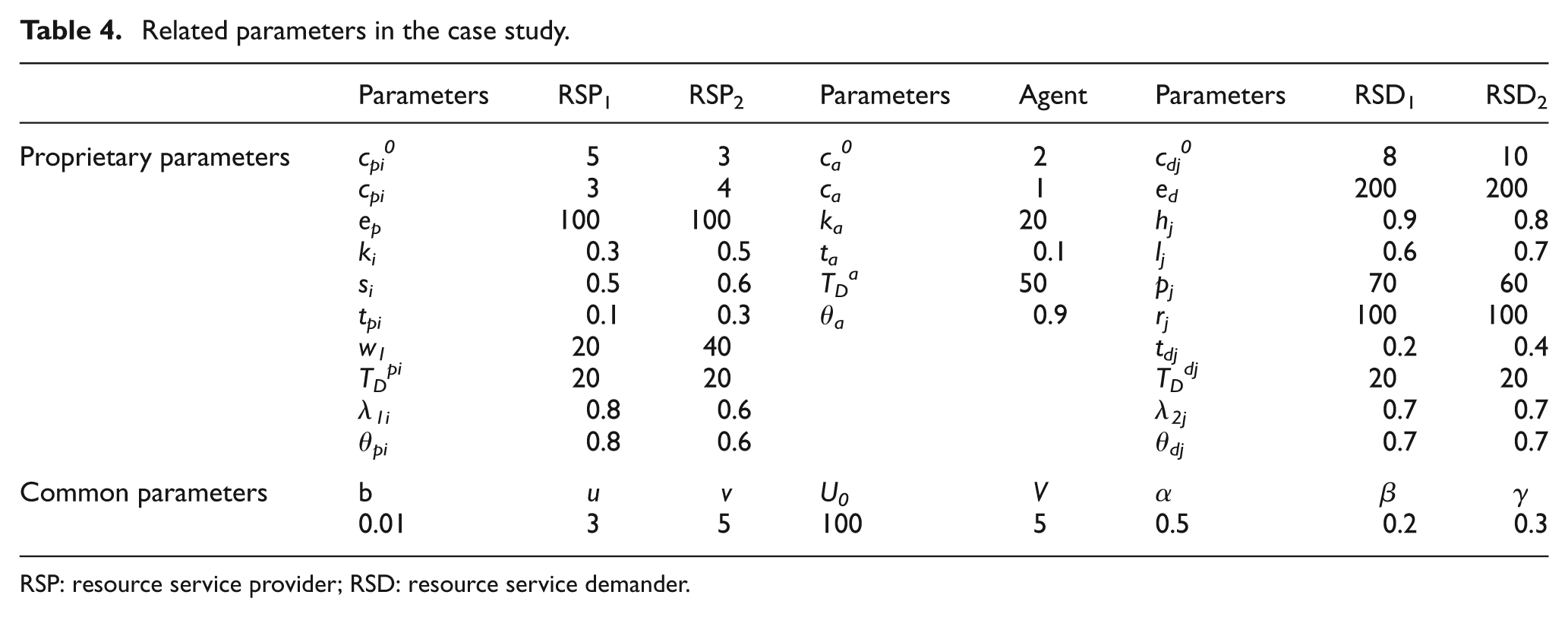
It is assumed that there are two manufacturing enterprises, i.e. an aircraft manufacturing enterprise and an automobile manufacturing enterprise (denoted as RSD1 and RSD2, respectively), submit their design and simulation analysis service requirements to the resource service operator (denoted as the agent) via a SOM system, such as a MGrid platform, and their demand quantities are 40 and 20 services, respectively. The detailed service requirements of RSD1 are the optimal design service of the wing’s structure, assembly simulation service of aircraft system, the optimal design service of the aircraft fuselage, etc. And the detailed service requirements of RSD2 are the optimal design service of the engine’s structure, the optimal design service of the automobile body, the optimal design service of the automobile chassis, etc. It assumed that there are two service providers (denoted as RSP1 and RSP2) that can provide the related functional service, and the detailed services that RSPs can provide are the same function class of design and simulation software service such as ANSYS, Pro/E, SolidWorks, UG, CATIA, and so on. The aim of this study is to show how to apply the proposed method to help the three sides (i.e. the agent, the two RSPs and the two RSDs) to determine and adjust their resource service demand and supply quantities so as to maximize their comprehensive utility while improve the comprehensive utility of the RSTC at the same time. The related parameters for the case study as shown in Table 4 and all data analysis are done using MATLAB7.1.
Related parameters in the case study.
RSP: resource service provider; RSD: resource service demander.
Utility modelling in the case study
Under the decentralized decision-making condition, facing the resource service request from the agent, the changing curves of the related comprehensive utility for RSP1 and RSP2, along with the changes of qi, are illustrated in Figure 5(a) and (b). Facing the resources provided by the agent, the changing curves of the related comprehensive utility for RSD1 and RSD2, along with the changing of dj0, are illustrated in Figure 5(c) and (d). As shown in Figure 5, there exists an optimal solution of the comprehensive utility of both RSP and RSD, which maximize the comprehensive utility of each subject. Besides the comprehensive utility curves, the curves reflecting the revenue utility (UBp1), the time utility UTp1 ), and the reliability utility (URp1 ), changing along with the qi, are illustrated in Figure 5(a). As shown in Figure 5(a), when the revenue of RSP1Bp1 ≤ 0, its utilities are zero, and when q1 increases to a certain amount that makes Bp1 > 0, along with the increasing of q1, UBp1 is increasing first and decreasing late, UTp1 is decreasing and URp1 is increasing.
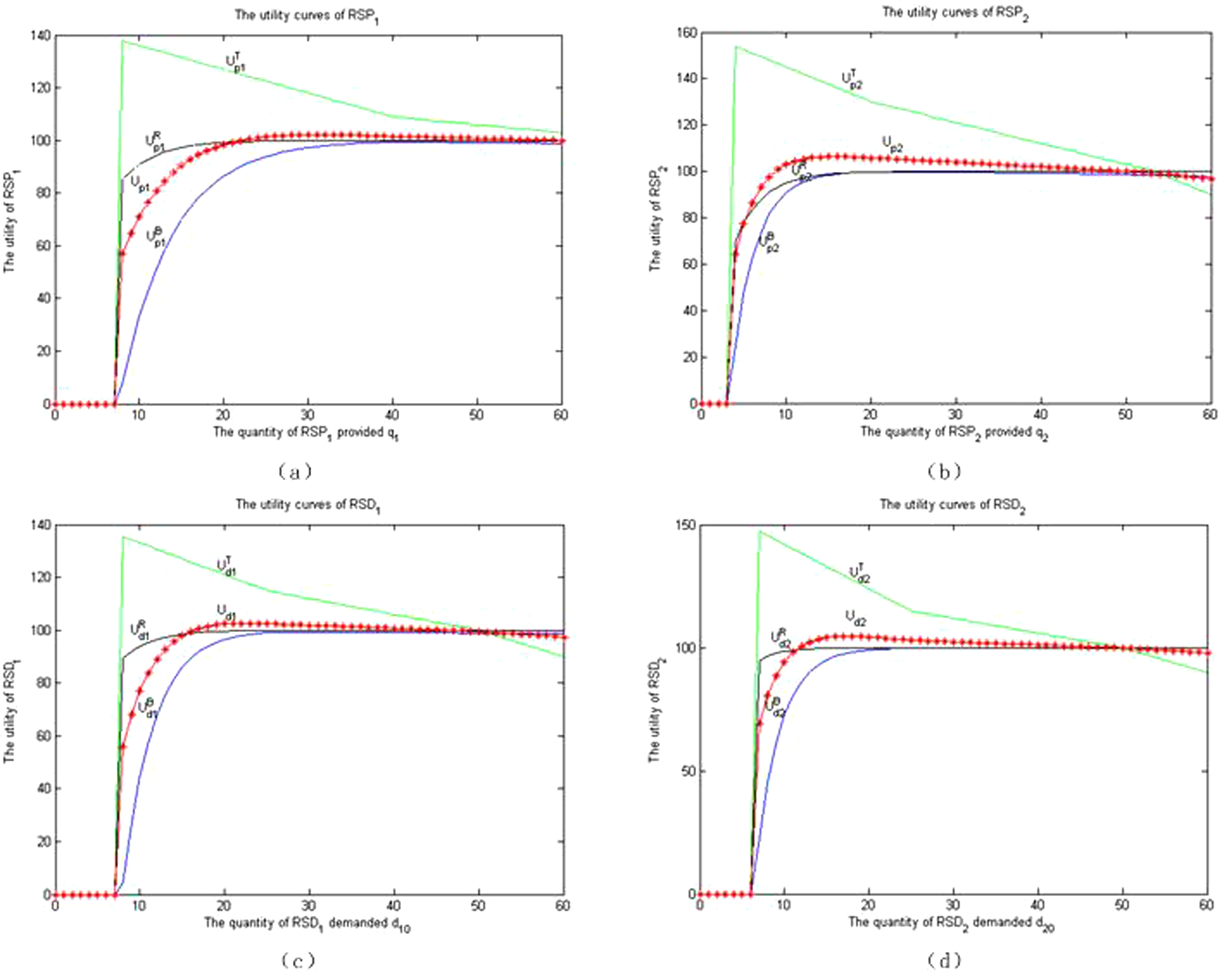
Comprehensive utility curve under a decentralized decision-making condition.
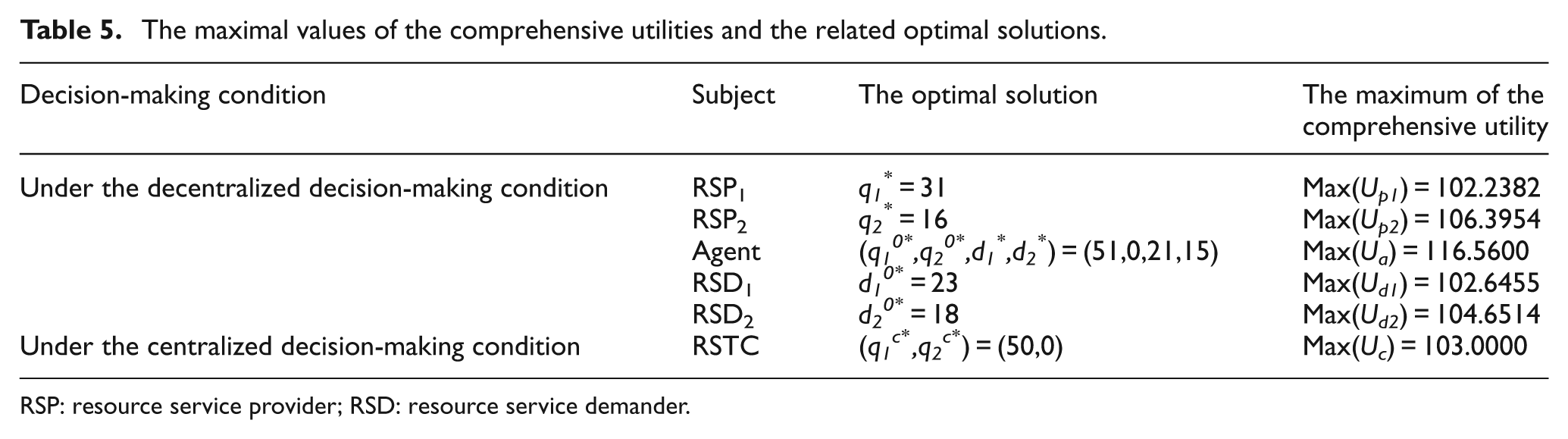
Because there are four variables with wide value ranges involved in Ua, the corresponding values of Ua are calculated by dividing the value ranges into several segments. According to the calculating results, it is found that the Ua decreases along with the increase of qi0 and decreases along with the increase of dj, and a group solution exists that makes the comprehensive utility of Ua have the maximal value. The maximal values of the comprehensive utilities for each side and the related optimal solutions are shown in Table 5.
The maximal values of the comprehensive utilities and the related optimal solutions.
RSP: resource service provider; RSD: resource service demander.
Under the centralized decision-making condition, if set d1
0
=d2
0
=25, then
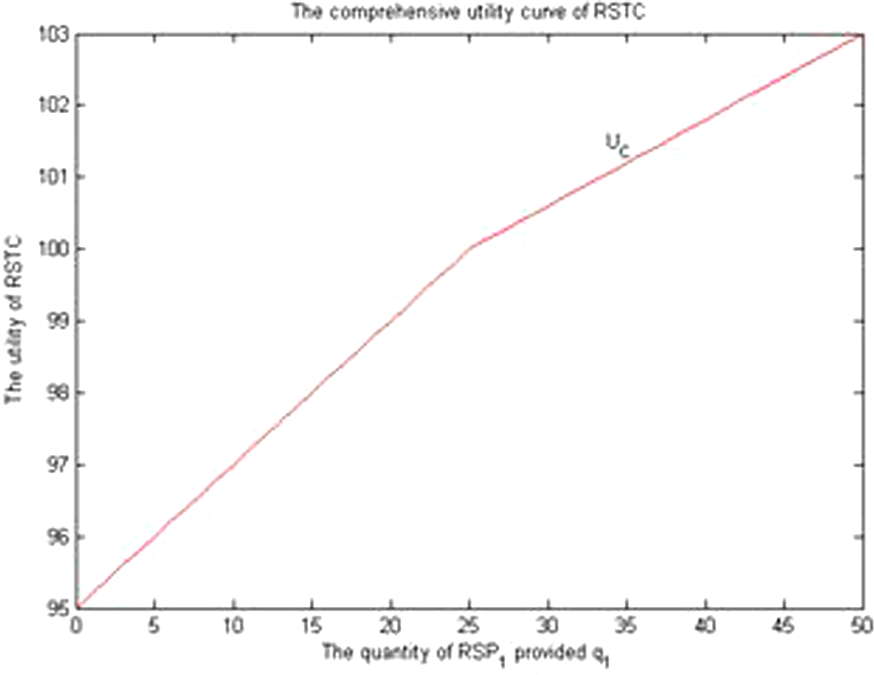
Comprehensive utility curve under a centralized decision-making condition.
Table 5 shows the maximum and the optimal solution of the comprehensive utility for each side (i.e. RSP, RSD, and the agent) under the decentralized decision-making condition and comprehensive utility of the RSTC under the centralized decision-making condition.
Utility equilibrium in the case study
In order to simplify the computation, the equilibrium analysis under the decentralized decision-making condition is divided into the following two steps:
taking the equilibrium analysis of RSP and RSD, and finding out the value ranges of (qi,qi0) and (dj,dj0) that make the comprehensive utilities of each side close to, or equal to, the maximal utility values listed in Table 5;
calculating the comprehensive utility of the agent within the value range generated in the last step, finding out the solution that enable the agent’s comprehensive utility close to, or equal to, the maximal utility of the agent listed in Table 5, and the solution point is the target equilibrium solution point.
The value ranges of the eight parameters (qi, qi0, dj, dj0) are obtained in the first step; q1∈(30,32), q1 0 ∈(30,40), q2∈(15,16), q2 0 ∈(15,20), d1∈(23,25), d1 0 =23, d2∈(17,25), and d2 0 ∈(17,18). The comprehensive utilities equilibrium analysis of RSP and RSD are illustrated in Figure 7. In the second step, the comprehensive utility of the agent are calculated within the values ranges of the eight parameters above. The equilibrium solutions for RSP–agent and RSD–agent under the decentralized decision-making condition when UaE = Max(Ua) = 106.5600 are found as well, the equilibrium solution of RSP–agent is (q1*E,q10*E, q2*E,q2 0*E ) = (30,32,15,20), while the equilibrium solution of RSD–agent is (d1*E,d10*E,d2*E,d2 0*E ) = (23,23,21,17). According to the equilibrium solution of RSP–agent (q1*E,q10*E,q2*E,q2 0*E ) and the equilibrium solution of RSD–agent (d1*E,d10*E,d2*E,d2 0*E ), it will ensure that the comprehensive utilities of RSPs and the agent, and the comprehensive utilities of RSDs and the agent are maximal at the same time in the SOM system mode.
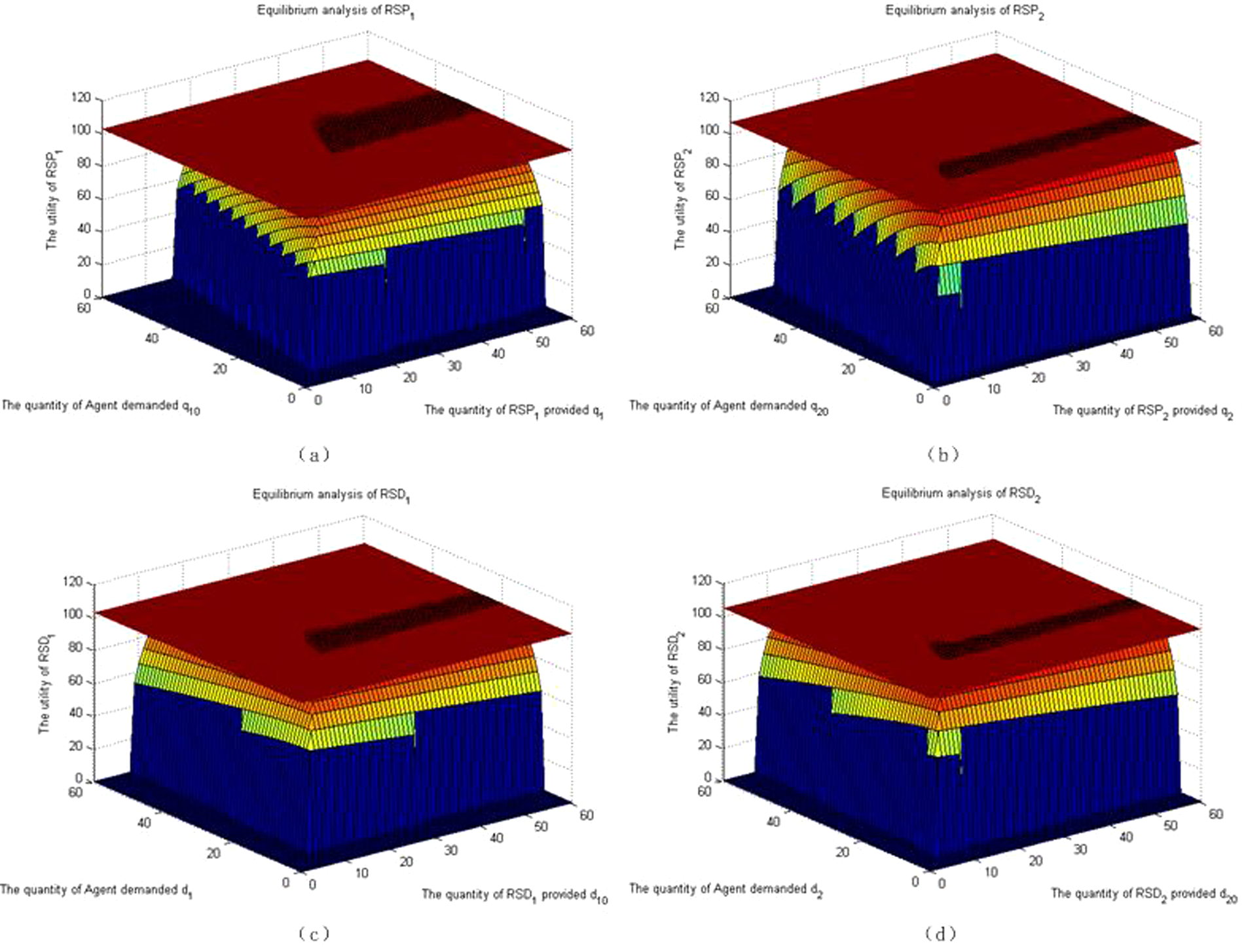
Equilibrium analysis of RSP and RSD under a decentralized decision-making condition.
Utility coordination in the case study
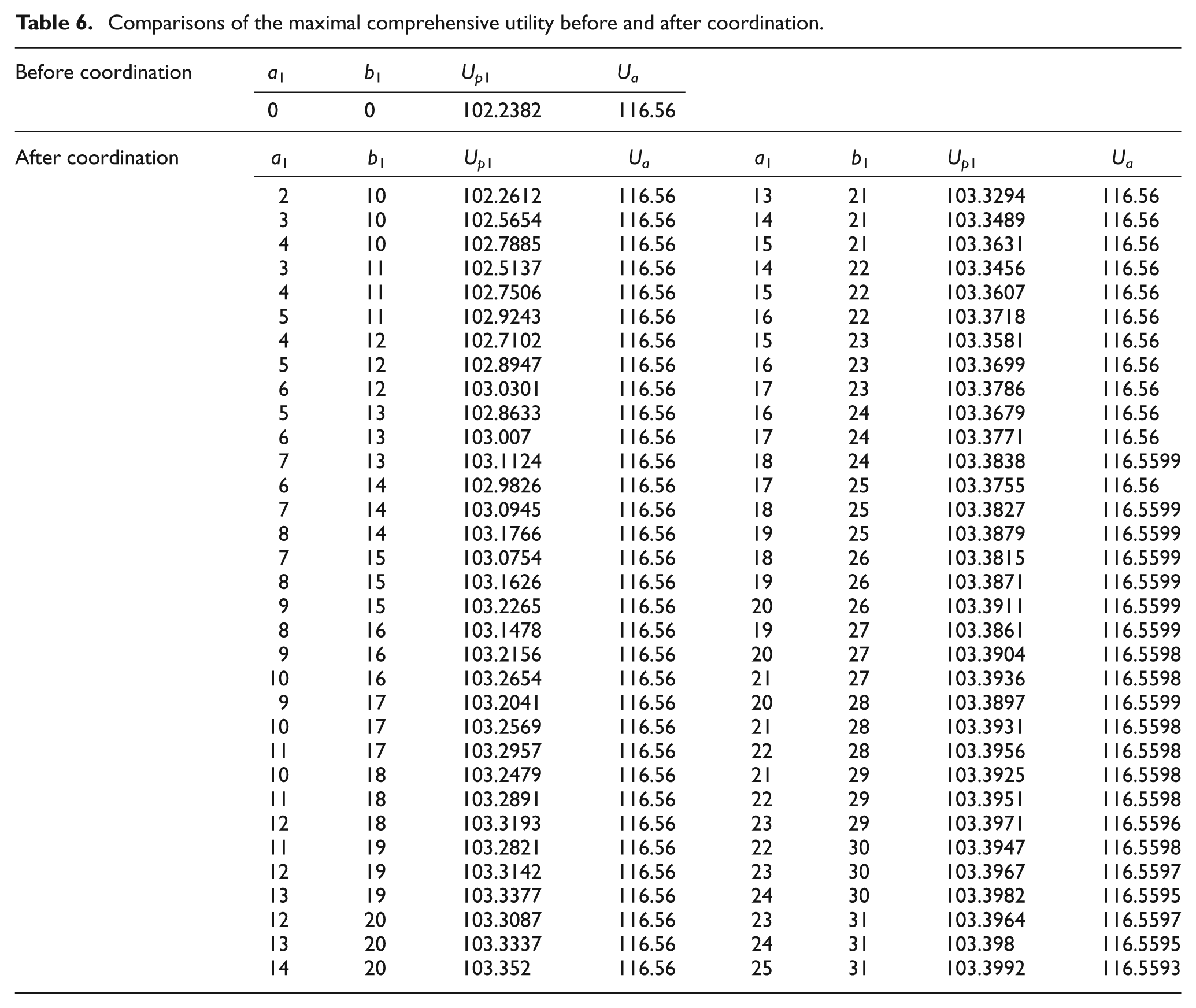
From Table 5 one can conclude that, when (q1c*, q2c*) = (50, 0), the comprehensive utility of the RSTC under the centralized decision-making condition has the maximal value and Max(Uc) = 103.0000. In order to improve the comprehensive utility of RSTC under the decentralized decision-making condition and enable it be close to, or equal to, the maximal value under the centralized decision-making condition, the resource service provided quantity must equal the optimal solution value (q1c*,q2c*) under the centralized decision-making condition. First, the agent sets the demand quantity to RSP1 and RSP2, i.e. set (q1c*, q2c*) = (50, 0). Under this condition, only the coordination between RSP1 and the agent exists because q2c* = 0. According to the coordination method previously mentioned, RSP1 and the agent, and RSP2 and the agent, negotiate with each other and fix the coordination coefficients a1 and b1. The value ranges of a1 and b1 can be calculated according to equation (34). The data in Table 6 are the comprehensive utility values of RSP1 and the agent after coordination calculated using different a1 and b1 within their value ranges. From the results shown in Table 6, the coordination coefficients a1 and b1 can help RSPs, RSDs, and the agent to obtain much more maximal utilities with the utility coordination under centralized decision-making than the maximal utilities without the utility coordination under decentralized decision-making.
Comparisons of the maximal comprehensive utility before and after coordination.
The following conclusions can be obtained from Table 7.
Under the decentralized decision-making condition, without changing the agent’s maximal comprehensive utility (i.e. Max(Ua) = 106.5600), the comprehensive utility of RSP1 can be improved through adjusting the cooperation coefficient a1 and b1 compared with the maximal value of comprehensive utility before coordination.
Within the proper value range, when the cooperation coefficient b1 is unchanged, the comprehensive utility of RSP1 increases with the increase of the cooperation coefficient a1.
Within the proper value range, when the cooperation coefficient a1 is unchanged, the comprehensive utility of RSP1 decreases with the increase of the cooperation coefficient b1.
However, although the comprehensive utility of RSP1 is increased, the comprehensive utility of the agent still equals the maximal value before coordination under the decentralized decision-making condition. The reason is that the key aim of the agent is not pursuing the profit but the quality of service (QoS) (such as time and reliability). In the guarantee of no loss, the change of revenue has small influence on the revenue utility and the comprehensive utility. The coordination method used in this article is that the finances are transferred within the chain of resource service transaction, therefore, the agent’s comprehensive utility after coordination remains at the level of the maximal comprehensive utility before coordination.
Through the calculation results and the analysis in the case study, the following conclusions can be obtained.
The comprehensive utility curves of RSPs and RSDs (i.e. RSPi and RSDj) in Figure 4 demonstrated that the comprehensive utility of RSP and RSD under the decentralized decision-making condition only have one maximal value.
The resource service operator (i.e. the agent) under the decentralized decision-making condition has the maximal value of comprehensive utility.
There is only one maximal value of comprehensive utility for the RSTC under the centralized decision-making condition.
The equilibrium analysis demonstrated that, under the decentralized decision-making condition, there is only one equilibrium solution between RSP and the agent (and RSD and the agent) in the chain of the resource service transaction, which enables each side to have the maximal comprehensive utility at the same time.
The results in Table 6 illustrate that, under the decentralized decision-making condition, by adjusting the cooperation coefficient a1 and b1 properly between RSP and the agent: the comprehensive utility of the chain of resource service transaction (i.e. RSTC) can be improved and it can arrive at the maximal comprehensive utility value under the centralized decision-making condition; the maximal comprehensive utilities of RSP and the agent can be increased compared with the maximal values before coordination, or equal the maximal values before coordination.
Conclusions and future works
In order to enhance the transformation from production-oriented manufacturing to SOM, many SOM systems and models have been proposed and studied during the past decade. One of the key factors deciding whether these SOM systems or models are widely accepted and applied is the utility of the users, including RSPs, RSDs, and the operator or agent in a SOM system. However, few works have been emphasized on the resource service and ability transaction in SOM systems, which is the research topic of this study. The comprehensive utility for the three user types or sides, i.e. RSP, RSD, and resource service agent or operator (agent), during the resource service transaction (RST) process in the SOM system are investigated. In order to guarantee and enhance the comprehensive utility of the three sides using the SOM system, the comprehensive utility models under the decentralized decision-making condition that considered the revenue, time, and reliability for each side in the RST process in the SOM system, are proposed and discussed. Also discussed is the related comprehensive utility model for the RSTC of ‘multiple RSPs–one agent–multiple RSDs’ under the centralized decision-making condition. The existence of utility equilibriums between RSP and the agent, and the agent and RSD, are proved in the optimal decision of the RSTC under the decentralized decision-making condition. A kind of coordination model is also proposed in order to obtain the maximal utility of the whole chain.
Although the case study illustrates that the proposed method is practicable and effective, only three key factors, i.e. revenue, time, and reliability, are considered in this study (including utility modelling, utility equilibrium, and utility coordination). In future, more factors will be considered the utility modes for each side in the SOM during the transaction process, or a general and extensible mode will be investigated. Furthermore, other coordination methods such as economic theory-based, game-based, auction-based methods will be studied, and comparison among these methods will be conducted. The trust model and evaluation algorithms among different users in the resource service transaction process will be emphasized too.
Footnotes
Appendix
This article is partly supported by the NSFC (National Science Foundation of China) Project (Number 51005012) and the Fundamental Research Funds for the Central Universities in China, and the National Hi-Tech R&D1283 (863) Program (Number 2011AA04 0501) in China.