




Abstract
Cloud Manufacturing, a new manufacturing mode, has the characteristics of service-oriented, knowledge-based, high efficiency and low consumption. Resource virtualization is critical for Cloud Manufacturing, which describes physical resources as cloud services. In this article, a resource virtualization method is proposed for sharing manufacturing resources. By analyzing features of Cloud Manufacturing resources, a multilevel resource virtualization framework is constructed. A multi-granularity resource classification algorithm is presented for cloud services encapsulation, based on which physical resources are flexibly composed to respond business opportunities. Ontology, the fundamental of the proposed method, is implemented by Web Ontology Language and Semantic Web Rule Language, along with a case study validating the proposed method.
Introduction
Cloud Manufacturing is emerging as a new, promising manufacturing paradigm that centers on the notion of cloud service as the fundamental element for developing complex product, such as aerospace components and automobile parts. 1 Figure 1 illustrates the architecture of Cloud Manufacturing, which consists of four layers (i.e. resource layer, virtual layer, global service layer, and application layer). Manufacturing resources are provided by distributed enterprises; they are heterogeneous on storage format, description granularity, and management strategies. 2 These problems impede resource sharing and allocating. So, resource virtualization is essential for Cloud Manufacturing. It is responsible for transforming heterogeneous manufacturing resources into isomorphic cloud services. 3 Cloud service has the nature of platform-neutral and can be viewed as a released form of underlying manufacturing resources. It mainly exhibits capabilities, behaviors, and qualities of manufacturing resources. A manufacturing cloud platform mainly performs activities such as service discovery, service matchmaking, service selection, and service scheduling. Cloud users can request services ranging from product design, manufacturing, testing, management, and all other stages of a product life cycle.
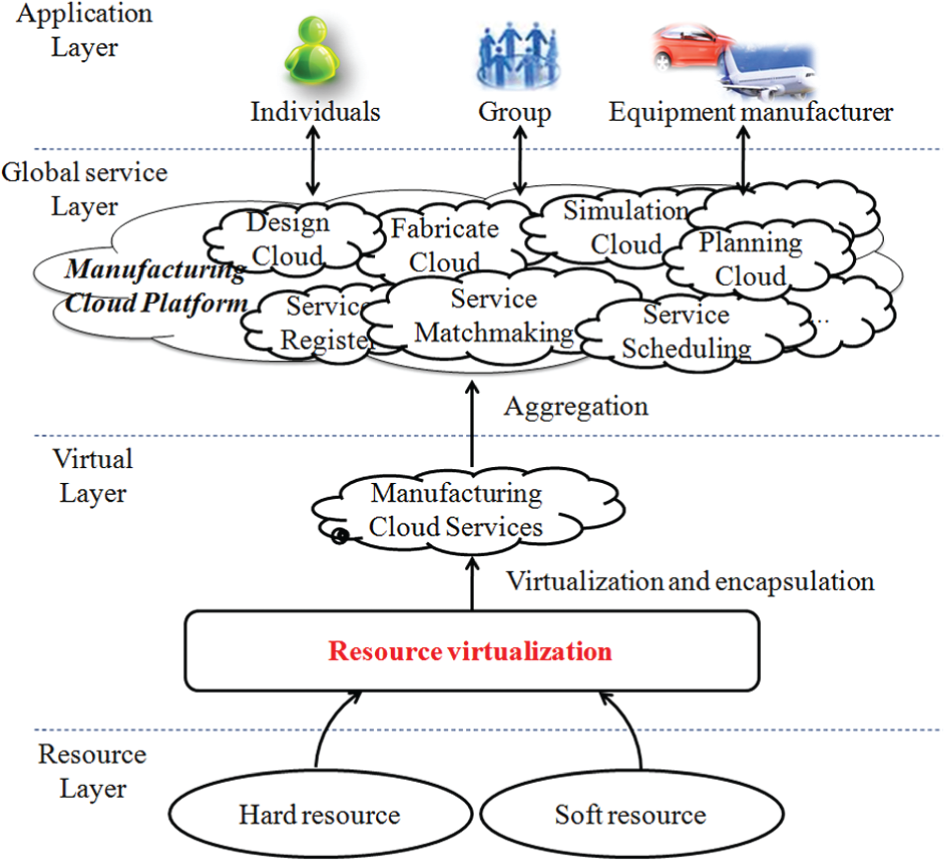
The architecture of Cloud Manufacturing.
Figure 1 shows that the virtual level lies between the global service level and the resource level. During the resource virtualization, manufacturing resources are integrated to virtualized resources, which are encapsulated into cloud services later. A manufacturing cloud platform deploys manufacturing tasks on a collection of cloud services but not on specific manufacturing resources. By this way, diverse manufacturing resources are utilized as one large cohesive set of resources and assigned to users on demand, which results in two issues from the resource virtualization of this level: (1) How to integrate distributed manufacturing resources into virtualized resources? and (2) How to encapsulate virtualized resources into cloud services? Manufacturing resources are entities that possess manufacturing capabilities, which participate in manufacturing activities. In general, virtualized resources represent business function units. They are aggregated from manufacturing resources in some way. Given the importance of resource discovery and selection for Cloud Manufacturing, both behavioral and quality of service (QoS) information of manufacturing resources are pivotal factors that should be considered in the process of generating virtualized resources. Then, the critical information related to virtualized resources is incorporated into cloud services in terms of their inputs and outputs. Semantics information should be enriched in cloud service description in order to support automatic and computer-interpretable processing.
Most existing resource virtualization methods are based on different resource modeling techniques, such as complex object representation, 4 software engineering, 5 and model-driven architecture. 6 The common manner of these methods lies in integrating manufacturing resources into virtualized resources by means of aggregating manufacturing resources with the same or similar capabilities. Consequently, there are two main limitations when they are applied to cope with complex manufacturing tasks in Cloud Manufacturing. First, these methods only provide simple application mode for manufacturing resources. It is difficult for them to flexibly and dynamically satisfy the constantly changing demands of cloud users. Second, multi-granularity is not considered, which is important for Cloud Manufacturing. For example, a complex manufacturing task is decomposed into subtasks recursively before matching them to the registered manufacturing resources. Yan et al. 7 proposed a semantic granularity-based information retrieval model and showed that the dimension of semantic granularity is important for effective retrieval. So, multi-granularity information need to be provided to bridge gaps between task decomposing levels.
Standards, agent, and ontology have been widely adopted during the manufacturing resource encapsulation to cloud services. Existing web service standards, 8 such as Web Service Description Language (WSDL); Simple Object Access Protocol (SOAP); Universal Description, Discovery, and Integration (UDDI); and Ontology Web Language for Service (OWL-S), are characterized with platform-independent and loosely coupled manufacturing resources, which support the interoperability among heterogeneous manufacturing resources. However, cloud services are different from web services. Cloud services are complex, diverse, context-dependency and resource-dependency, which are crucial for interpreting cloud services. Existing standards do not provide the means to explicitly represent these characteristics. Agents cooperate, coordinate, and negotiate with each other. 9 Agent-based resource virtualization focuses on information exchange and automates the activities of resource pooling and sharing. 10 However, besides manufacturing resource information exchange, semantics on manufacturing resources are essential for optimal resource selection and allocation in Cloud Manufacturing. Ontology 11 provides a solid, mature, and reliable formal knowledge representation mechanism to model cloud services with accurate conceptualization, shared understanding, and logical reasoning. Therefore, it is natural to use ontology to provide accumulated knowledge domain with open semantics for virtualized resources in Cloud Manufacturing.
The difficulties of resource virtualization in Cloud Manufacturing mainly concern about semantic interoperability and the multi-granularity feature of manufacturing resources. Semantic interoperability aims to promote the ability of automated resource discovery and selection. The multi-granularity feature aims to satisfy the diverse requirements of cloud users. To deal with these difficulties, in this article, the static information of manufacturing resources are decoupled with the dynamic information (i.e. functional features) of manufacturing resources to improve the flexibility of resource virtualization. A multi-granularity virtualization method is proposed based on set theory to formalize the multi-granularity feature and virtualized resources. Then, multi-granularity resource classification algorithms are designed for providing diverse application modes for manufacturing resources to satisfy various requirements of cloud users. Semantic Web techniques are applied to enrich resource semantic for accurate resource discovery and selection. As well, the proposed method is implemented based on ontology, which semantically encapsulates virtualized resources to cloud services.
The remainder of this article is organized as follows: section “Literature review” reviews the literatures related to resource virtualization. In section “Problem description,” the related concepts are defined and the problem is described. A multi-granularity resource virtualization method is developed in section “Proposed method.” The proposed method is validated by a case study in section “Case study,” followed by conclusions in section “Conclusion.”
Literature review
Networked manufacturing appeared in 1990s, of which the primary goal is to improve the competence of enterprises and alleviate the limitations of geographical locations. 12 Cloud Manufacturing is a new computing and service-oriented manufacturing model, which attracts a lot of attentions in recent years. Tao et al. 3 discussed and investigated the concept, architecture, core enabling technologies, and typical characteristics of Cloud Manufacturing. Xu 1 pointed out that different from existing networked manufacturing models, Cloud Manufacturing cares about both the integration of distributed resources and the distribution of integrated resources, which provides a seamless, stable, and high-quality transaction of manufacturing resource service. Huang et al. 13 introduced a small and medium-sized (SME)-oriented Cloud Manufacturing service platform (SME-CMfgsp). The key technologies and challenges for implementing SME-CMfgsp were discussed. Wang and Xu 14 reviewed recent researches on Cloud Manufacturing and proposed a novel manufacturing platform to enable manufacturing interoperability in the cloud paradigm. Wu et al. 15 analyzed Cloud Manufacturing based on a unique strategic vision and presented the current state of technology from both industry and academic viewpoints. The above overviews indicate that Cloud Manufacturing further emphasizes large-scale resource sharing based on enterprise interoperability and coordination. Therefore, resource virtualization in Cloud Manufacturing is facing new challenges, especially in how to realize semantic interoperability and deal with the multi-granularity feature.
Functional features of manufacturing resources are critical for resource virtualization. Steele et al. 16 proposed an object-oriented resource model to model the functions of a manufacturing system. Information from different knowledge domains is integrated by the proposed model. Vichare et al.17,18 designed a unified manufacturing resource model, which provided machine-specific data in the form of an EXPRESS schema and acted as a complementary part to the Standard for the Exchange of Product Model Data–Numerical Control (STEP-NC) to represent various machine tools in a standardized form. Cao et al. 19 proposed a scheme for functional specification, which decomposed a geometrical functional requirement on a complex mechanism into geometric specifications defined on key part. The scheme realizes each geometric specification on key features and ensures functional tolerance of the entire assembly. Shi et al. 20 employed extensible markup language (XML) schema to encapsulate manufacturing resource information and adopted WSDL to model the accessing operations to manufacturing resources. Li et al. 21 proposed several key techniques for sustaining a Web-based part library system, which realized the share of information of parts library in and among enterprise. Dong et al. 22 proposed a Web-based manufacturing resource service (WMRS) mode and developed relevant enabling techniques to share and reuse manufacturing resources. Wang 23 developed a Web-based service-oriented system for machine availability monitoring and process planning. A tiered system architecture was proposed, and IEC 61499 function blocks for prototype implementation were introduced. However, Web-based techniques focus on the syntactic integration, which cannot semantically describe manufacturing resource information. Required manufacturing resources cannot be automatically located by semantic matchmaking algorithms. To automatically use resources, a lot of cost and time are required by these techniques.
Semantic Web techniques provide a solution for promoting semantic interoperability in resource virtualization. Li et al. 24 proposed a semantic-based approach for collaborative aircraft tooling design. The approach combines heuristic reasoning with semantic Web ontology to facilitate the knowledge representation and reuse. Panetto et al. 25 defined a product ontology by formalizing technical data and concepts that are provided by standardization initiatives (International Organization for Standardization and International Electrotechnical Commission). Based on the proposed ontological model, manufacturing systems is interoperable with each other, and the loss of information semantics is minimized. Patil et al. 26 proposed a common format representing product-specific information to enable the semantic interoperability across different application domains. The requirements for application independency, expressiveness, and unambiguity are satisfied by the proposed method. Li et al. 27 proposed a STEP-based data model to represent one-of-a-kind product knowledge. Based on the data model, a framework was developed to enable product data exchange and sharing in Cloud Manufacturing. Lin and Harding 28 investigated ontology-based approaches for representing information semantics and developed a general manufacturing system engineering ontology model. However, individual partners are required to initially map their vocabularies to ontology, which is difficult, complex, ineffective, and time-consuming. Cai et al. 29 presented a prototype semantic Web system to manage distributed manufacturing services. By the semantic matchmaking of manufacturing service capabilities, the prototype facilitates the retrieval of required manufacturing services efficiently, accurately, and automatically. The aforementioned methods only provide single resource virtualization mode, which cannot be directly applied to Cloud Manufacturing because of the multi-granularity feature.
In Cloud Manufacturing, the requirement for the multi-granularity feature is very common. In order to solve multi-task-oriented manufacturing cloud service composition and optimization (MTO-MCSCO), Liu et al. 30 proposed a “Multi-Composition for Each Task (MCET)” pattern to combine the incomplete composite services into a whole to perform each multi-functionality manufacturing tasks (MFMTs) collectively. Laili et al. 31 presented a new comprehensive model for optimal allocation of computing resource (OACR) in Cloud Manufacturing system. The main computation, communication, and reliability constraints in the special circumstances were considered. Tao et al. 32 established comprehensive utility models to enhance the benefit of three sides using service-oriented manufacturing systems. A utility coordination method was proposed to improve the comprehensive utility of the resource service transaction chain under a decentralized decision-making condition. In addition, Tao et al. 33 investigated the formulation of service composition optimal-selection (SCOS) in Cloud Manufacturing with multiple objectives and constraints and developed a novel parallel intelligent algorithm. The above-mentioned researches are based on an effective multi-granularity resource virtualization method.
Multilevel representation and integration approaches are suitable for dealing with the multi-granularity feature. Zhu et al. 34 proposed a bilayer manufacturing resource model with separation of Cloud End and Cloud Manufacturing Platform. In Cloud End, a basic data model of manufacturing resources oriented to enterprise interior was established to store the physical characteristics. In Cloud Manufacturing Platform, a resource service attribute model oriented to actual users was established to store the service characteristics. Ding et al. 35 presented a holistic product design and analysis model to integrate design models and analysis models at different levels to overcome design inconsistencies. For cross-level integration, the design models were transferred and mapped with more structural and geometric details, while analysis models obtained more detailed design constraints from the top levels. Li et al. 36 investigated the resource virtualization and service encapsulation of a logistics center. A logistics resource expression model was designed with three levels. Service encapsulation focused on location, service function, and service status information. Lee et al. 37 proposed a multilevel product modeling framework enabling stakeholders to define product models and relate them to physical or simulated instances. Both the constructed semantic-based product meta-models and the developed editor interface allow engineers to describe product models using their familiar methods and terminology. The above researches indicate that multilevel approaches contribute to represent and integrate information comprehensively. Different level reflects different granularity. Therefore, a multilevel resource virtualization framework is adopted to deal with the multi-granularity feature of Cloud Manufacturing.
To summarize, the existing resource virtualization approaches contribute to resource sharing in a certain extent. However, the scope and the application mode of shared resources are limited. The crux of the problem lies in lacking adaptable manufacturing capability specifications and effective virtualized resource generation mechanisms to support resource interoperability and circulation. Therefore, the challenges of resource virtualization in Cloud Manufacturing are how to provide common specifications and flexible mechanisms to transform manufacturing resources into cloud services. To achieve the resource global circulation and on-demand usage, new resource virtualization approach need to be investigated.
Problem description
In Cloud Manufacturing, resource discovery and selection are mainly based on functional features of manufacturing resources. For example, when a request is submitted to the cloud platform, the resource consumer focuses on what capabilities a manufacturing resource can provide not just what resources are available. For this reason, virtualized resources should be classified according to the behavior information of manufacturing resources. Usually, the behavior information of manufacturing resources is specified as a list of requested inputs and provided outputs. However, since the same manufacturing resources usually exist in different contexts, distributed resource providers and resource consumers always abstract behavior information of manufacturing resources from different granularities.
As shown in Figure 2, the drilling machine in four contexts has four different abstractions. So, multi-granularity is crucial for resource virtualization. The multi-granularity feature of a manufacturing resource refers to different metrics to describe resources, which can be reflected from two aspects: hierarchy and view. Hierarchy reflects relationships and linkages among various abstraction levels. For example, the drilling machine can be described as “a material process machine” and “a drilling machine,” respectively. There is an inclusion relation between them. View represents descriptions and understanding of a manufacturing resource from different points of views. For example, different stakeholders (designer, engineer, manufacturer, and manager) concern about different views of the same resource.
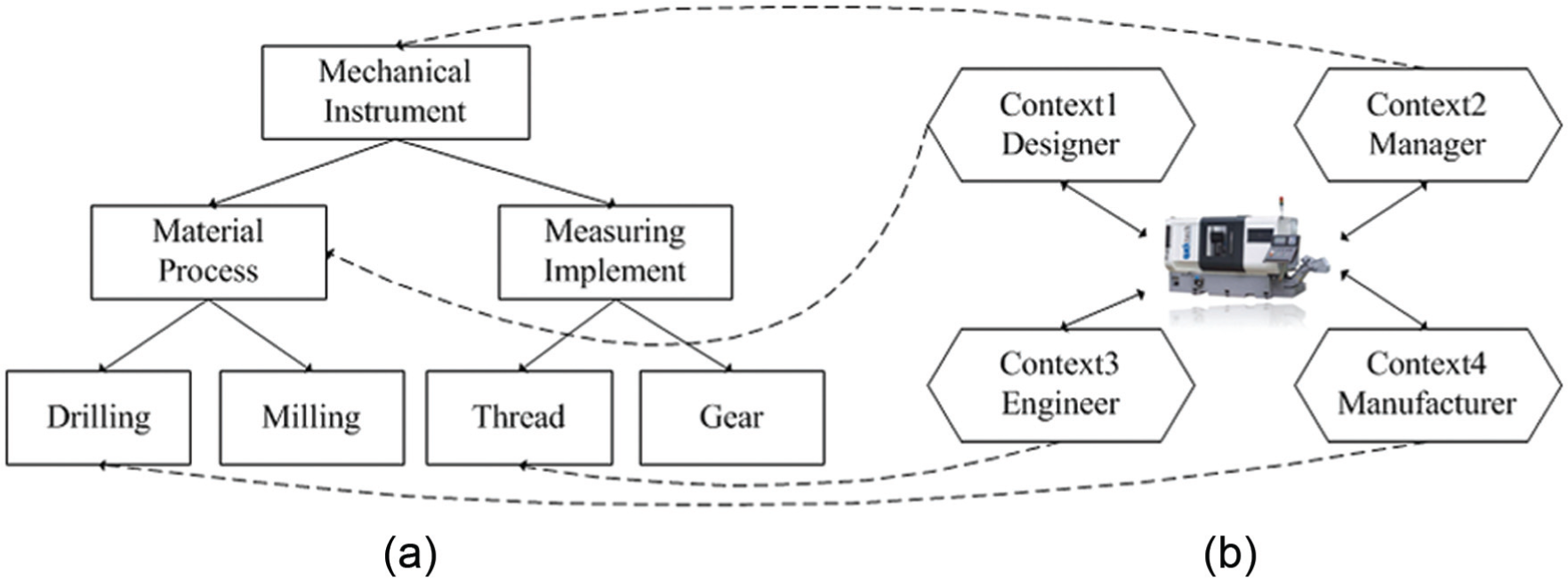
A manufacturing resource in different contexts: (a) a fragment of a mechanical instrument ontology and (b) a manufacturing resource and its context.
In order to define and unify behavior information of manufacturing resources from different contexts, a multi-granularity resource virtualization model is formalized based on set theory. The proposed model has three objectives: (1) define various elements; (2) consider resource virtualization based on three levels (process level, activity level, and attribute level) and construct resource aggregation functions, respectively; and (3) integrate virtualized resources based on resource aggregation functions.
Definition 1 (
Definition 2 (
Definition 3 (
Definition 4 (
The three-tuple
Proposed method
The granularity is defined as the measurement for the scale or level of problems. Within the field of granular computing, information granularity usually refers to “structural granularity,” which signifies the structural abstraction of information items. For example, chapters, sections, pages, and paragraphs are different structural abstractions of a book. 6 Similarly, in the context of Cloud Manufacturing, a complex manufacturing task is usually recursively decomposed into subtasks until there are appropriate manufacturing resources to match them. During the decomposition process, the three factors (workflow, activity node, and functional features of a manufacturing resource) exert great influence on resource granularity. They reflect both the level and the view of resource discovery and selection. In this section, resource granularities are investigated from three levels (process, activity, and attribute). These levels correspond to the three factors, respectively. Resource aggregation functions are constructed from three views (similarity, granularity gap, and resource composition). These views represent resource selection strategies of different levels.
Attribute-oriented resource classification
The attribute level is closely related to registered manufacturing resources. Behavior information of manufacturing resources is emphasized in this level. Attribute-oriented resource classification aggregates manufacturing resources based on their behavior information. This kind of classification decouples manufacturing resources with their capabilities to deal with resource failure.
Let
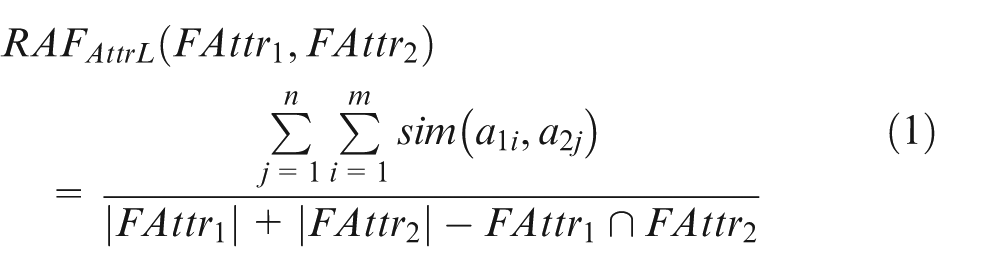
sim
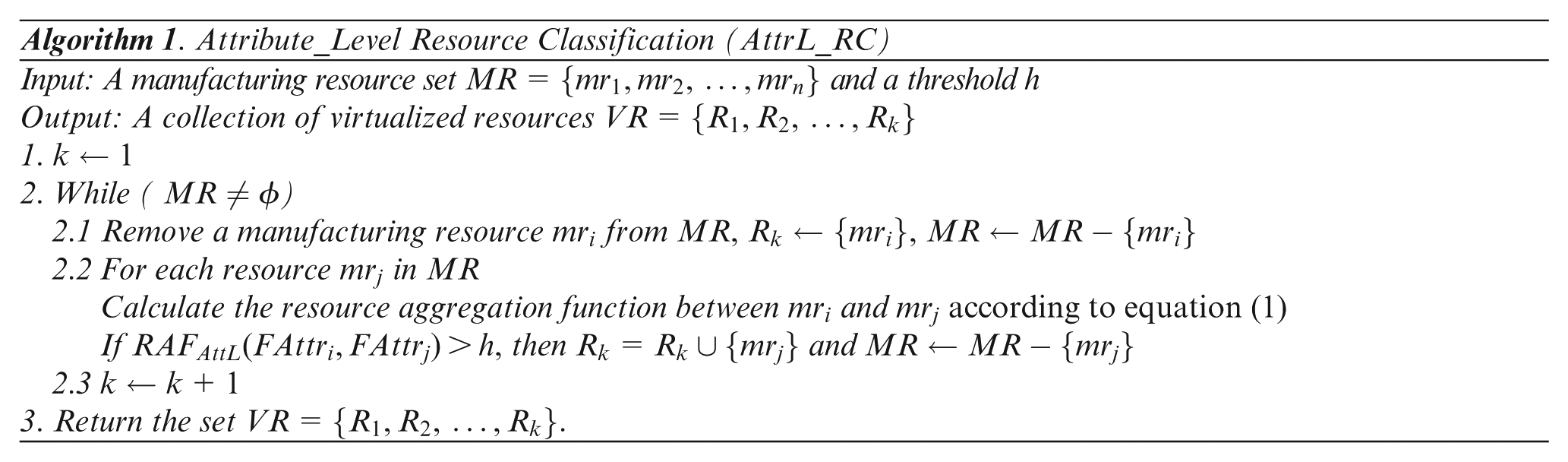
The worst case of the algorithm is that each resource is a singleton. Under this case, the algorithm produces
Activity-oriented resource classification
The activity level is related to activity nodes of a workflow and usually represents a subtask. Both the demand of subtask and behavior information of manufacturing resources are taken into account at this level. However, the resource and the activity are always described in different ways. For example, a manufacturing activity is described as “conical magnetic bearing grinding.” In a cloud platform, there are two manufacturing resources. One is described as “bearing polish grinding,” the other is described as “conical raw material processing.” The conjunctive forms of the descriptions are (1) conical ∧ magnetic ∧ bearing ∧ grinding, (2) bearing ∧ polish grinding, and (3) conical ∧ raw material processing. A partial reference ontology for the resource virtualization is illustrated in Figure 3.
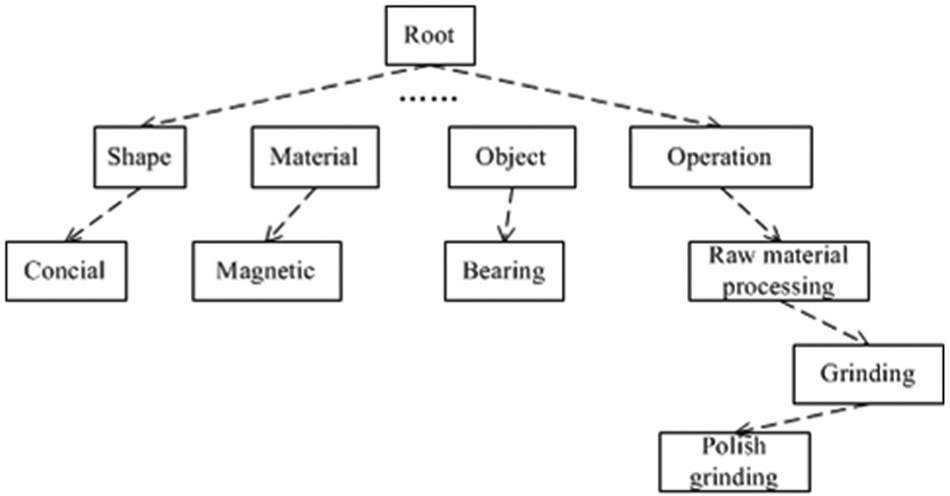
A partial reference ontology for resource virtualization.
Figure 3 shows that there are four VIEWs (shape, material, object, and operation) and two HIERARCHYs (the third level and the fourth level in the reference ontology) in an activity description. The first manufacturing resource includes two VIEWs (object and operation) and two HIERARCHYs (the third level and the fifth level). The second manufacturing resource includes two VIEWs (shape and operation) and one HIERARCHY. Both the manufacturing resources are all partially suitable for the activity. But which one is more appropriate for the activity? To measure how successfully a manufacturing resource provides support for an activity, resource contribution degree (RCD) is introduced.
Let
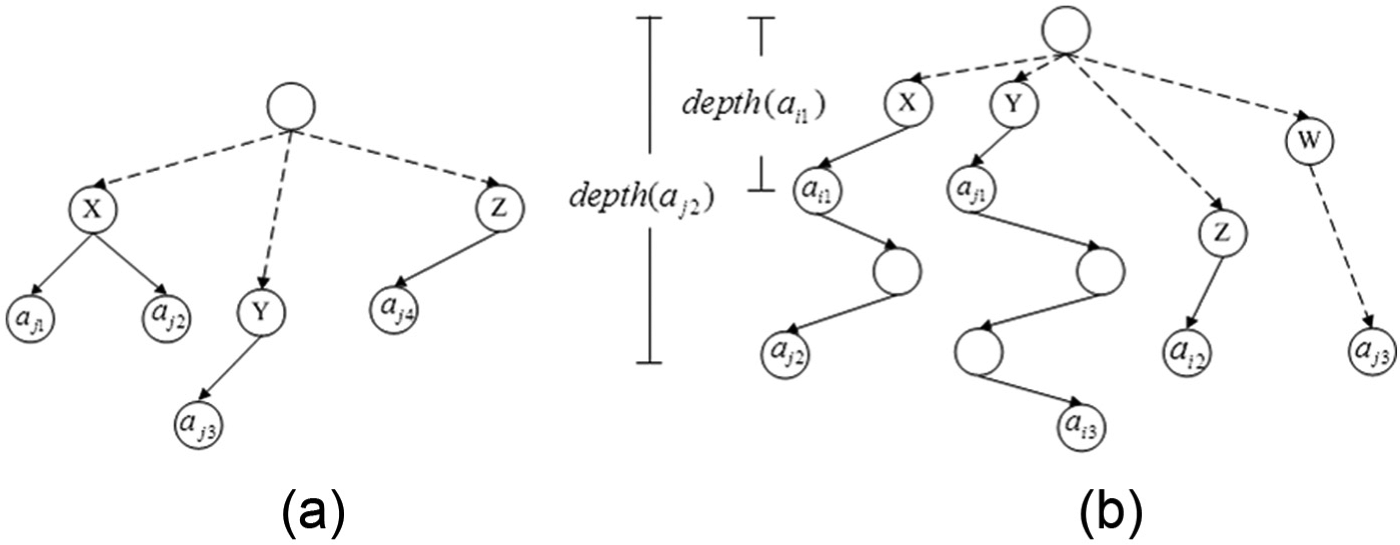
Examples for the calculation of (a)
Let
Let
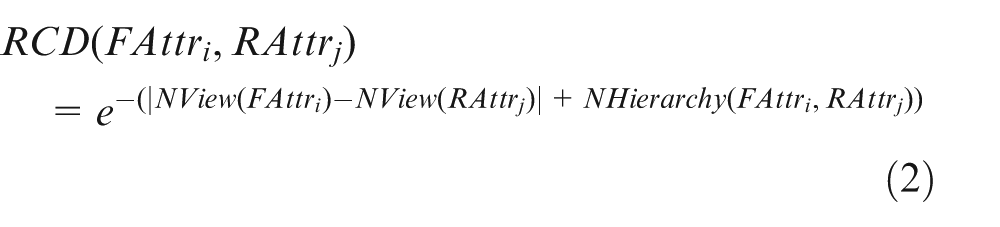
Normal distribution is usually regarded as the most suitable function for describing the probability distribution of phenomenon, of which the density function is an exponential function with the feature of trend of conservation. Therefore, equation (2) constructs the RCD with an exponential function, which means that the larger the granularity gap between a manufacturing resource and an activity, the smaller the RCD.
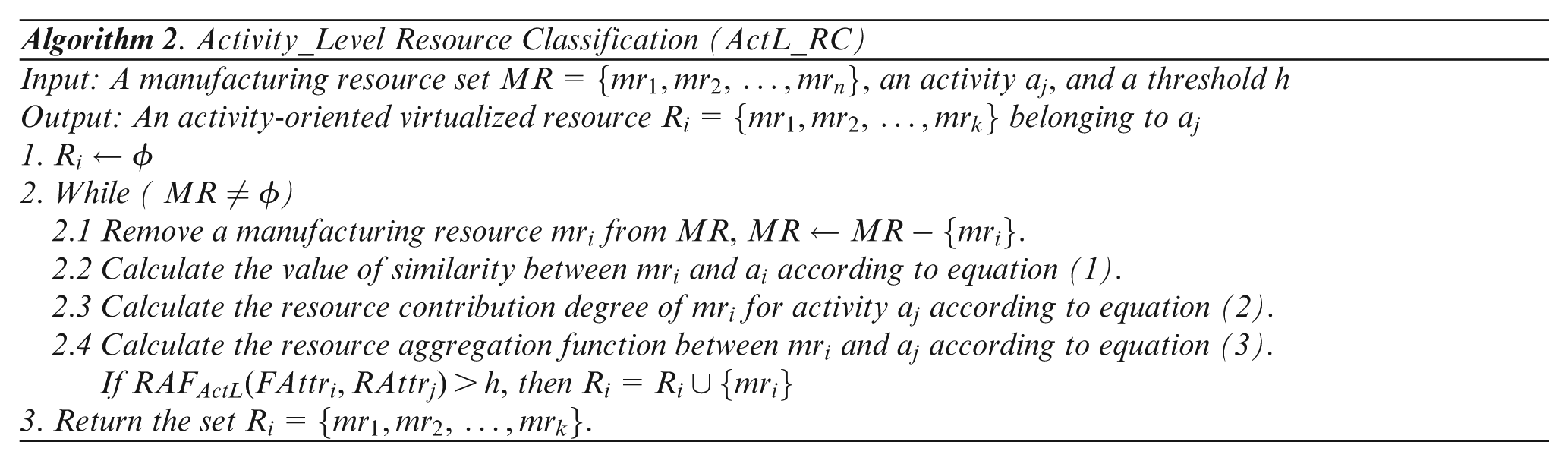
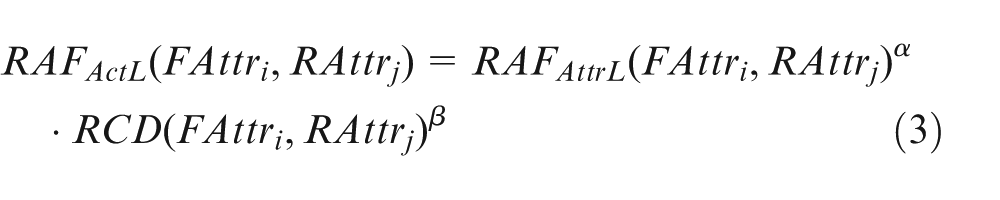
Besides the similarity between the descriptions of a manufacturing resource and an activity, the RCD is also incorporated in the activity-oriented resource classification function as defined in equation (3). The combination of the two aspects can enhance to improve the possibility of resource discovery and selection
The time complexity of computing the similarity and RCD is
Process-oriented resource classification
Process level is related to a workflow and usually represents a business function unit with a coarse granularity. Process-oriented resource classification aims at providing valuable information for enterprise collaboration. As the workflow shown in Figure 5, each activity has a candidate set of manufacturing resources. Process-oriented resource classification is responsible for discovering the resource compositions from
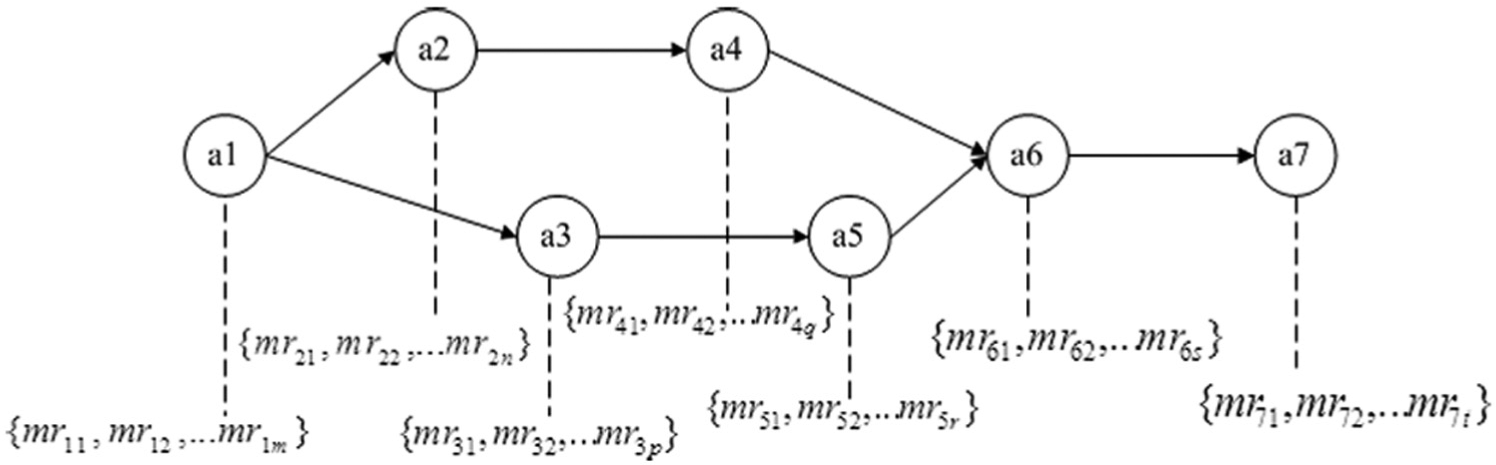
Process-oriented resource classification.
There are two aspects in resource composition: (1) the internal behavior of a manufacturing resource and (2) the sequence relations among activities. The former is denoted as the input parameters and output parameters of a manufacturing resource. The latter is represented as predecessors and successors of an activity. As the predecessor is the antonym of successor, only predecessors are chosen to represent such sequence relations.
Let
As shown in Figure 6, there are four phases in the process-oriented resource classification: (1) a topological sort sequence of the workflow is obtained, for example,
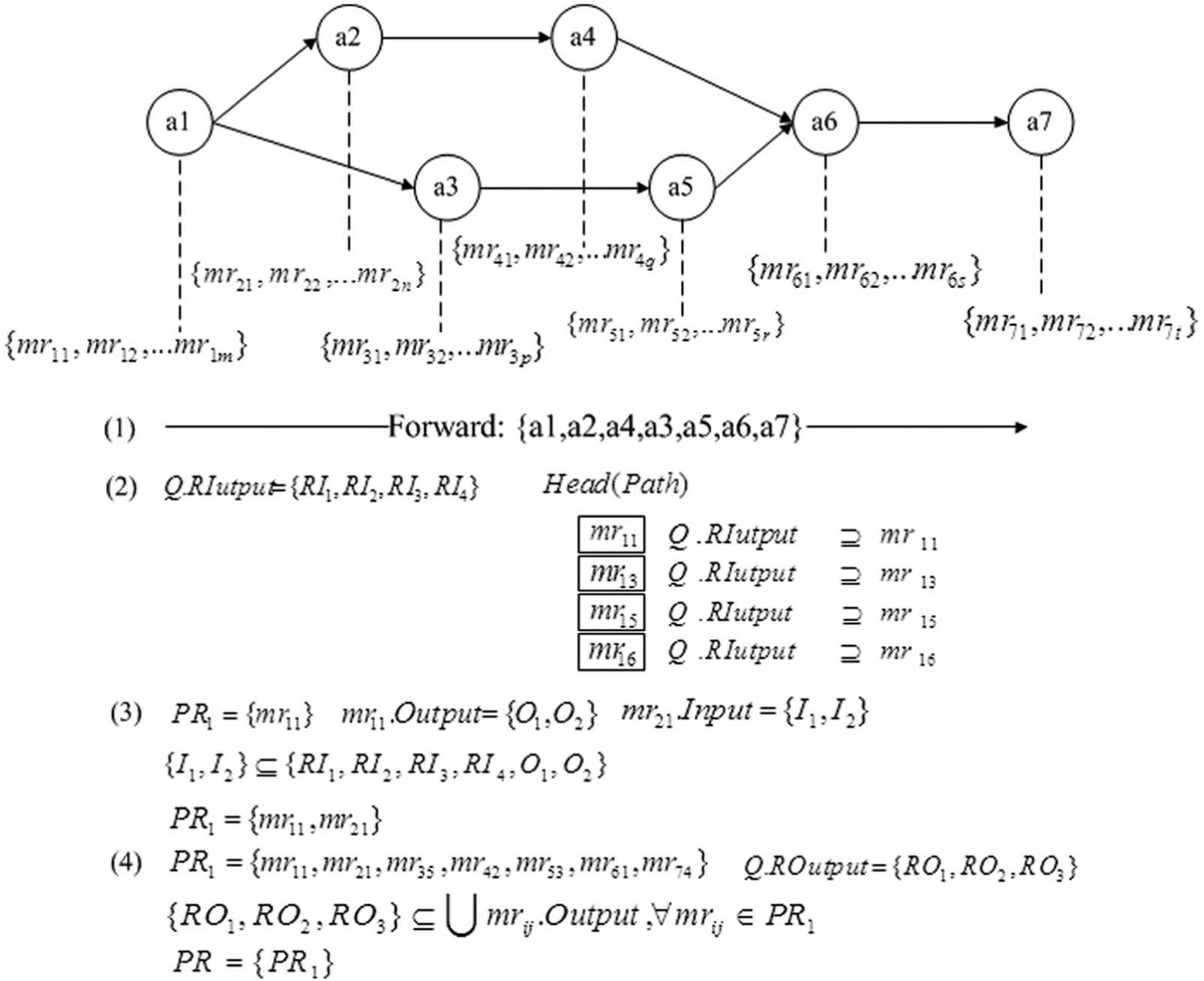
The main phases of process-oriented resource classification.
The details of the algorithm are summarized as follows:
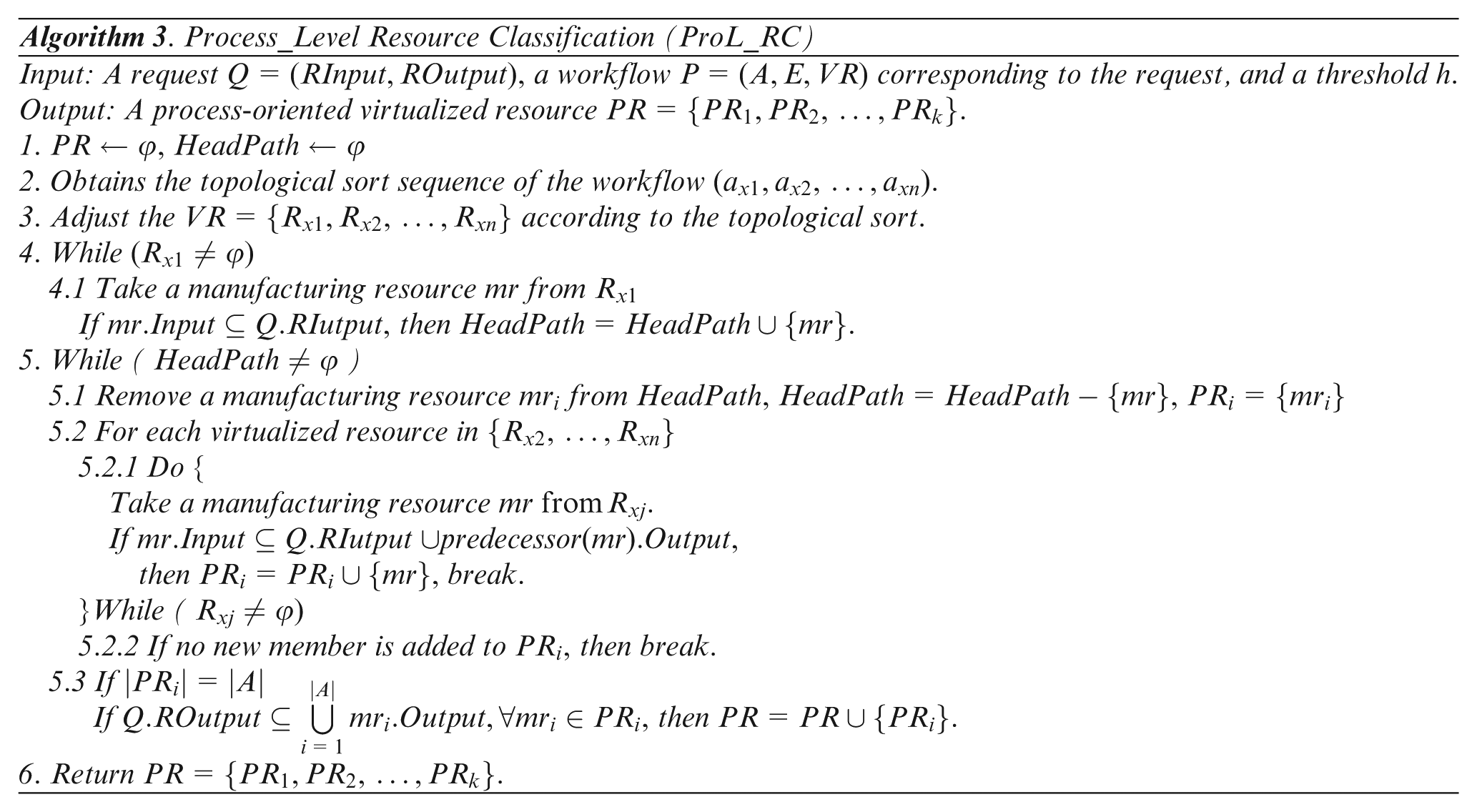
The time complexity of Algorithm 3 is
Case study
To validate the proposed method, a case study in a Chinese manufacturing enterprise is performed. The enterprise has been engaged in manufacturing aerospace products for 40 years, of which projects are cooperated with domestic and oversea partners. The enterprise has sites in ChengDu (CD), AnHui (AH), and HeiNan (HN), all of which are resource providers and capable of machining parts. The main business of the enterprise covers the design, development, and manufacture of tools and dies. The enterprise has more than 6000 international advanced computer numerical control (CNC) machining equipment and testing equipment, more than 100,000 ordinary equipment (machine tools, cutting tools, and auxiliary devices), and nearly 20,000 employees. Constrained by the core competitiveness, the enterprise relies on relatively single production orders to get profits. This situation has led to bottlenecks on some resources, on one hand, and other resources are idle, on the other hand. Thus, the overall resource utilization is only 40% in the past 3 years. To increase profits and improve resource utilization, the enterprise aims to promote resource sharing and interoperability based on a private cloud platform. Therefore, an effective resource virtualization prototype is developed based on the proposed method. There are more than 100 registered enterprises to seek enterprise collaboration and share their resources. The size of the resource pool has reached a scale of millions.
Figure 7 demonstrates the application screenshot of the multi-granularity resource virtualization prototype, which consists of four modules from top to bottom: the manufacturing task management module, the virtualized resource generation module, the manufacturing resource management module, and the user management module. The user management module provides cloud users with three roles to participate in the transactions of Cloud Manufacturing. Different roles have different permissions. Resource providers register and publish their resources through the manufacturing resource management module, while system operators maintain resource information according to the dynamic environment. Multi-granularity resource classifications are generated by the virtualized resource generation module. Based on the classification results, the cloud platform discovers and selects appropriate resources for resource requestors with different granularities. The task management module deals with manufacturing tasks submitted by resource requestors. Resource requestors trace the processing state of manufacturing tasks and give their evaluation after the tasks are completed.
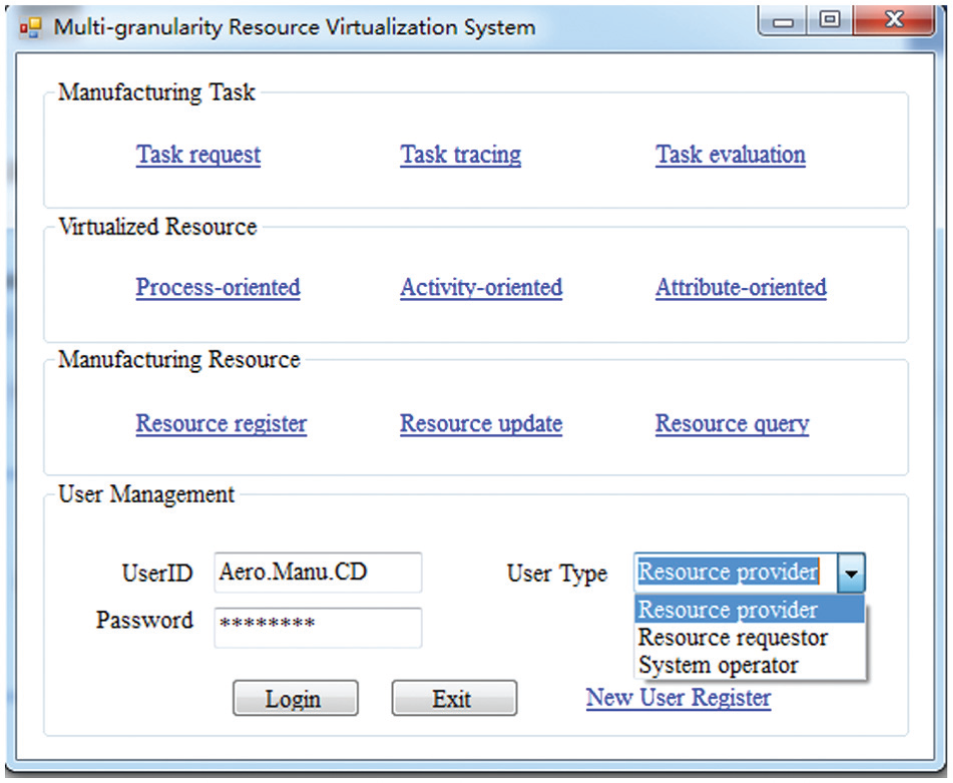
Interface view of multi-granularity resource virtualization.
Figure 8 depicts the structure of a helicopter tail, which consists of ducted, guide blade, rotor blade, and tail shaft. Due to the limited resources, the manufacturer of the helicopter tail submits orders to the cloud platform to outsource subtasks.
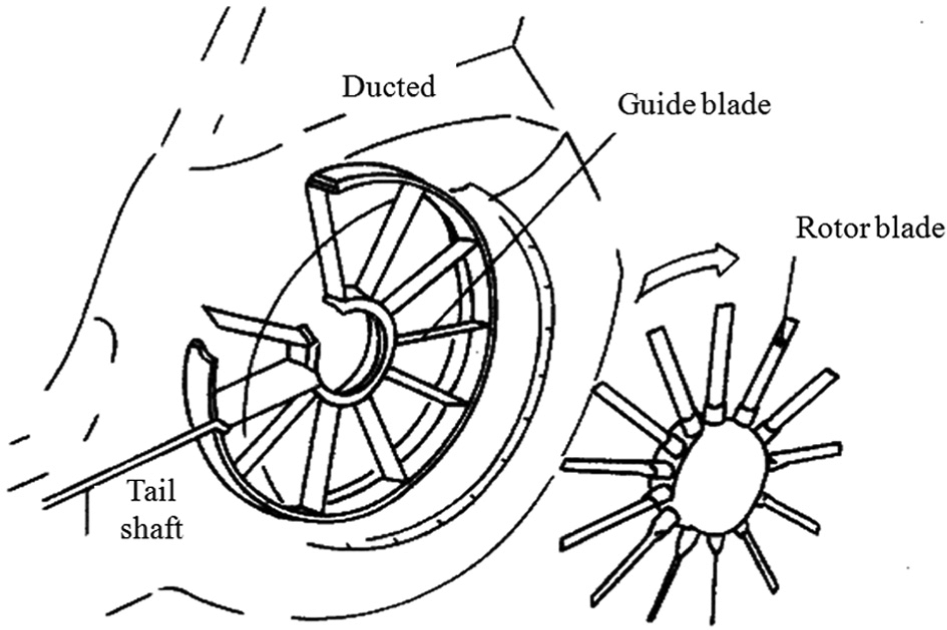
The structure of a helicopter tail.
The task request is input via the interface shown in Figure 9, which consists of three main parts, the basic information, the task profile, and the path to save the task document. The basic information includes the requestor name, the task name, the manufacturing cost, and the deadline. The profile divides the manufacturing task into three levels. The component level describes the component type, such as power machine, transport machine, chemical machine, medical machine, mining machine, hoisting machine, heavy machine, general machine, and others. The part level provides the part type and the required material. The part type includes gear, fork, shelf, box, case, plate, irregular surface, thin wall, and others. The required material is divided into carbon steel, alloy steel, cast iron, aluminum, aluminum alloy, copper, copper alloy, rubber, plastic, complex material, and others. The process level describes the process type, the geometry, and the related parameters. The process type includes assembly, testing, heat treatment, casting, wielding, machining, NC, stamping, special processing, and others. The geometry includes conical, flat, cylinder, hole, slot, tooth surface, complex surface, and others. The three levels provide requestors with a flexible task description framework. The cloud platform collects the input data and transmits the data into an XML format (Figure 10), which is saved in the path provided by the requestors.
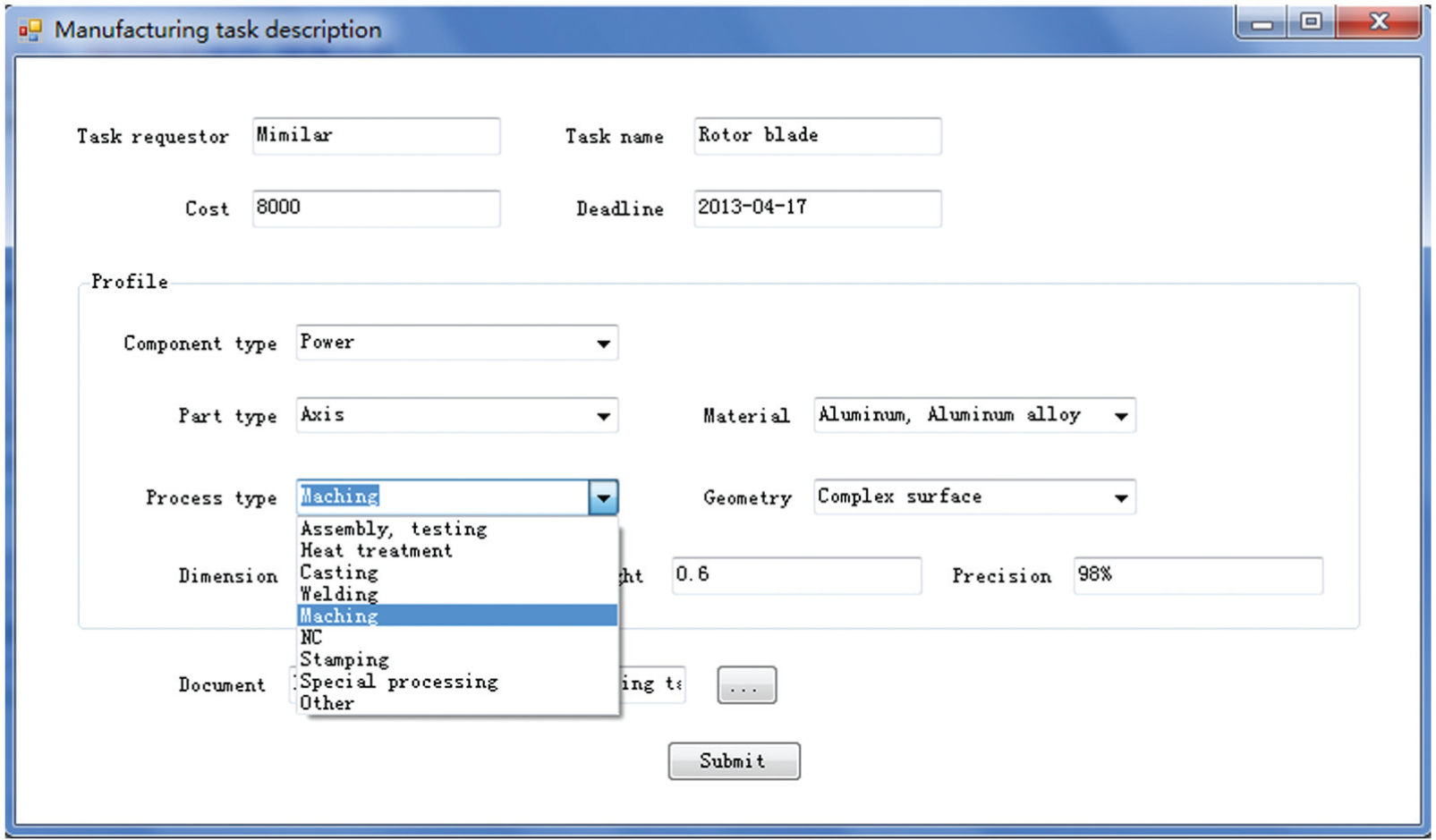
The interface of manufacturing task description.
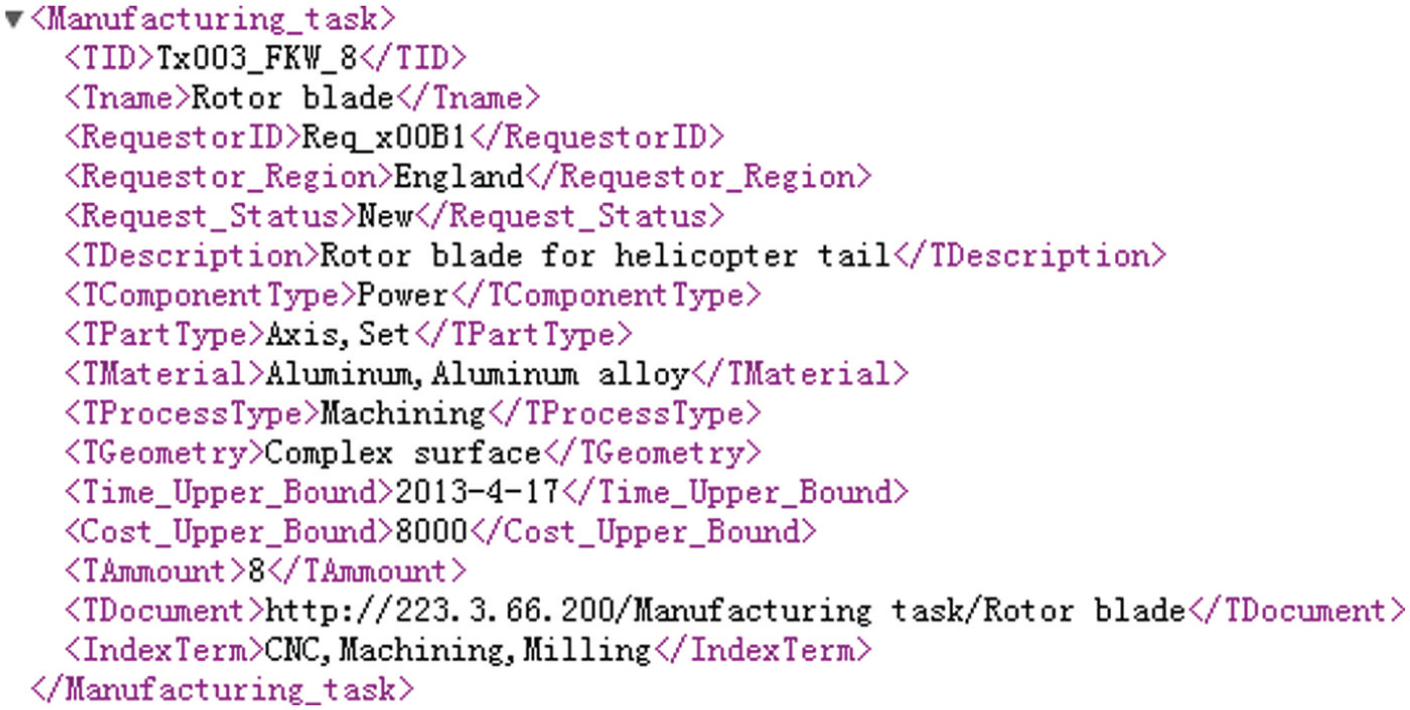
XML representation for the manufacturing task.
As soon as receiving a manufacturing task, the cloud platform decomposes the manufacturing task into activities. As shown in Figure 11, the manufacturing of the rotor blade of a helicopter tail is decomposed into 12 activities. Activity descriptions and the required resources are listed. Based on the activity list, the requestors add or delete activities according to their knowledge. Once the activity list is determined, virtualized resources are generated for each activity.
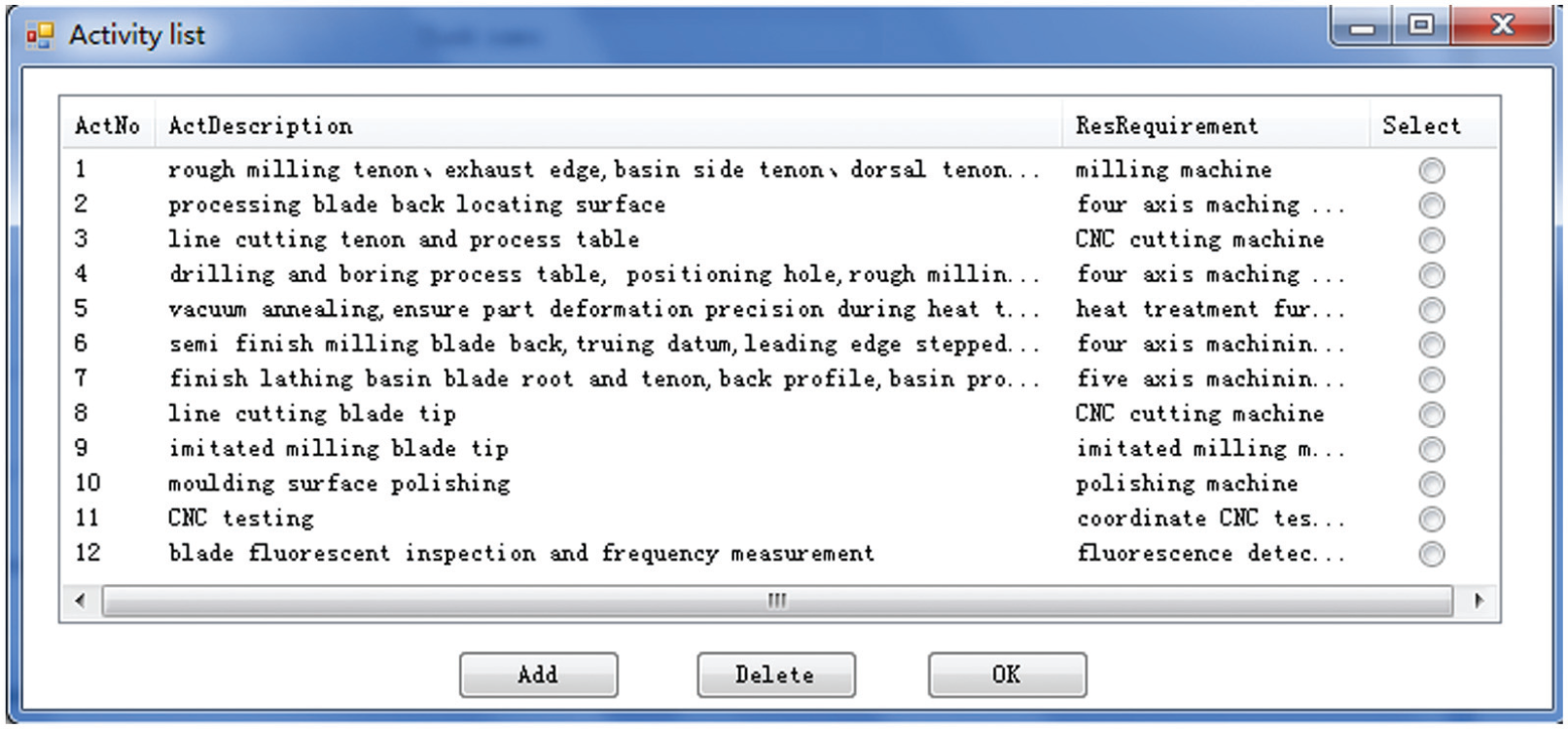
The activity list of the manufacturing task.
Figure 12 illustrates a view for activity-oriented resource classification. The left window displays an ontology tree of the Cloud Manufacturing classes including manufacturing enterprise, manufacturing task, manufacturing resource, nonfunctional feature, and functional feature. Each class is further classified into an extensive hierarchy. Besides class inheritance, each class has relationship properties with other classes and its own data properties. The ontology attaches resource semantic to resource description document, so that the computer can understand the meaning of a manufacturing resource. For example, after a resource provider registers his or her manufacturing resources through the interface in Figure 7, resource information is delivered to the resource virtualization system by structured documents, semistructured documents, or nonstructured documents. At this time, the cloud platform can only deal with these documents by keyword-based approaches. To achieve accurate resource classification, each resource document is annotated with semantic based on the ontology. Figure 13 illustrates a segment of semantic description for a multi-spindle lathe. From the description, functional features of the multi-spindle lathe are described in the first three rectangles. These functional features are reflected by behavior information, which is described in the fourth rectangle. The input parameters, such as hasMaterial, hasProcess, and hasAngle, show what the resource requires to perform functional features. The output parameters, such as hasResult, show what the resource provides after the functional features are completed. As the document is annotated by ontology, the cloud platform can understand the meaning and the application mode of a manufacturing resource. On the top of the middle window in Figure 12, the inputs for generating virtualized resources are set. By specifying the granularity and the match degree, a requestor obtains the virtualized resource corresponding to an activity. On the bottom of the middle window in Figure 12, an activity-oriented virtualized resource is described. The virtualized resource is generated for No. 7 activity in Figure 11. A collection of manufacturing resources are aggregated. These manufacturing resources have multi-spindle lathing capability or the similar capability. From the details of the description, it can be seen that for an atomic activity, the activity-oriented resource classification collects 328 candidate manufacturing resources into a virtualized resource. Compared to the size of the resource pool with a scale of millions, the number of candidate manufacturing resources is small, which is suitable for cloud platform for further choosing and guarantees high efficiency for the choosing procedure. On the other hand, the candidates provide enough manufacturing resources for the requestor and ensure the effectiveness of the resource classification. Details of resources in the virtualized resource are listed on the right window in Figure 12. The proposal provides a good balance between effectiveness and efficiency.
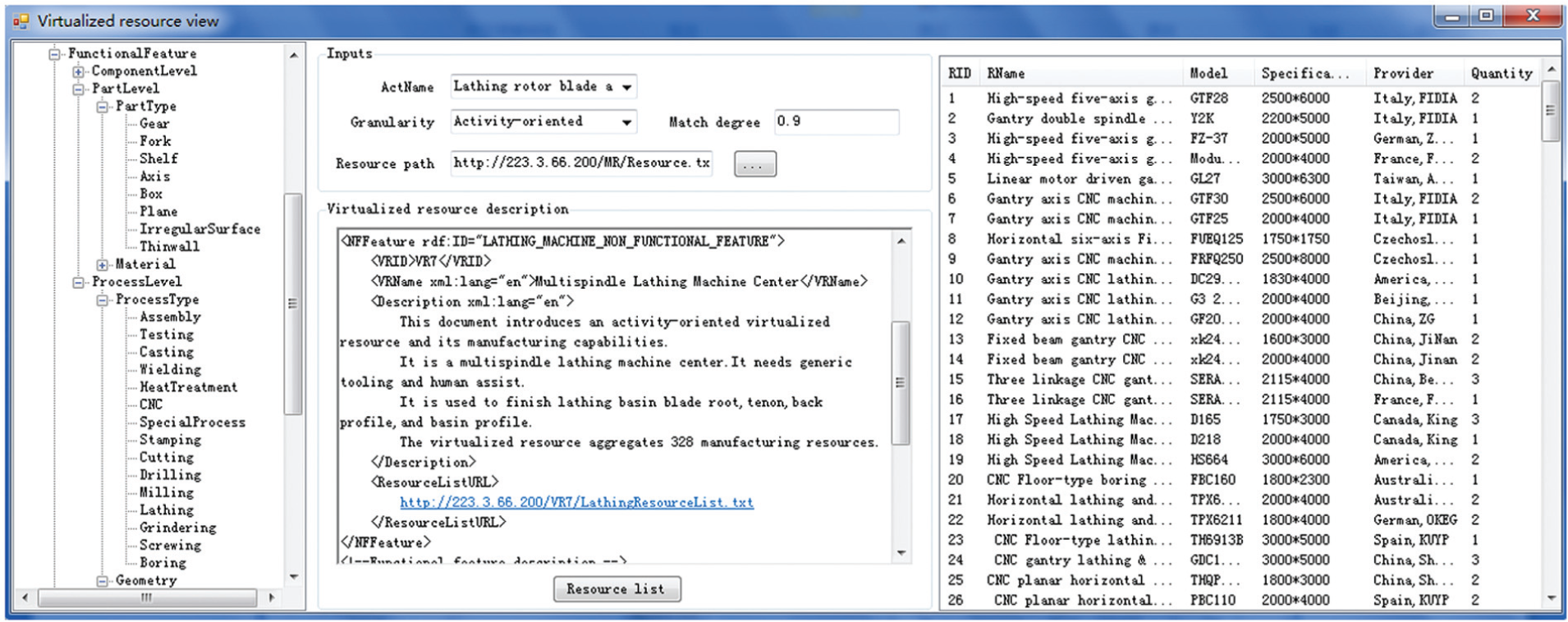
Activity-oriented virtualized resource view.
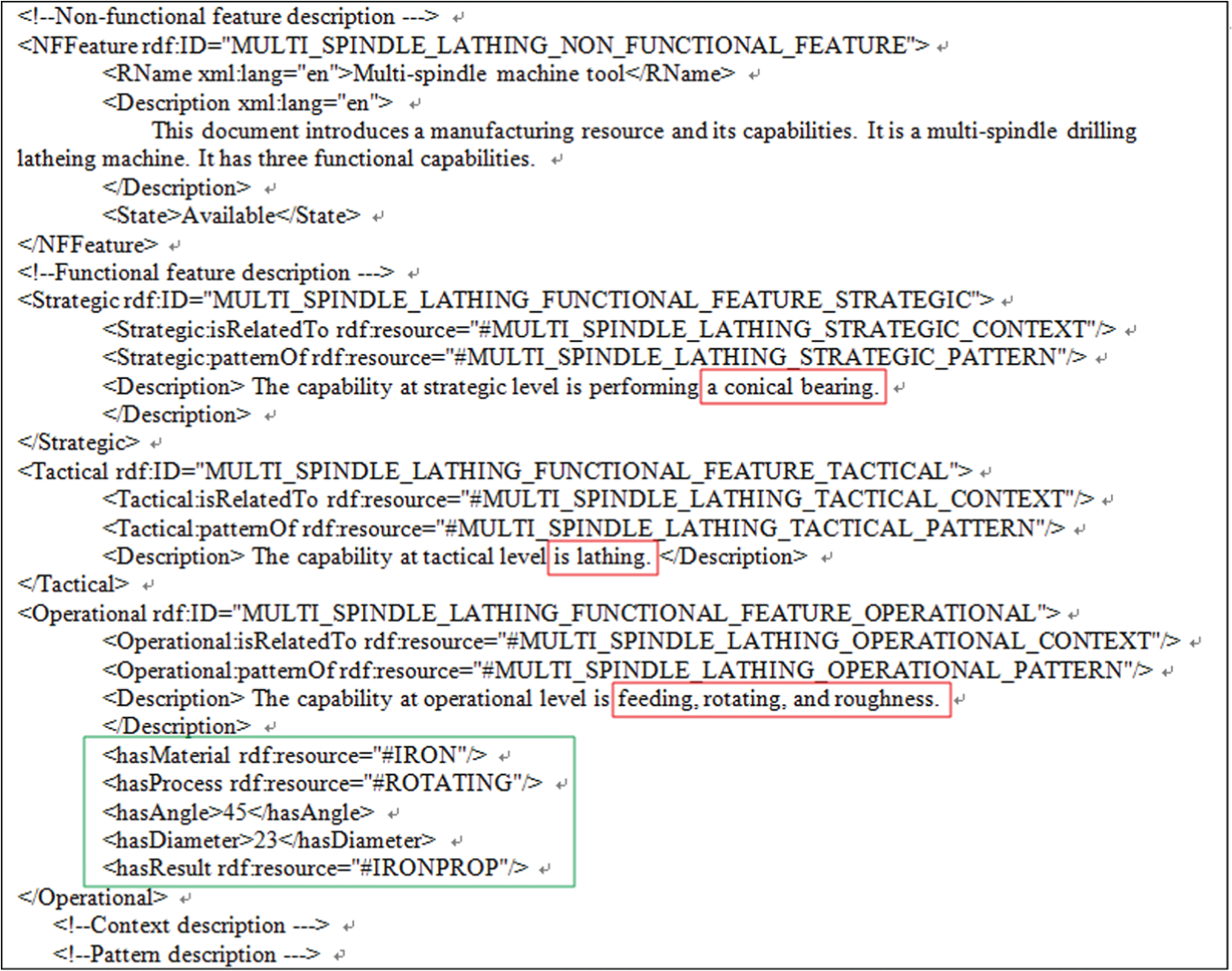
A segment of semantic representation for a multi-spindle lathe.
Conclusion
In this article, a multi-granularity resource virtualization method is proposed for resource discovery and selection in Cloud Manufacturing. By analyzing the recursively decomposed complex manufacturing task, workflow, activity, and resource are regarded as the three basic factors in collaborative manufacturing. Correspondingly, three granularity levels are introduced for practical application. Based on set theory, the multi-granularity resource virtualization problem is formulized. Resource aggregation functions are constructed concerning with similarity, granularity gap, and resource composition. Resource classification algorithms are presented for different granularity levels. Results on case study demonstrate that the proposed method is rather flexible to cope with the complex nature of Cloud Manufacturing. It provides a foundation for resource discovery and selection along with both effectiveness and efficiency consideration.
Footnotes
Declaration of conflicting interests
The authors declare that there is no conflict of interest.
Funding
This work was supported by National Natural Science Foundation of China (grant nos 61070160, 61272377).