




Abstract
Globalization is one of the widely considered factors in today’s manufacturing industries. This paradigm may be adopted for new technologies such as additive manufacturing. Additive manufacturing has been identified as an innovative manufacturing technology in recent years. The characteristics of this manufacturing technology, especially its support for quick design to manufacturing, have dominated it as an efficient generation of manufacturing techniques for today’s global manufacturing paradigm. This article discusses the requirements and necessities of additive manufacturing with respect to a globalized perspective. Considering the two major requirements studied as integration of manufacturing operations and enabling collaboration in distributed manufacturing networks, this article proposes an idea as an enabler of additive manufacturing in the global paradigm. This idea proposes the application of Cloud manufacturing paradigm as one of the recent researches for global manufacturing environments. The capabilities of the Cloud manufacturing to fulfill the requirements and necessities of additive manufacturing in global paradigm are discussed and elaborated through a comprehensive case study. The case study uses the recent researches of the authors for an integrated and collaborative distributed Cloud manufacturing platform named XMLAYMOD platform. This article discusses the different aspects of the Cloud manufacturing–based solution for additive manufacturing systems.
Keywords
Introduction
Globalization is one of the widely considered factors in today’s manufacturing industries.1–3 This paradigm is considered due to factors like reduction in the products’ lifecycle time, the rapid industrial development,4,5 the efficient reduction in the new product development time and the manufacturing processes 6 and the possibility of key personal recruit from the globe. 7 To affiliate with the increasing globalization, a variety of research fields have been considered, among which new manufacturing technologies are widely considered.8–10 Additive manufacturing can be named as one of the recent novel approaches used to fulfill the globalization motivators especially reducing new production development and manufacturing time.8,11,12 This paradigm is a new forming process that can be classified as layer-by-layer material addition in manufacturing and has been identified as an innovative manufacturing technology in recent years.13–15
However, depicting the additive manufacturing from a global perspective faces with challenges, most of the additive manufacturing processes use geometric and topologic information of products in a definite format known as Stereo Lithography (STL) format, which consists of a list of triangular facet data.16–18 This paradigm increases the dependency of additive manufacturing on other manufacturing operations especially computer-aided design (CAD) processes.8,19,20 Considering the global manufacturing paradigm, the interoperability among various CAx software packages each working with a data structure and additive manufacturing production methodologies is inevitable.21–25
Moreover, the challenges of additive manufacturing from global view increase where collaboration management among different manufacturing agents distributed over the globe is considered. 26 Working on overlapping manufacturing processes of additive manufacturing is also known as a competitive factor for global manufacturing paradigm.27–29 Finally, in a global paradigm for additive manufacturing, integrating heterogeneous and autonomous data sources through enterprises’ structures that are numerous in number and also in approaches for data management is a significant challenge where additive manufacturing agents work based on different data structures.30,31
To propose an efficient solution for additive manufacturing in a global perspective, this article has conducted a brief discussion for interpretation of the requirements for additive manufacturing paradigm in global perspective in section “Additive manufacturing necessities based on a global perspective.” In section “Overview of recent additive manufacturing researches from a global perspective,” this article discusses the latest work provided by the researchers in the area of additive manufacturing processes and discusses their structure and procedures based on the global perspective. Discussing the capabilities of one of the recent researches for global manufacturing paradigm called Cloud manufacturing in section “Cloud manufacturing paradigm,” the article proposes the application of the Cloud manufacturing for additive manufacturing in a global perspective in section “Cloud manufacturing paradigm: an efficient idea to achieve the additive manufacturing integration and collaboration in a global perspective.” Finally, to clarify the aforementioned capabilities, a brief case study is discussed in section “Case study.”
Additive manufacturing necessities based on a global perspective
In this section, this article discusses the main characteristics of additive manufacturing paradigm for a global manufacturing environment. This is accomplished by a discussion on global manufacturing requirements and necessities in today’s manufacturing environments. This article then interprets the requirements and necessities in the world of additive manufacturing. Globalization has shown an increasing trend in the manufacturing industries due to factors like market condition changes, 32 international key personnel recruitment, 7 access to limited resources, cost-effectiveness, 33 customer behavior changes and the innovations in manufacturing technological improvements.1,34 This paradigm motivated the manufacturing enterprises to use new strategies for production based on global network production system.21,35 According to the conducted researches, the main requirements and necessities of global manufacturing can be described as given below.
Integration of additive manufacturing operations
To achieve the global manufacturing paradigm, integration of manufacturing operations in different countries distributed over the globe has been known as one of the major requirements.9,36,37 Considering the various and distributed manufacturing data sources through enterprises’ structures with a vast variety of approaches for manufacturing data management, manufacturing integration is a significant challenge.24,38,39 This challenge encourages the researches for development of tools and techniques to integrate the various manufacturing enterprises’ data sources.40,41 This integration should enable the manufacturing data sources for collaboration while using their own data ontology design, structures and procedures for data management and representation.29,31 Moreover, the data integration should support the integration of autonomous, distributed and heterogeneous database sources into a single data source associated with a global schema.38,42,43
Considering that the additive manufacturing paradigm should answer the global manufacturing paradigm, the aforementioned issues of global manufacturing process integration in earlier section are compatible with the requirements of additive manufacturing. Moreover, the concept of integration in additive manufacturing operations is more critical due to the application of methodologies like reverse engineering in additive manufacturing.4,14 In processes like reverse engineering, the design data are produced from existing part which probably has been scanned or measured by a measurement device in different data formats. However, most techniques of additive manufacturing use a single geometry input called STL.17,44 The existence of an integration mechanism is essential to support the reverse engineering methods based on their data formats while fulfilling the STL data format necessities. 45 Also, aiming to improve the build time, geometry quality and decreasing the geometrical errors inherited from the additive manufacturing methods, there has been a high motivation to develop new and sophisticated algorithms and strategies that emphasize on the requirements of global integration through additive manufacturing paradigm. 14 Finally, it is remarkable that there are additive manufacturing methods that rely on CAD design files directly each with a different data structure.18,20,46
Enabling collaboration in distributed additive manufacturing networks
In global manufacturing paradigm, there is a growing collaboration through different manufacturing networks and production units.47,48 This collaboration is necessary due to its results like enabling the manufacturing enterprises for efficient response to market demands and obtaining competitive advantages.49,50 The collaborative manufacturing agents need to exchange their ideas with their colleagues who are distributed in geographical locations.26,30,51 This distributed collaborative manufacturing paradigm becomes more crucial where the collaborative teams use multi-disciplinary methods through different levels of global manufacturing processes 49 and the wide variety of manufacturing agents each specific manufacturing information and knowledge requirements. 52 Nevertheless, considering the worldwide factors affecting the manufacturing enterprises, 53 the existence of collaborative and distributed manufacturing networks to enable the efficient reaction has been discussed to be inevitable.3,54,55
Through the additive manufacturing processes, the designers need to discuss their design ideas. 47 Considering the global manufacturing paradigm requirements and necessities in aforementioned section, the designers are often distributed over geographical locations. To achieve the proper collaborative design in an acceptable accuracy and time, the existence of a collaborative platform with the capability to support the distributed additive manufacturing agents for effective communication, collaboration and evaluation is essential. 56 Moreover, the processes of fabricating the products in the additive manufacturing processes are usually located in distributed location over the globe. This requires the transition of design data to fabrication processes and increases the necessities of a collaborative distributed additive manufacturing environment. Finally, the additive manufacturing paradigm aims to shorten time to deliver the product in global manufacturing paradigm13,57 and this aim is discussed to have high dependencies with the organized collaboration of manufacturing agents from early phases of product development to later processes of fabricating the additive manufacturing products.49,58,59
Overview of recent additive manufacturing researches from a global perspective
In this section, this article reviews the dominant researches having contribution on facilitating the additive manufacturing paradigm based on a global perspective. This article investigates the capabilities of the research works for the aforementioned additive manufacturing requirements and necessities in a global perspective. The capabilities of the researches in the area of additive manufacturing operation integration and also enabling the collaboration of distributed additive manufacturing agents are discussed.
Considering the novelty of additive manufacturing paradigm in comparison with the conventional manufacturing techniques, most of the related researches for additive manufacturing paradigm are struggling for efficient methods of product fabrication from the product design data. Among these researchers, Asiabanpour and Khoshnevis 20 with focus on machine path generation algorithm in selective inhibition of sintering (SIS) processes, Byun and Lee 60 with focus on optimal build-up direction, Haipeng and Tianrui 18 with focus on efficient filtering and optimization slicing algorithms and Zeng et al. 56 proposing efficient algorithms for slicing accuracy can be named. These researches rely on the conventional technique of product design information based on STL formats. The researches propose their efficient contribution to facilitate the additive manufacturing processes. In a similar approach, Yin 4 proposed an extended STL format and a new triangulation algorithm to reduce the time in additive manufacturing processes and also reduce the related errors when using STL format. However, none of the aforementioned researches has proposed efficient approaches to maintain the integrity through additive manufacturing processes. Moreover, the researches lack collaboration enabler for a distributed additive manufacturing in a global paradigm.
To facilitate the support for a collaborative environment in additive manufacturing, researchers like Ma et al. 13 proposing an efficient adaptive slicing algorithms, Zhongwei 16 proposing a bridge solution for integration of reverse engineering and additive manufacturing processes, Jin et al.8,14 working on adaptive algorithms and strategies to shorten the time and increase the accuracy in additive manufacturing processes and Sakamoto et al. 61 proposing an Internet-based distributed collaboration framework for additive manufacturing processes can be named. Although these researches proposed enablers for collaboration of manufacturing agents during the additive manufacturing operations, they lacked an integrated data model in which the data and information related to additive manufacturing processes can be managed.
From other aspect of additive manufacturing requirements and necessities for a global paradigm, there are efforts that have proposed enablers for data integration of additive manufacturing processes. Of these researchers, Hur et al. 62 and Starly et al. 17 who have concentrated on using ISO 10303–based data structures for design information can be named. However, the integrity of other additive manufacturing operations is not ensured by likewise standards and also the researches lack to propose structure and procedures for a distributed collaborative additive manufacturing environment. Sohmura and Kumazawa 63 proposed a computer-aided rapid prototyping system for an implant surgery support system. The proposed system has an integrated data structure, although this integration is not integrated based on international solutions and has been implemented based on self-developed data structure, it has successfully integrated the chain of implant surgery processes from CAD/computer-aided manufacturing (CAM) operation to rapid prototyping operations and enabled the collaboration for different agents.
Discussion of the aforementioned works and the proceeding research
Considering the discussed researches in previous section, this article abridges the research works as shown in Table 1. The research works can be categorized into four main groups. In the first group of the researchers, the main contribution is focused to increase the efficiency of additive manufacturing processes. But the works in this group lack both efficient approaches that integrate the additive manufacturing processes and also enablers of collaboration among distributed manufacturing agents. The second group of researchers enables the collaboration for a wider range of manufacturing agents in comparison with the first group. However, this group lacks integration solution in additive manufacturing chain. Oppositely, the third group of researchers can ensure the integrity in some part of additive manufacturing chain, but this group of researches lacks structure and procedures that enable the collaboration for additive manufacturing agents. The last group has proposed integrated and collaborative solution; however, the integrity is based on a self-developed data structure which restricts the improvements and application of this solution for both a wider range of additive manufacturing processes and enabling interoperability with other additive manufacturing ontologies.
Dominant researches for additive manufacturing paradigm from a global perspective.
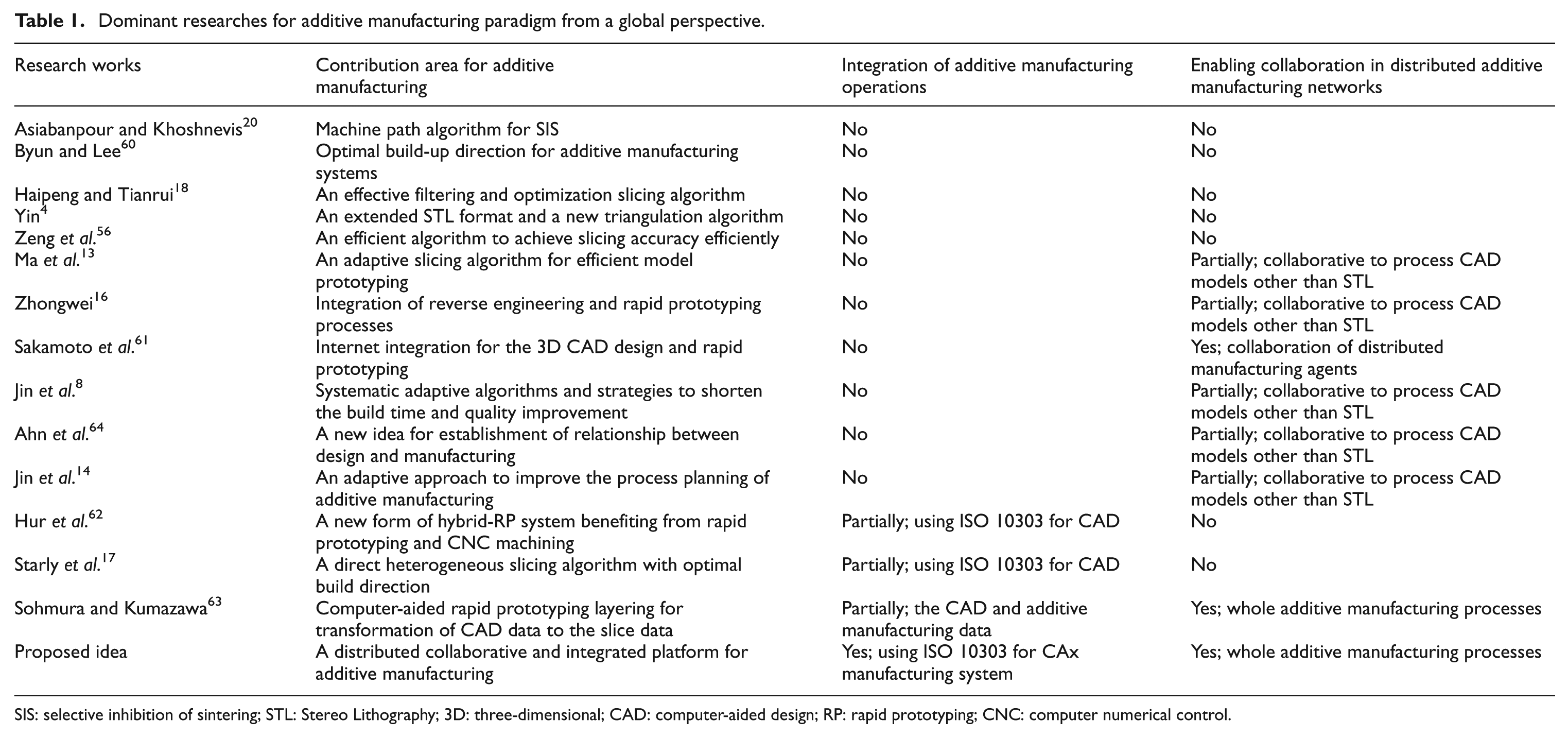
SIS: selective inhibition of sintering; STL: Stereo Lithography; 3D: three-dimensional; CAD: computer-aided design; RP: rapid prototyping; CNC: computer numerical control.
Proceeding, this article proposes an idea to achieve additive manufacturing integration as well as enabling collaboration of distributed manufacturing agents from a global perspective. This idea will be accomplished based on the recent researches of global manufacturing paradigm. This paradigm is based on a service-oriented approach named Cloud manufacturing paradigm. This service-oriented approach enables the manufacturing agents mostly consisting of CAx agents to collaborate with additive manufacturing agents each based on their own data structures and methodologies. 29 During a case study, the application of a Cloud manufacturing approach which has an international integration solution based on ISO 10303 (STEP) standard will be discussed.
Cloud manufacturing paradigm: an efficient idea to achieve the additive manufacturing integration and collaboration in a global perspective
Considering the discussed researches and the aforementioned requirements and necessities of the additive manufacturing paradigm, in this section, this article proposes an idea to achieve the additive manufacturing requirements in a global environment. This idea is called Cloud manufacturing, which is based on recent researches for global manufacturing environments. Cloud manufacturing enables a collaborative and integrated environment for today’s global manufacturing systems.
Cloud manufacturing paradigm
Cloud manufacturing is discussed as a novel movement from production-oriented manufacturing to service-oriented manufacturing. 65 The Cloud manufacturing paradigm proposes an efficient approach in which distributed manufacturing resources are encapsulated into cloud services and managed in a centralized way.29,66,67 The Cloud manufacturing supports the manufacturing agents using cloud services based on agents’ manufacturing operation. 68 This support is depicted based on the core context of Cloud computing paradigm in which everything is treated as a service.69–71 The range of these services varies from product design, manufacturing, testing, management or any other operation requirement in the product lifecycle manufacturing operations.69,72–74
The manufacturing resources are divided into two types 65 known as manufacturing physical resources like equipment, computers, servers and raw materials which are usually tangible. The second type of manufacturing resources are manufacturing capabilities which are intangible like different enterprises’ application software, data mining and data analysis methodologies, standards and manufacturing experience in different manufacturing operations.75,76
Cloud manufacturing as a solution depicting the additive manufacturing in a global perspective
Considering the Cloud manufacturing paradigm, this article proposes the idea of using Cloud manufacturing–based solutions to fulfill the requirements and necessities of additive manufacturing in a global paradigm.
Support of CAD process integration in additive manufacturing paradigm
As mentioned in earlier sections, the additive manufacturing paradigm endures high dependencies with the product design phases. These dependencies can be discussed based on two perspectives. In the first perspective, the product designers use different methods and techniques for product design which result in different product design models and ontologies. This perspective was depicted in previous sections as the requirements for integration of additive manufacturing operations in design phases. To fulfill this requirement, many researches have been conducted to facilitate interoperability issues using information technology concepts.30,31,77–79 The following researches can be realized through defined services in Cloud manufacturing paradigm. This article describes this feature through section “Case study” comprehensively.
In the second perspective, the dependencies of additive manufacturing paradigm can be described as the raised challenges for transition of product design data to the fabrication models and techniques. In this perspective, the main challenge is to integrate the product design phase with the additive fabrication phase. This perspective has been depicted as the enabler mechanism for collaboration in additive manufacturing processes. In this perspective, many researches have been conducted to facilitate integration data structure for a product lifecycle data model.25,80–82 The proposed structures can be implemented through defined services in Cloud manufacturing paradigm. This enables a wide range of product information model integration from design to process planning and manufacturing supporting the additive fabrication processes by delivering the required design data to them based on their required data format. In section “Case study,” this issue will be discussed based on Cloud manufacturing paradigm.
Support of distributed additive manufacturing networks
Considering that additive manufacturing paradigm is a young manufacturing technique in comparison with the other conventional manufacturing techniques, most of the current researches are focused on the efficient methods and techniques in additive manufacturing paradigm. However, considering the trends in today’s manufacturing systems benefiting from global networks of manufacturing agents from designers to manufacturing resources,83–85 the paradigm of distributed additive manufacturing networks in near future will be probable. There are many known researches that have been conducted to support the distributed manufacturing operations using information technology concepts’ capabilities.86–89 The Cloud manufacturing paradigm can ensure to support the mentioned researches in the form of defined services. These services enable the distributed manufacturing agents to collaborate with each other in distributed geographical locations.
Case study
In this case study, this article discusses the capabilities of a Cloud manufacturing solution to fulfill the additive manufacturing processes in global paradigm. The Cloud manufacturing solution should fulfill the aforementioned requirements and necessities of additive manufacturing paradigm especially in areas like CAD, process integration and distributed additive manufacturing networks.
XMLAYMOD: a collaborative and integrated platform based on a service-oriented approach of cloud computing paradigm
To investigate the capabilities of Cloud manufacturing paradigm, this article considers a collaborative and integrated platform for today’s manufacturing systems named XMLAYMOD, as shown in Figure 1. XMLAYMOD is proposed based on Cloud manufacturing paradigm. 29 XMLAYMOD offers an efficient solution in which distributed manufacturing resources are encapsulated into cloud services and managed in a centralized way.66,67
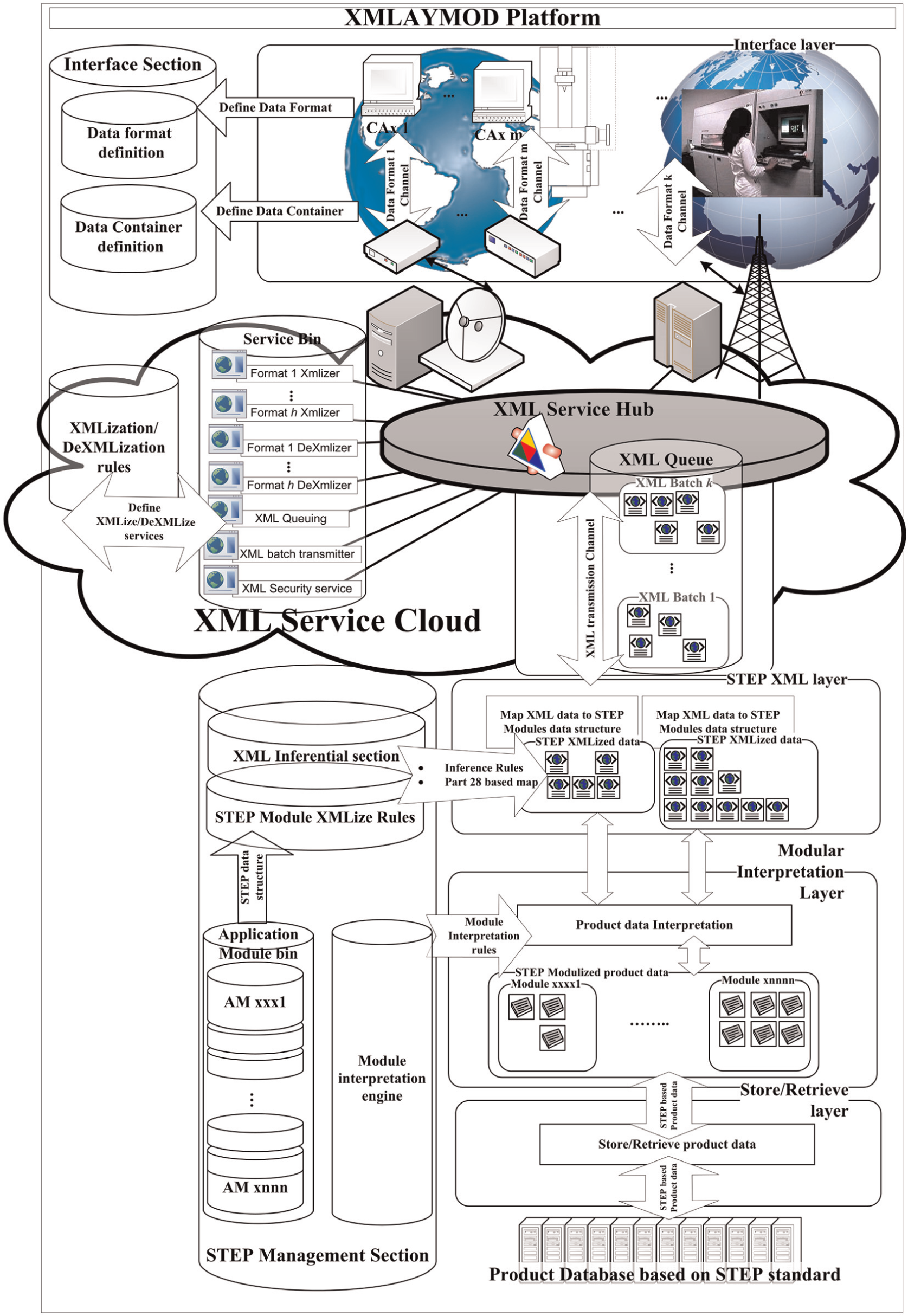
XMLAYMOD platform overall structure.
The layered and modular structure of the XMLAYMOD proposes functionalities like the following: 29
Support the manufacturing agents to collaborate with each other in different manufacturing operations. The layered structure of XMLAYMOD enables manufacturing agents to join the platform for data exchange. XMLAYMOD can share manufacturing data among the manufacturing agents while every manufacturing agent has its own data structures.
Support the manufacturing agents where they are distributed over the globe. XMLAYMOD is capable to exchange the manufacturing data among the distributed manufacturing agents applying its inherited XML Service Cloud architecture. The embedded XML service Cloud in XMLAYMOD enables the manufacturing agents to connect to the XMLAYMOD platform for data exchange.
Support the manufacturing data integration while the manufacturing agents collaborate with each other based on their own data structures. This integration is based on international STEP standard data structures which has been developed and is improving under auspices of the International Standard Organization and is believed to be one of the most successful solutions.90–93 Moreover, as the adoption of STEP standard can encounter with many problems,94–97 XMLAYMOD’s modular and layered approach can fulfill the shortcomings of the classical STEP standard limitations. The new modular approach of the STEP reduces shortcomings such as reduction of high cost and lengthy time of Application Protocol (APs)’ implementation by reusing the product data in a set of APs and eliminating duplication and repeated documentation of the same data entries in different APs.
As shown in Figure 1, there are four layers in the XMLAYMOD Cloud, as follows.
CAx Interface Layer
This layer is proposed to support the operations of product data send/retrieve with manufacturing agents which use their own data structures for product data exchange. This layer consists of data format channels each for a definite data format which facilitate the product data send and retrieve. The data format channels are managed and controlled by the Data Format Definition bin in the Interface Section. The Data Format Definition bin is reconciled by the Data Container Definition bin which enables the transmission of manufacturing data to the lower layer.
STEP XML Layer
XMLAYMOD ability to support the distributed manufacturing agents’ collaboration is achieved using the XML-based data containers. To accomplish the reliable manufacturing data transmission, XMLAYMOD uses a layer called STEP XML Layer. This layer receives the XML batch from the XML Service Cloud. The structure and procedures in this layer are designed based on the recent advantages of STEP standard in XML structures. Using the inferential rules and the procedures of the STEP Modules XMLizer rules based on part 28 in the STEP Management Section, the STEP XML Layer inferences the product data based on XML structure and then maps them to STEP Modularized product data structures. Vice versa, the operations are managed to map the product data from STEP XML–based format to a defined XML batch container.
Modular Interpretation Layer
This layer is designed to lead the integration of different product data structures. Different product data batches are delivered to this layer as a result of collaboration among different manufacturing agents. The structure of this layer uses Modular Interpretation rules and maps product data from different format to data structure of STEP Modules. This layer exchanges the integrated product data with Store/Retrieve Layer to store product data or retrieve the product data from this layer. 29
Store/Retrieve Layer
The responsibility of this layer is to send the product data to platform database and retrieve it vice versa. The procedures of this layer receive the product data according to the STEP standard modular data structures. In storing operations, the procedures in this layer send the product data to the database for storage operation. The product data are mapped to Integrated Resources (IRs) of STEP standard. Vice versa, these procedures retrieve product data from the database and then deliver them to Modular Interpretation Layer in the format of STEP standard data modules. 29 These STEP-based Modular product data will be transmitted to upper layers for modification by manufacturing software packages.
XML Service Cloud
To enable the support of distributed manufacturing agents, the XMLAYMOD also uses an XML Service Cloud. The XML Service Cloud, which is a service-oriented approach, enables different manufacturing agents to collaborate with each other when they are distributed over the globe. This Cloud is designed based on the XML structure due to its reliable and easy capability70,77,98–100 for manufacturing data transformation. The service cloud supports the manufacturing agents that are connected to Interface Layer. The XML Service Cloud comprises sections as follows:
Infrastructures in the cloud which handle the processing, storage and network computing operations in the cloud. These infrastructures support the manufacturing agents to send and receive their product data from XML cloud. Different data format channels in the Interface Layer are connected to XML service cloud by means of these infrastructures, which are distributed over the globe; 29
Service Bin that organizes the XMLizer/DeXM Lizer and XML queuing services. These services are responsible to put the manufacturing data to XML data structures or vice versa extract the manufacturing data from XML data structures for delivery to related data format channels. XML queuing service is used to provide the queuing operation for service execution. Of other services defined in the Service Bin are XML Batch transmitter for transmission of XML batch data through different sections and XML security services for the verification of manufacturing agents to data structures;
XMLization/DeXMLization rules that organize the rules for definition of XMLization/DeXMLization services for different data format definitions in the XML Service Cloud;
XML Queue section which is the queue for the XML batches. XML Queue section organizes the XML batches using the XML queuing service. The order of XMLization/DeXMLization service execution is managed by this section.
XML Service Hub provides the product data in the form of XML batches with their required services for different operations. The XML Service Hub joins the XML service Cloud with the out cloud Manufacturing universe. XML Service Hub organizes the operations of different sections of the XML Service Cloud with each other.
Capabilities of XMLAYMOD to fulfill the additive manufacturing in a global perspective
Considering that XMLAYMOD has enabled a collaborative and integrated environment for distributed manufacturing system, this article proposes the idea of using XMLAYMOD capabilities to fulfill the requirements and necessities of additive manufacturing in a global paradigm. This idea tries to align the aforementioned requirements of additive manufacturing in its global perspective and the shortcomings which have been discussed in recent researches with the structure and procedures of the XMLAYMOD platform.
Support of CAD processes in additive manufacturing paradigm
As mentioned in earlier sections, the additive manufacturing paradigm endures high dependencies with the product design phases. Considering the capabilities of XMLAYMOD for manufacturing data integration, this requirement can be fulfilled. XMLAYMOD can support different CAD data models and moreover integrate the collaborative design activities based on the STEP international standard. Considering the dependencies of additive manufacturing paradigm as the raised challenges for transition of product design data to the fabrication models and techniques, the XMLAYMOD capabilities can be used. XMLAYMOD benefits from an integration data structure which can ensure a product lifecycle ontology model. The modular structure of the XMLAYMOD enables it for benefiting from a wide range of product information model from design to process planning and manufacturing. XMLAYMOD can support the additive fabrication processes by delivering the required design data to them based on their required data format. Moreover, receiving the resulted data from additive fabrication processes, XMLAYMOD ensures the additive manufacturing data integrity based on the STEP standard data structures.
Support of distributed additive manufacturing networks
XMLAYMOD capabilities based on cloud manufacturing paradigm enable it to fulfill this requirement. As mentioned in earlier section, XMLAYMOD benefits from a cloud-based layer to enable the distributed manufacturing agents to collaborate with each other in distributed geographical locations. Using the STEP standard capabilities for supporting this cloud-based design, XMLAYMOD can moreover integrate the distributed manufacturing agents’ product data through the collaboration processes.
Using XMLAYMOD to enable the additive manufacturing in a global paradigm
In this case study, the product data integration will be studied through CAx software package collaboration while the manufacturing agents are distributed over different geographical locations and each will use different software packages and ontologies. The case study considers a product, as shown in Figure 2. It is aimed to use additive manufacturing technology for production. The additive manufacturing process is accomplished in distributed manufacturing units. There are one CAD, one process planner and an additive fabrication unit. The CAD agent which uses .WRL data format designs the product and collaborates in an additive manufacturing chain with the process planner of the rapid prototyping agents that work with .STL data format. Finally, the additive fabrication unit receives the process plan data and uses a self-developed software package to fabricate the part. This additive fabrication unit uses a RV-M1 Mitsubishi© robot for additive fabrication processes with its specified data formats. As mentioned earlier, these agents are assumed to be distributed in different geographical locations. The product data exchange between the above agents will be examined through this case study. The XMLAYMOD structure maintains product data integration based on STEP standard while enabling the collaboration among distributed additive manufacturing agents.
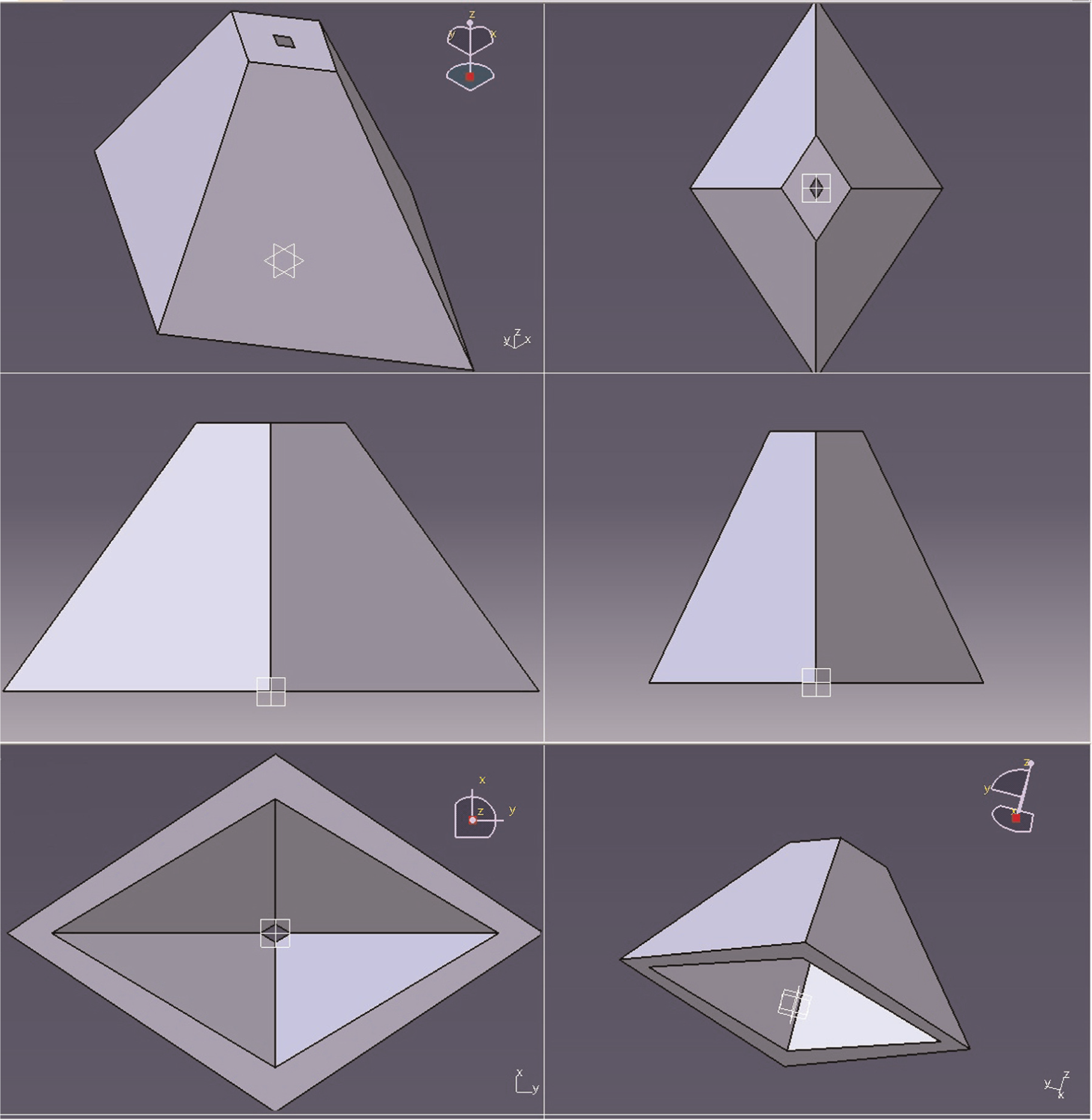
Case study product.
Part design
The first agent works with a CAD software package that uses .WRL data format. The agent designs the product as shown in Figure 2. The product design data are shown in Appendix 1. There is .WRL data format definition in Interface Section of the platform. Using the related .WRL data container definition for .WRL data format definition, the Interface Section connects to XML Service Cloud. Then, it requests for .WRL XMLizer Service from XML service Cloud. The XML Service Cloud uses XML security service and permits the Interface Section to use the .WRL XMLizer service. The product CAD data in .WRL data format are formed in an XML batch based on .WRL data format, as shown in Appendix 1. The Interface Section of the platform then requests for XML transmitter service. The XML Service Hub uses the XML transmitter service and delivers the .WRL XML batch to XML transmission channel. The XML Service Cloud then uses the XML Queuing service to deliver the .WRL XML batch to STEP XML Layer.
The STEP XML Layer uses XML Inferential section. It uses modular Interpretation rules for .WRL data format. The product design data are mapped to STEP standard Modular data format, as shown in Appendix 2. The modular STEP-based product data are formed based on part 28 XML late binding format. The STEP XMLized batch is then delivered to Modular Interpretation Layer. The Modular Interpretation Layer uses module interpretation rules and maps the STEP XMLized batch to required IRs of the STEP standard, as shown in Appendix 2.
The version of modular STEP used in XMLAYMOD is based on released ISO/TS 10303-203:2005 edition which considers AP203 based on Modular view. Now, the additive product design data are based on the STEP standard and then are delivered to Store/Receive Layer. This layer sends the CAD product data to platform database. The product data are stored based on STEP standard data format.
Part process planning
In the process planning phase, there is an additive manufacturing process planner who aims to receive the product design data and generates the related rapid prototyping data. This agent uses a developed software package that uses .STL data format, as shown in Figure 3. The process planner agent requests for the product design data in .STL format. The CAx Interface Layer uses the .STL data format channel to receive product design data from XML Service Cloud. Verifying the privilege of process planner agent by the XML service security, the XML Service Cloud uses the XML batch transmitter service to receive the product design data from STEP XML Layer. The Modular Interpretation Layer requests the product design data from Store/Retrieve Layer. The Product data in IRs of STEP standard format are retrieved from platform database. The product design data are then delivered to Modular Interpretation Layer. The Modular Interpretation Layer uses the Module Interpretation rules and provides the product design data in the format of STEP standard Modules. These product data modules are delivered to STEP XML Layer. The STEP XML Layer uses part 28 of the STEP standard and forms the product design data in XML format.
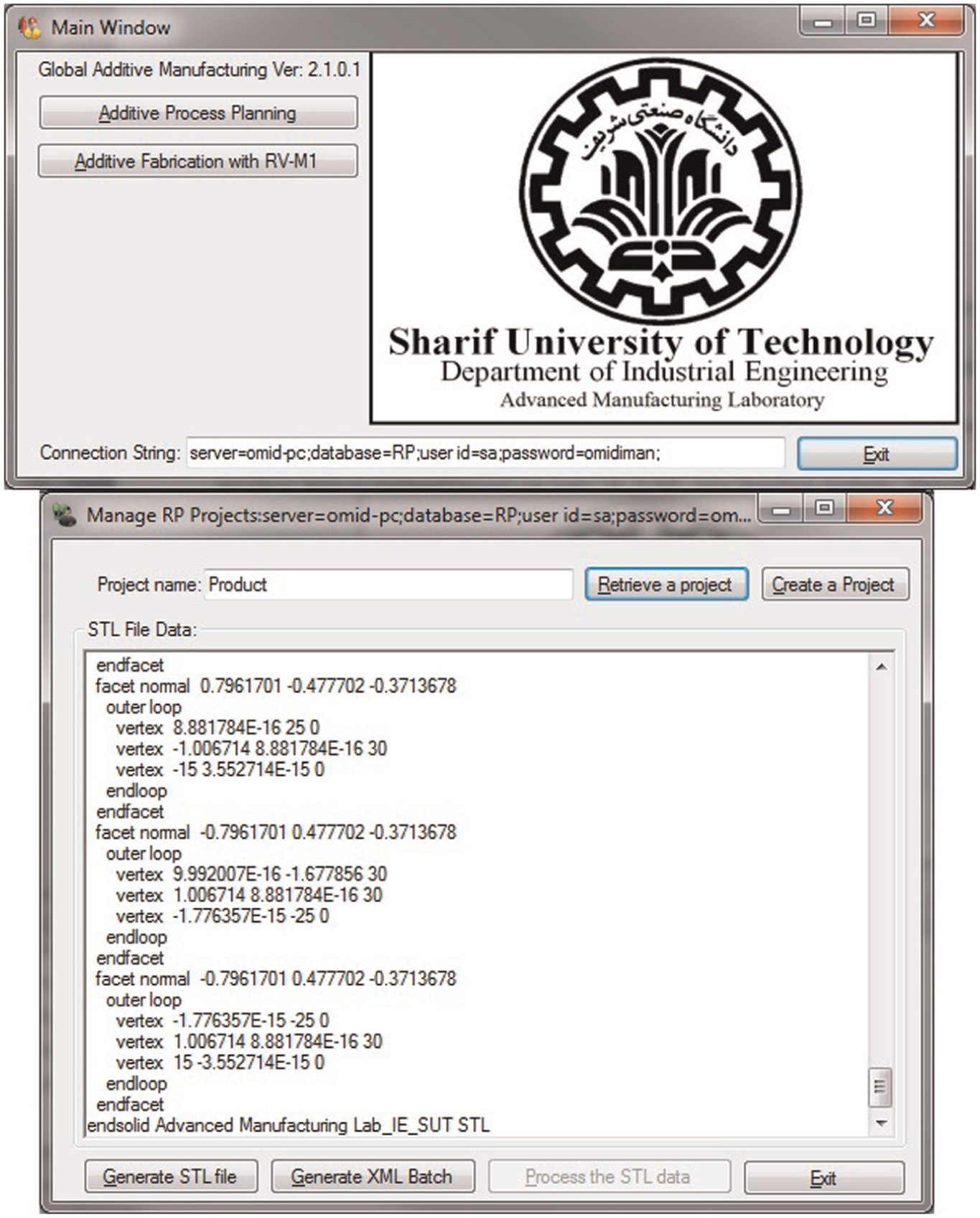
Additive process planner software package.
The STEP XML Layer maps the product design data to .STL format using the related Inferential Rules from XML Inferential section Bin. The result is product design data in .STL format in the form of XML data structure, as shown in Appendix 3. The XML Service Cloud uses the XML batch transmitter and XML Queuing services to retrieve the XMLized .STL data through the XML transmission channel. The product design data are delivered to the Interface Section through the .STL data format channel. The related Interface Layers use the appropriate .STL DeXMLizer services and deliver the product design data to additive process planner agent, as shown in Appendix 3.
The additive manufacturing process planner completes the additive process planning of product by its algorithm as shown in Figure 4 for finding the closed curve in which in every height the additive manufacturing machine should travel to fabricate the product, as shown in Figure 5. The resulting data are in a simple worksheet data format, as shown in Appendix 4. The additive process planner agent uses the related .txt data container definition in the Interface Sections. The Interface Section connects to XML Service Cloud and requests for .txt tab–based XMLizer Service. The XML Service Cloud uses XML security service and verifies the access of the Interface Sections to use the .txt XMLizer services. The additive process plan data are formed in an XML batch based on the related data format. The Interface Sections then request for XML transmitter service. The XML Service Hub uses the XML transmitter service and delivers the additive process plan batch to XML transmission channel, as shown in Appendix 4. The XML Service Cloud then uses the XML Queuing service to deliver the XML batch to STEP XML Layer.
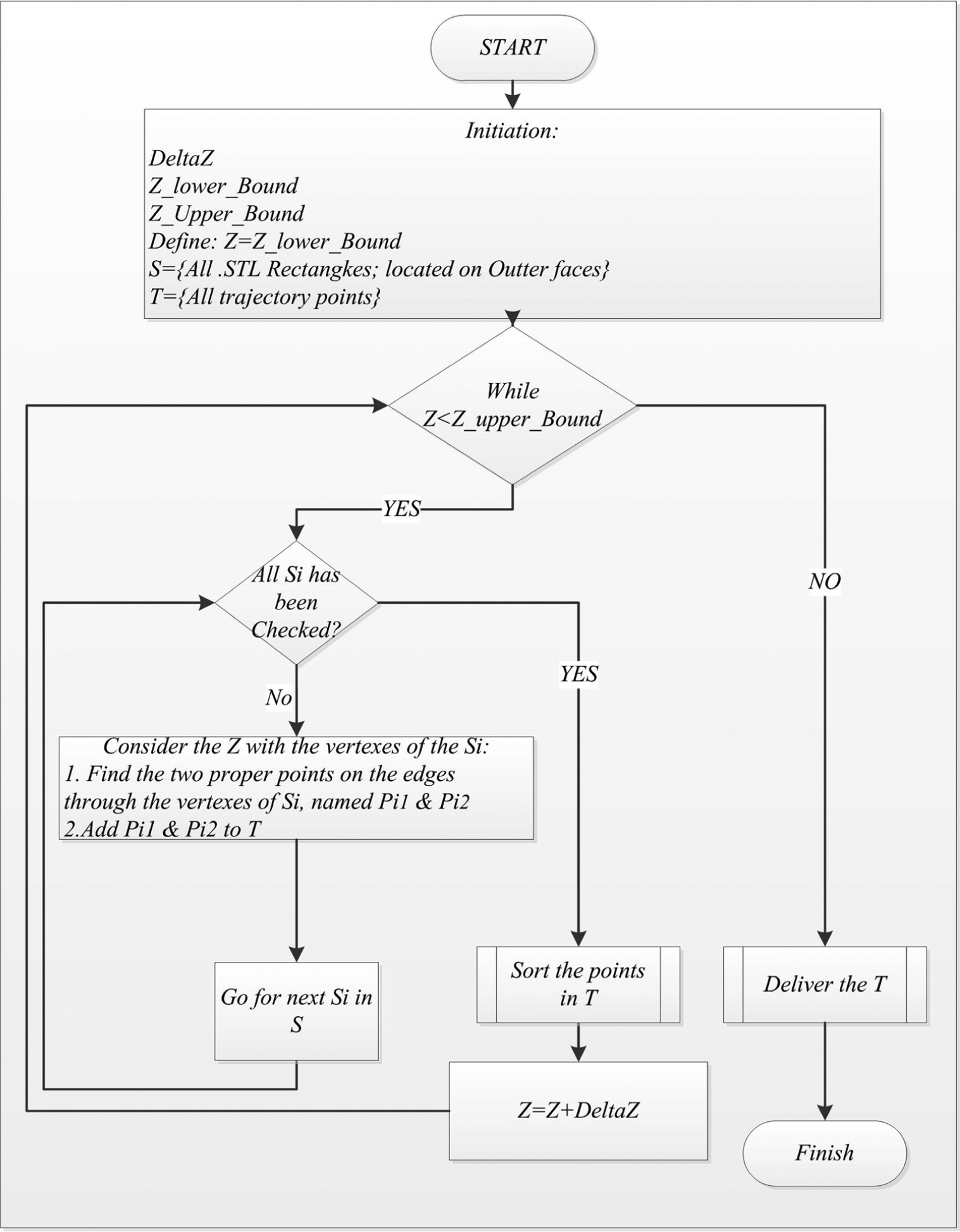
Developed algorithm for finding the closed curve in CAPP.
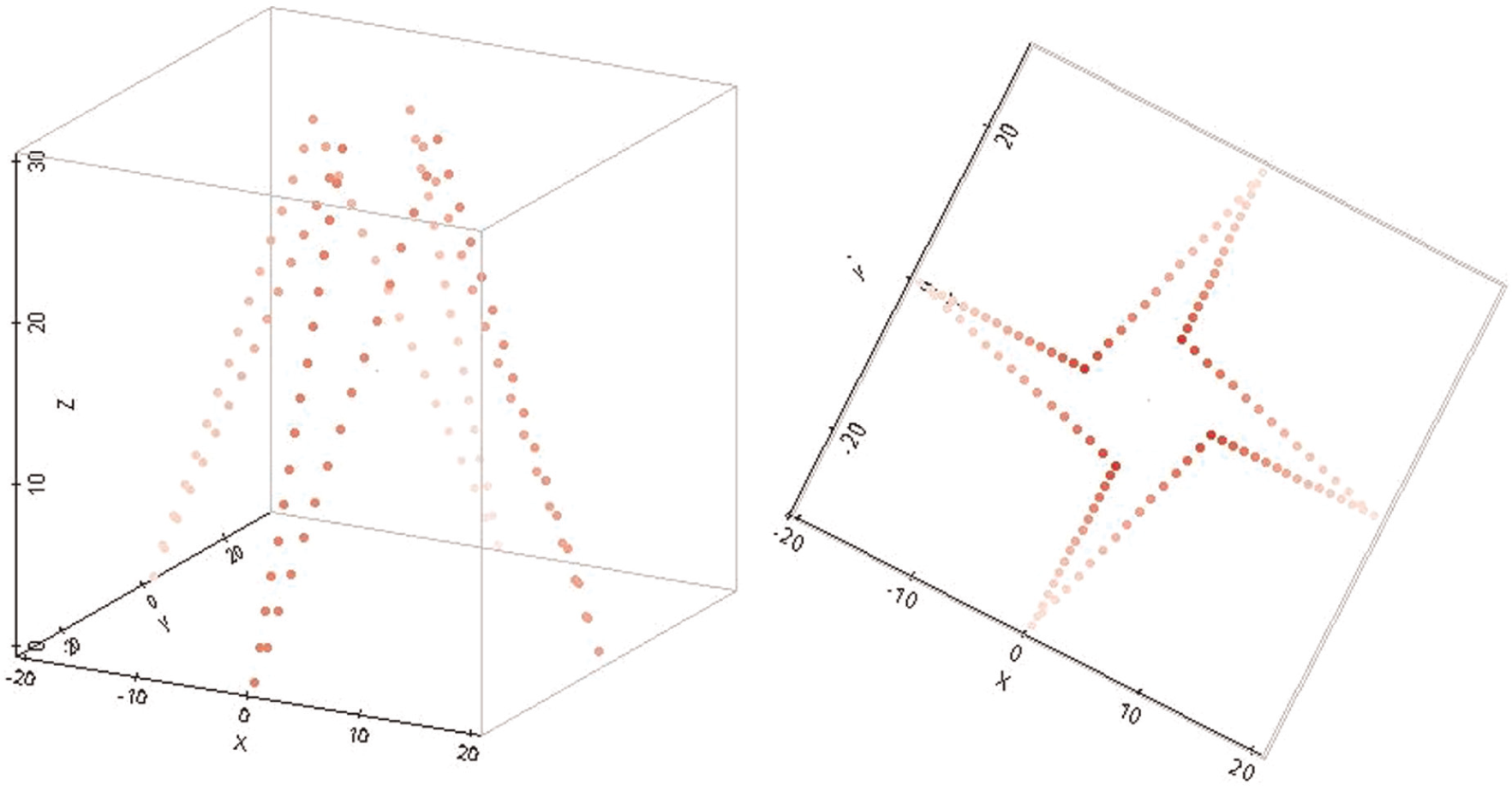
Travel points in additive process planning processes.
The STEP XML Layer uses XML Inferential section. It uses modular Interpretation rules for .txt tab–based data format for the XML batch. It maps the data of product process plan to STEP standard Modular data format. The modular STEP-based product data are formed based on part 28 XML late binding format. Then the STEP XMLized batch is delivered to Modular Interpretation Layer. The Modular Interpretation Layer uses module interpretation rules and maps the STEP XMLized batch to required IRs of the STEP standard which are here the geometry-related resources for travel curve in every height. The additive process plan of the product is now based on the STEP standard and then it is delivered to Store/Receive Layer. Finally, the product data are stored based on STEP standard IRs. The integrity of product design data and additive process planning data is maintained based on STEP standard while the agents used their own data structures and were distributed.
Part additive fabrication
In the last phase, the third agent aims to receive the product design and additive process planning data and generates the related RV-M1 Robot Movemaster program for additive fabrication of product. The third agent uses Mitsubishi Robot Communications® and a self-developed additive software package, as shown in Figure 6. The agent requests the product design and additive process plan data. The CAx Interface Layer uses the related data format channel to receive related data from XML Service Cloud. After verifying the related access issues, the XML Service Cloud uses the XML batch transmitter service to receive the design and additive process planning data from STEP XML Layer. The Modular Interpretation Layer requests the computer-aided Process Planning (CAPP)/CAM product data from Store/Retrieve Layer. The Product data in IRs of STEP standard format are retrieved from platform database. The product CAPP/CAM data are delivered to Modular Interpretation Layer. The Modular Interpretation Layer uses the Module Interpretation rules and delivers the design and additive process plan data in the format of STEP standard Modules. These product data modules are delivered to STEP XML Layer. The STEP XML Layer uses part 28 of the STEP standard and forms the CAPP/CAM product data in XML format.
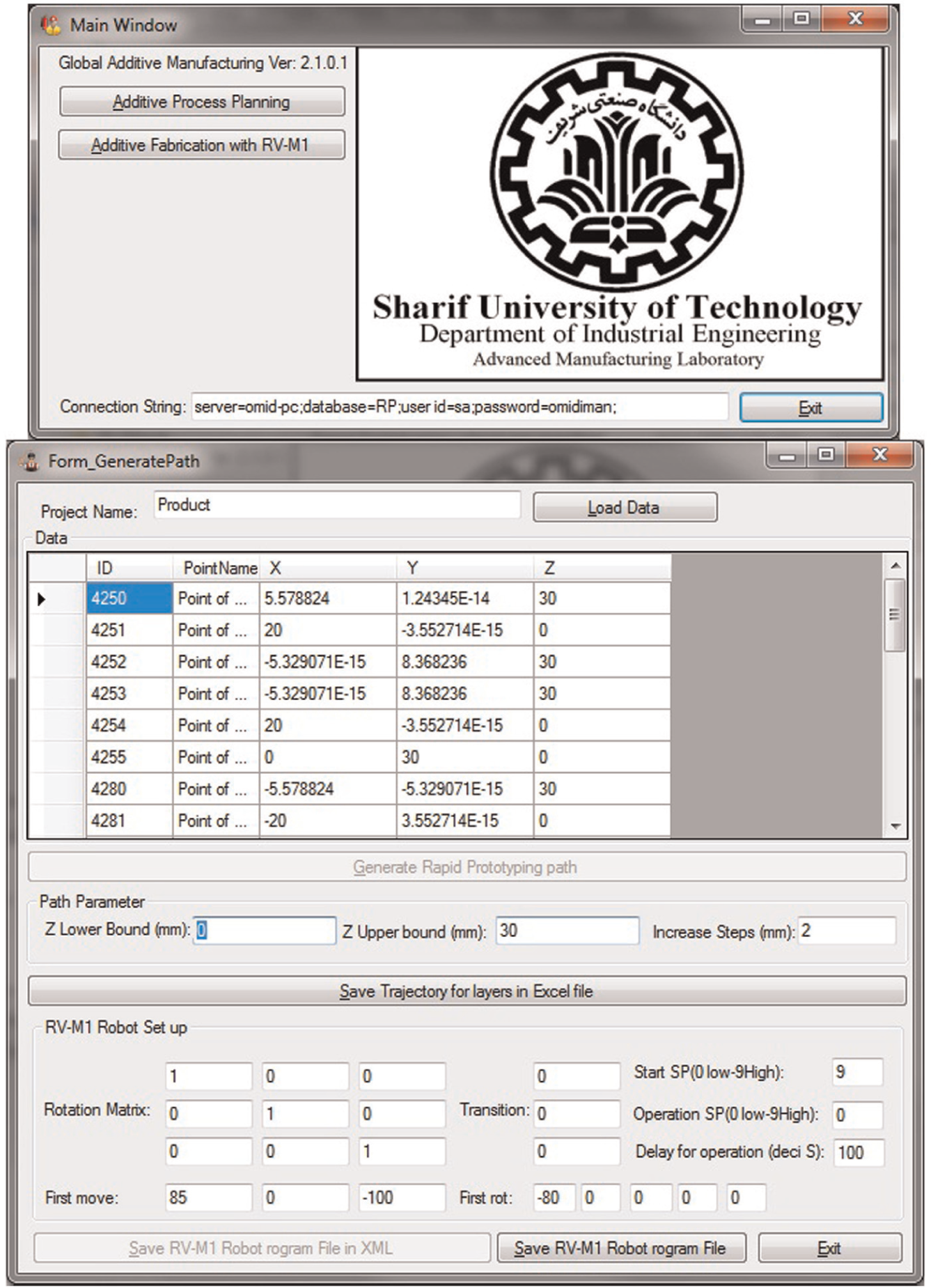
Additive fabrication for RV-M1 Movemaster.
The STEP XML Layer maps the related product data to .requested data format for the third agent using Inferential Rules from XML Inferential section Bin. The result is design and additive process plan data of product in the form of XML data structure. The XML Service Cloud uses the XML batch transmitter and XML Queuing services to retrieve the XMLized data through the XML transmission channel. The product data are then delivered to third agent’s Interface Section through the requested data format channel. The additive fabrication agent’s Interface Layer uses the related format DeXMLizer service and delivers the product data to the third agent.
The third agent receives the product data and starts generating the related program for additive fabrication by RV-M1 Movemaster robot, as shown in Figure 6. The RV-M1 robot is equipped with a self-developed mechanism for resin injection, as shown in Figure 7. After the agent generates the related program of the robot operations, it uses the free .txt format data container definition in the Interface Section. The Interface Section connects to XML Service Cloud and requests for .txt RV-M1 XMLizer Services. The XML Service Cloud uses the related XML security service and verifies the access of the Interface Section to use the .txt RV-M1 XMLizer service. The additive fabrication data of product are formed in an XML batch based on .txt RV-M1 data format, as shown in Appendix 5. The Interface Section then requests for XML transmitter service. The XML Service Hub uses the XML transmitter service and delivers the .txt RV-M1 batch to XML transmission channel. The XML Service Cloud then uses the XML Queuing service to deliver the XML batches to STEP XML Layer.
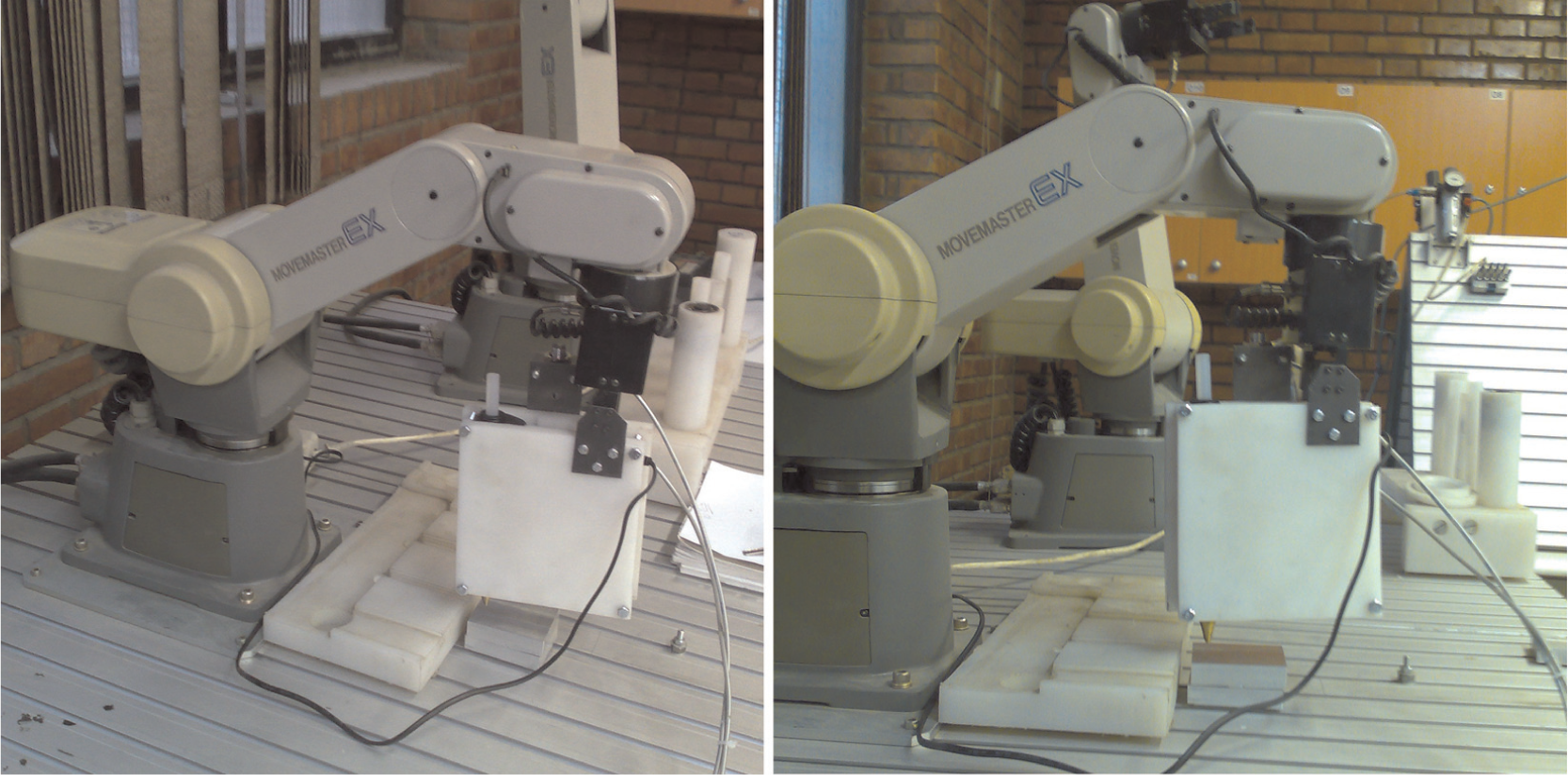
RV-M1 Movemaster robot used for additive fabrication.
The STEP XML Layer uses XML Inferential section. It uses modular Interpretation rules for .txt RV-M1 data format XML batch. It maps the additive fabrication data of product to STEP standard Modular data format. The authors adopted the necessary Application Activity Model (AAM), Module Interpreted Models (MIMs) from ISO/TS 10303-203:2005 edition. The modular STEP-based product data are formed based on part 28 XML late binding format for the product. The STEP XMLized batches are then delivered to Modular Interpretation Layer. The Modular Interpretation Layer uses module interpretation rules and maps the STEP XMLized batch to required IRs of the STEP standard. Since the additive fabricating data are related to travel curves at every heights and delay commands, the late binding rules related to STEP standard application protocol 203 are again used. The product additive fabrication by RV-M1 robot is now based on the STEP standard and then it is delivered to Store/Receive Layer. Finally, the additive fabrication data are sent to platform’s database and are stored based on STEP standard IRs. As considered during the case study, the integrity of the product design, additive process planning and additive fabrication by RV-M1 through the agents’ collaboration is maintained based on STEP standard.
Conclusion
The synergy of fundamental factors like changes in governmental policies, global expansions of the manufacturing industries and improvements in technology related to reliability of manufacturing information flow has created the global manufacturing revolution in the first years of the 21st century. Considering the requirements and necessities of global manufacturing paradigm, new methods and manufacturing technology have been introduced in recent years. Additive manufacturing has been identified as an innovative manufacturing technology in recent years. The characteristics of this manufacturing technology, especially its support for quick design to manufacturing, have dominated it as an efficient generation of manufacturing techniques for today’s global manufacturing paradigm. Considering its novelty and developing concepts, additive manufacturing technology will face with challenges due to the global manufacturing necessities and requirements. In this article, the principal requirements and necessities of additive manufacturing from a global paradigm are outlined. This article considers two major requirements for globalized perspective of additive manufacturing paradigm:
Integration of manufacturing operations;
Enabling collaboration in distributed manufacturing networks.
Considering these requirements, this article has proposed the idea of Cloud manufacturing as an enabler for globalized perspective of additive manufacturing. This idea forms an integrated and collaborative platform for distributed additive manufacturing systems. This article has discussed the aforementioned requirements’ fulfillment through a comprehensive case study using the recent researches of the authors for Cloud manufacturing solution. For further researches, this article strongly recommends the discussions for integration of a wide range of additive fabrications such as stereolithography apparatus (SLA), 3D printing (3-DP), fused deposition modeling (FDM), selective laser sintering or selective laser melting (SLS/SLM) and laminated object manufacturing (LOM) operations based on the Cloud manufacturing. Moreover, considering that additive manufacturing paradigm is a developing technology, discussion of new computer-aided processes in additive manufacturing chain and the role of the Cloud manufacturing–based platforms to support it can be of much interest.
Footnotes
Appendix 1
Appendix 2
Appendix 3
Appendix 4
Appendix 5
Declaration of conflicting interests
The authors declare that there is no conflict of interest.
Funding
This research received no specific grant from any funding agency in the public, commercial, or not-for-profit sectors.