




Abstract
In the modern global economy, the product-service system strategy is increasingly popular with manufacturers. However, to the best of our knowledge, the publication focusing on the supply chain model for product-service system is still scant. Based on the findings of a half-year investigation in an air compressor manufacturer in China, the article is trying to develop a comprehensive framework of supply chain for product-service system. By exploring the structure and the unique features of the supply chain for product-service system, the research leads to a better understanding of the subject. Following the analysis, the supply chain model for product-service system is developed and elaborated in the value co-creation, functional process management, and the enabling process management. It is hoped that the exploration will form the frontier basis for further research on supply chain for product-service system.
Keywords
Introduction
One of the dominant trends in manufacturing industry is that the manufacturers are trying to extend the value chain and transform themselves from manufacturing and goods-oriented organizations into service-oriented organizations.1,2 In order to keep up with the trend, the product-service system (PSS) strategy is increasingly popular with manufacturers.3–5 The effective provision of the integrated product-service requires inter-organizational integration through the coordination of manufacturing systems, maintenance systems, spare parts supply systems, and logistics systems.6,7 Enterprises have proclaimed and tried to undergo this transition, but great difficulty was found in reality.4,8 One of the major challenges for the wider implementation of PSS is the lack of adequate support from the service supply chain (SC).6,9 There are huge opportunities for organizations to improve the performance of SC in terms of competitiveness and profitability.6,10
Although the attention has been drawn to the service SC in the literature, it mainly focuses on intangible service, such as medical services 11 and financial services. 12 Due to the new features of the SC for PSS, 13 the existing service SC models are unable to direct the SC effectively. To the best of our knowledge, the publication focusing the SC model for PSS is still absent. The research is motivated by a case study and seeks to fill the gap by developing a comprehensive framework of SC for PSS.
The remainder of this article proceeds in the following. In section ‘State-of-art review’, a brief overview of service SC models is presented. The research method and techniques are introduced in section ‘Research method’. The service SC structure, unique features and the proposed model of SC for PSS are provided in section ‘Research results’. Finally, the article ends with a conclusion of the contribution of this research and suggestions for future study.
State-of-art review
There is a significant body of the literature on the structure of the SC for PSS, but with no consensus on the role of the members and the relationships among them. Salminen and Kalliokoski 8 pointed out that there are five members in the service SC: machine supplier, solution provider, maintenance partner, performance partner, and value partner. Baines et al. 6 indicated that the main actors in PSS delivery were the customer (user), original equipment manufacturer, and their partners. Meier and Völker 14 claimed that the industrial product-service system (IPS2) network organization consisted of customers, IPS2 providers, IPS2 module suppliers, component suppliers, and the service suppliers. Moreover, Meier et al. 15 enriched the view and classified the main stakeholders into four groups: the customer, the original equipment manufacturer, the supplier, and the society with regard to sustainable and ecological solutions.
A framework that links the elements into a unified structure is for evaluating and improving SC performance. A few of service SC models were developed with different applications in the literature. Ellram et al. 16 provided a service SC model by analysing the applicability of the three product-oriented SC models in service SC: global SC forum framework, 17 supply chain operations reference (SCOR) model, 18 and Hewlett-Packard (HP) model. 19 Following the structure of the SCOR model, Barnard 12 established the service supply chain operations reference (S2COR) model. Legnani et al. 20 compared the SC models from the perspective of service and presented a reference model for after-sales service process management (A/S model). Baltacioglu et al. 21 extended the research of Ellram et al. 16 and developed the IUE-SSC model by bringing in the order process management, service performance management, and the capacity and resource management. In addition, as the flexible application of the SCOR model, the customer chain operations reference (CCOR) model 22 concentrates on customer relationship management and service delivery management. As to the application in SC for PSS, Table 1 reports the strength and weakness aspects of the quoted models.
Strength and weakness of current service SC models.
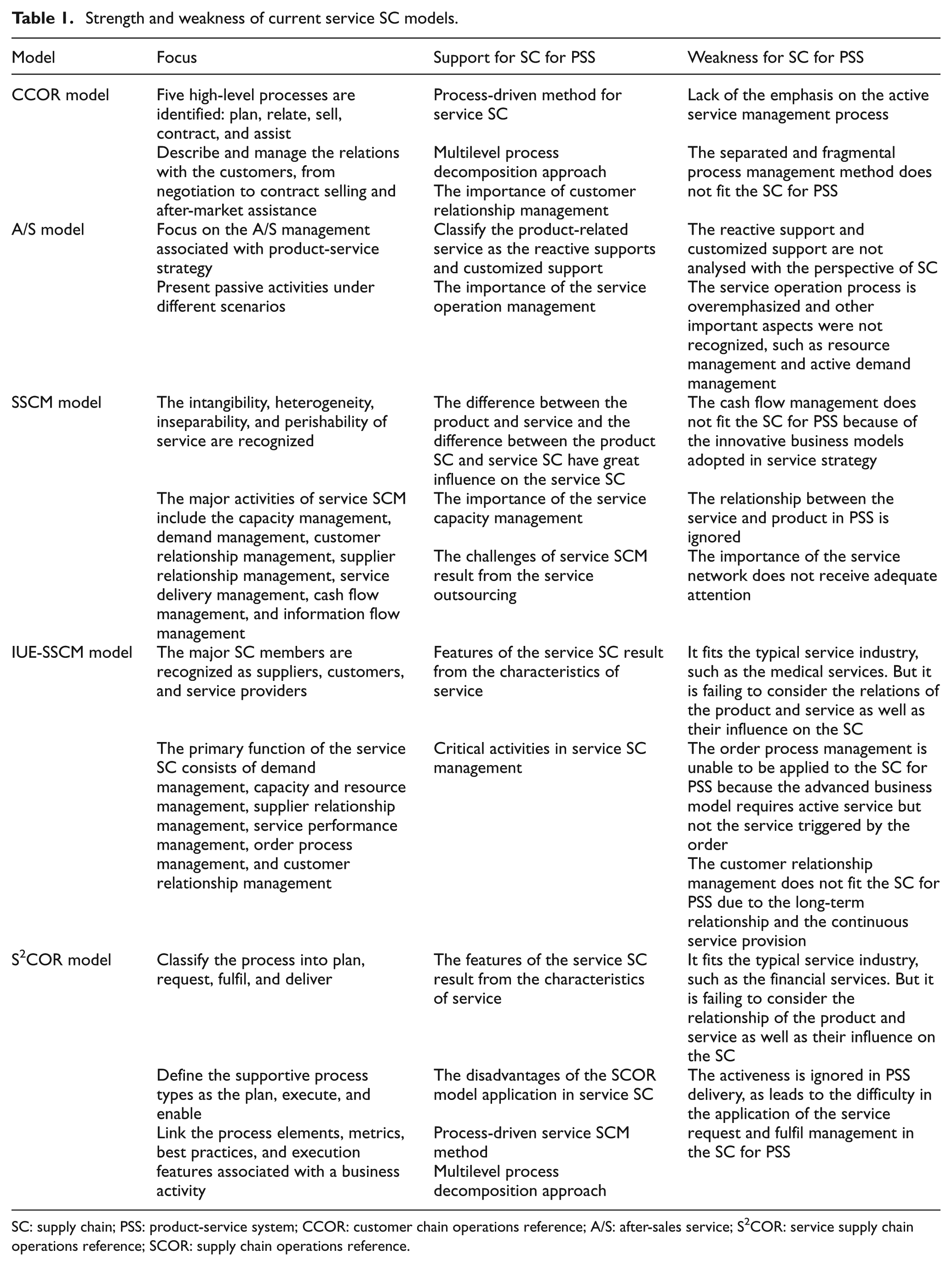
SC: supply chain; PSS: product-service system; CCOR: customer chain operations reference; A/S: after-sales service; S2COR: service supply chain operations reference; SCOR: supply chain operations reference.
Based on the most commonly ascribed characteristics of service, 23 those service SC models focus on the inter-organizational service process management. However, the property of service has been overemphasized and the neglect is the relation of product and service in PSS providing. Although the existing research would benefit the SC for PSS, PSS providing has progressively increased in scale and complexity. 24 The prior SC models cannot guide PSS delivery network operation exactly. A detailed analysis of the SC for PSS structure as well as its features can help managers to apply the established technologies effectively and develop new advanced approaches successfully.
Research method
The research methodology aims to offer answers to the research questions by building up the theoretical ground and providing guidelines for the study. 25 The research method in the investigation is case study with multiple embedded units of analysis. A case study is exploratory in nature, based on interviews and relied heavily on verbal reports and unobtrusive observation as data sources. 26 It contains no greater bias towards verification of the researcher’s preconceived notions than other methods of inquiry. 27 In order to investigate the SC for PSS, the findings are based on a half-year survey conducted in company IR, who is one of the largest air compressor manufacturers in the world and is undergoing the transition from the equipment manufacturer to be a PSS provider.
Qualitative research method is a systematic and reflective process for development of knowledge that can somehow be contested and shared, implying ambitions of transferability beyond the study setting. 28 It involves the systematic collection, organization, and interpretation of textual material derived from talk or observation. 29 With the approach suggested by George and Bennett, 30 three phases are emphasized in the research: designing the case study, carrying out the case study, and drawing the findings and implications. In the first phase, the structure and features of SC for PSS are analysed. The issue is formulated as a service SC problem instead of a simple service delivery problem. The main purpose of the research is to explore how to manage the SC for PSS more effectively and efficiently. The adopted research technique includes the literature review, documentary analysis, and interviews.
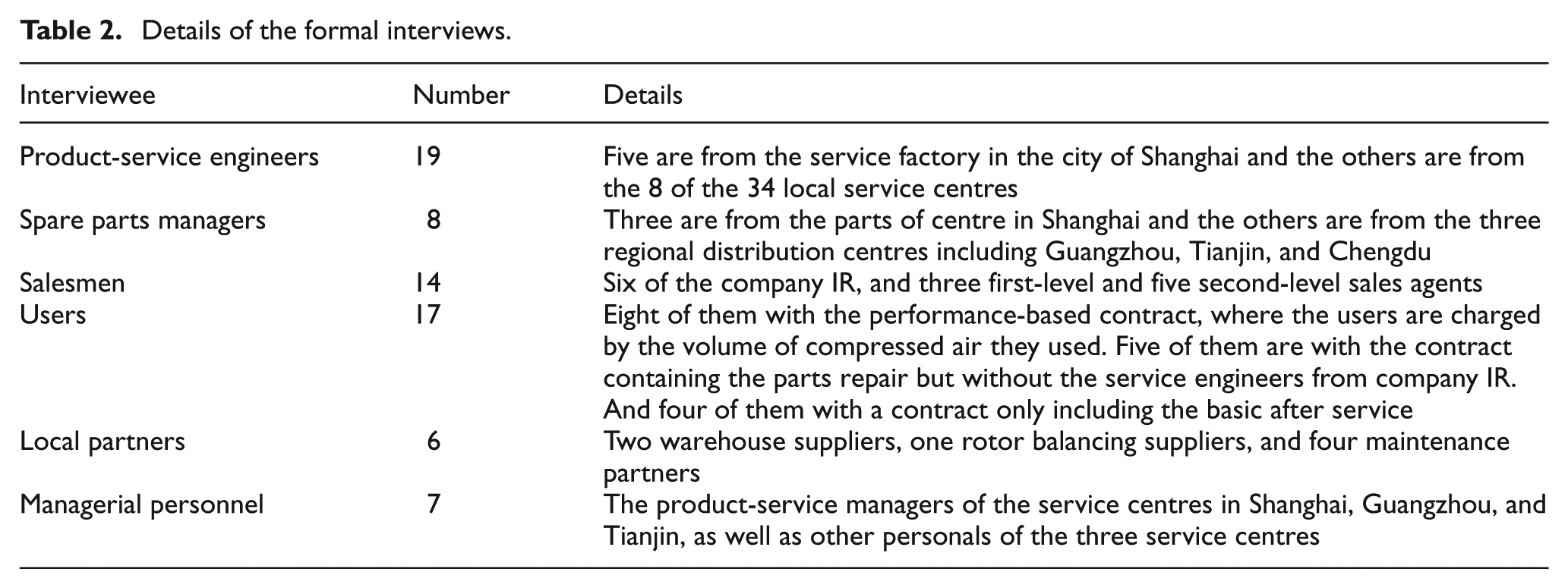
In the second phase, the data collection and preliminary analysis proceed simultaneously because the ongoing findings affect what types of data are collected and how they are collected. 31 First, the research benefits from considerable literature review, some of which give a better understanding of the service SC and make a great contribution to the SC model for PSS. Second, as a nonstructured method, narrative interviews offer interviewees an opportunity to assume an active role in which interviewees not only provide the interviewer with answers but also decide on the topics they would like to discuss. 32 The interviews focus on how to provide product-related service more effectively. The formal interviewees cover the service engineers, spare parts managers, salesmen, users, local service providers, and other managerial personnel, as shown in Table 2. The valuable suggestions for improving the SC also are obtained from more than 150 h interviews.
Details of the formal interviews.
Finally, documentary analysis is borrowed to evaluate the performance of the service SC. The documents are collected mainly from the major service centre in China and three local service centres from November 2009 to December 2012. Relevant documents include contracts, reports, records on customer satisfaction and service cost, as well as other vital materials. Moreover, the research benefits from sharing the innovative service ideas with the top managers and the PSS designers.
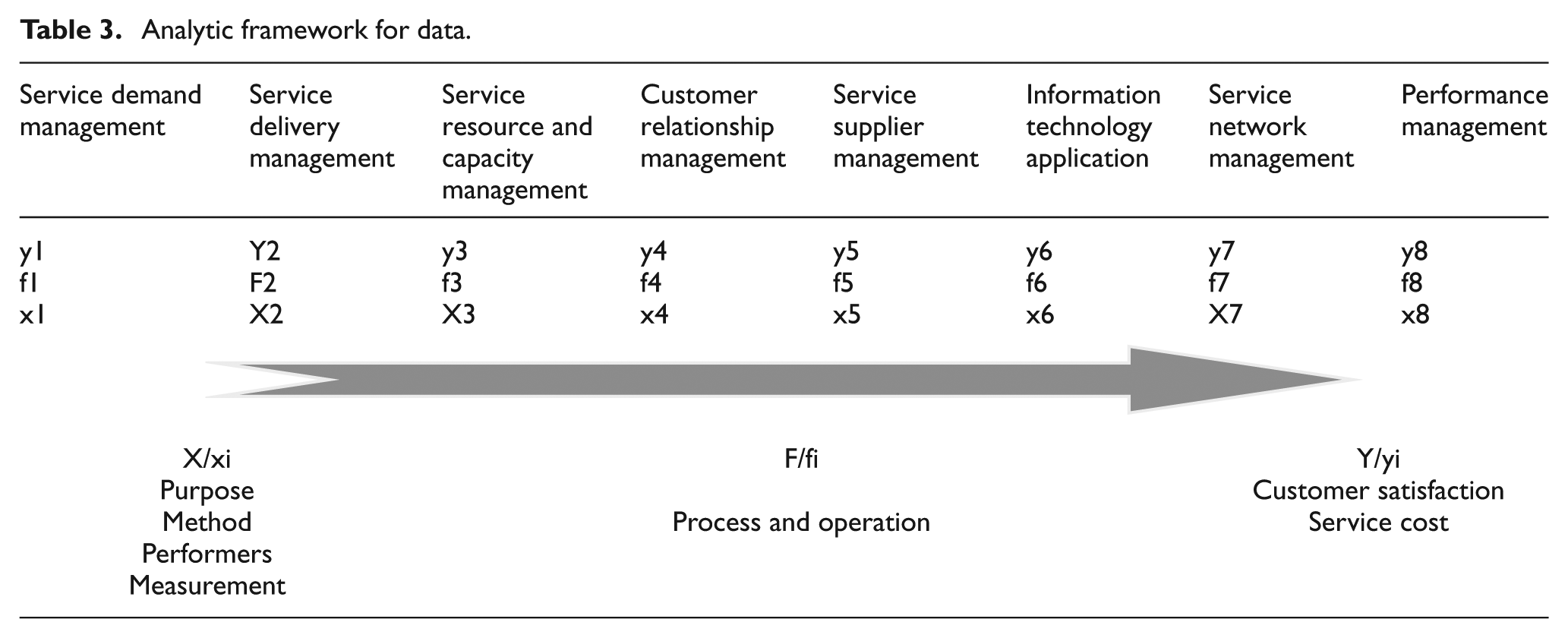
In the third phase, the qualitative data are analysed and the SC model for PSS is developed. In order to uncover the critical activities of the SC and their relations, an analytic framework is adopted for data analysis (Table 3). The analytic framework is described as the process function

Y/yi and X/xi are the output and the input of a process. F/fi is the operation.
Analytic framework for data.
Research results
Structure of SC for PSS
Prior to proceeding with the development of SC framework, it is necessary to identify the role of the SC members and the deliverables of the service providers. It is known that the tangible product and intangible service are integrated together in design and development of PSS.4,33 But it is not enough to understand and manage the PSS delivery because the two parts can be separated or combined freely. In a general sense, the deliverables can be classified into three groups. The first is physical unit, such as spare part, detecting device, and tools. The second is the service unit, such as training, consultancy, technical support, detection, logistics, and stock. While the third is the combination of physical unit and service unit, like providing installation service for free when selling spare parts. In order to avoid any misunderstanding, if there is no specification, the word ‘service’ refers to all the three deliverables in the following part of this article.
The network for PSS delivery consists of customers, main provider, other providers, and the suppliers. The SC structure is drawn up in Figure 1 to illustrate the role of the members. One of the distinguishing features of the SC for PSS is the flat structure, which determines that all the partners have the chance to provide service to customers directly.
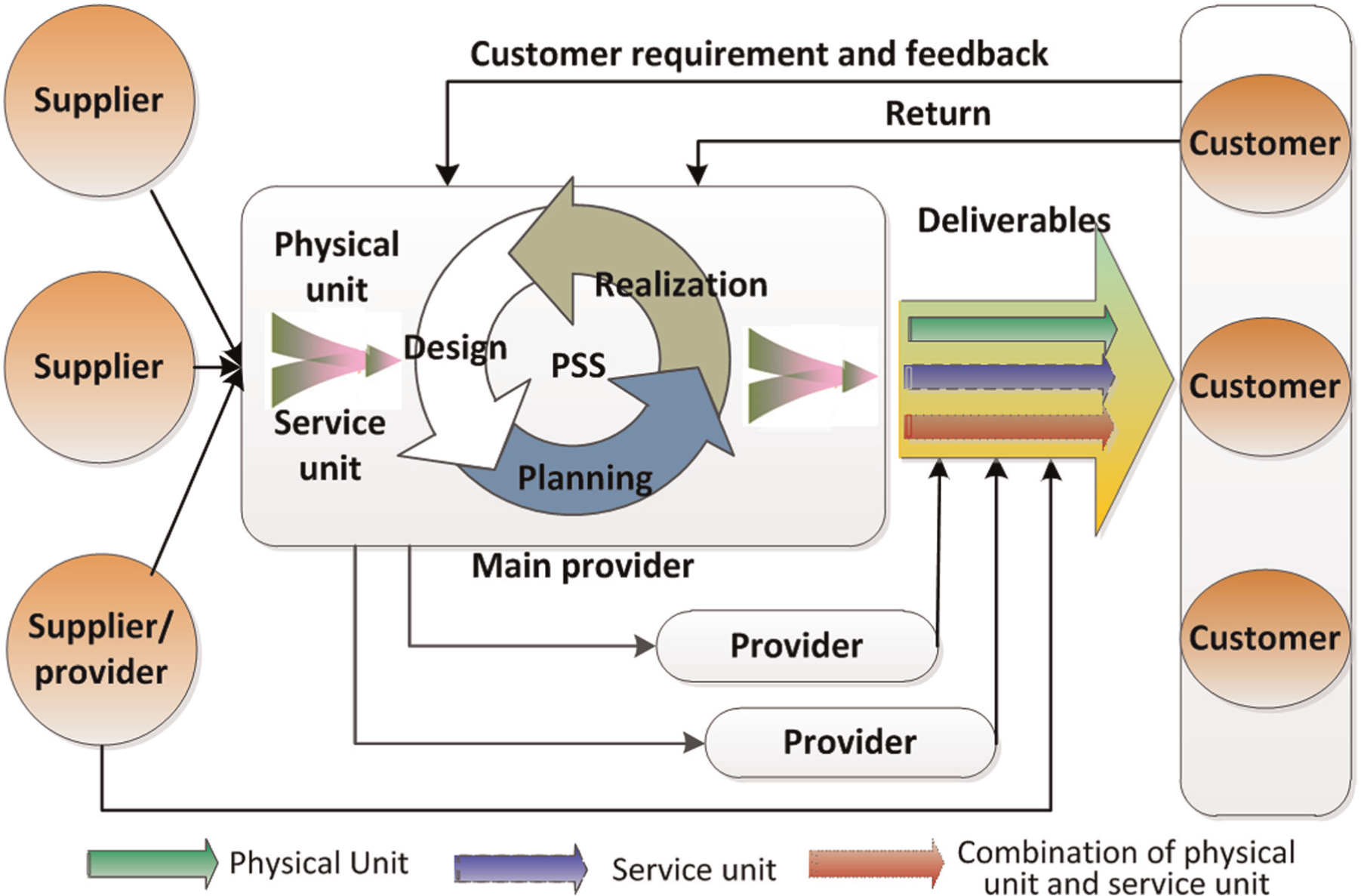
Structure of supply chain for PSS.
The customer is the receiver of the PSS in the first layer, who pays for the service and helps to realize its value. The customers not only include the end users but also the product owners. An example is the energy saving service provided by Siemens Group, which provides the energy saving equipment to energy saving company, which in turn provides its service to factory or community. Therefore, the customers of Siemens Group include the energy saving company, factory, and community. The customers cooperate with other units on training, information sharing, and other aspects, and they play an active role in the complicated process of PSS delivery, not just a passive receiver.
The second layer of the SC is the providers who offer service directly to customers. The main provider is the product manufacturer and the PSS designer as well as the solution developer. The customer’s requirement and feedback are gained, which applied to the life cycle management of PSS for continuous improvement, while other providers undertake the service outsourced by the main provider, such as warehouse service, logistics service, technical support, and other supporting activities.
The third layer is the supplier who is involved in the PSS development and offers support to provider. Some of the suppliers provide support directly to customers, and then they are changed to be providers. As an example, the GE Aviation sells the aircraft engines to aircraft manufacturers and renders innovative service to the airlines. The GE Aviation acts as both supplier and service provider in air service delivery.
Features of SC for PSS
As a new concept involving innovative business models, 14 PSS poses a profound impact on the service delivery network. A thorough investigation on the features of SC for PSS is helpful to provide service efficiently and effectively. The prominent features can be summarized as follows:
Value co-creation. A PSS is a solution for customers on the basis that the value propositions of customers, providers, suppliers, and other stakeholders are identified and realized. The value chain would be reconfigured and clearer under new business models. Value co-creation requires that the benefits and risks should be shared between the service SC members.
Activeness. The customer value creation is more active rather than responsive. That means the service is provided actively not driven by purchase order, which benefits both the customers and providers. In the second layer, the customers participate in the supply chain management (SCM) actively. For instance, the supplier selection for the outsourced service is subject to the customers.
Uncertainty. SC for PSS involves managing resource availability, capacity and capability along the service network. 34 The reason resulted in uncertainty includes the following: (1) the interaction between the providers and the customers in a variety of ways, (2) the service complexity and the delivery urgency, 34 (3) the service resource availability due to the perishability of service, and (4) the customer’s participation, as the resource from customers also benefits the service delivery.
Dynamics. The reconfiguration and optimization of value chains lead to changes in SC organization. The dynamic allocation of some service resources also has influence on the service capability of the service network, such as skilled workers and maintenance facilities.
A framework of SC for PSS
Suggested SC model for PSS
Although the literature describes the SC for PSS in different aspects,6,13,34,35 a comprehensive definition of the subject is still missing. This article primarily proposes:
With the purpose of offering productivity to customers, the SC for PSS is a network, which consists of manufacturers, service providers, customers, and other supporting units. It performs the functions of service demand forecast, service resource allocation, and service delivery management, as well as supportive activity management.
Following the structure and features discussed above, a framework is developed and used as a lens for the analysis of the SC for PSS (see Figure 2). According to whether a process is involved in direct service providing, the process can be classified into two groups: the functional process and the enabling process. The functional process is closely associated with the customer’s and other stakeholders’ value realization and it includes the demand management, service resource and capacity management, and the service delivery management. Aiming to offer the managerial and technological support for other activities, the enabling process covers the performance management, customer relationship management, service provider and supplier relationship management, information technology application management, and the service network management.
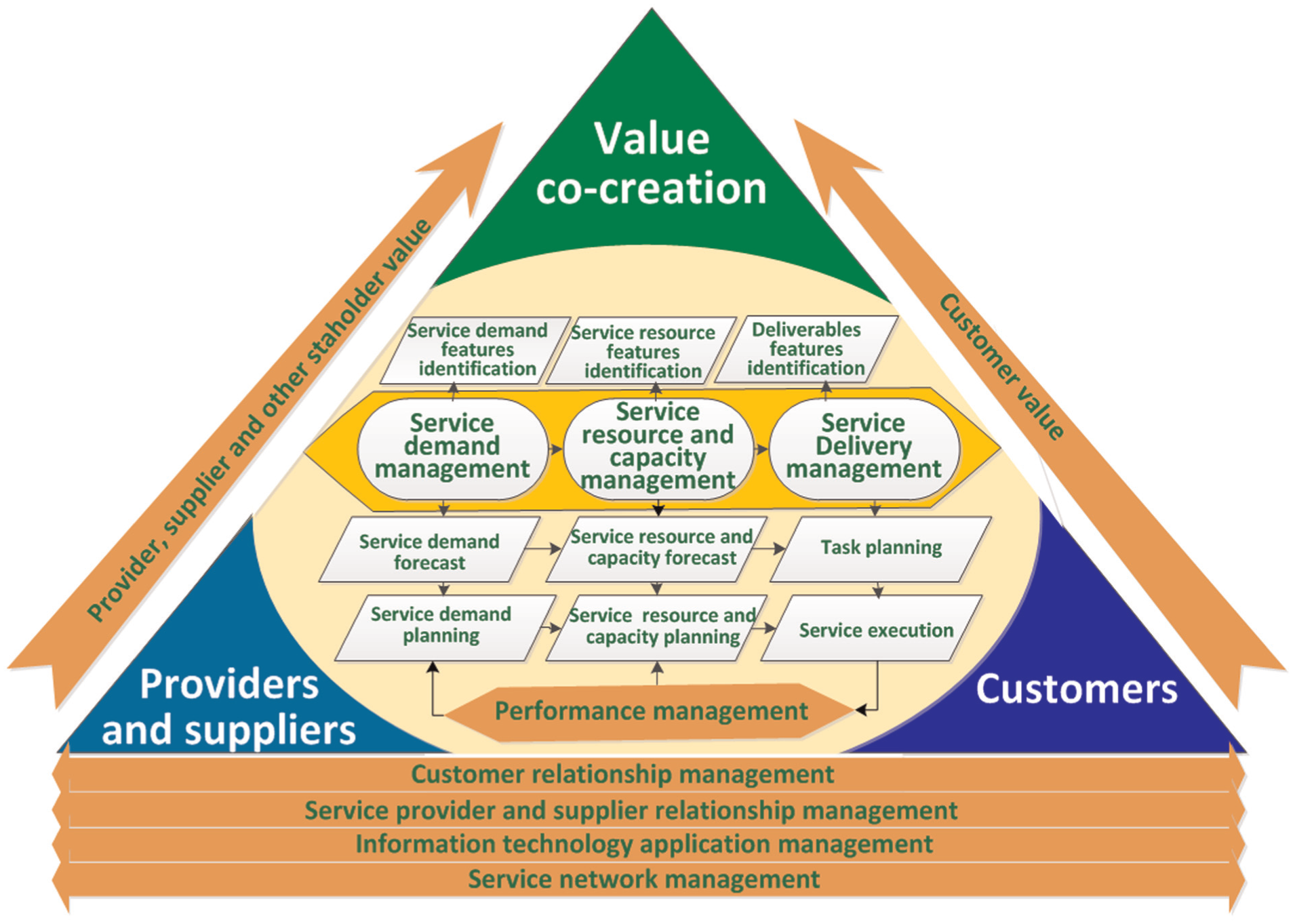
Suggested supply chain model for PSS.
Value co-creation
The motivation of the SC for PSS has changed to the new customer value instead of customer demand. 21 Porter and Millar 36 define the customer value as a product or service that the customers are willing to pay for. The definition forms the foundation of evaluating whether or not a service SC activity is value-added. For example, the customer value in company IR is recognized as compressed air. That means the service providers and other partners are dedicated to provide the compressed air but not repair or any other activities. In this case, repair is not a value-added activity.
Service-oriented SC is a value co-creation network. 37 It reveals that the locus of value creation is no longer perceived to reside within firm boundaries, but value is co-created with its customers, suppliers, and partners.38–40 Value co-creation also requires that the value proposition of other stakeholders is recognized, understood, and fulfilled. Therefore, value co-creation depends on adopting the new business models and sharing innovative service concept with all the SC members, such as selling the compressed air instead of the equipment or spare parts in company IR. Once a customer is charged by the volume of the compressed air they used, to keep the equipment in good condition is the goal of all the SC members. The interests of the suppliers, providers, and customers no longer conflict with each other and the value co-creation is applicable.
Functional process management
Demand management is to understand and react to current and potential customer demand. 11 As mentioned above, the product-related service is provided actively but not just responded to failures, which mean that service providers should make full preparation for service provision beforehand rather than afterwards. Because keeping the service available at any moment is in the interests of both the providers and the customers. For example, any delay in replacing the broken part would cause extra expenses for both the providers and the customers. Therefore, accurate demand forecasting is incredibly important for preparing and optimizing service resource. 41 However, compared with the pure service or product providing, the deliverables under PSS strategy are diverse and also interact with each other. Like the above-mentioned example, spare parts demand is influenced by the number of the equipment running in the market and their life cycle stages. Therefore, service demand feature identification is the first step of demand management, which is to distinguish the deliverables for a better understanding and more accurate forecasting of the customer demands. Following the service demand forecasting, the service demand planning indicates the requirement of deliverables on strategic, tactical, and operational plans.
The purpose of service resource and capacity management is to balance customer needs and service capacity. Due to the perishability of service, service resource management plays the role of the buffer. Generally speaking, the service resources can be sorted as material resource (e.g. spare parts, tools and material), human resource (experts, technicians, installation staff, etc.), information resource (e.g. schedule information, equipment status information, and logistic information), knowledge resource (e.g. technology and experience), and other resources. Therefore, it is necessary to identify their unique features of first for planning the engineers, tools, and other service resources. And then, since the deliverables determine the requirement of the service resource, the quantity of necessary resources can be forecasted in different time horizons. Finally, service resource planning is carried out to arrange different resources in the right time and right place, which is essential to form service capability. 13 A case in point is the major repair for air compressor in company IR; only the special tools, experienced engineers, and other necessary resources are available at the same time that the service could be provided. Effective and profitable PSS depends on managing service assets and fulfilling service demands in a flexible and integrated manner. 42 Furthermore, service outsourcing is a way of extending the service capacity of the main provider.
Service delivery is a provider’s and customer’s involvement process fulfilling the commitments to customers. 43 The service delivery may involve more than one provider and customer simultaneously. The way of service delivery is one of the important features of the deliverables. It includes on-site delivery, like air compressor installation; online delivery, for example, remote technological training; offline delivery (delivered by service factory), such as air compressor cleaning and upgrading. Therefore, feature identification of the deliverables is the first step for any customer satisfaction. Even for the air compressor overhaul, there are options for repairing the product in customer’s company or transferring to the service factory. However, the customer’s participation increases the uncertainty of the service delivery, especially for the outsourced service. Task planning and service execution management are vital measures to ensure a high level of customer satisfaction. The application of the modular technique in PSS development and standardization of SC process management would reduce the risk of service quality. 33 In company IR, the SC processes are defined as the standardized and semi-standardized service process, which outlines the customized service delivery process. Whether the service is provided by the main provider or not, the service quality is controllable via monitoring the SC process.
Enabling process management
The customer is no longer regarded as a passive transaction-oriented actor but rather an active relationship-oriented actor with a long-term perspective in the interaction. 44 Customer relationship management is concerned with the development of profitable, long-term relationships with customers and other key stakeholders. 45 The PSS calls for developing the new relationship with customers characterized by risk sharing and value co-creation. Identifying the customer value and building trust are the key steps in customer relationship management. Therefore, it would be reasonable to assort the customers in light of their value propositions. In company IR, the customers are classified according to customer value: the compressed air, the function of the air compressor, and the air compressor. It is evident that the customers requiring the compressed air have tight connections with the service providers. With regard to this kind of customers, the emphasis of customer relationship management is not only the product life cycle management but also the customer life cycle management, which covers the stages from the service relationship establishment to the time when the customer would not need the service or turns to other service providers. Moreover, with effective customer interaction, the providers can find out more potential needs of customers and present more innovative services. A case in point is the innovation of a handheld terminal of the air compressor. Although there is no complaint about the functions of the controller, company IR redesigned the handheld terminal and replaced the former considering the operation comfort ability, which is part of the customer value propositions. It not only improves customer satisfaction but also wins their trust.
As mentioned earlier, providers contribute to service delivery and contact with customers directly. Suppliers are indirect supporters and contribute to the SC by sharing their technologies, expertise, and other useful resource. Supplier relationship management involves setting up, developing, stabilizing, and dissolving relationships with suppliers. 46 The purpose of service provider and supplier relationship management is to share the information, technologies, tools, and other necessary service resources freely, as well as the benefit and risk. The identification of the partners’ value proposition would be helpful to build long-term mutual confidence and deepen the cooperation. On one hand, appropriate selection and evaluation approaches promise the performance of the partners. On the other hand, the performance of the suppliers and providers could be monitored and assessed by the feedback from customers.
The service SC depends on the information being shared efficiently. 21 Decreasing the service cost and improving the service response time are the primary drivers for information technology (IT) application in service delivery, such as the remote diagnosis and maintenance, online training. On one hand, IT has proved to be an effective tool for service SCM, such as the demand forecast and logistics management.16,21 On the other hand, it facilitates the service providing and enhances the transparency of the service delivery process. The remote monitoring system, diagnoses, and self-protection system, and the expert decision support system are widely used in company IR. Furthermore, it provides a useful tool for several providers offering service cooperatively and timely, especially when dealing with the thorny problems in the emergency.
The contradiction between the geographically distributed customers and the limited service resource is one of the main challenges in SC for PSS. An appropriate service network would decrease the service cost and improve customer service significantly. Service network consists of various terminal service facilities, such as the service centres, spare parts warehouse, and the service stations of partners. As for the main providers, service facilities may be self-built, partner-owned, or distributor-owned. In company IR, the distributors also perform the function of providing common spare parts to customers. The service network management covers the network design, service facility location selection, service facility function, and capacity design, as well as the forward and reverse logistics management.
Performance management has a profound influence on the improvement of customer satisfaction and the behaviour of SC members. Appropriate performance metrics and measurement can help to implement the principle of value co-creation and achieve the strategic objectives of the SC. Since the PSS is realized in the extended value creation network, the performance evaluation should consider the value propositions of all stakeholders. 33 Performance management can be conducted at two levels: the service delivery level and the service SC level. In the service delivery level, the customer value and customer satisfaction are the core criterion for evaluating the efforts of the providers. In the service SC level, the customer satisfaction and the service cost are equally important considering the value proposition of all the stakeholders. But the interval of the latter is much longer than the former.
Advantages of the SC model for PSS
Following the service SC models in the literature, the proposed SC model for PSS retains the merits of the service SC models and extends the implication of them as well. On one hand, the existing SC models benefit the proposed model in understanding the SC for PSS and identifying the crucial activities for PSS in SCM. First, the importance of the customer relationship management is recognized and elaborated in the proposed model, which was emphasized in all the models except the S2COR model; second, the service operation management interpreted as service delivery management, which is mentioned in A/S model, also works in SC for PSS. Finally, the explanation of the critical activities in service supply chain management (SSCM) model and IUE-SSCM model also benefits the new model development. Furthermore, following the structure of SSCM model and IUE-SSCM model, the article presents a new model.
On the other hand, considering the distinctive structure and unique features of SC for PSS, the new meanings are added to the SC activities by investigating the service SC in detail in the case study company. Comparing with the solutions mentioned in the literature (Table 4), the suggested model is more reasonable and applicable for SC for PSS. The CCOR model, A/S model, and S2COR model inherit the form of SCOR, but neglect the difference between intangible service and tangible product. The SSCM model and IUE-SSCM model pay particular attention to the intangible service; however, the information technology application management and the service network management are not taken into consideration in elaborating the crucial activities of the models. Failing to recognize the importance of the tangible product delivery as well as the role of service resource is the main reason. Furthermore, one of the prominent phenomena is that little attention has been paid to the significance of the value co-creation in SC. The customer value and value co-creation are overlooked in existing models.
Comparison between the proposed model and exiting ones.
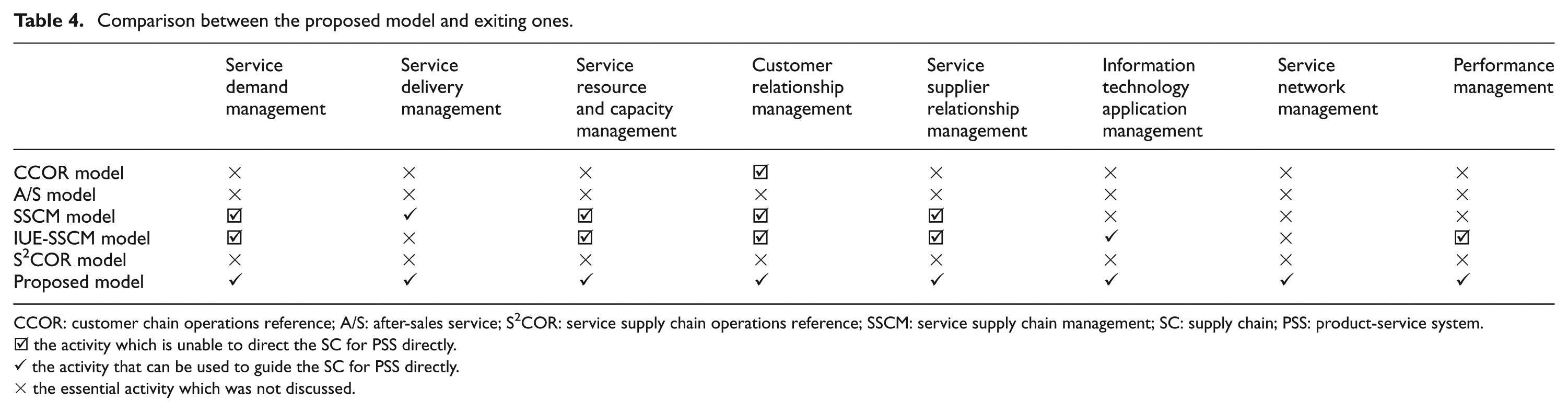
CCOR: customer chain operations reference; A/S: after-sales service; S2COR: service supply chain operations reference; SSCM: service supply chain management; SC: supply chain; PSS: product-service system.
the activity which is unable to direct the SC for PSS directly.
the activity that can be used to guide the SC for PSS directly.
the essential activity which was not discussed.
In particular, the new model enriches the implication of service demand management through identifying the customer value and distinguishing the different deliverables. As for the service resource and capacity management, the proposed model shows advantages in pointing out the type of the service resources and its buffering action. In CCOR model, customer relationship management is discussed, but the way to classify the customers is missing. In IUE-SSCM model and SSCM model, the activity is mentioned as well; unfortunately, assorting customers under PSS strategy by their importance is not a reasonable approach for customer management. Therefore, the article claims that it would be reasonable to assort the customers in light of their value propositions, which was justified in the case study. The research distinguishes the roles of providers and suppliers in service supplier relationship management. With regard to the performance management, it is helpful to improve customer satisfaction and reduce service cost simultaneously by carrying out the performance evaluation on service delivery management and service SCM separately. Furthermore, the function and components of the service network are explored, which were not paid adequate attention in prior models.
Conclusion and future perspective
PSS has been acknowledged as one of the most encouraging and promising industrial applications aiming for profit and competitive advantages in manufacturing industries. However, to the best of our knowledge, no effort has been made to explore the SC model for PSS. With a case study method, the article offers a new perspective to the service SC for PSS by investigating its structure, unique features, and the SC model.
The extensive analysis reveals that the existing service SC models are unable to guild the SC for PSS directly. In order to have a better understanding of the SC for PSS, the members, their roles, as well as the deliverables in the SC are identified and explained first. And then, four features of the SC for PSS are pointed out: value co-creation, activeness, uncertainty, and dynamics, which form the basis for an effective SCM for PSS. Furthermore, this article enriches the existing theory by developing a framework of SC for PSS covering three basic elements: the value co-creation, functional process management, and the enabling process management.
It is promised that the scholars and practitioners would yield valuable insights into the comprehensive literature review and in-depth study of the SC for PSS. However, the research is just only one step in the lengthy exploration. In this research, the product in the PSS refers to the complex industrial equipment instead of the consumer goods, such as mobile. The precondition would bring difficulty to the wide application of the proposed model. In terms of future research, on one hand, the proposed framework has to be tested and enriched by practice for further improvement. On the other hand, the enabling process decomposition would be helpful to investigate the relations among the elements of the SC for PSS and provide guidelines to improve the SCM for PSS. The process decomposition approach borrowed in the S2COR model and the SCOR model also provides a valuable reference to the work in the future research. Finally, it would also be interesting to perfect the presented model to guide the SC for PSS-relevant consumer goods.
Footnotes
Declaration of conflicting interests
The authors declare that there is no conflict of interest.
Funding
This research was supported by the Shanghai Research Centre for Industrial Informatics and Shanghai Key Lab of Advanced Manufacturing Environment.